Archive for October 2015

PA, Jordan to tell Kerry they want Muslim control over Jewish visits to Temple Mount

October 23, 2015

PA, Jordan to tell Kerry they want Muslim control over Jewish visits to Temple Mount Abbas and King Abdullah to present demand in upcoming talks with secretary in Amman, say restoring authority to Waqf would calm tensions

By Avi Issacharoff

October 23, 2015, 2:35 pm

Source: PA, Jordan to tell Kerry they want Muslim control over Jewish visits to Temple Mount | The Times of Israel

Won’t happen !

US Secretary of State John Kerry (left) meets with Palestinian Authority President Mahmoud Abbas in Amman on November 13, 2014. (AFP/Nicholas Kamm/Pool)

US Secretary of State John Kerry (left) meets with Palestinian Authority President Mahmoud Abbas in Amman on November 13, 2014. (AFP/Nicholas Kamm/Pool)


Jordan and the Palestinian Authority are expected to demand from the US that control over Jewish visits to the Temple Mount in Jerusalem be restored to the Muslim authority that administers the site, Palestinian sources say.

PA President Mahmoud Abbas and Jordan’s King Abdullah II were to raise the issue with Secretary of State John Kerry, who is in the region this weekend, the sources said.

Amman and the PA are seeking to return the running of the Temple Mount — the holiest site in Judaism and third-holiest in Islam — to how it was before the start of the intifada in September 2000, and before the visit of then-opposition Likud leader Ariel Sharon, when the Waqf was responsible for Jewish visitors’ access to the site.

The Jerusalem Islamic Waqf, controlled by Jordan, administers the Islamic sites at the compound, including the Al-Aqsa Mosque and the Dome of the Rock. Sharon’s visit is often said to have been the pretext for the Second Intifada, which broke out just a few weeks later and which saw hundreds of Palestinian suicide bombings that claimed the lives of over a thousand Israelis during a span of five years.

Until 2000, the entry of Jewish visitors to the Temple Mount was coordinated with the Waqf. The site was closed to Jews from 2000 until 2003, as the Second Intifada raged. Since then Israel Police have overseen visits by Jewish visitors. Under Israel’s regulations, imposed after the Old City was captured in the 1967 Six-Day War, Jews are allowed to visit, but not pray on, the Temple Mount.

The demand for Muslim oversight on Jewish access to the Temple Mount was first made by the Palestinian Authority on Thursday. “Israel must restore control of the Temple Mount to the Waqf,” said one official close to Abbas. “This is one of the only measures that can help calm the current situation.”

This Thursday, July 28, 2015 photo shows a group of religious Jews escorted by Israeli police at the Temple Mount in Jerusalem. (AP/Mahmoud Illean)

Palestinian sources also told The Times of Israel that Abbas will tell Kerry during their meeting in Amman on Saturday that he is interested in renewing peace talks with Israel and abiding by previous agreements, but that Jerusalem must first freeze all settlement activity and release the final 26 prisoners it had agreed to free last year as part of a US-brokered concession to Abbas.

Israel had agreed to release a total of 104 security prisoners jailed before the 1993 Oslo Accords in four phases. It went through with three of the four releases, setting free some of the worst orchestrators of terrorism, before talks collapsed in April 2014.

Senior Palestinian officials also told The Times of Israel that Israel had tried to create friction between Jordan and the Palestinian Authority by conveying messages to King Abdullah II warning him that Abbas’s inciting statements endangered Jordanian interests on the Temple Mount.

Abbas is expected to demand deeper American involvement in any renewed political process with Israel, and warn that if Prime Minister Benjamin Netanyahu continues with his current policies, he is dooming the region to more violence and bloodshed.

When asked if they understood that meeting their demands would spell the end of the Netanyahu-led government, the sources said the Israeli prime minister must choose between his government and a willingness to make peace.

The PA’s demands for Waqf control of the Temple Mount come amid a wave of Palestinian terror and violence which has seen 10 Israelis killed in the past month and a half. More than 40 Palestinians have also been killed — about half of them while carrying out attacks, and most of the rest in clashes with Israeli security officials in the West Bank and on the Gaza border.

Israel has accused Abbas and the PA of partial responsibility for the terror surge, with Netanyahu repeatedly castigating Abbas for telling “lies” about purported Israeli plans to change the status quo at the Temple Mount and for inciting violence over the issue. Netanyahu, who has denied any such plans and offered to meet Abbas without preconditions, has also vowed to make no concessions to the Palestinians in response to the current surge in terrorism.

The PA officials said that their security forces have prevented a series of recent attacks on Israeli targets, including stabbings, shootings and the planting of explosives. PA security forces have also been active during Palestinian demonstrations to prevent the use of live fire against IDF soldiers, and intervened when a gunman opened fire on soldiers during a recent protest near the Beit El settlement, they said.

Israeli security officials have acknowledged the value of the ongoing PA security coordination.

On Wednesday, the Prime Minister’s Office denied that Israel has offered to reduce the number of Jewish and non-Muslim visitors to the Temple Mount in an effort to calm tensions at the site and help end the wave of terror attacks. Arab diplomatic officials had told The Times of Israel that this offer was rejected by Palestinian and Jordanian leaders as not going far enough to meet their demands.

ISIS Warns Jews in Hebrew, You’re Next to be Slaughtered [video]

October 23, 2015

ISIS Warns Jews in Hebrew, You’re Next to be Slaughtered

By: JNi.Media

Published: October 23rd, 201

Source: The Jewish Press » » ISIS Warns Jews in Hebrew, You’re Next to be Slaughtered

ISIS released a video in Israeli-Arabic-accented Hebrew, ranting and warning the Jews that Islamic State plans to come to Israel to slaughter and eradicate everyone until no Jews are left in Jerusalem, Israel and the world. They would first overrun Jordan, after which they would overrun Israel from every direction.

ISIS has been focusing a lot of attention on Israel lately, and local ISIS affiliated terror cells have been captured by Israeli security forces. A number of Israeli-Arabs have joined ISIS in Syria and Iraq.

This may be the first time that the Islamist organization has spoken directly to Israelis in Hebrew.

The clip shows a masked soldier wearing a uniform, with a rifle and a dagger, who speaks a fairly modern dialect, with an accent that shifts from heavily Arab, with an unusually soft R for an Arab speaker (which could suggest Israeli upbringing). Like most Arabs, he is unable to pronounce the P sound, and so he says Bashut instead of Pashut (simple), and Bachad’tem instead of Pachad’tem (you feared).

At the beginning of the video, he turns to the camera and says, “This is a serious and clear announcement to all the Jews, the first enemy of the Muslims. To all the Jews who conquered our country, the Muslims. The real war has not started yet, and everything you had before is simply called a child’s play compared to that which is going to happen to you in the near future, inshallah (God willing).”

Speaking of the current wave of terror, he expresses the hope that ISIS will arrive and destroy Israel. He promises the annulment of the Sykes-Picot borders, which, in 1916, divided the dying Ottoman between France and Great Britain. He boasts of having already eliminated the Syrian-Iraqi border, and foretells erasing the Syrian-Jordanian border, too—a direct threat against King Abdullah II of Jordan. He then promises removing the Syrian-Palestinian borders, too, which is a curious promise, because that could mean the end of the dream of Palestinian statehood (under Ottoman rule, Palestine was ruled by a governor who sat in Damascus).

He promises to eventually arrive in Israel to destroy it, to avenge its “crimes,” telling Israelis: “Do whatever you feel like in the meantime, until we get to you, and then we’ll destroy everything ten times over for the crimes your committed. And we promise you that soon there will not be a single Jew in Jerusalem and throughout the country. And we’ll continue on until we eradicate this disease worldwide.”

The above reference to Jews as a worldwide disease suggests the speaker is versed in 19th century anti-Semitic literature, probably in the texts published and distributed by the Saudi government, which rules over a publishing empire dedicated to Jew hatred.

He repeats a theme commonly used by Hamas culture, chiding Jews and Westerners for their love of life, as compared to the Arab Klingon-like infatuation with death and killing. “Look what happened to you,” he slams his Israeli viewers, “a few stabbings and running over by our brothers in Palestine, you fell over on your head and started to fear any driver traveling too fast. You’re even scared of any person who grabs something in his hand. Simply put, that is your level. Think about it even for a second, what will happen to you as soon as—inshallah—tens of thousands from all over the world will be coming to slaughter you and throw you in the trash without a return?”

The speaker is clearly an Israeli Arab, or an Arab from the territories who attended an Israeli educational institute or otherwise lived near Israeli Jews. He is likely the son of a middle class family, he appears poised and secure. His recitation is restrained, meaning that he knows and understands his target audience: excited Hamas videos in Hebrew are usually so over the top, and rife with humiliating pronunciation gaffes, they often go viral as comedy. This one is not for laughs.

“Proxy” War No More: Qatar Threatens Military Intervention In Syria Alongside “Saudi, Turkish Brothers”

October 23, 2015

“Proxy” War No More: Qatar Threatens Military Intervention In Syria Alongside “Saudi, Turkish Brothers”

Submitted by Tyler Durden on 10/22/2015 14:37 -0400

Source: “Proxy” War No More: Qatar Threatens Military Intervention In Syria Alongside “Saudi, Turkish Brothers” | Zero Hedge


Earlier this week, Saudi foreign minister Adel al-Jubeir had the following message for Tehran:

“We wish that Iran would change its policies and stop meddling in the affairs of other countries in the region, in Lebanon, Syria, Iraq and Yemen. We will make sure that we confront Iran’s actions and shall use all our political, economic and military powers to defend our territory and people.”

In short, Riyadh and its allies in Doha and the UAE are uneasy about the fact that the P5+1 nuclear deal is set to effectively remove Iran from the pariah state list just as Tehran is expanding its regional influence via its Shiite militias in Iraq, the ground operation in Syria, and through the Houthis in Yemen.

Thanks to the fact that Tehran has more of an arm’s length relationship with the Houthis than it does with Hezbollah and its proxy armies in Iraq, the Saudis have been able to effectively counter anti-Hadi forces in Yemen without risking a direct conflict with Iran, but make no mistake, Sana’a is not the prize here. Yemen is a side show. The real fight is for the political future of Syria and for control of Iraq once the US finally packs up and leaves for good. Iran is winning on both of those fronts.

Over the last several weeks, we and others have suggested that one should not simply expect Washington, Riyadh, Ankara, and Doha to go gently into that good night in Syria after years of providing support for the various Sunni extremist groups fighting to destabilize the regime. There’s just too much at stake.

As noted on Tuesday, Assad’s ouster would have removed a key Iranian ally and cut off Tehran from Hezbollah. Not only would that outcome pave the way for deals like the Qatar-Turkey natural gas line, it would also cement Sunni control over the region on the way to dissuading Tehran at a time when the lifting of crippling economic sanctions is set to allow the Iranians to shed the pariah state label and return to the international stage not only in terms of energy exports, but in terms of diplomacy as well. Just about the last thing Riyadh wants to see ahead of Iran’s resurgence, is a powergrab on the doorstep of the Arabian peninsula.

Thanks to Washington’s schizophrenic foreign policy, there’s no effective way to counter Iran in Iraq but as Mustafa Alani, the Dubai-based director of National Security and Terrorism Studies at the Gulf Research Center told Bloomberg earlier this week, “The regional powers can give the Russians limited time to see if their intervention can lead to a political settlement — if not, there is going to be a proxy war.”

That’s not entirely accurate. There’s already a proxy war and the dangerous thing about it is that thanks to the fact that Iran is now overtly orchestrating the ground operation, one side of the “SAA vs. rebels” proxy label has been removed. Now it’s “Iran-Russia vs. rebels” which means we’re just one degree of separation away from a direct confrontation between NATO’s regional allies in Riyadh and Doha and the Russia-Iran “nexus.” Here’s Bloomberg with more on the Saudi’s predicament:

Powerful Saudi clerics are calling for a response to the Russian move, even though the kingdom is already bogged down in another war in Yemen. Analysts say the Saudi government will probably speed up the flow of cash and weapons to its allies in the opposition fighting to topple President Bashar al-Assad, who’s also supported by Saudi Arabia’s main rival, Iran.

While the Saudis may seek to direct their aid to “moderate forces” in Syria, “the definition of this word is subject to much debate,” said Theodore Karasik, a Dubai-based political analyst. Sending arms “is dangerous in the medium term because of how easily weapons can fall into the wrong hands,” he said.

And let’s not kid ourselves, there are no “wrong hands” as far as Riyadh and Doha are concerned. Sure, they’d rather not have ISIS running around inside their borders blowing up mosques but then again, those bombings simply provide more political cover for justifying an air campaign in Syria. Back to Bloomberg:

Extremist groups already hold sway over large parts of the country. The Saudis joined U.S.-led operations against Islamic State last year, and since then jihadist attacks in the kingdom have increased, many of them targeting minority Shiite Muslims in the oil-rich eastern province. Meanwhile, Assad accuses the Saudis and other Gulf states of arming rebel groups with ties to al-Qaeda.

Some Saudi thinkers advocate direct military engagement in Syria, just as the kingdom has done in Yemen. Nawaf Obaid, a visiting fellow at Harvard University’s Belfer Center for Science and International Affairs, is one of them.

“The Saudis are going to be forced to lead a coalition of nations in an air campaign against the remnants of Syrian forces, Hezbollah and Iranian fighters to facilitate the collapse of the Assad regime and assist the entry of rebel forces into Damascus,” Obaid wrote in an opinion piece published by CNN on Oct. 4.

And while some still see that outcome as far fetched not only because the Saudis are stretched thin thanks to falling crude prices and the war in Yemen, but because it would be an extraordinarily dangerous escalation, it looks as though Qatar is leaning in a similar direction. Here’s Sputnik:

Qatar who has been a major sponsor of jihadist groups fighting in Syria for years, now is actively considering a direct military intervention in the country, according to its officials.

Throughout Syria’s bloody civil war, the government of Qatar has been an active supporter of anti-government militants, providing arms and financial backing to so called “rebels.” Many of these, like the al-Nusra Front, were directly linked to al-Qaeda. That strategy has, of course, done little to put a dent in terrorist organizations in the region.

But as Russia enters its fourth week of anti-terror airstrikes, Qatar has indicated that it may launch a military campaign of its own.

“Anything that protects the Syrian people and Syria from partition, we will not spare any effort to carry it out with our Saudi and Turkish brothers, no matter what this is,” Qatar’s Foreign Minister Khalid al-Attiyah told CNN on Wednesday, when asked if he supported Saudi Arabia’s position of not ruling out a military option.

“If a military intervention will protect the Syrian people from the brutality of the regime, we will do it,” he added, according to Qatar’s state news agency QNA.

Syrian Deputy Foreign Minister Faisal Mekdad was fast to warn the Middle Eastern monarchy that such a move would be a disastrous mistake with serious consequences.

“If Qatar carries out its threat to militarily intervene in Syria, then we will consider this a direct aggression,” he said, according to al-Mayadeen television. “Our response will be very harsh.”

Let’s just be clear. If Saudi Arabia and Qatar start bombing Iranian forces from the airspace near Russia’s base at Latakia, this will spiral out of control.

Iran simply wouldn’t stand for it and if you think for a second that Moscow is going to let Saudi Arabia fly around in Western Syria and bomb the Iranians, you’ll be in for a big surprise. Of course the first time a Russian jet shoots down a Saudi warplane over Syria, Washington will have no choice but to go to war.

Finally, we’d be remiss if we didn’t point out the absurdity in what’s being suggested here. Qatar and Saudi Arabia are essentially saying that they may be willing to go to war with Russia and Iran on behalf of al-Qaeda if it means facilitating Assad’s ouster. The Western world’s conception of “good guys”/ “bad guys” has officially been turned on its head.

And meanwhile:

Russian President Vladimir Putin’s public approval rating has reached a record 89.9 percent since he ordered his military to begin air strikes in support of Syrian leader Bashar al-Assad, according to a state-run polling center

For Saudis, Countermove Against Putin in Syria Carries Risks

October 23, 2015

For Saudis, Countermove Against Putin in Syria Carries Risks

Glen Carey

October 21, 2015 — 3:00 PM CDT Updated on October 22, 2015 — 7:04 AM CDT

Source: For Saudis, Countermove Against Putin in Syria Carries Risks – Bloomberg Business

Russia’s entry into the Syrian civil war has tilted the balance in favor of the government side, and there’s no risk-free way for Saudi Arabia — a key backer of the rebels — to tilt it back.

Powerful Saudi clerics are calling for a response to the Russian move, even though the kingdom is already bogged down in another war in Yemen. Analysts say the Saudi government will probably speed up the flow of cash and weapons to its allies in the opposition fighting to topple President Bashar al-Assad, who’s also supported by Saudi Arabia’s main rival, Iran.

While the Saudis may seek to direct their aid to “moderate forces” in Syria, “the definition of this word is subject to much debate,” said Theodore Karasik, a Dubai-based political analyst. Sending arms “is dangerous in the medium term because of how easily weapons can fall into the wrong hands,” he said.

Waves of jihadists, most famously Osama Bin Laden, went to Afghanistan to fight Soviet forces after 1979, as the Saudis and U.S. provided them with weapons and cash. The effort succeeded: the Soviet Union was forced to pull out. Yet it ultimately backfired on the Saudis as militants returned home and turned their sights on the ruling family. Oil infrastructure, government officials and foreign workers were targeted. Saudi citizens also made up a majority of the Sept. 11 attackers.

Rebels in Damascus?

There are similar risks in Syria, where extremist groups already hold sway over large parts of the country. The Saudis joined U.S.-led operations against Islamic State last year, and since then jihadist attacks in the kingdom have increased, many of them targeting minority Shiite Muslims in the oil-rich eastern province. Meanwhile, Assad accuses the Saudis and other Gulf states of arming rebel groups with ties to al-Qaeda.

Some Saudi thinkers advocate direct military engagement in Syria, just as the kingdom has done in Yemen. Nawaf Obaid, a visiting fellow at Harvard University’s Belfer Center for Science and International Affairs, is one of them.

“The Saudis are going to be forced to lead a coalition of nations in an air campaign against the remnants of Syrian forces, Hezbollah and Iranian fighters to facilitate the collapse of the Assad regime and assist the entry of rebel forces into Damascus,” Obaid wrote in an opinion piece published by CNN on Oct. 4.

Already Stretched

Most analysts say that’s a far-fetched scenario because Saudi Arabia and its Gulf ally the United Arab Emirates are already stretched in Yemen. They’ve been bombing rebels for more than six months and deployed an expanding ground force, but have only managed to recapture southern regions of the country.

“It’s too soon for the Saudis or the Emiratis to be pivoting around to a different war,” said Yezid Sayigh, a senior associate at the Carnegie Middle East Center in Beirut. “I really don’t think that the Gulf states actually have the ability to take on two active wars at the same time.”

Publicly, Saudi Arabia and Russia, who also compete as the world’s two biggest oil exporters, have tried to play down their differences.

Foreign Minister Adel Al-Jubeir softened the Saudi position on Assad during a visit to Russia on Oct. 11, saying the Syrian leader could leave after a political transition, rather than before. Al-Jubeir also said talks with Putin were “constructive, frank and to the point.”

‘Collision Course’

The Saudi and Russian foreign ministers are set to join their U.S. and Turkish counterparts to discuss Syria at a Vienna meeting on Friday, days after Assad went to Moscow for his first official foreign visit since the war began more than four years ago. Putin called King Salman on Wednesday to discuss “the situation in the region,” the official Saudi Press Agency reported.

“It’s premature to assume that Saudi Arabia and Russia are on a collision course,” said Fahad Nazer, a political analyst at JTG Inc. in Virginia, who once worked at the Saudi Embassy in Washington.

The twin tracks of Saudi policy on Syria — talking to Russia and arming the rebels — are being handled separately by King Salman’s two top lieutenants, according to Bruce Riedel, a senior fellow at the Brookings Institution in Washington and a former U.S. Mideast adviser on the National Security Council.

Mohammed bin Salman, the king’s son and defense minister, is in charge of talks with Russia, and has met Putin twice, including earlier this month in Sochi, “to try to fashion a deal on Syria,” Riedel said.

‘Just Like 80s’

Meanwhile, the heir to the throne and interior minister, Mohammed bin Nayef, who’s closer to the U.S., is in charge of the rebel supply line and “ratcheting it up now just like the 80s,” Riedel said in an e-mail.

Salman himself was directly involved in fundraising for the mujahideen in Afghanistan, Riedel wrote in a Sept. 29 analysis for Brookings. Since ascending the throne in January, he’s taken a more assertive line on regional conflicts.

There are powerful forces in the kingdom pushing him to do the same in Syria. Fifty-five Sunni scholars called for a jihad there, and described Putin’s military involvement as a coalition with Iran “making real war against the Sunni people and their countries,” language that echoed the Afghan conflict.

There are some signs that Saudi rulers may be responding to such pressures. The U.K.-based Syrian Observatory for Human Rights has detected an increase in arms flows to the rebels since Russia intervened, according to its head, Rami Abdurrahman. He wasn’t able to say who was providing them.

While direct confrontation is probably too risky, the Gulf states “can try to make Russia’s life difficult, the way they did in Afghanistan back in the old days,” said Gregory Gause, a professor of international affairs at Texas A&M University. “Of course, the consequences might be supporting people who will eventually turn on the Saudis.”

Lies, lies and whoppers in the Middle East

October 23, 2015

Lies, lies and whoppers in the Middle East, Washington Times, Wesley Pruden, October 22, 2015

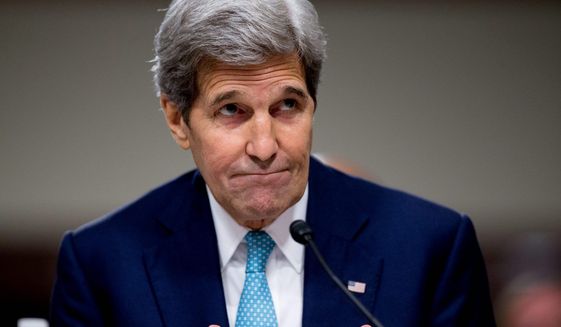
10222015_2015-10-22-19-23-278201_c0-0-1800-1049_s561x327Secretary of State John Kerry. (Associated Press

ANALYSIS/OPINION:

A diplomat, as any deputy assistant associate undersecretary could tell you, is a public servant paid to lie for his country. Lies are the hard currency in the land of the girly men.

The truth is rarely heard above the rattle and din of the teacups in the lounges where the masters of the art gather to collect their strength after a long day’s work in the vineyards of falsification, where Israel usually gets the shaft plunged to the hilt.

The knife has become the weapon of choice in the Palestinian war against Israeli civilians, brandished as if it were a holy scimitar of the avenging Allah. The dean of a university in Gaza characterizes this campaign of the short knives as “military operations,” and urges that it be aimed at women and children.

“The Jews of Palestine are fair game today, even the women,” the dean, Subhi al-Yazji, a learned doctor of Koranic studies, told an interviewer on Hamas television. “Every single Jew in Palestine is a combatant — even the children, breastfed on hatred for the Palestinian people.”

Just who is promoting this villainy launched from the shadows is clear to everyone, but it’s not polite in the well-behaved precincts of the West to say so. But we can be reassured, because John Kerry, the secretary of state and the grand master of moral equivalence, is on the job. He spent four hours Thursday with Israeli Prime Minister Benjamin Netanyahu in Berlin about how to “defuse” the violence. Their conversation was conducted as the knives conducted their own deadly business on the streets.

Before they sat down Mr. Kerry made the ritual condemnation of the assault on the Jews, composed of equal parts blarney and buncombe, and bravely urged an end to “all incitement and violence.” This softly worded admonition by the secretary of State naturally must include the Israelis who have done nothing but offer their Jewish flesh for the Palestinian blade. “There is no question,” said Mr. Netanyahu, “that this wave of attacks is driven directly by incitement by Hamas, incitement from the Islamist movement in Israel and incitement, I am sorry to say, from President Abbas and the Palestinian Authority.”

This was plain and unvarnished, what everybody knows to be true, but for reasons best known to him President Obama and his men (and women) won’t say anything like that. Perhaps they have a fear of cold steel in the ribs, too. What Mr. Kerry offers is this can of diplomatic yah-yah from the archives of claptrap at the State Department:

“I come directly from several hours of conversation with Prime Minister Netanyahu and I would characterize that conversation as one that gave me a cautious measure of optimism that there may be some things that may be in the next couple of days put on the table which would have an impact — I hope. I don’t want to be excessive in stating that, but I am cautiously encouraged.” There are a dozen lies somewhere in that thin treacle of organic gluten-free fat-added diet marshmallow, but only a diplomat could find them.

The moment cries for someone to say something real, and we get that from the secretary of state. And this: “We have to stop the incitement, we have to stop the violence.” Well, duh. He said he had talked to [Mr.] Abbas and Jordan’s King Abdullah, who are trusted to oversee the Temple Mount in Jerusalem, source of the latest Palestinian complaining. Abbas and Abdullah have assured him of their commitment to calm. Of course they do. And if you can’t trust a trusty, as a famous Southern governor caught between two fires once said, who can you trust?

The purveyors of calm work in parallel with the inciters of blood lust. This week a Jordanian teacher, from whom in other places you would expect something more, posted on the Internet a video of his 8-year-old daughter brandishing a knife, held up like a crucifix of the faith, declaring, “I want to stab a Jew.”

Mr. Netanyahu, who has no fear of saying what he thinks, nevertheless caught a little flak this week in Israel for speaking of some of the dark work of those who encouraged Hitler to proceed with the Holocaust. Hitler’s evil was unique, a professor at Hebrew University in Jerusalem told Mr. Netanyahu, and assigning blame to others makes him a Holocaust denier. Such a “dangerous distortion” of history “downplays” the Holocaust, the leader of the opposition in the Knesset told him.

Mr. Netanyahu was speaking a perfectly obvious truth, but we’re not supposed to notice what’s going on. It’s not diplomatic.

Spy vs. Spy: Inside the Fraying U.S.-Israel Ties – WSJ

October 23, 2015

Source: Spy vs. Spy: Inside the Fraying U.S.-Israel Ties – WSJ

Distrust set allies to snoop on each other after split over Iran nuclear deal; each kept secrets

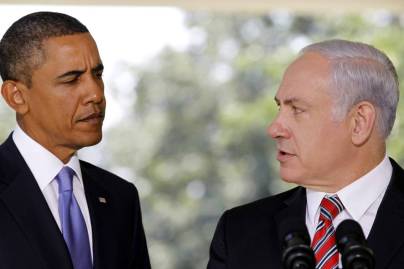
President Barack Obama and Israeli Prime Minister Benjamin Netanyahu appeared at a news conference at the White House on Sept. 10, 2010, a time when both countries began to split over the best means to keep Iran from an atomic bomb.
President Barack Obama and Israeli Prime Minister Benjamin Netanyahu appeared at a news conference at the White House on Sept. 10, 2010, a time when both countries began to split over the best means to keep Iran from an atomic bomb. PHOTO: JASON REED/REUTERS

The U.S. closely monitored Israel’s military bases and eavesdropped on secret communications in 2012, fearing its longtime ally might try to carry out a strike on Fordow, Iran’s most heavily fortified nuclear facility.

Nerves frayed at the White House after senior officials learned Israeli aircraft had flown in and out of Iran in what some believed was a dry run for a commando raid on the site. Worried that Israel might ignite a regional war, the White House sent a second aircraft carrier to the region and readied attack aircraft, a senior U.S. official said, “in case all hell broke loose.”

The two countries, nursing a mutual distrust, each had something to hide. U.S. officials hoped to restrain Israel long enough to advance negotiations on a nuclear deal with Iran that the U.S. had launched in secret. U.S. officials saw Israel’s strike preparations as an attempt to usurp American foreign policy.

Instead of talking to each other, the allies kept their intentions secret. To figure out what they weren’t being told, they turned to their spy agencies to fill gaps. They employed deception, not only against Iran, but against each other. After working in concert for nearly a decade to keep Iran from an atomic bomb, the U.S. and Israel split over the best means: diplomacy, covert action or military strikes.

Personal strains between President Barack Obama and Israeli Prime Minister Benjamin Netanyahu erupted at their first Oval Office meeting in 2009, and an accumulation of grievances in the years since plunged relations between the two countries into crisis.

This Wall Street Journal account of the souring of U.S.-Israel relations over Iran is based on interviews with nearly two dozen current and former senior U.S. and Israeli officials.

U.S. and Israeli officials say they want to rebuild trust but acknowledge it won’t be easy. Mr. Netanyahu reserves the right to continue covert action against Iran’s nuclear program, said current and former Israeli officials, which could put the spy services of the U.S. and Israel on a collision course.

A shaky start

Messrs. Obama and Netanyahu shared common ground on Iran when they first met in 2007. Mr. Netanyahu, then the leader of Israel’s opposition party, the right-wing Likud, discussed with Mr. Obama, a Democratic senator, how to discourage international investment in Iran’s energy sector. Afterward, Mr. Obama introduced legislation to that end.

Suspicions grew during the 2008 presidential race after Mr. Netanyahu spoke with some congressional Republicans who described Mr. Obama as pro-Arab, Israeli officials said. The content of the conversations later found its way back to the White House, senior Obama administration officials said.

Soon after taking office in January 2009, Mr. Obama took steps to allay Israeli concerns, including instructing the Pentagon to develop military options against Iran’s Fordow facility, which was built into a mountain. The president also embraced an existing campaign of covert action against Iran, expanding cooperation between the Central Intelligence Agency and Mossad, the Israeli spy agency.

Mossad leaders compared the covert campaign to a 10-floor building: The higher the floor, they said, the more invasive the operation. CIA and Mossad worked together on operations on the lower floors. But the Americans made clear they had no interest in moving higher—Israeli proposals to bring down Iran’s financial system, for example, or even its regime.

Some covert operations were run unilaterally by Mossad, such as theassassination of Iranian nuclear scientists, according to U.S. officials.

The first Oval Office meeting between Messrs. Obama and Netanyahu, in May 2009—weeks after Mr. Netanyahu became prime minister—was difficult for both sides. After the meeting, Mr. Obama’s aides called Ron Dermer, Mr. Netanyahu’s adviser, to coordinate their statements. Mr. Dermer told them it was too late; Mr. Netanyahu was already briefing reporters. “We kind of looked at each other and said, ‘I guess we’re not coordinating our messages,’ ” said Tommy Vietor, a former administration official who was there.

In 2010, the risk of covert action became clear. A computer virus dubbed Stuxnet, deployed jointly by the U.S. and Israel to destroy Iranian centrifuges used to process uranium, had inadvertently spread across the Internet. The Israelis wanted to launch cyberattacks against a range of Iranian institutions, according to U.S. officials. But the breach made Mr. Obama more cautious, officials said, for fear of triggering Iranian retaliation, or damaging the global economy if a virus spread uncontrollably.

Israel questioned whether its covert operations were enough, said aides to Mr. Netanyahu. Stuxnet had only temporarily slowed Tehran’s progress. “Cyber and other covert operations had their inherent limitations,” a senior Israeli official said, “and we reached those limitations.”

Mr. Netanyahu pivoted toward a military strike, raising anxiety levels in the White House.

The U.S. Air Force analyzed the arms and aircraft needed to destroy Iran’s nuclear facilities and concluded Israel didn’t have the right equipment. The U.S. shared the findings, in part, to steer the Israelis from a military strike.

The Israelis weren’t persuaded and briefed the U.S. on an attack plan: Cargo planes would land in Iran with Israeli commandos on board who would “blow the doors, and go in through the porch entrance” of Fordow, a senior U.S. official said. The Israelis planned to sabotage the nuclear facility from inside.

Pentagon officials thought it was a suicide mission. They pressed the Israelis to give the U.S. advance warning. The Israelis were noncommittal.

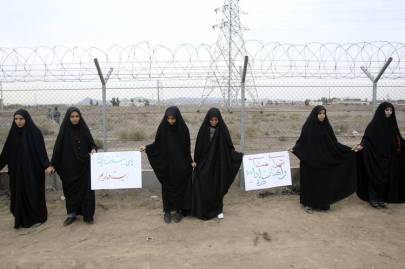
Iranian students in a November 2013 demonstration defending their country's nuclear program outside the Fordow Uranium Conversion facility in Iran.ENLARGE
Iranian students in a November 2013 demonstration defending their country’s nuclear program outside the Fordow Uranium Conversion facility in Iran. PHOTO:CHAVOSH HOMAVANDI/AFP/GETTY IMAGES

“Whether this was all an effort to try to pressure Obama, or whether Israel was really getting close to a decision, I don’t know,” said Michéle Flournoy, who at the time was undersecretary of defense for policy.

Mr. Obama, meanwhile, was moving toward diplomacy. In December 2011, the White House secretly used then-Sen. John Kerry to sound out Omani leaders about opening a back channel to the Iranians.

At the same time, the White House pressed the Israelis to scale back their assassination campaign and turned down their requests for more aggressive covert measures, U.S. officials said.

The president spoke publicly about his willingness to use force as a last resort to prevent Iran from getting a nuclear weapon—“I don’t bluff,” Mr. Obama said in March 2012—but some of Mr. Netanyahu’s advisers weren’t convinced.

In early 2012, U.S. spy agencies told the White House about a flurry of meetings that Mr. Netanyahu convened with top security advisers. The meetings covered everything from mission logistics to the political implications of a military strike, Israeli officials said.

Warning signs

U.S. spy agencies stepped up satellite surveillance of Israeli aircraft movements. They detected when Israeli pilots were put on alert and identified moonless nights, which would give the Israelis better cover for an attack. They watched the Israelis practice strike missions and learned they were probing Iran’s air defenses, looking for ways to fly in undetected, U.S. officials said.

New intelligence poured in every day, much of it fragmentary or so highly classified that few U.S. officials had a complete picture. Officials now say many jumped to the mistaken conclusion that the Israelis had made a dry run.

At the time, concern and confusion over Israel’s intentions added to the sense of urgency inside the White House for a diplomatic solution.

The White House decided to keep Mr. Netanyahu in the dark about the secret Iran talks, believing he would leak word to sabotage them. There was little goodwill for Mr. Netanyahu among Mr. Obama’s aides who perceived the prime minister as supportive of Republican challenger Mitt Romney in the 2012 campaign.

Mr. Netanyahu would get briefed on the talks, White House officials concluded, only if it looked like a deal could be reached.

The first secret meeting between U.S. and Iranian negotiators, held in July 2012, was a bust. But “nobody was willing to throw it overboard by greenlighting Israeli strikes just when the process was getting started,” a former senior Obama administration official said.

Israeli officials approached their U.S. counterparts over the summer about obtaining military hardware useful for a strike, U.S. officials said.

At the top of the list were V-22 Ospreys, aircraft that take off and land like helicopters but fly like fixed-wing planes. Ospreys don’t need runways, making them ideal for dropping commandos behind enemy lines.

The Israelis also sounded out officials about obtaining the Massive Ordnance Penetrator, the U.S. military’s 30,000-pound bunker-busting bomb, which was designed to destroy Fordow.

Mr. Netanyahu wanted “somebody in the administration to show acquiescence, if not approval” for a military strike, said Gary Samore, who served for four years as Mr. Obama’s White House coordinator for arms control and weapons of mass destruction. “The message from the Obama administration was: ‘We think this is a big mistake.’ ”

White House officials decided not to provide the equipment.

Messrs. Obama and Netanyahu spoke in September 2012, and Mr. Obama emerged convinced Israel wouldn’t strike on the eve of the U.S. presidential election.

By the following spring, senior U.S. officials concluded the Israelis weren’t serious about a commando raid on Fordow and may have been bluffing. When the U.S. offered to sell the Ospreys, Israel said it didn’t have the money.

Former Israeli Defense Minister Ehud Barak, who championed a strike, said Mr. Netanyahu had come close to approving a military operation against Iran. But Israel’s military chiefs and cabinet members were reluctant, according to Israeli officials.

While keeping the Omani talks secret, U.S. officials briefed the Israelis on the parallel international negotiations between Iran and major world powers under way in early 2013. Those talks, which made little headway, were led on the U.S. side by State Department diplomat Wendy Sherman.

Robert Einhorn, at the time an arms control adviser at the State Department, said that during the briefings, Mr. Netanyahu’s advisers wouldn’t say what concessions they could live with. “It made us feel like nothing was going to be good enough for them,” Mr. Einhorn said.

U.S. spy agencies were monitoring Israeli communications to see if the Israelis had caught wind of the secret talks. In September 2013, the U.S. learned the answer.

Yaakov Amidror, Mr. Netanyahu’s national security adviser at the time, had come to Washington in advance of a Sept. 30 meeting between Messrs. Netanyahu and Obama.

On Sept. 27, Mr. Amidror huddled with White House national security adviser Susan Rice in her office when she told him that Mr. Obama was on the phone in a groundbreaking call with Iran’s president, Hassan Rouhani.

Mr. Amidror had his own surprise. During a separate meeting in the Roosevelt Room, he told several of Mr. Obama’s top advisers that Israel had identified the tail numbers of the unmarked U.S. government planes that ferried negotiators to Muscat, Oman, the site of the secret talks, U.S. officials said.

Mr. Amidror, who declined to comment on the White House discussions, said that it was insulting for Obama administration officials to think “they could go to Oman without taking our intelligence capabilities into account.” He called the decision to hide the Iran talks from Israel a big mistake.

U.S. officials said they were getting ready to tell the Israelis about the talks, which advanced only after Mr. Rouhani came to office. During the Sept. 30 meeting with Mr. Netanyahu, the president acknowledged the secret negotiations. The secrecy cemented Israel’s distrust of Mr. Obama’s intentions, Israeli officials said.

Mr. Samore, the former White House official, said he believed it was a mistake to keep Israel in the dark for so long. Mr. Einhorn said: “The lack of early transparency reinforced Israel’s suspicions and had an outsize negative impact on Israeli thinking about the talks.”

Israel pushed for the U.S. to be more open about the Iran negotiations. Ms. Rice, however, pulled back on consultations with her new Israeli counterpart, Yossi Cohen, who took over as Mr. Netanyahu’s national security adviser, according to U.S. and Israeli officials.

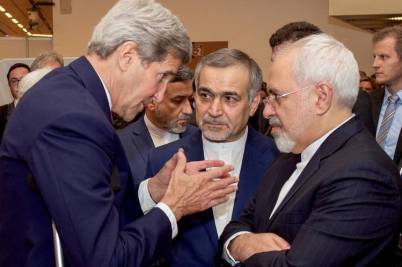
Secretary of State John Kerry, left, huddled with Iranian officials, including Hossein Fereydoun, center, the brother of Iranian President Hassan Rouhani, and Iranian Foreign Minister Javad Zarif, right, before addressing a news conference about a nuclear agreement reached in Vienna in July.ENLARGE
Secretary of State John Kerry, left, huddled with Iranian officials, including Hossein Fereydoun, center, the brother of Iranian President Hassan Rouhani, and Iranian Foreign Minister Javad Zarif, right, before addressing a news conference about a nuclear agreement reached in Vienna in July. PHOTO: US STATE DEPARTMENT/REUTERS

In exchanges with the White House, U.S. officials said, Mr. Cohen wouldn’t budge from demanding Iran give up its centrifuges and uranium-enrichment program. Israeli officials said they feared any deviation would be taken by the U.S. as a green light for more concessions.

In one meeting, Mr. Cohen indicated Mr. Netanyahu could accept a deal allowing Iran to keep thousands of centrifuges, U.S. officials said. Soon after, Mr. Cohen called to say he had misspoken. Neither side was prepared to divulge their bottom line.

In November 2013, when the interim agreement was announced, Mr. Samore was in Israel, where, he said, the Israelis “felt blindsided” by the terms. U.S. officials said the details came together so quickly that Ms. Sherman and her team didn’t have enough time to convey them all. Israeli officials said the Americans intentionally withheld information to prevent them from influencing the outcome.

Listening in

As talks began in 2014 on a final accord, U.S. intelligence agencies alerted White House officials that Israelis were spying on the negotiations. Israel denied any espionage against the U.S. Israeli officials said they could learn details, in part, by spying on Iran, an explanation U.S. officials didn’t believe.

Earlier this year, U.S. officials clamped down on what they shared with Israel about the talks after, they allege, Mr. Netanyahu’s aides leaked confidential information about the emerging deal.

When U.S. officials confronted the Israelis over the matter in a meeting, Israel’s then-minister of intelligence said he didn’t disclose anything from Washington’s briefings. The information, the minister said, came from “other means,” according to meeting participants.

Ms. Sherman told Mr. Cohen, Israel’s national security adviser: “You’re putting us in a very difficult position. We understand that you will find out what you can find out by your own means. But how can we tell you every single last thing when we know you’re going to use it against us?” according to U.S. officials who were there.

Mr. Netanyahu turned to congressional Republicans, one of his remaining allies with the power to affect the deal, Israeli officials said, but he couldn’t muster enough votes to block it.

U.S. officials now pledge to work closely with their Israeli counterparts to monitor Iran’s compliance with the international agreement.

But it is unclear how the White House will respond to any covert Israeli actions against Iran’s nuclear program, which current and former Israeli officials said were imperative to safeguard their country.

One clause in the agreement says the major powers will help the Iranians secure their facilities against sabotage. State Department officials said the clause wouldn’t protect Iranian nuclear sites from Israel.

Michael Hayden, a former director of the CIA, said the U.S. and Israel could nonetheless end up at odds.

“If we become aware of any Israeli efforts, do we have a duty to warn Iran?” Mr. Hayden said. “Given the intimacy of the U.S.-Israeli relationship, it’s going to be more complicated than ever.”

Write to Adam Entous at adam.entous@wsj.com

Iranian Supreme Leader Khamenei’s Letter Of Guidelines To President Rohani On JCPOA Sets Nine Conditions Nullifying Original Agreement Announced July 14, 2015

October 23, 2015

Iranian Supreme Leader Khamenei’s Letter Of Guidelines To President Rohani On JCPOA Sets Nine Conditions Nullifying Original Agreement Announced July 14, 2015, Middle East Media Research Foundation, Y. Carmon and A. Savyon, October 22, 2015

(Please pay particular attention to Conditions 1 – 6 and their implications as noted by MEMRI. The conditions appear to be quite substantial. Additional material, including Twitter and Facebook messages, is also provided in appendices at the end of the article. I have not reproduced that material here.– DM)

On October 21, 2015, Iranian Supreme Leader Ali Khamenei published a letter of guidelines to Iranian President Hassan Rohani on the execution of the Joint Comprehensive Plan of Action (JCPOA). The letter’s publication coincides with the days of the Ashura that are of vital religious and national significance in Iran and symbolize steadfastness against the forces of evil. Intended as an historical document aimed at assuring Iran’s future, the letter was posted on Khamenei’s website in Persian and tweeted from his Twitter account and posted on his Facebook page in English (see Appendices), and published in English by the official Islamic Republic of Iran Broadcasting authority IRIB (see below). The letter is now a founding document in all things concerning theJCPOA and the conditions under which Iran will be willing to execute it.

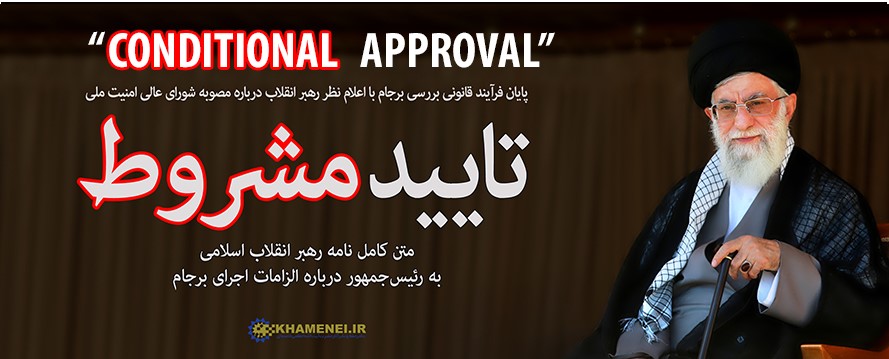
The letter, defined by Khamenei on his website as “conditional approval” of the JCPOA, sets several new conditions for Iran’s execution of the agreement. These conditions constitute late and unilateral additions to the agreement concluded three months previously that fundamentally change it. Khamenei stresses that the agreement awaits his opinion following what he calls “precise and responsible examination” in the Majlis and “clearance of this agreement through legal channels” in Iran’s Supreme National Security Council.  

25366

It should be further noted that in his introduction to the new conditions, Khamenei attacks the U.S. and President Obama with great hostility, and calls for Obama to be prosecuted by international judiciary institutions. He states that Obama had sent him two letters declaring that he has no intention of subverting the regime of the Islamic Republic of Iran, but adds that the U.S.’s support for fitna in Iran (i.e. the popular post-election unrest in 2009), its monetary aid to opponents of the Republic, and its explicit threats to attack Iran have proven the opposite and have exposed the real intent of America’s leaders, whose enmity towards Iran will not end. He wrote that the Americans’ behavior in the nuclear talks is another link in the chain of its enmity towards Iran, that America entered into the talks with the aim of “deception,” and that therefore Iran must remain alert in light of America’s hostile intentions.

The set of conditions laid out by Khamenei creates a situation in which not only does the Iranian side refrain from approving the JCPOA,[1] but, with nearly every point, creates a separate obstacle, such that executing the agreement is not possible.

The following are Khamenei’s nine conditions, and their implications:

Khamenei’s Conditions For Iranian Execution Of The JCPOA

First condition: Khamenei demands that the U.S. and Europe lift the sanctions, not suspend them, and in addition demands “solid and sufficient” guarantees in advance that this will be done, before Iran takes its own steps and meets its own obligations under the agreement. These guarantees, insists Khamenei, must include, inter alia, an official letter from the U.S. president and from the EU undertaking to fully lift the sanctions. Furthermore, he demands that this letter will state that any declaration by the West that the “structure of the sanctions will remain in force” (i.e. allowing snapback) will be considered “non-compliance with the JCPOA” on the part of the West.

Implications: These conditions constitute a total change of the JCPOA. Khamenei is not allowing any execution of the JCPOA by Iran until this is accepted in writing by the other side, and thus he is nullifying the JCPOA as agreed upon on July 14, 2015.

Second condition: Any sanctions against Iran “at every level and on every pretext,” including terrorism and human rights violations, by any one of the countries participating in the negotiations will “constitute a violation of the JCPOA,” and a reason for Iran to stop executing the agreement.

Implications: This demand, that links the JCPOA to other issues and prohibits any punishment of Iran on any issue and for any reason, serves as an excuse for Iran to cancel the agreement.

Third condition: Under the JCPOA, Iran is obligated, following the JCPOA’s Adoption Day, to carry out its obligations concerning changing the function of the nuclear reactor at Arak and shipping out most of its stockpile of enriched uranium. Contrary to this, Khamenei is changing the timetable of the JCPOA, stating that Iran will not carry out these actions until after the International Atomic Energy Agency (IAEA) declares that it is closing its dossier on Iran’s “past and future issues (including the so-called Possible Military Dimensions or PMD of Iran’s nuclear program).”

Implications: This demand to change the timetable creates a situation in which Iran will not take action as stipulated in the JCPOA, and will not meet its obligations, before the sanctions are eased, also according to the JCPOA, but instead dictates that the sanctions must first be lifted completely and states that only then will Iran meet its obligations. Khamenei here is creating a situation in which the IAEA will not be able to report on Iran’s meeting of its obligations regarding the Arak reactor and regarding the shipping out of its enriched uranium by the target date of December 15, 2015, because Iran is not going to do so by then – thus the execution of the agreement is thwarted from the beginning.

Fourth condition: Iran will meet its obligations to “renovate” and change the purpose of the Arak reactor only after there is a signed agreement on an “alternative plan” for changes to the reactor, and after there is “sufficient guarantee” that this alternative plan will be implemented.

Implications: Iran’s fulfillment of its obligations regarding the Arak reactor, as stipulated by the JCPOA, will be postponed until some unknown future date.

Fifth condition: Iran will carry out its obligation to ship out its enriched uranium to another country in exchange for yellowcake “on a gradual basis and on numerous occasions,” and only after “a secure agreement has been clinched to that effect, along with sufficient guarantees” that this exchange will be implemented.

Implications: The date for Iran to ship out its enriched uranium as stipulated by the JCPOA is postponed until some unknown future date. Khamenei is demanding that Iran receive in exchange for the enriched uranium not raw uranium as per the JCPOA, but instead uranium that has been enriched, albeit to a lower level than the uranium it ships out. This is yet another change to the JCPOA as concluded on July 14, 2015.

Sixth condition: Khamenei instructs President Rohani to begin, along with reducing Iran’s ability to enrich uranium under the JCPOA, immediately to expand Iran’s ability to enrich uranium with a 15-year long-term plan for 190,000 centrifuge SWU (Separative Work Units). “This plan,” he says, “must allay any concern stemming from some points entailed in the JCPOA appendices.”

Implications: This article nullifies the declared goal of the JCPOA, which is to reduce Iran’s nuclear enrichment capabilities.

Seventh condition: The Iranian Atomic Energy Organization must ensure continued nuclear research and development, in its various dimensions, such that in eight years’ time, Iran will not be lacking in enrichment technology. This, he says, is all in accordance with the JCPOA.

Eighth condition: In the event of doubt or ambiguity regarding the content of the JCPOA, the source of authority for removing this doubt or ambiguity will be the content of the talks – i.e. it will also include the statements by the Iranian side, not just the “interpretation provided by the opposite party,” that is, the P5+1.

Implications: Any doubt or ambiguity regarding the content of the JCPOA will become the source of unending dispute and will paralyze any possibility of executing the agreement.

Ninth condition: Due to apprehensions that the other side, particularly the U.S., will break its promises or cheat, President Rohani must establish a “well-informed and smart panel” to monitor the execution of the agreement.

Implications: Khamenei is creating an administrative framework for perpetual delays in the execution of the agreement.

Khamenei adds also a 10th condition, directed at Iran, not the P5+1, demanding that Rohani take seriously his instructions in the matter of the “resistance economy,” the main thrust of which is self-reliance instead of basing Iran’s economy on external sources. He also demands that after the sanctions are lifted, there will be no “unbridled imports,” and no imports whatsoever from the U.S.

Political Ramifications In Iran

In February 2016, elections for the Majlis and the Assembly of Experts are set to take place in Iran. The pragmatic camp, headed by Hashemi Rafsanjani and President Rohani, had hoped that a quick execution of the agreement would allow the sanctions to be eased and funds to be released immediately, which in turn would allow the pragmatic camp to present these achievements and triumph in the elections. By setting these conditions, however, Khamenei has thwarted any speedy execution of the agreement, and thus has thwarted the pragmatic camp’s hope for electoral success.

IRIB Translation

The following is the official English translation of Khamenei’s letter, as published by IRIB.[2] This translation was tweeted by Khamenei and also posted on his Facebook page (see Appendix I and II).

“Wednesday, 21 October 2015 17:41
“Ayatollah Khamenei sends a letter to President Hassan Rouhani about the JCPOA

25367

“Ayatollah Seyyed Ali Khamenei, the Leader of the Islamic Revolution, in a letter to President Hassan Rouhani, who also heads the Supreme National Security Council (SNSC), referred to the precise and responsible examination of the Joint Comprehensive Plan of Action (JCPOA) in the Islamic Consultative Assembly (parliament) and also the SNSC, and the clearance of this agreement through legal channels, and issued important instructions regarding the observation of and safeguarding the country’s national interests. Enumerating nine-point requirements for the implementation of the JCPOA, Ayatollah Ali Khamenei endorsed SNSC Resolution 634, dated August 10, 2015, provided that the following provisions and requirements are observed.

“The full text of Ayatollah Khamenei’s letter follows on:

In the Name of Allah, the Most Compassionate, the Most Merciful

“Your Excellency,  Mr Rouhani,
“President of the Islamic Republic of Iran and Head of the Supreme National Security Council
“May God bestow success upon you.
“Greetings to You

“The agreement known as the Joint Comprehensive Plan of Action (JCPOA) has already been cleared through legal channels following precise and responsible examinations in the Islamic Consultative Assembly, [parliamentary] ad hoc committees and other committees as well as the Supreme National Security Council. Since the agreement is waiting for my view, I deem it necessary to remind several points so that Your Excellency and other officials directly or indirectly involved in the issue would have enough time to comply with and safeguard national interests and the country’s best interests.

“1. Before anything else, I deem it necessary to extend my gratitude to all those involved in this challenging procedure throughout all its periods, including the recent nuclear negotiating team whose members tried their best in explaining the positive points and incorporating all those points [into the agreement], critics who reminded all of us of weak points through their appreciable meticulousness, and particularly the chairman and members of the Majlis ad hoc committee [set up to review the JCPOA] as well as the senior members of the SNSC who covered some voids by including their important considerations, and finally the Speaker of Majlis and Members of Parliament who adopted a cautious bill to show the right way of implementation [of the agreement] to the administration, and also national media and the country’s journalists who despite all their differences of view presented a complete image of this agreement to public opinion. This voluminous collection of activity and endeavors and thoughts [spent] on an issue which is thought to be among the unforgettable and instructive issues of the Islamic Republic, deserves appreciation and is a source of satisfaction. Therefore, one can say with certainty that the divine reward for these responsible contributions will, God willing, include assistance and mercy and guidance by Almighty God because the divine promises of assistance in exchange for assisting His religion are unbreakable.

“2. Enjoying decades-long background of presence in the very details of the affairs of the Islamic Republic of Iran, you must have naturally realized that the government of the United States of America, neither in the nuclear issue nor in any other issue, had been pursuing no other approach but hostility and disturbance, and is unlikely to do otherwise in the future either. The remarks by the US President [Barack Obama] in two letters addressed to me on the point that [Washington] has no intention of subverting the Islamic Republic of Iran turned out to be unreal and his open threats of military and even nuclear strike, which can result in a lengthy indictment against him in international courts, laid bare the real intentions of US leaders. Political pundits and public opinion of many nations clearly understand that the case of his never-ending hostility is the nature and identity of the Islamic Republic of Iran, which is born out of the Islamic Revolution. Insistence on rightful Islamic stances and opposition to the hegemonic and arrogant system, perseverance against excessive demands and encroachment upon oppressed nations, revelations on the US support for medieval dictators and suppression of independent nations, incessant defense for the Palestinian nation and patriotic resistance groups, rational and globally popular yelling at the usurping Zionist regime constitute the main items which make the US regime’s enmity against the Islamic Republic inevitable, and this enmity will continue as long as the Islamic Republic [continues to] disappoint them with its internal and sustainable strength.

“The behavior and words of the US government in the nuclear issue and its prolonged and boring negotiations showed that this (nuclear issue) was also another link in their chain of hostile enmity with the Islamic Republic. Their deception through flip-flopping between their initial remarks that came after Iran accepted to hold direct talks with them and their constant non-compliance with their pledges throughout two-year-long negotiations and their alignment with the demands of the Zionist regime and their bullying diplomacy regarding relations with European governments and bodies involved in the negotiations are all indicative of the fact that the US’s deceitful involvement in the nuclear negotiations has been done not with the intention of a fair settlement [of the case], but with the ill intention of pushing ahead with its hostile objectives about the Islamic Republic.

“Doubtlessly, vigilance vis-à-vis the hostile intentions of the US government and instances of resistance on the part of the officials of the Islamic Republic of Iran throughout the negotiations managed, in numerous cases, to prevent heavy damage from being inflicted [upon Iran].

“However, the outcome of the negotiations, which is enshrined in the JCPOA, has numerous ambiguities and structural weaknesses that could inflict big damage on the present and the future of the country in the absence of meticulous and constant monitoring.

“3. The nine-point provisions entailed in the recent bill adopted by the Majlis and the 10-point instructions outlined in the resolution of the Supreme National Security Council carry helpful and effective points which must be taken into consideration. Meantime, there are some other necessary points which are announced here while some of the points mentioned in the two documents are highlighted.

“First, since Iran has accepted to negotiate basically for the objective of removal of unjust economic and financial sanctions and its enforcement (the lifting of sanctions) is tied to Iran’s future actions under the JCPOA, it is necessary that solid and sufficient guarantees be arranged to avoid any infraction by the opposite parties. Written declaration by the US president and the European Union for the lifting of the sanctions is among them. In the statements of the EU and the US president, it must be reiterated that these sanctions will be fully lifted. Any declaration that the structure of the sanctions will remain in force shall imply non-compliance with the JCPOA.

“Second, throughout the eight-year period, any imposition of sanctions at any level and under any pretext (including repetitive and fabricated pretexts of terrorism and human rights) on the part of any of the countries involved in the negotiations will constitute a violation of the JCPOA and the [Iranian] government would be obligated to take the necessary action as per Clause 3 of the Majlis bill and stop its activities committed under the JCPOA .

“Third, the measures related to what is mentioned in the next two clauses will start only after the International Atomic Energy Agency (IAEA) announces [the conclusion of] the past and future issues (including the so-called Possible Military Dimensions or PMD of Iran’s nuclear program).

“Fourth, measures to renovate the Arak plant by preserving its heavy [water] nature will start only after a firm and secure agreement has been signed on an alternative plan, along with sufficient guarantees for its implementation.

“Fifth, the deal with a foreign government for swapping enriched uranium with yellow cake will start only after a secure agreement has been clinched to that effect, along with sufficient guarantees [for its implementation]. The aforesaid deal and exchange must be done on a gradual basis and on numerous occasions.

“Sixth, by virtue of the Majlis bill, the plan and the necessary preparations for mid-term development of the atomic energy industry, which includes the method of advancement in different periods of time for 15 years for the final objective of 190,000 SWU, must be drawn up and carefully reviewed by the Supreme National Security Council. This plan must allay any concern stemming from some points entailed in the JCPOA appendices.

“Seventh, the Atomic Energy Organization of Iran must organize research and development in different aspects such that after the end of the eight-year period, there would be no shortage of technology for the level of [uranium] enrichment entailed in the JCPOA.

“Eighth, it must be noted that on the ambiguous points in the JCPOA document, the interpretation provided by the opposite party is not acceptable and the reference would be the text of the negotiations.

“Ninth, the existence of complications and ambiguities in the text of the JCPOA and the suspicion of breach of promise, infractions and deception by the opposite party, particularly the US, require that a well-informed and smart panel be established to monitor the progress of affairs and [gauge] the opposite party’s commitment and realization of what was mentioned above. The composition and the tasks of this would-be panel should be determined and approved by the Supreme National Security Council.

“In witness whereof, Resolution 634, dated August 10, 2015, of the Supreme National Security Council, is endorsed pending the observation of the aforementioned points.

“In conclusion, as it has been notified in numerous meetings to you and other government officials and also to our dear people in public gatherings, although the lifting of sanctions is a necessary job in order to remove injustice [imposed on people] and regain the rights of the Iranian nation, economic overture and better livelihood and surmounting the current challenges will not be easy unless the Economy of Resistance is taken seriously and followed up on entirely. It is hoped that this objective will be pursued with full seriousness and special attention would be paid to enhancing national production. You should also watch out so that unbridled imports would not follow the lifting of sanctions, and particularly importing any consumer materials from the US must be seriously avoided.

“I pray to Almighty God for your and other contributors’ success.
“Source: www. leader. ir”

__________________

Endnotes:

[2] English.irib.ir/news/leader/item/217470-ayatollah-khamenei-sends-a-letter-to-president-hassan-rouhani-about-the-jcpoa, October 21, 2015.

[3] Twitter.com/khamenei_ir, October 21, 2015.

[4] Facebook.com/www.Khamenei.ir/posts/943612332378368:0, posted October 21, 2015.

US praises role of Iranian-backed Shiite militias in Baiji operation

October 22, 2015

US praises role of Iranian-backed Shiite militias in Baiji operation, Long War Journal, October 22, 2015

Over the past several days, US officials have celebrated the capture of Baiji from the Islamic State. While doing so, they have praised the role that Iranian-supported Shiite militias have played in capturing the strategic central Iraqi city. These are the same militias that are responsible for killing hundreds of US soldiers just a few years ago, and many of these militia leaders are listed as Specially Designated Global Terrorists. Additionally, the US is continuing to provide air support to aid these groups.

Both the US military and the Obama administration’s Deputy Special Presidential Envoy to the Global Coalition to Counter ISIL (the outdated acronym for the Islamic State) issued statements that praised the role the Shiite militias played in recapturing Baiji.

Brett McGurk, the Deputy Special Presidential Envoy for the Global Coalition to Counter ISIL [another acronym for the Islamic State], tweeted that the “US commends progress by Iraqi Security Forces and popular mobilization forces [emphasis ours] against ISIL terrorists in Baiji.” He also confirmed that the US has launched around 130 airstrikes in support of these groups since August.

McGurk’s plaudits for the role that the “popular mobilization forces” have played in Baiji was echoed by the US military, which called these units “Shiia [sic] security forces.”

Army Major Mike Filanowski, an officer in the Combined Joint Task Force-Operation Inherent Resolve (CJTF-OIR), said that “The people who did the heavy lifting [in Baiji] were the Iraqi special forces.” He continued by saying, “they not only secured the [Baiji] oil refinery, but also the power plant to the north all the way up to the al-Fatah Bridge.” While the Iraqi special forces did help capture the refinery, they were not the only forces doing the “heavy lifting.”

The Department of Defense press release that quoted Filanowski admitted that the Popular Mobilization Committee (also called Popular Mobilization Units or Popular Mobilization Forces), was conducting operations.

“In the last three days, a special operations team from the elite Counterterrorism Service spearheaded the attack,” the DoD statement said. “The team worked with Iraqi army soldiers, Popular Mobilization Front forces — essentially Shiia security forces — and federal police” [emphasis ours].

So while the US commends the Iraqi Security Forces and the Popular Mobilization Committee, it is also lauding designated terrorists and a Foreign Terrorist Organization. The Popular Mobilization Committee is led by Abu Mahdi al Muhandis, a former commander in the Badr Organization who was listed by the US government as a Specially Designated Global Terrorist in July 2009. The US government described Muhandis, whose real name is Jamal Jaafar Mohammed, as “an advisor to Qassem Soleimani,” the commander of the Qods Force, the external operations wing of the Iranian Revolutionary Guards Corps (IRGC).

The Iranian-backed Shiite militias that played a prominent role in the assault on Baiji include: Asa’ib al Haq (League of the Righteous), whose leader Qais al Khazali is thought to be involved in the murder of five US soldiers in Karbala in 2007; Hezbollah Brigades, which is listed as a Foreign Terrorist Organization by the US government; Harakat al Nujaba, which recently called for the expulsion of US troops from Iraq; Harakat al Nujaba, which is led by Akram Abbas al Kaabi, a Specially Designated Global Terrorist; Kata’ib Imam Ali, led by Shebl al Zaydi, who is close to Qods Force commander Qassem Soleimani; Kata’ib Sayyid al Shuhada, which is commanded by Mustafa al Sheibani, who is also a Specially Designated Global Terrorist; and Badr Corps, another large militia supported by Iran. For more information the role these militias played in the retaking of Baiji, including photographs and video of Iraqi forces operating alongside these militias, see LWJ report, Iraqi Army, Shiite militias report success in Baiji.

Sadly, this behavior by US officials is nothing new. Earlier this year, General (retired) John Allen, the former Special Presidential Envoy for the Global Coalition to Counter ISIL, claimed that the US is only supporting so-called moderate Shiite militas, and not the “extremist elements.” Allen’s statement is below:

With regard to militias, it’s really important to understand that the militias are not just a single monolithic entity. There are the militias that you and I are used to hearing that have close alignments with Iran. Those are the extremist elements, and we don’t have anything to do with that. But there are elements of the Shia militias that volunteered last year to try to defend Iraq from the onslaught of Daesh [Islamic State] who were called to arms by Grand Ayatollah Sistani, and those elements, or the Popular Mobilization Force, as they are known, have been subordinated to the Iraqi higher military campaign or command. And they will provide maneuver capacity and additional firepower to the Iraqi Security Forces as we continue to build them out, as we continue to build the professionalization of the Iraqi forces.

So the fact that militias are involved and tribes are involved in this part of the campaign, this part of the implementation of supporting Iraq ultimately to recover the country, should not alarm us. We just need to ensure that we manage the outcome of this. Prime Minister Abadi’s been clear that these organizations within the Popular Mobilization Force, the Shia volunteers, will eventually either transition into the security forces themselves or go home. That’s the solution that he intends and I think that that’s a supportable outcome. So for now – this goes back to the point that you made about urgency – urgency is an important factor here in helping us to focus on supporting the Iraqis, the tribes, and the Popular Mobilization Force to take those actions necessary to defeat Daesh locally.

Allen said that the fact that the US is supporting the Popular Mobilization Committee “should not alarm us.” Except it should alarm us. Because as we detailed, the organization’s operational leader is a Specially Designated Terrorist, and its most effective militias are Iranian pawns that are responsible for killing hundreds of US soldiers and remain openly hostile to the US.

CAIR’s 2015 Orlando intifada

October 22, 2015

CAIR’s 2015 Orlando intifada, Front Page MagazineJoe Kaufman, October 22, 2015

(Sheik Kerry and Imam Obama were busy denouncing climate change and hence unavailable to speak. — DM)

cairs-2015-orlando-intifada-fp

CAIR’s foundation was built upon anti-Israel activists seeking to tear apart Western society. Today’s CAIR is no different. A current hotspot for CAIR extremism is in Orlando, Florida, where CAIR-Florida just held an annual fundraising banquet and just hired a coordinator to take the place of a recently arrested sexual predator. The days of Orlando only being about theme parks and tourism are over. Now, residents and tourists have something else to look forward to – the threat of radical Islam.

CAIR or the Council on American-Islamic Relations was established in June 1994 as being part of the American Palestine Committee, a terrorist umbrella group headed by then-global head of Hamas, Mousa Abu Marzook. The people who founded CAIR, including present National Executive Director Nihad Awad, were previously leaders of the Islamic Association for Palestine (IAP), a now defunct organization that was at the time the American propaganda wing of Hamas and also one of the groups that made up the Palestine Committee.

CAIR-Florida, like those who established its parent organization, is made up of anti-Israel radicals.

CAIR-Florida Executive Director Hassan Shibly has referred to Hezbollah as “basically a resistance movement” and “absolutely not a terrorist organization” and, in August 2014, tweeted, “Israel and its supporters are enemies of G-d…” In December 2010, CAIR-Florida CEO and Statewide Regional Operations Director Nezar Hamze, repeatedly refused to denounce Hamas, when given numerous chances to do so, stating “I’m not denouncing anybody. I’m not getting involved in the politics.”

In November 2012, when Israel went to war with Hamas in Gaza, CAIR-Florida Legislative and Government Affairs Director Laila Abdelaziz tweeted, “Don’t worry ya Gaza, we’re working hard for you in Florida.” In July 2014, CAIR-Florida Communications Coordinator Ali Akin Kurnaz attacked U.S. Representative Ted Deutch, when Deutch wrote a tweet against Hamas and in support of Israel’s right to defend herself, stating to Deutch, “[T]hink before you tweet. Your lopsided message conveys your lack of understanding of this conflict.”

In July 2014, CAIR-Florida co-sponsored a pro-Hamas rally, in Downtown Miami. At the event, rally goers repeatedly shouted, “We are Hamas,” “Hamas kicked your ass,” and “Let’s go Hamas.” After the rally, the organizer of the rally, Sofian Abdelaziz Zakkout, wrote the following on Facebook: “Thank God, every day we conquer the American Jews like our conquests over the Jews of Israel!”

Earlier this month, CAIR-Florida held an annual fundraising dinner, in Orlando, Florida. The event was titled ‘Champions for Justice,’ and it featured as a guest speaker Chicago-area imam Kifah Mustapha.

Mustapha’s relationship to CAIR goes far beyond his speakership at CAIR events. Both Mustapha and CAIR were named as co-conspirators by the United States government for the 2007 and 2008 federal trials against the Hamas charity, Holy Land Foundation for Relief and Development (HLF). Like CAIR and the IAP, HLF was part of Mousa Abu Marzook’s Palestine Committee. Indeed, Mustapha is still listed as the Registered Agent of HLF’s Illinois corporation, which was revoked in 2001.

Mustapha was also involved with the IAP; he served as a board member for the group.

As well, Mustapha is a lecturer for American Muslims for Palestine (AMP), which the Anti-Defamation League (ADL) states “has its organizational roots in the IAP.” The Registered Agent for AMP is former IAP Secretary General Abdelbaset Hamayel. AMP’s office is merely blocks away from what used to be the IAP’s address, on the same street – Roberts Road in Palos Hills, Illinois. Mustapha and former IAP President Rafeeq Jaber (who was a CAIR founder) will be speaking at AMP’s 8th Annual Conference, next month.

In December 2014, Mustapha left his job as imam and Associate Director of the Mosque Foundation (MF), the Islamic center he had been affiliated with for 13 years. MF also has heavy ties to the IAP. Two former leaders of the IAP, Rafeeq Jaber and ex-IAP Chairman Sabri Samirah, were Presidents of MF.

Today, Mustapha is the imam and Director of the Prayer Center of Orland Park. And while he may have transferred his affiliation – albeit less than nine miles away – Mustapha’s fanatical views are still intact.

The morning of CAIR-Florida’s Orlando banquet, Mustapha posted the following message on his Facebook site. He wrote, “An uprising in the Blessed Land will reflect blessings on all Arab uprisings insha Allah.”

The uprising that he speaks of is the recent wave of stabbing and shooting attacks against Jews in Israel, which many are calling a Third Intifada – intifada meaning uprising. For Mustapha this violence, that includes many deaths on both sides, reflects blessings.

Shown in photos from CAIR-Florida’s banquet is CAIR-Florida’s new Orlando Regional Coordinator Rasha Mubarak. Mubarak replaced CAIR-Florida’s previous Orlando Coordinator, Ahmad Saleem, who is currently awaiting trial after having been arrested for traveling to have illegal sexual intercourse with someone who he believed to be a twelve-year-old girl.

Apart from her job with CAIR, Mubarak is an organizer for anti-Israel demonstrations. These events have included virulently anti-Semitic signs and flags of terrorist organizations.

In November 2014, Mubarak was a featured speaker at the Al-Awda 12th Annual International Convention, held in Fort Lauderdale, Florida. Al-Awda, the Palestine Right to Return Coalition, is an activist group based in the US, which opposes Israel’s right to exist. Participating at the Al-Awda event, along with Mubarak, were then-Chair and Vice Chair of Al-Awda, Coral Springs, Florida-based Anas Amireh and Cleveland, Ohio-based Abbas Hamideh, who are now respectively Al-Awda Treasurer and Vice Chair.

Amireh is a big fan of deceased Palestine Liberation Organization (PLO) Chairman Yasser Arafat and uses social media to memorialize former PLO leaders. He advocates Palestinians using their cars as weapons (‘Run-Over Intifada’) and refers to Israel as the “Zionist enemy.” Next to one photo Amireh posted on his Facebook site in August 2014, taken in Fort Lauderdale and showing him looking back at a group of Israel supporters, he writes, “Do you realize how hard it is not to turn around and beat the living hell out of one of those Zionists??”

Hamideh wants all of Israel, which he has been barred from entering, destroyed. This month, he told Jews, “Rest assured Zionism will be eradicated and if you’re lucky you’ll be sent back to Europe where you belong…” He says peace with Israel only means “surrender.” Hamideh loves Hezbollah and its leader Hassan Nasrallah, who he calls “the most honorable Arab-Muslim leader of our time.” Hamideh, who claims to have fought in the First Intifada, is excited at the idea of a third one. He tweeted a photo of two masked Palestinian terrorists holding Molotov cocktails, stating, “Let’s do this! Intifada.” He also tweeted a photo of himself firing an AK47 rifle.

CAIR calls itself a civil rights group, but the truth is that any initiatives undertaken by CAIR in the name of civil rights is a cover for an extreme anti-Israel agenda that has been an integral part of CAIR since its founding. CAIR’s subsidiary CAIR-Florida, its leaders and those they associate with are representative of this bigotry.

CAIR is a radical Islamic enterprise that exists to cause harm to the Jewish state and fracture Western civilization.

Orlando, beware!

After Holocaust remark, White House warns Benjamin Netanyahu against incitement

October 22, 2015

After Holocaust remark, White House warns Netanyahu against incitement

Source: After Holocaust remark, White House warns Benjamin Netanyahu against incitement – Israel News – Jerusalem Post

Who is listening ?,hamas ,the pa , the mufti,s,  the imans,s ? 

Are they now saying we have to ban the quran and the ahadit ?

WASHINGTON — Comments made by Prime Minister Benjamin Netanyahu earlier in the week, which implicated the former grand mufti of Jerusalem in the decision to proceed with the Holocaust, amount to inflammatory rhetoric stoking tensions on the ground between Israel and the Palestinians, the White House said on Thursday.

In a speech on Tuesday, Netanyahu said that Palestinian Haj Amin al-Husseini was directly responsible for encouraging Adolf Hitler not just to expel Jews from Europe, but to exterminate them. Netanyahu has since clarified that he had no intention of absolving Hitler for responsibility for the Holocaust.

White House press secretary Josh Earnest told reporters the Obama administration has no doubt who was responsible for the genocide, which involved the systematic murder of six million Jews.

“The inflammatory rhetoric needs to stop,” Earnest said.

On Wednesday, the State Department declined to characterize Netanyahu’s specific remarks as incitement, but added: “Scholarly evidence does not support that position,” referring to the prime minister’s historical account.

Earnest’s comments come just hours after Netanyahu met with Secretary of State John Kerry in Berlin to discuss the violence across Israel and the West Bank in recent weeks.