Archive for October 7, 2015

Anti-Israel and anti-Jewish bias in the media and State Dept.

October 7, 2015

Anti-Israel and anti-Jewish bias in the media and State Dept. | Anne’s Opinions, 7th October 2015

As I write this, events are overtaking me with a huge wave of terror attacks (145 at the last count) hitting throughout Israel, including my own hometown of Petach Tikva. I wonder how the media will cover this – if at all. — anneinpt)

I have been documenting anti-Israel bias in the media since I started this blog. In fact it was one of the reasons I st this blog up in the first place. Sadly it seems to be getting worse despite the fact that there are so many media-monitoring websites out there, at least in certain media outlets (Haaretz, the BBC, the NYT, I’m looking at you – and others besides). This is besides the built-in hostility towards Israel in international institutions like the UN. But it goes further. Much more egregiously, the double standard to wards Israel has become blatantly clear in the US State Department. Following are several examples from the past week which saw several terrorist atrocities in Israel.
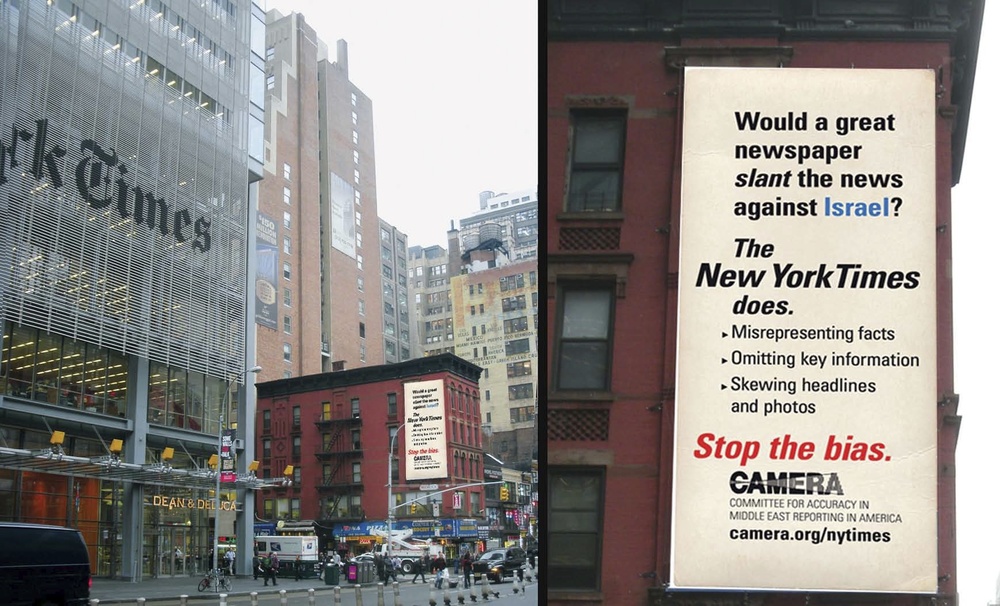
CAMERA billboard posted opposite the NYT building

The Algemeiner has an “interesting” (i.e. enraging) roundup of the blatant bias of the New York Times with examples from just the past month (there are many more recent exampels at the following links) documented by two media watchdogs: CAMERA and Honest Reporting):

On September 10, the NYT singled out Jewish lawmakers on the Iran deal. [At the link you will read that this was a blatantly antisemitic act, targeting Jews for no other reason than that they are Jewish. The NYT has yet to be made to pay for this racial discrimination. -Ed.]

On September 15, the NYT suggested that the Israeli who was murdered by rock-throwing Palestinians had died of a “self-inflicted accident” after the attackers had merely “pelted the road” (rather than his car). The National Review provided a detailed critique of this farcical “reporting.”

Unbelievably, Diaa Hadid, a NYT “journalist” responsible for reporting on Israel, used to work for an anti-Israel hate group, so it’s no surprise that she authored an article suggesting that Palestinian attackers pelted a road with stones on which an Israeli’s self-inflicted car accident just happened to cause him to die.

On September 29, Hadid used an anonymous European advocate of Palestinian rights as a witness to contradict Israeli army claims that a Palestinian woman who was shot at an IDF checkpoint had been armed with a knife. Hadid then omitted confirmatory reports from another witness mentioned in the article, a Palestinian named Fawaz Abu Aisheh, who said the woman had dropped her knife after being shot. (Hadid ignored this evidence even though Amnesty International mentioned Aisheh’s corroborating testimony about the knife).

On September 30, the NYT struck again with false historical information and tendentious coverage of Abbas’ UN speech. The article, by Rick Gladstone and Jodi Rudoren, noted that “Mr. Abbas accused Israel of having systematically violated these pacts,” without mentioning the many violations of the Oslo Peace Accords by Palestinians. In an article exceeding 1,000 words, the reporters made not even one reference to Palestinian terrorism, a basic historical fact that is essential to any fair and balanced understanding of the Israeli-Palestinian conflict. Indeed, since the Oslo Peace Accords, there have been 22 years of Palestinian terrorist attacks — including 140 suicide bombings — which have murdered more than 1,500 Israelis (in U.S. population terms, about 60,000 people killed) and made Israeli compliance with a complex and risky “peace” agreement even harder.

The reporters shamelessly failed to note that the “new strife over contested religious sites in Jerusalem” was produced by Palestinian incitement, anti-Jewish harassment and violence.

Equally egregious is their patently false claim that “the Israeli-Palestinian conflict is the most protracted dispute vexing the United Nations since the organization’s founding 70 years ago.” Some basic Wikipedia research reveals that the Israeli-Palestinian conflict began in 1948 and has produced about 24,000 fatalities since then, while the Kashmir conflict between India and Pakistan began in 1947 and has produced about 47,000 fatalities, and the conflict over Kurdish separatism in Iran began in 1946 and has caused at least 30,000 fatalities.

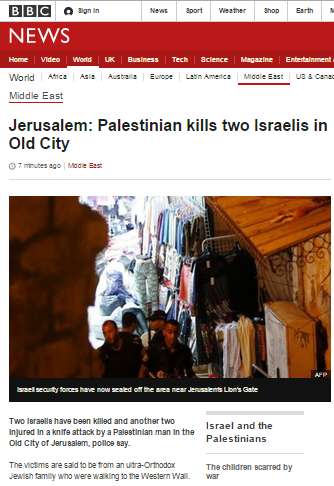
Moving on to the events of last week, the BBC outdid itself (if that is at all possible) in its outrageous headlines which even they themselves were persuaded – eventually – to change – four times! – until they matched the events on the ground. Honest Reporting gives us a screenshot of the initial BBC headline after a Palestinian terrorist stabbed and murdered two Israeli Rabbis and injured the wife and child of one of them in the Old City of Jerusalem:

BBC biased headline

Note how the headline focuses on the poor Palestinian murderer.

BBC Watch follows up on how the BBC flunked the headlines on the Jerusalem terror attack: – and includes a reference to the BBC’s misleading reporting on the murder of the Henkin’s two days previously, in which they did not mention the Palestinian Authority’s connection to the murder:

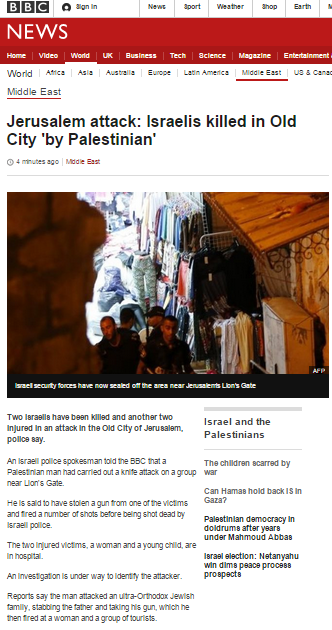
Predictably, that headline prompted considerable protest on social media and shortly after its publication the title was changed to one displaying yet another regular feature of BBC reporting; the use of superfluous punctuation.

Pigua Lions Gate art vers 2

Following further complaints, the headline was amended again.

Pigua Lions Gate art vers 3

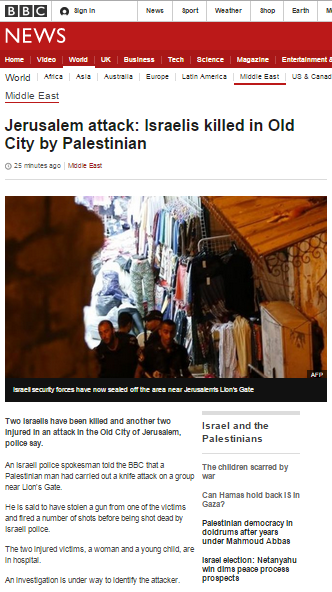
And later on – yet again.

Pigua Lions Gate art vers 4

In other words, professional journalists supposedly fluent in the English language had to make three changes to the article’s headline in not much more than an hour.

And what of the report itself? In line with standard BBC practice, the word terror does not appear in any of the versions of an article describing a terror attack on Israeli civilians. Readers are told that:

“It comes two days after an Israeli couple, who were in a car with their four children, were shot dead in the West Bank.”

Of course BBC audiences had not been informed that was a terror attack either.

Readers of the third version of the report were told that:

“Hamas, the Palestinian militant group that rules the Gaza Strip, issued a statement praising the attack which it described as “heroic”.”

They were not, however, informed that social media accounts belonging to Mahmoud Abbas’ Fatah party similarly praised the attack and described its perpetrator as a ‘hero’. The information concerning Hamas was later removed.
As BBC Watch remarked on its report on the BBC’s coverage of the Henkin murders:

The BBC cannot claim to be meeting its remit of building “a global understanding of international issues” as long as it continues to conceal the role played by the Palestinian Authority in inciting violence and executing terror attacks on Israeli civilians.

But the Beeb’s bias doesn’t seem to worry anyone in the British halls of power.

As for international coverage of the terror attacks that killed four Israeli civilians in 2 days, besides the countless attempted murder attacks via rock-throwing on the roads, firebombs, tossing firecrackers at the police, and arson, Israel experienced agricultural terrorism in the form of uprooted vineyards, as well as the destruction of priceless Bar Kochba-era antiquities.

Uprooted vines in the Shilo region

Kiryat Aravia caves before the destruction

The site after Palestinians bulldozed it

If you live outside Israel I’m pretty sure you haven’t heard of any of this. Edgar Davidson has produced another great (but sad) info-graphic showing the disparity in political reactions and the bias in reporting: (click to enlarge):
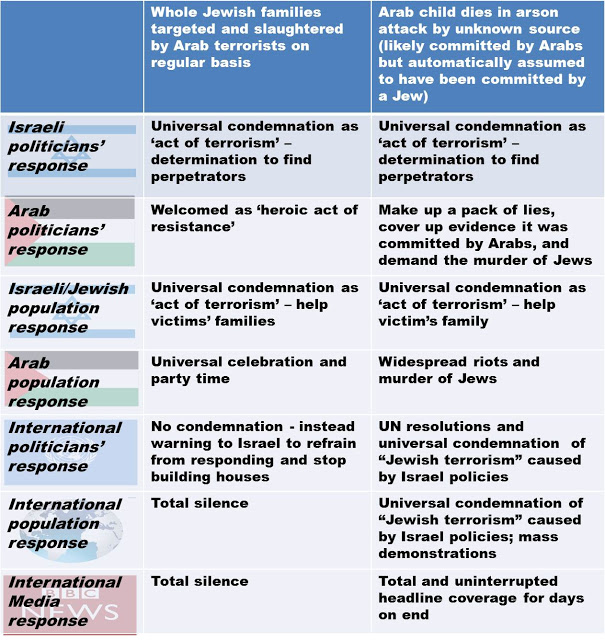
Compare and contrast responses to terror in Israel

Sadly, I find none of this surprising. We have become so inured to biased, misleading, distorted or simply missing reporting on Israel that, at least speaking for myself, I have no expectations at all from the foreign media and am pleasantly surprised when I find an accurate report.

However the bias at the US State Department which is also not new (it is dominated by Arabists, rather like the “Camel Corps” of the British Foreign Office), seems to have hit a new low.

The blogger “First One Through” at Jews Down Under created an instructive table comparing the State Department’s reactions to Israeli and Arab casualties of warfare and terrorism. Even with the knowledge that State is biased, I admit I was shocked by this (I edited the heading of the chart for errors):

Event July 1 Attack on Arabs October 1 Attack on Jews October 3 Attack on Jews
Words in Statement 122 68 77
Condemnation “condemns in strongest possible terms” “strongly condemns” “strongly condemns”
Terrorist attack “vicious terrorist attack” AND “terrorism” “terrorist attack” Not called terrorism
Condolences “profound condolences” “condolences” No condolences
Prayer for Injured “prayers for a full recovery” None None
Families mentioned “Dawabsheh family” None None
Location of Incident “Palestinian village of Douma” West Bank.” Not Israeli; not Samaria Old City of Jerusalem today”. Not Israeli
Call for Justice “murderers” “the perpetrators all perpetrators of violence” A general term

Furthermore, in an outrageously undiplomatic move, the White House instructed Secretary of State John Kerry and Ambassador to the UN Samantha Power to stay away from the UN while Binyamin Netanyahu delivered his speech to the UNGA last week.

https://twitter.com/RichardGrenell/status/649679192511135749

I cannot recall ever such a disgraceful, overtly antagonistic act being taken – for no reason other than hurt personal feelings – by the White House or the State Department. Shame on them!

But history is a cycle. Do you remember the “outrage” and “appalled” feelings at State when Israel hit a school or hospital – or rather, NEAR the buildings – in Gaza? That was described as a war crime and Israel was villified in every media outlet that you can think of, besides the State Department (reminder: the US is supposed to be Israel’s ally!) and of course the UN.

This week the tables have turned. Russia has begun brazenly bombing civilian targets in Syria. Meanwhile the US Air Force bombed an Afghan hospital, and it is instructive to note the media coverage and its comparison with Israel’s attack in Gaza, as Honest Reporting reports:

It will certainly be interesting to compare the media coverage of Russian and U.S. air strikes to the reports that Israel had to contend with. All too often, the media attributes a level of malevolence when it comes to Israeli military actions.

So, while, for example, the New York Times’s headline from July 2014 actively attributes responsibility to Israel for the alleged shelling of a UN school, its headline covering the Afghan hospital incident passively attributes the air strike rather than those who carried it out.

nytimes300714

nytimes031015Ultimately, both Israel and the U.S. have shared values when it comes to the ethics of war. It is hard to believe that the U.S. has intentionally targeted civilians in a hospital. It does, however, comparatively demonstrate the lengths that Israel goes to in order to avoid just such a scenario as the Afghan hospital.

It is a tragic inevitability that civilians will die in war. Russia does not appear to be influenced by morals or ethics. Meanwhile the U.S. may be realizing that it has something to learn from Israel when it comes to ethics on the battlefield.

I would have been angrier at the duplicity of the State Department, but I must admit I’m finally enjoying a great surge of schadenfreude at their expense as their spokesman squirmed, evaded and tried to wriggle out of a straight answer to a direct question posed by Matt Lee of AP about the Afghan hospital bombing. Watch the video at Israellycool:

Matt Lee decided to ask the State Department’s Mark Toner exactly what kind of standards they hold themselves to because it would seem to be a different set that they applied to Israel last year.

I’ll spoil it. He’s got no answer. They can’t justify it. They hold Israel to an impossible standard, one to which they cannot themselves match because this is war and bad stuff happens. We join the briefing for Matt’s follow up question after his first is left completely unanswered in over 3 minutes of bluster.

You can read the transcript of the entire question and answer session at the Israellycool link.

Enjoy! Maybe the State Department will think twice before again condemning Israel’s perfectly legal actions taken in self-defense.

One update before I go: there has been another terrorist stabbing in the Old City, near the site of the double murder on Saturday night:

Watch out for biased reporting about this one too – if it even gets a mention.

Robert Spencer: The speech the U.S. Catholic Bishops don’t want you to see

October 7, 2015

Robert Spencer: The speech the U.S. Catholic Bishops don’t want you to see, Jihad Watch via You Tube, October 5, 2015

(An excellent explication of differences between Islam and Christianity and the theological bases for the animosity of religious Muslims toward religious Christians. Please see also, Evangelicals Embrace Islamists at Maryland Interfaith Event. — DM)


According to the blurb beneath the video,

Jihad Watch director Robert Spencer was the keynote speaker at the annual convocation of the North American Lutheran Church, Dallas, Texas, August 13, 2015. He spoke about Muslim persecution of Christians.

The U.S. Conference of Catholic Bishops pulled their representative from the North American Lutheran Church convocation when they found out Spencer was the keynote speaker. Watch this speech and see what the Catholic Bishops of the United States don’t want you to know.

Russia’s endgame in Syria: Follow the Money

October 7, 2015

Russia’s endgame in Syria: Follow the Money, Center for Security Policy, John Cordero, October 6, 2015

(Is Putin engaging in a holy war against the Islamic State, an oily war or both? — DM)

3300795117

The one strategic motivation for Russia that has been widely ignored is the economic one.  Qatar, the richest country in the world per capita and also owner of the world’s largest natural gas field, proposed in 2009 to jointly construct a gas pipeline running through Saudi Arabia, Jordan, Syria, Turkey, and into Europe.  Assad, not wanting to provoke Moscow, refused to sign on.  Instead, he floated an alternative: an Iran-Iraq-Syria and possibly Lebanon pipeline, to then follow under the Mediterranean to Europe. The Qatar-Turkey pipeline would run through majority Sunni countries with the exception of Syria’s Alawite regime. Assad’s counter proposal follows the Shia crescent.

Russia, not wanting to lose its primary market in Europe, is adamantly opposed to a prospective Qatari project.  A military presence in Syria will guarantee that even if Assad is removed from power, the pipeline will not be built.  It will look on favorably to the Iranian proposal, provided Gazprom and other state-owned companies get their share of the pie.

****************************

As Vladimir Putin orders airstrikes against rebels of all stripes fighting Bashar al-Assad’s regime, there are important strategic economic goals behind Russia’s actions in Syria.  The short term goal is easy to discern: prevent Assad’s collapse as no alternative suitable to Russian interests exists, preserve Russia’s only naval base in the Middle East at Tartus, and promote Russia both at home and abroad as a world power that counterbalances American hegemony.

Much of the media has focused on Putin as a personal driver of Russian behavior.  While forays into Georgia and Ukraine have accomplished the tactical goals of preventing increased European Union presence in Russia’s sphere of influence, these have come at a high cost both politically and economically in the form of isolation and sanctions. Putin seems to have concluded that intervening in Syria in the name of fighting terrorism can only help repair Russia’s battered image.

It is important to at least try to understand Putin’s motivation without delving too much into psychoanalysis.  He is on record as lamenting the collapse of the Soviet Union as “the greatest geopolitical catastrophe of the 20th century.”  In power since 2000, the former KGB officer is an ardent Russian nationalist, a promoter of a personality cult concerned with his country’s standing and perception in the world.  With his career spent in the service of the state, he is not one to take a background role in world affairs. Putin has effectively used Russia’s alliance with Iran as an effective tool to undermine the US, both regionally in the Gulf and globally with the nuclear deal.

The current buildup at Tartus and Latakia is nothing new: since Hafez al-Assad’s rise to power in 1970, the Former Soviet Union and then Russia was and is a stalwart ally, long attempting to position Syria as a counterbalance to American and Israeli military superiority in the Middle East.

Russia’s actions are also a message to the world: unlike the US, which abandoned long-time ally Hosni Mubarak during his time of need in Egypt, Russia is prepared to intervene, militarily if necessary, to preserve a friendly regime in danger.  Therefore, it pays for autocrats to court Moscow, especially if they possess valuable resources or are in prime strategic locations.

While Vladimir Putin ostensibly espouses the acceptable goal of a global alliance against IS, the strategic context is that he has entered into a sectarian alliance with Shia Iran, Iraq, Syria, and the proxy army Hezbollah (The P4+1) against the American-backed Sunni alliance of Turkey, Saudi Arabia, Qatar, Jordan, and the UAE, all of whom insist that Assad has no future in Syria.

Through its airstrikes, Russia continues to advance the prior Syrian strategy of focusing efforts against pro-Western rebels, with the recognition that, while dangerous, the Islamic State is the one party in the conflict the West will never support.

The Islamic State will take advantage of both the respite, and the propaganda value of being the recognized number one enemy of the infidel coalition, which it uses to rally supporters simply by pointing out that its enemies are gathering to destroy the renewed Caliphate.

The one strategic motivation for Russia that has been widely ignored is the economic one.  Qatar, the richest country in the world per capita and also owner of the world’s largest natural gas field, proposed in 2009 to jointly construct a gas pipeline running through Saudi Arabia, Jordan, Syria, Turkey, and into Europe.  Assad, not wanting to provoke Moscow, refused to sign on.  Instead, he floated an alternative: an Iran-Iraq-Syria and possibly Lebanon pipeline, to then follow under the Mediterranean to Europe. The Qatar-Turkey pipeline would run through majority Sunni countries with the exception of Syria’s Alawite regime. Assad’s counter proposal follows the Shia crescent.

Russia, not wanting to lose its primary market in Europe, is adamantly opposed to a prospective Qatari project.  A military presence in Syria will guarantee that even if Assad is removed from power, the pipeline will not be built.  It will look on favorably to the Iranian proposal, provided Gazprom and other state-owned companies get their share of the pie.

Pipeline politics in the region have a long and varied history of Russian involvement.  The Baku-Tbilisi-Ceyhan oil pipeline was built only after Moscow’s demand for an alternative pipeline for Azeri oil to Russia was met.  During the 2008 Russia-Georgia war, US intelligence officials determined that an explosion on the pipeline near the Turkish-Georgian border was carried out via Russian government cyber warfare.  Days after the explosion, Russian fighter jets bombed positions in Georgia close to the pipeline. Although the BTC pipeline was built precisely to avoid Russian interference, the Kremlin has never let that stop them.

Turkey and Azerbaijan have also begun construction on a joint natural gas pipeline, theTANAP. This project’s stated goal is to reduce the EU’s dependence on Russian natural gas, a prospect that cannot please Moscow.   Both the BTC and TANAP bypass Armenia, a Russian ally and wary of its neighbors in the Caucasus.

As the endpoint for the Qatari project, Turkey is adamant in calling for Assad to step down or be removed, which dovetails with the proposed Sunni pipeline.  By clearing the way through Syria, Qatar and Saudi Arabia can receive a handsome return on their investment in backing jihadis fighting Assad.  On the other hand, Iran will not sit idly by and leave potential billions of dollars in the hands of its ideological and regional enemies.

Russian intervention in Syria is just beginning. There is every possibility that it will expand as more targets are found, perhaps those that are in the way of the proposed Iranian pipeline, directly threatening Damascus and by extension, the Russian monopoly of gas exports to Europe.  For the time being, Putin has the world’s attention.

AP INVESTIGATION: Nuclear smugglers sought extremist buyers

October 7, 2015

AP INVESTIGATION: Nuclear smugglers sought extremist buyers
By Desmond Butler And Vadim Ghirda Associated Press October 6, 2015

This undated photo provided by the Moldova General Police Inspectorate shows Alexandr Agheenco, a Russian citizen based in Moldova’s breakaway region of Trans-Dniestr, and called “the Colonel” by his cohorts. Authorities said a 2011 uranium-235 smuggling operation was led by him with Teodor Chetrus, a former KGB informant, as his middleman. (Moldova Police via AP) (AP)


(This article pretty much speaks for itself. With Russians like these guys, who needs enemies. – LS)

CHISINAU, Moldova (AP) — In the backwaters of Eastern Europe, authorities working with the FBI have interrupted four attempts in the past five years by gangs with suspected Russian connections that sought to sell radioactive material to Middle Eastern extremists, The Associated Press has learned. The latest known case came in February this year, when a smuggler offered a huge cache of deadly cesium — enough to contaminate several city blocks — and specifically sought a buyer from the Islamic State group.

Criminal organizations, some with ties to the Russian KGB’s successor agency, are driving a thriving black market in nuclear materials in the tiny and impoverished country of Moldova, investigators say. The successful busts, however, were undercut by striking shortcomings: Kingpins got away, and those arrested evaded long prison sentences, sometimes quickly returning to nuclear smuggling, AP found.

Moldovan police and judicial authorities shared investigative case files with AP in an effort to spotlight how dangerous the nuclear black market has become. They say the breakdown in cooperation between Russia and the West means that it has become much harder to know whether smugglers are finding ways to move parts of Russia’s vast store of radioactive materials — an unknown quantity of which has leached into the black market.

“We can expect more of these cases,” said Constantin Malic, a Moldovan police officer who investigated all four cases. “As long as the smugglers think they can make big money without getting caught, they will keep doing it.”

In wiretaps, videotaped arrests, photographs of bomb-grade material, documents and interviews, AP found a troubling vulnerability in the anti-smuggling strategy. From the first known Moldovan case in 2010 to the most recent one in February, a pattern has emerged: Authorities pounce on suspects in the early stages of a deal, giving the ringleaders a chance to escape with their nuclear contraband — an indication that the threat from the nuclear black market in the Balkans is far from under control.

Moldovan investigators can’t be sure that the suspects who fled didn’t hold on to the bulk of the nuclear materials. Nor do they know whether the groups, which are pursuing buyers who are enemies of the West, may have succeeded in selling deadly nuclear material to extremists at a time when the Islamic State has made clear its ambition to use weapons of mass destruction.

The cases involve secret meetings in a high-end nightclub; blue-prints for dirty bombs; and a nerve-shattered undercover investigator who slammed vodka shots before heading into meetings with smugglers. Informants and a police officer posing as a connected gangster — complete with a Mercedes Benz provided by the FBI — penetrated the smuggling gangs. The police used a combination of old-fashioned undercover tactics and high-tech gear, from radiation detectors to clothing threaded with recording devices.

The Moldovan operations were built on a partnership between the FBI and a small team of Moldovan investigators — including Malic, who over five years went from near total ignorance of the frightening black market in his backyard to wrapping up four sting operations.

“In the age of the Islamic State, it’s especially terrifying to have real smugglers of nuclear bomb material apparently making connections with real buyers,” says Matthew Bunn, a Harvard professor who led a secret study for the Clinton administration on the security of Russia’s nuclear arsenal.

The Moldovan investigators were well aware of the lethal consequences of just one slip-up. Posing as a representative’s buyer, Malic was so terrified before meetings that he gulped shots of vodka to steel his nerves. Other cases contained elements of farce: In the cesium deal, an informant held a high-stakes meeting with a seller at an elite dance club filled with young people nibbling on sushi.

In the case of the cesium, investigators said the one vial they ultimately recovered was a less radioactive form of cesium than the smugglers originally advertised, and not suitable for making a dirty bomb.

The most serious case began in the spring of 2011, with the investigation of a group led by a shadowy Russian named Alexandr Agheenco, “the colonel” to his cohorts, whom Moldovan authorities believe to be an officer with the Russian FSB, previously known as the KGB. A middle man working for the colonel was recorded arranging the sale of bomb-grade uranium, U-235, and blueprints for a dirty bomb to a man from Sudan, according to several officials. The blueprints were discovered in a raid of the middleman’s home, according to police and court documents.

Wiretapped conversations repeatedly exposed plots that targeted the United States, the Moldovan officials said. At one point the middleman told an informant posing as a buyer that it was essential that the smuggled uranium go to Arabs.

“He said to the informant on a wire: ‘I really want an Islamic buyer because they will bomb the Americans,'” said Malic, the investigator.

As in the other cases, investigators arrested mostly mid-level players after an early exchange of cash and radioactive goods.

The ringleader, the colonel, got away. Police cannot determine whether he had more nuclear material. His partner, who wanted to “annihilate America,” is out of prison.

Fatah leaders ‘salute’ Palestinians for rising to defend al-Aksa Mosque

October 7, 2015

Fatah leaders ‘salute’ Palestinians for rising to defend al-Aksa Mosque

Source: Fatah leaders ‘salute’ Palestinians for rising to defend al-Aksa Mosque – Arab-Israeli Conflict – Jerusalem Post

Fatah leaders who met in Ramallah on Wednesday “saluted” the Palestinians for “rising to defend their al-Aksa Mosque and confronting terrorist settlers.”

The members of the Fatah Central Council, including Palestinian Authority President Mahmoud Abbas, called on Palestinians to “preserve the popular nature” of the current protests “as part of a comprehensive national strategy to avoid sliding into the Israeli square.”

A statement released at the end of the meeting said that the Fatah Central Council stands behind Abbas’s policies as expressed in his recent speech at the UN General Assembly.

Abbas’s spokesman, Nabil Abu Rudaineh, said that the PA president briefed the Fatah leaders on the outcome of his contacts with various parties “in order to secure international protection for the Palestinians, who are facing wanton Israeli aggression.”

Abu Rudaineh said that the Palestinians would ask the UN Security Council to issue a statement calling for an end to settlement construction, providing protection for the Palestinians and recognizing a Palestinian state with Jerusalem as its capital on the pre-1967 lines.

He said that Abbas reiterated during the meeting his position that the Palestinians would revise signed agreements with Israel if the Israel government does not abide by them.


Senate set to pass bill funding Israeli anti-missile programs

October 7, 2015

Senate set to pass bill funding Israeli anti-missile programs But annual defense bill, which also includes money for anti-tunnel programs, faces presidential veto in latest round of Washington budgetary wars

By Rebecca Shimoni Stoil

October 7, 2015, 7:23 pm

Source: Senate set to pass bill funding Israeli anti-missile programs | The Times of Israel

An Iron Dome air defense system fires to intercept a rocket from the Gaza Strip in Tel Aviv, Israel, on Wednesday, July 9, 2014. (AP/Dan Balilty)

An Iron Dome air defense system fires to intercept a rocket from the Gaza Strip in Tel Aviv, Israel, on Wednesday, July 9, 2014. (AP/Dan Balilty)

WASHINGTON – The US Senate is expected to vote Wednesday afternoon to advance a key defense spending bill with a number of provisions guaranteeing security assistance to Israel, but is expected to run into the president’s veto pen.

The National Defense Authorization Act is the newest epicenter of a fight over federal spending levels and the budget for fiscal year 2016.

The bill, which governs defense spending for the 2016 fiscal year, would authorize the establishment of a joint anti-tunnel program between Israel and the US. The initiative would be funded up to $25 million per year, provided that matching funds are provided by Israel. The bill would also provide over $206 million earmarked for rocket and missile defense ventures, including $41.4 million for the Iron Dome missile defense project, up to $150 million for procurement of the David’s Sling mid-range rocket interceptor, and a maximum of $15 million for the Arrow 3 long-range interceptor program.

It also would require Congress to be briefed on the anticipated sale of fighter airplanes to Qatar, including an analysis reflecting on the implications of the sale for Israel’s ability to retain its “qualitative military edge.”

Speaking late last month in Washington, former IDF chief-of-general-staff Lt.-Gen. (res.) Benny Gantz emphasized the commitment to Israel’s military edge as one of the highlights of the US-Israel relationship.

The act is viewed as a must-pass piece of legislation that sets funding levels for the coming fiscal year and, on the way, also dictates national defense policy.

If the Senate passes the bill, it will head to President Barack Obama, who has already indicated that he will veto the bill.

Obama is unhappy that the bill ups funding to the Defense Department by tens of billions of dollars and surpasses the levels determined by the budget-cutting sequestration legislation.

Sequestration, which went into effect in 2013 as a result of the failure of Congress and the administration to agree to meaningful reductions in federal spending, entailed a series of across-the-board budget cuts to many key federal operations – including defense.

The Senate, however, seemed poised to forge ahead with the legislation, despite the threat from the White House.

On Tuesday, the Senate voted 73-26 to invoke cloture on the bill, which means that open debate over the legislation has ended and that following up to 30 hours of post-cloture debate the next likely step is to vote on it. Unlike in the case of the promised presidential veto of the disapproval vote on the Iran nuclear deal, Democrats did not try to block the bill from advancing by preventing cloture – a process known as the filibuster.

Nevertheless, Senate Minority Leader Harry Reid indicated late Tuesday that despite the fact that over half of the Senate Democrats voted to invoke cloture, he would garner enough Democratic votes after the bill’s passage to prevent the Senate from overriding the presidential veto.

Overturning a presidential veto requires a 67-vote majority in the Senate.

In addition to setting funding for joint US-Israel partnerships as part of the larger defense budget, the current legislation includes a number of policy dictates regarding US actions in the Middle East.

The bill would require the Secretary of Defense and the Secretary of State to jointly submit to Congress by mid-February “a strategy for the Middle East and to counter violent extremism.”

It would require the already mandatory annual report on Iran’s military power to include a section on Iran’s cyberwarfare capabilities and would also require a new report on “any military-to-military engagements conducted by the Armed Forces or Department of Defense civilians with representatives of the military or paramilitary forces (including the Iranian Revolutionary Guards Corps’ Quds Force) of the Islamic Republic of Iran during the one-year period ending on the date of the submission of the report.”

The bill also contains what is called a “sense of Congress” clause, expressing concern that Iran’s activities “justify continued pressure by the United States” and that as a result, the US should continue to work with regional partners to counter Iranian threats.

Egypt’s secular culture minister ruffles Salafi feathers

October 7, 2015

Egypt’s secular culture minister ruffles Salafi feathers, Al-MonitorRami Galal, October 6, 2015

(Building a secular Muslim state in a region dominated by Islamists is difficult and takes time, as Egypt and Al-Sisi are learning. — DM)

helmiEgypt’s newly appointed Culture Minister Hilmi al-Namnam appears on the Egyptian talk show 25/30, Nov. 11, 2014. (photo by youtube.com/ONtv)

CAIRO — On Sept. 19, a new Egyptian Cabinet, headed by Prime Minister Sherif Ismail, was sworn in before President Abdel Fattah al-Sisi. Among the new ministers is the journalist Hilmi al-Namnam, who holds the culture portfolio. The appointment of Namnam, a secularist, has sparked controversy among Egyptian Salafis and aroused opposition in Saudi Arabia. Such Saudi writers and intellectuals as Jamal Khashoggi, editor-in-chief of Al-Arab News Channel, object to Namnam’s appointment because he opposes Wahhabi Salafism, the religiopoliticial movement that originated in the Nejd region of the Saudi kingdom.

Muhammad ibn Abd al-Wahhab founded what became the Wahhabi movement in the 18th century. In 1744, Wahhab allied with Muhammad ibn Saud, emir of the Nejd and founder of the first Saudi state, to increase followers of the Quran, Sunnism and the words and actions of the Salaf, the first three generations of Muslims. In doing so, they sought to purify Islam of misguided practices negatively affecting the Islamic essence of unity and various forms of heresy.

Immediately after Namnam assumed the culture portfolio, a video of him from July 2013 went viral. In it, Namnam stated, “The political Islam current must leave the political game completely, especially the Salafist Nour Party, which is more dangerous than the Muslim Brotherhood.” He compared the Nour Party to a “whore who extorts her husband if he doesn’t fulfill her demands by escorting someone else.” Namnam also said, “We lie when we say Egypt is a naturally religious country. It is high time we said Egypt is a naturally secular state.”

The Nour Party came in second in the 2012 parliamentary elections. Among its positions at the time were prohibitions on electing women and Copts, saluting the flag and singing the national anthem. The party altered these platforms, however, after lending its stamp of approval in 2013 to the June 30 revolution, although most of its leading figures waivered over what course to take.

On Sept. 19, Shaaban Abdel Aleem, a member of the Nour Party’s board, requested information on the selection criteria used for appointing the new ministers. On the same day, Khashoggi, who is close to Saudi decision-makers, commented on Namnam’s appointment via Twitter. “For whoever is planning mutual cultural exchanges with our brothers in Egypt, the following piece of information could be useful: Namnam is not only a critic of Wahhabism, but abhors it and blames it for all his country’s catastrophes,” Khashoggi tweeted. In a separate tweet, he wrote, “Honestly, for the sake of relations between Saudi Arabia and Egypt, and due to the nature of the regime there, Egypt should not appoint a minister like Namnam, who has taken it too far in offending the kingdom.”

Namnam responded that evening in a phone call to “Al-Ashera Masaa,” a show on Dream TV, saying, “I did not say Wahhabism was the mother of vices. These are not my words, but I am against terrorist groups in general.” He added that he had criticized “attempts to export Wahhabism to Egypt,” but that he “respects the kingdom’s choices, just as the kingdom’s writers should respect Egypt and Egyptians’ choices.”

Khashoggi immediately replied, again on Twitter, writing, “Egypt’s minister of culture claims he respects Wahhabism, but admits that he is against exporting it to Egypt. I would like to tell him that Wahhabism cannot be exported. It is a pillar of the Egyptian revolution and is represented by emblematic figures like the followers of Sheikh Muhammad Abduh.” The Islamic jurist Abduh, an Egyptian, is a founder of Islamic modernism. He spearheaded the movement at the end of the 19th century, beginning of the 20th century to counter intellectual and cultural stagnation and revive the Islamic nation in line with the times.

Khashoggi argued, “Salafism preceded the Muslim Brotherhood in Egypt, as there was the Ansar al-Sunna al-Muhammadiyah group, which remains the oldest reformist Islamic organization in Egypt and the world.” Ansar al-Sunna al-Muhammadiyah seeks absolute unity and the rejection of superstitions and cults. It began in Cairo’s Hadara Mosque in 1926. Many Al-Azhar scholars and Salafist preachers were welcoming of it.

On Oct. 2, tensions escalated when Namnam said during an interview on the Sada al-Balad channel that he was ready to be “martyred to spare Egypt from turning into a caliphate state.” He added that secularism is not the adversary of Islam, as some claim. “Every moderate Muslim is necessarily secular. But, not every secularist is a Muslim,” he said.

The following day, Yasser Borhami, deputy leader of the Salafist Call, implored Sisi to intervene and forbid Namnam from making such statements, which he said contradict the constitution given that Sharia is the primary source of legislation.

Nour Party leader Younes Makhyoun entered the fray Oct. 3, asserting that Namnam should remain impartial or be dismissed. “The person [Sisi] who appointed this minister must oblige him to respect the constitution,” he stated.

Sayyed Mustafa, deputy chair of the Nour Party, told Al-Monitor, “The party did not look into Namnam’s old opinions, because they stem from personal freedom. Each person has the right to believe whatever they wish. But he must realize that he is the minister of culture for 90 million Egyptians. The Ministry of Culture should represent all currents, not just one, be it secular or nonsecular.” He added, “As a minister handling a political portfolio, Namnam must take into consideration Egypt’s foreign relations in general and brotherly relations in particular, like those it shares with Saudi Arabia.”

Zubeida Atta, former dean of Helwan University’s faculty of arts and a member of the Supreme Council of Culture, has a different perspective on the issue. “The concept of secularism that Namnam called for is not a heretical one. It relies on the use of education and its application in countries to improve them and ensure their civil aspects, instead of mixing religion with political life. The latter [mixing of the two] would send Egypt down a sectarian abyss that would threaten its existence,” she told Al-Monitor. “The Nour Party demanded clarifying the selection criteria of ministers. I demand clarifying the criteria that allow such a religious party to participate in political life and in parliamentary elections.”

As for the rumblings from the Gulf, Atta asserted, “Egypt does not dare suggest a Saudi Arabian minister for a certain ministry in the kingdom or criticize a current minister in the Saudi Arabian regime, because this is an internal Saudi Arabian matter. Why is Khashoggi, among others, allowing himself to interfere in the appointment of a minister in the Egyptian Cabinet?”


Right Turn Opinion Our ‘Baghdad Bob’ president

October 7, 2015

Right Turn Opinion Our ‘Baghdad Bob’ president, Washington PostJennifer Rubin, October 7, 2015

(Ms. Rubin is WaPo’s token conservative. Do go to the link and read the generally unfavorable comments about her article. — DM). 

So it has come to this: We now can recognize that Carter was not malicious or indifferent to American influence; he was simply slow to catch on. If Carter, widely regarded as the weakest foreign policy president of the second half of the 20th century, looks good in comparison, you can understand how daft is Obama’s worldview. Had he been in Carter’s shoes, I suppose he would have cheered rather than take steps to mitigate imperialistic aggression. Umm, thank goodness Carter was in the White House and not Obama? Yes, it has come to that.

****************************

Mohammed Saeed al-Sahaf, better known as “Baghdad Bob,” was the unintentionally hilarious Iraqi information minister who, no matter what evidence to the contrary, emphatically predicted evisceration of U.S. forces during the Iraq war and denied any news suggesting otherwise. As NBC News recalled, “His last public appearance as information minister was on April 8, 2003, the day before the fall of Baghdad, when he said that the Americans ‘are going to surrender or be burned in their tanks. They will surrender, it is they who will surrender.’ ”

Baghdad Bob now seems to be the model for the Obama White House. Ramadi falls to the Islamic State? No bother, we are winning! Russia invades Ukraine? Russian President Vladimir Putin — take this! — is on the “wrong side of history,” is only going to “wreck his country’s economy and continue Russia’s isolation,” was “desperate” to talk to Obama (and the next day commenced bombing U.S.-backed rebels in Syria) and is about to get “stuck in a quagmire” in Syria. Russia moves more forces into Syria, changing the dynamic in the Middle East? President Obama brushes it aside. Putin is acting out of “weakness,” you see. Next thing you know, the Russians will have to “surrender or be burned in their tanks.”

One is tempted to assume, is hopeful even, that the president and his spokesmen don’t believe what they are saying. It is less frightening to imagine this is ham-handed excuse-mongering for a failed foreign policy than to imagine Obama thinks things are going swimmingly. If Obama actually believes we have Putin just where we want him, why not concede all of Ukraine — or the rest of the former Soviet Union, even. If it’s to our advantage to have Russia prop up Syrian President Bashar al-Assad and destroy the U.S.-backed rebels, then we should be thrilled Russia is now being invited into Iraq to bomb the Islamic State. For that matter, why not welcome Iranian domination of Iraq and a new Shiite-Russian-Iranian crescent?

This is the bizarre parallel universe in which U.S. marginalization is good, chaos is nothing to worry about, the worst human rights offenders are our partners and traditional U.S. allies (Israel, Sunni states, even Turkey) will just have to lump it. It’s a world in which the system of nation-state sovereignty is subsumed to zones of influence — without the United States getting a zone. About the only politician willing to buy into such insanity is Donald Trump, who thinks it is a swell idea to have Putin fighting the Islamic State (except he is not fighting the Islamic State).

You can see why conservatives consider Obama a sharp departure from decades of American foreign policy under Democratic and Republican presidents. Instead of acting as a guarantor of the West’s security, the friend of free peoples and a check against rogue states, we rationalize weakness and abandon innocents. We tend to describe the president’s foreign policy as “feckless,” but it is worse: It is monstrous.

Even Jimmy Carter woke up, it is said, when the Soviets invaded Afghanistan. He did not think it was a good thing that the Soviets were invading an independent nation or that the West should huff and puff but take no action.

To the contrary, in what was surely the best speech of his presidency, Carter told the country: “This invasion is an extremely serious threat to peace because of the threat of further Soviet expansion into neighboring countries in Southwest Asia and also because such an aggressive military policy is unsettling to other peoples throughout the world. This is a callous violation of international law and the United Nations Charter. It is a deliberate effort of a powerful atheistic government to subjugate an independent Islamic people.” Unlike Obama, Carter grasped the danger in letting aggressors succeed: “The United States wants all nations in the region to be free and to be independent. If the Soviets are encouraged in this invasion by eventual success, and if they maintain their dominance over Afghanistan and then extend their control to adjacent countries, the stable, strategic, and peaceful balance of the entire world will be changed. This would threaten the security of all nations including, of course, the United States, our allies, and our friends.” He went on to announce a series of concrete steps — “defer further consideration of the SALT II treaty,” “delay opening of any new American or Soviet consular facilities, and most of the cultural and economic exchanges,” “halt or to reduce exports to the Soviet Union,” suspend licensing of “high technology or other strategic items,” end grain sales, pull out of the Olympics and “provide military equipment, food, and other assistance to help Pakistan defend its independence and its national security against the seriously increased threat it now faces from the north.”

More important, unlike Obama, who is emphatic that we stay on the path of slashing our military, Carter began repairing our military and extending covert efforts, as historian Arthur Herman recalls:

The first was pledging that US defense spending would rise by 4.6 percent per year, every year for five years, starting in 1980. This shocked and infuriated his fellow Democrats — and greased the wheels for President Ronald Reagan’s military buildup. (In the event, Reagan wound up increasing defense outlays less than Carter had planned.)

The second step came in the 1980 State of the Union Address, with announcement of the Carter Doctrine: The United States would use military force if necessary to defend our interests in the Persian Gulf.

To back this up, the president authorized the creation of the first Rapid Deployment Force — the ancestor of US Central Command or CENTCOM, the wheelhouse from which the United States would direct Desert Storm in 1991 and the fall of Saddam Hussein a decade later, and which keeps the Straits of Hormuz, vital to global energy markets, safe and open today.

The last step was authorizing the first covert military aid to Afghan guerrillas fighting their Soviet occupiers. That marked the start of the Soviet quagmire in Afghanistan — a major landmark in the ultimate undoing of the Soviet Union.

You see, a “quagmire” happens only when a power is confronted, stalls and undergoes unjustified losses. Otherwise, it is called a successful invasion.

So it has come to this: We now can recognize that Carter was not malicious or indifferent to American influence; he was simply slow to catch on. If Carter, widely regarded as the weakest foreign policy president of the second half of the 20th century, looks good in comparison, you can understand how daft is Obama’s worldview. Had he been in Carter’s shoes, I suppose he would have cheered rather than take steps to mitigate imperialistic aggression. Umm, thank goodness Carter was in the White House and not Obama? Yes, it has come to that.

Disgusting video encourages Arabs to murder Jews

October 7, 2015

Disgusting video encourages Arabs to murder Jews, elderofziyon2 via You Tube, October 6, 2015


This video was released apparently from Gaza telling Arabs to attack Jews.

Not Israelis – Jews.

Abbas is playing with fire

October 7, 2015

Abbas is playing with fire, Israel Hayom, Dr. Reuven Berko, October 7, 2015

Palestinian Authority President Mahmoud Abbas is continuing to play with fire. He and his ilk are claiming that because Israel is stuck in stalled negotiations, it is creating a show of violence and terrorism to increase international pressure to solve the Palestinian problem.

In reality, the situation is the exact opposite: In light of the chaos, the threat of millions of refugees from the Middle East looming over Europe, and the fact that Islamic terror is reigning over the international agenda, the Palestinian problem has nearly fallen off the radar. That is why the PA and Hamas are trying to revive the issue using Jewish blood.

The desperate situation they are in has led the PA and Hamas to use the infamous trigger: “Al-Aqsa is in danger.” Israel’s declarations that it would maintain the status quo on the Temple Mount did not help. Even as mosques and churches in the area were burned, the incitement did not stop, despite the well-known fact that it is precisely Al-Aqsa that is the best-kept mosque. Even the hadith in which Muhammad urged restraint, saying, “One drop of a Muslim blood is worth more than the Kaaba and it’s surroundings,” did not change the bloody equation appearing in Al Jazeera, the media outlet funded by Qatar’s ruling family, the house of Thani.

The truth is that Abbas and his people (as well as some of the people from the Joint Arab List and the Islamic Movement) yearn to realize the dream of a third intifada, which is supposed to be a repeat of the first one, “an unarmed mass carrying out Ghandi-style civil disobedience.” Jewish deaths are of course necessary to keep things running smoothly. However, like all pyromaniacs, Abbas and his crew have not devoted a thought to whether the fire could burn them as well, or to how they could possibly escape.

Abbas and his people have yet to condemn the recent attacks, rather, they simply issued a belated call to stop the violence. Having once advocated “controlled rock attacks,” it is now hard for them to put Hamas’ terrorist genie back in the bottle. They know very well that security cooperation with Israel primarily serves the PA’s internal security needs.

In terms of the Palestinian “constitution,” Abbas long ago lost his government’s legitimacy, and West Bank opinion polls indicate the public’s support for Hamas in the armed struggle against Israel. When Kalashnikovs fire, the rocks pile up on the graves of the top terrorists. It is clear to Abbas that if things get out of hand, as they did in Gaza in 2007, and Hamas takes over the territory, PA leaders will be thrown from rooftops and the property they accumulated thanks to their corrupt ways will be confiscated. Then, to Israel’s satisfaction, no one will pressure it to promote Hamas in the West Bank as a state alongside Islamic State.

Therefore, the PA’s threats to end security cooperation with Israel are empty, designed to extort what it wants through international pressure, with nothing in return for Israel. The Palestinian moment of truth has arrived. Abbas must now publicly recognize Israel as a Jewish state, forgo the folly of “return,” agree to land swaps, and agree to a demilitarized state with Ramallah as its capital and borders that are not under its own control.

The hadith that says, “The believer is not stung from the same hole twice,” teaches Muslims to learn lessons from the past. But the false memory of the Palestinians, and also of some Israeli Arabs who are dreaming of an intifada, has made them forget the disasters that were caused by their repeated clashes with Israel. In the wake of the “Arab Spring,” they should really consider changing their memory card.