Archive for September 3, 2015

Iran Promises to ‘Set Fire’ to U.S. Interests

September 3, 2015

Iran Promises to ‘Set Fire’ to U.S. Interests, Washington Free Beacon, September 3, 2015

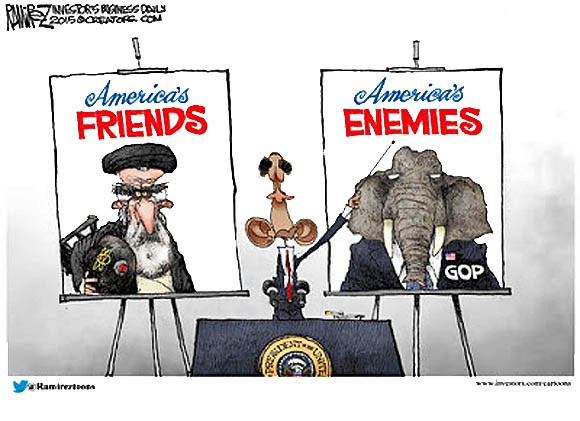
(Despite a the “deal” that favors Iran on every point, Obama’s Iranian friends keep saying “death to America.” He does not seem to mind. Who are his real friends and enemies?

Obama's enemies

— DM)

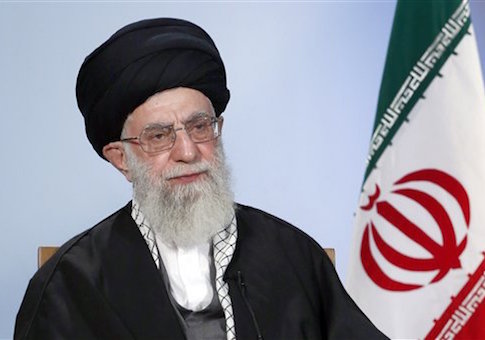
(AP Photo/Office of the Supreme Leader)

A senior Iranian military official has vowed to “set fire” to all U.S. interests in the region and maintained that the Islamic Republic welcomes war with America, according to regional reports demonstrating that Tehran is still committed to fighting the United States in the wake of a recently inked nuclear accord.

“In threatening remarks,” a top Iranian commander of the Revolutionary Guard Corps (IRGC) stated that Iran is prepared to “annihilate” U.S. and Israeli war forces should they “take the slightest military move against Iran,” according to Iran’s state-controlled Fars News Agency.

“We monitor their acts day and night and will take every opportunity to set fire to all their economic and political interests if they do a wrong deed,” Brigadier General Hossein Salami, the IRGC’s lieutenant commander, was quoted as saying in Tehran on Thursday.

In a direct threat to both the United States and Israel, Salami promised to “cut off enemies’ hands and fingers will then send its dust to the air,” according to the report.

These Iranian military officials were responding to multiple claims by U.S. officials that a military option against Tehran still remains on the table, despite the recently inked accord, which aims to constrain the Islamic Republic’s contested nuclear program.

In May, Salami said that Iran desires a war with the United States.

“We have prepared ourselves for the most dangerous scenarios and this is no big deal and is simple to digest for U.S.; we welcome war with the U.S. as we do believe that it will be the scene for our success to display the real potentials of our power,” he said at the time.

The comments came on the say day that the Iranian military unveiled a new missile defense system to track enemy threats.

“The system can detect and trace targets, take decisions for the operation of the missile systems, decide about the type of weapon systems needed, assess and foresee hostile targets, and field commanders can easily take a final decision with the data provided by the command and control system,” according to Fars.

Meanwhile, Iranian Supreme Leader Ali Khamenei on Thursday said that Iran is not open to negotiate with the United States on any other issue outside of the nuclear portfolio.

Khamenei “reiterated the complete ban on any negotiation between the Iranian officials and the Americans on other issues, and said there won’t be any other talks with the White House, except for the nuclear issue,” according to Fars.

“The U.S. positions are fully against the stances of the Islamic Republic,” Khamenei was quoted as saying in a wide-ranging speech.

Khamenei also called on the country’s leaders to attack U.S. critics of the deal.

“In the nuclear talks with are negotiating with the 5+1, but the U.S. administration is, in fact, the main party; but the U.S. officials speak very badly and a decision needs to be taken about the manner they speak,” Khamenei told the country’s powerful Assembly of Experts.

“Don’t say that the Americans are uttering these words to convince their internal rivals; of course, I believe that the internal disputes in the U.S. are real and they have differences and the reason for such a difference is clear to us, but what is officially said needs a response and if no response is given to them, the other side’s remarks will be entrenched,” Khamenei said.

Should Israel and its Arab neighbors form an alliance against Iran?

September 3, 2015

Should Israel and its Arab neighbors form an alliance against Iran? The Hill, Eli Verschleiser, September 3, 2015

Could a nuclear deal with Iran accomplish more than decades of diplomacy in the Middle East and, rather ironically, create new alliances between Israel and Arab neighbors?

That’s a key question as we gear up for the battle on Capitol Hill over President Barack Obama’s controversial pact with Tehran to limit uranium enrichment in return for lifting of sanctions. Critics say the agreement paves the way for a double reward of Tehran— a huge influx of cash and an eventual, unfettered path toward nuclear arms.

Neither the Saudis, the Kuwaitis, nor the United Arab Emirates or for that matter any of the other Persian Gulf states are too excited about the prospect of a nuclear-armed Iran. The role of Iran in the conflicts in Iraq and Syria, and the rise of Islamic State terror and the Muslim Brotherhood, have become a much bigger problem for Arab leaders than the tired conflict with Israel. Those countries have a Sunni majority, while Persian Iran is led by rival Shia Muslims.

Iran, of course, is also a major oil rival for the Gulf States and became more powerful following the fall of Saddam Hussein’s Iraq.

The Saudis have been publicly moderate on the deal but said to be privately angry over it. Epitomizing the old Middle East adage that the enemy of my enemy is my friend, the Saudis were reported to have offered Israel the ability to use their airspace to strike at Iran. This is a crucial step in keeping a military option on the table as it would save time and fuel if such a strike were necessary. “The Saudi authorities are completely coordinated with Israel on all matters related to Iran,” a European official was quoted as saying in an Israeli TV report.

Clearly momentum for alignment with Israel in some form is building.

“To all those who think the Persian state, and the regime of the Rule of the Imprudent… the dictatorial fascist Persian regime which controls it, is a friendly country, whereas Israel is an enemy country, I say that a prudent enemy is better than an imprudent one.”

Those words were written by Abdallah Al-Hadlaq in the official newspaper of Kuwait, Al-Watan.

It is not the first time the author has expressed support for ties with Israel. As far back as 2009 he called on his government and other Gulf states to put aside their differences with Jerusalem and forge an alliance against Iran.

But the fact that his column was published in a government daily in a country without full press freedom speaks volumes.

“The state of Israel and its various governments have waged more than five wars with the Arabs, yet never in the course of these wars did Israel think to use its nuclear weapons against its Arab enemies,” Al-Hadlaq wrote. “Conversely, if the Persian state, with its stupid, rash and fascist regime that hides behind a religious guise, ever develops nuclear weapons, it will not hesitate to use nuclear bombs against the Arab Gulf states in the first conflict that arises.”

Were the Saudis to show leadership in rallying other Sunni-led states against Iran it could have a significant impact on a new order in the Middle East.

Furthermore the new coalition could collectively work wonders to get rid of ISIS, as Jordan’s King Abdullah recently declared in a CNN interview that the war against ISIS ‘is our war’. The Iranian nuclear threat and the ISIS threat can top the agenda in this new coalition.

“Iran does have enough politico-military and economic potential to counter-balance Saudi led “Sunni” states in the Middle East and beyond,” wrote Salman Rafi Sheikh in an essay for the magazine Eastern Outlook last March. “It is precisely for this very reason that Saudi Arabia’s anxiety about an agreement has fueled a flurry of intense diplomacy in recent days to bolster unity among “Sunni” states in the Middle East in the face of “shared threats”, especially those emanating from Iran.”

Rafi Sheikh, a research-analyst of International Relations and Pakistan’s foreign and domestic affairs, noted that “this deal is most likely to send political jolts across the entire Middle Eastern political landscape, with Saudi Arabia and Israel standing as the most sensitive areas to bear its shocks; and as such, are most likely to clutch their hands into an alliance against Iran, and by default, against the US ambitions as well.”

There is great potential for Saudi Arabia’s King Salman to rally Gulf states as well as Turkey, Egypt and Jordan to stand up to an Iran that will only become more emboldened with the huge influx of post-sanctions billions and new political bona fides that will make Tehran bolder.

Increased security cooperation as Iran bides its time for an eventual bomb –after the agreement period, or in the worst-case scenario, in violation of the agreement — may eventually lead to more nuclear proliferation in the region.

Will that mean a nuclear pact between Israel and its former enemies? That will be a fascinating development that could never have been imagined even a decade ago.

And it will truly be a sad irony if, after nearly 70 years of a solid relationship between the United States and Israel, the Jewish state had to turn to despotic regimes with little or no human rights to solidify its security position, feeling far less than confident that Washington has its back than it has in the past.

However this may simply be the beginning of an Arabic Israeli accord where both groups can begin to understand and accept each other.

NATO Allies Making It Easier for Iran to Attack Israel?

September 3, 2015

NATO Allies Making It Easier for Iran to Attack Israel? The Gatestone InstituteBurak Bekdil, September 3, 2015

  • Iran did not go mad and threaten to hit all NATO installations in Turkey because it wanted 3.5 million Turkish citizens to die from the chemical warhead of a Syrian missile. It went mad and threatened because it viewed the defensive NATO assets in Turkey as a threat to its offensive missile capabilities.
  • Iran’s reaction to the NATO assets in Turkey revealed its intentions to attack. It could be a coincidence that the U.S. and Germany (most likely to be followed by Spain) have decided to withdraw their Patriot missile batteries and troops from Turkey shortly after agreeing to a nuclear deal with Iran. But if it is a coincidence, it is a very suspicious one. Why were Assad’s missiles a threat to Turkey two and a half years ago, but are not today?
  • Apparently, NATO allies believe, although the idea defies logic, that the nuclear deal with Iran will discourage the mullahs in Tehran from attacking Israel.

In early 2013, NATO supposedly came to its ally’s help: As Turkey was under threat from Syrian missiles — potentially with biological/chemical warheads — the alliance would build a mini anti-missile defense architecture on Turkish soil. Six U.S.-made Patriot missile batteries would be deployed in three Turkish cities and protect a vast area where about 3.5 million Turks lived.

The Patriot batteries that would protect Turkey from Syrian missiles belonged to the United States, Germany and the Netherlands. In early 2015, the Dutch mission ended and was replaced by Spanish Patriots. Recently, the German government said that it would withdraw its Patriot batteries and 250 troops at the beginning of 2016. Almost simultaneously, the U.S. government informed Turkey that its Patriot mission, expiring in October, would not be renewed. Washington cited “critical modernization upgrades” for the withdrawal.

Since the air defense system was stationed on Turkish soil, it unnerved Iran more than it did Syria. There is a story behind this. First, Patriot missiles cannot protect large swaths of land, but only designated friendly sites or installations in their vicinity. That the six batteries would protect Turkey’s entire south and 3.5 million people living there was a tall tale. They would instead protect a U.S.-owned, NATO-assigned radar deployed earlier in Kurecik, a Turkish town; and they would protect it not from Syrian missiles with chemical warheads, but from Iranian ballistic missiles.

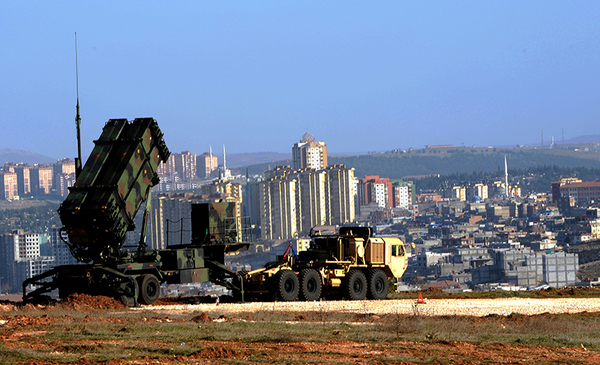
1234 (1)U.S. Patriot missiles, deployed outside Gaziantep, Turkey in 2013. (Image source: U.S. Army Europe/Daniel Phelps)

Kurecik seemed to matter a lot to Iran. In November 2011, Iran threatened that it would target NATO’s missile defense shield in Turkey (“and then hit the next targets,” read Israel) if it were threatened. Shortly before the arrival of Patriots in Turkey, Iran’s army chief of staff warned NATO that stationing Patriot anti-missile batteries in Turkey was “setting the stage for world war.”

What was stationed in Kurecik was an early-warning missile detection and tracking radar system. Its mission is to provide U.S. naval assets in the Mediterranean with early warning and tracking information in case of an Iranian missile launch that might target an ally or a friendly country, including Israel. So, a six-battery Patriot shield to protect the NATO radar in Kurecik against possible Iranian aggression was necessary. And that explains why the Iranians went mad about Kurecik and openly threatened to hit it.

NATO and Turkish officials have always denied any link between the Patriot missiles and the NATO radar in Turkey. They have often pointed out that the Patriot batteries were stationed in the provinces of Adana, Kahramanmaras and Gaziantep, while Kurecik was in nearby Malatya province. But the Patriot is a road-mobile system: It can be dismantled easily and re-deployed in another area in a matter of hours (the road distance between Kurecik and Kahramanmaras is a mere 200 kilometers, or 124 miles).

Clearly, Iran did not go mad and threaten to hit all NATO installations in Turkey because it wanted 3.5 million Turkish citizens to die from the chemical warhead of a Syrian missile. It went mad and threatened because it viewed the defensive NATO assets in Turkey as a threat to its offensive missile capabilities, which the Patriots could potentially neutralize.

Why, otherwise, would a country feel “threatened” and threaten others with starting a “world war” just because a bunch of defensive systems are deployed in a neighboring country? Iran did so because it views the NATO radar in Turkey as an asset that could counter any missile attack on Israel; and the Patriots as hostile elements because they would protect that radar. In a way, Iran’s reaction to the NATO assets in Turkey revealed its intentions to attack.

It could be a total coincidence that the U.S. and Germany (most likely to be followed by Spain) have decided to pull their Patriot batteries and troops from Turkey shortly after agreeing to a nuclear deal with Iran. But if it is a coincidence, it is a very suspicious one. In theory, the Patriot systems were deployed in Turkey in order to protect the NATO ally from missile threats from Syrian President Bashar al-Assad’s regime. Right? Right.

Assad’s regime is still alive in Damascus and it has the same missile arsenal it had in 2013. Moreover, Turkey’s cold war with Assad’s Syria is worse than it was in 2013, with Ankara systematically supporting every opposition group and openly declaring that it is pushing for Assad’s downfall. Why were Assad’s missiles a threat to Turkey two and a half years ago, but are not today?

The Patriot missiles are leaving Turkey. They no longer will “protect Turkish soil.”

Apparently, NATO allies believe, although the idea defies logic, that the nuclear deal with Iran will discourage the mullahs in Tehran from attacking Israel.

It looks as if the potential target of NATO heavyweights’ decision is more a gesture to Iran than to Turkey.

Obama secures rubber stamp for Iran deal catastrophe

September 3, 2015

Obama secures rubber stamp for Iran deal catastrophe, Front Page MagazineJoseph Klein, September 3, 2015

(Please see also, Use Our Senatorial Nuclear Option to Stop Iran’s Radioactive Nuclear Option. Make Senators vote yes or no on the “deal.”— DM)

obama-wc2

Democratic Senator Barbara Mikulski of Maryland has pushed President Obama’s nuclear appeasement deal with Iran over the top. With her decision to vote in favor of the deal, Obama now has the support of the 34 senators he needs to uphold his expected veto of a congressional resolution of disapproval. If enough craven Democrats back a planned filibuster to prevent a vote on the floor of the Senate, Obama will not even have to use his veto pen.

The nightmare of a financially secure nuclear armed Iran, legitimized by the Obama administration and its international partners, is about to envelop us.

Ironically, Obama warned in a speech he delivered on September 1st in Alaska that a potentially bleak future could lie ahead, in which “there’s not going to be a nation on this Earth that’s not impacted negatively.”

“People will suffer,” Obama said. “Economies will suffer. Entire nations will find themselves under severe, severe problems…more conflict.”

President Obama is right to be concerned about the future, but his stated reason for his concern is entirely misplaced. Obama was talking about climate change, which he considers to be a man-made disaster. In truth, Obama himself has created a far more imminent disaster with his nuclear deal.

In his climate change speech, Obama spoke about our “grandkids” who “deserve to live lives free from fear, and want, and peril.” He added that we need to prove “we care about them and their long-term futures, not just short-term political expediency.”

Obama, and the partisan loyalists who support him no matter what, are the ones letting down our grandkids. They are the ones who have sacrificed our grandkids’ long-term futures at the altar of short-term political expediency. The only long-term future that Obama is interested in is his own legacy.

By President Obama’s own admission, no later than 15 years from now – when my granddaughter will be just 18 years old – Iran will be in a position to develop enough enriched materials to produce nuclear bombs with virtually no “break-out” time. The deal’s major nuclear restrictions, such as they are, will have gone away, even assuming that Iran had not cheated in the meantime.

The deal’s inspection mechanism is a farce, including most notably, Iran’s self-inspection of its military site where it is suspected that nuclear weaponization research and development work was carried out. The military facility at Parchin is off-limits to onsite inspection by the International Atomic Energy Agency (IAEA). Yet the Obama administration continues to lie to the American people about how comprehensive the IAEA inspections will be. Secretary of State John Kerry tweeted this falsehood on September 2nd:  “With this #IranDeal, the IAEA can go wherever the evidence leads. No facility…will be off limits.”

The Iranian leaders also will get their hands soon on hundreds of billions of dollars. No doubt they will use some of their treasure trove from sanctions relief to fund their terrorist proxies all over the world. Obama admitted in his speech defending his deal last month at American University that monies from sanctions relief “will flow to activities we object to.” He acknowledged that “Iran supports terrorist organizations like Hezbollah. It supports proxy groups that threaten our interests and the interests of our allies – including proxy groups who killed our troops in Iraq. They try to destabilize our Gulf partners.”

Yet Obama tells the American people not to worry about such real-life risks. Instead, he diverts attention to his Chicken Little climate change hype that the sky will fall if we do not take urgent action now.

Much of the rest of the Iranians’ windfall from sanctions relief will go towards developing and acquiring, from North Korea, Russia and other sources, advanced military technology and long-range missiles.

Iran’s leaders have made it abundantly clear that they do not consider themselves bound by either the 5-year UN Security Council arms embargo or the 8-year missile embargo.  For example, Iran’s President Hassan Rouhani declared: “We will buy, sell and develop any weapons we need and we will not ask for permission or abide by any [U.N.] resolution for that.”

Iranian Defense Minister Hossein Dehghan said last month that “We are considering the design, research, and production of [missiles] that are highly destructive, highly accurate, radar evasive, and tactical.”

Brigadier General Amirali Hajizadeh, commander of the aerospace division of the Islamic Revolutionary Guard Corps (IRGC), said: “Some wrongly think Iran has suspended its ballistic missile programs in the last two years and has made a deal on its missile program.” To emphasize his point, the commander announced that Iran “will have a new ballistic missile test in the near future that will be a thorn in the eyes of our enemies.”

The head of Iran’s Islamic Revolutionary Guard Corps, Maj. Gen. Mohammad Ali Jafari, announced plans to expand the reach of Iran’s missiles.

The Iranian thugs are not limiting themselves to purely defensive weapons. “They (the US and the Zionists) should know that the Islamic Revolution will continue enhancing its preparedness until it overthrows Israel and liberates Palestine,” said Brigadier General Mohsen Kazzemeini, the IRGC’s top commander in the Tehran Province (as quoted by Iran’s Fars News Agency). “We will continue defending not just our own country, but also all the oppressed people of the world, especially those countries that are standing on the forefront of confrontation with the Zionists,” he added.

The Obama administration, which conceded as part of the nuclear deal to agree to unconditional term limits on the arms and missile embargoes, barely raised an eyebrow at Iran’s refusal to be bound by even these limited embargoes. In fact, Kerry went so far as to say that “they are not in material breach of the nuclear agreement for violating the arms piece of it.”

A sobering report was just released by the Iran Strategy Council, led by retired generals Chuck Wald (Commandant of Marine Corps) and James Conway (Deputy Commander of European Command). It warns of the deal’s likely dangers to America’s own national security and of the “cascading instability” it will produce in the Middle East region and beyond:

“The final agreement on Iran’s nuclear program, the Joint Comprehensive Plan of Action (JCPOA), has potentially grave strategic implications that directly threaten to undermine the national security of the United States and our closest regional allies. By allowing Iran to become a nuclear threshold state and enabling it to become more powerful and expand its influence and destabilizing activities – across the Middle East and possibly directly threatening the U.S. homeland – the JCPOA will place the United States in far worse position to prevent a nuclear Iran.”

The report’s authors predict that the “nightmare scenarios of WMD and terrorism on the soil of the United States and its allies will become more probable.”

Nevertheless, the Obama administration is spiking the ball, exulting over its evident victory in keeping enough Democratic senators on board to protect Obama’s deal.

The White House tweeted: “If your house is on fire, would you refuse to put it out because there could be another fire in 15 years?”

The question should be: “If your house is flammable, would you hand your enemy a match?”

Kerry, who turned on his own fellow soldiers during the Vietnam War, tweeted: “I have had the privilege of serving our country in times of peace and in times of war—and peace is better.”

When Neville Chamberlain returned from Germany with his infamous Munich Pact in hand, he declared: “I believe it is peace for our time…Go home and get a nice quiet sleep.”

The long nightmare of World War II ensued shortly thereafter. Thanks to Barack Obama and John Kerry, we are entering the nightmare leading inevitably to an emboldened, well-funded Iran equipped with nuclear arms and the missiles to deliver them.