Archive for August 2015

Another Iranian roadblock against nuclear inspections

August 18, 2015

Another Iranian roadblock against nuclear inspections, DEBKAfile, August 18, 2015

International nuclear inspectors will only be permitted into the country after offering proofs of suspicious activity at the sites to be inspected, Iran’s Defense Minister Brig. Gen Hossein Dehqan said Tuesday. DEBKAfile: This condition is not contained either in the nuclear deal Iran signed with the six world powers last month or in its contract with the IAEA. How will the international watchdog obtain proofs if it is denied visits for inspections? Monday, a senior Iranian official said that such visits were subject to prior approval from the Iranian Intelligence Ministry.

Obama’s shameful betrayal of America

August 18, 2015

Obama’s shameful betrayal of America, Front Page MagazineDr. Majid Rafizadeh, August 18, 2015

secretary_kerry_meets_with_iranian_foreign_minister_zarif_in_paris_to_continue_nuclear_program_negotiations_16107653417

Thanks to President Obama, radical Islam is the winner of the nuclear deal and the US emerges as the biggest loser when it comes to its national, economic, geopolitical and strategic interests. In addition, except for Israel and the United States, almost every country in the world (as well as Shiite militia groups) appear to be benefiting from the nuclear deal – economically, strategically, and geopolitically — as a result of rekindling relationships with the Islamic Republic. Not only does this deal damage the US and Israel’s national and economic interests, but it also strengthens the same forces and axis which have repeatedly sworn war and violence against Americans. 

A strong argument can be made that one of the major birthplaces of fundamentalist Islamism, which at its core aims at opposing and fighting the United States, is the Islamic Republic of Iran.

The mission of anti-Americanism and anti-Semitism began heavily when the ruling mullahs of Iran, with the leadership of Ayatollah Rooh Allah Khamenei, came to power.  This mission remains and will continue to remain the major pillar of the Islamic Republic as well as the keystone of the mullah’s political and ideological establishments.

Since then, the Islamic Republic, with IRGC and its proxies, has been attacking and slaughtering Americans. They also attempt to scuttle US foreign policy. The United States is not their sole target. They also interfere with the national and economic interest of several countries in the Middle East and beyond including Iraq, Lebanon, Syria, Yemen, etc.

Without a doubt, this is a regime that breeds anti-Americanism and hatred towards Jewish and Christian people. So, what is President Obama’s solution to offset such a threat? Surrender — while continuing to give bonuses and gifts to the Iranian regime.

After Russia and China, Switzerland was the first European country to officially lift economic and political sanctions against the Islamic Republic citing the nuclear deal which was reached between the Islamic Republic and six world powers. The sanctions included restrictions on trade in precious metals, petrochemical products, petroleum products as well as the transport of Iranian crude oil. Switzerland issued a statement pointing out that the “Federal Council (government) wishes today’s steps to be seen as a sign of its support for the implementation of the nuclear agreement and its interest in deepening bilateral relations with Iran.” It also added that it will seek to “promote a broad political and economic exchange with Iran.”

Other European countries are going to follow as well. What is going to happen next? Billions off dollars are going to flow into a government whose primary objective is to fight with the United States.

Russia, China, and other rivals will benefit economically, politically, strategically, and ideologically from the nuclear deal. It is the United States which not only is not gaining anything (economically, geopolitically, security-wise, or strategically) from this deal, but also is significantly empowering its rivals.

In the next phase, the nuclear deal will significantly tip the balance of power in favor of US rivals and the anti-American axis. China, Russia and the Iran-Assad-Hezbollah-Haman’s alliance will be considerably strengthened.

What does President Obama think that a political regime — that has been fighting the United States tooth and nail and that is responsible for the killing of many Americans in the Middle East — is going to use the billions of dollars it earns to promote? It certainly will not be pro-American or pro-Israel ideology, democratization, social justice, rule of law, human rights, or freedom of speech, press, and assembly.

Mr. Obama recently delivered a speech at American University pointing out that “just because Iranian hardliners chant ‘Death to America’ does not mean that that’s what all Iranians believe.” He added, “In fact, it’s those hardliners … chanting ‘Death to America’ who’ve been most opposed to the deal. They’re finding common cause with the Republican Caucus.”

There are several fallacies in his statements. First of all, he is implying the Republicans are similar to those Iranian politicians who are anti-American. Republicans are attempting to preserve the national and economic interest of their country when it comes to the Islamic Republic, but Iranian politicians are sworn to fight American interests and wipe out Israel.

Secondly, President Obama argues that Iranian hardliners are against the nuclear deal. This is absolutely inaccurate. It was because of the approval of  Iran’s Supreme autocrat, Ayatollah Ali Khamenei, that the deal was signed. The hardliners are the ones who will gain the most from this deal.

Third, it is true that not all Iranian people believe in “Death to America,” but Mr. Obama is dodging the major point. When it comes to international politics and the mission of fighting America, it honestly does not matter what Iranian people believe or do not believe. What matters is the political establishment of the Islamic Republic and the government which has the hard power (weapons, military, financial means, oil, etc) to fight with the US.

Finally, it is not only the hardliners that chant “Death to America,” but the entire group of ruling clerics and leaders of the Islamic Republic that believe this with a passion. We should not forget that a major slogan of President Rouhani (the so-called “moderate”) is: “Saying ‘Death to America’ is easy. We need to express ‘Death to America’ with action.” Or, as the other supposed “moderate” and “pragmatist,” Rafsanjani pointed out, “If a day comes when the world of Islam is duly equipped with the arms Israel has in possession, the strategy of colonialism would face a stalemate because application of an atomic bomb would not leave anything in Israel[.]”

United Nations and European Union sanctions on some of Iranian war criminals will also be lifted as part of the nuclear pact. One of these figures is General Qassem Suleimani, the head of Iran’s Islamic Revolutionary Guard Corps—Qods Force, who is the mastermind behind creating Shiite militia groups and terrorists across the region. He oversaw the training, financing, and arming of these militia groups. These groups are directly or indirectly fighting the United States and American soldiers as well.

As Lt. Gen. (ret.) Michael Barbero stated Sunday in The Weekly Standard, the lifting of international sanctions against Gen. Soleimani is a “shameful betrayal” of the “the American families of Suleimani’s casualties, and …those of us who lost friends and comrades.”

What if the Iranian leaders circumvent the guidelines put into place by the deal down the road? Then, too bad. If the Iranian leaders, as predicted, are caught deceiving their way towards obtaining a nuclear bomb, it will be too late to do anything. The economic and political sanctions will have been lifted, leaving the Iranian government with a surplus of funds. The US, which was in a stronger position when sanctions were imposed on the Islamic Republic, will become the weaker player. Russia and China will block any re-imposition of sanctions on the Islamic Republic. At that point, unfortunately, it will be the US in the desperate position, not the Islamic Republic. Radical Islam will exponentially spread against the US, as well as democratic and Western values around the globe.

Iran to arm West Bank Palestinians for new Eastern Front to “efface”Israel

August 18, 2015

Iran to arm West Bank Palestinians for new Eastern Front to “efface”Israel, DEBKAfile, August 17, 2015

Suleimani_Qassem_nameAl Qods chief Gen. Qassem Soleimani

Attesting to the seriousness of Iran’s intent, Jmail Majdalani, PLO executive committee member and personal representative of Mahmoud Abbas, chairman of the Palestinian Authority on the West Bank, has arrived in Tehran. He is there to arrange his boss’s first visit in many years to the Iranian capital.

*********************

Al Qods commander Gen. Qassem Soleimani, acting on the orders of Iran’s supreme leader Ayatollah Ali Khamenei, this week set up a new Iranian command to fight Israel, DEBKAfile reports exclusively from its military and intelligence sources.

It has been dubbed the Eastern Command of the Iranian Revolutionary Guards.The Al Qods Brigades, which are the external terrorist arm of the Guards, are organized according to sectors, with commands for Hizballah, the Palestinians, Syria, Iraq and the Gulf.

Their newest sector is the Eastern Command which, our sources report has been assigned as its first task to start handing out weapons, including missiles, to any Palestinian West Bank group willing to receive them. Tehran’s object is to transform the West Bank into a territory hostile to Israel on the model of southern Lebanon which is ruled by the armed Hizballah and the Gaza Strip under the Hamas and Islamic Jihad terrorists.

In the first week of August, Tehran published a book of 416 pages written by Ali Khamenei entitled “Palestine.” The cover image was labeled “The flagbearer of Jihad to liberate Jerusalem.”

 The volume was released to Western sources, who reported that the most constantly recurring phrases in the text in relation to Israel are “nabudi” – meaning annihilation; imha – meaning disappearing or fading out; and “zaval” meaning effacement.

Khamenei asserts that Israel must be destroyed because it captured Islam’s third most sacred city and is the foremost ally of “Big Satan” – America.

The Iranian leader goes into detail about exactly how Israel should be annihilated – not by “classical wars” or “massacres of the Jews” but by means of a “long period of low-intensity warfare designed to make life impossible for a majority of Israeli Jews.”

When he visited Beirut on Aug. 12, Iran’s Foreign Minister Mohammed Zavad Zarif said it was necessary after the nuclear deal, to “confront the challenges of the region, the most important of which is the Zionist and extremist regime.”

Members of the Obama administration wave away these disclosures of Iranian intent as no more than letting off steam to pacify the hard-line opponents of the nuclear deal – US Secretary of State John Kerry said on July 24: “I also told them that their chants of Death to American and so forth are neither helpful and they’re pretty stupid.”

But in Iran, the supreme leader’s words are treated as decrees demanding obedience. Indeed, at the first conference of the new Eastern Command, Gen. Soleimani read out passages from Khamenei’s book and told the officers that they were under orders to carry those decrees out to the letter.

Attesting to the seriousness of Iran’s intent, Jmail Majdalani, PLO executive committee member and personal representative of Mahmoud Abbas, chairman of the Palestinian Authority on the West Bank, has arrived in Tehran. He is there to arrange his boss’s first visit in many years to the Iranian capital.

Iran Threatened ‘Harm’ to Top Nuke Inspector to Prevent Disclosure of Secret Deal

August 18, 2015

Iran Threatened ‘Harm’ to Top Nuke Inspector to Prevent Disclosure of Secret Deal, Washington Free Beacon, Adam Kredo, August 18, 2015

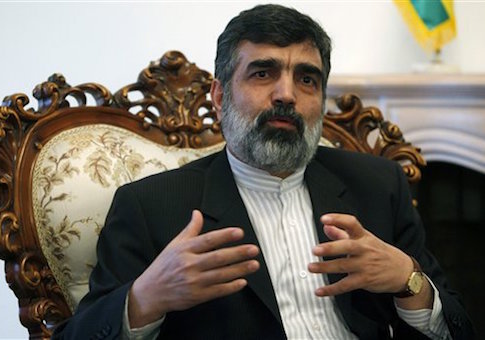
"FILE</aBehrouz Kamalvandi / AP

Iran also has gained additional leverage over the IAEA by refusing to sign a document known as the Additional Protocol, which forces Iran to disclose certain details of its nuclear program to the IAEA so that it can confirm that Tehran is not operating a clandestine weapons program.

“The IAEA desperately wanted the Iranians to ratify the Additional Protocol as part of the deal to lock them into formal obligations that would actually be permanent,” the source explained. “The Obama administration failed to win the concessions, and instead Iran got to promise to ascend eight years from now.”

“So for the next eight years the Iranians get to hold the threat over the IAEA: Don’t push your luck or we’ll refuse to accede in eight years,” the source said.

********************

Iranian leaders prevented a top International Atomic Energy Agency (IAEA) official from disclosing to U.S. officials the nature of secret side deals with the Islamic Republic by threatening harm to him, according to regional reports.

Yukiya Amano, IAEA director general, purportedly remained silent about the nature of certain side deals during briefings with top U.S. officials because he feared such disclosures would lead to retaliation by Iran, according to the spokesman for Iran’s Atomic Energy Organization (AEOI).

Amano was in Washington recently to brief members of Congress and others about the recently inked nuclear accord. However, he did not discuss the nature of side deals with Iran that the United States is not permitted to know about.

Iran apparently threatened Amano in a letter meant to ensure he did not reveal specific information about the nature of nuclear inspections going forward, according to Iranian AEOI spokesman Behrouz Kamalvandi.

This disclosure has only boosted suspicions among some that the Iranians are willing and able to intimidate the top nuclear watchdog and potentially undermine the verification regime that Obama administration officials have dubbed a key component of the nuclear accord.

“In a letter to Yukiya Amano, we underlined that if the secrets of the agreement (roadmap between Iran and the IAEA) are revealed, we will lose our trust in the Agency; and despite the US Congress’s pressures, he didn’t give any information to them,” Kamalvandi was quoted as saying Monday during a meeting with Iranian lawmakers, according to Tehran’s state-controlled Fars News Agency.

“Had he done so, he himself would have been harmed,” the official added.

Iran revealed in recent weeks that the United States is banned from knowing the details of its nuclear inspections agreement with the IAEA, a disclosure that prompted anger in many circles on Capitol Hill.

Iran also has gained additional leverage over the IAEA by refusing to sign a document known as the Additional Protocol, which forces Iran to disclose certain details of its nuclear program to the IAEA so that it can confirm that Tehran is not operating a clandestine weapons program.

Even supporters of the deal have noted that this gives Iran greater “leverage” over the IAEA going forward.

One source close to the Iran fight on Capitol Hill explained that Iran’s refusal to sign the document gives it up to eight more years to threaten the IAEA.

“The IAEA desperately wanted the Iranians to ratify the Additional Protocol as part of the deal to lock them into formal obligations that would actually be permanent,” the source explained. “The Obama administration failed to win the concessions, and instead Iran got to promise to ascend eight years from now.”

“So for the next eight years the Iranians get to hold the threat over the IAEA: Don’t push your luck or we’ll refuse to accede in eight years,” the source said.

Mark Dubowitz, executive director of the Foundation for Defense of Democracies (FDD), expressed concern that Iran could obstruct future inspections.

“Iranian leverage over the IAEA could impede a proper resolution of issues relating to Tehran’s past and possibly continuing weaponization activities,” Dubowitz said. “It may also prevent the agency from ever getting necessary physical access into suspicious sites including military facilities and prevent detection of Iranian clandestine nuclear activities.”

Further complicating the future inspections regime is the expiration of Amano’s term at the IAEA in 2017. The official could be replaced then.

Meanwhile, Iranian officials disclosed on Monday that any nuclear inspector entering Iran on behalf of the IAEA would first have to be screened by Iran’s Intelligence Ministry.

Iran additionally will be given 24 days notice before inspectors enter any site suspected of being used to build a nuclear weapon. U.S. inspectors also will be banned from entering suspicious sites under the deal.

Iranian official: Tehran to sign deal with Russia for advanced S-300 missile system next week

August 18, 2015

Iranian official: Tehran to sign deal with Russia for advanced S-300 missile system next week

via Iranian official: Tehran to sign deal with Russia for advanced S-300 missile system next week – Middle East – Jerusalem Post.

Iran and Russia will sign a deal that will see Moscow send Tehran the S-300 air-defense missile system by next week, Iranian Defense Minister Hossein Dehghan said Tuesday.

Russian President Vladimir Putin had been ready to deliver the S-300 to Iran already in 2010, but had previously agreed to ban the sale under pressure from the US. Israel has also pushed Moscow not to send the S-300 to Iran.

The deal has now been updated and will be finalized soon, the Iranian Students’ News Agency quoted Dehghan as saying.

Dehghan said that as part of the new deal, Iran would be receiving an upgraded version of the S-300 system.

“We will go to Russia next week to sign the deal and there is no barrier hindering the agreement,” ISNA quoted him as saying.

He added that the weapons system would be delivered to Iran shortly after the signing of the agreement.

The deal comes after Russia announced that it was lifting its five-year ban on the sale of the S-300 to Iran in April, prior to the July signing of the comprehensive nuclear deal between world powers and Tehran. Putin said at the time that lifting the ban could encourage Iran to finalize the nuclear deal. He reassured Israel that the S-300 does not endanger the Jewish state.

The S-300 is ““one of the most advanced air defense systems in the world,” Brig.-Gen. (res.) Asaf Agmon, a former senior Israel Air Force officer told The Jerusalem Post in April.

The S-300 would make a potential strike against Iran’s nuclear facilities much more difficult. “This system will be a challenge for an air force to overcome. Its arrival is a significant change in our region,” Agmon said.

“Once the S-300 is stationed in Iran, the chances of it getting to Syria and Lebanon rise,” he warned.

Yaakov Lappin and Tovah Lazaroff contributed to this report.

All Nuke Inspectors Require Approval From Iran’s Intelligence Agency

August 17, 2015

All Nuke Inspectors Require Approval From Iran’s Intelligence Agency, Washington Free Beacon, , August 17, 2015

"AbbasAbbas Araqchi / AP

[W]e learned that no Americans are allowed on the inspection teams and that Iran will do its own soil sampling,” Rubin added. “Now the Iranians claim that all IAEA inspectors have to be vetted by Iranian intelligence? It really can’t get any worse than this.”

**********************

A senior Iranian official declared on Monday that international nuclear inspectors would only be permitted into the country once they receive approval from the Islamic Republic’s Intelligence Ministry, putting another roadblock between the International Atomic Energy Agency (IAEA) and Iran’s contested nuclear sites.

Sayyed Abbas Araqchi, Iran’s deputy foreign minister and one of the top negotiators in talks that led to the recently inked nuclear deal, told the country’s state-controlled press that Iran’s intelligence apparatus must approve of any inspector who is issued a visa to enter Iran.

This requirement could complicate efforts to prove to the world that Iran is being fully transparent and that nuclear inspectors inside the country are neutral.

Iran has already stated that no American inspector would be permitted into the country under the deal. The accord also grants Iran a 24-day notice period before inspectors enter any site suspected of being used for nuclear weapons work.

“Any individual, out of IAEA’s Inspection group, who is not approved by the Islamic Republic of Iran cannot enter the country as the agency’s inspector,” Araqchi was quoted as telling the Islamic Consultative Assembly News Agency (ICANA), a government news outlet, according to a translation performed by the CIA’s Open Source Center (OSC).

This type of screening is fully permitted under the nuclear accord, Araqchi said.

The deal “has been set within the framework of the additional protocol and all limitations and supervisions are within the protocol and not beyond that,” he said.

Michael Rubin, a former Pentagon adviser and expert on rogue regimes, said that Obama administration’s promise of strict inspections is a fallacy.

“Administration claims that this was the best possible agreement are pathetic. First Kerry abandoned anytime, anywhere inspections,” Rubin said. “Then Obama claimed this was the most rigorous counter-proliferation regime ever, never mind that it failed to rise to the Libya and South Africa precedents.”

“Then we learned that no Americans are allowed on the inspection teams and that Iran will do its own soil sampling,” Rubin added. “Now the Iranians claim that all IAEA inspectors have to be vetted by Iranian intelligence? It really can’t get any worse than this.”

Iranian Supreme Leader Ali Khamenei also affirmed on Monday that there is no way for the United States to “infiltrate” Iran under the deal.

The “Americans seek to make an excuse to infiltrate Iran through a [nuclear] deal whose fate and whether it will be rejected or approved is not yet certain either in Iran or the U.S.,” Khamenei was quoted as saying on Monday.

“With all our strong capabilities, we will not allow Americans’ economic, political or cultural infiltration or political presence in Iran,” he added.

While Obama administration officials have touted the agreement as a first step toward moderating Iran’s rogue behavior, Khamenei insisted that “Tehran’s policy toward the U.S. will remain unchanged regardless of the ultimate fate of the” nuclear deal, according to Iran’s Tasnim news agency.

Iran also will continue to back any country that seeks Israel’s destruction.

“Iran fully defends the [axis of anti-Israeli] resistance in the region, including the Palestinian resistance, and will support anyone who confronts Israel and hammers the Zionist regime,” the Supreme Leader said.

Meanwhile, further details of secret talks between the Obama administration and Iran in 2012 have come to light.

The White House purportedly made overtures to Iran, guaranteeing its right to enrich uranium, in 2012, while President Barack Obama was locked in an election with Republican challenger Mitt Romney, according to Iranian Vice President Akbar Salehi, who was a senior member of the negotiating team.

This message from the U.S. leadership was then brought to then-President Mahmoud Ahmadinejad, according to Salehi, whose remarks were translated by the Middle East Media Research Institute (MEMRI).

The Iranian official disclosed the U.S. Energy Secretary Ernest Moniz was appointed to the U.S. team per a request by Salahi, who knew him from his time as a doctoral student at MIT.

“Salehi added that Khamenei agreed to open a direct channel of negotiations between Iran and the U.S. on the condition that the talks would yield results from the start and would not deal with any other issue, especially not with U.S.-Iran relations,” according to MEMRI. “Following this, Salehi demanded, via the Omani mediator Sultan Qaboos, that the U.S. recognize Iran’s right to enrich uranium, and received a letter from Qaboos expressing such American recognition, which he relayed to Ahmadinejad.”

Rubin said Congress should carefully consider the new details emerging about the deal and its ability to reign in Iran’s nuclear program

“There really is only one question before Congress now: Is Obama’s legacy and Kerry’s single-minded desire for a Nobel Prize worth sacrificing U.S. security and enabling Iran to maintain an industrial-strength nuclear program?” he asked. “Because this agreement is not about stopping Iran’s nuclear program or security; it is about ego and naiveté. “

The greater security threat: ISIS or Iran?

August 17, 2015

The greater security threat: ISIS or Iran? Front Page MagazineJoseph Puder, August 17, 2015

ii

JP: Who do you perceive to be a greater security threat, ISIS or the Islamic Republic of Iran?

HL: An Iran with nuclear weapons or a pathway to obtain them is a far more dangerous threat than ISIS.

HL: Iran should not have nuclear weapons, period. Any deal that allows for Iran to enrich uranium is a violation of the NPT (Non-Proliferation Treaty). That the U.S. and global powers have agreed to an arrangement that offers Iran a bridge to nuclear weapons is wrong and dangerous. It will set a notion nuclear proliferation in the region, thereby making the Middle East a tinderbox for explosion.

JP: Should Israel consider a preemptive strike on Iran’s nuclear facilities?

HL: A preemptive strike against Iran by Israel is fraught with complications, but an Iran with nuclear weapons, a delivery capacity and a motivation to destroy Israel leaves the Israeli government with very few alternatives. The choice is indeed existential. An attack will have consequences; blow back with many lives put in jeopardy. Hoping for the best, however, is not a policy since the very survival of Israel is at stake. Hence, I believe Israeli leaders must act to defend the state and its people which means it must make the difficult decision of attack. As Norman Podhoretz so eloquently put it, “fight a conventional war now or a nuclear war later.”

******************

Of the many speakers at the “Stop Iran Rally” on July 22, 2015 in New York’s Times Square, the comments of Dr. Herbert London aroused the most enthusiastic response. His large frame encompasses a magnetic personality, and an incredible gift as a speaker.  However, on a personal encounter, he reveals his gentle demeanor.

The 6’5” London played basketball for the Columbia University team, and was drafted by the Syracuse Nationals. He recorded several pop songs, achieving a hit record in 1959 with “Sorry, We’re Not Going Steady.” Herb has been primarily an intellectual steeped in academic life. He was listed among the “outstanding intellectuals of the 21st Century.” Yet, he became a force to be reckoned with far beyond the Ivory Towers of academia.

Dr. Herbert London is currently the president of the London Center for Policy Research, and senior fellow at the Manhattan Institute. He is the former president of the Hudson Institute. Herb is also professor emeritus and the former John M. Olin Professor of Humanities at New York University. He is responsible for creating the Gallatin School of Individualized Study in 1972, and was its dean until 1992. The school promotes the study of “great books and classic texts.”

Herb London graduated from Columbia University in 1960, and received his Ph.D. from New York University in 1966. London is also chairman of the National Association of Scholars and a member of the Council on Foreign Relations.

London believes in a better world for ordinary Americans. That is why he became a nominee of the Conservative party for Mayor of New York City and Governor of New York State. He is an author of a number of books, the latest being The BDS War against Israel.

Given Herb London’s global connections, and his involvement in framing foreign policy, this reporter addressed the following questions to him.

Joseph Puder (JP): Please tell us about the mission of the London Center for Policy Research. What are its goals, and how does it operate?

Herb London (HL): The London Center was organized to promote an independent, non-partisan analysis of “hot spots” on the globe and how to think strategically about them. In the areas where possible mitigation exits, the LCPR offers a variety of recommendations. Because of contacts cultivated in Washington, DC, the LCPR has established a regular seminar series on the Hill for staffers and elected officials, all designed to influence policy and future legislation.

JP: Millions of people from the Third World (mostly Muslims) will be flooding the West, especially Europe. What impact do you think this will have on the current Western democracies?

HL: Europe does not have a tradition of assimilation like the United States. As a consequence, minorities are generally not integrated into these societies. Separate communities, with separate conditions, and even separate laws within a host society is a recipe for tension and violence. Evidence for this can be found in every European nation. Malmo in Sweden, for example, the country’s third largest city, is organized as a Middle East Muslim community with imams determining who enters. Demographically, it is obvious a European population with a replacement level, on average of 1.5 and a Muslim replacement rate of 2.7 will result in significant political and attitudinal shifts in the next two decades rendering the continent an extension of Islamic positions to be.

JP: Who do you perceive to be a greater security threat, ISIS or the Islamic Republic of Iran?

HL: An Iran with nuclear weapons or a pathway to obtain them is a far more dangerous threat than ISIS. Moreover, Iran has created an empire of sorts with capitals in Damascus, Sanna, Bagdad, and Beirut. Should Iran obtain $150 billion with the lifting of sanctions, that money could be used to bolster its interests with Hezbollah, Hamas, and the Houthis. Using surrogates, the Iranians will likely extend their interests throughout the region with the prize being Saudi oil fields in the eastern part of the country which has a regional majority of Shia residents. Should Iran control Saudi and Iraqi oil along with its own deposits, it will control two-thirds of the world’s oil supply and be in a position to dictate oil prices.

ISIS is a relatively minor threat that has morphed into a formidable threat due to inaction and a hopelessly incompetent Iraqi military force. Using barbarism as a tactic, it has carved out a swath of territory in Iraq and Syria. If the U.S. were serious about launching a genuine attack against ISIS, it could be eliminated in a relatively short period.

JP: What alternatives to the nuclear deal with Iran would you propose?

HL: Iran should not have nuclear weapons, period. Any deal that allows for Iran to enrich uranium is a violation of the NPT (Non-Proliferation Treaty). That the U.S. and global powers have agreed to an arrangement that offers Iran a bridge to nuclear weapons is wrong and dangerous. It will set a notion nuclear proliferation in the region, thereby making the Middle East a tinderbox for explosion.

JP: Should Israel consider a preemptive strike on Iran’s nuclear facilities?

HL: A preemptive strike against Iran by Israel is fraught with complications, but an Iran with nuclear weapons, a delivery capacity and a motivation to destroy Israel leaves the Israeli government with very few alternatives. The choice is indeed existential. An attack will have consequences; blow back with many lives put in jeopardy. Hoping for the best, however, is not a policy since the very survival of Israel is at stake. Hence, I believe Israeli leaders must act to defend the state and its people which means it must make the difficult decision of attack. As Norman Podhoretz so eloquently put it, “fight a conventional war now or a nuclear war later.”

JP: How do you assess the performance of the Obama administration in the realm of foreign policy?

HL:  From the outset of his presidency, Barak Obama made it clear that U.S. involvement in foreign activity leads inexorably to chaos. With that as the overarching assumption, the president engaged in a precipitous withdrawal from Iraq and a hasty departure from Afghanistan. He claims he ended both wars, but the fact is he extricated the U.S. from the wars, but the wars continue.

Since U.S. foreign policy is regarded as “undesirable,” he wants less of it. That explains his belief that American international positions should be channeled through the United Nations. It also explains why he submitted the P5+1 proposal with Iran to the Security Council before it was given to the Congress.

Although it is often foolhardy to attempt to read minds, the president has seemingly developed his own skewed version of the Iraq war and the role of President Bush and his advisers. As a consequence, all his foreign policy initiatives are based on the experience of the recent past, most specifically his understanding of it. Therefore, the military has been hollowed out and troop deployments abroad have been shrinking. Presumably, this will lead to a more peaceful world. However, empirical evidence suggests the opposite. The U.S. may not want to be the world’s policeman, but a world without a policeman is fraught with tension and potential war.

Articulate and deep thinking, Herb London is a voice worth hearing, and unlike other intellectuals who hide behind the ivory towers of academia to express nefarious ideas, Herb London never sought shelter from the real world.

Looking Ahead at Middle East “Peace”

August 17, 2015

Looking Ahead at Middle East “Peace” The Gatestone InstituteShoshana Bryen, August 17, 2015

  • The U.S. has provided approximately $5 billion to the Palestinians in bilateral aid since the mid-1990s and about $540 million this year. The EU added more than €500 million ($558 million), making it the largest single-year donor. Why should Palestinian Authority (PA) not have to pay the bill for its own savage behavior? And why is the U.S. so determined to protect it?
  • According to the deputy head of UNRWA, the organization needs $101 million in order to open schools on time. Why does the Hamas government not pay for its own children to go to school? And why does the Hamas government not pay for the repair of its own people’s houses? UNRWA and the U.S. government seem to believe that the PA and Hamas cannot be expected to spend their own funds — or donated funds — on the needs of their own people. Hamas can therefore use all its funds to make war.
  • As long as Hamas and the PA are permitted both to spend sponsors’ money on terrorism and warfare while escaping responsibility for the needs of their people, and as long as Iran is a key donor — with all the temptations, means and opportunity to “wipe Israel,” as it repeatedly threatens to do — the idea of a U.S.-led “peace process” is fantasy.

The Obama Administration has made it clear that it will not pursue Israeli-Palestinian “peace talks” while the Iran deal remains fluid. But as the President heads into his last year in office, the “two state solution” apparently remains an important political aspiration. The Iran deal and the “peace process” are linked by concerns over Iranian behavior on the non-nuclear front, and concerns about American willingness to remain the sort of ally Israel has found it to be in the past.

The following stories — all involving money and how it is spent — should be understood together:

  • U.S. requests lower bond for Palestinian appeal of terror case
  • Infant mortality in Gaza
  • Schools in Gaza may not open
  • Iranian assistance to Hamas

First, the U.S. Department of Justice this week asked a judge to “carefully consider” the size of the bond he requires from the Palestinian Authority (PA) as it appeals the award of damages to the victims of six terrorist attacks that killed and injured Americans in Israel. Concerned about the possible bankruptcy of the PA, Deputy Secretary of State Antony J. Blinken added a statement to the Justice Department filing, saying, “A P.A. insolvency and collapse would harm current and future U.S.-led efforts to achieve a two-state solution to the Israeli-Palestinian conflict.”

The Palestinian Authority was proven in a U.S. court to have organized and paid for terrorist attacks that killed Americans and Israelis. The U.S. has provided approximately $5 billion to the Palestinians in bilateral aid since the mid-1990s and about $540 million this year. The EU added more than €500 million ($558 million), making it the largest single-year donor. Why should PA not have to pay the bill for its own savage behavior?

And why is the U.S. so determined to protect it?

Second, UNRWA (United Nations Relief and Works Agency for Palestine Refugees in the Near East), which maintains camps for Palestinians in Gaza, Lebanon, Syria and parts of the West Bank, released a broadside last week entitled, “Infant Mortality Rises in Gaza for the First Time in 50 Years.” Subhead: “UNRWA’s Health Director says the [Israeli and Egyptian] blockade may be contributing to the trend.”

Such a rise would be a terrible thing, and Israeli culpability would be terrible also. But is it true? It takes only a few clicks of the computer keys to find out.

Palestinian infant mortality in the West Bank and Gaza has been on a straight downward slope since 1968. Using CIA Factbook figures, infant mortality was 158 per 1000 from 1950-55; 87 per 1000 in 1968 (using an Israeli government publication); 25 per 1000 in 1985-90; and is at 14 per 1000 today in Gaza. Where is the rising trend? The UNRWA release came from an article entitled “Increasing Neonatal Mortality among Palestine Refugees in the Gaza Strip,” published by PLOS ONE, an “open access” online journal.

The study itself notes, “These estimates are based on small numbers of deaths, and the confidence intervals are wide, so the infant mortality rate could in fact be stable or continuing to decline” (emphasis added). Yet its conclusion reads, “In conclusion, we have estimated that, for the first time in five decades, the mortality rate has increased among Palestine refugee newborns in Gaza, and this may reflect inadequate neo-natal care in hospitals.”

An Israeli website that evaluated the entire study caught the inherent contradiction. “They didn’t have enough data to reach the conclusion they did… Those two statements have no place in a serious scientific paper and would merit its immediate rejection.”

Third, having dispensed with scare mongering about infant mortality, let us turn to the other UNRWA broadside of the week: “Without New Cash, UNRWA Schools Won’t Open.” According to the deputy head of the organization, UNRWA needs $101 million in order to open schools on time.

Why does the Hamas government not pay for its own children to go to school?

This is similar to a story last January, in which UNRWA suspended the repair of Palestinian houses in Gaza because of a shortage of international donor money, and it raises the question: Why does the Hamas government not pay for the repair of its own peoples’ houses?

It is UNRWA’s belief — like that of the U.S. government, apparently — that Palestinian governments, including the one on the U.S. list of sponsors of terrorism, have to be protected from the consequences of their own war-making, support for terrorism, and thievery. UNRWA and the U.S. government seem to believe that the Palestinian Authority and Hamas cannot be expected to spend their own funds — or donated funds — on the needs of their own people.

Which brings us to Iran; the only country working assiduously to ensure that its client, Hamas in Gaza, gets the assistance it needs to meet its goals, and then meets those goals.

According to Israeli government sources, Iran’s most recent assistance includes “cash, military training for Hamas fighters, weaponry, and electronics equipment including for use against Israeli drones… Hamas has also been training fighters in the use of anti-tank and anti-aircraft missiles, and is training recruits to fly paragliders across the border.”

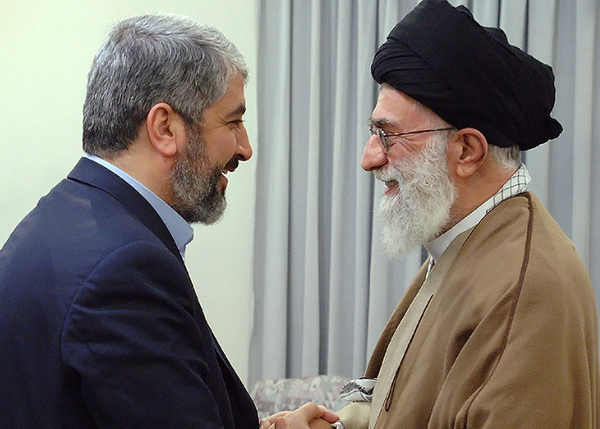
1162Bridging the Sunni-Shia divide, for the goal of genocide: Hamas leader Khaled Mashaal (left) confers with Iranian Supreme Leader Ali Khamenei, in 2010. (Image source: Office of the Supreme Leader)

UNRWA and Iran, with a supporting role played by the United States, have long made it possible for Hamas and the PA to spend other people’s money building more tunnels, arming multiplemilitias, paying “salaries” to convicted terrorists in Israeli jails, and improving the quality of their rockets and missiles. They know — and Israel knows — that between the Israeli government and the international aid agencies including, but not limited to, UNRWA, no Palestinians will starve, no one will go without medical care, no one will go homeless (except those homeless because Hamas confiscated about 20% of the cement and steel meant to restore Gaza houses damaged in last year’s war). Hamas can therefore use all its funds to make war.

As long as Hamas and the PA are permitted both to spend sponsors’ money on terrorism and warfare while escaping responsibility for the needs of their people, and as long as Iran is a key donor — with all the temptations, means and opportunity to “wipe Israel,” as it repeatedly threatens to do — the idea of a U.S.-led “peace process” is fantasy.

Associated Press says Tom Cotton was right!

August 16, 2015

Associated Press says Tom Cotton was right! Power LineJohn Hinderaker, August 16, 2015

[W]ith majorities in both houses of Congress opposed to the deal, the Associated Press tells us it can still proceed as an executive agreement. Of course it can. And the next president, who will probably be a Republican, can revoke it; and this Congress, or a subsequent one, can pass legislation inconsistent with it. That’s what happens when you don’t have the votes to ratify a treaty.

*****************

This Associated Press story, headlined “Obama can do Iran nuclear deal even if Congress disapproves,” is getting a lot of attention:

The September vote on the Iran nuclear deal is billed as a titanic standoff between President Barack Obama and Congress. Yet even if U.S. lawmakers reject the agreement, it’s not game-over for the White House.

A congressional vote of disapproval would not prevent Obama from acting on his own to start putting the accord in place. …

Obama doesn’t need a congressional OK to give Iran most of the billions of dollars in relief from economic sanctions that it would get under the agreement, as long as Tehran honors its commitments to curb its nuclear program.

“A resolution to disapprove the Iran agreement may have substantial political reverberations, but limited practical impact,” says Robert Satloff of the Washington Institute for Near East Policy. “It would not override President Obama’s authority to enter into the agreement.”

That is correct. The president has the constitutional authority to enter into an executive agreement. Which is where debate over the Iran deal began, with an open letter to Iran’s leaders that was signed by 47 Republican senators and posted on Senator Tom Cotton’s web site. The letter explained that the Iran agreement was not being submitted to the Senate for ratification as a treaty. Therefore, as a mere executive agreement, it could be canceled with a stroke of the pen by America’s next president:

First, under our Constitution, while the president negotiates international agreements, Congress plays the significant role of ratifying them. In the case of a treaty, the Senate must ratify it by a two-thirds vote. A so-called congressional-executive agreement requires a majority vote in both the House and the Senate (which, because of procedural rules, effectively means a three-fifths vote in the Senate). Anything not approved by Congress is a mere executive agreement. …

What these two constitutional provisions mean is that we will consider any agreement regarding your nuclear-weapons program that is not approved by the Congress as nothing more than an executive agreement between President Obama and Ayatollah Khamenei. The next president could revoke such an executive agreement with the stroke of a pen and future Congresses could modify the terms of the agreement at any time.

Tom Cotton’s letter was viciously attacked by liberals, but what it said was obviously correct. Now, with majorities in both houses of Congress opposed to the deal, the Associated Press tells us it can still proceed as an executive agreement. Of course it can. And the next president, who will probably be a Republican, can revoke it; and this Congress, or a subsequent one, can pass legislation inconsistent with it. That’s what happens when you don’t have the votes to ratify a treaty.

Satire | North Korea announces bold new peace plan

August 16, 2015

North Korea announces bold new peace plan, Dan Miller’s Blog, August 16, 2015

The views expressed in this article are those of my fictitious guest author and do not necessarily reflect mine, those of Warsclerotic or its other editors. — DM)

Editor’s note: This is a guest post by Kim Wu-hu, the highly respected director of North Korea’s Ministry of Everlasting Truth. She is variously believed to be Kim Jong-un’s sister or illegitimate daughter.

old korean woman

Kim Jong-un (also known as Kim Chi-un), the universally beloved Dear Leader of the Democratic Peoples’ Republic of Korea, today announced a bold new plan for peace with the illegitimate regime known as the Republic of Korea. It was met with tremendous joy and relief worldwide. Millions gathered in Pyongyang to celebrate, as even the leader of the rogue regime known as Obama’s America held a televised press briefing to praise Kim’s brilliant plan. 

Kim's hair

Dear Leader Kim’s plan is radical only in its overwhelming simplicity and has just two parts:

1. The illegitimate criminal regime known as the Republic of Korea (“ROK”), which unlawfuly occupies a southern province of the Democratic Peoples Republic of Korea (“DPRK”), will disarm immediately and turn over all of its weapons to the DPRK for safekeeping. Neutral international inspectors from the DPRK and Iran will travel to the ROK in one week to verify the ROK’s compliance. Should the ROK be found not to have complied, the DPRK and its ally Iran will make merciless war on it to force its voluntary compliance.

2. At least seventy-five percent of all males over the age of ten years living in the DPRK’s southern province under the rogue ROK regime will adopt Kim’s hairstyle and, within one month, present themselves to international inspectors who will determine whether they have complied in a satisfactory manner. The DPRK will provide suitable antiaircraft equipment to deal humanely with any who have not.

Many nations, even those which — for unknown and inexplicable reasons — have previously considered the DPRK less than trustworthy, responded enthusiastically. Even Obama, leader of the illegitimate regime known as Obama’s America, promptly held a televised press briefing. He announced that, in a show of solidarity with the DPRK, He will promptly (a) adopt Dear Leader Kim’s hairstyle, (b) issue executive decrees requiring all U.S. and allied military personnel to do the same and (c) seek to disarm His own rogue regime under terms similar to those graciously offered to the ROK. Suitable terms of American surrender to Russia, China and Iran will also be sought.

Obama expressed sincere regret that Republican warmongers will oppose His historic peace efforts for partisan purposes. He also noted that they are racists (as all opposition to Him clearly shows) and are therefore alligned with the apartheid Jewish regime that still occupies Palestine despite His vigorous efforts to impose a two state solution. He stated that their treasonous opposition will not matter, because He will accomplish everything He desires through Executive Decrees.

Here is a photo of Obama showing off His new hairstyle. (A wig was needed because His hair will take time to grow to the necessary length.)

Obama hair

During the press conference Obama also announced the immediate withdrawl of all U.S. military forces from the ROK and termination of planned joint military exercises there to prevent brutal attacks by the DPRK on the ROK and, indeed, on His own illegitimate province. He proudly proclaimed, again, that peace and negotiation are always better than war and stated that His Secretary of State, John Kerry, had already left for Pyongyang, Tehran, Moscow and Beijing to meet with his counterparts.

Kerry begins his journey

Kerry begins his journey

Immediately following Obama’s press briefing, and in lieu of a question and answer period, the reporters broke out spontaneously in song to praise Obama.

Kerry, fresh from his Herculean successes in negotiating the surrender of Obama’s America (as well as the rogue Jewish regime occupying Palestine) to Iran, expects to face difficulties in negotiating the terms of surrender to the DPRK, China and Russia. Iran will not be a problem, Kerry stated proudly but humbly, because his diplomatic skills are well known there and he is highly respected because of them.

Kerry nuanced

The science is settled and can no longer be disputed. A brave new world awaits. We have only our chains to lose and true world peace and prosperity to gain. We must thrust ever onward and upward together until we finally achieve all of the changes we have been waiting for!

*************

Editor’s comment

Due to limits on North Korea’s internet, Kim Wu-hu was unable to provide suitable graphics. I provided them for her.