Archive for August 2015

Obama: Israel sole objector to Iran deal; Netanyahu is ‘wrong’

August 5, 2015

Obama: Israel sole objector to Iran deal; Netanyahu is ‘wrong’

Making case for nuclear agreement, US president says Jerusalem has ‘rightly’ stated it can only rely on itself militarily; says PM is ‘sincere’

By Marissa Newman August 5, 2015, 7:02 pm

via Obama: Israel sole objector to Iran deal; Netanyahu is ‘wrong’ | The Times of Israel.

US President Barack Obama on Wednesday said Israel was the only country to object to the Iran nuclear deal, opposition he said was “sincere” but “wrong.”

In an address to the American University in Washington, Obama said the Iran deal was “the strongest nonproliferation agreement ever negotiated. And because it’s such a strong deal, every nation in the world that has commented publicly, with the exception of the Israeli government, has expressed support.”

The UN Security Council has “unanimously supported it,” Obama added, as well as over “100 former ambassadors who served under Democratic and Republican presidents.”

“I’ve had to make a lot of tough calls as president. But whether or not this deal is good for American security, this isn’t a hard one, it isn’t even close,” he said.

Netanyahu ‘sincere,’ but ‘wrong’

Obama said he believes Prime Minister Benjamin Netanyahu is “sincere” in his opposition, but “wrong.”

“When the Israeli government is opposed to something, people in the United States take notice. They should,” Obama said. Iranian leaders “deny the Holocaust,” and “facilitate the flow of rockets” on Israeli cities. “In such a dangerous neighborhood, Israel has to be vigilant.” Obama said.

Israel “rightly” says it can only rely on itself for its security, he added.

Nonetheless, the president argued that thwarting Iran’s nuclear program, something he said the deal successfully does, remains the top priority.

“A nuclear-armed Iran is far more dangerous to Israel, to America, and to the world, than an Iran that benefits from sanctions relief. I recognize that Prime Minister Netanyahu disagrees. I don’t doubt his sincerity. But I believe he is wrong,” Obama said.

Lashing out at unnamed critics of the deal, Obama said those who opposed the interim deal “were wrong,” and were now using the success of the interim deal to buttress its opposition to the nuclear deal.

“When the interim deal was announced, the critics, the same critics we’re hearing from now called it a historic mistake… The critics were wrong,” Obama said. “The progress of Iran’s nuclear program was halted, for the first time in a decade…. Inspections did increase. There was no flood of money into Iran. And the architecture of the international sanctions remained in place.”

The critics are right in one respect, he said. “Walk away from this and you will get a better deal,” Obama said, “for Iran.”

As “president of the United States, it would be an abrogation of my constitutional duty” to fail to pursue a policy good for America “simply because it causes friction with a friend and ally,” Obama said.

‘Diplomacy or war’

The only alternative to the deal is war, Obama maintained, adding that he is not saying this to “be provocative.”

It’s “diplomacy or some form of war. Maybe not tomorrow. Maybe not three months from now, but soon,” Obama said.

The president said he has not hesitated to use force during his term.

“There are times when force is necessary, ” the president said. If Iran does not abide by the deal “it’s possible war” will become necessary, he conceded. “But how can we justify” military action before trying a diplomatic approach? he asked.

The military option would not be as effective as diplomacy, Obama stressed, noting that Israeli analysts have said a strike would only set back Iran’s nuclear program by a few years.

He said that under the deal, it would be difficult for Iran to cheat, arguing that it would have to build “a secret source for every aspect of its program,” something the president said no other nation had succeeded in doing with such stringent oversight.

Obama said the US had “no illusions” about Iran’s support for terror groups such as Hezbollah. “But they engaged in these activities for decades. Before sanctions, and while sanctions were in place. They even engaged in them during the Iran-Iraq War, which cost them a million lives. The truth is Iran has always found a way to fund these efforts.”

Moreover, Israel and the Gulf states have larger defense budgets, Obama said.

“Iran’s defense budget is eight times smaller than the combined Gulf allies. Its military will never compare to Israel’s, and our commitment to Israel’s qualitative military edge will guarantee that,” Obama said.

Obama said those who were pushing for a better deal either didn’t understand the Iranian public or were purposely misleading the US public.

“Just because hardliners chant ‘death to America’ doesn’t mean that’s what all Iranians believe. Those hardliners have been opposed to the deal. They’re making common cause with the Republican caucus,” said Obama. “The majority of the Iranian people have powerful incentives to urge their government to move in another direction. We should offer them that chance, that opportunity.”

Obama said that the opposition to the deal was emerging from those who supported the Iraq war in 2003, a conflict he said bred the Islamic State, and “ironically” improved Iran’s regional standing.

The speech, which was supposed to start at 11:20 a.m., was delayed by over 25 minutes. No reason was given for the delay.

WATCH LIVE: Obama delivers major address on Iran accord

August 5, 2015

Kerry casts doubt on Iran’s desire to annihilate Israel

August 5, 2015

Kerry casts doubt on Iran’s desire to annihilate Israel

US secretary says Tehran’s ‘fundamental ideological confrontation’ with the Jewish state doesn’t necessarily ‘translate into active steps’

By Stuart Winer August 5, 2015, 4:42 pm

via Kerry casts doubt on Iran’s desire to annihilate Israel | The Times of Israel.

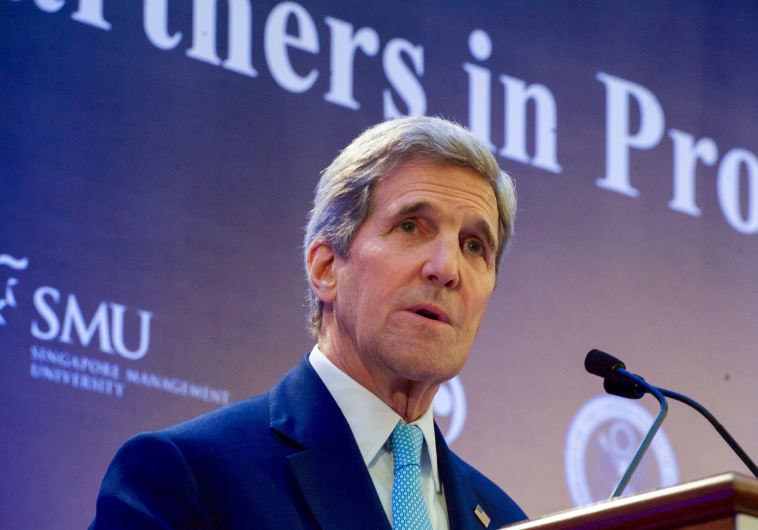
US Secretary of State John Kerry in Singapore, August 4, 2015. (AFP/POOL/BRENDAN SMIALOWSKI)

US Secretary of State John Kerry in Singapore, August 4, 2015. (AFP/POOL/BRENDAN SMIALOWSKI)

US Secretary of State John Kerry on Wednesday expressed doubt that Iran really wants to annihilate Israel, arguing that while Tehran has “a fundamental ideological confrontation” with the Jewish state, it has not implemented “active steps” to “wipe it off the map.”

In an interview with Jeffrey Goldberg published in The Atlantic on Wednesday, Kerry said that the proposed nuclear deal with Iran is as “pro-Israel” as it gets, and that should Congress block the agreement it would only reaffirm the Iranian leadership’s mistrust of America.

Regarding Iran’s open animosity to Israel, Kerry said that while “they have a fundamental ideological confrontation with Israel at this particular moment” that doesn’t necessarily mean “that translates into active steps” and pointed out that Iran has not ordered Hezbollah to use its arsenal of 80,000 missiles in Lebanon against Israel.

The discussion about Iran’s hostility toward Israel in connection with the nuclear deal is “a waste of time here,” opined Kerry.

The secretary of state also defended comments he made last Friday in which he warned that should Congress vote against the Iranian nuclear deal signed last month in Vienna, Israel could find itself more isolated in the international arena and “more blamed.”

It was, he explained, more of a head’s up to Israel than a threat.

“If you’ve ever played golf, you know that you yell ‘fore’ off the tee,” he said. “You’re not threatening somebody, you’re warning them: ‘Look, don’t get hit by the ball, it’s coming.’”

Kerry insisted the deal, which has been vehemently criticized by Prime Minister Benjamin Netanyahu for not going far enough to prevent Iran obtaining nuclear weapons, is the best that Israel could have hoped for.

“I’ve gone through this backwards and forwards a hundred times and I’m telling you, this deal is as pro-Israel, as pro-Israel’s security, as it gets,” Kerry said. “And I believe that just saying no to this is, in fact, reckless.”

The top US envoy, who led the American team in negotiations with Iran alongside diplomats from the UK, France, Russia, China, and Germany, cautioned that if Congress votes to block the deal it will only serve to play on the doubts and mistrust held by Iranian supreme leader Ayatollah Ali Khamenei.

“The ayatollah constantly believed that we are untrustworthy, that you can’t negotiate with us, that we will screw them,” Kerry said and warned that congressional intervention to stop the deal “will be the ultimate screwing.”

On the other hand, Kerry revealed, Iranian Foreign Minister Mohammad Javad Zarif had personally assured him that “If we get this finished, I [Zarif] am now empowered to work with and talk to you about regional issues.”

However, if Congress stops progress on the deal they would “shut that down, shut off that conversation, set this back, and set in motion a series of inevitables about what would happen with respect to Iranian behavior,” Kerry said.

As for restarting the Israeli-Palestinian peace process, the secretary of state, who sponsored that last round of talks that failed in 2014 after nine months of negotiations, still offered some hope of a solution.

“Doable,” he said. “But not unless somebody wants to do it.”

The US Congress is expected to vote on the Iran deal by September 17. Congress can pass a motion of disapproval, which US President Barack Obama has already said that he would veto. An override of the veto requires two-thirds approval in both the House and Senate.

Times of Israel staff contributed to this report.

In new project, pro-Israel voices opt for satire over polemic

August 5, 2015

In new project, pro-Israel voices opt for satire over polemic

Frustrated with classic ‘hasbara’ or public advocacy, Israeli cartoonists volunteer their talents for the cause

By Elhanan Miller August 5, 2015, 5:13 pm

via In new project, pro-Israel voices opt for satire over polemic | The Times of Israel.

A caricature by Yossi Shahar posted on the Israeli Cartoon Project Facebook page [courtesy/The Israeli cartoon Project/Yossi Shahar]

A caricature by Yossi Shahar posted on the Israeli Cartoon Project Facebook page [courtesy/The Israeli cartoon Project/Yossi Shahar]


Presenting Israel’s case to the world is a difficult endeavor, especially now when the country finds itself increasingly isolated diplomatically and culturally.

A new online initiative takes a different approach to Israel advocacy, however, striving to explain Israel’s case through satirical caricatures rather than emphatic argumentation.

Using Israeli cartoonists who volunteered their creative talents to the cause, The Israeli Cartoon Project has already garnered over 7,000 fans since its Facebook launch in June.

Asaf Finkelstein, 38, said the initiative was born out of a deep sense of frustration over the British Student Union’s vote to boycott Israel, and a statement by the CEO of mobile giant Orange, Stephane Richard, that he would pull his company out of Israel “tomorrow” were he not bound by contracts.

A caricature by Israeli artist Vladik Sandler courtesy/Vladik Sandler

“We realized that the people opposing us are much more numerous than we are,” he told The Times of Israel, recalling a conversation with Israeli cartoonist Uri Fink. “We said: ‘Hey, no one’s listening to us any more.’”

So Finkelstein, who promotes Israeli nonprofits, turned to his friend and colleague Yossi Klar, and together they began recruiting Israeli artists “on both sides of the political map” so as not to be tainted as partisan.

Shay Charka, an Israeli caricaturist, didn’t hesitate for a second when he was approached by Finkelstein and Klar. He said that fighting the pro-Palestinian global boycott campaign against the Jewish state and Israel defamation is one of his top priorities.

“There’s a huge amount of ignorance in the world about what goes on here,” Charka said. “It’s very easy for people to ‘buy’ horrific images of us, while there are no buyers for our argument of ‘listen, it’s not that terrible.’”

The only way to fight hostile images, Charka argued, is with images of our own.

A caricature posted by Israel artist Shay Charka courtesy/Shay Charka

“A caricature grabs you immediately because of its humor,” he said. “It works like a Trojan horse: once you’ve smiled, you’ve opened up. And that’s when the message can trickle down, even if you didn’t mean for it to.”

Veteran Israeli caricaturist Uri Fink said he had attempted to launch a similar initiative a few years ago through an Israel advocacy comics competition, but failed. “I’m a caricaturist but not such a great manager,” he said. So when Finkelstein approached him several months ago, he immediately jumped on board.

A caricature by Israeli artist Uri Fink posted on the Facebook page of The Israeli Cartoon Project courtesy/Uri Fink

“Caricatures are the best weapon in this war of ideas,” Fink told The Times of Israel.

Even though political caricatures have existed since the 18th century, they are much more effective in the age of social media, he opined.

“It jumps out at you, it takes you a second to get the message, and you go happily on your way,” he said. “It’s not too deep.”

Iran’s deputy FM brands nuclear program ‘big loss’ economically

August 5, 2015

Iran’s deputy FM brands nuclear program ‘big loss’ economically, Times of Israel, August 4, 2015

(Please see also, The Iranian Nuke Deal Depends on This One Myth. — DM)

Iran deputy foreign ministerDeputy Foreign Minister Abbas Araqchi speaking in Tehran, Iran, on October 22, 2013. (AFP/Atta Kenare)

Due to the pressure from above, . . .  the original report was removed by the national broadcasting service, which stated that the publication of Araqchi’s statements was a “misunderstanding.”

*********************

Iran’s deputy foreign minister and senior nuclear negotiator has called the Islamic Republic’s nuclear program “a big loss” economically, but necessary to defend the country’s honor.

In a leaked off-the-record meeting with journalists Saturday, Abbas Araqchi stressed that “if we want to calculate the expenses of the production materials, we cannot even think about it.” But, he said, “we paid this price so we protect our honor, independence and progress, and do not surrender to others’ bullying.”

Yet, he explained, “If we value our nuclear program based only on the economic calculations, it is a big loss.”

Meeting with the country’s news chiefs under the direction of the Supreme Leader Ali Khamenei, Araqchi said the Iranian Foreign Ministry’s public diplomacy and media relations have so far been unable to sell the agreement to the Iranian people and “the national broadcasting [service] has to help so the people do not feel frustrated with the agreement.”

During the meeting, which was leaked by the Iranian media soon after, the deputy foreign minister suggested that the Iranian parliament should only review the agreement reached in Vienna, and not present it for ratification.

Araqchi stressed that Iran should declare its final position on the deal as soon as possible, “so that should Congress reject the agreement, the burden of rejection and the failure of the talks would fall on the United States.”

1234The Iranian Parliament (CC-BY Parmida76/Flickr)

“If the [Iranian] National Security Council approves the Vienna nuclear agreement and the leader of the Islamic Republic signs it, then this resolution becomes law,” he added.

With regards to the implications of the agreement on Iranian support for Hezbollah in Lebanon, Araqchi explained that, “we said during the talks that we cannot not provide weapons to Hezbollah, and we are not willing to sacrifice them [Hezbollah] for our nuclear program. Therefore, if you want to keep the weapon sanctions as part of the agreement, we will continue with our efforts. We discussed this matter for a while.”

The Western powers eventually agreed to separate that resolution from the agreement, Araqchi said.

This is in direct contrast to remarks by US officials, who claimed Tuesday that Iran’s support for terror groups was never considered for inclusion in the nuclear deal.

The Iranian minister told journalists that he took seriously previous American threats of a possible military action. “It might be that people do not know the details, however, our IRGC and military friends know that every night in 2007-8 we were concerned that we would wake up in the morning and Iran would be surrounded by all necessary means for an attack against it.”

Iranian military personnel had shown the country’s negotiating team maps of bases where potential foreign attack planes had been identified. “The attack on Iran was a matter of the political will of Mr. Obama,” Araqchi said. “Despite everything, we still continued to object and did not compromise.”

He said that the West tightened the economic sanctions as much as they could and they reached a level where their continuation would lead to a “confrontation.”

“They tried 10 years of economic sanctions and military threats,” he explained, “and it was our strength and capabilities that brought them to the negotiation table.”

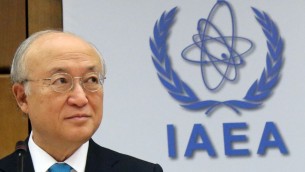
Austria-Iran-Nuclear_Horo-e1401748045152-305x172Yukiya Amano, director general of the International Atomic Energy Agency (IAEA) in Vienna, Austria, June 2, 2014. (AP/Ronald Zak)

Araqchi admitted that the regime had made some mistakes, and that those “mistakes in the past, made-up documentations and excuses were turned into claims against us.” He cited the example of International Atomic Energy Agency chief Yukiya Amano, who Araqchi said submitted a 60-paragraph report that included Iran’s use of detonators with multiple timers.

Iran, Araqchi said, has “to be careful with the information that we provide them… It is not that we are dealing only with the IAEA and these spies, but we are dealing with all countries that have nuclear programs. There are formulas and methods that prevent us from providing excess information to the IAEA inspectors. We did not know this in the past and provided information that we should not have done.”

Against national interest and security

The content of this supposedly off the record briefing was published a day later on the website of the Islamic Republic of Iran Broadcasting and picked up almost immediately by various other news sites inside Iran.

Due to the pressure from above, however, the original report was removed by the national broadcasting service, which stated that the publication of Araqchi’s statements was a “misunderstanding.”

Some believe that radical elements within the national broadcasting authority, who oppose the nuclear deal, leaked the briefing in order to undermine the reformist government’s achievements.

Araqchi called the leak “immoral” and “unprofessional,” saying it went “against national interest and security.”

The leak apparently occurred just days after the Iranian Ministry of Culture and Islamic Guidance issued confidential instructions to the media, warning them to avoid publications that could question “the achievements of the nuclear talks,” or would “indicate contradictions among the views of the high-ranking officials.”

On the day of leak, Iranian President Hassan Rouhani said during an interview on live Iranian television that the achievements of the nuclear talks exceeded his initial expectations.

Todd: No One Will Say The Iran Agreement Is A Great Deal

August 5, 2015

Todd: No One Will Say The Iran Agreement Is A Great Deal, Washington Free Beacon, August 5, 2015

NBC’s Chuck Todd said Wednesday that American sentiment about the Iran nuclear agreement is tepid because, while Americans want to engage in diplomacy, they do not trust Iran or the Ayatollah to keep his word.

“You haven’t hear anybody say this is a great deal,” Todd said on Morning Joe. “’This is a workable deal’ is about the best argument you hear for it.”

As the public opinion of the Iran deal suffers, President Obama has maintained that his deal is the only option to prevent war with the largest state sponsor of terrorism. Americans oppose the Iran agreement by a 2-1 margin.

“There is nobody excited about this deal,” Todd said.

Critics of the Iran deal point to Iran’s actions causing chaos in the Middle East as an indicator of why the deal is misguided. If Iran complies with the terms of the agreement, sanctions will be lifted giving the regime well over $100 billion of its own money that was previously frozen. Side deals between the International Atomic Energy Agency (IAEA) and Iran have also raised alarms, especially about the ability to inspect Iran’s nuclear facilities.

“I feel the president should be acknowledging that this isn’t a perfect deal more often,” Todd said. “I feel like they oversell the deal sometimes.”


Kerry says sinking of Iran deal would be ‘ultimate screwing of ayatollah’

August 5, 2015

Kerry says sinking of Iran deal would be ‘ultimate screwing of ayatollah,’ Jerusalem Post, August 5, 2015

(It’s as pro-Israel as the Obama administration gets. Please see also, Daniel Greenfield’s comments here. — DM)

ShowImage (6)
US Secretary of State John Kerry speaks in Singapore. (photo credit:STATE DEPARTMENT)

The secretary rejected Israel’s criticism of the nuclear agreement, saying that the deal “is as pro-Israel” as it gets.

******************

U.S. Secretary of State John Kerry told The Atlantic on Wednesday that if Congress were to shoot down the Iran nuclear agreement, it would be “the ultimate screwing” of Supreme Leader Ayatollah Ali Khamenei.

Kerry made the remarks in an interview with The Atlantic‘s Jeffrey Goldberg.

The secretary rejected Israel’s criticism of the nuclear agreement, saying that the deal “is as pro-Israel” as it gets.

Reneging on the nuclear agreement, which has the support of the major world powers, would constitute a setback for Washington and justify anti-American animus in Iran.

“The ayatollah constantly believed that we are untrustworthy, that you can’t negotiate with us, that we will screw them,” Kerry said. “[Having Congress vote down the nuclear pact] will be the ultimate screwing.”

“The United States Congress will prove the ayatollah’s suspicion, and there’s no way he’s ever coming back. He will not come back to negotiate. Out of dignity, out of a suspicion that you can’t trust America. America is not going to negotiate in good faith. It didn’t negotiate in good faith now, would be his point.”

Kerry also commented on the vociferous opposition to the deal expressed by Israel, which the secretary referred to as “visceral” and “emotional.” He was adamant that the agreement was positive for Israel’s geopolitical standing.

“I’ve gone through this backwards and forwards a hundred times and I’m telling you, this deal is as pro-Israel, as pro-Israel’s security, as it gets,” Kerry said. “And I believe that just saying no to this is, in fact, reckless.”

Kerry said that he was “sensitive” to Israeli concerns over Iran’s long-term aims, but he rejected arguments made by Jerusalem that the Islamic Republic was planning its annihilation.

“I haven’t seen anything that says to me [that Iran will implement its vow of wiping Israel off the map],” the secretary said. “They’ve got 80,000 rockets in Hezbollah pointed at Israel, and any number of choices could have been made. They didn’t make the bomb when they had enough material for 10 to 12. They’ve signed on to an agreement where they say they’ll never try and make one and we have a mechanism in place where we can prove that. So I don’t want to get locked into that debate. I think it’s a waste of time here.”

“I operate on the presumption that Iran is a fundamental danger, that they are engaged in negative activities throughout the region, that they’re destabilizing places, and that they consider Israel a fundamental enemy at this moment in time,” Kerry said. “Everything we have done here [with the nuclear agreement] is not to overlook anything or to diminish any of that; it is to build a bulwark, build an antidote.”

The secretary said that the nuclear deal is even more imperative if Israel’s fears that Iran is plotting its destruction are true, since the agreement neutralizes Tehran’s nuclear program.

Obama: If Congress kills Iran deal, rockets will fall on Tel Aviv

August 5, 2015

Obama: If Congress kills Iran deal, rockets will fall on Tel Aviv

President warns US Jews that without nuclear pact, America will have to attack Iran — and Israel will bear the brunt of the response

By Raphael Ahren August 5, 2015, 7:48 am

via Obama: If Congress kills Iran deal, rockets will fall on Tel Aviv | The Times of Israel.

ASHINGTON — If the US Congress shoots down the Iranian nuclear deal, America will eventually be pressured into a military strike against Tehran’s nuclear facilities, which will in turn increase terror against Israel, US President Barack Obama told Jewish leaders Tuesday, a source who was present at the meeting said.

During the two-hour meeting, Obama said it was legitimate for opponents of the deal to lobby lawmakers to reject it, but added that a discussion focused on personal attacks, rather than the merits of the deal, could jeopardize the coherence of the American Jewish community and ultimately the resilience of US-Israel relations, according to Greg Rosenbaum, the chair of the National Jewish Democratic Council.

In a bid to convince the US Jewish community to support the deal, Obama and Vice President Joe Biden hosted 20 Jewish leaders from across the political and religious spectrum at the White House’s Cabinet Room, hours after Prime Minister Benjamin Netanyahu urged members of the Jewish Federations of North America in a video address to fight the deal.

Speaking to the Israel Diplomatic Correspondents Association after the meeting with the president, Rosenbaum said that Obama had meticulously tried to debunk the arguments against the Iran deal, while acknowledging that the agreement was “by no means perfect.”

Some of the opponents of the deal have complained that the administration has been portraying them as warmongers, by asserting that the only alternative to the deal — signed last month in Vienna between Iran and six world powers — is war, according to several officials who attended the meeting. Obama replied that he truly believes that if the deal will be rejected by Congress, the ultimate result will be a military strike, Rosenbaum said.

If Congress succeeds in killing the deal and Iran were to subsequently walk away from the agreement and start enriching uranium again to weapons-grade levels, the opponents of the deal will pressure the US government into launching a preemptive strike against the Islamic Republic’s nuclear facilities, the president was said to have argued.

“But the result of such a strike won’t be war with Iran,” Rosenbaum said, quoting the president.

Iran is not going to launch a full-fledged assault on America, knowing that its military, with an annual budget of $15 billion, stands no chance against the US Army and its budget of close to $600 billion, the president said. Rather, Iran’s terrorist proxies will attack American and Israeli targets, for instance by ramming aircraft carriers or arming terrorist groups along Israel’s borders.

Hezbollah members mourn during the funeral of a comrade who was killed in combat alongside Syrian government forces in the Qalamun region, on May 26, 2015, in the southern Lebanese village of Ghaziyeh. (AFP PHOTO / MAHMOUD ZAYYAT)

“They will fight this asymmetrically. That means more support for terrorism, more Hezbollah rockets falling on Tel Aviv,” Rosenbaum quoted Obama as saying. “I can assure that Israel will bear the brunt of the asymmetrical response that Iran will have to a military strike on its nuclear facilities.”

During the White House briefing, Obama indicated that he was ready and willing to meet Netanyahu and discuss, “in more than general terms,” upgrading Washington’s military assistance to Israel, but that the Israeli leader has been unwilling to do so at this point, Rosenbaum said.

The president also implied that he had offered a meeting with Netanyahu – similar to his meeting with leaders of the Arab Gulf states – but that the prime minister had rebuffed the overture, according to Rosenbaum. The president believes that Netanyahu refuses to hold discussions about financial compensation because he intends to fight the deal, he said.

During the White House briefing, which was characterized by participants as “serious” and “contentious,” opponents and advocates of the deal clashed verbally, each side accusing the other of badmouthing it. Opponents said the administration portrayed them as seeking war with Iran, while those in favor of the deal said they had been accused of being kapos and helping to prepare for a second Holocaust.

Obama said he was under no illusion that he could convince all Jewish leaders to agree with him on the Iran issue, and that opponents have a legitimate right to spend as much money as they wish in lobbying against the agreement. If, however, the debate is not held on the merits of the deal but with name-calling, invective, and misleading and false facts, “I fear you are going to weaken the coherence of the Jewish community and ultimately the strength of the US-Israel relationship,” Obama said, according to Rosenbaum.

Contentions | Has Obama Read the Khamenei Palestine Book?

August 4, 2015

Contentions | Has Obama Read the Khamenei Palestine Book? Commentary Magazine, August 4, 2015

(Another interesting question would be, does Obama agree with any of Khamenei’s statements and, if so, which? — DM)

The Khamenei Palestine book is important not in and of itself but because the regime’s obsession with Israel is a key to its foreign policy. . . . But as much as Iran is focused on regional hegemony in which Sunni states would be brought to heel, as Khamenei’s Palestine illustrates, it is the fixation on Israel and Zionism that really animates their expansionism and aid for terror groups.

******************

It turns out President Obama isn’t the only world leader who writes books. His counterpart in Iran – Supreme Leader Grand Ayatollah Ali Khamenei — has also just published a new book. But while it may not be as introspective as Obama’s Dreams From My Father, it does tell us at least as much about the vision of the person in charge in Tehran (as opposed to Hassan Rouhani, the faux moderate who serves as its president) as the president’s best-selling memoir. As Amir Taheri reports in the New York Post, Palestine is a 416-page diatribe against the existence of the state of Israel and a call to arms for it to be destroyed. Supporters of the nuclear deal the president has struck with Khamenei’s regime may dismiss this book as merely one more example of the Supreme Leader’s unfortunate ideology that must be overlooked. But as the New York Times noted last week, the administration’s real goal here isn’t so much in delaying Iran’s march to a nuclear weapon (which is the most that can be claimed for the agreement) as it is fostering détente with it. Seen in that light, the latest evidence of the malevolence of the Islamist regime should be regarded as yet another inarguable reason for Congress to vote the deal down.

In his interview with The Atlantic’s Jeffrey Goldberg on May 21, President Obama was asked directly about the significance of Iran’s anti-Semitism and its commitment to destroying Israel. The president said the anti-Semitism of the Iranian leadership did not mean they weren’t also “interested in survival” or being “rational.” As far as he was concerned, the ideology of the regime was not something that would influence its decisions.

But everything Khamenei says and, even more importantly, everything the regime does, by funding terrorist groups at war with Israel such as Hamas and Hezbollah or by embarking on a ruinously expensive nuclear project that placed it in conflict with the West, speaks to its commitment to policies that Obama may think are irrational but which are completely in synch with what he called its “organizing principle.” Why would a nation so rich in oil need to risk international isolation or war seek nuclear power if not to help Khamenei fulfill his pledge to “liberate” what is now Israel for Muslims?

The president told Goldberg that the American military option would be a sufficient deterrent to ensure that Iran didn’t violate the nuclear pact or behave in an irrational manner. But since the president has ruled out the use of force in a categorical manner, it’s hard to see why the Iranians would fear it once the U.S. and Europe are doing business with them. Even if it was a matter of snapping back sanctions, assuming that such a concept is even possible? Once the restrictions are unraveled, it’s fair to ask why would they work then when the president repeatedly tells us additional sanctions won’t work now and require us to accept the current deal that doesn’t achieve the objectives that the administration set for the negotiations when they began.

The Khamenei Palestine book is important not in and of itself but because the regime’s obsession with Israel is a key to its foreign policy. Iran constitutes a grave threat to Neighboring Arab countries that are at least as angry about the president’s embrace of Tehran as the Israelis since their nuclear status would undermine their security. But as much as Iran is focused on regional hegemony in which Sunni states would be brought to heel, as Khamenei’s Palestine illustrates, it is the fixation on Israel and Zionism that really animates their expansionism and aid for terror groups.

As Taheri notes in his article on the book, Khamenei distinguishes his idée fixe about destroying Israel from European anti-Semitism. Rather, he insists, that his policy derives from “well established Islamic principles.” Chief among them is the idea that any land that was once ruled by Muslims cannot be conceded to non-believers no matter who lives there now. While the Muslim world seems to understand that they’re not getting Spain back, the territory that constitutes the state of Israel is something else. Its central location in the middle of the Muslim and Arab worlds and the fact that Jews, a despised minority people, now rule it makes its existence particularly objectionable to Islamists like Khamenei.

Khamenei’s book shows that not only is he serious about wanting to destroy Israel and uproot its Jewish population, he regards this project as a practical rather than a theoretical idea. The administration ignores this because it wants to believe that Iran is a nation that wants to, as the president put it, “get right with the world.” But what it wants is to do business with the world while pursuing its ideological goals. The nuclear deal is a means to an end for the regime and that end does not involve good relations with the West or cooperation with other states in the region, let alone coexisting peacefully with Israel.

What is curious is that this is the same administration that regarded the announcement of a housing project in Jerusalem by low-level Israeli officials as an “insult” to Vice President Biden. But it chooses to regard the “death to America” chants led by regime functionaries in Iran as well as a book by the country’s leader indicating that Obama’s ideas about its character are fallacious as non-events. The only explanation for this remarkable lack of interest in Iranian behavior is an ideological fixation on détente with Tehran that is every bit as hardcore as any utterances that emanate from the mouth or the pen of the Supreme Leader.

Taken out of the context of a vision of friendship with the Iranian regime, the nuclear deal makes no sense. Yet squaring that vision with Khamenei’s literary effort is impossible. Members of the House and Senate must take note of this conundrum and vote accordingly.

Israeli Preemptive Action, Western Reaction

August 4, 2015

Israeli Preemptive Action, Western Reaction, National Review, Victor Davis Hanson, August 4, 2015

[W]e should conclude that any deal that leads, now or in the near future, to an Iranian bomb is unacceptable to Israel — a nation that will likely soon have no choice but to consider the unthinkable in order to prevent the unimaginable.

*********************

Will Israel do the unthinkable to stop the unimaginable?

The Obama administration seems peeved that almost everyone in Israel, left and right, has no use for the present Iranian–American deal to thwart Iran’s efforts to get the bomb. Indeed, at times John Kerry has hinted darkly that Israel’s opposition to the pact might incur American wrath should the deal be tabled — even though Kerry knows that the polls show a clear majority of Americans being against the proposed agreement while remaining quite supportive of the Jewish state. President Obama, from time to time, suggests that his agreement is being sabotaged by nefarious lobbying groups, big-time check writers, and neoconservative supporters of the Iraq war — all shorthand, apparently, for pushy Jewish groups.

Obama and his negotiators seem surprised that Israelis take quite seriously Iranian leaders’ taunts over the past 35 years that they would like to liquidate the Jewish state and everyone in it. The Israelis, for some reason, remember that well before Hitler came to power, he had bragged about the idea of killing Jews en masse in his sloppily composed autobiographical Mein Kampf. Few in Germany or abroad had taken the raving young Hitler too seriously. Even in the late 1930s, when German Jews were being rounded up and haphazardly killed on German streets by state-sanctioned thugs, most observers considered such activities merely periodic excesses or outbursts from non-governmental Black- and Brownshirts.

The Obama administration, with vast oceans between Tehran and the United States, tsk-tsks over Iranian threats as revolutionary hyperbole served up for domestic consumption. The Israelis, with less than a thousand miles between themselves and Tehran, do not — and cannot. Given the 20th century’s history, Israel has good reason not to trust either the United States or Europe to ensure the security of the Jewish state. Israel has learned from the despicable anti-Semitism now prevalent at the U.N. and from the increasing thuggery directed at Jews in Europe that the world at large would shed crocodile tears over the passing of Israel on the day of its destruction, but, the next day, sigh and get right back to business in a “that was then, this is now” style.

In 1981 the Israelis took out the Iraqi nuclear reactor — sold to Saddam Hussein by France. They were ritually blasted as state terrorists and worse by major U.S. newspapers and at the United Nations — though not by Khomeini’s Iran, which earlier had failed in a preemptive bombing strike to do much damage to the Osirak reactor. Today, in retrospect, most nations are privately glad that the Israelis removed the reactor from a country that had hundreds of years’ worth of natural-gas and oil supplies and no need for nuclear power — and that is now under assault from ISIS.

In 2007, when the Israelis preempted once more, and destroyed the al-Kibar nuclear facility that was under construction in Syria, the world, after initial silence, again in Pavlovian fashion became outraged at such preemptive bombing. The global chorus claimed that there was no intelligence confirming that the North Koreans had helped to launch a Syrian uranium-enrichment plant.

Yet eight years later, most observers abroad once again privately shrug that Bashar Assad most certainly had hired the Koreans to build a nuclear processing plant — and are quietly satisfied that the Israelis took care of it. Note that the al-Kibar site lies in territory now controlled by ISIS. One can imagine a variety of terrifying contemporary scenarios had the Israelis not preempted. Most of those who condemned Israel’s attack would now be worrying about an ISIS improvised explosive device, packed with dirty uranium, that might go off in a major Western city.

In all these cases, the Israelis assumed that Western intelligence about nuclear proliferation in the Middle East was unreliable. They took for granted that Westerners automatically would blame Israelis for any preemptive attack against an Islamic nuclear site. And they likewise concluded that, privately and belatedly, Westerners would eventually be happy that the Israelis had belled the would-be nuclear cat.

But in a larger sense, the Israelis also recall the sad story of the West and the Holocaust less than 75 years ago — a horror central to the birthing of a “never again” Jewish state. By 1943, the outlines of the Nazis’ Final Solution were well known in both Washington and London; Jews were already being gassed at German death camps in Poland in an effort to kill every Jew from the Atlantic Ocean to the Volga River.

It was also a matter of record that the major Western democracies — America, Britain, and prewar France — had refused sanctuary to millions of Jewish refugees who had been stripped of their property by the Third Reich and told to leave Germany and its occupied territories. In some notorious cases, shiploads of Jews were turned away after docking in Western ports and were sent back to Nazi-occupied Europe, where the passengers were disembarked and soon afterward gassed. Moreover, Israelis understand that Hitler’s Final Solution would have been far more difficult to implement without the active participation of sympathetic anti-Semites in occupied European nations, who volunteered to round up their own Jews and send them on German trains eastward to the death camps.

In the case of the United States, anti-Semitic or indifferent officials high up in the State Department and elsewhere within the Roosevelt administration went out of their way to hide data about the plight of Jewish refugees, and circumvented protocol in order to refuse entry into the United States to the vast majority of Jews fleeing the Holocaust. The British were nearly as exclusionary, and also did their best to stop Jewish refugees from fleeing to Palestine to escape the death camps.

As it happens, Fascist and Nazi-allied Japan was sometimes more sympathetic to Jews desperate to leave Europe than were the Allies. Indeed, Hitler and his Nazi top echelon constantly bragged about the fact that neither the Allied powers nor occupied European nations wanted to take Jews off Berlin’s hands — proof, in Nazi eyes, of a supportive wink-and-nod attitude to the Holocaust. Each time the Allies published a threat to the Nazi leadership that there would be an accounting and war-crime trials after the war, Hitler, Goebbels, and Himmler remembered that none of these outraged governments wanted to accept Jews themselves, and thus they must secretly still have remained indifferent to their fate. Thus the threats rang hollow to the Nazis, and the crematoria burned on.

By mid-1943 at the latest, American authorities had comprehensive knowledge — from firsthand reports by camp escapees, from photo reconnaissance, and from brave Germans who passed on detailed inside information through the neutral Swiss — of the vast scope of the Holocaust. They were constantly beseeched by international Jewish advocates to at least bomb the crematoria and gas chambers at Auschwitz, which were within range of the Allies’ four-engine heavy bombers. Indeed, an Allied bombing mission would on occasion hit one of the key German factories that surrounded Auschwitz itself — to the delight of the doomed inmates of the death camps.

Given that eventually over 10,000 Jews per day were being gassed and cremated at Auschwitz, almost every Jewish leader advocated bombing the camps to destroy the rail links, the intricate camp machinery, and the SS guards so essential to the perpetration of the Holocaust. Again, such pleas were met with both indifference and lies, once more offered up by heralded American statesmen like U.S. Assistant Secretary of State Breckinridge Long and well-connected consigliere and future “wise man” John McCloy of the War Department. The latter falsely argued at times that the camps were not really in reach of Allied bombers, or that the numbers of Jews being slaughtered were exaggerated, or that the diversion of even one or two missions from the strategic bombing of Germany would hamper the entire Allied war effort.

After the war, with rising Cold War tensions and a need to ensure that the West German public remained firmly in the new NATO alliance, many Nazi war criminals either were let out of prison early, had their sentences commuted, or were never charged at all. For all the Western empathy about the horrific Final Solution, Jews remembered (1) that it would once have been possible to save many fleeing Jews, if only the democracies had just allowed in political refugees; (2) that many of the death camps could have been leveled by Allied bombers in their last year or two of full-bore operation, saving perhaps 2 to 3 million of the doomed; and (3) that the political expediency of the postwar Western alliance had trumped bringing Nazi war criminals to a full accounting for their horrendous acts.

The Israelis have taken to heart lots of lessons over the last 70 years. They have concluded that often the world quietly wants Israel to deal with existential threats emanating from the Middle East while loudly damning it when it does. They have learned from the experience of the Holocaust that, for good or evil, Jews are on their own and can never again trust in the world’s professed humanity to prevent another Holocaust. And they are convinced that they can also never again err on the side of the probability that national leaders, with deadly weapons in their grasp, do not really mean all the unhinged things they shout and scream about killing Jews.

Given all that, we should conclude that any deal that leads, now or in the near future, to an Iranian bomb is unacceptable to Israel — a nation that will likely soon have no choice but to consider the unthinkable in order to prevent the unimaginable.