(Another important Democrat, “Rep. Alcee Hastings (D-Fla.), ranking House Dem on the Commission on Security and Cooperation in Europe, or U.S. Helsinki Commission, and a member of the Congressional Black Caucus,” has now opposed Obama’s deal. In addition, he stated:
“I will also introduce legislation on Sept. 8 that authorizes the sitting president or his successors to use military force to prevent Iran from becoming a nuclear weapons state. Iran’s sincerity in forgoing the procurement of a nuclear weapon makes these steps, in my opinion, an absolute necessity — regardless of how Congress votes.”
Will Obama characterize Hastings as a traitor as well? — DM)
The apocalyptic rhetoric out of the White House is meant to shut down the debate. Threats of war and accusations of treason are not the language of an administration that is confident in its own arguments.
***********************
“I think it’s a bad deal and I’ve said so for several weeks now. I think we need to put country ahead of party,” Senator Jim Webb said. “It troubles me when I see all this debate about whether this is disloyalty to the president or the Democratic Party.”
Webb is a Democrat and he joins a number of other Democrats in criticizing a bad deal that even Obama admitted will allow Iran to get nuclear weapons after a number of years.
Obama and his cronies have pursued an extraordinary campaign of vilification against Republicans and Democrats who dared to question the deal that will allow Iran to upgrade its nuclear program and obtain ICBM missiles, that will fund its terrorist activities around the world and even lift sanctions on terrorists like Anis Naccache, who engaged in nuclear proliferation, over European protests.
The apocalyptic rhetoric out of the White House is meant to shut down the debate. Threats of war and accusations of treason are not the language of an administration that is confident in its own arguments.
Democrats and Republicans have been accused of treason, of warmongering and of making common cause with Iranian leaders who chant “Death to America” by this administration and its allies. These accusations are hysterical, unhinged and contradict themselves. If you take them literally, Obama and his allies are accusing critics of both wanting war with America’s enemies and collaborating with them.
Elected officials who don’t want money going to terrorists are traitors. Anyone who doesn’t want to escalate the conflict in the region by enabling Iran’s arms buildup is a warmonger. And those who think that Obama’s deal with a regime that chants “Death to America” is flawed are aligned with the enemy.
There’s so much abuse coming out of the White House that its officials can’t even coordinate a coherent smear campaign that makes any kind of sense. Senator Schumer is being tarred as a chickenhawk traitor who voted for the Iraq War and secretly works for Israel, but Senator Webb is a Vietnam veteran who was wounded in the war and whose son served in Iraq, but who opposed the Iraq War.
Is he also a chickenhawk traitor or is Obama Inc. going to assemble a different smear for every dissenting Democrat? If so it had better get started because the majority of the country opposes it.
Only 52 percent of Democrats support the deal. Are all the rest traitors too? Is the Democratic Party going to have purge most of its own treasonous base and only retain those fully loyal to Obama?
It is not treason to disagree with Obama. It is not treason for the Senate to assert its rightful powers under the Constitution. It is certainly not treason for the Senate to stand with the majority of Americans who oppose an agreement that will allow a terrorist state to control a deadly nuclear program.
America is not a monarchy. Dissent is not treason. It can be the highest form of patriotism. And if being pro-Israel is treason, then how are we to describe Biden and Kerry’s ties to the Iran Lobby?
We have seen this before. This is an administration that fights ruthlessly against any changes to deeply flawed plans even when they undermine the success of the policy they are meant to implement. That’s what happened with ObamaCare and the administration was forced to illegally tinker with it to try and make it work. It would apparently like to do that with the Iran deal, which is one more reason to distrust all the empty assurances. The deal that the Senate will vote on is not the deal that we will get.
Democrats face a choice between following Senator Webb’s sensible advice and putting country first or putting Obama first.
And that’s what this is really about.
Obama has hoarded unprecedented amounts of authority leading to constant power struggles with Congress, the Supreme Court and even within the White House. Obama is currently quarreling with his own Secretary of Defense and would like Congress to authorize him to free Gitmo terrorists without the approval of his own appointee. Is Obama’s own Secretary of Defense also a traitor?
Every former Secretary of Defense has been critical of Obama’s policies.
Obama fired Chuck Hagel for exactly the reason he is now feuding with his current Secretary of Defense. Former Secretary of Defense Robert Gates said that the “the only military matter, apart from leaks, about which I ever sensed deep passion on his part was ‘Don’t Ask, Don’t Tell.’”
Former Secretary of Defense Leon Panetta blamed Obama for the rise of ISIS. “The White House was so eager to rid itself of Iraq that it was willing to withdraw rather than lock in arrangements that would preserve our influence and interests,” he wrote.
Was every man who served as Secretary of Defense under Obama a worthless traitor or was he the problem all along? Has putting Obama’s ego ahead of country been bad for our influence and interests?
Senate Democrats are on the cusp of a post-Obama era. They will be held accountable for what they do now, then. Five or ten years from now, no one will remember the angry threats from MoveOn, but they will remember that Senate Democrats put the ego of a lame duck politician ahead of their country.
When Iran tests its first nuclear bomb, Obama will be giving paid speeches and the cameras will be on them. They will be asked why they allowed this to happen. The blame for it will fall on them.
As the White House and its allies hurl accusations of treason at anyone who points out the flaws of the Iran nuclear sellout, Democrats must decide whether they are loyal to America or to Obama.
Do they put country first or party first?
Webb, Schumer and Menendez have set a fine example for other Senate Democrats by pointing out the flaws of the deal and how it needs to be improved. All of them have far more policy experience than Obama or his staffers, many of whom were jumped up from driving buses or writing speeches, to taking on the foreign policy of a nation. Are these men committing treason by speaking out against the deal?
Are they traitors? Or are those who put Obama and the Democratic Party ahead of the country betraying their duty? Did the majority of voters, who oppose the deal, elect them to rigidly follow the leader or to use their minds and experiences to represent their interests and look out for them?
We are not a nation of parties. We are a nation of people.
Republicans or Democrats, we know that when Iran’s leaders chant, “Death to America”, they mean it. We remember the Iran Hostage Crisis. We remember the bombing of the Marine barracks in Beirut.
We know that a deal that gives the regime responsible for these atrocities a zero breakout time to a nuclear bomb is a bad deal for America. And supporting a bad deal just because it’s Obama’s bad deal is a betrayal of our national security, a betrayal of our soldiers in harm’s way and a betrayal of our future.
It’s time for Senate Democrats to stop fearing accusations of disloyalty to Obama and put loyalty to their country first.
(Sanctions “snap back?” That’s like “anytime, anywhere inspections.” Both are fiction.– DM)
Middle East expert Ilan Berman points out that for Iran, trading with Europe is actually the perfect self-defense, a virtual guarantee that it will not face military attack if it cheats on its obligations under the nuclear deal.
Sanctions will also be lifted on Supreme Leader Ali Khamenei’s $95 billion business empire, as well as on Iran’s Islamic Revolutionary Guard Corps, which operates a vast network of companies and industries. No wonder European media outlets are referring to Iran as the “new El Dorado,” the “chance of a century,” and the “last untapped market.”
“Conducting business with the Iranian regime means to finance the nuclear program, the annihilation threats against Israel, Holocaust denial, the export of Islamist terror and the oppression of the Iranian population.” — Stop the Bomb, Austria.
“Everyone is looking at Iran with greed.” — Senior French official.
European politicians and business leaders, resembling the running of the bulls in Spain, are falling over themselves in a rush to secure the “first-mover” advantage in Iran’s $400 billion economy.
Under the nuclear deal reached in Vienna on July 14, international sanctions will be removed on Iran’s banking, energy and trade sectors if Tehran agrees to certain curbs on its nuclear program.
The lifting of sanctions on Iran, a market of 80 million consumers (the second-largest market in the Middle East after Turkey in terms of GDP) creates the potential for staggering business opportunities.
Iranian officials say that investments of $185 billion are required in the oil and gas sector alone during the next five years. The mining sector requires $29 billion between now and 2025. Iran hopes to triple the number of cars manufactured in the country to three million a year by 2025.
Sanctions will also be lifted on Supreme Leader Ali Khamenei’s $95 billion business empire, as well as on Iran’s Islamic Revolutionary Guard Corps, which operates a vast network of companies and industries.
No wonder that European media outlets are referring to Iran as the “new El Dorado,” the “chance of a century,” and the “last untapped market.”
Although the United States Congress will not vote on the accord until September, Europeans appear to be operating on the premise that Iran is now open for business.
Within days of the agreement’s signing, the European Union approved the deal, and senior officials from Germany, France, Italy and the European Union rushed to Tehran to pursue business deals; leaders from Austria, Spain and Sweden are planning to lead trade missions to Iran in September and October.
On August 12, Switzerland — a neutral country that is not a member of the European Union — announced it would unilaterally lift sanctions on Iran effective immediately, presumably providing Tehran with access to technology and the Swiss banking system.
Analysts say the flurry of European activity implies that international sanctions on Iran are crumbling, and if Tehran violates its commitments under the nuclear deal, efforts to re-impose them are unlikely to succeed.
Saeed Ghasseminejad, an Iran analyst with the Washington-based Foundation for the Defense of Democracies, said:
“President Obama’s promise about the snapback sanction has no truth in it. When international companies go to Iran and commit themselves and their shareholders to long-term multi-billion dollar investments, there will be no snapback sanction mechanism.
“It took the U.S. almost a decade to convince Europeans to leave Iran’s market, as the European companies were deeply invested in the country. Those who promise an immediate return of sanctions in future are either naïve or they are not telling the truth.”
In an interview with the New York Times, Philip Gordon, the Obama Administration’s former coordinator for the Middle East who is now with the Council on Foreign Relations, admitted that American negotiators had deliberately left vague the procedures over sanctions snap-back, which means that if Iran fails to comply with the agreement, not all sanctions will necessarily be reapplied.
According to the Times, “The accord stipulates, for instance, that renewed sanctions ‘would not apply with retroactive effect’ to contracts signed before a potential violation is flagged. European companies and governments could argue that contracts signed now would be excluded from any future sanctions.”
Addressing a meeting at Iran’s Strategic Council on Foreign Relations on August 3, Iranian Foreign Minister Javad Zarif bragged that the international sanctions regime against the country has collapsed and will never again be re-imposed. He said:
“The structure of the sanctions that the US had built based on the UN Security Council’s resolutions was destroyed and like the 1990s when no other country complied with the US sanctions against Iran, no one will accept the return of the sanctions in the future.”
In an essay for Politico Europe, Middle East expert Ilan Berman pointed out that for Tehran, trading with Europe is actually the perfect self-defense, a virtual guarantee that it will not face military attack if it cheats on its obligations under the nuclear deal.
“The end result is a situation in which Europe’s growing political and economic stake in the Islamic Republic virtually guarantees that Iran won’t return to its old status as an international pariah, whether or not it ends up abiding by the terms of the JCPOA,” Berman wrote. “The lesson, it seems, is that trading with Europe means never having to say you’re sorry.”
Following is a brief country-by-country round-up of key European trade delegations seeking to open business opportunities with Iran.
Germany. German Vice Chancellor Sigmar Gabriel was the first senior European official to visit Iran after the signing of the Vienna agreement. On July 19, Gabriel, who also serves as Economy Minister, led a delegation of high-ranking German business leaders to Iran to build bilateral trade relations. He said there was “great interest on the part of German industry in normalizing and strengthening economic relations with Iran.”
The German Federation of Industries (Bundesverband der Deutschen Industrie, BDI) believesexports to Iran could rise to more than 10 billion euros ($10.9 billion) within three to four years, up from 2.4 billion euros in 2014.
Gabriel insisted that Iran must improve relations with Israel if it wants closer economic ties with Germany. “For Germany this much is clear: Anyone who wants sustainable relations with us cannot question Israel’s right to exist,” Gabriel said.
But Iranian officials flatly rejected Gabriel’s plea. “We have totally different views from Germany on certain regional issues in the Middle East, and we have explicitly expressed our viewpoints in different negotiations,” a foreign ministry spokesperson said.
France. Foreign Minister Laurent Fabius was the second senior European official to visit Iran after the nuclear deal was signed. Arriving in Tehran on July 29, Fabius proclaimed: “We are two great independent countries, two great civilizations. It is true that in recent years, for reasons that everyone knows, links have loosened, but now thanks to the nuclear deal, things are going to change.”
Imports from Iran to France fell to just 62 million euros in 2013 from 1.77 billion in 2011. French exports to Iran in 2013 fell to 494 million euros from 1.66 billion euros in 2011, according to French foreign ministry estimates.
Fabius, who denied accusations that France’s primary motivation in signing the Iran deal was to create business opportunities for French companies, also conveyed an invitation from French President François Hollande to Iranian President Hassan Rouhani to visit France in November.
Fabius’ visit was marred by Iranian hardliners, who blame him for the spread of AIDS in the country. Some 300 Iranians were infected with tainted blood supplies that were exported to Iran in the mid-1980s, when Fabius was the Socialist prime minister, and when France’s national blood transfusion center knowingly distributed HIV-contaminated blood products. Fabius was charged with manslaughter in 1999 but was later acquitted. Iranian protesters greeted Fabius with flyers depicting him with blood on his hands and the pledge: “We will not forgive or forget.”
Representatives from France’s largest employer federation, MEDEF, are due to visit Iran on September 27-29 to explore investment opportunities and re-establish commercial ties.
In February 2014, more than 100 French business leaders — with representatives from companies including Airbus, Alstom, Citroën, GDF Suez, Lafarge, Peugeot, Renault and Total — visited Iran “in an exploratory capacity.” It was the largest of trade delegation of its kind from Europe since Iran signed an interim agreement in November 2013 promising to limit its nuclear program.
At the time, French Finance Minister Pierre Moscovici said the visit was intended to “convey the message that, if the situation improves, there will be significant commercial opportunities for France in Iran.”
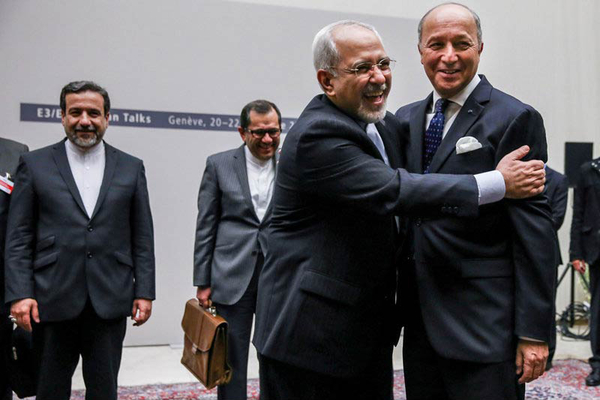
Foreign Minister Laurent Fabius says: “Trade is very important. It fosters growth. It’s important for the Iranians, it’s important for us,” adding that regarding the current nuclear deal with Iran, “we did not take it for commercial reasons, but for strategic reasons…” Above, Iranian Foreign Minister Javad Zarif hugs Fabius at the close of nuclear talks in Geneva, Nov. 23, 2014. (Image source: ISNA)
Italy. Italian Foreign Minister Paolo Gentiloni and Economic Development Minister Federica Guidi led a high-level trade mission to Iran on August 4-6, aimed at opening export opportunities for Italian companies. According to forecasts by SACE, the Italian export credit company, Italian exports to Iran are expected to grow to €3.8 billion ($4.1 billion) in 2018, up from €1.2 billion currently.
Companies in the oil and gas industry and the machine tool industry, the two sectors most adversely affected by sanctions, are hoping to recapture market share lost due to the trade embargo. Companies active in the machine tools sector (which accounts for nearly 60% of current Italian exports to Iran) have seen their exports drop to €700 million from €1.3 billion during the past five years, according to SACE.
Gentiloni and Guidi met with Iranian Oil Minister Bijan Namdar Zanganeh on August 6. After the meeting, Zanganeh said that Iran had invited the Italian oil and gas giant Eni, as well as other Italian companies, to participate in projects in the Iranian oil industry.
On August 4, SACE, together with the Italian Ministry of Economic Development and Mediobanca, the leading investment bank in Italy, announced the finalization of a Memorandum of Understanding with the Iranian Ministry of Economy and Finance and the Central Bank of Iran, aimed at facilitating the development of future economic and trade relations between the two countries.
Under the agreement, “the parties will collaborate to evaluate short and medium-long term projects of mutual interest implying Italian export and investments and to identify local financial institutions that could benefit from credit lines provided by Mediobanca, and guaranteed by SACE and the Ministry of Economy and Finance of Iran, to support the financing and payment of such transactions.”
Also on August 4, Finmeccanica, Italy’s main industrial group, announced that it had signed a €500 million ($543 million) contract with Iran’s Ghadir Investment Company to build a power plant in the country. Ghadir is 80% owned by the Islamic Revolutionary Guards’ Corps (IGRC). The IRGC, through its elite Quds Force, is responsible for the deaths of at least 1,000 American troops in Iraq.
Austria. Austrian President Heinz Fischer is set to become the first European head of state to visit Iran since 2004 when he travels to Tehran on September 7-9. Fischer will be accompanied by Vice Chancellor and Economy Minister Reinhold Mitterlehner, Foreign Minister Sebastian Kurz, as well as a delegation of high-ranking Austrian business leaders. Mitterlehner said he hopes that Austrian exports to Iran will reach one billion euros per year by 2020, up from 232 million euros today.
On July 23-24, the Austrian Economic Chamber (Wirtschaftskammer Österreich, WKÖ)organized a major EU-Iran trade conference that was attended by nearly 400 Austrian and Iranian business leaders, including Iranian Industry Minister Mohammad Reza Nematzadeh.
According to Nematzadeh: “We are no longer interested in unidirectional importation of goods and machinery from Europe. We are looking for two-way trade, as well as cooperation in development, design, engineering and joint investment for production and export.”
Not all Austrians are happy about the government’s rush to embrace Iran. The Austrian branch of the activist group “Stop the Bomb” organized a protest outside the WKÖ’s headquarters on July 23. In a statement, the group said:
“While the implementation of the nuclear deal with the Iranian has not even started and the sanctions on Iran are still in place, Iran trade lobbyists are set to host the ‘EU-Iran-Conference’ at the Austrian Economic Chamber WKO in Vienna. Among the participants are WKO-President Christoph Leitl and the Iranian Industry & Trade Minister Mohammad Reza Nematzadeh. 70 years after the Shoah, Austrian and German companies are in the first row to boost business ties with the anti-Semitic Iranian regime.
“This conference shows that billions of Euros are going to flow to the Iranian mullahs as a result of the Vienna agreement. This will enable the regime to sponsor its terror proxies like Hamas and Hezbollah and to enforce its aggressive expansion in the region in unprecedented ways. The terror against the Iranian population will not decrease, but increase. Already now more people have been executed under supposedly ‘moderate’ President Rouhani than under his predecessor Ahmadinejad.
“Conducting business with the Iranian regime means to finance the nuclear program, the annihilation threats against Israel, Holocaust denial, the export of Islamist terror and the oppression of the Iranian population.”
Spain. Foreign Minister José Manuel García-Margallo, Industry, Energy and Tourism Minister José Manuel Soria and Development Minister Ana Pastor will lead a high-level trade delegation to Iran in early September. The objective is to open doors for Spanish companies in the energy, telecommunications and infrastructure sectors.
After the sanctions are lifted, Spain hopes to double its exports to Iran to 600 million euros, up from 300 million euros today, according to the Chamber of Commerce. The key sectors of interest for Spanish companies are petroleum, petro-chemical, mining, automobile, infrastructure and rail transport.
Despite the embargo, more than 350 mostly small- and medium-sized Spanish companies are currently active in Iran. On July 19, the newspaper El Mundoreported that more than a dozen Spanish companies sold so-called dual-use materials that could have been used to help Iran build weapons of mass destruction.
Since 2011, Spanish authorities have carried out nearly a dozen police operations aimed at disrupting illegal weapons sales to Iran. One such operation blew the lid off a scheme to sell nine helicopters to Iran. Another operation discovered that a company ostensibly dedicated to importing Persian rugs was trying to sell missile casings to the Iranian military.
A report published by Gatestone Institute in April 2014 found that in addition to Spain, companies or individuals in more than a dozen European countries — including Belgium, Britain, Finland, France, Germany, Hungary, Ireland, Italy, the Netherlands, Norway, Slovenia, Sweden and Switzerland — have been involved in illegal dual-use exports to Iran.
A senior French official interviewed by the Reuters news agency summed it up this way: “Everyone is looking at Iran with greed.”
(The views expressed in this article are mine and do not necessarily reflect those of Warsclerotic or its other editors. — DM)
In 2011, well before the multilateral P5+1 “negotiations” with Iran began in February of 2013, Obama put Senator John Kerry in charge of “secret bilateral negotiations on the [Iranian] nuclear dossier.” Kerry then advised Iranian officials that “we are definitely and sincerely willing, and we can resolve the issues” — including Uranium enrichment and the Possible Military Dimensions (PMDs) of Iran’s nuclear program. Iran’s nuclear weaponization and missile development programs have been substantially ignored ever since.
Ernest Moniz, who was to become Kerry’s technical adviser, was brought into the P5+1 negotiations at the specific request of the Iranian official — Moniz’ former MIT classmate — who was to be his counterpart.
The Iran – North Korea nuclear axis, through which the rogue nations cooperate on nuke and missile development, continues to be ignored.
In earlier articles, beginning shortly after the Joint Plan of Action was published in November of 2013, I attempted to show that the focus was on pretending to curtail Iran’s Uranium enrichment programs as they expanded and then granting sanctions relief, while substantially ignoring the program’s “possible military dimensions” (PMDs). Followup articles are here, here and elsewhere. The PMDs have yet to be explored seriously and evidently will not be under the current “comprehensive” joint plan and the secret side deals between the International Atomic Energy Agency (IAEA) and Iran.
Any pretense that the IAEA will have “any time, anywhere” access to Iran’s military sites was mere rhetoric, as acknowledged by US Under Secretary of State Wendy Sherman on July 16th
“I think this is one of those circumstances where we have all been rhetorical from time to time,” Sherman said in a conference call with Israeli diplomatic reporters. “That phrase, anytime, anywhere, is something that became popular rhetoric, but I think people understood that if the IAEA felt it had to have access, and had a justification for that access, that it would be guaranteed, and that is what happened.” [Emphasis added.]
Ms. Sherman was right about the rhetorical nature of administration assertions, but wrong about IAEA access, of which there will apparently be little or none pursuant to the secret deals between Iran and the IAEA.
have “offered the opportunity to provide the nuclear fuel” to Iran, to “test them, see whether or not they were actually looking for it for peaceful purposes.” Mr. Kerry’s words brought comfort to Tehran’s top mullahs, who have been seeking to buy time from the international community for the past two years while they continue perfecting their nuclear weapons capabilities. [Emphasis added.]
. . . .
Top among the pro-regime fund-raisers who have contributed to the Kerry campaign is a recent Iranian immigrant in California named Susan Akbarpour.
. . . .
The Kerry campaign credits Miss Akbarpour and her new husband, Faraj Aalaie, with each raising $50,000 to $100,000 for the presidential campaign. Mr. Aalaie is president of Centillium Communications, a Nasdaq-listed software firm.
These contributions continue . . . even though Miss Akbarpour was not a permanent U.S. resident when she made her initial contribution to Mr. Kerry on June 17, 2002, as this reporter first revealed in March. (To be legal, campaign cash must come from U.S. citizens or permanent residents).
On August 10th of this year, the Middle East Media Research Institute (MEMRI) published a lengthy article quoting Iranian officials on their dealings with Senator Kerry. Obama had put Senator John Kerry in charge of “secret bilateral negotiations on the [Iranian] nuclear dossier” well before the multilateral P5+1 “negotiations” with Iran began in February of 2013.
The MEMRI article states that Kerry had representatives of The Sultanate of Oman deliver a letter he had written to Iranian officials recognizing Iran’s Uranium enrichment rights and suggesting secret negotiations. Omani officials discussed the letter with Iranian officials and, when the Iranians appeared skeptical, the Omani official suggested,
Go tell them that these are our demands. Deliver [the note] during your next visit to Oman.’ On a piece of paper I wrote down four clearly-stated points, one of which was [the demand for] official recognition of the right to enrich uranium. I thought that, if the Americans were sincere in their proposal, they had to accept these four demands of ours. Mr. Souri delivered this short letter to the mediator, stressing that this was the list of Iran’s demands, [and that], if the Americans wanted to resolve the issue, they were welcome to do so [on our terms], otherwise addressing the White House proposals to Iran would be pointless and unjustified. [Emphasis added.]
“All the demands presented in this letter were related to the nuclear challenge. [They were] issues we had always come up against, like the closing of the nuclear dossier, official recognition of [the right to] enrichment, and resolving the issue of Iran’s past activities under the PMD [possible military dimensions] heading. After receiving the letter, the Americans said, ‘We are definitely and sincerely willing, and we can resolve the issues that Iran mentioned.’” [Emphasis added.]
The texts of the November, 2013 Joint Plan of Action, as well as the July 14, 2015 “deal,” could easily have been predicted based on Kerry’s 2011 response to the Iranians.
“After Rohani’s government began working [in August 2013] – this was during Obama’s second term in office – a new [round of] negotiations between Iran and the P5+1 was launched. By this time, Kerry was no longer a senator but had been appointed secretary of state. [But even] before this, when he was still senator, he had already been appointed by Obama to handle the nuclear dossier [vis-à-vis Iran] and later [in December 2012] he was appointed secretary of state. Before this, the Omani mediator, who was in close touch with Kerry, told us that Kerry would soon be appointed secretary of state. In the period of the secret negotiations with the Americans in Oman, there was a more convenient atmosphere for obtaining concessions from the Americans. After the advent of the Rohani government and the American administration [i.e., after the start of Obama’s second term in office], and with Kerry as secretary of state, the Americans expressed a more forceful position. They no longer displayed the same eagerness to advance the negotiations. Their position became more rigid and the threshold of their demands higher. But the situation on the Iranian side changed too, since a very professional team was placed in charge of the negotiations with the P5+1…”
Perhaps Kerry had found it more congenial, and certainly more consistent with his and Obama’s own intentions, to be eager to help Iran during secret negotiations and to appear modestly resistant during the P5+1 sessions; they were at least slightly more in public view. Even so, according to Amir Hossein Motagh, a former aide to President Rouhani,
The US negotiating team are mainly [in Lausanne] to speak on Iran’s behalf with other members of the 5+1 countries and convince them of a deal. [Emphasis added.]
. . . .
French Foreign Minister Laurent Fabius, for example, has long been insisting that Iran come clean on its previous military activities, something we are now told that the American delegation, led by Secretary Kerry, wants to leave out of the negotiation. Why? Because the Iranians have said they will not come clean. [Emphasis added.]
That was too much even for the normally pro-Democrat Washington Post, which wrote in a column attributed to its Editorial Board last Friday that the deal was “a reward for Iran’s noncompliance.”
According to the article linked above,
Some Iranian-Americans believe that Secretary Kerry should have recused himself from the negotiations at the very outset because of his long-standing relationship to his Iranian counter-part, Mohammad Javad Zarif.
The two first met over a decade ago at a dinner party hosted by George Soros at his Manhattan penthouse, according to a 2012 book by Hooman Majd, who frequently translates for Iranian officials.
Iranian-American sources in Los Angeles tell me that Javad Zarif’s son was the best man at the 2009 wedding between Kerry’s daughter Vanessa and Behrouz Vala Nahed, an Iranian-American medical doctor.
The newlyweds went to Iran shortly after their wedding to met Nahed’s family. Kerry ultimately revealed his daughter’s marriage to an Iranian-American once he had taken over as Secretary of State. But the subject never came up in his Senate confirmation hearing, either because Kerry never disclosed it, or because his former colleagues were too polite to bring it up.
Why did Obama designate Kerry to deal with Iran in 2011? Andrew C. McCarthy, writing at The Center for Security Policy, offers this:
Clearly, there are two reasons: Obama needed someone outside the administration, and Kerry’s status and track record made him a natural.
Remember, Obama was running for reelection in 2011–12. Public opposition to Iran’s acquisition of nuclear weapons and, therefore, to Iran’s enrichment of uranium was very strong — and, indeed, remains so. Consequently, Obama pretended on the campaign trail that he would vigorously oppose Iran’s uranium-enrichment efforts . . . even as he was covertly signaling to the jihadist regime that he was open to recognizing Iran as a nuclear power. [Emphasis added.]
As my friend Fred Fleitz of the Center for Security Policy has noted, Obama asserted in the lead-up to the 2008 election that “the world must work to stop Iran’s uranium-enrichment program.” So too, in the run-up to the 2012 election, did Obama continue assuring voters that Iran “needs to give up its nuclear program and abide by the U.N. resolutions that have been in place.” Those U.N. resolutions prohibit Iran’s enrichment activities. Thus did the president proclaim, in seeking reelection, that the only deal he would accept would be one in which the Iranians “end their nuclear program. It’s very straightforward.” [Emphasis added.]
With Obama out feigning opposition to Iran’s enrichment activities, it would not do to have a conflicting message communicated to Iran by his own administration. What if Iran, to embarrass Obama, were to go public about an administration entreaty that directly addressed enrichment? It would have been hugely problematic for the president’s campaign. Obama thus needed an alternative: someone outside the administration whom Obama could trust but disavow if anything went wrong; someone the Iranian regime would regard as authoritative. [Emphasis added.]
John Kerry was the perfect choice.
I agree, but Mr. McCarthy does not address this exchange, quoted above but worth repeating here:
“All the demands presented in this letter were related to the nuclear challenge. [They were] issues we had always come up against, like the closing of the nuclear dossier, official recognition of [the right to] enrichment, and resolving the issue of Iran’s past activities under the PMD [possible military dimensions] heading. After receiving the letter, the Americans said, ‘We are definitely and sincerely willing, and we can resolve the issues that Iran mentioned.’” [Emphasis added.]
Salehi said that he was asked to join the nuclear talks when the discussions on the Natanz enrichment facility reached a dead end. Salehi said he would only join the talks if Moniz, his American counterpart, did as well. According to Salehi, this was approved by Undersecretary Wendy Sherman and Deputy Foreign Minister Abbas Araghchi, which he described as “the communications link between America and Iran.” [Emphasis added.]
Salehi said he and Moniz did not know each other well when they were at MIT, but when they first met during the talks, “there was a feeling that he has known me for years.” Salehi added, “A number of my classmates are now Mr. Moniz’s experts.” [Emphasis added.]
According to Salehi, Moniz entering the talks was important because Salehi expressed that he had been sent with “full authority” to sign off on all technical issues in the nuclear negotiations and Moniz had told him that he had the same authority.He added, “If the negotiations did not take place with the Americans, the reality is that it would not have reached a conclusion. No [other] country was ready to sit with us and negotiate for 16 days with their foreign minister and all of its experts.”
Salehi said that one of the more difficult times negotiating with Moniz was after they reached an agreement on a particular issue. Moniz would take it to the other members of P5+1, who would then make their own requests.
Moniz was likely as forthcoming with the non-US members of P5+1 as he was with members of the U.S. Congress; not at all.
North Korea and Iran, partners in crime
This is a drum I have been beating for years. Recent articles are available here and here. The Obama Administration persists in covering up what it knows on the subject and the current “deal” with Iran is silent on the matter. So, of course, was the November 2013 Joint Plan of Action.
Forbes published an article by Claudia Rosett today (August 13th) on the subject and, beyond noting that Douglas Frantz is Kerry’s Assistant Secretary in charge of the Bureau of Public Affairs, she observes that in his former capacity as a journalist for the Washington Post and New York Times, he wrote about the nature and perils of the axis.
Frantz’ duties under Kerry include
engaging “domestic and international media to communicate timely and accurate information with the goal of furthering U.S. foreign policy and national security interests as well as broadening understanding of American values.”
But it appears that as a State Department advocate of a free and well-informed press, Frantz himself is not free to answer questions from the press about his own reporting on North Korea’s help to Iran in designing a nuclear warhead. The State Department has refused my repeated requests to interview Frantz on this subject. Last year, an official at State’s Bureau of Public Affairs responded to my request with an email saying, “Unfortunately Assistant Secretary Frantz is not available to discuss issues related to Iran’s nuclear program.” This June I asked again, and received the emailed reply: “This is indeed an important topic for Doug, but he feels that speaking about his past work would no longer be appropriate, since he is no longer a journalist.”
The real issue, of course, is not the career timeline of Douglas Frantz, but the likelihood, past and future, of nuclear collaboration between Iran and North Korea. Frantz may no longer be a journalist, but it’s hard to see why that should constrain him, or his boss, Secretary Kerry, from speaking publicly about important details of Iran’s illicit nuclear endeavors — information which Frantz in his incarnation as a star journalist judged credible enough to publish in a major newspaper.
. . . .
President Obama has been telling Congress and the American public that the Iran nuclear deal — the Joint Comprehensive Plan of Action — “cuts off all Iran’s pathways to the bomb.” That’s not true. One of the most dangerous aspects of this deal is that it does not sever the longtime alliance between Tehran and Pyongyang. If there has indeed been cooperation between these two regimes on nuclear weapons, it’s time not only for Iran to come clean, but for the Obama administration to stop covering up. [Emphasis added.]
Although that’s not the only dangerous aspect which the Obama Administration has covered up and lied about cutting off “all [of] Iran’s pathways to the bomb” it is an important one. Meanwhile, it has been reported that
Fresh satellite images suggest North Korea is expanding its uranium extraction capacity, possibly with a view to increasing its stockpile of nuclear weapons.
The images taken in Pyongyang show Kim Jong-un has begun to refurbish a major mill that turns uranium ore into yellowcake – a first step towards producing enriched uranium.
A recent report by U.S. researchers warned that Kim was poised to expand his nuclear programme over the next five years and, in a worst-case scenario, could possess 100 atomic weapons by 2020.
Conclusions
“Negotiations” involving hostile foreign nations such as Iran are easier when led by friendly “negotiators” with compatible interests. At least since his failed 2004 campaign for the presidency, Kerry has been on Iran’s side and has favored it over the United States. While pretending for political purposes to be against Iran’s nuclear program, Obama was and remains in favor of it, pretenses to the contrary notwithstanding.
Obama, Kerry and Moniz got the deal they wanted. They, along with their P5+1 partners, richly deserve their resultant legacy of empowering Iran as an anti-American, anti-Israel, anti-Western civilization, Islamist hegemonic nuclear power with a disgraceful human rights record comparable to that of its partner, North Korea.
The Iran – North Korea nuclear axis has helped both rogue nations to develop and create nuclear bombs and the means to deliver them, with very little in the way of “adult supervision.” The failure to deal with even tangentially, or even to mention, the axis will likely become a significant part of Obama’s legacy. Ours as well.
Bringing Obama’s vision of stability to the Middle East, Allah willing.
This video is from August 2010. Now it may well be too late to stop Iran.
( My most important video is now also my most viewed. Few things make me proud. This is one of them… – JW )
__________________________________________________
Operation Opera (Hebrew: אופרה),[1] also known as Operation Babylon,[2] was a surprise Israeli air strike carried out on 7 June 1981, that destroyed a nuclear reactor under construction 17 kilometers (10.5 miles) southeast of Baghdad, Iraq.[3][4][5] This operation was after Iran’s Operation Scorch Sword that damaged this nuclear facility months before.
In 1976, Iraq purchased an “Osiris”-class nuclear reactor from France.[6][7] While Iraq and France maintained that the reactor, named Osirak by the French, was intended for peaceful scientific research,[8] the Israelis viewed the reactor with suspicion, and said that it was designed to make nuclear weapons.[3] On 7 June 1981, a flight of Israeli Air Force F-16A fighter aircraft, with an escort of F-15As, bombed and heavily damaged the Osirak reactor.[9] Israel claimed it acted in self-defense, and that the reactor had “less than a month to go” before “it might have become critical.”[10] Ten Iraqi soldiers and one French civilian were killed.[11] The attack took place about three weeks before the elections for the Knesset.[12]
The attack was strongly criticized around the world and Israel was rebuked by the United Nations Security Council and General Assembly in two separate resolutions.[13][14] The destruction of Osirak has been cited as an example of a preventive strike in contemporary scholarship on international law.
Iran has tested how to conduct an EMP attack, such as by attaching a nuclear weapon to an orbiting satellite or launching a nuclear-armed missile into the atmosphere from a ship.
Iranian military leaders have endorsed an EMP attack against America, according to secret Iranian military documents that Pentagon officials have translated, and the Pentagon’s North American Aerospace Defense Command is moving back into Cheyenne Mountain in Colorado because it can resist an EMP attack.
Those who, in light of this deal and Iran’s missile and EMP work, nevertheless dismiss the “Death to America” threats from Iran as just political rhetoric might heed the words of former Israeli Foreign Minister Abba Eban: “It is our experience that political leaders do not always mean the opposite of what they say.”
********************
Just four days after U.S.-led global powers and Iran completed their nuclear deal, Ayatollah Ali Khamenei, Iran’s supreme leader, reaffirmed the “Death to America” mantra that has pervaded his regime since its establishment in 1979, stating, “The entire country is under the umbrella of this great movement.” Iran has killed hundreds of Americans in the Middle East, both directly and through its terrorist proxies. It has threatened U.S. regional interests by funding anti-Israeli terrorists, propping up Syria’s terror-backing Bashar al-Assad and de-stabilizing U.S.-backed governments.
Moving forward, this deal will enable Tehran to threaten U.S. security more directly in at least two ways: First, Iran could deploy a nuclear warhead on one of its ballistic missiles and fire it at the United States. Iran is building increasingly sophisticated ballistic missiles, with its Shahab-3 able to reach Israel, and the Sejjil that it’s developing capable of reaching Italy and Poland.
Tehran also announced plans to build missile silos in what experts consider a precursor to deploying longer range missiles.
Second, Iran could detonate a nuclear device over the United States in an electromagnetic pulse attack that destroys our electric grid, putting the nation in the dark for months and eventually leaving 90 percent of Americans dead from disease or starvation.
Iran has tested how to conduct an EMP attack, such as by attaching a nuclear weapon to an orbiting satellite or launching a nuclear-armed missile into the atmosphere from a ship.
Iranian military leaders have endorsed an EMP attack against America, according to secret Iranian military documents that Pentagon officials have translated, and the Pentagon’s North American Aerospace Defense Command is moving back into Cheyenne Mountain in Colorado because it can resist an EMP attack.
That Iran can develop nuclear weapons under the deal, making these two scenarios plausible, is clear; the only question is when.
For starters, the deal is time-limited and, as restrictions end in 10-15 years, Iran can pursue two paths to a bomb – enriching uranium to weapons-grade levels or building plutonium-producing reactors, or both.
But Tehran need not wait that long because international inspectors will be hard-pressed to confirm that Iran is abiding by the deal’s restrictions on how much uranium it’s enriching, how many centrifuges it’s operating, and what it may be doing at secret sites that the world has not yet discovered.
That’s because rather than “anywhere, anytime” inspections, Iran will have 24 days to comply with requests from the International Atomic Energy Agency to visit a suspected undeclared site, during which Iran can move, hide, or destroy evidence of its nuclear progress.
If Iran refuses to allow a site visit after 24 days, global leaders likely would begin further negotiations with Iran that would give the latter weeks more to clean up a site.
But Tehran need not wait that long because international inspectors will be hard-pressed to confirm that Iran is abiding by the deal’s restrictions on how much uranium it’s enriching, how many centrifuges it’s operating, and what it may be doing at secret sites that the world has not yet discovered.
That’s because rather than “anywhere, anytime” inspections, Iran will have 24 days to comply with requests from the International Atomic Energy Agency to visit a suspected undeclared site, during which Iran can move, hide, or destroy evidence of its nuclear progress.
If Iran refuses to allow a site visit after 24 days, global leaders likely would begin further negotiations with Iran that would give the latter weeks more to clean up a site.
Nor, under this deal, must Tehran reveal the military-related dimensions of its nuclear work to date, leaving the world dangerously ignorant of how close it already is to developing and deploying a nuclear weapon and also leaving inspectors without a baseline against which to judge Iranian compliance in the future.
Moreover, the $100 billion to $150 billion in sanctions relief will give Iran a huge windfall to develop a more robust infrastructure for nuclear weapons production – either quickly by evading the weak inspections regime or more patiently by waiting about a decade until the world frees Iran of all restrictions.
Those who, in light of this deal and Iran’s missile and EMP work, nevertheless dismiss the “Death to America” threats from Iran as just political rhetoric might heed the words of former Israeli Foreign Minister Abba Eban: “It is our experience that political leaders do not always mean the opposite of what they say.”
(I have been beating this drum for years and this is among the best articles on the subject I have read. It is clearly past time for the Obama Administration to “come clean” on what it knows about the Iran – North Korea axis. Congress should reject the current “deal” with Iran if it does not do so, fully and promptly. — DM)
President Obama has been telling Congress and the American public that the Iran nuclear deal — the Joint Comprehensive Plan of Action — “cuts off all Iran’s pathways to the bomb.” That’s not true. One of the most dangerous aspects of this deal is that it does not sever the longtime alliance between Tehran and Pyongyang. If there has indeed been cooperation between these two regimes on nuclear weapons, it’s time not only for Iran to come clean, but for the Obama administration to stop covering up.
******************
As U.S. lawmakers debate the Iran nuclear deal, they are rightly concerned about Iran’s refusal to disclose its past work on nuclear weapons. Not only does this refusal deprive inspectors of a baseline for monitoring Iran’s compliance; it also deprives Congress of information about the networks that Iran’s regime might most readily employ should it choose to secretly continue its quest for the nuclear bomb.
On that note, it should also concern Congress that Tehran is not alone in hiding information on Iran’s history of developing nuclear weapons. Whatever President Obama and his negotiating team might know about such matters, they have been — to put it mildly — less than diligent about informing the American public.
An honest accounting would quite likely reveal something that many press reports have alleged, but U.S. administration officials have never publicly confirmed: A history of nuclear weapons collaboration between Iran and nuclear-proliferating North Korea.
Don’t take my word for it. Let us turn instead to an in-depth article published on August 4, 2003 by a staff writer of the Los Angeles Times under the headline “Iran Closes In on Ability to Build a Nuclear Bomb.” The reporter was no junior correspondent. The article was the product of a three-month international investigation by a veteran investigative reporter, previously a member of a Pulitzer-Prize winning team at the New York Times, Douglas Frantz.
Drawing on “previously secret reports, international officials, independent experts, Iranian exiles and intelligence sources in Europe and the Middle East,” Frantz wrote that “North Korean military scientists recently were monitored entering Iranian nuclear facilities. They are assisting in the design of a nuclear warhead, according to people inside Iran and foreign intelligence officials.”
Frantz added: “So many North Koreans are working on nuclear and missile projects in Iran that a resort on the Caspian coast is set aside for their exclusive use.”
Perhaps Frantz should recycle that article to Secretary of State John Kerry, who while testifying to a congressional panel last month was asked about its allegations by Rep. Christopher Smith, and ducked the question.
Frantz might have a better chance of getting Kerry’s attention; Frantz now works for Kerry. In 2009, then-Senator Kerry hired Frantz as deputy staff director and chief investigator of the Senate Foreign Relations Committee. Frantz returned briefly to newspaper work in 2012, as national security editor of The Washington Post. Frantz was then hired once again to work under Kerry, this time at the State Department, where Frantz has worked since 2013 as Assistant Secretary in charge of the Bureau of Public Affairs.
At State, Frantz’s portfolio includes engaging “domestic and international media to communicate timely and accurate information with the goal of furthering U.S. foreign policy and national security interests as well as broadening understanding of American values.”
But it appears that as a State Department advocate of a free and well-informed press, Frantz himself is not free to answer questions from the press about his own reporting on North Korea’s help to Iran in designing a nuclear warhead. The State Department has refused my repeated requests to interview Frantz on this subject. Last year, an official at State’s Bureau of Public Affairs responded to my request with an email saying, “Unfortunately Assistant Secretary Frantz is not available to discuss issues related to Iran’s nuclear program.” This June I asked again, and received the emailed reply: “This is indeed an important topic for Doug, but he feels that speaking about his past work would no longer be appropriate, since he is no longer a journalist.”
The real issue, of course, is not the career timeline of Douglas Frantz, but the likelihood, past and future, of nuclear collaboration between Iran and North Korea. Frantz may no longer be a journalist, but it’s hard to see why that should constrain him, or his boss, Secretary Kerry, from speaking publicly about important details of Iran’s illicit nuclear endeavors — information which Frantz in his incarnation as a star journalist judged credible enough to publish in a major newspaper.
If Frantz needs to protect his sources, by all means let him do so. He need not name his contacts inside Iran, or the “foreign intelligence officials” who gave him his scoop. If Frantz’s story was accurate, then presumably the administration has its own sources for such information. Recall that in June, with reference to Iran’s past work on nuclear weapons — the “possible military dimensions” of its nuclear program — Kerry told reporters “We know what they did. We have no doubt. We have absolute knowledge with respect to the certain military activities they were engaged in.”
So, what precisely were those activities, and Congress might want to ask Frantz, or his boss, Secretary of State Kerry, if information available to the U.S. administration supports Frantz’s story of North Korean-Iran collaboration on nuclear warheads. If so, then surely it’s time for the administration to lift the classified veil and share the blockbuster details not only with Congress, but with American voters — who deserve to know a lot more of the history that might yet shape the future of this “historic” Iran nuclear deal.
Of course, the real problem for the Obama administration is that an officially confirmed story of Iran-North Korea collaboration on nuclear warheads could spell further trouble for winning congressional approval of this nuclear deal. North Korea is a rogue state which despite sanctions has long served as a munitions back shop for Iran. If that business has included tutorials on nuclear warhead design, that is very bad news. North Korea has already conducted three nuclear tests, has been threatening a fourth, and appears to be producing bomb fuel — both plutonium and highly enriched uranium — for a nuclear arsenal which by the estimates of various experts could within a few years include dozens of warheads. Under the Iran nuclear deal, Iran would emerge with a lot more money to browse such wares.
According to public statements this year by a number of senior U.S. military officials, North Korea has also acquired the ability –untested, but dangerous — to mount miniaturized nuclear warheads on ballistic missiles. In other words, North Korea is becoming a full service shop for nuclear weapons, including the materials and technology to make them and the means to deliver them.
North Korea has a long record of peddling its weapons and related technology abroad, from conventional arms to missiles to the notorious caper in which North Korea helped Iran’s client state, Syria, build an entire clandestine nuclear reactor for no apparent use except to produce plutonium for nuclear weapons (that reactor was nearing completion when it was destroyed in 2007 by an Israeli air strike). Iran and North Korea are longtime allies, veteran smugglers and since the early days of Iran’s 1979 Islamic revolution have been prolific partners in weapons traffic.
Nor has Frantz been the only journalist to report that Iran and North Korea have worked together on nuclear weapons. For years, there have been reports in the media of Iranian officials attending North Korean nuclear tests, and North Koreans turning up at nuclear weapons research facilities in Iran. In testimony July 28th at a joint subcommittee hearing of the House Committee on Foreign Affairs, a former Congressional Research Service specialist on Asia, Larry Niksch, provided a list of respected news services that have published stories on Iran-North Korea nuclear cooperation. Among them were Reuters, Germany’s Der Spiegel and Suddeutsche Zeitung, Japan’s Kyodo News and Sankei Shimbun. and Australia’s Sydney Morning Herald. Broadly, these stories have cited sources such as foreign intelligence agencies and Iranian defectors.
The staple element missing from this picture is any official U.S. confirmation that Iran and North Korea have worked together on nuclear matters. The Obama administration has confirmed dealings between Iran and North Korea in conventional arms and missiles. But, as Niksch stated, “On nuclear collaboration there has been a virtual blackout of public information.”
When asked about allegations of Iran-North Korea nuclear ties, Obama administration officials either retreat behind the classified veil, or deflect the question. A standard response is that they take such allegations “seriously” and will look into them. From that process, to date, no significant public information has emerged.
The likely reason for this cone of silence is that for more than two decades, American presidents have tried to defang first North Korea’s nuclear program, and now Iran’s, by concocting nuclear deals that don’t hold up. In the process, Presidents Clinton, Bush (in his second term) and now President Obama, have each in turn tried to minimize disclosures that could derail their various nuclear deals. The unfortunate result is that instead of stopping nuclear proliferation, they have collectively run cover for some of the most virulent ties between Iran and North Korea. In doing so, they have deprived the American public of information important to assessing any nuclear deal with either North Korea or Iran.
Some secrecy may be necessary to protect intelligence sources and methods. That should not excuse any American president or his team from failure to alert the public to the extent of the Iran-North Korea connection, or refusal to comment in any meaningful way on allegations of nuclear weapons cooperation between Tehran and Pyongyang.
President Obama has been telling Congress and the American public that the Iran nuclear deal — the Joint Comprehensive Plan of Action — “cuts off all Iran’s pathways to the bomb.” That’s not true. One of the most dangerous aspects of this deal is that it does not sever the longtime alliance between Tehran and Pyongyang. If there has indeed been cooperation between these two regimes on nuclear weapons, it’s time not only for Iran to come clean, but for the Obama administration to stop covering up.
A look at several Israeli public opinion polls shows a broad consensus against the deal that seems to transcend conventional political divides.
Judy Maltz Aug 12, 2015 5:25 PM
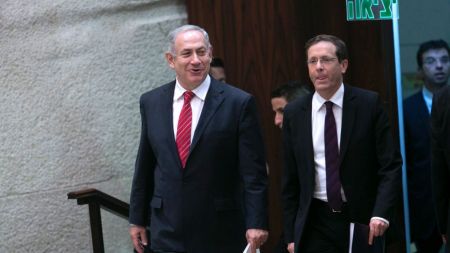
Netanyahu and Herzog. PM Benjamin Netanyahu and Labor chairman Isaac Herzog.Olivier Fitoussi
Momentous times for U.S. and Obama should make Israelis burn with envy
Iran deal isn’t Netanyahu’s worst defeat, it’s proof of his greatest triumph
Netanyahu’s government is hard-pressed to weather the mounting storm of international isolation
Israeli opposition leader Isaac Herzog is not happy with the Iran nuclear deal signed last month – to put it mildly. And he’s not the only high-profile Israeli from the center-left – among them some prominent peace activists, writers and commentators – to voice dissent, or at least skepticism.
By contrast, some tough-minded Israeli defense establishment types – among them former heads of the military and security services – insist it’s not the end of the world. While certainly no cause for celebration, in their view, the historic agreement signed between Iran and six world powers led by the United States is far better than the alternative.
And what do the common folk think? To be sure, among Israeli leftists, there are many whose knee-jerk reaction is to find out where Prime Minister Benjamin Netanyahu stands on an issue and take the opposing view. They need know nothing more than the fact that Netanyahu rejects the deal for them to be in favor.
Still, a look at some of the public opinion polls conducted after the agreement was signed – as well as before it – shows a broad consensus against the deal that would seem to transcend the conventional political divides. Most Israelis are not convinced the agreement will prevent Iran from becoming a nuclear power or that it will eliminate what is often considered the biggest threat to the country. Like their elected leaders, most Israelis, these polls show, don’t think the U.S. administration has their best interests at heart.
A day after the agreement was signed, a poll conducted by Israel’s Channel 10 found that an overwhelming 69 percent of Israelis opposed it, while only 10 percent were in favor, with 21 percent undecided.
Asked whether they thought the agreement would prevent Iran from achieving nuclear capabilities, 74 percent said it wouldn’t, while only 10 percent said it would, with 16 percent undecided.
The Channel 10 poll shows that 40 percent of Israelis would be in favor of attacking Iranian nuclear sites, with 32 opposed to such a move and 28 percent undecided. According to its findings, more Israelis (37 percent) feel Netanyahu had done a bad job of handling the campaign against the deal than those (34 percent) who believe he’s done a good job, with the rest undecided.
A poll conducted by Ma’ariv several days later showed an even greater level of suspicion toward the agreement. Asked if they thought it poses a threat to Israel, a whopping 78 percent of Israelis said they thought it did, with only 15 percent saying it didn’t and the rest undecided. Asked if they believed that the agreement brings Iran closer to obtaining nuclear capabilities, 71 percent said it did, and only 12 percent said it didn’t, with 17 percent undecided.
Asked it they believed Israel should launch an attack on Iran to prevent it from achieving nuclear capabilities, almost half of the respondents (47 percent) said yes, another 35 percent said no, with the rest undecided.
Asked how they thought the prime minister should respond to the agreement, 51 percent said he should use all possible means to convince Congress to vote against it, 38 percent said he should try to reach an understanding with Americans on its implementations, with 11 percent saying they didn’t know.
Looking back at earlier polls, it would appear that the man and woman on the street have not changed their position much. A public opinion survey conducted by The Jerusalem Post, several weeks before the deal was signed, found that slightly almost half (48.5 percent) of all Israelis considered the agreement-in-the-making to be an existential threat to the country, while only 22 percent did not. Asked to what degree they felt they felt could rely on the U.S. administration to protect Israel, close to 45 percent responded that they couldn’t, while less than 22 percent responded that they could, with the rest vacillating somewhere in the middle.
In a paper published by the Washington Institute for Near East Policy a month before the deal was finalized, Israeli military expert Michael Herzog (and brother to opposition leader Isaac Herzog) spells out where Israelis are united and divided in their positions on the matter. “While a wide consensus exists regarding the potential risks entailed in the deal, a policy debate is under way on how to best address Israel’s concerns,” he says.
“Should Israel fight the deal publicly and through Congress, as the current Israeli leadership has done? Or should it accept the deal as a fait accompli and seek to obtain maximal improvements and strategic assurances through a dialogue with the United States and other major international actors? The latter course has been taken by the Gulf countries, who equally dislike the deal and have found ways to express their displeasure. Notwithstanding converging interests between Israel and major Arab actors—such as shared concerns about Islamists and jihadists, Iran, and the weak U.S. regional role—some in Israel fear that staying on the current course could mean being left behind or, worse, weakening both its unique strategic relationship with United States and its qualitative military edge.”
A memorandum published in 2013 by The Institute for National Security Studies, a think-tank affiliated with Tel Aviv University, found that while most Israelis deem Iran’s nuclear capabilities a major threat to the country, they don’t see it as an existential threat. Written by Yehuda Ben-Meir and Olena Bagno-Moldavsky, the memorandum note that “most Israelis do not believe that Iran will launch a nuclear attack against Israeli, while at the same time, they believe in Israel’s deterrence capabilities.”
An examination of different surveys published by various polling organizations between 2006 and 2013 would seem to indicate that Israelis have and remain quite entrenched in their view of Iran’s nuclear capabilities. In almost all the surveys, at least 45 percent of the respondents – and in some cases as high as two-thirds and three-quarters – said they supported a unilateral attack on Iran’s nuclear facilities. An overwhelming majority – anywhere between two-thirds to more than 80 percent – said they considered a nuclear-armed Iran to constitute an existential threat to Israel, and at least one third of those questioned in these surveys said they supported an international attack on Iran’s nuclear facilities.
During a discussion hosted by Reuters on Tuesday, Secretary of State John Kerry said if the United States rejects the Iran nuclear agreement, the U.S. dollar would not be the world’s reserve currency.
“That is a recipe, very quickly, my friends, businesspeople here, for the American dollar to cease to be the reserve currency of the world, which is already bubbling out there,” Kerry said.
Kerry argued that if Congress rejects the deal, the United States would not be able to maintain an international coalition to impose sanctions on Iran and would have to resort to the sanctioning of allies.
“The United States is going to start sanctioning our allies and their banks and their businesses because we walked away from a deal?” Kerry said. “And we’re going to force them to do what we want them to do even though they agreed to the deal we came to? Are you kidding?”
Editor’s note: The following is the first article in the FrontPage series “Obama’s Betrayals,” which will explore the president’s record of perfidy, malfeasance and crimes against the American people. As the Obama presidency enters its final stages, examples of this treachery are only becoming more numerous and brazen. “Obama’s Betrayals” will shine the spotlight on these attacks on the American polity, the incredible damage they are inflicting on the nation, and the dangerous agenda the president intends to complete before leaving office.
It doesn’t get any more explosive than this: a high-ranking former Obama administration official charging that the administration made a conscious decision to support al-Qaeda – so where is the mainstream media?
Brad Hoff reported in Foreign Policy Journal last Friday that “in Al Jazeera’s latest Head to Head episode, former director of the Defense Intelligence Agency Michael Flynn confirms to Mehdi Hasan that not only had he studied the DIA memo predicting the West’s backing of an Islamic State in Syria when it came across his desk in 2012, but even asserts that the White House’s sponsoring of radical jihadists (that would emerge as ISIL and Nusra) against the Syrian regime was ‘a willful decision.’”
When Hasan asked Flynn if “the administration turned a blind eye” to analyses explaining how the Syrian “rebels” against the Assad regime were actually Islamic jihadists who wanted to establish a hardline Sharia state in Syria, Flynn responded: “I don’t know that they turned a blind eye, I think it was a decision. I think it was a willful decision.”
“A willful decision to support an insurgency that had Salafists, Al Qaeda and the Muslim Brotherhood?,” asked Hasan.
Flynn responded: “It was a willful decision to do what they’re doing.” That is, arm those Salafist, al-Qaeda and Muslim Brotherhood elements, and do all they could to enable them to succeed.
One has to pause and consider the source for all this. Mehdi Hasan is a highlysuspectanalyst and Foreign Policy Journal appears to be a pro-jihad paleocon publication, and Al Jazeera is certainly a pro-jihad propaganda outlet. All that is noted, but if this transcript is accurate, former DIA director Michael Flynn is confirming that the Obama Administration knowingly decided to support al-Qaeda and the Muslim Brotherhood in Syria, and directly enabled the rise of the Islamic State.
And given the Obama Administration’s general stance toward the global jihad and Islamic supremacism, what would be unbelievable about that? It has been well known for years that Obama has energetically supported the Muslim Brotherhood – so well known that Egyptians protesting against the corrupt and tyrannical Muslim Brotherhood regime of Mohamed Morsi in 2013 held up signs calling on Obama to “stop supporting terrorism.”
But al-Qaeda? The former head of the DIA revealing that the Obama administration made a conscious decision to aid the organization that murdered 3,000 Americans on September 11, 2001 and has been waging global warfare against the United States ever since? That is something else again.
It would, however, be consistent with so many odd aspects of Obama’s behavior. The President has aroused controversy over his affinity with Islam throughout his presidency, with his extravagant praise of the non-existent Islamic role in the founding and growth of the American republic, his exaggeration of Muslim achievements, his refusal to name the global jihad threat in any accurate manner, and so much more – even small incidents such as his notorious 2008 “slip of the tongue” in which he referred to “my Muslim faith,” right up to the one that broke in February 2015, when a photo surfaced from the U.S.-African Leaders’ Summit in August 2014, showing Obama passing by a group of African delegates with his right index finger raised in a gesture strongly reminiscent of the Islamic State’s now notorious one-finger salute.
That Islamic State, of course, was the direct beneficiary of Obama’s Syria policies, and now Michael Flynn has revealed that that was essentially the plan all along. So why isn’t the honking gaggle of Republican presidential candidates saying anything about this – demanding an investigation, asking Flynn for more information, imploring Obama to come clean about his Syria strategy – anything at all? In a sane political atmosphere, this would be enough to bring down the Obama presidency. Instead, it will get little notice and no action whatsoever.
Why that is so remains a mystery. Can it be that Flynn’s allegations are simply too hot to handle for everyone, and that, if taken seriously, they would bring down many more people than just Barack Obama? That seems to be the only remotely plausible explanation. But it is a deeply disquieting one.






 anneinpt
 artaxes
 danmillerinpanama
 davidking1530
 Peter Hofman
 Joseph Wouk
 Peter
Peter Louisiana Steve
 WarSclerotic
Recent Comments