Archive for August 12, 2015

Polls Show Israelis Strongly Oppose Iran Nuclear Deal

August 12, 2015

Polls Show Israelis Strongly Oppose Iran Nuclear Deal Israel News Haaretz.

A look at several Israeli public opinion polls shows a broad consensus against the deal that seems to transcend conventional political divides.

Judy Maltz Aug 12, 2015 5:25 PM
Polls Show Israelis Strongly Oppose Iran Nuclear Deal Israel News Haaretz

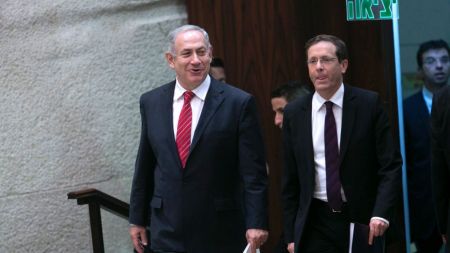
 Netanyahu and Herzog.
PM Benjamin Netanyahu and Labor chairman Isaac Herzog.Olivier Fitoussi

Momentous times for U.S. and Obama should make Israelis burn with envy
Iran deal isn’t Netanyahu’s worst defeat, it’s proof of his greatest triumph
Netanyahu’s government is hard-pressed to weather the mounting storm of international isolation

Israeli opposition leader Isaac Herzog is not happy with the Iran nuclear deal signed last month – to put it mildly. And he’s not the only high-profile Israeli from the center-left – among them some prominent peace activists, writers and commentators – to voice dissent, or at least skepticism.

By contrast, some tough-minded Israeli defense establishment types – among them former heads of the military and security services – insist it’s not the end of the world. While certainly no cause for celebration, in their view, the historic agreement signed between Iran and six world powers led by the United States is far better than the alternative.

And what do the common folk think? To be sure, among Israeli leftists, there are many whose knee-jerk reaction is to find out where Prime Minister Benjamin Netanyahu stands on an issue and take the opposing view. They need know nothing more than the fact that Netanyahu rejects the deal for them to be in favor.

Still, a look at some of the public opinion polls conducted after the agreement was signed – as well as before it – shows a broad consensus against the deal that would seem to transcend the conventional political divides. Most Israelis are not convinced the agreement will prevent Iran from becoming a nuclear power or that it will eliminate what is often considered the biggest threat to the country. Like their elected leaders, most Israelis, these polls show, don’t think the U.S. administration has their best interests at heart.

A day after the agreement was signed, a poll conducted by Israel’s Channel 10 found that an overwhelming 69 percent of Israelis opposed it, while only 10 percent were in favor, with 21 percent undecided.

Asked whether they thought the agreement would prevent Iran from achieving nuclear capabilities, 74 percent said it wouldn’t, while only 10 percent said it would, with 16 percent undecided.

The Channel 10 poll shows that 40 percent of Israelis would be in favor of attacking Iranian nuclear sites, with 32 opposed to such a move and 28 percent undecided. According to its findings, more Israelis (37 percent) feel Netanyahu had done a bad job of handling the campaign against the deal than those (34 percent) who believe he’s done a good job, with the rest undecided.

A poll conducted by Ma’ariv several days later showed an even greater level of suspicion toward the agreement.  Asked if they thought it poses a threat to Israel, a whopping 78 percent of Israelis said they thought it did, with only 15 percent saying it didn’t and the rest undecided. Asked if they believed that the agreement brings Iran closer to obtaining nuclear capabilities, 71 percent said it did, and only 12 percent said it didn’t, with 17 percent undecided.

Asked it they believed Israel should launch an attack on Iran to prevent it from achieving nuclear capabilities, almost half of the respondents (47 percent) said yes, another 35 percent said no, with the rest undecided.

Asked how they thought the prime minister should respond to the agreement, 51 percent said he should use all possible means to convince Congress to vote against it, 38 percent said he should try to reach an understanding with Americans on its implementations, with 11 percent saying they didn’t know.

Looking back at earlier polls, it would appear that the man and woman on the street have not changed their position much. A public opinion survey conducted by The Jerusalem Post, several weeks before the deal was signed, found that slightly almost half (48.5 percent) of all Israelis considered the agreement-in-the-making to be an existential threat to the country, while only 22 percent did not. Asked to what degree they felt they felt could rely on the U.S. administration to protect Israel, close to 45 percent responded that they couldn’t, while less than 22 percent responded that they could, with the rest vacillating somewhere in the middle.

In a paper published by the Washington Institute for Near East Policy a month before the deal was finalized, Israeli military expert Michael Herzog (and brother to opposition leader Isaac Herzog) spells out where Israelis are united and divided in their positions on the matter. “While a wide consensus exists regarding the potential risks entailed in the deal, a policy debate is under way on how to best address Israel’s concerns,” he says.

“Should Israel fight the deal publicly and through Congress, as the current Israeli leadership has done? Or should it accept the deal as a fait accompli and seek to obtain maximal improvements and strategic assurances through a dialogue with the United States and other major international actors? The latter course has been taken by the Gulf countries, who equally dislike the deal and have found ways to express their displeasure. Notwithstanding converging interests between Israel and major Arab actors—such as shared concerns about Islamists and jihadists, Iran, and the weak U.S. regional role—some in Israel fear that staying on the current course could mean being left behind or, worse, weakening both its unique strategic relationship with United States and its qualitative military edge.”

A memorandum published in 2013 by The Institute for National Security Studies, a think-tank affiliated with Tel Aviv University, found that while most Israelis deem Iran’s nuclear capabilities a major threat to the country, they don’t see it as an existential threat. Written by Yehuda Ben-Meir and Olena Bagno-Moldavsky, the memorandum note that “most Israelis do not believe that Iran will launch a nuclear attack against Israeli, while at the same time, they believe in Israel’s deterrence capabilities.”

An examination of different surveys published by various polling organizations between 2006 and 2013 would seem to indicate that Israelis have and remain quite entrenched in their view of Iran’s nuclear capabilities. In almost all the surveys, at least 45 percent of the respondents – and in some cases as high as two-thirds and three-quarters – said they supported a unilateral attack on Iran’s nuclear facilities. An overwhelming majority – anywhere between two-thirds to more than 80 percent – said they considered a nuclear-armed Iran to constitute an existential threat to Israel, and at least one third of those questioned in these surveys said they supported an international attack on Iran’s nuclear facilities.

Kerry: Rejection of Iran Deal Will Lead to U.S. Dollar Not Being the World’s Reserve Currency

August 12, 2015

Kerry: Rejection of Iran Deal Will Lead to U.S. Dollar Not Being the World’s Reserve Currency

BY:
August 11, 2015 2:04 pm

via Kerry: Rejection of Iran Deal Will Lead to U.S. Dollar Not Being the World’s Reserve Currency | Washington Free Beacon.


During a discussion hosted by Reuters on Tuesday, Secretary of State John Kerry said if the United States rejects the Iran nuclear agreement, the U.S. dollar would not be the world’s reserve currency.

“That is a recipe, very quickly, my friends, businesspeople here, for the American dollar to cease to be the reserve currency of the world, which is already bubbling out there,” Kerry said.

Kerry argued that if Congress rejects the deal, the United States would not be able to maintain an international coalition to impose sanctions on Iran and would have to resort to the sanctioning of allies.

“The United States is going to start sanctioning our allies and their banks and their businesses because we walked away from a deal?” Kerry said. “And we’re going to force them to do what we want them to do even though they agreed to the deal we came to? Are you kidding?”

Obama’s Betrayals: Willfully Supporting Al-Qaeda and the Muslim Brotherhood

August 12, 2015

Obama’s Betrayals: Willfully Supporting Al-Qaeda and the Muslim Brotherhood

Dare anyone call it treason?

August 12, 2015

Robert Spencer

via Obama’s Betrayals: Willfully Supporting Al-Qaeda and the Muslim Brotherhood | Frontpage Mag.

Editor’s note: The following is the first article in the FrontPage series “Obama’s Betrayals,” which will explore the president’s record of perfidy, malfeasance and crimes against the American people. As the Obama presidency enters its final stages, examples of this treachery are only becoming more numerous and brazen. “Obama’s Betrayals” will shine the spotlight on these attacks on the American polity, the incredible damage they are inflicting on the nation, and the dangerous agenda the president intends to complete before leaving office. 

It doesn’t get any more explosive than this: a high-ranking former Obama administration official charging that the administration made a conscious decision to support al-Qaeda – so where is the mainstream media?

Brad Hoff reported in Foreign Policy Journal last Friday that “in Al Jazeera’s latest Head to Head episode, former director of the Defense Intelligence Agency Michael Flynn confirms to Mehdi Hasan that not only had he studied the DIA memo predicting the West’s backing of an Islamic State in Syria when it came across his desk in 2012, but even asserts that the White House’s sponsoring of radical jihadists (that would emerge as ISIL and Nusra) against the Syrian regime was ‘a willful decision.’”

When Hasan asked Flynn if “the administration turned a blind eye” to analyses explaining how the Syrian “rebels” against the Assad regime were actually Islamic jihadists who wanted to establish a hardline Sharia state in Syria, Flynn responded: “I don’t know that they turned a blind eye, I think it was a decision. I think it was a willful decision.”

“A willful decision to support an insurgency that had Salafists, Al Qaeda and the Muslim Brotherhood?,” asked Hasan.

Flynn responded: “It was a willful decision to do what they’re doing.” That is, arm those Salafist, al-Qaeda and Muslim Brotherhood elements, and do all they could to enable them to succeed.

One has to pause and consider the source for all this. Mehdi Hasan is a highly suspect analyst and Foreign Policy Journal appears to be a pro-jihad paleocon publication, and Al Jazeera is certainly a pro-jihad propaganda outlet. All that is noted, but if this transcript is accurate, former DIA director Michael Flynn is confirming that the Obama Administration knowingly decided to support al-Qaeda and the Muslim Brotherhood in Syria, and directly enabled the rise of the Islamic State.

And given the Obama Administration’s general stance toward the global jihad and Islamic supremacism, what would be unbelievable about that? It has been well known for years that Obama has energetically supported the Muslim Brotherhood – so well known that Egyptians protesting against the corrupt and tyrannical Muslim Brotherhood regime of Mohamed Morsi in 2013 held up signs calling on Obama to “stop supporting terrorism.”

But al-Qaeda? The former head of the DIA revealing that the Obama administration made a conscious decision to aid the organization that murdered 3,000 Americans on September 11, 2001 and has been waging global warfare against the United States ever since? That is something else again.

It would, however, be consistent with so many odd aspects of Obama’s behavior. The President has aroused controversy over his affinity with Islam throughout his presidency, with his extravagant praise of the non-existent Islamic role in the founding and growth of the American republic, his exaggeration of Muslim achievements, his refusal to name the global jihad threat in any accurate manner, and so much more – even small incidents such as his notorious 2008 “slip of the tongue” in which he referred to “my Muslim faith,” right up to the one that broke in February 2015, when a photo surfaced from the U.S.-African Leaders’ Summit in August 2014, showing Obama passing by a group of African delegates with his right index finger raised in a gesture strongly reminiscent of the Islamic State’s now notorious one-finger salute.

That Islamic State, of course, was the direct beneficiary of Obama’s Syria policies, and now Michael Flynn has revealed that that was essentially the plan all along. So why isn’t the honking gaggle of Republican presidential candidates saying anything about this – demanding an investigation, asking Flynn for more information, imploring Obama to come clean about his Syria strategy – anything at all? In a sane political atmosphere, this would be enough to bring down the Obama presidency. Instead, it will get little notice and no action whatsoever.

Why that is so remains a mystery. Can it be that Flynn’s allegations are simply too hot to handle for everyone, and that, if taken seriously, they would bring down many more people than just Barack Obama? That seems to be the only remotely plausible explanation. But it is a deeply disquieting one.

Robert Spencer is the director of Jihad Watch and author of the New York Times bestsellers The Politically Incorrect Guide to Islam (and the Crusades) and The Truth About Muhammad. His next book, The Complete Infidel’s Guide to ISIS, is coming August 24. Follow him on Twitter here. Like him on Facebook here.

Cartoon of the day

August 12, 2015

H/t Joopklepzeiker


0115

Our World: The anti-peace administration

August 12, 2015

Our World: The anti-peace administration, The Jerusalem PostCaroline B. Glick, August 11, 2015

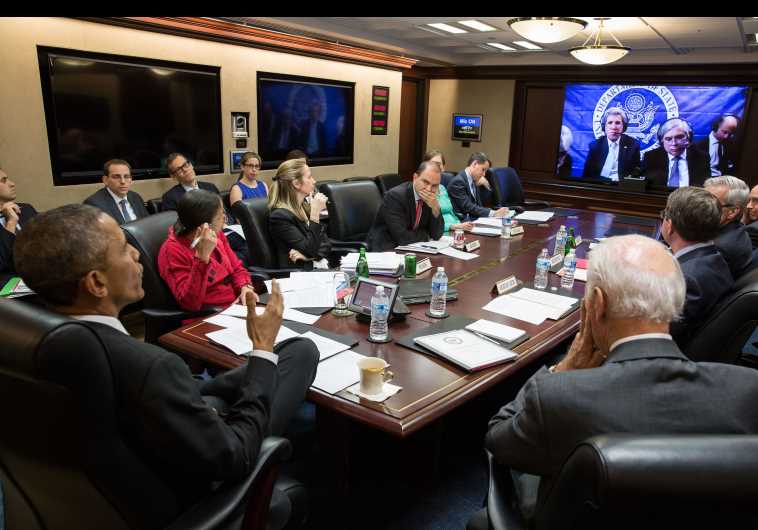
ShowImage (9)President Barack Obama, Vice President Joe Biden, and White House aides receive an update from Secretary of State John Kerry and Secretary of Energy Ernest Moniz via teleconference in Lausanne. (photo credit:WHITE HOUSE)

The US has striven to achieve peaceable relations between the states of the Middle East for nearly 70 years. Yet today, US government is disparaging the burgeoning strategic ties between the Sunni Arab states and Israel.

In a briefing to a delegation of visiting Israeli diplomatic correspondents in Washington last week, a senior Obama administration official sneered that the only noticeable shift in Israel-Arab relations in recent years is that the current Egyptian government has been coordinating security issues “more closely” with Jerusalem than the previous one did.

“But we have yet to see that change materialize in the Gulf.”

If this is how the US views the state of Israel’s relations with the Arabs, then Israel should consider canceling its intelligence cooperation with the US. Because apparently, the Americans haven’t a clue what is happening in the Middle East.

First of all, to characterize the transformation of Israeli-Egyptian relations as a mere question of “more closely” coordinating on security issues is to vastly trivialize what has happened over the past two years.

Before then Egyptian defense minister Abdel Fattah el-Sisi overthrew the US-backed Muslim Brotherhood regime headed by Muhammad Morsi in July 2013, there was a growing sense that Morsi intended to vacate Egypt’s signature to the peace deal with Israel at the first opportunity. Just a month after Morsi ascended to power in January 2013, the Muslim Brotherhood began threatening to review Egypt’s continued commitment to the peace treaty.

The main reason Morsi did not cancel the peace deal with Israel was that Egypt was bankrupt. He needed US and international monetary support to enable his government to pay for imported grain to feed Egypt’s destitute population of 90 million.

During his year in power, Morsi used Hamas as the Brotherhood’s shock troops. He embraced Iran, inviting president Mahmoud Ahmadinejad to visit Cairo in February 2013.

If Morsi were still in power today, with its $150 billion in sanctions relief Iran would have been in a position to support Egypt’s economy. So it is possible that if Morsi were still president, he would have felt he had the financial security to walk away from the peace treaty.

In happy contrast, under Sisi, Israeli-Egyptian ties are closer than they have ever been. Just last week Egyptian diplomats told Al Ahram that Israel’s support was critical for building administration support for Sisi.

Over Ramadan, Egyptian television broadcast a pro-Jewish mini-series.

Israel is closely working with the Egyptians on defeating the growing threat of Islamic State, Hamas and other Islamic terrorist groups waging a bloody insurgency against the regime in Sinai.

Last summer, it was due to the close coordination between Sisi and Israel that the US failed to force Israel to accept Hamas’s cease-fire terms, as those were represented by the Islamist regimes of Qatar and Turkey.

In part due to Israel’s critical support for Sisi’s government, and in part owing to their opposition to Iran’s rise as a regional hegemon armed with nuclear weapons, Saudi Arabia, the UAE and Jordan have all joined Egypt in viewing Israel as a strategic partner and protector.

Last year Saudi Arabia together with the UAE and Jordan supported Israel and Egypt in opposing Hamas and its American, Turkish and Qatari defenders. Had it not been for this massive Arab support, it is very likely that Israel would have been forced to accept the US’s demands and grant Hamas control over Gaza’s international borders.

In June, as negotiations between the US and the other five powers and Iran were moving toward an agreement, the Council on Foreign Relations in New York hosted a meeting between then incoming Foreign Ministry director general Dore Gold and retired Saudi General Anwar Eshki, a former advisor to the Saudi ambassador to the US. The two revealed that over the previous 18 months, they had conducted five secret meetings to discuss Iran.

Although President Barack Obama harangued Israel in his speech at American University last Wednesday, claiming that the Israeli government is the only government that has publicly opposed his nuclear deal with the Iranians, Monday US congressmen now shuttling between Egypt and Israel told Israeli reporters that Egypt opposes the nuclear deal.

As for the Gulf states, according to the US media, last week they told visiting US Secretary of State John Kerry that they support the nuclear deal.

Kerry addressed his counterparts in the Gulf Cooperation Council.

But the fact is that the only foreign minister who expressed such support was Qatari Foreign Minister Khaled al-Attiyah. To be sure, Attiyah was charged to speak for all of his counterparts because Qatar holds the GCC’s rotating chairmanship. But given that Qatar has staked out a pro-Iranian foreign policy in stark contrast to its neighbors and GCC partners, Attiyah’s statement is impossible to take seriously without the corroboration of his colleagues.

As for Qatar’s statement of support, Qatar has worked for years to cultivate good relations with Iran. It might have been expected therefore that Attiyah’s endorsement of the deal would have been enthusiastic. But it was lukewarm at best.

In Attiyah’s words, Kerry promised that the deal would place Iran’s nuclear sites under continuous inspections. “Consequently,” he explained, “the GCC countries have welcomed on this basis what has been displayed and what has been talked about by His Excellency Mr. Kerry.”

The problem of course is that Kerry wasn’t telling the truth. And the Arabs knew he was lying. The deal does not submit Iran’s nuclear sites to a rigorous inspection regime. And the GCC, including Qatar, opposes it.

In his briefing with Israeli reporters, the high-level US official rejected the importance of the détente between Israel and its Arab neighbors because he claimed the Arabs have not changed their position regarding their view of a final peace deal between Israel and the Palestinians.

But this is also nonsense. To be sure, the official position of the Saudis and the UAE is still the so-called Arab peace initiative from 2002 which stipulates that the Arabs will only normalize relations with Israel after it has ceded Jerusalem, Judea, Samaria and the Golan and allowed millions of foreign-born Arabs to freely immigrate to the shrunken Jewish state. In other words, their official position is that they will only have normal relations with Israel after Israel destroys itself.

But their official position is no longer their actual position. Their actual position is to view Israel as a strategic ally.

The senior official told the Israeli reporters that in order to show that “their primary security concern is Iran,” then as far as the Arabs are concerned, “resolving some of the other issues in the region, including the Palestinian issue should be in their interest. We would like to see them more invested in moving the process forward.”

In the real world, there is no peace process. And the Palestinian factions are fighting over who gets to have better relations with Iran. Monday we learned that PA leader Mahmoud Abbas wishes to visit Iran in the coming months in the hopes of getting the money that until recently was enjoyed by his Hamas rivals.

Hamas for its part is desperate to show Tehran that it remains a loyal client. So today, no Palestinian faction shares the joint Israeli-Saudi-Egyptian interest in preventing Iran from becoming a nuclear armed regional hegemon.

The administration showed its hand in that briefing with the Israeli reporters last week. For all their talk about Middle East peace, Obama and his advisors are not at all interested in achieving it or of noticing when it has been achieved.