Archive for July 21, 2015

Iran Deal: Europe’s Chief Negotiator Sympathized with Iran

July 21, 2015

Iran Deal: Europe’s Chief Negotiator Sympathized with Iran, Gatestone InstituteGeorge Igler, July 21, 2015

  • “Islam belongs in Europe… I am not afraid to say that political Islam should be part of the picture.” — Federica Mogherini.
  • Under the treaties establishing the EU, there are no democratic checks on figures such as Mogherini or on the enormous power they wield.
  • “It was Hamas’s strategy, not illegal Israeli action — as this report shamefully alleges without a shred of evidence — that was the reason why over 1,000 civilians died in Gaza.” — Col. Richard Kemp.
  • As a result of the border policies imposed by Mogherini, ISIS’s scheme to augment such a migrant flow with jihadists is now being accomplished.
  • Mogherini, the official responsible for the EU’s borders represents a sheltered elite, convinced that the solution to problems in the Middle East and North Africa is importing their populations into Europe.

Given the capitulation to Iran’s geopolitical ambitions represented by the agreement reached in Vienna on July 14, a spotlight is likely to fall on the pivotal role played by Europe’s chief diplomat.

Few guessed that while stating the “security of the world” was at stake during negotiations with the Islamic Republic of Iran, Federica Mogherini also felt “political Islam” should be a part of Europe’s future.
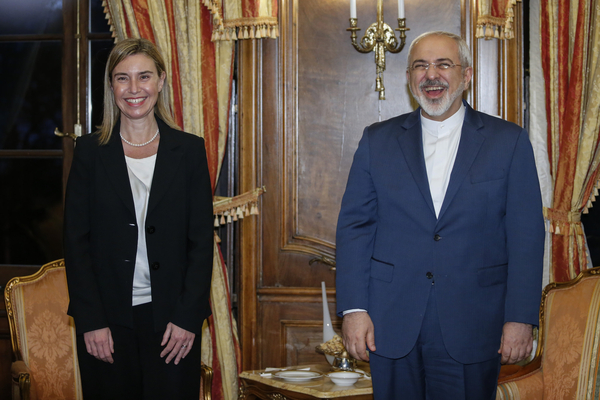
1163Not funny. Federica Mogherini (left) represented the European Union in nuclear negotiations with the Islamic Republic of Iran, a millenarian Shi’ite theocracy that calls for the annihilation of America and Israel. At right, Iran’s foreign minister, Javad Zarif. (Image source: European Union)

The European Union’s unelected High Representative for Foreign Affairs and Security Policy made her pro-Islamist remarks in a speech delivered last month in Brussels.

While heading up Europe’s combined delegation in the Austrian capital, and purportedly tasked with staving off Iran’s nuclear capabilities, Mogherini, a former member of the Italian Communist Youth Federation, also took to tweeting in Arabic.

The assertions made by Mogherini to the Islam in Europe conference, before she left for Vienna, reveal the thinking of a key figure behind the dangerous concessions given to Iran as a result of its continued intransigence and the West’s continued surrender to it.

It should therefore surprise no one that Syria’s President Assad has congratulated Ayatollah Ali Khamenei on his “great victory” in negotiations from which the Jewish state — which had the most to lose based on Iran’s constant threats to obliterate it — was excluded.

As talks progressed, the Supreme Leader of Iran was pictured trampling on an Israeli flag, with the accompanying caption on Khamenei’s official website reading: “The Zionist regime is condemned to vanish.”

Mogherini first gained notoriety after her statement to the United Nations Security Council on May 11, during which she dismissed pushbacks against the flood of migrants illegally crossing the Mediterranean.

As a consequence of the border policies of the European Commission, of which Mogherini is also Vice-President, the number of immigrants pouring into Europe by land has now exceeded those crossing by sea.

Local authorities in Hungary are struggling to cope with refugee camps filled with rioting migrants shouting “Allahu Akbar!” (Arabic for “Allah is Greater!”).

There seems no recognition of the generosity of a nation that is exhausting its resources to give Muslims asylum from conflict.

The speech given by Mogherini in Brussels on June 24 demonstrates why she believes that the growing migration crisis her actions have orchestrated should be welcomed:

“Islam holds a place in our Western societies. Islam belongs in Europe. It holds a place in Europe’s history, in our culture, in our food and — what matters most — in Europe’s present and future. Like it or not, this is the reality.”

She continued:

“We need to show some humble respect for diversity. Diversity is the core feature of our European history, and it is our strength. … We need to understand diversity, understand complexity. … For this reason I am not afraid to say that political Islam should be part of the picture.”

Under the treaties establishing the EU, there are no democratic checks on figures such as Mogherini or on the enormous power they wield. Only representatives elected to the European Parliament can quiz members of the European Commission.

There is also no democratic way for MEPs to repeal any of the laws applied across the EU, authored by the commission’s bureaucrats, or to fire any of its officials.

Regrettably, Mogherini’s speech chose not to delve into which aspects of the “diversity” represented by “political Islam” Europe should embrace: The subhuman status afforded to non-Muslims such as Christians and Jews, perhaps; or the death sentence faced by Muslims who seek to leave Islam or reform it? Or maybe the codified inferiority of females, or the view that democracy, made by man and not Allah is illegitimate, or that it is permissible to counter free speech with violence?

Mogherini’s speech in Brussels — added to the July 3 vote at the UN Human Rights Council (UNHRC) of several European nations in favor of a resolution condemning Israel for war crimes — also highlight a grim reality when viewed in the context of the West’s concessions to Iran.

While political leaders in Europe seek to placate their Muslim populations, Israel is faced with even fewer reliable allies on the world stage as the prospect of a nuclear Iran looms larger.

The UNHRC’s resolution targeting Israel had been prompted by a UNHRC report into last year’s Gaza conflict, during which the Israeli Defense Force had sought to protect the country’s population against constant and indiscriminate rocket attacks.

In an address on June 29, Britain’s Col. Richard Kemp urged the UNHRC to deal with the reality of events in Gaza last summer:

“Hamas sought to cause large numbers of casualties among their own people, in order to bring international condemnation against Israel, especially from the United Nations. … It was Hamas’s strategy, not illegal Israeli action as this report shamefully alleges without a shred of evidence, that was the reason why over 1,000 civilians died in Gaza.”

With only the US voting against the resulting “anti-Israeli manifesto” it was nevertheless endorsed by European nations including France, Germany, the UK, Ireland, and the Netherlands.

As a consequence of several international treaties, these countries and 23 others have unified executive authority on issues of foreign policy into the institutions of the European Union.

To those arguing with the EU’s head of security policy that, “more Muslims in Europe will be the end of Europe,” Mogherini has a curt answer:

“These people are not just mistaken about Muslims: these people are mistaken about Europe – that is my core message – they have no clue what Europe and the European identity are.”

Claiming that “Islam is a victim,” Mogherini went on to stress that the “caliphate” declared last year by ISIS under the name of the Islamic State, represents “an unprecedented attempt to pervert Islam.”

Led by “caliph” Abu Bakr al-Baghdadi, in February ISIS announced its intention to export 500,000 migrants to Europe to create chaos. As his nom de guerre suggests, the PhD in Islamic Studies possessed by Dr. Ibrahim al-Badri comes from the city where the Koran was compiled.

Federica Mogherini’s claim to have a better grasp of political Islam stems from an undergraduate paper she once authored on the subject.

As a result of the border policies imposed by Mogherini, the president of the EU’s judicial cooperation agency, Michèle Coninsx, confirmed on July 6 that ISIS’s scheme to augment such a migrant flow with jihadists is now being accomplished.

It is hard not to conclude that the official responsible for the EU’s borders represents a sheltered elite, convinced that the solution to problems in the Middle East and North Africa is importing their populations into Europe.

Using an Arabic euphemism to describe the Islamic State, Mogherini’s speech concluded:

“Western media like to refer to Da’esh with the word ‘medieval’. This does not help much to understand the real nature of the threat we are facing. Da’esh is something completely new.”

The EU’s chief representative to the talks in Vienna could have done with visiting the museum located on the city’s Karlsplatz. There can be found the following demand for surrender, issued against the Viennese, which post-dates the medieval period by two centuries:

“We order you to wait for us at your residences in the city so we can decapitate you. It will be a pleasure for me to publicly establish my religion and to pursue your crucified god. I will put your sacred priests to the plough and rape your nuns. Forsake your religion or else I will give the order to consume you with fire.”

It was authored by the Muslim caliph reigning in 1683.

When it comes to political Islam, Federica Mogherini is evidently incapable of differentiating between behaviors that are “completely new,” and those that form an established pattern.

That failure makes the diplomatic surrender to the Islamic Republic of Iran, being portrayed by President Obama as a path to a “more hopeful world,” easier to comprehend.

The West’s negotiations were conducted with a millenarian Shi’ite theocracy that calls for the annihilation of America and Israel.

Speaking of the Iran deal (4)

July 21, 2015

Speaking of the Iran deal (4), Power LineScott Johnson, July 21, 2015

Omri Ceren writes to draw attention to Bill Gertz’s Free Beacon article on the ludicrous inspections regime established under the deal with Iran. Omni writes:

Last April – in the immediate days after the Lausanne framework was announced – Obama administration officials assured reporters that it was a good deal because the verification regime would include anytime/anywhere inspections [a][b][c]. Then there was a range of hearings and forums held in early June – which was the lead-up to Vienna – at which IAEA veterans, nuclear experts, and top US intelligence officials confirmed that indeed anytime/anywhere access to suspicious sites was a minimum prerequisite to verifying a deal with Iran [d][e][f][g]).

Then the Vienna talks began and it became clear that the administration would cave to Iranian intransigence on verification. White House validators started trying to convince reporters that technology could be a substitute for robust access [h][i].

Then the talks ended and it was confirmed that Iran will be allowed to block IAEA inspectors for 24 days at a time. The administration is doubling down on the technology talking point and making it mostly about “environmental sampling.” White House communications staffers have begun using the phrase as their two-word answer to any questions about the collapse on inspections. Energy Secretary Moniz repeated it over and over again on last weekend’s Sunday talk shows [j]. White House validators got the hint and have begun invoking it as well yesterday [k]. The argument is that the IAEA’s technology is so good that – even though they have almost a month to destroy evidence – the Iranians could never “sanitize” a site so well that the IAEA couldn’t detect nuclear activity.

There are a couple of reasons why that argument doesn’t hold up.

(1) Diplomatic – Even if the IAEA could detect that *some* kind of nuclear activity had occurred in a sanitized site, the Iranians will have destroyed enough evidence to prevent the agency from determining *what* kind of activity occurred. The goal of verification is not just detection but detection to a sufficient degree that a diplomatic response can be justified. No country is going to be confident enough to blow up the deal without the IAEA being certain that significant cheating had occurred, and being able to explain what it was.

(2) Scientific – It’s just not true. The IAEA’s technology is not good enough. A month isn’t enough time for the Iranians to dismantle a big site like Natanz, but that’s not where they’ll cheat. They’ll cheat in smaller facilities that can be easily dismantled and scrubbed in a couple of weeks. Olli Heinonen – who is the former Deputy Director General of the IAEA, and who worked at the agency for 27 years, and who sat atop its verification shop as head of the Department of Safeguards – explained to reporters today that the Iranians could assemble all the parts they needed for a nuclear bomb in a building that’s just 239 square yards [full article linked above]. And unlike a facility like Natanz, small buildings can in fact be sanitized in 24 days:

Much of this equipment is very easy to move… So you can take it out over the night… and then there is this dispute settlement time which is 24 days – you will use that to sanitize the place, make new floors, new tiles on the wall, paint the ceiling and take out the ventilation… This [nuclear] equipment can be taken out in one or two nights. How long will it take for you to renovate your home? It doesn’t take three weeks… Secretary Kerry has said if there is big installation, 24 days is enough… But there are certain activities where unfortunately in my view, it’s not enough.

This isn’t a theoretical debate. In 2003 the Iranians delayed access to the Kalaye Electric Company for two weeks and completely scrubbed it. They pulled the same trick with the Lashkar Abad laser uranium enrichment plant.

It’s just not true that they can’t dismantle a covert facility in 24 days, and even if it was true they could still dismantle enough to ensure that no country would be confident enough to call them out for cheating.

[a] https://youtu.be/ObV5motay7E?t=1m18s
[b] http://www.timesofisrael.com/top-obama-adviser-dismisses-idea-that-better-iran-deal-is-possible/
[c] http://www.bloomberg.com/politics/articles/2015-04-20/inspectors-need-full-access-in-any-iran-nuclear-deal-moniz-says
[d] http://www.foreign.senate.gov/imo/media/doc/062515_Albright_Testimony.pdf
[e] http://www.foreign.senate.gov/imo/media/doc/062515_Albright_Testimony.pdf
[f] http://taskforceoniran.org/transcripts/Looming_Deadline_Event.pdf
[g] http://docs.house.gov/meetings/FA/FA13/20150610/103582/HHRG-114-FA13-Wstate-FlynnM-20150610.pdf
[h] http://www.nytimes.com/2015/07/07/world/middleeast/nuclear-inspectors-await-chance-to-use-modern-tools-in-iran.html
[i] http://www.thedailybeast.com/articles/2015/07/06/the-spy-tech-that-will-keep-iran-in-line.html
[j] http://www.powerlineblog.com/archives/2015/07/speaking-of-the-iran-deal-2.php
[k] http://www.msnbc.com/msnbc/qa-hans-blix-iran-deal-remarkably-far-reaching

‘US freed top Iranian scientist as part of secret talks ahead of Geneva deal’

July 21, 2015

US freed top Iranian scientist as part of secret talks ahead of Geneva deal’

Mojtaba Atarodi, arrested in California for attempting to acquire equipment for Iran’s military-nuclear programs, was released in April as part of back channel talks, Times of Israel told. The contacts, mediated in Oman for years by close colleague of the Sultan, have seen a series of US-Iran prisoner releases, and there may be more to come

By Mitch Ginsburg November 29, 2013, 9:02 pm

via ‘US freed top Iranian scientist as part of secret talks ahead of Geneva deal’ | The Times of Israel.


Iranian scientist Mojtaba Atarodi speaks to journalists, upon his arrival at the Imam Khomeini airport outside Tehran, Iran, Saturday, April 27 (photo credit: AP/Vahid Salemi)

Iranian scientist Mojtaba Atarodi speaks to journalists, upon his arrival at the Imam Khomeini airport outside Tehran, Iran, Saturday, April 27 (photo credit: AP/Vahid Salemi)

The secret back channel of negotiations between Iran and the United States, which led to this month’s interim deal in Geneva on Iran’s rogue nuclear program, has also seen a series of prisoner releases by both sides, which have played a central role in bridging the distance between the two nations, the Times of Israel has been told.

In the most dramatic of those releases, the US in April released a top Iranian scientist, Mojtaba Atarodi, who had been arrested in 2011 for attempting to acquire equipment that could be used for Iran’s military-nuclear programs.

American and Iranian officials have been meeting secretly in Oman on and off for years, according to a respected Israeli intelligence analyst, Ronen Solomon. And in the past three years as a consequence of those talks, Iran released three American prisoners, all via Oman, and the US responded in kind. Then, most critically, in April, when the back channel was reactivated in advance of the Geneva P5+1 meetings, the US released a fourth Iranian prisoner, high-ranking Iranian scientist Atarodi, who was arrested in California on charges that remain sealed but relate to his attempt to acquire what are known as dual-use technologies, or equipment that could be used for Iran’s military-nuclear programs. Iran has not reciprocated for that latest release.

Solomon, an independent intelligence analyst (who in 2009 revealed the crucial role played by German Federal Intelligence Service officer Gerhard Conrad in the negotiations that led to the 2011 Gilad Shalit Israel-Hamas prisoner deal), has been following the US-Iran meetings in Oman for years. Detailing what he termed the “unwritten prisoner exchange deals” agreed over the years in Oman by the US and Iran, Solomon told The Times of Israel that “It’s clear what the Iranians got” with the release of top scientist Atarodi in April. “What’s unclear is what the US got.”

The history of these deals, though, he said, would suggest that in the coming months Iran will release at least one of three US citizens who are currently believed to be in Iranian custody. One of these three is former FBI agent Robert Levinson.

Undated photo of retired-FBI agent Robert Levinson (photo credit: AP/Levinson Family)

Solomon told The Times of Israel that the interlocutor in the Oman talks is a man named Salem Ben Nasser al Ismaily, who is the executive president of the Omani Center for Investment Promotion and Export Development and a close confidant of the Omani leader Sultan Qaboos bin Said.

Omani interlocutor Salem Ben Nasser al Ismaily (photo credit: Channel 2 screenshot)

Educated in the US and the UK and fluent in English, Ismaily has authored two books. “Messengers of Monotheism: A Common Heritage of Christians, Jews and Muslims” and “A Cup of Coffee: A Westerner’s Guide to Business in the Gulf States.”

The latter tells the fictional tale of John Wilkinson, a successful American businessman who fails in all of his business endeavors in the Gulf until he meets Sultan, who explains to him, according to the book’s promotional literature, how to forgo his hard-charging Western style and “surrender to very different values rooted in ancient tribal customs and traditions.” Those mores have been central to the murky prisoner swaps surrounding the nuclear negotiations, Solomon said.

Iranian President Hasan Rouhani, right, shakes hands with Omani Sultan Qaboos during an official arrival ceremony, in Tehran, Iran, Aug. 25, 2013. (photo credit: AP/Iranian Presidency Office, Hojjat Sepahvand)

Solomon said he identified Ismaily’s role back in September 2010, when Sarah Shourd, an American who apparently inadvertently crossed into Iran while hiking near the Iraqi border, was released, for what were called humanitarian reasons. She was delivered into Ismaily’s hands in Oman and from there was flown to the US — the first release in the series of deals brokered in Oman. One year later, in September 2011, her fiancé and fellow hiker, Shane Bauer, was set free along with their friend, Josh Fattal. The two men were also received at Muscat’s Seeb military airport by Ismaily before being flown back to the US.

Former Iranian hostages Shane Bauer, left, Sarah Shourd, center, and Josh Fattal (photo credit: AP/Press TV)

The US began reciprocating in August 2012, Solomon said. It freed Shahrzad Mir Gholikhan, an Iranian convicted on three counts of weapons trafficking. Next Nosratollah Tajik, a former Iranian ambassador to Jordan — who, like Gholikhan, had been initially apprehended abroad trying to buy night-vision goggles from US agents — was freed after the US opted not to follow up an extradition request it had submitted to the British. Then, in January 2013, Amir Hossein Seirafi was released, also via Oman, having been arrested in Frankfurt and convicted in the US of trying to buy specialized vacuum pumps that could be used in the Iranian nuclear program.

Finally, in April, came the release of Mojtaba Atarodi.

The facts of his case are still shrouded. On December 7, 2011, Atarodi, a faculty member at the prestigious Sharif University of Technology (SUT) in Tehran — a US-educated electrical engineer with a heart condition, a green card and a brother living in the US — arrived at LAX and was arrested by US federal officials.

He appeared twice in US federal court in San Francisco and was incarcerated at a federal facility in Dublin, California and then kept under house arrest. The US government cloaked the contents of his indictment and released no statement upon his release. His lawyer, Matthew David Kohn, told The Times of Israel he would like to discuss the case further but that first he had to “make some inquiries” to see what he was allowed to reveal.

In January, shortly after Atarodi’s arrest, his colleagues wrote a letter to the journal Nature, protesting his detention. “We believe holding a distinguished 55-year-old professor in custody is a historical mistake and not commensurate with the image that America strives to extend throughout the world as a bastion of free scientific exchange among schools and academic institutions,” they said.

Solomon, who compiled a profile of Atarodi, believes that the scientist, prior to his arrest, played an important role in Iran’s missile and nuclear programs. Atarodi, he said, has co-authored more than 30 technical articles, mostly related to micro-electric engineering and, in 2011, won the Khwarizmi award for the design of a microchip receiver for digital photos. “That same technology,” he said, “can be used for missile guidance and the analysis of nuclear tests.”

Solomon further noted that the then-Iranian defense minister and former commander of the revolutionary guards, Ahmad Vahidi, attended the prize ceremony and that Professor Massoud Ali-Mahmoudi, an Iranian physics professor who was assassinated in 2010, was an earlier recipient of the prize.

“There is no doubt in my mind that Atarodi came to the US at the behest of the logistics wing of the IRGC [the Iranian Revolutionary Guard Corps],” Solomon said.

On April 26 Atarodi was flown from the US to Seeb military airbase in Oman, where he met with Ismaily, and onward to Iran. “The release of someone who holds that sort of information and has advanced strategic projects in Iran is a prize,” Solomon said. The US, said Solomon, must have already received something in return or will do so in the future.

Thus far, US-Iran prisoner swaps have been conducted in a manner utterly distinct from the old Cold War rituals, in which, as was the case with Prisoner of Zion Natan Sharansky, spies or prisoners from either side of the Iron Curtain walked across Berlin’s old Glienicke Bridge toward their respective home countries. Instead, with Iran claiming it knows nothing about the whereabouts of former FBI agent Levinson, for instance, and the US eager to show that it will not barter with hostage-takers, the deals have taken the form of a delayed quid pro quo.

There are currently three US nationals — Levinson, Saeed Abedini, and Amir Hekmati — still believed to be held in Iran.

US President Barak Obama raised the issue of the imprisoned Americans in his historic September phone call to Iranian President Hassan Rouhani. Obama’s Deputy National Security Advisor, Tony Blinken, told CNN that aside from the nuclear program it was the only other issue that was brought up in the call.

The interim deal in Geneva did not include any reference to prisoner dealings. Richard Haas, president of the Council on Foreign Relations, told CNN, “you’ve got to decide how much you’re going to try to accomplish, and just tackling all the dimensions of the nuclear agreement is ambition enough.” A spokeswoman for the National Security Council added that the “talks focused exclusively on nuclear issues.”

The omission prompted the chief counsel of the American Center for Law and Justice, Jay Sekulow, who is representing Pastor Saeed Abedini’s wife Naghmeh, to charge Obama and US Secretary of State John Kerry with turning their backs on an American citizen. On the center’s website, he called the decision “outrageous and a betrayal” and said it sends the message that “Americans are expendable.”

Abedini, who was born in Iran and later converted to Christianity, was arrested earlier this year in Iran for what would seem was strictly Christian charity work and sentenced to eight years in prison. He was recently transferred from Evin Prison, a notorious jail for political prisoners in Tehran, Sukelow wrote in a letter to Kerry, “to the even more notorious and brutal Rajai Shahr Prison in Karaj.”

Amir Hekmati, a 31-year-old former Marine from Flint, Michigan, who allegedly obtained permission to visit his grandmother in Iran in 2011, was charged with espionage and sentenced to death in 2012. In September, Hekmati managed to smuggle a letter out of prison. Published in the Guardian, it contended that his filmed admission of guilt had been coerced and that his arrest “is part of a propaganda and hostage-taking effort by Iranian intelligence to secure the release of Iranians abroad being held on security-related charges.”

Amir Hekmati, a former U.S. Marine held in Iran over the past two years on accusations of spying for the CIA. (photo credit: Hekmati family/FreeAmir.org)

Levinson, a 65-year-old veteran of the FBI, was last seen on March 9, 2007, on Kish Island, Iran. According to Solomon, Levinson was stationed in Dubai at the time as part of a US task force comprised of former officers operating in the United Arab Emirates, training officials there to combat weapons trafficking, and was tempted to come to Kish for a meeting.

The last person he is known to have had contact with, and with whom he shared a room the night before his abduction, according to a Reuters article from 2007, is Dawud Salahuddin, an American convert to Islam, who is wanted in the US for murder. According to a New Yorker profile of the Long Island-born Salahuddin, he showed up at the home of Ali Akbar Tabatabai’s Bethseda, Maryland door in July 1980, dressed as a mailman, and shot Tabatabai, a Shah supporter, three times in the abdomen, killing him. From there he fled to Canada and on to Switzerland and Iran.

Salahuddin has indicated that Levinson had come to Kish to meet with him.

In September, Rouhani denied any knowledge of Levinson’s whereabouts. In an interview with CNN’s Christiane Amanpour, he said that, “We don’t know where he is, who he is. He is an American who has disappeared. We have no news of him.”

This is highly doubtful. In 2010 and 2011 Levinson’s family received a video and photographs respectively of him in captivity. In January of this year the AP reported that “despite years of denials,” many US security officials now believe that “Iran’s intelligence service was almost certainly behind the 54-second video and five photographs of Levinson that were emailed anonymously to his family.” The photos and the videos traced back to different addresses in Afghanistan and Pakistan, suggesting, perhaps, that Levinson, the longest-held hostage in US history, was imprisoned in Balochistan, a desert region spanning the borders of Iran, Pakistan and Afghanistan.

On Tuesday, Levinson’s son Dan wrote a column in the Washington Post calling Rouhani and Foreign Minister Javad Zarif “well-respected men committed to the goodwill of all human beings, regardless of their nationality.”

Several hours later, White House Spokesman Jay Carney published a statement saying that the US government welcomes the assistance “of our international partners” in attempting to bring Levinson home and, he added, “we respectfully ask the Government of the Islamic Republic of Iran to assist us in securing Mr. Levinson’s health, welfare, and safe return.”

As was the case with the Geneva negotiations, and as is likely happening with the upcoming round of talks regarding Syria, there is good reason to believe, and in this case to hope, that the movements played out under the spotlights of the international stage have been choreographed well in advance, perhaps in the sea-side city of Muscat, under the careful tutelage of Salem Ben Nasser al Ismaily.


Added by me


Iran Scoffs at ‘Non-Binding’ Ban on Ballistic Missiles

July 21, 2015

Missiles

Zarif says Iran can continue making ballistic missiles because the agreement’s ban is “non-binding.”

By: Tzvi Ben-Gedalyahu

Published: July 21st, 2015

via The Jewish Press » » Iran Scoffs at ‘Non-Binding’ Ban on Ballistic Missiles.


Iranian long-range Shahab-1 missiles.
Photo Credit: Press TV

Iran’s Foreign Minister buried the Obama administration’s claim that the nuclear agreement will curtail Iran’s ballistic missile production and maintained that the prohibition is in a non-binding appendix of “ObamaDeal.”

Foreign Minister Javad Zarif was quoted by the state-controlled Fars News Agency as saying:

Using ballistic missiles doesn’t violate the Joint Comprehensive Plan of Action (JCPOA); it is a violation of a paragraph in the annex of the (UN Security Council) Resolution (2231) which is non-binding

This paragraph (of the annex) speaks about missiles with nuclear warheads capability and since we don’t design any of our missiles for carrying nuclear weapons, therefore, this paragraph is not related to us at all.

That is pretty fancy mouth-work, even better than President Barack Obama’s.

Zarif is laughing all the way to the nuclear bank. He admits that the nuclear agreement prohibits ballistic missiles but since it is non-binding, so what?

And it doesn’t make any difference because the missiles are not meant for carrying nukes.

If anyone wants to inspect the military sites to make sure he is telling the truth, he can’t because military sites are off-limits. The Islamic Republic’s international affairs adviser to the regime stressed on Tuesday that Iran will not allow international inspectors visit our military centers and interfere in decisions about the type of Iran’s defensive weapons.”

Velayati added:

Missiles like Shahab, Sejjil and the like, have never been used for carrying nuclear warheads, and therefore, are not subject to the paragraphs of the Vienna draft agreement.

Just take his word for it.

Zarif’s Foreign Ministry reassured everyone who still is listening that “Iran will continue its pioneering role in campaign against terrorism and violent extremism.”

For the record, just in case Congressional Democrats are awake, Joint Chiefs Chairman Gen. Martin Dempsey told a Senate committee just before ObamaDeal was concluded:

We should under no circumstances relieve pressure on Iran relative to ballistic missile capabilities and arms trafficking.

Secretary of Defense Secretary Ash Carter, who is in Israel to go through the motions that ObamaDeal is good for Israel, told the Senate Armed Services Committee:

We want them [Iran] to continue to be isolated as a military and limited in terms of the kinds of equipment and material they are able to procure.

That is what he wants. That is not what he – and Israel – is going to get.

Kerry doesn’t know how to “interpret” Iran’s vow to fund terrorists

July 21, 2015

Kerry doesn’t know how to “interpret” Iran’s vow to fund terrorists, Front Page Magazine, Daniel Greenfield, July 21, 2015

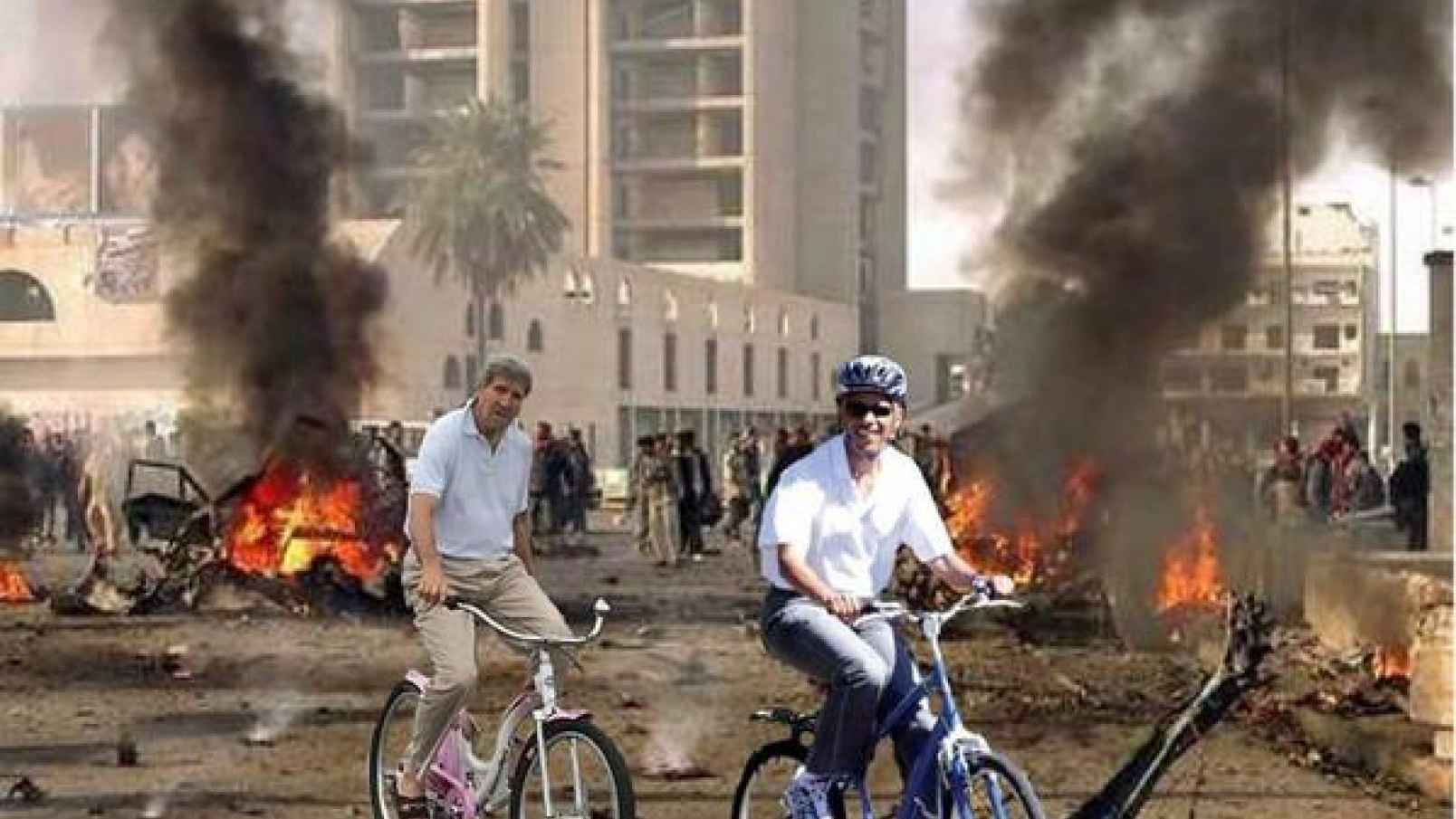
obama_kerry_bikes

John is going to have to go courting another terror state. North Korea has preemptively turned him down, but maybe Kerry can windsurf his way into North Korea and promise lots and lots of money if its dictator will pose for some photos in Vienna with America’s dumbest traitor.

*********************

Only liberals seem to need an interpretation of “Death to America”. John Kerry meanwhile wanders around the Middle East trying to interpret what Iran means when it vows to fund terrorists and fight America.

US Secretary of State John Kerry has acknowledged that Iranian Supreme Leader Ayatollah Ali Khamenei’s continued vows to defy the US are “very disturbing.”

“I don’t know how to interpret it at this point in time, except to take it at face value, that that’s his policy,” Kerry told Saudi-owned television station Al-Arabiya Tuesday. “But I do know that often comments are made publicly and things can evolve that are different. If it is the policy, it’s very disturbing, it’s very troubling.”

Don’t worry, given a little time, Kerry will find a way to interpret these comments not at “face value”.

Iran’s Supreme Leader Khamenei gave a particularly inflammatory speech just days after the deal, stating that the Islamic Republic’s policies toward the US have not changed.

“We will never stop supporting our friends in the region and the people of Palestine, Yemen, Syria, Iraq, Bahrain and Lebanon,” he continued, referring to the Iranian terror axis in the Middle East. “Even after this deal our policy towards the arrogant US will not change.”

Go and interpret a vow to keep funding Hezbollah, Hamas, the Houthis and Assad while fighting the US in the most positive way possible. If you’re good enough at it, you can get a gig at the State Department.

But you have to feel sorry for John Kerry, who pushed the Iran deal claiming that it would lead to a new era of diplomacy with Iran. Now John has been jilted once again. The Supreme Leader doesn’t seem to want to be his friend after all. Soon the Foreign Minister of Iran will stop returning his phone calls as soon as Iran gets $150 billion in sanctions relief.

And John is going to have to go courting another terror state. North Korea has preemptively turned him down, but maybe Kerry can windsurf his way into North Korea and promise lots and lots of money if its dictator will pose for some photos in Vienna with America’s dumbest traitor.

An Iran Deal Distraction

July 21, 2015

An Iran Deal Distraction, National Review, Henry F. Cooper, July 20, 2015

(I recommend that Obama resign for the good of the United States and the rest of the world. That has as much change of adoption as does Mr. Cooper’s recommendation. — DM)

I recommend that the president make a unilateral declaration that the United States will shoot down any Iranian (or North Korean) satellite unless an inspection demonstrates that no nuclear payload is involved. His negotiators could work out acceptable details that would be consistent with those negotiated with the Soviet Union over 25 years ago. Now that would be a treaty worth having.

*********************

There are many things wrong with the deal with Iran that, at a minimum, paves the road for Iran to get nuclear weapons and deliver them to attack Israel and the United States. This remains the explicit goal of the Iranian mullahs and their followers, who greeted the deal with chants of “Death to Israel” and “Death to America.” I could join the chorus recounting those many faults. But I prefer to emphasize something that is missing entirely from the debate: The mullahs and their followers may be able to achieve their goal with a capability they already have.

Iran launched a monkey into space on January 28, 2013 — almost 30 months ago. As then reported by Yeganeh Torbati in a Reuters article, this feat entailed launching a satellite weighting 4,400 pounds — much, much more than enough to carry a nuclear weapon.  The month before this monkey business, the Congressional Research Service published a report — Iran’s Ballistic Missile and Space Launch Programs — that, among other things, described a new Iranian satellite launch site at the mouth of the Persian Gulf. The site had been reported to be 80 percent complete in June 2012. Presumably, it can launch satellites southward over a wide swath of directions. Such a satellite could pass over the United States in its first orbit. A launch over the South Polar regions would approach the United States from a direction that avoids our current ballistic-missile defense (BMD) systems, which are focused on defending against intercontinental ballistic missiles (ICBMs) that approach the United from the north. In effect, we have left our back door open while working to lock the front door.

This past February, Iran conducted its fourth satellite launch to the south, during national ceremonies marking the 36th anniversary of the 1979 Iranian Revolution. This satellite was reported to weigh only 110 pounds and is in orbit at an altitude varying between 139 and 285 miles.  This range of altitudes fits for Iran to detonate a nuclear weapon over the United States and produce an electromagnetic pulse (EMP) that would shut down the electric-power grid of the continental United States for an indefinite period. Within a year, 200 million Americans could perish from starvation, disease, and societal collapse, according to estimates of members of the Congressional EMP Commission. Executing this existential threat is much simpler than delivering a nuclear weapon by an ICBM, because the nuclear weapon would be detonated above the atmosphere — no proven ability to reenter the atmosphere is needed.

Two points deserve emphasis. First, Iran already may have access to nuclear weapons, either in its own right or through cooperation with its ally, nuclear-capable North Korea — which also launches its satellites over the South Polar regions and can exploit the same U.S. vulnerabilities. And second, we should not permit this vulnerability to persist while being distracted by a debate about potential future Iranian capabilities. In turn, two straightforward action items seem obvious. First, we must deal with the EMP threat. The Department of Defense knows how; it has been protecting its key military systems against EMP effects for a half century — but it has not similarly been protecting the infrastructure upon which the survival of the American people depends. President Obama should knock heads until his lieutenants get their act together and address this deficiency.

And second, we must defend against the threat from the south. We currently have no defense against the aforementioned satellites that approach us from over the South Polar regions, or against ballistic missiles launched from vessels in the Gulf of Mexico. The first might be addressed by empowering our missile-defense site at Vandenberg Air Force Base with sensors that track the threatening satellite. The second could be addressed by deploying on military bases around the Gulf the same Aegis Ashore BMD systems that we are building in Romania and Poland to protect Europe against Iranian ballistic missiles.

While the EMP threat can be handled entirely by unilateral U.S. actions, diplomacy can play a role in countering the satellite threat. There are legitimate, non-threatening reasons for Iran (or North Korea) to launch satellites. But they should assure us that such launches do not carry nuclear weapons. And these assurances must be verified with high confidence. I recommend that the president make a unilateral declaration that the United States will shoot down any Iranian (or North Korean) satellite unless an inspection demonstrates that no nuclear payload is involved. His negotiators could work out acceptable details that would be consistent with those negotiated with the Soviet Union over 25 years ago. Now that would be a treaty worth having.

A Historic Catastrophe

July 21, 2015

A Historic Catastrophe, Rasmussen Reports, Thomas Sowell, July 21, 2015

[H]e has maneuvered the Republican-controlled Congress into a position where they will need a two-thirds majority in both Houses to prevent his unilaterally negotiated agreement from going into effect — just by not calling it a treaty. 

If he is that savvy at home, why is he so apparently incompetent abroad? Answering that question may indeed require us to “think the unthinkable,” that we have elected a man for whom America’s best interests are not his top priority.

********************

Distinguished scientist Freeman Dyson has called the 1433 decision of the emperor of China to discontinue his country’s exploration of the outside world the “worst political blunder in the history of civilization.”

The United States seems at this moment about to break the record for the worst political blunder of all time, with its Obama administration deal that will make a nuclear Iran virtually inevitable.

Already the years-long negotiations, with their numerous “deadlines” that have been extended again and again, have reduced the chances that Israel can destroy the Iranian nuclear facilities, which have been multiplied and placed in scattered underground sites during the years when all this was going on.

Israel is the only country even likely to try to destroy those facilities, since Iran has explicitly and repeatedly declared its intention to wipe Israel off the face of the earth.

How did we get to this point — and what, if anything, can we do now? Tragically, these are questions that few Americans seem to be asking. We are too preoccupied with our electronic devices, the antics of celebrities and politics as usual.

During the years when we confronted a nuclear-armed Soviet Union, we at least realized that we had to “think the unthinkable,” as intellectual giant Herman Kahn put it. Today it seems almost as if we don’t want to think about it at all.

Our politicians have kicked the can down the road — and it is the biggest, most annihilating explosive can of all, that will be left for our children and grandchildren to try to cope with.

Back in the days of our nuclear standoff with the Soviet Union, some of the more weak-kneed intelligentsia posed the choice as whether we wanted to be “red or dead.” Fortunately, there were others, especially President Ronald Reagan, who saw it differently. He persevered in a course that critics said would lead to nuclear war. But instead it led to the peaceful conclusion of the Cold War.

President Barack Obama has been following opposite policies, and they are likely to lead to opposite results. The choices left after Iran gets nuclear bombs — and intercontinental missiles that can deliver them far beyond Israel — may be worse than being red or dead.

Bad as life was under the communists, it can be worse under nuclear-armed fanatics, who have already demonstrated their willingness to die — and their utter barbarism toward those who fall under their power.

Americans today who say that the only alternative to the Obama administration’s pretense of controlling Iran’s continued movement toward nuclear bombs is war ignore the fact that Israel bombed Saddam Hussein’s nuclear facilities, and Iraq did not declare war. To do so would have risked annihilation.

Early on, that same situation would have faced Iran. But Obama’s years-long negotiations with Iran allowed the Iranian leaders time to multiply, disperse and fortify their nuclear facilities.

The Obama administration’s leaking of Israel’s secret agreement with Azerbaijan to allow Israeli warplanes to refuel there, during attacks on Iran’s nuclear facilities, was a painfully clear sabotage of any Israeli attempt to destroy those Iranian facilities.

But the media’s usual practice to hear no evil, see no evil and speak no evil in the Obama administration buried this news, and allowed Obama to continue to pose as Israel’s friend, just as he continued to assure Americans that, if they liked their doctor they could keep their doctor.

Some commentators have attributed Barack Obama’s many foreign policy disasters to incompetence. But he has been politically savvy enough to repeatedly outmaneuver his opponents in America. For example, the Constitution makes it necessary for the President to get a two-thirds majority in the Senate to make any treaty valid. Yet he has maneuvered the Republican-controlled Congress into a position where they will need a two-thirds majority in both Houses to prevent his unilaterally negotiated agreement from going into effect — just by not calling it a treaty.

If he is that savvy at home, why is he so apparently incompetent abroad? Answering that question may indeed require us to “think the unthinkable,” that we have elected a man for whom America’s best interests are not his top priority.


Saudi Arabia considers its own nuclear options after Iran deal

July 21, 2015

Saudi Arabia considers its own nuclear options after Iran deal

via Saudi Arabia considers its own nuclear options after Iran deal – Middle East – Jerusalem Post.

One likely Saudi Arabian response to the deal its biggest enemy Iran has struck with world powers is to accelerate its own nuclear power plans, creating an atomic infrastructure it could, one day, seek to weaponize.

But while it has recently made moves to advance its nuclear program, experts say it is uncertain whether it could realistically build an atomic bomb in secret or withstand the political pressure it would face if such plans were revealed.

“I think Saudi Arabia would seriously try to get the bomb if Iran did. It’s just like India and Pakistan. The Pakistanis said for years they didn’t want one, but when India got it, so did they,” said Jamal Khashoggi, head of a Saudi news channel owned by a prince.

The conservative kingdom is engaged in a contest for power with the Islamic republic stretching across the region and fears the nuclear deal will free Tehran from international pressure and sanctions, giving it more room to back allies in proxy wars.

So far its response has been lukewarm public praise for the deal coupled with private condemnation, a reaction that follows a more muscular approach to Iran evident in its war against allies of Tehran in Yemen and more help for Syrian rebels.

However, some Saudis close to the ruling family have also warned that if Iran still manages to weaponize its nuclear program, then the kingdom will have to follow suit despite the cost of becoming a pariah state and rupturing ties with the US.

Analysts who follow Saudi Arabia are divided as to whether it really does constitute a proliferation risk, given its newly assertive stance towards the US and the life-and-death import it places on the struggle with Iran, or whether it is bluffing.

They are also split on whether international pressure via meaningful sanctions could be imposed on a country whose economy depends almost entirely on trade, but whose ability to maintain massive oil exports is critical for global energy markets.

What senior Saudis have consistently said about the Iranian nuclear deal is that they will demand exactly the same terms. That would allow them a nuclear fuel cycle that could produce material for a bomb, but would also impose a tough inspections regime.

The kingdom’s atomic power plans, like those of Iran, are based on the economic principle that it is better to use crude oil for revenue-generating exports to maintain social benefits than fritter it away on soaring electricity consumption.

Its nuclear body, the King Abdullah City for Atomic and Renewable Energy (KACARE), recommended in 2012 that Saudi Arabia install 17 gigawatts of nuclear power but it has not yet laid out plans to do so.

Riyadh has signed nuclear energy cooperation agreements with several countries able to build reactors, but recent deals with France, Russia and South Korea go beyond these by including feasibility studies for atomic power plants and fuel cycle work.

Daunting technical obstacles would still hinder any Saudi attempt to build a bomb, something that would most likely be achieved via a uranium enrichment process for which technological transfer between countries is closely regulated.

“It’s very technically challenging to obtain the fissile material needed for a weapon and with the enhanced safeguard measures of the model additional protocol, the risk of detection is great,” said Karl Dewey, the Chemical, Biological, Radiological and Nuclear analyst at IHS Janes.

The additional protocol is part of a stronger regime of inspections and safeguards that Iran has adopted and would likely be a condition of any Saudi nuclear program.

At present, the United States is so closely entwined with Saudi Arabia’s political and security infrastructure that it would be hard to envisage Riyadh embarking on a nuclear weapons project without Washington finding out.

Going behind Washington’s back to build a nuclear bomb would cause massive ruptures in a strategic security relationship that will remain vital to Saudi Arabia despite its efforts to create alternative alliances with other military powers.

The pair’s relationship has weakened in recent years, but while they disagree on what role Washington should take in the Middle East, the U.S. remains Saudi Arabia’s chief security guarantor, so it retains considerable leverage over Riyadh.

Saudi Arabia’s unique place in world energy – it is not only the largest exporter but maintains a large cushion of excess output capacity giving it unparalleled leverage over oil prices at a cost that no other producer appears willing to match – makes sanctions on its crude exports impossible.

But while oil sales accounted for 33 percent of economic activity and 87 percent of revenue in the kingdom last year, its non-oil sector is heavily reliant on imports, including food and consumer goods, which are theoretically vulnerable to sanctions.

Riyadh has for decades avoided using its ability to upset the world economy for political gain, but that could change if it felt threatened enough. It may bet that fears of a repeat of the 1973 oil embargo would stop any real international pressure over its nuclear plans.

“I’m sure Saudi Arabia is ready to withstand pressure. It would have moral standing. If the Iranians and Israelis have it, we would have to have it to,” said Khashoggi, adding that he believed Riyadh’s oil exports would immunize it from pressure.

Testing that theory, however, would represent a huge gamble for Riyadh. Whether the risks involved outweigh those they believe would be incurred by allowing Iran a nuclear advantage is something the kingdom’s ruling Al Saud are doubtless considering.

Former Saudi Ambassador to US: Gulf States Willing to Attack Iran

July 21, 2015

Prince Bandar said that “ObamaDeal” will “wreak havoc Prime Minister Netanyahu the Middle East.”

By: Tzvi Ben-Gedalyahu

Published: July 21st, 2015

via The Jewish Press » » Former Saudi Ambassador to US: Gulf States Willing to Attack Iran.


Prince Bandar bin Sultan, the Kingdom's former chief of intelligence and ambassador to Washington.
Prince Bandar bin Sultan, the Kingdom’s former chief of intelligence and ambassador to Washington.

A Saudi prince’s reaction to the nuclear agreement with Iran makes last week’s White House’s rosy spin of official reaction by Saudi Arabia to “ObamaDeal” look like an act that should never have gone on stage.

Saudi Prince Bandar bin Sultan, former Ambassador to the United States, warned that the nuclear agreement with Iran “will wreak havoc in the Middle East” and that Gulf Powers are willing to attack Iranian nuclear sites, even if the United States is not interested.

One of King Salman’s first actions after taking the throne earlier this year was to yank Prince Bandar off the National Security Council, but he still is an advisor and an important voice, one that totally contradicts what President Barack Obama would like people to believe about Riyadh’s reaction the nuclear agreement.

White House Press Secretary, after a meeting between Saudi foreign minister Adel al-Jubeir and President Obama, glossed over Saudi skepticism of ObamaDeal and blah-blahed “about the important bilateral relationship that exists between the United States and Saudi Arabia.”

Believe that and then believe that President Obama has “an unbreakable bond with Israel.”

Prince Bandar’s comments to Beirut Daily Star and also reported by the Times of London were the first public criticism from Saudi Arabia, and he was straight to the point.

He warned that ObamaDeal will “wreak havoc” and then bluntly asserted:

Saudi Arabia and the Gulf powers are prepared to take military action without American support after the Iran nuclear deal

Prince Bandar is not a small voice. He was ambassador to Washington for 20 years, and MRC TV noted that it is unlikely that he would have conducted a major newspaper interview without King Salman’s blessing.
The prince’s view of the Obama administration sounds like Israel’s when it comes to relying on the United States.

“People in my region now are relying on God’s will, and consolidating their local capabilities and analysis with everybody else except our oldest and most powerful ally,” Prince Bandar told the Beirut newspaper.

He was even more candid in an article he wrote for the London-based Arabic news Web site Elaph, where he compared ObamaDeal with Bill Clinton’s agreement with North Korea, which supposedly would keep its word and not develop a nuclear bomb.

But Prince Bandar can forgive Clinton because “it turned out that the strategic foreign policy analysis was wrong and there was a major intelligence failure,” according to translation of interview provided by The Washington Post.

He said that he is “absolutely confident he would not have made that decision” if he had all the facts.
Prince Bandar said the case of Iran is different because:

The strategic foreign policy analysis, the national intelligence information, and America’s allies in the region’s intelligence all predict not only the same outcome of the North Korean nuclear deal but worse – with the billions of dollars that Iran will have access to.

He quoted a phrase first made by Henry Kissinger: America’s enemies should fear America, but America’s friends should fear America more.”

It sounds like Saudi Arabia and Israel are on the same page.

Cartoon of the day

July 21, 2015

H/t The Jewish Press


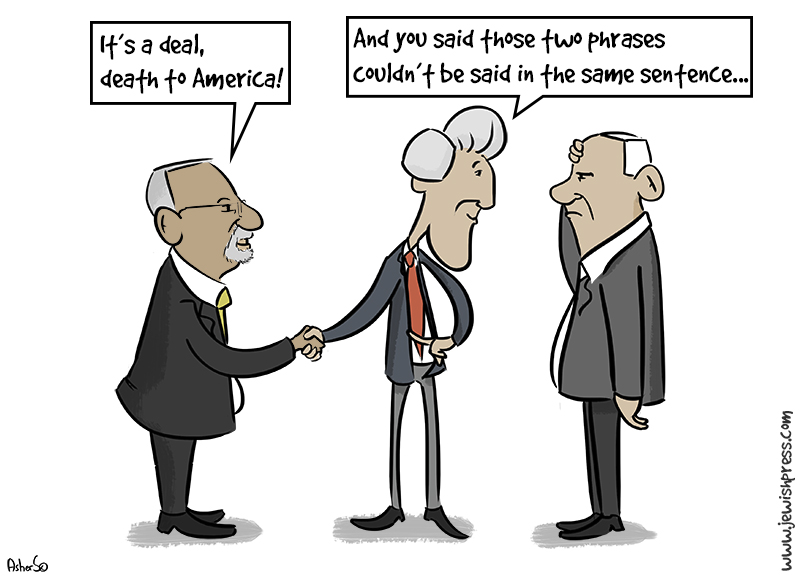
two-phrases