Archive for July 1, 2015

Israel closes crossings with Egypt, Gaza, following ISIS Sinai terror attacks

July 1, 2015

Israel closes crossings with Egypt, Gaza, following ISIS Sinai terror attacks

via Israel closes crossings with Egypt, Gaza, following ISIS Sinai terror attacks – Middle East – Jerusalem Post.

Israel closed the Niztana and Kerem Shalom border crossings Wednesday following militant attacks in Egypt’s North Sinai that killed at least 30 in one of the biggest coordinated assaults yet in the insurgency-hit province.

Islamic State’s Egypt affiliate, Sinai Province, claimed responsibility for the attacks against security forces in North Sinai, according to a statement on Twitter. The group said it had attacked more than 15 security sites, and had carried out three suicide attacks.

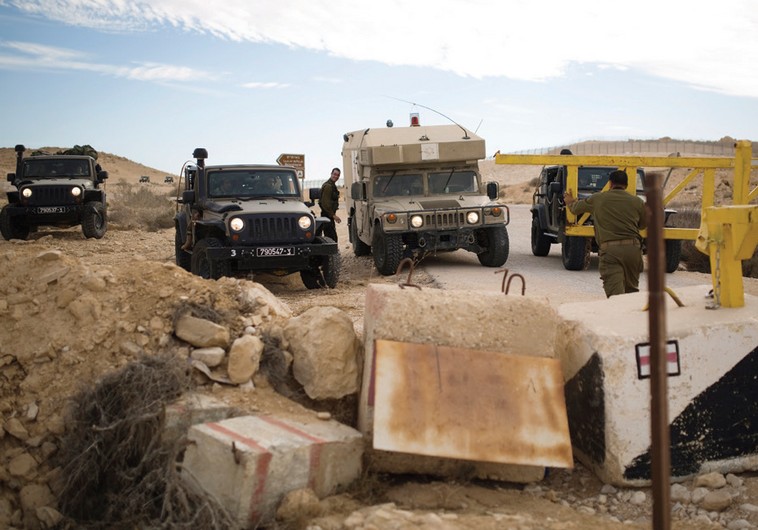
The IDF was closely monitoring the border area with Egypt and Gaza in light of the events.
 

ShowImage2


IDF troops at Sinai border . (photo credit:REUTERS)

It was second high-profile action in Egypt this week. On Monday, the prosecutor-general was killed in a car bombing in Cairo, raising questions about the government’s ability to contain the insurgency.

The army said five checkpoints were attacked by about 70 militants and that soldiers had destroyed three land-cruisers fitted with anti-aircraft guns.

Security sources said militants were surrounding a police station in the town of Sheikh Zuweid and had planted bombs around it to prevent forces from leaving.

Doctor Osama el-Sayed of El-Arish General Hospital in the provincial capital said 30 bodies had been brought in, “some of whom were wearing army fatigues”.

The exact breakdown of identities of those killed was not immediately clear. Security sources had said at least 20 security personnel were killed and 40 wounded. The army spokesman said 22 of the attackers were killed and 10 soldiers were killed or wounded.

Security sources said the militants had planted bombs along a road between Sheikh Zuweid and an army camp to prevent the movement of any army supplies or reinforcements. Meanwhile, Apache helicopters and F-16 planes strafed the area.

The insurgency based in the Sinai is seeking to topple the Cairo government and has managed to defy one of the toughest security crackdowns in Egypt’s history.

It has intensified since 2013, when then-army chief Abdel Fattah al-Sisi removed President Mohamed Morsi, an Islamist, after mass protests against his rule. Hundreds of policemen and soldiers have been killed in attacks since then.

The most active militant group in the region is Sinai Province, which has pledged allegiance to Islamic State.

It said in Wednesday’s statement that it had attacked more than 15 security sites and carried out three suicide bombings.

The group had urged its followers to escalate attacks during the Islamic holy month of Ramadan which started in mid-June, though it did not specify Egypt as a target.

In a recent tactic, Sinai Province has fired rockets at the direction of an airport used by multinational peacekeeping forces.

In late April, the army extended by three months a state of emergency imposed in parts of Sinai since October after 33 security personnel were killed in an attack claimed by Sinai Province.

The army has taken several measures to crush the insurgency. Aside from bombardments in the region, they have destroyed tunnels into the Palestinian-ruled Gaza Strip and created a security buffer zone in northern Sinai.

The army was also digging a trench along the border with Gaza in an effort to prevent smuggling.

The measures have stoked resentment among some residents, who say they rely on the smuggling trade through the tunnels and complain of neglect by the state.

Tuesday also marked the second anniversary of protests that preceded the overthrow of Morsi.

President Sisi said he would bring in tougher legal measures in coming days after the killing of the prosecutor, Hisham Barakat, the most senior Egyptian official to die in such an attack in years.

Sisi’s government does not distinguish between the now-outlawed Brotherhood and other militants. The Brotherhood says it is committed to peaceful activism.

At least 64 killed in Sinai terror attack

July 1, 2015

At least 64 killed in Sinai terror attack

According to reports from Egypt, around 70 armed terrorists attacked a number of military roadblocks in the area of Sheikh Dawid. At least 64 Egyptian soldiers and police officers were killed in the terror attack that included a truck bomb explosion and the firing of missiles.

Jul 01, 2015, 02:00PM | Dana Nasi

via Israel News – At least 64 killed in Sinai terror attack – JerusalemOnline.

At least 64 Egyptian soldiers and police officers were killed and dozens were injured this morning in a coordinated terror attack targeting military checkpoints in the area of Sheikh Dawid in the Sinai.  It included a car bomb explosion and the firing of missiles, according to reports in the Egyptian media.

The Al Ahram newspaper reported that fifty checkpoints were attacked by 70 armed terrorists. The fighting in the area continues as some reports speak about Egyptian soldiers that were kidnapped by armed terrorists with vehicles.  The terror attack began around 9:30am with heavy gunfire and explosions.  According to some reports, an Egyptian military apache helicopter was hit by armed terrorists.  ISIS took responsibility for this terror attack.

Palestinians: Why Salam Fayyad Lacks Popular Support

July 1, 2015

Palestinians: Why Salam Fayyad Lacks Popular Support, The Gatestone InstituteKhaled Abu Toameh, June 30, 2015

  • It is no secret that several senior Palestinian officials see themselves as potential successors to Abbas. Like his predecessor, Yasser Arafat, Abbas has stubbornly refused to share power with anyone. And like Arafat, he continues to run the Palestinian Authority as if it were his private fiefdom.
  • In Palestinian culture, it is more important if one graduates from an Israeli prison than from the University of Texas in Austin. A Palestinian who carries out an attack on Israel has more credentials among his people than one who studied at Harvard or Oxford universities.
  • It took Salam Fayyad too long to realize that no matter how many good things he does for his people, in the end he will be judged on the basis of his contribution to the fight against Israel, and not how much humanitarian and financial aid he provides.

In a surprise move, the Palestinian Authority (PA) has frozen the bank account of a non-profit organization headed by former Prime Minister Salam Fayyad.

The decision is seen in the context of PA President Mahmoud Abbas’s effort to undermine and discredit Fayyad. Abbas believes that Fayyad, who resigned in 2013, is seeking to replace or succeed him as president.

Following his resignation, the US-educated Fayyad established a Ramallah-based group called Future For Palestine. According to Fayyad, the group’s mission is to “enhance the resilience of Palestinian citizens in their homeland, especially in marginalized and severely impacted areas, by providing the basic development requirements.”

Abbas and the Palestinian Authority leadership did not like the idea from the beginning. Ever since Future For Palestine was established in August 2013, they have been working toward undermining the group and its founder, Fayyad.

The PA leadership is convinced that Fayyad is using the group to advance his own political goals and establish bases of power in the West Bank and Gaza Strip.

During the military confrontation between Israel and Hamas last year, Fayyad’s group launched acampaign to aid the residents of the Gaza Strip. The campaign included the purchase of tens of thousands of bottles of mineral water that were supposed to be dispatched to the Gaza Strip. The Palestinian Authority thwarted the campaign.

To justify the crackdown on Fayyad back then, the PA said that the former prime minister was part of a “conspiracy” to overthrow the Abbas regime. Some reports even suggested that Abbas had ordered his security forces to detain Fayyad for interrogation, but backtracked after threats from the US and several European governments.

Later, Abbas sent security officers to raid the offices of Future For Palestine and conduct a thorough search of its files. Some of Fayyad’s top aides were taken into custody and questioned about the sources of the group’s funding.

Last week, the campaign against Fayyad reached its peak when the Palestinian Authority announced that it has seized the assets of Future For Palestine, and accused the former prime minister of “money laundering.”

PA officials claimed that Fayyad’s group had received $10 million from the United Arab Emirates, a Gulf country that supports Abbas’s political enemy, ousted Fatah leader Mohamed Dahlan. The officials accused Dahlan and Fayyad of working together to topple the Abbas regime. Dahlan fled the West Bank several years ago after falling out with Abbas, who accused him of attempting to stage a coup against the Palestinian Authority leadership.

1135Former Palestinian Authority Prime Minister Salam Fayyad, pictured on January 25, 2013 at the World Economic Forum in Davos, Switzerland. (Image source: World Economic Forum)

Fayyad said this week that he is planning to take legal measures to cancel the decision to freeze his group’s assets. Denying the charge of “money laundering,” Fayyad added that Future For Palestine was operating within the framework of the law and did not commit any offense.

The decision to freeze the bank account of Future For Palestine came in the wake of increased talk about a behind-the-scenes power struggle to succeed the 80-year-old Abbas. The name of Fayyad has repeatedly surfaced as a potential successor to Abbas — a suggestion that has clearly enraged the Palestinian leader and his senior officials in Ramallah.

It is no secret that several senior Palestinian officials see themselves as potential successors to Abbas. These include, besides Dahlan, the chief of the PA’s General Intelligence Security Force in the West Bank, Majed Faraj, Palestinian Football Association Chairman Jibril Rajoub and Chief PLO negotiator Saeb Erekat.

Abbas believes that he has thus far succeeded in sidelining and discrediting at least two candidates: Fayyad and Dahlan. The charges made by Abbas against the two men are designed to depict them as agents of foreign countries who are plotting against him and the entire Palestinian people.

Like his predecessor, Yasser Arafat, Abbas has stubbornly refused to share power with anyone. And like Arafat, he continues to run the Palestinian Authority as if it were his private fiefdom.

Fayyad’s chances of succeeding Abbas are, anyway, very slim, if not non-existent. Fayyad is an independent figure who does not belong to Fatah, Hamas or any other political group. When he ran in the January 2006 parliamentary election at the head of the Third Way list, his group received two seats out of 132.

The reason most Palestinians did not vote for Fayyad is because he had not played any role in the “revolution” against Israel. In this culture, it is more important if one graduates from an Israeli prison than from the University of Texas in Austin. Fayyad did not participate in any armed attack on Jews and never supported the armed struggle against Israel. Nor did he send his son to throw stones or firebombs at Israelis. That is the real reason why people like Fayyad lack popular support.

If and when Abbas steps down, the only candidate who has a good chance of replacing him is one who was part of the “revolution.” A Palestinian who carries out an attack on Israel has more credentials among his people than one who studied at Harvard or Oxford universities. It took Salam Fayyad too long to realize that no matter how many good things he does for his people, in the end he will be judged on the basis of his contribution to the fight against Israel, and not how much humanitarian and financial aid he provides.

Humor| A real Grand Unification Theory: Christianity, Islam and Paganism

July 1, 2015

A real Grand Unification Theory: Christianity, Islam and Paganism, Dan Miller’s Blog, June 30,2015

(I refuse to acknowledge that the views expressed in this article are or are not mine. However, they do not necessarily reflect the views of Warsclerotic or any of its (other) editors. — DM)

Einstein tried but failed to develop a Grand Unification Theory. Perhaps he should have selected a name without the acronym GUT. Hope remains, and I developed one in less than an hour. It explains life, the universe and everything.

Einstein

I. posits:

1. An infinite number of universes exist, all of which have infinite numbers of galaxies.

2. Some universes and some galaxies are Christian (whatever that may mean there), some are Islamic (whatever that may mean there) and some are Pagan (whatever that may mean there). Pagan refers to all religions other than Christianity and Islam.

3. The allegedly Christian, Islamic and Pagan galaxies generally, but with exceptions, despise each other and, in some cases, themselves.

4. Each of the universes, and accordingly each of the galaxies, is controlled by a god of its own religion.

5. The multiple gods are, in reality, high-level laboratory technicians who enjoy damaging each other’s lab experiments.

II. Proofs:

1. The Islamic gods forbid alcohol, while the Christian and Pagan gods relish it.

2. Not many years ago, Haiti had developed the best rum in any universe — a fifteen year old nectar of the Christian and Pagan gods. Horrified, the Islamic gods conspired to ruin it and Haiti as well. To that end, they dispatched

a. Earthquakes,

b. Droughts,

c. United Nations peace keeping forces to spread disease, death, instability, poverty and

d. Clinton charities to take whatever Haiti still had.

e. In consequence, Haitian rum ceased to be palatable.

3. Since Dear Leader Osama Obama took office, the Islamic gods have encouraged The Islamic Republic of Iran to increase its nuclear energy weaponization program while pretending not to. By inducing Obama to ignore their efforts and to pretend that the Islamic Republic is as peaceful as He pretends the rest of Islam is, the Islamic gods inspired Him to give the Islamic Republic everything it wants and more. The Islamic gods also promised Him a great foreign policy legacy, akin to nothing ever accomplished by any former or future (if any) president.

Shaken by their defeat on alcohol, the Christian and Pagan gods abstained from interfering with the Islamic gods’ efforts. Some may even have converted to Islam, just to be on the winning side. Conversion — which no Islamic god would even consider — may have caused Christian gods little difficulty.

In the fourteenth century Pope Pius II, having given up on starting another crusade against the Islamist Turks because he could garner little support, wrote a letter to the Turkish ruler, Mehmed. It was distributed throughout Christendom. He

proposed not only to recognize Mehmed’s claim to be the ruler of the Eastern Roman Empire but also to transfer to him the imperium of the West, just as six and a half centuries earlier his predecessor Leo III, by the coronation of Charlemagne, had transferred (or “translated,” to use the technical term) it from the Greeks to the Franks. All the sultan had to do was to convert to Christianity. What, after all, asked the pope in somewhat unpapal terms, were “a few drops of baptismal water” in exchange for the right to rule over the entire Roman world?  It was an empty gesture, as he must have known. [Emphasis added,]

Some Christian and Pagan gods may be more amenable to conversion to Islam than Islamic gods are to Christianity.

Dedication

This otherwise incomparably short essay is dedicated to our Supreme Leader, Barack Humble Osama Obama who, by virtue of His equally incomparable empathy, insight, humility and intellect, has managed to come up even shorter.

barack-bicycle

I am not insane

If I were insane, that’s exactly what I would write. Go figure.


