Archive for July 1, 2015

What Sanctions? Iran Receives 13 Tons of Gold From S. Africa

July 1, 2015

By: Jewish Press News Briefs

Published: July 1st, 2015

via The Jewish Press » » What Sanctions? Iran Receives 13 Tons of Gold From S. Africa.


The Central Bank of Iran took deliver of 13 tons of Iran’s gold reserves from South Africa, worth close to $12 billion, Iranian Bank Governor Volilollah Seif announced on Wednesday, according to IRNA.

Seif said that Iran’s delegation to Vienna had taken up the issue of the gold reserves last week, in the course of the nuclear talks. Once again, Iran got everything it asked for.

Seif explained that the shipments of Iranian gold reserves, purchased from South Africa two years ago, had been blocked due to the sanctions.

The Central Bank governor confirmed that three shipments had been returned to the central bank since the start of the week, and on Tuesday night “the last parcel of that gold reserve, weighing four tons, arrived in Iran and was delivered to the safe of the CBI.”

Around $100 billion of Iranian assets have been frozen by the various sanctions, though sanctions were supposed to still be suspended until a deal was reached on Iran’s nuclear program as well as its support for terrorist organizations and developing ballistic missiles.

Iran already received $4.2 billion in thawed assets under the 2013 interim agreement with the US, followed by another $2.8 billion that the Obama administration freed last year to keep Iran at the negotiating table.

Iran has already been able to free up some 20% of its frozen assets, around $19 billion. At best, that’s without doing anything, and at worse, that’s while continuing to rush towards a nuclear bomb.

So much for sanctions.

Iran Threatens to Go Nuclear If Talks Fail

July 1, 2015

Iran Threatens to Go Nuclear If Talks Fail

BY:
July 1, 2015 2:35 pm

via Iran Threatens to Go Nuclear If Talks Fail | Washington Free Beacon.

Slap around the ears obama ? , you didn’t see that coming , did you ?


VIENNA—Iranian President Hassan Rouhani hinted this week that Iran would decide to fully pursue its nuclear program in a way “harsher than what they [the United States can] imagine” if Western powers fail to uphold any nuclear agreement expected to be finalized in the coming days.

Rouhani’s comments come as negotiators in Vienna struggle to solve disagreements over a range of issues concerning the future of Tehran’s nuclear program. The ongoing disputes prevented the sides from finalizing the agreement before a self-imposed June 30 deadline.

Talks are now expected to continue through July 9.

“If they [the P5+1 negotiating countries] breach the [nuclear] agreement, we immediately go back to the old path, harsher than what they imagine,” Rouhani was quoted as saying this week in Persian language media reports that were independently translated for the Washington Free Beacon.

Some have interpreted these comments as Rouhani threatening to boost a range of nuclear efforts that Western powers suspect have been used to construct a nuclear weapon.

Iran continues to insist in the talks that it be allowed to continue enriching uranium, the key component in a nuclear weapon, and also renew efforts to research ballistic weapons, which could be used to carry a nuclear payload.

The Islamic Republic also continues to receive billions of dollars in sanctions relief, which has helped to reinvigorate the country’s economy and potentially dissuade it from inking a comprehensive deal that U.S. leaders view as helpful.

Iranian officials claimed on Wednesday that the country’s central bank had repatriated 13 tons of gold that had been frozen in South Africa.

Speaking about the extension in talks, Secretary of State John Kerry was quoted as saying, “We have our own sense of deadline.”

As of Wednesday afternoon, Kerry continued to hold one-on-one meetings with Iranian Foreign Minister Javad Zarif, according to the State Department.

Iran Rewarded for Nothing

July 1, 2015

Iran Repatriates 13 Tons of Gold Under Sanctions Relief

BY: Adam Kredo July 1, 2015 12:20 pm Via The Washington Free Beacon


I’d smile too. [Photo Credit: AP]

(Follow the money…to more nuclear research. – LS)

Iran to receive $11.9 billion in sanctions relief as nuclear negotiations end.

VIENNA—Iranian officials said Monday that the Islamic Republic’s Central Bank has successfully repatriated 13 tons of gold as part of a package of sanctions relief provided to Iran by U.S. and Western powers.

The gold was transferred to Iran by the government of South Africa, which had been holding onto the assets due to harsh sanctions meant to pressure Tehran to reign in its rogue nuclear program.

The gold appears to have been released as part of a sanctions relief package that will have awarded Iran nearly $12 billion in unfrozen cash assets by the time negotiations wrap up next week.

Iran received $4.2 billion in unfrozen assets under the 2013 interim agreement with the United States and was then given another $2.8 billion by the Obama administration last year in a bid to keep Tehran committed to the talks.

The State Department calculates that Iran will have received a total of $11.9 billion in cash assets.

The governor of Iran’s Central Bank announced to the country’s state-controlled media that the South Africans have finally returned the 13 tons of gold.

“A sum of 13 tons of gold that had been purchased before and was deposited in South Africa in the past two years and could not be transferred to Iran due to the sanctions… was delivered to the Central Bank of Iran’s treasury last night,” Central Bank Governor Valiollah Seif was quoted as saying by the Fars News Agency.

Seif said Iranian officials had been working for some time to secure the gold’s release, but that the country was prevented from doing so as a result of the “illogical problems that were created under the pretext of the sanctions.”

“The removal of Iran’s sanctions and gaining access to the country’s financial and gold resources abroad is one of the main objectives of Iran’s negotiating team in the ongoing nuclear talks,” Fars reported.

Meanwhile, Iran’s ambassador to Paris this weekend stressed that his country’s main objective in the talks is to end international sanctions, which had nearly crippled Iran’s economy at their peak.

“Fortunately, the West has come to realize that the weapon of sanctions has not been effective and has been forced to change its approach and recognize Iran’s legitimate rights,” the official was quoted as saying on Tuesday.

Iran’s GDP has grown 3 percent in the last year, prompting experts to warn that ongoing sanctions still imposed on Tehran are not working.

“The report represents the latest sign of improvement in Iran’s economy in part as a result of the partial sanctions relief it received after signing an interim nuclear agreement in November 2013,” according to Iranian expert Saeed Ghasseminejad, an associate fellow at the Foundation for Defense of Democracies (FDD).

This rate of growth has enabled Iran to grow its oil sector and halve its rate of inflation.

“The erosion of the sanctions regime raise serious questions over Western countries’ leverage over Tehran in nuclear negotiations, and whether reaching an acceptable nuclear deal is even possible,” Ghasseminejad said.

ISIS Recognizes the ‘Jewish state’

July 1, 2015

ISIS recognizes the ‘Jewish state’

By Carl in Jerusalem 07/01/2015 Via Israel Matzav


Coming soon: ISIS switches to white flag. [Photo Credit: Unknown]

(Going from bad to worse. – LS)

ISIS – the Islamic State terror organization – has announced that first it will destroy Hamas rule in Gaza due to Hamas’ eschewing global jihad, and then it will destroy (God Forbid) the ‘Jewish state‘ (yes, they called it that).

The video statement, issued from an Islamic State stronghold in Syria, was a rare public challenge to Hamas, which has been cracking down on jihadis in Gaza who oppose its truces with Israel and reconciliation with the U.S.-backed rival Palestinian faction Fatah. “We will uproot the state of the Jews (Israel) and you and Fatah, and all of the secularists are nothing and you will be over-run by our creeping multitudes,” said a masked Islamic State member in the message addressed to the “tyrants of Hamas”. “The rule of shariah (Islamic law) will be implemented in Gaza, in spite of you. We swear that what is happening in the Levant today, and in particular the Yarmouk camp, will happen in Gaza,” he said, referring to Islamic State advances in Syria, including in a Damascus district founded by Palestinian refugees.

Islamic State, also known as ISIS and ISIL, has also taken over swathes of Iraq and has claimed attacks in Egypt, Libya, Tunisia and Yemen. Hamas is an Islamist movement that shares the jihadis’ hostility to Israel but not their quest for a global religious war, defining itself more within the framework of Palestinian nationalism. Deemed a terrorist group by Israel, the United States and the European Union, and viewed by neighbouring Arab power Egypt as a regional security threat, Hamas’s struggle against ISIS-linked jihadis has not won sympathy abroad.

Israel’s intelligence minister, Israel Katz, accused Hamas on Tuesday of partnering with Islamic State affiliates in the Egyptian Sinai – a charge long denied by the Palestinian group. “There is cooperation between them in the realm of weapons smuggling and terrorist attacks. The Egyptians know this, and the Saudis,” Katz told a Tel Aviv conference organised by the Israel Defense journal. “At the same time, within Gaza, ISIS has been flouting Hamas. But they have common cause against the Jews, in Israel or abroad.”

It’s all about tribalism folks. At the end of the day, these people have no loyalties outside their own families and clans. They will murder everyone else without a second thought.

Obama Won’t Enforce Anti-BDS Provision Language in Trade Bill he just Signed

July 1, 2015

Obama Won’t Enforce Anti-BDS Provision Language in Trade Bill he just Signed, The Jewish PressLori Lowenthal Marcus, July 1, 2015

(To enforce the anti-BDS provisions of the legislation Obama just signed would be Islamophobic. Or something. — DM)

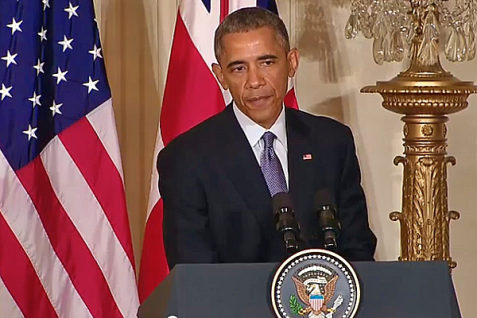
Obama (1)U.S. President Barack Obama Photo Credit: WhiteHouse.Gov screen capture

This week the United States officially put on notice its trade partners that it will not countenance boycotts or other economic warfare against Israel.

After signing the relevant trade legislation into law, however, the White House signaled to all its trade partners that they are still free to boycott goods made in the disputed territories, despite the clear language of the legislation the president signed.

This week the Trade Promotion Authority bill was passed by Congress and signed into law by President Barack Obama.

The TPA is primarily focused on international trade between the U.S. and Europe. It also included a section which addresses trade between the U.S. and Israel.

That part of the legislation, the U.S.-Israel Trade and Commercial Enhancement Act, bans boycotts and other means of economic warfare against Israel or the “Israeli-controlled territories.” This amendment, introduced by Rep. Peter Roskam (R-Ill-6) with bi-partisan co-sponsorship, was unanimously adopted into the PTA in April.

The passage of the TPA, including the anti-BDS section, should sound a death knell for the BDS (Boycott of, Divestment from and Sanctions against Israel) Movement. It should.

However, as pro-Israel Americans and Israelis learned only a few weeks ago in the Jerusalem passport case (Zivotofsky v. Kerry), there are certain spheres of international decision making over which the president has exclusive, or at least primary and controlling, control. Obama claims that international trade is one of those areas, even though Article 1, Section 8, clause 3, expressly gives Congress the power to regulate foreign commerce.

So even though the TPA is intended to act as a strong deterrent to European and other countries to pass and enforce boycotts of Israeli products, the White House has already signaled that it will not extend its protection to any goods produced in the disputed territories.

The anti boycott of Israel language in the TPA is: “actions by states, nonmember states of the United Nations, international organizations or affiliated agencies of international organizations that are politically motivated and are intended to penalize or otherwise limit commercial relations specifically with Israel or persons doing business in Israel or in Israeli-controlled territories.” [emphasis added.]

In a statement which Matt Lee of the Associated Press attributed to State Dept. spokesperson John Kirby, the administration made clear that despite signing the TPA, the position of the White House remains, as it has been, that the U.S. opposes boycotts of the State of Israel, but it also opposes the presence of Jews in the disputed territories of Judea and Samaria and the Golan Heights.

In the statement the administration argues that by “conflating Israel and ‘Israeli-controlled territories’ a provision of the Trade Promotion Authority legislation runs counter to longstanding U.S. policy towards the occupied territories, including with regard to settlement activity,” and says that every U.S. administration has opposed “settlement activity.”

It goes on to point out that the “U.S. government has never defended or supported Israeli settlements and activity associated with them and, by extension, does not pursue policies or activities that would legitimize them.”

The U.S. administration announced that it will not jeopardize the holy grail of the two-state solution by enforcing the U.S. law as written and which its leader signed. In the statement it claims that “both parties have long recognized that settlement activity and efforts to change facts on the ground undermine the goal of a two-state solution to the conflict and only make it harder to negotiate a sustainable and equitable peace deal in good faith.” It is on this basis, ostensibly to promote a peaceful solution to the Arab-Israeli conflict, that this administration

Professor Eugene Kontorovich of the Northwestern University School of Law analyzes several other provisions of the U.S-Israel trade aspect of the TPA which have been largely overlooked. In particular, Kontorovich points out, U.S. courts cannot recognize or enforce the judgment of any foreign court “that doing business in or being based in the West Bank or Golan Heights violates international law or particular European rules.”

Giant new Obama lie: I’m prepared to abandon these Iran nuke negotiations if we can’t get a good deal

July 1, 2015

Giant new Obama lie: I’m prepared to abandon these Iran nuke negotiations if we can’t get a good deal, Hot Air, Allahpundit, June 30, 2015

This may be the single most brazen lie he’s told since the glory days of “if you like your plan, you can keep your plan.” In fact, I might go one better than that. For sheer lack of believability, this may be the most transparent garbage he’s pushed at the public since he assured voters in 2008 that he had no choice as a deeply religious man but to oppose gay marriage because “God’s in the mix.” No one took him seriously then. No one’s taking him seriously on this either.

And by “no one,” I include former Obama administration staffers in that. Even Team Hopenchange is now worried about a gigantic Obama/Kerry sellout to Iran.

Over his 30-year political career, Kerry has long been knocked for delivering more talk than results. Achieving a nuclear deal he first began pursuing even before he became secretary of state could redefine his place in history.

And that, Republican critics, foreign officials, and even some ex-administration officials say, is a big problem. Kerry’s eagerness for a deal, they argue, risks that the Iranians will seduce him into a bad one.

“I don’t know how anyone who has observed Kerry over the past two years would think differently,” says a former administration official who worked on Iran issues.

He can’t stop Putin, he can’t get Israelis and Palestinians to the table, but he’s going to make rapprochement with Iran work one painstaking sellout at a time. Go read Stephen Hayes’s compendium at the Weekly Standard of how far the goalposts have moved, inch by inch, since the Obama White House first began laying down terms for a nuclear settlement with Iran several years ago. If they make a deal on nukes, it’s a fait accompli that Kerry will start prodding his new friend Javad Zarif to see what the terms of a “grand bargain” with Iran that formally restores diplomatic relations between the two countries might look like. (“Do it now or you’ll never have a chance under a Republican president,” Kerry might tell him.) Frankly, a nuclear sellout in which sanctions are lifted immediately and Iran gets to keep its military sites away from UN inspectors makes more sense with a grand bargain than without. If you’re going to bless the idea of Shiite fanatics having nuclear weapons, you’d better make nice with them.

Anyway, I hope O enjoys the little job approval bounce he’s getting this week while it lasts.

Exit question: If Obama’s prepared to walk away, why did he and Kerry extend the deadline for talks from today to July 7? Iran’s had month upon month to come around to our terms knowing full well that the deadline for a final deal was (supposedly) June 30. They refused to concede. So we’re giving them another chance. Why? You know why. A bad deal is better than no deal.


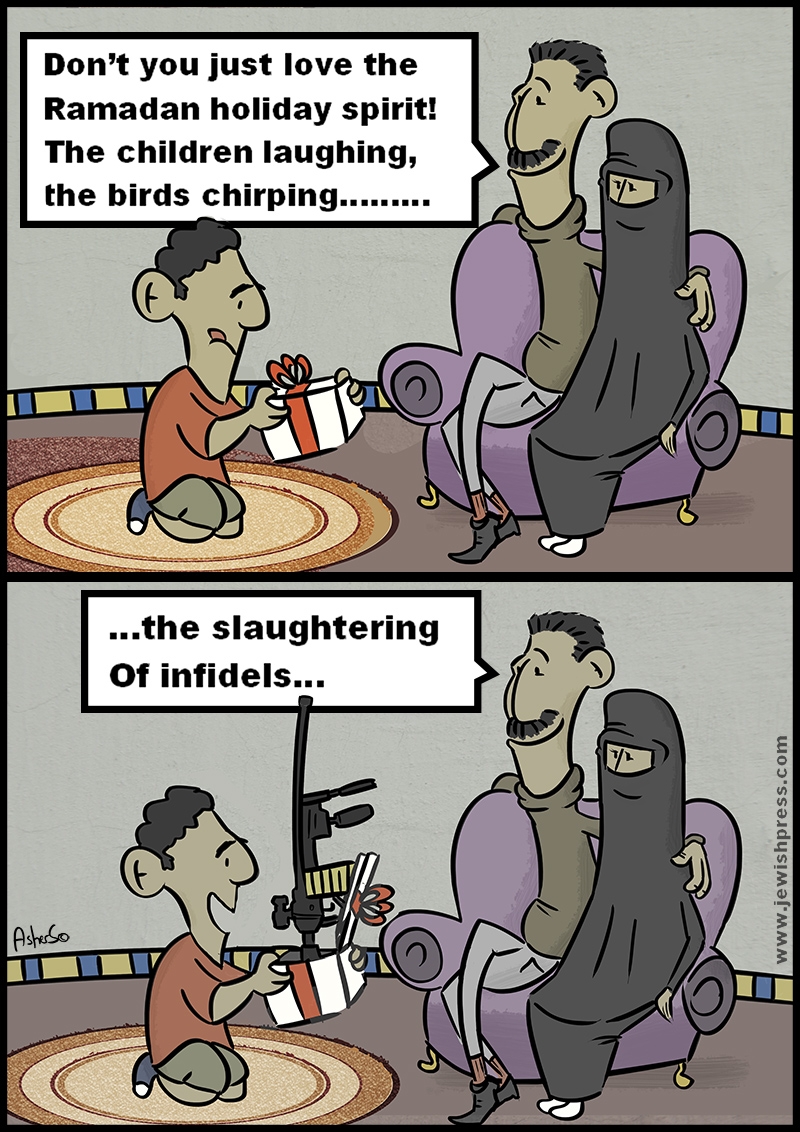
Cartoon of the day

July 1, 2015

H/t The Jewish Press


ramadan-spirit

Islamic State Captures First Territory in Afghanistan

July 1, 2015

Islamic State Captures First Territory in Afghanistan

by Oliver Lane30 Jun 2015

via Islamic State Captures First Territory in Afghanistan – Breitbart.

Islamic State fighters have taken substantial areas of Afghanistan for the first time, displacing the Taliban to become the new masters of parts of the east of the war-torn country.

Known commonly by the acronym ISIS, encompassing their initial territorial holdings in Syria and Iraq, the Islamic State has rapidly expanded its influence in the year since its establishment as the new Caliphate last Ramadan. Fighters pledging allegiance to the Caliphate now control territory accross North Africa and the Middle East, including Boko Haram in Nigeria and now in Afghanistan.

Witnesses who fled fighting in Nangarhar province told Reuters that hundreds of insurgents pledging allegiance to Islamic State pushed out the Taliban, scorching opium poppy fields that help to fund the Taliban’s campaign to overthrow the Afghan government.

They also distributed directives purportedly from Islamic State’s Middle East-based chief Abu Bakr al-Baghdadi, although it was not clear whether he issued them for the Afghan theater or if previous edicts may have been translated.

“They (ISIS loyalists) came in on many white pickup trucks mounted with big machine guns and fought the Taliban. The Taliban could not resist and fled,” said Haji Abdul Jan, a tribal elder from Achin district.

“Unlike the Taliban, they (ISIS) don’t force villagers to feed and house them. Instead, they have lots of cash in their pockets and spend it on food and luring young villagers to join them”, he said. ISIS forces have already banned the sale of cigarettes and have burned poppy fields, the staple of the traditional local economy.

Reports suggest many of the Islamic State forces in Afghanistan are former Taliban fighters who are following the money to the now more successful Caliphate. Black flags fly over villages and foreign Imams preach the extremist ISIS creed in Mosques, with translators on hand to render their words into local dialects. The scenes are redolent of foreign leaders active within Boko Haram, who deliver sermons and verdicts on punishments through translators.

One video captured by Nigerian security forces shows a man of presumed Sudanese origin handing down sharia law judgements before a large crowd of Nigerian villagers. After he finishes speaking, some men are flogged, others have their hands cut off, and one is buried to his neck and then stoned to death. The ISIS leader giving orders to the Boko Haram militants says: “God ordered all believers to enforce his punishments… God ordered us to cut off the hand of the thief and flog the adulterer and adulteress”.

Reuters Contributed to This Report

Israeli border troops, US Mid East forces on alert after massive ISIS assault on Egyptian forces in Sinai

July 1, 2015

Israeli border troops, US Mid East forces on alert after massive ISIS assault on Egyptian forces in Sinai, DEBKAfile, July 1, 2015

Sinai_Attack_1.7.15ISIS attacks Egyptian Sinai positions

The Islamic State of Iraq and the Levant moved ominously close to Israel’s borders Wednesday, July 1 – not as predicted in the north, but in the south, from the Sinai Peninsula. There, ISIS followed up on its Ramadan terror outrages in France, Tunisia, Kuwait and Kobani, with a massive assault on Egyptian forces in the northern Sinai region of Sheikh Zuwaid close to the Israeli and Gaza Strip borders.

Not just a terrorist attack, ISIS launched a full-scale military assault, starting with mortar fire and suicide bombings against five Egyptian military checkpoints.

Using a tactic similar to that employed in the capture of the Iraqi town of Ramadi last month, ISIS gunmen followed this initial assault by riding in on minivans, backed by heavy mortar fire, to storm the positions held by stunned Egyptian troops. Altogether some 20 Egyptian army positions were attacked in and around Sheikh Zuwaid.

Egyptian troop reinforcements setting out from El Arish to the northeast to aid the beleaguered force, went up on mine and bomb traps secretly planted around their camps and police stations. Egyptian Apache assault helicopters striking the ISIS force themselves faced ground fire from shoulder-borne anti-air missiles.

Egyptian forces are reported to have sustained heavy casualties, at least 64 dead and many more wounded. The Islamists are additionally said to have taken Egyptian prisoners as hostages.

As the fighting grew fierce during Wednesday, Israel to shut its border crossings with Egypt and the Gaza Strip, and sent reinforcements south in case the jihadis launched an attack on Israel from northern Sinai.

Our military sources also report that US Middle East forces located in Jordan and at Sharm el-Sheikh are on the ready in case the Islamic State decides to attack the US officers and men at the Multinational Force facility in Sinai, which is located near the Sheikh Zuwaid battlefield.

The ISIS Sinai offensive is part and parcel of the reign of terror launched last Friday by Yassin Sahli when he beheaded his French boss, and Seifeddine Rezgui, who murdered 39 holidaymakers on a Tunisian beach. Standing ready for the Islamist offensive in Sinai were the jihadis of the Ansar Beit al-Maqdis, which recently declared Sinai a province of the Islamic State and took an oath of allegiance to Abu Bakr al-Baghdadi.

ISIS draws on two additional major sources for its fighting manpower: the infrastructure it established in turbulent Libya for training and arming jihadis to cross the Egyptian border into Sinai; and the fatal attraction its radicalizing ideology holds for young Muslims who are taught that the brutal murder of Islam’s foes is a cleansing and purifying act.

Let’s Sign It So We Can See What’s In It

July 1, 2015

US prepares for ‘staggeringly consequential’ Iran deal

By MICHAEL WILNER 06/29/2015 Via The Jerusalem Post

ShowImage
Kerry: “Please allow me to direct your attention to page 2,563 in the English version. For those who wish to follow me in the Farsi version, please turn to page 2.” [Photo Credit: Reuters]

(Let see…probably thousands of pages long, English and Farsi versions, no outsiders allowed to see the document…hmmm. – LS)

The document is largely written, but the toughest negotiations come down to the wording of key annexes.

VIENNA – The deal at hand with Iran over its nuclear program will be a single, comprehensive text, annexes and all, in English and in Farsi, with “staggeringly consequential” effects on the security of the world, a senior US official said on Monday.

Entering a self-imposed deadline for that text, scheduled for Tuesday, the work of negotiators remained incomplete. Political decisions from all sides await. Lawyers still have to review the document once its finished.

But the American team hopes to adopt a final text within days – formally achieving agreement on a Comprehensive Joint Plan of Action.

The United States, Britain, France, Russia, China, and Germany say the CJPOA will adequately restrict Iran’s ability to obtain nuclear weapons.

The negotiations are in their final round here in the Austrian capital, where the foreign ministers of each nation are to arrive on Tuesday.

The entire US team, already here in Vienna, is preparing for the adoption of the text in two ways. First and foremost, they say, they are inspecting each provision with intricate care.

Each of those provisions, one official said, includes “a hundred details,” from the fate of heavy water in Iran’s plutonium facility in Arak to the precise language of a United Nations Security Council resolution that will codify the deal.

There are innumerable interwoven details, the official said, “not least of all, what technical experts tell us is real or not.”

While June 30 had been the deadline for a comprehensive deal, negotiators have been prepared to negotiate through the deadline for several weeks.

They are not, however, considering any long-term extension of the current round.

Phasing in a deal has become a negotiation in and of itself.

The Obama administration says to expect a multi-phase process that begins with the adoption of the agreement, then enters a period of procedural implementation, and is followed by a moment the deal “goes live” and all provisions activate.

“There wasn’t paper out of Lausanne. You didn’t have a text. You had parameters,” the senior US official said, on the condition of anonymity.

“You are going to have a text…it will be evident to everyone what has been agreed.”

The official said the US team expects a “roller coaster” entering the final days of their effort, similar to what they have experienced over two years of negotiations.

“We know what we need,” the official said, “and we’ll deal with what comes.”

US Secretary of State John Kerry held meetings internally on Monday, as well as one meeting with the head of the UN’s nuclear watchdog, the International Atomic Energy Agency, an independent body that will be tasked with monitoring Iran’s nuclear sites under the deal.

He is to meet Tuesday with Iranian Foreign Minister Mohammad Javad Zarif, who traveled to Tehran on Monday to consult on the deal’s final stage with the country’s supreme leader. Zarif plans to return from Iran early on Tuesday morning.

Also scheduled to arrive on Tuesday is Russian Foreign Minister Sergey Lavrov, who is to meet with Kerry at some point in the afternoon.

Over the weekend, one Chinese official said they expect the document to be “finalized on schedule, or maybe within a week.” The European Union’s high representative for foreign affairs, Federica Mogherini, said the parties are not considering an extension beyond that point.

Everyone at the table “feels the burden of the responsibility” for this deal, the US official said. “Making this decision to actually do the Joint Comprehensive Plan of Action is a very, very, very big decision for everybody.”

It’s a decision that Israel hopes the negotiators will postpone.

One of the fundamental disagreements Israel and the US have over a possible deal is that, while Israel views Iran as the main problem in the region, the US views it as part of the solution, Defense Minister Moshe Ya’alon said on Monday.

Ya’alon, at a briefing with diplomatic reporters in his Tel Aviv office, said that world powers and Iran are headed to a nuclear agreement, even if Tuesday’s deadline is not met, and that despite some last minute delays, the negotiations are not on the verge of collapse.

“What is clear is that this is a bad agreement,” he said. “After it is signed, we will have a nuclear threshold Iran.”

He said that the agreement does not close any Iranian nuclear facilities or dismantle centrifuges, and only suspends the Iranian nuclear program, which he said clearly has a military element.

Ya’alon said that despite the disagreements with Washington, the close channels of communication and cooperation between Israel and the US remain open. He asserted that Israel has influenced the agreement being worked out, and wants to continue to do so as much as possible.

After the agreement is signed, he said, Israel will likely enter in talks with the US over what is needed to preserve its qualitative military edge, not only because of the threat from Iran, but also since Washington has promised state-of-the-art weapons systems to some Arab states in the region that also feel threatened by Iran.