Archive for July 2015

Speaking of the Iran deal (10)

July 31, 2015

Speaking of the Iran deal (10), Power LineScott Johnson, July 31, 2015

(Is North Korea’s Minister of Hyperbolic Statements assisting Iran? — DM) 

I take it that the White House is willing to say and do just about anything in support of this catastrophic deal.

****************

AP Vienna bureau chief George Jahn reports: “Iran: US statements on attacking Tehran violates nuke deal” (subject-verb disagreement in the original, I hate to say). On Twitter, AP diplomatic correspondent Matt Lee concisely comments: “Already?!”

Here is Jahn’s report:

A senior Iranian official is accusing the U.S. of violating the nuclear deal with his country through comments indicating that the accord would make any attack on Tehran’s atomic program more efficient because it would result in greater insight about potential targets.

The July 14 deal foresees increased overview of Iran’s nuclear activities by the U.N.’s International Atomic Energy Agency. Reza Najafi, the IAEA’s chief Iranian delegate, quoted White House spokesman Josh Earnest as saying that would result in enhanced U.S. or Israeli military action against Iran — if needed — “because we’d been spending the intervening number of years gathering significantly more detail about Iran’s nuclear program.”

Israel is a harsh critic of the deal and says it is keeping all options open to prevent Iran from getting nuclear weapons. The Obama administration says the agreement has accomplished its goal of preventing Tehran from getting such arms.

Still, as part of White House pushback against congressional and other critics of the deal, Earnest, in his comments to reporters July 17 said that the U.S. “military option would remain on the table” if Iran breaks out of the deal and races to make a bomb.

Najafi, in a July 24 letter posted to the IAEA website on Wednesday, called Earnest’s statement “outrageous.” He said it “seriously undermines the very basic principles” needed to implement the deal, adding that the comments amount to “a material breach of the commitments” agreed to by the United States and the five other world powers at the negotiating table with Iran.

Citing Earnest, Najafi also suggested that Washington could try to violate provisions of the nuclear deal committing the agency during its Iran monitoring to “protect commercial, technological and industrial secrets as well as other confidential information coming to its knowledge.”

I take it that the White House is willing to say and do just about anything in support of this catastrophic deal. Behind closed doors, to take an example from yesterday, Obama told Democratic congressmen hearing him out on the deal that if they were to help override his veto of congressional disapproval of the deal, he would do everything in his power to  undermine their disapproval. Other than noting the White House’s willingness to say anything, I find the substance of Jahn’s report weird beyond immediate comment.

When Is It a War Crime to Defend Yourself? If You’re an Israeli.

July 31, 2015

When Is It a War Crime to Defend Yourself? If You’re an Israeli.

by Jonathan S. Tobin July 31, 2015 Via Commentary Magazine


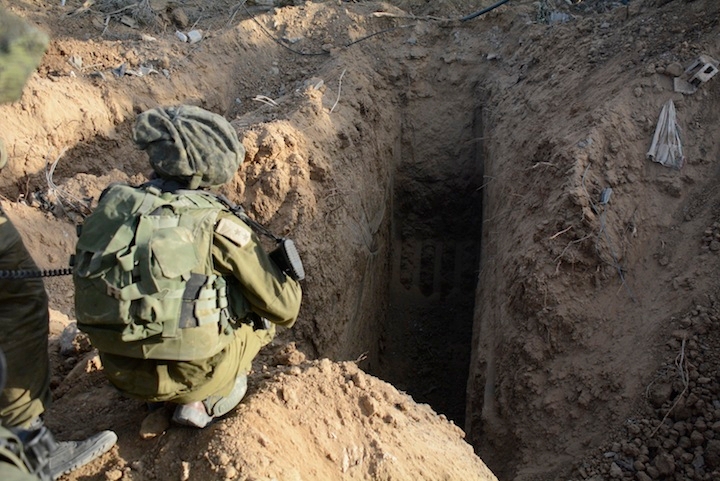
Israeli paratroopers inspect the entrance of a tunnel they discovered in the northern Gaza Strip, July 18, 2014. (IDF Spokesperson/Flash 90)

(That dangerous double standard just won’t go away. – LS)

Yesterday, Amnesty International issued its latest broadside at the State of Israel. The group’s report, titled “Black Friday: Carnage in Rafah” dutifully reported at length by the New York Times, seeks to portray an incident from last summer’s war in Gaza as an example of  particularly awful Israeli war crimes involving shelling of civilian areas and egregious loss of life. But, as with most such accusations, the closer you look at the charge the more it becomes clear that the point of the exercise isn’t merely a supposed quest for justice for dead Palestinians. While this must be seen in the context of a campaign to prepare war crimes charges against the Israel Defense Forces before the International Criminal Court that was recently joined by the Palestinian Authority, the effort has a broader purpose than merely beginning a human rights prosecution before that body. By expending a great deal of its limited resources on this one incident, Amnesty is seeking to make a much broader political point: delegitimizing Israeli self-defense under virtually any circumstances.

The incident that generated the reported took place on August 1, 2014. On that morning, a cease-fire between Israel and Hamas was put into effect that sought to end the war that had begun a month earlier. The conflict started when a Hamas terror cell kidnaped and murdered three Israeli teenagers and then escalated when the group began firing rockets at Israeli cities and towns. Several thousand of these missiles would be launched at Israel before the war ended. In addition to that, Hamas attempted to employ tunnels it had dug underneath the border with Israel to conduct more such kidnap/murder raids. Though the Israelis tried at first to halt the attacks with air power, when that didn’t work, ground forces were required to stop the terrorists. Though the August 1st cease-fire — like the one that later finally did end the shooting — left Hamas in place and in possession of its rocket arsenal, Israel agreed to it.

But only an hour after the fighting was supposed to stop, a Hamas terror squad ambushed a group of Israeli soldiers in the city of Rafah along the border with Israel. Two were killed and the body of one, Second Lieutenant Hadar Goldin, was dragged into the tunnel from which his attackers had emerged. That set off a desperate search and counter-attack aimed at recovering him and/or his body. That directive, known by the code name, “Hannibal” aims to use maximum force to prevent terrorists from escaping with a hostage. The order is always controversial because some interpret it as encouraging Israeli forces to even endanger the life of the captured soldier rather than standing down and subjecting both the individual and his country to a protracted hostage negotiation that inevitably involves the release of a disproportionate number of terrorist murderers.

In this case, Amnesty accuses Israel of using artillery fire in such a way as to conduct “disproportionate or otherwise indiscriminate attacks” on civilian areas with no regard for the lives of innocents who might be killed in the barrage. According to Amnesty and its Palestinian sources, the Israelis fired 1,000 shells and 40 bombs on the area where the Hamas assault took place resulting in 135 Palestinian deaths.

But while the loss of life during this battle was regrettable, the focus of the Amnesty report is remarkably skewed.

After all, the one war crime that we can be sure that took place was the attack on Goldin and his squad. It was a deliberate violation of a cease-fire that might have been a godsend for ordinary Palestinians, but which didn’t serve the purposes of Hamas. Having bled Gaza white for weeks, the leaders of the terrorist group were not yet satisfied with the toll of casualties among their own people. Hamas places its missile launchers and terror squads among civilians in order to deliberately expose them to Israeli fire. While there are plenty of fortified shelters in the strip for Hamas fighters and their massive arsenal, there are few for civilians. In Hamas-run Gaza, the shelters are for the bombs, not the people.

That means that any fair-minded observer of the events of August 1, 2014 must concede that the responsibility for all of the casualties the ensued as Israeli and Hamas forces fought in Rafah that day belongs to those who cynically ordered the attack on the Israeli soldiers that ended the cease-fire. The tunnel they used ran through residential areas, and the flight of these terrorists was such that they deliberately and with malice aforethought endangered the lives of all those who lived in the area. Their goal was not only to spirit away a hostage but also to create the kind of havoc that would result in more accusations against Israel.

But the minute analysis of every round fired by the Israelis by Amnesty not only doesn’t take that into account or put their accusations in a reasonable context. It also treats the effort to rescue Goldin — who probably did not survive the initial attack — as wrong while treating the assault on the Israelis as a reasonable and even legal action. But even in the course of its effort to demonize the Israeli actions by pouring on the details of bullets and shells fired amid a chaotic battle amid the fog of war, Amnesty cannot help falsifying their indictment. The report fails to take into account that along with the civilians who were sadly killed or wounded as a result of terrorist actions, some of the casualties they lament were actually Hamas or Islamic Jihad personnel.

But no matter how you break down the battle, the talk of disproportionate fire frames the discussion in a way that inevitably skews it toward treating the Israelis as the transgressors rather than a combatant. Would any nation, including Western democracies or the United States, be any less “indiscriminate” in its fire on terrorists attacking its cities and its troops than the Israelis? The answer is obviously not. As General Martin Dempsey, the chairman of the Joint Chiefs of Staff said in his comments about the Gaza war, the conduct of the Israelis in the fighting was a model that U.S. forces seek to emulate in their own conflicts in the Middle East. Indeed, the same accusations of “disproportionate” fire are often, and sometimes with more reason, lodged against Americans fighting in Afghanistan or bombing Taliban or al-Qaeda targets in Pakistan.

As for the “Hannibal” directive, the discussion is a controversial one even within Israel. But the assumption that it means that soldiers are ordered to kill one of their own rather than let them be taken is probably a misunderstanding. Any hostage in a war zone is, by definition, in harm’s way and faces a good chance of becoming a casualty. The Israelis rightly seek to prevent the capture of their people. Doing so spares the country and the individual from a terrible ordeal. Efforts to prevent these crimes deserve the praise of fair-minded people, not their condemnation.

The effort to turn the effort to save Hadar Goldin was, like the entire counter-offensive that Israel conducted in Gaza last summer, entirely justified. The blame for the deaths of Palestinians needs to be placed at the door of the Hamas terrorists that started the conflict and then broke a cease-fire in a conscious effort to set in motion the tragic events that then unfolded.

In the meantime, the family of Lt. Goldin still awaits the return of his body from Hamas that may be holding his remains in order to exact another gruesome exchange for live killers. If Amnesty wants to live up to its claim of advocacy for human rights, it might want to get involved in that issue. More to the point, the group and its financial backers need to understand that by conducting such attacks on Israel, it cannot pretend that is rationalizing the actions of one side in the conflict. In this case, their version of human rights advocacy appears to be indistinguishable from rationalizing the crimes of terrorists and seeking to hamstring the efforts of those seeking to stop them.

Britain’s secret ties to governments, firms, behind ISIS oil sales

July 31, 2015

Britain’s secret ties to governments, firms, behind ISIS oil sales

by Nafeez Ahmed

via Britain’s secret ties to governments, firms, behind ISIS oil sales — Medium.

This exclusive is published by INSURGE INTELLIGENCE, a new crowd-funded investigative journalism project


In the scramble to access Kurdistan’s oil and gas wealth, the US and UK are turning a blind eye to complicity in ‘Islamic State’ oil smuggling


Key allies in the US and UK led war on Islamic State (ISIS) are covertly financing the terrorist movement according to senior political sources in the region. US and British oil companies are heavily invested in the murky geopolitical triangle sustaining ISIS’ black market oil sales.

The Kurdish Regional Government (KRG) in Iraq and Turkish military intelligence have both supported secret ISIS oil smuggling operations and even supplied arms to the terror group, according to Kurdish, Iraqi and Turkish officials.

One British oil company in particular, Genel Energy, is contracted by the KRG to supply oil for a major Kurdish firm accused of facilitating ISIS oil sales to Turkey. The Kurdish firm has close ties to the Iraqi Kurdish government.

Genel operates in the KRG with the backing of the British government, and is also linked to a British parliamentary group with longstanding connections to both the British and KRG oil industries.

The relationship between British and Kurdish energy companies, and senior British politicians, raises questions about conflicts of interest — especially in the context of a ‘war on terror’ that is supposed to be targeting, not financing, the ‘Islamic State.’

Kurds, Turks and blind eyes

One of ISIS’ most significant sources of revenue is oil smuggling. The Islamic State controls approximately 60% of Syria’s oil, and seven major oil-producing assets in Iraq.

Using a carefully cultivated network of intermediaries and ‘middlemen’ in the Kurdish region of Iraq, as well as in Turkey, ISIS has been able to produce a phenomenal 45,000 barrels of oil a day, raking in as much as $3 million a day in cash by selling the oil at well below market prices.

But the sheer scale and impunity of this oil smuggling network has caused local politicians to ask whether certain officials in the KRG and Turkey are turning a blind eye to these operations.

Iraqi, Kurdish and Turkish officials have accused both the KRG and Turkish governments of deliberately allowing some of these smuggling operations to take place.

Tensions between the KRG and Iraq’s central government in Baghdad are escalating over who controls production and revenues from oil fields within the Kurdish region. Kurdish officials see the oil within the Kurdish-controlled territory of Iraq as a means to seek greater autonomy, if not potentially total independence, from Baghdad — whereas the Iraqi government seeks to ensure it retains sovereign control over all sales from its own oil fields, which include those in the KRG.

Those tensions reached a crescendo when the KRG began unilaterally selling oil by exporting it to Turkey, bypassing Baghdad.

Complicity

KRG and Turkish authorities vehemently deny any role in intentionally facilitating IS oil sales. Both governments have taken measures to crackdown on smuggling operations, and US and UK authorities work closely with the KRG to identify IS smuggling routes.

Despite KRG arrests of Kurdish ‘middlemen’ involved in the IS black market oil sales, evidence continues to emerge that these measures are largely piecemeal, and have failed to address corruption at the highest levels.

According to a senior source in the Iraqi government’s ruling Islamic Dawa Party, US and Iraqi authorities have developed “significant intelligence confirming that elements of the KRG have tacitly condoned ISIS oil sales on the black market.”

The source, which has direct access to top Iraqi government officials, said that the KRG had originally seen the ISIS invasion of Iraq as an opportunity to consolidate Kurdish control over disputed territory, especially the oil-rich region of Kirkuk. The Kurds had not, however, anticipated how powerful IS’ presence in the region would become.

In the early period of the invasion last year, he said:

“Elements of the KRG and Peshmerga militia directly facilitated secret ISIS oil smuggling through the Kurdish province. This was known to the Americans, which shared intelligence on the matter with the Iraqi government in Baghdad.”

The issue inflamed tensions between Baghdad and the KRG, contributing to efforts by Hussein al-Shahrestani, then Iraq’s deputy prime minister for energy affairs, to crackdown on independent Kurdish oil exports.

His successor, new oil minister Adel Abdul-Mehdi, was brought in through a reshuffle in September last year that was engineered under US diplomatic pressure. Unlike Shahrestani, the source said, Abdul-Mehdi has a much more conciliatory approach to the Kurdish oil question, one which also happens to suit the interests of US and British investors in the KRG: “This has meant that Baghdad has also been much more lax on evidence of ISIS oil smuggling through the KRG.”

The source confirmed that under mounting US pressure, “KRG authorities have taken serious steps to curb the illegal smuggling on behalf of ISIS. But the smuggling still continues, although at a more restrained level, with the support of elements of KRG’s ruling parties, who profit from the black market oil sales.”

Turkey also plays a crucial role in the ISIS oil smuggling operations according to the Iraqi source. As the end-point through which much of this oil reaches global markets, Turkish authorities have routinely turned a blind eye to the IS-run black market. “The Turks have an acrimonious relationship with the Americans,” he claimed, but admitted that US intelligence is familiar with Turkey’s role:

“US intelligence is monitoring many of these smuggling operations in minute detail. Some of this intelligence has been passed on to us. The Americans know what is going on. But Erdogan and Obama don’t have a great relationship. Erdogan basically does what he likes, and the US has to lump it.”

The allegations have been confirmed by Turkish government officials and parliamentarians. In particular, a source with extensive connections to the Turkish political establishment including the office of the Prime Minister, said that Turkey’s support for Islamist rebels opposed to Bashir al-Assad’s reign in Syria began long before the emergence of the Islamic State, and was pivotal in the group’s meteoric rise to power.

Turkey, a longstanding NATO member, is part of the US-led coalition fighting IS, and has been integral to the region’s ‘moderate’ rebel training schemes supervised by Western military intelligence agencies.

“Turkey is playing a double-game with its Syria strategy,” said the source.

“Turkey has sponsored Islamist groups in Syria, including ISIS, since the beginning, and continues to do so. The scale of ISIS smuggling operations across the Turkish-Syrian border is huge, and much of it is facilitated with the blessings of Erdogan and Davitoglu, who see the Islamists as the means to expand the Turkish foothold in the region.”

Recep Tayyip Erdogon is the President of Turkey, and Ahmet Davutoglu is the country’s Prime Minister. Asked how this fits with recent Turkish operations to shut-down ISIS smuggling operations and target ISIS strongholds across the border, the source described the actions as too little, too late.

“These actions fit with Erdogan’s strategy of expansion,” he said. “We are not trying to shut down the infrastructure of ISIS, we are attacking it selectively.”

A shadow network in broad daylight

The ISIS oil smuggling route — which encompasses the KRG and ends up at the Turkish port of Ceyhan — was recently investigated by two British academics at the University of Greenwich.

The paper by George Kiourktsoglou, Lecturer in Maritime Security and former Royal Dutch Shell strategist, and Dr Alec Coutroubis, Acting Head at the Faculty of Engineering and Science, attempted to identify suspicious patterns in the illicit oil trade.

Their extraordinary study, published by Maritime Security Review in March, examined the international route used by IS, based on “a string of trading hubs” comprising the localities of Sanliura, Urfa, Hakkari, Siirt, Batman, Osmaniya, Gaziantep, Sirnak, Adana, Kahramarmaras, Adiyaman and Mardin. “The string of trading hubs ends up in Adana [in southeast Turkey], home to the major tanker shipping port of Ceyhan.”

By comparing spikes in tanker charter rates from Ceyhan with a timeline of IS activities, the University of Greenwich analysis identified significant correlations between the two. Whenever the Islamic State fights “in the vicinity of an area hosting oil assets, the… exports from Ceyhan promptly spike. This may be attributed to an extra boost given to crude oil smuggling with the aim of immediately generating additional funds.”

While the evidence is still “inconclusive” at this stage, the authors wrote that “there are strong hints to an illicit supply chain that ships ISIS crude from Ceyhan” to global markets. Since the launch of the ISIS oil venture in summer 2014, “tanker charter rates from Ceyhan re-coupled up to a degree with the ones from the rest of the Middle East.”

Though they could not be categorical, primary research including interviews with informed sources indicated that this was most likely “the result of boosted demand for ultra-cheap smuggled crude, available for loading” from the Turkish port.

Kiourktsoglu and Coutroubis call for “further research” on ISIS criminal ventures which “can potentially integrate it within the global economy.” The academics have previously given evidence before the parliamentary foreign affairs select committee regarding maritime security off the Somalian coast.

Their study also highlights failures in the US military approach to the ISIS oil operations. Although they commend how US, Turkish and Gulf air raids have “curtailed” the Islamic State’s “oil cashflows” by destroying some “oil manufacturing facilities,” this has not gone far enough. They report that:

“… extraction wells in the area of bombardments have yet to be targeted by the US or the air-assets of its allies, a fact that can be readily attributed to the at times ‘toxic’ politics in the Middle East.”

Despite large convoys of trucks transporting ISIS oil through government-controlled areas in Syria, Iraq and Turkey, “allied US air-raids do not target the truck lorries out of fear of provoking a backlash from locals.” As a result, “the transport operations are being run efficiently, taking place most of times in broad daylight.”

The public record

Evidence already in the public record corroborates the allegations of the Iraqi and Turkish sources, showing that corruption is endemic at both the origin and end-points of the ISIS smuggling route.

Informed observers inside and outside Turkey have accused the Turkish government of turning a blind eye to the smuggling of oil across the Syrian-Turkish border in its commitment to bringing down the Assad regime.

Prosecutor and witness testimony in Turkish courts revealed that in late 2013 and 2014, Turkish military intelligence had supplied arms to areas in Syria under Islamist rebel control, contributing directly to the rise of ISIS.

Turkish opposition MP Ali Ediboglu last year said that some $800 million worth of ISIS oil had been smuggled into Turkey. He also said that over a thousand Turkish nationals were helping foreign fighters join ISIS in Syria and Iraq through Turkish territory. Both, he alleged, are occurring with the knowledge and involvement of Turkish military intelligence.

In July 2014, Iraqi officials revealed that when ISIS had begun selling oil extracted from the northern province of Salahuddin, “the Kurdish peshmerga forces stopped the sale of oil at first, but later allowed tankers to transfer and sell oil.”

Three months later, a KRG Interior Ministry document leaked to the Kurdish media outlet, Rudaw, showed that a former opposition MP, Burhan Rashid, had accused KRG institutions of facilitating the flow of funds and arms to ISIS militants in Iraq.

“A Kurdish political party in Erbil has supplied the ISIS militants with weapons and ammunition in exchange for oil,” Rashid is recorded as saying. The document revealed that the KRG chief public prosecutor had secretly prepared a lawsuit against Rashid for making the allegations.

The lawsuit, which apparently went nowhere, was an obvious effort to silence criticism. By January, however, an investigative committee led by the KRG interior minister and natural resources minister had largely corroborated Rashid’s allegations.

Kurdish parliamentary sources familiar with the final report of the committee, which remains secret, told Rudaw the report had confirmed:

“… a number of officials from the ruling Kurdistan Democratic Party (KDP), the Patriotic Union of Kurdistan (PUK) and the Peshmerga have been involved in the illegal trade.”

Half a year later, the identities of officials investigated remain undisclosed, and no one has been charged, tried or sentenced. The KRG’s UK office did not respond to a request for comment.

The Nokan Group

Instead, a couple of months after the committee had reached its conclusions, evidence emerged that the Nokan Group, a major Kurdish company with close ties to the KRG, had been directly facilitating ISIS oil sales.

In a letter to the Nokan Group, Mark D. Wallace — a former US ambassador to the United Nations under President George W. Bush and CEO of the New York-based Counter Extremism Project — noted credible “reports that some Kurdish entities are in fact facilitating ISIS-related oil trade…

“Specifically, certain Kurdish companies are reportedly contracted to transport refined fuel from the ISIS-controlled Baiji refinery, north of Tikrit, Iraq, for delivery throughout the Kurdish region by Sulaymaniyah province authorities in Iraqi Kurdistan, in the north-eastern region of Iraq.”

Trucks owned or operated by Meer Soma, a “subsidiary” of the Nokan Group, “are being used to transport refined petroleum products from ISIS-controlled refineries to Kurdish entities in or near Kirkuk,” wrote Ambassador Wallace in the letter dated 20th March 2015.

Wallace noted that according to the Kurdish press, Meer Soma is among several Nokan-controlled dummy companies operating on behalf of the group, to avoid public association with the parent firm.

According to a 2012 country report by the Paris-based business intelligence agency MarcoPolis, the Nokan Group is among the largest companies in the province, and “has interests” in Meer Soma.

In 2014, the same year that photographs of Meer Soma tankers transporting ISIS oil to Kurdish refineries were published online, the Nokan subsidiary’s website was deleted.

Ambassador Wallace’s letter has generated little more than silence. No response from the Nokan Group was received by Wallace. The Nokan Group could not be reached for comment.

Copies of the letter were sent to relevant Congressional committees, as well as John E. Smith, Acting Director of the US Treasury Department’s Office of Foreign Assets Control. The US Treasury did not respond to queries about what was done to investigate the allegations.

Even a spokesperson for the Counter Extremism Project, on behalf of which the letter was sent, declined to comment when asked to clarify the follow-up from US authorities.

Corruption, Nokan and the KRG

The Nokan Group is a conglomerate of companies owned and controlled by the Iraqi Kurdish political party, the Patriotic Union of Kurdistan (PUK), which is one of the KRG’s ruling parties alongside the majority KDP.

The Kurdistan Tribune reports that Nokan is run from the general management office of the PUK in Sulaymani district. The newspaper estimates that, accounting for its 23 subsidiary companies, the Nokan Group’s net worth approaches roughly 4–5 billion US dollars, many multiples larger than its declared value.

The Tribune points out that the PUK business model is representative of private enterprise across the KRG — rife with corruption and nepotism, largely for the enrichment of political elites and their allies. “The economic model in Kurdistan monopolises the market for the benefit of a few and poisons the environment for Small Medium Enterprises (SMEs),” observes the paper.

A lengthy report in The Nation found that the KRG’s patronage system was alienating and disenfranchising much of the population: “Many of the most profitable companies, such as those controlling construction projects, are owned by a Barzani or Talabani,” the heads of the two KRG ruling parties.

“But beyond the gleaming new suburbs, five-star hotels and flashy cars lies an ancient city in which critics say corruption remains a problem and the lines dividing government and business are unhealthily blurred,” noted the Financial Times.

Until last year, the PUK’s leader Jalal Talabani was President of Iraq. His son, Qubad Talabani, is currently Deputy Prime Minister in the KRG. Previously, the latter served as the KRG’s representative in the United States. In both capacities Qubad has played a key role in developing commercial relationships with the West, especially concerning oil.

Jalal Talabani’s other son, Pavel, oversees the KRG’s anti-terror squad in Sulaymani, which is run by PUK member Lahur Sheikh Jangi.

The elder Talabani’s sister-in-law, Shanaz Ibrahim Ahmed, is the PUK representative to the UK responsible for media relations, as well as for the finances of the Nokan Group.

Qubad Talabani, incumbent KRG deputy PM, is slated to speak at the Kurdistan-Iraq Oil & Gas Conference to be held in London this November. The conference, organised by British firm CWC Group in partnership with the joint PUK-KDP government, is sponsored by a number of energy corporations including Exxon Mobil, Chevron, DNO, Gulf Keystone Petroleum, and the Qaiwan Group.

The Qaiwan Group, among the London conference’s platinum sponsors, is contracted to the KRG’s Ministry of Energy to design, construct and operate planned expansions to the Bazian oil refinery under a Power Purchase Agreement (PPA).

The current ‘phase three’ expansion, due for completion by 2018, aims to lift the refinery’s capacity from 34,000 to 80,000 barrels per day.

The Bazian refinery is, however, owned and controlled by WZA Petroleum — another subsidiary of the PUK’s Nokan Group, dominated by the Talabani family.

WZA Petroleum’s president is Parwen Babakir, in which capacity she is the principal owner of the Bazian refinery. Babakir is also the Chairman of the Nokan Group, and is in charge of the PUK’s oil and gas portfolio. She was previously appointed Minister of Industry in the Sulaymani district by Talabani from 2003 to 2007. She did not respond to questions concerning the Nokan Group’s alleged facilitation of IS oil sales.

While KRG government officials and their relatives are directly profiting from lucrative oil and gas contracts brokered by the KRG, the same officials — who are responsible for anti-terrorism in the Sulaymani province — oversee the Nokan Group, which is implicated in facilitating ISIS oil smuggling.

The British connection

A British energy company with strong backing from the UK political establishment operates the oil field supplying the Nokan-owned Bazian refinery.

The refinery, owned by the Nokan Group whose trucks were seen transporting IS oil through the Kurdish province earlier this year, is supplied from the KRG’s Taq Taq field. The oil field produces a total of around 100,000 barrels per day, most of which is shipped to local refineries. British-Turkish firm Genel Energy has a 45 percent stake in the Taq Taq field.

Genel Energy was formed from a $2.1 billion merger in 2011 between a UK firm, Vallares Plc, and a Turkish company, Genel Enerji. The firm is run by Tony Hayward, a former CEO of British Petroleum (BP).

Asked about Genel’s position on working with institutions allegedly involved in financing ISIS terrorism, Andrew Benbow, spokesperson for the Anglo-Turkish company, stated: “These are all questions to be asked to the KRG rather than ourselves.”

According to the final report of the House of Commons Select Committee on Foreign Affairs’ inquiry into the British government’s policy toward the KRG, published in January 2015, Genel is the only major British investor in the province.

The report noted that the Kurdistan region holds an estimated 45 billion barrels of oil — in the same league as Libya and Nigeria — and a further 110 trillion cubic feet of gas, placing it around tenth or twelfth in the world for reserves. The KRG aims to export as much as 2 million barrels per day by 2020, a prospect of huge interest to Western companies including, according to the report, “Exxon, Chevron, Repsol, Total, the local giant KAR, and the British-Turkish company, Genel Energy.”

Just a month earlier, David Cameron’s then Energy Minister Matthew Hancock told the 4th Kurdistan-Iraq Oil & Gas Conference in Erbil, that Iraq “has a critical role to play in meeting the world’s future demand for oil.” Remarking that US oil production is “forecasted to peak in 2020,” he said that therefore “the world is expected to become ever more dependent on Iraqi supply.”

Iraqi oil production will treble to over 8 million barrels a day by 2040, he added: “Reserves in Kurdistan play a significant role in this increase. The region is not only thought to be one of the largest untapped areas of oil in the world, but also has significant gas potential.”

Genel Energy is positioned to profit massively from increased Kurdish output, bar an oil shock or other such wild card. Genel’s president, Mehmet Sepil, told the 2014 conference that his firm planned to play the lead role in exploiting 11 trillion cubic feet of gas in the Kurdish province.

A year earlier, the All-Party Parliamentary Group (APPG) on the Kurdistan Region of Iraq had released a report from its fact-finding mission to the province, recommending that the Foreign Affairs Select Committee undertake this inquiry.

As part of that fact-finding mission, British Conservative MP Nadhim Zahawi, who is co-chair of the APPG on Kurdistan, visited the Taq Taq oil field being run by Genel Energy in November 2013.

Zahawi held shares in Genel Energy, according to the House of Commons Register of Interests, which shows that he declared his relationship to Genel in June 2013. According to Zahawi, he sold his shares in Genel on 30th April 2014.

Later in 2013, Zahawi was appointed by David Cameron to the Prime Minister’s Policy Board, with special responsibility for business and the economy, a post he still holds.

By June 2014, Zahawi was appointed as a member of the Foreign Affairs Select Committee, and played a key role in its inquiry into government policy.

“These are obviously very serious allegations which I was not previously aware of and that were not submitted to the Select Committee’s inquiry,” said Zahawi regarding the Ambassador Wallace’s letter concerning the Nokan Group. He explained that the committee would investigate ISIS funding sources in a further inquiry.

Zahawi also denied knowledge of the KRG’s internal investigation into support for ISIS terrorism, as well as the allegations concerning Genel’s relationship to Nokan. “As an ex retail shareholder,” he explained, “I have no more knowledge of the details of their operation than any other retail share holder or member of the public. I would suggest that you submit your evidence and questions to Genel directly.”

The APPG on Kurdistan is intimately connected to both the PUK-KDP run government and Western oil interests in the province. Gary Kent, who is Director of Labour Friends of Iraq, is paid directly by Gulf Keystone Petroleum — which is heavily invested in KRG oil assets — to provide secretariat services for the APPG.

The KRG and its UK arm also provide “administrative services” for the APPG, including “dinners for parliamentarians,” annual receptions, and funding group delegations to the province.

Describing the APPG on Kurdistan’s findings in January 2014, APPG Vice Chair Robert Halfon — who is now a Minister (without portfolio) in David Cameron’s new cabinet and Deputy Chairman of the Tory Party — told the House of Commons:

“Across the Kurdistan region, business is flourishing… and people are keen on British and foreign investment. Privatisation continues apace and huge property complexes are being built. There are significant oil and gas reserves, which, unusually in these parts, are used for the benefit of the country, not salted away in corruption. As I pointed out in an early-day motion [tabled with Zahawi and others]… the KRG can become an important ally in guaranteeing the UK’s future energy security.”

In January 2015, as the UK parliamentary Foreign Affairs Select Committee released its inquiry report, Zahawi was back in the KRG as part of an official UK trade delegation led by Mayor of London Boris Johnson, recently appointed to the Prime Minister’s political cabinet.

Fracturing Iraq for oil

Although the KRG launched its investigation of ISIS terrorism financing by Kurdish officials while the British parliamentary inquiry was still ongoing, the inquiry report makes no mention of it, nor does it acknowledge that the KRG investigation had confirmed the allegations nearly a month before publication.

The parliamentary committee did not come across such allegations, nor had any such information ever been submitted to the inquiry, Zahawi said.

The 2015 UK parliamentary report repeatedly justifies calls for cementing British-KRG ties due to the KRG’s role as a reliable “partner in the fight against terrorism.”

While the parliamentary report goes to pains to emphasise the British government’s formal position in favour of a unified Iraq, it also leans heavily toward a federal solution granting the KRG considerable autonomy, based on its ability to exploit oil and gas resources in the province.

Pointing to the UK Foreign Secretary’s recommendation of “devo max” (maximum devolution) as the best possible model of democratic governance in Iraq, the report recommends that the British government should be prepared for “the possible consequences of Iraq’s break-up.”

The KRG’s “increased self-governance, or even independence, is itself rational, given its economic potential and demonstrable capacity for effective self- governance, and also understandable, given its recent history.” While the move to independence is not imminent, “it is a medium-term possibility, depending in large part on the Kurdistan Region’s energy export strategy, for which the UK Government should be prepared.”

In its reporting on Zahawi’s visit to KRG oil fields run by Genel Energy, The Independent observed that there is “no suggestion of any impropriety in relation to the Kurdistan APPG.”

But irrespective of parliamentary rules, the APPG’s brazen role in facilitating British oil and gas interests in the region is hardly a secret.

“We have taken the detailed reports from our delegations to UK ministers and other groups to promote the message that Kurdistan is open to business and to boost British connections in trade, culture and other fields,” the APPG declares on its website.

“This has helped change the UK’s approach to Kurdistan… The group’s reports helped overcome that erroneous assumption and persuaded the UK Government to send its first official mission to the Erbil Trade Fair — more British companies are expected at next month’s fair.”

Like many of the other interests involved, the UK Foreign Office (FCO) simply failed to respond when questioned about the British government’s relationship with regional authorities and firms implicated in the facilitation of IS black market oil sales.

Genel Energy CEO Tony Hayward has previously spoken out in defence of the KRG’s decision to ask the company to truck exports of crude oil from the Taq Taq field to Turkey. The Anglo-Turkish firm is receiving payments for these exports directly from the KRG, rather than from the Baghdad government, which had condemned them as illegal.

Until her resignation earlier this year, former Labour MP Meg Munn was chair of the APPG on Kurdistan alongside Zahawi. A former Foreign Office minister under Tony Blair, she is Vice Chair of the Westminster Foundation for Democracy (WFD), an “executive non-departmental public body” sponsored by the Foreign Office that promotes parliamentary institutions abroad.

The WFD has been contracted for many years by the Foreign Office and UK Department for International Development (DFID) to augment the formal mechanisms of democracy in Iraq and the KRG.

Yet an independent review of the organisation’s work commissioned by the FCO in 2010 concluded that its own internal records “provide little evidence that the organisation is having significant, long-term and sustainable impact.” Rather, the review concluded:

“… the purpose of party support — strictly defined — is not to show demonstrable improvements in the functioning of democracy… [but] allows the parties to engage in activity that would be impossible for the FCO to undertake.”

This involves political activities “designed to help their ideological counterparts in other countries” and which facilitate “access to, and influence over parties in developing democracies,” thus supporting the “UK government’s diplomatic objectives.”

Thus, the WFD ultimately functions to promote British government interests. Its constitution stipulates that all fourteen members of its Board of Governors must be appointed by the British Foreign Secretary, with eight of them nominated by Westminster political parties. One WFD Annual Report concedes that:

“WFD offers the FCO and HMG [Her Majesty’s Government]… a focus on political work which the FCO or the Government could not or would not wish to undertake directly… where direct British government support could be interpreted as foreign interference.”

Despite its self-description as a “neutral convener” between demands for national unity and federalisation, the WFD’s entire national Iraq programme is run from the KRG capital, Erbil.

In Iraqi Kurdistan, for the WFD this has meant, according to the APPG’s 2011 report, promoting “a democratic market economy” safe for foreign capital penetration: “The menu includes a smaller but smarter state, an active civil society, a free and professional media system and more private businesses.”

“Kurdistan is exploiting its oil and gas riches commendably and ahead of schedule through making good use of the private sector,” the APPG report under Zahawi and Munn’s watch enthused.

“European energy security will gain from their ability to supply gas through the projected southern energy corridor for a century. This deserves UK recognition and support.”

The eagerness of American and British oil companies to exploit Iraqi Kurdish resources, however, raises urgent questions as to whether US-UK government support for the KRG-Turkish oil nexus is undermining the war on ISIS, if not fuelling the terror group.

Neither the British nor American governments appear to be willing to answer these questions.

Dr Nafeez Ahmed is an investigative journalist, bestselling author and international security scholar. A former Guardian writer, he writes the ‘System Shift’ column for VICE’s Motherboard, and is also a columnist for Middle East Eye.

He is the winner of a 2015 Project Censored Award, known as the ‘Alternative Pulitzer Prize’, for Outstanding Investigative Journalism for his Guardian work, and was selected in the Evening Standard’s ‘Power 1,000’ most globally influential Londoners.

Nafeez has also written for The Independent, Sydney Morning Herald, The Age, The Scotsman, Foreign Policy, The Atlantic, Quartz, Prospect, New Statesman, Le Monde diplomatique, New Internationalist, Counterpunch, Truthout, among others. He is a Visiting Research Fellow at the Faculty of Science and Technology at Anglia Ruskin University.

Nafeez is the author of A User’s Guide to the Crisis of Civilization: And How to Save It (2010), and the scifi thriller novel ZERO POINT, among other books. His work on the root causes and covert operations linked to international terrorism officially contributed to the 9/11 Commission and the 7/7 Coroner’s Inquest.


Blue State Blues: Barack Obama’s Antisemitic Rant on the Iran Deal

July 31, 2015

Blue State Blues: Barack Obama’s Antisemitic Rant on the Iran Deal

by Joel B. Pollak31 Jul 2015

via Blue State Blues: Barack Obama’s Antisemitic Rant on the Iran Deal – Breitbart.


President Barack Obama is using anti-Jewish language to sell the Iran deal.

Some critics made that claim a week ago, when Obama complained about “the money” and “the lobbyists” on the other side of the debate over the Iran nuclear deal. This week, Obama proved it.

On Thursday, Obama led a conference call with left-wing activists in which he repeatedly railed against his political opponents by using the old canard of rich Jews using their money to exert control.

Accusing critics of the deal of being “opposed to any deal with Iran”–i.e. of advocating war–Obama railed against “well-financed” lobbyists, as well as the “big check writers to political campaigns,” and  “billionaires who happily finance super-PACs.” He complained about “$20 million” being spent on ads against the deal—a subtle reference to the American Israel Public Affairs Committee (AIPAC–whose support he had repeatedly courted when running for office).

Some of Obama’s references were thinly-veiled attacks on specific (Jewish) individuals—columnist Bill Kristol, for example, the Weekly Standard publisher and former New York Times resident conservative who served in the George H.W. Bush administration, and also helps run the Emergency Committee for Israel, which opposes the Iran deal; or billionaire Sheldon Adelson, who is a prodigious Republican benefactor, super PAC donor, and well-known hawk on Israel issues.

On the call, Obama twice accused his opponents of being the same people “responsible for us getting into the Iraq war.“ That sweeping, and largely false, characterization of the opponents of the Iran deal repeats the sensational accusations of The Israel Lobby, a widely discredited 2007 book that accused a group of pro-Israel, and largely Jewish, individuals and organizations of pushing the U.S. into war with Iraq, and seeking to drag America into a new war with Iran.

Obama’s deliberate, and jarring, choice of words clearly worried even some sympathetic Jews.

Nathan Guttman, of the left-leaning Forward, which covers Jewish issues, wrote of the call that “what many liberals hear as a powerful rallying call to avoid entering another military quagmire in the Middle East could seem tone deaf to some in the organized Jewish community.” Obama’s claims about the Iraq War, he added, were “likely to make many in the community feel uneasy.”

Of course, there is a large, well-funded effort to oppose to the Iran deal. There is also—as the president well knows—a large, well-funded effort to support it. The radical group J Street is spending millions on its ads; other groups have already used Hollywood stars in theirs.

There are also liberal Jews, like Times columnist Tom Friedman, who abuse the term “Israel lobby”—knowing it is a vicious slur. Presumably, that is why Obama thinks he can get away with it.

Yet a Republican who did the same thing would be criticized as antisemitic. 

As the Republican Jewish Coalition noted Thursday, in a press statement objecting to Obama’s remarks, “Jewish groups—including Jewish Republicans—came down hard on the first President Bush for similar remarks.”

Indeed, Democrats spent this week bashing former Arkansas Gov. Mike Huckabee for saying that the president “will take the Israelis and march them to the door of the oven.”

Obama himself criticized Huckabee for those remarks from abroad. Wolf Blitzer of CNN said that Huckabee had “essentially, essentially” likened Obama to Adolf Hitler. He pressed every Republican who appeared on his show to slam Huckabee.

Yet if Obama and his supporters are so concerned about comments that portray the president as an antisemite, he should stop trying to act like one. At the very least, it shows he knows he cannot defend the Iran deal on its merits.

On the call, Obama’s case for the agreement was weak.

He claimed it has the most rigorous inspections regime ever—ignoring the fact that unlike the inspections under the New START treaty, the Iran deal excludes Americans from participating. He said that while it was possible military force might be needed if Iran raced to the bomb after the deal expired in 15 years, the U.S. would be better prepared for war then—ignoring the likelihood that Iran would be, as well.

With his peculiar mix of arrogance and self-pity, Obama told the conference call that while he had a “bully pulpit,” the fight was up to them: ”I can’t carry it by myself,” he said.

He urged them to become informed about the Iran deal. But the more Americans know about the deal, the more they reject it. So Obama is, once again, demonizing his opponents for political gain.

In his heart, Obama is probably not an antisemite. That is all the more reason to deplore what he is doing.

Obama goes nuclear on Iran deal opponents

July 31, 2015

Obama goes nuclear on Iran deal opponents, Front Page Magazine, Daniel Greenfield, July 31, 2015

(Please see also, Obama tells liberals: I can’t carry Iran deal on my own and The Iran Nuke Documents Obama Doesn’t Want You to See.– DM)

of

Obama will do anything to protect his legacy. And the fight has only begun.

***********************

Obama has decided that two wildly unpopular policies, one foreign and one domestic, will be the final legacy of his wildly unpopular administration. The domestic policy is gun control. The foreign policy is Iranian nukes. While Americans will be disarmed, Iran will be getting ready for its ballistic missiles.

Ramming through wildly unpopular policies is what this administration does best. More than anything else, this administration will be remembered for the mix of bullying, smears, pop culture distractions, outright lies, bureaucratic sabotage and blatant lawbreaking with which it achieved its policy goals.

Iran is no different.

The sales pitch is going badly. John Kerry has probably managed to dissuade more senators by testifying than he would have if he had taken the fifth. A viral video featuring the Iran lobby’s Thomas Pickering lecturing failed movie star Jack Black on the importance of the deal earned all the wrong kind of laughs.

Too many Democrats are still sitting on the fence. Some have come out against the deal. So the White House is looking for weak points in a potential coalition against the deal.

Its opening move is a classical “Divide and Conquer” strategy that tries to split pro-Israel Democrats from Republicans. The Democrats are being told that a rejection of the deal means war with Iran. If they don’t back the deal, they will be warmongers. Those who oppose the deal with Iran will face the same anti-war coalition that targeted those Democrats who supported Bush’s overthrow of Saddam.

The deal is too unappealing to be sold on its merits, so it is instead being presented as the only alternative to a war. Obama and Kerry love nuance when it comes to finding all the positive sides to making deals with Iran or the Taliban, but quickly abandon it at home in favor of a polarized argument in which opponents of their latest terrorist appeasement are warmongers and traitors.

Jewish Democrats, in particular, are being told that Israel and Jews will be blamed for such a war.

John Kerry has already come out and said that Israel will be blamed. That’s nothing new for the Democratic Party. It wasn’t that long ago when Senator Hollings was claiming that Bush had invaded Iraq and passed tax cuts for the “Jewish vote”. To Jon Stewart, Obama referenced the Iraq War and suggested that the people against the deal “are not going to be making sacrifices” if there is a war.

That type of rhetoric sounded better coming from politicians who had served in the military, instead of a career community organizer who refers to a “Corpse-man” and uses Marines as umbrella stands.

Jewish Democrats who oppose the deal will be “Senator Lieberman-ed”, primaried by the left, smeared and added to the list of neo-con warmongers. Non-Jewish Democrats may be allowed a place at the table, like Kerry or Hillary, but only after they serve a penal term of appeasement as Secretary of State.

The Pollard release meanwhile begins the process of splitting Republicans from a pro-Israel coalition. The leverage is once again accusations of treason. Obama’s supporters showed where their argument was bound to end up when they spread the #47Traitors hashtag targeting Senators opposed to the deal.

Israel certainly hadn’t arranged for Pollard’s release. The administration isn’t being accommodating or trying to win over anyone. It’s calculatedly turning a former spy into a talking point during a debate involving Israel to add weight to the treason talking point.

Democrats who oppose the deal will be smeared as warmongers. Republicans who oppose it will be tarred as traitors.

Pollard’s shelf life as a talking point will be limited, but it won’t be hard to manufacture further scandals. An official here or there will be investigated for inappropriate contacts with Israeli officials or pro-Israel groups. The charges will fall apart on any real scrutiny, but the story will have achieved its results.

The last time the left wanted to kneecap pro-Israel opposition to Iran, it manufactured the Rosen-Weissman case targeting two AIPAC officials heavily involved in lobbying for sanctions on Iran. The case fell apart, but not before AIPAC offices had been raided and the media had written up a spy drama. But the real goal had been to link AIPAC to Feith, Wolfowitz and other Republican enemies of the left.

Now that the left controls the White House, it has even more leeway for its political witch hunts.

Reviving the Pollard case sends Republicans the message that national security and pro-Israel policies are a contradiction in terms. It also intimidates Jewish critics of the deal on both sides of the aisle. This is an administration that has used the IRS against its political opponents, including pro-Israel opponents like Z Street, and will not hesitate to use every arm of government against its domestic political enemies.

While the “Israel Lobby” is an incessant topic, the Iran lobby which, until Hagel’s resignation, controlled the offices of the Vice President, the Secretary of State and the Secretary of Defense is a black topic. Just about every critic is passed off as a pawn of an Israeli or Jewish organization, but mentioning that Secretary of State John Kerry has an Iranian son-in-law with reported connections to Iran’s Foreign Minister is off limits.

Obama welcomed in people like Charles W. Freeman, a Chinese state oil company board member and apologists for PRC atrocities from Tiananmen Square to Tibet, and Hamas fan Robert Malley, who wouldn’t have passed a security check to be dogcatchers in a dogless town. But now suddenly everyone else will be held to standards that Obama’s people don’t recognize or abide by for themselves.

The White House and its allies define any opposition as treason. Unwilling to force Iran to abandon its nuclear program, they are instead going nuclear on opponents of the deal. If they can split up the burgeoning coalition in Congress against the deal with accusations of treason, their own treasonous efforts to let Iran go nuclear and force the United States out of the Middle East will succeed.

And even if the tactic alone doesn’t win the day, it’s still an effective distraction.

ObamaCare was even more unpopular than the Iran deal, but Obama and his media allies kept up a barrage of distractions, attacks, smears and publicity stunts. Pollard is another way to swallow up airtime with a counter-topic while keeping opponents off balance. If Obama can’t sell the deal on its merits, he can always keep shifting the conversation to keep opponents on the defensive.

Selling the Iran deal on its merits has failed. It’s now being sold as the only alternative to war. Obama and Kerry had insisted, “No deal is better than a bad deal”, but now argue that their bad deal is better than no deal. And they demand that critics of their deal take responsibility for the alternative.

The entire line of argument is an admission that the deal is indefensible. The only possible defense of it is an attack on critics. Some of these attacks are crude. Others are subtle. Some attack directly, while others induce doubt, apathy and division.

Right now the biggest threat to Obama is the possibility that enough Democrats will join Republicans in shutting the deal down. If that happens, one of Obama’s sunset policy agendas will die. Coming off a defeat on Iran will leave him in poor shape for a fight over gun control. It will hand him a major defeat and finish off his unilateral foreign policy of signing treaties and starting wars without Congress.

Obama will do anything to protect his legacy. And the fight has only begun.

Enemy Manifesto: The Ayatollah’s Plan for Israel and Palestine

July 31, 2015

The Ayatollah’s Plan for Israel and Palestine

by Amir Taheri July 31, 2015 at 10:30 am


Iran’s Supreme Leader, Ayatollah Khamenei (center), is shown meeting in May 2014 with Iran’s military chief of staff and the commanders of the Islamic Revolutionary Guards Corps. (Image source: IRNA)

(Quote: ‘…U.S., which has supported the Jewish state for decades, might decide that the cost of doing so [supporting Israel] is higher than possible benefits.’ End Quote. The Ayatollah fails to realize that America’s ties to Israel are much deeper than reaping ‘possible benefits’. – LS)

“The flagbearer of Jihad to liberate Jerusalem.”

This is how the blurb of “Palestine,” a new book, published by Islamic Revolution Editions last week in Tehran, identifies the author.

The author is “Grand Ayatollah Seyyed Ali Husseini Khamenei,” the “Supreme Guide” of the Islamic Republic in Iran, a man whose fatwa has been recognized by U.S. President Barack Obama as having the force of law.

Edited by Saeed Solh-Mirzai, the 416-page book has received approval from Khamenei’s office and is thus the most authoritative document regarding his position on the issue.

Khamenei makes his position clear from the start: Israel has no right to exist as a state.

He uses three words. One is “nabudi” which means “annihilation”. The other is “imha” which means “fading out,” and, finally, there is “zaval” meaning “effacement.”

Khamenei claims that his strategy for the destruction of Israel is not based on anti-Semitism, which he describes as a European phenomenon.

His position is based on “well-established Islamic principles”, he claims.

One such is that a land that falls under Muslim rule, even briefly, can never again be ceded to non-Muslims. What matters in Islam is control of a land’s government, even if the majority of inhabitants are non-Muslims. Khomeinists are not alone in this belief.

Dozens of maps circulate in the Muslim world, showing the extent of Muslim territories lost to the infidel that must be recovered. These include large parts of Russia and Europe, almost a third of China, the whole of India and parts of the Philippines and Thailand.

However, according to Khamenei, Israel, which he labels as “adou” and “doshman,” meaning “enemy” and “foe,” is a special case for three reasons. The first is that it is a loyal “ally of the American Great Satan” and a key element in its “evil scheme” to dominate “the heartland of the Ummah.”

The second reason is that Israel has waged war on Muslims on a number of occasions, thus becoming a “hostile infidel” (“kaffir al-harbi”).

Finally, Israel is a special case because it occupies Jerusalem, which Khamenei describes as “Islam’s third Holy City.” He intimates that one of his “most cherished wishes” is to one day pray in Jerusalem.

Khamenei insist that he is not recommending “classical wars” to wipe Israel off the map. Nor does he want to “massacre the Jews.” What he recommends is a long period of low-intensity warfare designed to make life unpleasant if not impossible for a majority of Israeli Jews so that they leave the country.

His calculation is based on the assumption that large numbers of Israelis have dual-nationality and would prefer emigration to the United States or Europe to daily threats of death.

Khamenei makes no reference to Iran’s nuclear program. But the subtext is that a nuclear-armed Iran would make Israel think twice before trying to counter Khamenei’s strategy by taking military action against the Islamic Republic.

In Khamenei’s analysis, once the cost of staying in Israel has become too high for many Jews, Western powers, notably the U.S., which has supported the Jewish state for decades, might decide that the cost of doing so is higher than possible benefits.

Thanks to President Obama, the U.S. has already distanced itself from Israel to a degree unimaginable a decade ago.

Khamenei counts on what he sees as “Israel fatigue.” The international community would start looking for what he calls “a practical and logical mechanism” to end the old conflict.

Khamenei’s “practical and logical mechanism” excludes the two-state formula in any form.

“The solution is a one-state formula,” he declares. That state, to be called Palestine, would be under Muslim rule but would allow non-Muslims, including some Israeli Jews who could prove “genuine roots” in the region, to stay as “protected minorities.”

Under Khamenei’s scheme, Israel plus the West Bank and Gaza would revert to the United Nations’ mandate for a brief period during which a referendum would be held to create the new state of Palestine.

All Palestinians and their descendants, wherever they are, would be able to vote, while Jews “who have come from other places” would be excluded.

Khamenei does not mention any figures for possible voters in his dream referendum. But studies by the Foreign Ministry in Tehran suggest that at least eight million Palestinians across the globe would be able to vote, against 2.2 million Jews “acceptable” as future second-class citizens of the new Palestine. Thus, the “Supreme Guide” is certain of the results of his proposed referendum.

He does not make clear whether the Kingdom of Jordan, which is located in 80 percent of historic Palestine, would be included in his one-state scheme. However, a majority of Jordanians, who are of Palestinian extraction, would be able to vote in the referendum and, logically, become citizens of the new Palestine.

Khamenei boasts about the success of his plans to make life impossible for Israelis through terror attacks from Lebanon and Gaza. His latest scheme is to recruit “fighters” in the West Bank to set-up Hezbollah-style units.

“We have intervened in anti-Israel matters, and it brought victory in the 33-day war by Hezbollah against Israel in 2006 and in the 22-day war between Hamas and Israel in the Gaza Strip,” he boasts.

Khamenei describes Israel as “a cancerous tumor” whose elimination would mean that “the West’s hegemony and threats will be discredited” in the Middle East. In its place, he boasts, “the hegemony of Iran will be promoted.”

Khamenei’s book also deals with the Holocaust, which he regards either as “a propaganda ploy” or a disputed claim. “If there was such a thing,” he writes, “we don’t know why it happened and how.”

Khamenei has been in contact with professional Holocaust deniers since the 1990s. In 2000, he invited Swiss Holocaust-denier Jürgen Graf to Tehran and received him in private audiences. French Holocaust-denier Roger Garaudy, a Stalinist who converted to Islam, was also feted in Tehran as “Europe’s’ greatest living philosopher.”

It was with Khamenei’s support that former President Mahmoud Ahmadinejad set up a “Holocaust-research center” led by Muhammad-Ali Ramin, an Iranian functionary with links to German neo-Nazis who also organized annual “End of Israel” seminars.

Despite efforts to disguise his hatred of Israel in Islamic terms, the book makes it clear that Khamenei is more influenced by Western-style anti-Semitism than by classical Islam’s checkered relations with Jews.

His argument about territories becoming “irrevocably Islamic” does not wash, if only because of its inconsistency. He has nothing to say about vast chunks of former Islamic territory, including some that belonged to Iran for millennia, now under Russian rule.

Nor is he ready to embark on Jihad to drive the Chinese out of Xinjiang, a Muslim khanate until the late 1940s.

Israel, which in terms of territory accounts for one per cent of Saudi Arabia, is a very small fry.

Khamenei’s shedding of tears for “the sufferings of Palestinian Muslims” are also unconvincing. To start with, not all Palestinians are Muslims. And, if it were only Muslim sufferers who deserved sympathy, why doesn’t the “Supreme Guide” beat his chest about the Burmese Rohingya and the Chechens massacred and enchained by Vladimir Putin, not to mention Muslims daily killed by fellow-Muslims across the globe?

At no point in these 416 pages does Khamenei even mention the need to take into account the views of either Israelis or Palestinians regarding his miracle recipe. What if Palestinians and Israelis wanted a two-state solution?

What if they chose to sort out their problems through negotiation and compromise rather than the “wiping-off-the-map” scheme of he proposes?

Khamenei reveals his ignorance of Islamic traditions when he designates Jerusalem as “our holy city.” As a student of Islamic theology, he should know that “holy city” and “holy land” are Christian concepts that have no place in Islam.

In Islam, the adjective “holy” is reserved only for Allah and cannot apply to anything or anyone else. The Koran itself is labeled “al-Majid” (Glorious) and is not a holy book as is the Bible for the Christians.

The “Supreme Guide” should know that Mecca is designated as “al-Mukarramah” (the Generous) and Medina as “al-Munawwarah” (the Enlightened). Even the Shi’ite shrine cities of Iraq are not labeled “muqqaddas” (holy). Najaf is designated as “al-Ashraf” (the Most Noble) and Karbala as “al-Mualla” (the Sublime).

In the early days of his mission, the Prophet Muhammad toyed with the idea of making Jerusalem the focal point of prayers for Islam. He soon abandoned the idea and adopted his hometown of Mecca, where the black cube (kaabah) had been a magnet for pilgrims for centuries before Islam. For that reason, some classical Muslim writers refer to Jerusalem as “the discarded one” (al-yarmiyah) like a first wife who is replaced by a new favorite. In the 11th century, the Shiite Fatimid Caliph, Al-Hakim, even ordered the destruction of “discarded” Jerusalem.

The Israel-Palestine issue is not a religious one. It is a political conflict about territory, borders, sharing of water resources and security. Those who, like Khamenei, try to inject a dose of religious enmity into this already complex cocktail deserve little sympathy.

U.S. Defense Official: ‘No Meaningful Degradation’ In Islamic State Force From Obama Bomb Campaign

July 31, 2015

U.S. Defense Official: ‘No Meaningful Degradation’ In Islamic State Force From Obama Bomb Campaign

BY:
July 31, 2015 1:15 pm

via U.S. Defense Official: ‘No Meaningful Degradation’ In Islamic State Force From Obama Bomb Campaign | Washington Free Beacon.

The CIA and other U.S. intelligence agencies have concluded that the Obama administration bomb campaign launched last year against the Islamic State has yielded no perceivable degradation of the terrorist organization’s forces.

The Associated Press reported:

The military campaign has prevented Iraq’s collapse and put the Islamic State under increasing pressure in northern Syria, particularly squeezing its self-proclaimed capital in Raqqa. But intelligence analysts see the overall situation as a strategic stalemate: The Islamic State remains a well-funded extremist army able to replenish its ranks with foreign jihadis as quickly as the U.S. can eliminate them. Meanwhile, the group has expanded to other countries, including Libya, Egypt’s Sinai Peninsula and Afghanistan.

An unnamed defense official, who was not authorized to speak publicly on the matter, admitted that U.S. intelligence has “seen no meaningful degradation in their numbers.”

U.S. intelligence officials estimate that the Islamic State (IS, also known as ISIL or ISIS) remains between 20,000 and 30,000 fighters strong.

Nevertheless, President Obama spoke earlier this month on the “progress” the United States has witnessed after hitting IS in Iraq and Syria with thousands of air strikes.

John Allen, the retired Marine general tasked with developing the campaign against IS, said, “ISIS is losing” at the Aspen Security Forum in Colorado last week. At the same event, FBI director James Comey called IS a “the threat that we’re worrying about in the homeland most of all.”

The Obama administration strategy to thwart IS involves bombing militants and training Syrian and Kurdish fighters on the ground. It bars U.S. troops from engaging in combat with the Islamic State or launching air strikes from the ground.

Only 60 Syrian insurgents have received appropriate training and been vetted by the United States to fight the Islamic State. Still, the U.S. is planning to rely on Syrian rebels–many of whom have connections to Islamic militant groups and are more concerned with toppling Bashar al-Assad’s regime–to secure an IS “safe zone” along the Syrian-Turkish border.

Despite the U.S. campaign, the Islamic State has exhibited signs of transforming into a functional state, issuing identification cards and dispersing fishing guidelines in the areas of Syria and Iraq that it controls.

John E. McLaughlin, who served as deputy director of the CIA between 2000 and 2004 during portions of the Bill Clinton and George W. Bush administrations, recently admitted that the idea of IS eventually becoming a legitimate state with working airports and passports is “not inconceivable.”

The Islamic State is also accumulating plenty of money. According to one estimate, IS nets $500 million in annual revenue from oil sales in addition to the $1 billion the terrorist group lifts from banks in areas it controls.

Obama has insisted in July that there are “no current plans” to send more U.S. troops overseas to fight IS.

Palestinian Authority and Kerry freed Muslim terrorists who burned Jewish family to death

July 31, 2015

Palestinian Authority and Kerry freed Muslim terrorists who burned Jewish family to death, Front Page Magazine, Daniel Greenfield, July 31, 2015

(Israel is properly distraught when Israeli Jews murder Palestinian children, but at least a smidgen of perspective is needed. — DM)

nathaniel_weiss_3Nathaniel Weiss was 3 years old when Muslim terrorists burned him to death.
m_np_038070_10Ephraim Weiss was 10 months old
adi_moses_and_familyThe Moses children were children.

The EU has demanded that Israel show “zero tolerance” for attacks on Muslims and yet it demands that Israel appease the terrorists who commit atrocities like these as a matter of state policy.

It is time for us to remember who the enemy is and what it does, not once in a blue moon, but day after day as part of a policy of violent genocidal hatred going back to Mohammed.

********************

The Palestinian Authority called their murderers heroes and Obama and Kerry obtained their release.

While the Israeli government is falling over itself to condemn a supposed arson attack, the government released Muslim terrorists involved in a horrific arson to get the PLO to peace negotiations. It did this under pressure from Obama, Kerry and the European Union.

Here’s the horrific case.

A shocked and angry Israel today buried Rachel Weiss, 26, and her three young sons. They were burned to death in a firebomb attack on an Israeli passenger bus on Sunday night. Seven others were wounded, and three are hospitalized in serious condition.

Israeli soldier David Delarosa also died in the bombing when he attempted to save the family.

The four charred bodies — Rachel Weiss, 26, in a white shroud and her three sons, Netanel, 3, Rafael, 2, and Efraim, 10 months, together in an open pine coffin — were interred in a small hole scratched out of the hard rock on a barren hillside.

Most of the passengers got out of the burning bus in time, but Rachel Weiss and her children remained inside, with the mother throwing herself on her children in a vain attempt to protect them. A soldier tried to get them out but was driven back by the flames.

Besides Weiss, two of the victims were Americans.

The Palestinian Authority terrorists who firebombed an Egged bus in the Jordan Valley in 1988, killing five and wounding five, made sure the wounds would be as painful as possible.

Juma’a Adem and Mahmoud Kharbish mixed glue with the gasoline, causing the flammable liquid to stick to the skin of the victims, two of whom were American-Israelis Sandy Bloom of New York City and her husband Dov of Pittsburgh.

They were walking free at the time they firebombed the bus, after having been previously jailed for attacking Jews with Molotov cocktails.

The terrorists struck at night Bloom told the Jewish Press.

“We left their children with the grandparents at the Kibbutz. We were on the bus when there was a flash and a boom,” he continued. “Within a second, we were covered with a flammable liquid and were burning up. The terrorists threw several firebombs, and one of them smashed through our window.

“The flammable liquid spilled on us, and we later found out that the terrorists mixed glue with the gasoline to cause more pain and more severe burns.

The Blooms were rushed to Hadassah Hospital. It was five weeks before Dov and Sandy could leave. “We also spent years of painful recuperation with more operations and skin grafts,” Dov Bloom added.

Obama and Kerry however backed the PLO’s demands that the terrorists, among many others, had to be freed by Israel before PLO boss Abbas would negotiate with Netanyahu.

When Kerry had first raised the prisoner issue in June, Netanyahu was adamant. “I can’t get that through my Cabinet,” he said. His right-wing Likud Party would never stand for it. Neither would the more hard-line Jewish Home Party. It wasn’t even certain that the coalition’s two centrist parties would.

But it happened anyway. The PLO threw a party for the terrorists it had extracted and the man Obama had described as Israel’s peace partner praised them as heroes.

Palestinian Authority President Mahmoud Abbas held a celebration in Ramallah in honor of the second set of 26 Palestinian terrorists released by Israel as part of Israeli-Palestinian conflict negotiations, calling the prisoners “heroes” despite their violent history.

At the Ramallah celebration, Abbas told the crowd, “We welcome our brothers the heroes coming from behind the bars to a world of freedom and liberty.”

Every released prisoner will receive a special grant and monthly stipend from the PA, between $710-$1,280, Israel Hayom reported.

American taxpayers end up footing the bill for that. They always do.

The EU has demanded that Israel show “zero tolerance” for attacks on Muslims and yet it demands that Israel appease the terrorists who commit atrocities like these as a matter of state policy. Yair Lapid, currently throwing a tantrum by claiming that any act of violence against Muslims is a declaration of war against Israel… voted to approve the release of terrorists.

Such atrocities were not unique. And as the brilliant Guillio Meotti points out, the PLO state was built on them.

At the entrance to Alfei Menashe there is a monument remembering Ofra Moses and her son Tal. If you look closely, you can make out the figure of Ofra still in her car seat–with Tal closely behind her, burned to death by Arabs. “What else does a man, a terrorist like this, have to do in order to get the death sentence?”, the father, Avraham Moses said, after the sentence of life imprisonment was announced.

Ofra Moses, 35,from the settlement of Alfei Menashe, near Kalkilya, was burned to death and her 5-year-old son, Tal, died of burns three months later. Her husband, Abraham; their two other children, Nir, 15, and Adi, 9; and a friend, Yossi Hilleli, 14, were all badly burned, but they recovered.

Their faces and bodies are still scarred and they are still grieving over their loss. But the surviving members of the Moses family had an impromptu party at their home here Wednesday night to celebrate the capture of Mohammad Daoud of Kalkilya

Mohammed Daoud was another of the terrorists extracted by the PLO and Kerry and Obama.

“You know the story of my family. In 1987 a terrorist threw a firebomb at the car my family was travelling in. He murdered my mother and my brother Tal, and injured my father, my brother, his friend and myself. It is a story you know. But… Me, you do not really know. I was 8 years old when this happened.

While my father was rolling me in the sand to extinguish my burning body, I looked in the direction of our car and watched as my mother burned in front of my eyes.

This story did not end that day in 1987. This story is the difficult life I have led since then. I am still 8 years old, hospitalized in critical condition. Screaming from pain. Bandaged from head to toe. And my head is not the same. No longer full of golden long hair. The head is burnt. The face, back, the legs and arms, burnt. I am surrounded by family members, but my mother is not with me. Not hugging and caressing. She is not the one changing my bandages. In the room next door, my brother Tal in lying. Screaming in pain. I call out to him to count sheep with me so he can fall asleep. Three months later, little Tal dies of his wounds. I am seated, all bandaged up, on a chair in the cemetery and I watch as my little brother is buried.”

This is what we should be outraged about.

A policy of mass murder whose perpetrators are funded by American and European taxpayers and whose freedom is obtained on behalf of a terrorist group by our governments.

Even though Israel freed most of the terrorists that Kerry and his PLO pals wanted, Kerry blamed Israel when the PLO trashed the negotiations. That is what we are dealing with. It is time for us to stop apologizing and stop appeasing.

It is time for us to remember who the enemy is and what it does, not once in a blue moon, but day after day as part of a policy of violent genocidal hatred going back to Mohammed. And it is time for us to remember that the governments that appease Islamic terrorists and the media that defend them have the blood of children like this on their hands.

Cartoon of the day

July 31, 2015

H/t Joopklepzeiker


screenshot_170


A Brief Look Back

July 31, 2015

‘Israel will attack Iran if you sign the deal, French MP told Fabius’

By Times of Israel staff November 10, 2013, 8:53 pm (Just 20 short months ago)


Prime Minister Benjamin Netanyahu meets with the foreign minister of France, Laurent Fabius, at the Prime Minister’s office in Jerusalem, 25 August 2013 (photo credit: Marc Israel Sellem/Pool/Flash90)

(Really?? As you know, this hasn’t happened and probably will not happen. Maybe it’s just easier to blame the USA for this mess. Meanwhile, to me, it’s a good thing that our brave young soldiers, USA and IDF, can continue to return each night to their families without being placed in harm’s way. – LS)

French member of parliament telephoned French Foreign Minister Laurent Fabius in Geneva at the weekend to warn him that Prime Minister Benjamin Netanyahu would attack Iran’s nuclear facilities if the P5+1 nations did not stiffen their terms on a deal with Iran, Israel’s Channel 2 News reported Sunday.

“I know [Netanyahu],” the French MP, Meyer Habib, reportedly told Fabius, and predicted that the Israeli prime minister would resort to the use of force if the deal was approved in its form at the time. “If you don’t toughen your positions, Netanyahu will attack Iran,” the report quoted Habib as saying. “I know this. I know him. You have to toughen your positions in order to prevent war.”

France’s Fabius is widely reported to have scuppered the finalizing of the emerging deal late Saturday, leading to the halting of the negotiations with Iran, and an agreement to reconvene on November 20.

Explaining his concerns to reporters in Geneva, Fabius said Tehran was resisting demands that it suspend work on its plutonium-producing reactor at Arak and downgrade its stockpile of higher-enriched uranium.

Habib, the deputy president of the Jewish umbrella organization in France, was elected to the National Assembly in Paris in June, to represent the district of southern Europe, which includes French nationals residing in Israel.

“I have known Meyer Habib for many years and he is a good friend to me and to Israel,” Netanyahu said in French in a video of endorsement posted on YouTube in May. Standing next to Habib, Netanyahu continued in Hebrew: “He fights a lot for Israel, for public opinion, and cares intensely about the Land of Israel and Jerusalem, and he has helped me over the years deepen Israeli-French relations.”

The TV report on Sunday said Jerusalem believed that Netanyahu’s angry public criticism of the emerging deal, and his phone conversations with world leaders — including Presidents Barack Obama, Vladimir Putin, and Francois Hollande, Chancellor Angela Merkel and Prime Minister David Cameron — had played a crucial role in stalling the deal, but that Israel was well aware that an agreement would be reached very soon. Netanyahu himself said Sunday that he was aware of the “strong desire” for a deal on the part of the P5+1 negotiators, and had asked the various leaders in his calls, “What’s the hurry?”

The report, quoting sources in Jerusalem, said Netanyahu and ministers close to him were castigating the United States for its “radical eagerness” in seeking a deal, and saying that Washington appeared fearful of confrontation with Iran. “This is no way to run a negotiation,” the sources were quoted as saying. The Americans “are giving up all of their pressure points, and the Iranians recognize the Americans’ weakness.”

At Sunday’s cabinet meeting, Netanyahu expressed outrage that under the terms of the emerging deal, “not a single centrifuge would be dismantled, not one.”

Israel believes the imminent deal will leave Iran with uranium enrichment capabilities, and thus enable it to become a nuclear breakout state at a time of its choosing.

Secretary of State John Kerry hit back at Netanyahu on Sunday, declaring, “I’m not sure that the prime minister, who I have great respect for, knows exactly what the amount or the terms are going to be because we haven’t arrived at them all yet. That’s what we’re negotiating.”

After the talks broke up in Geneva after midnight Saturday, Kerry complained about critics who were “jumping to conclusions” about the terms of the accord on the basis of “rumors or other parcels of information that somebody pretends to know.”

Netanyahu on Friday publicly pleaded with Kerry not to rush to sign what he called a “very, very bad deal.”