Is there anything the Iranians could do that would upset President Obama? Jerusalem Post, Eric R. Mandel, June 16, 2015
(Not likely. — DM)
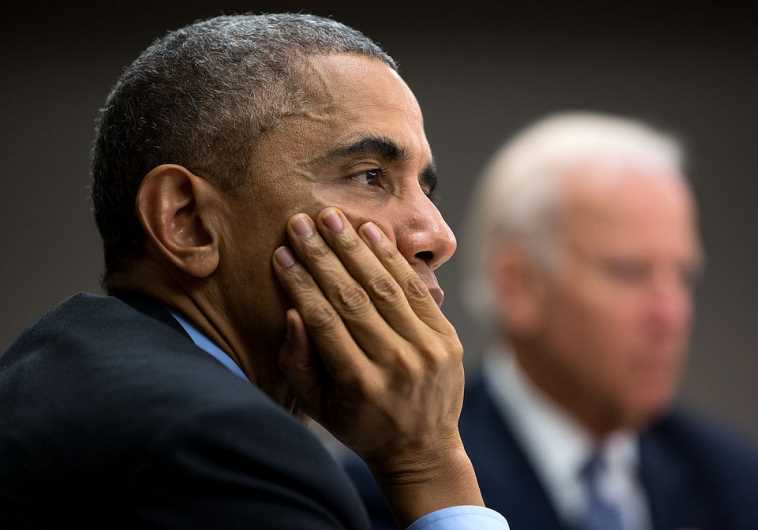 US President Barack Obama (L) and Vice President Joe Biden. (photo credit:OFFICIAL WHITE HOUSE PHOTO BY PETE SOUZA)
The administration’s fear of provoking actions while the nuclear negotiations are ongoing is interpreted by Iran not as pragmatism, but as an invitation to cheat on any future deal.
This schizophrenic foreign policy is not fooling anyone. At best, it is naïve; at worst, it threatens longterm American national security and foreign interests, to say nothing of Israel’s existence.
*****************
It is probably time of us who have strenuously opposed acquiescing in Iran’s development of nuclear weapons to throw in the towel… Mr. Obama’s definition of a satisfactory outcome has evolved… from the complete abandonment… of the Iranian nuclear program to an honor-system reliance on the Iranians.” – Conrad Black, National Review.
What stands out in the following bullets?
• Iran is increasing its financial and military support for the genocidal Syrian ophthalmologist President Bashir Assad.
• The Iranian proxy Hezbollah is helping to prop up the Assad government with its armed forces in Syrian territory.
• US President Barack Obama has stopped supporting Hayya Bina, a “civil society program in Lebanon that seeks to develop alternative Shi’ite political voices to Hezbollah” (The Wall Street Journal).
Reminiscent of the president’s abandonment of the Iranian people during the 2009 Green Revolution, when he sided with the radical mullahs over Iranians seeking a democratic government, the US has decided to leave Lebanese Shi’ites with little choice but the repressive fundamentalist Hezbollah government.
But shouldn’t it be in America’s foreign policy interests to help Iranian and Lebanese Shi’ites break free from the repressive shackles of these anti-Western terrorists and help create the conditions for a peaceful and non-threatening Islam? Anyone paying attention to Iran’s behavior since the Revolution knows that the ayatollah does not reciprocate appeasement. You would have thought after six years of a failed Middle East policy that the president would have learned that unilateral concessions are pocketed, and only encourage more demands and intransigent behavior.
The administration’s fear of provoking actions while the nuclear negotiations are ongoing is interpreted by Iran not as pragmatism, but as an invitation to cheat on any future deal.
The Iranians have been testing the Obama administration with transgressions of the Joint Plan of Action, and their escalating support of the Yemini Houthis, Hezbollah, Hamas, Syria and the Iraqi Shi’ite government. Iran has learned that this American administration would rather bury its head in the sand than act upon almost any transgression.
Iran can be confident that the Obama administration will be the loudest public defender of the deal, knowing it is the president’s foreign policy legacy. Future transgressions will be swept under the table to avoid anything that might unsettle the Iranian regime. Just this week, Iran tested advanced satellite missile launchers, which could be used to deliver nuclear warheads.
Although they contradict current UN Security Council (UNSC) Resolutions, the Obama administration has remained silent, claiming the Iranians are complying with their commitments because the Joint Plan of Action does not address missile systems. The administration conveniently fails to acknowledge is that the JPA does not abrogate the UNSC sanctions.
The president’s outreach to the Iranian-backed Shi’ite Houthis in Yemin, while simultaneously defending the Iranian narrative that it does not support the Shi’ite fighters, fuels the fire that the White House will defend the Iranian narrative after the deal is concluded. Nothing must get in the way of threatening the “success” of the deal.
Even more egregious is the White House’s silence on the blatant violation of a UNSC blacklist. Qassem Suleimani, the head of Iran’s Revolutionary Guard’s elite Quds Force, is barred from traveling to UN member states like Lebanon, Iraq and Syria, yet he travels freely to these nations. For the past eight years, the American government has listed the Quds Force of the Iranian Revolutionary Guard Corps as a terrorist-supporting entity. The Quds Force reports directly to the supreme leader.
The history of the Quds Force’s terrorist activity is well known.
Ahmad Vahidi, who directed the Quds Force at the time, allegedly planned the infamous bombing of the Jewish Center in Buenos Aires in 1994. According to the Obama administration, in 2011 it attempted to assassinate the Saudi ambassador to the US in Washington. No wonder America’s Gulf allies are less than enthusiastic about the US cozying up to the mullahs.
Israel and the Sunni Arab world see the president’s desire to align with Iran as both incomprehensible and inevitable. With little chance of the Senate having the votes to override the president’s almost certain veto this summer, the president is a step closer to his grand plan, in place since his first day in office – to distance America from Israel and the Gulf States, and create a new relationship with the world’s capital for terrorism, Tehran.
The head of the Joint Chiefs of Staff, General Martin Dempsey, went to Israel last week and bluntly told the Israelis that the US expects sanctions relief to increase Iranian support of its proxies, including State Department-designated terrorists Hezbollah and Hamas. The Quds Force can expect a virtual windfall for its overseas terrorist activities. Iran is expected to receive at least $150 billion in sanctions relief, and Dempsey said it would not all be staying in Iran to help its people and economy. Is this administration acting as an indirect supporter of terrorist entities by facilitating their financing? You be the judge.
To deflect charges that the White House is in bed with the Iranians, the administration has allowed the Treasury Department to continue to place some sanctions on Hezbollah members. Like the blacklisting of Quds leader Qassem Suleimani, however, sanctions or blacklisting are one thing, enforcement is another.
This schizophrenic foreign policy is not fooling anyone. At best, it is naïve; at worst, it threatens longterm American national security and foreign interests, to say nothing of Israel’s existence.
Nuclear weapons in the hands of a terrorist state in a decade’s time. That’s a perplexing goal for the leader of the free world.





 anneinpt
 artaxes
 danmillerinpanama
 davidking1530
 Peter Hofman
 Joseph Wouk
 Peter
Peter Louisiana Steve
 WarSclerotic
Recent Comments