Archive for June 9, 2015

Op-Ed: Core Synergies in Israel’s Strategic Planning

June 9, 2015

Op-Ed: Core Synergies in Israel’s Strategic Planning, Harvard Law School National Security Journal via Israel National News, Prof. Louis René Beres, June 9, 2016

(Rather “high brow,” but well worth considering seriously. — DM)

Significantly, the most insidious synergy of all could involve a rudimentary failure to understand that belligerent enemy intentions ultimately depend for their efficacy upon confused, partial, or inadequately thoughtful Israeli responses.

*****************

To best serve Israel, the country’s strategic studies community should favor more conceptual or “molecular” assessments of expected security perils. Going forward therefore, it will not suffice for this community to operate in ways that are roughly comparable to the purely reportorial activities of journalists and pundits, that is, of ordinary observers who focus exclusively on current personalities and events. With this timely warning in mind, the following brief essay explains and argues for a specifically enhanced Israeli consideration of enemy “synergies.”

For the most part, the concept of synergy is already familiar to capable scientists and scholars. It signifies, above all, that the usually binding axioms of geometry can sometimes be overridden by various intersecting phenomena. Applied to Israel, this concept suggests that certain identifiable threats to the Jewish State should no longer be considered as wholly separate or discrete, but instead, as more-or-less interpenetrating and mutually-reinforcing.

The most obvious and portentous example of pertinent synergy for Jerusalem is represented by Iranian nuclear weapons and Palestinian statehood.[1]

At first, any such talk of “synergy” may sound needlessly pretentious, or at least more contrived, concocted, or complicated than is really the case. In medicine, after all, it would already seem plain that the dangers of smoking cigarettes and drinking alcohol together must exceed either one behavior without the other. This is because the synergistic effect is presumptively much greater than those consequences ascertained by merely adding these two injurious activities together.

For Israeli planners, the still-widely-unrecognized synergy between Iranian nuclearization and “Palestine” should finally be treated with a more emphatic intellectual regard.[2] Notwithstanding the declared assumptions of virtually all acknowledged national strategists, Iran and Palestine,[3] as “negative force multipliers,”[4] do not represent thoroughly separate or unrelated hazards to Israel. To continue to assess each one independently of the other would be a serious conceptual error. It would be to consciously obscure what is potentially most revealing and most ominous.

Israel’s main security policies must involve carefully nuanced considerations of active defense, as well as of deterrence, preemption, and war-fighting. The country’s multilayered missile defenses are central to national survival. As long as incoming rocket aggressions from Gaza, West Bank, and/or Lebanon (Hezbollah) were to remain “only” conventional, the inevitable leakage could still be tolerable. But once these rockets were fitted with chemical and/or biological materials, such porosity could quickly prove “unacceptable.[5] This means, among other things, that the projected harms of rocket attacks upon Israel would depend not only upon the inherent dangers posed by a particular weapon system, but also upon the ways in which these individual harms would intersect.[6]

Once facing Iranian nuclear missiles, Israel’s “Arrow” ballistic missile defense system would require a fully 100% reliability of interception. To achieve any such level of reliability, however, would be impossible. Now, assuming that the prime minister has already abandoned any residual hopes for a cost-effective eleventh-hour preemption against pertinent Iranian nuclear assets , this means that Israeli defense planners must prepare instead, and longer-term, for stable deterrence.[7]

Theory is a net. Only those who cast, can catch.[8] Because of the expectedly corrosive interactive effects involving Iranian nuclear weapons and Palestinian statehood, for example, Israel will need to update and refine its existing theories of deterrence.

Looking ahead, there are various antecedent issues of theoretical concern. For one, Israel’s leaders will have to accept that certain more-or-less identifiable leaders of prospectively overlapping enemies might not necessarily satisfy the complex criteria of rational behavior in world politics. In such partially improbable but still conceivable circumstances, assorted Jihadist adversaries in Palestine, Iran, Syria, Iraq, Lebanon, or elsewhere might sometime refuse to renounce certain still-contemplated aggressions against Israel.[9]

By definition, these irrational enemies could exhibit such more-or-less plausible refusals even in anticipation of fully devastating Israeli reprisals. But, would they still remain subject to alternative threats or forms of deterrence? And might an entire state sometime exhibit such non-rational orientations, thereby becoming, in essence, a suicide terrorist writ large?

These utterly core questions can no longer be ignored. Sooner rather than later, and facing new and prospectively incalculable synergies from Iranian and Palestinian aggressions, Israel will need to take appropriate steps to assure that: (1) it does not become the object of any non-conventional attacks from these enemies; and (2) it can successfully deter all possible forms of non-conventional conflict. To meet this ambitious but indispensable goal, Jerusalem, inter alia, absolutely must retain its recognizably far-reaching conventional superiority in pertinent weapons and capable manpower, including effective tactical/operational control over the Jordan Valley.

In this connection, a Palestinian state could make Israeli military and civilian targets more opportune for Iranian rockets. It could simultaneously undermine the Jewish State’s critical early-warning systems.

Maintaining a qualitative edge in conventional war-fighting capacity could reduce Israel’s overall likelihood of ever actually having to enter into a chemical, biological, or even nuclear exchange with regional adversaries. CorrespondinglyIsrael should plan to begin to move incrementally beyond its increasingly perilous posture of “deliberate nuclear ambiguity.”[10] By preparing to shift toward prudently selective and partial kinds of “nuclear disclosure” – in other words, by getting ready to take its “bomb” out of the “basement,” but in carefully controlled phases[11] – Israel could best ensure that its relevant enemies will remain sufficiently subject to Israeli nuclear deterrence.

In matters of defense strategy, truth may emerge through paradox. Israeli planners, it follows, may soon have to acknowledge that the efficacy and credibility of their country’s nuclear deterrence posture could sometime vary inversely with enemy perceptions of Israeli nuclear destructiveness. However ironic or counter-intuitive, enemy views of a too-large or too-destructive Israeli nuclear deterrent force, or of an Israeli force that is not sufficiently invulnerable to first-strike attacks,[12] could substantially undermine this deterrence posture.

Here, too, carving “Palestine” out of the still-living body of Israel (whatamounts to the unhidden Palestinian Authority plan for a “one state solution”), could impact the Iranian nuclear threat, and vice-versa. Once again, Israel’s defense planning must account for possible and prospectively prohibitive synergies.

Also critical, of course, is that Israel’s current and future adversaries will always acknowledge the Jewish State’s nuclear retaliatory forces as “penetration capable.” This suggests forces that will seem “assuredly capable” of penetrating any Arab or Iranian aggressor’s active defenses. Naturally, a new state of Palestine would be non-nuclear itself, but it could still present a new “nuclear danger” to Israel by its probable impact upon the prevailing regional “correlation of forces.”[13] Palestine, therefore, could represent an indirect but nonetheless markedly serious nuclear threat to Israel. Here, yet again, is an example of the need for Israeli planners to think synergistically.

More remains to be done. Israel should continue to strengthen its active defenses, but Jerusalem must also do everything possible to improve each critical and interpenetrating component of its nuanced deterrence posture. In this bewilderingly complex and dialectical[14] process of strategic dissuasion, the Israeli task may require more incrementally explicit disclosures of nuclear targeting doctrine, and, accordingly, a steadily expanding role for cyber-defense and cyber-war.

Even before undertaking such delicately important refinements, Israel will need to more systematically differentiate between adversaries that are presumably rational,[15] irrational, or “mad.”[16]

Overall, the success of Israel’s national deterrence strategies will be contingent, inter alia, upon an informed prior awareness of enemy preferences, and of specific enemy hierarchies of preferences. In this connection, altogether new and open-minded attention will need to be focused on the seeming emergence of “Cold War II” between Russia and the United States. Any such emergence, of course, could have meaningful effects upon both Israeli and adversarial military postures.[17]

If, within a pattern of “Cold War II,” a newly-formalized state of Palestine does not find itself in the same ideological orbit as Iran, the net hazard to Decision-makers will then need to explore and acknowledge what amounts, paradoxically, to a geometry of chaos. Israel could still exceed the sum of relevant intersecting threats. While attempting to survive amid growing regional disorder, therefore, Israel’s leaders should learn to understand the profound strategic limits of normal “geometry”—where, quite mundanely, the whole is always expected to equal to the sum of its parts—and to augment an enhanced understanding with certain new geometric orthodoxies. In essence, these decision-makers will then need to explore and acknowledge what amounts, paradoxically, to a geometry of chaos.

Still, even this long-hidden geometry could reveal a discernible sense of symmetry and form, including the precise shape of certain critically interwoven enemy threats. Wherever the belligerent whole might add up to more than the sum of its constituent parts, Israel’s leaders could discover lethal hazards of adversarial synergies. Significantly, the most insidious synergy of all could involve a rudimentary failure to understand that belligerent enemy intentions ultimately depend for their efficacy upon confused, partial, or inadequately thoughtful Israeli responses.

When Pericles delivered his famous Funeral Oration, with its meticulously elaborate praise of Athenian civilization, his geostrategic perspective was applicable to more than the particular struggle at hand. Recorded by Thucydides, Pericles had expressed confidence in a military victory for Athens (a confidence, of course, that turned out to be misplaced), but also grave concern for any self-imposed limitations along the way: “What I fear more than the strategies of our enemies,” he had warned, “is our own mistakes.” However unforeseen, there is a vital lesson here for present-day Israel: In observing enemy preparations for war and terror, never forget that the ultimate success of these preparations will depend upon Israel’s selected responses.

There exists an overarching or determinative synergy between certain individual or intersecting enemy preparations and Israel’s own prepared policies and reactions.

In all world politics, but especially in the Middle East, we are present at the gradual unveiling of a “big picture,” but the nucleus of meaning—the essential truth of what is taking place—involves what is left out. For the foreseeable future, Israel’s enemies will continue with their ardent preparations for every form of war and terrorism. Unaffected by any civilizing expectations of international law of comity, these calculated preparations will proceed largely on their own track, culminating, if left suitably unobstructed, in new and ever more serious aggressions against Israel. The Jewish State must remain vigilant of such an emergent “big picture,” but also of every imaginable intersection or pattern of intersections between its component parts.

Always, Israel’s leaders and planners must reflect, core dangers to national security are profoundly synergistic.

Always, Israeli policy must recall, these fundamental dangers are potentially much greater than the additive sum of their  respective parts.

Always, Jerusalem must insightfully recognize, even a bewildering geometry of chaos has potentially meaningful sense and form.

Always, it must be Israel’s consuming task, to discover this synergistic truth.

Sources: 

[1] There are other still more complex synergies that need to be examined. These concern, especially, the intersecting roles of ISIS and al-Qaeda, including pertinent sub/state-state relationships with Syria, Iran, Libya, Lebanon, Yemen, and Saudi Arabia. Also worth exploring, in this connection, is the plausible escalation of “Cold War II,” a broadly transforming context of world politics that could create a “synergy of synergies.” Although all such bewildering hypotheticals may be intimidating or annoying to scholars and policy-makers, there remains no reasonable explanatory alternative to taking them into account.

[2] Rabbi Eleazar quoted Rabbi Hanina, who said: “Scholars build the structure of peace in the world.” See: The Babylonian Talmud, Order Zera’im, Tractate Berakoth, and IX.

[3] Once a Palestinian state were created, it would more likely become subject to destruction by assorted Arab forces, than by Israel. Plausibly, in this connection, ISIS forces fighting their way westward across Jordan could quickly arrive at the West Bank (Judea/Samaria), and make fast work of any now indigenous Hamas/PA national “army.” In such dire circumstances, the citizens of “Palestine” would assuredly rue the day of their recently-declared “independence.”

[4] This is a term that will likely be favored by the generals, over synergy.

[5] See, on this issue: Louis René Beres and (Major-General/IDF/Res.) Isaac Ben-Israel, “Think Anticipatory Self-Defense,” The Jerusalem Post, October 22, 2007; Professor Beres and MG Ben-Israel, “The Limits of Deterrence,” Washington Times, November 21, 2007; Professor Beres and MG Ben-Israel, “Deterring Iran,”Washington Times, June 10, 2007; Professor Beres and MG Ben-Israel, “Deterring Iranian Nuclear Attack,” Washington Times, January 27, 2009; and Professor Beres and MG Ben-Israel, “Defending Israel from Iranian Nuclear Attack,” The Jewish Press, March 13, 2013. See also: Louis René Beres and (General/USAF/ret.) John T. Chain, “Could Israel Safely Deter a Nuclear Iran?” The Atlantic, August 9, 2012; Professor Beres and General Chain, “Living With Iran,” BESA Center for Strategic Studies, Israel, May 2014; and Louis René Beres and (Lt.General/USAF/ret.) Thomas McInerney, “Obama’s Inconceivable, Undesirable, Nuclear-Free Dream,” U.S. News & World Report, August 29, 2013.

[6] Here, it warrants mention that Palestinian statehood could represent an enlarged set of risks to Israel’s Dimona nuclear reactor. Already, in 1991 and 2014, this small reactor came under missile and rocket attack from Iraqi and Hamas aggressions respectively. For authoritative assessments of these attacks and related risks, see: Bennett Ramberg, “Should Israel Close Dimona? The Radiological Consequences of a Military Strike on Israel’s Plutonium-Production Reactor,” Arms Control Today, May 2008, pp. 6-13.

[7] With particular reference to nuclear deterrence, the primary function of Israel’s nuclear forces must always be dissuasion ex ante, rather than revenge ex post.

[8] This convenient metaphor is generally attributed to Novalis, the late 18th-century German poet and scholar. See, for example, introductory citation by Karl R. Popper, in his The Logic of Scientific Discovery (1959). Ironically, perhaps, Novalis’ fellow German poet, Goethe, had declared, in his early Faust fragment (Urfaust): “All theory, dear friend, is grey. But the golden tree of life is green.” (Grau, theurer Freund, ist alle Theorie, Und grűn des Lebens goldner Baum.)

[9] See, on this point: Louis René Beres, “Religious Extremism and International Legal Norms: Perfidy, Preemption, and Irrationality,” Case Western Reserve Journal of International Law, Vol. 39, No.3., 2007-2008, pp. 709-730.

[10] See: Louis René Beres, “Like Two Scorpions in a Bottle: Could Israel and a Nuclear Iran Coexist in the Middle East,” The Israel Journal of Foreign Affairs, Vol. 8, No. 1., 2014, pp. 23-32; Louis René Beres, “Facing Myriad Enemies: Core Elements of Israeli Nuclear Deterrence,” The Brown Journal of World Affairs, Vol. XX, Issue 1., Fall/Winter 2013, pp. 17-30; Louis René Beres, “Lessons for Israel from Ancient Chinese Military Thought: Facing Iranian Nuclearization with Sun-Tzu,”Harvard National Security Journal, 2013; Louis René Beres, “Striking Hezbollah-Bound Weapons in Syria: Israel’s Actions Under International Law,” Harvard National Security Journal, 2013; Louis René Beres, “Looking Ahead: Revising Israel’s Nuclear Ambiguity in the Middle East,” Herzliya Conference presentation, 2013; March 2013; IDC, Herzliya; Louis René Beres and (General/USAF/ret) John T. Chain, “Could Israel Safely Deter a Nuclear Iran?” The Atlantic, 2012.

[11] On identifying alternative nuclear disclosure options, see: Louis René Beres, “Israel’s Strategic Doctrine: Updating Intelligence Community Responsibilities,”International Journal of Intelligence and Counterintelligence, Vol. 28, No. 1, Spring, 2015, pp. 89-104.

[12] On Israeli submarine basing measures, see: Louis René Beres and (Admiral/USN/ret.) Leon “Bud” Edney, “Israel’s Nuclear Strategy: A Larger Role for Submarine-Basing,” The Jerusalem Post, August 17, 2014; and Professor Beres and Admiral Edney, “A Sea-Based Nuclear Deterrent for Israel,” Washington Times, September 5, 2014.

[13] See: Louis René Beres, “Understanding the Correlation of Forces in the Middle East: Israel’s Urgent Strategic Imperative,” The Israel Journal of Foreign Affairs,Vol. IV, No. 1 (2010).

[14] Dialectic formally originated in the fifth century BCE, as Zeno, author of the Paradoxes, had been acknowledged by Aristotle as its inventor. In the middle dialogues of Plato, dialectic emerges as the supreme form of philosophical/analytic method. Here, Plato describes the dialectician as one who knows best how to ask and answer questions. This particular knowledge – how to ask, and to answer questions, sequentially – should now be insistently transposed to the organized study of Israeli security issues.

[15] Israelis, like Americans, are inclined to project their own dominant sense of rationality upon adversaries. Acknowledging that western philosophy has always oscillated between Plato and Nietzsche, between rationalism and irrationalism, we have all routinely cast our psychological lot with the Greek thinkers and their inheritors. Significantly, however, Israel is now up against a steadily transforming ordering of the geostrategic universe; now, Israel’s strategists might sometimes be better advised to read Dostoyevsky and Kafka, than to dwell too fixedly on Platonic rationalism.

[16] “Do you know what it means to find yourselves face to face with a madman,” inquires Luigi Pirandello, “with one who shakes the foundations of all you have built up in yourselves, your logic, and the logic of all your constructions? Madmen, lucky folk, construct without logic, or rather, with a logic that flies like a feather.”

[17] On this point, see: Louis René Beres, “Staying Strong: Enhancing Israel’s Essential Strategic Options,” Harvard National Security Journal, Harvard Law School, June 13, 2014.
 

Turkey’s View of Israel

June 9, 2015

Turkey’s View of Israel, The Gatestone InstituteUzay Bulut, June 9, 2015

  • The media’s unethical coverage of the Israel/Palestine conflict seems to be the number one reason why people in Turkey have remained so misinformed and brainwashed about the issue. It is not just anti-Semitism, but also anti-Zionism, that is racist and hateful.
  • The houses and apartments Israelis built in their historic homeland are called “illegal settlements.” But there were no “settlements” before 1967. What, then were the Israelis supposedly “occupying” between 1948 and 1967? Why was the Palestine Liberation Organization (PLO) even then trying to destroy Israel? What did it think it was “liberating”?
  • This “occupation” myth seems, instead, to have a lot to do with the “Islamization” of history and geography. Since the creation of the world, it goes, there has been only one religion: Islam. All our religious teachers have taught us that earlier historical figures were prophets — Isa [Jesus], Musa [Moses], Davut [David] and so on — were Muslims and that the original religions they brought were Islamic. These prophets, we are told, preached the teachings of Allah, but their followers, who came later, distorted their messages, changed the writings in their holy books, and fabricated these fake, untrue religions called Judaism and Christianity. Then Islam came as the last, the perfect and the only true and unchanged eternal word of Allah, which led to Muhammad to this world as a “liberator.”
  • If someone says, “there is a place related to King David and it is a Jewish place,” then a Muslim would say, “Yes, but David was also a Muslim. So this place actually belongs to Muslims.” There is never Islamic invasion; there is only Islamic liberation. If these people truly cared about Palestinian Arabs, they would do their best to stop the incitement and help to achieve a sustainable peace where both Arabs and Jews would be safe.

A large number of the citizens of Turkey, a NATO member, see Israel and the United States as enemies.

A survey conducted recently in Turkey found that nearly half the country’s citizens (42.6%) see Israel as the biggest security threat, followed by the United States (35.5%), and only then Syria (22.1%).

How do they visualize Israel, a country with which they have made several military and trade agreements, as being a security threat? Do they think Israel would ever invade Turkey? Bomb Turkey? Nuke Turkey? This view seems to be based on either religion-induced paranoia caused by Islamic anti-Semitism, or else their understanding of reality has been distorted Nazi-style by Turkish leaders and the media.

The problem is that the false myth of Israel’s being an “occupier” and “troublemaker” has been indoctrinated into the minds of most Turkish children from their early years. Almost all of us — including myself — grew up with an extreme prejudice against Israel. The media’s unethical coverage of the Israel/Palestine conflict — including both the Islamist and Kemalist (secular nationalist) media — seems to be the number one reason why people in Turkey have remained so misinformed and brainwashed about the issue.

Only the intensity of the prejudice changes according to what newspaper or TV channel you follow or what family raises you. Islamic anti-Semitism, even if we might not be aware of it, has a lot to do with this kind of upbringing.

A short scanning of Turkish newspapers and TV channels would also clearly show their continual hateful propaganda against Israel.

No other state or organization has been demonized and delegitimized by the Turkish media to this extent.

Unfortunately, even the media that calls itself “progressive” has bought and reproduced the propaganda that Israel is the “invader” and the “oppressor.” One of their most popular slogans is, “We are not anti-Semitic, but just anti-Zionist.”

Zionism defends the concept that Jews — like any other people — have human rights, and are entitled to live their original Biblical homeland. Although forced out of their land many times, as by the Babylonians or the Romans, they never entirely left it.

If the demand of Jews for equality and independence disturbs anyone, it is due to his own racism — in whatever name he is trying to dress it up — and not to anything the Jews might have allegedly done. It is not just anti-Semitism, but also anti-Zionism, that is racist and hateful.

Every person who comes up with the genius idea of “not being anti-Semitic but just being anti-Zionist” should also offer their idea of what kind of a Jewish state they would like to see or whether they would like to see a Jewish state at all. If it is the political system of Israel they oppose, then they should clarify how their own alternative system would be better than the current one, and what they would do to convince Hamas and the Palestinian Authority to achieve peaceful coexistence with Israel.

They should also clarify why they are so obsessed with Israel, which has the most democratic political system in the Middle East, while autocratic, theocratic, despotic regimes abound in the region.

They might also please explain what makes the non-existent, imaginary “democratic Palestine” preferable to already existing, thriving and democratic Israel.

Mahmoud Abbas’s Fatah is essentially no better than Hamas; just sometimes less violent. The Palestinian Authority (PA), as stated in its charter and “phased plans,” says it prefers to displace Israel diplomatically, through the dictator-controlled United Nations and European governments, and economically through boycotts and sanctions, rather than with missiles.

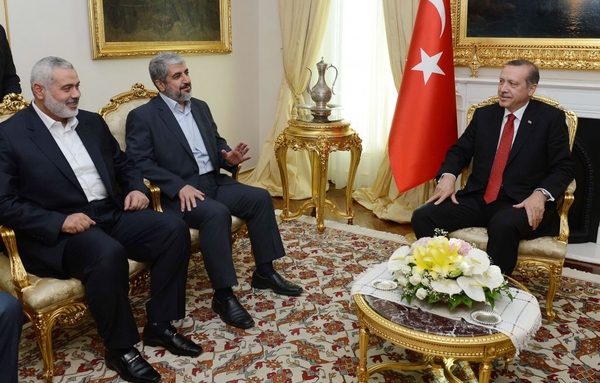
826Turkish President (then Prime Minister) Recep Tayyip Erdogan, right, meeting with Hamas leaders Khaled Mashaal (center) and Ismail Haniyeh on June 18, 2013, in Ankara, Turkey. (Image source: Turkey Prime Minister’s Press Office)

Now that so many Jews are all in one place, the progressives can pretend to themselves that it is “just Israel,” and not “the Jews,” who are the target of their hate. As the former Iranian president Akbar Hashemi Rafsanjani said, Israel, only slightly bigger than the city of Beijing, is a “one-bomb country.”

The progressive media’s representation of Israel as an “occupier” only caters to the genocidal desires of these anti-humanitarian regimes or groups. They never point to Turkey’s occupation of northern Cyprus, China’s occupation of Tibet, or Pakistan’s occupation of Kashmir — not to mention Russia’s recent flamboyant occupations.

For the past 2000 years, Jews have been exposed to unending persecution accompanied by expulsions, forced conversions, mob attacks, pogroms, property confiscations, massacres, and the 1938-45 Holocaust. Attacks against Jews in Europe continue today.

After Jews were forced from their Biblical home into the Diaspora, their lives were painful for centuries. When they were in exile in Europe, they were disposable. Now that they are back home in Israel, they are “occupiers;” again not wanted.

Under Nazi rule, Jews were “illegal,” slaughtered wholesale, tortured with fake “medical experiments” and not even considered fully human.

To end their history of 2000 years of suffering and to finally be free, Jews have returned to their home, Israel.

They have brought their light back to the land and presented gifts to the Middle Eastern peoples that no other nation there has experienced: democracy, tolerance, freedom of speech, human rights — as well as countless medical and technological innovations. This tiny country has produced some of the most brilliant minds in history, and has become the second most educated nation on earth.

What they have done is to build a truly open and productive society on sand dunes and deserts, where even the Muslim citizens, who make up 20% of Israel’s population, have the freedom to say the most horrendous things about anyone they wish, including the prime minister — and they do. In short, even the Muslims in Israel enjoy privileges that in any other country in the region would get them incarcerated.

Israel’s neighbors, however, have not shown much appreciation for these admirable traits — only more jealousy and hatred.

As thanks for the endless good the Israelis bring the region and the world, they are vilified by the anti-Semitic, anti-Zionist, Jew-hating, politically-driven blocs in the Arab countries, Turkey, Europe and the UN, which clearly want to destroy them, on one pretext or another.

The houses and apartments Israelis build in their historic homeland are called “illegal settlements.” But there were no “settlements” before 1967. What, then, were the Israelis supposedly “occupying” between 1948 and 1967? Why was the Palestine Liberation Organization (PLO) even then trying to destroy Israel? What did it think it was “liberating”?

This “occupation” myth seems, instead, to have a lot to do with the “Islamization” of history and geography.

According to Islamic ideology, all history is actually Islamic history and most of the major historical figures were actually Muslims. Islam does not recognize other religions as either genuine or original.

Since the creation of the world, it goes, there has been only one religion: Islam. Others are irrelevant, fabricated by those who came later but went astray. All our religion teachers have taught us that the earlier prophets — Issa [Jesus], Musa [Moses], Davut [David] and so on — were Muslims, and that the original religions they brought were Islamic. These prophets, we are told, preached the teachings of Allah, but their followers, who came later, distorted their messages, changed the writings in their holy books, and fabricated those fake, untrue religions called Judaism and Christianity. Then Islam came as the last, the perfect and the only true and unchanged eternal word of Allah, which led to the coming of Muhammad to this world as a “liberator.”

If someone says “there is a place related to King David and it is a Jewish place,” then a Muslim would say “Yes, but David was also a Muslim. So this place actually belongs to Muslims.”

The Islamization of history leads to the Islamization of geography. All those religious figures were Muslims, so the places in which they resided were also Muslim places. So Muslims never call their invasions “invasions.” They consider them all liberations of former Muslim places. There is never Islamic invasion; there is only Islamic liberation.

This view is the view behind the recent call of Turkey’s President, Recep Tayyip Erdogan, for “Liberating Jerusalem” from the Jews. “Conquest is Mecca,” said Erdogan in a speech in Istanbul on June 1, before millions who were celebrating the 562nd anniversary of the fall of Constantinople. “Conquest is Saladin,” he said, “It is to hoist the Islamic flag over Jerusalem again; conquest is the heritage of Mehmed II and conquest means forcing Turkey back on its feet.”

Erdogan is calling for an invasion of Jerusalem, which basically means a call for death and destruction. He was doing that just prior to the elections, because he knew that such anti-Semitic outbursts will most likely increase the votes of the AKP party.

The biggest problem is that this statement was made by the head of a NATO member.

Why would a Turk or a Muslim want to “liberate” Jerusalem? To turn it into another Muslim land where discrimination and persecution against minorities and all kinds of human rights violations run wild? Turkey does not even treat its own minorities with respect and discriminates against them daily, for instance by not giving the Kurds even the right to be educated in their native language. For what purpose, or based on what right, should Turkish authorities want to rule over Jerusalem?

Do they want to slaughter the Jews just as they slaughtered Christians in 1915, and still deny it even today? Do they want to ban the Hebrew language just as they ban the Kurdish language in Turkey? Do they want to rape Jewish women as they raped Kurdish and Greek Cypriot women during ethnic cleansing campaigns? Do they want to convert Israel’s synagogues and churches into stables as they did those in Turkey? Or do they want to turn Israel’s prisons into centers of torture just as they did in Turkey’s Kurdistan? What on earth could Turkish authorities give to Jerusalem if they could capture it?

These people need to understand and accept the fact that the Ottoman Empire is dead and that none of its former colonies wants it back.

This is not the first time that anti-Semitism is promoted by a Turkish state authority. Anti-Semitism has a very long history in Turkey. Some of the most horrible crimes committed against Turkey’s Jews happened during the 1934 pogrom, when about 15,000 Jews in Thrace were forcibly driven out of their homes. During the pogrom, Jews were boycotted and attacked, their property was looted and burned down, and Jewish women were raped.

Just prior to the outbreak of the 1934 pogrom, Ibrahim Tali Ongoren, the inspector general of Thrace (the highest state official in the region) made a four-week inspection tour of the province. According to Tali Ongoren’s report, “The Jew of Thrace is so morally corrupt and devoid of character that it strikes one immediately.” The Jew, he wrote, possessed a “fawning, deceitful character that hides its secret intentions, always applauds the powerful, worships gold and knows no love of the homeland.”

“The Jews represent a secret danger and possibly want to establish communist nuclei in our country through the workers’ club and it is therefore an indispensable necessity for Turkish life, the Turkish economy, Turkish security, the Turkish regime and the revolution in Thrace and for Turkish Thrace to be able to recover, to finally solve [the Jewish] problem in the most radical way.” [1]

According to the historian Corry Guttstadt, although the 90-page report Ongoren prepared for the government and for the ruling Republican People’s Party (CHP) contained a wide range of topics, he seemed to be, “outright obsessed with the ‘Jewish problem,’ which comes up in nearly every chapter.”

“Tali’s report” Guttstadt wrote, “is laced with the crudest of anti-Semitic stereotypes. This contradicts not only the government’s assertion that anti-Semitism in Turkey was only a fringe phenomenon [Tali was the highest ranking official of the Republic in this region] but must also be considered proof that the expulsion of the Jews from Thrace and from the Dardanelles was in keeping with the state’s objectives, just as foreign diplomats had reported.

“The rights of the non-Muslim minorities were protected by the international Treaty of Lausanne, at least on paper. To circumvent these legal obstacles, The Turkish authorities had apparently opted for the strategy of putting the Jews under such pressure with boycott activities and anonymous threats ‘from the population’ that they would leave the area ‘voluntarily’.

“The period that followed was characterized by further boycott attempts and intimidation in Edirne and even in Istanbul.”[2]

While these crimes against Jews were committed, there was no Jewish state in Israel. But Jew-hatred was clearly rampant.

The main offenders to be held responsible for anti-Semitism in Turkey are the Turkish state authorities. A state that is an EU candidate, as well as a NATO member, is supposed to be a true ally of the West. It is supposed to fight anti-Semitism and promote a peaceful, diverse and pro-Western culture. It is supposed to provide its schoolchildren with a kind of education in which the children will rid themselves off the traditional Jew-hatred and other racism, and embrace at least some humanitarian values that will help them recognize all peoples as equal and worthy of respect.

Sadly, Turkey has done none of that. It has made a record number of military and commercial deals with the state of Israel, but domestically it has systematically propagated anti-Semitism and racism, as well as Turkish-Islamic supremacy, through its institutions and media. As a result of this propaganda, a great number of Turkish people see Israel and the USA as the biggest security threats today.

In Turkey, being Westernized has been restricted to benefiting from the technical and material innovations of the West, but rejecting the social values of the West on grounds that those values would not fit into the Turkish culture. More perplexingly, being politically and socially pro-Western is almost associated with being a “traitor.”

“Israel wants peace. Period,” wrote the journalist Israel Kasnett. “The Jewish people have never held a desire to rule over others and this remains true today. Not only are we ohev shalom [‘lovers of peace’], but we are also rodef shalom [‘active pursuers of peace’].”

Is anyone listening? Are Turks listening? Many, apparently, are not.

Throughout much of the world are bloodbaths and persecution of human beings, but it is only Israel, the sole democracy in the Middle East, that is targeted and singled out for defending itself, and is accused of “occupation.”

To many of the people here in Turkey, the problem does not seem to be whether Israel wants peace, or whether Israel is a democracy, or whether Palestinian Arabs are really suffering, or why. If these people truly cared about Palestinian Arabs, they would do their best to stop the killings and incitement and to help achieve a sustainable peace where both Arabs and Jews would be safe.

But they do not really care about the Palestinians. They do not want peace. They do not want a “two-state solution.” They want to see Jews dead. And they could not care less about how many Arabs will lose their lives in the meantime.

But there is one thing they do not seem to be aware of: Their genocidal Jew-hatred can never strip Israel off its right to self-defense. It can only empower and further legitimize this right.

_______________
[1] Guttstadt, Corry (2013). Turkey, the Jews, and the Holocaust. Cambridge University Press. More slurs include: “Although (the Jews) underwent natural selection as a result of constant mixing with different blood in the last century and have almost entirely lost the physical characteristics specific to Jewry, they have completely retained the typically Jewish fawning, deceitful character that hides its secret intentions, always applauds the powerful, worships gold, and knows no love of the homeland, and have even developed these harmful traits so much further that they could inflict torment on humanity.

“In the Jewish value system, honor and dignity have no place. The Jews of Thrace owe their rise to the destructive effects of the wars on the Turkish population, that is how [the Jews] have become rich and enchanted their influence.

“The Jews of Thrace are intent on making Thrace the equivalent of Palestine. For the development of Thrace, it is of the utmost necessity that this element [the Jews], whose hands are grabbing for all the treasures of Thrace, not be allowed to continue to suck out the Turks’ blood. In the establishment of new military facilities… we must keep our administrative and military activities entirely secret from this element [the Jews].

“Above all, it is essential that this element [the Jews] be neutralized so completely that they cannot engage in spying…”

[2] Guttstadt, Corry (2013). Turkey, the Jews, and the Holocaust. Cambridge University Press.

“In the light of this, it hardly seems coincidental that Tali himself had travelled the entire region until a week before the events erupted and then remained in Ankara during the boycott activities and the threats. It seems that the operations then ‘got out of hand’ locally, with the nationalist mob putting itself in charge in some places and committing looting and acts of violence.

“After the reports of the riots reached the international public, the government was forced to condemn both the events and anti-Semitism in general. In the end, however, the episode achieved, for the most part, the intended goal and largely ‘solved’ the ‘Jewish problem’ in Thrace in the way favored by Tali.”

There is Iron in Your Word

June 9, 2015

Dempsey: Israel, IDF have no greater friend on Earth than the US military

By YAAKOV LAPPIN 06/09/2015 Via The Jerusalem Post

Dempsey and Eisenkot
U.S. Army Gen. Martin E. Dempsey, left, chairman of the Joint Chiefs of Staff, receives the Distinguished Ally of Israeli Defense Forces award from Israeli Chief of Defense Lt. Gen. Gadi Eisenkot in Tel Aviv, Israel, June 9, 2015.
DOD photo by D. Myles Cullen

(‘No signed paper can hold the iron. It must come from men.’ – LS)

CLICK HERE FOR VIDEO

Eisenkot tells visiting US military chief: Your personal commitment to our security has inspired us.

Israel and the IDF have “no greater friend on the face of the Earth than the United States military,” US Chairman of the Joint Chiefs of Staff. Gen. Martin Dempsey, told his counterpart in Israel on Tuesday.

Dempsey made the warm remarks after receiving a badge of appreciation from IDF Chief of Staff Lt.-Gen. Gadi Eisenkot at a ceremony held at IDF headquarters, at the Kirya in Tel Aviv.

The ceremony followed a guard of honor held by the IDF for Dempsey.

“I am greatly honored to host your visit to Israel. Your loyalty, friendship, and personal commitment to our security has inspired us,” Eisenkot told Dempsey.

“Under your leadership, the cooperation between our militaries has become more powerful,” Eisenkot added.

Dempsey responded by saying, “I’m so honored to accept this award. And I accept it on behalf of all of the men and women who had the privilege of serving side by side with the men and women of the IDF.”

The words reflected years of very close cooperation between the two armed forces, which has continued irrespective of the turbulent diplomatic relationship between the Netanyahu government in Jerusalem and the Obama Administration in Washington.

Dempsey, arrived in Israel on Monday on an official visit, and is holding a series of meetings with Eisenkot, Defense Minister Moshe Ya’alon, and other Israeli security chiefs, to discuss bilateral military cooperation, and pressing security challenges.

This is Dempsey’s fifth visit to Israel since his appointment as US military chief.

The US military chief was last in Israel in March 2014, when he met Netanyahu, Ya’alon, and the former IDF Chief of Staff Lt.-Gen. (res.) Benny Gantz for a series of closed-door meetings.

As ISIS Brutalizes Women, a Pathetic Feminist Silence

June 9, 2015

As ISIS Brutalizes Women, a Pathetic Feminist SilenceThe New York Post via Middle East Forum, Phyllis Chester, June 7, 2015

1354

While the most recent Women’s Studies annual conference did focus on foreign policy, they were only interested in Palestine, a country which has never existed, and support for which is often synonymous with an anti-Israel position. Privately, feminists favor non-intervention, non-violence and the need for multilateral action, and they blame America for practically everything wrong in the world.

Feminists strongly criticize Christianity and Judaism, but they’re strangely reluctant to oppose Islam — as if doing so would be “racist.” They fail to understand that a religion is a belief or an ideology, not a skin color.

**************************

Oh, how the feminist movement has lost its way. And the deafening silence over ISIS’s latest brutal crimes makes that all too clear.

Fifty years ago, American women launched a liberation campaign for freedom and equality. We achieved a revolution in the Western world and created a vision for girls and women everywhere.

Second-wave feminism was an ideologically diverse movement that pioneered society’s understanding of how women were disadvantaged economically, reproductively, politically, physically, psychologically and sexually.

Feminists had one standard of universal human rights — we were not cultural relativists — and we called misogyny by its rightful name no matter where we found it.

As late as 1997, the feminist majority at least took a stand against the Afghan Taliban and the burqa. In 2001, 18,000 people, led by feminist celebrities, cheered ecstatically when Oprah Winfrey removed a woman’s burqa at a feminist event — but she did so safely in Madison Square Garden, not in Kabul or Kandahar.

Six weeks ago, Human Rights Watch documented a “system of organized rape and sexual assault, sexual slavery, and forced marriage by ISIS forces.” Their victims were mainly Yazidi women and girls as young as 12, whom they bought, sold, gang-raped, beat, tortured and murdered when they tried to escape.

In May, Kurdish media reported, Yazidi girls who escaped or were released said they were kept half-naked together with other girls as young as 9, one of whom was pregnant when she was released. The girls were “smelled,” chosen and examined to make sure they were virgins. ISIS fighters whipped or burned the girls’ thighs if they refused to perform “extreme” pornography-influenced sex acts. In one instance, they cut off the legs of a girl who tried to escape.

These atrocities are war crimes and crimes against humanity — and yet American feminists did not demand President Obama rescue the remaining female hostages nor did they demand military intervention or support on behalf of the millions of terrified Iraqi and Syrian civilian refugees.

An astounding public silence has prevailed.

1355The National Organization for Women (NOW) apparently doesn’t think ISIS is a problem.

The upcoming annual conference of the National Organization for Women (NOW) does not list ISIS or Boko Haram on its agenda. While the most recent Women’s Studies annual conference did focus on foreign policy, they were only interested in Palestine, a country which has never existed, and support for which is often synonymous with an anti-Israel position. Privately, feminists favor non-intervention, non-violence and the need for multilateral action, and they blame America for practically everything wrong in the world.

What is going on?

Feminists are, typically, leftists who view “Amerika” and white Christian men as their most dangerous enemies, while remaining silent about Islamist barbarians such as ISIS.

Feminists strongly criticize Christianity and Judaism, but they’re strangely reluctant to oppose Islam — as if doing so would be “racist.” They fail to understand that a religion is a belief or an ideology, not a skin color.

The new pseudo-feminists are more concerned with racism than with sexism, and disproportionately focused on Western imperialism, colonialism and capitalism than on Islam’s long and ongoing history of imperialism, colonialism, anti-black racism, slavery, forced conversion and gender and religious apartheid.

And why? They are terrified of being seen as “politically incorrect” and then demonized and shunned for it.

The Middle East and Western Africa are burning; Iran is raping female civilians and torturing political prisoners; the Pakistani Taliban are shooting young girls in the head for trying to get an education and disfiguring them with acid if their veils are askew — and yet, NOW passed no resolution opposing this.

Twenty-first century feminists need to oppose misogynistic, totalitarian movements. They need to reassess the global threats to liberty, and rekindle our original passion for universal justice and freedom.

Rouhani: Saving environment starts with sanctions removal

June 9, 2015

Rouhani: Saving environment starts with sanctions removal, Al-MonitorArash Karami, June 8, 2015

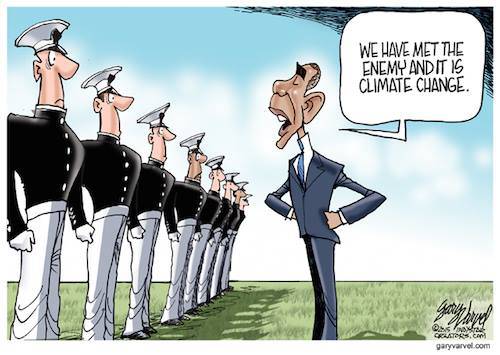
(Human rights, Iranian missiles, Iranian threats, Iranian proxies, theocratic dictatorship? Those are not relevant to the deal. But whatever may help the environment and therefore stop climate change is my top priority — Obama.

enemy

— H/t Freedom is just another word. — DM)

Rouhani’s comments linking the country’s various environmental problems and employment woes to the nuclear negotiations and sanctions relief have upset conservatives, who believe the administration is too eager to resolve the dispute and too optimistic about what the deal means for the country.

**********************

Iranian President Hassan Rouhani has been criticized for suggesting that once a comprehensive nuclear deal is made it will open the door to improving the country’s environmental problems. “The oppressive sanctions must be removed so that investment can come and the problems of the environment, employment, industry and drinkable water are resolved,” Rouhani said at a ceremony on June 7 commemorating Environment Week in Iran.

Rouhani described the sanctions as “a small fever … that at the beginning no attention was paid to this fever, but when the sick person fell ill and was not able to move anymore, we sought a remedy for the illness. Some did not know the reason of the sanctions but step by step, the problems became larger.”

Rouhani added that while “the oppressive sanctions must be removed,” this does not mean “that we must submit to the unreasonable wants of others.”

Iran and five permanent members of the UN Security Council plus Germany (P5+1) are working through the final details of a comprehensive deal that would see Iran reduce its nuclear activity in return for sanctions relief, particularly banking sanctions that have hurt the country’s ability to sell its oil and conduct trade and have prevented Western investment in the country.

But Rouhani’s comments linking the country’s various environmental problems and employment woes to the nuclear negotiations and sanctions relief have upset conservatives, who believe the administration is too eager to resolve the dispute and too optimistic about what the deal means for the country.

In an article titled, “The water, wind, soil and forests have also been tied to sanctions,” the conservative Javan newspaper criticized Rouhani’s latest comments. The article said, “Despite experts warning of not connecting domestic issues of the country to the nuclear issue and negotiations, at this ceremony Rouhani once again suggested that with the removal of sanctions not only will investment become fluid in Iran but the issues of the environment, youth employment, water and banking will be [resolved].”

The article continued that Rouhani’s comments “resulted in many experts becoming surprised and a few hours afterward many hostile Western networks and media … took this point and broadcast this to show [that] sanctions have brought Iran to its knees.”

In an article sarcastically titled, “Solving all the problems is tied to the negotiations, even drinking water,” the Kayhan newspaper also criticized Rouhani. Kayhan repeated Javan’s warning that analysts have warned of not tying the nuclear negotiations to domestic issues and cast doubt that so many problems could be resolved with the removal of sanctions. Kayhan wrote, “Stranger than anything else, Rouhani said the removal of sanctions would increase the water levels.”

Kayhan said, “The issue of sanctions is one the most important obstacles for the negotiators because the Americans do not want to remove sanctions, which is a tool to apply pressure on Iran.”

According to his previous statements, Iran’s Supreme Leader Ayatollah Ali Khamenei, who has final say on the nuclear program, has warned Iranian officials about being optimistic regarding the sanctions and has emphasized focusing on domestic capabilities instead.

On April 29, he said, “The key to solving economic issues is not in Lausanne, Geneva or New York,” three locations where the Iran and P5+1 nuclear talks have taken place under the Rouhani administration. “Without a doubt, sanctions and pressure cannot stop organized and planned efforts to increase domestic production.”


US Diplomats Reveal EU Sanctions Assault After Iran Deal

June 9, 2015

US Diplomats Reveal EU Sanctions Assault After Iran Deal, Israel National News, Ari Yashar, June 9, 2015

EU flagEU flag (illustration)Flash 90

Israel has been fighting the Iran nuclear deal due to the great danger it poses, but senior Western officials have revealed it is also doing so because once a deal is reached, the European Union (EU) and UN are planning a diplomatic offensive targeting the Jewish state.

The political assault is meant to force Israel into returning to yet more peace talks with the Palestinian Authority (PA) and making dangerous concessions in the process – and reportedly the EU already has a list of sanctions ready to force Israel to bend.

A senior Western diplomat told Ma’ariv in a report published Tuesday that “a diplomatic attack against Israel is expected soon that will surprise even the pessimists in Jerusalem.”

“In the (UN) Security Council, in western capitals and at EU headquarters, they are just waiting for the Iran deal to be signed and for it to be approved by the American Congress,” warned the diplomatic source.

It appears that the waiting period will likely expire in September, at which time a UN General Assembly will open in tandem with the first shots of the diplomatic barrage against Israel.

Diplomatic sources familiar with Western European positions vis-a-vis Israel said the EU already has a list ready, itemizing sanctions against Israel in the fields of trade, agriculture, science and culture.

That list is to be translated into an economic assault – unless Israel presents a new set of concessions it is willing to make for a new round of peace talks, after the last set of talks was torpedoed by the PA signing a unity deal with the Hamas terrorist organization.

“S‭enior officials in Jerusalem are aware of the existence of sanctions documents at EU headquarters, some of which have even fallen into their hands,” one diplomatic source revealed to Ma’ariv.

The source added that US President Barack Obama’s threat made in an Israeli interview this month, according to which he may cut US support for Israel at the UN, specifically was referring to “the sanctions file” against Israel which is currently biding its time at the EU headquarters.

The US is reportedly weighing its responses, as the current Israeli government does not appear to be likely to launch a new series of peace talks after the massive failure of the last round, and the PA’s unilateral moves in the international arena in breach of the 1993 Oslo Accords that founded it.

“The make-up of the government is such that no faction or minister will stand up to the lack of an initiative from Prime Minister (Binyamin) Netanyahu,” a diplomat from New York told Ma’ariv. “The coming months will be difficult for Israel. This time Israel will pay a heavy price for continued stagnation. This time, it is also uncertain if Uncle Sam will succeed in saving Israel, and maybe he won’t want to do so.”

Cartoon of the day

June 9, 2015

H/t Freedom is just another word.

liberal-logic-101-1902-500x416

U.S. Acting as Air Support to Al-Qaeda in Syria Against ISIS

June 9, 2015

U.S. Acting as Air Support to Al-Qaeda in Syria Against ISIS

June 7, 2015 – 7:41 pm

via U.S. Acting as Air Support to Al-Qaeda in Syria Against ISIS | PJ Tatler.


U.S. coalition aircraft struck ISIS positions in support of Syrian rebels, including Jabhat al-Nusra, Al-Qaeda’s official Syria affiliate, along with another prominent jihadist group, Ahrar al-Sham. This is a dramatic shift from just a year and a half ago, when Obama administration officials said they would support Islamist groups as long as they weren’t allied with Al-Qaeda.

Agence France Presse reports:

US-led aircraft bombed Islamic State group fighters as they battled rival Syrian rebels, including Al-Qaeda loyalists, for the first time, a monitoring group said on Sunday.

The Syrian Observatory for Human Rights described the overnight raids in northern Aleppo as an intervention on the side of the rival rebels, which include forces who have been targeted previously by US-led strikes.

“The coalition carried out at least four strikes overnight targeting IS positions in the town of Suran,” the Britain-based Observatory said.

“It’s the first time that the international coalition has supported non-Kurdish opposition forces fighting the Islamic State,” Observatory director Rami Abdel Rahman told AFP.

He said at least eight IS fighters were killed in the strikes and another 20 were injured.

This is also the first time that the U.S. has openly acted as air support for Al-Qaeda.

It needs to be stressed that U.S. airstrikes have targeted Jabhat al-Nusra in just the past month. Now we are effectively their air force. Nusra was designated a terrorist organization by the U.S. in December 2012.

Some may remember the breathless media reports last September that a previously unmentioned terror group operating inside Syria was plotting attacks on the U.S. and other Western targets, described by U.S. officials as the “Khorasan group.” As Al-Aan TV later revealed, the “Khorasan group” was nothing more than an elite group of foreign fighters working as part of Jabhat al-Nusra.

Thus began a series of U.S. strikes targeting al-Nusra:

Sept. 23: An airstrike killed Nusra leader Abu Yousef al-Turki.

Nov. 13: A Nusra base near Idlib was hit killing two.

Nov. 19: A storage facility controlled by Nusra was struck near the Turkish border at Harem.

March 9: A local Nusra headquarters in Bab al-Hawa was targeted close to the Turkish border.

May 20: Two Nusra buildings in Tawama were destroyed, killing 15 fighters.

This dramatic shift in U.S. policy towards al-Nusra has not gone unnoticed:

So what changed?

Leaked Information: Khamenei’s Lies Exposed

June 9, 2015

Leaked Information: Khamenei’s Lies Exposed, Front Page Magazine, June 9, 2015

(?????????????????? — DM)

1.29.13-Ayatollah-Ali-Khamenei-431x350

[W]hat the ayatollah is announcing to the media — that basically the Islamic Republic does not desire to seal a final nuclear deal with the six world powers — is not the truth.  The leaked information (in Persian language) indicates that the Supreme Leader has already instructed the nuclear negotiating team and his advisors to ignore his public statements and seal the final nuclear deal.

******************

Iran’s paramount religious leader can be described as one of the longest-ruling dictators in the Middle East who still enjoys the throne. An ideologue and a Shiite Islamist, he is also a shrewd Machiavellian politician.

Although he attempts to project himself to the Muslim world as a united religious leader who pursues truth, faith, and honesty, his double-faced character can easily be detected in the discrepancies among his statements and policies.

When Khamenei came to power, he lacked the charisma of his predecessor, Ayatollah Ruhollah Khomeini. To rule, he continued the major policies of his predecessor, relying on hard power and hardliners to suppress domestic opposition, making different statements to the public than in private, and funding Shiite or non-Shiite extremists groups in the region such as Hezbollah and the Houthis.

In addition, he created the Office of the Supreme Leader, comprised of close advisors and excluding the presidential and other major offices in order to further consolidate his power and prevent the leaking of information. The Islamic Republic’s major domestic and foreign policy decisions are made in the small gilded circle of his office and he is the final decision-maker of the country.

To rule, the ayatollah began wielding power without being held accountable. In order to do so, his government pre-select a handful of candidates to become president. Presidents do not have any actual power, but would be held accountable, blamed for any gaffes such as economic mismanagements and failure in nuclear talks, among other things. This system has so far worked for the ayatollah.

His predecessor and founder of the Islamic Republic came to power by promising people that oil revenues will be distributed among the population and that people do not have to pay for major bills such as electricity or water (in a speech that he gave in Behesht e Zahra). The videos and audios of that speech were removed from public access. Now, one can even be punished or executed by the Islamic Republic if the government finds that particular speech in one’s possession.  Ayatollah Khamenei also continued this dual policy of deceiving the public.

Most recently, with regards to the marathon nuclear negotiations, Mr. Khamenei’s double standards have become more obvious due to leaked information.

In less than a month, the six world powers (known as the P5+1; the United States, China, Germany, United Kingdom, France, and Russia) and the Islamic Republic will be reaching the deadline for their marathon nuclear talks, marking one the lengthiest international negotiations of our generation.

The position and opinion of the Islamic Republic’s paramount leader, Ayatollah Ali Khamenei, on the nuclear negotiations and the terms of the final nuclear deal can be characterized as the most crucial factor in determining whether a final deal will be reached by the end of June or not.

Khamenei recently stated, “We will never yield to pressure… We will not accept unreasonable demands… Iran will not give access to its (nuclear) scientists,” he added, “They say we should let them interview our nuclear scientists. This means interrogation… I will not let foreigners talk to our scientists and to interrogate our dear children… who brought us this extensive (nuclear) knowledge… We will not allow the privacy of our nuclear scientists or any other important issue to be violated.”

Nevertheless, what the ayatollah is announcing to the media — that basically the Islamic Republic does not desire to seal a final nuclear deal with the six world powers — is not the truth.  The leaked information (in Persian language) indicates that the Supreme Leader has already instructed the nuclear negotiating team and his advisors to ignore his public statements and seal the final nuclear deal.

The Supreme Leader’s double-standards and the difference in what he states publicly and what he instructs behind the scenes, indicate that he indeed needs the final nuclear deal and he will be more likely willing to allow inspections in order to obtain the deal. Ayatollah Khamenei is cognizant of the fact that the final nuclear deal is geopolitically, economically, and ideologically a win for him. Iran’s nuclear infrastructure will not be dismantled, Iran’s break-time to become a nuclear state will shrink from one year to zero in the next few years, Iran’s economy will be strengthened, and the US will likely ignore Iran’s increasing influence and their proxy wars in the region because of the nuclear deal.

Khamenei is being disingenuous with the public and other nations for several reasons. First of all, The fact that Iran’s negotiating team are continuing with the talks, sitting at the same table with Obama administration’s diplomats, and the fact that there is contradiction between what the Supreme Leader and his advisors stated publicly and behind the scenes indicates that Khamenei is giving a green light to the nuclear team to get a nuclear agreement from the White House, the major player in the talks.  Secondly, by showing that Iran is not in need of such a deal, Khamenei is giving leverage to the Iranian negotiating team to obtain more concessions from the West.

Khamenei attempts to publicly show that he is a strong religious and nationalistic leader who is totally against foreign inspection and monitoring of his country. Finally, he desires to project the picture that he is not desperate for the final nuclear deal in order to get as many concessions as he can from the Obama’s administration. And so far, his tactics and dual policies have worked for him in further strengthening his throne and power.

Soup Sandwich: Obama and His National Security Team Has no Plan to Combat ISIS

June 9, 2015

Soup Sandwich: Obama and His National Security Team Has no Plan to Combat ISIS, ISIS Study Group, June 9, 2015

(This appeared in an e-mail this morning from Foreign Policy Strategy Report:

Wait, where is everybody? Several hundred U.S. soldiers and Marines at al Asad air base in Iraq are standing by, ready to train some Iraq soldiers. But those Iraqi troops have stopped showing up, leaving the Americans all alone at the sprawling base. FP’s John Hudson, Lara Jakes and Paul McLeary report that across Iraq, there seem to be more U.S. trainers than recruits, with only 2,600 Iraqi soldiers currently receiving training from about 3,000 U.S. military personnel.

While the training has dried up, at the G-7 summit in Germany, President Barack Obama maintained that the United States and its allies must speed up the training of the Iraqi security forces….even, presumably, if they aren’t showing up.

— DM)

President Obama did some talking about the Islamic State (IS) after the G-7. Of note is that he admitted to not having an actual strategy in combatting IS and the threat it poses to the free world. In typical fashion he fails to hold himself accountable for his actions and points the finger at everybody but himself. He’s known about the threat of IS for since 2010 when Baghdadi’s guys initiated the “Breaking the Walls Campaign” in Iraq (which the Long War Journal did a great job of covering btw). This quote from our illustrious President was quite telling:

“I don’t want to put the cart before the horse. We don’t have a strategy yet,”

Obama: No ‘complete strategy’ yet on training Iraqis
http://www.cnn.com/2015/06/08/politics/obama-abadi-iraq-germany-g7/

And here’s President Obama’s press conference after the G-7 (we recommend fast-forwarding to the 18:00 mark to get to the good stuff):


The President comes off as well-versed in “saying the right things” when it comes to things like Greece, healthcare or raising minimum wage. However, he starts stumbling the minute someone asks about IS. At around the 19:00 mark of the aforementioned video he said that we’re making “progress” in pushing IS back, but then goes on to say that as we “secure” an area they move into other areas the Iraq Security Forces/Popular Mobilization Committee (ISF/PMC) left. This is the President’s definition of “winning” the fight against IS. We’re sorry if this offends his supporters (not really), but what’s happening on the ground in Syria, Iraq, Lebanon and Yemen isn’t the US “winning” this fight against IS, Iran or al-Qaida (AQ).

His “solution” to the problem being an acceleration of training up the ISF is smoke and mirrors, really. You can train the ISF up all you want and it won’t make any difference because at its core both the IA and Iraqi Police (IP) have been purged of their most capable commanders and replaced by incompetent officers. The fact that the IA is now 80% Shia further alienates itself from the Sunni Arab and Kurd communities. Even Secretary of Defense Ash Carter stated all the training in the world can’t help the IA due to the cowardice that’s endemic throughout the force. As much as the Iranian regime denied this and pushed back against Carter’s assessment, IRGC-Qods Force commander GEN Suleimani shares many his beliefs in the poor state of the IA – and that’s a big reason why Suleimani has been influencing the establishment of the Iraqi National Guard by working to ensure that the ranks are filled with Shia militia personnel. Oh, and btw, a lot of those “fresh troops” the President was referring to are already being put through the meat grinder in places like Bayji and Ramadi – and the results aren’t pretty.

Iranian Regime, GOI Take Issue With US SECDEF’s Assessment that IA are Cowards
http://isisstudygroup.com/?p=6707

ash-carter-300x169

SECDEF Ash Carter is the only guy in the Obama administration who seems to “get it” – too bad the powers that be forced him to walk back his accurate assessment on the cowardice seen throughout the IA
Source: Wall Street Journal

Again, none of this is surprising to our readers who’ve been with us since the beginning of our site. President Obama had a quasi-strategy of sorts that we covered in last summer’s “Obama’s ISIS Strategy: Failed Before it Started” that was followed up by “Another Reason Obama’s ISIS Strategy Has Already Failed.” To the uninitiated, the Obama strategy called for trainers and the arming of so-called “moderates” in Syria while supporting an Iraqi Army (IA) that has taken on sectarian characteristics. He’s banking on doing the bare minimum to basically run out the clock so that he can say he “didn’t deploy combat troops to Iraq.” In other words, he has a plan alrighHe’s been very untruthful because he’s dramatically increased the US military footprint in Iraq since last summer. Their situation is also much more dangerous now than it ever was during the OIF-era thanks to the restrictive ROE he slapped our brethren with prior to authorizing their deployment. Additionally, his term “no boots on the ground” is misleading because those “advisors/trainers” we’ve deployed are all ground troops – many of which are located in bases currently under siege such as al-Asad Airbase or Habbaniyah. If these aren’t American “combat troops,” then what are they, aid workers? Bystanders? The Obama administration may give the “trainer” label on our guys being deployed to Iraq, but the inconvenient truth of the matter is that they all have either “US ARMY” or “US MARINES” tags on their uniforms.

Obama’s ISIS Strategy: Failed Before it Started
http://isisstudygroup.com/?p=1730

Another Reason Obama’s ISIS Strategy Has Already Failed
http://isisstudygroup.com/?p=1757

US-Backed Syrian Group Disbands – But Were They Ever Truly “Moderate” to Begin With?
http://isisstudygroup.com/?p=5286

It was painful to watch President Obama – the alleged “leader” of the free world – have a hard time answering some pretty easy questions asked about US policy to combat IS. President Obama and his national security team had more than a few years to develop a strategy – but didn’t. Why is that? Its because President Obama doesn’t want his domestic agenda to get sidetracked by things like the foreign-policy arena. He just points the finger at everybody else saying “its their fault” while not formulating any real solution. He’s on his 7th year in office and still blames his predecessor for everything. Coming from military backgrounds ourselves, we were taught that a leader doesn’t make excuses. He makes things happen. A leader doesn’t keep rolling with a plan if it clearly isn’t working. A leader will adjust accordingly and inspire his subordinates to press on. That’s what a leader does. We’re not seeing that from this President. As we’ve stated earlier in this article, he’s just trying to “run out the clock” of his second term so that this will become the “next guy’s problem.” Unfortunately for him, it doesn’t work that way. His inaction and arrogance has directly led to the rise of IS, and his current policies have allowed the terror organization to expand into other locales such as Yemen, Libya, Egypt, Tunisia, Iraq, Afghanistan, Pakistan and the North Caucasus region. History won’t look so kindly on him as the current American media. The public will see this manifest itself in the next administration, when our country gets attacked on our home soil – again. Of course there’s the hope that the American people will finally realize this is what a “hope and change” foreign policy is all about before its too late. But we doubt it.

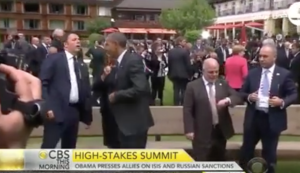
Screen-Shot-2015-06-08-at-2.21.59-PM-300x173

Oh yeah, President Obama knew PM Abadi was next to him and acted as if he wasn’t there – kinda like his approach to foreign policy
Source: CBS News

If you want additional details on the lead up to the rise of IS, then check out the history lesson we put together for President Obama’s counterpart Rand Paul, who is just as naive on foreign policy as he is:

Rand Paul Needs a History Lesson..
http://isisstudygroup.com/?p=6782

Links to Other Related Articles:

Defeating The Islamic State
http://isisstudygroup.com/?p=1708

Egypt Atmospherics
http://isisstudygroup.com/?p=614