Archive for April 2015

Iran, Saudi Arabia in tense buildup opposite Yemen’s Gulf of Aden shore: US air tankers refueling Saudi jets

April 10, 2015

Iran, Saudi Arabia in tense buildup opposite Yemen’s Gulf of Aden shore: US air tankers refueling Saudi jets

DEBKA file Exclusive Report April 10, 2015, 8:30 AM (IDT)

via Iran, Saudi Arabia in tense buildup opposite Yemen’s Gulf of Aden shore: US air tankers refueling Saudi jets.


Saudi-Iranian saber-rattling over Yemen has reached a dangerous peak, Thursday, April 9, the Saudi army spokesman, Brig. Gen. Ahmad Al-Assiri, warned: “Iranian ships have the right to be present in international waters, but won’t be allowed to enter Yemeni territorial waters.”

This was Riyadh’s rapid-fire riposte for the Iranian decision to deploy its navy’s 34th Flotilla, consisting of the Alborz destroyer and the Bushehr helicopter carrier warship, in the Gulf of Aden opposite the Yemeni coast.

The Saudi general noted that Iran had not evacuated any of its citizens from Yemen because, he said, “they are all involved in training and arming the Houthis.”
Soon after launching their air offensive in late March against the Iranian-backed Houthi rebels and forces loyal to ousted president Ali Saleh, the Saudis took control of the country’s airspace to prevent the landing of airlifted Iranian supplies for the Houthis. Russian flights were also barred later from landing in the embattled country.
Gen. Al-Assiri then issued Saudi Arabia’s bluntest threat yet: “Those Iranians planning to remain in the country would face the same fate as the Houthis and their supporters,” he said.

Clearly, the Iranian Revolutionary Guards personnel were being trapped in a Saudi vice: Unable to leave Yemen, on the one hand, they were threatened with death if caught, on the other.
Tehran decided to send its most effective naval force to the Gulf of Aden when it realized that Riyadh would not heed its warnings to back off Yemen. Its presence substantiated the threat of direct Iranian intervention in the Yemeni conflict should harm come to the elite IRGC force aiding the rebels.
The Bushehr helicopter carrier made its maiden voyage to Port Sudan at the end of 2012. Shortly after that, on Dec. 8 of that year, debkafile first revealed is features:

The new 13,000-ton vessel carries 12 Iranian strike helicopters, a crew of 200 and has a range of 8,000 nautical miles that reaches the US coast. There are five landing spots on its decks and four parking spots, as well as SM-1 and SAM anti-air missiles and 40-mm Fath-40 AAA anti-air cannon. Tehran invested $800 million in its first helicopter carrier.

If Tehran is not scared off by the Saudi threat and does order the Bushehr to sail into Yemeni territorial waters, its guns and missiles would be in range there to strike targets in neighboring Saudi Arabia to the north. Tehran could justify this attack by Yemeni President Abd Rabbo Mansour Hadi having been granted asylum in the oil kingdom.

However, the Saudi Air Force would also be on hand close by over Yemen to retaliate by bombing the Iranian Bushehr and other warships to chase them away from the Yemeni coast, if not to sink them.

Our sources predict that this naval-air collision would likely be limited in extent. After peaking to a dangerous crisis, the clash would most probably be contained before it escalated into a full-blown war between Saudi Arabia and Iran.
The Obama administration’s backing for the Saudi Arabian intervention in support of the internationally recognized Yemen president Hadi was intended to keep Iran in check.

On Tuesday, April 7, US Deputy Secretary of State Antony Blinken arrived in Riyadh and stated: “Saudi Arabia is sending a strong message to the Houthis and their allies that they cannot overrun Yemen by force.  As part of that effort, we have expedited weapons deliveries, we have increased our intelligence sharing, and we have established a joint coordination planning cell in the Saudi operation center.”
He was sending a clear message to Tehran backed up by solid US assistance

1.  Tehran was being warned not to make the mistake of assuming that its understandings with Washington over Iran’s regional promotion included license for aggression against Saudi Arabia.
2.  Tehran was notified that the Saudi operational chiefs would henceforth receive ongoing intelligence gathered by a US military satellite over the region through their joint coordination center in Riyadh. This intelligence would also cover the movements of Iranian warships in the Gulf of Aden and the Red Sea.

3. Further details of vital US aid came through Thursday, April 9, from Pentagon spokesman Army Col. Steve Warren. He announced that the US Air Force had begun an aerial refueling mission for “the Saudi Arabian-led mission engaged in air strikes on Shiite Houthi rebels in Yemen.” In its first task Wednesday, a US KC-135 Stratotanker refueled a Saudi Air Force F-15 Eagle and a UAE F-16 Fighting Falcon.

Warren said that the US Central Command aimed to fly one tanker mission a day in support of the Saudi-led alliance, but it would not enter Yemeni airspace to perform it.
Nonetheless, a potential sea-cum-air clash of arms between Saudi Arabia and Iran off the shores of Yemen cannot be ruled out, especially after Riyadh ratcheted up the tension Friday with a ban imposed on Iranian flights carrying pilgrims to Mecca.
It would not be the first firefight to be triggered by the Yemeni conflict. Earlier this week, Egyptian and Iranian warships exchanged fire in the tussle for control over the strategic Bab el-Mandeb Strait. The episode ended with the Iranian ships being ordered directed from Tehran to break off contact and distance themselves from the Egyptian craft. The Iranian Navy commander Rear Adm. Habibollah Sayyari later denied reports appearing in the Gulf media that Egyptian warships had forced Iranian naval vessels to retreat and quit the Gulf of Aden.
The incendiary tension around the Gulf of Aden and rising fear of a Saudi-Iranian military engagement has raised enough alarm for the US, French and British fleets with a naval presence in the Gulf to go on a state of preparedness.

There is no better deal with Iran

April 9, 2015

There is no better deal with Iran, Israel Hayom, Prof. Efraim Inbar, April 9, 2015

If inspections, sanctions, sabotage and political isolation ever had a chance to stop Iran from getting the bomb (this was always a dicey proposition), that certainly is no longer the case. It is more evident than ever that only military action can stop a determined state such as the Islamic Republic of Iran from building a nuclear bomb. It remains to be seen whether Israel has elected the leader to live up to this historic challenge.

***********************

The debate over the pros and cons of the Iran nuclear framework agreement negotiated between the P5+1 and Iran at Lausanne (April 2, 2015) is simply irrelevant. The search for truth in the conflicting versions about the details of the deal coming out of Washington and Tehran is of no consequence. And the steps suggested by Israel and other critics to improve the efficacy of the deal (by more stringent inspections and so on) will not change much. The deal is basically dangerous in nature, and needs to be rejected outright.

The deal permits Iran to preserve stockpiles of enriched uranium, to continue to enrich uranium, and to maintain illegally-built facilities at Fordow and Arak. Even in the absence of a signed full agreement, the U.S. and its negotiating partners already have awarded legitimacy to Iran’s nuclear threshold status. In all likelihood, the United States, quite desperate to get a formal deal, will make additional concessions in order to have a signed formal deal — which won’t be worth the paper on which it is printed.

This outcome has been a foregone conclusion since November 2013, when the U.S. agreed to the “Joint Plan of Action” on Iran’s nuclear program. Already back then, the U.S. decided not to insist any longer on the goal of rolling back the Iranian nuclear program, ignoring several U.N. Security Council resolutions demanding no uranium enrichment, as well as discarding the security concerns of American allies in the Middle East (primarily Israel, Saudi Arabia and Egypt — who better understand the regional realities).

Middle Easterners clearly discern an Iranian diplomatic victory in this accord, which should not surprise anybody. Iranians are much more adept at negotiating than Americans. Iran is getting more or less what it wanted: the capability to produce enriched uranium and to research weapon design; agreement to keep its missile program intact; and no linkages to Iranian behavior in the region. The deal is a prelude to nuclear breakout and Iranian regional hegemony.

Indeed, with no attempt to roll back the Iranian nuclear program, as was done in Libya, we are progressing toward the North Korean model. Those two are the only options in dealing with nuclear programs of determined states such as Iran. Iran’s nuclear program benefited in many ways from assistance that originated in Pakistan and in North Korea (both are nuclear proliferators despite American opposition). Compare the recent statements by President Obama to the speeches of President Clinton justifying the agreement with North Korea (October 1994). Their similarities are amazing; an indication of the incredible capacity of great powers for self-delusion.

What counts is not the Obama’s administration expression of satisfaction with the prospective deal, but the perceptions of Middle East actors. For example, Saudi Arabia and Egypt have deplored the fact that the U.S. is bestowing international legitimacy on Iran’s status as a nuclear threshold state. They probably believe the interpretations of the deal offered by Tehran more than those professed in Washington. Therefore, they will do their best to build a similar infrastructure leading inevitably to nuclear proliferation in the region — a strategic nightmare for everybody.

Unfortunately, no better deal is in the offing. Whatever revisions are introduced cannot change its basic nature. The accord allows Iran to have fissionable material that can be enriched to weapons grade material in a short time and Tehran can always deny access to inspectors any time it chooses. This is the essence of the North Korean precedent.

Obama is right that the only alternative to this deal is an Iranian nuclear fait accompli or the bombing of the Iranian nuclear infrastructure. Obama’s penchant for engagement, his reluctance to use force, and his liberal prism on international relations (which adds rosy colors to international agreements) has led to this miserable result.

Netanyahu is wrong in demanding a better deal because no such deal exists. Yet denying its ratification by the U.S. Congress could create better international circumstances for an Israeli military strike. In fact, criticism of Obama’s deal with Iran fulfills only one main function — to legitimize future military action. Indeed, Netanyahu is the only leader concerned enough about the consequences of a bad deal with the guts and the military capability to order a strike on the Iranian key nuclear installations.

If inspections, sanctions, sabotage and political isolation ever had a chance to stop Iran from getting the bomb (this was always a dicey proposition), that certainly is no longer the case. It is more evident than ever that only military action can stop a determined state such as the Islamic Republic of Iran from building a nuclear bomb. It remains to be seen whether Israel has elected the leader to live up to this historic challenge.

Ayatollah Khamenei Outlines Requirements of Final Iran Nuclear Deal

April 9, 2015

Ayatollah Khamenei Outlines Requirements of Final Iran Nuclear Deal, Tasnim News Agency (Iranian), April 9, 2015

(All bold face print is from the original. — DM)

139401201524404185070453

TEHRAN (Tasnim) – Supreme Leader of the Islamic Revolution Ayatollah Seyed Ali Khamenei on Thursday defined the main points that a final nuclear deal between Iran and world powers should involve, but refused to adopt a stance on the Lausanne statement that entails no binding commitment.

Addressing a gathering in Tehran on Thursday, Ayatollah Khamenei said he has not taken a position on a statement released by Iran and the Group 5+1 (Russia, China, the US, Britain, France and Germany) after the most recent round of nuclear talks in the Swiss city of Lausanne, because nothing has been still agreed upon, nor have the parties reached any binding agreement.

“What has happened so far does not guarantee either the principle of an agreement, or the negotiations that lead to an agreement or even the content of an agreement, and it does not even guarantee that these talks would result in a deal, so congratulation has no meaning,” the Leader said.

The comments came after Iran and the six powers on April 2 reached a framework nuclear agreement after more than a week of intensive negotiations in Lausanne, Switzerland, with both sides committed to push for a final, comprehensive accord until the end of June.

Ayatollah Khamenei then reaffirmed strong support for a deal that respects the Iranian nation’s dignity, and rejected as “untrue” the reports on his opposition to any agreement.

The Leader, however, underlined that “no deal is better than a bad deal.”

Imam Khamenei then explained that he has only outlined the “general issues, the main guidelines, frameworks and red lines” regarding the nuclear talks and has not specified the details.

“I am not indifferent to the negotiations, but have not interfered in the details of the talks so far, and will not interfere in future either,” the Leader stressed.

The Supreme Leader then pointed to the unreliable nature of the US, an obvious sign of which he said was a biased fact sheet that Washington issued only two hours after the Lausanne statement was declared.

“Drafting such a statement (fact sheet) within two hours is not possible, so they (Americans) had been busy preparing a flawed and wrong statement contrary to the content of the talks at the same time that they were negotiating with us.”

The Leader further called on the country’s negotiators to hold consultations with the critics of the Lausanne statement to better deal with the talks, something known as “rapport” among Iranians.

Imam Khamenei once again made it clear that the talks with the US revolve only around the nuclear issue and nothing else, but at the same time noted that such nuclear negotiations provide an experience to test the possibility of talking on other subjects if Washington puts aside objections.

But, the Leader added, if the US keeps raising objections, Iran’s experience of mistrust of the US will be corroborated.

Commenting on the main points that have to be stipulated in a possible final nuclear deal, Ayatollah Khamenei pointed to the removal of anti-Iran sanctions all at once, adding, “This issue is very important and the sanctions should be completely terminated at the very day of the agreement.”

“If the removal of sanctions is to be conditioned by a new process, the fundamental of negotiations will be nonsense, because the purpose of the talks is lifting of the sanctions,” the Leader said.

The Supreme Leader also categorically rejected foreign access to the country’s “security and defensive” sectors under the pretext of nuclear monitoring.

Imam Khamenei said Iran’s military capabilities must be upheld and strengthened day by day, stressing that Iran’s backing for its “brothers” in the resistance front in different regions should never be diminished.

Moreover, the Leader voiced opposition to any deal that subjects Iran to “unconventional” monitoring and would make it a special case in the world, underlining that monitoring of Iran’s peaceful nuclear program should be conventional, like the other countries.

Iran’s “scientific and technical developments in different dimensions” was another requirement that the Leader emphasized a deal must include.

Ayatollah Khamenei finally said the responsibility lies with the country’s negotiators to fulfill those necessary demands in the talks, calling on them to “find the correct ways of negotiations” by using the view points of the informed and reliable individuals and listening to the critics.

Take Them At Their Word: Iran Might Destroy Us | Bill Whittle

April 9, 2015

Take Them At Their Word: Iran Might Destroy Us | Bill Whittle via You Tube, April 9, 2015


Humor?| Obama to Israel: I have your back

April 8, 2015

(The views expressed in this article are either mine or those of my guest author. They do not necessarily reflect those of Warsclerotic or its other editors. — DM)

The Most Revereddd Mohamed Allah-scimitar

The Most Revereddd Mohamed Allah-scimitar

This is a post by my (imaginary) guest author, the Most Reverend Mohamed Allah-scimitar, President Obama’s chief foreign policy adviser on Islamic relations with Christians and Jews. But first, some related observations:

Iran continues to reject as lies Obama’s statements about the April 2nd P5+1 nuke “deal,” and states that it “could build bomb today” but won’t because of Ayatollah Khamenei’s (non-existent) fatwa. Understandably, Israel is becoming increasingly concerned about her future existence. Obama’s claims that He has her back and that she therefore need not worry about anyone (else) who tries to “mess with Israel.” His assurances have provided scant comfort.

Cartoon_Israel_BB_KnifeInBack

Here’s are the comforting(?) words of the Most Reverend Mohamed Allah-scimitar.

***********************

Lord Obama has Israel’s back almost to the same extent that He has the Obama Nation’s back and will protect her if necessary. For Israel to maintain, and even improve, her weapons minimizing destruction (WMDs) is an unacceptable insult to Him and to all for which He stands.

ObamaWillStandWithMuslims (2)

Obama salute

During Israel’s “Protective Edge” war against peaceful Palestinians in Gaza, Israel shamelessly shifted the odds disproportionately in her own favor by using the Iron Dome to thwart efforts to destroy her major cities. She provided not even one Iron Dome to the Palestinians! Since that time, she has improved the Iron Dome and developed other WMDs less dependent upon lengthy trajectory tracking of missiles and perhaps even mortar rounds. Racist to the core, she has no regard for social justice, equality and the sad plight she has imposed on the Palestinians. Indeed, they are forced to rely on funds (“tens of millions of dollars”) from Iran to help rebuild Tunnels for Peace (TFP) and resupply their stocks of Missiles for Peace (MFP).

Now that Israel claims that peaceful Iranian nuclear weapons are an existential threat, she is doubtless looking for — and probably finding — ways to escape their consequences as well. Doing so is risible because Lord Obama has explained patiently — even as He would to a backward child — that it is unnecessary. He has her back, as He always had and always will.

Nobody except Obama had dare mess with Israel! Not even Netanyahu! Hence, there is no need for Iran to recognize Israel’s speciously claimed right to continue to exist, which would require fundamental changes in Iran. For Israel to insist on it is a fundamental misjudgment.

Lord Obama is able and willing to act, if necessary, to demonstrate the firmness of His resolve. Indeed, it has already been rumored that He may dispatch His own beloved mother in law from her happy home in the White House to live with Prime Minister Netanyahu in Occupied Palestine. If so, she will be accompanied by a suitable contingent of unarmed Organizing for Action volunteers. Recognizing, however, that more may be required, Lord Obama has been negotiating with Iran to provide the unjustly impoverished Palestinians not only free electrical power but also medically useful radioactive isotopes as well as others for other peaceful purposes. Despite the petty squabbles between the Palestinian Authority and Hamas, Iran will treat them equally.

Israel should and will cease to exist but, with Lord Obama in the picture, Iran should not be a concern.

**************************

There is no P5+1 “deal” and it seems unlikely that there ever will be, no matter how many contortions Obama and Kerry attempt. A deal like the one described in Obama’s talking points would be bad enough. However, Iran has rejected His talking points, has stated that it could build nukes now if it so desired and that the only impediment is a (non-existent) fatwa issued by the Supreme Leader. The Iranian foreign minister has been quoted as saying that

Iran will begin using its latest generation IR-8 centrifuges as soon as its nuclear deal with the world powers goes into effect, Iran’s foreign minister and nuclear chief told members of parliament on Tuesday, according to Iran’s semi-official FARS news agency. [Emphasis added.]

If accurate, the report makes a mockery of the world powers’ much-hailed framework agreement with Iran, since such a move clearly breaches the US-published terms of the deal, and would dramatically accelerate Iran’s potential progress to the bomb.

Iran’s military sites are, of course, off limits to inspections according to Iran’s Defense Minister. Meanwhile, the Supreme Leader continues to lead “death to America” chants and Iranian television continues to entertain its viewers with simulations of nuclear attacks on Israel.


More recently,

[T]he Islamic Republic has announced a new documentary film which will celebrate the life of Qods Force Commander Qassem Soleimani. It’s bad enough lionizing a master terrorist responsible for the deaths of hundreds of Americans in Iraq and Afghanistan. But the description of the film is even more telling: The film Commander will depict Iran’s and Soleimani’s strategic approach to destroy not only the Islamic State but also “the Zionist regime.” Importantly, the article describing the film was published after agreement on a nuclear framework between the P5+1 and Iran. [Emphasis added.]

Iran Announces Film to Celebrate Israel’s Coming Destruction

April 8, 2015

Contentions

Iran Announces Film to Celebrate Israel’s Coming Destruction

Michael Rubin | @mrubin1971 04.08.2015 – 11:30 AM

via Iran Announces Film to Celebrate Israel’s Coming Destruction – Commentary Magazine Commentary Magazine.


President Barack Obama has dismissed arguments that U.S. negotiators should demand that Iran recognize Israel and Israel’s right to exist as part of any final agreement. To do so would be too difficult, the president argues, and not relevant to the narrow goal at hand which is simply to strike an accord to constrain Iran’s nuclear breakout ability for a decade or so. Perhaps no statement better illustrates the moral and cultural equivalence that infuses President Obama and Secretary of State John Kerry.

It is akin to saying North Korea seeks South Korea’s destruction and it would be too complicated to impede Pyongyang’s murderous intent. Russian President Vladimir Putin has expansionist intent? Well, let’s not let his imperialist ambitions toward the Baltics, Poland, and the rest of Ukraine get in the way of our diplomacy.

The Iranian regime’s character isn’t some inconvenient detail; it is the central problem. And as if to underline the problem, the Islamic Republic has announced a new documentary film which will celebrate the life of Qods Force Commander Qassem Soleimani. It’s bad enough lionizing a master terrorist responsible for the deaths of hundreds of Americans in Iraq and Afghanistan. But the description of the film is even more telling: The film Commander will depict Iran’s and Soleimani’s strategic approach to destroy not only the Islamic State but also “the Zionist regime.” Importantly, the article describing the film was published after agreement on a nuclear framework between the P5+1 and Iran. Let’s hope that with their willful naivete, Obama and Secretary of State John Kerry don’t get credit for small but important bit roles.

Iran: Military Sites Off-Limits to Inspectors

April 8, 2015

Contentions

Iran: Military Sites Off-Limits to Inspectors

Michael Rubin | @mrubin1971 04.08.2015 – 12:30 PM

via Iran: Military Sites Off-Limits to Inspectors – Commentary Magazine Commentary Magazine.

President Barack Obama called the framework agreement Secretary of State John Kerry and other representatives of the P5+1 reached in Lausanne “historic.” Alas, as time passes and more is learned about the agreement and Iran’s understanding of it, the more it does seem to be “historic,” but for all the wrong reasons.

One of the key concerns of the international community and the International Atomic Energy Agency has been “possible military dimensions” of Iran’s nuclear program (see the annex to this IAEA report for a listing of these). Much of the work Iran conducted on military dimensions of a nuclear program occurred in Islamic Revolutionary Guard Corps facilities and on their bases.

Iranian Defense Minister Hossein Dehqan today said that the Lausanne Framework does not commit Iran to provide international inspectors access to such military facilities. From Fars News:

Iranian Minister of Defense and Armed Forces Logistics Brigadier General Hossein Dehqan has rejected reports on inspection of the country’s military facilities being included in the recent deal achieved by Iran and the world powers (P5+1) in Switzerland’s Lausanne on April 2, Fars news agency reported on April 8. According to Fars, commenting on “domestic media highlighting such baseless claims by foreign media about the Lausanne agreement,” Dehqan said, “Such actions do not serve national interests, but in fact set the ground for enemy’s excessive demands… The Supreme Leader’s, the government’s approach and the determination of the Islamic Republic of Iran’s nuclear negotiating team together do not allow the other party to impose anything on the Iranian nation.” Referring to “false claims by foreign media outlets such as the Guardian newspaper” on inspection of the country’s military facilities being a part of the Lausanne statement, Dehqan stressed: “There is no such agreement. Basically, inspection of military facilities is a red line and no inspection of any kind from such facilities would be accepted.”

So the Iranian government now contradicts President Obama’s announcement and the State Department fact-sheet with regard to when sanctions will be lifted, centrifuges, enrichment, and even plutonium. Now let’s add inspections and possible military dimensions to the list. Obama is right. The Lausanne agreement is historic. It will be studied by generations of diplomats who will use it to illustrate American naïveté, Iranian duplicity, and the dangers of not actually gaining agreements in writing.


Iran sends battleships to Yemen amid standoff with Saudis

April 8, 2015

Iran sends battleships to Yemen amid standoff with Saudis

Move comes as Sunni coalition converges on Tehran-backed Shiite rebels who conquered much of the country

By AP and Times of Israel staff April 8, 2015, 7:18 pm

via Iran sends battleships to Yemen amid standoff with Saudis | The Times of Israel.


An Iranian navy vessel launches a missile during a drill in the Sea of Oman, in January 2012. (photo credit: AP/ISNA, Amir Kholousi)

An Iranian navy vessel launches a missile during a drill in the Sea of Oman, in January 2012. (photo credit: AP/ISNA, Amir Kholousi)


Iran dispatched a naval destroyer and another vessel Wednesday to waters near Yemen, ratcheting up tensions with Saudi Arabia, which is leading a coalition to quash a Shiite rebellion. The rebels, back by Iran, have deposed the US-backed Sunni leader and captured large swaths of territory in the embattled country in recent months.

Iran’s Chief of the Judiciary Sadeq Amoli Larijani warned Saudi Arabia to stop its “aggression” against Yemen or wait for “dire consequences.

“This blatant aggression of a government which claims [to be leading] Islam, against the Muslim people of another country who want to decide their fate will not remain unanswered,” Larijani told the Fars News Agency, referring to Saudi Arabia.

“When naive individual decisions are made in a country that doesn’t have the least experience of democracy, has no parliament and no elections — the result will be the aggression of a state that claims to be the leader of Islam to another Muslim nation,” he said.

Iran’s English-language state broadcaster Press TV quoted Rear Adm. Habibollah Sayyari as saying the ships would be part of an anti-piracy campaign “safeguarding naval routes for vessels in the region.”

The maneuver comes amid an intense Saudi-led Gulf Arab air campaign targeting the Yemeni rebels, known as Houthis, who come from a Shiite sect. Critics say Shiite power Iran backs the Houthis, though both the Islamic Republic and the rebels deny any direct military assistance.

Speaking a day earlier in the Saudi capital, Riyadh, US Deputy Secretary of State Antony Blinken blamed the violence in Yemen on the Houthis and on forces loyal to former president Ali Abdullah Saleh, saying that the US is committed to defending Saudi Arabia.

“We have expedited weapons deliveries, we have increased our intelligence sharing, and we have established a joint coordination and planning cell in the Saudi operations center,” he said in a statement to reporters after meeting with Saudi royals and Yemen’s President Abed Rabbo Mansour Hadi, who fled his country amid rebel advances.

Intelligence sharing includes making available raw aerial imagery the coalition could use to better strike anti-Hadi forces, said a US defense official who was not authorized to comment publicly. Blinken said the US and the six-nation Gulf Cooperation Council must coordinate closely and press all parties to seek a political solution.

The Gulf Arab-backed air campaign supporting Hadi, which began on March 26, has so far failed to stop the Houthis’ advance on Aden, Yemen’s second-largest city, which was declared the provisional capital by Hadi before he fled.

The US says that the chaos has allowed the local al-Qaeda branch, which it considers the world’s most dangerous wing of the group, to make “great gains” on the ground, prompting Washington to rethink how it prevents it from launching attacks in the West.

Speaking from Tokyo, Defense Secretary Ash Carter said the collapse of the central government in Yemen makes it harder to conduct counterterrorism operations against al-Qaeda, which has ambitions to strike Western targets, including the United States. Regarding the weapons deliveries, he said it involved “some resupply of equipment and munitions” to Saudi Arabia.

The World Health Organization warned Tuesday of an unfolding humanitarian crisis, saying at least 560 people, including dozens of children, have been killed, mostly in the air campaign and ground battles. The aid group said that over 1,700 people have been wounded and another 100,000 have fled their homes as fighting has intensified over the past three weeks.

The first boat carrying medical aid to Yemen since the coalition began bombing arrived in the southern port city of Aden on Wednesday, international humanitarian organization Doctors Without Borders said.

The group’s head of mission in Yemen, Marie-Elisabeth Ingres, said the ship carried some 2.5 tons of supplies from Djibouti for its hospital in Aden.

The group is concerned about how it will transport the supplies and wounded people given the chaos in Aden’s streets, where the situation continues to deteriorate and combat intensifies overnight.

“We have street fighting, snipers, tanks in the street, roads cut and areas not accessible, and electricity, water and fuel cuts,” she said. “Last night the different groups were fighting around the hospital. It lasted all night into the morning and continues now, so all our employees were forced to sleep at the hospital.”

Tons of desperately needed aid awaits clearance to be flown into Yemen, including a Red Cross shipment with 17 tons of medical supplies from Jordan, which emergency workers hope can be flown into the Yemeni capital, Sana’a, on Wednesday. Another 35 tons of supplies were also ready for shipment.

Also Wednesday, Human Rights Watch cited witnesses as saying that Houthi forces fired into crowds of demonstrators in the cities of Taiz and Torba the day before the bombing campaign began, killing at least 7 people and wounding over 80 others. The New York-based group called on Houthi authorities to investigate the incidents.

“Yemen’s spiraling conflict is causing a calamitous breakdown in law and order,” said Joe Stork, deputy Middle East and North Africa director at Human Rights Watch. “Security forces in control, whatever side they are on, have responsibilities to uphold and protect people’s rights and to take action against their members who commit abuses

Hezbollah Chief Likes Nuke Deal: Iran Can Fund Terror Groups

April 8, 2015

Hezbollah Chief Commends Nuke Deal for Helping Iran Fund Terror Groups

by Jordan Schachtel7 Apr 2015Washington, D.C

via Hezbollah Chief Likes Nuke Deal: Iran Can Fund Terror Groups.


Hezbollah leader Hassan Nasrallah said that his forces are readying for war against Israel in an interview with Syrian state-television on Monday.

“The nations in the region must prepare to make sacrifices in any future conflict with Israel,” said the Iran-backed terror chief.

Nasrallah was encouraged by the basic framework agreed upon by the P5+1 World Powers (United States, Russia, China, France, Germany, UK) and the Iranian regime. He said that the deal will allow for a “stronger and wealthier Iran” regime that will “stand by its allies [Hezbollah], and especially the Palestinian resistance [Hamas], more than at any other time in history.”

“Iran will become richer and wealthier and will also become more influential,” said Nasrallah. “There is no doubt that an agreement will have repercussions on the region,” he added.

In the interview, Nasrallah pointed to Israel and Saudi Arabia’s condemnation of the deal as evidence that it would immensely benefit Tehran.

Analysts believe that both Hamas and Hezbollah– which are U.S.-designated terrorist groups– continue to receive the majority of their funding and armaments from the Islamic Republic of Iran.

Over the weekend, it was reported that Iran has disbursed tens of millions of dollars into Gaza to help recreate Hamas’s vast terror network, which includes remaking its underground tunnels and restoring its missile stockpiles.

In January, an Israeli strike killed senior Hezbollah commander Jihad Mughniyeh, whose deceased father had been deemed responsible for taking countless American lives. The strike, which took place near the Israel-Syria border in the Golan Heights, also reportedly killed multiple Iranian commanders. Just two weeks later, Hezbollah militants attacked an IDF position and killed two Israeli soldiers. Since January, there have been no major flare-ups between Israel and the Iranian terror-proxy.

‘Iran to publish facts document to counter American lies’

April 8, 2015

‘Iran to publish facts document to counter American lies’, Israel Hayom, April 8, 2015

Iran could build bomb today but isn’t doing so because of ayatollah’s religious decree, not because of sanctions, Iranian FM reportedly tells parliament • “We made significant achievements in exchange for unimportant concessions,” says Iranian lawmaker.

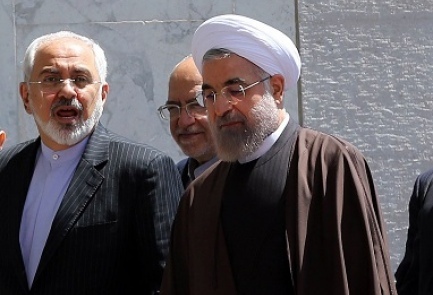
142848211618964843a_bIran’s Foreign Minister Mohammad Javad Zarif (left) with Iranian President Hassan Rouhani | Photo credit: AFP

Iran could build a nuclear bomb today if it wanted and is only refraining from doing so because of a fatwa (religious decree) issued by Ayatollah Ali Khamenei, not because of international sanctions, Iran’s Foreign Minister Mohammad Javad Zarif reportedly said on Tuesday during a closed hearing at the Iranian parliament, Majlis.

According to one of the participants, Zarif said the country’s foreign ministry would soon publish a “document of facts” about the nuclear deal with world powers.

“Zarif told us that his office hadn’t intended on releasing such a document, but reversed its decision because of the Americans’ lies,” said Iranian lawmaker Hussain Naqvi al-Hussaini.

Another Iranian parliamentarian, Gholamali Jafarzadeh Imenabadi, said Zarif told the parliament that Iran is not going to permit online cameras for inspection purposes at nuclear facilities. The reason for the decision, allegedly conveyed by Zarif, was because cameras have supposedly been used in the past to help assassinate Iranian nuclear scientists.

Also in attendance was Ali Akbar Salehi, the head of Iran’s Atomic Energy Organization, who presented the Majlis with the technical aspects of the framework deal. Salehi, who participated in the negotiations in Lausanne, reportedly told his audience that world powers consented to enter negotiations with Iran because they had no other choice.

“We made significant achievements in exchange for unimportant concessions,” said Iranian lawmaker Nozar Shafi.

Meanwhile, Zarif and Iranian President Hassan Rouhani have reportedly garnered the support of Revolutionary Guard commander Mohammad Ali Jafari, who demanded immediate sanctions relief in exchange for a deal.

Iran’s supreme leader, Khamenei, did not voice his opposition to the deal, widely interpreted as silent consent. With that, some 200 Iranian hardliners protested in Tehran against the framework deal.