Archive for January 2015

Exclusive: ISIS Gaining Ground in Syria, Despite U.S. Strikes

January 15, 2015

Exclusive: ISIS Gaining Ground in Syria, Despite U.S. Strikes, The Daily Beast, January 15, 2015
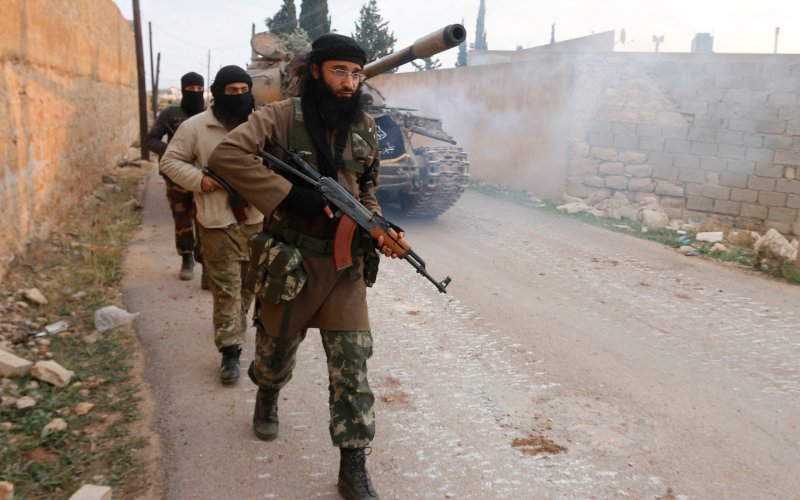
1421322880562.cachedHosam Katan/Reuters

American jets are pounding Syria. But ISIS is taking key terrain—and putting more and more people under its black banners.

ISIS continues to gain substantial ground in Syria, despite nearly 800 airstrikes in the American-led campaign to break its grip there.At least one-third of the country’s territory is now under ISIS influence, with recent gains in rural areas that can serve as a conduit to major cities that the so-called Islamic State hopes to eventually claim as part of its caliphate. Meanwhile, the Islamic extremist group does not appear to have suffered any major ground losses since the strikes began. The result is a net ground gain for ISIS, according to information compiled by two groups with on-the-ground sources.In Syria, ISIS “has not any lost any key terrain,” Jennifer Cafarella, a fellow at the Washington, D.C.-based Institute for the Study of War who studies the Syrian conflict, explained to The Daily Beast.Even U.S. military officials privately conceded to The Daily Beast that ISIS has gained ground in some areas, even as the Pentagon claims its seized territory elsewhere, largely around the northern city of Kobani. That’s been the focus of the U.S.-led campaign, and ISIS has not been able to take the town, despite its best efforts.Other than that, they are short on specifics.

1421269431538.cachedClick to Enlarge (Coalition For a Democratic Syria)

“Yes, they have gained some ground. But we have stopped their momentum,” one Pentagon official told The Daily Beast.

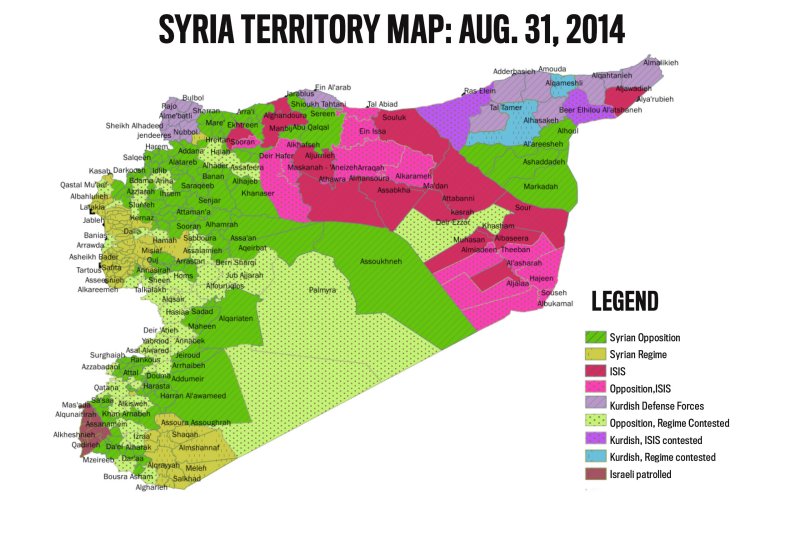
A map developed by the Coalition for a Democratic Syria (CDS), a Syrian-American opposition umbrella group, shows that ISIS has nearly doubled the amount of territory it controls since airstrikes began last year.

“Assessing the map, ISIS has almost doubled its territorial control in Syria. But more importantly, the number of people who now live under ISIS control has also increased substantially,” CDS political adviser Mouaz Moustafa said.

With the fall of that much territory into ISIS hands, Syrians who once lived in ungoverned or rebel held areas are now under ISIS’s grip. Of course, in an irregular war like this one, control of people is far more important than control of territory. In that regard, too, things appear to be going in the wrong direction.

In the first two months following American airstrikes, about a million Syrians who had previously lived in areas controlled by moderates now lived in areas controlled by extremist groups al Nusra or ISIS, according to CDS, citing conversations with European diplomats who support the Syrian opposition.

The area of ISIS’s expansion includes large segments of the Homs Desert, which begins far south of the contested northern city of Aleppo. It stretches below the presumed capital of ISIS in Syria, Raqqa, and all the way to the Iraqi border. It is largely rural and not an area that ISIS has had to fight for. Rather the group took control of uncontested parts of the countryside while skirting key regime strongholds in the area, Cafarella said.

But that does not mean that land is not valuable to ISIS. That newly acquired terrain allows ISIS troops to target and threaten more valuable areas, Cafarella said.

Since the U.S. campaign began in August, “there are little buds of ISIS control in eastern Homs, al Qalamoun [which borders northern Lebanon], and southern Damascus that do appear to be growing because of that freedom of operation that can connect those western cells to key ISIS terrains in Raqqa and Deir ez Zour” in northern and eastern Syria.

Moustafa, the CDS political adviser, blamed ISIS territorial gains on a lack of “strategic coordination between coalition strikes and moderate forces inside Syria, meaning that the Free Syrian Army and aligned groups cannot use the strikes to retake territory.” Further, Moustafa told The Daily Beast, coalition strikes have given other extremist groups sympathy for ISIS.

One frustration of the Syrian opposition groups is that the bombing campaign has been focused at the heart of ISIS controlled territory, rather than at the front lines, where ISIS territorial gains could be pushed back.

“The coalition strikes seem similar to drone campaigns in Yemen or Pakistan, targeting only leadership. The front-line strength of ISIS has undoubtedly increased even as some of these targeted strikes take out mid-level individual leaders,” Moustafa said.

As of Sunday, the U.S. and its coalition partners had conducted 790 airstrikes in Syria, according to Pentagon statistics. In all, the U.S. has spent $1.2 billion on its campaign against ISIS in Iraq and Syria.

In its public comments, the U.S. military has said repeatedly the effort against ISIS is on the right track. However it often does this by conflating its war in Iraq and Syria. Ask a question about what is happening in Syria, and U.S. officials will stress that ISIS has not gained ground in Iraq. Ask if the U.S. effort is working in Syria, and the military often points to the fact that ISIS has failed to take control of Kobani.

During a Jan. 6 press briefing, for example, when a reporter asked “where ISIS’s relative strength is right now,” Navy Rear Adm. John Kirby replied by talking exclusively about the U.S. effort in Iraq, naming cities were the military believed ISIS’s momentum has been “halted.”

When the reporter pressed for an answer on what was happening in Syria, Kirby struggled, saying, “I couldn’t give you a—a specific point at which, you know, we believe, well geez, we’ve halted their momentum. It—it’s come slowly, in various stages. But I think it’s safe to say that over the last three to four weeks, we—we’ve been confident that that momentum has largely been blunted.”

On Friday, Kirby proclaimed that ISIS had lost 700 square kilometers since the campaign began—over half the size of New York City or about four times the size of the District of Columbia. But the Pentagon spokesman could not say what percentage that area marked of total ISIS-controlled land. Nor could he say if that loss was in Iraq, Syria, or combined in both nations. As Kirby asserted: “I’m frankly not sure how relevant that is. I mean, it’s—they have less ground now than they did before. They’re trying to defend what ground that they have. They’re not going on the offense much, and they’re really trying to preserve their own oxygen.”
1421269455425.cachedClick to Enlarge (Coalition For a Democratic Syria)

The American military has not been able to take full advantage of the difficulties ISIS is facing. A worldwide drop in oil prices threatens the recently declared state’s ability to raise revenue, while declining standards in public services, distribution of aid, and provision of electricity threaten to undercut the group’s support across the territories it controls. ISIS has also not been able to follow through on its military quest to challenge the Iraqi government all the way to Baghdad.

The U.S. military stressed it is waging an “Iraq first” war, that is focused on eliminating ISIS from that country first. There, the U.S. can turn to Iraqi troops on the ground to assess its efforts. But there is no equivalent resource on the ground in Syria. Perhaps because of that, the U.S. military has offered a far more detailed assessment of the air campaign in Iraq than the one in Syria.

The Combined Joint Task Force in charge of the American air campaign refused to answer a Daily Beast query about ISIS gains in Syria, even as it striking targets there. U.S. Central Command replied, “As a matter of policy we do not discuss intelligence issues.”

Information on the maps:

The maps provided by the Coalition for a Democratic Syria show the areas controlled by moderate Syrian rebels, the Syrian regime, ISIS, Syrian al Qaeda affiliate al Nusra, as well as territories contested by these groups. The maps were developed by a field team from the Coalition for a Democratic Syria (CDS), an umbrella group of Syrian American organizations. The maps were sourced through on-the-ground networks including civilian councils, humanitarian organizations, armed actors, and media monitoring of independent Syrian channels.

Pegida: The New German Revolution

January 15, 2015

Pegida: The New German Revolution, The Gatestone InstitutePeter Martino, January 15, 2015

Pegida’s worries about the Islamization of Germany concern the seeming intolerance and religious fanaticism that have grown hand in hand with the arrival of Muslim populations unwilling to adapt to Western values.

But by decrying Pegida’s views as “xenophobic,” “narrow minded” and even “inhuman,” Germany’s ruling establishment shows how deeply out of touch it is with the worries of a large segment of the population.

***************

Pegida’s worries about the Islamization of Germany concern the seeming intolerance and religious fanaticism that have grown hand-in-hand with the arrival of the Muslim populations unwilling to adapt to Western values.

The terror attacks in France Had “nothing to do with Islam.” — German Interior Minister Thomas de Maizière.

By decrying Pegida’s views as “xenophobic,” narrow minded” and even “inhuman,” Germany’s ruling establishment shows how deeply out of touch it is with the worries of a large segment of the population.

Perhaps the people in the East just want to avoid the situation that the Western part of the country is in. Having gone through decades of Communist dictatorship, perhaps they are less inclined to trust that their political leaders have the people’s best interests in mind with their policies.

Every Monday evening since last October, thousands of citizens have marched through the city of Dresden as well as other German cities to protest the Islamization of their country. They belong to an organization, established only three months ago, called Pegida, the German abbreviation for “Patriotic Europeans Against the Islamization of the West.”

834 (1)PEGIDA on a Monday “evening walk” in Dresden, November 10, 2014. (Image source: Filmproduktionen video screenshot)

Pegida is a democratic grassroots organization, without origins in the far-left, far-right or links to any political parties, domestic or foreign. The French Front National [FN] of Marine Le Pen even made it clear that it wants nothing to do with “spontaneous initiatives” such as Pegida. According to the FN, “something like Pegida cannot be a substitute for a party.”

In the Netherlands, Geert Wilders of the Freedom Party [PVV] is more positive. He sees Pegida as a sign of the growing discontent of ordinary people with the political elite now governing them. “A revolution is on its way,” he says. Ironically, Wilders’s PVV, currently by far the largest party in the Dutch polls, is itself more of a spontaneous movement, driven by the energy and charisma of one single man with a mission to liberate his country from Islamic extremism, rather than an established and structured political party.

That Pegida is a spontaneous and diffuse organization of citizens expressing their discontent, seems to be worrying the German political establishment. German Chancellor Angela Merkel knows how powerful these movements can become. In 1989, when thousands of people shouting, “Wir sind das Volk” [“We are the people”] took to the streets in cities such as Dresden, the Communist regime in East Germany was toppled.

Apart from slogans such as: “Against Religious Fanaticism,” and: “For the Future of our Children,” the anti-Islamization protesters of Pegida are using exactly the same slogan — “Wir sind das Volk” — of the anti-Communist demonstrators a quarter of a century ago, as they march against the open-door policies of the German government.

The use of the 1989 liberation slogan has infuriated Merkel, who reproaches Pegida for using it. In her New Year’s speech, Merkel attacked the Pegida demonstrators. “Their hearts are cold, full of prejudice and hatred,” she said, while defending her government’s policies of welcoming asylum seekers and immigrants. She pointed out that Germany had taken in more than 200,000 asylum seekers in 2014, making it the country that is accepting the largest number of refugees in the world.

Merkel has been backed by church leaders, who are slamming Pegida and calling for solidarity with migrants. The Confederation of German Employers has been blaming Pegida for damaging Germany’s international reputation. Meanwhile, so-called anti-fascist demonstrators, shouting “Wir sind die Mauer. Das Volk muss weg!” [“We are the Wall. Down with the people!”], last week blocked a Pegida march in Berlin.

On January 10, fearing that the recent Islamic terror attacks in France might lead to even more public support for Pegida, Dresden Mayor Helma Orosz, a member of Chancellor Merkel’s Christian-Democratic CDU Party, co-sponsored in her town a so-called “Lovestorm” event. The aim was to conquer the “xenophobia” of Pegida through “open mindedness and humanity.” Interior Minister Thomas de Maizière, another leading CDU politician, claimed that the terror attacks in France had “nothing to do with Islam” and warned against “political pyromaniacs” such as Pegida who suggest otherwise.

Pegida’s worries about the Islamization of Germany concern the seeming intolerance and religious fanaticism that have grown hand in hand with the arrival of Muslim populations unwilling to adapt to Western values.

But by decrying Pegida’s views as “xenophobic,” “narrow minded” and even “inhuman,” Germany’s ruling establishment shows how deeply out of touch it is with the worries of a large segment of the population.

A recent poll, dating from before the terror attacks in France, found that one in three Germans support the Pegida anti-Islamization marches. Further, a new study by the Bertelsmann Foundation found that German attitudes toward Islam are hardening, with 61% saying in 2014 that Islam is “not suited to the Western world” — up from 52% in 2012. Also, up to 57% of the Germans see Islam as a threat, 40% feel that they are becoming foreigners in their own country because of the Muslim presence, and 24% want to ban Muslim immigration.

Looking at the numbers of demonstrators that join the Pegida demonstrations every Monday in various German cities, Pegida is clearly an overwhelmingly East German phenomenon. Indeed, in the provinces formerly belonging to the Communist German Democratic Republic [GDR], many thousands of people are drawn to the demonstrations, while in the West the numbers are far lower. Political analysts admit to being puzzled by this, given that the number of immigrants, including Muslims, is far lower in the East than in the West. Some blame the higher unemployment figures in the East; the “backwardness,” the lack of “civil society,” the lack of “liberal open mindedness,” and that “people in the East feel that they are losers.”

There might, however, be two other explanations that make more sense. Perhaps the people in the East just want to avoid the situation that the Western part of the country is in, as a result of the large Islamic presence. While the West might already be lost as a result of Islamization, the East is still capable of avoiding the West’s fate. Moreover, having gone through decades of Communist dictatorship, perhaps the Easterners are less inclined to trust that their political leaders have the people’s best interests in mind with their policies.

Perhaps they feel that, rather than trust that Frau Merkel knows what is best for the German people — as she welcomes in record numbers these new Islamic immigrants — the German people need to show her clearly that they think she is wrong.

Pope Francis: “There are Limits to freedom of expression

January 15, 2015

Wow we have a catholic terrorist !


Pope Francis: “There are Limits to freedom of expression”

Referring to the terrorist attack in Paris and the Charlie Hebdo caricatures mocking Islam, the leader of the Catholic Church stated that “one cannot make fun of other peoples’ faith. Something could occur.”

Jan 15, 2015, 05:20PM | Tom Dolev

via Israel News – Pope Francis: “There are Limits to freedom of expression” – JerusalemOnline.

Pope Francis lands in Manila today

Pope Francis lands in Manila today Photo Credit: AP / Channel 2 News

Pope Francis addressed the terror attacks, which took place last week in Paris, and the controversy sparked by the new edition of the “Charlie Hebdo” magazine showcasing a caricature of the Prophet Mohammed.  He stressed today (Thursday) that “even freedom of expression has its limits, when it comes to mocking other peoples’ faith.”

The remarks were voiced during a flight from Sri Lanka to the Philippines, when Pope Francis was asked about his position regarding freedom of expression. The Pope said that one cannot stir up provocations at the expense of others and insult another persons’ faith. “Whoever does this should expect a response,” he explained.

The terror attack at the Charlie Hebdo offices

The terror attack at the Charlie Hebdo offices Photo Credit: The Sun / Channel 2 News

The Pope emphasized that “both freedom of expression and freedom of religion are basic human rights.” He added that “one has not only the right and freedom but the obligation to say what one thinks for the greater good.”

However, the Pope claimed that freedom of expression should not come at the expense of others. Addressing his assistant, he said that “it is true that one should not respond violently, but even if we are good friends, if you curse my mother, you can expect a punch.  It’s normal. One cannot make fun of other peoples’ faith.  Something could occur. Even freedom of expression has its limits.”

Caricature of Prophet Mohammed in Charlie Hebdo Magazine

Caricature of Prophet Mohammed in Charlie Hebdo Magazine Photo Credit: Channel 2

With regards to the battles between Islam and Christianity throughout history, the Pope said: “Let us think of our history.  How many religious wars have we undertaken? We have also sinned.  One cannot kill in the name of God – it is a perversion.”


Just to have a balance in opinion.


Turkey’s Staggering ‘Shoeboxgate’

January 15, 2015

Turkey’s Staggering ‘Shoeboxgate’
by Burak Bekdil January 15, 2015 at 4:30 am Via The Gatestone Institute


(Actually, I started to post an article about the Turkish Prime Minister comparing Netanyahu to the Paris attackers. Instead, I found this one about Erdogan and his crooked administration more newsworthy. – LS)

Imagine an audio recording of the president calling his son and telling him to get rid of all the cash he keeps at home; and his son, after trying for several hours, telling him there are still millions left.

For Erdogan, his election victories meant that all allegations of corruption were baseless. For the first time in the history of justice, voters had acted as the jury for a high-profile corruption case.

Erdogan’s ambitions are also about securing a two-thirds majority in the May election so that the constitution can be amended.

For the past year, Erdogan’s administration has suspended, reassigned, prosecuted and jailed thousands of (mostly) police officers on charges of attempting illegally to topple his government.

The main opposition party replied: “If you don’t trust the top court, how do ordinary citizens trust the ordinary courts?” Good question.

Imagine one chilly day the American people wakes up to news that, in early morning raids, squads of public prosecutors and police detain the sons of cabinet secretaries, a mayor, a state bank manager and prominent businessmen — all with publicly known close ties to the Obama administration. The mounds of evidence include telephone conversations, video material, and more — all unmasking the trafficking of huge amounts of illegal money and expensive gifts among the suspects, who include a shady Iranian businessman.

Dozens of audio recordings reveal a network of relations among Obama’s closest political and business allies, involving billions of dollars. And imagine an audio recording of Obama calling his son and ordering him to get rid of all the cash he keeps at home; and his son, after trying for several hours, tells him there are still millions left. And Obama claims this is a coup d’état against his elected administration, and purges all prosecutors and police officers investigating the charges.

This is what exactly happened in Turkey in December 2013.

In the investigation, Reza Zarrab, an Iranian businessman, was accused of running a network that laundered at least $87 billion to bypass international sanctions on Iran, and bribing ministers, their sons and senior public officials in Turkey. The prosecutors claimed Zarrab handed out around $60 million in bribes. Zarrab allegedly gave $5 million to (then) Interior Minister Muammer Guler in return for Turkish citizenship. Zarrab also allegedly paid $5 million to (then) Economy Minister Zafer Caglayan’s son, Salih Kaan, and gave a $300,000 Patek Philip Swiss watch to the minister.
Meanwhile, the police found around $9 million in cash stuffed into shoeboxes at the home of Suleyman Arslan, then general manager of Halkbank, a government-owned bank that was instrumental in trade between Turkey and Iran (shoeboxes would later become a symbol of corruption at anti-government protests across Turkey). EU Minister Egemen Bagis was the other recipient of cash from Zarrab, according to the prosecutors. And Housing Minister Erdogan Bayraktar was accused of arranging multibillion dollar contracts for government-friendly companies.

At the peak of the wave of arrests and investigation, Bayraktar would publicly say: “Whatever I have done, I have done it with [Erdogan’s] knowledge and orders.” And he would argue that “the prime minister [Erdogan] too should resign.”

Reza Zarrab, an Iranian businessman, was accused of running a network that laundered at least $87 billion to bypass international sanctions on Iran, and bribing ministers, their sons and senior public officials in Turkey.

On Dec. 25, 2013, a week after the investigation officially took off, three ministers resigned from cabinet, but that was not the end of the story. On the same day, a chief prosecutor in Istanbul ordered the detention of 30 more suspects on charges of bribes involving around $100 million. Among the top suspects were Erdogan’s son, Bilal, and Yasin al-Qadi, who had been put on a U.S. list of “specially designated global terrorists” for his alleged activity to sponsor terrorism.

Many years ago, Erdogan said of Qadi, his “family friend,”: “I know him very well and vouch for him.”

From the start of the investigation, Erdogan seemed to fear that the allegations now in the public domain could finish him off at the ballot box in municipal and presidential elections in March and August 2014, respectively. He claimed that behind the investigations were an influential Muslim preacher, Fethullah Gulen, and his network of prosecutors and police officers. He and his closest political associates, including Prime Minister Ahmet Davutoglu claim the same thing to this day. Gulen, who lives in self-exile in the United States, was Erdogan’s most powerful political ally until the two were engaged in a power struggle early in 2014.

For the past year, since December 2013, Erdogan’s administration has suspended, reassigned, prosecuted and jailed thousands of (mostly) police officers on charges of attempting illegally to topple his government. “If reassigning individuals who betray this country is called a witch hunt, then, yes, we will carry out a witch hunt,” Erdogan said.

There is speculation in Ankara that the next target of Erdogan’s “witch hunt” will likely be prosecutors and judges believed to be members of Gulen’s movement.

All the same, the big blow to the Gulenists did not come from Erdogan’s counter-offensive, but from the ballot box. Erdogan’s Justice and Development Party [AKP] won 43.3 percent of the vote in municipal elections last March, and Erdogan won 51.5 percent of the vote in presidential elections in August.

For Erdogan, his election victories meant that all allegations of corruption were baseless. The nation had found the suspects not guilty. For the first time in the history of justice, voters had acted as the jury for a high-profile corruption case.

That thinking, coupled with a move to reshuffle the top layers of the judiciary, changed the balance of power in favor of Erdogan.

In October, a prosecutor in Istanbul dropped all charges against the suspects in the corruption investigation. The cash confiscated from them was returned, with interest! But there was another investigation not yet closed.

Upon AKP’s proposal, a parliamentary commission was set up to investigate the charges independently. The commission consisted of nine AKP members of parliament and five opposition members. Despite findings reported by the government’s financial crimes investigation body, which said the personal wealth of the ministers in question had increased disproportionately to their incomes, the commission decided on Jan. 5 not to send the suspects to the Constitutional Court to stand trial. All nine government MPs had voted against trials for the suspects, and all five opposition MPs voted in favor.

Turkey’s top court, the Constitutional Court, has the authority to try ministers and prime ministers on criminal charges. A few days before the commission announced its decision, Health Minister Mehmet Muezzinoglu said that his party did not trust the Constitutional Court, which, he said, could be part of the coup d’état against the administration. To which the main opposition party replied: “If you don’t trust the top court, how should ordinary citizens trust the ordinary courts?” Good question. But the government shrugs it off.

Turkey is once again heading for elections. The parliamentary elections in June will be particularly critical for Erdogan, for a number of reasons. First, someone other than him (Davutoglu) will be leading the party’s campaign for the first time since 2002. Second, Erdogan’s ambitions are not about just winning the elections. He seems interested in securing a two-thirds majority, so that the constitution can be amended to legitimize his present effective executive presidency. Erdogan calculates that any publicity about his former ministers standing trial, and evidence against them hitting headlines, could prune his party’s votes in June. He is probably right. If he wants to change the constitution in favor of a lawfully executive presidential system, he cannot afford to lose even a handful of votes.

The opposition is furious. So is the anti-Erdogan block, which makes up roughly half of Turkey. There will be a final round of voting at the parliament’s general assembly at the end of January. The vote will be about whether to send the corruption suspects to the Constitutional Court or not. The AKP has enough of a majority to kill the move. But the opposition relies on “secret voting,” which can produce defectors from the AKP benches. The opposition will need about 55 defectors from the government to send the former ministers to the Constitutional Court. This looks unlikely, but not altogether impossible.

Once again, Turkey has proven to be a fascinating country, putting rules of law and ethics upside down. In Turkey, corruption suspects have a shield against prosecution, and law enforcement officers who prosecute corruption can go to jail.

Nasrallah: Hezbollah prepared for war deep into Israel, beyond the Galilee

January 15, 2015

We have made all necessary preparations for a future war with Israel,” Hezbollah chief says.

By YASSER OKBI/ MAARIV HASHAVUA

01/15/2015 14:24

http://www.jpost.com/Arab-Israeli-Conflict/Nasrallah-Hezbollah-prepared-for-war-deep-into-Israel-beyond-the-Galilee-387826


Nazrallah

Hezbollah leader Hassan Nasrallah. (photo credit:ALMANAR)
Hezbollah is prepared for military intervention in Israel’s Galilee and beyond, deeper into Israeli territory, the group’s leader Hassan Nasrallah said in an interview with Lebanon’s Al-Mayadeen TV to be aired Thursday evening.
“We have made all necessary preparations for a future war with Israel,” Nasrallah said.

He vowed that the group would not stay quiet in the face of attacks attributed to Israel in Syria. “We will provide an answer for every attack against Syria,” he said.

“We have military abilities that will deliver us the victory against Israel,” Nasrallah threatened. “The military capability of the resisitance has not been damaged, and if Israel thinks differently, it is wrong.”

In excerpts of the interview that were previously released on Wednesday, Nasrallah said that Hezbollah has more types of weapons than Israel can imagine.

According to the Hezbollah leader, Israel is interested in a conflict that would be a landslide victory for it, however he claims that such a win is completely unrealistic. “If Israel attacks Lebanon, our resistance is strong and our ability to win is great.”


Nuclear talks resume with warnings to Congress over Iran sanctions

January 15, 2015

Nuclear talks resume with warnings to Congress over Iran sanctions – Middle East – Jerusalem Post.

US Secretary of State John Kerry and Iranian Foreign Minister Mohammad Javad Zarif engaged in “substantive meetings” on Wednesday, the State Department said.

WASHINGTON — Diplomats held yet another round of high-level talks over Iran’s nuclear program on Wednesday in Geneva, including over five hours of negotiations between the top diplomats from Iran and the United States.

US Secretary of State John Kerry and Iranian Foreign Minister Mohammad Javad Zarif engaged in “substantive meetings,” the State Department said, and took one break for a fifteen-minute walk along the Rhone River.

US officials on the ground told journalists to expect Kerry’s departure at the end of the day. But instead, Kerry unexpectedly returned to his hotel for yet more conversation with his Iranian counterpart.

“Secretary Kerry is returning to Mandarin Hotel for another meeting with Foreign Minister Zarif,” a senior State Department official said.

The talks, pressured by a deadline twice delayed, now center around a political agreement the parties hope to reach by the end of March.

The US, United Kingdom, France, Russia, China and Germany seek to end international concerns over the nature of Iran’s nuclear program, which many suspect is military in nature.

In Washington, however, aides on Capitol Hill continue to work on the final touches of a bill that would “trigger” new sanctions on Iran should talks ultimately fail, or should Tehran violate terms of an interim deal that laid the groundwork for negotiations, formally known as the Joint Plan of Action.

Leadership in Congress, now under full Republican control, plans to introduce the bill by the president’s State of the Union address.

But any bill from Congress regarding new, nuclear-related sanctions on Iran during international talks over its nuclear program will be vetoed by US President Barack Obama, the State Department said this week.

“Even with a trigger, if there’s a bill that’s signed into law, and it is US law, in our mind it is a violation of the Joint Plan of Action— which, as we’ve said, could encourage Iran to violate it,” State Department deputy spokeswoman Marie Harf said on Tuesday.

“A sanctions bill, trigger or not, that is passed and signed into law by the president, which we’ve said we will not do… would be a violation of the JPOA,” she continued. If a deal does not come to pass, Harf said, “we could put initial sanctions on Iran in 24 hours.”

Harf added on Wednesday that a bill from Congress could “very well lead to a breakdown in these negotiations.”

Obama briefed Prime Minister Benjamin Netanyahu by phone on Monday on “recent developments” in the negotiations. Diplomats at the table have given themselves until June to reach a final, comprehensive agreement.

Speaking ahead of the Geneva round, a source in the Prime Minister’s Office said that Israel believes pressure on Iran should remain, and even be beefed up “until we see Iran dismantle the military elements” of its nuclear program.

The issue of the negotiations is one that comes up in every high-level discussion between Israeli and US officials, he said.

Israel has been critical of the US position in negotiations from the start, calling for an increase in pressure.

“Sanctions alone do not stop Iran’s nuclear program. It was through negotiations that we got to the Joint Plan of Action,” Harf added.

Herb Keinon contributed to this report from Jerusalem.

‘IDF must be prepared for action against Hezbollah, Hamas and Iran’

January 15, 2015

‘IDF must be prepared for action against Hezbollah, Hamas and Iran’ – Israel News – Jerusalem Post.

Ex-national security advisor Amidror: Hezbollah’s firepower of 150,000 projectiles exceeds all European armies combined.

The IDF must be prepared for three principal security scenarios in the near future, former national security adviser Maj.- Gen. (res.) Yaakov Amidror has said, naming them as a large-scale ground war against Hezbollah in Lebanon, attrition against Hamas in Gaza, and the possibility of a military operation in Iran.

The military must prepare for these challenges while providing ongoing security, Amidror, a senior researcher at the Begin-Sadat Center for Strategic Studies, said in a report published on the center’s website.

The feat “will be neither easy nor cheap,” he added.

“The most significant threat to Israel’s very existence is the possibility that some time in 2015, Iran will reach a deal with the West that would allow it to pursue some form of nuclear military capability. This process will not come to fruition this year, but a bad deal with the superpowers would be an important milestone for Tehran,” Amidror warned.

Looking ahead to 2015, Israel faces threats posed mainly by non-state entities motivated by Islamic ideology.

“The strongest of them is Hezbollah, which was formed with a dual purpose in mind: It represents Iran’s long reach in the area and against Israel, while at the same time it aims to control Lebanon, where the Shi’ites are the largest ethnic group,” Amidror added.

Hezbollah most closely resembles an army, and its arsenal totals some 150,000 missiles and rockets, several thousand of which can target any area in Israel.

“This rare and substantial firepower apparently even exceeded the firepower possessed by most of the European states combined,” Amidror said in the report.

Additionally, Hezbollah is armed with surface-to-sea missiles, anti-aircraft missiles, drones and modern anti-tank missiles.

“It is well organized into a military-style hierarchy and appears to possess command and control systems of high quality. It was established by Iranian leaders, but its leadership has always consisted of Lebanese people who were closely linked to Iran’s interests,” the report continued. “Hezbollah assisted the Shi’ites by providing for their needs in the civilian sphere as a base for building its military power.”

Hezbollah is busy with its intervention in Syria, a war it deems crucial for its own survival, according to Amidror. “It fights beside the Syrian Alawites because it needs them to stay in power. If Assad survives, Hezbollah’s status in Lebanon will increase, as will its status in Damascus.”

Hamas in the Gaza Strip also constitutes a steadily rising security threat, one that is able to manufacture its own longrange rockets and tunnel grid.

Hamas is left with 3,500 rockets after a 50-day war with Israel. Now, “the big question is the speed at which Hamas can regain the capabilities it has lost. For Hamas, the current regime in Egypt is a formidable obstacle. Hamas has the markings of a well-organized military organization, as well as an impressive ability to learn and improve,” Amidror wrote.

Islamic Jihad in Gaza cannot be discounted as a threat either.

Amidror noted that in 2015, no real army threatens Israel’s security any longer. Egypt’s military does not hold Israel as a prime target, and Egyptian military leaders have yet to consolidate their hold on power, the former national security adviser argued.

The Syrian army is completely engaged in the civil war, “and while it still possesses a substantial arsenal, its units have been compromised, its morale is extremely low, and many of its commanders fear for their lives if the other side should win. The once enormous Iraqi army, at one time seen as having the ability to change the balance of power on the eastern front against Israel, has ceased to exist.”

Additionally, Amidror stated, “the small but professional Jordanian army is looking east and north, toward the crumbling states of Iraq and Syria.

Islamist terrorists are thriving within the power vacuum in both countries, and Jordan may already be in their crosshairs.”

Gulf states, led by Saudi Arabia, are arming themselves with the best of Western weaponry to prepare themselves for Iran.

Radical jihadi elements are basing themselves in the Sinai Peninsula and Syrian Golan, but the threat they pose to Israel is less significant, due to their current lack of strength, he said.

After the Paris murders: Islam and the West, and blaming the Jews

January 15, 2015

After the Paris murders: Islam and the West, and blaming the Jews | Anne’s Opinions, 14th January 2014

The horrific terrorist murders in Paris have led to much thinking and opining about the root causes of the attacks and Muslim hostility towards the West and the Jews. The prime root cause in my humble opinion is Western denial about such hostility in the first place. The Blaze for example has a detailed article about President Obama’s denial of the link of Islam to any one of the multiple terror attacks that have taken place around the world in recent years.

David Horovitz in an excellent article (all his articles are excellent) in the Times of Israel really hits the nail on the head in The death cult ideology that France prefers not to name:

The obsession with Netanyahu’s words and deeds in Paris, and with what Hollande did or didn’t want, might seem trivial in the context of the day’s great exhibition of determined resistance to terrorism. The question of whether France would have mobilized in the way it did solely for Jewish victims might seem jaundiced and small-minded after a day of such grand display.

Netanyahu at the Grand Synagogue in Paris

But now that the 3.5 million marchers have all gone home, we are left with the question: What are the French actually going to do about the mounting challenge of Islamist terrorism? More security? Evidently so. More vigilance? Doubtless, at least for a while. More substantive action, truly designed to eliminate the danger? Don’t bet on that.

France promised the world to its Jewish community after the murderous Toulouse attacks. Hollande vowed time and again that France would do everything to counter anti-Semitism, to fight hatred, “to tear off all the masks, all the pretexts.” This time, too, he pledged unity and vigilance in the battles against racism and anti-Semitism. What he didn’t explicitly promise, then or now, however, was to tackle violent Islamic extremism. On Friday, indeed, he asserted in an address to the nation that “these terrorists and fanatics have nothing to do with the Islamic religion.”

It would be nice to think that they didn’t. But it is their perverted interpretation of obligation to that religion that they invoke in carrying out their acts of terror and fanaticism. And it is the growing brutal resonance of their kill-and-be-killed ideology, and the failure of mainstream Islam to effectively challenge it, that led Egypt’s President Abdel-Fattah el-Sissi to appeal to Muslim clerics in a remarkable speech on January 1 to promote a more “enlightened” interpretation of Islamic texts. As things stand, el-Sissi warned, the Islamic world is “making enemies of the whole world. So 1.6 billion people (in the Muslim world) will kill the entire world of 7 billion? That’s impossible … We need a religious revolution.” [I blogged about Sisi’s speech last week -anneinpt.]

Islamist jihad cannot and will not be defeated if it is not honestly acknowledged. The enemies of freedom will not be picked out at border crossings, tracked on the internet, targeted, thwarted and ultimately marginalized if insistent self-defeating political correctness means those enemies are not even named.

Jonathan Spyer, writing in “Reflections on the murders in Paris” in Middle East Forum provides some background to the motivations of political Islam which lead to Jihad and offers some remedies:

The Islamic world is currently in the midst of a great historic convulsion. This process is giving birth to political trends and movements of a murderously violent nature. These movements offer a supposed escape route from the humiliation felt at the profound societal failure of the Arab and to a slightly lesser extent the broader Muslim world.

The escape is by way of the most violent and intolerant historic trends of Islam, into a mythologized and imagined past. The route to this old-new imagined utopia is a bloody one. All who oppose or even slight it must die. The simple and brutal laws of 7th century Muslim Arabia are re-applied, in their literal sense. The events of last week in Paris were a manifestation of this trend.

The political trend in question is called political Islam. It manifests itself in its most extreme form in the rival global networks of the Al Qaeda movement and the Islamic State. But these, alas, are only the sharp tip of a much larger iceberg.

Political Islamists are not all, or mainly, young men from slums. On the contrary, its adherents include heads of state, powerful economic interests and media groups, and prominent cultural figures. Some of these, absurdly, were even present at the “solidarity rally” in Paris.

They rendered this event an empty spectacle by their presence.

Political Islam is a reaction to profound societal failure. It is also a flight into unreality. It has nothing practical to offer as an actual remedy to Arab and Islamic developmental problems. Economic, legal and societal models deriving from the 7th century Arabian desert are fairly obvious impediments to success in the 21st.

Where they are systematically imposed, as in the Islamic State, they will create something close to hell on earth. Where they remain present in more partial forms — as in Qatar, Gaza, Iran, (increasingly) Turkey, and so on — they will merely produce stifling, stagnant and repressive societies.

But the remedy for failure that political Islam offers is not a material one. It offers in generous portions the intoxicating psychological cocktail of murderous rage and self-assertion, and the desire to strike out and destroy those deemed enemies — infidels who transgress binding religious commandments, Jews and so on.

In contemporary western European societies, political Islam meets a human collectivity suffering, by contrast, from a profound loss of self. No one, at least in the mainstream of politics and culture, seems able to quite articulate what western European countries are for, or what they oppose — at least beyond a sort of vapid belief in everyone doing what they want and not bothering each other.

The result is that when violent political Islam collides with the satiated, lost societies of western Europe, the response is not defiance on the part of the latter, but rather fear.

This fear, as fear is wont to do, manifests itself in various, not particularly edifying, ways.

The most obvious is avoidance (“the attacks had nothing to do with Islam,” “unemployment and poverty are the root cause,” “the Islamic State is neither Islamic nor a state,” etc etc).

Another is appeasement — “maybe if we give them some of what they want, they’ll leave us alone.”

This response perhaps partially explains the notable adoption in parts of western Europe of the anti-Jewish prejudice so prevalent in the Islamic world.

The ennui of the western European mainstream will almost certainly prevent the adoption of the very tough measures which alone might serve to adequately address the burgeoning problem of large numbers of young European Muslims committed to political Islam and to violence against their host societies.

Such measures — which would include tighter surveillance and policing of communities, quick deportations of incendiary preachers, revocation of citizenship for those engaged in violence, possible imprisonment of suspects and so on — would require a political will which is manifestly absent. So it wont happen. So the events of Paris will almost certainly recur.

And lastly, since the elites will not be able to produce resistance, it will come from outside of the elites. Hence the growth of populist, nationalist parties and movements in western Europe. But Europe being what it is, such revivalist movements are likely to contain a hefty dose of the xenophobia and bigotry which characterized the continent of old.

Both these articles clearly illustrate the West’s problem with facing up to the awful brutal reality of religiously inspired political Islam which leads to the Jihadism that we are facing today on the streets of Europe and Israel.

Much of the media however appears to blame Israel, or even the Jews as a whole, for the murders of the four French Jews at the supermarket on Friday.

The BBC’s Tim Wilcox hit a new low by comparing Palestinian deaths to the murder of the French Jews, and then compounding the insult by claiming the Palestinians deaths were “at the hands of the Jews” – not Israel. BBC Watch reports:

Tim Willcox interrupts an interviewee talking about the recent antisemitic attacks in France to inform her – forty-eight hours after four Jewish hostages had been murdered in a terror attack on a kosher supermarket – that:

“Many critics of Israel’s policy would suggest that the Palestinians suffer hugely at Jewish hands as well.”

He then goes on to lecture her:

“But you understand; everything is seen from different perspectives.”

Here’s a short clip of his interview:

Wilcox later apologized but the “apology” was such a travesty that it itself became a further insult:

The reporter later took to social media platform Twitter to offer an apology of sorts. “Really sorry for any offense caused by a poorly phrased question in a live interview in Paris yesterday – it was entirely unintentional,” Willcox wrote.

Campaigners against anti-Semitism were unimpressed, however. “Tim Willcox is right to have apologized for the question, but the thinking behind it was just as problematic as the way he phrased it,” Dave Rich, Deputy Director of Communications for the Community Security Trust, the official communal security body of British Jews, told The Algemeiner. “There are simply no grounds on which to suggest that random Jewish shoppers in a Paris kosher grocery might be responsible for the fate of the Palestinians.”

Michael Salberg of the Anti-Defamation League accused Willcox of engaging in “anti-Semitism, plain and simple,” describing the reporter as “a proponent of anti-Jewish conspiracy theories and stereotypes.” As The Algemeiner reported last November, Willcox caused a separate furore during a BBC television panel discussion when he suggested that Jewish voters uncomfortable with British Labour Party leader Ed Miliband’s stance on Israel were motivated by financial concerns. “A lot of these prominent Jewish faces will be very much against the mansion tax,” Willcox said, referring to a Labour proposal for an additional tax on properties worth $3.5 million or more.

Wilcox is a disgrace and the fact that he hasn’t been fired by the BBC reflects as much on the BBC as on himself.

CNN downplayed the targeting of the Jews:

On CNN, meanwhile, reporters Chris Cuomo and Isa Soares implied that the assault on kosher supermarket Hyper Casher had not intentionally targeted Jews since the store was located in an “ordinary” part of Paris and Muslims also shopped there.

WATCH the CNN video below:

It was only a “surprise” to anyone who has not been following the huge rise in antisemitism in France. CNN is a prime example of politically-correct blindness.

CNN’s Jim Clancy went on a total anti-semitic meltdown in a Twitter screed documented by the Elder of Ziyon, yet Clancy, like Wilcox, is still employed by CNN. Again, this reflects as much on CNN as on Clancy.

Meanwhile the New York Times found the eve of the funerals of the Jewish victims the perfect timing to publish an anti-Israel op-ed by an Israeli:

Even a week of terrorist outrages in Paris wasn’t enough to convince the New York Times editorial page to temporarily suspend its obsession with the supposed evils of Israeli policy.

On Monday morning, alongside a piece signed by the Times Editorial Board which discussed anti-immigrant and anti-Muslim sentiment in France in several places – but did not deign to mention the fear among French Jews of rising anti-Semitism – readers of the “newspaper of record” were confronted with another article, entitled “Why I Won’t Serve Israel.”

Gilead Ini, a senior analyst with media watchdog CAMERA, slammed the Times for “perversely using the emigration of over one percent of the French Jewish population as an occasion to do what the newspaper does so often: Undermine Israel’s right to exist or, in this case, its ability to defend itself, by giving the country’s most marginal and hateful critics a platform.”

Added Ini: “It is a reminder that the New York Times opinion editor recently admitted to treating Israel with a harsher standard.”

For Rabbi Cooper, however, the publication of the piece “inadvertently highlighted an important truth.”

“Israel the only democracy in the neighborhood,” he said. “Good luck to the author if he had dared pen such a piece from Beirut, Damascus or Tehran.”

Jennifer Rubin at the Washington Post quotes Canadian PM Stephen Harper and Israeli PM Binyamin Netanyahu’s statements on the terror attacks and then notes:

Israel is the beacon of light, the representative of democratic values and civilization itself in the Middle East. This is obviously why jihadists seek to destroy “Little Satan”; it is a warm-up to taking on Big Satan, the United States.

Like it or not, the Europeans and the left more generally have taken up anti-Israel doctrine as part of their creed, not realizing that Israel is essential to their survival and the values of democracy, pluralism and tolerance. It is not merely that Israel battles the jihadists in the Middle East, although this is crucial to the West. More important, Israel’s existence is confirmation that the West will defend itself, that those who yearn for a new caliphate do not get a free pass. Its presence is a refutation of the Islamists’ vision.

Killing Jews as the first step in a barbaric onslaught is, alas, not unique to the Islamic terrorists. It is an uncomfortable truth that whatever the latest “ism,” forces of tyranny and suppression target Jews, whether it is Nazi Germany, the Soviet Union or the jihadists in Gaza and Tehran. If ever there is confusion about who is the enemy of civilization itself, look at who is seeking to kill Jews.

The trouble is that the West, its leadership and its media, are having great difficulty in internalising and acknowledging that Islamic terrorism has nothing to do with Israel or Jews per se, nor with anything Israel is perceived to have done.

The West has a problem understanding or agreeing that those same Hamas terrorists that Israel is fighting in Gaza and Hezbollah in Lebanon are of the same jihadist mindset as the Paris murderers or the 9/11 terrorists or the Muslim terrorists who blew up buses and trains in Madrid and London on 7/7, and committed mass murder in Bali and Mumbai, and who killed hostages in an Australian cafe. Israel’s building settlements or demanding the right to pray on the Temple Mount is irrelevant to the Jihadis, no matter what they say to willing ears in the Western media. The Muslim terrorists’ problem with Israel is that it exists, full stop.

It’s long beyond high time that the world stopped hectoring Israel on what it “must” or “must not” do. As long as Israel exists we will be the target of terrorism, and Western antagonism to us only encourages the terrorists.

Moreover this Western hostility to Israel makes the Jihadists miscalculate and think that since the world blames Israel for the terrorism targeting it, they can similarly get away with targeting the West. And thus the roundabout continues. As one Twitter user observed:

https://twitter.com/ThisIsPalestine/status/555036840496209921

Oxford University Press Bans Pork Related Material From Books

January 15, 2015

Oxford University Press Bans Pork Related Material From Books, The Investigative Project on Terrorism, January 14, 2015

Oxford University Press (OUP) has banned authors from depicting pork-related products in their children’s books in an apparent attempt to avoid offending Jews and Muslims, the Daily Mail reports.

The new prohibition came up during a conversation about free speech on Radio 4’s Today program and was referred to as “nonsensical political correctness.”

“I’ve got a letter here that was sent out by OUP to an author doing something for young people. Among the things prohibited in the text that was commissioned by OUP was the following: Pigs plus sausages, or anything else which could be perceived as pork,” state Radio 4’s Today presenter Jim Naughtie.

An OUP spokesman justified the new regulations.

“Many of the educational materials we publish in the UK are sold in more than 150 countries, and as such they need to consider a range of cultural differences and sensitivities.”

However, these new measures have received considerable backlash from prominent figures.

Tory Member of Parliament (MP) Philip Davies stated that “no word is offensive. It is in the context in which it is used that is offensive … we have to to get a grip on this nonsensical political correctness.”

“That’s absolute utter nonsense. And when people go too far, that brings the whole discussion into disrepute,” agreed Muslim Labour MP Khalid Mahmood.

These new rules have serious implications for the freedom of speech, particularly in context of the recent deadly terrorist attacks in Paris initially targeting the satirical Charlie Hebdo publication.

“Jewish law prohibits eating pork, not the mention of the word, or the animal from which it derives,” said a spokesman for the Jewish Leadership Council.

This is not the first time that non-Muslims in Britain have attempted to self-censor in an effort to avoid actions they believed would offend Muslims. In 2007, organizers of a performance of a children’s play by Roald Dahl at a school in West Yorkshire originally removed the “Three Little Pigs” from the show, in favor of the “Three Little Puppies.” Councillors reversed that decision.

Likewise, two major banks in England in 2005 banned the use of piggy-banks in advertising or as gifts for children because of a perception that the banks would offend Muslims.

Obama plans to restrain media offensiveness to Islam

January 15, 2015

Obama plans to restrain media offensiveness to Islam, Dan Miller’s Blog, January 14, 2015

(The views expressed in this article are mine, and do not necessarily reflect the views of Warsclerotic or its other editors. — DM)

All the “news” that is fit to print serves Obama.

Islamic pig

In keeping with Obama’s policy and practice of pressuring “legitimate news media” to follow His desires vis a vis news coverage (see generally Sharyl Attkisson’s Stonewalled), Josh Earnest announced on January 12th:

President Barack Obama has a moral responsibility to push back on the nation’s journalism community when it is planning to publish anti-jihadi articles that might cause a jihadi attack against the nation’s defense forces, the White House’s press secretary said Jan. 12. [Emphasis added.]

“The president … will not now be shy about expressing a view or taking the steps that are necessary to try to advocate for the safety and security of our men and women in uniform” whenever journalists’ work may provoke jihadist attacks, spokesman Josh Earnest told reporters at the White House’s daily briefing.[Emphasis added.]

The unprecedented reversal of Americans’ civil-military relations, and of the president’s duty to protect the First Amendment, was pushed by Earnest as he tried to excuse the administration’s opposition in 2012 to the publication of anti-jihadi cartoons by the French satirical magazine Charlie Hebdo. [Emphasis added.]


Here’s what Obama said on January 7th about the Islamic jihad attacks in France. Please note that He expressed approval of a free press and mentioned terrorism, but mentioned neither jihad nor Islam, “radical,” “extremist” or any other flavor.

Earnest’s January 12 statement, generally not reported by the “legitimate news media,” is a masterpiece of ambiguity and hence of obfuscation. Hence, we will have to wait to learn what “anti-jihadi” means, how and under what circumstances Obama, in His capacity as President and Commander in Chief of active duty U.S. armed forces, and His minions, will know in advance which media organizations are planning to publish what material and what tactics He will employ if expressing His views is insufficient.

What, in Obama’s view, are “jihadi” activities? Are they un-Islamic?

What types of “anti-jihadi articles” “might cause a jihadi attack against our nation’s armed forces”? Those criticizing Muslim attacks on members of the U.S. or allied military forces? Those criticizing Muslim slaughter of Christians, Jews and other non-Muslims? Those critical of Sharia law? Those critical of a Muslim clerics, perhaps Iran’s Supreme Leader, Ali Khamenei, or its President, Rouhani (also a cleric)? Those critical of a nuclear deal with Iran? Those critical of Mohamed and/or Allah? Those critical of Islam in general — perhaps televised interviews with Ayaan Hirsi Ali or with other apostates from Islam? Interviews with reformist Muslims, such as Egyptian President Sisi? Any of these, as well as others casting even minimal aspersions on the “religion of peace” might (or might not) have that effect.

Would media reports about attacks on members of  U.S. or allied military by forces of the Islamic State and its various cohorts fit within Obama’s parameters? Since the Islamic State, et al, are “not Islamic,” perhaps Obama does not consider such attacks to be true jihad.

How about reports of “anti-Muslim” backlash? Obama most likely wants as many as quickly as possible, whether real or imagined.

When the media rushes to print interviews with Muslims claiming to suddenly be terrified of an imaginary backlash, it is marginalizing and silencing the real victims of Muslim violence who have been the subjects of a Muslim assault for over a thousand years complete with literal lashings.

Earnest threatened that Obama will “will not now be shy about expressing a view or taking the steps that are necessaryto restrain the media. That suggests that if, after expressing His views, a media outlet does not oblige Him, He will take additional steps. How? What? Ms. Attkisson provided many examples of what His administration has done to make media accede to His views on what should be reported and how, and what should not be reported. For example, Government employees have been instructed to refuse or restrict access to journalists out of favor with the Obama administration, they have been excluded from photo ops and other, more important, events and, if Ms. Attkisson is correct, as I think she is, her computers and those of others less than favorable to Obama have sometimes been hacked and their other electronic devices have been tampered with by Government agents. “That’s a nice newspaper/radio station/television station you have there. I sure hope nothing unfortunate happens to it.”

Whatever Earnest may mean and whatever Obama may intend, the ambiguous warning to the media — even standing alone and even without further public clarification — seems likely to have an unwholesome restraining effect on what is reported about Islam and how.


