Posted tagged ‘West Bank’

Palestinians: The “Mountain of Fire” Erupts Against Abbas

August 25, 2016

Palestinians: The “Mountain of Fire” Erupts Against Abbas, Gatestone InstituteKhaled Abu Toameh, August 25, 2016

♦ The Palestinian Authority is now paying the price for harboring, funding and inciting gang members and militiamen who until recently were hailed by many Palestinians as “heroes” and “resistance fighters.”

♦ Hamas’s dream of extending its control to the West Bank now seems more realistic than ever — unless Mahmoud Abbas wakes up and realizes that he made a big mistake by authorizing local and municipal elections.

♦ The blood pouring out in Nablus and other Palestinian towns is proof that Abbas is on his way to losing control over the West Bank, just as he lost Gaza to Hamas in 2007. In an emergency meeting held on August 25 in Nablus, several Palestinian factions and figures reached agreement that it would be impossible to hold the vote under the current circumstances.

Hours after his security officers lynched a detainee, Palestinian Authority President Mahmoud Abbas urged Palestinian businessmen living abroad to support the Palestinian economy by investing in the Palestinian territories. The Palestinian Authority (PA), he asserted, was “working to provide security and safety to encourage investment.”

According to Abbas, “The Palestinian territories are living in a state of security stability, which we are working to provide for residents and investors alike by enforcing the rule of law and enhancing transparency and accountability.”

It must be nice to create your own reality, especially if your true reality is that of the 81-year-old Abbas.

In his speech before the businessmen, Abbas neglected any reference to the latest wave of “security chaos” in PA-controlled areas in the West Bank, specifically Nablus, the largest Palestinian city.

Five Palestinians, including two PA police officers, were killed in the worst scenes of internecine violence to hit the West Bank in recent years. Abbas was either playing the businessmen for fools or hoping that they share his deaf and blind state.

The violence in Nablus did not come as a surprise to those who have been monitoring the situation in the West Bank in recent months.

In fact, scenes of lawlessness and “security chaos” have become part of the norm in many Palestinian cities, villages and refugee camps — a sign that the PA may be losing control to armed gangs and militias. Palestinians refer to the situation as falatan amni, or “security chaos.” An article published in Gatestone in June referred to the growing instances of anarchy and lawlessness in PA-controlled areas in the West Bank, first and foremost Nablus.

Palestinians refer to Nablus as the “Mountain of Fire” — a reference to the countless armed attacks carried out against Israelis by residents of the city since 1967. Current events in Nablus, however, have shown how easily fire burns the arsonist. The Palestinian Authority is now paying the price for harboring, funding and inciting gang members and militiamen who until recently were hailed by many Palestinians as “heroes” and “resistance fighters.” Unsurprisingly, most of these “outlaws” and “criminals” (as the PA describes them) are affiliated in one way or another with Mahmoud Abbas’s Fatah faction.

Nablus, the so-called Mountain of Fire, is now threatening to turn into a volcano that is set to erupt in the face of Abbas and his PA government.

The situation in Nablus the past few days raises serious questions about the ability of the PA to perform basic security measures and rein in armed gangs and militiamen. Moreover, the unprecedented violence has further shattered Palestinian confidence in the PA and its leaders ahead of the local and municipal elections, scheduled to take place on October 8.

Hamas’s dream of extending its control to the West Bank now seems more realistic than ever. Under the current circumstances, Abbas would be offering the West Bank to Hamas on a silver platter — unless he wakes up and realizes that he made a big mistake by authorizing the local and municipal elections.

And the businessmen who met with Abbas? One might guess that they are sophisticated enough to avoid a doomed investment. Nablus will no doubt do the trick: they are likely to go running from the mayhem of the PA-controlled territories.

Things lately began to unravel when on August 18, in the Old City of Nablus, two Palestinian Authority security officers, Shibli bani Shamsiyeh and Mahmoud Taraira, were killed in an armed clash with gunmen.

Hours later, PA policemen shot dead two Palestinian gunmen who were allegedly involved in the killing of the officers. The two were identified as Khaled Al-Aghbar and Ali Halawah. The families of the two men accused the PA of carrying out an “extrajudicial” killing, and claimed their sons were captured alive and only afterwards shot dead. The families called for an independent commission of inquiry into the circumstances surrounding the killing of their sons. Palestinian human rights organizations have also joined the call for an inquiry into the killings.
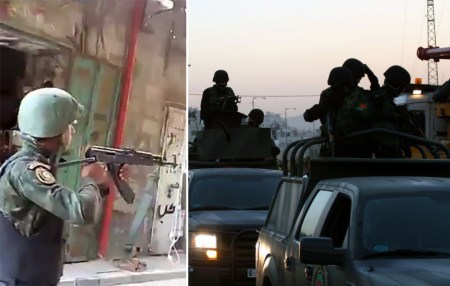
1809On August 18, two Palestinian Authority policemen were killed in an armed clash with gunmen in Nablus (left). In April of this year, a fierce gun battle erupted between Palestinian Authority policemen and members of the Jaradat clan in the refugee camp of Jenin (right). The clash started during an attempt to arrest a clan member.

In June, two other PA security officers, Anan Al-Tabouk and Uday Al-Saifi, were also killed in a shootout with gunmen in Nablus. The PA claimed that “outlaws” were behind the killings and vowed to punish the culprits.

Tensions in Nablus reached their peak on August 23, when scores of PA policemen lynched Ahmed Halawah, a former policeman suspected of leading a notorious gang belonging to Abbas’s Fatah faction. Halawah was beaten to death by PA policemen shortly after he was arrested and taken to the PA-run Jneid Prison in Nablus.

The PA leadership, which has since admitted that Halawah was lynched by its policemen, says it has ordered an inquiry into the case. Its leaders have described the lynching as an “unacceptable mistake.”

The lynching of the detainee sparked widespread protests throughout the West Bank, with many Palestinians calling for an immediate inquiry into the circumstances surrounding the case and demanding that those responsible be brought to trial.

The Palestinian Bar Association issued a statement strongly condemning the lynching of Halawah as a “crime and a human rights violation.” The Association called for holding those responsible, adding, “The regrettable and painful events, including the crime of killing Ahmed Halawah, do not serve the interest of the citizen or homeland and deepens divisions in our society.” It also called on the PA and its security forces to abide by the law and honor the human rights of the Palestinians and their public freedoms.

Alarmed by the widespread condemnations of the lynching of Halawah, some Palestinian Authority officials began issuing direct and veiled threats against Palestinian critics.

Palestinian lawyer Wael Al-Hazam, who called on Abbas to “withdraw” his security forces from Nablus, was visited by unidentified gunmen who sprayed his house with 14 bullets. The attorney and his family members were not hurt in the shooting attack, which was clearly designed to send a warning message to anyone who dared to raise his or her voice against human rights abuses by the PA security forces. And in this instance, the message arrived.

Shortly after the attack on his house, the lawyer issued a statement in which he said, “14 bullets are enough to silence me. I’m a man of the law and I cannot face bullets. My pen and voice are the only weapon I have. I do not possess armed militias to defend myself.” The attack on his house came shortly after PA security officers threatened the lawyer, warning him against appearing on a TV show to discuss the latest wave of violence in his city.

The turmoil in Nablus has prompted many Palestinians to call on Abbas to make a decision to postpone the upcoming municipal election in their city. In an emergency meeting held on August 25 in Nablus, several Palestinian factions and figures reached agreement that it would be impossible to hold the vote under the current circumstances.

Sarhan Dweikat, a senior member of Abbas’s Fatah, said that an election delay was needed, to

“protect the social fabric and preserve our national project, which is facing an existential threat in light of the security chaos and anarchy in Nablus. … Conditions in Nablus do not provide a positive climate for holding elections.”

It is hard to see how Abbas, delusional as he appears to be, would heed the calls to postpone the local and municipal elections. His pathetic attempt to persuade Palestinian businessmen to invest their money in PA-controlled areas at a time when the flames are engulfing his backyard is yet another sign of the man’s refusal — or inability — to see the reality on the ground.

This is the same president who claims that he is seeking to lead his people toward statehood and a better future. Incredibly, Abbas can probably continue to fool world leaders into believing that he and the Palestinian Authority are prepared for statehood. Yet the blood pouring out in Nablus and other Palestinian cities and villages is proof positive that Abbas is on his way to losing control over the West Bank, just as he lost the Gaza Strip to Hamas in 2007. If until now it seemed that Hamas posed the biggest threat to Abbas’s rule over the West Bank, it is now obvious that that is not so. The real threat, as brought home in blood in the West Bank, is coming from Abbas’s homegrown loyalists-turned-rebels.
Secretary-General Of Palestinian Presidency Delivers Speech On Behalf Of President ‘Abbas: In Fighting For Palestine, Our People ‘Loves Death More Than Life’

May 24, 2016

Secretary-General Of Palestinian Presidency Delivers Speech On Behalf Of President ‘Abbas: In Fighting For Palestine, Our People ‘Loves Death More Than Life’ MEMRI, May 24, 2016

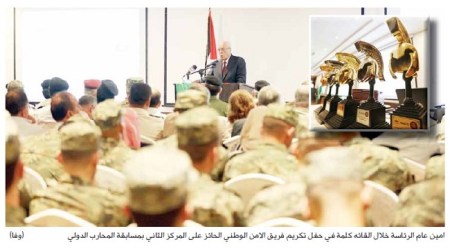
On May 22, 2016, Palestinian Presidency Secretary-General Al-Tayeb ‘Abd Al-Rahim delivered a speech on behalf of Palestinian President Mahmoud ‘Abbas to a group of Palestinian National Security Forces. The speech was part of a ceremony celebrating their second-place win in the international 8th Annual Warrior Competition, which took place in Jordan on May 2-6, 2016.[1]

In his speech, ‘Abd Al-Rahim condemned attempts to intimidate the Palestinian people and divert it from its path, and called such attempts futile, as “our [Palestinian] people loves death more than life.” He added that the National Security Forces victory was a step on the way to establishing an independent Palestinian state, and rejected the notion of establishing a separate independent entity in Gaza, or a state with temporary borders in the West Bank alone.

The following are excerpts from the speech:

28164Abd Al-Rahim speaking at the ceremony (Al-Ayyam, PA, May 23, 2016)

“Today we celebrate the Palestinian man, who suffers a lack of means and opportunity, but has will power and is determined to keep the Palestinian flag flying so that it [the flag] remains in the hearts of peace-loving and liberty-loving peoples. We were very happy with this victory [in the Warrior Competition], and the honorable president and commander-in-chief, president Abu Mazen [Mahmoud ‘Abbas], has expressed his esteem for the brothers who won this award and his pride in their achievements. Many commanders in Arab military institutions have also expressed their pride in this new Palestinian man, who is always new and always renewing [himself].

“The occupation wagered that we would forget our cause and that, as the generations passed, we would dissolve into the societies around us… However, the occupation was the first to realize that each new generation was more determined and had a stronger desire to achieve the goals that the martyrs had died for in the distant and the near past and [are still dying for] in the present. Our blood is still being spilled at the roadblocks and the checkpoints by the gangs of settlers and the extremist soldiers of the occupation, some of whom have acknowledged that they do not act according to moral standards when facing our people and children…

“Occupiers are always destined to fail. This fact should be in our minds forever. We must always cling to hope. Our morale will not be influenced or shaken by anything. We will not grow soft or deviate towards personal interests for the sake of dubious goals such as establishing a state or an emirate in Gaza, or establishing a state with temporary borders in the West Bank. We must always tirelessly stick to our truth, and our faith in victory must never falter. It is the faith in our hearts that will lead us to our rights and to the realization of our righteous and legitimate goals…

“Every achievement is a step on the road to establishing an independent state and strengthens our belief that the future is ours, that tyrants will disappear, and that the aggressors will end up in the trash bin of history. Indeed, they are trying to intimidate us today with people who threatened to strike Gaza or the Aswan Dam [a reference to incoming Israeli defense minister Avigdor Liberman], but these threats are hollow as we are a people who loves death more than life when it fights for Palestine.”[2]

Endnotes:

[1] The Annual Warrior Competition is a combat-oriented competition held at the King Abdullah II Special Operations Training Center (KASOTC) in Amman (Warriorcompetition.com).

[2] Al-Hayat Al-Jadida (PA), May 23, 2016.

Palestinians: Presidents for Life, No Elections

April 1, 2016

Palestinians: Presidents for Life, No Elections, Gatestone InstituteKhaled Abu Toameh, April 1, 2016

♦ We hear often that Mahmoud Abbas is keen on having Palestinians vote in a democratic election. Yet Abbas turned 81 last week and appears ready to remain at the helm until his last day — free elections for Palestinians be damned. That makes sense: Hamas could easily best Abbas in such an election.

♦ Hamas and Abbas’s Fatah are still far from achieving any form of reconciliation. This, despite all the talk about “progress” that has been reportedly achieved in talks between the two parties taking place in Doha, Qatar.

♦ Hamas is also cracking down on journalists, academics, unionists and even lawyers in the Gaza Strip.

♦ Yet Abbas’s West Bank rivals Hamas in Gaza, in terms of a lack of human rights and freedom of speech. The idea of free and democratic elections there is a joke. Abbas will leave a legacy of chaos.

Best birthday wishes to Palestinian Authority (PA) President Mahmoud Abbas, who turned 81 last week. The octogenarian appears ready to remain at the helm until his last day — free elections for Palestinians be damned.

Abbas has inherited a tradition of tyranny. His predecessor, Yasser Arafat, was also president for life. Both have plenty of company, joining a long list of African presidents who earned the notorious title of “President for Life” – in Uganda, Equatorial Guinea, Angola, Zimbabwe, Sudan, Chad, Eritrea and Gambia. And let us not forget the Arab dictators in these ranks.

One might hope for at least a deputy — someone to fill the impending and inevitable power vacuum in the PA. Not likely.

Abbas has fiercely resisted demands from leaders of his ruling Fatah faction to name a deputy president or a successor. His reasoning: the time is not “appropriate” for such a move. Palestinians should instead concentrate their energies on rallying international support for a Palestinian state.

The PA president acquired his “private fiefdom,” as it is called by his detractors, in a January 2005 election, when Abbas was given a four-year mandate.

Such mandate seems to have been rewritten by the standing president. January 2016 marked the beginning of the eleventh year of Abbas’s four-year term in office. But it is business as usual in Ramallah.

We hear on a monthly basis that Abbas is keen on having Palestinians cast their ballots in a free and democratic vote. Yet we have seen no evidence to this effect. That make sense: Hamas could easily best Abbas in such an election. Despite his advancing age, Abbas still has clear memories of January 2006, when Hamas was permitted to run in the parliamentary election and won.

Abbas is also acutely aware that Hamas, which holds hostage nearly two million Palestinians in the Gaza Strip, would never allow a free vote there — especially for Abbas loyalists who have been seeking to undermine its rule.

Just a few days ago, a Hamas “military” court in the Gaza Strip sentenced two senior Palestinian Authority security officers, Sami Nisman and Naim Abu Ful, to 15 and 12 years in prison respectively, on charges of spying for the Palestinian Authority and plotting terror attacks against Hamas targets.

The verdicts are yet another sign that Hamas and Abbas’s Fatah are still far from achieving any form of reconciliation. This, despite all the talk about “progress” that has been reportedly achieved in talks between the two parties. Unconfirmed reports earlier this week leaked details of sticking points between Hamas and Fatah negotiators, have been meeting in Doha, Qatar, under the auspices of the Gulf state, towards forming a new unity government and holding new presidential and parliamentary elections. Qatar is the largest source of funds for the Muslim Brotherhood and its offshoot, Hamas.

Abbas’s fear of holding elections in the Gaza Strip is not without justification. In addition to the crackdown on his loyalists and security officers there, Hamas is also cracking down on journalists, academics, unionists and even lawyers.

Last week, Hamas security forces raided the offices of the Palestinian Bar Association in Gaza City and confiscated computers. The raid came as a result of the controversy surrounding the Bar Association not submitting lawyers’ financial and administrative records, in addition to complaints filed by some lawyers against the Bar Association, according to a statement released by the Palestinian Center for Human Rights (PCHR). The raid, some Palestinians claim, is in the context of Hamas’s effort to crack down on lawyers who are affiliated with the rival Fatah faction.

Yet Abbas’s West Bank rivals Hamas in Gaza, in terms of a lack of human rights and freedom of speech. The president’s security forces are in the midst of a massive and ongoing crackdown on political opponents of all stripes, making the idea of free and democratic elections there a joke. Abbas cannot tolerate the idea of having a deputy: how would he consider the establishment of a new party or the emergence of a potential candidate for the presidency.

Senior figures who have dared to challenge Abbas’s autocratic rule have already found themselves targeted by the president and his men. Ask former Prime Minister Salam Fayyad, who had his organization’s bank accounts seized by Abbas, or Mohamed Dahlan, the former Fatah commander and minister who was forced to flee the Palestinian territories after falling out with Abbas and his sons. Perhaps deposed PLO Secretary-General Yasser Abed Rabbo, who overnight was stripped of his powers and thrown to the dogs for speaking out against the president, would have a word to say. In Ramallah, they call them the “Abbas victims.”

909Palestinian Authority President Mahmoud Abbas (left), who turned 81 last week, has fiercely resisted demands from leaders of his ruling Fatah faction to name a deputy president or a successor. Senior figures who have dared to challenge Abbas’s autocratic rule have been targeted by the president — such as Mohamed Dahlan (right), the former Fatah commander and minister who was forced to flee the Palestinian territories after falling out with Abbas and his sons. (Image sources: U.S. State Dept., M. Dahlan Office)

We would need a crystal ball to know what will happen the day after Abbas disappears from the scene. Perhaps, say some, we shall witness a scene reminiscent of the old days of the Soviet Union “Politburo,” with the next president chosen by a group of Fatah and PLO leaders who will meet in Ramallah. This seems the most likely scenario, in the absence of any chance of free and democratic elections, and in light of the continued split between the two Palestinian entities in the West Bank and Gaza Strip.

We do not need a crystal ball, however, to know that Abbas will leave a legacy of chaos. His adamant refusal to name a deputy or even discuss the issue of succession in public has already created tensions among the top brass of the PLO and Fatah. The Palestinian public, for its part, has precious little confidence in its leaders.

The behind-the-scenes power struggle that has been quietly raging in Ramallah for the past few months is likely to lead to a state of paralysis in the Palestinian arena and leave the Palestinians without an acceptable leader. Or, as senior Fatah official Tawfik Tirawi put it, Abbas will be the last president for the Palestinians.

Palestinians are plagued with leaders who desire one thing: personal power. The Palestinians are marching away from achieving a state, partly because they seem incapable of the fundamental political principle of free and democratic elections. The day after does not look promising.

More Palestinian Empty Threats

March 21, 2016

More Palestinian Empty Threats, Gatestone InstituteKhaled Abu Toameh, March 21, 2016

♦ For Abbas, security coordination with Israel is indeed “sacred”: it keeps him in power and stops Hamas from taking over the West Bank.

♦ Abbas cannot tell his people that security coordination with Israel is keeping him on the throne. That is a topic for Israeli ears only.

♦ So what are the threats to end security cooperation about? Money. Here is Abbas’s take-home to the world: “Send more money or we will cut off security cooperation with Israel.”

♦ Halting security coordination with Israel would spell both his end and that of the PA in the West Bank. The international community is simply hearing a new version of the old bid for yet more political concessions and yet more cash.

The Palestinian Authority’s endless threats to suspend security coordination with Israel are a carefully crafted bluff designed to extort more funds from Western donors, scare the Israeli public and provide a cover for its refusal to talk peace with Israel.

Many Palestinians say these threats are also intended for “internal consumption” — namely to appease Hamas and other radical factions and to refute charges that the Palestinian Authority (PA) is betraying its people by “collaborating” with Israel.

Hamas has conditioned “reconciliation” with President Mahmoud Abbas’s ruling Fatah faction in the West Bank on Fatah ending all forms of security coordination with Israel. Hamas claims that the security coordination is directed mostly against its members and supporters in the West Bank.

Over the past several years, PA security forces have rounded up hundreds of Hamas men in an attempt to prevent the Islamist movement from establishing bases of power in the West Bank.

Hardly a week has passed during the past few months in which a senior Palestinian Authority official does not threaten to cut off security ties with Israel. Some officials in Ramallah have even claimed that the PA has already taken a decision to suspend not only security coordination with Israel, but also political and economic relations as well.

PA officials are saying that their threats, which until now have been so much dust in the wind, will be realized next month.

“April is going to be the turning point,” declared Jamal Muheissen, member of the Fatah Central Committee. “This is a month that will witness changes with regards to several issues that can no longer be delayed or marginalized. April will witness the complete and public suspension of security coordination [with Israel]. This will be the first step taken by the Palestinian leadership.”

This sounds curiously familiar: nearly a year has passed since leaders from the Palestinian Authority and Fatah first announced their decision to halt all forms of security coordination between the PA and Israel.

Meeting in Ramallah last month, the leaders once again reaffirmed their decision. This time, it is allegedly Israel’s “failure to honor all signed agreements with the Palestinians” that prompts them to suspend security coordination.

U.S. Vice President Joe Biden was reportedly informed of this intention earlier this month while visiting Ramallah.

But Biden is not the only Western leader to be privy to this threat. Palestinian sources say that foreign dignitaries and leaders who visit Ramallah have become accustomed to hearing Abbas and other Palestinian leaders announce their “intention” to suspend all relations with Israel, including security coordination.

Moreover, the PA recently leaked to the Palestinian media that it has officially notified Israel of its decision to “limit” all relations with it. According to the unconfirmed report, President Mahmoud Abbas dispatched three senior officials — General Intelligence Chief Majed Faraj, Preventive Security Chief Ziad Hab Al-Reeh and PA Minister for Civilian Affairs, Hussein Al-Sheikh — to a meeting with Israeli officials to brief them about the reported decision.

The Palestinian street, however, takes a different view of these threats. The reports, they say, call to mind President Abbas’s incessant threats to resign.

These Palestinians consider the threats a smokescreen to conceal the continued security coordination with Israel which, they say, seems even to have increased in recent months. They say that President Abbas can probably fool Western leaders with these threats, but not his people, who have become used to hearing empty threats from their leaders.

A senior Fatah official in Ramallah summed up the Palestinian Authority’s dilemma: “We are facing a complicated crisis. If we carry out the threat [to suspend security coordination with Israel], we will suffer; similarly, if we don’t we will suffer.”

The situation, however, is not all about money: it is also about power. President Abbas and his security chiefs know perfectly well that the security coordination benefits them first and foremost. They are well aware that without Israel’s help, Hamas would spread in the West Bank like a cancer, ultimately overthrowing the PA and replacing it with another Islamist regime like the one in the Gaza Strip.

It is helpful to remember Abbas’s moment of lucidity, when in 2014, in front of a visiting Israeli group, he declared that security coordination with Israel was “sacred.” He added: “We will continue with it even if we differ on political matters.”

For a change, Abbas was being honest. And he is right. For Abbas, security coordination is indeed “sacred”: it is keeping him in power and stopping Hamas from taking over the West Bank. Hence the security coordination — in Abbas’s words — is very important for the Palestinian Authority – perhaps more than thwarting Hamas terror attacks against Israel.

Abbas has a problem. He cannot tell his people that security coordination with Israel is what is keeping him on the throne. The sacredness of security coordination is a topic for Israeli ears only.

So what are the threats about? Money.

Here is Abbas’s take-home to the world: “Send more money or we will cut off security cooperation with Israel.” And now there is a little added value, messaged mostly to the U.S. and EU: Convene an international conference for “solving” the Israeli-Palestinian conflict, or we will cut off security cooperation with Israel.

1410 (1)Abbas to the world: “Send more money or we will cut off security cooperation with Israel.”
Left: Palestinian Authority President Mahmoud Abbas with French President François Hollande. Right: Abbas with top European Union officials Federica Mogherini and Jean-Claude Juncker.

Whatever else he is, Abbas is not suicidal. Halting security coordination with Israel would spell both his end and the end of the Palestinian Authority in the West Bank. What the international community is hearing, then, is nothing more than a new version of the old bid for yet more political concessions and yet more cash.

Palestinians: The Right Time to Take Big Steps?

March 4, 2016

Palestinians: The Right Time to Take Big Steps? Gatestone InstituteBassam Tawil, March 4, 2016

♦ Despite the “official” surveys taken among Palestinians, which show support for Hamas, the residents of the West Bank are terrified that Hamas will gain control and destroy our lives and property, the way they did in the Gaza Strip.

♦ The BDS organizations are trying to boycott products made in the West Bank, which only throws masses of Palestinians out of good jobs in an effort to force Israel into a hasty withdrawal that has no chance of taking place. The Israelis and everyone else remember all too well that the last Israeli withdrawals — from southern Lebanon and the Gaza Strip — led to the terrorist takeover of the vacuums created.

♦ Ikrima Sabri, the former Mufti of Jerusalem, often said that Palestinians were better off with the Jews in charge of Al-Aqsa mosque and Jerusalem, because in the future they could be removed and killed off, but if the Crusaders returned to Jerusalem — such as an international commission headed by the French — it would be harder to get rid of them.

During a visit to Berlin, German Chancellor Angela Merkel told Israel’s Prime Minister Benyamin Netanyahu that now is not time to move forward with the “two-state solution” and the establishment of a Palestinian state.

Merkel, evidently seeing Israel as a dam protecting Europe from Islamist extremists, told Netanyahu that while the Germans recognized the terrorist threat faced by Israel, and that a peace process had to be advanced based on two states for two peoples, now was not the right time to take big steps.

1494Agreed: It’s not a good time to establish a Palestinian state. Pictured: Israeli Prime Minister Benjamin Netanyahu and German Chancellor Angela Merkel address a press conference in Berlin, Germany, on February 16, 2016. (Image source: Israel Government Press Office)

The Palestinians living in the Gaza Strip are well aware that they are hostages of the terrorist organizations, in particular Hamas. Jibril Rajoub, a senior official in the Palestinian Authority (PA), told Al-Jazeera TV the same thing just last week.

The Palestinians in the West Bank, regardless of public declarations, also secretly support security collaboration with Israel, which protects us from radical Islamist terrorism. Therefore, despite the “official” surveys taken among Palestinians, which show support for Hamas, the residents of the West Bank are terrified that Hamas will gain control and destroy our lives and property the way they did in the Gaza Strip. We do want a Palestinian state, but one that will preserve the lifestyle and accomplishments we have built over the years — not a state that will have them fall to the horrors of Hamas and ISIS.

In light of the quiet, passive public support for the regime of Mahmoud Abbas, Hamas is inciting Palestinians against it. Hamas, in an attempt to overthrow the Palestinian Authority, is portraying Abbas’s security forces as traitors who transmit information to Israel.

Like Germany — and unlike Sweden and France — Britain has recently instituted a more balanced policy. The UK has begun to fight the anti-Israel BDS (Boycott, Divestment and Sanctions) organizations. Matthew Hancock, Britain’s Minister for the Cabinet Office, who coordinates activities between various government ministries, is advancing protocols to prevent the ongoing boycotts by the British establishment.

These BDS organizations are trying to boycott products made in the West Bank, but the boycott only throws masses of Palestinians out of good jobs and great benefits in an effort to force Israel into a hasty withdrawal that has no chance of taking place. The Israelis and everyone else remember all too well that the last Israeli withdrawals — from southern Lebanon and the Gaza Strip — were nothing more than case-studies for the terrorist takeover of the vacuums created, exactly the same way as the U.S. withdrawal from Iraq made room for the Islamic State (ISIS).

As Palestinians we know that the BDS may or may not harm Israel, but it does untold damage to the Palestinians who support their families by working in the settlement factories and would otherwise be unemployed and then, as a scarcity of jobs will have been created, hired by various terrorists. When the SodaStream factory moved out of the West Bank, 500 Palestinians lost their well-paid jobs.

In view of the current U.S. helplessness in dealing with the Russians, Iranians and Syrians, the Obama administration has now chosen to bare its fangs at Israel. Despite what are apparently his predictable personal objections, U.S. President Barack Obama is expected to sign into law the Trade Facilitation and Trade Enforcement Act, which includes anti-BDS provisions. It introduces new policy language by including all “Israeli-controlled territories” as part of Israel. Meanwhile, the American customs authority is still continuing to enforce a 20-year-old law, marking products made in the West Bank and hurting Palestinians. Labeling products hurts the Palestinians, who then are driven look for work in the eager arms of the terrorist organizations radicalizing the region.

The French, as usual, slither and shift. A number of months ago, they tried to build up steam for an international commission of inquiry into the Al-Aqsa mosque. Both the Israelis and the Palestinians objected.

Ikrima Sabri, the former Mufti of Jerusalem, often said that Palestinians were better off with the Jews in charge of Al-Aqsa mosque and Jerusalem, because in the future they could be removed and killed off, but if the Crusaders returned to Jerusalem through the back door — such as an international commission headed by the French — it would be harder to get rid of them.

The French, fearing for their lives at the hands of their own local Islamist enclaves, are in dire straits and doggedly try one maneuver after another to appease them. In desperation, they have proposed peace negotiations for the Palestinians and Israel “with international mediation.” They even brazenly suggested that if the negotiations failed, they would recognize the Palestinian state. The outcome is written on the wall: the Palestinians, who will have no reason to negotiate, will fall over themselves rushing to the conference, then automatically veto every proposal or possible compromise, and then receive the promised recognition of Palestine.

The French are masters of diplomatic flimflam: on the one hand, they will do anything to appease their own Islamists at the expense of Israel, and on the other, they know full well neither Israel nor any other Western country will accept their self-serving suggestion. The French keep revealing their duplicity again and again. They refuse to designate Iranian-backed Hezbollah as a terrorist organization; they instead call it a “political party,” despite its full participation in slaughtering Sunni Muslims in Syria. Hezbollah is also one of the main actors pushing the countless asylum-seekers (and occasional ISIS operative) flooding Europe, Turkey and Jordan.

The atrocities committed today in the Middle East are the direct result of the refusal of Europe (including France) and the United States to intervene, and the stunning silence of the Arab states. Unwilling to fight ISIS, they are more than willing to condemn, slander and criticize Israel, while the Middle East slips into anarchy.

The result for us Palestinians will be bloodletting, either in the Hamas-Fatah rivalry, or as collateral damage in the Israelis’ war against Islamist terrorism, or, when the Palestinian Authority falls, at the hands of ISIS and Al-Qaeda and the Al-Nusra Front as they sweep through the Jordan Valley on their way to attack Israel.

Al-Jazeera TV is also trying to serve its master, Qatar, radicalize the Palestinians by saying that the Palestinian Authority’s security coordination with Israel, which benefits everyone here by keeping out Islamic terrorists, is betraying the Palestinian cause. In addition, Israeli intelligence, by saying that a seaport for Hamas should be built is, for some mysterious reason, trying to kill off the Palestinian Authority by strengthening Hamas. Both the Egyptians and we Palestinians — and even the Israelis — do not need Hamas strengthened at our expense. Hamas and the many other extremist organizations that have infiltrated the Gaza Strip, including ISIS, are what enable Israelis to justify their security concerns as well as those regarding peace negotiations with the Palestinians, and that prevent a withdrawal from the West Bank. Given the current situation in the Middle East, Angela Merkel was correct. It is not the right time now to take big steps.

Special Israeli emissary to Moscow over Russian Syria air strikes near border

February 17, 2016

Special Israeli emissary to Moscow over Russian Syria air strikes near border, DEBKAfile, February 17, 2016

Israel_near_border_16.2.16

In view of the crisis building up on the southern Syrian-Israeli border, Prime Minister Binyamin Netanyahu decided immediately on his return home from Berlin early Wednesday, Feb. 17, to send a special  emissary to Moscow to ask for clarifications. Tuesday, Intensified Russian air strikes came to within 6 km of the Israeli border, sparking a growing exodus of Syrian refugees heading towards the Qoneitra border crossing to Israel.

DEBKAfile’s sources reveal that the envoy is Dr. Dore Gold, director-general of the Foreign Ministry and one of the prime minister’s few trusted confidantes.

It was still not clear whom Gold will meet in the Russian capital, but it is assumed that it will be one of Moscow’s senior decision-makers in the loop on its military operation in Syria.

The fact that Netanyahu decided to dispatch a top diplomat rather than a senior military or intelligence officer is a sign that the prime minister is not of one mind with the IDF’s intelligence assessments of the situation on the ground.

Netanyahu’s concerns grew after after the Russian air force on Tuesday widened its massive bombing of southern Syria from the city of Daraa to the Golan town of Quneitra, in order to help the Syria army’s 7th armored division push the rebels east, so they will not attempt to cross the border and seek shelter in Israel.

DEBKAfile’s military sources report that that 12 of the 15 targets bombed by the Russian air force across from the Israeli border were new rebel positions that had not been attacked before, even by the Syrian army. Military sources monitoring the war said Tuesday night that there is no doubt that the Russians are in the process of wiping out the rebel positions along the Israeli border by means of an offensive comparable to their operations in the northern Aleppo sector.

Our sources report that Israel’s concerns grew when, as the Russians bombing raids neared the Israeli border, Syrian officials threatened Jordan with serious consequences if Amman gave the Saudi air force a base for attacking eastern or southern Syria.

The threats began Tuesday, after Jordanian forces took over the Syrian-Jordanian border crossings formerly held by Syrian rebels, as a measure to stem the volume of Syrian refugees in search of sanctuary in the Hashemite Kingdom. But this step was interpreted by the Syrians and their Russian ally as clearing the way for Saudi intervention in the Syrian conflict using Jordan as a jumping-off base.

Meanwhile, Western military sources reported a sub substantial presence Tuesday of both Russian and Israeli warplanes in the skies over and around southern Syria.

Hezbollah tries to shift attention to the West Bank

February 5, 2016

Hezbollah tries to shift attention to the West Bank, Long War Journal, February 5, 2016

Hezbolla Gaza

Israeli security forces announced last week their dismantling of a five-man terror cell from the West Bank city of Tulkarem, jihadists who were recruited by Hezbollah’s secretive Unit 133. The men were instructed to gather intelligence information on Israel Defense Forces (IDF) training facilities for attacks and prepare a bomb for use in a suicide operation against civilians. The foiled plot was Hezbollah’s latest attempt to stir up Israeli-Palestinian violence, exploiting the conflict to improve its tarnished image while bogging down Israeli forces in a battlefield far from its home base.

Hezbollah established Unit 133 in the early 2000s, to focus its operations on Israeli targets both domestically and across the Middle East and Europe. Unit 133 relies primarily on human intelligence activity, luring recruits with money. Due to the nature and purpose of the Unit’s activities, it does not exclusively draw on Shia Muslims for recruitment. Recruits are given broad security and military training, charged with recruiting new assets as well as intelligence collection, target acquisition, surveillance, reconnaissance, managing sources and establishing cover stories.

For its operations within Israel, the unit was tasked with recruiting intelligence assets and terror operatives from among Palestinians in the West Bank and Israel’s Arab citizens. To accomplish that, it turned to Lebanese drug dealers who work with Israeli-Arab smugglers.

Unit 133 has been linked to previous attempts, some unsuccessful, to carry out attacks within Israel. In April 2012, for example, it tried to smuggle 24 C-4 explosive devices, M-16 rifles and other weapons past Israel’s border with Lebanon through Israeli-Arab smugglers. The goal was to have one of the Unit’s cells within Israel use the materials to carry out a mass-casualty attack, but the attempt was foiled by Israel’s Shin Bet security services before they reached their intended recipients. Last summer, Israeli security forces arrested Hezbollah operative Hassan Khalil Hizrana dual Lebanese-Swedish citizen, at Ben-Gurion Airport. Hizran was to report on the airport’s security procedures, recruit Israeli Arabs with ties to Israeli civilians or military personnel, and gather intelligence on military targets.

This newest cell, taken down last week, was put together and funded by Hezbollah chief Hassan Nasrallah’s son, Jawad. He instructed the men to recruit more Palestinians and Israeli Arabs, providing them with $5,000 to acquire the necessary weapons and materials for the intended attacks.

Israeli security officials said the cell hoped to reignite the months-long wave of Palestinian violence that has waned in recent weeks. Hezbollah likely hoped the attacks would be the catalyst for turning the violence into a real Intifada, or uprising, on par with the bloody Al-Aqsa Intifada of the early 2000s. Beyond simply killing Israelis, Hezbollah has much to gain from such a heightened level of violence.

For one, full-blown violence would refocus the ire of Sunni Arabs (particularly the wealthy Gulf states) on what they insist is the “central cause” of the Arabs – Palestine – and away from Hezbollah and its Iranian masters. Sparking another Intifada would also improve Hezbollah’s image on the Arab street, allaying some of the anger directed at it over its involvement in the Syrian civil war. It would allow Hezbollah to portray itself as primarily fighting Israel, while – unlike during the 2006 war – keeping the fight away from Lebanese soil.

Finally, if Israel were once again plagued with frequent Palestinian suicide bombings and large-scale attacks as in the early 2000s,  the IDF would become bogged down again in counter-terror operations in the West Bank, severely reducing its ability to act against Hezbollah – either in Lebanon or Syria.

New Iranian-Backed Terror Group Makes Inroads in West Bank, Gaza

January 19, 2016

New Iranian-Backed Terror Group Makes Inroads in West Bank, Gaza, Washington Free Beacon, January 19, 2016

Screen-shot-from-al-Sabireen-propaganda-videoScreen shot from al-Sabireen propaganda video

A new Iranian-backed terror group is making inroads in the Gaza Strip and West Bank, where it operates underground with the potential capacity to deliver devastating attacks to Israel, according to regional experts who have been investigating the organization’s rise.

The group, which goes by the name Harakat al-Sabireen, was established around May 2014 but has begun in recent months to boost its public profile on social media and brag about its plots to wage jihad against Israel, according to information gathered by regional analysts and provided to the Washington Free Beacon.

Al-Sabireen is believed to receive $10 million a year from Iran via funds that are smuggled through a large network of tunnels built by terrorists to facilitate illicit travel beneath the Gaza Strip, according to estimates disseminated in the Arab language press.

Like Hezbollah, the Iranian-funded terror group that controls territory along Israel’s northern border, al-Sabireen is being used by the Islamic Republic to indirectly wage war on the Jewish state and foster unrest in the Palestinian territories, according to experts, who view the group’s rise as a sign that Iran is not interested in scaling down its global terror network following the recent implementation of the nuclear agreement.

A State Department official who was not authorized to speak on record said that officials are aware of al-Sabireen and its activities. However, the group has not been officially designated as a foreign terrorist organization, though it is possible this could occur in the future.

Al-Sabireen says it has established an armed wing with militants in Jerusalem and the West Bank, according to a recent interview with the Palestinian news agency Ma’an.

“Given the tense relationship between Tehran and Hamas the past few years, it makes sense that Iran would look to form another proxy in Gaza,” Grant Rumley, a Middle East analyst at the Foundation for Defense of Democracies, said. “However, Sabireen’s entire model of expansion hinges on its ability to present itself as a Palestinian, non-sectarian movement.”

Like Hezbollah, al-Sabireen’s official logo closely resembles that of the Iranian Revolutionary Guard Corps, which is responsible for giving orders to these types of terror groups.

The group’s charter condones violent jihad and promotes attacks on “the racist Zionist body” and “America the great Satan,” according to a copy published by the group on its official Arabic-language website.

Al-Sabireen has taken to its website and Facebook page in recent months to praise operatives who have been killed while conducting reconnaissance missions on the group’s behalf.

In one posting from late October, the group celebrated the death of one operative who was killed “after direct targeting from the Zionist forces while he was leading a monitoring and reconnaissance team.”

Mourners raised flags during a funeral ceremony for this individual from a variety of Palestinian political groups, including Fatah, which is largely viewed by Western governments as a moderate voice, according to photographs posted by al-Sabireen on its Facebook page.

It also has been plucking recruits from rival terrorist groups, according to Rumley.

“It’s unclear exactly what Sabireen’s operational capabilities are right now, but we know that they’ve pulled recruits from a more established terror group, Palestinian Islamic Jihad, and that they’ve lost at least two fighters in two separate Israeli strikes, so they’re on Israel’s radar,” Rumley said.

Al-Sabireen has been present at pro-Hezbollah rallies in Gaza that were also attended by leading Hamas officials.

While not much is known about the group’s composition, it appears to have two main leaders, one an operational leader and another who provides intellectual guidance.

Hisham Salem, the terror group’s top leader, formerly served as a member of Palestinian Islamic Jihad, a State Department-designated terror organization, according to information provided by regional analysts. Salem, who is in his early 50s, was raised in the Gaza Strip and began referring to himself as al-Sabireen’s leader in 2014.

Salem claimed in a recent interview with the Palestinian press that armed members of the group are currently in the West Bank and Jerusalem.

“We have an armed branch whose goal it is to wage war on the Israeli occupation everywhere,” Salem was quoted as saying. “Within this framework we have members in the West Bank and Jerusalem who will soon receive financial and military support from us.”

A recent propaganda video produced by the organization and posted to YouTube shows soldiers marching through Gaza with AK-47s.

Al-Sabireen’s second in command, Mohammad Abu Nadi, frequently writes on al-Sabireen’s official website and praises Palestine as integral to the Arab world.

Al-Sabireen has taken a hardline stance against the United States, claiming in September on its Facebook page that the United States is responsible for “producing terrorists.”

The group’s Facebook page remains active with near-daily postings despite attempts by Facebook to shut it down.

While al-Sabireen has faced difficulty in expanding its base in Gaza, where the Hamas-controlled government cracks down on rival terror groups, it has been able to gain a foothold in the West Bank, where it can directly challenge both Israel and the Palestinian Authority.

Palestinians: Save Us from the Good-Hearted Westerners!

January 1, 2016

Palestinians: Save Us from the Good-Hearted Westerners! Gatestone InstituteBassam Tawil, January 1, 2016

(How many other “Palestinians” agree with Tawil? — DM)

♦ Every Palestinian knows in his heart that we do not want a state of our own alongside Israel, but rather instead of Israel. This includes all the land of Palestine and Israel. It means that Jews have no right to exist on even one speck of it.

♦ Palestinian President Mahmoud Abbas claims he wants to reach a peace agreement with Israel. But at the same time he and his henchmen incite the Palestinians to stab, run over and shoot Israelis to death, while he idealizes, glorifies and finances — with the funds he receives from the West — the terrorists and their families.

♦ The Palestinian people are already almost totally radicalized, even in the West Bank. They do not seem concerned about living under an Islamist regime run by Hamas or Islamic State.

♦ Abbas’s goal is now, with the help of the international community, to impose a solution on Israel. The solution he seeks – a full withdrawal to the 1967 lines – would pose an existential threat to Israel. It would also just be a matter of time before the Palestinian state will be run by Hamas or Islamic State.

What can be done with these Americans and Europeans? They always seem pining for a dialogue between the Israelis and the Palestinians that would end in a peace agreement, yet oddly all of them seem aware that the Palestinians have not, in all honestly, met Israel’s most minimal demands: the cessation of incitement (agreed to even under the Oslo accords — and requiring no funding!) and the recognition of Israel as a Jewish State. Many throughout the world still view Israel as potentially the next — and 22nd — Arab state.

As hard as it is to say it, the Jews have a point. There is a legitimate concern that without such a stipulation, there will be two Palestinian States: the West Bank and Israel – actually three if you count Gaza.

The Americans and Europeans seem not to realize that, for the Jewish people, the request for a state has to be a precondition for any discussion of Jerusalem, as well, based on its history. Before 1967, when half of Jerusalem was in the hands of Jordan — what the international community says it wants Israel to go back to — around 38,000 ancient Jewish headstones were taken from the Mount of Olives cemetery by Arab residents and used to pave latrines.[1]

These good-hearted Americans and other Westerners nevertheless pressure Israel to act as the “responsible adult” and make unilateral gestures of goodwill. They ask the Israelis to withdraw from the occupied territories and to take Jewish residents of the West Bank settlements with them. They seem already to have forgotten what happened just over ten years ago, in the Gaza Strip, when the Israelis did offer a unilateral gesture of good will. The Israelis unilaterally evacuated every meter of Gaza in 2005, so the Palestinians could build a Singapore — no conditions attached! In return, they were met by Hamas and a nine-year war of rockets. If anyone thinks the Israelis are about to try that again, they have a surprise coming.

As a Palestinian, I welcome the humanistic approach that calls on the strong to cede to the weak; but an honest examination of the issues makes me wonder if Westerners even understand the Middle East. In trying to find a just solution, they keep making every possible mistake. First, they keep demanding from the Israelis concessions that would undermine the country’s security — and they do not demand from the Palestinians so much as a statement, such as “Israel has the right to exist.”

Westerners, it seems, want to frighten Israel into making concessions. What seems to have been forgotten is that under UN Security Council Resolution 242, the territories would be occupied until the dispute is settled. Now, that makes a nice game of rope-a-dope: You never end the dispute, so the territory stays occupied, then you blame the other side for occupying you! Even we can see that.

The Westerners’ latest good-hearted demand — so devastating to the employment situation for Palestinians — is to label goods from the occupied territories. This requirement is asked of no other occupying nation: not Russia in Crimea and Ukraine, Turkey in Cyrus, Pakistan in Kashmir, nor China in Tibet. It is basically a form of Boycott, Divestment and Sanctions (BDS), presumably intended to crush Israel economically.

What these good-hearted Westerners fail to see is that their threats only strengthen Israel’s perception of danger, and end up creating a result that is the opposite of what the Europeans intended. Instead of bringing the Israelis and the Palestinians to the negotiating table, such a move understandably strengthens Israel’s resolve to protect itself. But exerting pressure on Israelis will not induce them to commit collective suicide. Rather, it will make both the Israelis and Palestinians more intransigent than ever.

The American threat of Israel turning into a binational state is meant to frighten Israel into waiving its vital interests while getting nothing from the Palestinians in return. In reality, the threat just stiffens the Palestinians’ resolve and keeps our leaders from granting even the least of Israel’s demands. The American threat is an obstacle to peace.

Most of all, what, staggeringly, Westerners do not seem to understand, is that the aim of the current incitement and attacks by the Palestinian Authority (PA) comes from a desire to replaceIsrael with a Palestinian state.

Look for a minute at the Palestinian Authority. In the Middle East, sooner or later, anything that can collapse, collapses — regardless of efforts to shore it up. The Israelis, all too experienced in such matters, are understandably not about to cast their lot with the PA’s current leader, Mahmoud Abbas. The death rattle of his regime gets louder every week, as even Westerners can surely see. So if the PA can expire at any time, how can anyone even think of asking the Israelis to place their future in Abbas’s trembling hands? Do Westerners seriously mean for the Israelis to give up their security in return for the empty promises of a regime a few faltering steps from implosion?

Unfortunately, the Israelis already know — again from history — that so far, at least, Palestinian promises are not worth an old shoe. Again, just as one example, in the Oslo Accords, the Palestinians signed an agreement no longer to use terrorism to advance political aims.

Mahmoud Abbas may serve as the President of Palestine, but whom does he represent? He certainly does not represent the Palestinians in the Gaza Strip, Israel, Jordan, Lebanon, Syria and anyplace else there are Palestinians. He does not even represent the Palestinians in his own West Bank. Broad swaths of Palestinians in the West Bank no longer consider Abbas their lawful representative. His term of office ended years ago; he is now in the eleventh year of his four-year term. I can promise to sell you that that olive tree over there, but what do I do if it is not my olive tree to sell? He cannot truthfully promise anything to anyone.

The Palestinians in Gaza also reject the legality of Abbas’s reign. They support Hamas. Not only that, but in the West Bank, supporters of Hamas make up roughly half of the population. Their goal is to destroy the Palestinian Authority and Mahmoud Abbas along with it.

Israelis therefore regard the Palestinian president as terminally ill, on life support — also known as the Israeli security forces, Israeli economic support and Western handouts.

Despite relying totally on this charity, Abbas’s position is so weak that to remain in power, he needs to pander to his opponents, to the “resistance front” and the Islamist terrorist organizations in the Palestinian camp. He therefore claims he wants to reach a peace agreement with Israel and that “Palestinian hands are extended in peace;” but at the same time he relentlessly attacks Israel on the international front, in UN agencies and in the International Criminal Court. Meanwhile, he and his henchmen incite the Palestinians to stab, run over and shoot Israelis to death, while he idealizes, glorifies and finances — with the funds he receives from the West — the terrorist “shaheeds” [martyrs] and their families.

Hamas and ISIS at least tell the truth. They openly and repeatedly declare their intentions to destroy “infidel” places such as Israel and Rome — the same way Islam conquered the former seat of Christianity, Constantinople. Mahmoud Abbas, by contrast, is a merely a cowardly hypocrite who successfully dupes the world by talking peace while inciting terror.

If an Islamist terrorist organization does take control of the Palestinian Authority, it will actually make life far easier for Israel. Israel will be able to explain its security position to the world and fight terrorism in the occupied territories — without having to negotiate, make concessions or beg the Palestinians for recognition.

There are some Israelis who worry about the possible fall of Mahmoud Abbas and a radical Islamist takeover of the West Bank. But no Western country will support the establishment of an Islamic emirate in the West Bank. The Islamists will kill the Palestinian Authority’s leaders, the same way Hamas did in 2006-2007 in Gaza. And as usual, only the Palestinians will suffer.

The only people rightly frightened by the thought of a Hamas or ISIS takeover of the West Bank are Mahmoud Abbas and his Fatah loyalists. The Palestinian leadership will be summarily executed and their ill-gotten gains confiscated.

The Palestinian people, on the other hand, already almost totally radicalized, and do not seem even slightly concerned about living under an Islamist regime run by Hamas or Islamic State. They are Muslims: many feel it will make them more pure.

The Palestinian refusal to recognize Israel as a Jewish state is not only a matter of semantics that could change over time. It is a deep-seated ideology that will never change; it is part and parcel of the militant Palestinian-Islamist perception that the Jews are a religious sect — not a nation — and therefore not deserving of sovereignty, a homeland or nationhood.

The Palestinians, like other Muslims all over the world, believe that any land once conquered by Islam becomes part of the waqf, Islam’s religious endowment, owned by Islam in perpetuity. This includes the land of Palestine and Israel, and means that the Jews have no right to exist on even one speck of it.

Our leaders know that recognition of the Jewish state would mean relinquishing the “right of return” of the Palestinian refugees to the State of Israel, and instead settling them only in the future Palestinian state. They simply cannot agree to that.

Every Palestinian knows in his heart that we do not want a state of our own alongside Israel, but rather instead of Israel. Palestinians have not relinquished, and will not relinquish, the right of return; deep down, they hope it will lead to Israel’s demographic extinction and, on its ruins, the establishment of a State of Palestine.

The Jews living in the Middle East understand Middle Eastern dynamics and the challenge of maintaining an independent, democratic state in a region beset by chaos and internecine conflict. They know that anyone who blinks is perceived as weak, and that any blink is perceived by an adversary as an open door.

Despite the threats from the West, the Israelis do not seem particularly shaken. Israel has opened vast new markets in the Far East and appear to be doing brilliantly. Demographically, the number of Jews between the Jordan River and the Mediterranean Sea is rising.

What our past-the-expiry-date leaders have failed to grasp is that the Israelis have set a trap for us: they are building their plans on the foundation of our intransigence. Our leaders are only encouraged by the false hopes and unreasonable expectations given them by the good-hearted Westerners.

Their intentions may even be good, but they persistently refuse to see that our leaders simply do not have the will, the courage or the ability to deliver so much as a dish full of mud. Mahmoud Abbas and the Palestinian Authority leadership prefer to leave things as they are rather than be denounced as traitors by their people for sitting with Israelis at a negotiating table.

1410Palestinian Authority President Mahmoud Abbas is regularly fêted by good-hearted Westerners such as France’s President François Hollande (left) and top European Union officials like Federica Mogherini and Jean-Claude Juncker (right).

Abbas knows — as many of the leaders in Europe apparently do not — that without Israel’s presence in the West Bank, Hamas and Islamic State would execute him, along with his aides, in a public square tomorrow.

Abbas does not want to return to negotiations with the Israelis because he knows has absolutely nothing to offer. His main goal is now, with the help of the international community, to impose a solution on Israel. The solution he seeks — a full withdrawal to the 1967 lines — would pose an existential threat to Israel. It would also just be a matter of time before the Palestinian state will be run by Hamas or Islamic State.

We thank these good-hearted Westerners for all their good intentions. But they are causing suffering to everyone and accomplishing nothing. Our wish for the New Year is, please, for these good-hearted Westerners good-heartedly to stop.

____________________

[1] On the Mount of Olives, the Jordanian Arabs removed 38,000 tombstones from the ancient cemetery and used them as paving stones for roads and as construction material in Jordanian Army camps, including use in latrines. When the area was recaptured by Israel in 1967, graves were found open with the bones scattered. Parts of the cemetery were converted into parking lots and a gas station, and an asphalt road was built through it.

Palestinian terror claims 5 murders in a day as Hebron swings out of Shin Bet control

November 20, 2015

Palestinian terror claims 5 murders in a day as Hebron swings out of Shin Bet control, DEBKAfile, November 19, 2015

Blood inside a minibus at the scene of a drive-by shooting near the West Bank settlement of Alon Shvut, in the Etzion Bloc, on November 19, 2015. Three people were killed in the terrorist attack, and several more wounded. Photo by Gershon Elinson/FLASH90 *** Local Caption *** ????? ???? ??? ??? ????? ???? ?????? Blood inside a minibus at the scene of a drive-by shooting near the West Bank settlement of Alon Shvut, in the Etzion Bloc, on November 19, 2015. Three people were killed in the terrorist attack, and several more wounded. Photo by Gershon Elinson/FLASH90

All five murders perpetrated by Palestinian terrorists Thursday, Nov. 19, led back to the Hebron district of the southern West Bank. The writing on the wall was there in June 2014, when three Israeli teenage boys, Gil-Ad Sheer, Yakov Frankel and Eyal Yifrah were kidnapped at the Gush Etzion intersection near Hebron, and eventually found murdered.

Since the current wave of Palestinian terror erupted on Oct. 1, it has been obvious that the breeding ground was the town of Hebron and the district of Mount Hebron. This wave hit a deadly peak on Thursday. A Palestinian father of five from the village of Duma in the Hebron district, who a few days earlier received a permit to work in Tel Aviv, slashed to death two Israelis at a makeshift synagogue in southern Tel Aviv. Another terrorist from the village of Deir Samath near Hebron, slammed his car into Israeli vehicles and sprayed a traffic jam with gunfire on the highway to Hebron, killing an Israeli man, a tourist teenager and a Palestinian motorist. Seven others were injured.

The mother of one of the terrorists praised her son for bringing “pride and honor to the Palestinians and to Hebron.”

The controversy in Israeli military circles about whether the Palestinian terrorists have escalated the violence from rocks and knives to guns is hardly relevant, when the first attack of the current wave on Oct. 1 was a well-planned deadly shooting attack on an Israeli couple in a car. The 2015 violence would be more aptly dubbed “the Hebron Intifada.”

Hebron, 30 km south of Jerusalem, is the second largest West Bank city after Ramallah, the seat of the Palestinian Authority administration. Around 400,000 Palestinians, roughly a quarter of the West Bank Palestinian population, lives there and in the Mount Hebron towns of Dahariya, Halhoul, Yata, Dura. Samoa, Beit Umar, Bani Naim and Hirbat al-Aroub, as well as a far smaller Jewish population mainly in Hebron, Kiryat Arba and Gush Etzion. Just south of Mt.Hebron are the lands of small Bedouin tribes.

Periodic outbreaks of Arab pogroms against Jewish dwellers have been endemic to this region since 1929, but it was internal strife that ignited the current wave of violence which derives from four causes:

1.  The Palestinian Authority and the ruling Fatah party in Ramallah are at daggers drawn with the Hamas leadership in Gaza. The Palestinian centers of government have been too preoccupied with their quarrel to keep touch with what was going on in Hebron.

2. This void of authority opened the door for the local families and clans, which ruled the district before central authority was established in Ramallah 21 years ago, to reinstate themselves in power, with the result that Israeli and Palestinian intelligence agencies alike have found the restored authority shut tight against their penetration.

Not only are external intrusions excluded, but the clans themselves are careful to keep their business private from rival clans and families.

3. To avoid admitting to its incapacity in this new situation, Israel’s security agency, the Shin Bet, continues to harp on the “lone wolf” theory to explain why the latest round of terror is unpredictable.

But the attacks in Sharm el-Sheikh on a Russian airliner and the multiple terrorist attacks in Paris show Islamist terror to have assumed a new, impenetrable guise, to fight which anti-terror agencies will have to adapt and come up with new methods.

The Shin Beit is finding it harder than before to procure intelligence not just in Hebron but also from the Palestinian Hamas and Islamic Jihad. This difficulty is shared by Jordanian intelligence, which until not long ago maintained a broad net of highly professional agents and informers in the Palestinian community.

4.  In the current situation, Hebron is swinging out of control as athe spearhead of the current wave of Palestinian terror, and appears poised to evolve into a new Palestinian bloc to contest Ramallah for the national leadership.

5.  Israel’s failure to stem their campaign of terror has given Hebron’s clan chiefs enhanced standing in the Palestinian community at large and even in broader circles of the Arab world.