Posted tagged ‘West Bank’

Dire Jordanian straits

March 14, 2017

Dire Jordanian straits, Israel Hayom, Daniel Pipes, March 14, 2017

Palestinians, according to most estimates, constitute a substantial majority of the population and present the deepest division. It’s common to speak of “Jordanians” and “Palestinians” even though the latter are citizens and children and grandchildren of citizens. As this suggests, the sense of being separate from and superior to the mostly tribal peoples of the East Bank has not diminished over time, especially not when Palestinians have achieved economic success.

I asked nearly all of my 15 interlocutors (who represented a wide range of viewpoints) about a return of Jordanian sovereignty to the West Bank. I regret to report that every one of them strongly rejected this idea. “Why would we want that headache?” they all seemed to say. Accepting their verdict means Israel has no practical solution to its West Bank conundrum, so its reluctant and unwanted sovereignty over Palestinians will likely continue into the distant future.

***************************************

“We’re in dire straits,” Jordan’s King Abdullah said half a year ago. After recently completing a week of intensive travels and discussions throughout Jordan, I found no one disagreeing with that assessment. Jordan may no longer be hyper-vulnerable and under siege, as it was in the past, but it does face possibly unprecedented problems.

Created out of thin air by Winston Churchill in 1921 to accommodate British imperial interests, the Emirate of Transjordan, now the Hashemite Kingdom of Jordan, for almost a century has led a precarious existence. Particularly dangerous moments came in 1967, when pan-Arabist pressures led King Hussein to make war on Israel and lose the West Bank; in 1970, when a Palestinian revolt nearly toppled the king; and 1990-1991, when pro-Saddam Hussein sentiments pushed him to join a hopeless and evil cause.

Today’s dangers are manifold. Islamic State lurks in Syria and Iraq, just beyond the border, attractive to a small but real minority of Jordanians. The once-robust trade with those two countries has nearly collapsed — and with it, Jordan’s lucrative transit role. In a region bountiful in oil and gas, Jordan is one of the very few countries to have almost no petroleum resources. City dwellers receive water just one day a week and country dwellers often even less. Tourism has declined, thanks to the Middle East’s notorious volatility. King Abdullah’s recent assertion of authority grates on those demanding more democracy.

The core issue of identity remains unresolved. As a country of massive immigration for over a hundred years (even exceeding the numbers going to Israel), it has received waves of Palestinians (in 1948-1949, 1967, and 1990-1991), Iraqis (2003), and Syrians (since 2011). Palestinians, according to most estimates, constitute a substantial majority of the population and present the deepest division. It’s common to speak of “Jordanians” and “Palestinians” even though the latter are citizens and children and grandchildren of citizens. As this suggests, the sense of being separate from and superior to the mostly tribal peoples of the East Bank has not diminished over time, especially not when Palestinians have achieved economic success.

The country’s strengths are also formidable. Surrounded by crises, the population is realistic and wary of trouble. The king enjoys an undisputed position of authority. Intermarriages and the influx of Iraqis and Syrians are eroding the historic divisions between Palestinians and others. The population enjoys a high level of education. Jordan has a good reputation around the world.

Then there’s Israel. “Where are the fruits of peace?” is a common refrain about Jordan’s 1994 treaty with Israel. Politicians and the media may not say so, but the answer is blindingly obvious: Whether it is using Haifa as an alternative to the Syrian land route, the purchase of inexpensive water, or the provision of plentiful gas (which is already being delivered), Jordan benefits directly and substantially from its ties with Israel. Despite this, a perverse social pressure against normalization with Israel has grown over time, intimidating absolutely everyone and preventing relations with the Jewish state from reaching their potential.

One Jordanian asked me why Israelis accept being treated like a mistress. The answer is clear: Because Jordan’s welfare ranks as a paramount Israeli priority, successive governments accept, even if through gritted teeth, the calumnies and lies told about Israel in the press and on the streets. Though they are too polite to say so, they clearly wish the king would take hold of this issue and point to the benefits of peace.

On a personal note: Since 2005, I have been advocating for “Jordan to the West Bank, Egypt to Gaza: The Three-State Solution” as a way to solve the Palestinian problem.

Accordingly, I asked nearly all of my 15 interlocutors (who represented a wide range of viewpoints) about a return of Jordanian sovereignty to the West Bank. I regret to report that every one of them strongly rejected this idea. “Why would we want that headache?” they all seemed to say. Accepting their verdict means Israel has no practical solution to its West Bank conundrum, so its reluctant and unwanted sovereignty over Palestinians will likely continue into the distant future.

Summing up the visit: Jordan has muddled through many crises and may do so again, but the concatenation of current dangers pose an extraordinary challenge to Jordan and its many well-wishers. Will Abdullah cope with these “dire straits”?

Israel Targets Palestinian Gun Makers

March 10, 2017

Israel Targets Palestinian Gun Makers, Investigative Project on Terrorism, Yaakov Lappin, March 10, 2017

At first glance, the bridal gown shop in the Palestinian city of Nablus appeared innocuous. But behind the scenes, Israeli intelligence says, the store served as a front for a major West Bank gun parts distribution center.

“Components for weapons were continuously being sold out of there,” a senior Israel Defense Forces (IDF) source told The Investigative Project on Terrorism.

The store turned out to be part of a wide network of weapons dealers who had imported their lethal goods by ordering them on the internet, the IDF stated this week.

Nine suspects, including the store owner, are in custody, and additional members of the weapons trafficking ring remain at large. “They came from all walks of life and from varied layers of Palestinian society,” the source stated.

Since mid-2016, the IDF has been engaged in an intensive, large-scale campaign to seize as many firearms circulating in the West Bank as possible to prevent them from falling into the hands of terrorists.

A growing number of such firearms have been used in deadly attacks, such as the Sarona Market shooting in Tel Aviv last June in which two Palestinian gunmen murdered four people in a restaurant. The gunmen used locally produced automatic rifles, dubbed ‘Carlos’ due to their resemblance to the Carl Gustav Swedish sub-machine gun.

While the latest wave of arrests focused on traders who used the internet to import gun parts, most of those on the IDF’s target list manufacture and assemble guns in local workshops. Seven such workshops have been shut down since the start of 2017, and 84 guns have been seized by Israeli security forces, according to figures made available by the IDF.

“The terrorist threat picture has changed. In the past, the main threat was posed by organized, institutional organizations,” the senior security source said. “For the most part, these were hierarchical terror cells, with a clear division of labor. There was someone responsible for financing, someone else had the designated job of transporting the suicide bomber or gunman, etc. This threat still exists. Hamas is trying to organize such cells all of the time. But the main challenge these days comes from terrorists that we do not have prior knowledge about.”

Lone attackers, or small, localized cells with no organizational affiliation or background of security offenses, are far harder for intelligence services to detect, and these are just the type of terrorists who are likely to use firearms available in their surroundings. These types of attackers, some of whom have suicidal tendencies or personal crises, according to the source, often will attempt simple attacks, using whatever is at their disposal. This can take the form of knife or vehicle attacks, or picking up locally available weapons.

Guns in the West Bank can be purchased by Palestinians for many reasons; whether for personal protection, to defend families and clans, to fire at wedding celebrations, or to reinforce one’s sense of ego.

As long as the guns are cheap and affordable, the source warned, “anyone can get [them]. Many of the shootings cells we captured in the West Bank were armed with these types of weapons.”

A year ago, a locally produced Carlo rifle cost around 2,300 shekels in the West Bank, meaning that Palestinians could purchase it with a single month’s salary, or take the money from family members, before moving ahead with an attack.

“The Sarona Market gunmen had no outside financial support, but still managed to get their hands on their firearms. The suits they wore [to disguise their identities] cost more than their guns,” the source said.

“This is why we are in the midst of an intensive campaign targeting the manufacturing and trade of weapons and gun parts. Even if I can’t get rid of the illegal weapons phenomenon, I can make them less accessible, and much harder to traffic in them.”

The increased Israeli pressure makes it more difficult to obtain guns, and increases the odds of catching people before they can attack. They have to leave their village or neighborhood and move around with the firearms where they can be caught and intercepted by the IDF. “People will fear more getting caught and moving around with these firearms,” the source said.

The Palestinian Authority would also like to see these guns taken off the streets, the source said, since it encourages lawlessness and anarchy in some areas that pose challenges to its rule.

Nablus, Balata Camp (next to Nablus), and Hebron are gun manufacturing focal points, according to IDF assessments. In addition, areas like Ramallah, Kalandia, and Palestinian neighborhoods on the outskirts of Jerusalem have workshops that take air or toy guns and convert them into real firearms using stolen components.

Thefts from IDF soldiers and Israeli civilians, as well as trade with Israeli weapons traffickers who do not care where the guns end up provide other sources of terrorist arms.

Efforts by security forces to stem the tide were beginning to pay dividends, the source said. Today, a Carlo gun costs more than 6,000 shekels, as numbers dwindle.

“With time, we are seeing improvements,” he said. “We are seizing more than we did in the past, and our intelligence techniques have improved, so that we can capture guns not only in homes, but also in the manufacturing locations, and when they are moved around. This is a campaign. No single incident will stamp out the problem. So long as the profit from this trade is big enough compared to the fear of arrest or facing raids, many Palestinians will continue to be active in it. ”

Ultimately, he said, “over time, we will seek to decrease the number of guns and keep raising the price. This will result in less terrorists getting their hands on them, and resorting to less lethal attack forms, such as knife attacks. Our soldiers’ alertness [to knife attacks] means such attacks produce less casualties – meaning that our effort will boost security.”

Hizballah Continues Recruiting Palestinians to Kill Israelis

March 9, 2017

Hizballah Continues Recruiting Palestinians to Kill Israelis, Investigative Project on Terrorism, March 9, 2017

Over the years, Hizballah has tried to establish a West Bank foothold to carry out terrorist and kidnapping attacks against Israelis. Members of Hizballah’s Unit 133 external operations branch used social media, particularly Facebook, to recruit West Bank Palestinians.

*****************************

Israeli security authorities arrested a suspected Palestinian member of Hizballah for planning terrorist attacks against Israelis, Israel’s domestic security agency announced on Thursday.

A subsequent Shin Bet interrogation revealed that Hizballah recruited Yusef Yasser Suylam, 23, via Facebook page. Suylam hails from the West Bank town Qalqiliya.

Investigators say the Palestinian operative was responsible for establishing a cell devoted to kidnapping Israeli civilians. Hizballah also directed Suylam to conduct surveillance on Israeli military bases and other security sites, in addition to various places in Jerusalem.

After an Israeli military court filed an indictment, several felony charges are expected against the Palestinian terrorist.

Over the years, Hizballah has tried to establish a West Bank foothold to carry out terrorist and kidnapping attacks against Israelis. Members of Hizballah’s Unit 133 external operations branch used social media, particularly Facebook, to recruit West Bank Palestinians.

Last August, a Shin Bet investigation found disrupted a terror cell that was recruited though the “Palestine the Free” Facebook page featuring anti-Israel Hizballah posts. Cell leader Mustafa Kamal Hindi recruited other operatives in hopes of waging a shooting attack against the Israeli military. Each operative was between the ages of 18-22 and lived in Qalqiliya.

One of the cell members purchased the material required to build a suicide bomb, while another was tasked with building the explosive device. Another terrorist focused on garnering intelligence about IDF patrols in the area. The group also began training with rifles for shooting attacks.

The characteristics, modus operandi, and recruitment methods match the description and reports surrounding recently arrested Yussef Suylam.

In January 2016, a Shin Bet investigation found that Hizballah leader Hassan Nasrallah’s son, Jawan, used social media to recruit terrorists in the West Bank. Through encrypted email exchanges with a Hizballah handler, cell leader Muhammad Zaghloul received instructions for carrying out suicide-bombing attacks and provided a plan to kill an IDF officer. Zaghloul admitted that the cell conducted surveillance of the officer and requested $30,000 to purchase arms to kill him. The plot to kill Israeli troops was likely in the execution phase, considering the two operatives were arrested in possession of a firearm.

Click here to read more details about other Hizballah attempts at recruiting Palestinians to conduct terrorist attacks against Israelis.

How Israel Would Become Palestine

February 20, 2017

How Israel Would Become Palestine, The Jewish PressFred Maroun, February 19, 2017

israel-palestine-flag

If Israel annexes the West Bank, the Jewish majority in Israel would be reduced immediately from 75% to between 56% and 57%, and the Arab minority in Israel would double from 21% to between 40% and 41%.

While Jews would retain a clear majority immediately after annexation, the Arabs’ influence on government would increase dramatically. Arab parties have been kept out of every governing coalition in Israel’s history, but the continuation of that practice would be almost impossible when Arabs represent 40% to 41% of the population. It would require that all Jewish parties, from left to right, always agree to work together after every election; sooner or later, that Jewish-only coalition would break up.

There is not much that is uncertain in this common-sense scenario resulting from annexation of the West bank, other than how long it would take to unravel. The end result is that Israel, which would likely be renamed Palestine, would no longer be a Jewish state by any definition of the term.

*********************************

The idea of Israel annexing the West Bank was tentatively endorsed by Israeli President Reuven Rivlin who insisted that if this occurred, Palestinians living in the West Bank must be given Israeli citizenship. US President Donald Trump signaled that he is willing to accept a one-state solution, and Israeli Prime Minister Benjamin Netanyahu’s lack of response to Trump indicates that he is not opposed to it either.

Based on the Jewish Virtual Library, in Israel, as of January 2017, “The Jewish population makes up 6,450,000 (74.8%); 1,796,000 (20.8%) are Arabs; and, those identified as ‘others’ (non-Arab Christians, Baha’i, etc) make up 4.4% of the population (384,000 people)”. Based on the Jerusalem Post, “Current estimates of the West Bank population, according to Israeli, Palestinian and US numbers, put the number of Palestinians at anywhere between 2.7 and 2.9 million.”

If Israel annexes the West Bank, the Jewish majority in Israel would be reduced immediately from 75% to between 56% and 57%, and the Arab minority in Israel would double from 21% to between 40% and 41%.

While Jews would retain a clear majority immediately after annexation, the Arabs’ influence on government would increase dramatically. Arab parties have been kept out of every governing coalition in Israel’s history, but the continuation of that practice would be almost impossible when Arabs represent 40% to 41% of the population. It would require that all Jewish parties, from left to right, always agree to work together after every election; sooner or later, that Jewish-only coalition would break up.

As Arab parties negotiate to be included in governing coalitions, some of their priorities would become government policy. Arab policies that are outright anti-Zionist would be rejected at first, but other priorities would have to be accepted.

One of the first priorities to be demanded by Arab parties is likely to be the immigration into Israel of relatives of Israeli Arab citizens, including some Palestinian refugees residing in Arab countries and some Palestinians residing in Gaza. This would have the effect of further increasing the size of the Arab minority, which would lead to even more Arab clout in the government.

Other Arab demands would have to be met, including immigration of more Palestinian refugees into Israel and the annexation of Gaza. Eventually, Arab parties would be able to govern with little or no Jewish representation. As Arabs control the Israeli government, they would eliminate laws that discriminate against them, including the unlimited Jewish right of return, perhaps even replacing it with an unlimited Palestinian “right of return”.

There is not much that is uncertain in this common-sense scenario resulting from annexation of the West bank, other than how long it would take to unravel. The end result is that Israel, which would likely be renamed Palestine, would no longer be a Jewish state by any definition of the term.

Israel Foils Another Hamas Kidnapping and Murder Plot

February 7, 2017

Israel Foils Another Hamas Kidnapping and Murder Plot, Investigative Project on Terrorism, February 6, 2017

Hamas actively seeks to recruit and mobilize terrorists in the West Bank to form cells dedicated to killing Israelis in an effort to spark chaos and eventually take over the Palestinian Authority.

***************************

Israeli security forces indicted three Palestinians Monday, saying they were part of a Hamas terrorist cell planning to kidnap and kill Israelis in the West Bank and within Israel.

According to the indictment, Hamas officials in Gaza sent instructions to the terrorists via Facebook, explaining how to carry out shooting attacks, detonate explosives, and coordinate kidnappings around Hebron. The cell also scouted several locations within Israel for future attacks, including a bus station in Afula, a military base, the Binyamina Train Station, and a synagogue. The terrorists gained important information about the targets while working in Israel illegally.

To facilitate the attacks, the terrorists saved about $270 per month to buy weapons, build bombs and recruit other Palestinians.

“The uncovering of the infrastructure and activities it planned demonstrates the high threat level posed by Hamas militants, especially those who enter Israel and remain their [sic] illegally,” according to the Shin Bet.

Israeli authorities have foiled several Hamas terrorist plots since the latest wave of Palestinian violence, which peaked in October 2015. While most attacks were largely individual terrorist initiatives, groups like Hamas and even Hizballah sought to hijack the popular uprising by planning and coordinating terrorist attacks. Both organizations failed to execute a sophisticated attack thus far due to vigilant Israeli intelligence practices.

In January 2016, Shin Bet foiled a Hamas terror cell seeking to kidnap and kill Israelis in hopes of using their victims’ bodies to negotiate the release of Palestinian prisoners in Israeli jails. A similar motivation encouraged Hamas affiliated terrorists behind the June 2014 kidnapping and murder of three Israeli teens, which eventually led to a full-fledged war between Israel and Hamas in Gaza.

Palestinian terrorists continue to provoke Israel, launching a rocket Monday from Gaza into southern Israel and firing at Israeli soldiers working on the Gaza border fence. In response, the Israeli military targeted several Hamas positions in Gaza with airstrikes and artillery shells.

Last week, a senior Israeli military official told Israel’s Channel 2 that Hamas has regained its military capabilities since the 2014 Gaza war. Hamas continues to invest considerable resources to rebuild its terrorist infrastructure at the expense of civilian reconstruction efforts.

In the meantime, Hamas actively seeks to recruit and mobilize terrorists in the West Bank to form cells dedicated to killing Israelis in an effort to spark chaos and eventually take over the Palestinian Authority.

Trump Gave Money to “West Bank” Settlement

December 19, 2016

Trump Gave Money to “West Bank” Settlement, Power Line, Paul Mirengoff, December 19, 2016

The Washington Post reports that in 2003, Donald Trump gave $10,000 to “institutions in one of Israel’s oldest and most steadfast West Bank settlements.” He made the donation in honor of David Friedman, who is now Trump’s pick to be U.S. ambassador to Israel.

I wish I had known about this before. It would have made me more supportive of Trump.

Trump’s donation was used to support schools in the Beit El settlement. According to the Post, he has donated money to many Jewish schools (yeshivas) in Israel and the U.S.

Beit El was founded in 1977. It is located on the outskirts of Ramallah, a major Palestinian population center. Approximately 1,300 Jewish families live there.

Israeli settlements are a bugaboo of the American left and of some on the center-right, as well. They are an impediment to a “peace” agreement, they say.

But Israel is a vibrant, dynamic, and growing society. The notion that its population should have remained confined to land within the pre-1967 borders in the hope that a peace agreement might one day be reached is ridiculous. One might just as well have expected Americans to confine themselves to the original 13 colonies.

The term “West Bank settlements” gives the game away. The settlements are no more on West Bank than the rest of Israel is. There is no natural barrier between the settlements on the outskirts of Jerusalem and Jerusalem itself. There is no significant natural barrier between the Beit El settlement Trump supported and the Mediterranean Sea.

The Mediterranean Sea is what most Palestinians want to drive Israeli Jews into.

Israel shouldn’t be pressured into assisting Palestinians in this quest by ceding control of the West Bank. And, security concerns aside, it shouldn’t be pressured into abandoning places where its citizens have lived for nearly 40 years (in the case of Beit El).

The only salient facts about the pre-1967 borders are: (1) they were untenable and (2) they were swept away by Israel’s military victory. Losing a war has consequences. There is no exception for losing a war intended to obliterate a nation.

But let’s return to president-elect Trump. Remember when mainstream media stalwarts accused him of running an anti-Jewish campaign in order to appeal to the “alt-right”? I wonder what the “alt-right” will make of Trump’s donations to Jewish educational institutions in the U.S. and Israel.

It’s time for a narrative shift. Hence forward, until further notice, the liberal MSM will no longer portray Trump as Jew-baiting. He will now be deemed fanatically pro-Jewish.

All About Amona

November 24, 2016

All About Amona | Anne’s Opinions, 24th November 2016

(Human rights work only in one direction apparently, not only outside of Israel, but even within its own judicial system. Why is it that the word of Palestinians is automatically taken at face value, whereas the words of Jewish settlers are immediately suspect? The injustice eats away at me. –anneinpt).


A very menacing caravan in Amona

A very menacing caravan in Amona

The community of Amona in the title has been the subject of much controversy over the past couple of years, reaching a head in the last couple of months.

The background to the story is a familiar one in the Israeli domestic landscape. (One caveat – I am writing from memory because I’m having a problem finding links in English. If I have facts wrong, please correct me in the comments and I will edit the post accordingly).

A small settlement, consisting of only about 40 families, was established with government permission or at least without official rejection. The land was purchased by the Jewish settlers (there, I said the bogey-word!) and all was quiet for 20 years (!) until an Arab “owner” was found by Israeli leftists who can’t bear the idea of Jews returning to their ancestral homes. This ostensible Arab owner suddenly “remembered” that part of the land is his and laid a claim to it.

The case went to court, which is where it has been bouncing around ever since. Israel’s hyperactivist High Court ruled in favour of the Arab (of course – it is very rare for the High Court to ever rule in the Jews’ favour). The Israeli government was duly horrified and has tried various tricks of the political trade to try and mitigate the High Court’s ruling.

These tricks have included legislation to retroactively legalize all settlement outposts, (which Sweden expressed deep concern over, as if they have nothing better to be concerned about in their refugee-infused crime-infested cities), setting up a “Cyprus commission” to examine competing land claims in a manner similar to the commission set up in Cyprus to arbitrate between Greek and Turkish claims, and assorted other delaying tactics.

The High Court ordered that compensation be paid to the Arab owner, in which case there is no reason to destroy the community.

Nevertheless it now looks like Amona is going to be destroyed because after all, you cannot have actual Jews living on Jewish land in the Jewish State can you? The world would never be the same!

A very menacing Amona resident with her 2 very dangerous children

An Amona resident with her 2 children

Adding insult to injury, when the government came up with a plan to move the Amona houses a few hundred yards up the road, the US State Department objected to that too! There is no pleasing those Jew-hating politicians.

Meanwhile, the demolition of an illegal Bedouin village in southern Israel has been delayed (via Reality) because of the objections of human rights activists. I wonder if those activists will turn up at Amona on demolition day. Or do human rights only apply to Arabs, and not to Jews?

For more reading on this very painful subject (which I admit I have been avoiding precisely because the outrage at the injustice of the decisions so upsets me), here are some illuminating articles:

Here are eight crucial things you need to know about Amona: (via MP):

1. Jordan had no right to parcel out lands
When the Amona case first reached the Supreme Court, a representative of the land registrar for the IDF Coordinator of Government Activities in the Territories (COGAT) argued that despite the fact that the location was a bald and abandoned mountaintop, there existed documented parcels of land which had been registered by the Jordanian government as belonging to area sheiks and clans. However, as an invading and occupying power, Jordan had no right to award these lands. Jordan’s rule over the “West Bank” was not recognized by the vast majority of UN member states save for the UK and Pakistan, and so this local Arab “ownership” is based on a lie.

2. Only 0.5% of the Amona land is registered to private Arab owners
… in Jerusalem Magistrate Court it was discovered that out of the nine Arab petitioners, seven own land that is entirely outside the Amona perimeter, and have had no problem working their land had they been so inclined. The remaining two owned only a sliver – about half an acre altogether, out of the 125 acres of the Amona territory – less than .5%. The remaining land is registered to names of non-existent people who do not appear in the 1967 census.

3. COGAT didn’t differentiate between the parcels with known and unknown ownership
Despite the above facts, the COGAT prosecution related to the parcels whose owners are unknown as being privately owned, declaring that some 15 acres in the southern part of the settlement belonged to real private owners. They then told the court that, in fact, there was no difference between the various parts of the community and that the half-acre that became 15 acres was, in effect, indistinguishable from the rest, and the entire community had to come down.

4. The Settlement Arrangements Act does not violate international law
Regarding the Settlement Arrangements Act, which the left, as well as senior Netanyahu cabinet officials, are saying violates international law, former Tel Aviv University president and international law expert Prof. Yoram Dinstein has argued that “when an occupier appropriates the power to legislate in an occupied territory, said power belongs to the occupying state and not to one of its organs (COGAT).” […]

5. International law compels Israel to care for the rights of Jewish and Arab resident
Another popular argument against the Settlement Arrangements Act is that it violates international law because it sanctions the impounding of Arab owned land for the sake of a Jewish community. However, it has been noted that international law compels the occupier to care for the needs of all the civilians under its rule, Jews and Arabs alike, and the right of a government to expropriate private property for public use, with proper payment of compensation (eminent domain) is inherent in exerting such care.

6. The Settlement Arrangements Act is consistent with the pre-67 law in Judea and Samaria
… the Settlement Arrangements Act is consistent with the legal systems that were in use in Judea and Samaria before 1967. Both Ottoman law and Jordanian law determine that in a case where a man built and planted in good faith land belonging to another, should the value of the construction exceed the value of the land, the land owner is compelled to receive compensation.

7. Israel legislates retroactively when needed
Another argument against the Settlement Arrangements Act is that it retroactively alters a court ruling. But the state of Israel regularly legislates retroactively, as in the amendment that reversed many hundreds of court sentences of Arab terrorists, to facilitate the Gilad Shalit deal with Hamas.

8. The Settlement Arrangements Act is not unconstitutional
Finally, the most crucial argument against the Settlement Arrangements Act is that it is unconstitutional – the constitution in this case being Israel’s Basic Laws. Setting aside the paradox whereby one Knesset law is inapplicable in the territories while the same Knesset’s basic laws are applicable – does Israel’s basic law really dictate that 40 families with their 200 children who have lived in Amona for 20 years be evicted to satisfy the alleged rights of two claimants who own less than .5% of the land and have never lived there? Has the court become so immoral as to be the enemy of its constituents without any foundation?

Caroline Glick, always a very worthwhile read, writes about Amona and the rule of law: She succinctly summarizes the issue and points out the naked bias in the court’s ruling: (emphases are added):

Yehuda Yifrach reported Friday in Makor Rishon that once the suit was filed, the Jerusalem District Court acted to ascertain the actual scope of the ownership rights under question. It was determined that a mere half-acre of Amona was built on lands to which the Palestinians made claim. The rest of their claims pertained to land outside of the community altogether.

In other words, once the actual claims of ownership were examined it worked out that a mere fraction of the community was built on privately owned land. It further worked out that the precise areas that were owned by claimants are non-contiguous and indiscernible, but all were generally located on smidgens of plots on the southern side of the community.

Others have disputed Yifrach’s findings. But that is part of the problem of ascertaining the validity of ownership claims.

At any rate, as Yifrach noted, rather than say that the owners would be compensated for the half acre, whose specific locations were unclear, the Attorney General’s office decided that all the plots that included privately owned land had to be destroyed. Thus the Attorney General’s lawyers magically transformed a half acre into 15 acres, covering the entire southern part of Amona.

The government then decided it would raze only the homes located on those 15 acres and move the families to new homes in Amona on undisputed plots in the northern half of the community.

The Supreme Court would have none of that, however.

The justices insisted that their initial decision that all 60 acres be razed to the ground still stands.

Glick next addresses the Arrangements Law, which was intended to legalize or regulate “illegal” outposts:

Given the specious nature of Mandelblit’s legal reasoning, it is difficult to avoid the conclusion that in writing his opinion he was not acting as a lawyer, but as a political activist. Mandelbilt’s purpose was not to protect the rule of law – which his opinion ignores and distorts. Rather his goal was to protect the rule of lawyers who use their positions as officers of the court to advance their political agenda.

Faced with the specter of Mandelblit’s legally unsupported “legal” opinion, Prime Minister Benjamin Netanyahu first tried to get the court to delay the deadline for destroying Amona for several months.

Unsurprisingly, the court, which is fighting not for justice but to prove that it is more powerful than the government, rejected his request.

Caroline Glick’s conclusion is one that we should all pay attnetion to – but unfortunately I am pretty sure our government won’t and certainly our judicial system will studiously ignore:

The timing of this showdown between the rule of law and the rule of lawyers couldn’t be worse. It comes in the twilight of the Obama administration which has shown consistently that the actual legal basis for Israel’s actions in Judea, Samaria and Jerusalem is irrelevant.

President Barack Obama and his advisers condemn every action Israel takes because they oppose Israel’s presence in the areas for ideological reasons that have nothing to do with law.

Unfortunately, we can’t always pick the timing of our great battles.

Mandelblit and his comrades have left our lawmakers no choice. They must pass the Arrangements Law, and override Mandelblit. This is the only way to ensure the Knesset’s position as Israel’s lawmaking body is respected.

This is the only way to secure Israel’s position as a nation governed by the rule of law, rather than the rule of unelected, unaccountable lawyers.

It is as much the empowering of our enemies (including our enemies within) as the judicial outrage which infuriates me. “צדק צדק תרדוף”, “Justice, Justice shall you pursue” we are enjoined by the Torah. But the Torah did not mean that we should pursue justice right out of our system.

Justice should be meted out to Israeli Jews as well as to Palestinians. Someone should remind our holier-than-thou activist courts of this point.

Sporadic Attacks Reveal Fragility of Israel-PA Security Cooperation

November 23, 2016

Sporadic Attacks Reveal Fragility of Israel-PA Security Cooperation, Investigative Project on Terrorism, Yaakov Lappin, November 22, 2016

1890IDF photo

A spate of terrorist attacks involving Palestinian Authority (PA) security personnel turning their firearms on Israelis is placing a strain on the discreet security cooperation place between the Israel Defense Forces (IDF) and the PA’s armed forces in the West Bank.

Guided by a common interest to repress Hamas and maintain stability, Israel’s defense establishment and the PA’s security forces cooperated on security affairs throughout a wave of largely unorganized Palestinian violence over the past year and a half.

The PA’s raids against Hamas and Islamic Jihad cells in the West Bank represent around 20 percent of all counter-terrorism raids there, according to official Israeli figures.

Yet a series of shootings by armed PA personnel, targeting Israeli soldiers and civilians, is a warning signal that provides clues to the fragility of this cooperation.

In the most recent attack, PA police officer Muhammad Turkaman, 25, fired his automatic weapon at a group of Israeli soldiers on Oct. 31, wounding three. He was shot and killed in the return fire at a checkpoint near Ramallah.

Turkman was from the northern West Bank town of Kabatiya, which produced several terrorists recently.

After the attack, the PA security forces spokesman Adnan Damiri denied that the shooting indicated a trend, and dismissed the idea that the PA security forces were becoming a threat to Israel, according to an Israel Radio report.

Turkaman’s attack was a response to a home search conducted by members of his own security organization, during which illegal firearms were seized, Damiri claimed.

Security sources in Israel told the Investigative Project on Terrorism that since October 2015, five Palestinian Authority security personnel carried out terrorist attacks against Israel.

Nevertheless, throughout recent years, security cooperation has continued.

The sources declined to discuss the ultra-sensitive question of whether these incidents challenge future cooperation.

The ability by Israel and the PA’s 30,000-strong security forces to work together on the ground is a litmus test of regional stability. So far, the cooperation has weathered the challenges, but each new attack by a member of the PA security forces represents a new crack. .

The ruling Fatah movement glorified Turkman’s shooting on its official Facebook page, Palestinian Media Watch reported. Separate Facebook posts described Turkman as a “heroic martyr,” and the “the Martyr police officer.”

Fatah claimed Turkman was a special forces member, and included photos of him posing with a Kalashnikov assault rifle.

Away from such rhetoric, the cooperation quietly goes on. On Nov. 5, the PA foiled a bombing plotted against the IDF near Hebron, arresting a terrorist from the West Bank city of Kalkilya who planted a large explosive device. The PA alerted the IDF to the danger, which diffused the bomb.

The PA periodically conducts such operations, often drawing fierce condemnation and outrage from its arch-rival, Hamas in Gaza.

The big picture can appear contradictory; official PA ruling entities often promote and enable incitement to violence, while Palestinian security forces are under orders to continue cooperating with the IDF.

That’s because preventing Hamas and Islamic Jihad from taking over the West Bank is as much a PA interest as it is an Israeli one.

And yet, the orders to cooperate with Israel have not prevented a growing number of Palestinian personnel from breaching their directives. The question of when – and if – these attacks might no longer be seen as rogue is critical.

On Jan. 31, an armed PA employee fired on a group of IDF solders near Ramallah, wounding three, before being shot dead in return fire.

In a statement following the attack, the Palestinian police force did not bother to condemn the shooting, announcing that “with great pride, the members of the Palestinian police eulogize the brave martyrdom of their colleague, Master Sergeant Amjad Sukkari… who committed the operation at V.I.P checkpoint in Beit El.”

Similarly, last December, a PA intelligence officer opened fire near Hizma, northeast of Jerusalem, wounding an IDF soldier and an Israeli Arab civilian. He was killed in return fire.

A month earlier, a PA security officer used a Kalashnikov to fire on an IDF patrol. The gunman was later turned over to PA custody by his father, and is serving a 10-year prison sentence in a Palestinian prison.

In June 2015, a member of a terror cell that shot dead an Israeli civilian in the West Bank was a PA intelligence agency member.

PA employees and police officers also carried out attacks during the Intifada that broke out in 2002, though on a much larger scale. During that period, they were acting under official policy set by then-PA President Yasser Arafat to pursue armed conflict and terrorism. Although Mahmoud Abbas is not known to have enacted similar policies, the PA continues to pay the families of dead terrorists and provide support for those imprisoned by Israel, records show. It is unclear whether that policy will apply to those PA employees carrying out the recent attacks.

A big difference between the bloody days of the Second Intifada, which raged 15 years ago, and today is that the PA’s armed forces and the IDF are, for the majority of the time, not shooting at one another. Instead they remain in communication and coordinate some of their activities.

Only a complete halt of the succession of terror attacks by PA security personnel can rule out the return of a wider clash.

Palestinian court orders local elections only in West Bank

October 3, 2016

Palestinian court orders local elections only in West Bank Hamas and Fatah to take part in first polls since 2006, but not in Gaza Strip; date has yet to be set

By AFP

October 3, 2016, 1:44 pm

Source: Palestinian court orders local elections only in West Bank | The Times of Israel

A Palestinian man casts his vote in the municipal elections in the West Bank town of Al-Bireh on October 20, 2012. (Issam Rimawi/Flash90)

The Palestinian high court on Monday ordered municipal elections to be held only in the West Bank and not in the Hamas-controlled Gaza Strip, though a new date for the suspended polls was not set.

The ruling could bring to an end hopes that the municipal elections would be the first since 2006 in which both Islamist movement Hamas, which controls the Gaza Strip, and Palestinian Authority President Mahmoud Abbas’s Fatah, which runs the West Bank, would participate.

Palestinian municipal polls scheduled for October 8 were postponed last month after a court delayed a ruling on whether to hold the first vote since 2006 to include both Fatah and Hamas.

The Palestinian high court in the Fatah-led West Bank put off its ruling until October 3, only five days before the scheduled date for the elections.

In response, the electoral commission confirmed that the October 8 date “is no longer applicable.” It set no new date.

On September 8, the court suspended the elections following disputes between the rival Fatah and Hamas movements over candidate lists.

It had left open the possibility that they could be re-scheduled for the same date if the dispute was resolved, but Wednesday’s announcement by the electoral commission was widely anticipated.

Gaza-ruling Hamas, considered a terror group by Israel and other Western countries, boycotted the last Palestinian municipal elections in 2012, but it was due to participate this year.

The October vote was to choose municipal councils in some 416 cities and towns in Gaza and the Israeli-occupied West Bank.

It is seen by some analysts as a test of whether Hamas and Fatah can take a significant step towards reconciliation.Their divisions are viewed as among the key obstacles in efforts to restart Israeli-Palestinian peace efforts, at a standstill for more than two years.

The Palestinian parliament has not met since 2007, the year Hamas, buoyed by its 2006 election victory, seized the Gaza Strip by force, driving out Fatah in a week of deadly clashes.

Hamas caused a shock by winning the majority of seats in the 2006 polls, which were seen by some as the most transparent to be held in the Palestinian territories.

But the international community refused to accept a Hamas government, demanding the Islamist group first renounce violence, recognize Israel, and respect agreements signed between Palestinian and Israeli leaders.

Palestinians: “The Mafia of Destruction”

September 21, 2016

Palestinians: “The Mafia of Destruction”

by Khaled Abu Toameh

September 21, 2016 at 5:00 am

Source: Palestinians: “The Mafia of Destruction”


  • Hamas and Palestinian Authority (PA) officials have turned medical care into a business that earns them hundreds of thousands of dollars per year. This corruption has enabled top officials in the West Bank and Gaza Strip to embezzle millions of shekels from the PA budget.
  • In 2013, the PA spent more than half a billion shekels covering medical bills of Palestinians who were referred to hospitals outside the Palestinian territories. However, no one seems to know exactly how the money was spent and whether all those who received the referrals were indeed in need of medical treatment. In one case, it appeared that 113 Palestinian patients had been admitted to Israeli hospitals at the cost of 3 million shekels, while there is no documentation of any of these cases. Even the identities of the patients remain unknown.
  • Hajer Harb, a courageous Palestinian journalist from the Gaza Strip, says she is now facing charges of “slander” for exposing the corruption. She has been repeatedly interrogated by Hamas. The PA regime, for its part, is not too happy with exposure about the scandal.
  • Gaza’s hospitals would be rather better equipped if Hamas used its money to build medical centers instead of tunnels for smuggling weapons from Egypt to attack Israel.

Question: How do Palestinian patients obtain permits to receive medical treatment in Israeli and other hospitals around the world? Answer: By paying bribes to senior Palestinian officials in the West Bank and Gaza Strip. Those who cannot afford to pay the bribes are left to die in under-equipped and understaffed hospitals, especially in the Gaza Strip.

Yet, apparently some Palestinians are more equal than others: Palestinians whose lives are not in danger, but who pretend that they are. These include businessmen, merchants, university students and relatives of senior Palestinian Authority (PA) and Hamas officials, who receive permits to travel to Israel and other countries under the pretext of medical emergency.

Many Palestinians point a finger at the PA’s Ministry of Health in the West Bank. They argue that senior ministry officials have been abusing their powers, in order to collect bribes both from genuine patients and from other Palestinians who only want medical permits in order to leave the Gaza Strip or the West Bank. Thanks to the corruption, many real patients have been denied the opportunity to receive proper medical care in Israel and other countries.
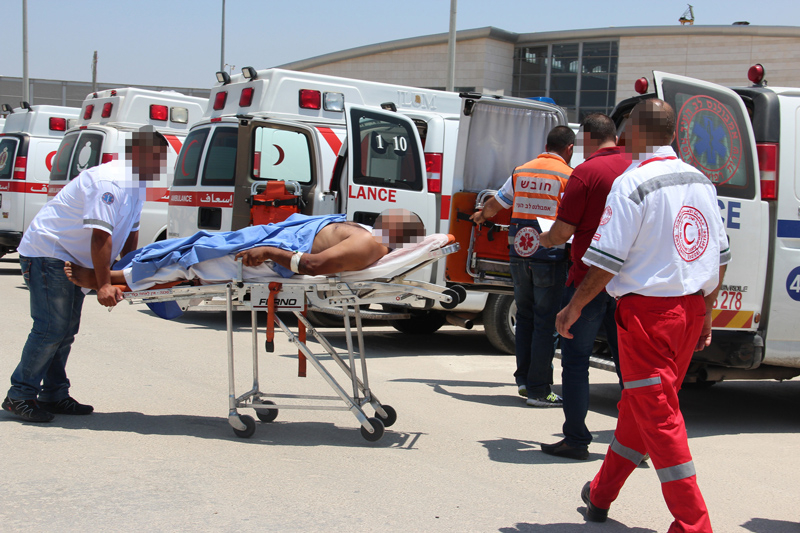
A Palestinian man is transferred to an Israeli ambulance at the Erez crossing between the Gaza Strip and Israel, on his way to an Israeli hospital, July 29, 2014. (Image source: Israeli Foreign Ministry)

This, of course, does not apply to senior Palestinian officials and their family members, who continue to make ample use of Israeli hospitals and other medical centers in Jordan, Egypt, the Gulf and Europe.

Even top Hamas officials enjoy access to Israeli hospitals. In 2013, Amal Haniyeh, the granddaughter of Hamas leader Ismail Haniyeh, was transferred to an Israeli hospital for urgent medical treatment. A year earlier, Haniyeh’s sister, Suheilah, was also brought to an Israeli hospital for urgent heart surgery.

Haniyeh, however, did not need to offer cash to get his daughter and sister medical treatment in Israel. Indeed, some Palestinians are evidently very much more equal than others.

The corruption in the Palestinian health system, both in the West Bank and Gaza Strip, has long been a well-known secret. Palestinians without the right connections and without money to hand over to a senior official or physician are fully aware that they would never be allowed to receive what is called “medical referrals abroad.” The signature of a physician or a senior health official is the most precious merchandise in the West Bank and Gaza Strip. This signature allows patients to receive free medical treatment in Israel and various countries.

The absence of clear regulations to define who is entitled to this privilege have facilitated widespread corruption in the Palestinian health system. Nepotism plays a major role in this form of corruption. The relative of a senior Palestinian official can easily be transferred for treatment in an Israeli, Jordanian or Egyptian hospital, while poor patients from the Gaza Strip can wait months and years before obtaining such permits.

Hamas and PA officials are trading with the lives of Palestinian patients. They have turned medical care into a business that earns them hundreds of thousands of dollars per year. This corruption, in the absence of transparency and accountability, has also enabled top officials in the West Bank and Gaza Strip to embezzle millions of shekels from the PA budget.

Although both the Palestinian Authority and Hamas have vowed to combat this exploitation of Palestinian patients, the Palestinians themselves report no improvement. They say that more than 70% of the cases of medical referrals to Israeli hospitals and abroad have never been documented, and it remains unclear how and where the money was spent.

In 2013, for instance, the PA spent more than half a billion shekels covering medical bills of Palestinians who were referred to hospitals outside the Palestinian territories. However, no one seems to know exactly how the money was spent and whether all those who received the referrals were indeed in need of medical treatment.

The PA maintains that in 2014, more than 54,000 Palestinians from Gaza received medical referrals for treatment outside the Strip. Health officials in the Gaza Strip, however, say they are aware of only 16,382 documented cases of real patients who received such permits.

Between 1994 and 2013, the Palestinian Authority did not ask Israeli hospitals for detailed bills of the medical treatment provided to Palestinian patients. The money is deducted on a monthly basis from tax revenues collected by Israel and later paid to the PA.

The Coalition for Accountability and Integrity (AMAN), a Palestinian group working in the fields of democracy, human rights and good government, to combat corruption and enhance integrity, principles of transparency and systems of accountability in Palestinian society, is one of the few bodies sounding an alarm bell about this abuse.

Last year, AMAN released a report in which it warned against corruption in the Department of Medical Referrals Abroad, which belongs to the PA Ministry of Health. The report pointed out discrepancies in the costs of medical treatment in Israeli and other hospitals, and the actual bills. For example, in one case it appeared that 113 Palestinian patients had been admitted to Israeli hospitals at the cost of 3 million shekels, while there is no documentation of any of these cases. Even the identities of the patients remain unknown.

The AMAN report stated that measures taken by Palestinian health officials to limit nepotism and bribes, and prevent the squandering of public funds, have been insufficient. Physicians, it said, faced pressure from Palestinian Authority officials to issue medical referrals to Israeli hospitals and other hospitals around the world, even to those not in need of them. Some of the cases, the report notes, could have been treated in Palestinian hospitals, and there was no need to transfer them to other hospitals at very high costs.

The PA says that it has asked its Anti-Corruption Commission to investigate the scandal. To date, it remains unclear whether substantive measures have been taken against those responsible for the corruption.

Hamas, for its part, continues to hold the PA responsible for the misery of patients in the Gaza Strip. The Islamist movement claims that the PA government is withholding the issuance of medical permits as a means to punish Palestinians for their support of Hamas.

The truth, however, is somewhat different: health officials in the Gaza Strip who are linked to Hamas have also been exploiting the plight of patients. Hamas is uninterested in this coming to light.

Hajer Harb, a courageous Palestinian journalist from the Gaza Strip, recently prepared an investigative report about the corruption of health officials in the West Bank and Gaza Strip. She has been repeatedly interrogated by Hamas.

Harb says she is now facing charges of “slander” for exposing the corruption. She was told by her interrogators that the decision to summon her for investigation came after a physician in the Gaza Strip filed a complaint against her for “defamation.”

Hamas interrogators demanded that Harb reveal her sources and the identity of those involved in the corruption scandal. “I told them that I am a journalist and I cannot provide them with the identities of my sources without a court order,” she said.

“The prosecution told me that I was facing the following charges: impersonation of another person (they claim I did not reveal my real identity during the investigative report); slandering the Ministry of Health, publishing inaccurate and incorrect information and working with ‘foreign parties’ (by preparing a report for a London-based television station under the pretext that the media organization is not registered with the Press Office in the Gaza Strip).”

In her report, Harb wrote about the middlemen who obtain medical referrals to Israeli and foreign hospitals in return for bribes. She approached one of the middlemen and claimed she wanted to travel from the Gaza Strip to the West Bank to marry a man living there. She wrote that she received a permit to leave the Gaza Strip and receive medical treatment in East Jerusalem’s Al-Makassed Hospital after she paid a bribe to a local physician. She also found several forged medical referrals in the name of the son of a senior Palestinian official in the Gaza Strip, who obtained them in order to complete his studies in the West Bank. Harb further located a man who claimed that he works for the PA’s Preventative Security Service and who boasted that he could get a permit for medical treatment outside the Gaza Strip in return for $200. Another Palestinian bought a medical permit to leave the Gaza Strip and work in a restaurant in Ramallah.

Hamas claims to be combating the corruption of officials who are tampering with the lives of Palestinian patients. In reality, it is busy harassing journalists who speak the truth. The Palestinian Authority regime, for its part, is not too happy with exposure about the scandal.

The Palestinian Journalists Syndicate (PJS), based in the West Bank, condemned Hamas for harassing Harb. But this critique should be seen more in the context of the power struggle between the PA and Hamas, rather than as stemming from a concern for public freedoms.

In a statement, the PJS criticized Hamas for interrogating Harb as a “grave breach of media work and freedom of expression” in the Palestinian territories. The syndicate emphasized the right of journalists not to reveal the identity of their sources, adding that Harb had abided by all moral, legal and professional standards.

Najat Abu Baker, a member of the Palestinian Legislative Council who belongs to PA President Mahmoud Abbas’s Fatah faction, was one of the few politicians in the West Bank who dared to come out against the corruption scandal.

In her words, the corruption in the PA’s Department of Medical Referrals has transformed it into a “real mafia headed by influential figures.” Abu Baker accused the ministry of exploiting the impoverished residents of the Gaza Strip and wasting public funds:

“The issue of medical permits has become a business and the only ones who are paying the price are the patients from the Gaza Strip. Hundreds of these patients who have died are the victims of the ministry’s measures.”

She called for a commission of inquiry into the corruption scandal. She noted that many patients from the Gaza Strip have died while waiting for medical referrals while others, who were not ill, were given the permits thanks to nepotism and bribery.

“The merchants of death are tampering with the fate of our patients. It is time to tell the truth so that we can get rid of the mafia of destruction and end their trade in the lives of our patients.”

The medical permit scandal is yet further proof that Hamas and the Palestinian Authority shamelessly exploit their people for political and financial purposes. The PA leverages its power to issue medical permits in order to pressure Palestinians in the Gaza Strip to turn against Hamas. Its officials sell the permits for cold hard cash. Hamas, which continues to hold the entire Gaza Strip hostage, has its own ideas about how money is well spent. Gaza’s hospitals would be rather better equipped if Hamas used the money it has to build medical centers instead of tunnels for smuggling weapons from Egypt to attack Israel. While medical permits are sold to the highest Palestinian bidder, we ask: What is the going rate for a permit for clarity concerning the behavior of Palestinian leaders?

Khaled Abu Toameh, an award-winning journalist, is based in Jerusalem.