Posted tagged ‘United Nations’

Turkey to Host UN’S First Global Humanitarian Summit

March 30, 2016

Turkey to Host UN’S First Global Humanitarian Summit, Front Page MagazineJoseph Klein, March 30, 2016

(Please see also, Turkish Gov’t Children’s Magazine Promotes Martyrdom. — DM)
rf_2

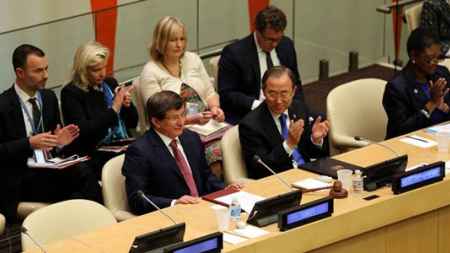
The first-ever United Nations-sponsored World Humanitarian Summit is scheduled to take place May 23-24, 2016 in Istanbul, Turkey. UN Secretary General Ban Ki-moon praised Turkey’s “compassionate leadership” in hosting the summit and its “admirable commitment to humanitarian action.”

Turkey’s hosting of the UN humanitarian summit is a travesty. Ban Ki-moon’s praise of Turkey’s “compassionate leadership” and “admirable commitment to humanitarian action” is a disgrace.  Did perhaps the Secretary General have in mind the so-called Turkish “charity” known as the Foundation for Human Rights and Freedoms and Humanitarian Relief (IHH)? Despite its name and some programs that have delivered aid to areas in genuine need, IHH has an overtly political Islamist agenda. It has had a particular interest in directing assistance to terrorist organizations such as Hamas, and has had ties with al Qaeda and the Muslim Brotherhood. It is looking forward, in its words, to when “Muslims may show up in Tel Aviv and Jerusalem one day unannounced and we will erect the flag of Islam everywhere.”

The IHH is best known for sponsoring the 2010 Gaza flotilla, which had been sent to break Israel’s legal naval blockade of Gaza against the shipment of weaponry to Hamas. Nine armed Turkish Hamas supporters on one of the ships were killed by Israel Defense Force personnel, whom had acted in self-defense after they had boarded the ship to prevent it from reaching Gaza. Never mind that a UN investigatory committee subsequently concluded that Israel had legally boarded the IHH ship in the first place. Turkey’s leader Recep Tayyip Erdogan sided with the IHH and Hamas, and accused Israel of engaging in “state terrorism.” Erdogan’s government has coordinated with the IHH and has given it cover as a so-called “humanitarian” charity so that it could carry on its support of Hamas against Israel. Erdogan’s loyalists even went so far as to fire a senior police official who thought he was simply doing his job by conducting a police raid of IHH offices. The raid which so displeased Erdogan had led to the detention of at least 23 people with alleged ties to Al Qaeda.

Apart from its ties to the misnamed Foundation for Human Rights and Freedoms and Humanitarian Relief, Erdogan’s government has made a mockery of the “core responsibilities” outlined in the Agenda for Humanity, which will be the focus of discussion at the Istanbul UN World Humanitarian Summit in May.

For example, one of these core responsibilities is “a commitment to address forced displacement.” Turkey has a huge internal displacement problem, primarily involving the forced displacement of members of its minority Kurdish population. Between 954,000 and 1.2 million people were forced to flee their homes between 1986 and 2005. Turkey’s attempts to address this situation, with such measures as compensation for the victims, have been fitful at best. Most internally displaced persons (IDPs) have been left to fend for themselves, living in poverty. According to the Internal Displacement Monitoring Centre, “Poverty has forced IDPs’ children to work rather than going to school, and some women have resorted to negative coping mechanisms including prostitution to get by.”

In Cyprus, Greek Cypriots were forcibly expelled from their homes after Turkey invaded the northern area of the Republic of Cyprus and placed it under military occupation in 1974. Turkey’s illegal occupation of the northern third of the island continues to this day. The European Court of Human Rights concluded in a judgment against Turkey for damages that “Greek-Cypriot owners of property in northern Cyprus are being denied access to and control, use and enjoyment of their property as well as any compensation for the interference with their property rights.” The Court noted “the protracted feelings of helplessness, distress and anxiety” suffered by the victims of Turkey’s actions. Turkey’s Foreign Minister angrily rejected the Court’s verdict.

Another “core responsibility” outlined in the Humanitarian Summit’s Agenda for Humanity is “catalyzing action to achieve gender equality.” Turkey’s President Erdogan declared in November 2014 that “men and women are not equal; it is against nature.” In the 2015 Global Gender Gap country rankings, Turkey is near the bottom of the list – 130th out of 145 countries surveyed. It placed only four countries above Saudi Arabia.

According to an article written in 2015 by Meltem Müftüler-Baç, a Professor of International Relations  and Jean Monnet chair at Sabanci University, Istanbul, “when it comes to protecting Turkish women against violence, ensuring their rights of education and employment, and even their right to choose their own spouse, women face layers of discrimination. Child marriages and domestic violence are the most visible forms, with around 30-35% of all marriages in Turkey involving under-age girls, rising in rural southeastern Turkey to up to 75%.”

Two other “core responsibilities” outlined in the Humanitarian Summit’s Agenda for Humanity are “leadership to prevent and end conflicts” and “upholding the norms that safeguard humanity.” Turkey has engaged in policies that have heightened conflicts and caused human suffering.

In September 2015, for example, the Turkish Armed Forces besieged the Kurdish town of Cizre in southeastern Turkey. Civilian residents have been cut off from receiving food, medical supplies, water and electricity for days on end.  In one incident, people were trapped inside a burning, multi-story building, surrounded by Turkish troops who reportedly would not let them out. Unconfirmed reports have estimated the number of people killed in the fire as at least 150, and perhaps several hundred more.

“This was a residential building where women and children lived. Erdogan killed them all with heavy artillery. He destroyed this building. They say they’re fighting terrorists. But where are the terrorists? All victims were local civilians,” a local resident told journalists. “They were old men, women, and children. They even killed pregnant women.”

Turkey’s claim to humanitarian action is its hosting of 2.5 million refugees from Syria, more than any other country worldwide. However, while Turkey can spin the sheer number of refugees it has admitted and the billions of dollars it has spent to host them on its soil, Turkey has also contributed to creating the problem in the first place. It has served for years as a passage way for foreign jihadists to reach Syria and exacerbate the conflict. Moreover, many of the refugees living in Turkey are treated poorly. They “still live in terrible conditions, some have been deported back to Syria and security forces have even shot at Syrians trying to cross the border,” said Gauri van Gulik, Amnesty International’s Deputy Director for Europe and Central Asia.

Until very recently, Turkish authorities have looked the other way as smugglers transported self-proclaimed “asylum-seekers” and economic migrants – mostly young adult males – from Turkey’s shores to Greece.  From Greece, they began their trek through European Union member states to reach Germany or other desirable destinations. These include ISIS fighters embedded in the masses of refugees reaching Europe from Turkey, as well as garden variety criminals whom have responded to the welcome they received in Germany, Sweden and other EU member states with gang rapes, armed robberies and murder.

Erdogan used the prospect of a continued flow of refugees from Turkey to Europe as a bargaining chip to win key concessions from his European counterparts. Most importantly, he extracted a pledge of €6 billion from Europe (approximately US$6.7 billion based on the current currency conversion rate) to be paid by 2018. For its part, Turkey agreed to take back new refugees seeking to enter Europe and to implement other measures to stem any future refugee flow. The amount Europe will be paying Erdogan’s regime is the equivalent of over 3 years of Turkey’s expenditures on Syrian refugees, based on its own report of US$1.8 billion for all of its humanitarian related expenditures in 2014. No doubt, Turkey will have its hand out for more money from the European Union well before the end of 2018.

Erdogan is an autocrat. His government tramples on basic human rights such as freedom of expression. It has committed what could be considered crimes against humanity in its treatment of its Kurdish population. It scoffed at a judgment by the European Court of Human Rights, which sought to hold Turkey accountable for its illegal occupation in Cyprus and the human suffering it caused. Erdogan’s government has an abysmal record on women’s rights. It is extracting a large sum of money and other concessions from the European Union in order to stem the flow of Syrian refugees from Turkey to Europe that it helped to worsen in the first place. And it supports terrorist organizations such as Hamas.

In short, Turkey is one of the last places on earth that should be hosting a global summit devoted to addressing genuine humanitarian concerns.
You can’t make it up. UN names democratic Israel as world’s top human rights violator

March 29, 2016

You can’t make it up. UN names democratic Israel as world’s top human rights violator, Fox News, March 29, 2016

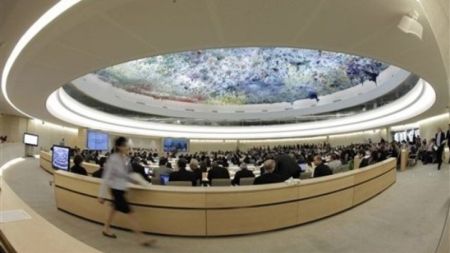
UNHRCFILE — A woman walks past the Human Rights Council at the European headquarters of the United Nations in Geneva, Switzerland.

According to the United Nations, the most evil country in the world today is Israel. 

On March 24, 2016, the U.N. Commission on the Status of Women (CSW) wrapped up its annual meeting in New York by condemning only one country for violating women’s rights anywhere on the planet – Israel, for violating the rights of Palestinian women.

On the same day, the U.N. Human Rights Council concluded its month-long session in Geneva by condemning Israel five times more than any other of the 192 UN member states.

There were five Council resolutions on Israel.  One each on the likes of hellish countries like Syria, North Korea and Iran.  Libya got an offer of “technical assistance.”  And countries like Russia, Saudi Arabia and China were among the 95 percent of states that were never mentioned.

No slander is deemed too vile for the U.N. human rights bodies that routinely listen to highly orchestrated Palestinian versions of the ancient blood libel against the Jews.

Asylum-Seekers from Israel by Country in 2015 | FindTheData

(Map at link — DM)

In Geneva, Palestinian representative Ibrahim Khraishi told the Council on March 24, 2016:  “Israeli soldiers and settlers kill Palestinian children. They shoot them dead. They will leave them to bleed to death.”  And in New York, Palestinian representative Haifa Al-Agha told CSW on March 16, 2016:  “Israel…is directing its military machinery against women and girls. They are killing them, injuring them, and leaving them bleeding to death.”

Operating hand-in-glove with governments and the U.N. secretariat are the unelected, sanctimonious NGOs, to which the UN offers free facilities and daily advertisement of “side-events.”  In theory “materials containing abusive or offensive language or images are not permitted on United Nations premises.”

In practice, in Geneva the UN permitted handouts that claimed Israel “saw ethnic cleansing as a necessary precondition for its existence.”  A film accused Israel of sexual violence against children and “trying to exterminate an entire Palestinian generation.”  Speeches focused on the 1948 “catastrophe” in which a “settler colonial state” was established on Palestinian land.

The New York CSW-NGO scene included a film set in in the context of Israeli “oppression” and the “tear gas of my childhood,” and statements analogizing the experiences of Palestinians to today’s Syrian refugees.

Picture these real-life scenes:

In Geneva’s grand U.N. “Human Rights” Council chamber, 750 people assembled, pounced on the Jewish state, broadcast the spectacle online, and produced hundreds of articles and interviews in dozens of languages championing the results.

On the ground, Israelis are being hacked to death on the streets, stabbed in buses, slaughtered in synagogues, mowed down with automobiles, and shot in front of their children.

At the New York’s UN headquarters, 8,100 NGO representatives gathered from all corners of the globe, in addition to government delegates, and watched the weight of the entire world of women’s rights descended on only one country.

On the ground, Palestinian women are murdered and subjugated for the sake of male honor, Saudi women can’t drive, Iranian women are stoned to death for so-called “adultery,” Egyptian women have their genitals mutilated and Sudanese women give birth in prison with their legs shackled for being Christian.

Isn’t it about time that people stopped calling the U.N. a harmless international salon or a bad joke?

The poison isn’t simply rhetorical.  One of the Council resolutions adopted last week launches a worldwide witch-hunt for companies that do business with Israel – as part of an effort to accomplish through economic strangulation what Israel’s enemies have not been able to accomplish on the battlefield.  The resolution casts a wide net encompassing all companies engaged in whatever the U.N. thinks are business “practices that disadvantage Palestinian enterprises.”

And the toxicity is self-perpetuating. Acting at the beck and call of Islamic states and their conduit – French Ambassador Elizabeth Laurin and Council President Choi Kyonglim selected Canadian law professor Michael Lynk as the newest U.N. “independent” human rights investigator on Israel.

Lynk’s qualifications?  He has likened Israelis to Nazis, and challenged the legitimacy of the state of Israel starting in 1948 as rooted in “ethnic cleansing.”

All of this played out in the same week that Europe was reeling from the Belgian terror attacks.  Petrified or already vanquished, no European state voted against this onslaught of U.N. resolutions against Israel.  Germany and the United Kingdom occasionally abstained, while France voted with Arab and Islamic states on all but one Council resolution.

Here we are just 70 years after World War II and Europeans believe that they can license this vitriol against the Jewish state – the only democracy on the front lines of an Islamist war against human decency – and the consequences can be contained to the Jews.

Even as the converse stares them in the face.  Two days after the Brussels attacks, Islamic states rammed through a Council resolution slyly labeled “Effects of terrorism on the enjoyment of all human rights” that was actually so anti-human rights even Belgium was forced to vote against it.

As for the United States, the Obama administration has been the Human Rights Council’s most important supporter.  Though the U.S. is currently in a mandatory one-year hiatus — after serving two consecutive terms — President Obama plans to bind his successor by running again in the fall for another three-year term that starts January 1, 2017.

Memo to Americans who are mad as hell: It’s time to elicit a promise from our would-be leaders to refuse to sit on the U.N. Human Rights Council or to legitimize the United Nations.


Op-Ed: At the UN, ISIS and Israel are equal

March 17, 2016

Op-Ed: At the UN, ISIS and Israel are equal, Israel National News, Giulio Meotti, March 17, 2016

Professor of Law at Queen Mary University of London, Penny Green, is the first candidate for the role of the UN envoy to Israel and the Palestinian territories, a position that the Human Rights Council in Geneva will soon fill.

Ms. Green would be a truly “impartial” choice. She accuses Israel of being a “criminal state”, of being guilty of “ethnic cleansing” and “apartheid” and she even compares Israel to the Islamic State. Green has also complained that the US and the UK have not yet begun to bomb Israel for its “massacres”. The other “impartial” candidate, Canadian Professor Michael Lynk, is a bit more decent as he only signed anti-Israel petitions.

Considering that without the US veto Israel would have already been blacklisted by the UN Security Council; considering that Israel is treated worse than North Korea and Nigeria at the Human Rights Council; considering that at UN schools in Gaza Hamas stocks missiles to be launched against Israel; considering that the UN court in The Hague treats Israeli officials as Nazi war criminals, why is it so outrageous naming as UN bureaucrats those who compare Caliph Al Baghdad to Prime Minister Benjamin Netanyahu?

The UN envoy for Children and Armed Conflict, Leila Zerrougui, suggested including the Israeli army in the black list of countries and organizations that regularly cause harm to children along with Al Qaeda, Boko Haram, the Islamic State of Iraq and Syria, the Taliban, and countries such as the Congo and the Central African Republic, infamous for their armies of children.

The culture of human rights, created by Jewish jurists after the Holocaust, is now being used by anti-Semites to foment a war against the State of Israel. Mr. Alfred de Zayas, the United Nations’ Independent Expert on the promotion of a democratic and equitable international order, blamed last year’s Paris attacks on the U.S., Western colonialism, capitalism, and “Israeli settlers”, implicitly justifying them as “a response to grave injustices and ongoing abuses perpetrated by the dominant, primarily developed countries, against populations of less developed countries”.

Instead of equating Hamas with ISIS and ISIS with Iran, the UN officials ponder whether to include the IDF on the same lepers’ list as Islamic State. Whether they succeed or not doesn’t matter: they very presence pollutes the political atmosphere and destroys the reputation of the Jewish State.

Israel’s biggest enemy today is not Jihadism, but the UN, which entrusted the defense of human rights to China, Cuba, Russia and Saudi Arabia, among other liberal bastions, and to paranoid “experts” whose anti-Semitism resembles that of Doktor Joseph Goebbels.

‘State of Palestine’ Becomes Member of Permanent Court of Arbitration in The Hague

March 17, 2016

State of Palestine’ Becomes Member of Permanent Court of Arbitration in The Hague

by Breitbart Jerusalem

16 Mar 2016

Source: ‘State of Palestine’ Becomes Member of Permanent Court of Arbitration in The Hague – Breitbart

The Associated Press

The Jerusalem Post reports:

The Permanent Court of Arbitration in The Hague announced on Tuesday that the State of Palestine has joined it, becoming its 118th member state.

It is unclear how significant an achievement joining the PCA is with the Palestinians likely to brandish it as supporting their joining the International Criminal Court and Israel likely to underplay it.

At press time, the Palestinian Authority had not responded to inquiries and the Foreign Ministry responded, “this is a legal body which is not among the more important ones. What a waste that the Palestinians continue to invest efforts to be accepted into these kinds of bodies instead of returning to the negotiating table.”

Israel opposes any recognition of Palestine as a state outside of bilateral negotiations.

The ICC Prosecution in January 2015 accepted Palestine as a state for purposes of opening an examination of the 2014 Gaza war crimes allegations and of the settlements enterprise, but Israel has been trying to convince it to back away from this position.

Tuesday’s news only complicates Israel’s efforts, even as the PCA is much less prominent now than the ICC.

Read the full story.

Russia Reminds Obama: You Caved on Iran’s Missile Program, Bro

March 15, 2016

Russia Reminds Obama: You Caved on Iran’s Missile Program, Bro, Washington Free Beacon, Beacon Staff, March 15, 2016


https://www.youtube.com/watch?v=G-isxwtpw_U


Days after the latest Iranian ballistic missile test, Russia and Iran are telling the Obama administration that Iranian missile tests are not prohibited by the UN Security Council, as the administration argues.

Russia and Iran cited language about ballistic missiles that was changed during last summer’s nuclear negotiations in Vienna. UN Security Council Resolution 1929 had stated plainly: “Iran shall not undertake any activity related to ballistic missiles.” During the negotiations, Iran demanded the removal of this uncompromising language in favor of a new, softer formulation.

The Obama administration complied, resulting in the passage of a new UN Security Council Resolution after the Iran agreement was reached. The new resolution merely “calls upon Iran not to undertake any activity related to ballistic missiles.”

The change in language—from the “shall not” requirement of the original resolution to the “calls upon” suggestion of the new one—was the subject of intense questioning by Congress precisely due to the suspicion that the administration had provided a loophole Iran would use to justify missile development.

In one exchange, Sen. Robert Menendez (D., N.J.) pressed Secretary of State John Kerry to acknowledge that the change in language was substantive.

“The ban on Iranian ballistic missiles,” Menendez told Kerry, “has, in fact, been lifted. The new Security Council resolution is quite clear. Iran is not prohibited from carrying out ballistic missile work.” Kerry rejected Menendez: “That is not accurate … [Iran is] restrained from any sharing of missile technology, purchase of missile technology, exchange of missile technology, work on missiles.”

In response to the Obama administration’s announcement that it would pursue sanctions after Iran’s latest missile test, Russia’s UN Ambassador raised precisely the objection that Menendez and other critics of the deal did: Obama and Kerry removed the prohibition on Iranian ballistic missile work last summer, when they agreed to remove the “shall not” language from the relevant UNSC resolution.

Report: Obama to use UN to divide Jerusalem

March 8, 2016

Report: Obama to use UN to divide Jerusalem, Israel National News, David Rosenberg, March 8, 2016

Senior US officials revealed that the President is looking to initiate a final negotiated settlement between Israel and the Palestinian Authority using United Nations Security Council resolutions, a step that would obligate not only Israel and the Palestinian Authority, but effectively determine the direction of US policy for the president’s successor as well.

The report comes ahead of Vice President Joe Biden’s visit to Israel on Tuesday, where he is scheduled to meet with Israeli Prime Minister Binyamin Netanyahu and senior Palestinian Authority officials.

On Monday, the Prime Minister’s Office reported that Netanyahu’s annual trip to the US, planned for later this month, had been cancelled. Israeli officials remarked that the cancellation was in part due to President Obama’s refusal to schedule a meeting with the Prime Minister. Later on Monday, the White House issued a statement denying those claims, asserting that the president had in fact invited the Israeli leader to talks during his visit.

According to the plan described by senior US officials, Obama is considering reviving the dormant Middle East Quartet, a diplomatic body including the US, UN, EU, and Russia, to apply pressure to Israel and the Palestinian Authority to resume active negotiations.

The President is also considering use of a United Nations Security Council resolution to forcibly extract concessions from Israel and the PA. The US has until now vetoed any such resolutions, though Mr. Obama has in the past threatened to allow them to pass.

A Security Council resolution would be binding upon all parties, unlike General Assembly measures which are non-obligatory recommendations. Such a resolution would remain in force even after the president leaves office next January, effectively shaping the future of American policy in the region for Mr. Obama’s successors.

The resolution would require Israel cease construction over the Green Line and would force Israel to recognize eastern Jerusalem as the capital of Palestine.

At the same time, the Palestinian Authority would be obliged to officially recognize Israel as a Jewish state and would be pressured to give up the long-standing demand for a right of return.

IAEA: Iran Nuke Deal Limits Public Reporting on Possible Violations

March 7, 2016

IAEA: Iran Nuke Deal Limits Public Reporting on Possible Violations, Washington Free Beacon, , March 7, 2016

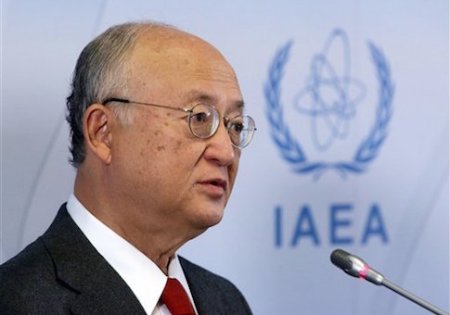
Director General of the International Atomic Energy Agency, IAEA, Yukiya Amano of Japan addresses the media during a news conference after a meeting of the IAEA board of governors at the International Center in Vienna, Austria, Monday, March 7, 2016. (AP Photo/Ronald Zak)

Director General of the International Atomic Energy Agency, IAEA, Yukiya Amano of Japan addresses the media during a news conference after a meeting of the IAEA board of governors at the International Center in Vienna, Austria, Monday, March 7, 2016. (AP Photo/Ronald Zak)

The head of the international community’s nuclear watchdog organization disclosed Monday that certain agreements reached under the Iran nuclear deal limit inspectors from publicly reporting on potential violations by the Islamic Republic.

Yukiya Amano, chief of the International Atomic Energy Agency, or IAEA, which is responsible for ensuring Iran complies with the agreement, told reporters that his agency is no longer permitted to release details about Iran’s nuclear program and compliance with the deal.

Amano’s remarks come on the heels of a February IAEA oversight report that omitted many details and figures related to Iran’s nuclear program. The report sparked questions from outside nuclear experts and accusations from critics that the IAEA was not being transparent with its findings.

Amano disclosed in response to questions from reporters that the last report was intentionally vague because the nuclear agreement prohibits the IAEA from publishing critical data about Iran’s program that had been disclosed by the agency in the past.

“The misunderstanding is that the basis of reporting is different,” Amano said. “In the previous reports, the bases were the previous [United Nations] Security Council Resolutions and Board of Governors. But now they are terminated. They are gone.”

Most U.N. measures pertaining to Iran—including its military buildup and illicit work on nuclear technology—were removed following the nuclear agreement, which essentially rewrote the organization’s overall approach to the country.

The IAEA, which operates under the U.N. umbrella, must now follow the new resolutions governing the implementation of the nuclear pact, Amano said.

“These two resolutions and the other resolutions of the Security Council and Board are very different,” he said. “And as the basis is different, the consequences are different.”

Amano said that going forward, the agency would only release reports that are consistent with the most recent Security Council resolutions on Iran, meaning that future reports are likely to impact the international community’s ability to determine if Iran is fully complying with its end of the agreement.

Last month’s report was viewed as particularly significant because it allowed the nuclear agreement to proceed to its implementation stage. However, the dearth of information in it has angered some experts.

The latest report “provides insufficient details on important verification and monitoring issues,” Olli Heinonen, the IAEA’s former deputy director general, stated in a policy brief.

“The report does not list inventories of nuclear materials and equipment or the status of key sites and facilities,” Heinonen said in his analysis, which was published by the Foundation for Defense of Democracies. “Without detailed reporting, the international community cannot be sure that Iran is upholding its commitments under the nuclear deal.”

The IAEA’s latest report also failed to disclose information about Iran’s stockpiles of low-enriched uranium, which is supposed to be significantly reduced as part of the nuclear deal.

Additional information about Iran’s nuclear centrifuges, the machines responsible for enriching uranium, also was withheld by the IAEA.

Other critics accused the Obama administration of misleading Congress during negotiations over the deal. White House officials maintained at the time that the agreement would provide increased transparency into Iran’s nuclear endeavors.

“When nuclear negotiations began in late 2013, the administration asked Congress to stand down on pressuring the Iranians, and promised to force the Iranians to dismantle significant parts of their nuclear program if Congress gave negotiators space,” Omri Ceren, an official with The Israel Project, which works with Congress on the Iran issue, wrote in an analysis sent to reporters on Monday.

“U.S. negotiators eventually caved on any demands that would have required the destruction of Iran’s uranium infrastructure, and instead went all-in on verification and transparency: Yes, the Iranians would get to keep what they’d built, and yes, their program would eventually be fully legal, but the international community would have full transparency into everything from uranium mining to centrifuge production to enriched stockpiles,” Ceren explained.

However, “now Amano has revealed that the nuclear deal gutted the ability of journalists and the public to have insight into Iran’s nuclear activities,” he said. “In critical areas, it’s not even clear that the IAEA has been granted the promised access.”

Report: Israel’s northern border violated daily

February 28, 2016

Report: Israel’s northern border violated daily, Israel National News, David Rosenberg, February 28, 2016

Lebanon borderIDF patrol along border with Lebanon Flash 90

Israel’s border with Lebanon is violated on a daily basis, according to a new report by the Israeli Mission to the United Nations.

The report also shows the degree to which UN resolutions are ignored and even tolerated – despite the presence of United Nations observers. In 2015 alone, there were fully 2,374 documented violations of the most recent UN ruling on the Israel-Lebanon border, UN Security Council Resolution 1701.

Israel’s Ambassador to the UN, Danny Danon, conveyed the statistics to the UN Secretary General and Security Council. Danon condemned the rampant violations of the border area and the UN’s tacit acceptance of Hezbollah control.

“The government of Lebanon is not acting and armed Hezbollah operatives are roaming freely throughout the south Lebanon in violation of the UN,” Danon said. “Hezbollah has free reign in South Lebanon and instead of reacting forcefully to their violations, the UN is ignoring the problem.”

Hezbollah, which has de facto autonomy in southern Lebanon, maintains regular armed patrols along the Blue Line – the UN’s demarcation between Israel and Lebanon – well within the United Nations Interim Force in Lebanon (UNIFIL) security zone. The number of Hezbollah patrols along the border in 2015 was estimated at 653.

More disturbing, the report revealed that Israel’s northern border is violated on a daily basis. During 2015 alone, infiltrators breached the border 589 times.

Another 1,079 incidents of armed individuals – presumably Hezbollah fighters – openly operating in the UNIFIL security zone were recorded.

The report noted two Hezbollah terror attacks on Israel in 2015, and 51 violent protests targeting Israeli forces along the border.

Exclusive: Obama Refuses to Hit ISIS’s Libyan Capital

February 18, 2016

Exclusive: Obama Refuses to Hit ISIS’s Libyan Capital, Daily Beast, Nancy A. Youssef, February 18, 2016

(Please see also, ISIS Leader Moves to Libya. — DM)

Islamic State in Libya

Despite the growing threat from the self-proclaimed Islamic State in Libya, the Obama administration has turned down a U.S. military plan for an assault on ISIS’s regional hub there, three defense officials told The Daily Beast. 

In recent weeks, the U.S. military—led by its Africa and Special Operations Commands—have pushed for more airstrikes and the deployment of elite troops, particularly in the city of Sirte. The hometown of former Libyan leader Muammar Gaddafi, the city is now under ISIS control and serving as a regional epicenter for the terror group.

The airstrikes would target ISIS resources while a small band of Special Operations Forces would train Libyans to eventually be members of a national army, the officials said.

Weeks ago, defense officials told The New York Times that they were crafting military plans for such strikes, but needed more time to develop intelligence so that they could launch a sustained air campaign on ISIS in Sirte.

But those plans have since been put on the back burner.

“There is little to no appetite for that in this administration,” one defense official explained.

Instead, the U.S. will continue to do occasional strikes that target high-value leaders, like the November drone strike that killed Abu Nabil al-Anbari, the then-leader of ISIS in Libya.

“There’s nothing close to happening in terms of a major military operation. It will continue to be strikes like the kind we saw in November against Abu Nabil,” a second defense official explained to The Daily Beast.

The division over what action the U.S. and the international community should take in Libya speaks to the uncertainty about when and where ISIS should be countered.

For Europe, Libya is uncomfortably close and already a jumping off point for migrants willing to take on the rough Mediterranean waters in search of asylum. ISIS pronouncements have previously pointed out that Rome is nearby.

For the United States, there are major concerns about allowing another ISIS hub to emerge in the region. The Libyan city of Sirte is under ISIS control and some believe the terror group seeks to turn Sirte into a center of operations, like Raqqa in Syria and Mosul in Iraq.

Leaders across Europe have hinted that more should be done in Libya but have fallen short on specifics. In an interview with Der Spiegel last month, the German envoy to Libya said: “We simply cannot give up on Libya.”

According to U.S. military figures, there are roughly 5,000 ISIS fighters in Libya, a spike from 1,000 just a few months ago. Defense officials believe that ISIS supporters are moving toward Libya, having found it increasingly difficult to travel to Iraq and Syria.

Perhaps because of that, Sirte, and areas around it, are increasingly falling victim to ISIS’s barbaric practices. And some are urging the international community not to wait until Sirte falls further under ISIS control, and filled with fighters mixed in with civilians.

According to this report, residents there cannot leave the city freely as ISIS fighters—many of them from Egypt, Chad, Niger, and Tunisia—inspect cars for signs of residents trying to escape. As in Raqqa and Mosul, residents do not have access to cellphone or Internet networks and live under an ISIS judicial system that issues death sentences to those who do not practice the terror group’s brand of Islam.

Moreover, in nearby cities like Ras Lanouf, ISIS is destroying oil installations, cutting off a key potential source of revenue for any newly cobbled unified Libyan government. ISIS has set its sights across the country, from Misrata in the west to Derna in the east.

Some fear the terror group is hunkering down in places like Sirte in preparation for a potential U.S. offensive.

The administration had said that it would not intervene until Libya, which now is governed by two rival governments on opposite sides of the country, had created a single entity to govern the state.

At a press conference Tuesday, during this year’s summit of the Association of Southeast Asian Nations, President Obama referred to United Nations efforts to help build a government in Libya, suggesting any military effort could create even more political fractures. On Sunday, a member of Libya’s Presidential Council announced that a list of 13 ministers and five ministers of state had been sent to Libya’s eastern parliament for approval.

But while the president said the U.S. would go after ISIS “anywhere it appeared,” he stopped short of saying the U.S. would expand its effort in Libya unilaterally.

“We will continue to take actions where we’ve got a clear operation and a clear target in mind. And we are working with our other coalition partners to make sure that as we see opportunities to prevent ISIS from digging in, in Libya, we take them. At the same time, we’re working diligently with the United Nations to try to get a government in place in Libya,” the president said. “And that’s been a problem.”

Some military officials believe Obama feels that France and Italy, which both have hinted at intervention, should take the lead on any military effort. Both countries were key to the NATO-led campaign in 2011 that led to Gaddafi’s fall. Still others believe the United States wants to limit its war against the Islamic State to Iraq and Syria.

Since Gaddafi’s death in October 2011, the state has become especially susceptible to outside extremists. With no tradition of an independently strong state military, militias have served as security forces and now are unwilling to disarm.

With no stable government or security forces, parts of Libya have become vulnerable to groups like ISIS looking for territory to set up a self-described caliphate.

As many as 435,000 of the country’s 6 million people are internally displaced, according a recent UN report. An estimated 1.9 million require some kind of humanitarian aid. And as of August, 250,000 migrants had entered, turning Libya into a key hub for those seeking to enter Europe.

Tuesday marked the five-year anniversary of Libya’s Arab Spring. It’s now considered a bittersweet day, rather than the beginning of a democratic movement the protests launched that day once promised.

Saudi Arabia, Yemen and the Politicized UN

February 16, 2016

Saudi Arabia, Yemen and the Politicized UN, Gatestone InstituteRichard Kemp and Jasper Reid, February 16, 2016

♦ The UN’s assertion that the Saudi-led coalition has committed war crimes in Yemen is unlikely to be true. UN experts have not been to Yemen, depending instead on hearsay evidence and analysis of photographs.

♦ The UN has a pattern of unsubstantiated allegations of war crimes against the armed forces of sovereign states. Without any military expertise, and never having visited Gaza, a UN commission convicted the Israel Defense Force of deliberately targeting Palestinian civilians in the 2014 conflict. It was an assessment roundly rejected by America’s most senior military officer, General Martin Dempsey, and an independent commission.

♦ The Houthis have learned many lessons from Hamas and Islamic Jihad in Gaza, groups also supported by Iran. Those lessons include the falsification of civilian casualty figures and their causes. The UN swallowed the fake Gaza figures hook, line and sinker, and are now making the same error in Yemen.

♦ The Houthis exploit gullible or compliant reporters and human rights groups to facilitate their propaganda, including false testimony and fabrication of imagery.

♦ Forensic analysis shows that rather than deliberately targeting civilians, the Saudis and their allies have taken remarkable steps to minimize civilian casualties.

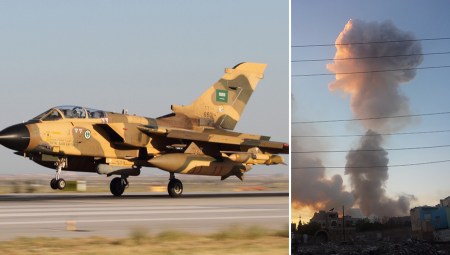
The United Nations, Amnesty International and other groups have accused the Saudi-led coalition of war crimes in Yemen. A leaked UN report claims the bombing campaign against Iranian-supported Houthi insurgents seeking violently to topple the legitimate government of Yemen has conducted deliberate, widespread and systematic attacks on civilian targets.

If the UN’s assertion is true, and the coalition is deliberately and disproportionately killing thousands of innocent civilians, it is a war crime. But it is unlikely to be true. The UN has produced no actual evidence of war crimes. None of their allegations is based on investigation on the ground. Their experts have not been to Yemen, depending instead on hearsay evidence and analysis of photographs.

The UN has a pattern of unsubstantiated allegations of war crimes against the armed forces of sovereign states. Only last year, without any military expertise, and never having visited Gaza, a UN commission convicted the Israel Defense Force of deliberately targeting innocent Palestinian civilians in the 2014 conflict. It was an assessment roundly rejected by America’s most senior military officer, General Martin Dempsey, the Chairman of the Joint Chiefs of Staff.

Dempsey’s own findings were confirmed by an independent commission of experienced senior military officers and officials from nine countries. The High Level Military Group found that Israel had not committed war crimes, but had in fact set a bar for avoiding civilian casualties so high that other armed forces would struggle to reach it.

Moreover, last September the UN said that a US airstrike against a hospital in Kunduz, Afghanistan, was “inexcusable” and “possibly a war crime.” Few military forces in the world take greater precautions to prevent civilian casualties on the battlefield than the US. Anyone who has actually experienced combat knows that while such incidents are tragic, when carried out by Western forces, they are far more likely to be the result of human error or the chaos of battle than deliberate war crimes.

There is every reason to believe that the UN is again crying wolf. There is no doubt that thousands are dying in Yemen in horrific circumstances. But we cannot just accept the UN’s figures and its attribution of the proportion of deaths being inflicted by the Saudi coalition. Most of the data comes from the Houthi insurgents, either directly or via non-governmental organizations (NGOs), and is simply accepted as fact. The Houthis have learned many lessons from Hamas and Palestinian Islamic Jihad in Gaza, groups also supported by Iran. Those lessons include the falsification and distortion of civilian casualty figures and their causes. The UN swallowed the fake Gaza figures hook, line and sinker, and are now making the same error in Yemen.

As with Israel’s defensive campaign in Gaza in 2014, and the continued U.S. military support to the Afghan regime, the Saudis’ war to defend the government of Yemen and curb Iranian aggression in the region is lawful and legitimate. Therefore, the illegality of civilian deaths must be assessed according to the laws of armed conflict, in particular whether adequate precautions were taken to avoid them, whether they were proportionate to the military objectives and whether they were necessary to achieve legitimate military goals. The UN cannot possibly make such judgements without a more far-reaching and thorough investigation, and especially not on the basis of information provided by Saudi Arabia’s enemies and by interpreting photographs.

Most of us do not like the way that the Saudi regime runs their country according to the strict application of Islamic Sharia law, and we abhor their record on human rights. But the Saudi military ethos is well known and understood by Western military leaders, including from the U.S. and UK, who have worked closely with them for many years. The reality is, as our officers currently serving alongside them will attest, that the Saudis and their allies are not deliberately trying to kill innocent civilians. Indeed, they are doing their best to minimize civilian casualties. The question is whether their best is good enough.

Saudi Arabia and its coalition allies have the most sophisticated Western combat equipment, including planes, attack helicopters, drones and precision-guided munitions. But they lack battle experience. The exception to this is the Emirati forces within the coalition. They have had many years of combat experience alongside Western militaries, including in Somalia, Kosovo, Libya and Afghanistan. Because of that, they have acquitted themselves in Yemen with great professionalism and effectiveness at sea, on the ground and in the air.

But the lack of experience of the other coalition members puts them many years behind our own forces in wielding the highly complex 21st century capabilities of intelligence, surveillance, reconnaissance, communication and targeting.

Yet the coalition faces the same tough challenges that we face on battlefields everywhere. Their Houthi adversaries fight according to the well-developed doctrine of their backers, the Iranian Quds Force. Like Hizballah, Hamas, the Taliban, Al Qaeda and the Islamic State, their techniques include deliberately killing civilians, fighting from within the population and forcing innocents to become human shields.

1474

Completely ignoring the laws of war, they exploit their enemies’ adherence to them. They lure their opponents to attack and kill civilians. They exploit gullible or compliant reporters, international organizations and human rights groups to facilitate their propaganda, including false testimony and systematic fabrication of imagery. The aim is to instigate international condemnation in order to constrain their militarily superior enemies.

We have seen credible forensic analysis of strikes in Yemen that directly contradict the findings of the UN. Forensic analysis shows that rather than deliberately targeting civilians, the Saudis and their allies have taken remarkable steps to minimize civilian deaths. Of note, they have learned much from Israel’s conduct of operations in Gaza. This has included the use of guided munitions to conduct precision attacks against insurgents while seeking to reduce collateral damage.

Why would coalition forces spend vast amounts of money in a cripplingly expensive conflict firing precision strike munitions, and put their valuable pilots at risk, if they wanted to massacre civilians? Why not use much cheaper unguided munitions or Assad’s indiscriminate barrel-bombs?

The overwhelming majority of civilian deaths caused by the Saudi-led coalition have been due not to deliberate targeting, but to inexperienced pilots and unsophisticated intelligence and targeting capabilities in the face of an enemy that fights from within the civilian population. And to that the friction, confusion, stress and fog of war that leads even the most sophisticated, experienced and restrained military forces, such as American, British and Israeli, to sometimes kill civilians unintentionally. Contrary to the UN’s claim, this is unlikely to amount to war crimes.

Like every conflict in the Middle East, the war in Yemen is almost intractable, takes a heavy toll on innocent civilians, and is unlikely to end in anything approaching a perfect solution. But Saudi Arabia and its allies are making considerable efforts to restore stability to the country and its legitimate government.

Instability in Yemen undermines Western interests, including oil supplies. Instability also allows Al Qaeda and the Islamic State — proven and lethal threats to the US and the West — to flourish there.

By confronting the Houthis in Yemen, Saudi Arabia is also confronting Iran, which represents an even greater threat to the region and to the world. Emboldened by U.S. President Barack Obama’s nuclear deal, enriched by the release of billions of dollars of previously frozen funds, encouraged by the imminent boost in oil revenues, Iranian imperial aggression is today rampant in Iraq, Syria, Lebanon and Yemen.

However unpalatable to many, Saudi Arabia is and will remain a vital ally of the West. We must continue to support them in the fight in Yemen. We must not allow the false, ill-informed and increasingly shrill condemnations by the UN, human rights groups and the media to undermine Saudi’s fighting effectiveness as they have sought to do against other legitimate government forces fighting lawless insurgents in so many other places.