Posted tagged ‘United Nations’

From The Mediterranean to the Golan, Iran Builds Active Front And Direct Military Presence

February 23, 2015

From The Mediterranean to the Golan, Iran Builds Active Front And Direct Military Presence On Israel’s Border To Deter Israel And Further Ideology Of Eliminating The Zionist Regime

By: Y. Carmon and Y. Yehoshua*

February 16, 2015

via From The Mediterranean to the Golan, Iran Builds Active Front And Direct Military Presence On Israel’s Border To Deter Israel And Further Ideology Of Eliminating The Zionist Regime.


Israel faces a fateful crisis. As much as it feared the Iranian nuclear program, it never imagined that Iran would be standing on its border even before its nuclear agreement with the Americans was complete. The Iranian threat to Israel is no longer theoretical, nor does it have anything to do with Israel’s deterrent of using its nuclear weapons, which cannot be used considering the international power balance. The threat has become direct, practical and conventional.”[1]

Introduction

In recent years, Iran has based its deployment in Syria on the establishment of a new Hizbullah Syria organization along the lines of Hizbullah Lebanon, as well as on the direct presence of Iranian forces in Syria, particularly in the Golan Heights.

Iran’s deployment in Syria, and particularly the presence of its forces in the Golan Heights, at first only as command posts and a limited number of special forces, reveals a trend of Iranian activity in the region that is direct, not only by proxy as it has been to date. According to the Iranian plan, the command posts are meant to operate “130,000 trained Iranian Basij fighters waiting to enter Syria,” as is evident from May 2014 statements by Islamic Revolutionary Guards Corps (IRGC) senior official Hossein Hamedani, that were censored and removed immediately after publication in Iran.[2]

Statements expressing intent to establish a front of anti-Israel activity in the Golan were heard from Iranian and Syrian officials as early as 2013, and have been implemented openly and in practice  in the past two years (see MEMRI Special Dispatch No. 5307, Assad And His Allies Threaten To Open A Front In Golan Heights, May 21, 2013). During this time, there were also a few terror operations as well as operations to collect intelligence information in the Golan, which Israel claims were carried out by Hizbullah and Iranian elements; for example, there have been rocket fire, roadside bombs, drones launched, and weapons transferred to Hizbullah. Israel for its part has carried out pinpoint counter-operations inside Syrian territory, such as bombing missile deliveries and attacking senior Iranian officials in Syria, for example, the January 2015 assassination of Gen. Mohammad Ali Allahdadi and other IRGC soldiers who have not been publicly identified, alongside several Hizbullah operatives, and the February 2013 assassination of top IRGC official Hassan Shateri, which Iran claims was carried out by Israel.[3]

Iran’s direct deployment in the Golan creates a single battle front against Israel from Rosh HaNikra to Quneitra.[4] It also constitutes a violation of the status quo of the Golan Heights front, which has been quiet since the Separation of Forces Agreement of 1974,[5] and comes on top of Hizbullah’s violations of U.N. Security Council Resolution 1701.[6] Syrian Foreign Minister Walid Al-Mu’allem said in an interview on Iran’s Al-Alam TV channel that “there is resistance in the Golan that is acting against Jabhat Al-Nusra and against the Israeli plans.”[7] Lebanese analyst Anis Naqash, who is close to Hizbullah, also said that “there is indeed resistance in the Golan.” According to him, there have been several actions against Israel by the Golan resistance, which he called popular Syrian resistance, and Israel has not acknowledged this so as to not reveal its helplessness. Regarding the violation of Resolution 1701 he said: “From the onset there was confusion about it. We – the resistance camp – violated Resolution 1701 from the moment they began implementing it.”[8]

Furthermore, Iran’s deployment on the border has implications for the chances of a war breaking out in the region and for the character of such a war. This, because it increases the possibility that any local eruption could quickly develop into a regional conflict, since Iran now commands the theater that stretches from Iran and Iraq through Syria and Lebanon and the Mediterranean.[9] It should be noted that Hizbullah’s January 28, 2015 retaliatory attack against Israel’s January 18 attack in itself did not develop into a broader conflict only because Israel refrained from responding to it. A senior Iranian spokesman assessed that this was due to Israel’s “intense fear of the outbreak of an all-out war.”[10]

Iran’s aim in deploying in the Golan Heights is not only to deter Israel from acting against its nuclear program, defend Syria as part of the resistance axis, and establish an active front for anti-Israel terror attacks in the Golan and even liberate the Israeli Golan. It also meshes with the Iranian regime’s ideological perception of Israel as an entity that must be eliminated, as is evident in statements by Iranian Supreme Leader Ali Khamenei. According to this perception, the West Bank must be armed, as the Gaza Strip was, in advance of eliminating the state of Israel.

It should be noted that in addition to its deployment for the purpose of eliminating the state of Israel, Iran is building capabilities and ways of operating against Israel and against Jewish/Israeli targets worldwide; these are occasionally put into action.[11]

Iran’s front on Israel’s northern border, in addition to its involvement in other arenas in the region, creates tremendous pressure on its dwindling resources and exhausts it, intensifying its dependence on regional forces. But the export of Iran’s Islamic Revolution always contributes directly to the survival of the Iranian regime. This is because the mobilization of Iranian national forces and Iranian youth in the ideological framework of struggle outside Iran inoculates Iran’s dictatorial regime against internal uprising and rebellion against it.

I. Regional Background: Under Guise Of Fighting Sunni Jihadi Organizations, Iran Deploys On Israel’s Border

In recent years Iran has taken advantage of the fact that the theater between Iraq and the Mediterranean – that is, Iraq, Syria, and Lebanon – has become a veritable no man’s land like Afghanistan, and has tightened its grip there and built up its deployment vis-a-vis Israel. Following the abandonment of the Syrian theater by the West, primarily the U.S., and the absence of any operation to decide the conflict following the Syrian uprising, Syria has become an arena of regional and global conflict. Participating in this conflict are fighters in the global jihad, such as Jabhat Al-Nusra and the Islamic State (ISIS), which have the support of Sunni elements, and on the other side Iran and its satellites, such as Hizbullah Lebanon and Hizbullah Syria, as well as the Iraqi militia Asa’ib ‘Ahl Al-Haqq and “the Fatimiyyoun Brigade” of Afghan Shi’ites.[12]

The West’s nonintervention in Syria has spawned not only Iran’s infiltration into that country but also its infiltration into two additional theaters where it has tightened its grip. First, the non-intervention has brought about the undermining of the situation in Lebanon, where in addition to the influx of millions of refugees and the collapse of the political system, the country has become an arena of conflict between Iran and the Sunni jihadis. Likewise, it has brought about the complete undermining of the situation in Iraq, where ISIS – which first established itself in Syria – has invaded the Sunni region and has consolidated its status there. The Iraqi army has collapsed, leading to the emergence on the ground of pro-Iran militias and of troops of the IRGC’s Qods Force, which is headed by Qassem Soleimani.[13]

Thus, Iran has created for itself a single theater of operation stretching from Iran to the Mediterranean, as Iranian officials describe it. For example, Yahya Rahim Safavi, former IRGC commander and security affairs advisor to Supreme Leader Ali Khamenei, boasted in May 2014: “Our strategic depth reaches to the Mediterranean, and above Israel’s head.”[14] In recent similar statements, Ali Saeedi, Khamenei’s representative in the IRGC, said: “The borders of Islamic Iran have expanded [all the way] to the shores of the Mediterranean, and the countries of the region are supported by Iran.” He said further that “we must prepare the ground for the globalization of the Islamic Revolution.”[15] In another speech, he said: “In the past, our borders were Haji Omran [on the Iran-Iraq border], while today our borders are the shore of the Mediterranean and Bab El-Mandeb [in Yemen].”[16] IRGC commander Mohammad Ali Jafari said: “Today, the borders of Islamic Iran and [its Islamic] Revolution have expanded, and we are not defending our country from its own borders but are standing fast and fighting together with our Shi’ite and Sunni brothers against the front of the arrogance [i.e. the West, headed by the U.S.] many kilometers from Iran’s borders.”[17]

In deploying directly on Israel’s border, Iran has effectively become a country neighboring Israel, despite being geographically distant, while Syria and Lebanon have become components in a broader Iran-led regional resistance entity bordering Israel.

II. Building A Single Conflict Front With Israel From Rosh HaNikra To Quneitra

Implementing the statements it has made over the past two years, Iran has created a single conflict front with Israel stretching from Rosh HaNikra to Quneitra, where it and its satellites, Hizbullah Lebanon and Hizbullah Syria, operate freely against Israel in violation of UN Resolution 1701 and while changing the status quo that has existed between Israel and Syria since the Separation of Forces Agreement of 1974.

As part of this implementation, the Syrian Golan has become an Iranian theater of operation as well. This strategic Iranian presence in the Golan was at first clandestine, under the auspices of “defending the resistance axis” and in the name of “the war on Sunni terrorism,” but later became public, and was accompanied by open threats to target Israel from the Syrian border. Thus, for example, in response to a May 2013 Israeli airstrike in the Damascus area targeting Fateh-110 long-range missiles being transferred from Iran to Hizbullah, spokesmen in Iran, Syria, and Hizbullah issued statements regarding the need for resistance in the Golan.[18] At a May 7, 2013 meeting with Iranian foreign minister Ali Akbar Salehi, Syrian President Bashar Al-Assad announced, “The Golan will become a front of resistance.”[19] Iranian Army chief of staff Hassan Firouzabadi also revealed that “according to Assad’s strategic decision, a popular resistance based on the Hizbullah template is being established across Syria.”[20]

In their statements, the top leaders of the resistance axis stress that, in addition to forming an active front in the Syrian Golan vis-a-vis Israel, the axis means to actually “liberate the Syrian Golan” from Israeli control. The deputy of the Iranian chief of staff, Mas’oud Jazeyeri, promised that the region would see many changes, “some of which will pass through the Golan,” and added that “the liberation of the Golan is not impossible.”[21] Hizbullah secretary-general Hassan Nasrallah announced, for his part, that his organization would aid the Syrian resistance “in order to liberate the Syrian Golan.”[22] Nahed Hattar wrote in the Lebanese Al-Akhbar  that “ending the Syria war [i.e., expelling the jihad organizations from it] is meaningless without wresting the Golan from Israeli hands.”[23]

In the framework of this plan for creating a single front from Rosh HaNikra to Quneitra, Hizbullah Lebanon is ignoring the Lebanon-Syria border and is operating freely in Syria, particularly in the Golan, despite criticism in Lebanon.[24] Nasrallah’s January 30, 2015 speech, delivered two days after Hizbullah’s counterattack following Israel’s January 18 attack in Quneitra, amounted to an acknowledgement of a reality in which “there is no recognition of division into arenas” and the resistance is entitled to confront the enemy “wherever it wants and however it wants.” Moreover, in this speech Nasrallah described the death of Hizbullah and IRGC operatives in Israel’s operation as “the mingling of Lebanese blood with Iranian blood on Syrian soil” and stated that this reflected the fact that there is “one cause, one destiny, and one battle.”[25] He also declared in his speech that “the rules of engagement” with Israel had now changed, referring to the rules set out in UN Resolution 1701; as a matter of fact, Hizbullah is indeed violating this resolution in various ways, including with its presence south of Lebanon’s Litani River, alongside the presence of IRGC forces.

III. Elements Of The New Iranian Deployment In Syria: Hizbullah Syria And A Direct Iranian Presence On Israel’s Border

The building of the new Iranian front has two elements: a) establishing a Hizbullah Syria based on the Hizbullah Lebanon model, and b) Iranian forces’ direct involvement in the Golan.

A. Hizbullah Syria – Another Resistance Arm Against Israel

The new Hizbullah Syria is also being established as part of an extensive strategic view and in preparation for the coming conflict with Israel. Senior IRGC official Hossein Hamedani said in a May 2014 speech that “Syria has become a decisive geopolitical region in the regional power balance” and that Iran has established “a second Hizbullah – popular militias in 14 Syrian governorates with 70,000 members, from Syria’s Shi’ites, Sunnis, and Alawites.”[26]

Likewise, an April 21, 2014 analysis published by the moderate conservative Iranian website Farda stated, “The establishment of a Hizbullah Syria, as a bud of resistance, will not only impact the Syrian crisis but will also serve as a mighty arm of the resistance that will give the Zionists nightmares. The Zionist regime, which was previously concerned with the threats along the Lebanese border, must now prepare itself for the new situation. As ongoing events show, the resistance front is uniting from day to day, and the situation for the Zionists and their supporters is worsening.”[27]

Also, Mohammad Reza Naqdi, commander of the Basij paramilitary force, explained: “Hizbullah emerged after the 1982 war in Lebanon. The Palestinian resistance was born after the attacks against Palestine. And today in Syria we are witnessing the establishment of a military force, following the aggression and plots against Syria.” He added, “The resistance force will liberate Jerusalem.”[28]

B. Direct Iranian Activity In The Golan And Lebanon

In the past, Iran preferred to manage the conflict with Israel exclusively through its proxies and allies – Assad and Hizbullah. However, there has recently been open physical presence of IRGC and Qods Force soldiers in Syria, specifically in the Syrian Golan. As mentioned above, Hossein Hamedani, former IRGC commander in the Tehran province, even stated in a speech that “there are 130,000 trained Iranian Basij fighters waiting to enter Syria.”[29]

Arab media also published reports that Iranian forces have been present in the Golan since May 2013. The reports included details provided by Syrian oppositionist circles regarding important bases in the Golan where IRGC forces were present: bases in the Tal Al-Sha’ar area and Tal Al-Ahmar, the Division 90 headquarters, an espionage base near Mazari’ Al-Amal, and a camp in Al-Shuhada.[30]

Testimony also appeared regarding significant IRGC presence on the Israeli-Lebanese border, including on a Twitter account close to the IRGC which posted photos indicating that “the IRGC soldiers of the Islamic revolution are on the border of [Lebanon and] occupied Palestine.”[31] In this context it should be mentioned that, back in January 2012, there was outrage in Lebanon following statements by the commander of the IRGC’s Qods Force, General Qassem Soleimani, who said that “Iran has a presence in South Lebanon and Iraq” and that “these regions are under the influence of the activity and philosophy of the Islamic Republic of Iran.”[32]

The physical presence of senior IRGC generals in the Golan and South Lebanon also indicates the importance of this arena in Iran’s eyes. Examples are presence of Iranian General Mohammad Ali Allahdadi in the Golan, which was exposed after he was killed in an Israeli airstrike in January 2015, and of Iranian General and IRGC commander in Lebanon Hassan Shateri, who was killed in February 2014 in an attack on a military convoy from Damascus to Beirut.[33] This, alongside reports that General Qassem Soleimani was present in Syria in general and in the Quneitra and Dar’a areas in particular.[34]

IV. Calls In Palestinian Resistance Movements To Join Northern Front

Palestinian resistance movements such as Hamas also expressed willingness to join the northern front against Israel by activating Palestinians living in refugee camps there.

Hamas official Mahmoud Al-Zahar called to enable the establishment of military groups belonging to the Al-Qassam Brigades – Hamas’s military wing – in Lebanese and Syrian refugee camps in order “to resist the enemy from northern Palestine.”[35] At the same time, there have been increasing reports recently on renewed Hamas contacts with Iran and Hizbullah, after a period of tension between them due to Hamas’s support for the Syrian revolution.[36]

Abu Ahmad Fouad, deputy secretary-general of the Popular Front for the Liberation of Palestine (PFLP), supported Al-Zahar’s call and said that the establishment of these militias “should take place as part of a general framework of resistance movements, including the Lebanese Hizbullah.” He told the Al-Mayadeen TV channel: “We believe what Hizbullah Secretary-General Hassan Nasrallah said regarding uniting the fronts against the Israeli occupation, and there are ongoing meetings to develop the Palestinian resistance operation and coordinate it with the Lebanese resistance.”[37]

‘Imad Zaqout, news director for Hamas’s Al-Aqsa TV, even admitted for the first time that the ‘Izz Al-Din Al-Qassam Brigades have already operated groups in neighboring countries, and that the rocket fire from Lebanon into Israel during the 2014 conflict in Gaza had been ordered by the Brigades. He added: “Hamas thought and planned for every future war with the Zionist enemy to be a total one. Meaning that it would include every inch of land in Palestine and inflict large-scale damage on the enemy.”[38]

V. The Iranian Front In The Golan – Implementing Iranian Ideological Perception Regarding Need To Eliminate Israel

Constructing a united front from Rosh HaNikra to Quneitra meshes with Iran’s comprehensive strategy to eliminate Israel. Iranian regime heads have repeatedly stated their commitment to this goal over the years, from Supreme Leader Ali Khamenei to other regime and military leaders.[39]

To bring only a handful of examples, in a July 23, 2014 speech, Khamenei said that “the only solution is to destroy the Zionist regime.”[40] Furthermore, Mehdi Taeb, head of Khamenei’s “Ammar Headquarters” think tank and the brother of IRGC intelligence chief Hossein Taeb, said in a November 12, 2014 speech in Qom that “Iran’s sword is currently stuck in the throat of the accursed Israeli regime, and according to the instructions of the founder of the Islamic Republic [Ayatollah Ruhollah] Khomeini, we must remove this oppressive regime from the world map… The Imam Khomeini saw the Basij [as a force] that would destroy the Zionist regime, and today, thanks to divine grace, Iran has besieged Israel with those same popular forces.”[41] Similar statements were repeatedly made by IRGC officials as well. On August 27, 2014, IRGC Deputy Commander Hossein Salami said: “Destroying the Zionist regime is a very simple matter… [It] will take place gradually. It is a matter of divine faith, [it is] more than a mere wish for us.”[42] On November 26, 2014, Basij Commander Mohammad Reza Naqdi said: “The Iranian nation and Basij members are determined to hold victory prayers led by their Imam [Khamenei] at the Al-Aqsa Mosque.”[43] The next day, IRGC navy official Ali Razmjou said that the Zionist regime “will be eliminated from the world map in the near future thanks to the resistance of Basij and Hizbullah members throughout the world.”[44]

VI. Developing The Palestinian Front By Arming West Bank, Israeli Arabs

To comprehensively implement this Iranian strategy to eliminate Israel, in addition to its activity in Syria and the Golan, the Iranian regime has increasingly expressed its intent to arm the West Bank, and even the Israeli Arabs, as it has armed the Gaza Strip.[45] Khamenei called on several occasions to arm the West Bank. In a July 23, 2014 speech, he said: “Allah willing, the day will come when this regime is destroyed. [But] so long as this false regime is on its feet – what is the solution? The solution is total armed resistance against this regime. This is the solution… Therefore, it is my belief that the West Bank should be armed just like Gaza.”[46]  A July 26, 2015 post on Khamenei’s Facebook page said: “The West Bank should be armed like Gaza.”[47]

Other officials also referred to the arming of the West Bank as part of a strategic policy of the Iranian regime. The deputy chair of the Majlis National Security Committee, Mansour Haghighatpour, said: “One of our goals is to arm the West Bank, because it is the best measure for fighting the Zionist regime.”[48] Ahmad Vahidi, who was defense minister under Ahmadinejad and commander of the IRGC Qods Force, said that “arming the West Bank is a strategic policy of the Leader [Khamenei], whose implementation will transform the Palestine arena,” and even called to arm the territories that were conquered in 1948, in addition to the West Bank. [49] Iranian Defense Minister Hossein Dehghan said in a rally honoring the Hizbullah members killed in the Quneitra attack, held on January 27, 2015 at the Hizbullah representation in Tehran: “We will utilize every available capability in order to arm the West Bank… The policy of the Islamic Republic regime is to arm the West Bank and strengthen the resistance axis and the forces of Hizbullah in order to fight the usurping and occupying Zionist regime.”[50]

In an August 29, 2014 message of congratulations to the Palestinian people at the close of the 2014 Gaza conflict, IRGC commander Jafari expressed Iran’s support of the Gaza resistance, while mentioning the hope for the elimination of the Zionist regime. He said: “We shall stand fast with you to the end. Continue to raise the banner of jihad in the path of God, for your honor and the honor of all Muslims is linked to this holy jihad. And know that, with Allah’s help, eliminating this crumbling and bloodthirsty Zionist regime will be the greatest achievement on this divine path, and the final victory is not so far away.”[51]

VII. The Battle In The Dar’a Region – Completing The Siege Around Israel

It should be mentioned that the Syrian army, Hizbullah and Iranian forces recently launched a large-scale joint attack on the southern front to expel the rebels from the Dar’a region. During this campaign, titled “The Quneitra Martyrs Battle,” the Syrian regime admitted openly for the first time that Iranian forces were fighting in Syria alongside Assad’s forces. In addition, Gen. Qassem Soleimani visited the region, and Hizbullah and IRGC flags were flown there.[52]

This joint effort to wrest control of the southern Syria front from the hands of the rebels is regarded by Syria, Iran and Hizbullah as part of their struggle against Israel and its allies. A victory in this region will bring the Iranian forces closer to the Jordanian border in the south and the Israeli border in the west, will prepare the ground for defeating the opposition forces in the Quneitra area, and will enable the creation of a territorial continuum of resistance axis forces stretching from Dar’a through Damascus and Quneitra to Lebanon.

A Syrian army commander admitted on Syrian TV that the operation in the Dar’a region was being carried out “in collaboration with the resistance axis – Hizbullah and Iran.” He added that the goal of the army’s actions in the Dar’a and Quneitra area was “to ensure calm on the borders with the neighboring countries [Israel and Jordan] and disrupt the security zone they are attempting to establish.”[53]

The Al-Hadath News website, which is close to the Syrian regime, also exposed Iran’s involvement  in the fighting, and even posted a photo of Gen. Qassem Soleimani in the area. It reported: “Iran, which had been taking part in the fighting in Syria by means of military advisors within the Syrian army, recently decided to join the military conflict officially and openly.” According to the site, Soleimani arrived in the area “to supervise and follow the campaign in southern Syria, and take part in directing it,” and his presence there lends the campaign “a clear geopolitical military character” that means that “the resistance is calling the shots in southern Syria.” The site added that the first goal of this attack was to defeat the armed opposition forces in Dar’a in advance of defeating them in Quneitra, which would be “a blow to the Zionist enemy.” This, in addition to preventing them from advancing towards Damascus. The site stated further that “southern Syria is clearly no longer involved in an inter-Syrian conflict, or a conflict between Syrians and takfiri forces [i.e., the jihad groups], but rather in a conflict between the resistance axis [comprising] Iran, Syria and Hizbullah on the one hand and the Israel-Jordan-U.S. alliance on the other.”[54]

Ibrahim Al-Amin, board chairman of the Lebanese Al-Akhbar daily, which is close to Hizbullah, wrote on this matter on February 11 that the top leadership of the resistance axis has decided “to create new political, military and security facts [on the ground] along the border between Jordan and occupied Palestine.”[55]

VIII. The Implications Of Iran And Its Proxies Surrounding Israel

Iran’s presence in the Golan, as well as in Lebanon and on the Mediterranean, creates a situation where any local conflict can rapidly escalate into a comprehensive regional war with direct Iranian involvement. Though Nasrallah stressed in his speech in late January 2015 that Hizbullah had completed its punitive measures for the killing of its six operatives in Quneitra, and that it is not interested in war, Iran continues to threaten further attacks, and may arrange further eruptions in the region or outside it by employing Hizbullah cells in various parts of the world.[56] In addition, articles in the Lebanese press spoke of the possible outbreak of a regional war.[57]

As long as Hizbullah operates from Lebanon, Israel is able to deter it, since Israel’s response to an attack from Lebanon employing the full force of Hizbullah’s missile arsenal (comprising over 100,000 missiles) will be the destruction of Lebanon’s infrastructures, a scenario that deters Hizbullah. However, if Hizbullah is activated from outside Lebanon, Israel will not be able to respond in the same manner.

As for Iran, it does not regard itself as deterred by Israel, now that it has built a single, comprehensive front against Israel stretching from the Mediterranean to southern Syria. It also has the capability of activating Hizbullah, despite the heavy price this organization will pay.

In fact, the Syrian front in general, and especially in the Golan, has become Iran’s favored theatre of operations, since acting there diminishes the chance of a war within its own borders. In this context, Khamenei’s advisor Ali Ahmad Velayati said on February 8, 2013 that “Iran has planned its defensive positions outside its own borders, and has linked its fate to the fate of the Islamic countries; this is why it will support those such as [Syrian President] Bashar Al-Assad to the end…”[58] Mehdi Taeb, the head of Khamenei’s “Ammar Headquarters” think tank, said in one of his speeches: “The loss of Syria will lead to the loss of Tehran itself.”[59]

Moreover, Iran’s presence on the Israeli border limits Israel’s ability to use military measures against Iran’s nuclear program. This, since Iran is building up its response capabilities in the region, to complement its long-range missiles. In the past, it was Hizbullah Lebanon that deterred Israel, to some extent, from acting militarily against Iran’s nuclear program. Today this deterrence is significantly strengthened by the advent of Hizbullah Syria and the direct presence of Iranian forces in the Golan.

According to Mehdi Taeb, the centrality of Hizbullah to Iran’s deterrence vis-a-vis Israel was already demonstrated in the 2006 Lebanon war. In a 2013 speech, he said that Iran never had to attack Israel’s nuclear warheads because “we completely locked up [Israel] with Hizbullah. During the 2006 Lebanon war, the Zionist regime tried to break this lock [i.e. Hizbullah], but after 33 days [of fighting], it gave up, and left [Lebanon].”[60]

Al-Akhbar columnist Nahed Al-Hattar also addressed the implications of Iran’s deployment on Israel’s border. He said that, while Israel is unable to use its nuclear capabilities due to international considerations, Iran has created a “practical, direct and conventional” threat against it: “Israel faces a fateful crisis. As much as it feared the Iranian nuclear program, it never imagined that Iran would be standing on its border even before its nuclear agreement with the Americans was complete. The Iranian threat to Israel is no longer theoretical, nor does it have anything to do with Israel’s deterrent of using its nuclear weapons, which cannot be used considering the international power balance. The threat has become direct, practical and conventional.”[61]

*Y. Carmon is President and Founder of MEMRI; Y. Yehoshua is Vice President for Research and Director of MEMRI Israel.

Endnotes:

[1] From a February 13, 2015 article by columnist Nahed Al-Hattar in the Lebanese daily Al-Akhbar.

[2] Fars (Iran), April 5, 2014. See also MEMRI Special Dispatch No. 5848, Iranian Media Reports Deleted Following Publication (1): Senior IRGC Official Speaking On Iran’s Military Involvement In Syria Says Iran Has Established ‘Second Hizbullah’ There, September 25, 2014.

[3] In the last two years, numerous security incidents have occurred on Israel’s northern border. The incidents include the launch of a drone from South Lebanon in April 2013, which, according to Israeli estimates, was carried out by IRGC members; rocket fire towards the Hermon outpost in May 2013; a roadside bomb near the Israeli-Lebanese border in August 2013; roadside bombs on the Israeli-Syrian border in March and October 2014; anti-tank missile fire from Syria towards an Israeli vehicle in June 2014; a drone infiltrating Israel from Quneitra in August 2014; and  rocket fire on the Golan in January 2015. This, alongside Israeli attacks on weapons shipments such as a shipment of SA-17 anti-aircraft missiles to Hizbullah in Syria in January 2013, an attack on a truck convoy carrying missiles and a launcher in February 2014, and an attack on a warehouse storing Russian-made missiles that were on their way from Syria to Lebanon in December 2014.

[4] The notion of a single front from the Rosh HaNikra to Quneitra (i.e., from the Mediterranean to the Golan) was expressed  repeatedly in the Lebanese press. See for example a January 19, 2015 article in the daily Al-Safir, an article by Firas Al-Shoufi from the same date in Al-Akhbar, and Nahed Hattar’s January 21, 2015 article in Al-Akhbar. The head of Al-Akhbar‘s board of directors, Ibrahim Al-Amin, expressed a similar notion in the daily as early as May 27, 2013.

[5] This violation of a decades-long status quo is so grave that, in a late January 2015 interview with Foreign Affairs magazine, Bashar Al-Assad persisted in denying that it was happening, claiming, “Never has an operation against Israel happened through the Golan Heights since the cease-fire in 1974. It has never happened. So for Israel to allege that there was a plan for an operation—that’s a far cry from reality, just an excuse, because they wanted to assassinate somebody from Hizbullah.” Foreign Affairs (U.S.), January 25, 2015.

[6] On Hizbullah’s violations of  Resolution 1701, see MEMRI Special Dispatch No. 5857, “Daily Close To Hizbullah: In Violation Of UNSCR 1701, Hizbullah Has Resumed Operations South Of The Litani River,” October 13, 2014.

[7] Al-Alam TV (Iran), February 2, 2015.

[8] LDC (Lebanon), January 29, 2015.

[9] Many columnists close to Hizbullah and Iran addressed the scenario of an imminent all-out war with Israel. For example, columnist Wafiq Qanso described Hizbullah’s considerations prior to reacting to the Israeli attack as follows: “The time, place, and manner of a reaction  is subject  to the examination of  the leadership of the resistance.” He said that such an examination takes into account several elements, including “the reality in the region and the possibility of a counter-reaction [by Israel] and a slide into extensive war.” Al-Akhbar (Lebanon), January 21, 2015. Lebanese analyst ‘Ali Haidar  wrote: “It is now clear that direct Israeli military intervention will trigger a parallel regional intervention on an [even] larger and more dangerous scale, leading to a scenario of  regional escalation.” Al-Akhbar (Lebanon), February 13, 2015. Iranian analyst Hassan Hanizadeh, who is close to Iranian  regime circles, wrote: “The current confrontation is a prelude to a comprehensive war that will not be confined to South Lebanon, and may even spread  south of Quneitra.” Fars, Iran, January 28, 2015. Al-Akhbar’s Ibrahim Al-Amin wrote, “The possibility of an all-out conflict breaking out that will leave no border between Lebanon and Syria is valid and in effect.” Al-Akhbar, Lebanon, May 27, 2013.

[10]  Brigadier Yadollah Javani, an advisor to Khamenei’s representative in the IRGC, said in a February 15, 2015 interview on Iran’s Al-Alam TV: “Nasrallah announced they [Hizbullah]  would respond to the [January 18] attack, and we saw how this response was carried out. The beauty of it is that the Zionists, for their part, did not respond at all. The reason is their intense fear of the outbreak of an all-out war.”

[11] Recently, many Iran and Hizbullah cells across the world planning attacks against Israeli and Jewish targets were discovered. For example, Uruguay in early January 2015 expelled a top diplomat at the Iranian Embassy in Montevideo on suspicion of his involvement in placing a bomb near the Israeli Embassy in the city; see: English.alarabiya.net, February 6, 2015. Likewise, in April 2014, two Hizbullah operatives planning an attack against Israeli tourists were arrested in Thailand; see: English.alarabiya.net, April 18, 2014. In May 2013, Nigerian security forces uncovered a Hizbullah terror cell that planned to carry out attacks against Israeli targets in the country and in other parts of West Africa. In February 2013, Nigerian security forces uncovered a terror squad operated by the IRGC’s Qods Force that was planning attacks against Chabad House and against offices of the Israeli Zim shipping lines in the city of Lagos. See: Haaretz, IBA, May 30, 2013.

[12] Reports on Iranian forces participating in the fighting in Syria appeared in Iran as early as 2013. See MEMRI Inquiry & Analysis No. 1040, “Despite Denials By Iranian Regime, Statements By Majlis Member And Reports In Iran Indicate Involvement Of Iranian Troops In Syria Fighting,” December 4, 2013.

Recently, Al-Sharq Al-Awsat reported, citing Ahmad Ramadan, a member of the National Coalition for Syrian Revolution and Opposition Forces, that Iran  was airlifting Shi’ite warriors, especially Iraqis and Afghans, to Latakia, Syria, where they are trained by the IRGC before being dispatched to Dar’a. Al-Sharq Al-Awsat, London, February 13, 2015.

[13] See MEMRI Special Dispatch No. 5877, Iranian Campaign Touts IRGC Qods Force Commander Qassem Soleimani As ‘Savior Of Iraq’; Soleimani: Iran Has Thousands Of Organizations Like Hizbullah; I Pray To Die A Martyr, November 10, 2014.

[14] Mehr (Iran), February 5, 2015.

[15] Tasnim (Iran), February 11, 2015.

[16] Tasnim (Iran), February 4, 2015.

[17] Mehr (Iran), January 30, 2015.

[18] See MEMRI Special Dispatch No. 5848, Iranian Media Reports Deleted Following Publication (1): Senior IRGC Official Speaking On Iran’s Military Involvement In Syria Says Iran Has Established ‘Second Hizbullah’ There, September 25, 2014.

[19] Al-Quds Al-Arabi (London), Almayadeen.net, May 7, 2013.

[20] ISNA (Iran), May 11, 2013.

[21] The statements were made in an interview on Hizbullah’s Al-Manar TV. Irinn.ir, May 17, 2013.

[22] Al-Safir (Lebanon), May 10, 2013.

[23] Al-Akhbar (Lebanon), February 13, 2015.

[24] Recently, former Lebanese prime minister Sa’d Al-Hariri, chairman of the Al-Mustaqbal faction, expressed harsh criticism of Hizbullah’s involvement in Syria. In a speech marking the 10th anniversary of the assassination of his father, Rafiq Al-Hariri, he said: “[In the past] we said to Hizbullah: entering the Syrian war is lunacy in itself. It has brought the terrorist insanity into our country. Today we say to it that connecting the Golan with the South [of Lebanon] is also lunacy, and another reason for us to say to it: Get out of Syria. Stop importing Syrian conflagrations into our country, first a terrorist conflagration, then a conflagration from the Golan, and tomorrow who knows where [the conflagration] will come from.” See Youtube.com/watch?v=G90oHQpD-AU#t=174, February 14, 2015.

On earlier criticism inside Lebanon on Hizbullah’s involvement in Syria, see MEMRI Inquiry & Analysis No. 980, Lebanon Openly Enters Fighting In Syria, June 13, 2013. The Lebanese press close to Hizbullah  has since May 2013 mentioned numerous times the notion of abolishing the Lebanon-Syria border and the expansion of the resistance front from Lebanon to Syria in the framework of all-out conflict with Israel. For example, Ibrahim Al-Amin wrote in Al-Akhbar: “Everyone must act based on the expansion in practice of [Israel’s] northern front, [which now stretches from  Lebanon to Syria]. In the near future, we may see the border with Lebanon remaining calm, while the most active front will be on the Palestine-Syria border [in the Golan]… We are simply facing a new level of unity between the resistance in Lebanon and [that in] Syria… such that the possibility of an all-out conflict breaking out that will leave no border between Lebanon and Syria is valid and in effect.” Al-Akhbar, Lebanon, May 27, 2013. Columnist Nahed Hattar wrote in Al-Akhbar recently that the Golan was “a pan-Arab arena shared by the Lebanese, the Syrian, the Jordanian, and the Iraqi [people]. From today onwards, there is no longer room for partial resistance and for partial national plans.” Al-Akhbar, Lebanon, January 23, 2015. See also  MEMRI Inquiry & Analysis No. 1138, Following Killing Of Hizbullah Operative Jihad Mughniyah, New Information Comes To Light Regarding Hizbullah, Iranian Activity In Syrian Golan On Israeli Border, January 28, 2015.

[25] Al-Safir (Lebanon), January 31, 2015. The previous day, similar statements were made by IRGC commander Jafari: “Iran and Hizbullah are one, and everywhere the blood of our martyrs on the front is spilled together, and our response will be the same.” Fars, Iran, January 30, 2015.

[26] Fars (Iran), May 4, 2014. See MEMRI Special Dispatch No. 5848, Iranian Media Reports Deleted Following Publication (1): Senior IRGC Official Speaking On Iran’s Military Involvement In Syria Says Iran Has Established ‘Second Hizbullah’ There, September 25, 2014.

[27] Farda (Iran), April 21, 2014.

[28] Al-Manar TV (Lebanon), May 10, 2013.

[29] Fars (Iran), May 4, 2014.

[30] See MEMRI Inquiry & Analysis Series Report No. 1138, Following Killing Of Hizbullah Operative Jihad Mughniyah, New Information Comes To Light Regarding Hizbullah, Iranian Activity In Syrian Golan On Israeli Border, January 28, 2015.

[31] See MEMRI Special Dispatch No. 5915, Iranian Army Twitter Account, Iranian Army-Affiliated Blog Report: IRGC Troops At Lebanon-Israel Border, December 26, 2014.

[32] ISNA (Iran), January 18, 2012. The Lebanese government requested clarifications on these statements, which resulted in denials by the Iranian foreign ministry. See Fars (Iran), January 25, 2012.

[33] Al-Gumhouriyya (Egypt), Alarabiya.net, February 15, 2014.

[34] The Syrian opposition reported  that  Soleimani was spotted in Quneitra. Al-Nahar (Lebanon), January 19, 2015. Another report indicated that, on January 11, 2015, “Qassem Soleimani visited Damascus on his way to Beirut, where he met with the resistance leadership.” Al-Akhbar (Lebanon), January 21, 2015. There were also reports, accompanied with photos, that Soleimani recently visited the Dar’a region. Alhadathnews.net, February 10, 2015.

[35] Almanar.com, February 4, 2015.

[36] Al-Akhbar (Lebanon), January 10, 2015, October 23, 2014.

[37] Alwatanvoice.com, February 6, 2015.

[38] Alwatanvoice.com, February 6, 2015.

[39] See MEMRI Special Dispatch No. 5906, Iranian Regime Escalates Threats To Annihilate Israel, December 17, 2014.

[40] See MEMRI TV Clip 4366, Iran’s Leader Khamenei: Armed Struggle Should Continue until Israel Is Destroyed by a Referendum, July 23, 2014.

[41] Snn.ir, November 12, 2014.

[42] Fars (Iran), August 27, 2014.

[43] Fars (Iran), November 26, 2014.

[44] IRNA (Iran), November 27, 2014.

[45] See MEMRI Special Dispatch No. 5906, Iranian Regime Escalates Threats To Annihilate Israel, December 17, 2014.

[46] See MEMRI TV Clip No. 4366, “Iran’s Leader Khamenei: Armed Struggle Should Continue until Israel Is Destroyed by a Referendum,” July 23, 2014.

[47] See Special Dispatch No. 5808, “Iranian Supreme Leader Khamenei Calls For The Annihilation Of Israel,” July 28, 2014.

[48] Fars (Iran), November 27, 2014.

[49] Tasnim (Iran), July 26, 2014.

[50] ISNA (Iran), January 27, 2015.

[51] Tasnim (Iran), August 29, 2014.

[52] On Soleimani’s presence in Dar’a, including photos, see Alhadathnews.net, February 11, 2015. There have recently been many other reports in the Arab press on the involvement of Iranian troops in the fighting in Dar’a. See a February 13, 2015 report in the Lebanese  Al-Akhbar, as well as reports in Al-Sharq Al-Awsat  from February 12 and February 13. The February 12 article in Al-Sharq Al-Awsat stated that Hizbullah’s leadership in the area was stationed in a special war room in the 9th Division base in Sanamin, north of Dar’a.

[53] Lbcgrouop.tv; Al-Riyadh (Saudi Arabia), February 12, 2015.

[54] Alhadathnews.net, February 11, 2015.

[55] Al-Akhbar (Lebanon), February 11, 2015.

[56] Iran has made numerous threats to this effect.  IRGC Qods Force deputy commander Esmail Qaani said after the Quneitra attack: “We will not rest until Israel is eliminated,” Mehr (Iran), January 22, 2015. IRGC commander ‘Ali Jafari threatened a response by means of Hizbullah’s cells across the world: “They [Israel] are surely familiar with the capabilities of the Hizbullah cells that have been established  around the  world [to fight] the enemies of Islam, and they fear them. If  they expect Hizbullah to respond to their action, they must expect a firm and crushing response not only in the region of their border but in any part of the world where there are Zionist Israelis or their supporters” Fars (Iran), January 30, 2015.

[57] On this, see note 9.

[58]  Yjc.ir, February 8, 2013.

[59] See MEMRI Inquiry & Analysis No. 946, “Iranian Official: The Loss Of Syria Will Lead To The Loss Of Tehran Itself; Syria Is An Iranian Province; Iran Has Formed A 60,000-Strong Syrian Basij; Israel Is Our Only Threat,” March 11, 2013.

[60] See reference in note 59.

[61] Al-Akhbar (Lebanon), February 13, 2015.

The Only Strategy to Defeat Jihad

February 11, 2015

The Only Strategy to Defeat Jihad

By Jonathan David Carson

February 11, 2015

via Articles: The Only Strategy to Defeat Jihad.


An imam on British television taught me more in a few minutes than any of the books I have read on Islam, some of them quite instructive.  After railing at Israel and America, the imam smiled knowingly and said that if God did not want those skyscrapers to fall, he wouldn’t have let airplanes fly into them.  I almost shouted, “Then I guess God wants Palestinians to suffer, or else he wouldn’t let Israelis do all those awful things you say they do!”

I hear endless lamentations about our not having a strategy to defeat “Islamic extremism” or whatever the day’s euphemism is.  The cynic in me says that what we really need is to get rid of our strategy of helping the Muslim Brotherhood and the mullahs in Iran.  But if we have to have a strategy, here it is.

We blow some ISIS bastard to smithereens and shout, “Allahu Akbar!”  We take out Iran’s nuclear reactors and say, “If Allah wanted Iran to have a nuclear bomb, he wouldn’t have dropped those bunker-busters.”

Islam holds that there are no “secondary causes,” that is, that God never acts indirectly, by means of natural law, but always directly, willing everything that happens.  Fine, then, let secondary causes, cruise missiles, for instance, or rifle bullets, kill as many of our enemies as it takes for them to have to come to their senses.  Make them believe that Allah is killing them.  Make them believe it for so long that they stop believing the absurd promise that heaven is full of beautiful virgins waiting lustfully for their smelly carcasses.  Tell them over and over again that Allah is killing them, and doing it directly, without intermediaries, such as drone pilots or Marine snipers, and they will just want a drink.

Franklin Roosevelt said that the Doolittle Raid was launched from Shangri-La.  That’s the idea.  We won that war.

People frequently make the mistake of thinking that Islam is like Christianity, only different.  They are opposites.

Christianity thrives under adversity.  What’s killing Christianity is comfort and ease.  Christianity is for people in trouble.  Judaism too.

Islam thrives on success.  Muslims won one battle, and Mohammed said it was God’s will.  That seemed to make sense.  They won another battle, and they were convinced.  They won another battle, and Mohammed’s boast began to make sense to their enemies.  They won another battle, and their enemies were convinced.  Enemies fled and fled until they had a mighty empire.

Then they ran into men who knew to fight the long defeat, as the elves in The Lord of the Rings put it, and, lo, the defeat was not so long anymore.

We must fight whether we expect to win or not.  We are not cowards who won’t fight without a guarantee of victory from God.

I don’t want to hear any “moderate Muslim” crap.  Who are these mythical beasts?  The Saudis, who in the name of sexual morality won’t let girls escape from burning buildings improperly dressed and who then buy sex slaves from India and Pakistan?  Selling us oil makes them moderate?   They won’t even drill for it themselves.  We have to do it, just as we have to defend them from Saddam Hussein.  What makes them moderate is that we are fools.

I also don’t want to hear that most victims of Islamic extremism are Muslims.

For a while the hobbits sat in silence. At length Sam stirred. ‘Well, I call that neat as neat,’ he said. ‘If this nice friendliness would spread about in Mordor, half our trouble would be over.’

‘Quietly, Sam,’ Frodo whispered. ‘There may be others about. We have evidently had a very narrow escape, and the hunt was hotter on our tracks than we guessed. But that is the spirit of Mordor, Sam; and it has spread to every corner of it. Orcs have always behaved like that, or so all tales say, when they are on their own. But you can’t get much hope out of it. They hate us far more, altogether and all the time. If those two had seen us, they would have dropped all their quarrel until we were dead.

Colonialism has been roundly condemned as oppressive.  Maybe so.  But what the Islamic world needs is oppression.  When the West oppressed the Muslim world, we didn’t have this problem.  And the Muslims were better off.  They could gradually become sane,  as they noticed that Allah was not winning any battles for them.

The reason so many of us are complacent about the threat from Islam is that the colonial era, which ended only recently in historical terms, made us feel safe.  It made Muslims feel impotent and made us feel invincible.  We got swelled heads and saw too many movies and decided that Muslims were peaceful when they were simply afraid.  Now the Establishment reassures them of our peaceful intentions and destroys our best defense: their fear.

Not every Muslim is a terrorist, but Islam is a terrorist religion.  Mohammed was a mass murderer and child molester, and devout Muslims have been following his example ever since.  As long as there is Islam, there will be “Islamic extremists.”

The only way to get rid of Islamic extremism is to get rid of Islam, and it can be done.  Several times Islam has been near collapse, only to be rescued by infidels.  The Great Powers of the West, more fearful of each other than of Islam, rescued it in hopes of using it against their European enemies.  During the Cold War, Russians and Americans tried to turn the Islamic world against each other.  Now both live in fear of it.

Islam will collapse in reverse order.  One victory led to another and another and another.  One defeat will lead to another and another until either some Obama rescues it or it collapses.  The no secondary causes doctrine works only on the way up.

The reason we lost the wars in Iraq and Afghanistan is that we don’t know our enemies — or anybody else for that matter.  We think that we have to “win the hearts and minds” of Muslims.  That is insane.  No Iraqi or Afghan is going to fight for us.  They will fight for themselves, some of them.  Afghans will not fight for America; they might fight to protect themselves from the Taliban.

We don’t have to be liked or even respected.  Afghans have to be brave enough to fight for freedom.  We can help them be brave by killing some of their enemies.  The Muslim god is an illusion, American military might real.

Do not in your arrogance think that Afghan villagers are so much less intelligent than we are that it is impossible for them to grasp the obvious: Allah cannot protect the Taliban from determined Americans.  Afghans are like anyone else: they want to be on the winning side.  So don’t lose.

Squeamishness means death all around, even death for our enemies.  Wait until a nuclear weapon goes off in an American city, or the anti-Semites have their way and Israel is on the brink of destruction.  That is when you will see real death of Muslims, deaths of millions or tens of millions.

The issue is how many Muslims we will have to kill.  The liberals would have us kill more, far more, than is necessary.  We could kill a billion Muslims on a lazy afternoon.  We don’t do it because we are not killers, not because we can’t.  They, on the other hand, would kill a billion of us if they could.  They just can’t.

The more we wring our hands and say we are weary, the more we praise Islam without any real knowledge of it or any intention to obey its cruel rules, the more we temporize, the more we pride ourselves on our compassion and understanding, the more Muslims will die.

Obama is presenting a false American face to the Islamic world, which is getting the idea that Americans are just a bunch of European weenies, just when Europeans giving up on being weenies.  We are not “war weary”; we are weary of wars we lose.  Even if we win, we lose, as when we put in place a regime in Iraq more beholden to Iran than to us or a regime in Afghanistan no one should have to live under.

Obama is not America, as Muslims are going to find out.  The sooner, the better


Scandal Rocks the U.N.

February 6, 2015

Scandal Rocks the U.N., National Review Online, Anne Bayefsky, February 6, 2015

UN Flag

Setting aside all the legal verbiage, the politics are painfully clear. Criminalizing Israel’s efforts to exercise its right of self-defense against a foe openly committed to genocide strikes at the heart of the sovereignty, well-being, and legitimacy of the Jewish state. Demonizing a democratic society that is ready, willing, and able to ensure the accountability of its armed forces is not about protecting Palestinians. It is about endangering Israelis.

Human-rights law is being perverted for anti-human-rights ends, and it is about time human-rights lawyers — and all those who care about defeating the enemies of rights and freedoms — stood up and objected.

*********************

A report on human-rights violations has been compromised not once but twice.

Four days ago, on February 2, the head of a U.N. commission of inquiry created to investigate war crimes in Gaza was forced to resign after it was revealed that he had taken money from the PLO for providing legal advice. William Schabas’s U.N. job was to expose war criminals and recommend how to hold them “accountable.” William Schabas’s PLO job was to show them how to use the International Criminal Court (ICC) to hold Israeli war criminals accountable. He didn’t think there was a problem.

His conflict of interest did not surface, however, until after the inquiry he was heading had “largely completed” its evidence-gathering, and the writing of the requisite report had begun, according to Schabas himself. But instead of taking the only legitimate route and setting aside the whole tainted exercise, the president of the U.N. Human Rights Council, Joachim Rücker of Germany, claimed he was “preserving the integrity” of the inquiry simply by accepting Schabas’s resignation.

The council — the U.N.’s top human-rights body — had voted to create the Schabas inquiry in the middle of the Gaza War last July. Palestinians garnered support from council members and human-rights authorities like China, Russia, Saudi Arabia, and the United Arab Emirates. The United States and the members of the European Union either voted against or abstained. A majority of the states that have seats on the council are not “fully free” (on the Freedom House scale).

The idea of the inquiry was to open a second front in the war, conducted by international lawyers, to tie the hands of Israeli decision-makers — political and military — behind their backs.

Hence, the Schabas inquiry’s mandate was to examine human-rights violations “in the occupied Palestinian territory,” not “in Israel.” The date cited for the beginning of the inquiry was June 13, 2014, because Palestinian terrorists had kidnapped (and later murdered) three Israeli teenagers the day before — and Israeli aggression was a given of the investigation. The mandate never mentioned “Hamas” or its terror tunnels, almost half of which opened into Israel.

With the terms of the “inquiry” set to ensure the desired outcome, Schabas and two others became the council’s tools. They were selected by President Rücker “in consultation” with the Palestinians in the belief that they could be counted upon to deliver a guilty verdict.

Little wonder, then, that Schabas was miffed about the council’s newfound concern over his past activities. He had earlier had plenty to say in public about the subject matter covered by his new position. In 2012, on camera, he lectured about “crimes against humanity, war crimes, and the crime of aggression, all of which I think it can be shown have been perpetrated at various times during the history of the State of Israel. . . . The International Criminal Court is in a position to exercise jurisdiction over crimes committed on the territory of Palestine . . . So much of my effort these times is addressed to try to get . . . the Court . . . to take up this burning, important issue. . . . With a bit of luck and by twisting things and maneuvering, we can get them before the courts.”

This was just the kind of lawyer who the U.N. Human Rights Council would think satisfied its rule requiring the “independence, impartiality, personal integrity, and objectivity” of all its “mandate-holders.”

The council could even be sure Schabas would go after Israel’s prime minister personally. Said Schabas on camera before he was hired: “My favorite would be Netanyahu in the dock at the International Criminal Court.”

His manifest bias, thought Schabas, should have saved him from his not-so-manifest conflict of interest. So he decided not to go quietly, even if it meant taking the council down with him. In his letter of resignation he divulged: “[W]hen I was asked if I would accept nomination to the Commission of Inquiry, I was not requested to provide any details of my past statements and other activities concerning Palestine and Israel.” He assumed that because his “views on Israel and Palestine . . . were well known,” the council was getting exactly what it wanted. And so was he.

What finally clued Schabas in to the fact that the jig was up? Shortly before he resigned, the council tried to save face all around by pretending “this matter” was so very complicated that it required an opinion from the U.N.’s legal office.

With Schabas gone, the legal opinion on the meaning of impartiality has been shelved — though it is a lesson the council evidently still needs. President Rücker moved the deck chairs around, appointing one of the two remaining members of the inquiry, the American Mary McGowan Davis, as chair, and fancies it is now business as usual.

The February 3 letter from Rücker to Schabas accepting his resignation thanks him for his “work over the past six months,” says that the “appearance” of a problem has now been solved, and says that Rücker is “looking forward” to the report, due out in March. Six months preparing the report, a month to go before publication, and the U.N. imagines all appearances of impropriety and contamination have vanished into thin air.

Rücker told McGowan Davis: “I am convinced that you will . . . uphold the highest standards of integrity, particularly the principles of independence, impartiality and objectivity.”

Seriously? Unlike Schabas, McGowan Davis previously worked for the same U.N. employer on the same subject! In 2010 and 2011 she was a member of a Human Rights Council committee responsible for promoting the implementation of the council’s infamous Goldstone Report on the 2008–09 Gaza War. She chaired this follow-up committee in the last months of its work. The Goldstone Report’s central lie was its claim that Israel set out to kill Palestinian civilians deliberately. After Goldstone himself retracted the slander, McGowan Davis told the Jerusalem Post his statement “does not have any impact” and she would continue “to take his report as a given.”

At that time, McGowan Davis had the specific task of assessing whether Israel had adequately responded to the Goldstone Report’s defamatory accusations — and lo and behold, in her own report she found Israel’s response wanting. Apparently her assessment of Israeli “proceedings” in one Gaza war between Israel and rocket-launching Palestinian terrorists leaves her “impartial” and “objective” about Israel’s “accountability measures” in the subsequent Gaza war between Israel and rocket-launching Palestinian terrorists. Her 2011 finding that Israel did not conform to the “international standards” required to avoid the dominion of the International Criminal Court mirrors precisely the end game of her current job.

Furthermore, throughout her work for the U.N. Human Rights Council, McGowan Davis has been a member of the board of directors of the American Association of the International Commission of Jurists, which according to its website is “an affiliated organization of the ICJ in Geneva.” The ICJ participated in the July council session that adopted the resolution creating the 2014 Gaza inquiry. Prior to the vote and only two weeks into the war, this group of lawyers made a statement to the council, judging Israel guilty of war crimes and making a specific suggestion: “[T]he ICJ calls on this Council to establish a commission of inquiry to investigate all breaches of international humanitarian law and gross violations of human rights committed during the Israeli military operations in Gaza.”

Not only did the council adopt the ICJ’s recommendation, it appointed a member of the board of directors of the ICJ’s American affiliate to do the job — Mary McGowan Davis.

Three days ago, she accepted Schabas’s chair with alacrity and promised “a report that meets the highest standards of independence and impartiality.”

In what universe?

There is a reason why the council — along with its Palestinian partners, who are working furiously behind the scenes to salvage the fiasco — is so desperate to plow ahead. We now know that Schabas provided the Palestinians with legal advice about how to move forward with the prosecution of Israelis before the ICC, a step that they subsequently took. There is no doubt that the Schabas/McGowan Davis report will immediately be sent to the ICC prosecutor to assist in deciding whether a “preliminary examination” already underway should become a full-fledged “investigation.” The report’s lack of credibility has put the credibility of the ICC in question.

Setting aside all the legal verbiage, the politics are painfully clear. Criminalizing Israel’s efforts to exercise its right of self-defense against a foe openly committed to genocide strikes at the heart of the sovereignty, well-being, and legitimacy of the Jewish state. Demonizing a democratic society that is ready, willing, and able to ensure the accountability of its armed forces is not about protecting Palestinians. It is about endangering Israelis.

Human-rights law is being perverted for anti-human-rights ends, and it is about time human-rights lawyers — and all those who care about defeating the enemies of rights and freedoms — stood up and objected.

The New Antisemitism: Chesler

January 25, 2015

The New Antisemitism: Chesler, You Tube, January 23, 2015

(Phyllis Chester is — gasp — a Zionist! She even fails to understand that Islam is the religion of peace and claims that it is a danger to Western civilization which —  as all right left-thinking people know — is the cause of all evil in the world. I’m with her.– DM)

“Unity”? About What Exactly?

January 22, 2015

Unity”? About What Exactly? The Gatestone Institute, Jeremy Havardi, January 22, 2015

Meanwhile, Saudi Arabia tried to fool the world by joining France’s “Unity March” for free speech just two days after a young Saudi blogger, Raif Badawi, received the first installment of 50 lashes — out of the 1000 he is to get — “very severely,” the lashing order says. Badawi still has 950 lashes to complete.

Mahmoud Abbas, whose genocidal, jihadi partner, Hamas, was just declared not a terrorist group by the European Union, joined the forefront of the “Unity March” at the same time as a Palestinian human rights groups published a report accusing the Palestinian Authority of “waging war” against university students in the West Bank.

What “Islamophobia” motivated the killing of Jewish customers in a kosher supermarket? What had those victims done to deserve that?

We may like to imagine that this is not Islam, and that the faith promotes peace and nothing else. But the murderers say it is Islam, and they act accordingly.

Much of the media has offered up a context for these killings that is false.

The real story is that despite a few sporadic incidents, there has been no backlash against the Muslim community.

The recent rally for free speech and against the terrorism in Paris initially appeared to have generated a surge of defiance and resolve, not just in France but around the world. People were actually talking about a turning point in the battle against terrorism and radical Islam.

If only it were true.

The reality is that much of the political class and media remain in denial about the events in Paris.

Ban Ki Moon explained that the tragic events had nothing to do with religion. Signing a condolence book for the victims of the attacks, he said: “This is not a country, a war against religion or between religions… This is a purely unacceptable terrorist attack – criminality.”

France’s President François Hollande said that the Charlie Hebdo fanatics had “nothing to do with Islam,” and he was joined in this view by commentators on France24, as well as the German Interior Minister, Thomas de Maizière.

The Guardian’s Jonathan Freedland condemned the actions of a “handful of wicked fanatics against the rest of us.” The implication was that they merely acted in the name of Islam — purely coincidentally, as it were.

In the Daily Mail, Piers Morgan wrote that the perpetrators were “not ‘real’ Muslims” and that this was “not a religious war.” Why he thought he could act as the arbiter on that question is still unclear.

As for President Obama, he has effectively outlawed the term “Islamic terror.”

The United States, in what was widely seen as a snub, was only represented at the rally by the U.S. Ambassador to France, Jane Hartley. Since the President had declared in 2012 that “[t]he future must not belong to those who slander the prophet of Islam” — the implication was that they were not acting purely coincidentally.

There is in those comments a mixture of political correctness, wishful thinking and staggering ignorance. It is understandable and commendable not to lump a majority of law-abiding, patriotic and peaceful Muslims together with their violent counterparts. But calling for “unity” in a march leaves one asking: Unity about what exactly?

To pretend that there is a complete disconnect between Islam and terror is to ignore reality. Jihadis are gaining ideological succour from the tenets of their faith, drawing upon teachings promulgated by imams, including the late Anwar al Awlaki. We may like to imagine that this is not Islam, and that the faith promotes peace and nothing else. But the murderers say it is Islam, and they act accordingly.

To confront this problem properly, the ideological underpinnings of jihad need to be tackled comprehensively at source.

It is not enough to unite against terrorism, as every community must. We need to know what we are uniting for — free speech. And we need to know what we are uniting against — namely the militant war of extremist Islamism.

It is equally inaccurate to describe these jihadis as “lone wolves.” They will have spent time gaining combat experience abroad, perhaps in Yemen, Syria or Iraq, and will have received ideological indoctrination and funding from a network of other jihadis. They are recruits in a theocratic, totalitarian death-cult spread across the planet. It comes in different forms: Boko Haram, which slaughtered 2,000 people in Nigeria the weekend before last; the Taliban, which murdered schoolchildren in Pakistan; Hamas with its genocidal doctrine and many years of bombings, and the Islamic State, which seems busy ethnically cleansing nearly everyone in Syria and Iraq.

The murders in Paris, therefore, were merely the latest salvo in a global confrontation between jihadist Islam and its declared enemies, this time in the West.

Much of the media has offered up a context for these killings that is false. Within hours of the massacre at Charlie Hebdo, the Telegraph led with a feature on the growing problem of “Islamophobia” in France. The Guardian, too, weighed in; one story headlined: “Muslims fear backlash after Charlie Hebdo deaths as Islamic sites attacked”. The Spectator spoke of the killings as an “attack on Islam;” and Robert Fisk in the UK Independent referred to the legacy of the Algerian war as a motive for the attackers. Other news outlets voiced fears of a “backlash” against Muslims in France and elsewhere.

But the real story is that while there have been some sporadic incidents against mosques and Muslim owned businesses in France following the Charlie Hebdo attacks, there has been no backlash against the Muslim community. Muslims across France even joined in the unity rally, an act that would have been impossible were there a climate of widespread public hostility.

The majority of hate crimes in France, as in a number of other countries, affects the Jewish community. It was a Jewish supermarket that was attacked. This does not mean that there will not be attacks — all of them naturally deplorable — against Muslim innocents, only that fears of a major widespread assault seem highly exaggerated. The same fears of widespread attacks against the Muslim community also proved unfounded after the 7/7 London bomb attacks.

Lumping terrorism and “Islamophobia” together ignores the real motivation of the latest killers in France. One of them, Amedy Coulibaly, pledged allegiance to the Islamic State in a video address prior to the supermarket attack. This hardly suggests a rant against perceived intolerance or racism. Invoking racism here also suggests, in a shifting of blame, that we in the West are somehow at fault for the violent behaviour of these Islamist terrorists. What “Islamophobia” motivated the killing of Jewish customers in a kosher supermarket? What had those victims done to deserve that?

Another reason this is no turning point is that the press continues to engage in self-righteous self-censorship. Not one broadcaster — including the BBC, Fox, NBC and CNN — showed any of the Charlie Hebdo images that had been deemed provocative. Those outlets were joined by the Associated Press, which deliberately cropped a photograph of the magazine’s now-dead editor to avoid showing an image of the Prophet Muhammad. In a cringe replicated across almost all of Europe, not one major British newspaper published any of Charlie Hebdo’s satirical images of Islam, and only The Guardian showed the full front cover of the edition that the survivors published after the attack.

Big mistake. These newspapers and broadcasters are denying the public a dispassionate view of what the killers themselves say is causing them to kill. Worse again, by drawing a line against possibly offending Muslims — many of whom seem to have no problem offending Jews and Christians, among others, if not killing them — the media have acted as if there is already in place an unofficial blasphemy law: the terrorists’ key demand.

A violent mob, disastrously undermining Western values, is effectively dictating the boundaries of free speech.

It is all very well to praise Charlie Hebdo as an icon of free speech, but after the riots that followed the publishing of Muhammad cartoons in Denmark’s Jyllands Posten in 2006, Charlie Hebdo was virtually alone in reprinting them, and it was condemned widely for doing so.[1]

Time magazine, in 2011, likened Charlie Hebdo’s reprinting the cartoons as “the right to scream ‘fire’ in an increasingly over-heated theater.” In other words, the “Islamophobic” cartoonists were to blame for their own misfortune. There is a notion permeating Europe, that if you speak out, not only can you can be put on trial — as is the Dutch MP, Geert Wilders[2] — but that it will also, in an Orwellian twist, be your own fault; if you had just kept quiet, nothing unpleasant would be happening to you. Try telling that to the four Jews lying murdered on the floor of the French supermarket. What did they ever say?

Meanwhile, Saudi Arabia tried to fool the world by joining France’s “Unity March” for free speech just two days after a young Saudi blogger, Raif Badawi, received the first installment of 50 lashes — out of the 1000 he is to get — “very severely,” the lashing order says. He was taken after Friday prayers to a public square outside a mosque in Jeddah. His declared “crime” is “insulting Islam,” for writing thoughts such as, “My commitment is to reject any repression in the name of religion… a goal we will reach in a peaceful and law-abiding way.” Badawi still has 950 lashes to complete. If he lives. There is no medical help.

Palestinian Authority President Mahmoud Abbas — whose genocidal, jihadi partner, Hamas, was, in a burst of surrealism, declared not a terrorist group by the European Union — joined the forefront of the Unity March in Paris at the same time as a report was published by a Palestinian human rights group, accusing the Palestinian Authority of “waging war” against university students in the West Bank.

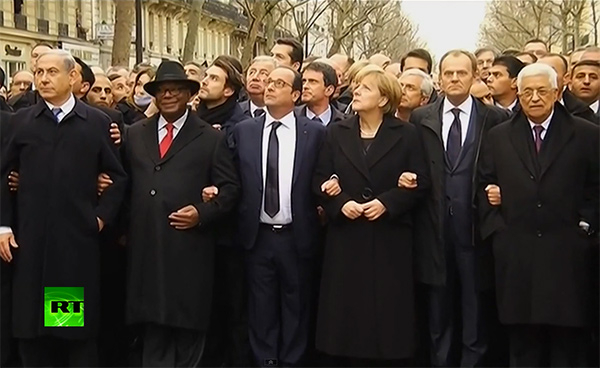
883World leaders link arms at the Paris anti-terror rally on January 11, 2014. Palestinian Authority President Mahmoud Abbas stands at the far right of the front row. (Image source: RT video screenshot)

Turkey, “named the world’s biggest jailor of journalists in 2012 and 2013” according to theWashington Post, was also there. Turkey “ended 2014 by detaining a number of journalists … including Ekrem Dumanli, editor in chief of Zaman, a leading newspaper” with links to an opposition movement.

Meanwhile, between January 8 and January 14, as over three million copies of Charlie Hebdowere selling out and four million more being printed, there was already talk in France of hardening its laws against free speech. So this may not be a turning point either for free speech or against radical Islam. So it may be a while before we can truly say, “Nous sommes Charlie.”

Jeremy Havardi is a historian and journalist based in London. His books include The Greatest Briton, analytical essays on Churchill.


[1] Ezra Levant, who reprinted the cartoons in Canada, was then compelled to appear before the Alberta Human Rights Commission to defend their publication, because of a complaint lodged by Syed Soharwardy of the Islamic Supreme Council of Canada and the Edmonton Council of Muslim Communities.

[2] As also was Lars Hedegaard (for speaking in his own drawing room), Suzanne Winters, Elisabeth Sabaditsch-Wolff, or at the very east need round-the-clock-bodyguards, such asFrench journalist Eric Zemmour, for saying that France might be facing a virtual civil war.

Iron Dome Deployed in North, Border Farms on War Footing

January 19, 2015

Farmers at northern border ordered off their fields. UNIFIL, Israeli and Lebanese soldiers on high alert.

By: Tzvi Ben-Gedalyahu

Published: January 19th, 2015

via The Jewish Press » » Iron Dome Deployed in North, Border Farms on War Footing.


Iron Dome system seen being transported at an undisclosed location in the north Monday night.
Iron Dome system seen being transported at an undisclosed location in the north Monday night. 

The IDF reportedly moved Iron Dome anti-missile systems to defend northern communities Monday night in the wake of Hezbollah threats to punish Israel for Sunday’s spectacular counter-terror bombing raid that killed approximately a dozen Hezbollah and Iranian Revolutionary Guards fighters.

The IDF told The Jewish Press, “We do not confirm or deny movements” of the Iron Dome systems, although the military previously has announced their redeployment against rockets from Gaza.

A picture of the Iron Dome being transported was posted on social media, but its location could not be verified.

Farmers in Metulla, which is smack on the northern border, were ordered off their fields by the IDF in SMS messages sent out Monday morning. Farmer Chaim Hod was quoted by Yediot Acharonot as saying that he and is workers began pruning apples tress at 6 a.m. and were ordered away from the orchards by mid-morning.

Several Metulla farms are located at the border, beyond a barbed wire fence, and are off-limits to anyone except the farmers and the IDF.

Reserve units stationed along the Lebanese border are on high alert, and several leaves of absence for regular soldiers have been cancelled.

Increased patrols were observed on both sides of the border, with UNIFIL, Lebanese and Israeli troops keeping an eye out for any suspicious activity.

UNIFIL troops are using night goggle and binoculars, according to sources quoted by the Beirut Daily Star.

Israel soldiers were seen patrolling the streets of Metulla, but civilians on both sides of the border do not seem concerned,

Hod said he actually feels safer when he sees both UNIFIL and Israeli soldiers beefing up patrols, and a Lebanese construction worker told the Star, “We are not afraid. As you see we are continuing construction work just a few kilometers from the Israelis.”

IDF Chief of Staff Benny Gantz said, “The IDF is prepared, tracking all developments, and ready to act as needed.” The air strike highlights the excellent level of Israeli intelligence operations, which are the key to carrying out counter-terror strikes and make Hezbollah leader Hassan Nasrallah think twice and three times every time he moves.

As in the past, Israel warned Lebanon that it will be held responsible for any attacks by Hezbollah, which controls southern Lebanon and is an influential part of the fragile government.

The threat of a fierce Israeli retaliation to any Hezbollah aggression is a strong deterrent. Hezbollah has fallen into growing disfavor in strife-torn Lebanon because it has brought the war in Syria into Lebanon by fighting rebels to the Assad regime. Lebanese hate Israel but a devastating retaliation by the IDF to Hezbollah rockets would make the terrorist army and party even more unwanted.

Below is a video of the aftermath of the attack on Hezbollah and Iranian commanders, as seen in a telecast from southern Lebanon.


US Strongly Backs Israel over ICC Move to Probe Israel for War Crimes

January 17, 2015

The Obama administration is not in love with Israel but certainly is divorcing itself from the Palestinian Authority.

By: Tzvi Ben-Gedalyahu

Published: January 17th, 2015

via The Jewish Press » » US Strongly Backs Israel over ICC Move to Probe Israel for War Crimes.


Does Abbas really want a war crimes probe Above: Hamas fires rockets on Israel from a hotel.

Does Abbas really want a war crimes probe Above: Hamas fires rockets on Israel from a hotel.


The U.S. State Dept. has strongly attacked the International Criminal Court (ICC) for opening a probe of alleged Israeli war comes and left open the question whether the ICC even has the a right to conduct a probe of last year’s war with Hamas.

The State Dept. called the ICC announcement a “tragic irony,” a statement that was further bolstered by praise for the ICC decision by Hamas, which may find itself under the ICC microscope.

Jeff Rathke, director of the State Dept. press office, stated:

We strongly disagree with the ICC Prosecutor’s action today. As we have said repeatedly, we do not believe that Palestine is a state and therefore we do not believe that it is eligible to join the ICC. It is a tragic irony that Israel, which has withstood thousands of terrorist rockets fired at its civilians and its neighborhoods, is now being scrutinized by the ICC.

He told reporters at Friday’s daily press briefing:

We don’t think that the Palestinians have established a state, and we don’t think they’re eligible to join the International Criminal Court. I would highlight that many other countries share this view.

In answer to a question whether the ICC is conducting “an illegitimate preliminary examination,” Rathke responded, ” I’m not going to characterize it.,” and he declined to say one way or the other if the United States will appeal to the ICC to drop the preliminary examination.

Prime Minister Binyamin Netanyahu spoke with Sec. of State John Kerry Friday and asked him to intervene against the ICC on behalf of Israel

Hamas was thrilled by the ICC decision and declared on Saturday, “We are ready to provide (the court) with thousands of reports and documents that confirm the Zionist enemy has committed horrible crimes against Gaza and against our people.”

“Tragic irony” is an excellent definition of the ICC decision, which is even more astonishing since it apparently follows a complaint by the Palestinian Authority, which will not be a member of the ICC until April 1.

Technically, the ICC is off the hook of overreaching its authority.

The “Rome Statute” concerning war crimes states that non-members cannot ask for an investigation of war crimes.

The ICC got around this restriction by stating it is “examining” whether an investigation should be conducted, and it obviously cannot make a decision until April 1.

But how can the ICC examine alleged war crimes dating back to last year, when the Palestinian Authority did not even apply for ICC membership.

PA chairman Mahmoud Abbas presented documents to the ICC giving it authority to act retroactively.

The ICC stated it will open its examination on alleged Israeli war crimes in last summers’ war with “full independence and impartiality.”

If so, it will have a hard time ignoring Hamas war crimes, which Israel documented day by day in the war, having learned to do so after the United Nations’ scathing Goldstone Report that barely mentioned Hamas’ war crimes in the three-week Operation Cast Lead counter-terrorist campaign in late December 2008 and early January 2009.

Prime Minister Netanyahu said that the ICC announcement of a preliminary examination as based on an “outrageous request” by the Palestinian Authority.

Top 10 Worst U.N. Decisions Of 2014

January 14, 2015

Top 10 Worst U.N. Decisions Of 2014

The most immoral, corrupt and unjust U.N. resolutions of the year.

posted on Dec. 21, 2014, at 9:25 a.m.

via Top 10 Worst U.N. Decisions Of 2014.

10. U.N. Elects Iran to Women’s Rights Commission

U.N. Elects Iran to Women's Rights Commission

ATTA KENARE AFP / Getty Images

NEW YORK, April 24, 2014 – The U.N. Economic and Social Council in New York elected Iran to a four-year term on its 45-nation Commission on the Status of Women, the top world body dedicated to protecting women’s rights.

9. U.N. Elects Elects New Human Rights Council Members: China, Russia, Cuba and Saudi Arabia

UN Watch / Via unwatch.org

On January 1, 2014, several of world’s worst dictatorships were elected to judge the rest of the world on human rights.

8. U.N. Creates Biased Inquiry into Hamas-Israel War, Declares Israel Guilty in Advance

GENEVA, JULY 23, 2014 — In an emergency session, the U.N. Human Rights Council declared Israel guilty of “gross violations of international human rights,” even as it created a commission of inquiry to purportedly investigate the facts.

7. U.N. Picks Genocidal Sudan to Oversee Human Rights Activists

U.N. Picks Genocidal Sudan to Oversee Human Rights Activists

NEW YORK, April 24, 2014 — The U.N. rewarded genocidal Sudan, along with the regimes of slave-holding Mauritania, Pakistan, Turkey, and Venezuela, by making them members of the powerful 19-nation U.N. Committee on NGOs, a coveted position that allows governments to silence criticism by acting as the gatekeeper and overseer of all human rights groups that seek to work inside the world body.

6. U.N. “Sees No Objection” to Praising Qatar’s Human Rights Record

UN Watch / Via unwatch.org

After UN Watch raised objections from migrant workers, women, and terror victims to a report praising Qatar’s human rights record, the U.N. went ahead and adopted the report anyway, with the Chair of the Human Rights Council saying, “I see no objection.”

5. As 9/11 Truther Richard Falk Exits, U.N. Names His Wife and Co-Author to Top Human Rights Post

As 9/11 Truther Richard Falk Exits, U.N. Names His Wife and Co-Author to Top Human Rights Post

GENEVA, May 8, 2014 — The U.N. Human Rights Council appointed Hilal Elver, the Turkish wife of Richard Falk, to become its Special Rapporteur on the Right to Food. Together with her husband and co-author, Elver is explicitly acknowledged in the world’s leading 9/11 conspiracy book, “The New Pearl Harbor,” for the help she provided the author, David Ray Griffin. Elver’s own academic work cites to Griffin’s conspiracy book, which argues that the U.S. government helped orchestrate the attacks on the World Trade Center to justify wars against Muslims in Iraq and Afghanistan. In a 2012 law journal article, Elver explicitly cited to Griffin’s notorious conspiracy tract. She compared 9/11 to Pearl Harbor, saying that both incidents “gave permission to the government to unleash the war power,” “invade countries”, “create new hegemonies”, and “racially discriminate against and segregate the people inside the United States.”

4. UNRWA Hands Rockets in Gaza Schools Back to Hamas Terrorists

UNRWA Hands Rockets in Gaza Schools Back to Hamas Terrorists

UN Watch

THE DAILY BEAST, July 20, 2014 – Reached by phone in Barcelona, Spain, UNRWA spokesman Chris Gunness insisted that the local authorities in Gaza report to the Palestinian government in Ramallah, not to Hamas. “As far as we are concerned, the government that we are dealing with now is the government of national consensus and they have authority over the organization that we dealt with for getting rid of these rockets from our school,” said UNRWA spokesman Chris Gunness. “We handed them over to the relevant authorities, and that organization, as it were, the experts that came and did it, are under the government of national consensus in Ramallah.”

July 23, 2014: “The Secretary-General is alarmed to hear that rockets were placed in an UNRWA school in Gaza and that subsequently these have gone missing…” (U.N. Spokesman of Ban Ki-Moon)

3. U.N. Names Anti-Israel Judge to Head Gaza Inquiry

William Schabas, a law professor who said that Israel’s prime minister was his “favorite in the world” to see in the dock of the International Criminal Court was selected by the U.N. Human Rights Council to chair its inquiry into the Hamas-Israel war of 2014. However, top human rights activist Aryeh Neier said that “any judge who had previously called for the indictment of the defendant should recuse himself.”

2. U.N. rewards murderous Syrian regime with top post on human rights committee

U.N. rewards murderous Syrian regime with top post on human rights committee

The U.N. Special Committee on Decolonization, charged with upholding fundamental human rights and opposing the subjugation of peoples, voted by acclamation to elect the murderous Syrian regime to a senior post.

1. U.N. Adopts 20 Resolutions on Israel vs. 4 on Rest of World Combined

U.N. Adopts 20 Resolutions on Israel vs. 4 on Rest of World Combined

UN Watch / Via blog.unwatch.org

In 2014, the U.N. General Assembly adopted 20 resolutions condemning Israel, and only four on the rest of the world combined, being one on Syria, North Korea, Ukraine and Iran.

There were zero UNGA resolutions condemning gross and systematic abuses committed by China, Cuba, Egypt, Pakistan, Russia, Saudi Arabia, Sri Lanka, Sudan, Turkey, Venezuela, Zimbabwe, nor on many other major perpetrators of grave violations of human rights.

Defending Islam from free speech: Column

January 13, 2015

Defending Islam from free speech: Column, USA Today, Robert C. Blitt, January 12, 2015

(Please see also Largest Islamic Body in the World Calls for More Anti-Free Speech Laws in Wake of Charlie Hebdo Attack. The significance of the USA Today article not so much its substance, which should be obvious, but that it was published by a “mainstream media” outlet.  — DM)

635566011815298626-BLITT(Photo: Ahmad Gharabli, AFP/Getty Images)

Clinging to the position that a prohibition on defamation of Islam is somehow a justifiable and measured response to perceived insult will continue inciting attempts to silence critics.

With millions marching in France and increasing unrest across Europe focused on Muslim immigrants, let’s hope the leaders of the Muslim world acknowledge that the effort to turn blasphemy into a crime has done more to breed religious intolerance than any cartoon or YouTube video.

****************

The OIC, whose member states range from moderate U.S. allies such as Jordan to adversaries such as Iran, describes itself as the world’s largest international body after the United Nations. For more than a decade, “the collective voice of the Muslim world” has spread the belief that any insult directed against the Muslim faith or its prophet demands absolute suppression. Quashing “defamation of Islam” is enshrined as a chief objective in the organization’s charter.

With countless internal resolutions, relentless lobbying of the international community and block voting on resolutions advocating a prohibition on defamation of religion at the U.N., the OIC continuously pushes to silence criticism of Islam.

Translated into practice inside Islamic nations and increasingly elsewhere, this toxic vision breeds contempt for freedom of religion and expression, justifies the killing of Muslims and non-Muslims alike, and casts a pall of self-censorship over academia and the arts.

By building the expectation that dissent or insult merits suppression, groups such as the OIC and the Arab League have emboldened extremists to take protection of Islam to the next level. With the most authoritative Muslim voices prepared to denounce violence but not to combat the idea that Islam should be immune from criticism, a meaningful response to counteract the resulting violence continues to be glaringly absent.

An OIC statement released after a 2011 Charlie Hebdo issue “guest-edited” by the prophet Mohammed typifies this troubling position: “Publication of the insulting cartoon … was an outrageous act of incitement and hatred and abuse of freedom of expression. … The publishers and editors of the Charlie Hebdo magazine must assume full responsibility for their … incitement of religious intolerance.”

This ominously prescient declaration tepidly closed by urging that Muslims exercise restraint.

Blasphemy is a crime

Likewise, after the attack last week, the OIC “strongly condemned the terrorist act,” but quickly added “that such acts of terror only represent the criminal perpetrators.”

It had nothing to say about the principle of free speech. Perhaps that is because blasphemous speech is a crime in a vast arc of Islamic countries from Morocco in the West to Indonesia in the East.

If the OIC, Arab League and Muslim states genuinely want to distance themselves and the religion of Islam from such ghastly acts of terror, they must reversethe years spent advancing the motive that spawned them. As a start, they should stop punishing their own citizens for failure to properly respect Islam.

Support for a prohibition on defamation of religion must be decisively repudiated. To counteract the damage that has been done, OIC members should embrace the promotion of tolerance, including sponsorship of moderation and tolerance efforts in mosques and madrassas globally. The OIC and its members should compensateCharlie Hebdo and the victims’ families.

Clinging to the position that a prohibition on defamation of Islam is somehow a justifiable and measured response to perceived insult will continue inciting attempts to silence critics.

With millions marching in France and increasing unrest across Europe focused on Muslim immigrants, let’s hope the leaders of the Muslim world acknowledge that the effort to turn blasphemy into a crime has done more to breed religious intolerance than any cartoon or YouTube video.

.

Welcoming Terrorists at the International Criminal Court

January 13, 2015

Welcoming Terrorists at the International Criminal

CourtJanuary 13, 2015

by Deborah Weiss

via Welcoming Terrorists at the International Criminal Court | FrontPage Magazine.


Amidst the rise of ISIS and the jihadi attacks in Europe, the International Criminal Court (ICC) admitted the Hamas-linked Palestinian Authority into its ranks, in effect, welcoming terrorists.

The Palestinians have long sought statehood. The official narrative proclaims a desire for an independent state in the “occupied territories” of Gaza and the West Bank, with East Jerusalem as its capitol. But in reality, Palestinians consider all of Israel to be “occupied” and many seek the extermination of the State of Israel entirely.

Israel and Palestine are bound by the Oslo accords to negotiate for peace through bilateral talks. The premise is that Israel will relinquish land in exchange for peace and security. But when Israel withdrew from Gaza in 2005, instead of receiving peace, Israel was bombarded with 10,000 Kassam rockets and Palestinians renamed their streets to “honor” jihadi martyrs.

Over the years, peace talks have failed repeatedly and negotiations have been interrupted by multitudes of Palestinian assaults on the Israeli civilian population. The Palestinian Authority (PA), the only representative of the Palestinians officially recognized by Israel and the U.S., has been unable to halt the terrorism.

To make matters worse, in 2014, the PA and Hamas joined together to form a “unity government” in an effort to reconcile the Fatah-Hamas conflict. This “reconciliation”, in effect, made the PA official collaborators with Hamas, which is a State-designated terrorist organization. Hamas refuses to recognize the State of Israel or to negotiate with her. Its charter spells out its mission to obliterate Israel through violence, and its deeds back up its words.

It is illegal to fund a terrorist organization and there is no exception for the U.S. government. However, the Obama Administration has bent over backwards to find legal loopholes through which it could still funnel financial aid to “Palestine,” to the tune of 400 million dollars annually. In contrast, Israeli officials refuse to negotiate with a terror-affiliated entity.

PA President Abbas publicly proclaimed that the unity government would recognize Israel’s right to exist, be non-violent, and be bound by prior PLO agreements. The Hamas spokesperson, on the other hand, admits that it never did, or would, recognize the State of Israel. Furthermore, Hamas claims that its affiliation with the PA ended after a six month term. Abbas insists to the contrary, that the unity government is still in full force.

Either way, “Palestine” is not a state, and therefore fails to qualify for ICC membership. Never-the-less, in an attempt to make an end-run around bi-lateral negotiations, the Palestinians applied for, and obtained, an upgrade in UN status. In 2012, pursuant to a UN General Assembly vote, Palestine’s status went from “observer entity” to “non-member observer state”. This change in status made admission to the ICC possible.

It is noteworthy that this is the same GA that on a regular and frequent basis, passes anti-Israel resolutions. Indeed, the entire UN apparatus in incredibly biased, holding Israel to a standard to which no other country is held. Resolutions condemning Israel in the GA and the Human Rights Council are numerous, while both bodies turn a blind eye to real human rights abuses in countries like Sudan, Pakistan and Saudi Arabia.

Additionally, Palestine has been lobbying countries to provide it with unilateral recognition of statehood. Many states have acquiesced, with a swell in the western ranks during 2014, though sometimes the recognition extended is diplomatic and not legally binding. These states include Sweden, France, Spain, Britain, Ireland, and Iceland, as well as the EU.

Palestine’s goal has been to join the ICC for the purpose of filing claims against Israel for war crimes and crimes against humanity, in an attempt to force unilateral concessions without an exchange of peace. Already, the PA is preparing its paperwork for submission to the ICC. The PA seeks to have Israel prosecuted for its 2014 campaign against Gaza, though it was a response to Palestinian terrorism and the illegal smuggling of weapons through underground tunnels. Additionally, the PA wants Israel prosecuted for her settlements on so-called “occupied territory”, despite the fact that it is quite a stretch to allege that settlement activity constitutes a war crime.

Israel is not a member of the ICC, but the ICC asserts jurisdiction over anyone that commits war crimes or crimes against humanity on the territory of its member states. Jurisdictional disputes are determined by the ICC itself, demonstrating one of the many problems with its expansive, unchecked power. Israeli Prime Minister Netanyahu has already promised that Israel will stand by the IDF soldiers as they have defended Israel, but what that means in legal terms is unclear.   Israeli citizens are also at risk for potential prosecution if the ICC accepts the PA’s case.

Already there is blowback from the PA’s move to ICC membership, which Israel considers to be a game-changer of escalatory proportion. Accordingly, Israel has frozen 127 million dollars in tax revenue designated for the PA, which the Palestinians direly need, and the peace talks are virtually dead. Additionally, U.S. officials are re-evaluating appropriations and will consider legislation to cease U.S. aid to “Palestine” if it demands the prosecution of Israel.

Still, the PA seeks momentum in the court of public opinion. Its goal on the world stage is to gain international recognition of Palestinian statehood and to delegitimize Israel.

On June 13, 2014, “Palestine” accepted ICC jurisdiction by means of a declaration pursuant to article 12(3) of the Rome Statue (the treaty that provides for the creation and jurisdiction of the ICC). The PA government signed the Rome Statute on December 31, 2014. This was one day subsequent to its failed bid at the UN Security Council to pass a resolution calling for Israel to withdraw to the pre-1967 borders within the next three years. “The State of Palestine’s” instruments of accession to the ICC were deposited and effected as of January 2, 2015. The PA also signed a multitude of treaties and international conventions shortly thereafter.

The official date on which Palestine will become a full-fledged ICC member is on April 1, 2015, April Fool’s Day. In a world where anti-Semitism and Islamic jihad are on the rise (both stealth and violent), April Fool’s Day will be a grim day indeed. But the joke is not on Palestine. It will be on all those in the West who profess to care about freedom and human rights, but have abandoned their principles in capitulation to Islamist demands and welcomed terrorists into their midst.