Posted tagged ‘U.S. military’

The future of counterterrorism: Addressing the evolving threat to domestic security

March 1, 2017

The future of counterterrorism: Addressing the evolving threat to domestic security, Long War Journal, February 28, 2017

Below is Thomas Joscelyn’s testimony to the House Committee on Homeland Security, Subcommittee Counterterrorism and Intelligence, on the future of counterterrorism and addressing the evolving threat to domestic security.

Chairman King, Ranking Member Rice, and other members of the committee, thank you for inviting me to testify today. The terrorist threat has evolved greatly since the September 11, 2001 hijackings. The U.S. arguably faces a more diverse set of threats today than ever. In my written and oral testimony, I intend to highlight both the scope of these threats, as well as some of what I think are the underappreciated risks.

My key points are as follows:

– The U.S. military and intelligence services have waged a prolific counterterrorism campaign to suppress threats to America. It is often argued that because no large-scale plot has been successful in the U.S. since 9/11 that the risk of such an attack is overblown. This argument ignores the fact that numerous plots, in various stages of development, have been thwarted since 2001. Meanwhile, Europe has been hit with larger-scale operations. In addition, the U.S. and its allies frequently target jihadists who are suspected of plotting against the West. America’s counterterrorism strategy is mainly intended to disrupt potentially significant operations that are in the pipeline.

-Over the past several years, the U.S. military and intelligence agencies claim to have struck numerous Islamic State (or ISIS) and al Qaeda “external operatives” in countries such as Afghanistan, Iraq, Libya, Pakistan, Syria, Yemen, and elsewhere. These so-called “external operatives” are involved in anti-Western plotting. Had they not been targeted, it is likely that at least some of their plans would have come to fruition. Importantly, it is likely that many “external operatives” remain in the game, and are still laying the groundwork for attacks in the U.S. and the West.

-In addition, the Islamic State and al Qaeda continue to adapt new messages in an attempt to inspire attacks abroad. U.S. law enforcement has been forced to spend significant resources to stop “inspired” plots. As we all know, some of them have not been thwarted. The Islamic State’s caliphate declaration in 2014 heightened the threat of inspired attacks, as would-be jihadists were lured to the false promises of Abu Bakr al Baghdadi’s cause.

-The Islamic State also developed a system for “remote-controlling” attacks in the West and elsewhere. This system relies on digital operatives who connect with aspiring jihadis via social media applications. The Islamic State has had more success with these types of small-scale operations in Europe. But as I explain in my written testimony, the FBI has uncovered a string of plots inside the U.S. involving these same virtual planners.

-The refugee crisis is predominately a humanitarian concern. The Islamic State has used migrant and refugee flows to infiltrate terrorists into Europe. Both the Islamic State and al Qaeda could seek to do the same with respect to the U.S., however, they have other means for sneaking jihadists into the country as well. While some terrorists have slipped into the West alongside refugees, the U.S. should remain focused on identifying specific threats.

-More than 15 years after 9/11, al Qaeda remains poorly understood. Most of al Qaeda’s resources are devoted to waging insurgencies in several countries. But as al Qaeda’s insurgency footprint has spread, so has the organization’s capacity for plotting against the West. On 9/11, al Qaeda’s anti-Western plotting was primarily confined to Afghanistan, with logistical support networks in Pakistan, Iran, and other countries. Testifying before the Senate in February 2016, Director of National Intelligence (DNI) James Clapper warned that the al Qaeda threat to the West now emanates from multiple countries. Clapper testified that al Qaeda “nodes in Syria, Pakistan, Afghanistan, and Turkey” are “dedicating resources to planning attacks.” To this list we can add Yemen. And jihadists from Africa have been involved in anti-Western plotting as well. Incredibly, al Qaeda is still plotting against the U.S. from Afghanistan.

Both the Islamic State and al Qaeda continue to seek ways to inspire terrorism inside the U.S. and they are using both new and old messages in pursuit of this goal.

The jihadists have long sought to inspire individuals or small groups of people to commit acts of terrorism for their cause. Individual terrorists are often described as “lone wolves,” but that term is misleading. If a person is acting in the name of a global, ideological cause, then he or she cannot be considered a “lone wolf,” even if the individual in question has zero contact with others. In fact, single attackers often express their support for the jihadists’ cause in ways that show the clear influence of propaganda.

Indeed, al Qaeda and al Qaeda in the Arabian Peninsula (AQAP) first began to aggressively market the idea of “individual” or “lone” operations years ago. AQAP’s Inspire magazine is intended to provide would-be jihadists with everything they could need to commit an attack without professional training or contact. Anwar al Awlaki, an AQAP ideologue who was fluent in English, was an especially effective advocate for these types of plots. Despite the fact that Awlaki was killed in a U.S. airstrike in September 2011, his teachings remain widely available on the internet.

The Islamic State capitalized on the groundwork laid by Awlaki and AQAP. In fact, Abu Bakr al Baghdadi’s operation took these ideas and aggressively marketed them with an added incentive. Al Qaeda has told its followers that it wants to eventually resurrect an Islamic caliphate. Beginning in mid-2014, the Islamic State began to tell its followers that it had already done so in Iraq, Syria, and elsewhere. Baghdadi’s so-called caliphate has also instructed followers that it would be better for them to strike inside their home countries in the West, rather than migrate abroad for jihad. The Islamic State has consistently marketed this message.

In May 2016, for instance, Islamic State spokesman Abu Muhammad al Adnani told followers that if foreign governments “have shut the door of hijrah [migration] in your faces,” then they should “open the door of jihad in theirs,” meaning in the West. “Make your deed a source of their regret,” Adnani continued. “Truly, the smallest act you do in their lands is more beloved to us than the biggest act done here; it is more effective for us and more harmful to them.”

“If one of you wishes and strives to reach the lands of the Islamic State,” Adnani told his audience, “then each of us wishes to be in your place to make examples of the crusaders, day and night, scaring them and terrorizing them, until every neighbor fears his neighbor.” Adnani told jihadists that they should “not make light of throwing a stone at a crusader in his land,” nor should they “underestimate any deed, as its consequences are great for the mujahidin and its effect is noxious to the disbelievers.”

The Islamic State continued to push this message after Adnani’s death in August 2016.

In at least several cases, we have seen individual jihadists who were first influenced by Awlaki and AQAP gravitate to the Islamic State’s cause. Syed Rizwan Farook and his wife were responsible for the December 2, 2015 San Bernardino massacre. They pledged allegiance to Baghdadi on social media, but Farook had drawn inspiration from Awlaki and AQAP’s Inspire years earlier.

Omar Mateen swore allegiance to Baghdadi repeatedly on the night of his assault on a LGBT nightclub in Orlando, Florida. However, a Muslim who knew Mateen previously reported to the FBI that Mateen was going down the extremist path. He told the FBI in 2014 that Mateen was watching Awlaki’s videos. It was not until approximately two years later, in early June 2016, that Mateen killed 49 people and wounded dozens more in the name of the supposed caliphate.

Ahmad Khan Rahami, the man who allegedly planted bombs throughout New York and New Jersey in September 2016, left behind a notebook. In it, Rahami mentioned Osama bin Laden, “guidance” from Awlaki, an also referenced Islamic State spokesman Adnani. Federal prosecutors wrote in the complaint that Rahami specifically wrote about “the instructions of terrorist leaders that, if travel is infeasible, to attack nonbelievers where they live.” This was Adnani’s key message, and remains a theme in Islamic State propaganda.

The Department of Justice (DOJ) has alleged that other individuals who sought to support the Islamic State were first exposed to Awlaki’s teachings as well.

These cases demonstrate that the jihadis have developed a well of ideas from which individual adherents can draw, but it may take years for them to act on these beliefs, if they ever act on them at all. There is no question that the Islamic State has had greater success of late in influencing people to act in its name. But al Qaeda continues to produce recruiting materials and to experiment with new concepts for individual attacks as well.

Al Qaeda and its branches have recently called for revenge for Sheikh Omar Abdel Rahman, who died in a U.S. prison earlier this month. Rahman was convicted by a U.S. court for his involvement in plots against New York City landmarks in the mid-1990s. Since then, al Qaeda has used Rahman’s “will” to prophesize his death and to proactively blame the U.S. for it. Approximately 20 years after al Qaeda first started pushing this theme, Rahman finally died. Al Qaeda’s continued use of Rahman’s prediction, which is really just jihadist propaganda, demonstrates how these groups can use the same concepts for years, whether or not the facts are consistent with their messaging. Al Qaeda also recently published a kidnapping guide based on old lectures by Saif al Adel, a senior figure in the group. Al Adel may or may not be currently in Syria. Al Qaeda is using his lectures on kidnappings and hostage operations as a way to potentially teach others how to carry them out. The guide was published in both Arabic and English, meaning that al Qaeda seeks an audience in the West for al Adel’s designs.

Both the Islamic State and AQAP also continue to produce English-language magazines for online audiences. The 15th issue of Inspire, which was released last year, provided instructions for carrying out “professional assassinations.” AQAP has been creating lists of high-profile targets in the U.S. and elsewhere that they hope supporters will use in selecting potential victims. AQAP’s idea is to maximize the impact of “lone” attacks by focusing on wealthy businessmen or other well-known individuals. AQAP has advocated for, and praised, indiscriminate attacks as well. But the group has critiqued some attacks (such as the Orlando massacre at a LGBT nightclub) for supposedly muddying the jihadists’ message. AQAP is trying to lay the groundwork for more targeted operations. For example, the January 2015 assault on Charlie Hebdo’s offices in Paris was set in motion by al Qaeda and AQAP. Inspire even specifically identified the intended victims beforehand. Al Qaeda would like individual actors, with no foreign ties, to emulate such precise hits.

Meanwhile, the Islamic State has lowered the bar for what is considered a successful attack, pushing people to use cars, knives, or whatever weapons they can get in their hands. The Islamic State claimed that both the September 2016 mall stabbings in Minnesota and the vehicular assault at Ohio State University in November 2016 were the work of its “soldiers.” It may be the case that there were no digital ties between these attackers and the Islamic State. However, there is often more to the story of how the Islamic State guides such small-scale operations.

The Islamic State has sought to carry out attacks inside the U.S. via “remote-controlled” terrorists.

A series of attacks in Europe and elsewhere around the globe have been carried out by jihadists who were in contact, via social media applications, with Islamic State handlers in Syria and Iraq. The so-called caliphate’s members have been able to remotely guide willing recruits through small-scale plots that did not require much sophistication. These plots targeted victims in France, Germany, Russia, and other countries. In some cases, terrorists have received virtual support right up until the moment of their attack. The Islamic State has had more success orchestrating “remote-controlled” plots in Europe, but the jihadist group has also tried to carry out similar plots inside the U.S.

Since 2015, if not earlier, the U.S.-led coalition has launched airstrikes against the Islamic State operatives responsible for these operations. Jihadists such Rachid Kassim, Junaid Hussain, and Abu Issa al Amriki have all been targeted. Both Hussain and al Amriki sought to “remotely-control” attacks inside the U.S. They have reached into other countries as well. For example, British Prime Minister David Cameron connected Hussain to plots in the UK. And Hussain’s wife, Sally Jones, has also reportedly used the web to connect with female recruits.

Kassim was tracked to a location near Mosul, Iraq earlier this month. Hussain was killed in an American airstrike in Raqqa, Syria on August 24, 2015. Along with his wife, al Amriki perished in an airstrike near Al Bab, Syria on April 22, 2016. But law enforcement officials are still dealing with their legacy and it is possible that others will continue with their methods.

In this section, I will briefly outline several cases in which Hussain and al Amriki were in contact with convicted or suspected terror recruits inside the U.S. In a number of cases, the FBI has used confidential informants or other methods in sting operations to stop these recruits. It should be noted that it is not always clear how much of a threat a suspect really posed and the press has questioned the FBI’s methods in some of these cases. I have included the examples below to demonstrate how the Islamic State’s digital operatives have contacted potential jihadists across the U.S.

For example, Hussain was likely in contact with the two gunmen who opened fire at an event dedicated to drawing pictures of the Prophet Mohammed in Garland, Texas on May 3, 2015. As first reported by the SITE Intelligence Group, Hussain (tweeting under one of his aliases) quickly claimed the gunmen were acting on behalf of the caliphate. Then, in June 2015, Hussain claimed on Twitter that he had encouraged Usaamah Rahim, an Islamic State supporter, to carry a knife in case anyone attempted to arrest him. Rahim was shot and killed by police in Boston after allegedly wielding the blade. The DOJ subsequently confirmed that Rahim was “was communicating with [Islamic State] members overseas, including Junaid Hussain.”

On July 7, 2016, Munir Abdulkader, of West Chester, Ohio, pleaded guilty to various terrorism-related charges. According to the DOJ, Abdulkader communicated with Hussain, who “directed and encouraged Abdulkader to plan and execute a violent attack within the United States.” In conversations with both Hussain and a “confidential human source,” Abdulkader discussed a plot “to kill an identified military employee on account of his position with the U.S. government.” Abdulkader planned to abduct “the employee at the employee’s home” and then film this person’s execution. After murdering the military employee, Abdulkader “planned to perpetrate a violent attack on a police station in the Southern District of Ohio using firearms and Molotov cocktails.” Hussain repeatedly encouraged Islamic State followers to attack U.S. military personnel, just as Abdulkader planned.

On August 11, 2016, Emanuel Lutchman of Rochester, New York pleaded guilty to conspiring to provide material support to the Islamic State as part of a planned New Year’s Eve attack. Lutchman admittedly conspired with Abu Issa al Amriki after he “initiated online contact” with the Islamic State planner on Christmas Day 2015. “In a series of subsequent communications,” DOJ noted, al Amriki “told Lutchman to plan an attack on New Year’s Eve and kill a number of kuffar [nonbelievers].” Al Amriki wanted Lutchman “to write something before the attack and give it to” an Islamic State member, “so that after the attack the [Islamic State] member could post it online to announce Lutchman’s allegiance” to the so-called caliphate. Lutchman wanted to join the Islamic State overseas, but al Amriki encouraged him to strike inside the U.S., as it would better serve the jihadists’ cause. “New years [sic] is here soon,” al Amriki typed to Lutchman. “Do operations and kill some kuffar.” Al Amriki also promised Lutchman some assistance in traveling to Syria or Libya, if the conditions were right. Lutchman divulged his contacts with al Amriki to individuals who, “unbeknownst to Lutchman,” were “cooperating with the FBI.”

On November 7, 2016, Aaron Travis Daniels, also known as Harun Muhammad and Abu Yusef, was arrested at an airport in Columbus, Ohio. He was reportedly en route to Trinidad, but he allegedly intended to travel to Libya for jihad. According to DOJ, Daniels was in contact with Abu Issa al Amriki, who acted as a “recruiter and external attack planner.” Daniels said at one point that it was al Amriki who “suggested” he go to Libya “to support jihad” and he allegedly “wired money to an intermediary” for al Amriki. The DOJ did not allege that Daniels planned to commit an attack in Ohio or elsewhere inside the U.S. Still, the allegations are significant because Daniels was allegedly in contact with al Amriki.

On November 29, 2016, Justin Nojan Sullivan, of Morganton, North Carolina, pleaded guilty to terrorism-related charges. “Sullivan was in contact and plotted with now-deceased Syria-based terrorist Junaid Hussain to execute acts of mass violence in the United States in the name of the” Islamic State, Acting Assistant Attorney General for National Security Mary B. McCord said in a statement. Sullivan and Hussain “conspired” to “plan mass shooting attacks in North Carolina and Virginia,” with Sullivan intending “to kill hundreds of innocent people.”

On February 10, 2017, the DOJ announced that two New York City residents, Munther Omar Saleh and Fareed Mumuni, pleaded guilty to terror-related charges. “Working with [Islamic State] fighters located overseas, Saleh and Mumuni also coordinated their plot to conduct a terrorist attack in New York City,” the DOJ explained. Saleh, from Queens, sought and received instructions from an [Islamic State] attack facilitator to create a pressure-cooker bomb and discussed with the same [Islamic State] attack facilitator potential targets for a terrorist attack in New York City.” Saleh “also sought and received religious authorization from an [Islamic State] fighter permitting Mumuni to conduct a suicide ‘martyrdom’ attack by using a pressure-cooker bomb against law enforcement officers who were following the co-conspirators and thus preventing them from traveling to join” the Islamic State. Federal prosecutors revealed that the “attack facilitator” Saleh was talking to was, in fact, Junaid Hussain.

Also on February 10, 2017, Mohamed Bailor Jalloh, a Virginia man and former member of the Army National Guard, was sentenced to 11 years in prison and five years supervised release for attempting to provide material support to the Islamic State. According to the DOJ, Jalloh was in contact with Islamic State members both in person and online. He met Islamic State members in Nigeria during a “six-month trip to Africa” and also “began communicating online with” an Islamic State member located overseas during this time. The Islamic State member “brokered” Jalloh’s “introduction” to the FBI’s confidential human source. This means the U.S. government’s intelligence was so good in this case that the digital handler was actually fooled into leading Jalloh into a dead-end. Still, Jalloh considered “conducting an attack similar to the terrorist attack at Ft. Hood, Texas,” which left 13 people dead and dozens more wounded.

More than 15 years after the 9/11 hijackings, al Qaeda is still plotting against the U.S.

Al Qaeda has not been able to replicate its most devastating attack in history, the September 11, 2001 hijackings. But this does not mean the al Qaeda threat has disappeared. Instead, al Qaeda has evolved. There are multiple explanations for why the U.S. has not been struck with another 9/11-style, mass casualty operation. These reasons include: the inherent difficulty in planning large-scale attacks, America’s improved defenses, and a prolific counterterrorism campaign overseas.

In addition, contrary to a widely-held assumption in counterterrorism circles, al Qaeda has not made striking the U.S. its sole priority. In fact, al Qaeda leader Ayman al Zawahiri has even ordered his men in Syria to stand down at times, as they prioritized the war against Bashar al Assad’s regime over bombings, hijackings, or other assaults in the West. However, Zawahiri could change his calculation at any time, and it would then be up to America’s intelligence and law enforcement officials to detect and thwart specific plots launched from Syria. One additional caveat here is warranted. Despite the fact that Zawahiri has not given the final green light for an anti-Western operation launched from Syrian soil, al Qaeda has been laying the groundwork for such attacks in Syria and elsewhere. There is a risk that al Qaeda could seek to launch Mumbai-style attacks in American or European cities, bomb trains or other mass transit locations, plant sophisticated explosives on Western airliners, or dream up some other horrible attack.

In September 2014, the Obama administration announced that it launched airstrikes against al Qaeda’s so-called “Khorasan Group” in Syria. There was some confusion surrounding this group. The Khorasan Shura is an elite body within al Qaeda and part of this group is dedicated to launching “external operations,” that is, attacks in the West. Several significant leaders in the Khorasan Group were previously based in Iran, where al Qaeda maintains a core facilitation hub. In fact, at least two Khorasan figures previously headed al Qaeda’s Iran-based network, which shuttles operatives throughout the Middle East and sometimes into the West. As I have previously testified before this committee, some foiled al Qaeda plots against the West were facilitated by operatives based in Iran.

Al Qaeda began relocating senior operatives to Syria in 2011. And the U.S. has targeted known or obscure al Qaeda veterans in Syria in the years since, often citing their presumed threat to the U.S. and the West. I will not list all of these operatives here, but we regularly track the al Qaeda figures targeted in drone strikes at FDD’s Long War Journal.

During the final months of the Obama administration, American military and intelligence officials highlighted al Qaeda’s continued plotting against the U.S. on multiple occasions. And there was also a shift in America’s air campaign, from targeted strikes on individual al Qaeda operatives in Syria to bombings intended to destroy whole training camps or other facilities. In addition, the U.S. Treasury and State Departments began to designate terrorist leaders within al Qaeda’s branch in Syria who may not play any direct role in international operations. This change in tactics reflects the realization that al Qaeda has built its largest paramilitary force in history in Syria. And while only part of this force may have an eye on the West, there is often no easy way to delineate between jihadists involved in al Qaeda’s insurgency operations and those who are participating in plots against America or European nations.

In October 2016, the Defense Department announced that the U.S. had carried out “transregional” airstrikes against al Qaeda’s “external” operatives in Syria, Yemen, and Afghanistan. Al Qaeda “doesn’t recognize borders when they conspire to commit terrorist attacks against the West, and we will continue to work with our partners and allies to find and destroy their leaders, their fighters and their cells that are planning attacks externally,” Pentagon spokesman Navy Capt. Jeff Davis said shortly after the bombings. Davis added that some of al Qaeda’s “external” plotters enjoyed a “friendly, hospitable environment” within Al Nusrah Front, which was the name used by al Qaeda’s guerrilla army in Syria until mid-2016. Davis added that the jihadists targeted “are people who are from outside Syria in many cases and who are focused on external operations.”

The Pentagon provided short descriptions for each of the al Qaeda operatives targeted in October 2016. On October 17, Haydar Kirkan was killed in Idlib, Syria. He was “a long-serving and experienced facilitator and courier for al Qaeda in Syria,” who “had ties to al Qaeda senior leaders, including Osama bin Laden.” Davis added that Kirkan “was al Qaeda’s senior external terror attack planner in Syria, Turkey and Europe.” Kirkan oversaw a significant network inside Turkey. The U.S. has killed a number of individuals with backgrounds similar to Kirkan since 2014.

On October 21, an AQAP leader known as Abu Hadi al-Bayhani and four others were killed in a U.S. airstrike in Yemen’s Marib governorate. The Pentagon tied al-Bayhani to AQAP’s “external” plotting, noting that the al Qaeda arm relies on “leaders like Bayhani to build and maintain safe havens” from which it “plans external operations.”

Then, on October 23, two senior al Qaeda leaders, Farouq al-Qahtani and Bilal al-Utabi, were killed in airstrikes in Afghanistan. Qahtani was one of al Qaeda’s most prominent figures in the Afghan insurgency, as he was the group’s emir for eastern Afghanistan and coordinated operations with the Taliban. Osama bin Laden’s files indicate that Qahtani was responsible for re-establishing al Qaeda’s safe havens in Afghanistan in 2010, if not earlier. But Qahtani was also tasked with plotting attacks in the West.

General John W. Nicholson, the Commander of NATO’s Resolute Support and U.S. Forces in Afghanistan, described the threat posed by Qahtani in a recent interview with the CTC Sentinel, a publication produced by the Combating Terrorism Center at West Point. Gen. Nicholson described Qahtani as al Qaeda’s “external operations director,” saying that he was “actively involved in the last year in plotting attacks against the United States.” Nicholson added this warning: “There’s active plotting against our homeland going on in Afghanistan. If we relieve pressure on this system, then they’re going to be able to advance their work more quickly than they would otherwise.”

Kirkan, Bayhani, and Qahtani are just some of the men involved in anti-Western plotting who have been killed in recent bombings. And these targeted airstrikes are just part of the picture.

In October 2015, the U.S. and its Afghan allies destroyed what was probably the largest al Qaeda training camp in Afghanistan’s history in the Shorabak district of Kandahar. The facility was an estimated 30 square miles in size, making it bigger than any of al Qaeda’s pre-9/11 camps.

The U.S. military says that approximately 250 al Qaeda operatives were killed or captured in Afghanistan in 2016. This is far more than the U.S. government’s longstanding estimate for al Qaeda’s entire force structure in all of Afghanistan. For years, U.S. officials claimed there was just 50 to 100 al Qaeda jihadists throughout the entire country.

On January 20, the Defense Department announced that “more than 150 al Qaeda terrorists” had been killed in Syria since the beginning of 2017. In addition to individual terrorists involved in plotting against the West, the U.S. struck the Shaykh Sulayman training camp, which had been “operational since at least 2013.”

The reality is that al Qaeda now operates large training camps in more countries today than on 9/11. The next 9/11-style plotters could be in those camps, or fighting in jihadist insurgencies, right now. If so, it will be up to America’s offensive counterterrorism campaign and its defenses to stop them.

Thomas Joscelyn is a Senior Fellow at the Foundation for Defense of Democracies and the Senior Editor for FDD’s Long War Journal.

HUMOR | ‘We’re Making Real Progress,’ Say Last 17 Commanders In Afghanistan

February 27, 2017

‘We’re Making Real Progress,’ Say Last 17 Commanders In Afghanistan, Duffel Blog, February 27, 2017

afghanprogress

BAGRAM AIRFIELD, Afghanistan — The past 17 commanders of international forces in Afghanistan, as well as other US leaders, say the coalition is making “real progress” towards defeating the Taliban insurgency and stabilizing the country, sources confirmed today.

That positive outlook has offered new hope for peace and stability as the current commander, Gen. John Nicholson, looks to deploy “a few thousand” more troops to theater to build upon all the progress that has already been made

Gen. Tommy Franks served as commander of US Central Command from 2000-2003, and was in charge of operations in the Middle East when the Taliban was conclusively defeated in 2002.

“What a difference 10 months makes in a country like Afghanistan,” Franks said in an interview that year. “Taliban’s gone.”

Many other commanders have talked about the incredible progress that has been achieved in Afghanistan, where NATO has crippled the Taliban and put them against the ropes. As most terror analysts note, the terror group can barely hold on after more than 15 years of fighting.

In 2005, Gen. John Abizaid, who succeeded Franks at CentCom, promisingly judged that international activity in Afghanistan had “shown interesting progress.” He also noted the coalition was making progress in “reconstruction projects that showed some tangible progress” and “the cessation of hostilities after 25 years worth of hostilities in the vast majority of the country.”

And Gen. Dan McNeill, who served as commander of the International Security Assistance Force (ISAF) from 2007-2008, prudently assessed that “there is significant progress in the forward move of the Afghan National Army,” while scrupulously reminding the audience that “NATO’s an interim force in Afghanistan.”

Still, there have been setbacks.

In 2009, Gen. David McKiernan was fired from his post as ISAF commander after brashly stating that the US “must define winning in Afghan terms: meaning improved security, reduced civilian casualties, trustworthy government, economic and social progress.”

He went on to suggest that a satisfactory outcome in Afghanistan would take a decade or more to achieve, despite historical precedent to the contrary and Vice President Dick Cheney’s assertion that the wars in Iraq and Afghanistan were won back in 2004.

After taking the post from McKiernan, Gen. Stanley McChrystal was rightfully relieved in 2010 after failing to recognize the great progress that was being made.

Fortunately, Gen. David Petraeus replaced McChrystal and masterfully implemented a grand strategy to inject more progress into the campaign for progress. In a letter to the troops in July 2010 he declared, “progress has been achieved in some critical areas, and we are poised to realize more.”

Full progress in Afghanistan was achieved definitively in May 2011 with a high-profile raid that killed Osama bin Laden. Vice President Joe Biden then drove a proverbial stake through the heart of the war when he said in 2012, “we are leaving [Afghanistan] in 2014. Period.”

Gen. John Allen paved the path to victory for his successors, stating in 2013, “I think we are on the road to winning,” as he turned over command to Gen. Joseph Dunford.

Before “Fightin’ Joe” closed out the war in 2014, he offered a more somber assessment, saying, “At this point we have made significant progress, but we are not yet at the point where it is completely sustainable.” He also reassured Americans that though there would be a US presence in Afghanistan after 2014, “the actual fighting on a day-to-day basis will all be done by Afghans.”

And as ISAF transitioned to the Resolute Support Mission (RSM) at the end of 2014, Gen. John Campbell maintained a bright outlook.

“Together, we have lifted the Afghan people out of the darkness of despair and given them hope for the future,” he said during the transition ceremony.

Gen. Nicholson, the current RSM commander, is looking to continue the progress made by his predecessors over the past 15 years. He has big shoes to fill, as at least two presidents and perhaps a dozen commanders have successfully won the war thus far.

But his plans are on track, as he stated in a press briefing in July 2016, “I would say overall our mission in Afghanistan is on a positive trajectory.”

Interestingly, Mullah Mohammed Omar, who served as the sole Taliban leader from 1996 until his death in a jet ski accident in 2013, also says the Taliban is making “real progress” in the region.


Trump-Putin safe zones deal ousts Iran from Syria

January 26, 2017

Trump-Putin safe zones deal ousts Iran from Syria, DEBKAfile, January 26, 2017

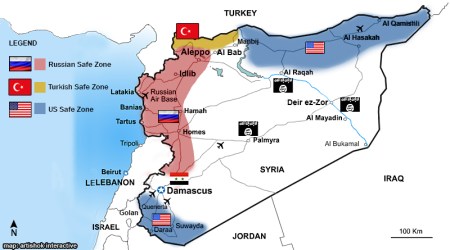
syria_safezones

Russia had originally planned to deploy Syrian military, pro-Iranian Shiite militia and Hizballah forces in battles for the capture of land around the cities of Derra and Quneitra on the Syrian side of the Golan. That plan has been dropped and will be superseded by the deployment in southern Syria of US troops accompanied by Jordanian special forces and Syrian rebels, trained by American instructors in Jordanian military camps.

Israelis will breathe a sigh of relief over the removal of the threat of Iranian and Hizballah forces being deployed along their northern border with Syria.

**************************

Syria stands on the threshold of dramatic changes that will directly impact on the strategic and military situation along the Syrian borders with Israel and Jordan, DEBKAfile reports exclusively. They derive from a deal struck this week by US President Donald Trump and Russian President Vladimir Putin to establish US, Russian and Turkish security zones in Syria. This scheme will transfer military control of the country to those three powers. Each of them will be responsible for a zone whose borders will be defined and agreed upon by Washington, Moscow  and Ankara.

As part of this arrangement, all forces from the Iranian military, the pro-Iranian Shiite militias and Hizballah will be required to leave Syria.

The US military is to have two security zones – one covering the entire area east of the Euphrates River up to the Iraqi border including Kurdish areas (see attached map). This arrangement will partly resurrect the accord reached in late 2015 by US President Barack Obama and Putin, for the division of Syria into areas of influence. All territory east of the Euphrates was allocated to the US, with Russia taking responsibility for all areas west of the river until the Mediterranean coast.

Under the new deal, the Turkish area is to stretch about 650 kilometers along the entire Syria-Turkey border and extend between 35 and 50 kilometers into Syrian territory up to Al-Bab, the town where the Turkish military is engaged in its third straight month of fighting for its capture from ISIS.

DEBKAfile’s military and intelligence sources report that the overriding change on the ground will be the establishment of a second US security zone adjacent to Syria’s borders with Israel and Jordan. It means that the approximately 7,500 US special operations forces troops currently in Jordan will be shifted northward into southern Syria.

Russia had originally planned to deploy Syrian military, pro-Iranian Shiite militia and Hizballah forces in battles for the capture of land around the cities of Derra and Quneitra on the Syrian side of the Golan. That plan has been dropped and will be superseded by the deployment in southern Syria of US troops accompanied by Jordanian special forces and Syrian rebels, trained by American instructors in Jordanian military camps.

Israelis will breathe a sigh of relief over the removal of the threat of Iranian and Hizballah forces being deployed along their northern border with Syria.

The Trump-Putin deal for Syria and its ramifications are explored in the coming issue of DEBKA Weekly (for subscribers) out Friday, with especially attention to the way it leaves Iran and Hizballah high and dry.

If you are not yet a subscriber, click here to sign on.

White House to End Defense Sequester, Boost Military’s Cyber Capabilities

January 23, 2017

White House to End Defense Sequester, Boost Military’s Cyber Capabilities, Washington Free Beacon, January 23, 2017

(Now that we have a President who will use the military to the nation’s benefit, it needs additional resources. There is no truth to any rumor that Hillary Clinton will be hired as a cyber security expert.– DM)

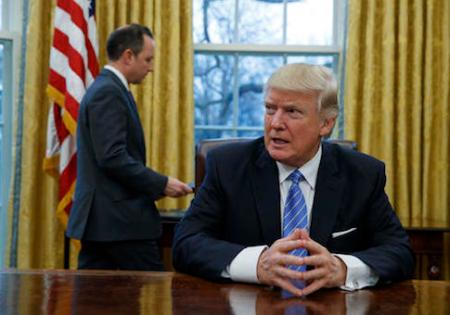
President Donald Trump sits at his desk as he waits for White House Chief of Staff Reince Priebus, left, to deliver three executive orders for his signature, Monday, Jan. 23, 2017, in the Oval Office of the White House in Washington. (AP Photo/Evan Vucci)

President Donald Trump sits at his desk as he waits for White House Chief of Staff Reince Priebus, left, to deliver three executive orders for his signature, Monday, Jan. 23, 2017, in the Oval Office of the White House in Washington. (AP Photo/Evan Vucci)

Donald Trump’s administration will end the defense sequester and direct U.S. military leaders to develop defensive and offensive cyber capabilities to bolster the armed forces.

The military budget, missile defense, and cyber defense are priorities for the new White House, according to a statement on its website laying out Trump’s plan to “make our military strong again.”

Military leaders have spotlighted how reductions in defense spending have compromised the future military readiness of the joint force. In congressional testimony last fall, service leaders disclosed that their forces would not be able to defend the United States against current and future threats if sequestration continued.

According to the White House, Trump plans to end the defense sequester and send a new budget to Congress outlining his plan to rebuild the military. It is unclear how much defense spending Trump will propose, but the White House said he will commit to providing military leaders “with the means to plan for our future defense needs.” The Pentagon operates on a roughly $600 billion annual budget.

The Budget Control Act of 2011 implemented a package of automatic spending cuts to defense and discretionary domestic spending. The cuts, designed to take place over a decade, are expected to erode defense spending by roughly $1 trillion.

Some Republican members of Congress have been vocal about the need to reverse cuts that have squeezed the defense budget, as well as force drawdowns authorized during the Obama administration. Sen. John McCain (R., Ariz.), who chairs the Senate Armed Services Committee, unveiled a plan last week that would boost national defense spending by $430 billion over five years, repeal the Budget Control Act, and increase the services’ force levels.

Defense Secretary James Mattis, who was confirmed by the Senate to lead the Pentagon on Friday, will be responsible for plans to bolster the military. Mattis underscored his commitment to ending the defense sequester during his confirmation hearing earlier this month, saying the military could not deter potential adversaries like Russia and China at present.

The Trump administration also plans to develop a “state-of-the-art missile defense system” to protect against missile threats from Iran and North Korea, given their development of ballistic missiles and nuclear weapons.

The United States last year deployed a missile defense system in Romania to protect NATO allies against missile threats from Iran and other rogue states. It plans to deploy the advanced THAAD anti-missile system to South Korea as soon as possible. Both Russia and China regard the U.S. missile defense shield as a threat, and have agreed to work on countermeasures against U.S. anti-missile technology.

Trump also intends to make cyber defense a priority of the U.S. military, according to the White House. Cyber attacks have become a source of serious concern among congressional lawmakers and the media as a result of the intelligence community’s conclusions about the Russian government’s hacking campaign aimed at the U.S. presidential election.

The intelligence community concluded in an unclassified report released this month that Russia used cyber attacks and disinformation to undermine the election and damage Democratic nominee Hillary Clinton.

“Cyberwarfare is an emerging battlefield, and we must take every measure to safeguard our national security secrets and systems,” the White House website states. “We will make it a priority to develop defensive and offensive cyber capabilities at our U.S. Cyber Command, and recruit the best and brightest Americans to serve in this crucial area.”

The Pentagon’s inspector general concluded at the end of last year that the department faces significant challenges in cyber security after it uncovered a “wide range of cyber security weaknesses” in Defense Department systems during fiscal year 2016.

Trump, who has sharply criticized the intelligence community’s conclusions about Russia, has already said he will appoint a team to develop a strategy to combat cyber attacks within 90 days of taking office.

Former Senator DeMint: Russia Needs to See a ‘Strong and Determined U.S.’

January 21, 2017

Former Senator DeMint: Russia Needs to See a ‘Strong and Determined U.S.’, Washington Free Beacon, , January 21, 2017

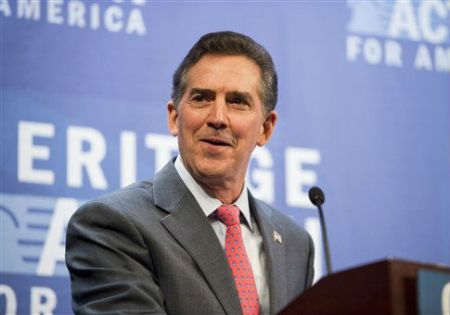
demint-1Former Sen. Jim DeMint, (R., S.C.), president of the Heritage Foundation / AP

“The implications worldwide of America being perceived as weak are huge; it’s the quickest way to draw us into some kind of conflict”

******************************************

Former Senator Jim DeMint (R., S.C.) says the United States needs to deter aggression from Russia and China by projecting strength and determination and making good on promises to its allies.

DeMint, who runs the conservative Heritage Foundation, criticized the Obama administration for not backing up its promises with force during an interview with the Washington Free Beacon, urging the Trump administration to chart a new course on projecting strength and drawing clear “lines in the sand.”

“The best way to keep peace is for us to be strong and perceived as strong, clear in what we are going to do and what we expect, and then we have to back that up,” DeMint said at the Heritage headquarters in Washington, D.C.

“We don’t want to be drawing lines in the sand that we ignore. Once Obama did that in Syria and other places, said things and didn’t follow up, the rest of the world basically knew that he wouldn’t. So, everyone has been testing us and our allies are nervous,” DeMint said.

DeMint downplayed concerns voiced about Trump’s handling of both Russia and China, saying that representatives from foreign countries with whom he has met have expressed optimism about the prospects for defense under the new administration.

“Most of the delegations—and we’ve had a lot of them since the election— that come through here are optimistic that Trump might reestablish America’s leadership position in the world and develop our strength to the point where they can count on us to keep their enemies at bay, or at least keep them honest,” DeMint said.

Trump has pledged to rebuild America’s military by reversing drawdowns of the armed forces set in motion during the Obama administration and ending sequestration that has eroded the defense budget. He has also telegraphed a willingness to pursue warmer relations with Russia, while taking a harder line on China when it comes to trade and the “one China” policy; both suggestions have drawn scrutiny from the press and critics of the Republican president.

DeMint said he suspects Trump is “toying” with Russian President Vladimir Putin and trying to “draw him in” by making positive statements about Moscow’s leader. The most recent administrations of Barack Obama and George W. Bush both tried to improve relations with Russia, to no avail. Many experts describe current tensions between Washington and Moscow as the highest since the Cold War.

“The best thing that Russia could see is a strong and determined U.S. and I think putting any missile systems all around them and convincing them that all of their development is not going to do anything because we have a missile system that could stop anything,” DeMint said, referring to the U.S. missile defense shields being deployed to Europe that have drawn ire from Moscow.

“Russia is a threat; we need to try to bring them into some kind of civilized [conversation] but we can’t be naïve in the thinking,” he said. “They want to dominate their neighborhood and keep Europe in their influence sphere, and they’re doing a good job.”

DeMint also said Trump is right to “put China on notice” as Beijing continues to build on disputed territories in the South China Sea.

“I don’t think it’s a bad thing that he’s stirring the pot a little bit with China to let them know that they cannot count on the status quo of a passive U.S.,” DeMint said. “Obviously, he has to bring that down into some clear policies, but China respects strength.”

DeMint, who has led Heritage since 2013 after serving two terms in the Senate, spoke to the Free Beacon two days before Trump’s inauguration just blocks away from the U.S. Capitol, outlining the think tank’s defense priorities for the new administration. He referenced at length Heritage’s Index of U.S. Military Strength, an annual assessment that last November shed light on the declines in American military power.

The individual service chiefs have testified before Congress about how budget cuts have compromised modernization and future readiness, agreeing that the U.S. military would not be able to defend the homeland against present and future threats if sequestration continues. Trump’s defense secretary, retired Gen. James Mattis, who was confirmed Friday afternoon, has already committed to ending sequestration.

“It’s not just about defending our country,” DeMint observed on Wednesday. “We have alliances with so many countries that depend on us that what you see now in our [analysis], it doesn’t just expose us. It’s got the rest of the world scrambling as to whether or not we could meet our commitments.”

“The implications worldwide of America being perceived as weak are huge; it’s the quickest way to draw us into some kind of conflict,” he later added.

Propping up US-Iraqi Mosul flop exposed Baghdad

December 31, 2016

Propping up US-Iraqi Mosul flop exposed Baghdad, DEBKAfile, December 31, 2016

(I receive frequent daily Google alerts on Iraq. Most deal with terrorist attacks in and near Baghdad, sometimes resulting in a few deaths and sometimes resulting in many.  —  DM)

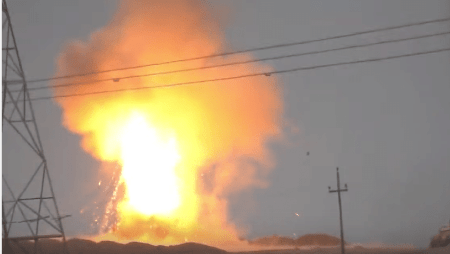
mosul_iraq_destroyed_tank_12-16Iraqi tank blown up by ISIS bomber in Mosul battle

This week, another 1,700 US special operations forces and 4,000 members of the Iraqi federal police and counter-terrorism service (CTS) were urgently sent out to reinforce the crumbling front lines. Their deployment was officially characterized as marking the launch of “the second phase of the operation to retake Mosul.”

*********************************

The US-backed Iraqi campaign launched in October to liberate Mosul from the clutches of the Islamic State is on its last legs, although the Obama administration and Iraqi Prime Minister Haydar al-Abadi are making every effort to disguise the debacle.

AS DEBKAfile has been reporting for three weeks, the Iraqi army’s Mosul operation has run aground, despite solid US military backing, giving the advantage to Islamic State fighters occupying Iraq’s biggest city since the summer of 2015.

This development has major security ramifications – not only for Iraq, but also for Syria, Jordan, Israel and the West at large.

The jihadists staunched the Iraqi army’s advance by releasing in its path hundreds of suicide killers in waves on foot and in bomb cars. This tactic has inflicted crippling losses on the two elite Iraqi divisions leading the offensive, the Golden Division, which is the backbone of Iraq’s Special Operations forces, and the 9th Armored Division. Devastating losses forced both to pull back from the battlefield.

This week, another 1,700 US special operations forces and 4,000 members of the Iraqi federal police and counter-terrorism service (CTS) were urgently sent out to reinforce the crumbling front lines. Their deployment was officially characterized as marking the launch of “the second phase of the operation to retake Mosul.”

Their real function was to prop up the few positions Iraqi forces have captured so far and save the Mosul offensive from crashing.

Western military observers noted Saturday, Dec. 31, that more and more American troops are to be seen on the embattled city’s front lines. US combatants are therefore fighting face to face with ISIS jihadists, a development the Obama administration is loath to admit, never having released the number of American lives lost in the Mosul offensive.

Our military sources add that the Iraqi counter-terrorism force sent to Mosul was previously posted in Baghdad to secure the capital against Islamist terrorist operations and ISIS attempts to seize the center and Iraqi’s national government centers. Its transfer to Mosul, 356km to the north, exposed central Baghdad to terror.

And, inevitably, on Saturday, two suicide bombers blew themselves up on a main street of the capital, killing 28 people and injuring 40 in their first major attack there in three months since the onset of the Mosul offensive..

This happened the day after the Pentagon spokesman Peter Cook released an unwelcome report that US security agencies “do think [Abu Bakr al] Baghdadi is alive and is still leading” the Islamic group and the battle for Mosul.

ISIS for its part issued a menacing new communiqué that jacked up its threat against neighboring Jordan’s King Abdullah II and his security forces, in the wake of its terrorist-cum-hostage assault earlier this month on the southern town of Karak, in which 10 people were killed and 29 injured.

The communiqué reads:“All Jordanian soldiers, police, mosque preachers, information activists and regime supporters are legitimate targets for the muhahideen’s bullets and knives. All of Jordan is an open battlefield!”

ISIS is informing the world of its coming targets, say DEBKAfile’s counterterrorism sources, which are:

1. The overthrow of the Hashemite king and his rule, and

2. The seizure of southern Jordan.

If Baghdadi succeeds in this scheme, he will gain control of a large stretch of land adjacent to Israel and Egyptian Sinai to the west and Saudi Arabia to the south, thereby bringing both under threat and placing itself close enough to block the port of Aqaba, Jordan’s only outlet to the sea.

From the desert region of southern Jordan, ISIS will also achieve proximity to the Sinai desert – through Israeli and Egyptian Bedouin – and be able to control the main Middle East arms-smuggling route and the Sinai center of operations of this illicit and enormously profitable trade

Oops. First Female Afghan Fighter Pilot Pleads For Asylum In America

December 27, 2016

Oops. First Female Afghan Fighter Pilot Pleads For Asylum In America, Hot Air, JAZZ SHAW, December 27, 2016

(Nah. Obama’s America prefers jihadists. — DM)

Afghan air force 2nd Lt. Niloofar Rhmani and Capt. Aaron Marx preflight a Cessna 208 at Kabul International Airport, Afghanistan. On this day, Rhmani became the first woman to fly a fixed wing combat mission. Marx hails from San Antonio, Texas, and is deployed from RAF Mildenhall, England, were he pilots KC-135R Stratotankers. (U.S. Air Force photo/Master Sgt. Ben Bloker)

Afghan air force 2nd Lt. Niloofar Rhmani and Capt. Aaron Marx preflight a Cessna 208 at Kabul International Airport, Afghanistan. On this day, Rhmani became the first woman to fly a fixed wing combat mission. Marx hails from San Antonio, Texas, and is deployed from RAF Mildenhall, England, were he pilots KC-135R Stratotankers. (U.S. Air Force photo/Master Sgt. Ben Bloker)

Niloofar Rahmani has become somewhat famous in the United States. She’s the first female fighter pilot from Afghanistan and her story has been sold as proof of a new dawn of western ideals in her home country. That story fell apart somewhat this year, however. In order to complete her training she’s been serving at various bases in the United States, and during the course of this process she has asked for asylum in America because she fears returning to her home nation. This has enraged the Afghanistan government and she’s been accused of lying by her own military command. (New York Times)

Contending that her “life isn’t at risk at all,” military officials in Afghanistan have asked that the United States reject the asylum case of Capt. Niloofar Rahmani, the first female fixed-wing pilot in the Afghan Air Force.

On Thursday, Captain Rahmani revealed that she had applied for asylum this summer, saying she felt unsafe in Afghanistan, where she and her family have received death threats. For the last 15 months, she has been training at air bases in Arkansas, Florida and Texas.

This attempt to flee for her life is proving embarrassing for the United States. While it sounds like Rahmani is a capable pilot, she’s become more of a political selling point for the war in Afghanistan, showing how the country is slowly but surely modernizing and our efforts there have not been in vain. The fact that she wishes to stay here to avoid some sort of honor killing or other peril shows that things really haven’t changed all that much.

The idea that she wasn’t facing any danger (as Afghan officials claim) seems problematic at best. Back in March of 2015, after she was honored during a ceremony with First Lady Michelle Obama, the pilot was being interviewed and talked about the threats she faced both from the Taliban and her own family.

She shared the extreme pressure she is under with female pilots from the 3rd Marine Aircraft Wing. Rahmani said she has been subjected to multiple death threats from members of the Afghan military, people in her own country, the Taliban and eventually her extended family.

Her sister she said was beaten and is forbidden from seeing her own daughter. Her bother had to hide from gunfire while walking home from class one day. Her family has to move every couple of months to stay safe.

While serving in the military is something to be proud of, for Rahmani, there is a huge price to pay. “Being a female in the military is a shame for all family,” she said.

It’s not just the Taliban putting her in danger. The current government in Afghanistan is still ruled by people very much set in the old ways. One of the worst examples is Abdul Rashid Dostum. A former warlord, he’s now the Vice President of that nation and you should see what he’s been up to lately. (Washington Post)

Dostum has long been infamous for his cruelty: He has reportedly ordered tanks driven over enemies’ legs and been accused of suffocating hundreds of Taliban prisoners in sealed truck containers. He is also known for violent and abusive rages. But none of the accusations ever landed him in serious trouble. He was either too intimidating, or too important, to challenge.

But now, Dostum may have gone too far.

His latest alleged victim, a 63-year-old former provincial governor named Ahmad Ishchi, has accused Dostum on television of imprisoning him, beating him and ordering him raped in November; Ishchi has also submitted to medical tests at a U.S. military hospital. This time, Dostum, 62, is not a warlord but the first vice president of a government backed by the United States and Europe — a heartbeat away from replacing President Ashraf Ghani.

This is the reality of the nation that Niloofar Rahmani will be returning to if her request for asylum is denied. Their government and particularly their military remain mired in ancient, repressive culture, where pedophilia is openly embraced by military commanders and women are killed as punishment for being raped. Getting out of line and above your station – particularly for women – can be a death sentence. And to repeat the point, it’s not just the Taliban doing all of this.

I don’t know whether the final decision on this request will be handled by the Obama administration or Trump, but if we really honor the contributions of Ms. Rahmani as much as we claim to, her request should be approved. If we send her back there and she winds up dead, the blame won’t be placed entirely on people in Afghanistan.

U.S. Accused of Training Iranian-Tied Forces in Iraq

December 16, 2016

U.S. Accused of Training Iranian-Tied Forces in Iraq, Washington Free Beacon, December 26, 2016

(It all depends on what “Iranian-tied” means. — DM)

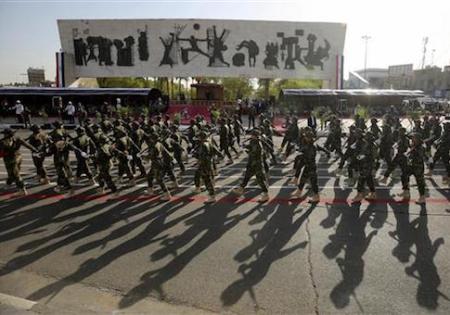
pmfIraqi government-backed Popular Mobilization forces take part in a joint military parade with Iraqi security forces in Baghdad / AP

“There are militiamen, Sunni, Shias, and Christians who are not part of the Iranian-backed network in Iraq and are not necessarily amenable to Tehran’s influence,” he said. “However, these are dwarfed, out-financed, and out-gunned by the IRGC-backed militias, who promote the brand of Islamic identity as espoused by the IRGC, and openly display ideological loyalty to the velayat-e faghih (the Islamic Republic’s founding ideology) and Iran’s supreme leader.”

*****************************

The United States military is facing accusations that it has been training Iraqi militia fighters who are tied to Iran, a charge that military officials who spoke to the Washington Free Beacon denied this week while insisting that the United States and Iran share common goals in the war-torn country, as both sides fight to eradicate the threat of Islamic State terrorists.

The latest charge that the United States may be directly involved in the training of Iranian-backed militia fighters has reignited concerns that America is becoming too cozy with Iranian interests operating in Iraq, an issue that highlights the difficultly facing U.S forces as they seek to counter the influence of ISIS.

Video recently emerged of U.S. military advisers training Iraqi militia fighters in Makhmur. Some foreign policy observers assessed that these militia fighters may have ties to Iran, which controls an increasing number of Iraqi militia fighters taking on ISIS.

The charge was picked up this week in a lengthy Los Angeles Times exposé claiming, “The U.S. is helping train Iraqi militias historically tied to Iran.”

Senior military sources who spoke to the Free Beacon denied the United States is directly working with Iranian forces, but acknowledged the United States and Iran do share similar goals in Iraq when it comes to combatting the threat of ISIS.

“In Iraq, with regards to ISIL, our interests and Iranian interests have some convergence,” said one senior military official who spoke to the Free Beacon on background, using another acronym for the Islamic State.

Iranian influence over militias in Iraq continues to be a challenge for the United States, which is barred by law from working with any such group. Foreign policy insiders who spoke to the Free Beacon about the issue warned that U.S. intervention against ISIS in Iraq is serving to bolster and legitimize Iran’s regional influence.

During last spring’s campaign in Fallujah, the U.S. provided air cover to Iraqi fighters, some of whom came from militias tied to Iran. Iranian media reported that some of the fighters belonged to Iran’s state-controlled militia.

“The forces that the LA Times observed in that story are not affiliated with Iran,” Col. John Dorrian, a spokesman for the U.S. Joint Task Force operating in Iraq, told the Free Beacon. “They are approved as hold forces ‎for terrain that has been liberated by the Iraqi Security Forces. They are being trained by coalition forces. They are local forces, and they represent diverse ethnic and sectarian backgrounds. The local tie is a key element in their acceptance by the population they are going to keep secure.”

Dorrian added that the headline on the LA Times article discussing the training of these militias “is very misleading.”

“There’s a lot of good information ‎in the article but the Iranian tie is nonexistent,” Dorrian said. “The Government of Iraq has enrolled these forces as Popular mobilization forces. I think LAT conflated that fact with Iran. Despite my telling them there’s no tie, they went with that headline.”

Multiple other military officials, Obama administration sources, and outside experts familiar with the matter told the Free Beacon that the militia fighters depicted in recent videos have no ties to Iran.

However, they said the United States and Iran share common goals in Iraq, where the threat of ISIS has sparked sectarian battles and endangered the Western-backed government.

A State Department official authorized only to speak on background told the Free Beacon that the United States does not train any Iranian-tied fighters, even if they are officially backed by the Iraqi government.

“The U.S. provides support to the Iraqi Security Forces, and those aligned with the Iraqi government,” the official said. “The U.S. does not, and will not, provide direct support to any group proscribed by American law, or which does not operate under the aegis of the Iraqi government.”

Much of Iraq’s Popular Mobilization Forces, or PMFs, are comprised of Shia Muslim fighters, many of whom are ideologically aligned with Iran’s hardline regime.

Maj. Adrian J.T. Rankine-Galloway, a Defense Department official, confirmed to the Free Beacon that some Iraqi units have been barred from receiving U.S. training due to their inability to pass background checks.

“Some Iraqi units have been restricted from receiving assistance because their commander didn’t pass vetting,” Rankine-Galloway said. “Because that quarterly report is classified, we cannot release which units were disqualified from receiving ITEF assistance.”

Rankine-Galloway further maintained that the United States has not changed its policy with regards to training in Iraq.

“U.S. government support to the counter-ISIL campaign remains by, with, and through the central Government of Iraq—and only to forces under the command and control of the Iraqi Security Forces,” Rankine-Galloway said. “Department of Defense policies on the provision of military assistance to foreign military forces have not changed. Iraqi Security Forces units who receive Iraq Train and Equip Fund assistance are strictly vetted” for ties to terror groups and the government of Iran.

Critics of the Obama administration’s policy in Iraq charge that even if the forces are not directly under the Iranian government’s orders, they are influenced by its senior military leaders.

“For proof the Obama administration treats our enemies like friends, look no further than their efforts to train armed militias loyal to Qassem Soleimani, commander of the IRGC-Qods Forces, in Makhmur,” said one senior congressional aide who works on the matter. “Incoming national security adviser Michael Flynn knows intimately what Iran is capable of, so it’s hoped that he and the Trump administration will reverse this disgrace.”

Amir Toumaj, an Iran analyst at the Foundation for Defense of Democracies, said that militia fighters tied to Iran far outnumber other fighters in Iraq.

“There are militiamen, Sunni, Shias, and Christians who are not part of the Iranian-backed network in Iraq and are not necessarily amenable to Tehran’s influence,” he said. “However, these are dwarfed, out-financed, and out-gunned by the IRGC-backed militias, who promote the brand of Islamic identity as espoused by the IRGC, and openly display ideological loyalty to the velayat-e faghih (the Islamic Republic’s founding ideology) and Iran’s supreme leader.”

“Key leaders” in the PMF “are beholden to Qassem Soleimani,” a top Iranian military leader, Toumaj said. “For example, the PMF operations commander is Abu Mahdi al Muhandis, Iran’s number one man in Iraq who has been designated as a terrorist by the U.S. Treasury and has overseen lethal attacks against U.S. soldiers during the occupation of Iraq. Iraqi militia and party leaders openly travel to Iran, and have received royal treatment, such as Akram al Kabi, head of Harakat al Nujaba, or the Movement of the Noble. The group under his command has committed war crimes and summary executions of women and children in east Aleppo this past week, according to the U.N.”

“The law legalizing the PMF has been welcomed in Iran. When Supreme Leader Ali Khamenei this past week received Ammar Hakim, head of the National Alliance Shia party that helped passed that bill, he called the PMF a ‘great wealth’ for Iraq that should be ‘supported and consolidated.’”

“The current U.S. policy of defeating the Islamic State above all else is empowering the IRGC-backed network, which has worked to infiltrate the Iraqi government and cement itself into a part of the state and establish an Iraqi version of the IRGC, crystallized in the PMF,” Toumaj said.

Humor | Pentagon recalls Thanksgiving MREs that were contaminated with real turkey

November 24, 2016

Pentagon recalls Thanksgiving MREs that were contaminated with real turkey, Duffel Blog, November 24, 2016

mre-loading

QUANTICO, VA – The Pentagon on Wednesday issued an emergency recall of more than 750,000 Meals, Ready to Eat, after it was discovered the rations had been contaminated with real turkey.

“Shredded Tryptophan-Induced Poultry Product in Gravy Sauce,” which was deemed item 12 in the latest batch of MRE’s shipped across the globe last week, was found to contain “an almost 100% contamination rate” among the boxes shipped out across the military.

“We can’t just allow our service men and women to be exposed to such harmful substances,” Army Col. James McDoughery said. “I mean it’s one thing to inhale a cubic pound of 7 ton exhaust every day, or to have abnormal amounts of diesel fuel in a unit’s water supply from time to time. But the kind of damage it would cause if troops suddenly started eating actual food in the field could be catastrophic.”

He added: “They might find they have morale. And if they ever found it, they would realize just how low it’s been all these years.”

The recall for Thanksgiving MREs is not a first for the DoD. It previously had to recall humanitarian rations containing pork over concerns for the Islamic religion in 2006, and its “Country Captain Chicken” MRE was phased out after most troops complained of it actually tasting more like urban lieutenant dogshit.

Most troops were unfazed by the recall decision.

“Look sometimes I just put the hot sauce on the cardboard box and eat that because it tastes better than the meal inside of it.” Navy Petty Officer 2nd Class Jonathan Eckerd said. “Plus, the fiber helps keep you regular, and after a week of MRE’s you use all the help you can get.”

Still, at least one Marine managed to get his hands on the dangerous MRE in question. Lance Cpl. Anthony Smith found a box that was untouched while on a field exercise in Camp Lejeune.

“Inside was the brand new Thanksgiving MRE with all the bowel-clogging trimmings; garlic mashed potatoes, wheat snack bread, peanut butter,” Smith said. “And then there it was: The Shredded Tryptophan-Induced Poultry Product in Gravy Sauce main meal. I took about three bites and was really surprised by how unplasticky it tasted.”

“It was right then that my company gunny suddenly returned. By the time my ass-chewing was over, someone had stolen it. The only thing that was left was the Cornbread Stuffing, and there’s not enough Copenhagen dip in the world to be bribed with to make me eat that.”

The Pentagon promised that it would never again make the mistake of having real food contaminate MREs again.

RIGHT ANGLE: Mattis for SECDEF?

November 23, 2016

RIGHT ANGLE: Mattis for SECDEF? Bill Whittle Channel via YouTube, November 22, 2016