Posted tagged ‘Two state solution’

Lies, lies and whoppers in the Middle East

October 23, 2015

Lies, lies and whoppers in the Middle East, Washington Times, Wesley Pruden, October 22, 2015

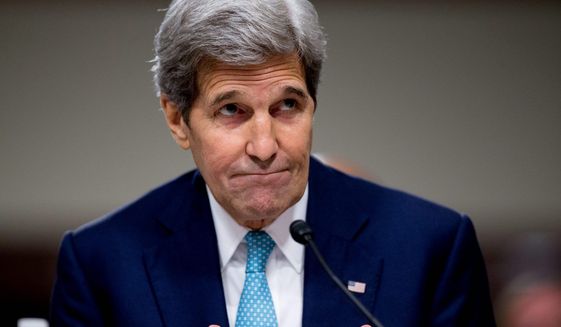
10222015_2015-10-22-19-23-278201_c0-0-1800-1049_s561x327Secretary of State John Kerry. (Associated Press

ANALYSIS/OPINION:

A diplomat, as any deputy assistant associate undersecretary could tell you, is a public servant paid to lie for his country. Lies are the hard currency in the land of the girly men.

The truth is rarely heard above the rattle and din of the teacups in the lounges where the masters of the art gather to collect their strength after a long day’s work in the vineyards of falsification, where Israel usually gets the shaft plunged to the hilt.

The knife has become the weapon of choice in the Palestinian war against Israeli civilians, brandished as if it were a holy scimitar of the avenging Allah. The dean of a university in Gaza characterizes this campaign of the short knives as “military operations,” and urges that it be aimed at women and children.

“The Jews of Palestine are fair game today, even the women,” the dean, Subhi al-Yazji, a learned doctor of Koranic studies, told an interviewer on Hamas television. “Every single Jew in Palestine is a combatant — even the children, breastfed on hatred for the Palestinian people.”

Just who is promoting this villainy launched from the shadows is clear to everyone, but it’s not polite in the well-behaved precincts of the West to say so. But we can be reassured, because John Kerry, the secretary of state and the grand master of moral equivalence, is on the job. He spent four hours Thursday with Israeli Prime Minister Benjamin Netanyahu in Berlin about how to “defuse” the violence. Their conversation was conducted as the knives conducted their own deadly business on the streets.

Before they sat down Mr. Kerry made the ritual condemnation of the assault on the Jews, composed of equal parts blarney and buncombe, and bravely urged an end to “all incitement and violence.” This softly worded admonition by the secretary of State naturally must include the Israelis who have done nothing but offer their Jewish flesh for the Palestinian blade. “There is no question,” said Mr. Netanyahu, “that this wave of attacks is driven directly by incitement by Hamas, incitement from the Islamist movement in Israel and incitement, I am sorry to say, from President Abbas and the Palestinian Authority.”

This was plain and unvarnished, what everybody knows to be true, but for reasons best known to him President Obama and his men (and women) won’t say anything like that. Perhaps they have a fear of cold steel in the ribs, too. What Mr. Kerry offers is this can of diplomatic yah-yah from the archives of claptrap at the State Department:

“I come directly from several hours of conversation with Prime Minister Netanyahu and I would characterize that conversation as one that gave me a cautious measure of optimism that there may be some things that may be in the next couple of days put on the table which would have an impact — I hope. I don’t want to be excessive in stating that, but I am cautiously encouraged.” There are a dozen lies somewhere in that thin treacle of organic gluten-free fat-added diet marshmallow, but only a diplomat could find them.

The moment cries for someone to say something real, and we get that from the secretary of state. And this: “We have to stop the incitement, we have to stop the violence.” Well, duh. He said he had talked to [Mr.] Abbas and Jordan’s King Abdullah, who are trusted to oversee the Temple Mount in Jerusalem, source of the latest Palestinian complaining. Abbas and Abdullah have assured him of their commitment to calm. Of course they do. And if you can’t trust a trusty, as a famous Southern governor caught between two fires once said, who can you trust?

The purveyors of calm work in parallel with the inciters of blood lust. This week a Jordanian teacher, from whom in other places you would expect something more, posted on the Internet a video of his 8-year-old daughter brandishing a knife, held up like a crucifix of the faith, declaring, “I want to stab a Jew.”

Mr. Netanyahu, who has no fear of saying what he thinks, nevertheless caught a little flak this week in Israel for speaking of some of the dark work of those who encouraged Hitler to proceed with the Holocaust. Hitler’s evil was unique, a professor at Hebrew University in Jerusalem told Mr. Netanyahu, and assigning blame to others makes him a Holocaust denier. Such a “dangerous distortion” of history “downplays” the Holocaust, the leader of the opposition in the Knesset told him.

Mr. Netanyahu was speaking a perfectly obvious truth, but we’re not supposed to notice what’s going on. It’s not diplomatic.

Netanyahu accurately describes the Mufti’s role in the Holocaust

October 22, 2015

Netanyahu accurately describes the Mufti’s role in the Holocaustelderofziyon2 via You Tube, October 22, 2015


There is Nothing to Negotiate

October 22, 2015

There is Nothing to Negotiate, American ThinkerDan Calic, October 21, 2015

(But shouldn’t Israel commit suicide to satisfy Abbas, the US, the EU, the UN and others? It would be the warm and fuzzy thing to do. — DM)

Some hard realities need to be faced about the Middle East “peace process.” The US, EU, UN and others have said the “settlements” are an obstacle to peace. The Arabs point to the “occupation.”

However, neither of these are the core issue…. and frankly, they never have been. Why? Keep in mind there was no “occupation” or “settlements” in 1948 when the surrounding Arab nations attacked the fledgling Jewish nation one day after declaring independence.

Moreover, where were settlements or occupation in 1967?

So if it isn’t the “occupation,” or “settlements,” what is the real issue? While many consider these to be legitimate issues, the Arabs are using them as a deliberate smokescreen.

The core issue is the Muslim’s rejection of Israel’s right to exist. It’s as simple as that. This is the main reason why the first attempt at a two-state solution (the 1947 UN partition plan) was not successful. The Muslims would not allow a Jewish state on land which they consider theirs. Its size or borders didn’t matter. It was, and remains, its mere existence.

Case in point: in 2000 when Yasser Arafat met with Israeli Prime Minister Ehud Barak under the auspicious of President Bill Clinton at Camp David ll, the real Muslim goal became evident.

During those discussions Barak made an unprecedented offer to Arafat. He was willing to turn over 95% of Judea/Samaria, commonly called the “West Bank.” He okayed the return of many of the so-called “refugees” and offered compensation for others. He was willing to split Israel in two by virtue of a contiguous road between Judea/Samaria and the Gaza Strip.

Plus, he offered to divide Jerusalem, which included handing most of the Old City over to the Muslims.

President Clinton felt Barak went above and beyond his expectations in an effort to achieve a breakthrough in the decades old conflict. Yet in the end, Arafat rejected it, without even making a counter offer. Why? An agreement would require compromise, which Muslims viewed as giving in to American demands. From their point of view this was (and remains) unacceptable, thus his rejection of the offer.

President Clinton was furious with Arafat, telling him “I am a failure and you have made me one.”

These days, with Arafat long gone, Mahmoud Abbas is in charge of the PA and considered by the U.S., EU, and others to be “sincere” and a “moderate.” However, very little has changed since the days of Arafat.

In some respect things have worsened. For example Abbas has repeatedly said he will not recognize Israel as a Jewish state. This in spite of Israel’s repeated willingness to recognize ‘Palestine’ as a state, side by side with Israel.

Abbas’s refusal to accept the Jewish state of Israel is reflective of some longstanding Muslim views.

For example-

  • Muslim thinking has always been once they have controlled someplace, it’s considered theirs forever. It doesn’t matter if they get defeated in war. They view anyone in control of “their” land as “occupiers,” who need to be driven out or destroyed. To back away from this position is seen as compromise, which is unacceptable in Muslim thinking for at least two reasons.
  • Compromise is seen as weakness. Weakness is intolerable in their culture. Keep in mind the Saudi flag contains the official credo of Islam (“there is no god but Allah, and Mohammed is his messenger”) which includes the image of a sword. The clear inference being they prefer to die upholding their beliefs than live by compromise.
  • Plus, compromise, from a fundamentalist perspective is also viewed as breaking a foundational tenet of the faith. Breaking a tenet of the faith is considered blasphemy, which is punishable by death in Islam.

Mahmoud Abbas has acted in accordance with these views. When one understands how Muslim’s view anyone in control of land they consider theirs, you understand his actions. It also becomes clear the conflict is not about borders. The Jews are seen as “occupiers” of Muslim land. A Jewish state has no right to exist on “Muslim” land.

If there is any doubt of this take a look at the charters of the PLO, Hamas, or Fatah, which is the party Mahmoud Abbas is president of. Moreover, all three, the PLO, Hamas, and Fatah by virtue of their emblems leave no doubt their goal is not a two-state solution. Each emblem shows only one state — Palestine, covering all of Israel. The goal of each group is the complete elimination of Israel. Every inch of land which makes up Israel today is considered “occupied Palestine.”

Why aren’t the voices criticizing Israel for “settlement” activity also demanding the charter of Abbas’s party reflect peaceful co-existence with Israel, instead of its destruction?

In order for a two-state solution to be achieved negotiations are required. Negotiations by their very nature require compromise. How is Israel supposed to negotiate when its very existence is considered unacceptable?

There is nothing to negotiate.


Terror, Shmerror, State Dept Only Cares About Two State Holy Grail

October 15, 2015

The U.S. State Dept. is equally unhappy with Israelis and Palestinian Arabs for the increase in violence – it interferes with the path to the beloved Two State Holy Grail.

By: Lori Lowenthal Marcus

Published: October 15th, 2015

Source: The Jewish Press » » Terror, Shmerror, State Dept Only Cares About Two State Holy Grail

U.S. State Dept. Spokesperson John Kirby at Daily Press Briefing, Oct. 15, 2015.

U.S. State Dept. Spokesperson John Kirby at Daily Press Briefing, Oct. 15, 2015.
Photo Credit: screen capture State.gov

Several things became clear during Wednesday’s U.S. State Dept. press briefing, the first half of which focused exclusively on the wave of terrorism in Israel.

First, the overriding goal for the United States of America is the creation of a Two State Solution and anything that gets in the way of that is a problem. The Two State Solution is the Holy Grail (as it were) regardless of whether that fixed goal will dramatically increase violence and further destabilize the region or not.

Second, the U.S. State Department despises the fact that increasing numbers of Jews are living beyond the “Green Line,” in Judea and Samaria. The U.S. hates this so much that official policy is to condemn Jews living and breathing in that area at least as much, if not more, than brutal murders of innocent Jewish civilians by Arab terrorists.

Third, the U.S. has so embraced the idea that the Temple Mount “belongs” to the Palestinian Arabs that it casts unarmed, non-hostile Jewish tourists or Israelis who peacefully ascend the Mount as the legitimate cause of savage murders of any Jews, anywhere. The U.S. has jettisoned the fact that Israel re-acquired control of the Temple Mount in a defensive war and simply handed over control of that area to the Arabs, in the hope and belief that members of all religions would have equal access to that site.

Throughout the first half of the Oct. 15 State Dept. press briefing, reporters sought to pin down State Department Spokesperson John Kirby on who and what the U.S. believes is responsible for the recent tsunami of terror in which Jews were shot, stabbed with kitchen knives, hunting knives, butcher knives and rammed with cars by Arab Palestinians.

The violence is condemned by the U.S., although this government refuses to assign primary blame to either party. Young Arab men and women are brutally stabbing Israeli Jews standing at bus stops, boarding buses, walking on Israeli streets? That’s bad, but, as Kirby quoted Secretary of State John Kerry, “there’s disenfranchisement, there’s disgruntlement, there is – there’s frustration on both sides that have led to this [increase in violence].”

Why this reluctance to assign blame? It is because, apparently, anything that diplomats aching for a Two State Solution see as an impediment to their goal is equally bad. This becomes apparent from watching and reading the transcripts of the endless State Dept. briefings in which the issue of terrorism or violence in Israel is raised.

More than a dozen Israeli Jews going about their lives in Israel were stabbed, shot or run over by Arab terrorists in the past few weeks alone. One 17-year old Israeli Jew stabbed four Beduoins in Dimona, Israel. That act was condemned across the spectrum in the Israeli government, including by Prime Minister Benjamin Netanyahu.

“Israel is a country of law and order. Those who use violence and break the law – from whatever side – will be dealt with to the fullest extent of the law,” said Netanyahu. He added that he “strongly condemns the attack against innocent Arabs.”

When Matt Lee of the Associated Press asked Kirby why it was so important that Secretary Kerry refused to assign blame, the response was:

I think he’s been very clear that he wants both sides to take affirmative actions, both in rhetoric and in action, to de-escalate the tension, to restore calm, and to try to move forward towards a two-state solution. He also recognizes, as a public servant with a long career associated with foreign affairs and the diplomatic relations of this country, that many of these issues are ages old. And when there’s a specific attack such as we’ve seen, we are not shy about calling it out. And as I said last week on – if we believe it’s terrorism, to say it’s terrorism. We’re not shy about that in terms of affixing responsibility for it. But in terms of the general scope of the violence that we’re seeing and the unrest, he’s been very clear that rather than to affix blame specifically on all of that, to try to focus on moving forward and restoring calm.

In other words, specific acts don’t matter, the only thing that matters is the Holy Grail in the distance and the desire to continue moving towards it.

This position was reinforced when Kirby was asked to comment about whether there has been a change in Israeli policy on the Temple Mount. Arab leadership, religious and political, have spread rumors of efforts by Israeli to change the policy on the Temple Mount in order to inspire religious terrorist responses.

The AP’s Lee asked whether it was the Administration’s position that the status quo at the Temple Mount has been broken.

Kirby responded: “Well certainly, the status quo has not been observed, which has led to a lot of the violence.”

In fact, there has not been a change in policy regarding the Temple Mount, other than a recent prohibition directed at members of knesset from visiting the site. In other words, Israel preemptively sought to remove any potentially incendiary actions, or ones that could be interpreted that way.

Several hours after the briefing, Kirby sent out a tweet in which he sought to claim that he “did not intend to suggest that status quo at Temple Mount/Al Sharif was broken.” Well, that is what he said, hard to understand what else he could have intended by it.

What the State Department Spokesperson’s tweet should have said is that he was wrong to suggest the status quo was broken, and therefore, Israel was not responsible for any violent acts purporting to avenge dishonor to the Temple Mount.

One reporter pressed Kirby on  Secretary Kerry’s upcoming visit to the region. The bottom line answer, of course, is to try and shove the parties along the path to the Two State Holy Grail.

MR KIRBY: The Secretary’s made clear his concerns over what’s going on there and his desire to travel to the region to engage and to discuss and to try to find ways to reduce the tensions, restore the calm, and then start to work collaboratively, hopefully, towards a two-state solution. SAID ARIKAT, al Quds: John? MR KIRBY: Yeah. ARIKAT: What would be the practical steps that both sides can take immediately to defuse the situation? What would be, like, practical suggestions to both sides that they must do now? MR KIRBY: Well, again, I wouldn’t get too specific here. I think the Secretary spoke about this yesterday very clearly that the violence needs to stop. So to the degree leaders on either side can help lead to that outcome, that would be useful. The incitement needs to stop. ARIKAT: Right. MR KIRBY: So to the degree to which leaders – whether they’re responsible for it or not, to the degree that they can contribute to an atmosphere which isn’t encouraging more violence, more killing, that would be useful. And then, again, to sort of put in place and then keep in place, maintain a sense of calm. All that would useful right now, and I think that’s really again where the Secretary’s head was yesterday. It’s where it is today, and it’s why he’s interested in pursuing travel there soon. ARIKAT: For instance, the Israelis put a great many checkpoints in the last, let’s say, 24 hours in and around Arab neighborhoods, Palestinian neighborhoods in Jerusalem and the surrounding areas, and so on. Would that be something that the Secretary or you would call on the Israelis to undo, so to speak, to sort of – to alleviate some of the frustration or the feeling of being cooped in and so on by these young men and women? MR KIRBY: Well, I don’t think it’s going to be useful for me to stake out a position on each and every decision that the Israeli security forces are making. They certainly have an obligation towards their citizens and we understand that. Again, what the Secretary wants to see is the violence cease. ARIKAT: Mahmoud Abbas just made a speech, a short speech, a little while ago. I wonder if you’ve had the chance to see it. MR KIRBY: I have not. ARIKAT: But he’s – he’s basically accusing Israel of conducting summary executions, and so on. He’s threatening to take it to the international court – the International Criminal Court. He’s saying that we will not be held hostage to agreements that Israel is not adhering to, and so on. Apparently he’s talking about Oslo. He’s saying that the Palestinians must have a recourse to resist an occupation. Do you agree that the Palestinians must have some sort of a method or recourse, and so on, by which they oppose this occupation that has gone on for so long? MR KIRBY: Well, again, without getting into specific terminology here, Said, what we would like to see is progress made on both sides in both rhetoric and in action towards a meaningful two-state solution. That is very difficult to get to, to even get to the process of pursuing that when there’s so much violence going on, which isn’t doing anything but spiraling the tension upward rather than downward. And so again, what we want to see is both sides take the actions to calm things down so that we can have meaningful discussions and progress towards a two-state solution. No one even bothered to point out that Abbas’s “short speech” is an effort to rouse anger and incite violence directed at Israelis.

You can’t really blame Arikat for trying to corner Kirby into labeling Israel’s new security measures as forms of incitement. Arikat has successfully manipulated State Dept. spokespeople into making similar statements before.

Michael Wilner of the Jerusalem Post also tried to pin down Kirby as to what constitutes incitement and who is responsible for the increase in violence, to no avail.

Wilner pointed out that Ambassador Saperstein had just spoken at the State Department and “said to hold Israel to different standards than other – any other country isn’t just inappropriate; it’s anti-Semitism. What would you have – in terms of these checkpoints, what would you have Israel do?”

Kirby evaded the anti-Semitism point – which was a good one – and said the State Dept. is not going to dictate immediate security requirements onto Israel, which has the right and obligation to protect its citizens. He did, however, say that the U.S. is concerned by some reports of “what many would consider the excessive use of force.”

And then Kirby masterfully steered back on course, saying that what the State Dept. wants so see is “for both sides to take – to take the leadership responsibilities of calling for calm, maintaining that calm, and being able to restore a sense of normalcy so that people can get on with their lives safely and not have to worry, but also so that we can really begin to have again a meaningful discussion towards a two-state solution – which we continue to believe is the outcome that is – that’s best for the people there in the region.”

Terror, shmerror. The U.S. only cares about the Two State Holy Grail.

Looking beyond the ‘third intifada’

October 14, 2015

Looking beyond the ‘third intifada’ Jerusalem PostLouis Rene Beres, October 13, 2015

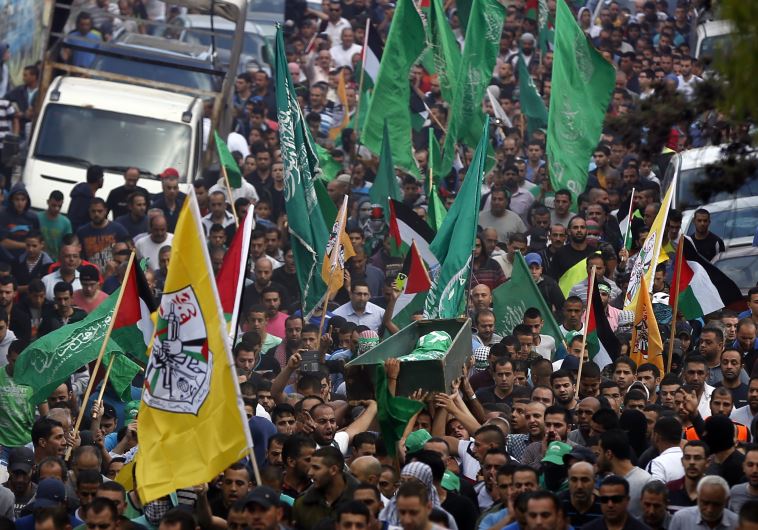
ShowImage (14)Funeral in the Shuafat refugee camp in east Jerusalem, on October 10, 2015. (photo credit: AHMAD GHARABLI / AFP)

About expected Palestinian state intentions, there is little real mystery to fathom. It should already be widely understood that any new state of Palestine could provide a ready platform for launching endlessly renewable war and terrorism against Israel. Significantly, not a single warring Palestinian faction has ever even bothered to deny such overtly criminal intent. On the contrary, aggressive intent has always been openly embraced, fervently cheered as a distinctly sacred “national” incantation.

*********************************

It’s farewell to the drawing-room’s civilized cry, The professor’s sensible where to and why, The frock-coated diplomat’s social aplomb, Now matters are settled with gas and with bomb.”

– W.H. Auden, Danse Macabre

With apparent suddenness, and a very deliberate brutality, Palestinian terrorists are launching a new wave of indiscriminate assaults they proudly hail as a “third intifada.”

But behind the protective veneer of language, where homicide is conveniently transfigured into revolution, these latest Arab attacks remain what they have always been – that is, crudely camouflaged expressions of rampant criminality.

Jurisprudentially, this is all perfectly obvious. Prima facie, under all pertinent international law, calculated assaults on mostly women and children can never be sanitized or justified. Always, rather, they represent codified crimes of war and crimes against humanity.

Always, such crimes are unpardonable.

Oddly enough, even after the painfully long history of egregious Palestinian crimes carried out against noncombatant populations, a sizable portion of the “international community” still seeks to encourage Palestinian statehood. Self-righteously, of course, and with ritualistic indignation directed against Israeli “intransigence,” the “civilized community of nations” remains willing to rip a 23rd Arab state from the still-living body of Israel. Even now, as the Palestinians remain rigorously segmented into barbarously warring factions – into opponents who enthusiastically maim and torture each other, all while cooperating in doing the same to their commonly despised Israeli victims – world public opinion calls naively for Palestinian “self-determination.”

Even now, when any new Palestinian state could quickly come to resemble an already-fractured Syria, the United Nations and its secretary – general seem much more concerned with comforting the markedly unheroic Palestinian criminals than with protecting fully innocent Israeli civilians.

Unapologetically, and whatever their unhindered and ongoing excesses, Fatah, Hamas and Islamic Jihad are easily able to incite followers to inflict and then celebrate incessant harms upon Israel.

At some point, it is likely that such harms, joyously imposed with a reassuring impunity, could involve diverse weapons of mega-terrorism, including assorted chemical, biological, or even nuclear agents.

In this last category of insidious choice, Palestine, after formalizing its sought-after condition of statehood or sovereignty, could be placed in an optimal position to assault Israel’s Dimona nuclear reactor.

This plainly sensitive facility was previously attacked, in both 1991 and again in 2014. Those earlier missile and rocket barrages, which produced no ascertainably injurious damages to the critical reactor core, had originated with Iraqi and Hamas aggressions, respectively.

About expected Palestinian state intentions, there is little real mystery to fathom. It should already be widely understood that any new state of Palestine could provide a ready platform for launching endlessly renewable war and terrorism against Israel. Significantly, not a single warring Palestinian faction has ever even bothered to deny such overtly criminal intent. On the contrary, aggressive intent has always been openly embraced, fervently cheered as a distinctly sacred “national” incantation.

A September 2015 poll by the Palestinian Center for Policy and Survey research – the leading social research organization in the Palestinian territories – found that a majority of Palestinians unhesitatingly reject a two-state solution.

When asked, as a corollary question, about any preferred or alternate ways to establish an independent Palestinian state, 42 percent called for “armed action.”

Only 29% favored “negotiation,” or some sort of peaceful resolution.

Not much mystery here.

On all currently official Hamas and Palestinian Authority (PA ) maps of “Palestine,” Israel has been removed altogether, or identified exclusively as “occupied Palestine.”

By these revealingly forthright and vengeful depictions, Israel has already been forced to suffer a “cartographic genocide.” Unambiguously, from the standpoint of any prospective Palestinian state policies toward Israel, such incendiary maps are portentous, predictive and possibly even prophetic.

What is not generally recognized is that a Palestinian state, any Palestinian state, could play a determinedly serious role in bringing some form of nuclear conflict to the Middle East. Palestine, of course, would itself be non-nuclear; but that’s not the issue. There would remain several other ways in which the new state’s predictable infringements of Israeli security could make the Jewish state more vulnerable to an eventual nuclear attack from Iran, or, in the even more distant future, from a newly-nuclear Arab state.

This second prospect would likely have its core origins in understandable reactions to the plainly impotent Vienna pact with Iran.

Following the July 14, 2015 Joint Comprehensive Plan of Action (JCPOA ), several Sunni states in the region, most plausibly Egypt and/ or Saudi Arabia, will likely feel compelled to “go nuclear.”

In essence, any such considered Sunni Arab nuclear proliferation would represent a more-or-less coherent “self-defense” reaction against expectedly escalating perils, once still-avoidable dangers now issuing from the reciprocally fearful Shi’ite world.

There is also more to expect from the Sunni side. Here, in actions that would have no apparent connection to expected Iranian nuclearization, Islamic State (IS) could begin an avowedly destructive march westward, across Jordan, and all the way to the borders of West Bank (Judea/Samaria). There, should a Palestinian state already be established and functional, dedicated Sunni terrorist cadres would likely make quick work of any deployed Palestinian army. In the event that a new Arab state had not yet been suitably declared – that is, in a fashion consistent with codifying Montevideo Convention (1934) expectations – invading IS forces (not Israel) will have become the principal impediment to Palestinian independence.

Credo quia absurdum – “I believe because it is absurd.” In either case, any such IS or IS-related conquest could create another available platform for launching relentless terrorist attacks across the region.

In time, of course, most of these murderous attacks would be aimed precisely at Israel.

IS, as everyone can see, is on the move. It has already expanded well beyond Iraq and Syria, notably into Yemen, Libya, Egypt and Somalia.

Although Hamas leaders generally deny any IS presence in Gaza, that terrorist group’s black flag is now seen more and more regularly in that expressly Palestinian space.

In principle, at least, Israel could sometime find itself forced to cooperate with Hamas against IS, but any reciprocal willingness from the Islamic Resistance Movement, whether glaringly conspicuous or beneath the radar, is implausible.

Additionally, Egypt regards Hamas as part of the much wider Muslim Brotherhood, and prospectively, just as dangerous as IS.

In any event, after Palestine, and even in the absence of any takeover of the new Arab state by IS forces, Israel’s physical survival would require increasing self-reliance in existential military matters.

Such expansions, in turn, would demand: 1) an appropriately revised nuclear strategy, involving deterrence, defense, preemption and warfighting capabilities; and 2) a corollary conventional strategy.

Significantly, however, the birth of Palestine could impact these strategies in several disruptive ways.

Most ominously, a Palestinian state could render most of Israel’s conventional capabilities substantially more problematic. It could thereby heighten certain eventual chances of a regional nuclear war.

Credo quia absurdum. A nuclear war in the Middle East is not out of the question. At some point, such a conflict could arrive in Israel not only as a “bolt-from-the-blue” surprise missile attack, but also as a result, whether intended or inadvertent, of escalation.

If, for example, certain enemy states were to begin “only” with conventional and/or biological attacks upon Israel, Jerusalem might then respond, sooner or later, with nuclear reprisals. Or if these enemy states were to begin hostilities with certain conventional attacks upon Israel, Jerusalem’s own conventional reprisals might then be met, at least in the future, with enemy nuclear counterstrikes.

For now, this second scenario could become possible only if Iran were to continue its evident advance toward an independent nuclear capability. It follows that a persuasive Israeli conventional deterrent, at least to the extent that it could prevent enemy state conventional, and/or biological attacks, would substantially reduce Israel’s risk of any escalatory exposure to a nuclear war. Israel will need to maintain its capacity for “escalation dominance,” but Palestinian statehood, on its face, could still impair this overriding strategic obligation.

A subsidiary question comes to mind. Why should Israel need a conventional deterrent at all? Israel, after all, seemingly maintains a capable nuclear arsenal and corollary doctrine, even though both still remain “deliberately ambiguous.”

And there arises a still further query. Even after “Palestine,” wouldn’t enemy states desist from launching conventional and/or biological attacks upon Israel, here, out of an entirely reasonable and prudent fear of suffering a nuclear retaliation? Not necessarily. Aware that Israel would cross the nuclear threshold only in certain extraordinary circumstances, these enemy states could be convinced – rightly or wrongly – that so long as their attacks were to remain non-nuclear, Israel would respond only in kind. Faced with such probable calculations, Israel’s ordinary security would still need to be sustained by conventional deterrent threats.

A strong conventional capability will still be needed by Israel to deter or to preempt conventional attacks – attacks that could, if undertaken, lead quickly, via escalation, to various conceivable forms of unconventional war.

Credo quia absurdum. It is still not sufficiently understood that Palestine could have serious effects on power and peace in the Middle East. As the creation of yet another enemy Arab state would need to arise from the intentional dismemberment of Israel, the Jewish state’s strategic depth would inevitably be diminished. Over time, therefore, Israel’s conventional capacity to ward off assorted enemy attacks could be correspondingly reduced.

Paradoxically, if enemy states were to perceive Israel’s own sense of expanding weakness and desperation, this could strengthen Israel’s nuclear deterrent. If, however, pertinent enemy states did not perceive such a “sense” among Israel’s decision-makers (a far more likely scenario), these states, now animated by Israel’s conventional force deterioration, could then be encouraged to attack. The cumulative result, spawned by Israel’s post-Palestine incapacity to maintain strong conventional deterrence, could become: 1) defeat of Israel in a conventional war; 2) defeat of Israel in an unconventional chemical/biological/nuclear war; 3) defeat of Israel in a combined conventional/unconventional war; or 4) defeat of Arab/Islamic state enemies by Israel in an unconventional war.

For Israel, a country less than half the size of Lake Michigan, even the “successful” fourth possibility could prove intolerable. The tangible consequences of a nuclear war, or even a “merely” chemical/ biological war, could be calamitous for the victor as well as the vanquished.

Under such exceptional conditions of belligerency, the traditional notions of “victory” and “defeat” would likely lose all serious meaning.

Although a meaningful risk of regional nuclear war in the Middle East must exist independently of any Palestinian state, this uniquely serious threat would be still greater if a new Arab terrorist state were authoritatively declared.

Palestine, it has increasingly been argued, could sometime become vulnerable to overthrow by even more militant jihadist Arab forces, a violent transfer of power that could then confront Israel with an even broader range of regional perils.

In this connection, IS, again, could find itself at the outer gates of “Palestine.” In such a scenario, it is plausible that the IS fighters would make fast work of any residual Palestinian defense force, PA and/ or Hamas, and then absorb Palestine itself into a rapidly expanding Islamic “caliphate.”

Before anything remotely decent could be born from such a determined theocracy, a very capable sort of gravedigger would have to wield the forceps.

The “third intifada” is just another legitimizing term for remorseless Palestinian terrorism. Should it transform the always fratricidal Palestinian territories into another corrupted Arab state, Palestine, either by itself, or as a newly-incorporated part of a still-growing IS “caliphate,” would become another Syria. Even more significantly, Palestine could bring specifically nuclear-based harms to the broader region.

Then, quite predictably, all pertinent “matters” would be settled “with gas and with bomb.”
Why now?

October 12, 2015

Why now? Israel Hayom, Judith Bergman, October 12, 2015

Among the several unanswered questions about the ongoing terror onslaught against Israelis, one of the most pertinent is why this is happening now, entirely unprovoked and spurred on by the incendiary incitement of Palestinian Authority President Mahmoud Abbas and his ilk.

Relying on brainwashed youths to perpetrate the terrorist attacks, Abbas instigated the onslaught now simply because he had to do something to take back the world stage.

Abbas and his flock are used to the spotlight on the international stage, but in recent months, the influx of migrants and refugees from the Middle East and North Africa into Europe has completely swallowed the headlines there, and Abbas saw himself being marginalized to the point of being entirely forgotten. Abbas had to do something, so he unleashed terror on Israel, and he knew from years of experience with the so-called international community, as represented by the U.N., the Obama administration and the international media that he would be able to do so with impunity. In fact, the choreography of his little dance with the international media is so well-rehearsed and so perfectly tuned to his interests that Abbas knows he can rely on it to achieve his goals.

And that is exactly what is happening now. Abbas knew he could count on the major news outlets not to question why the terrorism is occurring now. Instead, the ragged old cliches of the mysteriously self-igniting “cycle of violence” are being re-hashed, while Israel’s legitimate self-defense against the stabbings, shootings and rock throwings is being increasingly reported in negative terms.

True to form, Israel has been unable thus far to counter the media dynamic that has worked so well for Abbas in the past. It appeared to be too little and too late when Deputy Foreign Minister Tzipi Hotovely several days ago announced a media campaign, as well as the formation of an inter-ministerial team to prepare a series of informational videos on the subject of Palestinian incitement. We have had 20 years to prepare those videos. Do not wait for the international media to hold its breath.

In his next move, truly Orwellian in a way that only the old Soviet cadres could have trumped, Abbas is now asking the U.N. Human Rights Council to quickly dispatch a commission of inquiry to the region “to investigate all crimes perpetrated by Israel against our people.” While this may sound outlandish to right-minded people, Abbas is not entirely wrong in his calculations that the U.N. will respond to his exhortations. Abbas knows that the dance he performs for the benefit of the U.N. is usually met with applause, and is just as predictably choreographed as his dance with the international media. All is possible when it comes to the U.N., particularly the U.N. Human Rights Council, where Saudi Arabia is currently chairing the U.N. Human Rights Council panel in charge of appointing independent experts.

While Abbas is craving the attention, other Middle East players are stoking the fire to deflect attention from them. Iran’s puppet, Hamas, has not only been sending rockets into Israel, aiming to add tension to the situation, but has also been sending Gazans to riot on the border with Israel, knowing fully well that confrontations and the likelihood of Palestinian casualties will further stoke the headlines against Israel and deflect attention from Iran’s own murky business in the region. The brutal murder of the Henkin couple in front of their four children was committed by a Hamas terror cell.

The Soviet-style inversion of truth and lies and the incredible willingness of the mainstream media not only to play along with it, but to exacerbate it with uncritical and bigoted reporting, is of course maddening. The answer, however, is not bitter resignation or long deliberations over future strategies, but to present the truth, as it happens and when it happens. The truth needs to be put out there, because the media create its own truth according to a pre-rehearsed template that we have seen ad nauseam, most damagingly during Operation Protective Edge in the summer of 2014. The time to speak out is now.

Terror in Israel — why’s the world media yawning?

October 12, 2015

Terror in Israel — why’s the world media yawning? Front Page MagazineP. David Hornik, October 12, 2015

knife-stabbing


That fear of making Israel look “good.”

There’s been a terror onslaught here in Israel for the last week and a half. Those of us who bother checking foreign media outlets have noticed that there’s relatively little coverage. This is mainly good, since, of course, coverage of Israel’s conflicts with Palestinians and neighbors tends to be quite hostile to Israel.

Still, it raises the question of why interest isn’t greater this time. Those hallowed principles of “If it bleeds, it leads” and “Jews are news” would seem to apply.

True, they don’t apply on the scale of last year’s Gaza war, which drew huge coverage. But that may give a clue as to the explanation.

In that war much larger numbers died than in the current terror onslaught—and given Israel’s superior military capabilities and Hamas’s use of civilians as human shields, they were predominantly on the Palestinian side. A lot of scenes were broadcast from Gaza hospitals. The “text” was: see what the Israelis have done now!

In this current campaign so far, four Israelis have been killed and many more wounded. The number of Palestinians killed is, again, larger—but they were primarily killed by security forces fending off attacks, with few cases of collateral killing of civilians.

Still, a lot of what is happening would seem to be “newsworthy.” Even in Israel, with its long history of aggressions by surrounding populations, terror organizations, and countries, what’s happening has been almost unique.

Along with the usual rock-throwing and gun ambushes, they’ve been lunging at us—on streets and sidewalks, in malls and bus stations—with knives and screwdrivers. These “lone-wolf” attackers aren’t terrorists per se. Many have been teenage boys—or teenage girls, or young women.

They mostly come from the territories—but some also from within Israel—looking for Jews, any Jews, to kill. They’re crazed with hate and not seeking a “two-state” solution and definitely not “peace.” The hate largely takes the form of a religious frenzy—after months of the Islamist organizations and the Palestinian Authority drumming the libelous message into their heads that Israel is scheming to destroy the Al-Aqsa Mosque on the Temple Mount in Jerusalem.

Even for the media with its anti-Israeli bias, it may hard to finagle these hate-crazed, religiously motivated attacks into its “Israel victimizes Palestinians” frame. It gets even harder when one looks at individual cases.

On October 3, for instance, Aharon Banita, his wife Adele, and their two young children were attacked by a Palestinian stabber in the Old City of Jerusalem. Seeing her husband fatally wounded and having been stabbed herself, The Times of Israel reported that Adele

“…yelled ‘please help me!’ and [the surrounding Palestinian shopkeepers] just spat at me.…”

Banita said Palestinian youths who saw the attack laughed and cursed at her as she yelled for help.

She said that one of them slapped her and another laughed in her face and told her to “drop dead” when she told him she’d give him a million shekels if he helped her get away with her two babies.

“They saw that we were with two baby carriages,” she said.

Are there some Palestinians whom even the “elite” media can’t love?

And on October 7, in the town of Kiryat Gat in southern Israel, there was this incident:

A Palestinian man stabbed an IDF soldier and grabbed his gun…. He then fled to a fourth floor apartment….

The soldier was lightly injured in the attack, with wounds to his head, apparently inflicted with a pair of scissors….

Liat Ohana said she encountered the terrorist in the kitchen of her apartment, and that “he had murder in his eyes.” She said she pushed him into her kitchen, where she heard him rooting around in the cutlery, apparently looking for a knife. The gun he had seized had no magazine.

She and her mother fled, screaming, she said, and later heard gunfire. “I didn’t think I’d get out alive, but I was determined to fight,” Ohana said later. The security forces “shot him in my kitchen,” she told Army Radio.

Liat Ohana, in other words, is a heroine. And there have been other cases of heroism by Israeli civilians, like the ones whopinned down a stabber in a shopping mall on October 7, and the female soldier in Tel Aviv on October 8 who, though stabbed with a screwdriver, fell on her gun and stopped the attacker from getting it.

Heroic Israelis fending off Palestinian killers? Seems “dramatic” and—with Israelis not the only ones under Islamic attack—even inspirational. But it’s not the stuff mainstream-media stories are made of, and only those following Israeli outlets are likely to know about these cases at all.

Of course, to the extent that the media has covered the events, it’s been up to its usual antics. The BBC’s headline for the abovementioned attack involving the Banitas, in which Aharon Banita and another man were killed before security forces killed the attacker, was: “Palestinian shot dead after Jerusalem attack kills two.” HonestReporting gives a spate of similar examples gleaned from a single day.

At this point it’s not yet clear if this terror wave will die down or intensify. If the latter, it can be safely assumed that the Western media will increase its coverage on the side of the assault.

We know that the Palestinian attackers are driven by a systematically inculcated religious and nationalistic rage. What drives the Western media’s dehumanization of Israelis and identification with their killers?

Does the PA have a strategy?‎

October 11, 2015

Does the PA have a strategy?‎ Israel Hayom, Richard Baehr, October 11, 2015

Abbas may sense that a reconciliation between Israel and the ‎Obama administration is not at hand this time around. The obvious and petty ‎boycott of Netanyahu’s speech at the U.N. certainly supports that thesis. This president ‎carries grudges. In Israel’s case, he seems to have come into office carrying one. ‎With the president in full-time legacy-building mode in his last 16 months in office ‎‎(the climate treaty and executive action on gun control are next up), it is hard to ‎believe that he will simply accept defeat and an inability to influence the Israeli-‎Palestinian conflict in the time he has left. ‎

************************

A third intifada has not yet been officially designated by Haaretz or The New York ‎Times or National Public Radio, though it may feel as if one is underway, when ‎over 60% of Israelis in the latest public opinion survey say they now fear for their ‎personal safety. So too, there is no evidence yet that the wave of Palestinian ‎attacks or — new to this current campaign — the attempted mass crossings from Gaza, ‎have peaked. ‎

Certainly, the reporting on the current events in Israel reflects old habits about ‎how most journalists cover stories of Palestinian violence and Israeli responses. ‎Two standbys always work. One if that there is “a cycle of violence” ( a pox on both ‎your houses), always leaving unclear who the original perpetrators were in an ‎individual attack or group of attacks. A second is to keep a daily scorecard of the ‎comparative body counts, especially when there are more Palestinian casualties ‎and fatalities than Israeli, courtesy of Israeli police or soldiers responding to ‎stabbing attacks, not all of which prove lethal before the attacker is neutralized. ‎This narrative leads to the inevitable charge of disproportionality, one that has ‎become the principal media assault on Israeli responses to terror emanating from ‎Gaza in recent years. As in every other instance in recent years, Haaretz is playing ‎its appointed role of feeding the many international journalists in the country with ‎the “truth in English” as it sees it, and as the international media want to receive ‎and see it, confirming all their established biases about Israel behavior.

For Israeli ‎responses to the current violence to be “fair” and proportional, the comparative ‎Jewish and Arab body counts would need to be more in balance than in prior ‎years. When the current campaign of attacks on Israelis began, The New York Times ‎relegated the story to it its interior pages. Once a few Palestinians were killed by ‎Israeli police, the story became front page news.‎

Any attack on Arabs by an Israeli is always highlighted since it removes any ‎attempt by Israel to argue it is the victim of attacks. It also buttresses the PA’s ‎charges that Israelis, whether in security roles or settlers, are willing executioners, ‎committing crimes against Palestinians. Regardless of how infrequent these individual attacks by Israelis ‎are, they serve to solidify the cycle of violence theme. The Israeli government can ‎condemn these attacks and capture the perpetrators, but it makes no difference. ‎The PA, meanwhile, will applaud the heroism of their new martyrs protecting the ‎holy places on the Temple Mount from an invasion of stinking Jewish filth.‎

The current wave of Arab attacks followed a Palestinian Authority incitement ‎campaign with language such as that above, in which President Mahmoud Abbas, ‎seemingly the president for life, though only elected to a four year term, ‎condemned Israel’s campaign to change the status of the Temple Mount, for which ‎there is no evidence whatsoever. U.S. Secretary of State John Kerry, probably in ‎seclusion and being treated with antidepressants since being denied the Nobel ‎Peace Prize for his abject surrender to the Iranians in Geneva, has acknowledged ‎to Israeli Prime Minister Benjamin Netanyahu that the Americans understand there is no ‎Israeli effort underway to reshape any policy regarding behavior on the Temple ‎Mount. Kerry can probably blame Yasser Arafat’s Nobel Peace Prize for the peace ‎prize medal he did not receive (and likely would not have tossed away). The ‎selection committee was probably not anxious to have the Iranians make them look ‎like fools in years to come once they violated the nuclear deal as Arafat tossed Oslo ‎aside when it was inconvenient. ‎

The naked demagoguery of Abbas’ continually repeated lies about Israeli plans for ‎the Temple Mount will always have the desired affect on the many young men on ‎whom the PA can depend to take to the streets and do their part to protect the ‎‎”holy places” for a fee. While there is no consensus on the degree of PA control ‎over the attacks, the Palestinians certainly know where their rhetoric leads.‎

The question, though, is why the Palestinians have chosen this point in time to ‎overheat the situation, resulting in the loss of both Israeli and Palestinian lives.‎

The answer offered by most analysts so far is that the PA wanted to draw ‎international attention back to its grievances with Israel, which most basically ‎begins with the continued existence of the State of Israel. For many months, ‎relations between Israel and the United States, never very good at any time during ‎the Obama years, have become much more fractious as a result of the ‎disagreement between the two countries over the wisdom of America’s ‎spearheading the effort to make all the concessions required as achieve the ‎nuclear deal with Iran by the ‎P5+1 group of nations. ‎

In prior administrations, when relations between the two countries hit a rough ‎patch over some policy disagreement, typically there was an effort made by both ‎parties to try to restore the historic relationship. In the Obama years, the White ‎House has had problems with Israel on pretty much everything — whether to ‎impose new sanctions on Iran, inhibiting Israeli steps targeting Iran’s nuclear ‎program, the nuclear deal itself, and of course the peace process with the ‎Palestinians, the breakdown of which was blamed on Israel by the administration. ‎In no prior administration has the public rhetoric and off-the-record commentary ‎about Israel and its elected leader been so consistently hostile. A boycott of Netanyahu’s speech to a joint meeting of Congress was supported by the ‎administration, which pulled Vice President Joe Biden from attendance. Near a quarter ‎of all Democrats in Congress chose to observe the boycott. The administration ‎doubled down on its boycott campaign when Kerry and ‎Ambassador Samantha Power were instructed not to attend ‎Netanyahu’s recent speech to the U.N. General Assembly. It makes sense that the president has never condemned the Boycott, Divestment and Sanctions campaigns targeting Israel on American ‎college campuses. He would probably be leading them if he were now a student. ‎

In any case, Abbas may sense that a reconciliation between Israel and the ‎Obama administration is not at hand this time around. The obvious and petty ‎boycott of Netanyahu’s speech at the U.N. certainly supports that thesis. This president ‎carries grudges. In Israel’s case, he seems to have come into office carrying one. ‎With the president in full-time legacy-building mode in his last 16 months in office ‎‎(the climate treaty and executive action on gun control are next up), it is hard to ‎believe that he will simply accept defeat and an inability to influence the Israeli-‎Palestinian conflict in the time he has left. ‎

Abbas has resorted to the strategy that always works to get his cause back in the ‎news — get some of his people killed by Israel, and blame it on Israeli over-reaction ‎and trigger-happy behavior. Maybe Obama will then show his disgust with Israel ‎and commit to not vetoing new measures targeting Israel at the U.N. Security ‎Council, including establishing a plan for Israeli withdrawal from the West Bank ‎and Jerusalem. ‎

It is also possible that Obama planned to lower the temperature of the American-‎Israeli relationship now that the Iran deal had not been blocked by Congress. The prime minister had been invited to the White House next month, and reportedly ‎the president planned to show up. If Abbas thought this was the new glide path, ‎then throwing a monkey wrench into the mix with new violence would certainly ‎complicate things. Obama’s press secretary, Josh Earnest, gave a particularly awful ‎response when questioned about the new wave of Palestinian violence this week, ‎suggesting he had not been advised to turn any page:‎

“The United States condemns in the strongest possible terms ‎violence against Israeli and Palestinian civilians. We call upon ‎all parties to take affirmative steps to restore calm and refrain ‎from actions and rhetoric that would further enflame tensions ‎in that region of the world. We continue to urge all sides to find ‎a way back to the full restoration of the status quo at the ‎Temple Mount in Haram al-Sharif, the location that has ‎precipitated so much of the violence that we’ve seen there.”

In other words, both sides are guilty for attacking the other’s ‎civilians, and somehow a change in the status of the Temple ‎Mount (Israel’s doing) was the root cause of the new problems. ‎

When the administration’s top spokesperson makes this kind ‎of comment, do you think Abbas will decide to ease ‎up on the violence accelerator?

What’s Obama’s Next Move on Israel?

October 9, 2015

What’s Obama’s Next Move on Israel? Commentary Magazine, October 9, 2015

(On the other hand, Obama may concentrate on global smarming and bypassing Congress on gun control. — DM)

new-obama

The reasoning behind America’s supine reaction to Russian intervention in Syria is no mystery. It is a clear reflection of President Obama’s longstanding desire to withdraw from the Middle East, as well as his commitment to détente with Iran. Since the Iranians are hoping the Russian forces can do what Hezbollah and Iranian volunteers failed to accomplish in the last few years — destroy Bashar Assad’s opposition — it is hardly surprising that the U.S. would decide to shrug at this nightmarish reversal of fortune for American interests. But that doesn’t mean the president likes being upstaged by Russian President Vladimir Putin. The question for the White House now is how to seize back the initiative on the world stage in a manner better suited to President Obama’s sensibilities. The recent surge of Palestinian terror attacks on Israelis may provide the answer. Though the administration has its hands full with foreign crises right now, it may be that Obama’s answer to Russian adventurism will be a return to the dead in the water peace process between Israel and the Palestinians. Instead of stronger efforts to make good on his promise to destroy ISIS, he may prefer another go at hammering Israeli Prime Minister Netanyahu.

As late as only a couple of weeks ago, the conflict between Israel and the Palestinians didn’t seem to be on the White House’s front burner. To judge by his recent speech at the United Nations General Assembly, President Obama was done with the Israel-Palestinian peace process. For the first time since he became president, Obama didn’t mention the topic once in his annual UN address. With Russia waging war in Syria, the U.S. is unable to do much about ISIS and the region in chaos. The notion that the carnage and suffering that had spread across the Middle East has anything to with Israel or the Palestinians is ludicrous. So it was little surprise that the president preferred to use his address to boast of the dubious virtues of his nuclear deal with Iran than to spout his standard lines about Israel needing to take risks for the sake of a peace process that wasn’t going anywhere.

Indeed, the scheduled meeting with Prime Minister Netanyahu next month was seen as an opportunity to repair the alliance that was damaged by the debate over Iran rather than another chance for Obama to renew his longstanding feud with the Israeli leader. Though Palestinian Authority leader Mahmoud Abbas’s farcical declaration at the UN that the Oslo Accords no longer bound him fell flat, the outbreak of a wave of Palestinian terror directed at Israelis has put that issue back in the news. The administration’s studious neutrality about the recent violence in spite of the incitement from the Palestinian Authority that has stoked the bloodshed has helped to further isolate Israel. The intractable nature of the conflict and the Palestinians’ obvious lack of interest in peace would deter a wiser man than Obama. But the need to do something to assert American influence, or at least get some attention, could prompt the president to use what may be the start of a third intifada to unleash Secretary of State John Kerry and begin a new round of pointless negotiations.

Why would the administration expend what is left of its diminishing political capital for another round of Netanyahu-bashing that would almost certainly do nothing to advance the cause of peace?

The first thing to remember about this president is never to underestimate either the strength of his obsessions or his willingness to hold onto grudges.

President Obama is a man who has learned nothing in his seven years in office. He arrived at the White House determined to foster engagement with Iran and create more daylight between the U.S. and Israel, and convinced that Netanyahu’s Likud was not to his taste. Nothing that has happened in the intervening years has altered his opinion about any of this.

Part of it is rooted in a genuine belief that the only way to solve the Israel-Palestinian conflict is to put sufficient pressure on the Israelis to make concessions. That fits in nicely with his equally sincere conviction that the United States must concentrate its efforts on reaching out to the Muslim and Arab worlds rather than reinforcing the alliance with Israel, which he and advisors like Susan Rice see as an impediment to U.S. interests.

The failure of every previous attempt to foster peace has not influenced the president’s opinion. No matter how many times the Palestinian leadership says no to Israeli offers of peace or incites their people to religious-based violence — as Abbas is currently doing — Obama still thinks that the key to success will be more Israel-bashing.

However, just as important as his faith in pressure on Israel is his animus for Netanyahu. The president’s defining characteristic in office is his arrogant belief in his own superior intellect and Netanyahu’s stubborn refusal to bow to Obama’s demands irritates him in a way that can only be described as disproportionate. As State Department veteran and former Obama staffer Dennis Ross describes in his new book that was excerpted yesterday in Politico, Obama and Susan Rice were so offended by possible Israeli opposition to the Iran deal that they kept Netanyahu in the dark about the talks with Tehran and then spread canards about his dissent being rooted in racism.

It would make political sense for Obama and the Democratic Party for the president to forget about his feud with Netanyahu,  but that isn’t likely to happen. That’s especially true since the prime minister used his own UN speech to reiterate his criticisms of the Iran deal, something that was likely to drive Obama straight up the White House walls even though that’s a fight he’s already won.

Lastly, a new peace process push would let Obama preen on the international stage in a way that he likes. The president disdains and even mocks Putin’s muscular approach to international affairs, even though Russia’s advances come at America’s expense. But he really thinks that moves like appeasing Iran or putting Israel in its place enhance his prestige. That this is dangerous nonsense that only undermines American credibility seems never to occur to him.

The ultimate outcome of any new push for peace with the Palestinians is a foreordained conclusion. Neither Abbas nor his Hamas rivals are willing to recognize the legitimacy of a Jewish state, no matter where its borders might be drawn. Moreover, the violence that Abbas has incited in order to compete with Hamas may not be so easily kept in check. American neutrality about Abbas’ double game in which he stokes hatred with one hand and seeks to restrain it with the other may serve to only make the situation even more dangerous. Instead of allowing the president to claim that the U.S. is a force for peace, more pressure on Israel will just add to the toll of suffering in Iraq and Syria, that Obama’s misguided policies have created.


Column One: Abbas must be stopped

October 9, 2015

Column One: Abbas must be stopped, Jerusalem Post, Caroline Glick, October 8, 2015

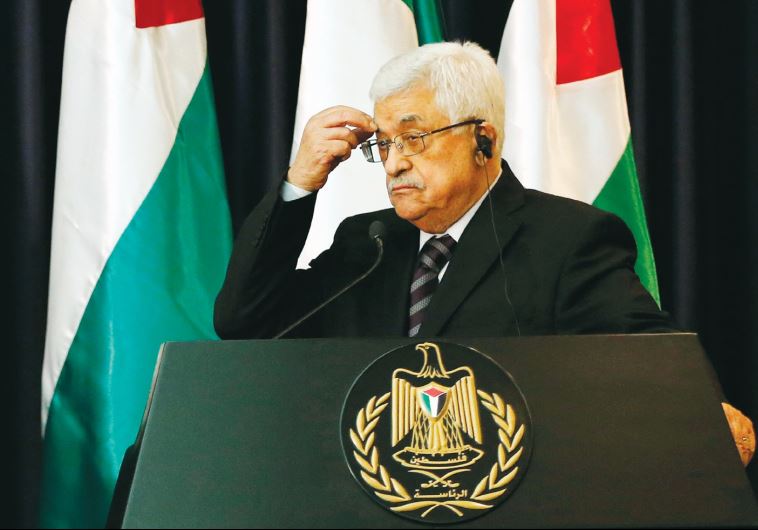
ShowImage (12)PA President Mahmoud Abbas.. (photo credit:AMMAR AWAD / REUTERS)

All the Palestinian terrorist attacks that have been carried out in recent weeks share one common feature. All the terrorists believe that by attacking Jews they are protecting the Temple Mount from destruction.

And why shouldn’t they believe this obscenity? Everywhere they go, every time they turn on their televisions, read the paper, go to school or the mosque they are told that the Jews are destroying al-Aksa Mosque. Al-Aksa, they are told, is in danger. They must take up arms to defend it from the Jews, whatever the cost.

One man stands at the center of this blood libel. The man who propagates this murderous lie and orchestrates the death and mayhem that is its bloody harvest is none other than the West’s favorite Palestinian moderate: PLO chief and Palestinian Authority Chairman Mahmoud Abbas.

On September 16 Abbas gave a speech. It was broadcast on PA television and posted on his Facebook page. In it, he incited the Palestinians to kill Jews. In his words, “Al-Aksa Mosque is ours.

They [the Jews] have no right to desecrate it with their filthy feet. We won’t allow them to do so and we will do everything in our power to defend Jerusalem.”

Abbas added, “We bless every drop of blood spilled for Jerusalem. This is clean and pure blood, blood that was spilled for God. It is Allah’s will that every martyr will go to heaven and every wounded [terrorist] will receive God’s reward.”

Two weeks later, Abbas opened his address before the UN General Assembly with the same lies, threats, and incitement.

Almost exactly a year ago, Abbas spewed the same bile in a speech, with the same murderous consequences. In a speech before Fatah’s executive committee last October, Abbas said, “We must prevent them [the Jews] from entering the holy site in every possible way. This is our holy site, this is our al-Aksa and our church [the Church of the Holy Sepulchre]. They have no right to enter them. They have no right to desecrate them. We must prevent them from entering. We must block them with our bodies to defend our holy sites.”

In subsequent weeks, Abbas’s words were rebroadcast 19 times on Palestinian television.

During that period, Arab terrorists massacred rabbis in prayer at a Jerusalem synagogue, attempted to assassinate human rights activist Yehudah Glick, and murdered Jews standing at light rail stops in the capital.

Eleven Israelis were butchered in that terrorist onslaught.

Then as now, Abbas and his lieutenants not only incited attacks, they incentivized would be perpetrators to kill Jews.

Every year, the same PA that claims perpetual poverty pays more than $100 million to terrorists imprisoned in Israeli jails. Their salaries range between four to seven times the average PA salary, depending on the lethality of the attacks they carried out.

Popular awareness of the financial benefits of terrorist activities has played a critical role in motivating Palestinians to attack Jews. This is made clear by the actions in recent weeks of several of the supposedly “lone wolf” attackers in the hours before they struck. Several of them – like their predecessors in last year’s onslaught – announced their intention to become martyrs to protect al-Aksa from the Jews on their Facebook pages immediately before they carried out their attacks.

Money may be the greatest incentive Abbas and his PA provide for potential terrorists. But it isn’t the only one. There is also the social status they confer on terrorists and their families. Every would-be terrorist knows that if he succeeds in killing Jews, he will be glorified by the Palestinian media and his family will be embraced by the PA establishment – first and foremost by Abbas himself, who has made a habit of meeting with terrorists and their families.

Presently, Israel’s security brass is embroiled in a bitter dispute with our elected leaders regarding the nature of the current terrorist offensive. The dispute bubbled to the surface Wednesday night when the generals used military reporters to criticize Prime Minister Benjamin Netanyahu for blaming Abbas for the violence.

The generals insist that Abbas is a good guy.

He’s trying to calm the situation, they argue, and Israel needs to support him.

From the looks of things, the IDF seems to have the upper hand in this fight. This is the only way to read Netanyahu’s announcement Wednesday night that he is barring government ministers and members of Knesset from visiting the Temple Mount until further notice. Netanyahu’s move is nothing less than a signal that he accepts Abbas’s premise that there is something wrong with Jews exercising their right to visit Judaism’s holiest site.

The generals’ rationale for defending Abbas is fairly straightforward. Throughout the current Palestinian terror onslaught they have continued to cooperate with Abbas-controlled Palestinian security forces in Judea and Samaria.

These forces cooperate with the IDF in seeking out and arresting terrorists from Hamas and other groups that are not subordinate to Abbas. The fact that Abbas has ordered his men to work with the IDF has convinced the generals that he is a positive actor. So as they see it, he must be protected.

In their view, Israel must limit its counterterrorism operations to tactical operations against trigger pullers and their immediate commanders and ignore the overarching cause of the violence.

In behaving in this manner, our security brass is being willfully blind to the fact that Abbas is playing a double game. On the one hand, he orders his forces to be nice to IDF officers in Central Command when they fight terrorist cells from Hamas and other groups not loyal to Abbas, and so wins their appreciation.

But on the other hand, Abbas works with those same terrorist forces, incites them to attack, and rewards them for doing so.

Perhaps the most outrageous aspect of the IDF’s insistence that Abbas is critical to its counterterrorism efforts is that the IDF’s own data demonstrate that Abbas has played an insignificant role in quelling terrorist attacks against Israel.

As Jerusalem Post columnist Evelyn Gordon showed in an article in Commentary this week, according to official data, from 2002 when Palestinian terrorist activities in the areas were at their peak until 2007, when Israel began transferring security control over some Palestinian cities to Abbas’s forces, levels of terrorism went down 97 percent. Even after Israel began permitting Abbas to deploy his security forces to Nablus and Jenin, the IDF has continued to operate at will in these areas, often on a nightly basis.

As Gordon noted, the only place Abbas has exercised sole security control was in Gaza. From September 2005, when Israel removed its military forces from Gaza until Hamas expelled Fatah forces from the areas in June 2007, Abbas’s forces had full control over Gaza. During this time, his forces did nothing to prevent Hamas – and Fatah forces – from attacking Israel with thousands of mortars and rockets. His forces did nothing to prevent the massive transfer of advanced weaponry to Gaza from Egypt and Iran.

True, since his forces were routed in Gaza, Abbas has ordered them to work with the IDF in Judea and Samaria to prevent Hamas from overthrowing him. But at the same time, he continuously seeks to form a unity government with Hamas.

He funds Hamas. He glorifies its terrorists. And he refuses to condemn their attacks against Israel.

Moreover, while ordering his men to help the IDF to protect him from Hamas, he leads the diplomatic war against Israel internationally. The goals of that war are to harm Israel’s economy and deny Israel the right to self-defense.

Our political leadership’s reluctance to stand up to the army is understandable. It is nearly impossible to order the IDF to take action it opposes.

At some point though, the government is going to rein in our insubordinate generals. Fortunately, the government doesn’t need the IDF to deal with Abbas and destroy his capacity to foment and direct attacks against Israel.

Our elected officials have the authority to go after the twin foundations Abbas’s terrorist offensive on their own. Those foundations are the incitement and the financial incentives he uses to motivate Palestinians to attack Jews.

On the financial end, the Knesset should pass two laws to dry up the wells of terrorism financing.

First, the Knesset should pass a law stipulating that all property belonging to terrorists, and all property used by terrorists to plan and carry out attacks, will be seized by the government and transferred to the victims of their attacks.

Moreover, all compensation paid to terrorists and their relatives pursuant to their attacks will be seized by the government and transferred to their victims.

The second law would relate to Israel’s practice – anchored in the Oslo Accords that Abbas revoked last month at the UN – of transferring tax revenues to the PA. The Knesset should pass a law prohibiting those transfers unless the Defense Minister certifies that the PA has ceased all terrorism- related activities including incitement, organization, financing, directing and glorifying terrorist attacks and terrorists.

Until he so certifies, all revenues collected should be used to pay PA debts to Israeli institutions and to compensate victims of Palestinian terrorism.

As for the incitement, the government needs to go to the source of the problem – Abbas’s blood libel regarding Jewish rights to the Temple Mount.

As things stand, Abbas is exacting a price in human lives for his obscene anti-Jewish propaganda about our “filthy feet defiling” the most sacred site in Judaism. By barring elected officials from visiting the Temple Mount, not only is the government failing to exact a price for Abbas’ obscene propaganda. It is rewarding him and so inviting Abbas to expand his rhetorical offensive.

To remedy the situation an opposite approach is required. Rather than bar elected officials from visiting the Temple Mount, Netanyahu should encourage them to do so. Just as he sent a letter to Jordan’s King Abdullah telling him that Israel is preserving the status quo on the Temple Mount, so he should write a similar letter to our lawmakers.

In his letter, Netanyahu should say that in keeping with the status quo, which protects the rights of members of all religions to freely enter the Temple Mount, so he commits the government to protect the rights of all believers of all religions to ascend the Mount.

The Palestinian terrorist onslaught now raging against us is not spontaneous. Abbas has incited it and is directing it. To stop this assault, Israel must finally take action against Abbas and his machinery of war. Anything less can bring us nothing more than a temporary respite in the carnage that Abbas will be free to end whenever he wishes.