Posted tagged ‘Turkey’

The Muslim Brotherhood-ISIS Connection

February 19, 2015

The Muslim Brotherhood-ISIS Connection

February 18, 2015 by Arnold Ahlert

via The Muslim Brotherhood-ISIS Connection | FrontPage Magazine.


President Obama’s ongoing antipathy towards Egypt is no accident. Our feckless president has long had a soft spot in his heart for the Muslim Brotherhood (MB), and Egypt’s removal of the terror group from the corridors of power has rankled the administration. So what is it the Egyptians understand and our president denies? The Egyptian Minister of Religious Endowments insists that ISIS was birthed by the MB.

Dr. Mohamed Mokhtar Gomaa and other Egyptian scholars have explained that while ISIS is publicly hostile to the MB, they share identical goals. Last August, the Ministry illuminated those goals. “They are both waging a war against their homelands with vandalism, destruction and murder—murder on behalf of the enemies of the state who fund them,” read a published statement. Other similarities include the exploitation of women to further their agenda, and the reality that both groups use “lying and deception in the name of religion,” and both have “ignorant and lying” leaders who “use religion to play with the minds of the public,” the statement explained. “The main commonality between the two groups is their terrorist acts,” it added.

A month later, Egyptian President Abdel Fattah Al Sisi, who pledged to support the Obama administration’s war against ISIS, urged the president to recognize the bigger picture of Islamic extremism that extends beyond the borders of Iraq and Syria. He cited terrorist threats in Libya, Sudan, Yemen and the Sinai Peninsula as examples of identical danger posed by ISIS. “We can’t reduce the danger lurking in the region to ISIL (ISIS). We have to bear in mind all the pieces of the puzzle,” he insisted. “We can’t just limit the confrontation to checking and destroying the Islamic State.”

Unfortunately for his nation, Al Sisi’s prescience proved correct: 21 Egyptian Christians were beheaded by ISIS in Libya, where they have established another presence. Such an opportunity was made possible by the Obama administration’s determination to topple Muammar Gaddafi—followed by its refusal to help the new U.S.-backed Libyan government train their police and military. As a result Libya is in complete chaos. Moreover the administration’s political pettiness has allegedly reached a new low: according to Oliver North, Obama denied both Egypt and Jordan targeting information on ISIS in Libya and Syria, despite the decapitation of the Egyptian Christians and the incineration of Jordanian pilot Muath al-Kaseasbeh.

The administration’s behavior in this context runs completely counter to the reality illuminated by Egyptian Foreign Minister Sameh Shukr. “Ultimately this extremist ideology is shared by all terrorist groups. We detect ties of cooperation between them and see a danger as it crosses borders,” he explained.

Part of that mix includes includes Hamas, also spawned by the MB. Writing for the Times of Israel, Ryan Mauro, National Security Analyst for the Clarion Project, wonders why the world agrees that ISIS is morally repugnant even as Hamas gets a pass. “Both implement sharia governance, deliberately target civilians, have genocidal beliefs and seek the establishment of a caliphate,” he writes. He further explains that ISIS’s determination to exterminate Iraq’s Yazidi population is “no more egregious” than Hamas’s determination to eliminate millions of Jews. And the only difference between the MB, Hamas and ISIS is in regard to their method of achieving the same goal. The MB and Hamas wish to establish a Muslim caliphate incrementally, while ISIS is willing to do anything and everything to bring one about as quickly as possible.

Moreover, the MB’s and Hamas’s desire to eliminate the Jews is nothing new. The MB was established in 1928 by Hasan al-Banna, who admired Hitler and wrote to him expressing his desire to collaborate with the Nazi Party. During World War II, the MB made good on that desire. Its members spied for Hitler in the Middle East and formed two Muslim Waffen-SS Handschar Divisions to fight for the Nazis. Following the war, the MB was supported by the West, who saw them as a counterweight to the Soviet Union’s Middle East aspirations. And while some MB members eschewed violence and built schools and medical clinics, others continued to promote violence that included two failed assassination attempts against Egyptian President Gamal Abdel Nasser. Hamas was spawned in 1987 by the MB in Israel.

Two years later, the MB’s Mujahedeen army repelled the Soviets from Afghanistan and then split into two groups—one of which was Al Qaeda. And as Americans are now fully aware, MB-educated Osama bin Laden became their leader. Both groups, along with other Sunni Islamists, were inspired by al-Banna’s successor Sayyid Qutb. In his 1964 manifesto, Milestones, he insisted that governments not based on Sharia Law are apostate, making them legitimate targets of jihad.

ISIS has ideological roots that trace all the way back to the Wahhabist strain of Islam founded by Muhammad ibn ʿAbd al-Wahhab during the 16th century in Saudi Arabia. Like ISIS, al-Wahhab believed in a strict and conformist form of Islam. Those who dissented were to be killed, their property confiscated, and their wives and daughters violated. The essential rift between the two groups arises from Wahhabism’s “One Ruler, One Authority, One Mosque” doctrine that refers to the Saudi king, the absolute authority of Wahhabism, and its control of the mosques and their teachings. ISIS rejects this doctrine, which explains why Saudi Arabia feels as threatened as anyone else by their rise, even as much of the kingdom still embraces Wahhabism. With the rise of Saudi oil wealth, the West preferred to look at the kingdom’s modernization, even as they ignored the Wahhabist part of the equation.

ISIS’s modern roots can be traced to Abu Musab al-Zarqawi, a Jordanian street thug who arrived in Afghanistan too late to fight the Soviets. After a return to Jordan, he went back to Afghanistan a decade later, meeting bin Laden in 1999, but refusing to join al Qaeda. When the Taliban fell in 2001 he fled to Iraq, and in 2003 he set up ISIS’s precursor, Jama’at al-Tawhid w’al-Jihad (the Party of Monotheism and Jihad). It was comprised mostly of non-Iraqis, and al-Zarqawi’s primary targets were Iraq’s Shi’ite Muslim majority. By 2004 his campaign of suicide bombings in that nation made him a jihadist superstar, earning Bin Laden’s endorsement in the process. Al-Zarqawi returned the favor by rebranding his group al-Qaeda in Iraq (AQI).

Yet by 2005, al Qaeda began to have misgivings about AQI’s brutality towards civilians. The American troop surge, coupled with Sunni Iraq’s own disenchantment with Zarqawi’s strict sharia rules gave birth to the “Awakening” that allowed the U.S. to prevail in Iraq—until the deadly combination of a Shi’ite-dominated Maliki government looking for payback after years of Sunni Ba’athist domination, coupled with the Obama administration’s precipitous troop withdrawal in 2011, laid the groundwork for ISIS’s current rise.

In 2011, AQI was being run by current ISIS leader Abu Bakr al-Baghdadi and had become a largely Iraqi organization. Another rebranding took place as these “Sons of Iraq” became ISI, until their ranks were swelled by former commanders and soldiers in Saddam’s military. With the addition of new troops, Baghdadi opened a second front in Syria, once again targeting Shi’ite Muslims and their Shia sub-sect Alawite rulers led by Bashar Assad. When Syrian became part of the equation, ISI became ISIS.

And while all of this was occurring, Obama not only ignored the metastasizing threat, but used his 2012 presidential campaign to assure the American public that al Qaeda had been “decimated” and terror was “on the run.” More accurately, ISIS has been on a roll, seizing large swaths of both Iraq and Syria, along with billions of dollars, courtesy of bank seizures and oil revenue that make them the richest terrorist organization in the history of the world.

Moreover despite the “conventional wisdom” that al Qaeda and ISIS are enemies, the terrorist attack on Charlie Hebdo indicates there was at least some indication that al Qaeda on the Arabian Peninsula (AQAP) and ISIS worked together to perpetrate that atrocity.

On 25 December, Egypt declared the MB a terrorist organization, with the Egyptian courts dissolving nearly all of its institutions, organizations and charities. By contrast on Feb. 4, Obama hosted a meeting at the White House with 14 Muslim leaders, including Azhar Azeez, President of the Islamic Society of North America (ISNA), and Hoda Elshishtawy of the Muslim Public Affairs Council (MPAC).

Both groups were founded by members of the MB.

Former congressman Pete Hoekstra was incensed. The Michigan Republican  insisted it was “absolutely outrageous” for Obama to invite “the Muslim Brotherhood into our government to meet with the White House.” “These are people who are committed to destroying our way of life,” the Michigan Republican warned. “The policy failures go on and on and on, and that’s how we need to be addressing this president and challenging him that his policies are just not working.”

Such challenges will have to overcome that complicity, as well as the grim determination by this administration not to link terror with Islam. Both challenges are epitomized by the Summit on Countering Violent Extremism beginning today. As the AP explains, the Summit will “highlight domestic and international efforts to prevent extremists and their supporters from radicalizing, recruiting and inspiring others, particularly disaffected young people.”

The words “Islamist” or “terror?” Nowhere to be found. As for complicity, one of the Summit’s attendees is the Islamic Society of Boston (ISB) an organization with extensive ties to terror, including former Cambridge mosque worshipper Ahmad Abousamra who is currently ISIS’s top propagandist, as well as the Tsarnaev brothers who carried out the Boston Marathon bombing.  The Cambridge mosque, ISB’s first house of worship was founded in 1982 by Abdulrahman Alamoudi, currently serving a 23-year prison term for his conviction as an al Qaeda fundraiser. Yusuf Qaradawi, the spiritual leader of the Muslim Brotherhood, was a founding trustee at the ISB’s second mosque in Roxbury.

One of the Obama administration’s ostensible ideas for preventing recruitment and radicalization? State Department spokesperson Marie Harf, epitomized their enduring recklessness, insisting we cannot “kill” our way to victory against ISIS. “We need, in the longer term, medium and longer term, to go after the root causes that lead people to join these groups, whether it’s lack of opportunity for jobs,” she declared.

Jobs? Twenty-one Egyptian Christians went to Libya in search of jobs. ISIS decapitated every one of them.

The Obama administration is morally bankrupt. And as the history of the MB-ISIS connections presented here suggests, it is only a matter of time before Americans pay an unconscionable price for that bankruptcy.

The Only Strategy to Defeat Jihad

February 11, 2015

The Only Strategy to Defeat Jihad

By Jonathan David Carson

February 11, 2015

via Articles: The Only Strategy to Defeat Jihad.


An imam on British television taught me more in a few minutes than any of the books I have read on Islam, some of them quite instructive.  After railing at Israel and America, the imam smiled knowingly and said that if God did not want those skyscrapers to fall, he wouldn’t have let airplanes fly into them.  I almost shouted, “Then I guess God wants Palestinians to suffer, or else he wouldn’t let Israelis do all those awful things you say they do!”

I hear endless lamentations about our not having a strategy to defeat “Islamic extremism” or whatever the day’s euphemism is.  The cynic in me says that what we really need is to get rid of our strategy of helping the Muslim Brotherhood and the mullahs in Iran.  But if we have to have a strategy, here it is.

We blow some ISIS bastard to smithereens and shout, “Allahu Akbar!”  We take out Iran’s nuclear reactors and say, “If Allah wanted Iran to have a nuclear bomb, he wouldn’t have dropped those bunker-busters.”

Islam holds that there are no “secondary causes,” that is, that God never acts indirectly, by means of natural law, but always directly, willing everything that happens.  Fine, then, let secondary causes, cruise missiles, for instance, or rifle bullets, kill as many of our enemies as it takes for them to have to come to their senses.  Make them believe that Allah is killing them.  Make them believe it for so long that they stop believing the absurd promise that heaven is full of beautiful virgins waiting lustfully for their smelly carcasses.  Tell them over and over again that Allah is killing them, and doing it directly, without intermediaries, such as drone pilots or Marine snipers, and they will just want a drink.

Franklin Roosevelt said that the Doolittle Raid was launched from Shangri-La.  That’s the idea.  We won that war.

People frequently make the mistake of thinking that Islam is like Christianity, only different.  They are opposites.

Christianity thrives under adversity.  What’s killing Christianity is comfort and ease.  Christianity is for people in trouble.  Judaism too.

Islam thrives on success.  Muslims won one battle, and Mohammed said it was God’s will.  That seemed to make sense.  They won another battle, and they were convinced.  They won another battle, and Mohammed’s boast began to make sense to their enemies.  They won another battle, and their enemies were convinced.  Enemies fled and fled until they had a mighty empire.

Then they ran into men who knew to fight the long defeat, as the elves in The Lord of the Rings put it, and, lo, the defeat was not so long anymore.

We must fight whether we expect to win or not.  We are not cowards who won’t fight without a guarantee of victory from God.

I don’t want to hear any “moderate Muslim” crap.  Who are these mythical beasts?  The Saudis, who in the name of sexual morality won’t let girls escape from burning buildings improperly dressed and who then buy sex slaves from India and Pakistan?  Selling us oil makes them moderate?   They won’t even drill for it themselves.  We have to do it, just as we have to defend them from Saddam Hussein.  What makes them moderate is that we are fools.

I also don’t want to hear that most victims of Islamic extremism are Muslims.

For a while the hobbits sat in silence. At length Sam stirred. ‘Well, I call that neat as neat,’ he said. ‘If this nice friendliness would spread about in Mordor, half our trouble would be over.’

‘Quietly, Sam,’ Frodo whispered. ‘There may be others about. We have evidently had a very narrow escape, and the hunt was hotter on our tracks than we guessed. But that is the spirit of Mordor, Sam; and it has spread to every corner of it. Orcs have always behaved like that, or so all tales say, when they are on their own. But you can’t get much hope out of it. They hate us far more, altogether and all the time. If those two had seen us, they would have dropped all their quarrel until we were dead.

Colonialism has been roundly condemned as oppressive.  Maybe so.  But what the Islamic world needs is oppression.  When the West oppressed the Muslim world, we didn’t have this problem.  And the Muslims were better off.  They could gradually become sane,  as they noticed that Allah was not winning any battles for them.

The reason so many of us are complacent about the threat from Islam is that the colonial era, which ended only recently in historical terms, made us feel safe.  It made Muslims feel impotent and made us feel invincible.  We got swelled heads and saw too many movies and decided that Muslims were peaceful when they were simply afraid.  Now the Establishment reassures them of our peaceful intentions and destroys our best defense: their fear.

Not every Muslim is a terrorist, but Islam is a terrorist religion.  Mohammed was a mass murderer and child molester, and devout Muslims have been following his example ever since.  As long as there is Islam, there will be “Islamic extremists.”

The only way to get rid of Islamic extremism is to get rid of Islam, and it can be done.  Several times Islam has been near collapse, only to be rescued by infidels.  The Great Powers of the West, more fearful of each other than of Islam, rescued it in hopes of using it against their European enemies.  During the Cold War, Russians and Americans tried to turn the Islamic world against each other.  Now both live in fear of it.

Islam will collapse in reverse order.  One victory led to another and another and another.  One defeat will lead to another and another until either some Obama rescues it or it collapses.  The no secondary causes doctrine works only on the way up.

The reason we lost the wars in Iraq and Afghanistan is that we don’t know our enemies — or anybody else for that matter.  We think that we have to “win the hearts and minds” of Muslims.  That is insane.  No Iraqi or Afghan is going to fight for us.  They will fight for themselves, some of them.  Afghans will not fight for America; they might fight to protect themselves from the Taliban.

We don’t have to be liked or even respected.  Afghans have to be brave enough to fight for freedom.  We can help them be brave by killing some of their enemies.  The Muslim god is an illusion, American military might real.

Do not in your arrogance think that Afghan villagers are so much less intelligent than we are that it is impossible for them to grasp the obvious: Allah cannot protect the Taliban from determined Americans.  Afghans are like anyone else: they want to be on the winning side.  So don’t lose.

Squeamishness means death all around, even death for our enemies.  Wait until a nuclear weapon goes off in an American city, or the anti-Semites have their way and Israel is on the brink of destruction.  That is when you will see real death of Muslims, deaths of millions or tens of millions.

The issue is how many Muslims we will have to kill.  The liberals would have us kill more, far more, than is necessary.  We could kill a billion Muslims on a lazy afternoon.  We don’t do it because we are not killers, not because we can’t.  They, on the other hand, would kill a billion of us if they could.  They just can’t.

The more we wring our hands and say we are weary, the more we praise Islam without any real knowledge of it or any intention to obey its cruel rules, the more we temporize, the more we pride ourselves on our compassion and understanding, the more Muslims will die.

Obama is presenting a false American face to the Islamic world, which is getting the idea that Americans are just a bunch of European weenies, just when Europeans giving up on being weenies.  We are not “war weary”; we are weary of wars we lose.  Even if we win, we lose, as when we put in place a regime in Iraq more beholden to Iran than to us or a regime in Afghanistan no one should have to live under.

Obama is not America, as Muslims are going to find out.  The sooner, the better


Qatar, Egypt on a collision course

February 9, 2015

Qatar, Egypt on a collision course, Israel Hayom, Dr. Reuven Berko, February 9, 2015

This anti-Egypt agenda, which seems to be shared by Turkey, is fueled by the desire to realize the dream of installing a Sunni Islamic empire, all while undermining moderate Arab regimes and giving a nod to Iran, as a way of covering all bases — just in case.

******************

Qatar and Egypt are at odds, and the attempts by the late King Abdullah of Saudi Arabia to facilitate a reconciliation between them have failed.

Qatar’s relentless efforts to overthrow Egyptian President Abdel-Fattah el-Sissi’s regime and reinstate the Muslim Brotherhood to power are evident from the programs airing on the Doha-controlled Al-Jazeera television network, and from the publication of doctored wiretaps featuring the Egyptian president and his advisers, who allegedly “stole” Egypt away from the Muslim Brotherhood and the “holy” Mohammed Morsi.

This anti-Egypt agenda, which seems to be shared by Turkey, is fueled by the desire to realize the dream of installing a Sunni Islamic empire, all while undermining moderate Arab regimes and giving a nod to Iran, as a way of covering all bases — just in case.

Egypt’s decision to outlaw the Muslim Brotherhood has resulted in increased incitement by Qatar as well as in an escalation in terrorist attacks in Egypt and Sinai. Egyptian intelligence has linked the latest series of attacks to Ansar Beit al-Maqdis, an offshoot of the Islamic State group, as well as to Hamas’ Izzedine al-Qassam Brigades. Hamas and the Izzedine al-Qassam Brigades are very much Qatar’s “babies,” and their involvement in these terrorist attacks has prompted Egypt to outlaw both.

In response, Al-Jazeera has begun portraying Izzedine al-Qassam Brigades’ operatives, who have denounced Sissi as a traitor to Islam and Arabs everywhere, as heroes fighting for the liberation of “Palestine.” The Qatari television station has also been obsessively covering the riots and unrest instigated by the Muslim Brotherhood to undermine the regime, intimidate foreign investors, and reverse the image of stability Sissi’s government is trying to convey to the world.

The airing of secret wiretaps, on which Sissi is heard mocking the wealthy Persian Gulf states, at this time seeks to pit Cairo against the Gulf states, ahead of the World Economic Forum on the Middle East, which is scheduled to convene in Sharm el-Sheikh, in Egypt, in late February, and where Egypt will lobby for aid.

Sissi’s assertion about the current situation in the Middle East is correct: Sunni Arab states are being offered as sacrifice to Iran, which is pursuing its nuclear endeavors uninterrupted. These states understand that Egypt’s stability is a prerequisite for their own national security, and therefore aiding Cairo is a favor that could only work to their advantage.

At the end of the day, in a reality where Iran poses an existential threat to other Arab countries, pointing to the emir of Qatar as a leader drowning in gold while millions of Egyptians go hungry — as heard on the wiretaps — may prove to be a double-edged sword, which may end up striking Qatar itself.

Egypt’s fight, America’s apathy

February 3, 2015

Egypt’s fight, America’s apathy, Israel Hayom, Dr. Reuven Berko, February 3, 2015

[M]any Arab states long ago branded the movement and its “offspring” as illegal. In the Arab states, unlike in the West, Arabic is fully understood. This fact raises the suspicion that the U.S., which is losing interest in our region, has come to terms with radical Islam’s ascension to power in the Middle East, and is sacrificing its allies in the region.

*********************

The Muslim Brotherhood in Egypt refuses to accept the verdict of the electorate and is trying, through brutal terrorism, to delegitimize President Abdel-Fattah el-Sissi. Ever since the el-Sissi government’s democratic election, Egypt has been plagued by a wave of terror perpetrated by the Brotherhood against the country’s army and security forces in Egypt proper and the Sinai Peninsula, which has damaged the economy and infrastructure.

In his most recent speech at Al-Azhar ‎University, on Jan. 1, el-Sissi tried conveying to the “sane” senior religious leaders a brave message about the need to fight terror, calling for introspection and for them to implement a “religious revolution” against terror. His call has gone unanswered.

Indeed, Egypt is fighting these days against Ansar Beit al-Maqdis, the terrorist group that has renamed itself the “Sinai Province” and has sworn allegiance to Islamic State. Over the past several months, Sinai Province terrorists have inflicted considerable damage and casualties on the Egyptian army, in a series of car bombings and shooting attacks. Last Thursday night, the group carried out four separate attacks on security forces in northern Sinai, killing at least 30 soldiers and police officers.

Egyptian sources pointed a finger at Hamas and its armed wing, the Izzedine al-Qassam Brigades, accusing the Gaza-based terrorist group of aiding Sinai Province in its violent campaign. Evidence of this aid can be found in intercepted messages between the groups. Consequently, Egypt over the weekend banned Hamas’ military wing, listing it as a terrorist organization. In light of the dozens of slain soldiers, el-Sissi called on his security forces in Sinai to avenge the blood of their fallen comrades, and said: “We are fighting a well-funded global terrorist organization. … I am not tying your hands to prevent you from taking retribution from the terrorists.” During the heartfelt speech, el-Sissi announced the establishment of a new headquarters, commanded by a general, charged with waging war on terror and retaking Sinai.

As per its custom, Al-Jazeera distorted his message. One of the network’s “analysts” argued that el-Sissi’s words constituted a call for vengeance and civil war, and that he has turned the Egyptian army into a jury and hangman.

In contrast, in an interview with the network, the editor-in-chief of the weekly Egyptian newspaper Al-Mashhad protested the consistent incitement by Al-Jazeera against Egypt. Al-Jazeera, meanwhile, continues to incite, provide Hamas with material aid, and exalt the Izzedine al-Qassam Brigades as a role model via its documentaries and programs. Within this framework, Izzedine al-Qassam Brigades member Abdel Karim Al-Hanini, in his own series broadcast on Al-Jazeera, boasts of murdering Israeli civilians and soldiers, while instructing his audience, Palestinians and Muslim Brotherhood followers in Egypt alike, on how to build bombs.

Despite the events in Egypt, the Muslim Brotherhood has yet to be outlawed in Europe and the United States. Many leaders still believe it is a legitimate political movement, despite knowing that it engages in terrorism across the globe and the “new Middle East,” and regardless of the fact that many Arab states long ago branded the movement and its “offspring” as illegal. In the Arab states, unlike in the West, Arabic is fully understood. This fact raises the suspicion that the U.S., which is losing interest in our region, has come to terms with radical Islam’s ascension to power in the Middle East, and is sacrificing its allies in the region. Its abstention from reining in Qatar, which incites and funds terrorism, testifies to the indifference of the United States to the damage this causes to Israel and to Egypt’s fight against fundamentalism, and will lead to the fall of other moderate Arab states.

It appears the Americans, who have soldiers based in the manipulative Qatar, along with the Europeans and partnered by Islamist Turkey and NATO, are implementing a policy of “after me, the deluge,” and have accepted the partition of the fading Middle East between the subversive Sunnis and the encroaching Iranians, who are establishing outposts and bridgeheads in Iraq, Syria and Lebanon, as well as in Bahrain and Yemen. Both camps, the Sunni and Shiite, are now moving toward an arms race and inevitable apocalyptic clash, simultaneous to the completion of Iran’s nuclear program, in lieu of sanctions or a deal ensuring it is scaled back.

In the meantime, the European Union is working with Arab League foreign ministers and, bizarrely, Turkey and Qatar, two countries that support these terrorist movements, to create a front against Islamist terror. The criminals have been appointed the guards, indeed.

How to lose friends and empower radicals: the peace prize president’s more dangerous world

January 29, 2015

How to lose friends and empower radicals: the peace prize president’s more dangerous world, Breitbart,  Dr. Sebastian Gorka, January 29, 2015

(Please see the video at the link. — DM)

obama-binoculars-AP-640x480AP Photo/Susan Walsh

Since 2008, the world has become a significantly more dangerous place. In every region, new threats have emerged or old ones have reasserted them. The scorecard is clear: the bad guys are winning and America’s interests are being undermined daily.

As a nation, America has yet to recover from the experience of September 11th, 2001. Public opinion on our national response to the attacks against the World Trade Center, the Pentagon, and Flight 93 is today divided. On one side we have the “Bush lied, People Died!” crowd who portray President George W. Bush’s response in terms of a conspiracy, despite the fact that we now know Saddam Hussein indeed possessed thousands of WMD warheads (and had used them in the past).

On the other, we have conservatives who are themselves split between the unsophisticated isolationists/non-interventionists who believe that an American withdrawal from the world will make us safe, and the quietly resurgent neoconservatives who see in the rise of ISIS/The Islamic State a justification for more foreign engagements.

For a moment, let us put Operations Enduring Freedom (Afghanistan), and Operations Iraqi Freedom (OIF), to one side. Instead, let us take an unemotional snap-shot of the global geostrategic situation to see whether the administration whose head was awarded a Nobel Peace Prize during his first year in office has indeed make the world a safer and more peaceful place.

Europe: During most of the last century, American security was tied directly to the continent of Europe. Whether is was the generational genocide of World War One, the racial genocide of WWII, or the class-based totalitarianism of the Cold War, Europe was the source of strategic, and at times existential, threats to America.

During the first Obama Administration, Secretary of State Hilary Clinton declared a “Pivot to Asia” which would deemphasize Europe’s importance and see Washington focus more on our Pacific partners than on old Atlantic Allies.

Since that announcement, an emboldened Vladimir Putin has seen fit to break an almost 70-year-old international taboo by using force to redraw national borders with his annexation of Crimea. This includes, incredibly, the shooting down of a civilian jet-liner by forces armed by Moscow.

At the same time, we have seen the European Union become evermore centralizing and undemocratic as untenable economic and fiscal policies are propped up by a Brussels bureaucracy in the name of “broader and deeper union.” This has naturally led to two types of responses: the unprecedented success of a paleo-conservative backlash,f best typified by the insurgent victories of UKIP in Great Britain, as well the reverse: Utopian socialist populists such as the victorious Syriza party of Greece.

Then there are Europe’s ties to the Global Jihadist Movement. The recent slaughter in Paris, the beheading of a British serviceman on the streets of the UK, and Spanish and Belgian terror-related arrests all attest to the failure of the current international campaign against Islamist terrorism.

The flawed immigration policies of many EU nations have also facilitated the establishment of literally hundreds of ethnic and religious enclaves across the continent where integration is seen as a bad thing and where radical talent spotters for groups such as Al Qaeda and ISIS/IS identify, indoctrinate and recruit murderers such as the Charlie Hebdo killers, as well as thousands of fighters for The Islamic State.

This has led to a grass-roots response from Europeans afraid of the future survival of their countries embodied in the ever-broadening PEGIDA movement that Breitbart London has covered in great detail. The failure of multiculturalist immigration policies has not only encouraged the enclave phenomenon, but is also clearly linked to the disturbing rise of anti-Semitism on the continent which has led to unprecedented numbers of European jews deciding to leave the nations of their birth for good.

If we include Turkey in our European snapshot, the situation is even worse, as we have seen the one viable example of a secular Muslim state slip even deeper into the corruption-ridden maelstrom of Islamic fundamentalism under the Erdogan government which is either incapable or unwilling to prevent Turkey becoming a pre-deployment site for jihadist fighters traveling into Syria and Iraq. All this from a formal NATO ally of the US.

Asia: The much-vaunted Pivot to Asia has clearly not worked. China has, over the last several years, openly challenged the post-Cold War peace in the region with a commitment to its own military build-up coupled with a concerted campaign of intimidation against its smaller and weaker neighbors.

While challenging and intimidating our regional partners, China has continued to grow economically at such a rate that the nation which was once universally ridiculed as the maker of plastic toys for McDonalds Happy Meals has now surpassed the US economy in terms of gross output.  At the same time, China is waging a covert war against America in the cyber domain, stealing not only state secrets for use in developing its new weapons systems, but also billions of dollars worth of intellectual property and commercial secrets from American businesses. See the remarkable report from Mandiant on scale of the threat.

North Korea has also used the internet to assault American interests as the Sony hacking attack attests, while Washington has proven totally ineffective in undermining the world’s last truly fully-fledged Stalinist regime, or its regionally destabilizing nuclear weapons capabilities.

Africa: A giant continent, with threats as bad as they were in 2008, or in several cases much worse. The Global Jihadist Movement continues to consolidate its control in Nigeria through the horrific attacks of Boko Haram, the group made famous for the kidnapping of the girls from Chibok, an attack which is just one part of a vast campaign targeting Christians and anyone who does not want to live under a theocratically run system based upon sharia and 7th century interpretation of the Koran.

In addition to the insurgent-like threat of Boko Haram, we have also witnessed horrific hit and run terrorist tactics used by other African jihadists, as in the Westgate Mall attack in Nairobi by Al Shabaab. At the same time, China proceeds to build its vast network of economic interests in the continent in ways that far outstrip American geostrategic investment in Africa.

Australasia: Of course, the Pivot to Asia should have pleased our Antipodean allies. But the concrete consequences of the declarations and speeches by Secretary Clinton and the White House have amounted to little more than the deployment of a handful of US Marines from Camp Pendleton to Australia. Instead of the security situation improving, Australia faced its own Jihadist attack just before Christmas last year as a self-styled imam took hostages and brought the violent jihad so familiar to New York, London, Madrid, and Paris, to the streets of Sydney.

The Americas: Canada likewise became a direct victim of the Global Jihadist Movement after a spate of attacks against its armed forces and even its parliament which was only stopped when a brave sergeant-at-arms applied deadly force in the face of a rampaging jihadi.

Those who like illicit quality cigars may be celebrating the White House’s “normalization” of relations with Communist Cuba, but if statements by the Castro regime are to be credited as expressing Havana’s true intentions, then the deal was good for the dictatorship and bad for America. And despite the US government’s historic decision, conditions inside Cuba have remained the same, or in many case deteriorated, with last year seeing record-breaking numbers of political arrests on the island nation. And Cuba’s anti-democratic influence is a problem for the region, not just its wretched population, with Raul Castro’s secret police providing aid and expertise in the oppression of dissidentsto the government of Venezuela.

The Middle East and North Africa: Leaving the worst for last we have, of course, the Middle East, and North Africa. The highs hopes for the Arab Spring turned very rapidly into a “Christian Winter” and a victory for the fundamentalist and anti-Democratic forces of the Muslim Brotherhood. One after another, one-man authoritarian regimes fell to Islamist MB governments, or collapsed into deadly civil wars which are still being fought in places like Syria and Libya. Throughout the region, proto-democrats and vulnerable minorities, especially ancient Christian communities, have been targeted for death or persecution, or have been forced to flee.

The one ray of hope, the people’s revolt in Egypt against the Brotherhood government of Mohammad Morsi, which led to his being ousted by a secular military, was rejected by the US administration as a coup, despite the fact that General, now President, Sisi, has been fighting his own war against Jihadi fundamentalists since he was the Chief of the Egyptian Armed Forces.

And now Yemen, which was lauded just a few months ago by President Obama as the poster-child of his successful counterterrorism strategy, has collapsed under insurgent attacks and the resignation of the government in Sanaa.

Then there is Iran, which, much like Cuba, has squeezed concession after concession out of the administration without either stopping its acquisition of nuclear weapons capability, or curtailing its support of Shiite terrorist fighters in either Iraq or Syria.

I said I would leave Afghanistan and Iraq of our the equation, but nevertheless, it is important to recognize that this is a new jihadist threat that is even more dangerous than Al Qaeda. ISIS, the Islamic State, is today a full-fledged insurgency, one that in four dimensions is much more of a threat that [Sic] Al Qaeda ever was.

The Islamic State is more than a terrorist group, it now functions as a quasi-state and controls territory equivalent to the size of the UK. It is the richest non-state threat group in human history. It has an incredibly sophisticated understanding of information warfare and how to use social media as a propaganda platform, and lastly – and relatedly – it has recruited ten of thousands of young Muslim men from around the world, including Europe and the US, to fight for the new Caliphate of Abu Bakr al Baghdadi. Bin Laden dreamt of being this powerful. The Islamic State has turned his dream into a horrific reality.

There is not one area of the world of import to America in which we have either not lost friends, or failed to help our allies to defend themselves against the common enemies that threaten us all. Whatever your politics, or whomever you favor for the next Commander-in-Chief of the United States, one thing is certain: without resolute American leadership the world can become, and now is, a much more dangerous place.

The Imaginary Islamic Radical

January 28, 2015

The Imaginary Islamic Radical, Front Page Magazine, Daniel Greenfield, January 28,2015

(Ask Secretary Kerry.

Please see also Muslim Brotherhood-Aligned Leaders Hosted at State Department. — DM)

iraqstill-450x281

Our problem is not the Islamic radical, but the inherent radicalism of Islam. Islam is a radical religion. It radicalizes those who follow it. Every atrocity we associate with Islamic radicals is already in Islam. The Koran is not the solution to Islamic radicalism, it is the cause.

******************

The debate over Islamic terrorism has shifted so far from reality that it has now become an argument between the administration, which insists that there is nothing Islamic about ISIS, and critics who contend that a minority of Islamic extremists are the ones causing all the problems.

But what makes an Islamic radical, extremist? Where is the line between ordinary Muslim practice and its extremist dark side?

It can’t be beheading people in public.

Saudi Arabia just did that and was praised for its progressiveness by the UN Secretary General, had flags flown at half-staff in the honor of its deceased tyrant in the UK and that same tyrant was honored by Obama, in preference to such minor events as the Paris Unity March and the Auschwitz commemoration.

It can’t be terrorism either. Not when the US funds the PLO and three successive administrations invested massive amounts of political capital into turning the terrorist group into a state. While the US and the EU fund the Palestinian Authority’s homicidal kleptocracy; its media urges stabbing Jews.

Clearly that’s not Islamic extremism either. At least it’s not too extreme for Obama.

If blowing up civilians in Allah’s name isn’t extreme, what do our radicals have to do to get really radical?

Sex slavery? The Saudis only abolished it in 1962; officially. Unofficially it continues. Every few years a Saudi bigwig gets busted for it abroad. The third in line for the Saudi throne was the son of a “slave girl”.

Ethnic cleansing? Genocide? The “moderate” Islamists we backed in Syria, Libya and Egypt have been busy doing it with the weapons and support that we gave them. So that can’t be extreme either.

If terrorism, ethnic cleansing, sex slavery and beheading are just the behavior of moderate Muslims, what does a Jihadist have to do to be officially extreme? What is it that makes ISIS extreme?

Our government’s definition of moderate often hinges on a willingness to negotiate regardless of the results. The moderate Taliban were the ones willing to talk us. They just weren’t willing to make a deal. Iran’s new government is moderate because it engages in aimless negotiations while pushing its nuclear program forward and issuing violent threats, instead of just pushing and threatening without the negotiations. Nothing has come of the negotiations, but the very willingness to negotiate is moderate.

The Saudis would talk to us all day long while they continued sponsoring terrorists and setting up terror mosques in the West. That made them moderates. Qatar keeps talking to us while arming terrorists and propping up the Muslim Brotherhood. So they too are moderate. The Muslim Brotherhood talked to us even while its thugs burned churches, tortured protesters and worked with terrorist groups in the Sinai.

A radical terrorist will kill you. A moderate terrorist will talk to you and then kill someone else. And you’ll ignore it because the conversation is a sign that they’re willing to pretend to be reasonable.

From a Muslim perspective, ISIS is radical because it declared a Caliphate and is casual about declaring other Muslims infidels. That’s a serious issue for Muslims and when we distinguish between radicals and moderates based not on their treatment of people, but their treatment of Muslims, we define radicalism from the perspective of Islamic supremacism, rather than our own American values.

The position that the Muslim Brotherhood is moderate and Al Qaeda is extreme because the Brotherhood kills Christians and Jews while Al Qaeda kills Muslims is Islamic Supremacism. The idea of the moderate Muslim places the lives of Muslims over those of every other human being on earth.

Our Countering Violent Extremism program emphasizes the centrality of Islamic legal authority as the best means of fighting Islamic terrorists. Our ideological warfare slams terrorists for not accepting the proper Islamic chain of command. Our solution to Islamic terrorism is a call for Sharia submission.

That’s not an American position. It’s an Islamic position and it puts us in the strange position of arguing Islamic legalism with Islamic terrorists. Our politicians, generals and cops insist that the Islamic terrorists we’re dealing with know nothing about Islam because that is what their Saudi liaisons told them to say.

It’s as if we were fighting Marxist terrorist groups by reproving them for not accepting the authority of the USSR or the Fourth International. It’s not only stupid of us to nitpick another ideology’s fine points, especially when our leaders don’t know what they’re talking about, but our path to victory involves uniting our enemies behind one central theocracy. That’s even worse than arming and training them, which we’re also doing (but only for the moderate genocidal terrorists, not the extremists).

Secretary of State Kerry insists that ISIS are nihilists and anarchists. Nihilism is the exact opposite of the highly structured Islamic system of the Caliphate. It might be a more accurate description of Kerry. But the Saudis and the Muslim Brotherhood successfully sold the Western security establishment on the idea that the only way to defeat Islamic terrorism was by denying any Islamic links to its actions.

This was like an arsonist convincing the fire department that the best way to fight fires was to pretend that they happened randomly on their own through spontaneous combustion.

Victory through denial demands that we pretend that Islamic terrorism has nothing to do with Islam. It’s a wholly irrational position, but the alternative of a tiny minority of extremists is nearly as irrational.

If ISIS is extreme and Islam is moderate, what did ISIS do that Mohammed did not?

The answers usually have a whole lot to do with the internal structures of Islam and very little to do with such pragmatic things as not raping women or not killing non-Muslims.

Early on we decided to take sides between Islamic tyrants and Islamic terrorists, deeming the former moderate and the latter extremists. But the tyrants were backing their own terrorists. And when it came to human rights and their view of us, there wasn’t all that much of a difference between the two.

It made sense for us to put down Islamic terrorists because they often represented a more direct threat, but allowing the Islamic tyrants to convince us that they and the terrorists followed two different brands of Islam and that the only solution to Islamic terrorism lay in their theocracy was foolish of us.

We can’t win the War on Terror through their theocracy. That way lies a real Caliphate.

Our problem is not the Islamic radical, but the inherent radicalism of Islam. Islam is a radical religion. It radicalizes those who follow it. Every atrocity we associate with Islamic radicals is already in Islam. The Koran is not the solution to Islamic radicalism, it is the cause.

Our enemy is not radicalism, but a hostile civilization bearing grudges and ambitions.

We aren’t fighting nihilists or radicals. We are at war with the inheritors of an old empire seeking to reestablish its supremacy not only in the hinterlands of the east, but in the megalopolises of the west.

“Unity”? About What Exactly?

January 22, 2015

Unity”? About What Exactly? The Gatestone Institute, Jeremy Havardi, January 22, 2015

Meanwhile, Saudi Arabia tried to fool the world by joining France’s “Unity March” for free speech just two days after a young Saudi blogger, Raif Badawi, received the first installment of 50 lashes — out of the 1000 he is to get — “very severely,” the lashing order says. Badawi still has 950 lashes to complete.

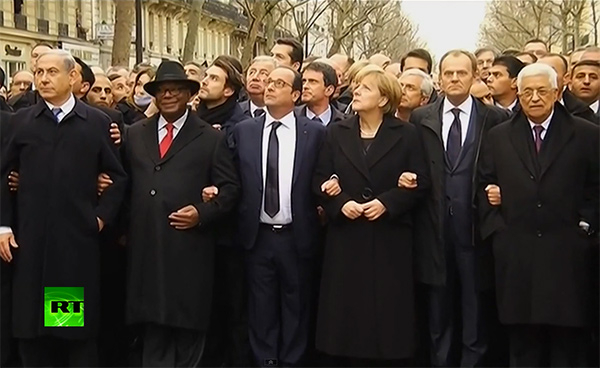
Mahmoud Abbas, whose genocidal, jihadi partner, Hamas, was just declared not a terrorist group by the European Union, joined the forefront of the “Unity March” at the same time as a Palestinian human rights groups published a report accusing the Palestinian Authority of “waging war” against university students in the West Bank.

What “Islamophobia” motivated the killing of Jewish customers in a kosher supermarket? What had those victims done to deserve that?

We may like to imagine that this is not Islam, and that the faith promotes peace and nothing else. But the murderers say it is Islam, and they act accordingly.

Much of the media has offered up a context for these killings that is false.

The real story is that despite a few sporadic incidents, there has been no backlash against the Muslim community.

The recent rally for free speech and against the terrorism in Paris initially appeared to have generated a surge of defiance and resolve, not just in France but around the world. People were actually talking about a turning point in the battle against terrorism and radical Islam.

If only it were true.

The reality is that much of the political class and media remain in denial about the events in Paris.

Ban Ki Moon explained that the tragic events had nothing to do with religion. Signing a condolence book for the victims of the attacks, he said: “This is not a country, a war against religion or between religions… This is a purely unacceptable terrorist attack – criminality.”

France’s President François Hollande said that the Charlie Hebdo fanatics had “nothing to do with Islam,” and he was joined in this view by commentators on France24, as well as the German Interior Minister, Thomas de Maizière.

The Guardian’s Jonathan Freedland condemned the actions of a “handful of wicked fanatics against the rest of us.” The implication was that they merely acted in the name of Islam — purely coincidentally, as it were.

In the Daily Mail, Piers Morgan wrote that the perpetrators were “not ‘real’ Muslims” and that this was “not a religious war.” Why he thought he could act as the arbiter on that question is still unclear.

As for President Obama, he has effectively outlawed the term “Islamic terror.”

The United States, in what was widely seen as a snub, was only represented at the rally by the U.S. Ambassador to France, Jane Hartley. Since the President had declared in 2012 that “[t]he future must not belong to those who slander the prophet of Islam” — the implication was that they were not acting purely coincidentally.

There is in those comments a mixture of political correctness, wishful thinking and staggering ignorance. It is understandable and commendable not to lump a majority of law-abiding, patriotic and peaceful Muslims together with their violent counterparts. But calling for “unity” in a march leaves one asking: Unity about what exactly?

To pretend that there is a complete disconnect between Islam and terror is to ignore reality. Jihadis are gaining ideological succour from the tenets of their faith, drawing upon teachings promulgated by imams, including the late Anwar al Awlaki. We may like to imagine that this is not Islam, and that the faith promotes peace and nothing else. But the murderers say it is Islam, and they act accordingly.

To confront this problem properly, the ideological underpinnings of jihad need to be tackled comprehensively at source.

It is not enough to unite against terrorism, as every community must. We need to know what we are uniting for — free speech. And we need to know what we are uniting against — namely the militant war of extremist Islamism.

It is equally inaccurate to describe these jihadis as “lone wolves.” They will have spent time gaining combat experience abroad, perhaps in Yemen, Syria or Iraq, and will have received ideological indoctrination and funding from a network of other jihadis. They are recruits in a theocratic, totalitarian death-cult spread across the planet. It comes in different forms: Boko Haram, which slaughtered 2,000 people in Nigeria the weekend before last; the Taliban, which murdered schoolchildren in Pakistan; Hamas with its genocidal doctrine and many years of bombings, and the Islamic State, which seems busy ethnically cleansing nearly everyone in Syria and Iraq.

The murders in Paris, therefore, were merely the latest salvo in a global confrontation between jihadist Islam and its declared enemies, this time in the West.

Much of the media has offered up a context for these killings that is false. Within hours of the massacre at Charlie Hebdo, the Telegraph led with a feature on the growing problem of “Islamophobia” in France. The Guardian, too, weighed in; one story headlined: “Muslims fear backlash after Charlie Hebdo deaths as Islamic sites attacked”. The Spectator spoke of the killings as an “attack on Islam;” and Robert Fisk in the UK Independent referred to the legacy of the Algerian war as a motive for the attackers. Other news outlets voiced fears of a “backlash” against Muslims in France and elsewhere.

But the real story is that while there have been some sporadic incidents against mosques and Muslim owned businesses in France following the Charlie Hebdo attacks, there has been no backlash against the Muslim community. Muslims across France even joined in the unity rally, an act that would have been impossible were there a climate of widespread public hostility.

The majority of hate crimes in France, as in a number of other countries, affects the Jewish community. It was a Jewish supermarket that was attacked. This does not mean that there will not be attacks — all of them naturally deplorable — against Muslim innocents, only that fears of a major widespread assault seem highly exaggerated. The same fears of widespread attacks against the Muslim community also proved unfounded after the 7/7 London bomb attacks.

Lumping terrorism and “Islamophobia” together ignores the real motivation of the latest killers in France. One of them, Amedy Coulibaly, pledged allegiance to the Islamic State in a video address prior to the supermarket attack. This hardly suggests a rant against perceived intolerance or racism. Invoking racism here also suggests, in a shifting of blame, that we in the West are somehow at fault for the violent behaviour of these Islamist terrorists. What “Islamophobia” motivated the killing of Jewish customers in a kosher supermarket? What had those victims done to deserve that?

Another reason this is no turning point is that the press continues to engage in self-righteous self-censorship. Not one broadcaster — including the BBC, Fox, NBC and CNN — showed any of the Charlie Hebdo images that had been deemed provocative. Those outlets were joined by the Associated Press, which deliberately cropped a photograph of the magazine’s now-dead editor to avoid showing an image of the Prophet Muhammad. In a cringe replicated across almost all of Europe, not one major British newspaper published any of Charlie Hebdo’s satirical images of Islam, and only The Guardian showed the full front cover of the edition that the survivors published after the attack.

Big mistake. These newspapers and broadcasters are denying the public a dispassionate view of what the killers themselves say is causing them to kill. Worse again, by drawing a line against possibly offending Muslims — many of whom seem to have no problem offending Jews and Christians, among others, if not killing them — the media have acted as if there is already in place an unofficial blasphemy law: the terrorists’ key demand.

A violent mob, disastrously undermining Western values, is effectively dictating the boundaries of free speech.

It is all very well to praise Charlie Hebdo as an icon of free speech, but after the riots that followed the publishing of Muhammad cartoons in Denmark’s Jyllands Posten in 2006, Charlie Hebdo was virtually alone in reprinting them, and it was condemned widely for doing so.[1]

Time magazine, in 2011, likened Charlie Hebdo’s reprinting the cartoons as “the right to scream ‘fire’ in an increasingly over-heated theater.” In other words, the “Islamophobic” cartoonists were to blame for their own misfortune. There is a notion permeating Europe, that if you speak out, not only can you can be put on trial — as is the Dutch MP, Geert Wilders[2] — but that it will also, in an Orwellian twist, be your own fault; if you had just kept quiet, nothing unpleasant would be happening to you. Try telling that to the four Jews lying murdered on the floor of the French supermarket. What did they ever say?

Meanwhile, Saudi Arabia tried to fool the world by joining France’s “Unity March” for free speech just two days after a young Saudi blogger, Raif Badawi, received the first installment of 50 lashes — out of the 1000 he is to get — “very severely,” the lashing order says. He was taken after Friday prayers to a public square outside a mosque in Jeddah. His declared “crime” is “insulting Islam,” for writing thoughts such as, “My commitment is to reject any repression in the name of religion… a goal we will reach in a peaceful and law-abiding way.” Badawi still has 950 lashes to complete. If he lives. There is no medical help.

Palestinian Authority President Mahmoud Abbas — whose genocidal, jihadi partner, Hamas, was, in a burst of surrealism, declared not a terrorist group by the European Union — joined the forefront of the Unity March in Paris at the same time as a report was published by a Palestinian human rights group, accusing the Palestinian Authority of “waging war” against university students in the West Bank.

883World leaders link arms at the Paris anti-terror rally on January 11, 2014. Palestinian Authority President Mahmoud Abbas stands at the far right of the front row. (Image source: RT video screenshot)

Turkey, “named the world’s biggest jailor of journalists in 2012 and 2013” according to theWashington Post, was also there. Turkey “ended 2014 by detaining a number of journalists … including Ekrem Dumanli, editor in chief of Zaman, a leading newspaper” with links to an opposition movement.

Meanwhile, between January 8 and January 14, as over three million copies of Charlie Hebdowere selling out and four million more being printed, there was already talk in France of hardening its laws against free speech. So this may not be a turning point either for free speech or against radical Islam. So it may be a while before we can truly say, “Nous sommes Charlie.”

Jeremy Havardi is a historian and journalist based in London. His books include The Greatest Briton, analytical essays on Churchill.


[1] Ezra Levant, who reprinted the cartoons in Canada, was then compelled to appear before the Alberta Human Rights Commission to defend their publication, because of a complaint lodged by Syed Soharwardy of the Islamic Supreme Council of Canada and the Edmonton Council of Muslim Communities.

[2] As also was Lars Hedegaard (for speaking in his own drawing room), Suzanne Winters, Elisabeth Sabaditsch-Wolff, or at the very east need round-the-clock-bodyguards, such asFrench journalist Eric Zemmour, for saying that France might be facing a virtual civil war.

Turkish military says MIT shipped weapons to al-Qaeda

January 21, 2015

Turkish military says MIT shipped weapons to al-Qaeda

By Fehim Taştekin

January 15, 2015 03:38

via Turkish military says MIT shipped weapons to al-Qaeda – Al-Monitor: the Pulse of the Middle East.


According to information published on and then banned from the Internet in Turkey, on Jan. 19, 2014, the prosecutor of an Adana court instructed the Adana Provincial Gendarmerie Command to stop and search three trucks.  (photo by Anonymous)


Secret official documents about the searching of three trucks belonging to Turkey’s national intelligence service (MIT) have been leaked online, once again corroborating suspicions that Ankara has not been playing a clean game in Syria. According to the authenticated documents, the trucks were found to be transporting missiles, mortars and anti-aircraft ammunition. The Gendarmerie General Command, which authored the reports, alleged, “The trucks were carrying weapons and supplies to the al-Qaeda terror organization.” But Turkish readers could not see the documents in the news bulletins and newspapers that shared them, because the government immediately obtained a court injunction banning all reporting about the affair.

When President Recep Tayyip Erdogan was prime minister, he had said, “You cannot stop the MIT truck. You cannot search it. You don’t have the authority. These trucks were taking humanitarian assistance to Turkmens.”

Since then, Erdogan and his hand-picked new Prime Minister Ahmet Davutoglu have repeated at every opportunity that the trucks were carrying assistance to Turkmens. Public prosecutor Aziz Takci, who had ordered the trucks to be searched, was removed from his post and 13 soldiers involved in the search were taken to court on charges of espionage. Their indictments call for prison terms of up to 20 years.

In scores of documents leaked by a group of hackers, the Gendarmerie Command notes that rocket warheads were found in the trucks’ cargo.

According to the documents that circulated on the Internet before the ban came into effect, this was the summary of the incident:

  • On Jan. 19, 2014, after receiving a tip that three trucks were carrying weapons and explosives to al-Qaeda in Syria, the Adana Provincial Gendarmerie Command obtained search warrants.
  • The Adana prosecutor called for the search and seizure of all evidence.
  • Security forces stopped the trucks at the Ceyhan toll gates, where MIT personnel tried to prevent the search.
  • While the trucks were being escorted to Seyhan Gendarmerie Command for an extensive search, MIT personnel accompanying the trucks in an Audi vehicle blocked the road to stop the trucks. When MIT personnel seized the keys from the trucks’ ignitions, an altercation ensued. MIT personnel instructed the truck drivers to pretend their trucks had malfunctioned and committed physical violence against gendarmerie personnel.
  • The search was carried out and videotaped despite the efforts of the governor and MIT personnel to prevent it.
  • Six metallic containers were found in the three trucks. In the first container, 25-30 missiles or rockets and 10-15 crates loaded with ammunition were found. In the second container, 20-25 missiles or rockets, 20-25 crates of mortar ammunition and Douchka anti-aircraft ammunition in five or six sacks were discovered. The boxes had markings in the Cyrillic alphabet.
  • It was noted that the MIT personnel swore at the prosecutor and denigrated the gendarmerie soldiers doing the search, saying, “Look at those idiots. They are looking for ammunition with picks and shovels. Let someone who knows do it. Trucks are full of bombs that might explode.”
  • The governor of Adana, Huseyin Avni Cos, arrived at the scene and declared, “The trucks are moving with the prime minister’s orders” and vowed not to let them be interfered with no matter what.
  • With a letter of guarantee sent by the regional director of MIT, co-signed by the governor, the trucks were handed back to MIT.
  • Driver Murat Kislakci said in his deposition, “This cargo was loaded into our trucks from a foreign airplane at Ankara Esenboga Airport. We are taking them to Reyhanli [on the Syrian border]. Two men [MIT personnel] in the Audi are accompanying us. At Reyhanli, we hand over the trucks to two people in the Audi. They check us into a hotel. The trucks move to cross the border. We carried similar loads several times before. We were working for the state. In Ankara, we were leaving our trucks at an MIT location. They used to tell us to come back at 7 a.m. I know the cargo belongs to MIT. We were at ease; this was an affair of state. This was the first time we collected cargo from the airport and for the first time we were allowed to stand by our trucks during the loading.”
  • After accusations of espionage by the government and pro-government media, the chief of general staff ordered the military prosecutor to investigate,. On July 21, the military prosecutor declared the operation was not espionage. The same prosecutor said this incident was a military affair and should be investigated not by the public prosecutor, but the military. The civilian court did not retract its decision.

The government cover-up

Though the scandal is tearing the country apart, the government opted for its favorite tactic of covering it up. A court in Adana banned written, visual and Internet media outlets from any reporting and commenting on the stopping of the trucks and the search. All online content about the incident has been deleted.

The court case against the 13 gendarmerie elements accused of espionage has also been controversial. The public prosecutor, who in his indictment said the accused were involved in a plot to have Turkey tried at the International Criminal Court, veered off course. Without citing any evidence, the indictment charged that there was collusion between the Syrian government, al-Qaeda and the Islamic State (IS). The prosecutor deviated from the case at hand and charged that the killing by IS of three people at Nigde last year was actually carried out by the Syrian state.

At the moment, a total blackout prevails over revelations, which are bound to have serious international repercussions


Turkey: America’s unacknowledged problem

December 31, 2014

Turkey: America’s unacknowledged problem, Israel Hayom, Prof. Efraim Inbar, December 31, 2014

(The foreign policy of the Obama administration is difficult to understand. What might be the reasoning behind its apparently continuing support for Islamic Turkey, a bitter foe of Israel? What are the administration’s interests in the Middle East?– DM)

It is not clear why Washington puts up with such Turkish behavior. The Obama ‎administration seems to be unable to call a spade a spade. It refuses to acknowledge ‎that Turkey is a Trojan horse in NATO, and that Ankara undermines American interests ‎in the Middle East and elsewhere.‎

***************

Turkey is a NATO ally, and U.S. President Barack Obama has called Turkish President Recep Tayyip Erdogan his best friend. But Erdogan-led Turkey does not ‎behave as an ally or a friend of the U.S. This is not a new development.‎

Erdogan and his Islamist party, the Justice and Development Party (AKP), have ruled Turkey since 2002. Erdogan’s ‎Turkey has gradually distanced itself from the West, adopting domestic and foreign ‎policies fueled by Ottoman and Islamist impulses. ‎

Turkey has been on the road to an authoritarian regime for several years. Infringements ‎on human rights have gradually increased. In truth, Turkey has never had a political ‎system with checks and balances able to constrain attempts to consolidate power ‎around one politician. In recent years, Erdogan has weakened further the few ‎constitutional constraints against “Putinization” of the Turkish political system. ‎

The longer Erdogan rules, the more power-hungry he seems. His authoritarian ‎personality becomes clearer every day. The press is hardly free. Erdogan arrests even ‎Islamist journalists who are critical of his policies. His party has infiltrated the judicial ‎system and the police. Foci of power, such as the bureaucracy, the banking system, ‎industrial associations and trade unions, have been mostly co-opted by the AKP. ‎Opposition political parties are largely discredited. The military, once active in politics ‎as the defender of the Kemalist secular tradition, has been successfully sidelined. ‎

From a realpolitik perspective, the domestic political developments, deplorable as they ‎may be in Turkey, could be ignored by the democratic West as long as Ankara ‎continues to be a useful ally. Unfortunately, Turkey no longer qualifies as a trusted ‎ally. ‎

The most recent examples of nefarious Turkish behavior are its support of Islamic State and ‎Hamas. Turkey is playing a double game on the issue of Islamic State. It pretends to ‎cooperate with the U.S. policy in the attempt to contain radical Islam, but actually ‎Turkey supports the radical group. It allows passage of volunteers through Turkish territory to join ‎Islamic State in Iraq. The group gets logistical support via Turkey, and sends its wounded militants for ‎treatment in Turkey. Turkish military forces stood idly by the besieged city of Kobani, ‎just across the Turkish border, while the Islamists killed Kurdish fighters. Finally, ‎Turkey denies the American air force access to Turkish bases, forcing the U.S. to use far‎away bases when attacking Islamic State targets. ‎

Turkey is also openly supporting another radical Islamist organization, Hamas. ‎Despite the fact that the West regards Hamas a terrorist organization, Ankara regularly ‎hosts Hamas representatives to meet the highest Turkish dignitaries. Hamas, an ‎offshoot of the Muslim Brotherhood, has a rabid anti-American position. Moreover, ‎Salah al-Aruri, a senior Hamas operative, operates out of Istanbul. Recently, the ‎Turkish branch of Hamas was involved in a series of attempts to carry out terrorist ‎attacks against Israel, and in orchestrating a coup against the current leadership of the ‎Palestinian Authority.‎

Such behavior should not surprise policy makers in Washington. In 2003, Ankara ‎denied the request from Washington to open its territory so that the U.S. military could ‎attack Saddam Hussein’s forces from two separate fronts.‎

AKP-ruled Ankara also defied American preferences on Syria, a country allied with ‎radical Iran and on the American list of states supporting terrorism. In January 2004, ‎Bashar Assad became the first Syrian president ever to visit Turkey. In April 2009, the ‎two states conducted their first ever joint military exercise. No other NATO member ‎had such close relations with the authoritarian regime in Damascus, which has been ‎closely allied with Iran for several decades.‎

Turkey further deviated from the Western consensus in 2008 by hosting Sudanese ‎President Omar Hassan al-Bashir twice. Bashir, who was charged with war crimes and ‎genocide in Darfur, presided over an Islamist regime. ‎

Turkey even welcomed the president of the Islamic Republic of Iran, Mahmoud ‎Ahmadinejad, for a visit in August 2008. No Western country has issued such an ‎invitation to the Iranian leader. Additionally, Erdogan congratulated Ahmadinejad ‎immediately after his re-election in June 2009. When it comes to Iran’s nuclear threat, ‎Ankara, unlike its NATO allies, has refused to adopt the U.S. stance on harsher ‎sanctions, fearing in part the economic consequences of such steps. In June 2010, ‎Turkey voted at the U.N. Security Council against a U.S.-sponsored resolution meant to ‎impose a new round of sanctions on Iran.‎

Turkey also has consistently defied advice from Washington to tone down its anti-‎Israel statements and mend relations with an important American ally. All American ‎efforts in this direction have failed.‎

There is also a clear divergence between the U.S. and Turkey on important global issues ‎such as Russia and China. For example, U.S. wanted to send ships into the Black Sea via ‎the Bosporus Strait during the Georgia war in August 2008. Turkey flatly denied ‎several such requests on the pretext that the military vessels were too large. Moreover, ‎Turkey proposed the creation of a regional security framework involving Turkey, ‎Russia, Georgia, Armenia and Azerbaijan that left out a NATO role. More blatantly, ‎Turkey has failed to participate in the Western economic sanctions imposed on Russia ‎during the recent Ukraine crisis.‎

Dissonance exists also with regards to China. While the U.S. fears the rise of China, ‎Turkey sees this country as a potential economic partner and not a problem. It held ‎military exercises with China. Ankara even considered purchasing anti-aircraft systems ‎from Beijing, an incredibly brazen position for a NATO member.

It is not clear why Washington puts up with such Turkish behavior. The Obama ‎administration seems to be unable to call a spade a spade. It refuses to acknowledge ‎that Turkey is a Trojan horse in NATO, and that Ankara undermines American interests ‎in the Middle East and elsewhere.‎

Erdogan’s Egyptian Nightmare

December 30, 2014

Erdogan’s Egyptian Nightmare, The Gatestone InstituteBurak Bekdil, December 30,2014

Erdogan was happy. At least until a few days ago….

Erdogan probably did not know the Emir of Qatar’s next move on the Middle Eastern chessboard.

Turkey aspires to be a regional leader with no, little or problematic dialogue with about a dozen countries in its region.

Back in 2011, everything ostensibly was coming up roses between Turkey and Egypt. In a speech that year, then-Turkish President Abdullah Gul mentioned “…an axis of democracy of the two biggest nations in our region [Turkey and Egypt], from the north to the south, from the Black Sea down to the Nile Valley…”

In September 2011, then-Prime Minister [now President] Recep Tayyip Erdogan found an emotional hero’s welcome at Cairo’s Tahrir Square. Tens of thousands of Egyptians had flocked to the Cairo airport to welcome him. Streets were decorated with posters of Erdogan.

In early 2012, a survey by TESEV, a Turkish think-tank, found that Turkey was the most popular country for the residents of seven Arab countries, including Egypt.

But against that glittering backdrop, this author wrote in June 2011: “For Ankara, Cairo can be the new Damascus until another capital becomes the new Cairo. At that time, Syrian President Bashar al-Assad, Erdogan’s one-time best regional ally, had already become his worst regional nemesis.

The Turkish-Egyptian love affair would, in fact, be quite short-lived.

In August 2013, about a month after General Abdel Fattah el-Sisi in Egypt toppled the Muslim Brotherhood rule of President Mohammed Morsi, Erdogan appeared on TV, reading — in an unusually soft voice — a letter by the Muslim Brotherhood’s Mohamed al-Beltagy. The letter was written to Beltagy’s daughter Asmaa, a 17-year-old girl, who had been killed in Cairo when security forces stormed two protest camps occupied by supporters of the deposed president. Poor Asmaa had been shot in the chest and back.

“I believe you have been loyal to your commitment to God, and He has been to you,” her father wrote in the letter. “Otherwise, He would not have called you to His presence before me.” Erdogan’s tears were visible.

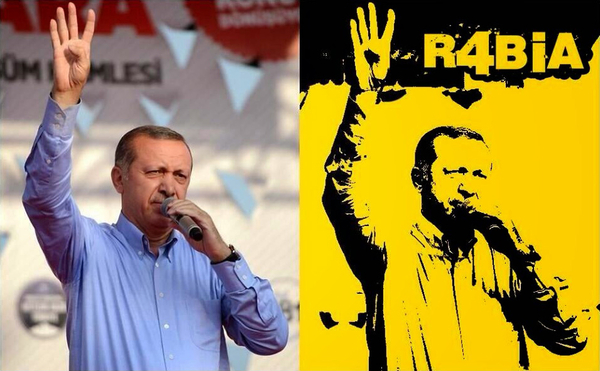
Later, Asmaa became another symbol for Turkish Islamists; Erdogan cheered party fans with the four-finger “Rabia” sign, in reference to his solidarity with the Muslim Brotherhood, and as a sign of his endearment for the unfortunate girl. Even on the playing field, a few footballers made the same sign after scoring.

859In this image, widely circulated in social media, Turkey’s then-Prime Minister [now President] Recep Tayyip Erdogan flashes the Egyptian Muslim Brotherhood’s four-fingered “Rabia” sign.

After the coup in Egypt, when el-Sisi ran for president and won the elections, Turkey’s Erdogan declared them “null and void.” And not just that. Erdogan also said that he did not view el-Sisi as “president of Egypt.” At another time, he said, “Turkey would not recognize the coup regime in Egypt.” Last July, he called el-Sisi “an illegitimate tyrant” and a “coup-maker.”

Meanwhile, neither was Erdogan a “rock star” in Cairo nor was Turkey “the most popular country.” Egyptian non-governmental organizations [NGOs] called on Egyptians and Arabs to boycott Turkish goods and soap operas. Egypt’s intellectuals, writers and businessmen were recommending a break in Egypt’s relations with Turkey because “they were disappointed.” Egypt unilaterally cancelled both visa-free travel for Turkish citizens and a transit agreement for Turkish trucks.

In the anti-el-Sisi campaign, Turkey was not alone. Its only regional ally, Qatar, fully supported Turkey against Egypt’s elected “coup leader.” Erdogan was happy. At least until a few days ago….

In Ankara, Erdogan was all smiles when he offered a red-carpet ceremony to the visiting Qatari Emir Sheikh Tamim bin Hamad al-Thani. Happy to have his best ally as a guest, Erdogan probably did not know the Emir’s next move on the Middle Eastern chessboard.

A few days after al-Thani’s merry visit to Ankara, Qatar announced its determination to thaw ties with Egypt, ending its alliance with Turkey over “Egypt’s illegitimate tyrant.”

“The security of Egypt is important for the security of Qatar … the two countries are linked by deep and fraternal ties,” ran a statement from the office of al-Thani on Dec. 21. It was a real cold shower on Ankara — and Erdogan. The statement had come one day after el-Sisi met in Cairo with a Qatari envoy, suggesting a possible thaw in relations. After the meeting, el-Sisi’s office issued a statement saying, “Egypt looks forward to a new era that ends past disagreements.” Apparently, the Egyptian-Qatari reconciliation had been brokered by Saudi Arabia and, once again, Turkey was the odd one out.

In its immediate vicinity, Turkey does not have diplomatic relations with three countries — Armenia, Cyprus and Syria — and has deeply problematic diplomatic relations with two countries: Israel and Egypt. This situation is not sustainable.

Even Deputy Prime Minister Bulent Arinc has said that Turkey should repair its relations with Egypt. But this is not an easy task. In the unlikely event of a reconciliation, Erdogan’s previous big words on el-Sisi the coup-maker will make him look like a leader shaking hands with an “illegitimate tyrant.”

On Dec. 24, Turkey’s foreign ministry spokesman said that bilateral ties with Egypt could “normalize if the country properly returns to democracy, if the Egyptian people’s free will is reflected in politics and social life.” Meaning, no normalization. The spokesman would not comment on Qatar’s policy change on Egypt.

Turkey aspires to be a regional leader with no, little or problematic dialogue with about a dozen countries in its region. Erdogan’s top advisors have found a nice euphemism for this situation: “precious loneliness.” In reality, it is rather a blend of miscalculation and over self-confidence.