Posted tagged ‘Turkey’

Council of Europe warns Turkey over death penalty plans

October 30, 2016

Council of Europe warns Turkey over death penalty plans

STRASBOURG – Agence France-Presse

October/30/2016

Source: Council of Europe warns Turkey over death penalty plans – EUROPE

The Council of Europe warned Turkey against re-establishing the death penalty on Oct. 30.

“Executing the death penalty is incompatible with membership of the Council of Europe,” the 47-member organization, which includes Turkey, tweeted a day after President Recep Tayyip Erdoğan said his government would ask parliament to consider reintroduction.

Austrian Foreign Minister Sebastian Kurz added to the Council’s warning, denouncing Turkey for considering a move that would “slam the door shut to the European Union.”

“The death penalty is a cruel and inhumane form of punishment, which has to be abolished worldwide and stands in clear contradiction to European values,” Kurz told the Austrian Press Agency.

Council of Europe Secretary General Thorbjorn Jagland had in August warned Ankara about reinstating capital punishment, noting that the European Convention on Human Rights, which Turkey has ratified, clearly excluded it.

The Convention, signed in 1983, excludes capital punishment except in time of war or imminent threat of war and a 2002 protocol ended the time-of-war proviso.

Ash Carter: Raqqa Invasion Will Begin Before Mosul Campaign Ends

October 26, 2016

Ash Carter: Raqqa Invasion Will Begin Before Mosul Campaign Ends

BY:

October 25, 2016 6:00 pm

Source: Ash Carter: Raqqa Invasion Will Begin Before Mosul Campaign Ends


Secretary of Defense Ash Carter revealed Tuesday that Western allies fighting the Islamic State have already begun preparing to invade the terrorist group’s de facto capital of Raqqa in Syria before the ongoing military campaign to recapture the ISIS-controlled Iraqi city of Mosul is complete.

In anticipation of potential security threats and repercussions from the Islamic State’s expulsion from Mosul, Carter was hosted by his French counterpart, Jean-Yves Le Drian, in Paris and met with defense ministers from 12 other nations to discuss plans for Raqqa, the Wall Street Journal reported

“We’ve already begun laying the groundwork with our partners to commence the isolation of Raqqa,” Mr. Carter said. “As we meet here, we’re helping to generate the local forces that will do so.”

The question of what ground forces will lead the invasion of Raqqa is proving to be a thorny problem for the U.S. and its allies. Turkey, a key member of the anti-Islamic State coalition, has objected to Kurdish fighters, longtime foes of Ankara, being involved in the operation.

Mr. Carter on Tuesday described the soldiers that he hopes will take Raqqa as “capable and motivated local forces that we identify and then enable. The lasting defeat of ISIL can’t be achieved by outsiders; it can only be achieved by Syrians enabled by us.” ISIL is one acronym for Islamic State.


Carter and other senior officials believe that ISIS militants may begin retreating from Raqqa to plan other terrorist attacks in the region or Europe, raising the urgency to take Raqqa to prevent further attacks. French President François Hollande said Tuesday at the start of the meeting that the U.S.-led coalition would need to focus on picking out ISIS fighters from civilian masses expected to flee when combat reaches Mosul itself, Iraq’s second largest city.

“We must clearly identify them, and we must be extremely vigilant about the return of foreign fighters,” Hollande said.

Iraqi and Kurdish forces, with American advisers, began their operation to reclaim Mosul last week and have been largely successful, getting closer to the outskirts of the city of 1.2 million people. Iraqi security forces anticipate more resistance as they get closer to the central part of the city.

ISIS jihadists are expected to flee from Iraq and Syria as they lose territory, which concerns American advisers due to their likely tactic of reverting back to bombing civilian targets  or using guerrilla tactics, the Journal noted.

“Those who are hatching those plots, we’re killing the leadership of ISIL,” Mr. Carter said in Erbil on Sunday. “We’re getting more and more effective at doing that.”

Defense officials hoped the meeting Tuesday would get the coalition to focus on what happens after Islamic State loses its main territories and becomes more of a traditional terrorist threat.

“This meeting will follow up those themes, and start to push the conversation in a more focused way beyond Mosul and Raqqa,” a senior defense official said.

Hours prior to the Paris meeting, NATO Secretary-General Jens Stoltenberg warned in Brussels that Russian naval ships headed towards the Mediterranean could strike targets and civilians in eastern Aleppo in Syria.

“The battle group may be used to increase Russia’s ability to take part in combat operations over Syria and to conduct even more airstrikes against Aleppo,” Stoltenberg said. “The concern is that the carrier group can be used as a platform for increased airstrikes against civilians in Aleppo.”

Hillary Clinton wants to add Turkey to EU’s TTIP trade deal, Podesta Emails leak shows

October 22, 2016

EXPOSED: US plot to add Turkey to hated EU trade deal AFTER it is signed off by Brussels

PUBLISHED: 15:52, Tue, Oct 11, 2016 | UPDATED: 21:18, Tue, Oct 11, 2016

Source: Hillary Clinton wants to add Turkey to EU’s TTIP trade deal, Podesta Emails leak shows | World | News | Daily Express

EXCLUSIVE: TURKEY is set to be bolted on to a controversial EU-US trade deal after it has been signed off by European countries if Hillary Clinton wins the White House, Express.co.uk can reveal today.

Leaked e-mails from the inbox of her campaign chairman reveal how the Democrat candidate could try to sidestep EU parliaments by bringing Ankara in on the controversial pact.

In the unverified material, America’s former ambassador to Brussels reveals how Recep Tayyip Erdogan is “upset” at not being included in negotiations on the free trade deal, and suggests ways to keep him on side.

They include retrospectively adding Turkey to the agreement and manipulating the International Monetary Fund (IMF) to pump even more money into the country’s economy.

Hillary Clinton

REUTERS

Hillary Clinton’s team have suggested adding Turkey to an EU-US trade deal

Such a move would give Ankara unprecedented access and influence on both US and European markets, despite severe concerns over the future direction of Mr Erdogan’s increasingly authoritarian government.

The shock revelations are bound to cause fury in capital cities across Europe, coming at a time when Turkey’s proposed membership of the bloc seems further away than ever due to an ongoing purge of moderates.

They come as the Transatlantic Trade and Investment Partnership (TTIP) is teetering on the brink of collapse, with politicians on both sides of the Atlantic increasingly turning their backs on it.

Protesters against TTIP in Brussels

GETTY

The TTIP pact has sparked furious protests across Europe

Turkey’s Recep Erdogan was said to be upset at being excluded from the EU pact
Mrs Clinton has even signalled in recent weeks that she would block the deal if she became the next US President as part of a tough new stance on free trade.

But her public remarks are in stark contrast to the contents of her campaign team’s private communications, which reveal how the Democrat candidate is an avowed supporter of unrestricted movement of people and goods globally.

And in an e-mail to her foreign policy advisor Jake Sullivan, sent on January 17 this year, the former US ambassador to the EU, Stu Eizenstat, indicated that the deal would go ahead under Mrs Clinton’s leadership.

He wrote: “Turkey is upset by not being in the TTIP negotiations, fearing they will lose markets in Europe and the US.

“We cannot add them, but should make clear that after an agreement, they can accede.

“We can also stress the importance of Turkey as an energy hub in the region. We can do more to help (e.g. through the IMF) with their economy.”

The new e-mail release comes amid a growing storm over Mrs Clinton’s conviction in her policies, which has been sparked by revelations that she told Wall Street bankers she had different public and private positions on a range of issues.

The furore will intensify today after the latest batch of internal e-mails, released by the whistleblowing website WikiLeaks, show that the Democrat passionately backed borderless free trade in a speech to financiers.

Mrs Clinton has vowed to put on hold and even scrap a whole host of proposed free trade agreements, including TTIP and the Trans-Pacific Partnership (TPA), amid a backlash from working class American voters.

But in a paid speech to financiers at the Brazilian institution Banco Itaú, delivered in May 2013, she struck a very different tone, speaking about her “dream” of unfettered trade across the northern hemisphere.

Tony Carrk, the campaign’s research director, revealed that she said: “My dream is a hemispheric common market, with open trade and open borders, some time in the future with energy that is as green and sustainable as we can get it, powering growth and opportunity for every person in the hemisphere.”

She later added: “Governments can either make it easy or make it hard and we have to resist, protectionism, other kinds of barriers to market access and to trade and I would like to see this get much more attention and be not just a policy for a year under president X or president Y but a consistent one.”

The remarks will go down incredibly badly with blue collar workers across America’s so-called Rust Belt, who have been flocking to Donald Trump’s campaign over his promise to restrict free trade and bring back factory jobs.

And they will once more leave the Democrat open to accusations of hypocrisy and insincerity, with opponents likely to question how her fundamental views on global trade could have altered so drastically in the space of two years.

Mrs Clinton’s campaign team has not officially confirmed or denied the authenticity of the emails.

However, today her press secretary Brian Fallon tweeted: “If you are going to write about materials issued by @wikileaks, you should at least state they are product of illegal hack by a foreign govt.”

Her supporters believe that Russia was responsible for hacking into the emails – a claim that WikiLeaks has denied.

Report: US, Egypt, Asking PA Not to Approach UNSC before Nov. 8

October 21, 2016

By: JNi.Media Published: October 21st, 2016

Source: The Jewish Press » » Report: US, Egypt, Asking PA Not to Approach UNSC before Nov. 8

Secretary Kerry meets with PA Chairman Abbas
Photo Credit: Wikipedia commons

The US and Egypt, which is a temporary member of the UN Security Council, have recently passed on messages to the Palestinian Authority leadership asking them not to promote any move against Israel until after the Nov. 8 elections in the US, Ha’aretz reported, citing a senior PA source. The source claimed there have been several messages, direct and indirect—through Arab and Western go-betweens, warning that the US would veto any anti-Israel move initiated prior to the elections, including condemnation of the settlement enterprise.

The source noted that, despite their “dissatisfaction” with these requests, the PA leadership will restrain itself and avoid any UNSC move until after the elections. However, as soon as voting in the US is over, PA Chairman Mahmoud Abbas is determined to accelerate his plan to promote an anti-settlements vote at the council, the source said. The same PA official admitted, however that “so far there has been no agreement on the final draft and we are not clear what the American position would be.”

Sources inside Abbas’s office have told Ha’aretz that the chairman’s recent contacts with US officials, including a meeting with Sec. John Kerry, have not created the impression that the Administration is planning to initiate a UNSC move, or even support another member country’s initiative. “We have no illusions or expectations that the Americans would not veto or torpedo a proposal submitted to the UNSC,” a senior Palestinian official said. “We also haven’t heard of an outline being worked on or any proposal to be put forth in the future. All we hear are ideas.”

A month ago, Prime Minister Benjamin Netanyahu said that he “hoped” President Obama would not seek to establish a Palestinian state at the UN. Asked if Obama had promised him that he would not seek to establish a state of Palestine without Israel’s cooperation before the end of his term in January, Netanyahu told the Jerusalem Post: “If you’re asking if he spoke to me about this, the answer is no. If you’re asking me if I am hoping that he won’t do this, the answer is yes.”

Has World War 3 Already Started?

October 20, 2016

Has World War 3 Already Started?

by Nick Giambruno, Senior Editor

Source: Has World War 3 Already Started? | International Man

It took 3 million soldiers, 3,000 tanks, 7,000 artillery pieces, and 2,500 aircraft…

“Operation Barbarossa” was the code name for Nazi Germany’s invasion of the Soviet Union in 1941.

It was the largest military operation in human history.

The Nazis had already conquered most of Europe. Hitler had grown overconfident from his recent military victories. Now he was hunting for big game… Stalin’s USSR.

Throughout history, many European invaders, including Napoleon, suffered monumental defeats when they took on Russia. Despite this, Hitler thought he could succeed where they had failed.

The idea was to inflict a total defeat on the Soviets in a matter of months, before the notoriously brutal Russian winter began.

At first, it looked like the Germans might succeed. The Soviets were taken by surprise and were disorganized.

But those initial victories wouldn’t be enough. Thanks to stubborn resistance and a seemingly inexhaustible supply of Soviet troops, Operation Barbarossa stalled.

The Germans didn’t make it to Moscow before winter. The ruthless cold weather would prove to be a far more effective weapon than anything in the Soviet arsenal. Hitler’s hopes of quickly taking out the USSR perished in the brutal cold. It ultimately turned the tide of the war against Germany.

But the Soviet victory cost millions of lives. By the end of the war, the Soviets had lost over 20 million people. Some estimate they lost many millions more. By comparison, the U.S. lost around 400,000 people.

So, it shouldn’t be surprising that the Russians get a little prickly when a foreign military starts marching toward their borders.

And recently… for the first time since Operation Barbarossa, German tanks are once again advancing on Russia’s border.

You probably haven’t heard this extraordinary piece of news. That’s because the mass media has basically ignored and obscured it. They’ve been busy covering far more important things… like transgender issues and Kim Kardashian’s latest stunt.

That’s why I want to tell you about Operation Anaconda 2016.

It’s the largest war game in Eastern Europe since the end of the Cold War. It’s essentially a rehearsal to secure a quick NATO victory in the event of war with Russia.

It was launched from Warsaw, Poland, recently and involves 31,000 NATO troops.

Operation Anaconda 2016 is one of the most important stories you’re not hearing about. It shows how perilously close the world is to another global war.

I found out about Operation Anaconda 2016 while in Warsaw with Doug Casey earlier this year.

(Incidentally, Poland is one of the cheapest, enjoyable countries I’ve ever been to. A 30-minute taxi ride from the middle of Warsaw to the airport is only $5. You’ll be hard-pressed to find an entrée in one of the nicest restaurants for over $15.

Poland does not use the European currency, the euro. It has its own currency, the zloty. And the zloty’s weakness is a big reason Poland is so inexpensive today. By the way, “zloty” means “gold” in Polish. But the currency has no tie to gold. It’s just a paper currency, like the dollar and euro are.)

Operation Anaconda 2016 is controversial even within NATO. German Foreign Minister Frank-Walter Steinmeier recently said:

Whoever believes that a symbolic tank parade on the alliance’s eastern border will bring security is mistaken. We are well advised to not create pretexts to renew an old confrontation.

Although Steinmeier said Operation Anaconda 2016 is symbolic, he failed to mention exactly what it symbolizes.

First, an anaconda is a giant snake. It kills its prey by squeezing it. From the Russian perspective, they’re the ones who feel squeezed. This is precisely what the U.S. has been doing by fomenting so-called colored revolutions in Ukraine and Georgia (both on Russia’s periphery) and trying to absorb them into NATO.

Second, this unprecedented “tank parade” on Russia’s borders symbolizes nothing less than World War 3.

(Doug Casey: It’s provocative, and actually quite insane. The Western media paints the Russians as the aggressors, which—let me shock you by saying this—is the opposite of the truth. Russia is an economic minnow, producing nothing but oil and gas, and mostly unprofitably, at current prices. Its population is in permanent decline, and it’s actually a disintegrating empire with a dozen secession movements. Its only serious industrial sector is manufacturing weapons, but even the most advanced Sukhois and MiGs (like the F-22 and F-35) are artifacts of a bygone era. The Russians aren’t in a position to threaten anyone—entirely apart from the fact that conquering neighboring countries no longer makes sense. In today’s world, you’re no longer acquiring an asset to be looted, but taking on a liability.

As for NATO, it’s outlived its usefulness by over 25 years. The huge military bureaucracy is just a hammer in search of a nail. It should be abolished before it gets everyone in a lot of trouble.)

Russian President Vladimir Putin has reacted to Operation Anaconda 2016 with alarm. At a recent press conference, he warned Western mainstream media journalists that the world is sleepwalking into World War 3, saying:

We know year by year what’s going to happen, and they know that we know. It’s only you that they tell tall tales to, and you buy it, and spread it to the citizens of your countries. Your people in turn do not feel a sense of the impending danger—this is what worries me.

How do you not understand that the world is being pulled in an irreversible direction? While they pretend that nothing is going on. I don’t know how to get through to you anymore.

U.S. politicians like to use Putin as a piñata to show how tough they are. Hillary Clinton has declared Putin to be the new Hitler. This is the kind of thinking that fueled Operation Anaconda 2016.

Now, we’re not referees charged with deciding which political players are good guys and which are bad guys.

However, the portrait of Putin as a Hitler or a crazy man leading his country toward disaster—the picture you get from the mainstream media and from many politicians—is suitable only for propaganda posters.

I don’t give two you-know-whats about what happens in Eastern Europe, except to the extent it might spark World War 3 and cause us to get vaporized in a nuclear exchange.

Albert Einstein once said, “I know not with what weapons World War 3 will be fought, but World War 4 will be fought with sticks and stones.”

Editor’s Note: It’s always been true, as Bourne said, that “war is the health of the State.” But it’s especially true when economic times get tough. That’s because governments like to blame their problems on outsiders; even an imagined foreign threat tends to unify opinions around those of the leaders.

Since economies around the world are all weakening, and political leaders are all similar in essential mindset, there’s good reason to believe the trend toward World War 3 is accelerating.

Unfortunately, there’s little any individual can do to practically change the trajectory of this trend in motion. The best you can and should do is to stay informed so that you can protect yourself in the best way possible and even profit from the situation.

That’s exactly why New York Times best-selling author Doug Casey and his team just released an urgent video. Click here to watch it now.

Norway Surveillance Photos Show Russian Aircraft Carrier Flotilla On Route To Syria

October 20, 2016

Norway Surveillance Photos Show Russian Aircraft Carrier Flotilla On Route To Syria

Source: Norway Surveillance Photos Show Russian Aircraft Carrier Flotilla On Route To Syria | Zero Hedge

One month ago we reported that in the latest naval escalation involving the US and Russia, one which would make the eastern Mediterranean a carbon copy of what it looked like three years ago during the peak of 2013 Syrian conflict which almost ended in war between Russia and the US, Russia announced it would deploy its only aircraft carrier, the Admiral Kuznetsov to the coast of Syria.

Russia’s defence minister said Wednesday that Moscow was dispatching its flagship aircraft carrier to bolster its forces in the eastern Mediterranean off Syria. The Admiral Kuznetsov aircraft carrier would be sent to join Russia’s current naval deployment there, minister Sergei Shoigu said during a televised meeting.


“At the moment the Russian task force in the Eastern Mediterranean consists of no fewer than six combat ships and three or four logistic ships from all fleets” the minister said adding that “to build up the group’s combat capabilities we plan to reinforce it with an Admiral Kuznetsov-led group,” Shoigu told a meeting of the Defense Ministry’s board. He added that the Russian Navy has been permanently present in the Eastern Mediterranean since 2013.

Now, according to a report by the Norwegian military which released pictures taken by surveillance aircraft, we know that the Kuznetsov accompanied by a fleet of Russian warships, is currently on its way to Syria and is sailing in international waters off the coast of Norway near Trondheim. Photos of the vessels, which include the aircraft carrier Admiral Kuznetsov and the Pyotr Velikiy battle cruiser, were taken near Andoya island, in northern Norway on Monday.

As reported by Reuters , a spokesman for the Norwegian military intelligence service said the country’s armed forces frequently releases such footage, while newspaper VG quoted General Morten Haga Lunde, head of the service, as saying the eight ships involved “will probably play a role in the deciding battle for Aleppo”. According to Russia’s TASS state news agency, the aircraft carrier would carry 15 Su-33 and MIG-29K jet fighters and over 10 Ka-52K, Ka-27 and ??-31 helicopters.

The naval group which includes the carrier and its escort of seven other Russian ships, is the most powerful Russian naval task force to sail in northern Europe since 2014, Russia’s Nezavisimaya Gazeta daily reports. The carrier can carry more than 50 aircraft and its weapons systems include Granit anti-ship cruise missiles.

Next in the flotilla, in terms of firepower, is the Russian nuclear-powered battle cruiser Peter the Great.

The Kirov-class cruiser Peter the Great escorts the carrier

As BBC adds, a Norwegian Lockheed P-3 Orion reconnaissance plane, monitoring the force, photographed the ships. MiG-29 Fulcrum jets and combat helicopters were visible on the carrier’s deck.

The other Russian surface ships in the group are: two large anti-submarine warships – the Severomorsk and Vice-Admiral Kulakov – and four support vessels.

Several of the task force ships are shown in this Norwegian photo

Norway did not appear to be fazed by the passage of the Russian flotilla in international waters: “The Kuznetsov Task Group situation is normal routine for the Norwegian military,” said Norwegian military spokesperson Maj Elisabeth Eikeland. “The only unusual thing is the amount of ships,” she told the BBC.

The group will beef up the Russian naval presence off the Syrian coast – Russia already has about 10 ships there. During its bombardment of anti-government rebels in Syria that force has fired cruise missiles.

In an article headed “Moscow’s Maritime Fist” the Russian armed forces channel TV Zvezda said several submarines would probably move from the Atlantic to escort the flotilla.

Meanwhile, commenting on the Russian flotilla, a Royal Navy spokesperson said: “UK and Nato assets routinely monitor warships from other nations when they enter our area of interest and this will be no different.”

More importantly, when the group reaches Syria the Russian navy will rival the firepower of the US Sixth Fleet in the region, Russian media report. As such, the possibility of a provocation on either side rises substantially. This is particularly notable in light of the recent report that having launched a military assault on Yemen due to alleged attacks by Houthi rebels on a US warship traveling in the Red Sea, subsequently the Pentagon admitted it was no longer confident the attack had originated from Yemen, suggesting the failed missile attack may have been in fact a false flag, potentially originating out of Saudi Arabia.

Romania: Lawsuit Launched to Stop Bucharest Mega-Mosque

October 13, 2016

Romania: Lawsuit Launched to Stop Bucharest Mega-Mosque, Gatestone Institute, Soeren Kern, October 13, 2016

The original deal called for a “mutual exchange” in which Romania would build a new Orthodox Church in Istanbul, while Turkey would build the mosque in Bucharest. In July 2015, however, Prime Minister Victor Ponta revealed that the Romanian government had abandoned the Istanbul church project because it is “not allowed under Turkish law.” Ponta approved the Bucharest mosque project anyway, saying it was a multicultural symbol of Romania’s acceptance of the Muslim community.

Ponta’s decision to approve the mosque, which will mimic Ottoman-era architecture, was greeted with outrage in a country that was under Ottoman Turkish domination for nearly five centuries until 1877.

“This plan is not about worship, it is about marking the territory of their authority through a monument.” – Ozgur Kazim Kivanc, a Turkish activist opposed to Erdoğan’s destruction of public commons to build mosques.

“Once Islam enters a land, that land becomes Islamic and Muslims have the duty to liberate it someday. Spain, for example, is Islamic land, and so is Eastern Europe: Romania, Albania, Macedonia, Serbia, Kosovo and Bosnia…” – Omar Bakri Muhammad, a prominent Sunni Islamist cleric.

“We consider the disposal of free land which, ironically, belonged to the family of Prince Constantin Brâncoveanu, who was beheaded by the Turks on August 15, 1714, to be a betrayal of the Romanian people.” – Pending lawsuit calling on the court to annul the government’s grant of free city land for the mosque project.

Opponents of a proposed Turkish mega-mosque in Romania’s capital, Bucharest, have filed a lawsuit against the government in an effort to halt the project. The court is set to begin hearing the case on October 14.

The lawsuit seeks to reverse a June 2015 decision by the Romanian prime minister at the time, Victor Ponta, to approve construction of what could become the largest mosque in Eastern Europe — second only to the Blue Mosque in Istanbul — on a large tract of city-owned land in northern Bucharest.

The property, valued at more than four million euros ($4.4 million), is being provided for free by the Romanian government, while the construction costs, estimated at three million euros ($3.3 million), are being paid for by Turkey.

Ponta said the mosque will reap economic benefits for Romania because Turkey is the country’s leading non-EU trading partner. The mosque’s critics, including an array of Romanian academics, historians, politicians, anti-immigration groups and even some Muslims, counter that not only will it increase Turkish influence over Romania, it will also encourage Muslim immigration to the country.

The Bucharest mosque is the result of more than a decade of talks between the Romanian and Turkish governments. The original deal called for a “mutual exchange” in which Romania would build a new Orthodox Church in Istanbul, while Turkey would build the mosque in Bucharest.

In July 2015, however, Ponta revealed that the Romanian government had abandoned the Istanbul church project because it is “not allowed under Turkish law.” Ponta approved the Bucharest mosque project anyway, saying it was a multicultural symbol of Romania’s acceptance of the Muslim community.

Ponta’s decision to approve the mosque, which will mimic Ottoman-era architecture, was greeted with outrage in a country that was under Ottoman Turkish domination for nearly five centuries until 1877.

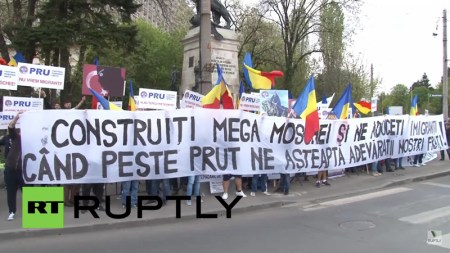
“Turkey attempts a symbolic conquest of Europe through these mosques,” said Tudor Ionescu, leader of the anti-immigration Noua Dreaptă (New Right) party. “I don’t know why we are the recipients of such a ‘blessing.'” Noua Dreaptă has organized protests against the project where people have chanted, “Romania is not a Turkish province.”

1945Romanians protest against a proposed Turkish mega-mosque in Bucharest, April 10, 2016. (Image source: RT video screenshot)

Critics say the large size of the mosque is out of proportion to the small size of Bucharest’s Muslim population. The 13,000 square meter (140,000 square foot) project, to be situated near the Romexpo trade fair grounds, includes a mosque for 2,000 worshippers, a Koran school, a library and a recreational center.

Bucharest is home to around 9,000 Muslims who are being served by ten mosques scattered throughout the city. The Muslim population of Romania is 65,000, or less than one percent of the country’s population of 19.5 million. Most are ethnic Turks and Tatars living in the Dobrogea region of eastern Romania.

In an interview with Balkan Insight, historian Ionut Cojocaru said:

“It is a bit surprising, building such a big mosque in a country where the number of Muslims is very small. This is just a sign of Turkey’s neo-Ottoman policy, which is designed to promote its economic and political interests all around the Balkans.”

Turkey has been on a mega-mosque building spree across the Balkans and Eastern Europe as part of an effort by Ankara to expand its influence — and its brand of Islam — in the region.

In interviews with Balkan specialist Michael Bird, several observers said that Turkish President Recep Tayyip Erdoğan’s international mosque-building program is part of a plan to project Turkey as the pre-eminent Muslim nation.

“Ultimately every mosque abroad with a Turkish brand name seems to contribute to the discourse of Turkey as a leading Islamic power,” said Kerem Oktem, Professor of Modern Turkey at the University of Graz.

Ozgur Kazim Kivanc, an activist opposed to Erdoğan’s destruction of public commons to build mosques, added:

“The Roman Empire used to build temples on the places they took over to remind people of their conquest. We believe the instinct is the same. Places of worship are not compulsory for a belief system to spread — especially in Islam. This plan is not about worship, it is about marking the territory of their authority through a monument.”

Former Romanian President Traian Basescu worries that the Bucharest mosque could fuel Islamic extremism in the country. He has said the mosque project is “irresponsible” and a threat to national security. On Facebook he wrote:

“Perhaps you cannot imagine a subway station in Bucharest, during rush hour, where a young man would blow himself up in the name of Allah. Or perhaps your intelligence cannot help you imagine young Romanians who have failed in life being sent off to training camps in Syria, Iraq or Afghanistan and brought back to Europe in order to bring us the benefits of the Islamic State.”

Islamic State has repeatedly stated that Romania and other parts of Eastern Europe and the Balkans are part of its “pan-Islamic Caliphate.” Omar Bakri Muhammad, a prominent Sunni Islamist cleric who has recruited British jihadis for Islamic State, has alleged that Romania is Islamic territory. In an interview with the Bulgarian daily 24 Chasa (24 Hours), he said:

“Once Islam enters a land, that land becomes Islamic and Muslims have the duty to liberate it someday. Spain, for example, is Islamic land, and so is Eastern Europe: Romania, Albania, Macedonia, Serbia, Kosovo and Bosnia…”

Basescu has also said he believes the mosque — the first purpose-built mosque in the Romanian capital (the existing places of Muslim worship in the city are buildings converted into mosques or prayer rooms) — is not actually meant for Bucharest’s Muslim population, but for Muslim migrants who will arrive in the years ahead.

During a visit to Romania in April 2015, President Erdoğan said the mosque will be the “the most beautiful expression of dialogue and solidarity between the two countries.”

A Romanian Muslim leader, however, expressed skepticism about Turkey’s intentions. “We heard about it on TV, like everyone else,” he said. “We are Romanian Muslims, but now the Turkish are coming and they get the land. When they complete the building, they won’t even allow us there. So we are sold, thrown out.”

During an official visit to Turkey in March 2016, Romanian President Klaus Iohannis tried to reassure Erdoğan that the mosque project is moving forward, despite mounting opposition at home. Commenting on the trip, the daily România Liberă wrote:

“Apparently Iohannis demanded nothing but a measly Orthodox chapel that will probably be built somewhere on the outskirts of Istanbul in exchange for the construction of the mosque…. Erdoğan has inherited from the Ottomans the skill of making his guests feel more important than they are. … Iohannis was welcomed with a military ceremony including the firing of 21 cannon salvoes which only sultans offer their guests. … In the end, however, Erdoğan will despise him for letting himself be tricked and making it so easy for him to turn the president of an EU state into a vassal of his court.”

Some Romanian politicians are now calling for a referendum on the mosque. More than 90% of the public is opposed to the project, according to an online survey conducted by the mainstream newspaper Gândul.

Meanwhile, the pending lawsuit calls on the court to annul the government’s grant of free city land for the mosque project. The lawsuit states:

“We consider the disposal of free land which, ironically, belonged to the family of Prince Constantin Brâncoveanu, who was beheaded by the Turks on August 15, 1714, to be a betrayal of the Romanian people. In the current context in which all of Europe is being brought to its knees by terrorist attacks by Muslim extremists, we are entitled to fear the establishment of Islamic learning schools. We believe the Romanian state is unable to ensure the security of its citizens, and approving a mega-mosque in Romania could set a precedent with unintended catastrophic consequences.”

Obama set for Mosul battle, leaves Aleppo to Putin

October 8, 2016

Obama set for Mosul battle, leaves Aleppo to Putin, DEBKAfile, October 8, 2016

(Please see also, The Obama administration is pushing Iraq into further chaos. — DM)

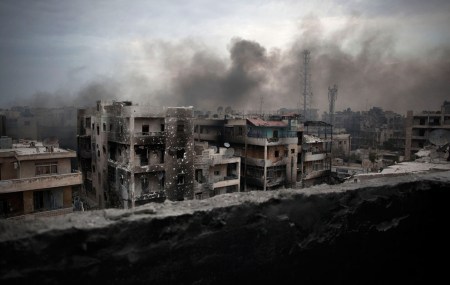
aleppo_destruction

Obama is brooking no distractions from his main objective, He hopes the Mosul operation will be over and done with by mid-December, so that when he exits the White House in January, he will have chalked up a major victory against the Islamic State as part of his legacy.

****************************

The warlike rhetoric heard from Washington over the plight of the stricken Syrian town of Aleppo does not represent any current Obama administration plan for military intervention to halt the ever-mounting carnage.

President Barack Obama’s mind is elsewhere.

This was discovered by his national security adviser Susan Rice every time she tried to arrange for Defense Secretary Ashton Carter and the Chairman of the Chiefs of Staff Gen. Joseph Dunford to be received by the president. After the collapse of diplomacy with Moscow for a cessation of hostilities, they had drawn up a plan for limited US military intervention in Syria that would enable essential humanitarian aid to reach the population.

Obama refused to hear what the trio had to say and the plan was shelved.

DEBKAfile’s Washington sources report that, for now, the US president’s mind is fixed exclusively on the preparations for the Oct. 19 offensive for the liberation of the Iraqi city of Mosul from ISIS occupation. US, Iraqi, Iraqi and Kurdish forces are aligned for the battle.

Obama is brooking no distractions from his main objective, He hopes the Mosul operation will be over and done with by mid-December, so that when he exits the White House in January, he will have chalked up a major victory against the Islamic State as part of his legacy.

In the process, the Democratic president intends to debunk the Republican candidate Donald Trump’s criticism of his administration as showing weakness in the face of ISIS.

Russian President Vladimir Putin is exploiting Obama’s preoccupation with the Mosul offensive to snatch a free hand for pushing the Aleppo battle to its barbaric limit. He is letting Bashar Assad and his allies conduct a scorched earth policy – even if this means reducing Syria’s second town to ruins.

Russian and Syrian jets are bombing the city, building by building, leaving the 8,000 rebels still fighting there with little hope of survival, since food, water, medicine or ammunition and anti-air missiles are out of their reach. The only form of resistance remaining to them is marksmen sniping from the rubble in an attempt to slow the advance of Syria, Iranian and Hizballah foot soldiers.

Obama, Putin and Assad are not alone in sentencing Aleppo to its doom: Turkish President Tayyip Erdogan, after grabbing 5,000 sq. km of northern Syria, is letting his army stand by idly as every attempt to bring life-saving assistance from Turkey to the beleaguered population is thrown back.

The Turkish leader is shielding himself with his secret deal with Putin, whereby his army is given a free hand in northern Syria without Russian interference, while the Aleppo arena becomes a Russian-Syrian precinct that is off-limits to Turkey.

This secret deal has also neutralized the US special operations forces deployed in northern Syria as well as the small Syrian rebel militias they trained and sponsor. Washington has therefore lost any leverage for swaying events in that part of the country. Since they are hemmed in on all sides, Obama refuses to hear of any military intervention in an area under Russian-Turkish control.

As he sees the larger picture, the northern Syrian devolution as a sphere of Turkish-Russian influence is balanced by US-Iraqi-Kurdish domination of northern Iraq

On paper, the US plans and preparations afoot for the liberation of Mosul are impressive.

Elite US troops are being pumped into the Mosul region – 600 just this week. Altogether an estimated 12,500 US servicemen are assigned for the offensive, which is due to be launched in 11 days, on Oct. 19.

This is the largest American military force to fight in Iraq since the battles against Al Qaeda during 2006-2007.

US military engineers are working overtime on the construction of bases around Mosul for the intake of US and Iraqi army units. The Kurdish Republic’s Peshmerga army is in position to the north.

Two new US facilities have just been completed. One is near the Mosul Dam, which regulates the flow of the Tigris River bisecting the targeted city. A second is located in the Bashiqa Mountains north of Mosul.

The two bases plus Kurdish army posts are designed as jumping-off points on the city from the south, east and Uninvited military forces are hovering nearby hoping to pick up a piece of the action. Among them are Turkish military units, local Iraqi militias, such as Turkmen, which the Turkish army is training for combat, and pro-Iranian Iraqi militias, such as the Badr Brigades and the Popular Mobilization Forces.

US commanders are intent on keeping these hangers-on out of the action, because their participation in the Mosul offensive would deepen the discord dividing Iraq’s Shiite, Sunni and Kurdish communities, and throw the city into chaos after the jihadists are driven out. US officers failed to check the sectarian violence that erupted in another Sunni-dominated town, Fallujah, in the wake of the battles for its recovery from ISIS in May and June.

Iraq demands that Turkey pull its ‘occupying’ troops out of military base near Mosul

October 5, 2016

Iraq demands that Turkey pull its ‘occupying’ troops out of military base near Mosul Published time:

5 Oct, 2016 07:52 Edited time: 5 Oct, 2016 10:07

Source: Iraq demands that Turkey pull its ‘occupying’ troops out of military base near Mosul — RT News

© Asmaa Waguih / Reuters

Outraged by Ankara’s decision to extend the stationing of its troops in northern Iraq, 30 kilometers from Mosul, Iraqi MPs have called on the government to review its relations with Turkey and lodge a complaint against the “occupation” with the UNSC.

On Tuesday, the majority of Iraqi legislators spoke out against the Turkish parliament’s decision to prolong the stationing of about 150 Turkish soldiers and some 25 tanks at the Bashiqa military camp in Iraq’s northern Nineveh Province, which is located at the forefront of the battle with Islamic State (IS, formerly ISIS/ISIL).

Read more

U.S soldiers walk on a bridge with in the town of Gwer northern Iraq © Azad Lashkari

In a written statement, the MPs decried the decision, appealing to the country’s prime minister, Haider al-Abadi, to summon the Turkish ambassador and file a complaint with the United Nations Security Council that would designate Turkey’s military contingent as an “occupying” force, according to Rudaw news agency.

On Saturday, the Turkish parliament green lighted the extension of the Turkish military’s engagement in both Iraq and Syria.

Since 2014, Turkish servicemen have provided training and support to Kurdish Peshmerga units and Sunni militia known as Hashd al-Watani forces at the camp, subject to agreement with the Iraqi government. However, on December 4 of last year, Turkey beefed up its military presence at the camp, allegedly to protect its advisers. The move infuriated Bagdad, which insisted that Turkey had not asked for permission from the Iraqi government to deploy additional troops, thus violating its sovereignty.

Turkish President Recep Tayyip Erdogan refused to acknowledge this at that time, claiming that Turkey was acting within the scope of the previous agreement.

“Turkish soldiers are in Basheeqa camp at the request of Haider al-Abadi in 2014. Now I am asking why he has been silent since 2014,” Erdogan said in December, disputing claims that Turkey was intervening in Iraq.

Read more

© Alaa Al-Marjani

Speaking in the wake of the vote, Abadi publicly called for Turkey’s troops to immediately leave its territory, saying that “the Turkish insistence on their presence inside Iraqi territories has no justification.”

The prime-minister told journalists on Tuesday that Iraq has managed to enlist the support of the ‘international community,’ as well as the US-led international coalition, in its bid to remove the Turkish military from its territory.

While Iraq doesn’t want to be dragged into a military conflict with Turkey, it finds the actions of its government “not acceptable by any standard,” he added.

Turkish Deputy Prime Minister Numan Kurtulmus stressed on Wednesday that Turkey’s military presence in the Bashiqa camp is intended solely to provide stability and train the local forces, and that Ankara does not aim to become an occupying force.

Turkey will not allow this to become a matter of debate,” he told reporters as cited by Reuters.

Both Turkey and Iraq summoned each other’s ambassadors on Wednesday to discuss the growing rift between the two states.

Turkey’s foreign ministry also condemned the vote, the Daily Sabah reported.

READ MORE:French fighter jets take off on mission against ISIS stronghold in Mosul, Iraq

Back in December, Iraq appealed to NATO to force Turkey to withdraw its forces, but the alliance found Ankara to be in compliance with the terms of the training agreement.

Iraq’s largest city, Mosul, fell into the hands of Islamic State in 2014, and Iraqi forces are currently preparing an offensive to retake the terrorist stronghold, aided by US-led anti-terrorism coalition.

If the operation is successful, Iraq wants to “ensure Turkish troops do not exploit the power vacuum after achieving victory against Islamic State in Mosul,” Abadi has stressed.

Syrians will soon receive EU money deposited into ‘credit card’

September 30, 2016

It is a prominent part of the migration agreement between the EU and Turkey: European money for Syrian refugees that they get paid monthly on an electronic debit card.

From October 1 this should enter into force, but what should we imagine ?

By Tom Reijner

27 sep 2016

( translation from original Dutch article by JK  )

http://www.elsevier.nl/buitenland/achtergrond/2016/09/zo-krijgen-syriers-straks-eu-geld-gestort-op-creditcard-368393/?utm_medium=website&utm_source=nieuwskoerier.nl

The utility is officially launched Monday by the Cypriot Commissioner Christos Stylianides (Humanitarian Aid).
‘Biggest EU aid project ever’

Not without any triumphalism: “Today we launch the largest and most comprehensive humanitarian project that the EU has ever supported. It will ensure that 1 million Syrian refugees have a kind of basic income, “said the Commissioner at a press conference. The project, according to him the “ultimate proof” how the EU is involved in solving the migration and refugee crisis. But what about this aid money system exactly work?

The debit cards – similar to a type of credit or prepaidpas – provided by the so-called Emergency Social Safety Net (ESSN). This is a special program of the EU for refugees and set up in collaboration with the World Food Programme of the United Nations, the Turkish authorities and the Turkish Red Crescent (the Islamic equivalent of the Red Cross).

In the words of the Commissioner “a system that combines the Turkish welfare of a humanitarian response.” The ESSN project has been allocated EUR 348 million, to be paid from the big pot of money (3 billion euros), which Ankara had pledged to help the refugees in their own country. Meanwhile, paid 652 million – though Erdogan complained bitterly that it is all not enough, and where the rest of the money actually remains.

It sounds like a fraud sensitive system

But not everyone will benefit from EU funds. Only the ‘most vulnerable’ among the more than 3 million Syrians in Turkey may make purchases “so they can feed their families.” Brussels hopes that therefore the local economy is supported, as they embark on fruit and vegetable markets. These people, who are outside the refugee camps, may decide that they spend the money. So they can keep “their dignity, and they are not condemned to begging on the streets.

It sounds like a fraud sensitive system. How do the EU officials assured that the money is well spent, and not in bags reaches of shady characters, whether or not within the Turkish government itself?

Namely, there is also cooperation with the Turkish Ministry of Family and Social Policy. The European Commission ensures strict control: “We will ensure that every euro is spent properly,” says Stylianides.