Posted tagged ‘Turkey’

Putin’s “Endgame” in Syria

October 12, 2015

Putin’s “Endgame” in Syria

By Mike Whitney

Source: Putin’s “Endgame” in Syria

Russia doesn’t want to fight a war with Turkey, so Russian generals devised a simple, but effective plan to discourage Turkey from taking any action that could lead to a clash between the two nations.

Last week, Russian warplanes intruded into Turkish airspace twice. Both incidents caused consternation in Ankara and send Turkish leaders into a furor.  On both occasions, officials in Moscow politely apologized for the incursions claiming they were unintentional (“navigational errors”) and that they would try to avoid similar intrusions in the future.

Then there was a third incident, a more serious incident, that was not a mistake. It was clearly intended to send a message to Turkish President Recep Tayyip Erdogan.  Here’s a short summary of what happened from an article at the World Socialist Web Site:

“Turkish officials claimed a third incident on Monday, when an unidentified MiG-29 fighter jet locked its radar for four and a half minutes on eight Turkish F-16 jets that were on patrol on their side of the border, in apparent preparation to open fire.” (“US, NATO step up threats to Russia over Syria“, World Socialist Web Site)

This was no mistake. The only time a fighter pilot adopts these protocols is when he plans to take down an enemy plane. This was a message, and while it might have been over-the-heads of the politicians and the media but, I assure you, every general in the Turkish High-Command knows what’s it means. This is a wake-up call.  Moscow is indicating that there’s a new sheriff in town and that Turkey had better behave itself or there’s going to be trouble. There’s not going to be any US-Turkey no-fly zone over North Syria, there’s not going to be any aerial attacks on Syrian sites from the Turkish side of the border, and there certainly is not going to be any ground invasion of Turkish troops into Syria.  The Russian Aerospace Defence Forces now control the skies over Syria and they are determined to defend Syria’s sovereign borders. That’s the message. Period.

This is a good example of how “preemption” can actually prevent conflicts rather than starting them. By firing a shot over Turkey’s bow, Moscow has dampened Erdogan’s plan to annex part of N. Syria and declare it a “safe zone”. Turkey will have to scrap that plan now realizing that any attempt to seize-and-hold Syrian territory will trigger a swift and powerful Russian retaliation. Seen in this light,  Russia’s incursion looks like an extremely effective way to prevent a broader war by simply telegraphing to potential adversaries what they can and can’t do. Simply put: Putin has rewritten the rules of the game in Syria and Erdogan had better comply or else. Here’s more on Turkey from Patrick Cockburn in The Independent:

“A Turkish ground invasion into Syria, though still a possibility, would now be riskier with Russian aircraft operating in areas where Turkey would be most likely to launch an incursion.

The danger for the Turks is that they now have two Kurdish quasi-states, one in Syria and one in Iraq, immediately to the south. Worse, the Syrian-Kurdish one…is run by the Democratic Union Party (PYD) which is effectively the Syrian branch of the Kurdistan Workers Party (PKK) which has been fighting the Turkish state since 1984. Any insurgency by the PKK in Kurdish areas in south-east Turkey in future will be strengthened by the fact that the PKK has a de facto state of its own.

It appears that Turkey’s four-year attempt to overthrow President Bashar al-Assad has failed. It is unclear what Turkish President Recep Tayyip Erdogan can do about this since support from Nato is at this stage purely rhetorical. As for Turkey’s relations with Russia, Mr Erdogan says that any attack on Turkey is an attack on Nato and that “if Russia loses a friend like Turkey with whom it has co-operated on many issues, it will lose a lot.” But in Syria, at least, it appears that it is Turkey that is the loser.” (“Russia in Syria: Russian Radar Locks on to Turkish Fighter Jets“, The Unz Review)

Poor Erdogan. He rolled the dice and came up snake-eyes. He figured he could expand his would-be Ottoman Empire into Northern Syria, and now his dream is in a shambles. Should he deploy his warplanes to N Syria and openly challenge the Russian airforce?  No, he’s not that foolish. He’s going to stay on his side of the border, stomp his feet, and lash out at “evil Putin”, but at the end of the day, he’ll do nothing.

And Washington’s not going to do anything either. Yes, Hillary and McCain have been calling for a no-fly zone over Syria, but that’s not going to happen. Putin won’t allow it and neither will the Security Council. And, on what pretext anyway? Is Obama really going to request a no-fly zone on the basis that Putin is killing “moderate” terrorists along with the “extreme” terrorists? That’s not a very compelling argument, in fact, even the American people are having a hard time swallowing that one. If Obama wants something from Putin, he’s going to have sit-down at a bargaining table and hash out a deal. So far, he has refused to do that, because he still thinks regime change is within his grasp. There are signs of this everywhere like this article in Turkey’s Today’s Zaman titled “İncirlik base to increase capacity by 2,250 to accommodate new personnel”:

“A tent city within İncirlik has been undergoing reconstruction for modern prefabricated houses, which will host 2,250 US military personnel, the Doğan news agency reported on Friday. During the Gulf War of 1991, a tent city was established to accommodate military personnel serving with Operation Provide Comfort (OPC) and was shut down with the end of the OPC.

On Aug. 20, work began to transform the site of the tent city into a new area named “Patriot Town.” After construction is completed, the İncirlik base will have the largest capacity among the US bases in Europe…

The expansion of the İncirlik base’s capacity comes at a time when Russia has launched the biggest intervention in the Middle East in decades….Moscow’s intervention means the conflict in Syria has been transformed from a proxy war.. into an international conflict in which the world’s main military powers… are directly involved in fighting.” (“İncirlik base to increase capacity by 2,250 to accommodate new personnel“, Today’s Zaman)

This article smacks of US ambitions in the Middle East. As readers can plainly see,  Washington is gearing up for another war just like it did in 1991.  And the US air war is going to be launched from “Patriot Town” at Incirlik just like we’ve been predicting since July when the deal was finalized. Here’s more background from an article at Hurriyet:

“U.S. Air Force Central Command has started deploying search and rescue helicopters and airmen at Turkey’s southeastern Diyarbakır Air Base in order to help with recovery operations in neighboring Iraq and Syria, it has announced….

NATO’s Supreme Allied Commander in Europe and the commander of U.S. European Command, Gen. Phillip Breedlove, has said the mission will be temporary.

“We will be guests of the government of Turkey at Diyarbakir Air Base. There are no plans for a permanent U.S. presence at this location … This marks yet another successful cooperative effort between the Turkish and U.S. militaries,” Breedlove said.” (“US deploys recovery aircraft in Turkey’s southeast“, Hurriyet)


“US Search and rescue helicopters” just a couple miles from Turkey’s southeastern border?

Yep.  In other words,  if an F-16 is shot down somewhere over Syria while trying to impose an illegal no-fly zone, then– Presto– the search and rescue helicopters are just 20 minutes away.

How convenient.

So you can see that– even though Putin has thrown a wrench in the works–  the Obama team is still moving ahead with its “Topple Assad” plan.  Nothing has changed, the Russian intervention just makes the future much more uncertain which is why frustrated geopolitical strategists, like Zbigniew Brzezinski, have begun to pop-up in the op-ed pages of leading newspapers blasting Putin for sabotaging their plans for regional hegemony. It’s worth noting that Brzezinski is the spiritual godfather of Islamic extremism, the man who figured out how religious nutcases could be used to foment hysteria and advance US geopolitical objectives around the world. Thus, it’s only natural that Brzezinski would want to offer his advice now in a desperate effort to avoid a legacy of failure and disgrace. Check out this clip from Politico:

“The United States should threaten to retaliate if Russia does not stop attacking U.S. assets in Syria, former national security adviser Zbigniew Brzezinski wrote in a Financial Times op-ed published Sunday, urging “strategic boldness,” with American credibility in the Middle East and the region itself at stake….And if Russia continues to pursue non-ISIL targets, the U.S. should retaliate, he added.

“In these rapidly unfolding circumstances the U.S. has only one real option if it is to protect its wider stakes in the region: to convey to Moscow the demand that it cease and desist from military actions that directly affect American assets,” he said.” (“Brzezinski: Obama should retaliate if Russia doesn’t stop attacking U.S. assets“, Politico)

The people who Brzezinski breezily refers to as “American assets” in Syria are terrorists. It’s that simple. Putin doesn’t distinguish between the “moderate” terrorists and the “radical” terrorists, the good terrorists and the bad terrorists. It’s a joke. They’re all in the same pool and they’re all going to meet the same fate. They all have to be rooted out, apprehended or killed. End of story.

By tweaking the war on terror narrative in a way that supports some, but condemns others, the Obama administration has backed themselves into an ideological cul de sac from which there is no way out. What they are doing is wrong and they know it is wrong. And that’s why it’s going to be so difficult to make the case for war. In a recent “must see” interview, Putin called out Obama on this very point. Here’s what he said:

“President Obama frequently mentions the threat of ISIS. Well, who on earth armed them? And who created the political climate that facilitated the current situation?  Who delivered arms to the area? Do you really not know who is fighting in Syria? They’re mercenaries mostly. They are paid money. Mercenaries work for whatever side pays more. We even know how much they are paid. We know they fight for awhile and then see that someone else pays a little more, so they go there…..

The US says “We must support the civilized, democratic opposition in Syria”. So they support them, arm them, and then they join ISIS. Is it impossible for the US to think one step ahead?  We do not support this kind of policy at all. We think it’s wrong.” (Putin explains who started ISIS, you tube, 1:38 to 4:03)

See? Everyone knows what’s going on. Barack Obama is not going to initiate a confrontation with Russia to defend a fundamentally immoral CIA program that has gone south.  He will, however, do what the US always does when dealing with an adversary that can actually defend itself.  He’s going to hector, harass, threaten, demean, demonize, ridicule, and bully. He might launch another attack on the ruble, or fiddle with oil prices or impose more economic sanctions. But he’s not going to start a war with Russia,  that’s just not going to happen.

But don’t give up hope just yet, after all, there is a silver lining to this fiasco, and all of the main players know exactly what it is.

It’s called Geneva. Geneva is the endgame.

Geneva is the UN-backed road map for ending the war in Syria. Its provisions allow for the “establishment of a transitional governing body”, the  “participation of all groups… in a meaningful national dialogue,” and “free and fair multi-party elections.”

The treaty is straightforward and uncontroversial. The one sticking point, is whether Assad will be allowed to participate in the transitional government or not.

Putin says “Yes”.  Obama says “No”.

Putin is going to win this battle. Eventually, the administration will cave in and withdraw their demand that Assad step down. Their plans for regime change through the use of jihadi-proxies will have failed, and Putin will have moved the Middle East one step closer to a lasting peace and genuine security.

That’s the silver lining and that’s how the war in Syria will end.

Bravo, Putin.

Turkish Military Carry Out Airstrikes on PKK Targets in Iraq

October 11, 2015

Turkish Military Carry Out Airstrikes on PKK Targets in Iraq

13:07 11.10.2015

(updated 13:26 11.10.2015)

Source: Turkish Military Carry Out Airstrikes on PKK Targets in Iraq

The Turkish military bombed targets of the Kurdistan Workers Party (PKK) in southeastern Turkey and Iraq during airstrikes on Sunday.

PKK shelters and gun positions were destroyed during the airstrikes in areas of northern Iraq. At least 14 PKK fighters were killed in the Lice area of southeast Turkey, the military statement said.

The airstrikes were carried out a day after deadly twin bomb blasts in Ankara.Tensions in Turkey escalated in mid-summer when the country launched a military campaign against PKK in northern Iraq, after the militant group claimed responsibility for the murders of two Turkish police officers who they say had aligned themselves with Islamic State.

On Monday, Turkish Interior Minister Selami Altinok said that the Turkish security forces have killed more than 2,000 PKK militants since July.

PKK seeks to create a Kurdish state in parts of Turkey and Iraq. The organization is considered a terrorist group by Turkey, the European Union and NATO.


Obama administration ends $500mn program to train Syrian rebels

October 9, 2015

Obama administration ends $500mn program to train Syrian rebels – report

Published time: 9 Oct, 2015 11:56

Edited time: 9 Oct, 2015 14:00

Source: Obama administration ends $500mn program to train Syrian rebels – report — RT News


he Obama administration is set to overhaul the Defense Department’s $500 million program to train and equip Syrian rebels, according to Defense Secretary Ashton Carter. The US president is expected to speak on the matter later on Friday.

Carter said during a Friday news conference in London that Washington has been “looking for several weeks at ways to improve” the program.

He added that he “wasn’t satisfied with the early efforts” of the program, and that Washington is looking for “different ways to achieve the same kind of strategic objective.”

“I think you’ll be hearing very shortly from [President Obama] in that regard about the proposals that he has approved and that we are going to go forward with,” Carter said following a meeting with his British counterpart Michael Fallon.

READ MORE: ‘Who are Syrian moderates & where are they?’

Meanwhile, a Pentagon official told The New York Times that the recruitment of so-called moderate Syrian rebels to go through training programs in Jordan, Qatar, Saudi Arabia, and the United Arab Emirates will end.

The official, speaking on condition of anonymity, added that a much smaller training center will be opened in Turkey, where a small number of “enablers” – mostly leaders of opposition groups – will be taught operational maneuvers, such as how to call in airstrikes.

A separate US defense official said on Friday that the training program is not ending, but is simply being refocused. Speaking to reporters on condition of anonymity, the official said that some US training and vetting of Syrian forces would continue, Reuters reported.

Speaking to RT, political analyst Dan Glazebrook said “it was obvious that something was going to have to change…my opinion has always been that this whole business about funding moderate rebels has always been a bit of a fantasy, for a number of reasons.”

“There’s nothing moderate about what they’re being trained to do. There’s nothing moderate about forming a militia and then going and killing as many police and soldiers of a sovereign state as you can. And that’s assuming the best case scenario that they’re only attacking police and soldiers…”

He added that there’s “no great surprise that Russia has achieved more in a week of airstrikes than a 62-power coalition has achieved in a year against ISIS.” 

A top US General told Congress in September that only “four or five” US-trained rebels were still fighting on the ground, with Sen. Jeff Sessions (R-Ga.) calling the program a “total failure.”

White House spokesman Josh Earnest said at the time that the small number “certainly raises legitimate questions about what kinds of changes need to be made to this program.”

Senator John McCain has been a vocal critic of Obama’s campaign against ISIS in Syria.

“One year into this campaign, it seems impossible to assert that [Islamic State] is losing and that we are winning. And if you’re not winning in this kind of warfare, you are losing,” McCain said in September.

It comes just one day after reports of a funding bill which earmarks $600 million to support “appropriately vetted” Syrian rebels fighting against both ISIS and the Assad government.

The $500 million training program has experienced multiple setbacks. The first group of trainees disbanded soon after being sent into combat, with some captured or killed and others fleeing. A second class of troops introduced only a small number of new fighters. The original plan, devised in December 2014, aimed to prepare as many as 5,400 fighters this year, and 15,000 over the next three years.

A leaked German document confirms what we already know about Turkish support to Syrian rebels

October 8, 2015

A leaked German document confirms what we already know about Turkish support to Syrian rebels

Published October 6th, 2015 – 09:44 GMT

via SyndiGate.info

Source: A leaked German document confirms what we already know about Turkish support to Syrian rebels | Al Bawaba

Ahrar al-Sham is an ally of al-Nusra Front, Syria's al-Qaeda affiliate. (AFP/File)

Ahrar al-Sham is an ally of al-Nusra Front, Syria’s al-Qaeda affiliate. (AFP/File)

It’s a report we’ve all heard before — that Turkey, along with Saudi Arabia, is supporting Syrian rebels to help take President Bashar al-Assad down.

According to the document leaked from the German Intelligence Services, Turkey is providing Ahrar al-Sham and the Islamic Front with weapons. Turkey denied the claim again in May, but it still doesn’t come as much of a surprise.

The document shows German parliamentarian Katrin Kunert’s written request from the German government on May 18.

Here’s a translation:

… Question 25 asked which Syrian parties are receiving which type of weapons from the Turkish government (if possible please list border cities where deliveries take place).

Answer: Since mid-November of 2014, information from Federal German Intelligence Service indicate that Ankara delivers weapons to armed Syrian rebel groups. Recipients are said to be the groups Ahrar al-Sham and Islamic Front. 

German paper Die Welt (“The World”), which published a photo of the document, seemed to confirm the document’s legitimacy when it reported Germany’s attempts to find the person who leaked it to PKK-owned media.

“The German Parliament is filing charges,” said Martin Steltner, a speaker of the prosecution, according to Die Welt. “We are investigating and the investigations will continue.”

So what’s the problem with Turkey supporting these rebels? Both Salafist groups, Ahrar al-Sham and the Islamic Front are known to have more extreme goals in the Syrian conflict. Ahrar al-Sham has partnerships with al-Nusra Front, which is affiliated with al-Qaeda and sometimes considered more dangerous than Daesh (ISIS) itself.

By Hayat Norimine


turkey-syria-border


The so-called “buffer zone” — allegedly established to protect refugees and stage military operations aimed at ISIS — is a de facto no-fly zone used to protect jihadist fighters entering the country from Turkey.

More Evidence of Turkish Collusion with ISIS

Earlier this week a leaked German intelligence document confirmed reports that Turkey is directly assisting Harakat Ahrar ash-Sham al-Islamiyya, a coalition of Islamist and Salafist units that have vowed to establish a Sunni Wahhabist state under Sharia law in Syria.

Ahrar ash-Sham is aligned with al-Nusra which has pledged allegiance to the Islamic State.

The Russians understand that Ahrar ash-Sham — currently the most powerful and effective jihadist group fighting in Syria — must be targeted if it hopes to turn back the effort to unseat Bashar al-Assad.

If NATO follows through on its promise to “defend all allies” by inserting troops in Turkey’s illegal “safe zone,” it will be effectively aiding and abetting the Islamic State.

In May declassified US Defense Intelligence Agency documents from 2012 revealed the United States and its partners in the Gulf states and Turkey supported the Islamic State and plan to establish a Salafist principality in Syria.

Turkey says Russia has escalated Syrian conflict with violation of its airspace

October 5, 2015

Turkey says Russia has escalated Syrian conflict with violation of its airspace

Source: Turkey says Russia has escalated Syrian conflict with violation of its airspace – Middle East – Jerusalem Post

Turkey said on Monday it had summoned Russia’s ambassador to protest the violation of its airspace by one of its warplanes and was told it was a “mistake” that would not happen again.

Turkey, which has the second-largest army in NATO, scrambled two F-16 jets on Saturday after a Russian warplane crossed into its airspace near the province of Hatay, which borders Syria, the foreign ministry said.

In a second incident, the Turkish military said a MiG-29 fighter jet — an aircraft used by both Russia and Syria — had harassed two of its F-16s by locking its radar on to them on Sunday as they patrolled the border.

Speaking in a live interview on HaberTurk TV, Prime Minister Ahmet Davutoglu accused Moscow of escalating the Syrian crisis by entering the conflict.

Russian air strikes in Syria, launched last week, have wrong-footed both the United States and its allies including Turkey, which says lasting peace can only be achieved with President Bashar al-Assad’s removal. Moscow says its intervention aims to weaken Islamic State militants, but Ankara and Western powers see it as support for Assad.

“What we have received from Russia this morning is that this was a mistake and that they respect Turkey’s borders and this will not happen again,” Davutoglu said of Saturday’s airspace violation, making clear Turkey would respond if provoked.

“Turkey’s rules of engagement apply to all planes, be they Syrian, Russian or from elsewhere. Turkey’s armed forces are very clearly instructed. Necessary steps would be taken against whoever violates Turkey’s borders, even if it’s a bird,” he said in the interview.

“For Russia, which long opposed foreign intervention in Syria and blocked UN Security Council resolutions, to be actively involved in Syria is both a contradiction and a move that has escalated the crisis.”

U.S. Defense Secretary Ash Carter said Washington was conferring with Turkey about the incursion. Speaking during a trip to Spain, he also compared Moscow’s effort to bolster Assad to tethering itself to a sinking ship.

“By taking military action in Syria against moderate groups targets, Russia has escalated the civil war,” Carter said in a speech in Madrid.

Turkish President Tayyip Erdogan has criticised Russia’s actions as a “grave mistake”.

“Assad has committed state terrorism, and unfortunately you find Russia and Iran defending (him),” Erdogan was quoted by the Hurriyet newspaper as telling a crowd of supporters in Strasbourg, France, late on Sunday.

“Those countries that collaborate with the regime will account for it in history,” he said.

The Turkish foreign ministry said it had summoned Moscow’s ambassador to protest the violation and urged Russia against any repeat, warning that it would be held “responsible for any undesired incident that may occur.”

Foreign Minister Feridun Sinirlioglu spoke with his Russian counterpart Sergei Lavrov, as well as key NATO partners, the statement said.

Kremlin spokesman Dmitry Peskov confirmed that the Russian ambassador had been summoned, telling reporters that “some facts were mentioned there which are to be checked”. There was no emergency meeting planned between Erdogan and his Russian counterpart Vladimir Putin, Peskov said.

“(The) Russian incursion into Turkish airspace raises stakes in what is already a high risk situation,” British Foreign Secretary Philip Hammond said on Twitter, calling on Moscow to desist.


Germany’s Appeasement of Radical Islam

September 10, 2015

Germany’s Appeasement of Radical Islam, Gatestone Institute, Vijeta Uniyal, September 10, 2015

  • German, and possibly European, demographics are being set to change forever.
  • “No one knows exactly what actually happens in Islamic classes in German primary schools.” — Abdel-Hakim Ourghi, head of the Faculty for Islamic Theology and Religious Studies at the Freiburg University of Education.
  • In Ourghi’s assessment, conservative Islam, the one dominant in Germany, is incapable of thinking critically about its past.
  • According to the report, the textbooks fail to “confront the problematic verses of Koran.” The curriculum also fails in its most important purpose — integrating Muslims into the German society — as it fails to reconcile the “Islamic faith of the students with the reality of the western society” they are living in.
  • By legitimizing extremist groups such as DITIB within German Muslim society as the sole legitimate representatives of Islam, the German government has marginalized genuine voices of reform and dissent within its Muslim population.
  • These courageous dissident Muslim men and women are left to face threats and intimidation on their own, while the government is busy appeasing the self-proclaimed leaders of the faith.

As Muslim migration is being set to change German, and possibly European, demographics forever, Germany is gearing up for the new challenge — not by integrating and assimilating young Muslims in a free and democratic Western society, but by handing over the religious education of the next generation of German Muslims to Islamist radicals.

Worse yet, German authorities see no problem in doing that.

With Germany predicted to receive 800,000 migrants — mostly Muslims — this year alone, and millions more waiting to cross Europe’s unguarded borders, the Muslim population in Germany is seeing a historic rise from the current figure of nearly 6 million. Several German states including Bavaria, Hesse and North Rhine-Westphalia have introduced Islamic Studies in their public schools. The state of Hesse has become the first in Germany to offer Islamic education in public schools, with religious instruction starting as early as the first grade.

Giving young children religious and moral instruction might sound like a good idea, if not for the content of the newly written Islamic curriculum and the influence of Islamist elements over the recruitment of teachers.

The writing of textbooks is being overseen by the Turkish-Islamic Union for Religious Affairs (DITIB). In an agreement reached between the State of Hesse and DITIB, the organization will play a key role in setting the curriculum, selecting the teachers and monitoring the Islamic religious instruction. The organization is apparently assuming a similar role in several other key German states.

DITIB is the largest Muslim organization in Germany and controls several prominent mosques. The group depends heavily on the Turkish government for its funding, and maintains close ties with Turkish President Recep Tayyip Erdogan’s Islamist party, the AKP.

The newly compiled Islamic curriculum for public schools in Hesse has come under great scrutiny. An independent report conducted by Abdel-Hakim Ourghi, who heads of the Faculty for Islamic Theology and Religious Studies at the Freiburg University of Education, has sharply criticized the curriculum.

According to an article in Die Welt, Ourghi, a prominent Muslim scholar, has been raising concern about the activities of DITIB and other conservative Muslim organizations operating in Germany. “No one knows exactly what actually happens in Islamic classes in German primary schools,” he says. In his assessment, conservative Islam, the one dominant in Germany, is incapable of thinking critically about its past.

According to Ourghi’s report, the textbooks fail to “confront the problematic verses of Koran.” The report also says that the curriculum fails in its most important purpose — integrating Muslims into the German society — as it fails to reconcile the “Islamic faith of the students with the reality of the western society” they are living in.

Confronted with the damning report, Hesse’s Minister of Education and Culture, Alexander Lorz,dismissed the allegations and called the Hesse’s Islamic education a “success.”

Meanwhile, despite Lorz’s stance, young German Muslims from his state keep heading to Syria and Iraq to join the ranks of the Islamic State (ISIS). And despite DITIB’s regular lip service to denouncing the terrorist organization, the Islamic State receives a continuous flow of freshrecruits from DITIB-run mosques.

According to a recent investigative report by the German news magazine, Focus, a DITIB-run Mosque in Cologne is a key base in Germany for Turkey’s intelligence agency, the MIT. The intelligence team not only gathers information on Turkish President Erdogan’s opponents in Germany, but also maintains a local “thug squad” to mete out “tough punishments” to Turkish dissidents in Germany.

1241The Cologne Central Mosque is used as a key base in German for Turkey’s intelligence agency, where they run a local “thug squad” to mete out “tough punishments” to Turkish dissidents in Germany. (Image source: © Raimond Spekking/CC BY-SA 4.0, via Wikimedia Commons)

By legitimizing extremist groups such as DITIB as the sole legitimate representatives of Islam within German Muslim society, the German government has marginalized genuine voices of reform and dissent within its Muslim population.

These courageous dissident Muslim men and women are left to face threats and intimidation on their own, while the government is busy appeasing the self-proclaimed leaders of the faith.

The fruits of liberty enjoyed by Germans today are not Germany’s to squander in the first place. Every bit of this precious freedom was paid for in blood — from the beaches of Normandy to the pavements of the Warsaw Ghetto — often meter-by-meter with bare knuckles and bloody fists.

As if history has come full circle, in the span of less than a century, Germany’s state institutions are folding again at the mere sight of an organized band of fascists.

NATO Allies Making It Easier for Iran to Attack Israel?

September 3, 2015

NATO Allies Making It Easier for Iran to Attack Israel? The Gatestone InstituteBurak Bekdil, September 3, 2015

  • Iran did not go mad and threaten to hit all NATO installations in Turkey because it wanted 3.5 million Turkish citizens to die from the chemical warhead of a Syrian missile. It went mad and threatened because it viewed the defensive NATO assets in Turkey as a threat to its offensive missile capabilities.
  • Iran’s reaction to the NATO assets in Turkey revealed its intentions to attack. It could be a coincidence that the U.S. and Germany (most likely to be followed by Spain) have decided to withdraw their Patriot missile batteries and troops from Turkey shortly after agreeing to a nuclear deal with Iran. But if it is a coincidence, it is a very suspicious one. Why were Assad’s missiles a threat to Turkey two and a half years ago, but are not today?
  • Apparently, NATO allies believe, although the idea defies logic, that the nuclear deal with Iran will discourage the mullahs in Tehran from attacking Israel.

In early 2013, NATO supposedly came to its ally’s help: As Turkey was under threat from Syrian missiles — potentially with biological/chemical warheads — the alliance would build a mini anti-missile defense architecture on Turkish soil. Six U.S.-made Patriot missile batteries would be deployed in three Turkish cities and protect a vast area where about 3.5 million Turks lived.

The Patriot batteries that would protect Turkey from Syrian missiles belonged to the United States, Germany and the Netherlands. In early 2015, the Dutch mission ended and was replaced by Spanish Patriots. Recently, the German government said that it would withdraw its Patriot batteries and 250 troops at the beginning of 2016. Almost simultaneously, the U.S. government informed Turkey that its Patriot mission, expiring in October, would not be renewed. Washington cited “critical modernization upgrades” for the withdrawal.

Since the air defense system was stationed on Turkish soil, it unnerved Iran more than it did Syria. There is a story behind this. First, Patriot missiles cannot protect large swaths of land, but only designated friendly sites or installations in their vicinity. That the six batteries would protect Turkey’s entire south and 3.5 million people living there was a tall tale. They would instead protect a U.S.-owned, NATO-assigned radar deployed earlier in Kurecik, a Turkish town; and they would protect it not from Syrian missiles with chemical warheads, but from Iranian ballistic missiles.

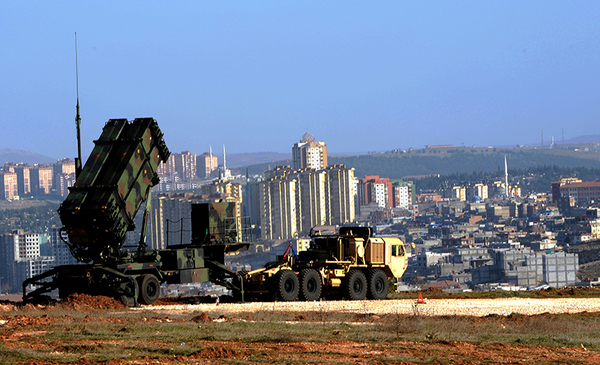
1234 (1)U.S. Patriot missiles, deployed outside Gaziantep, Turkey in 2013. (Image source: U.S. Army Europe/Daniel Phelps)

Kurecik seemed to matter a lot to Iran. In November 2011, Iran threatened that it would target NATO’s missile defense shield in Turkey (“and then hit the next targets,” read Israel) if it were threatened. Shortly before the arrival of Patriots in Turkey, Iran’s army chief of staff warned NATO that stationing Patriot anti-missile batteries in Turkey was “setting the stage for world war.”

What was stationed in Kurecik was an early-warning missile detection and tracking radar system. Its mission is to provide U.S. naval assets in the Mediterranean with early warning and tracking information in case of an Iranian missile launch that might target an ally or a friendly country, including Israel. So, a six-battery Patriot shield to protect the NATO radar in Kurecik against possible Iranian aggression was necessary. And that explains why the Iranians went mad about Kurecik and openly threatened to hit it.

NATO and Turkish officials have always denied any link between the Patriot missiles and the NATO radar in Turkey. They have often pointed out that the Patriot batteries were stationed in the provinces of Adana, Kahramanmaras and Gaziantep, while Kurecik was in nearby Malatya province. But the Patriot is a road-mobile system: It can be dismantled easily and re-deployed in another area in a matter of hours (the road distance between Kurecik and Kahramanmaras is a mere 200 kilometers, or 124 miles).

Clearly, Iran did not go mad and threaten to hit all NATO installations in Turkey because it wanted 3.5 million Turkish citizens to die from the chemical warhead of a Syrian missile. It went mad and threatened because it viewed the defensive NATO assets in Turkey as a threat to its offensive missile capabilities, which the Patriots could potentially neutralize.

Why, otherwise, would a country feel “threatened” and threaten others with starting a “world war” just because a bunch of defensive systems are deployed in a neighboring country? Iran did so because it views the NATO radar in Turkey as an asset that could counter any missile attack on Israel; and the Patriots as hostile elements because they would protect that radar. In a way, Iran’s reaction to the NATO assets in Turkey revealed its intentions to attack.

It could be a total coincidence that the U.S. and Germany (most likely to be followed by Spain) have decided to pull their Patriot batteries and troops from Turkey shortly after agreeing to a nuclear deal with Iran. But if it is a coincidence, it is a very suspicious one. In theory, the Patriot systems were deployed in Turkey in order to protect the NATO ally from missile threats from Syrian President Bashar al-Assad’s regime. Right? Right.

Assad’s regime is still alive in Damascus and it has the same missile arsenal it had in 2013. Moreover, Turkey’s cold war with Assad’s Syria is worse than it was in 2013, with Ankara systematically supporting every opposition group and openly declaring that it is pushing for Assad’s downfall. Why were Assad’s missiles a threat to Turkey two and a half years ago, but are not today?

The Patriot missiles are leaving Turkey. They no longer will “protect Turkish soil.”

Apparently, NATO allies believe, although the idea defies logic, that the nuclear deal with Iran will discourage the mullahs in Tehran from attacking Israel.

It looks as if the potential target of NATO heavyweights’ decision is more a gesture to Iran than to Turkey.

Egypt sends Assad secret arms aid, including missiles, with Russian funding

August 30, 2015

Egypt sends Assad secret arms aid, including missiles, with Russian funding, DEBKAfile, August 30, 2015

( Given that Egypt is heavily reliant on Saudi funding as well as the absence of any other news source beyond “Debka,” I find this article worthy of a generous helping of salt. – JW )

Egyptain_missile_in_Zabadani_25.8.15

Egyptian President Abdel-Fatteh El-Sisi has begun supplying Bashar Assad with arms, including missiles, after concluding a secret deal with Russian President Vladimir Putin and his consent to pick up the tab, DEBKAfile’s military and intelligence sources reveal. The first batch of short-range Egyptian-made surface missiles has reached the Syrian forces fiercely battling rebels for weeks for the recovery of the strategic town of Zabadani without breaking through (See picture showing missile with Egyptian factory markings.) 

It is not clear if the Egyptian missiles have also been passed to the Hizballah forces fighting with the Syrian army, considering that El-Sisi and Hizballah are at daggers drawn.

Our sources also reveal that the Egyptian arms consignments are freighted from Port Said to the Syrian port of Tartus by Ukrainian cargo vessels. These ships are today the most popular means of transport for clandestine and Black Market arms freights across the Mediterranean and Adriatic Seas.

Sums and quantities are yet to be determined, but Western intelligence sources report that Ukrainian vessels called in at Egyptian ports at least three times from July 22 to Aug. 22 and sailed off to Syria laden with weapons.

It is a deal that may affect the fate of the Assad regime from five, often conflicting, perspectives:

1. By providing Assad with an additional source of weapons, Cairo is reducing his dependence on Iran. This suits the Syrian ruler very well at this time, because he is fully aware of Tehran’s latest steps to draw Gulf rulers and Moscow into supporting a plan for ending the Syrian war, by installing a provisional government in Damascus and so easing his exit.

2. A certain parting-of-the ways has developed between Moscow and Tehran on how to terminate the Syrian conflict. By sending Assad arms, Cairo  casts its vote for Moscow’s perspective in preference to Tehran’s.

3. El-Sisi is now diametrically opposed on Syrian policy to the GCC led by Saudi Arabia and the United Arab Emirates who are patrons of the rebel movement dedicated to toppling Assad.

4. He is also on the opposite side to Israel and Turkey. Israel backs the rebels fighting in southern Syria to create a barrier against the encroachment of Hizballah and Iranian Al Qods Brigades up to its northern border and the Golan. Turkey and the US have reached terms on Syrian policy. Saturday, Aug. 30, Turkish jets carried out their first air strikes in Syria against the Islamic State, as part of its deal with the US.

5. The Russian-Egyptian understanding on the Syrian question is a signpost that clearly marks the way to deepening military and strategic relations between Moscow and Cairo.

Taking the lead on a resolution of the Syrian question, the Kremlin staged a discussion last Tuesday, Aug. 18, with three Arab visitors: Jordan’s King Abdullah, UAE Crown Prince Sheikh Mohamed bin Zayed Al Nahyan and the Egyptian president. It was led by Mikhail Bogdanov, Deputy Foreign Minister in charge of Middle East Affairs, and followed by individual tête-à-têtes between Putin and each visitor in turn.

The Russian and Egyptian leaders did their best, according to DEBKAfile’s Moscow sources, to draw the Jordanian and UA rulers over to their pro-Assad policy, or at least accept common ground for a measure of cooperation. In effect, Putin and El-Sisi were out to convince Jordan and the US to back away from the Syrian rebel cause and the Saudi line. Their future actions may indicate how far they succeeded.

America: A Tool for Turkish Domestic Policy

August 21, 2015

America: A Tool for Turkish Domestic Policy

How the US is helping the ruling Islamist government solidify power.

August 21, 2015

Robert Ellis

via America: A Tool for Turkish Domestic Policy | Frontpage Mag.

Turkey’s President Recep Tayyip Erdogan has finally agreed to allow the US to use the NATO airbase at Incirlik in southern Turkey for sorties against ISIL in Syria. This will cut flying time for American bombers from 3 hours from the Gulf to 15 minutes, but the two allies seem to be talking at cross purposes.

According to US President Barack Obama, the agreement they are working on is carefully bound around closing off the Turkish border to foreign fighters entering Syria, but Turkey regards it as carte blanche for a showdown with Kurds on both sides of the border. A senior US military official, speaking to The Wall Street Journal, has been more forthright: “It’s clear that ISIL was a hook. Turkey wanted to move against the PKK [Kurdistan Workers’ Party], but it needed a hook.”

Three years ago, Turkey failed to secure the UN Security Council’s support for the creation of a safe zone for refugees and a no-fly zone along the Syrian border and has since lobbied for U.S. backing, but after the bomb attack in the Kurdish border town of Suruc on July 20 a solution has been found.

There is apparent agreement between the US and Turkey to create what both parties call “an ISIL-free zone” across the border in northern Syria, which will drive a wedge about 68 miles long and 40 miles deep between the Kurdish autonomous cantons of Kobane and Jazira to the east and Afrin to the west of the projected zone.

The US State Department insists that this will not be a “safe zone,” but Turkish Prime Minister Ahmet Davutoglu continues to push for a no-fly zone in this “safe area.” Furthermore, Turkey claims it has reached an understanding with the US that the Kurdish PYD (Democratic Union Party) and its military wing, the YPG (People’s Defense Units), will not cross to the west of the Euphrates.

The idea is that joint anti-ISIL operations will clear this zone ready for occupation by “moderate” Syrian opposition forces, but here there is also a difference of opinion on the definition of “moderate.” The first test of a joint “train and equip” program did not end well, as most of a team of 54 fighters sent to Syria in July were killed, wounded or captured by the al-Nusra Front.

The most effective force in the region is Jaish al-Fatah (Army of Conquest), which includes the al-Nusra Front and Ahrar al-Sham, a Salafist group. Backed by Turkey, Qatar and the Saudis, this coalition is unlikely to gain US support. Besides, al-Nusra has decided to withdraw from the region in criticism of the Turkey-US plan, which it said was aimed to prevent the creation of a Kurdish state in northern Syria rather than fight Syrian President Bashar al-Assad.

A Reliable Ally

The Suruc bombing was blamed on ISIL, but whoever arranged it, it allowed Turkey’s interim AKP (Justice and Development Party) government to make common cause with the US and brand itself as a reliable ally in the war on terror. Prime Minister Davutoglu declared: “Turkey and AK Party governments have never had any direct or indirect connection with any terrorist organization and never tolerated any terrorist group,” but facts state otherwise.

A report last November from the UN Security Council’s Analytical Support and Sanctions Monitoring Team notes that the primary routes for the arms smuggled to ISIL and the al-Nusra Front run through Turkey. A US State Department briefing at the beginning of June also stated that nearly all of more than 22,000 foreign fighters who have poured into Syria to join extremist organizations, mainly ISIL, have come through Turkey.

There are numerous reports in the Western and also Turkish press implicating Turkey and in particular Turkey’s National Intelligence Organization (MIT) in the organized supply of weapons and fighters to jihadist groups in Syria. In one instance, in January last year Syria-bound trucks belonging to MIT were stopped by the local gendarmerie, but the public prosecutors and the gendarmerie commander involved have themselves been arrested and prosecuted for “attempting to topple or incapacitate the government” and “exposing information regarding the security and political activities of the state.”

The violent response of the PKK to the Suruc bombing has also provided justification for the Turkish government to launch attacks on PKK targets in northern Iraq and southeastern Turkey under the guise of a “synchronized war on terror.” It is indicative that there have been three strikes on ISIL positions in Syria but 300 against the PKK.

In a tape of a national security meeting leaked on YouTube in March last year, the Turkish Foreign Ministry’s undersecretary observed: “Our national security has become the tool of vulgar, cheap domestic policy.” This is apparently what has happened, and in return for access to Incirlik airbase the US is now serving Turkish domestic interests.

President Erdogan’s AKP government lost its overall majority in the June election because the Kurdish-based HDP (Peoples’ Democratic Party) overcame the 10 percent electoral threshold and gained 80 out of the Turkish parliament’s 550 seats.

Attempts to form a coalition government have predictably collapsed and now Erdogan can call for a new election, probably in November. His hope is that the AKP will once again gain an overall majority sufficient to push through a new constitution, which will give him full executive power.

To do this Erdogan will have to discredit the HDP in the eyes of the electorate, which he is well on the way to doing with his claim that the Kurdish party is an extension of the PKK. In return, the HDP has warned: “It is a plan to set the country on fire in order for the government to secure a single-party government in a snap election, while creating an impression it is conducting a comprehensive fight against terrorism.”

Newly-Declassified U.S. Government Documents: The West Supported the Creation of ISIS Washington’s Blog

August 8, 2015

Newly-Declassified U.S. Government Documents: The West Supported the Creation of ISIS

Posted on May 24, 2015 by WashingtonsBlog

via Newly-Declassified U.S. Government Documents: The West Supported the Creation of ISIS Washington’s Blog.

Judicial Watch has – for many years – obtained sensitive U.S. government documents through freedom of information requests and lawsuits.

The government just produced documents to Judicial Watch in response to a freedom of information suit which show that the West has long supported ISIS.   The documents were written by the U.S. Defense Intelligence Agency on August 12, 2012 … years before ISIS burst onto the world stage.

Here are screenshots from the documents. We have highlighted the relevant parts in yellow:

ISIS1Why is this important? It shows that extreme Muslim terrorists – salafists, Muslims Brotherhood, and AQI (i.e. Al Qaeda in Iraq) – have always been the “major forces driving the insurgency in Syria.”

This verifies what the alternative media has been saying for years: there aren’t any moderate rebels in Syria (and see this, this and this).

The newly-declassified document continues:

ISIS 2Yes, you read that correctly:

there is the possibility of establishing a declared or undeclared Salafist Principality in eastern Syria (Hasaka and Der Zor), and this is exactly what the supporting powers to the opposition want, in order to isolate the Syrian regime ….

In other words, the powers supporting the Syrian opposition – the West, our Gulf allies, and Turkey wanted an Islamic caliphate in order to challenge Syrian president Assad.

Sure, top U.S. generals – and vice president Vice President Joe Biden – have said that America’s closest allies support ISIS.  And mainstream American media have called for direct support of ISIS.

But the declassified DIA documents show that the U.S. and the West supported ISIS at its inception … as a way to isolate the Syrian government.  And see this.

This is a big deal.  A former British Army and Metropolitan Police counter-terrorism intelligence officer and a former MI5 officer confirm that the newly-released documents are a smoking gun.

This is a train wreck long in the making.