Terrorists have increased their activities ahead of the next week’s inter-Syrian talks, with insurgents in the Syrian province of Aleppo receiving reinforcements from Turkey, Russia’s Foreign Ministry said.
The much-anticipated talks between the Syrian government and different opposition groups are scheduled to take place in the Swiss city of Geneva on January 25.
“Unfortunately, in recent days, it’s especially noticeable that ahead of the planned start of the inter-Syrian negotiations in Geneva the activities of terrorist groups have intensified. Obviously, they’re trying to turn the tide in their favor on the battlefield,” Foreign Ministry spokeswoman Maria Zakharova said during a briefing in Moscow.
According to Zakharova, Attempts to launch counter-attacks against the government forces were performed by Al-Nusra Front and Ahrar ash-Sham groups, which “got serious reinforcements from Turkey.”
The increased activity of the terrorists was witnessed in several suburbs of Damascus, Homs and Idlib provinces of Syria, she added.
Russia will continue providing humanitarian assistance to the civilian population in Syria, Zakharova stressed.
She reiterated that Russia’s Emergencies Ministry has performed 30 flights “not only to Syria, but also to Lebanon and Jordan” in January, delivering 600 tons of food and essentials for those affected by the conflict.
Besides humanitarian assistance, “Russia has also been involved in evacuation of citizens who want to leave dangerous areas,” she added.
Zakharova said that Moscow was “surprised” by recent comments from Washington, in which “representatives of the US State Department said that they don’t see Russia’s efforts in regard to providing humanitarian aid to Syria.”
“This is very strange, especially since the State Department allegedly sees everything, including Russian tanks that are being flown in or crawling into the territory of other states, but there’s no humanitarian aid in sight,” she said.
Zakharova said that Russia is concerned over Ankara’s increased military incursions into Syria, adding that “it cannot be ruled out that… fortifications [built by Turkey] along the Syrian-Turkish border may be used by militant groups as strongholds.
“While all parties involved pin their hopes on the start of a meaningful and… inclusive dialogue between the Syrian government and the opposition, external forces continue to help militants in Syria, including terrorist groups, providing them with arms and ammunition,” she stressed.
According to the spokeswoman, the Syrian government has sent an official appeal to UN secretary-general and chairman of the UN Security Council over “repeated incursions of Turkish troops into Syrian border areas.”
Since March 2011, Syria has been engulfed in a bloody civil war, in which over 250,000 lives were lost, according to UN estimates.
During those years, the Syrian government of President Bashar Assad battled various opposition and terror groups, including Islamic State (IS, formerly ISIS) and Al-Nusra Front.
The Russian-Turkish conflict is reflected not only in the military, political and economic tension between the two countries but also in the Russian media, which expresses extreme hostility towards Turkey and its president.
This is evident, for example, in articles in English published recently on the Russian websites NEO[1]and Pravda.[2]One of these articles cites “a leading military expert” as saying that, in the event of a war between the two countries, “Russia will have to use nuclear weapons immediately, because the existence of the nation will be at stake.” The others focus on Turkish president Recep Tayyip Erdogan, presenting him as an enabler and supporter of the Islamic State (ISIS) and calling him a “madman” and a “murderer.” One even suggests that Turkey was “a prime mover in the [November 13] Paris attack.”
The following are excerpts from the articles.
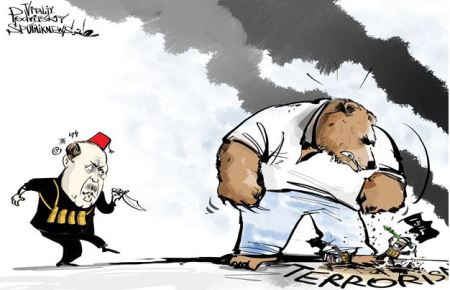
The Russian bear stamps out terror, but Erdogan prepares to stab it in the back (Sputniknews.com, November 24, 2015)
‘It Would Be A Mistake For Russia Not To Use Nuclear Weapons’ In A War With Turkey
A Pravda.ru article titled “‘Scenarios For Real War Between Russia And Turkey” states:
“The possibility of a full-fledged war between Russia and Turkey has been a talk of the day for conspiracy theorists, analysts, couch warriors and experts on international politics for several weeks already… Let’s assume that a real war sparks between Russia and Turkey (NATO) – what kind of war would it be? What results would it bring?
“Politonline.ru[3]discussed the topic with leading military experts that follow various approaches to international armed conflicts.
“A leading expert of the Center for Military and Political Studies,[4]Mikhail Alexandrov, is convinced that in case of a real war, Russia will have to use nuclear weapons immediately, because the existence of the nation will be at stake.
“‘It would be a mistake for Russia not to use nuclear weapons in this case,’ [he said]. ‘The West and Turkey will try to drag us into a war such as the Crimean war, where escalation will be slow, combat actions in the Caucasus will erupt, and the Russian group in Syria will be destroyed. The West will be helping Turkey – there will be military units and state-of-the-art aviation deployed there. It will be a war of the wearing-out strategy’, he said.
“‘From my point of view, should the war with Turkey start, it must be a determined, ambitious and quick war. Russia will have to strike a nuclear blow on main infrastructure and military targets in Turkey immediately’…
“‘During the first few hours of this war, Russia must destroy the entire military infrastructure of Turkey’, Mikhail Alexandrov said. ‘One does not even have to use ballistic missiles in this strike – Iskander-M with nuclear warheads would be enough. As soon as the military infrastructure is destroyed, the Russian troops will go and take the area of the straits’, he added.
“‘The West will not even have time to do anything. European countries will be so horrified that they will not even dare to intervene. The Americans will face a choice – either they begin a strategic nuclear war against Russia or not. As a result, Russia will take the area of the straits, and the rest will be left to Turkey’, said the expert.
“In turn, non-nuclear scenario of a hypothetical possibility, but deputy head of the Tauric information-analytical center at Russian Institute for Strategic Studies,[5]Sergey Ermakov, suggested a non-nuclear scenario.
“‘Hopefully, the real conflict will not happen. Using nuclear weapons is an extreme option. As for a regional war, there are non-military tools in the region. There are many anti-Turkish players in the region. In the case of a military conflict, the Kurds will rip the region to pieces, so for Turkey, a war is a game not even with the zero, but with a negative sum’, he said.
“‘If Turkey provokes the conflict, NATO may not resort to the fifth article. Aggression is one thing, but a country asking for a conflict and pulling NATO into it is another thing. In such cases, NATO tries not to get involved’, Sergei Ermakov said.
“‘No one wants to get involved in a direct military conflict with Russia. This conflict is fraught with a nuclear war and a global tragedy’, he added.”[6]
‘The Leader Of The Turkish Nation Is Not Just An Islamist, He’s A Supporter Of International Terrorism”
An article on NEO titled “What Fate Awaits Turkey?” states:
“It is now clear that Tayyip Erdogan’s political career is heading to a closure, slowly but surely. He had a chance of saving it if he had the courage to immediately offer his apologies to Moscow after the downing of the Russian Su-24 bomber over Syria, that was in fact heading away from Turkey, not toward it.
“Instead, he got tangled in a web of ridiculous lies and explanations, all while being rude to Russia. On top of it all, he framed Washington, by trying to excuse the actions of the Turkish Air Force with alleged orders he personally received from Barack Obama at the G20 summit held in Antalya.
“But even with his back against the wall, Turkey’s President proved to be stubbornly shortsighted, which forced Russia to go even further by uncovering the role Turkey and Erdogan’s family played in the smuggling of stolen Syrian oil, which is a direct violation of the UN Security Council Resolution that was adopted on February 12, 2015. This means that the Turkish state is directly responsible for the sponsorship of international terrorism, which, according to the UN, should be punished in a particularly harsh manner.
“But what’s even more grave – the president has publicly disgraced himself before the country. His had already been steadily losing his position, but once he dropped his mask, his ratings started falling abruptly. It turns out that the leader of the Turkish nation is not just an Islamist, he’s a supporter of international terrorism.
“Now we are presented with a situation in which the AKP leader and the sitting Prime Minister Ahmet Davutoglu who are largely secured by the victory for the ruling party, has obtained as much influence as the president. And after the downing of Russia’s bomber he strengthened his positions even more, even though he decided not to distance himself publicly from the president. It’s safe to assume that he’s just quietly waiting for a perfect opportunity to strike a mortal blow. He’s nothing short of a dangerous contender that is prepared to replace Erdogan at any given moment.
“But the deposing of Erdogan is a relatively positive scenario. Those who remember Turkish history should know that Erdogan is hated by the military command of the Turkish Armed Forces, which has traditionally played a crucial role in the maintaining of country’s stability… The army is not getting any revenues from the illegal oil smuggling, so, should the ties between ISIL and Ankara be maintained, the military command, while enjoying the support of NATO allies, can launch a coup d’etat and return to the power they had three decades ago. But this scenario won’t satisfy local Kurds and other ethnic and religious minorities, who have experienced the cruelty of the army in the suppression of their rights first hand.
“Turkey is going to be plunged into political chaos, when the ruling AKP will find itself opposed by both the army and the legal opposition, along with 22 million Kurds led by the banned Kurdistan Workers Party (PKK). In this case, the civil conflict could result in the collapse of the Turkish state with the Kurdish areas (the entire South-East Anatolia) breaking away, seeking ways to create an independent Kurdistan that will absorb certain areas in Syria in Iraq, changing the whole balance of power in the Middle East.
“Whatever happens, one thing is clear: Tayyip Erdogan will be forced to answer for his stubbornness, inability to respect others, dictatorship, corruption, and connections with ISIL. And above all, he must answer to the people of Turkey. And also to Russia for the cowardly attacks that claimed the lives of two Russian soldiers who fought valiantly against terrorism.”[7]
‘Turkey May Well Have Been A ‘Prime Actor’ In The Paris Attack’
Another NOE article, titled “Mad King Erdogan’s Oil Lies,” stated: “Erdogan is claiming he stole no oil. He has threatened to resign if he receives proof. There is little doubt that Erdogan is insane, those who have been watching his dance of death with ISIS have known this all along.
“However, while Erdogan talks only of oil, there are other issues to note as well. First of all, let’s talk about arms shipments that cross Turkey and move into Syria and Iraq. By Erdogan’s claim of total innocence, we must assume that ISIS, al Qaeda and the other openly terrorist groups that make up 95% of those fighting against Iraq and Syria are operating without any outside supplies.
“Where Erdogan’s wild claims fail is simple as looking at a map. When Russia publishes surveillance photos of not just hundreds but thousands of oil trucks, how can there be denial? The roads that these trucks use only go to Turkey.
“They don’t go anyplace else, there is no place else. There is absolutely no vehicle traffic between the Turkish occupied areas of Iraq and Syria, and we might as well call them that, and the areas under control of the legitimate governments in Baghdad and Damascus.
“What is support of terrorism if it isn’t trading oil for arms or, moreover, trading oil and the other loot of Iraq and Syria, for the cooperation of Turkish politicians and, just perhaps, their European and American friends as well.
“Yet no one considers that Turkey may well have been a ‘prime actor’ in the Paris attack. Would Erdogan have downed a Russian plane if it weren’t for the Paris attack? What about the Russian airliner downed over Syria? When you add MH17 and examine what is now known, that Ukraine and Turkey have been working closely together all along, with ISIS troops joining Kiev forces against NovoRussians, do we see a pattern?”[8]
‘Turkey’s “Leader” Should Be Charged With Murder’
A Pravda.ru article titled “Turkey: Treacherous Turncoat,” stated:
“Turkey’s ‘leader’ should be charged with murder. The sanctimonious West is in denial. NATO, partly complicit if not the instigator, vows to defend the murderer. Washington, which knows every detail, feigns ignorance. Why is there no Western condemnation in absence of Turkey’s compunction?
“Turkey, though paying lip service to Obama’s ‘coalition of the coerced’ to at long last fight ISIS in Syria with military force, is loath to do so. More important Turkey has its political/economic motives to do just the opposite: not lift a finger (against ISIS). That is because, as President Putin already disclosed to Russia’s Western ‘partners’ at the G20 Summit, Turkey is in reality a turncoat. Russian military intelligence provided the evidence: Turkey, including its President, are really aiding and abetting the ISIS terrorists. Detailed satellite images show that Turkey provided the egress for the stolen oil that ISIS has been trucking in and through Turkey.
“From there the contraband, once brokered by the Turks, is sold elsewhere. The ‘buyers’ list includes Israel, the European Union and as some have suggested, even America. The scale and the scope of the covert theft equates to over 50 million barrels. Moreover, Turkey has profited from this nefarious heist for almost four years. Russia has more proof. The laundered money trail flows straight to the Turkish President’s palace. Using a labyrinth of the Erdogan’s financial network including his own son, the ill-gotten gains are then spirited outside the country.
“While the Kurds fight ISIS, Erdogan courts the terrorists by providing them military cover. Russia, now wiser as to Erdogan’s true colors, should endeavor to be ever more vigilant in its Syria campaign as to joining the West’s coalition of ‘partners’.
“That same portent applies to the newest ‘partners’: Hollande and Cameron. The two turkeys are even bigger U.S. vassals. Neither one is trustworthy. Syria’s war is about oil; both Putin and Assad know that well.”[9]
Endnotes:
[1] NEO (New Eastern Outlook) is the journal of the Russian Academy of Science’s Institute of Oriental Studies, a leading research institution dealing with Asian and African countries and cultures. NEO presents itself as follows: “We cover political and religious issues, economic and ideological trends, regional security topics and social problems. We are committed to develop NEO into a notable international networking platform offering unbiased expert opinions and open dialogue among all thinking people worldwide regardless of their nationality, race or religion… We are focused on creating a new culture of partnership where opinions influence decisions.” (Journal-neo.org, “About” section, accessed January 12, 2016).
[2] Pravda.ru is a pro-government news and opinion website. According to its former Director General, Vadim Gorshenin, it is the successor of Pravda, the official mouthpiece of the Soviet Union’s Communist Party. It was founded by prominent members of Pravda’s editorial staff who left it in 1999, and today it is privately owned by Pravda.ru Holding, of which Gorshenin is the head. Its current Director General, Inna Novikova, is Gorshenin’s wife.
The Pravda website publishes in four languages: Russian, English, Italian, Portuguese, and has more than 200,000 visitors daily. According Gorshenin, the English version is the second most popular English-language Russian website, after Russia Today (Pravda.ru, September 16, 2013).
[3] Politonline.ru is a political website, part of the Pravda media network.
[4] The Center for Military-Political Studies is a division of the Russian foreign ministry’s Moscow State Institute of International Relations. The center studies trends and affairs in the domains of defense policy, weaponry, military industry, military cooperation and state security (Eurasian-defence.ru).
[5] The Russian Institute for Strategic Studies (RISS) is a research center established by the President of the Russian Federation. Its main task is to inform various Russian state institutions on the political, economic and socio-political situation in the Black Sea countries and Mediterranean region (En.riss.ru).
[6] Pravdareport.com, December 8, 2015. The Russian version of the article was published on Politonline.ru on November 27, 2015.
[7] Journal-neo.org, December 7, 2015. The author, Peter Lvov, is described by NEO as a Ph.D in political science.
[8] Journal-neo.org, December 7, 2015. The author, Gordon Duff, is described by NEO as a U.S. Marine combat veteran of the Vietnam War and a senior editor and board chairman of the Veterans Today website.
[9] Pravdareport.com, December 16, 2016. The author’s name is given as “Montresor.”
In recent months, further information about the AKP government’s support for ISIS and other jihadis in Syria has come to light. Turkish journalists who have documented their government’s support for terrorists and who have published evidence of truckloads of arms and ammunition, as well as fighters, being sent into Syria have been threatened, arrested, and imprisoned by Turkish authorities.[1] Foreign media have also extensively covered Turkey’s sponsorship of ISIS and other terrorist organizations, and documented the ease with which thousands of foreign and Turkish jihadis enter and exit Syria under the eyes of Turkish officials.
However, Western governments have refrained from criticizing Turkey’s conduct in this matter, and continue to call Turkey “a partner in the fight against terrorism.” Many in Turkey, including Mehves Evin, columnist for Turkish opposition daily Diken, have asked, in light of this heavy media coverage of Turkey’s sponsorship of jihadi terrorists, “Why isn’t there a peep from the West?”[2]
The following report presents further evidence of the Turkish government’s support and sponsorship of ISIS and other jihadi terrorist organizations:
After Turkish Daily Cumhuriyet Released Video Footage Of Weapons-Filled Syria-Bound Turkish Trucks, Paper’s Editor-In-Chief, Ankara Bureau Chief Are Imprisoned, Charged With Treason, Espionage, And Terrorism
On November 26, 2015, Can Dundar, prominent journalist and editor-in-chief of Turkey’s oldest dailyCumhuriyet, and Erdem Gul, its Ankara bureau chief, were arrested; they are now being held in isolation pending a trial initiated by Erdogan himself, on charges of espionage, treason, and providing support for terrorism. The charges are in connection with the newspaper’s May 29, 2015 publication of video footage of a January 19, 2014 search conducted by Turkish judicial, security, and military officials of three large Syria-bound trucks in the Turkish border province of Adana; the search turned up heavy weaponry concealed under boxes of medicines. The weaponry, including missiles, mortars, anti-aircraft ammunition artillery, and grenades, was being transported by Turkey’s National Intelligence Organization (MIT) to jihadi organizations in Syria. Erdogan, at that time prime minister, immediately intervened to stop the search, and to secure the release of the MIT personnel carrying the arms into Syria.
Earlier, on January 1, 2014, a similar truck was stopped in the border province of Hatay, but no search could be conducted due to intervention by the local governor on behalf of the government.
The Adana and Hatay prosecutors’ investigations into both of the incidents, which came to be known as the “MIT trucks affair,” and all related legal files, were closed; gag orders were issued, and all security personnel, high-ranking military officers, and prosecutors involved in the searches were arrested. Erdogan, the AKP government, and its partisan media claimed that the trucks had only been carrying humanitarian aid to Turkmens in Syria.
Along with the video footage, published 17 months after the incident, Cumhuriyet also published other court documents, under the headline “The Weapons That Erdogan Said Did Not Exist”[3]
The following is the video footage published by Cumhuriyet:
Following Dundar’s imprisonment, an outcry arose in Turkey and in press organizations in Turkey and internationally; he has since received multiple press awards. Additionally, teams of journalists from the anti-AKP media, along with MPs from the main opposition Republican People’s Party (CHP), and artists and intellectuals, have been sitting in shifts outside the gates of the Silivri prison compound in Istanbul, where the detainees are being held, in solidarity.[4]
MIT Transports Jihadis, Weapons From One Syrian Battlefront To Another – Via Turkey
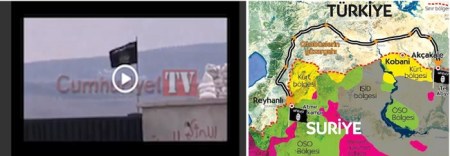
On June 11, 2015, Cumhuriyet also published a video of statements by two bus drivers telling authorities how they had been commissioned by the MIT to transport, on the night of January 9, 2014, over 70 Jabhat Al-Nusra (JN) jihadi fighters, along with a large load of arms and ammunition, from Atme Camp in Syria near the Reyhanli border crossing in the Turkish province of Hatay, to Tel Abyad in Syria, near the Akcakale border crossing in the southeastern Turkish province of Urfa. They showed where they had entered Syria from Turkey, without headlights, stopping near a building in Atme Camp where the JN flag was flying and “La-i-lahe-il-Allah” (“There is no God but Allah”) was painted on the wall. At Atme, they said, they had not been allowed off their buses, and the buses had been boarded there by bearded, Arabic-speaking militants who also loaded large boxes of weapons onto them. The drivers said that they then drove back into Turkey and proceeded without stopping to re-cross into Syria at Akcakale. At around 5:30 AM, near Tel Abyad, the militants disembarked with their weaponry.
It will be remembered that at that time ISIS was fighting to take control of Tel Abyad, and several days later, on January 13, it succeeded in doing so.
According to Cumhuriyet, the jihadis were transported from one point to another in Syria via Turkey because it was unsafe for Islamist fighters to travel through Syrian territory that was under Kurdish Democratic Union Party (PYD) control, such as Kobane.
The drivers also stressed that they had committed no crime, as they had been hired by the MIT to work for the government and had been escorted throughout by MIT operatives in two black vehicles.
The AKP government called the Cumhuriyet report a lie and libel, and, on February 14, 2014, ordered the investigation into the matter and the related files closed, removed the prosecutor from his position, and sealed and covered up the incident.[5]
Left: The Cumhuriyet video showing the building in Atme Camp where the drivers picked up the jihadis. Right: The route taken by the buses carrying jihadis from Atme Camp in Syria to Tel Abyad in Syria, via Turkey.
CHP MP Says Sarin Gas Components Were Transferred To ISIS Via Turkey; Erdogan Accuses Him Of Treason; Criminal Investigation Against Him Is Launched
On several occasions – at an October 21, 2015 press conference, in an early December 2015 interview with the Russian news agency RT, and in a December 10, 2105 speech in the Turkish parliament, CHP MP Eren Erdem said that components for sarin gas had been imported from foreign countries, some of them European, by Turkish businessmen on behalf of an ISIS operative, and delivered to a terrorist organization in Syria, for the production of chemical weapons that were later used in Syria.[6]
Erdem said that his claims were based on a 2013 investigation, case file number 2013/139, by the Chief Prosecutor’s Office in the southern province of Adana. According to this investigation, five Turkish citizens the wanted Al-Qaeda/ISIS militant and Syrian citizen Hayyam Qassap were arrested and prosecuted for procuring the toxic components to be transferred to ISIS in Syria.
Erdem stressed that the statements he was making were not his own, but that he had been quoting a Republic’s Chief Prosecutor. He added that in late June 2013 this case had been closed and a news blackout imposed on it, and that on July 1, 2013 the six accused had been released from prison and allowed to cross into Syria.
Erdem launched a parliamentary inquiry in October 2015 demanding government explanations in this matter, but to date Turkish Prime Minister Ahmet Davutoglu has not responded.
On December 18, 2015, Erdogan publicly accused Erdem of treason. The same day, the Ankara Chief Prosecutor’s Office sent a summary of proceedings to the Ministry of Justice for permission to begin legal action against Erdem; if it is sent on to the parliament, the process to strip him of his parliamentary immunity so that he can be tried for treason will begin.[7] Since then, he has been threatened by the pro-AKP media and subjected to a lynching campaign on social media; in addition, he and his family have received death threats.
On December 23, 2015, Erdogan blasted Erdem again, calling him a “traitor,” and also slammed CHP leader Kemal Kilicdaroglu for his defense and protection of Erdem. The previous evening, in a televised interview,[8]Erdem had reiterated that he had accused neither Turkey nor the government, but had only objected to the release of the suspected businessmen and of a Syrian militant who had attempted to procure illegal chemical components to transfer to Syria via Turkey.[9]
“Jihad Hospital” In Turkey For Islamist Terrorists
In September 2015, the Turkish opposition daily Birgun visited a 75-bed “jihad hospital” in the border province of Gaziantep that treats the mujahedeen fighting in Syria, and on September 22 reported:[10] “Turkey… is turning a blind eye to a medical support network serving the Islamic Front militants. The administrators of the six-floor, 75-bed hospital in Gaziantep told Birgun that during the first eight months of 2014 they had treated well over 700 militants; they administrators also expressed their gratitude to the local security officials and the AKP municipality for their assistance, and for the AKP government’s support.”
The Birgun report continued: “The AKP government… continues to assist the jihadi organizations, and by permitting the operations of a medical network that extends from Aleppo to Ankara and Istanbul, is trying to strengthen the hand of the Islamic Front, an umbrella organization for many jihadi groups fighting in Syria, which is structured like ISIS and has at least 45,000 active fighters, especially in the Idlib and Aleppo areas. Their wounded are treated in Gaziantep.
“The treatment of the wounded fighters is made possible by ImkanDer, an Islamist association, whose regional representative is Sait Gokdere. He is the former executive of the Humanitarian Relief Foundation (IHH), that became known in connection with from the 2010 sailing of the Mavi Marmara to break Israel’s blockade on Gaza. Gokdere told us that the IHH focused their activities on Syria when the civil war broke out, and that thanks to the AKP government’s permission and support, ‘may Allah bless them,’ they were able to provide health services to the mujahideen at this rehabilitation facility and in the many houses in the area that have been turned into clinics, reaching a capacity of 150 beds. He said that the hospital personnel were conducting their activities, and exiting and entering Syria officially, with the permission of the authorities.
“Doctors with whom we [Birgun] spoke explained that the treatment of wounded fighters begins with receiving news [of them] from Aleppo, through their local sources there. They then dispatch vehicles into Syria to bring them over. The seriously wounded are taken to state hospitals in Kilis or Gaziantep, and in the rare cases when they are not able to treat their injuries, they are sent to hospitals in Ankara or Istanbul. Once these wounded mujahedeen are out of intensive care, they are taken to the home clinics or to this hospital. Upon their recovery, they return to Syria to resume fighting.”
A recovering jihadi in the “jihadi hospital” in Gaziantep. Birgun, September 22, 2015
ISIS In Turkey
Since 2013, the opposition media in Turkey have been reporting on the spread of Salafi ideology within the country, and on the steady stream of thousands of Turkish jihadis who join ISIS, Jabhat Al-Nusra, Ahrar Al-Sham, and other terrorist organizations in Syria. An estimated 10,000 Turkish jihadis have gone to Syria to join the fight, as the AKP government has turned a blind eye.
Turkish ISIS Militant In Ankara: ISIS “Loves Turkey, Because Of The Ease At The Borders And For Its Allowing Safe Passage To Fighters Of Many Nationalities”
Birgun interviewed multiple ISIS militants in the Hacibayram district, in Ankara, which has become an ISIS center. While its report, published July 8, 2015, included names of recruiters and recruits, the Turkish government has done nothing to stem the flow of recruits into Syria.
C.A., 29, told Birgun that initially there had been many Al-Qaeda operatives in the area, but that they had declared their allegiance to ISIS. He recounted how, after he decided to go to the Islamic State in February 2014, he had established contact with some well-known people in order to cross the border. He told how upon arrival he had received education in Koranic verses, Hadith, shari’a law, and the high purpose of ISIS’s fight, and then had received military training. He said he fought there for nine months and could not remember how many people he had killed.
Asked whether he had seen any Turkish police or soldiers during his border crossings, C.A. said: “Turkey permits the crossings to Dawla [the Islamic State]. My first time, I came face to face with a military police officer. They see you, but pretend they don’t,” Only once, he said, the last time he returned to Turkey was he caught – and that time he was taken before a judge, who released him. Asked about how ISIS views Turkey, and whether “talk that ISIS militants may [be planning to or intending to] conduct operations inside Turkey” was true, C.A. answered: “Dawla loves Turkey, because of the ease it provides at the borders and for its allowing safe passage to fighters of many nationalities. The mujahideen there [in the Islamic State] criticize Turkey because it is not ruled by Allah’s rule, but there is no thought or intention to fight Turkey. Turkey, on the other hand, helps us because we fight particularly against the Kurdish PKK. Allah knows, if ISIS is given one month without the [coalition and Russian] air raids, we will eliminate the PKK.”[11]
Turkish Jihadi: “Jihad Is A Religious Obligation, Like Daily Prayers; If A Muslim Is Hurt In The Arctic, We Would Go There Too”
The major mainstream Turkish daily Hurriyet tracked ISIS in five Turkish cities, interviewing the families of many who had joined ISIS, and some jihadis. The report, published September 22, 2014, showed how easy it was for thousands of Turkish and foreign fighters to cross the southeastern border of Turkey into Syria, and how a new breed of Islamist associations, Islamist lodges, Islamist chat rooms, and Islamist bookstores and cafes were popping up around the country encouraging young Turks to join the jihad and to receive Islamic education and preliminary training. The report also mentioned young jihadis who had fought alongside ISIS or the Al-Qaeda affiliate Jabhat Al-Nusra and who had returned to Turkey to receive medical treatment after being wounded.
An ISIS recruit, interviewed in Istanbul, told the reporters that he had entered Syria five times. Like the other recruits, he said, he had been escorted by militants to the border, jumped the fence, and ran into one of the houses on the Syrian side. First, he had joined Jabhat Al-Nusra, but then switched to ISIS. Asked whether he would also go to fight in other Muslim countries, he answered: “It is a religious obligation. Jihad [is] like daily prayers. If a Muslim is hurt in the Arctic, we would go there too.”
Worried families told Hurriyet that that their sons had gone “to die for the Muslims.” A father in Gaziantep said that his son, 22, and nephew, 34, had both left to join ISIS, and that when he reported this to police, he was told: “Everybody goes there [to ISIS]. Don’t mess with this issue, so as not to get yourself into trouble.”[12]
In a July 2015 column titled “ISIS Among Us,” Aydin Engin wrote in Cumhuriyet that not only were the suicide bomber who carried out the July 20, 2015 attack in Suruc, that killed 33, and the bombers who killed over 100 in Ankara on October 10, 2015 Turkish citizens who had joined ISIS, but that there were thousands more like them across Turkey. He wrote that ordinary citizens in all the cities and towns of the southern border provinces of Turkey can easily point out ISIS houses, ISIS cells, the wounded ISIS militants brought in daily from Syria to their hospitals, and groups of ISIS members sitting at tables in restaurants. Engin asked how it would be possible for the AKP government and the MIT not to be aware of what every citizen knows so well – i.e. that ISIS is everywhere in Turkey.[13]
ISIS Affiliates In Istanbul Hold Events, Call For Jihad – Without Interference By Turkish Security
While Turkish police are always present at protests, and frequently disperse crowds with water cannon, pepper gas, and, sometimes, bullets, Islamist organizations are allowed to openly demonstrate and call for shari’a law and jihad, in major cities. Similarly, the AKP government closes down media outlets and websites of dissenters and Kurds, while Islamist websites disseminating ISIS propaganda are left to operate freely.
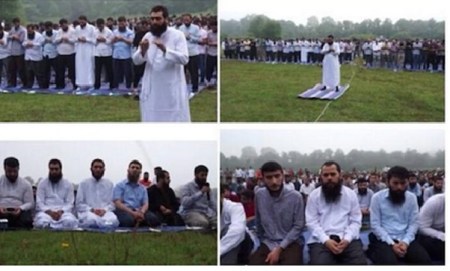
ISIS-affiliated group at an encampment in an Istanbul park allocated to them by the AKP celebrates Ramadan, praises ISIS, and calls to jihad. Photos: Rotahaber and Twitter, July 29, 2014.
The so-called Islamic State (ISIS) is armed with biological and chemical weapons but Europeans don’t take the existential threat seriously, according to a European Union parliament document..
Israeli experts last week also said ISIS is armed with weapons forbidden by the Geneva Convention and that it is a state in every sense of the word, with its own currency, a university and even license plates..
The London Express reported that the parliamentary report states that ISIS “may be planning to try to use internationally banned weapons of mass destruction in future attacks.” The document was prepared by the Parliament’s political analyst following the ISIS massacres in Paris last month..
ISIS has been trafficking in chemical weapons and also is able to manufacture them by putting together a team of experts with degrees in chemistry and physics..
The EU report, quoted by the Express, states:
Chemical, biological, radiological or nuclear substances (CBRN) have been carried undetected into the European Union. Interpol’s monthly CBRN intelligence reports show numerous examples of attempts to acquire, smuggle or use CBRN materials..
At present, European citizens are not seriously contemplating the possibility that extremist groups might use chemical, biological, radiological or nuclear (CBRN) materials during attacks in Europe. Under these circumstances, the impact of such an attack, should it occur, would be even more destabilizing..
Experts at an Israeli conference said that ISIS is a genuine state even if it not recognized by others, Globes reported..
It controls approximately one-third of Syria’s land, nearly 10 million people and earns approximately $300 million in day from the sale of oil it has confiscated in Iraq and Syria..
Besides its well-publicized black flag and army of barbaric terrorists, ISIS runs courts, schools, welfare agencies and even issues license plates. One of the experts said, “There is no precedent for anything like this in the past 100 years”..
Dr. Ronen Yitzchak, head of the Middle East Dept. at the Western Galilee College, said that the Western coalition has succeeded in seriously damaging the infrastructure of ISIS and in limiting its expansion.
However, he added:
Despite weaknesses in the organization, it will not disappear and will continue to be present for many years. The Islamic State is not a temporary episode. It will continue to present a danger to the West and the entire world..
Terror will worsen in Europe, whether it is because of terrorists who are there now or because of those who be recruited in the future..
ISIS has succeeded in recruiting cells in dozens of countries, “something that has never been seen in terror groups,” Yitzchak said..
ISIS has its own currency, has minted gold and silver coins and soon will introduce bronze coins..
Its radical Islamic school system forbids studies in music, arts and Western subjects such as psychology..
The expert panel also revealed that every family is required to “contribute” one male adult to fight in the ISIS army, which comprises estimated 35,000-50,000 men…
(What benefit beyond oil sales to Turkey — a minor one that Turkey could extinguish at its pleasure — would Israel receive? — DM)
♦ It would be truly embarrassing if a Turkey-Israel normalization results in new arms shipments into Gaza and rockets over Israeli skies — with the only achievement being a temporary peace with Turkey’s Islamists, who never hide their ideological kinship with Hamas.
♦ The future Turkish and Israeli ambassadors would always have to keep their bags packed, ready to return to their own capitals at the first dispute – which could be caused by Israeli retaliation against Arab terrorism or anything that may make Erdogan roar in front of cameras.
♦ How do you shake hands with a man whom you know ideologically hates you and wishes to mess up things at his earliest convenience?
None of this happened half a century ago; the timeline here covers only a span of a year and a half: A Turkish-Kurdish pop star wrote on her Twitter account, “May God bless Hitler. He did far less [than he should have done to Jews].” The mayor of Ankara replied: “I applaud you!” Hundreds of angry Turks, hurling rocks, tried to break into the Israeli diplomatic missions in Ankara and Istanbul. The mayor of Ankara said: “We will conquer the consulate of the despicable murderers.” He blamed the Charlie Hebdo massacre in Paris on Israel’s Mossad. Islamist columnists close to the government suggested imposing a “wealth tax” on Turkish Jews (who are full citizens). A governor threatened to suspend restoration work at a synagogue. And a credible research group at the Kadir Has University in Istanbul found in a poll that Turks view Israel as the top threat to Turkey.
Against such a background, Turkish and Israeli diplomats are negotiating a historical deal that will, in theory, end Turkey’s hostility toward the Jewish state and normalize diplomatic ties between Ankara and Jerusalem.
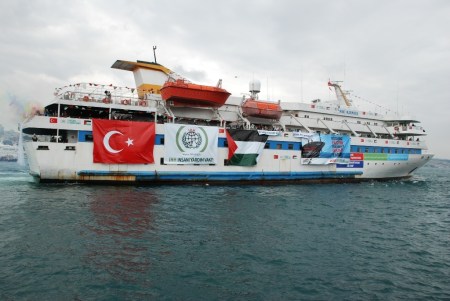
In 2010, a Turkish flotilla, led by the Mavi Marmara with hundreds of jihadists and anti-Israeli “intellectuals” aboard, sailed toward the coast of Gaza, aiming to break Israel’s naval blockade of the Hamas-run strip. Israel’s naval blockade aims to prevent weapons such as rockets being smuggled into Gaza. To stop the flotilla, naval commandos of the Israel Defense Forces boarded the vessel and, during clashes, killed nine aboard.
The Turkish-owned ship Mavi Marmara, which took part in the 2010 “Gaza flotilla” that attempted to break Israel’s naval blockade of Gaza. (Image source: “Free Gaza movement”/Flickr)
Since the incident, Turkey’s Islamist leaders have pledged to isolate Israel internationally and have downgraded diplomatic ties with Jerusalem. They have put forward three conditions before any normalization could take place: an Israeli apology, compensation for the families of the victims and the removal of the naval blockade on Gaza.
After President Barack Obama’s intervention, Israeli Prime Minister Benjamin Netanyahu in 2013 apologized for “any error that may have led to the loss of life.” Turkey’s two other conditions remain unfulfilled. But diplomatic teams from Ankara and Jerusalem are apparently working on a deal. There are good reasons why an accord may or may not be possible.
Since the nearest Turkish election is four years from now, neither Turkish President Recep Tayyip Erdogan nor his prime minister, Ahmet Davutoglu, has any reason to cultivate further anti-Semitism at election rallies in order harvest votes from conservative masses who are deeply hostile to Israel and Jews. These are days when Turkey’s leaders need not practice their usual anti-Israeli rhetoric.
There is another reason related to “timing” that makes a deal attainable. After pledging to isolate Israel, Turkey has become the most isolated country in the region, especially after the recent crisis with Russia that emerged after two Turkish F-16 fighters shot down a Russian SU-24 aircraft along Turkey’s Syrian border on Nov. 24.
In its region, Turkey does not have diplomatic relations with Cyprus and Armenia. It has downgraded diplomatic relations with Israel and Egypt. It is confronted by Shiite and Shiite-dominated regimes in Iran and Iraq, respectively. On top of all that, an angry Vladimir Putin, Russia’s president, curses and threatens every day to punish Turkey. Turkey buys over half of its natural gas and 10% of its oil from Russia.
Therefore, a third incentive could be a mutually beneficial future deal for Turkey to buy natural gas from Israel. If the two countries build an underwater pipeline, Turkey can compensate for the potential loss of Russian gas supplies, starting in 2019. For Israel, a pipeline to Turkey would be the most commercially feasible route to export its gas to Turkey and other potential buyers beyond.
A Turkish-Israeli handshake would also be music to ears in Washington. Deep hostility and occasional tensions between its two allies in the Middle East have always been unnerving for the U.S. administration.
The road ahead has its problems. Turkey’s second condition for normalization, compensation, is not too difficult to overcome. But the third condition, that Israel should remove the naval blockade of Gaza — and risk weapons being smuggled into the hands of Hamas (or other terrorist groups) — could be an unsafe move for Israel.
It would be truly embarrassing if a Turkey-Israel normalization results in new arms shipments into Gaza and rockets over Israeli skies — with the only achievement being a temporary peace with Turkey’s Islamists, who never hide their ideological kinship with Hamas.
If Netanyahu decides to take risks and go for a deal, he must make sure that however the naval blockade of Gaza would be eased, it does not expose Israel to the risk of new acts of terror.
Another risk is the potential psychological domino effect any deal could cause. It is certain that Turkish Islamists will portray any deal as a success story — that they were able to “bring Israel to its knees.” This message, relayed through a systematic propaganda machine, could set a dangerous precedent and potentially encourage Arab Islamists to consider more assertive policies toward Israel in the future.
The future Turkish and Israeli ambassadors would always have to keep their bags packed, ready to return to their own capitals at the first dispute – which could be caused by Israeli retaliation against Arab terrorism or anything that may make Erdogan roar in front of cameras, “Our Palestinian brothers … Those murderer Jews again … Go back to your pre-1967 borders or you’ll suffer the consequences!”
Netanyahu’s problem is that he does not trust Erdogan in the least. He is right not to trust Erdogan. But then how do you shake hands with a man whom you know ideologically hates you and wishes to mess up things at his earliest convenience?
The US-Russian plan, approved by the UN Security Council as the lever for activating a political process towards ending the five-year Syrian war, can only go so far towards its objectives. The process is not capable of halting the fighting or removing Bashar Assad from power; just the reverse: progress in the talks is heavily dependent on the state of play on the battlefields of the north while the Syrian dictator’s ouster is a fading issue.
The limitations and obstacles facing the UN-endorsed US-Russian plan are summed up here by DEBKAfile’s analysts:
1. The understanding reached by the Obama administration and the Kremlin in the past month was first conceived as a stopgap measure. It was never intended to bring the calamitous Syrian war to an end or remove Assad, but rather to provide a pretext to account for the expansion of Russia’s ground operation and gloss over America’s military deficiencies in the Syrian conflict. Taking it as carte blanche from Washington, President Vladimir Putin felt able to announce Saturday, Dec. 19, that “the Russian armed forces have not employed all of their capability in Syria and may use more military means there if necessary.”
2. President Barack Obama has stopped calling for Assad’s removal as the condition for ending the war and is silent on the expanding Russian military intervention. Obama and Putin have in fact developed a working arrangement whereby Putin goes ahead with military operations and Obama backs him up..
3. Almost unnoticed, on Dec. 17, the day before the Security Council passed its resolution for Syria, all the 12 US warplanes that were deployed a month earlier at the Turkish air base of Incirlik for air strikes in Syria were evacuated. This happened at around the same time as Russia deployed to Syria its Buk-M2-SA-17 Grizzly antiaircraft missile systems. The presence of this system would have endangered American pilots had US air strikes over Syria not been halted. The upshot of the two evidently coordinated moves was the US withdrawal of most of its military resources for striking the Islamic State forces in Syria and the handover of the arena to the Russian army and air force.
4. In another related development, Friday, Dec. 18 the German intelligence service, BDN, leaked news that it had renewed its contacts with the Assad regime’s intelligence services and German agents were now visiting Damascus regularly. The import of this change is that Berlin no longer relies on US intelligence briefings from Syria and, rather than turn to Moscow, it prefers to tap its own sources in the Syrian capital.
5. Washington and Moscow are still far apart on the shape of the transitional government mandated by the Security Council resolution
The Obama administration wants Assad to hand presidential powers over the military and of all security-related and intelligence bodies to the transitional government, which is to be charged with calling general and presidential elections from which Assad will be barred.
Putin won’t hear of this process. He insists on a transitional government being put in place and proving it can function before embarking on any discussion of its powers and areas of authority.
The two presidents agree that the transition will need at least two years, overlapping the Obama presidency by about a year and dropping the issue in the lap of his successor in the White House.
6. The US and Russia don’t see to eye to eye either on which Syrian opposition organizations should be represented in the transitional government and which portfolios to assign them. On this question, both Washington and Moscow are at odds with the Persian Gulf states, Saudi Arabia, Qatar and the UAE, which back some of the organizations labeled as terrorist by Moscow.
7. But it is abundantly clear that the Obama administration is ready to wash its hands of the Syrian rebel movement and most of all, abandon Turkish President Tayyip Erdogan to give the Russians an open remit.
On Saturday, Dec. 19, Putin turned the screw again on Erdogan when he said he had no problem with the Turkish people, adding, “As for the current Turkish leadership, nothing is eternal.”
In support of Moscow, Obama meanwhile leaned hard on the Turkish president in a telephone conversation, to remove Turkish forces from northern Iraq. Ankara responded that Putin’s comment was not worth a response and denied hearing of any such US request.
Ankara may be feigning ignorance but it must realize by now that Moscow and Washington have joined forces to pus the Turkish military out of any involvement in northern Syria and Iraq.
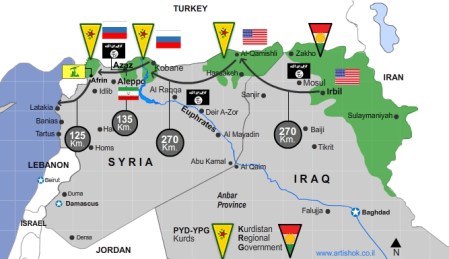
8. This US-Russia collaboration against Turkey is having a dramatic effect on the war in northern Syria along the Turkish border. DEBKAfile’s military and intelligence sources report it opened the door to the secret deal between Washington and Moscow to divide the areas of influence in northern Syria between them – essentially assigning the Kurdish enclaves north of the Euphrates river and bordering on Iraq to American influence (see map), and the areas west of the Euphrates up to the Mediterranean to Russian control. This deal (first revealed by DEBKA Weekly 688 on Dec. 4) effectively squeezes Turkey out of any role in the Syrian conflict.
9. The ongoing battles in northern Syria near the Turkish border will have a greater impact in shaping the future of Syria and its unending conflict than any UN resolution. Participating in the fighting at present is a very big mixed cast: Russia, the Kurdish YPG militia, most of the important rebel groups, including radical Sunni organizations tied to Al Qaeda, such as the Nusra Front and Ahram al-Sham, Iran and Shiite Hizballah, and the Islamic State.
It is only when one of these forces gains the upper hand in this free-for-all, that there will be progress toward a political solution on ending the war.
♦ “Some of those women and girls have had to watch 7-, 8-, and 9-year-old children bleed to death before their eyes, after being raped by ISIS militia multiple times a day.” — Mirza Ismail, chairman of the Yazidi Human Rights Organization-International.
♦ “An office has been established by ISIS members in Antep [Turkey]; and at that office, women and children kidnapped by ISIS are sold for high amounts of money. Where are the ministers and law enforcement officers of this county who are talking about stability?” — Reyhan Yalcindag, prominent Kurdish human rights lawyer.
♦ “Five thousand people have been taken as captives. Women and children are raped, and then sold. These must be considered crimes.” — Leyla Ferman, Co-President of the Yazidi Federation of Europe.
♦ “Turkey has signed several international treaties, but it is the number one country when it comes to professional non-compliance with human rights treaties.” — Reyhan Yalcindag.
This month, the German television station, ARD (Consortium of Public Broadcasters in Germany), produced footage documenting the slave trade being conducted by the Islamic State (ISIS) through a liaison office in the province of Gaziantep (also known as Antep) in Turkey, near the border with Syria.
In August 2014, Islamic State jihadists attacked Sinjar, home to over 400,000 Yazidis. The United Nations confirmed that 5,000 men were executed, and as many as 7,000 women and girls made sex slaves.
While some have escaped or been ransomed back, thousands of Yazidis remain missing.
A news report from German broadcaster ARD shows photos of Yazidi slaves distributed by ISIS (left), as well as undercover footage of ISIS operatives in Turkey taking payment for buying the slaves (right).
Last month, after Kurdish forces recaptured the area from ISIS jihadists, mass graves, believed to contain the remains of Yazidi women, were discovered east of Sinjar.
The German TV channels NDR and SWR declared on their website:
“IS [Islamic State] offers women and underage children in a kind of virtual slave market with for-sale photos. … The transfer of money, as the reporter discovered, takes place through a liaison office in Turkey. …
“For weeks, NDR and SWR accompanied a Yazidi negotiator, who, on behalf of the families, negotiates with the IS for the release of the slaves and their children. … the women are sold in a digital slave market to the highest bidder. 15,000 to 20,000 US dollars are a typical price. Similar sums for ransom are also required to free Yazidis. The money is then transferred via IS-liaison offices and middlemen to the terrorist group.
“NDR and SWR were present at the liberation of a woman and her three small children, aged between two and four years old, and followed the negotiations. How many Yazidi slaves are still ‘owned’ by IS is unclear. Experts estimate that there still could be hundreds.”
The negotiator told NDR and SWR that in the course of a year, he transferred more than USD $2.5 million to ISIS from the families of 250 Yazidi women and children, in order to free them.
He also said that to advertise the slaves, ISIS assigns numbers to the female and child slaves, and posts their photographs on the WhatsApp Messenger smartphone app.[1]
In response to these reports, the Gaziantep Bar Association filed a criminal complaint against “Turkey’s National Intelligence Organization (MIT) and law-enforcement officers that have committed neglect of duty and misconduct by not taking required measures, and not carrying out preventive and required intelligence activities before the media covered the said incidents.”
The bar association also demanded that the prosecutors start prosecuting and punishing perpetrators engaged in crimes of “human trafficking, prostitution, genocide, deprivation of liberty, crimes against humanity, and migrant smuggling,” according to the Turkish penal code.
“The tragic reality,” said lawyer Bektas Sarkli, the head of Gaziantep Bar Association, “is that Gaziantep is a crowded city; the suicide bombers easily cross [to Syria and Iraq]. Unfortunately, Gaziantep exports terrorism.”
Sarkli added: “When you see the ammunition captured and especially take into account the money transferred here [it is clear that] ISIS easily shelters in this city. Gaziantep is the logistic site of ISIS.”
Mahmut Togrul, an MP of the pro-Kurdish Peoples’ Democratic Party (HDP), in a motion to Efkan Ala, Turkey’s Interior Minister, asked about the alleged office where ISIS members engage in slavery and the sex trade. His questions included: “How many liaison offices affiliated with ISIS terror organization are there in Gaziantep? If there are, do those liaison offices have any legal basis? Under what names do these offices operate? Are those offices affiliated with any institution?”
Interior Minister Ala has not yet provided any answers.
“According to the local press of Gaziantep, as well as the national press,” Togrul said, “Gaziantep has been turned into a city with sleeper cell houses for the ISIS terror group; ISIS members abound and travel freely.” [2]
The “Struggle Platform for Women Forcefully Seized,” the Democratic Society Congress (DTK) and the Kurdish Congress of Free Women (KJA) in Diyarbakir also filed a criminal complaint, calling for the prosecutors to investigate allegations and bring the perpetrators to account.
Reyhan Yalcindag, a prominent Kurdish human rights lawyer, said, “An office has been established by ISIS members in Antep; and at that office, women and children kidnapped by ISIS are sold for high amounts of money. Where are the ministers and law enforcement officers of this county who are talking about stability?”
“Turkey,” she said, “has signed several international treaties, but it is the number one country when it comes to professional non-compliance with human rights treaties.”
The Co-President of the Yazidi Federation of Europe, Leyla Ferman, referred to the number of the genocides to which the Yazidis say they have been exposed throughout history. “The Yazidis have been given 73 death warrants,” she said, “The people are massacred under the Islamic State. Thousands of Yazidi women are missing. Five thousand people have been taken as captives. Women and children are raped, and then sold. Today, due to the war, women have been scattered all around. These must be considered crimes.”
This is not the first time the presence of ISIS in Antep appeared in the news.
In November 2015, after the terrorist attacks in Paris, a group waving black ISIS flags appeared, honking the horns of their cars and celebrating in the streets of Antep. The footage was shared widely on social media. One user wrote, “This is Turkey supposedly struggling against ISIS. This is the ISIS convoy in Antep celebrating the Paris massacre.”
The Yazidis, a historically persecuted community, are ethnically Kurdish, but not Muslim; their native religion of Yazidism is linked to ancient Mesopotamian religions. The Yazidis are indigenous to northern Mesopotamia and Anatolia; part of the Yazidi homeland is located in what is modern Turkey; other parts are in Syria and Iraq.
Yazidis have been exposed to campaigns of forced Islamization and assimilation, according to the Turkish sociologist Ismail Besikci, a prominent expert on Kurdistan:
“During the 1912-13 Pontic Greek deportations and the 1915 Armenian genocide, Yazidis were also driven out from their lands. Throughout the history of republican Turkey, all methods have been tried to Islamize the Yazidis. Before 1915, for instance, Suruc was an entirely Yazidi town. So was the town of Viransehir. Today, there is not a single Yazidi left in Suruc. Furthermore, the Islamized Yazidis can be seen exhibit insulting behavior towards those who remain Yazidis.”
Because they are Kurds, the state has not recognized their Kurdishness; and because they are Yazidis, the state has not recognized their religion. The section of ‘religion’ in Yazidis’ identity cards has been left empty; or the religion of some has been registered as ‘x’ or ‘-‘ .
“Research states that in 2007, there were only 377 Yazidis left in Turkey,” an Assyrian MP of the Peoples’ Democratic Party (HDP), Erol Dora, said.
“Yazidis, just like other minorities in Turkey, have also been exposed to discrimination and hate speech; that is why they have had to leave their lands. … Their villages and lands have been seized; their agricultural areas have been appropriated, their holy sites have been attacked. All these racist attitudes continue today; the language, religion and culture of Yazidis face extinction.”
Yazidis say they have been subjected to 72 attempts at extermination, or attempted genocide. Today, they are the victims of yet another attempted genocide in Iraq — at the hands of ISIS jihadists.
“According to many escaped women and girls to whom I spoke in Northern Iraq, the abducted Yazidis, mostly women and children, number over 7,000,” said Mirza Ismail, founder and chairman of the Yezidi Human Rights Organization-International, in his speech at the U.S. Congress.
“Some of those women and girls have had to watch 7-, 8-, and 9-year-old children bleed to death before their eyes, after being raped by ISIS militia multiple times a day.
“I met mothers, whose children were torn from them by ISIS. These same mothers came to plead for the return of their children, only to be informed, that they, the mothers, had been fed the flesh of their own children by ISIS. Children murdered, then fed to their own mothers.
“ISIS militias have burned many Yezidi girls alive for refusing to convert and marry ISIS men. Young Yezidi boys are being trained to be jihadists and suicide bombers. All of our temples in the ISIS controlled area are exploded and destroyed. Why? Because we are not Muslims, and because our path is the path of peace. For this, we are being burned alive: for living as men and women of peace.”
The Yazidis, one of the most peaceful people on earth, are struggling to survive yet another Muslim genocide, before the eyes of the entire world.
While much of the world has been silent, a NATO member, Turkey has been openly complicit — the enabler of jihadist terrorism. Reports and eyewitnesses testify that Turkey has contributed to the rise of the Islamic State by letting fighters and arms over the border. Some of the fighters go on to join the jihadist terrorist group.
The latest reports reveal that in Turkey, a country that fancies itself as a candidate for EU membership, Yazidi women and children are enslaved and forced into sexual slavery. Meanwhile, the Turkish government has not even bothered to make a single statement about these reports.
That is what happens when a regime is never held responsible.
Iraq Press Agency quoted politician Hanan Al Faltawi as saying she received that information from reliable sources after talks between US Senator John McCain and Iraqi Prime Minister Haider al-Abadi
BEIRUT, December 10. /TASS/. Around 100,000 foreign military, including 90,000 from Arab countries, may be deployed to Iraq to fight against the Islamic State (IS) terrorist organization, Iraq Press Agency quoted politician Hanan Al Faltawi as saying.
Al Fatlawi said that she received this information from reliable sources after talks between US Senator John McCain and Iraqi Prime Minister Haider al-Abadi. The meeting took place on November 27 in the joint American-Iraqi operational headquarters in Baghdad that coordinates military actions against IS, she added.
Foreign forces of 100,000 – 90,000 from Saudi Arabia, the United Arab Emirates, Qatar and Jordan and 10,000 from the United States – will be stationed in Iraq’s western parts,” Al Fatlawi noted. The politician added that “the Iraqi prime minister openly expressed bewilderment over McCain’s statement but was told that everything had already been decided.”
Islamic State extremist organization
The Islamic State is an extremist organization banned in Russia. In 2013-2014, it called itself the Islamic State of Iraq and the Levant (ISIL). In June 2014, IS announce the establishment of the “Islamic caliphate” on the territories seized in Iraq and Syria. According to US’ Central Intelligence Agency, the extremist group includes around 30,000 people, while Iraqi authorities claim there are around 200,000 in IS. Among members of the group are citizens of 80 countries, including France, Great Britain, Germany, Morocco, Saudi Arabia, US, Canada, as well as Russia and other CIS countries. According to reports, militants now control around 40% of the Iraqi territory and 50% of the Syrian territory.
Ankara carried out airstrikes targeting Kurdistan Workers’ Party (PKK) forces in northern Iraq, the Turkish army said on Wednesday. The action comes in the wake of rising tensions between Ankara and Baghdad over the deployment of Turkish troops in Iraq.
Ten F-16 fighter jets launched an attack between 10pm and 10:50pm on Tuesday, targeting PKK positions in the Kandil, Hakurk, Zap and Avasin-Baysan regions in northern Iraq, the Turkish General Staff said in a statement. It added that the targets were “destroyed in an aerial campaign.”
Tensions have been rising between Ankara and Baghdad after Turkey deployed hundreds of troops equipped with tanks and artillery to Iraq’s northern Nineveh Governorate last Thursday, saying they will train forces battling Islamic State (IS, formerly ISIS/ISIL).
Baghdad said it had not asked for the help of Turkish forces, and demanded their withdrawal after it said Turkey had “illegally” sent the troops into Iraq. Describing the move as violation of sovereignty, the Iraqi government also asked NATO to intervene.
Meanwhile, Shiite paramilitary groups have threatened to use force against Turkey unless it pulls its forces out of Iraq. Likening the Turkish incursion to the occupation of Iraq by IS militants, Badr Brigade spokesman Karim al-Nuri said “all options” were available.
“We have the right to respond and we do not exclude any type of response until the Turks have learned their lesson,” Nuri said on Wednesday. “Do they have a dream of restoring Ottoman greatness? This is a great delusion and they will pay dearly because of Turkish arrogance.”
Also on Wednesday, the Iraqi parliament unanimously approved a motion condemning the Turkish intervention, supporting the government in taking whatever measures it viewed as appropriate.
Russia raised the issue at a meeting of the UN Security Council on Tuesday, expressing hope that Ankara will avoid escalating the situation in the region with any further reckless actions. Following the meeting, Russia’s UN envoy Vitaly Churkin said that Moscow expects Ankara to “settle the situation in Iraq in a way that would satisfy the Iraqi government.”
“Now the situation is within the focus of the attention of the Security Council, so we hope it will help resolve [it] to the satisfaction of the Iraqi government, whose sovereignty, territorial integrity and independence will be respected,” he said.
Russian Foreign Minister Sergey Lavrov slammed Ankara’s actions while speaking to Italian media on Wednesday.
Lavrov proposed a thorough examination of how Turkey performs goals set by the coalition in Syria. “We need to examine how a member of the US-led coalition – the Republic of Turkey – performs goals set by the coalition,” the minister said. “Why is it not bombing terrorists as such, but the Kurds instead?”
On Wednesday, Ankara argued that Turkish soldiers were sent to northern Iraq after a threat from IS to Turkish military trainers in the area. Prime Minister Ahmet Davutoglu said that the deployment was an act of solidarity, not aggression.
“The [military] trainers in the Bashiqa camp were threatened by Daesh (Islamic State) because it is 15-20 kilometers from Mosul and they have only light arms,” he told media in Istanbul. “So when these threats increased… we sent some troops to protect the camp, not as an act of aggression but as an act of solidarity.”
The Iraqi PM has called on NATO to intervene shortly after the deadline of a Baghdad-issued ultimatum demanding that Turkish troops leave its territory expired. Ankara has refused to withdraw.
Iraq “is incumbent upon NATO to use its powers to urge Turkey to withdraw immediately from Iraqi territory,” a statement posted on Iraqi Prime Minister Haider al-Abadi’s website said on Tuesday.
The statement was made after the Baghdad government’s 48-hour deadline for Turkish withdrawal expired. Al-Abadi has already spoken with NATO Secretary General Jens Stoltenberg by telephone regarding the matter, the statement added, saying that the PM “reiterated during the call that these forces are present without the knowledge and consent of the Iraqi government.”
Meanwhile, Russia intends to bring up Ankara’s invasion of northern Iraq at the UN Security Council on Thursday.
“The issue will be raised at a closed-door meeting,” TASS cited a diplomatic source within the organization as saying. The source also dismissed earlier reports that Moscow was going to call a separate UNSC meeting.
The Russian Foreign Ministry has expressed grave concern over reports of the US-led coalition’s missile airstrike on the Syrian Army base near Ayyash in the Deir ez-Zor province, which killed three Syrian soldiers, as well as an airstrike in Al-Hasakah Governorate that resulted in multiple civilian casualties.
“Generally, these facts serve proof that the situation on the frontline with Islamic State is heating up,” the Foreign Ministry’s Information and Press Department acknowledged.
“An additional and extremely dangerous factor promoting international tensions is the unlawful presence of the Turkish armed forces on Iraqi territory near the city of Mosul, which arrived there without a request and approval of the legitimate government of Iraq,” the Russian Foreign Ministry said in a statement.
“We consider this [military] presence unacceptable,” the statement says, adding that violation of international law principles, such as respect towards other states’ sovereignty is “at the core of the emerging problems.”
According to Iraqi media,Prime Minister Haider Al-Abadi has put the Iraqi Air Force on high alert and the ruling National Iraqi Alliance has given the prime minister the go-ahead to take “any measures” to ensure territorial integrity and protect its borders, including addressing the UN and the Arab League.
The Turkish Foreign Ministry announced on Tuesday that the country is suspending further deployment of troops to Iraq, but refuses to withdraw servicemen and hardware already on Iraqi soil.
Baghdad was informed of Ankara’s decision in a phone conversation between the Turkish and Iraqi foreign ministers late on Monday.
Turkish Foreign Minister Mevlut Cavusoglu reiterated Ankara’s respect for Iraq’s territorial integrity, Foreign Ministry spokesman Tanju Bilgic told reporters.
In a separate statement, Turkish PM Davutoglu expressed readiness to visit Baghdad as soon as possible to discuss the current troop deployment crisis between Ankara and Baghdad.
Iraqi media reported earlier that on December 4 Iraq’s PM said: “Turkish troops numbering around one regiment armored with tanks and artillery entered Iraqi territory,” labeling the incident as a “serious breach of Iraqi sovereignty.” He added that the move “does not conform with good neighborly relations,” and called on to Ankara to “withdraw immediately from Iraqi territory.”
Ankara’s reaction has been offhand. It claimed up to 150 of its troops had crossed into Iraq to train forces battling Islamic State (IS, formerly ISIS/ISIL).
Although the US-led anti-IS coalition was aware of Turkey’s move, it emerged later that Ankara’s deployment is not part of the efforts of the US-led coalition battling Islamic State.
Turkish troops did not simply cross the Iraqi border into the Nineveh province, but penetrated 100 kilometer into Iraq, according to Reuters. They reached the Bashiqa region, about 10 kilometers northeast of Mosul, Iraq’s second largest city, which has been occupied by IS terrorists since June 2014.
Turkey is lying when it says it received Baghdad’s blessing to invade part of its territory, according to the Iraqi PM.
On Monday, the governor of the Iraqi province of Nineveh told Sputnik that the number of Turkish servicemen there has reached 900.
On December 6, Baghdad warned that “Iraq has the right to use all available options, including resorting to the UN Security Council if these forces are not withdrawn within 48 hours,” reiterating the same ultimatum on Monday giving Ankara 24 hours to leave the area.
Iraqi Defense Minister Khaled Obeidi turned down his Turkish counterpart’s invitation to visit Ankara. A spokesman for the Iraqi Defense Ministry said the visit will take place only after Turkey sends “positive signals” regarding the withdrawal of its troops from northern Iraq.
Ankara refused to extract its military, claiming that heavily armed troops deployed to a camp near Mosul are needed to protect an Iraqi Kurd training mission, which is taking place near the frontline with Islamic State.
“It is our duty to provide security for our soldiers providing training there,” the Guardian cited the Turkish Foreign Minister Mevlüt Çavuşoğlu as saying in an interview with Kanal 24 television. “Everybody is present in Iraq … The goal of all of them is clear. Train-and-equip advisory support is being provided. Our presence there is not a secret.”









 anneinpt
 artaxes
 danmillerinpanama
 davidking1530
 Peter Hofman
 Joseph Wouk
 Peter
Peter Louisiana Steve
 WarSclerotic
Recent Comments