Posted tagged ‘Turkey’

ISIS, Syrian Conflict ‘Not Containable’ in Middle East

May 17, 2016

ISIS, Syrian Conflict ‘Not Containable’ in Middle East Bipartisan report calls for greater American involvement abroad

BY:
May 17, 2016 5:00 am

Source: ISIS, Syrian Conflict ‘Not Containable’ in Middle East

Threats emanating from the Middle East, including those caused by ISIS and the Syrian civil war, cannot be contained and therefore require the United States to significantly ramp up its military commitments in the region, according to a new report.

A group of scholars, strategists, and former government officials from Republican and Democratic administrations convened to develop the study, which was released by the Center for a New American Security on Monday.

The report, which has been endorsed by a number of ex-Democratic officials including a former Clinton administration aide, implies that the Obama administration’s policies toward Syria and the Middle East in general have been weak.

“Despite recent American misjudgments and failures in the Middle East, for which all recent administrations, including the present one, bear some responsibility, and despite the apparent intractability of many of the problems in the region, the United States has no choice but to engage itself fully in a determined, multi-year effort to find an acceptable resolution to the many crises tearing the region apart,” the report states.

“The key point is that the dangers emanating from the Middle East, including both terrorism and the massive flow of refugees, are not containable. They must be addressed at the source, over many years, using a combination of local actors and American power and influence.”

The report calls for the international effort against ISIS to be “scaled up substantially,” a move that would include sending more U.S. special operations forces to help root out the terror group from Iraq, Syria, and newly-established footholds in countries like Libya.

“The United States should show a new resolve by increasing significantly its military contribution across the board, including providing more unique air assets, additional intelligence assets, and a larger contingent of special operation forces capable of identifying and destroying high value and other critical ISIS targets,” the report states.

President Obama’s efforts against ISIS, which he once compared to a “JV team,” have long been criticized. Just one day before the group launched deadly coordinated terror attacks in Paris last November, the president declared during a nationally televised interview that the terror group had been “contained.”

The Obama administration, which began air strikes against ISIS in 2014, has sent modest contingents of special operations forces to Syria and Iraq in order to provide “advise and assist” support for Syrian Arab, Kurdish, and Iraqi troops fighting the terror group in the region. It has also green-lit limited operations directly targeting leaders of the terrorist group.

The administration has insisted that American troops are not in combat operations against ISIS, even though three American service members have died at the group’s hands in Iraq.

The report released Monday indicates that the administration has not done enough to thwart a terrorist group that could pose a greater threat to American and Western security than al Qaeda.

“The terrorist assault on Paris this past November and on Brussels in March were stark and painful reminders of the many ways instability in the Greater Middle East can come home to countries in Europe. The mass shooting in California in early December 2015 also demonstrates why ISIS potentially poses a greater threat to the United States and its allies and partners than al Qaeda,” the report states, citing the terrorist attack on a San Bernardino, Calif., holiday party carried out by a radicalized couple.

“With so many ISIS-inspired terrorists holding Western passports, counterterrorism has become significantly more difficult. Nor can one discount the possibility that just as ISIS has emerged to compete with al Qaeda for leadership of the jihadi forces, there will be other groups seeking to take the mantle.”

The CNAS project is co-chaired by James Rubin, a former State Department official during the Clinton administration, and is endorsed by CNAS co-founder Michèle Flournoy, who served as undersecretary of defense in the Obama administration. The project was established to develop a bipartisan consensus about the role America should play in the world, and the report was deliberately rolled out ahead of the 2016 election to shape the national conversation.

While the experts do not go out of their way to criticize the current administration’s foreign policy agenda, the report offers implicit rebukes of the administration’s efforts abroad, particularly in the Middle East. It calls for making a political solution to the five-year Syrian civil war dependent on the departure of Syrian leader Bashar al Assad—a point the Obama administration has appeared willing to concede in recent months.

The report also calls for an overhaul of the Pentagon’s “inadequate” program to arm and train the Syrian opposition forces, who have faced brutal resistance from Syrian government troops emboldened by Russian and Iranian intervention in the conflict. The Defense Department was forced to shutter its failed program to train and equip moderate Syrian rebels, which cost American taxpayers $500 million, in favor of a less ambitious initiative last October.

“Syrian government forces have regained considerable territory and momentum especially in and around Aleppo, primarily as a result of coordinated Russian-Syrian-Iranian operations backed by heavy and often indiscriminate Russian bombardment from the air,” the report states.

“At a minimum, the inadequate efforts hitherto to arm, train, and protect a substantial Syrian opposition force must be completely overhauled and made a much higher priority.”

The report also proposes the establishment of a no-fly zone in Syria where displaced Syrians can relocate out of harm’s way and where opposition forces can arm, train, and organize.

More generally, the experts make the case for boosting American engagement in the face of Chinese economic growth and military buildup, Russian aggression, and continued destabilization in the Middle East. The maintenance of post-World War II international order, the report explains, is dependent on strengthening U.S. diplomatic, economic, and military power and boosting spending on defense and national security.

“The greatest challenge to the preservation of this order today may be here in the United States. The bipartisan consensus that has long supported America’s engagement with the world is under attack by detractors in both parties,” the report states.

“Responsible political leaders need to explain to a new generation of Americans how important this world order is to their well-being and how vital America’s role is in sustaining it.”

IRGC routed in Syria by new missile

May 16, 2016

IRGC routed in Syria by new missile, DEBKAfile, May 16, 2016

Khan_tuman_ambush_5.16

[N]either the Iranians nor Hizballah can win the war for Assad.

***************************

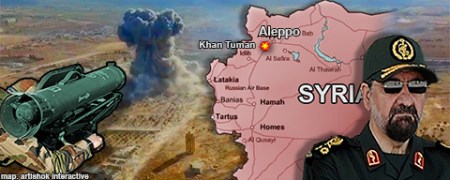
The battle on May 6 in the village of Khan Touman, located southwest of Aleppo near Route 5, the main highway leading to Damascus, will go down in the annals of the Syrian war as the biggest defeat suffered by the Iranian Revolutionary Guard Corps (IRGC) and Hizballah, as well as the battle that changed the face of the war.

DEBKAfile’s military and intelligence sources report that an Iranian force consisting of IRGC troops and Hizballah was ambushed by fighters from the Jaysh al Fath organization, part of the Nusra Front.

Until this battle took place, Iranian and Hizballah commanders in Syria did not know that the rebels had received a shipment of MILAN antitank missiles provided by Turkey and funded by Saudi Arabia.

The encounter with the advanced weapon system brought the IRGC and Hizballah to rout.

The Iranians admitted that 17 of their fighters fell in the battle, including 13 from the IRGC’s “Karbala” Division that is usually based in Iran, and 22 were wounded. Among the dead were two Iranian brigadier generals. At least ten IRGC troops were taken prisoner by the rebels. Five or seven Iranian troops were executed immediately, and an unknown number were taken from the area to an undisclosed location.

Hizballah claimed that none of its troops were killed or taken prisoner. However, that statement was actually an attempt to hide that at least 15 of its fighters were killed. According to intelligence sources that monitored the battle, Hizballah’s death toll was even higher.

The defeat was a major shock to the Iranian and Hizballah hierarchies In Tehran and Beirut, and officials vowed that revenge would be coming soon.

The immediate result of the shock was the appointment of Gen. Mohsen Rezaei, commander of the IRGC 26 years ago in the 1980s, who retired years ago and was a candidate in several presidential elections.

DEBKAfile’s sources report that Rezaei is one of the only IRGC commanders to have visited many times in the West, mainly to participate in international conferences, and has spoken freely with Western military and intelligence officers on the situation in Iran and the Middle East.

It is hard to believe that he will succeed in turning the clock back for Iran and Hizballah in Syria. Rezaei’s appointment indicates confusion   or panic in the Iranian hierarchy that does not know how to respond to the defeat.

KhanTuman480

In addition, it is still not clear whether Rezaei will replace Gen. Qassem Soleimanias commander of Iran’s forces in Syria, or be subordinate to him.

DEBKAfile’s military sources point out that bringing Rezaei to Syria does not resolve Iran and Hizballah’s main military problem, as the battle in Khan Touman showed. If the rebels continue to receive advanced weapons like antitank and antiaircraft missiles, they will become superior to the three military forces fighting for Syrian President Bashar Assad, namely Iran’s standing army and IRGC troops, the Syrian army and Hizballah.

In other words, neither the Iranians nor Hizballah can win the war for Assad.

Seven days after the battle, the commander of Hizballah’s forces in Syria, Mustafa Bader Al-din, was killed by a ground-to-ground missile strike near the Damascus international airport. Later claims by various sources that he was killed in battle at Khan Touman were actually attempts to conceal the two biggest military blows suffered by the Iranians and Hizballah in Syria

Leaked wiretaps of ISIS agents show Ankara routinely ignores terrorist cross-border activity

May 14, 2016

Leaked wiretaps of ISIS agents show Ankara routinely ignores terrorist cross-border activity

Published time: 14 May, 2016 06:19 Edited time: 14 May, 2016 08:07

Source: Leaked wiretaps of ISIS agents show Ankara routinely ignores terrorist cross-border activity — RT News

Thousands of ISIS associates have been routinely crossing into Syria aided by contacts in Turkey, phone calls tapped by Ankara security forces and handed to the media by opposition MP Erem Erdem reveal. He accuses the government of a massive cover-up.

Transcribed phone recordings belonging to Ilhami Bali, well known in Islamic State (IS, formerly ISIS/ISIL) ranks and suspected of staging high-profile bomb attacks in Ankara and the mainly-Kurdish border city of Suruc, detail the lack of control along the Syrian Turkish border. The 98-kilometer (61-mile) stretch of border has only two crossings, the Jarablus and Al Rai entry points across from Turkey’s Gaziantep and Kilis.

Pressured by the international community to impose stricter border controls to stem the flood of militants into Syria, Ankara has been erecting walls at key crossing points, but to no avail as surveillance data from the Municipality of Ankara Provincial Security Department revealed.

Read more

File photo: A bomb-disposal expert walks near victims' bodies covered with banners and flags, at the site of twin explosions near the main train station in Turkey's capital Ankara, on October 10, 2015. © Adem Altan

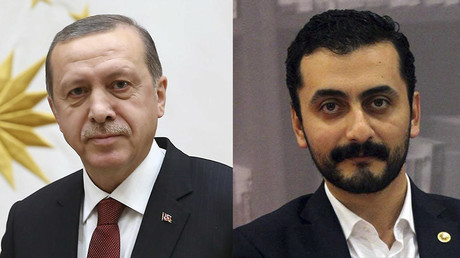
The transcripts of the recordings have been passed on to the media by Turkish opposition politician, Eren Erdem of the Republican People’s Party (CHP), who is facing a witch-hunt from President Recep Tayyip Erdogan’s government over his repeated allegations of massive cover-up of IS activity on Turkish soil.

While daily logs by the Turkish Armed Forces reveal that Turkish security forces apprehended 961 IS members from 57 countries in 2015, the alleged reality exposed by the Erdem leak, shows that thousands of IS fighters and their family members cross the Turkish border from Syria on a daily basis. But even those who get arrested on the Turkish side are often released at the crossing points.

For instance several documents suggest that IS coordinators helped some 1,400 people cross the Turkish border from September 22 – October 17. In one of the phone conversations, Ilhami Bali asked his interlocutor named Erkek, who according to the conversations helps smuggle people, the exact number of persons he has helped cross the border.

Read more

© Kayhan Ozer / Reuters; Eren Erdem / Facebook

As the men argue about the actual number of all those who entered and left Turkey, the conversation reveals that the actual count of people passing through to the Turkish side is actually more than IS coordinators have presumed.

Another conversations between the two subjects revealed Bali was extremely dissatisfied with Erkek’s performance as he failed to help IS operatives cross the border.

“Did you get our people through?” Bali asked Erkek, who replied that he was not the one guiding the group in question.

“What? Are you the one who is responsible that they got arrested? Don’t lie to me! Don’t lie to me. Eighteen people crossed the border last night. Fifteen of them got arrested when you tried to help them,” Bali said.

“Listen to me, I have warned you,” added Bali, losing his temper. “If I ever hear that you try to pass our guys through, I will come in your house and shoot you to your head. I will shoot your head while you’re in bed.”

READ MORE: RT documentary exposes dirty oil secrets, ISIS ties with Turkey

However, as other conversations have shown, IS operatives and contacts on the Turkish side of the border help those IS affiliates detained by Turkish security forces to evade justice.

“One brother, two sisters and one child were arrested while they tried to cross [at Kilis]. How could this happen? I do not understand,” wondered Erkek in another phone call.

“We have called and gave them the information,” Bali replied. “We talked to the brother who will look after the people who were arrested. Inshallah will look after them.”

More conversations between the two subjects further confirm that those who get arrested are later released through IS connections at police stations.

“The guy from the Gendarmerie called me and said that they were in the smuggler car,” Bali told Erkek in a conversations about another group detained at the border. “Call this guy. The people who got arrested today are at the Gandermarie station. Maybe he can do something… Gendarmerie took them under arrest. If they can let them free they should do that.”

Bali’s conversation with another IS operative, Mustafa Demir, offers apparent proof that the IS terror group is smuggling its fighters into Turkey for medical treatment.

“You know this Abu Abdella Garip who gets out the wounded people? Now Ali Mantara will come. He will bring a brother. He will call you when he arrives… Take the numbers and send them to the administration [of the crossing]. So the administration will look after them,” Mustafa Demir tells Bali.

“Where should I bring Abdullah Garip who helps cross the wounded ones? Should I take him to madrasa?” Bali asked.

“Send them to madrasa and call Ebu Abdallah and tell him that five persons are with Garip Geli… tell him that he should write down their names… So we can control how many left from here,” Demir replies.

In another conversation Erkek asks Bali what should “one wounded person” do when he comes to Turkey.

“I don’t really know. It has nothing to do with us,” Bali replied. “Tell them they should go to the border to the administration there.”

Geert Wilders: Let’s Dump Turkey

May 11, 2016

Geert Wilders: Let’s Dump Turkey

by Geert Wilders

11 May 2016

Source: Geert Wilders: Let’s Dump Turkey

The greatest threat to the West is Islam.

Look at every country where Islam is dominant and you will see a total lack of freedom and democracy. Islam and freedom are absolutely incompatible. And yet, we are importing it into our western societies, thereby endangering our own freedoms. It is time to stop this foolishness.

Take Turkey, for example. Turkey’s President, Recep Tayyip Erdogan, has never made a secret of his aim to strengthen the powers of Islam. Contrary to what some want us to believe, Turkey does not prove that Islam and democracy are compatible.

For Erdogan, democracy is merely a tool. He once compared it to a tram: “You ride it until you arrive at your destination, then you step off.”

Today, Mr Erdogan is stepping off.

The repercussions are felt not only in Turkey, but also in European countries, such as Germany and the Netherlands, where large Turkish immigrant communities act as the fifth column of intolerance.

Indeed, the Turkish President not only oppresses free speech at home. He has embarked on a crusade to oppress it in Europe as well. And the large groups of Turkish immigrants in Western European countries are his henchmen.

Last month, the Turkish President demanded criminal prosecution of German comedian Jan Böhmermann. The latter had ridiculed Erdogan with a critical poem on German television.

German Turks began to threaten Böhmermann to such degree that he had to request police protection and go into hiding. At the same time, the German authorities started criminal proceedings against the comedian, based on a 19th century German penal law which forbids insulting the representatives of foreign states.

The criminal proceedings were started with the explicit consent of German Chancellor Angela Merkel, who, according to Böhmermann, has “served me for tea to a despot.”

Meanwhile, Erdogan’s appetite is far from over. This week, he demanded a German court to stop Mathias Döpfner, the CEO of the Springer publishing company, from defending the comedian.

Fear of violent Turkish immigrants also forced a hamburger restaurant in Cologne to shut down. Its owner, Jörg Tiemann, had put a burger with goat cheese on the menu, calling it “the Erdogan burger.” Erdogan supporters immediately responded with threats against owner and staff, forcing the restaurant to close its doors.

Then, there is the case of Ebru Umar, a Dutch journalist of Turkish descent. Four weeks ago, she wrote a column criticizing the Turkish Consulate in Rotterdam. Following the Böhmermann incident, the Consulate had called on Dutch Turks to report incidents of “insults” against Erdogan in The Netherlands.

One week later, while on holiday in the Turkish seaside resort Kusadasi, Umar was arrested and only released on condition that she not leave Turkey. On Facebook and Twitter, hundreds of Dutch Turks openly rejoiced in her arrest.

Her home in Amsterdam was broken into and vandalized.When walking the streets of Kusadasi, Umar was threatened on several occasions by Dutch Turks who had gone looking for her. “We will know where to find you when you return to the Netherlands,” they said. “You will get what you deserve.”

Last Tuesday, after three weeks, the Erdogan regime finally allowed Umar to return to the Netherlands.

Many of those threatening people in the West are third or even fourth generation immigrants to our countries. This proves that – barring a few exceptions – the integration and assimilation of Islamic immigrants into our Western society has failed.

Many of the Islamic newcomers are simply incapable of adopting our values. Indeed, they are a danger to these values.

We must protect these values. And one of the first things to do is to sever our links with regimes promoting Islam. These regimes cannot be our friends; they are dangerous.

It is an outrage that Turkey is still a member of NATO. The sooner we get rid of this Trojan Horse within our Western alliance, the better. We should dump Turkey.

Instead of doing this, however, our current Western leaders are welcoming Turkey.

Next June, the European Union wants to allow visa free travel for Turks. For decades, the EU elites have been promoting Turkish EU membership, eagerly backed by President Barack Obama and by Hillary Clinton, who has even said that she is “strongly in favor of it.”

There is little doubt that if Hillary Rodham Clinton becomes the next President of the United States, she will be a cheerleader for Turkey.

Geert Wilders is a member of the Dutch Parliament and leader of the Party for Freedom (PVV), which is currently by far the biggest party in the Dutch polls. He is the author of “Marked for Death: Islam’s War Against the West and Me” (Regnery)

America’s Outrageous Ultimatum: Syria as the Libya of the Levant

May 7, 2016

America’s Outrageous Ultimatum: Syria as the Libya of the Levant

07.05.2016 Author: Tony Cartalucci

Source: America’s Outrageous Ultimatum: Syria as the Libya of the Levant | New Eastern Outlook

How the United States presumes to possess the authority to determine the fate of a sovereign nation thousands of miles from its own shores in the Middle East is never explained by US Secretary of State John Kerry when he recently announced a new ultimatum leveled at Damascus. Nor is it explained why Syria should capitulate to US demands to begin a political transition that has demonstrably left other nations across the Middle East and North Africa (MENA) divided, destroyed, and safe-havens for state-sponsored terrorism years after “successful” US-backed regime change has been achieved – Libya most notably.

Yet despite all of this, according to the Associate Press (AP) in their article, “Kerry warns Assad to start transition by Aug. 1  or else,” the United States fully expects Damascus to concede to a “political transition” engineered by Washington, leaving the nation in the hands of verified terrorists linked directly to the political and militant forces currently laying waste to Libya and those nations that put them into power.

The article reports:

Secretary of State John Kerry warned Syria’s government and its backers in Moscow and Tehran on Tuesday that they face an August deadline for starting a political transition to move President Bashar Assad out, or they risk the consequences of a new U.S. approach toward ending the 5-year-old civil war.   

AP would also claim:

…it’s unlikely that the Obama administration, so long opposed to an active American combat role in Syria, would significantly boost its presence beyond the 300 special forces it has authorized thus far in the heart of a U.S. presidential election season. More feasible might be U.S. allies like Saudi Arabia giving the rebels new weapons to fight Assad, such as portable surface-to-air missiles.

Again, the US is making demands of “Syria’s government and its backers in Moscow” while it is openly allied with Saudi Arabia who is admittedly backing US State Department-listed foreign terrorist organizations including the Al Nusra Front – quite literally Al Qaeda in Syria and Iraq.

This point has inconveniently surfaced even across the West’s own media, including the Independent in an article titled, “Turkey and Saudi Arabia alarm the West by backing Islamist extremists the Americans had bombed in Syria.” In it states that:

Turkey and Saudi Arabia are actively supporting a hardline coalition of Islamist rebels against Bashar al-Assad’s regime that includes al-Qaeda’s affiliate in Syria, in a move that has alarmed Western governments. 

The two countries are focusing their backing for the Syrian rebels on the combined Jaish al-Fatah, or the Army of Conquest, a command structure for jihadist groups in Syria that includes Jabhat al-Nusra, an extremist rival to Isis which shares many of its aspirations for a fundamentalist caliphate.

Despite superficial attempts to portray Al Nusra at “arms length” from Saudi Arabia, and thus from Saudi Arabia’s closest and most valuable ally, Washington, the inseparable nature of those the US and Saudi Arabia are supporting and those they claim not to support is documented fact.

America Essentially Demands Syria’s Surrender to Al Qaeda

Considering the verified nature of the so-called “opposition” in Syria and the verifiable nature of what US foreign policy has done to Libya – leaving it to this day in the hands of state-sponsored terrorist organizations including the notorious “Islamic State” or ISIS – what the US is essentially demanding of Syria and its allies is capitulation to Al Qaeda.

It is a surreal full-circle US foreign policy has made, from first creating Al Qaeda in the late 1980’s jointly with Saudi Arabia and elements within the Pakistani government, then claiming to have been struck egregiously by the terrorist organization on September 11, 2001 triggering over a decade of very profitable war, before finally arriving in Libya and Syria beginning in 2011 where once again US politicians found themselves standing shoulder-to-shoulder with literal commanders of Al Qaeda and its affiliates, waging proxies wars against their collective enemies.

Indeed, US Senator John McCain would find himself in a Libya utterly devastated by NATO at the end of 2011, shaking hands with the commander of US State Department-listed foreign terrorist organization, the Libyan Islamic Fighting Group (LIFG) – literally Al Qaeda in Libya. The LIFG commander, Abdelhakim Belhadj, had at one point been arrested by the US before being handed over to the Libyan government and imprisoned for his terrorism.

Syria’s Clear Course of Action

Syria is undoubtedly being overrun by heavily armed and extremely dangerous terrorists backed by foreign powers. These are terrorists that have proven already in Libya, that upon coming to power, they will first carry out genocide against their ethnic and political enemies, then transform Syria into a devastated wasteland and springboard for terrorism and proxy war elsewhere in the region – likely Iran and then southern Russia.Syria’s only clear course of action is to resist and defeat these terrorist factions and restore order within the nation’s boundaries. It must do this by interdicting terrorists and their supplies along the Turkish-Syrian border in the north, and the Jordanian-Syrian border in the south. It is abundantly clear that the terrorists operating within Syria cannot sustain their fighting capacity without significant and constant logistical support from their foreign sponsors beyond Syria’s borders. This fact alone, undermines the legitimacy of the so-called “uprising” and “civil war” in Syria that upon closer examination is clearly a proxy invasion.

The US’s Clear Course of Action

The US itself, in its own military manuals (MCWP 3-35.3) regarding combat operations, states in reference to defeating terrorism that:

In countering this threat, [it should be determined] whether it is internally or externally directed terrorism. Terrorism rooted externally must be severed from its roots. Against internal terrorism, [attempts should be made] to penetrate the infrastructure and destroy the leadership of the terrorist groups.

The US has already boasted of having struck hard at the leadership of various terrorist groups in Syria it claims to be at war with, yet these groups appear unfazed. This is precisely because the terrorism is being direct externally, from Turkey and Jordan where the US itself has based its forces for its ongoing Syrian operations. The clear and obvious course of action for the US is to identify the “roots” of this externally directed terrorism and “sever” them.

However, the US refuses to do this. Instead, even as it continues its feigned war against terrorism in Syria, it is doubling down on support for its proxies, including Turkey, Jordan, and Saudi Arabia, who in turn, are harboring, arming, funding, training, and directly supporting the very terrorist groups the US claims to be fighting.

US Secretary of State John Kerry threatens a “new approach” by the US in Syria, if Syria does not capitulate to what is essentially the end of its existence as a functioning nation-state. The “new approach” is likely simply the continuation of existing plans to incrementally invade and occupy Syrian territory, particularly in the east through the infiltration of Iraq-based Kurds operating under US proxy Masoud Barzani, as well as to trigger a cross-border incident north of Aleppo by using their ISIS proxies to attack Turkish targets – reminisced of staged attacks Ankara had planned earlier during the war to justify the invasion and occupation of northern Syria.

Warning the world of the “success” America’s previous “political transitions” have wrought in Libya or Iraq, and raising awareness of the current nature of US-Saudi support for Al Qaeda and other terrorist groups in Syria today, is essential in undermining the legitimacy and authority upon which the US is attempting to base its demands directed at Damascus. The demands are illegitimate and the authority they are made with constitutes not principles nor rule of law, but naked and unjust aggression that must be resisted today lest it succeed and set a precedent for further acts of injustice against other nations tomorrow.
http://journal-neo.org/2016/05/07/america-s-outrageous-ultimatum-syria-as-the-libya-of-the-levant/

Gun attack on Turkish editor outside court during his trial for exposing Turkey-Syria weapons convoy( video )

May 6, 2016

Gun attack on Turkish editor outside court during his trial for exposing Turkey-Syria weapons convoy

Published time: 6 May, 2016 14:42 Edited time: 6 May, 2016 15:48

Source: Gun attack on Turkish editor outside court during his trial for exposing Turkey-Syria weapons convoy — RT News

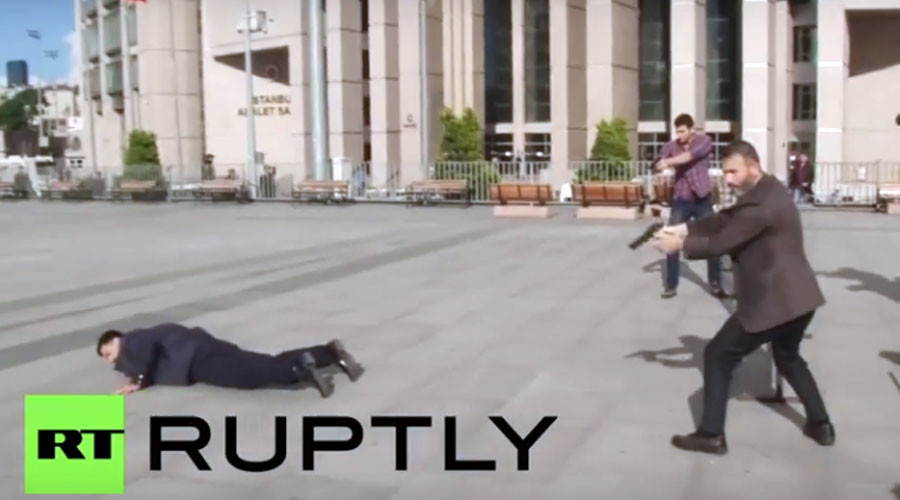
An assailant has tried to shoot the editor-in-chief of Turkey’s Cumhuriyet newspaper Can Dündar , before the court was to announce the verdict on his case, Reuters reported, citing witnesses. The paper had published reports implicating the Turkish government in having links with extremists.

The gunman shouted “traitor” before firing at least three shots at the journalist, an eyewitness told Reuters, adding that Dündar, who was unarmed, was not injured in the incident.

Reportedly at least one journalist who was covering Dündar’s trial was injured, however.

READ MORE: ‘Govt. trying to hide’: Turkey closes then postpones trials of two leading opposition journalists

Dündar, 54, and his colleague, chief of Ankara bureau of Cumhuriyet, Erdem Gul, 49, stand accused of trying to topple the government, something they allegedly attempted to do in May 2015 by publishing a video purporting to reveal truckloads of arms shipments to Syria overseen by Turkish intelligence.

The Cumhuriyet report in May 2015 claimed that Turkey’s state intelligence agency was helping to transfer weapons to Syria by trucks.

Both Dündar and Erdem spent 92 days in jail, almost half of that time in solitary confinement, before the Constitutional Court ruled in February that their pre-trial detention was a violation of their rights.

READ MORE: Jailed Turkish journalists say arrests were aimed at sending ‘clear message’ to the press

President Recep Tayyip Erdogan repeatedly stated that the trucks really belonged to the MIT intelligence agency, but were carrying aid to Turkmens in Syria, who are fighting both Assad’s forces and Islamic State (IS, formerly ISIS/ISIL).

The journalists remain under judicial supervision and are banned from leaving the country, according to the state-run Anatolia news agency.

READ MORE: Erdogan: ‘I don’t respect court ruling to free Cumhuriyet journalists’

Their detention fuelled criticism from international human rights groups, as well as from the EU. US Vice President Joe Biden said that Turkey was setting a poor example for the region by intimidating the media.

The journalists’ arrests and trial prompted numerous protests across Turkey.

The UN World Humanitarian Summit Money Pit

May 5, 2016

The UN World Humanitarian Summit Money Pit, Front Page MagazineJoseph Klein, May 5, 2016

UCHA

The United Nations Office for the Coordination of Humanitarian Affairs (OCHA) is organizing what is being billed as the first ever World Humanitarian Summit, which will take place in Istanbul Turkey on May 23-24 2016. Representatives from UN member states (including a number of heads of state and government), civil society, the private sector, crisis-affected communities and multilateral organizations are expected to attend the summit.

The summit’s purpose is said to be no less than to provide governments, the private sector, non-governmental organizations and community leaders a global platform to “announce major commitments to action, launch new partnerships aimed at saving lives, and highlight innovations which help reduce suffering and uphold humanity in times of crisis.” One of the most important goals is to inspire the creation of mechanisms for more reliable, multi-year financing for humanitarian and development programs combined. It sounds like OCHA is planning to dig an even deeper money pit for donors at the summit.

UN leaders have talked about a “grand bargain” in which UN organizations across the entire UN system would pledge to work together more cooperatively and to be more transparent in how they spend donated funds in return for enhanced, more predictable funding. “The donor base must clearly expand,” said OCHA’s Under-Secretary-General and Emergency Relief Coordinator, Stephen O’Brien, at a UN event on humanitarian financing last year.

However, when Mr. O’Brien spoke to reporters on May 2nd to highlight the importance of the upcoming summit’s agenda and the so-called “Grand Bargain” it is intended to promote, he inexplicably declined to answer some key questions. This is especially concerning, since Mr. O’Brien had already called into question his commitment to genuine UN reform and transparency. He declared in an interview with IRIN last October, for example, that “the UN doesn’t have to change.”

When asked at his May 2nd press conference how much the two day World Humanitarian Summit and preparations leading up to it are expected to cost, and where the money was coming from, Mr. O’Brien provided no numbers. He praised the host country Turkey for its generous contributions in helping to defray the full cost, without acknowledging Turkey’s self-interest in whitewashing its own abysmal record on two of the issues the summit is supposed to address – forced displacement and gender inequality.

According to OCHA’s 2016 budget plan, OCHA itself will be paying $700,748 towards the summit cost. In light of the recent scandal involving alleged payments by groups affiliated with an indicted businessman to buy influence at the United Nations, the identities and profiles of all donors of monies to defray the cost of the World Humanitarian Summit should be made public. At this point, Mr. O’Brien would not even agree to publicly disclose the heads of state and government whom have accepted invitations to attend the summit.

When asked to provide figures on the proportion of contributions to UN humanitarian programs that actually reach those in need, Mr. O’Brien also declined. There is reason to be concerned with Mr. O’Brien’s lack of transparency here as well. The UN’s Office of Internal Oversight had concluded in its 2012 audit of OCHA’s management of the Haiti Emergency Relief and Response Fund (ERRF) that “OCHA Haiti’s governance, risk management and control processes examined were assessed as unsatisfactory in providing reasonable assurance regarding the sound management of the ERRF and the effectiveness of OCHA’s coordination mechanisms and oversight role for humanitarian activities in Haiti.”

As of August 2011, $86 million had been received in donor contributions, of which approximately $80 million had been programmed and allocated for projects, and about $57.4 million had been disbursed. The UN’s internal audit found “insufficient oversight over $86 million funding made available to OCHA by donors.” The rate of international staff salaries ranged as high as $32,000 a month, while the monthly salary of national staff ranged as high $18,000. Some vehicles were rented for as high as $6000 per month.

This is not an isolated instance that should raise concern about where OCHA-channeled money is really going. According to Nicolas Séris and Roslyn Hees of Transparency International (TI), “The top ten Priority countries featured in OCHA’s 2015 Consolidated Appeal all received very low rankings in TI’s 2014 Corruption Perception Index, scoring less than 25 out of a possible 100.”

OCHA’s total 2016 budget (funded mostly from voluntary contributions, supplemented by an allocation from the regular UN assessed budget) is $323,982,056 million. In addition, OCHA coordinates the donations of hundreds of millions of dollars to specific humanitarian emergency relief programs, such as the much-criticized Haiti Emergency Relief and Response Fund.  OCHA also spends funds to coordinate with politicized pro-Palestinian organizations.

Anyone who is serious about accountable, transparent delivery of humanitarian aid to people truly in need should think long and hard before making any further unconditional funding commitments to OCHA, including at the Turkish government-hosted World Humanitarian Summit.

Cessation of hostilities in Aleppo to be announced in coming hours

May 3, 2016

Cessation of hostilities in Aleppo to be announced in coming hours – Lavrov

Published time: 3 May, 2016 11:55 Edited time: 3 May, 2016 13:34

Source: Cessation of hostilities in Aleppo to be announced in coming hours – Lavrov — RT News

A cessation of hostilities in the Syrian city of Aleppo will be announced in the coming hours, Russian Foreign Minister Sergey Lavrov said on Tuesday after talks with UN Syria envoy Staffan de Mistura.

Lavrov added that the US and Russian militaries are currently holding talks on the Aleppo ceasefire.
“I hope that in the coming hours such an agreement will be announced,” the minister said after the meeting in Moscow.

According to UN special envoy Staffan de Mistura, the stalled Syria peace talks could be resumed if an Aleppo ceasefire is agreed. He added that there is now a possibility to relaunch the ceasefire by extending local truces.

I have a feeling and a hope that we can relaunch this,” De Mistura said. “We all hope that … in a few hours we can relaunch the cessation of hostilities. If we can do this, we will be back on the right track.”

Lavrov also announced the creation of a new Russian-US monitoring center in Geneva, Switzerland, which will oversee ceasefire violations in Syria.

“We are grateful to the UN for its help in solving logistical issues on the creation of this center in Geneva where the militaries of the two countries will discuss face-to-face specific developments on the ground,” he said.

Moscow is also urging Washington to distinguish between extremists and the Syrian opposition, Lavrov added.

To make the ceasefire work and make it inclusive, our partners must do everything possible to remove the moderate opposition, which relies on foreign support, from the positions occupied by the terrorists.

Lavrov also called for an extended ceasefire in Syria. “Of course, there are separate groups who would like to undermine the cessation of hostilities, to provoke an escalation [of the crisis]. We can’t let them do it,” he said.

Lavrov also warned against any calls for a ground operation in Syria.

Russia is concerned, and not just us alone, about Turkey’s shelling of the Syrian territory, continued creation of certain security zones in Syria, not to mention the increasing calls for a ground operation.”

Moscow is convinced “that such calls come from those who are not interested in the real political settlement [of Syrian crisis] and who rely on a military solution.”

“We are convinced that this is the way to a catastrophic situation, and such appeals should be stopped,” Lavrov said.

In April, the Geneva peace talks were gridlocked after the Saudi-backed Syrian opposition withdrew from the negotiations, citing the deteriorating situation in Aleppo.

Acknowledging the increasingly shaky state of the ceasefire in Syria, de Mistura then expressed hope that Russia and the US could breathe new impetus into the process, halting the fighting on the ground and solidifying the political transition process.

On Monday, the Free Syrian Army refused to recognize partial ceasefires or local lulls in violence, claiming that if the UN-backed truce was not implemented in full, the group would reserve its right to withdraw from the Geneva talks and respond to any attacks.

“Nightmare” Mistake: Visa Free Travel For 80 Million Turks Coming Up

May 3, 2016

Nightmare” Mistake: Visa Free Travel For 80 Million Turks Coming Up Tyler Durden’s picture Submitted

by Tyler Durden

05/02/2016 21:43 -0400

Source: “Nightmare” Mistake: Visa Free Travel For 80 Million Turks Coming Up | Zero Hedge

Submitted by Mike “Mish” Shedlock of MishTalk

“Nightmare” Mistake: Visa Free Travel For 80 Million Turks Coming Up

Of all the inane, self-serving, deals German Chancellor Angela Merkel made with Turkey, visa-free travel for 80 million Islamic Turks tops the list.

“This is all a nightmare,” said one diplomat charged with making the deal work.

Nightmares aside, Brussels Prepares Legal Groundwork on Visa-Free Travel for Turks.

Brussels will this week propose visa-free travel to Europe for 80m Turks but says Ankara still needs to meet several politically explosive reform conditions within weeks, including overhauling its terrorism laws and party funding rules.


The enhanced travel rights were Turkey’s main windfall from a landmark EU deal in March, in which Ankara helped dramatically cut migrant flows to Europe by agreeing to take back all migrants arriving on the Greek islands.


On Wednesday the European Commission will legally recommend Turks should be granted short-term visa-free travel to the Schengen area. But it will point out that up to nine of the 72 eligibility conditions required of Turkey remain incomplete, according to people familiar with the proposal.


The stage is now set for a stand-off before the June visa deadline, with far-reaching consequences for the migration crisis, domestic politics across Europe and Turkey’s long-term relations with the bloc. Decisions on visa rights for Ukraine, Georgia and Kosovo are set to be taken at the same time.


“This is all a nightmare,” said one diplomat involved in talks. Another European diplomat described the Turkey-EU deal as carrying “the seeds of its own destruction”.


It is a gamble some senior EU officials fear “is a big mistake” and will backfire. “This will be the perfect get-out for the Dutch, French and Germans, who are facing major domestic problems and  suffering from buyer’s remorse since the Turkey deal,” the official said. “And the European Parliament will just not accept a political fudge, the Turks won’t be able to ram it through.”

Appropriate Terms (in Order of Occurrence)

  • Windfall to Turkey
  • Short-Term
  • Stage Set for Standoff
  • Nightmare
  • Seeds of its Own Destruction
  • Big Mistake
  • Backfire
  • Political Fudge

Political fudge, seeds of its own destruction, and nightmare are my three favorite descriptions.

A strong argument can be made for “short-term” given the massive long-term problems should this deal actually go through.

Europe’s Migration Crisis: No End in Sight

May 2, 2016

Europe’s Migration Crisis: No End in Sight, Gatestone Institute, Judith Bergman, May 2, 2016

♦ According to France’s Defense Minister, Jean-Yves Le Drian, 800,000 migrants are currently in Libyan territory waiting to cross the Mediterranean.

♦ The multitude of very costly social problems that Muslim migration into Europe has caused thus far, do not exist in this whitewashed European Union report, where the “research” indicates that migrants are always a boon. Similarly, any mention of the very real security costs necessitated by the Islamization occurring in Europe, and the need for monitoring of potential jihadists, simply goes unmentioned.

♦ Several European states have a less optimistic picture of the prospect of another three million migrants arriving on Europe’s borders than either the Pope or the European Commission do.

Pope Francis, on his recent visit to the Greek island of Lesbos, said that Europe must respond to the migrant crisis with solutions that are “worthy of humanity.” He also decried “that dense pall of indifference that clouds hearts and minds.” The Pope then proceeded to demonstrate what he believes is a response “worthy of humanity” by bringing 12 Syrian Muslims with him on his plane to Italy. “It’s a drop of water in the sea. But after this drop, the sea will never be the same,” the Pope mused.

The Pope’s speech did not contain a single reference to the harsh consequences of Muslim migration into the European continent for Europeans. Instead, the speech was laced with reflections such as “…barriers create divisions instead of promoting the true progress of peoples, and divisions sooner or later lead to confrontations” and “…our willingness to continue to cooperate so that the challenges we face today will not lead to conflict, but rather to the growth of the civilization of love.”

The Pope went back to his practically migrant-free Vatican City — those 12 Syrian Muslims will be hosted by Italy, not the Vatican, although the Holy See will be supporting them — leaving it to ordinary Europeans to cope with the consequences of “the growth of the civilization of love.”

There is nothing quite as free in this world as not practicing what you preach, and what the Pope is preaching is the acceptance of more migration into Europe, and more migration — much more — is indeed what is in the cards for Europe.

At the UN’s Geneva conference on Syrian refugees on March 30, Italy’s Minister of Foreign Affairs, Paolo Gentiloni, put the total number of asylum seekers into Italy in the first three months of 2016 at 18,234. This is already 80% higher than in the same period in 2015.

According to Paolo Serra, military adviser to Martin Kobler, the UN’s Libya envoy, migrants currently in Libya will head for Italy in large numbers if the country is not stabilized. “If we do not intervene, there could be 250,000 arrivals [in Italy] by the end of 2016,” he said. According to France’s Defense Minister, Jean-Yves Le Drian, the number is much higher: 800,000 migrants are currently in Libyan territory waiting to cross the Mediterranean.

Already in November 2015, the European Union estimated — in its Autumn 2015 European Economic Forecast, authored by the European Commission — that by the end of 2016, another three million migrants will have made it into the European Union.

Nevertheless, the European Commission optimistically noted that, “while unevenly distributed among countries, the estimated additional public expenditure related to the arrival of asylum seekers is limited for most EU member states.” It even concluded that the migrant crisis could have a small, positive impact on European economies within a few years citing that “Research indicates that non-EU migrants typically receive less in individual benefits than they contribute in taxes and social contribution.”

This is the classic, politically correct denial of facts on the ground. The multitude of very costly social problems that Muslim migration into Europe has caused thus far do not exist in this whitewashed report, where the “research” indicates that migrants are always a boon. Similarly, any mention of the very real security costs necessitated by the Islamization that is occurring in Europe and the consequent need for monitoring of potential jihadists, simply goes unmentioned. One wonders whether the EU bureaucrats, who authored this report, ever descend from their ivory towers and move about in the real Europe.

Several European states have a less optimistic picture of the prospect of another three million migrants arriving on Europe’s borders than either the Pope or the European Commission do. In February, Austria announced that it would introduce border controls at border crossings along frontiers with Italy, Slovenia and Hungary. On April 12, Austria began preparations for introducing border controls on its side of the Brenner Pass, the main Alpine crossing into Italy, by starting work on a wall between the two countries.

The Austrian decision to close the Brenner pass has received harsh criticism from the EU. European Commission spokeswoman Natasha Bertaud criticized the measure as unwarranted, claiming that “there is indeed no evidence that flows of irregular migrants are shifting from Greece to Italy”. Is Bertaud deliberately misrepresenting the issue? The issue is not whether the migrants are shifting from Greece to Italy after the EU’s unsavory deal with Turkey (they probably will) but the up to 800,000 migrants are already waiting to cross into Italy from Libya.

EU Migration Commissioner Dimitris Avramopoulos joined in the criticism of Austria, saying, “What is happening at the border between Italy and Austria is not the right solution.” He had criticized Austria already in February, when Vienna announced that it would cap asylum claims at 80 per day. At the time, Avramopoulos said,

“It is true that Austria is under huge pressure… It is true they are overwhelmed. But, on the other hand, there are some principles and laws that all countries must respect and apply… The Austrians are obliged to accept asylum applications without putting a cap.”

In response, Austria’s Chancellor Werner Faymann told the EU that Austria could not just let the influx of migrants continue unchecked — nearly 100,000 have applied for asylum in Austria — and he called for the EU to act. The EU has not yet acted.

The EU should hardly be surprised that a sovereign state decides to take matters into its own hands in the face of the EU’s failure to heed that call, and as it anticipates a repeat of last year’s migration chaos — which, given the predicted estimates, is bound to occur this year with even greater force.

Predictably, Italy has also criticized the decision, with Italian Interior Minister Angelino Alfano saying that Austria’s decision to erect the barrier is “unexplainable and unjustifiable.” Italy, however, only has itself to blame for Austria’s restrictions at the Brenner Pass. In 2014 and the first half of 2015, around 300,000 migrants arrived in Italy, mainly from Libya. Despite EU rules that require Italy to register those migrants, Italy simply let most of them pass through the country and continue into Austria. From there, most went further into Germany and Northern Europe. Clearly, Austria does not expect the Italians to change their practices.

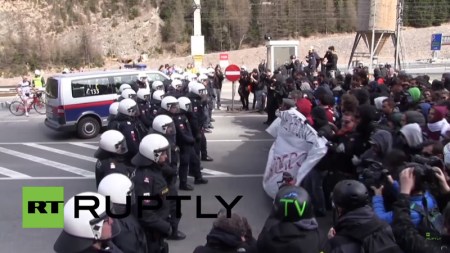
1573Austrian police prepare to hold the line at the Brenner Pass border crossing with Italy, as a crowd tries to break through during a violent protest on April 3, 2016, against Austria’s introduction of border controls to stem the flow of migrants. (Image source: RT video screenshot)

While the bureaucrats of the EU bicker with their member states over those states’ unwillingness to follow EU regulations — evidently not made to cope with a migration crisis of these huge proportions — Turkey’s President, Recep Tayyip Erdogan is threatening to drop his obligations under a recent EU-Turkey migration deal. Those obligations include taking back all new “irregular migrants” crossing from Turkey into Greek islands, as well as taking any necessary measures to prevent the opening of new sea or land routes for migration from Turkey to the EU. “There are precise conditions. If the European Union does not take the necessary steps, then Turkey will not implement the agreement,” Erdogan warned recently in a speech in Ankara.

Erdogan knows that in the current European reality, his words have the effect he intends: When he threatens to flood Europe with migrants unless it does what he wants — in other words, blackmail — EU leaders will do what he says. German Chancellor Angela Merkel, one of the driving forces behind the EU-Turkey deal, also recently bowed to Erdogan’s demands that Germany prosecute the satirist Jan Böhmermann, after he mocked and insulted the Turkish president in a poem. The German criminal code prohibits insults against foreign leaders, but leaves it to the government to decide whether to authorize prosecutors to pursue such cases. Angela Merkel gave her authorization, a decision widely criticized. Her own ministers — Foreign Minister Frank-Walter Steinmeier, and Justice Minister Heiko Maas — said they did not believe that the authorization should have been granted.

Another indication that Erdogan has no reason to fear any misbehavior on the part of the European Union regarding the EU-Turkey deal is that the European Parliament just voted in favor of making Turkish an official European Union language. Ostensibly, the vote came about in order to back an initiative by the president of Cyprus, Nicos Anastasiades, who asked the Dutch EU Presidency to add Turkish to the bloc’s 24 official languages in order to boost attempts to reach a reunification agreement for Cyprus.

In his letter to the EU presidency, Anastasiades noted that Cyprus had already filed a similar request during its EU entry talks in 2002, but, at that time, it “was advised by the [EU] institutions not to insist, taking into account the limited practical purpose of such a development … as well as the considerable cost”. Turkey’s occupation of northern Cyprus, which Turkey invaded in 1974, is one of the issues blocking Turkey’s accession negotiations with the EU.

Making Turkish an official language is seen by Turkey, according to a senior Turkish official, as “a very important, very positive gesture” for the Cyprus peace talks and for EU-Turkish ties more broadly. “If the blockage is lifted because of Cyprus being solved, then we can proceed very quickly,” the Turkish official said.

All of the other official and working languages of the European Union are tied to states which are full members of the EU. Although the vote has to be approved by the European Commission before the decision can come into effect, it speaks volumes about the EU’s deference to Erdogan.

In light of these developments, the granting of visa-free travel to European Union states for 80 million Turks looks as if it is a done deal, despite the 72 conditions, which Turkey, at least on paper, is expected to live up to. These include increasing the use of biometric passports and other technical requirements. So far, Turkey has only met half of these conditions. Perhaps that is why European Commission President Jean-Claude Juncker recently felt the need to mention that, “Turkey must fulfill all remaining conditions so that the Commission can adopt its proposal in the coming months. The criteria will not be watered down.” The question is whether Juncker himself even believes his own words.

With the provisions on visa-free travel for 80 million Turks, the EU may just have gone from the frying pan into the fire. The visa-free admission of Turks into Europe would give Erdogan completely free rein to control the influx of migrants into Europe. Moreover, anyone believing that Erdogan would not take great advantage of this opportunity would have to be dangerously naïve. The European Union may yet conclude that the migrant crisis, in all its enormity, is the far lesser evil.