Dore Gold on “Fox & Friends,” May 22, 2017, The Jerusalem Center via YouTube
A Dose of Reality in Riyadh, Front Page Magazine, Bruce Bawer, May 22, 2017
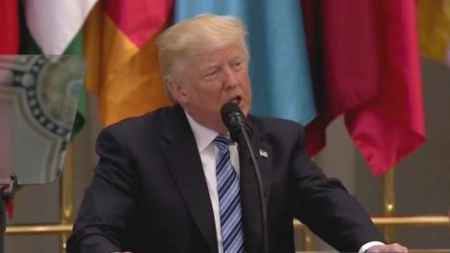
Early on in his speech, Trump addressed his audience as friends and partners; within a few minutes, without pointing a finger, and without abandoning the collegial tone or the complimentary language, made it clear he was lecturing them. He was the boss, the capo di tutti capi, and he was laying down terms. This wasn’t Obama, who naively thought he could change the world with groveling apologies for the West, praise for Islam built on sheer fantasy, and yet another retelling of his own supposedly inspiring personal story – all the while oozing beta-male deference and docility. No; this was a man of power who – never once talking about himself – made expert use of that power, wielding an iron fist in a velvet glove. His message was unmistakable: either set aside this stupid religion (or at least rein it in, and now), join the modern world, and set your people free to dream, hope, create, grow, and prosper. Or else face the consequences. When, at the end, he summed up the assets of the Islamic world, he didn’t even mention Islam: he cited, among other things, its “spirit of enterprise” and ambitious young people. Where Obama had falsely attributed all kinds of past wonders to Islam, Trump imagined an implicitly Islam-free future in which the region could finally enjoy “glorious wonders of science, art, medicine, and commerce to inspire mankind.”
*****************
On June 4, 2009, Barack Obama went to Cairo and delivered a speech, addressed to the Muslim world, that was full of praise for Islam and apologies on behalf of the West. In the address, entitled “A New Beginning” (“I’ve come here to Cairo,” he explained, “to seek a new beginning between the United States and Muslims around the world”), he called the university at which he was speaking (which, if it were anywhere in the West, would probably not be able to gain accreditation) “a beacon of Islamic learning”; he blamed tensions between the West and Islam largely on Western “colonialism”; he said “Salaam aleikum” and kept referring to “the Holy Koran”; he asserted, in a ridiculous example of hyperbole, that “Islam has always been part of America’s story”; he served up a big wallop of revised history, giving Islam unmerited praise for centuries-old accomplishments in science, architecture, music, art, and medicine and even holding it up as “a model of tolerance and equality” (at one point, he seemed to imply that in some ways women’s rights are more advanced in the Muslim world than in the U.S.); and, with utter predictability, he quoted the the “Holy Koran” out of context, plucking out that favorite verse of all Western apologists that supposedly teaches “that if one kills an innocent, it is as if it he has killed all of mankind.”
And of course, as always, he talked about himself: a descendant of “generations of Muslims” in Kenya; a man who, in his Indonesian boyhood, daily heard the beautiful Islamic call to prayer; a president who had “known Islam on three continents before coming to the region where it was first revealed.” As someone with such intimate ties to the Religion of Peace, asserted Obama, he saw it as part of his job to “fight against negative stereotypes of Islam.” Yes, he spoke about the need to fight terror, but he was quick to maintain that “Islam is not part of the problem” but rather “an important part of promoting peace.” He defended U.S. ties to Israel and recognized the “reality of the Holocaust,” but quickly pivoted to the “suffering” of Palestinians, the “pain of dislocation” they experienced, and the “daily humiliations” of the “occupation” – preaching, in short, to Israel from a Cairo pulpit. He quoted from the Talmud, but was careful not to call it holy. He implied that the histories of the Jews and Palestinians were equally tragic. And he preached to America too, suggesting that when Americans criticize the “choice” of women – and girls (!) – to wear hijab they were disguising their “hostility” to Islam “behind the pretense of liberalism.” Similarly, instead of thundering against the evil of 9/11, Obama apologized for the supposed excesses of some Americans’ responses to that atrocity, saying with nauseating chagrin that “in some cases it led us to acts contrary to our principles and our ideals.” Oh, and he vowed to close Guantánamo “by early next year.”
This Sunday, almost exactly as far into his presidency as Obama was when he gave his Cairo speech, Donald Trump spoke in Riyadh. For some of us, the very prospect of this appearance had been, to put it mildly, dismaying. Trump won the election, after all, largely because of his tough and bracingly realistic talk about Islam. Now, on his first trip abroad as president, he was going to Saudi Arabia. It was bad enough that this was a trip to a Muslim country. But Saudi Arabia isn’t just any Muslim country. It’s the mother of all Muslim countries. It’s the single most backward of them all. It’s a state sponsor of terrorism. It, and members of its royal family, have bankrolled mosques and madrassas and university departments of Middle Eastern Studies throughout the Western world – places that are nothing more than centers of Islamic propaganda. Most of the 9/11 hijackers, as the whole world knows, were Saudis. And the whole point of Trump’s visit to Riyadh was to celebrate a gigantic sale of U.S. arms to the Saudis on the premise that they represent a major bulwark against an even more dire threat, namely Iran. Nor was Trump just addressing the Saudis: also in attendance were the leaders of most of the other Muslim countries on the planet – in other words, a whole boatload of really nasty customers. It was hard not to conclude that Trump, like Obama, was going to try to brown-nose his way into a “new beginning between the United States and Muslims.”
The opening minutes of Trump’s speech certainly did nothing to dispel this expectation. It was gag-inducing to hear him praise the “magnificent kingdom” of Saudi Arabia, “the splendor of your country,” “the grandeur of this remarkable place,” and so on. It was absurd to hear him talk about working together with the ultra-extremist Saudis to eliminate “extremism.”
But then something happened. Even as he continued to serve up the usual glowing rhetoric about Islam being “one of the world’s great faiths,” and to refer to this and that as being “holy,” he made a couple of exceedingly elegant transitions. First, he began mixing the ethereal praise with realistic businessman-type talk about the value of international partnership. “We are not here to lecture, to tell other people how to live, what to do, who to be, or how to worship,” he said. “Instead, we are here to offer partnership” between the West and the Muslim world – a partnership that would bring prosperity to future Muslim generations. But he underscored the fact that in order for such a partnership to work, something would have to change. And it would have to change a lot. The Islamic world, he insisted, had to turn into a place where young Muslims could grow up “innocent of hatred.” And then he spelled out the results of that hatred, presenting first a roll call of some of the “barbaric attacks” on America – 9/11, Boston, San Bernardino, Orlando – and then a list of other places (“Europe, Africa, South America, India, Russia, China, and Australia”) where that hatred has manifested itself.
However delicately he worked his way around to it, it was nothing less than an accusation.
No, he didn’t explicitly charge Muslim leaders with funding terrorism – but he told them, in no uncertain terms, that they needed to cut off funds to terrorists. Nor did he explicitly blame Islam for terror or explicitly call it evil (as much as some of us would have loved to hear him do so) – but he came tantalizingly close to doing so, speaking bluntly about the “vile creed,” the “wicked ideology,” the “craven ideology”, that underlies terror. He did use the word “evil.” And, yes, he spoke of “Islamic” (not “Islamist” or “radical Islamic”) terror. And he made it clear he wasn’t just talking about terrorism – he was talking about Islam itself. He condemned “the oppression of women, the persecution of Jews, and the slaughter of Christians.” He warned: “barbarism will deliver you no glory. Piety to evil will bring you no dignity.” Yes, “piety to evil.” Even as he continued to make flattering references to Islam, they felt increasingly pro forma, and it became increasingly manifest that he was identifying that religion as the root not just of terror but of all that is primitive and barbaric about that portion of the world in which it is most commonly practiced. In one remarkable passage, he listed a number of wonders of the Arab region of which his listeners should be proud. What was remarkable was that they were all wonders that dated to pre-Islamic times. In short, he was reminding these people that they had a proud history, a proud identity, that predated their prophet and that could, if they wished, help form the foundation of a new, free, forward-looking culture.
Of course, even to express such thoughts, in some Islamic countries, is considered heretical, illegal; but Trump did it in such a masterly way that you could imagine some of these Muslim big shots sitting there trying to figure out whether they should be offended or not.
In fact, it was all quite masterfully done. Early on in his speech, Trump addressed his audience as friends and partners; within a few minutes, without pointing a finger, and without abandoning the collegial tone or the complimentary language, made it clear he was lecturing them. He was the boss, the capo di tutti capi, and he was laying down terms. This wasn’t Obama, who naively thought he could change the world with groveling apologies for the West, praise for Islam built on sheer fantasy, and yet another retelling of his own supposedly inspiring personal story – all the while oozing beta-male deference and docility. No; this was a man of power who – never once talking about himself – made expert use of that power, wielding an iron fist in a velvet glove. His message was unmistakable: either set aside this stupid religion (or at least rein it in, and now), join the modern world, and set your people free to dream, hope, create, grow, and prosper. Or else face the consequences. When, at the end, he summed up the assets of the Islamic world, he didn’t even mention Islam: he cited, among other things, its “spirit of enterprise” and ambitious young people. Where Obama had falsely attributed all kinds of past wonders to Islam, Trump imagined an implicitly Islam-free future in which the region could finally enjoy “glorious wonders of science, art, medicine, and commerce to inspire mankind.”
Yes, it would have been terrific to hear an American president spell out the truth about Islam in a less nuanced, less diplomatic fashion. And it was frankly bizarre to hear Trump, in his closing moments, singling Iran out as uniquely malevolent after having heaped praise on other equally nefarious regimes whose leaders were right there in the room with him. But we critics of Islam have our jobs and Trump has his. Given the occasion and the purpose, this was, even at its worst, an immense improvement over Obama’s Cairo oration, and, at its best, a convincing assertion of authority, a strongly pitched demand for radical transformation, and a perfectly calibrated use of the carrot-and-stick approach.
No, international Islam is almost certainly beyond meaningful reform. But history has shown that it can at least be contained and controlled in ways that give citizens of Muslim-majority countries a certain degree of freedom and that keep to a minimum the scale of violence in the West originating in those countries. (The rampant Islamization of the West, and the concomitant increase in home-grown Islamic terror, are separate questions.) And no, a single speech can’t accomplish much of anything. But Trump’s tough presentation in Riyadh, if followed up by equally tough interactions with our “friends” in that audience, may well get a few things, here and there, moving in welcome directions.
Major US Jewish Organization Lauds Trump’s ‘Refreshing, Honest’ Speech in Saudi Arabia, Algemeiner, May 21, 2017
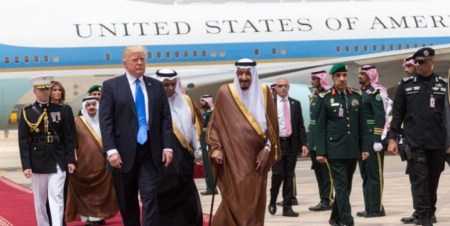 President Donald Trump arrives in Saudi Arabia. Photo: White House
A leading American Jewish advocacy organization praised Donald Trump’s speech to Muslim leaders in Saudi Arabia on Sunday, saying the president had demonstrated “refreshing honesty…in describing the Islamist extremist threat that developed in the Middle East years ago.”
“We agree that the fight against Islamist extremism is a battle between the forces of good and decency, on the one hand, and evil and a death cult, on the other, and that victory depends, above all, on what Arab and Muslim nations do to counter and defeat this violent, deadly scourge,” said David Harris, CEO of the American Jewish Committee (AJC), in a statement.
Trump issued an urgent plea to the leaders of more than 50 Muslim countries to join a “coalition of nations who share the aim of stamping out extremism and providing our children a hopeful future that does honor to God.”
Trump pointed out to his hosts that “in sheer numbers, the deadliest toll has been exacted on the innocent people of Arab, Muslim and Middle Eastern nations. They have borne the brunt of the killings and the worst of the destruction in this wave of fanatical violence.”
Trump pointedly included organizations other than ISIS on his list of terrorist organizations.
“The true toll of ISIS, al Qaeda, Hezbollah, Hamas, and so many others, must be counted not only in the number of dead. It must also be counted in generations of vanished dreams,” Trump declared.
“He could not have been clearer in his description of Hezbollah and Hamas as the terrorist groups they most assuredly are,” the AJC’s Harris added.
Trump, Unlike Obama, Addressed ‘Islamic Terror’ Directly, Breitbart, Joel B. Pollak, May 21, 2017
President Donald Trump and President Barack Obama delivered addresses to the Muslim world at roughly the same point in their respective presidencies.
But unlike Obama, who attempted to appease Islamic resentment of the West by admitting America’s faults, Trump’s speech in Riyadh, Saudi Arabia on Sunday emphasized terrorism and challenged the Arab and Muslim world to foster peace by “honestly confronting the problem of Islamic extremism, and the Islamists, and Islamic terror of all kinds.”
Trump rallied the nations of the region to deal with a problem in their midst; Obama gave legitimacy to a banned group associated with terror and extremist ideology.
Obama began his address by focusing on western guilt:
More recently, tension has been fed by colonialism that denied rights and opportunities to many Muslims, and a Cold War in which Muslim-majority countries were too often treated as proxies without regard to their own aspirations. Moreover, the sweeping change brought by modernity and globalization led many Muslims to view the West as hostile to the traditions of Islam.
In contrast, Trump began by declaring that “Muslim countries must take the lead in combating radicalization. He said that he was not there to lecture to others about how to worship, but to call for unity “in pursuing the one goal: … to conquer extremism and vanquish the forces that terrorism brings with it every single time,” singling out “young Muslim men and women.”
Trump went further, taking on “terrorism and the ideology that drives it.” He listed recent terror attacks in the U.S. and around the world, and noted that “the deadliest toll has been extracted from the innocent people of Arab and Muslim nations.” The optimism of the region, he said, was “held at bay by bloodshed and terror.” And he added: “There can be no co-existence with this violence.”
Obama, too, had emphasized that many of the victims of groups like Al Qaeda were Muslim. Like Obama, Trump distanced terror from faith, suggesting terrorists falsely used the name of God, and implying that the problem was not limited to Islam, But Trump did not shy away from the link to Islam, whereas Obama sought to absolve Islam itself of any link with terrorism.
Obama said: “Islam is not part of the problem in combating violent extremism – it is an important part of promoting peace.” Obama never even used the word “terror.” He simply referred to “violence against civilians” by “extremists,” whom he never connected directly to Islam.
In contrast, Trump told the gathering in Saudi Arabia to “[d]rive them [terrorists] out from your places of worship,” and exhorted the nations present to make sure “terrorists find no sanctuary on their soil.”
Obama defended America to the Muslim world by emphasizing America’s connection to Islam — almost describing the U.S. as a Muslim nation itself. “[L]et there be no doubt: Islam is a part of America,” Obama declared. He cited exaggerated population figures for Muslims in the U.S.: “nearly seven million American Muslims in our country today,” he claimed.
Trump, in contrast, praised the achievements of the Arab and Muslim world in the region itself, but did not try to remake America in Islam’s image. Trump also spoke in a forthright manner about the persecution of Jews, whereas Obama irritated Israelis by claiming Israel was created because of the Holocaust.
Both presidents were gracious to their audience. Both downplayed the idea of interfering in the affairs of the Muslim world, unlike earlier administrations. Trump offered the Saudis the “friendship, and hope, and love” of the American people, and praised his hosts as the guardians of “the two holiest sites in the Islamic faith.” Trump also praised the arms deal he had reached with Saudi Arabia the day before, which he said would help both sides.
Obama was somewhat less focused on Egypt itself, but was effusive in his praise of Islam in general, crediting it — with some exaggeration — with making the European enlightenment possible, and with fostering religious tolerance.
Yet Trump was clear about the need to confront Iran as a common challenge to peace in the entire region. He even implied that regime change was an ultimate goal of U.S. policy toward Iran. Obama, in contrast, appeased Iran and accepted blame, publicly, for a “role in the overthrow of a democratically-elected Iranian government” in the 1950s.
Early media reports suggest that Trump’s speech is being described as “moderate,” because he did not use the signature phrase “radical Islamic terror.” That is not accurate: the principal objection to Obama’s evasion was the absence of the word “Islam,” which Trump addressed directly. But if that is indeed how the speech was received, then Trump achieved something great indeed: identifying the eradication of Islamic terror as a “moderate” value.
Excerpts: Trump will say ‘Islamist extremism’ in Saudi Arabia speech, Washington Examiner, Daniel Chaitin, May 21, 2017
(President Trump’s address is to be carried live here:
— DM)
 President Trump speaks during a bilateral meeting with Qatar’s Emir Sheikh Tamim Bin Hamad Al-Thani, Sunday, May 21, 2017, in Riyadh. (AP Photo/Evan Vucci)
Following speculation that he would avoid saying “radical Islamic extremism” on Sunday after using it often during the campaign — both national security adviser H.R. McMaster and Trump counselor Kellyanne Conway refused to say if Trump would use the terminology — Trump will say “Islamist extremism.”
“That means honestly confronting the crisis of Islamist extremism and the Islamist terror groups it inspires. And it means standing together against the murder of innocent Muslims, the oppression of women, the persecution of Jews, and the slaughter of Christians,” Trump will say. “Religious leaders must make this absolutely clear: Barbarism will deliver you no glory — piety to evil will bring you no dignity. If you choose the path of terror, your life will be empty, your life will be brief, and your soul will be condemned.”
************************
President Trump will describe the fight against terrorism as “Islamist extremism” during his major speech to Middle Eastern leaders on Sunday, according to excerpts released from the White House.
“We are adopting a principled realism, rooted in common values and shared interests,” Trump will say in Saudi Arabia. “Our friends will never question our support, and our enemies will never doubt our determination. Our partnerships will advance security through stability, not through radical disruption. We will make decisions based on real-world outcomes — not inflexible ideology. We will be guided by the lessons of experience, not the confines of rigid thinking. And, wherever possible, we will seek gradual reforms — not sudden intervention.”
The president will urge Middle Eastern countries to take the initiative in the conflict, as the United States is willing to help but not do all the fighting itself. Trump just signed a $110 billion arms deal with Saudi Arabia to do just that, and told the Emir of Qatar, Tamim bin Hamad al Thani, during a brief photo spray on Sunday that they discussed another purchase of “beautiful military equipment.”
“But we can only over acome this evil if the forces of good are united and strong — and if everyone in this room does their fair share and fulfills their part of the burden,” Trump will say. “Terrorism has spread across the world. But the path to peace begins right here, on this ancient soil, in this sacred land. America is prepared to stand with you — in pursuit of shared interests and common security. But the nations of the Middle East cannot wait for American power to crush this enemy for them. The nations of the Middle East will have to decide what kind of future they want for themselves, for their countries, and for their children.”
As previously reported by the Associated Press about a draft it obtained, Trump will cast the fight as a “battle between good and evil.”
“This is not a battle between different faiths, different sects, or different civilizations,” Trump will say. “This is a battle between barbaric criminals who seek to obliterate human life, and decent people of all religions who seek to protect it. This is a battle between good and evil.”
Following speculation that he would avoid saying “radical Islamic extremism” on Sunday after using it often during the campaign — both national security adviser H.R. McMaster and Trump counselor Kellyanne Conway refused to say if Trump would use the terminology — Trump will say “Islamist extremism.”
“That means honestly confronting the crisis of Islamist extremism and the Islamist terror groups it inspires. And it means standing together against the murder of innocent Muslims, the oppression of women, the persecution of Jews, and the slaughter of Christians,” Trump will say. “Religious leaders must make this absolutely clear: Barbarism will deliver you no glory — piety to evil will bring you no dignity. If you choose the path of terror, your life will be empty, your life will be brief, and your soul will be condemned.”
Here are the top 15 agreements signed between Saudi Arabia and the US, Al Arabiya, May 20, 2017
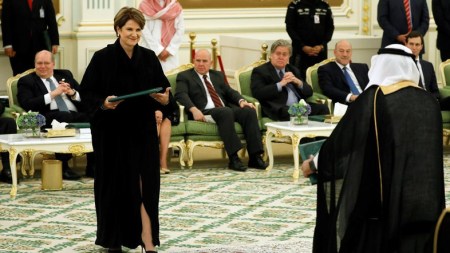
Lockheed Martin Chairman and CEO Marillyn Hewson (L) exchanges agreements with a Saudi official after a signing ceremony between Saudi Arabia’s King Salman bin Abdulaziz Al Saud and U.S. President Donald Trump at the Royal Court in Riyadh, Saudi Arabia May 20, 2017. REUTERS/Jonathan Ernst
Saudi Arabia and the United States signed agreements and economic deals worth 280 billion dollars expected to create over hundreds of thousands of jobs in the two countries in the next coming years.
Reflections on Trump’s First State Visit to the Middle East, The National Interest, Ahmed Charai, May 19, 2017
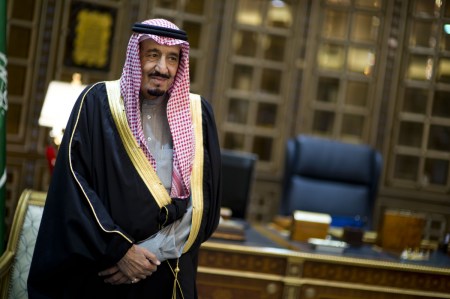 King Salman of Saudi Arabia in 2013. Flickr/Secretary of Defense
The Trump administration, working alongside its Arab allies, should promote moderate or quietist forms of Islam, and not remain neutral on religious matters. This means working with Islamic leaders, many of whom are state-funded imams, to challenge jihad on a religious basis and offer a form of faith shorn of violence.
These strategic insights come together in Morocco, where King Mohammed VI has used his religious role as commander of the faithful to inspire religious leaders to combat jihadism and urge tolerance and peace.
******************************
President Trump is visiting the Middle East. He will travel to Saudi Arabia and Israel, then visit the Vatican. Given the sequence of the first two, some observers speculated that he will attempt to revive the Israeli-Palestinian peace process, perhaps within a broader, regional framework. But different potential outcomes for Arab-Israeli relations, short of a peace settlement, may also be in the offing.
Both Saudi Arabia and Israel have proven themselves to be invaluable partners to the United States in the struggle against ISIS. An American-brokered framework whereby direct cooperation between the two is formalized—rather than a reliance on the United States as an intermediary—may create a framework to broaden the cooperation. Heightened partnership to counter the shared threat of Iran would be an obvious next step. The Trump administration’s new strategy is the creation of a regional alliance, focused on the Gulf countries but also including countries such as Egypt, Jordan and Morocco. A multilateral approach in which Israel plays a more direct and visible role in the coalition would signify a breakthrough. It would bolster confidence among Arab publics that broader cooperation and conflict resolution are warranted.
Donald Trump made the eradication of the Islamic State a priority during his campaign. He has been criticized for his more muscular strategy, as well as the desire to augment intelligence, economic and communications measures to put the screw to the organization.
It seems possible that the president is making a clean break with the Obama administration’s policy of disengagement from the Middle East. For Trump, the rubric of a “war on terrorism” seems to be appealing. Arabs appreciate the fact that, unlikely his predecessor, Trump appears to be recognizing the Shia extremist terror threat as represented by Iran and its proxy militias alongside the widely recognized Sunni jihadist threat.
In the view of this administration, this alliance should function like NATO, as an alliance (perhaps supported by the West) with multiple objectives. The eradication of Islamic State is the main objective, but the containment of Iranian influence in the region is also on the menu.
But of course, matters are not so simple.
At the geostrategic level, Russia and the pro-Iranian Shia arc cannot be ignored politically. The alliance between the two poses layers of complexity, whereby American and Russian accounts in the Baltic states and vis à vis NATO may be dragged into the diplomatic mix. Moscow cannot be excluded from the equation in any prospective political resolution in Syria. As for Iran, Russia wields heavy influence on its government and its security sector. Trump faces a Twister-like game of challenges in navigating the array of alliances, rivalries and hostilities among the players. Yet his aspiration to eradicate the Islamic State and block Iranian expansion in the region depends on his effective management of these quandaries.
Nor do Trump’s aspirations allow for neglect of the broader counterterrorism challenge beyond military action, intelligence work and even diplomacy. He must wage an ideological war, and challenge extremist strands within Arab and Islamic societies that guarantee the perpetuation of conflict—whatever the outcomes on the battlefield—unless they are addressed.
The Trump administration, working alongside its Arab allies, should promote moderate or quietist forms of Islam, and not remain neutral on religious matters. This means working with Islamic leaders, many of whom are state-funded imams, to challenge jihad on a religious basis and offer a form of faith shorn of violence.
These strategic insights come together in Morocco, where King Mohammed VI has used his religious role as commander of the faithful to inspire religious leaders to combat jihadism and urge tolerance and peace.
King Mohammed VI has demonstrated his commitment to deeper cooperation with neighboring countries by embarking on several state visits and signing an unprecedented number of economic-partnership conventions. He has also expressed support for joint efforts to combat radicalization, and officials from Cote d’Ivoire, Niger, Tunisia, and Guinea have indicated a willingness to train their imams in Morocco.
If Trump is looking for a healthy example of Muslim leaders bringing peace through Islam, Morocco is a good place to start.
The Devil’s Triangle: At-Tanf/Abu Kamal/Ar Rusafah, Israel National News, Mark Langfan, May 19, 2017
This weekend President Trump must make the stakes clear to the Sunnis gathered in Saudi Arabia to meet him. President Trump must bring truth to Arab and Islamic fantasies. He must tell them Israel, and the ‘West Bank’ are not the issue; the only issue is fighting Iran and controlling the At-Tanf/Abu Kamal/Ar Rusafah Triangle. The Arabs and the Sunnis themselves must contribute blood and treasure to securing this strategic triangle and killing the Iran monster before it can metastasize into an unstoppable one.
The US and the US coalition forces have to move, and move fast to control the At-Tanf/Abu Kamal/Ar Rusafah Triangle so as to avoid an Iran that will cause the death and destruction of millions of people for many, many decades into the future.
*************************
You may have carefully read all the newspapers about the Middle East, but you will likely have never heard about the three Syria cities of At Tanf, Abu Kamal, or Ar Rusafah. But the soon-to-be-determined military control of the geographic area bounded by these 3 Syrian cities in Syria’s south east corner will determine the fate of the entire world.
To see the area on a US government map so that you fully understand this article, click here.
If Iran and its proxies control these three Syrian cities, Iran will have achieved its strategic goal of creating a topologic unbroken ground corridor from Iran through Iraq, through Syria, through Lebanon to the Mediterranean Sea. If Iran fails to secure this geographic Syrian triangle, Iran’s tens of billions of dollars spent to mass-murder Syrian Sunnis to create the foundation of its neo-Safavidic Empire will collapse under its own weight, and Iran’s Khomeneist Shiite Regime will likely implode.
Therefore, next month’s military victors in the battle for this strategic triangle will dictate decades of future conflict, or future peace in the Middle East and the world.
What’s the first order of battle? If the Islamic State leaders are truly Sunnis, American and US Coalition forces should convince the Islamic State to cede and surrender Raqqah immediately, so US coalition forces can focus on and secure the At-Tanf/Abu Kamal/Ar Rusafah triangle immediately. Otherwise, the US coalition will have to divert precious and scarce resources to conquering Raqqah, while Iran is redeploying its forces to steal the Triangle.
The question is simple. Does the Islamic State want the Iranian Shiites to win the At-Tanf/Abu Kamal/Ar Rusafah Triangle, to win Syria, and become the unstoppable Shiite hegemon? Or does the Sunni Islamic State want the Shiite Iran to lose? The catastrophic scenario would be for the US coalition forces to win the Raqqah battle against the Islamic State, only to lose the Syrian war to the Islamic Republic of Iran.
The second order of battle? Trump’s minions must convince the Russians that it is in Russia’s ultimate strategic national interest to allow the US coalition to quickly and decisively win the At-Tanf/Abu Kamal/Ar Rusafah Triangle. The US must convince Russia that an Iran with a ground corridor through Iraq and Syria to the Mediterranean is as catastrophic to Russian vital national security interests in 2017 as Hitler’s acquisition of Czechoslovakia and Poland was to the Soviet Union in 1939. Then, Stalin partnered with Hitler in building Hitler the highway for his Wehrmacht to invade the Soviet Union.
Once Iran militarily digests this Iraq-Syrian land corridor, Iran won’t need Russia anymore. Putin will have created a unstoppable Islamic Terror Superpower. Putin should remember Stalin’s exuberant celebration of occupying half of Poland was a short-lived delusion that soon came crashing down on his head when he had to face the ugly reality of Hitler’s Operation Barbarossa, the Nazi invasion of the Soviet Union that came close to occupying Moscow itself.
Iraq is a modern-day Czechoslovakia, and Syria is a modern-day Poland. It is the Iranian war that will lay the groundwork for the next Iranian-Safavidic violent expansion throughout the Middle East.
The third order of battle? This weekend President Trump must make the stakes clear to the Sunnis gathered in Saudi Arabia to meet him. President Trump must bring truth to Arab and Islamic fantasies. He must tell them Israel, and the ‘West Bank’ are not the issue; the only issue is fighting Iran and controlling the At-Tanf/Abu Kamal/Ar Rusafah Triangle. The Arabs and the Sunnis themselves must contribute blood and treasure to securing this strategic triangle and killing the Iran monster before it can metastasize into an unstoppable one.
The US and the US coalition forces have to move, and move fast to control the At-Tanf/Abu Kamal/Ar Rusafah Triangle so as to avoid an Iran that will cause the death and destruction of millions of people for many, many decades into the future.




 anneinpt
 artaxes
 danmillerinpanama
 davidking1530
 Peter Hofman
 Joseph Wouk
 Peter
Peter Louisiana Steve
 WarSclerotic
Recent Comments