Posted tagged ‘Trump appointments’

EXCLUSIVE: ‘Civil Rights’ Groups Fearmongering Over Trump “Hate Crimes” Backed Hillary

December 2, 2016

EXCLUSIVE: ‘Civil Rights’ Groups Fearmongering Over Trump “Hate Crimes” Backed Hillary, Counter JihadPaul Sperry, December 2, 2016

civilrightsgroups

“President-elect Trump must reconsider some of the selections he has made as top advisers to his administration,” asserted Brenda Abdelall of Muslim Advocates. “Otherwise, the selection of individuals like Steve Bannon (White House counselor), Lt. Gen. Michael Flynn (National Security Adviser) and Sen. Jeff Sessions (Attorney General nominee) indicates that the bigoted and divisive rhetoric that we saw in his campaign will continue as a matter of policy and practice in the White House.”

************************

A coalition of self-described “civil rights groups” tarring GOP President-elect Donald Trump and his advisers as “white supremacists” unleashing “hate crimes” against Muslims and other minorities is made up of Democrat activists who endorsed or donated heavily to Hillary Clinton, federal records show.

The group — comprised of the Southern Poverty Law Center, Muslim Advocates, The Leadership Conference, National Council of La Raza and the American Federation of Teachers — says it formed to protect minorities from the “hate-filled” and “bigoted rhetoric” of Trump and his supporters. But it has a decidedly partisan political agenda that includes trying to derail key Trump appointments to his Cabinet.

Earlier this week, the group held a press conference in Washington calling on Trump to “disavow” supposedly “anti-Muslim” policy proposals and “reconsider” Cabinet appointees “who have sent a message that white supremacy and anti-Muslim conspiracy theories are in vogue this days.”

“President-elect Trump must reconsider some of the selections he has made as top advisers to his administration,” asserted Brenda Abdelall of Muslim Advocates. “Otherwise, the selection of individuals like Steve Bannon (White House counselor), Lt. Gen. Michael Flynn (National Security Adviser) and Sen. Jeff Sessions (Attorney General nominee) indicates that the bigoted and divisive rhetoric that we saw in his campaign will continue as a matter of policy and practice in the White House.”

Added Abdelall: “He needs to disavow the dangerous proposals and ideas that single out and demonize Muslims and other communities.”

The George Soros-controlled group bankrolling Muslim Advocates, the Open Society Foundation, gave $9,463 to Clinton and $0 to Trump during the 2016 presidential campaign.

White House visitors logs show San Francisco-based Muslim Advocates met with Obama officials at least 11 times, including several times in 2011 to lobby the administration to purge FBI and Homeland Security counterterrorism training materials it deemed “offensive” to Muslims. Muslim Advocates played a central role in the agencies removing in 2012 more than 870 pages of material from some 390 presentations — including PowerPoints and papers describing jihad as “holy war” and portraying the Muslim Brotherhood as a worldwide jihadist movement bent on, according to its own bylaws, “establishing an Islamic state.” Security experts say the purge weakened terrorism investigations and left the US vulnerable to the rash of deadly homegrown jihadists attacks seen in the country starting with 2013’s Boston Marathon bombings.

Top Muslim Advocates officials have spoken at Islamic conferences held by known Muslim Brotherhood front groups and defended a major U.S. Muslim Brotherhood charity convicted of financing terrorism.

Southern Poverty Law Center President Richard Cohen called Trump’s naming of Bannon as his top White House strategist “a very unfortunate sign.” He contended that Bannon “is the alter ego” of American white nationalist Richard Spencer.

“Mr. Trump has been singing the white supremacist song since he came down the escalator in his tower and announced his candidacy,” Cohen claimed, adding that “he needs to apologize to the Muslim community.”

Cohen, who says he was the target of discrimination “growing up as a Jewish kid,” has hired security guards to protect his offices and home in Montgomery, Ala. In the past, he has said that he so feared “white supremacists” that he “had to leave his home and stay in a hotel as a precautionary measure.”

A search of Federal Election Commission records shows that Southern Poverty Law Center directors have given more than $13,450 to Hillary Clinton’s campaigns.

The Southern Poverty Law Center is also backed by the ultra-liberal billionaire Soros, and has supported radical leftists, including unrepentant communist terrorist Bill Ayers, whom the group once called “a highly respected figure.”

The National Press Club event also featured Janet Marguia of the National Council of La Raza, an illegal immigrant advocacy group, who claimed Trump was “threatening” Hispanic children.

La Raza, which means “the race,” refuses to condemn an openly racist affiliate known as MECHa, which claims the Southwest was stolen and should be returned to Mexico and whose slogan is “For the race, everything; outside the race, nothing.”

In the 2016 election cycle, La Raza gave $6,600 to Hillary Clinton’s campaign and $0 to Trump’s campaign.

American Federation of Teachers President Randy Weingarten also took the podium to denounce Trump and his appointments.

“The nomination of Jeff Sessions, the appointment of Steve Bannon and the appointment of Mike Flynn all sent a message that white supremacy and anti-Muslim conspiracy theories are in vogue these days,” she said.

American Federation of Teachers formally endorse Clinton and donated$38,885 to her campaign while contributing nothing to Trump.

“We endorsed Hillary today for the same reasons we endorsed (her) in the Democratic primary. She is a tested leaders who shares our values,” Weingarten said</> earlier this year. “Today, our members made it clear we stand with her.”

During the campaign, AFT made more than 1 million phone calls and knocked on more than 500,000 doors to get out the vote for Clinton.

Leadership Conference President Wade Henderson also laced into Trump and his nominations, claiming they were “racist.”

“We are concerned about the impact of Jeff Sessions at the Department of Justice, Gen. Mike Flynn or Steve Bannon just a heartbeat away from the presidency,” he said during the press conference.

Henderson charged that Bannon “has supported and embraced organizations that take direct views that are anti-Semitic, Islamophobic, anti-immigrant and racist.” He also alleged that Sessions is “someone whose record will suggest that he will have great difficulty in enforcing civil rights laws, including hate crimes laws on the books.”

In the 2016 election cycle, records show The Leadership Conference donated $8230 to Hillary Clinton and her presidential campaign, while contributing $0 to Trump. All told, the conference gave $81,800 to Democrat candidates for federal office in 2016 vs. $0 for Republicans.

In addition, FEC individual donation records reveal that The Leadership Council’s top lobbyists — including executive vice president Nancy Zirkin and senior counsel Emily Chatterjee — have personally given thousands of dollars to Hillary Clinton’s campaign.

Donald Trump’s Team of Outsiders

December 2, 2016

Donald Trump’s Team of Outsiders, Washington Free Beacon, December 2, 2016

outsidersAll images via AP

Only a liberal could believe that Trump’s pledge to drain the swamp was an attack on the wealthy or on market economics. While he and Bernie Sanders struck similar notes on trade, Trump happily attacked the Vermont senator as a socialist nut. The swamp to which Trump and his audiences refer isn’t Wall Street per se but an interlocking system of major financial institutions and multinational corporations, lobbyists, academics, media, and, most importantly, the consultants and rent-seekers in Washington, D.C., that get rich despite failure after failure in economic, foreign, and domestic policy.

*********************

Democrats and the media are confused about the meaning of Donald Trump’s pledge to “drain the swamp” in Washington, D.C. The president-elect’s critics say his appointment of wealthy Republicans to cabinet positions is hypocritical and reveals him to be a phony populist. “Hypocrisy at its worst,” cry  Bernie Sanders and Elizabeth Warren. “Trump’s Economic Cabinet Picks Signal Embrace of Wall St. Elite,” reads the headline on the New York Times. “Stick a sterling silver fork in Trump’s ‘populism,’” reads the title of a Washington Post column.

This is the same sloppy thinking that led practically everyone in politics and media to believe Trump would lose the election. If populist voters despise wealth, then why did they back Trump, the wealthiest man ever to become president, who paid for much of his own campaign and bragged on the trail about using bankruptcy and tax laws to his advantage?

The mark of a populist isn’t his net worth but his relationship to the establishment, his rejection of the ideologies, fashions, clichés, and manners of the political and social and cultural elite, his attitude toward the capacities of ordinary people to manage their daily affairs. Rich as he might be, Donald Trump’s candidacy was an exercise in populist confrontation and polarization. He ran against the eastern establishment of both parties with his opposition to comprehensive immigration reform, criticism of global trade, and repudiation of the foreign policies of the last two presidents. His blunt, uncouth, dramatic, untutored, brash, politically incorrect manner was about as far as one can get from elite habits of deference and groupthink. For decades, the nation’s cultural and political elites treated him with disdain, disgust, or ironic fascination. Trump was the original deplorable. That’s how he forged a gut connection with his base of white voters without college degrees.

Only a liberal could believe that Trump’s pledge to drain the swamp was an attack on the wealthy or on market economics. While he and Bernie Sanders struck similar notes on trade, Trump happily attacked the Vermont senator as a socialist nut. The swamp to which Trump and his audiences refer isn’t Wall Street per se but an interlocking system of major financial institutions and multinational corporations, lobbyists, academics, media, and, most importantly, the consultants and rent-seekers in Washington, D.C., that get rich despite failure after failure in economic, foreign, and domestic policy.

The “Contract with the American Voter” that Trump outlined in his October 22 speech at Gettysburg did not include provisions saying no one with Goldman Sachs on their resume would serve in his administration. What he pledged instead were term limits, a hiring freeze on federal workers, “a requirement that for every new federal regulation two existing regulations must be eliminated,” five-year bans on executive and legislative branch personnel from lobbying after leaving government, lifetime bans on White House personnel from lobbying for a foreign government, and a “complete ban on foreign lobbyists raising money for American elections,” as well as “seven actions to protect American workers,” “five actions to restore security and constitutional rule of law,” and legislation to reduce and simplify corporate and individual taxes, impose tariffs to protect U.S. industry, add $1 trillion in infrastructure spending over the next decade, create a federal school choice program, end Common Core, replace Obamacare, make child care expense tax deductible, build the wall and crack down on illegal immigration, give more resources to police, increase defense spending, and reform the VA. All in his first 100 days in office.

This expansive and substantive agenda was the hidden story of the 2016 campaign. So obsessed were we with the accouterments of the Trump phenomenon—the crowds, the controversies, the tweets, the harangues, the drama—that the only people who heard the details of his program were the ones that attended his major speeches or listened to them on talk radio. Now, as president-elect, Trump faces the challenge of enacting even a part of this grandiose vision. His cabinet selections give us an early clue into the character of his incoming administration. And they tell us his fight with the political class is just beginning.

It’s been reported that Trump has cited Doris Kearns Goodwin’s Team of Rivals as he mulls appointing Mitt Romney as secretary of State. But the Trump cabinet looks less to be a team of rivals than a team of outsiders. The men and women Trump has nominated are largely in sync with the program on which Trump campaigned, and while Trump enjoys delegating and hearing different opinions, it is unlikely any member of the cabinet will last long if they displease or undermine or embarrass him. The big worry for Trump isn’t infighting. It’s the massive bureaucratic resistance that will soon greet his nominees.

Only one of the men and women nominated by Trump has experience managing the gigantic and recalcitrant organizations that comprise the administrative state: Elaine Chao, who served as George W. Bush’s secretary of labor and is now slated to head the department of transportation under Trump. White House counsel Don McGahn knows Washington as an attorney and former chair of the FEC. And, as I write, there are two members of the administration who have experience as elected executives: Mike Pence and Nikki Haley.

But Haley has no background in diplomacy or foreign affairs, and she’s going to be ambassador to the United Nations. Senator Jeff Sessions is liked by his peers and has been a U.S. attorney and state attorney general, but he never has had as much authority as he will have next year. Neither Reince Priebus nor Steve Bannon has served in government, much less the White House. General Flynn made his reputation as a hard-charging “disrupter,” K.T. McFarland’s last government job was in the Reagan administration, Betsy DeVos is a philanthropist and activist who will be new to government, General Mattis is an American hero beloved by Marines but also a stranger to domestic politics, Mike Pompeo was elected to Congress six years ago, and Ben Carson is, well, Ben Carson.

The press has covered the economic team of Steve Mnuchin at Treasury and Wilbur Ross at Commerce as a win for insiders. However, as successful as Mnuchin and Ross might be, neither is the sort of insider who routinely traverses the Acela corridor, alternating between government office and lucrative business interests. And both are at odds with establishment thinking on economics. The Wall Street Journal editorial page on Thursday slighted Mnuchin’s praise and concerns for small banks. Ross’ views on trade are as heretical as Trump’s.

This roster of new personnel is a reflection of the man who put it together, the ultimate outsider who relishes combat with entrenched institutions such as the media, the political parties, and Clinton Inc. But he and his top officials will have to draw on all their talents amid the bureaucratic inertia and conventional wisdom of Washington life. They ought to remember that the CIA chewed up and spat out President George W. Bush’s director Porter Goss, just as the World Bank revolted over Paul Wolfowitz.

Trump supporter Newt Gingrich, who won’t be joining the administration, advises incoming cabinet officials to read Peter Drucker’s The Effective Executive. “President-elect Trump and his senior team have to acquire the habit of asking of every situation, ‘Is this a symptom, or a problem?’” writes Gingrich. “If it is a symptom, they must take some time to look for the real underlying problem. When they solve that problem, they will have solved orders of magnitude more symptoms.” The problems are large and daunting as Donald Trump and his team of outsiders prepare to take up residence in the swamp.

Humor | Military frantically Googling where Defense Secretary is in presidential order of succession

December 2, 2016

Military frantically Googling where Defense Secretary is in presidential order of succession, Duffel Blog, , December 2, 2016

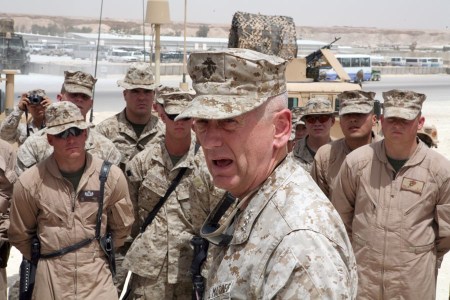
mattisdeploy-900x600

WASHINGTON — Millions of members of the U.S. military are frantically Googling where the Secretary of Defense sits in the line of succession to President of the United States, sources confirmed today.

The more than two million Google searches for terms such as “where is SecDef in succession order” and “can SecDef be promoted to president” came just hours after it was learned that retired Marine Gen. James Mattis would be named to lead the Department of Defense.

Mattis, 66, has been tapped by President-elect Donald Trump to head the department, which has been plagued by low morale and expensive cluster-fuck weapons systems, such as the F-35. He’s expected to easily boost morale, but attempting to fix DoD bureaucracy may be beyond even Mattis’ abilities.

When asked how Pentagon procurement could be fixed, for example, even God declined to answer. Instead, the Almighty referred all further questions to Lockheed Martin, Boeing, and General Dynamics.

If confirmed, Mattis would need to simultaneously take out the Treasury Secretary, Secretary of State, President pro tempore of the Senate, the Speaker of the House, the Vice President, and the President, in order to assume the highest office in the land.

According to sources, he already has a plan to do just that, which he wrote in 2003. He later stashed the plan in the drawer of his nightstand, on which his concubine places a breakfast shake mix of Jack Daniels and Creatine each morning. A person familiar with the plan said that Mattis mostly uses his bare hands, though he often carries multiple guns, knives, and sharp sticks on his person.

Experts say that Mattis dropping six people who have no military training would be a “walk in the park,” compared to his usual average of 12 kills per day. They went on to say that Mattis exterminating a bunch of tubby civilians would be roughly equivalent to him taking a bath or making toast, in terms of difficulty.

Survivors of Mattis’ wrath are expected to write about what he does to Washington, D.C. for the next 10,000 years.


Krauthammer’s Take: It’s Good to Have a Defense Secretary Called ‘Mad Dog’

December 2, 2016

Krauthammer’s Take: It’s Good to Have a Defense Secretary Called ‘Mad Dog’, Fox News via YouTube, December 1, 2016

https://www.youtube.com/watch?v=PbAT92oDLDU

Trump Selects James Mattis for Defense Secretary

December 1, 2016

Trump Selects James Mattis for Defense Secretary, Washington Free Beacon, December 1, 2016

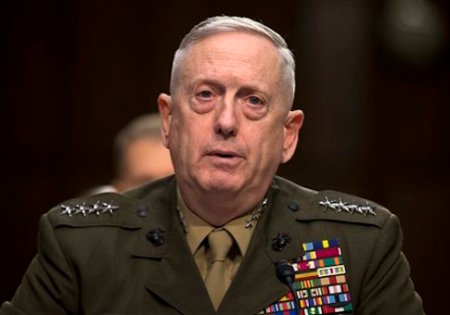
Marine Gen. James Mattis, commander, U.S. Central Command, testifies on Capitol Hill in Washington, Tuesday, March 5, 2013, before the Senate Armed Services Committee hearing to review of the Defense Authorization Request for Fiscal Year 2014 and the Future Years Defense Program. (AP Photo/Evan Vucci)

Marine Gen. James Mattis, commander, U.S. Central Command (AP Photo/Evan Vucci)

President-elect Donald Trump’s selection of Gen. James Mattis as the next secretary of defense is sending shockwaves through the defense community, where insiders are praising the retired Marine Corps general as a plain spoken realist who has the leadership ability to rebuild America’s military, according to conversations with multiple sources.

Mattis, former commander of U.S. Central Command, is known for being outspoken about combat and America’s need to reassert authority across the globe to challenge threats from extremism and radical rogue regimes.

Trump’s selection of Mattis follows those of Rep. Mike Pompeo (R., Kan.) as the next CIA director and retired Gen. Michael Flynn as national security adviser, picks that have won plaudits from observers and mark a clear ideological shift from the Obama administration.

Foreign policy insiders and congressional sources told the Washington Free Beacon that Mattis has proven himself on the battlefield and earned respect among his peers.

“Mattis is not someone who is going to prioritize wishful thinking over the reality of the world we face,” said Michael Rubin, a former Pentagon adviser and expert on rogue regimes.

Rubin said Mattis has the experience necessary to implement tough reform while keeping America’s fighting force nimble and well equipped.

“But it’s not enough for the next defense secretary to face down our enemies. He must also face down the huge bloated bureaucracy which the Pentagon has become,” Rubin said. “His predecessors have all taken the easy way out–enjoying the perks of office without carrying out substantive reform. The United States needs the most powerful military in the world capable of projecting force globally. It does not need the most bloated bureaucracy, capable of projecting powerpoints for hours a day.”

Michael Ledeen, a onetime consultant to the National Security Council and State and Defense Departments, as well as a former special adviser at the State Department, also had high praise for Mattis, who he described as a consummate Washington outsider.

“He hates Washington, really hates it,” Ledeen said, describing this as a positive trait for a defense secretary. “He’s the best possible. The choices [by Trump] have been pretty good, I must say.”

The selection of Mattis also earned praise in Congress from Republican sources who work on foreign policy issues.

“General Mattis is exactly the type of leader we need after eight years of failed leadership under President Obama,” said one senior GOP aide. “He would serve our country well by reaffirming fractured alliances and pushing back against our enemies. I am encouraged to see President-elect Trump considering him to run the Pentagon.”

Another senior Republican Senate staffer who handles Middle East issues said that Mattis’ extensive combat experience makes him a perfect fit for the role.

“As a Marine, General Mattis served our nation honorably and fearlessly,” the source said. “We should expect no less if Mattis, as a civilian, is now asked to serve as secretary of defense.”

Raheem Kassam, editor of Breitbart London and a Trump world insider, said that the selection of Mattis sends a positive sign to America’s closest allies, including Britain.

“Mattis is revered the world over,” said Kassam, who had speculated about Mattis getting picked weeks before his name emerged in the running. “This is one appointment that even British liberal and conservatives agree upon. And frankly, it is about time America projected the ‘don’t f— with us’ attitude that he so well embodies.”

How James Mattis As Defense Secretary Could Bust Our Deathly Political Correctness About Islam

November 30, 2016

How James Mattis As Defense Secretary Could Bust Our Deathly Political Correctness About Islam, The Federalist, November 31, 2016

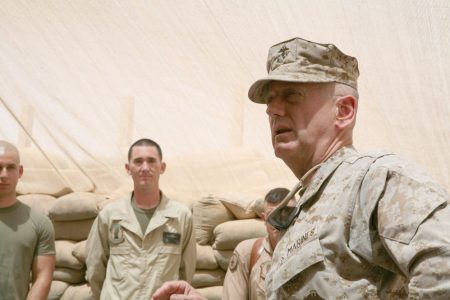
usmc-08001-998x666

Is political Islam in America’s best interests? This question should be central to our strategy of fighting ISIS and Islamist terrorism in general. Yet it’s one that many political leaders would rather not answer, because of our politically correct climate. But since Trump’s transition team announced last week that it’s considering retired Gen. James Mattis for secretary of defense, this reluctance might fade.

In a speech given at the Heritage Foundation last year, Mattis spoke about America’s position vis à vis political Islam. Rather than equivocating on the matter in order to avoid saying something uncomfortable or politically incorrect, Mattis simply pointed out that America needs to make a decision about its stance toward this ideology.

Recall that political Islam, or Islamism, is a movement within Islam: it works toward the increasing implementation of Islamic law and values in all areas of life—usually via state control—in order to make Islam a dominant force in the world.

Why We Don’t Talk About Islamism

Mattis’ suggestion—which sounds like a basic element of defense strategy—has been surprisingly neglected in the years since 9/11. The U.S. tends to deal with Islamism on a case-by-case basis. And so long as any particular group or political entity doesn’t have a direct and obvious link to terrorism, we tend to give them a pass. Even then, this is sometimes too high of a bar, as is the case with the Muslim Brotherhood and associated groups.

No one wants to delve into the question of Islamism because it has become a politically charged issue, one that often leads to accusations of bigotry and Islamaphobia. As Islam is increasingly treated as a protected class by America’s progressive Left, any scrutiny of any faction within Islam is considered off limits. This is done in the name of tolerance, but is in fact a highly intolerant position. But it’s successfully scared off politicians and military personnel, who tend to make vague and noncommittal statements on the topic.

This makes Mattis’ statements all the more notable. He’s simply urging the U.S. to make a decision. And what’s more, he’s arguing that this decision ought to be based on what we believe is in our best interest:

“Is political Islam in the best interest of the United States?…If we won’t even ask the question then how do we even get to the point of recognizing which is our side in the fight? And if we don’t take our own side in this fight we’re leaving others adrift.”

What Is In The Country’s Best Interests?

This is a surprisingly unpopular question to ask in general, and specifically when it comes to Islam. The concept itself—asking what is in America’s best interest—has largely been ignored as of late. Under Obama, America has pursued a policy of “leading from behind,” and more or less disregarding America’s interests abroad. The Obama administration has done this based on the notion, central to the progressive narrative of history, that America is a de facto colonialist power, whose influence in the world is malign and ought to recede of our own volition.

But if the U.S. can’t identify what is in its best interests, or refuses to pursue those interests out of an oversized sense of political correctness, there’s no way to forge a comprehensive global defense strategy. As Mattis points out, if we won’t even talk about political Islam with a critical eye, how can we figure out which side we’re on, and make decisions from that point? Neglecting the question not only hurts our interests—it leaves our allies unsure of where we stand and how we will proceed when Islamist movements gain traction in their countries.

Mattis also points out that ISIS is counting on Americans not having a debate on whether political Islam is good for America. If we don’t examine this question, we can’t create a cohesive strategy, and our fight against ISIS’s self-proclaimed Caliphate (or other groups like them) will ultimately fail.

This is the opposite of what some Islamist apologists and those on the left insist, which is that ISIS wants us to talk about the connections between Islam and violence, in order to make Muslims feel like the West is at war with their entire religion. Then, so the thinking goes, Muslims will turn on the West.

Mattis Would Change Our Reputation

As it is, ISIS has largely won this battle. Any serious strategic discussion about the relationship between political Islam and American national interests has been deemed illegitimate and offensive by the political Left. See, for example, the scrubbing of terms related to Islam from Department of Homeland Security training materials.

Mattis’ appointment as Defense Secretary would be a marked change not only from the Obama administration, but also from the Bush years. Both administrations were reluctant to substantively engage in a debate on the merits or threats of political Islam.

Since giving this speech at Heritage, ISIS has experienced significant territorial losses. But the question Mattis raises has not lost its relevance. It will be central to many of the Trump administration’s foreign policy challenges. Political Islam remains, and will remain, a problem for the West both in terms of domestic security and global strategy. Whether it’s the Muslim Brotherhood’s activities in the U.S., or political Islam in a post-Arab Spring Middle East, the U.S. needs to know where it stands on this issue.

Mattis concludes that political Islam is not, in the end, good for America. But he acknowledges that what’s most important is that we have a discussion about it—so that we can develop a broader strategy for how to deal with Islamism in the world. Without a cohesive strategy, there is little hope of checking the destructive influences of political Islam both at home and abroad.

Giuliani’s Ties to Iranian Resistance Group MEK Should be Viewed as a Valuable Contribution

November 29, 2016

Giuliani’s Ties to Iranian Resistance Group MEK Should be Viewed as a Valuable Contribution, Iran Focus, November 29, 2016

(The objected-to Politico article was written by Daniel Benjamin, often referred to below but not identified as author of that article. — DM)

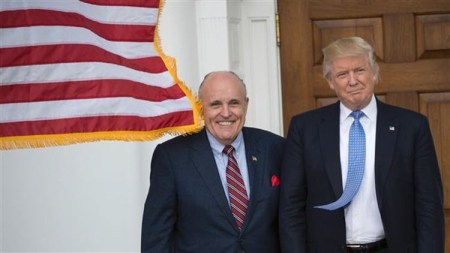
trumpandgu

London, 29 Nov – On November 28, in an article for Politico Magazine, Robert G. Torricelli, former U. S. Senator from New Jersey, and a former member of the U.S. House of Representatives, wrote about the Iranian Resistance Group, Mujahidin e-Khalq (MEK).  His article was written  in response to an article published in Politico last week, criticizing the MEK and the U.S. politicians who support them, particularly former New York Mayor Rudy Giuliani.

Torricelli, a former Democratic member of the Senate Foreign Relations Committee, who is familiar with the MEK and with Giuliani’s work on behalf of the organization says, “I can say unequivocally that Benjamin’s assertions are outrageous—so outrageous that I must respond.” 

A large bipartisan coalition supports the MEK in its campaign for regime change in Iran, including two former chairmen of the joint chiefs, two former CIA directors, a former attorney general and the former chairs of both political parties. People with such varied political ideals, such as Howard Dean and Patrick Kennedy to Newt Gingrich and John Bolton support the MEK. Torricelli says, “From this perspective, the outlier isn’t Rudy Giuliani; it’s Daniel Benjamin.” 

The history of the MEK began when it was part of the coalition opposing the shah of Iran in the late 1970s. The shah’s secret police executed and imprisoned most of their leadership. That vacuum was briefly filled by a Marxist group who were rejected by the incarcerated MEK leaders. Most of the Marxist leaders were killed by the shah or by the mullahs after their ascent to power in 1979. The MEK eventually regained its original leadership, and the MEK became an opposition group to the theocratic regime, and fled into exile in Paris and Iraq.

Torricelli writes, “Throughout this time, the MEK did take part in legitimate political and military action against the Iranian regime, but I have seen no evidence to support the assertion Benjamin makes that it took part in terrorist activities against Iranians or Americans.”

In Iraq in the 1980s, the refugee camps of the MEK were under the protection of the government of Iraq. MEK fighters were aligned with Iraqi Army during Iran/Iraq War. “But Benjamin’s claims that they assisted in Saddam Hussein’s repression of the Kurds have been denied by both MEK and U.S. Army leaders in Iraq. Upon the arrival of U.S. forces in 2003, the MEK willingly handed over its weapons, accepted U.S. protection and actively exposed the Iranian regime and its proxies’ terrorist activities. This included saving American lives by identifying IED locations. This, more than anything, explains the group’s support by former U.S. military personnel, including the former army anti-terror officer and the U.S. military police general assigned to the camp,” writes Torricelli.

The MEK provided invaluable intelligence regarding the Iranian nuclear program that helped counter Tehran’s efforts to develop atomic weapons. Maryam Rajavi, leader of the movement, committed herself publicly to a democratic, non-nuclear, secular Iran at peace with its neighbors with gender equality and a ban on capital punishment. The MEK organized thousands in the Iranian diaspora and built political support in Congress and parliaments across Europe. It is now the most organized and disciplined of the Iranian opposition groups.

“Some current and former State Department employees, including Mr. Benjamin, have a different concept. They remain committed to the idea that the MEK was a terrorist organization—a notion, I believe, which stems from an illusion of American reconciliation with the mullahs. In 1997, a group at State succeeded in convincing President Bill Clinton to place the MEK on the State Department list of terrorist organizations. Some claimed at the time that this decision was mainly intended as a goodwill gesture to Iran. The State Department gave as its reasons the MEK’s long record of violence, but I can tell you that as a member of the Foreign Relation Committee, I reviewed the State Department file on the MEK and found no evidence, no testimony and no reason for the designation except placating Tehran,” Torricelli writes, adding, “Thousands of Iranian-Americans and literally hundreds of members of Congress protested. In 2011, as a private attorney, I led a team of lawyers in a State Department inquiry to resolve the issue. After four hours of testimony, we yielded to the State Department to present their contradictory evidence. They had nothing.”

Without evidence, an order by the U.S. District Court was issued.  The MEK was removed from the State Department list of terrorist organizations by Secretary Hillary Clinton in 2012.

Torricelli continues, “Defeat came hard for the Iran apologists within the department. Mr. Benjamin isn’t the first to argue that the broad coalition of former U.S. intelligence, military, diplomatic and congressional leaders can’t be believed because some accepted speaking fees to attend MEK meetings around the world. The fact that these people faced combat for or dedicated their entire careers to our country, and are among our most respected leaders seems to be of no consequence. It’s an argument that requires no rebuttal except to note that by this standard the views of Thomas Paine, Elie Wiesel and Winston Churchill—all of whom accepted speaking fees from various international organizations—would have been silenced as well.”

Rudy Giuliani was one of the most outspoken supporters. The 3,000 MEK refugees settled along the Iran/Iraq border were under imminent threat in 2012. Iraqi relations with the United States were tense. Torricelli writes,  “Secretary Clinton requested that I assemble a persuasive group of distinguished Americans to travel to Europe and persuade Mrs. Rajavi to relocate the refugees to a former U.S. military base near Baghdad. I appealed to Louis Freeh, Ed Rendell, Michael Mukasey and Rudy Giuliani. Each accepted, canceled commitments, paid his own transportation to Paris and argued persuasively that the MEK assist the United States by relocating.”

Such a broad coalition of diverse Americans has varied perspectives. Torricelli says that, “Some believe that in the political vacuum following an economic or political collapse in Tehran, a determined and well-funded political opposition like the MEK could seize power. Others believe that the MEK might simply be part of a broader coalition, a simple pressure point or just a source of continuing intelligence.” Although rationales for support might differ, this group of Americans is united by the beliefs that the MEK is a genuine democratic force, and that regime change in Tehran is the best option to keep the peace, avoid a nuclear Iran, and benefit American interests.

Going back to Mr. Benjamin’s argument that Rudy Giuliani’s participation in this coalition should disqualify him for consideration as secretary of state, Torricelli has this to say, “Experience and participation in public policy issues was once a condition for high government service. It’s now a complication, because a record of advocacy creates controversy. But the selection of secretary of state needs to be different. Among the most likely crises facing the new president is an escalation in the struggle with the fundamentalist Islamic Republic of Iran. Rudy Giuliani has lived that struggle for a decade. Mr. Benjamin may quarrel with his efforts but it’s important to note that voices in the American foreign policy establishment as diverse as Senator McCain, Secretary Clinton, Deputy Secretary Blinken and John Kerry’s own personal representative on the MEK, Jonathan Weiner disagree. Each has thanked Rudy Giuliani and the other Americans involved in these efforts.”

Whether or not the president-elect chooses Mr. Giuliani as secretary of state, countering Tehran and assisting our country should not be seen as anything other than a valuable contribution to his consideration.

Trump’s Appointments Continue to Impress

November 25, 2016

Trump’s Appointments Continue to Impress, Power LineJohn Hinderaker, November 24, 2016

(As to Dr. Carson

In an interview with Fox News on Tuesday night, Carson confirmed that Trump has offered him a position in his cabinet, and HUD is “one of the offers that’s on the table.” When asked if he knows anything about housing policy, Carson told Neil Cavuto: “I know that I grew up in the inner city and have spent a lot of time there, have dealt with a lot of patients from that area, and recognize that we cannot have a strong nation if we have weak inner cities.”

— DM

If, as is often said, personnel is policy, the Trump administration may prove more impressive than many conservatives expected. His nominations so far have been outstanding. The latest is his choice of Betsy DeVos to head the Department of Education. DeVos is a school choice activist who puts the interests of children first–especially inner-city children–rather than the interests of teachers’ unions. The New York Times, intending to express outrage at her selection, came up with this heartwarming headline: “Betsy DeVos, Trump’s Education Pick, Has Steered Money From Public Schools.”

It was reported that Trump has offered the position of Secretary of Housing and Urban Development to Dr. Ben Carson. It now appears that the offer has been neither made nor accepted, but I hope it comes to pass. While he is not an experienced administrator, Carson is respected by just about everyone, and is ideally positioned to dismantle the left-wing social engineering that President Obama’s HUD has engaged in. Once again, we turn to the New York Times to explain why Carson would be an excellent choice: “How Ben Carson at Housing Could Undo a Desegregation Effort.” The “desegregation effort” in question is the Obama administration’s Affirmatively Furthering Fair Housing power grab, which we have written about many times. Carson is just the man to put AFFH out of its misery.

Let’s hope that Trump’s personnel winning streak continues.

The agony of watching the transition

November 25, 2016

The agony of watching the transition, Washington TimesWesley Pruden, November 24, 2016

transitionSen. Jeff Sessions (Associated Press)

The press is in a pout just now because Donald Trump is not supplying a new Cabinet officer on demand. He’s taking his time choosing his team, and this is reported as if a national tragedy. Time magazine calls the Trump transition “chaotic,” and The New York Times asserts that the Donald’s team is plagued by “discord” and stalled in “disarray.” A reporter at Politico, the political daily, says the transition team is having “a knife fight,” which demonstrates mostly that the reporter has never been to a knife fight, and is probably covering his first transition.

***************************

What we used to call “the press,” before the newspapers aspired to be part of the professional class with its inflated titles and airs, is never happy. Nor should it be. The press is a demanding and cranky lot by definition, and now they’re something called “the media.” Marshall McLuhan, who invented the concept if not the word, must never be forgiven.

This invited television, which is an entertainment medium, to share a definition with newspapers, and soon newspapermen (including women) wanted to be seen as well as heard, and there went the neighborhood. Megyn Kelly is Hollywood gorgeous, but she wouldn’t be happy working on a newspaper where nobody could see her.

The press is in a pout just now because Donald Trump is not supplying a new Cabinet officer on demand. He’s taking his time choosing his team, and this is reported as if a national tragedy. Time magazine calls the Trump transition “chaotic,” and The New York Times asserts that the Donald’s team is plagued by “discord” and stalled in “disarray.” A reporter at Politico, the political daily, says the transition team is having “a knife fight,” which demonstrates mostly that the reporter has never been to a knife fight, and is probably covering his first transition.

“The president-elect will be announcing specific Cabinet positions,” says Jason Miller, a spokesman for the transition, “as well as key position staff, when those decisions are made. The focus of the administration is putting together the best team. It is not an arbitrary timetable. It’s about getting it right.”

The wiseheads in the Trump camp understand that the press/media will never think he’s “getting it right.” The notabilities of press and the twinkles of the tube should be pleased with a slow pace that spreads their misery. A wise man awaiting the hangman never complains if he can’t remember where he put the rope.

But the pace this time is not unusually slow, and it’s faster than in many incoming administrations. George W. Bush, bedeviled by all those hanging chads, did not name his first Cabinet officer until early December. President Obama was eager to get moving to deal with the financial crisis in 2008, but nevertheless did not make his first Cabinet appointment, the Treasury secretary, until Nov. 24. The press was so busy swooning it never noticed. Donald Trump beat that date with four such appointments.

Mr. Obama did not reveal his next appointments, secretary of State, attorney general and director of homeland security until Dec. 1. By that time, Richard Nixon had named his entire Cabinet, and see where that got us.

The chattering about discord, disarray and knife fights is neither unprecedented nor unexpected. Chattering is what magpies do, and December announcements are the rule not the exception. The smarter magpies might usefully aim their hysteria elsewhere.

David Axelrod, a senior adviser in the early Obama administration, says he has “lots of reasons” to be concerned about a Trump administration but the pace of announcements isn’t one of them. “We hadn’t made any major announcements at this point in 2008,” he says, “and I don’t remember being criticized for it.”

But criticizing is what Washington does well, and sometimes it’s all that Washington does well. Criticisms are the fleas that come with the dog. Changing governments is a big job, and nowhere as big as in the United States. Ronald Reagan’s transition was marked by fits and starts. Bill Clinton’s path was not strewn with rose petals (though he was always on the scout for rosebuds), and John F. Kennedy’s transition to Camelot was difficult, particularly after he appointed his brother Robert as the U.S. attorney general.

The pace of appointments may be giving the Donald’s critics a headache now, and the headache will become a bellyache when all appointments are made, and the Democrats have chosen the subject of the execution. That might be Jeff Sessions, the attorney general-nominee. He’s white and a Southerner, and the hangman only needs to find the third strike.

The transition to president of the United States is never easy because it’s unique. There’s nothing remotely like the presidency; nothing can prepare man or woman for it. Harry Truman said on assuming the office in the final days of World War II that he felt like “the sun, the moon and the stars fell on me.”

He never expected the star shower, and apparently never did Donald Trump. Unlike some other presidents, he wouldn’t talk about a transition during the campaign. “I don’t want to talk about this,” he told his inner circle. “I don’t want to jinx this.”

With the jinx defeated, he can get on with choosing his side. Life will go on. Our friends on the left will survive, too.

The Truth About John Bolton, The Iraq War and WMD Diplomacy

November 23, 2016

The Truth About John Bolton, The Iraq War and WMD Diplomacy, Center for Security Policy, Fred Fleitz, November 23, 2016

bolton1

Source: Breitbart News Network

You’re probably heard the criticism of Ambassador John Bolton by the left that he would not be a good choice to be the next Secretary of State because Bolton was an architect of the Iraq War and a hawk who has little use for diplomacy.

This is completely false. The truth is that Bolton was frozen out of Iraq War planning. This criticism also ignores Bolton’s successful diplomacy as Under Secretary of State for Arms Control and International Security to pressure rogue states to comply with WMD treaties and his work as UN ambassador to take strong and meaningful action in the UN Security Council against WMD proliferation and terrorism.

The record shows John Bolton had little to do with promoting the Iraq war or war planning. Check out the State Department’s archive page of Bolton’s speeches, op-eds in 2002 and early 2003. You won’t find anything calling for military action against Iraq.

Bolton was not involved in any decision-making or planning for the Iraq War because Secretary of State Colin Powell and Deputy Secretary Richard Armitage froze him out. As Bolton’s chief of staff, I witnessed this first hand. I remember well how State Department offices were told by Powell’s and Armitage’s staffs not to share any information with Bolton and his staff about Iraq war planning.

Looking back on this, Bolton believes Powell did him a favor. He says on pages 165-166 of his 2007 book Surrender is Not an Option:

I played no significant decision-making role on Iraq policy, because Powell and Armitage largely excluded me from these issues, no doubt fearing that my views would be similar to Cheney’s and Rumsfeld’s and not their own.  It was the greatest favor Powell ever did for me, utterly unintentionally, to be sure, and my Iraq-related activities were only at the margins of the central decisions.

I believe Bolton’s liberal critics are falsely portraying Bolton as an architect of the Iraq War for two reasons.

First, they want to obscure his successful diplomatic efforts to address cheating on WMD treaties by rogue states. Bolton did this by calling out major violators of treaties to stop the proliferation of weapons of mass destruction like the Nuclear Nonproliferation Treaty and the Biological Weapons Convention.

 Bolton also negotiated the creation of the Proliferation Security Initiative (PSI), a global effort now composed of 103 countries to stop and interdict shipments of WMD technology to rogue states. PSI’s most important success occurred in September 2003 when it led to the inspection of a ship transporting nuclear technology to Libya. This interdiction was a major reason why Libyan leader Muammar Qadaffi decided to give up his WMD programs.

And second, after holding three confirmed foreign policy positions and a reputation for toughness, John Bolton is the last person the foreign policy establishment wants to see leading the State Department. They know he has an intimate knowledge of the State bureaucracy and will exercise the leadership to ensure it implements the president’s policies. The foreign policy establishment is only too aware that no one is better qualified to drain the swamp at State than John Bolton.

In short, the Iraq War architect argument that Bolton’s opponents are using against him is a ruse intended to play on Mr. Trump’s opposition to the Iraq War. I am confident that as President-elect Donald Trump and his team look at John Bolton’s entire record, they will see a man committed to making America safe again with a sophisticated understanding of national security who knows how to be tough and how to use diplomacy.  They also will find someone who will work hard and loyally to bring the Trump revolution to the State Department and the world.