Posted tagged ‘Trump and Israel’

Report: Trump May Exit Peace Talks After ‘Tense’ Kushner/Abbas Meeting

June 24, 2017

Report: Trump May Exit Peace Talks After ‘Tense’ Kushner/Abbas Meeting, Jerusalem Post, Asser Okbi/ Maariv Haskavua, Jpost.Com Staff, June 24, 2017

(“Abbas angrily accused Kushner and Trump’s lead international negotiator, Jason Greenblatt, of taking Israel’s side. . . ” After the Obama administration, he must be shocked. — DM)

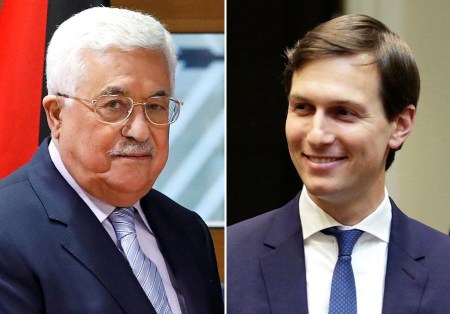
Abbas and Kushner. (photo credit:REUTERS)

US President Donald Trump is reportedly weighing whether to pull out of Israeli-Palestinian peace negotiations following a “tense” meeting with White House senior staff and officials in Ramallah, according to London-based Arabic daily al-Hayat on Saturday.

The report claimed that Trump is to determine the future of reigniting Mideast peace talks in the near future, including  the possibility of withdrawing completely from the process.

The al-Hayat report came just days after a meeting between the administration’s senior adviser Jared Kushner and Palestinian Authority President Mahmoud Abbas, which was described as “tense” by an Abbas advisor present at the talks.

Abbas was supposedly furious with the president’s son-in-law after Kushner relayed Israeli demands to the 81-year-old Palestinian leader which included the immediate halt of payments to terrorists and their families.

Abbas angrily accused Kushner and Trump’s lead international negotiator, Jason Greenblatt, of taking Israel’s side and refused to commit to the request.

The report claims that the Trump administration was equally upset with Abbas after he failed to denounce the latest stabbing attack in Jerusalem, leaving 23-year-old St.-Sgt. Maj. Hadas Malka brutally stabbed to death in a terror attack last week. Ties were further strained after Abbas reportedly refused to meet  American ambassador to Israel David Friedman.

The Palestinian official also told the paper that the Americans demanded Palestinian officials curb inflammatory statements regarding Israel.

“(Kushner) will submit his report to the president and, after it is submitted, Trump will decide if there’s a chance for negotiations or it might be preferable to pull out peace talks,” the official said.

Abbas claimed that Israel is using the issue of payments to terrorists and their families as a pretext to avoid entering peace-talks, saying that the payments are a part of the Palestinian government’s “social responsibility.”

U.S.: Strategic Objectives in the Middle East

June 22, 2017

U.S.: Strategic Objectives in the Middle East, Gatestone InstitutePeter Huessy, June 22, 2017

On relations with the Palestinian Authority, the administration has moved to improve matters but has not moved to advocate a two-state solution — for which there is no contemplated security framework sufficient to protect Israel.

****************************

The new “test” of our alliance will be whether the assembled nations will join in removing the hateful parts of such a doctrine from their communities.

What still has to be considered is the U.S. approach to stopping Iran from filling the vacuum created by ridding the region of the Islamic State (ISIS), as well as Iran’s push for extending its path straight through to the Mediterranean.

The tectonic plates in the Middle East have shifted markedly with President Trump’s trip to Saudi Arabia and Israel, and his announced new regional policy.

The trip represented the beginning of a major but necessary shift in US security policy.

For much of the last nearly half-century, American Middle East policy has been centered on the “peace process” and how to bring Israel and the Palestinians to agreement on a “two-state” solution for two peoples — a phrase that Palestinian Authority President Mahmoud Abbas refuses to say.

First was shuttle diplomacy during 1973-74 in the Nixon administration; then second, in 1978, the Camp David agreement and the recognition of Israel by Egypt, made palatable by $7 billion in new annual US assistance to the two nations; third, the anti-Hizballah doctrine, recently accurately described by National Security Advisor General H.R. McMaster, as Iran, since 1983, started spreading its terror to Lebanon and elsewhere in the region. This last effort was often excused by many American and European analysts as a result somehow, of supposed American bad faith. Fourth, came the birth, in 1992, of the “Oslo Accords” where some Israelis and Palestinians imagined that a two-state solution was just another round of negotiations away.

Ironically, during the decade after Oslo, little peace was achieved; instead, terror expanded dramatically. The Palestinians launched three wars, “Intifadas,” against Israel; Al Qaeda launched its terror attacks on U.S. Embassies in Africa; and Iran, Hizballah, and Al Qaeda together carried out the forerunner attacks against America of 9/11/2001.

Since 9/11, despite wars in Afghanistan and Iraq, terrorism has not only failed to recede; on the contrary, it has expanded. Iran has become the world’s biggest state sponsor of terrorism, and the Islamic State (ISIS) has tried to establish a transnational “Islamic caliphate.” Literally tens of thousands of terror attacks have been carried out since 9/11 by those claiming an Islamic duty to do so. These assaults on Western civilization have taken place on bridges, cafes, night clubs, offices, military recruitment centers, theaters, markets, and sporting events — not only across the West but also in countries where Muslims have often been the primary victims.

Particularly condemnable have been the improvised explosive device (IED) attacks against U.S. soldiers in Iraq and Afghanistan, perpetrated to a great extent by Iran, according to U.S. military testimony before Congress.

All the while, we in the West keep trying to convince ourselves that, as a former American president thought, if there were a peace deal between Israel and the Palestinian Authority, most of the terrorist attacks we see in Europe and the United States “would disappear.”

No matter how hard we may rhetorically push the “peace process”, there is no arc of history that bends naturally in that direction. Rather, nations such as the United States together with its allies must create those alliances best able to meet the challenges to peace and especially defeat the totalitarian elements at the core of Islamist ideology.

If anything, the so-called Middle East “peace process” has undercut chances of achieving a sound U.S. security policy. While the search for a solution to the Israel-Palestinian “problem” dominated American thinking about Middle East peace for so many decades, other far more serious threats materialized but were often ignored, not the least of which was the rise of Iran as the world’s most aggressive terrorist.

The United States has now moved in a markedly more promising and thoughtful direction.

The new American administration has put together an emerging coalition of nations led by the United States that seeks five objectives:

(1) the defeat of Islamic State;

(2) the formation of a coalition of the major Arab nations, especially Egypt and the Kingdom of Saudi Arabia, to clean up in their own back yards financing terrorism and providing terrorists with sanctuary. As Elliott Abrams, an adviser to former U.S. President George W. Bush, cautions us, however, this will not be an easy effort: “Partnerships with repressive regimes may in some cases exacerbate rather than solve the problem for us” but, Abrams says, “gradual reform is exactly the right approach…”;

3) “driving out” sharia-inspired violence and human rights abuses from the region’s mosques and madrassas;

(4) a joint partnership with Israel as part of an emerging anti-Iran coalition — without letting relations with the Palestinian authority derail United States and Israeli security interests; and

(5) the adoption of a strategy directly to challenge Iran’s quest for regional and Islamic hegemony, while ending its role in terrorism.

Defeating Islamic State

Defeating ISIS began with an accelerated military campaign and a new American-led strategy to destroy the organization rather than to seek its containment. According to the new U.S. Secretary of Defense, James Mattis, “Our intention is that the foreign fighters do not survive the fight to return home to North Africa, to Europe, to America, to Asia. We’re going to stop them there and take apart the caliphate.”
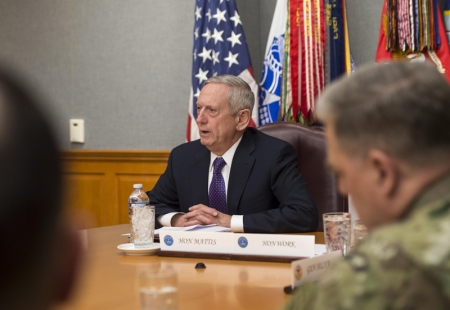
Secretary of Defense James Mattis. (Dept. of Defense/Brigitte N. Brantley)

So far, the United States coalition has driven ISIS from 55,000 square kilometers of territory in Iraq and Syria.

A New Coalition

Apart from a strategy to counter ISIS, the Trump administration also called on our allies in the Middle East to put together a new joint multi-state effort to stop financing terrorism. Leading the multi-state effort will be the Kingdom of Saudi Arabia and the United States, which together will supposedly open a new center dedicated to the elimination of terrorist financing. Positive results are not guaranteed, but it is a step in the right direction.

According to Abdul Hadi Habtoor, the center will exchange information about financing networks, adopt means to cut off funding from terrorist groups, and hopefully blacklist Iran’s jihadist army, the Islamic Revolutionary Guard Corps (IRGC). These measures in turn will help eliminate the sanctuaries from which terrorists plot and plan.

This move also places emphasis on the responsibility of states to eliminate terrorism. As President Trump said, each country — where it is sovereign — has to “carry the weight of their own self-defense“, be “pro-active” and responsible for “eradicating terrorism”, and “to deny all territory to the foot soldiers of evil”.

This determination was underscored by many Arab countries breaking diplomatic relations with Qatar for its support of Iran, the Muslim Brotherhood and ISIS. Most of Qatar’s Arab neighbors, including the Saudis, Egypt, and the UAE did so, while the US, although denouncing Qatar’s support of terrorism, continues to maintain access to, and use of, its critical military base there.

In short, the U.S. is playing good-cop, bad-cop in the region, while U.S. allies are putting together what Josh Rogin of the Washington Post described as “a regional security architecture encompassing countries on the periphery of Iran.”

Such an approach is not without risk: Turkey, allied with Iran and Qatar, has already has pledged to help Qatar defy the Gulf States’ trade cut-off. If Turkey, for example, seeks to move its promised aid shipments to Qatar through the Suez Canal, the ships could possibly be blocked by Egypt or attacked on the high seas. Does the U.S. then come to the assistance of a NATO member — Turkey — against an ally in the strategic coalition?

Drive Hateful Ideology Out

A companion challenge by the new American President underscored this new security effort. President Trump said to the assembled nations of the Islamic conference that they have to expel the ugly Islamist ideology from the mosques and madrassas that recruit terrorists and justify their actions.

Trump said: “Drive them out of your places of worship”. Such words had never been spoken so clearly by an American president, especially to the collection of nearly all the Islamic-majority countries (minus the Shi’ite bloc) gathered together.

The president’s audience doubtless understood that he was speaking of the doctrine of sharia (Islamic law). The new “test” of our alliance will be whether the assembled nations will join in removing the hateful parts of the doctrine from their communities. It was a sharp but critical departure from the previous American administration’s message in Cairo in 2009, and placed the Islamic doctrine that seeks to establish the sharia throughout the world in a contained context.

New Israeli Partnership

With Israel, the administration has cemented the next part of its strategy. Here the Trump administration successfully improved our political and military relations with Israel. Markedly so. One part of that effort was enhanced missile-defense cooperation called for in the FY18 United States defense budget, specifically to deal with Iranian and Iranian-allied missile threats.

On relations with the Palestinian Authority, the administration has moved to improve matters but has not moved to advocate a two-state solution — for which there is no contemplated security framework sufficient to protect Israel.

Challenge and Roll Back Iran

The final part of the administration’s strategy starts with a thorough review of our Iran strategy and the Joint Comprehensive Plan of Action (JCPOA), or “nuclear deal”, with Iran. As Max Singer recently wrote, even if we discount what secretive nuclear capability Iran may now have, the Iranian regime will at the very least be much closer to producing nuclear weapons down the road than when the JCPOA was agreed to.

As Ambassador John Bolton has warned the nuclear deal with Iran did nothing to restrain Iranian harmful behavior: “Defiant missile launches… support for the genocidal Assad regime… backing of then Houthi insurgency in Yemen… worldwide support for terrorism… and commitment to the annihilation of Israel” continue.

In addition, uranium enrichment, heavy water production, the concealed military dimensions of warhead development and joint missile and nuclear work with North Korea all lend a critical urgency to countering Iran’s lethal efforts. The United States did not make these counter-efforts any easier by providing to Tehran $100 billion in escrowed Iranian funds, equivalent to nearly one quarter of the Islamic Republic’s annual GDP.

The United States’ and Europe’s easing of sanctions on Iran has helped reintegrate Iran into global markets via mechanisms such as the electronic payment system run by the Society for Worldwide Interbank Financial Telecommunications (SWIFT). That, in turn, has helped Iran expand dramatically its military modernization budget by 33%, including deals worth tens of billions of dollars in military hardware with China and Russia.

Added to that is Iranian financial- and weapons-support for foreign fighters in Syria, Iraq, Yemen, Lebanon and Afghanistan. Iran’s significant support to the Houthi rebels in Yemen includes weaponry, financing and logistical support, including advanced offensive missiles. The Houthis regularly attempt to carry out missile attacks against Saudi oil facilities.

Such Iran activity is described by the Commander of U.S. Central Command, General Joseph Votel, as “the most significant threat to the Central Region and to our national interests and the interest of our partners and allies”.

As such, it can only be challenged through exactly the kind of military, political, and economic coalition the Trump administration is seeking to band together, which would include the Gulf Arab nations, especially Saudi Arabia, as well as Egypt, Jordan, and Israel.

The administration’s five-step strategy has a chance to work. It creates a policy to destroy ISIS; oppose Islamic terrorism and specifically the imposition of sharia; adopt measures to go after the financing of such terrorism; implement improvements in Gulf allies’ military capabilities — including missile defenses — parallel with pushing NATO members to meet their military spending obligations; put back into place a sound and cooperative relationship with Israel; and specifically contain and roll back Iranian hegemonic ambitions and its terror-master ways.

What still has to be considered, however, is the U.S. approach to stopping Iran from filling the vacuum created by ridding the region of ISIS, as well as Iran’s push for extending its path straight through to the Mediterranean.

If successful, some modicum of peace may be brought to the Middle East. And the arc of history will have finally been shaped toward America’s interests and those of its allies, rather than — however inadvertently — toward its mortal enemies.

Dr. Peter Huessy is President of GeoStrategic Analysis, a defense consulting firm he founded in 1981, and was the senior defense consultant at the National Defense University Foundation for more than 20 years.
Naming Bin Salman Saudi heir impacts US, Israel

June 21, 2017

Naming Bin Salman Saudi heir impacts US, Israel, DEBKAfile, June 21, 2017

US President Trump is taking the lead role along with Prince Mohammed bin Salman of Saudi Arabia, Sheikh Mohammad bin Zayed Al Nahyan of the United Arab Emirates, another crown prince, Egypt’s President Abdul-Fatteh El-Sisi, and Israel’s Prime Minister Binyamin Netanyahu.

******************************

The Saudi king’s decision to elevate his son Prince Mohammed bin Salman, 31, to crown prince and heir to the throne, in place of his cousin Mohammed bin Nayef – as part of a broad reshuffle, is not merely the internal affair of the royal hierarchy, but a game-changing international event.

DEBKAfile’s analysts see it as the outcome of a global and regional process initiated by Donald Trump soon after he settled in the White House in January. With his appointment as de facto ruler of the oil kingdom, the Saudi king’s son is ready to step into his allotted place in a new US-Arab-Israeli alliance that will seek to dominate Middle East affairs. Israel will be accepted in a regional lineup for the first time alongside the strongest Sunni Arab nations who all share similar objectives, especially the aim to stop Iran.

Trump’s trip to Riyadh and Jerusalem in early May laid the cornerstone for the new US-Sunni Arab bloc versus Iran’s Shiite grouping and also cemented Israel’s co-option.

This bloc is in its infancy and has yet to display staying power and prove the wisdom of its policies. But its contours have taken shape. US President Trump is taking the lead role along with Prince Mohammed bin Salman of Saudi Arabia, Sheikh Mohammad bin Zayed Al Nahyan of the United Arab Emirates, another crown prince, Egypt’s President Abdul-Fatteh El-Sisi, and Israel’s Prime Minister Binyamin Netanyahu.

Three of those leaders already maintain strong direct – albeit discreet – ties with Israel’s prime minister, its security establishment, military and various intelligence agencies.

In a lecture on Tuesday, June 20, Israel’s chief of staff, Lt. Gen. Gady Eisenkott, spoke of the covert relations between the IDF and certain Arab nations, which he did not name. There is clearly a lot going on under the surface in various political, economic, financial, intelligence and military fields.

Recent events in the region already point to President Trump acting on important matters, such as the confrontation with Iran, the war on terror, the Syrian conflict and US intervention in the Yemen conflict, on the advice of the two Arab crown princes rather than Defense Secretary James Mattis and Secretary of State Rex Tillerson.

This was strikingly demonstrated when Trump overrode Tillerson’s recommendation to apply diplomacy for resolving the dispute that led to four Arab nations boycotting Qatar, with the Saudis in the lead, whereas the president then demanded strong action to stop Qatar’s funding of terrorists. He therefore opted for the aggressive Saudi and UAE stance against Qatar’s ruler, Sheikh Tamim bin Hamad Al Thani.

These developments bear strongly on US-Russian relations. The two crown princes maintain active ties with President Vladimir Putin. They could, of course, act as go-betweens for smoothing relations between the White House and the Kremlin. But, on the other hand, their influence could be counter-productive and goad Trump into engaging the Russians in a limited confrontation in Syria. It is hard to see Washington and Moscow coming to terms in Syria at this point when the former is closely allied to Saudi Arabia and the UAE and Moscow maintains its loyalty to Tehran.

The evolving bonds between the US, Saudi Arabia, the UAE, Egypt and Israel are the source of President Trump’s optimism about the prospects of pulling off an Israeli-Palestinian peace accord, a vision which eluded all his predecessors in the White House, while knocking over the decades-old barriers between the moderate Arab nations and the Jewish State.

The first steps towards this goal are in the making. They will include exposing parts of their hidden interaction to the light of day, as well as such important symbolic actions, as opening Arab skies to the passage of Israeli commercial flights, or direct telephone links.

None of this is expected to transpire overnight but rather over years, especially since there is opposition to the process still to overcome in the Arab world, including Saudi Arabia, and also in the United States. Critics lay into Mohammed bin Salman, who has made his mark as a visionary social and economic reformer at home, as too young, brash and impatient to rule the kingdom. His decision to entangle Saudi Arabia in the Yemen war, which many believe it cannot win, is held up as evidence of his reckless nature.

But the process switched on by Trump in Riyadh took a large stride forward on June 21, with the formalization by King Salman of his young son’s role as the top mover and shaker in the Saudi kingdom. King Salman obtained the support of 31 out of 34 members of Saudi Arabia’s Allegiance Council for confirming Prince Muhammad Bin Salman as crown prince as well as deputy prime minister and minister of defense.

The Saudis hold the key

June 20, 2017

The Saudis hold the key, Israel Hayom, Prof. Abraham Ben-Zvi, June 20, 2017

This multi-phased approach is not overly ambitious. It does not seek to solve everything all at once, nor does it impose an agreement on the two parties. Instead, the goal is to reach an agreement on those issues that are less charged, thereby creating an island of relative stability in a chaotic and violent environment.

***********************

The focus of the international media has ostensibly shifted away from the Middle East to other parts of the world following U.S. President Donald Trump’s visit last month, but the administration has not stopped pushing for renewed peace talks.

The efforts to end the Israeli-Palestinian stalemate by redrawing the fundamental principles so that they satisfy both sides are clearly evident in the decision to send two senior White House officials, senior adviser to the president Jared Kushner and Special Representative for International Negotiations Jason Greenblatt, to the region.

Even though the magic formula that could produce such fundamental principles is not within reach, one fact is abundantly clear: Trump does not consider a permanent agreement between Israel and the Palestinians a necessary stepping stone to a new Middle East under U.S. auspices, unlike his predecessor Barack Obama, who held this belief from the moment he became president.

In fact, Trump believes an Israeli-Palestinian accord is just one issue that needs to be addressed while he puts together a much wider regional framework. Moreover, Trump has placed a particular emphasis on Saudi Arabia rather on the Israeli-Palestinian axis. The kingdom, which fears that Iran has become more powerful since the 2015 nuclear deal, has reacted to this renewed threat by abandoning its long-held policy of kowtowing to radical entities and rogues states and has instead embarked on an uncompromising path of containment. This has generated a host of opportunities for the United States.

The strength the U.S. is projecting now (including Trump’s willingness to provide Saudi Arabia sophisticated weapons in unprecedented quantities) stands in stark contrast to the weakness during the Obama years, giving Trump a great deal of room to maneuver and influence over Riyadh.

Thus, the key to ending the impasse between the Palestinians and the Israelis is not in Ramallah or in Jerusalem but in the Saudi capital. Saudi Arabia’s willingness to publicly take on Iran and its proxies (as well as other regional entities such as Qatar), means that the president can demand confidence-building measures from the Saudis toward Israel.

In light of Riyadh’s newfound willingness to take on Hamas and similar organizations, the president’s advisers want the Saudis to pressure Ramallah and convince the PA to scale back its demands. In that context, Kushner and Greenblatt’s visit is designed to gauge what confidence-building measures Israel and the Palestinians would be willing to offer.

This multi-phased approach is not overly ambitious. It does not seek to solve everything all at once, nor does it impose an agreement on the two parties. Instead, the goal is to reach an agreement on those issues that are less charged, thereby creating an island of relative stability in a chaotic and violent environment.

Will Trump make a peace breakthrough in 2018?

June 15, 2017

Will Trump make a peace breakthrough in 2018? DEBKAfile, June 15, 2017

(Lots of speculation about future events, but an interesting piece nevertheless. — DM)

US President Donald Trump’s goal of generating a rapid improvement of Israel’s ties with the Arab world, including the Palestinians in 2018, is not just up to Prime Minister Binyamin Netanyahu and Palestinian Authority Chairman Mahmoud Abbas, but depends largely on how the Trump administration handles the continuing conflict between Qatar and its powerful Arab opponents, Egypt, Saudi Arabia and the UAE.

Up until the end of this week, Trump had turned down the efforts of Secretary of State Rex Tillerson and Secretary of Defense James Mattis to resolve the Gulf conflict by diplomacy. Instead of heeding them, the president took the advice of the Saudi defense minister, Prince Mohammed bin Salman, and Saudi Foreign Minister Adel Al-Jubeir, who visited Washington this week. Tillerson and Mattis tried to arrange a conference between Saudi Arabia and Qatar so as to gradually ease the tensions, but Trump torpedoed the initiative by adopting Riyadh’s tough line.

A complex situation has arisen in the last few days regarding the US diplomacy for bringing Israel and the Palestinians aboard a peace process. The signs of movement on this score fluctuate between crises and some progress:

1. The Gaza electricity row falls under the first heading. Some circles contend that the crisis is artificial, since the Palestinian enclave is receiving as much power now as before. What is different is the new, intensified pressure by Egypt on the one hand and the Palestinian Authority on the other in the hope of toppling Hamas rule in the Gaza Strip or squeezing its leaders into toeing their lines. Neither Egyptian President Abel Fatteh El-Sisi nor the Palestinian Authority chairman has made headway. Hamas stubbornly refuses Cairo’s demand to sever ties with Qatar, while launching a counteroffensive to draw Israel into the dispute by making an empty threat of an “explosion.”

Israel responded with a counter-threat on Thursday, June 15: a proposal to transfer one hour’s worth of power from West Bank Palestinian towns to boost the supply to Gaza.

This maneuver kept the entire electricity issue in the court from it was tossed, Ramallah.

2. A shower of Israeli concessions is landing on the Palestinians judging by almost daily reports. Some are true and others false. But in sum, they are designed to impress President Trump with the Netanyahu government’s good will towards his peace initiative and readiness to take steps in its support. In fact, the prime minister is preparing the ground for the forthcoming arrival of Jason Greenblatt, Trump’s envoy on the Israel-Palestinian issue.

3. US Secretary of State Tillerson this week informed the Senate that the Palestinian Authority had agreed to  halt its payments to the families of Palestinian terrorists who were killed while carrying out attacks against Israelis. Palestinian officials no doubt let this be understood to demonstrate their willingness to go along with Trump’s peace initiative, without, however, have any real intention of following through.

4. Media reports and the findings of Arab research institutes add up to the following predictions on the fate of the negotiations generated by the Trump administration between Israel and the Arab world:

A. Some time during 2018, a showcase summit will be staged for Trump, Netanyahu and leading Arab rulers like Saudi King Salman, Egyptian President El-Sisi and the UAE’s Crown Prince Mohammed bin Zayed al-Nahyan.

They will publish a joint declaration signaling the phased normalization of relations with Israel by such preliminary steps as the exchange of economic and business delegations, the opening of trade offices and of Arab skies to Israeli commecial flights. None of these researchers is clear about the Palestinian role in this event.

B. Meanwhile, Israel will make concessions towards improving the lives of ordinary Palestinians, such as removing checkpoints, issuing building permits for Palestinian towns and more jobs in Israel.

C. Israel and the Palestinian Authority will expand their security cooperation. The Palestinians will be persuaded to cease their incitement against the Jewish State and stop payouts to the families of convicted Palestinian terrorists and other security offenders.

D. Direct Israeli-Palestinian negotiations will ensue, without preconditions on either side, and expand. with Arab governments sitting in.

E. At the end of a period of some years, this process will mature into a discussion of the core issues of the dispute, Palestinian statehood, future borders, settlements, Jerusalem and refugees.

In other words, the year 2018 will see the building of normal relations between Israel and Arab countries to be followed at a later date by the Israeli-Palestinian peace process. President Trump has clearly seized on relations with Riyadh, Cairo and Abu Dhabi as a lever for pushing Israel and the Palestinians into peace talks.

The idea is simple. Israel’s improved ties with the Arab world will resonate positively on Israeli-Palestinian relations. That appears to be Trump’s formula for peace. But there is a catch. It depends heavily on the US President maintaining good relations with the Arab world in the long term.

The Left’s Abbas problem

June 6, 2017

The Left’s Abbas problem, Israel Hayom, Jonathan S. Tobin, June 6, 2017

Despite repeated Palestinian rejections of peace offers, advocates of a two-state solution still cling to the belief that it is Israel that is inventing conditions designed to ensure that negotiations will fail. But if their goal is to create a genuine consensus behind peace, then rather than lament Trump’s criticisms of Abbas, they ought to hope he will succeed in getting the PA leader to stop the incitement as well as the prisoner payments. If Netanyahu’s opponents continue to refuse to take this issue seriously, they will have no one but themselves — and the Palestinians — to blame if they continue to be marginalized and peace remains a remote dream.

***********************

For the Israeli Left, talk about Palestinian incitement is nothing more than an excuse invented by the Right to avoid peace. The same largely applies to their views about the Palestinian Authority’s payments of more than $1 billion in just the last four years in salaries to imprisoned terrorists and their families.

The PA’s ongoing efforts to inculcate new generations in the ideology of hate that has driven the century-long war on Zionism is itself a barrier to peace. It also ensures that any effort to end the conflict will run counter to notions of Palestinian identity that are inextricably linked to that war.

But if you believe that Israel’s chief objective must be to achieve a separation from the Palestinians and an end to its presence in the West Bank and east Jerusalem regardless of what happens or who governs a Palestinian state, you view the issue differently. If you think separation is the only way to preserve a Jewish majority in the Jewish state and to protect both Israelis and Palestinians from the burden of the occupation, statements of support or even subsidies for those who commit violence are side issues or distractions that obscure the big picture.

Yet opponents of the Netanyahu government are making a big mistake when they downplay these issues. Though they doubt the motives of those who point out what the Palestinian Authority have been doing and even agree with PA President Mahmoud Abbas’ assertion that both sides incite, they are missing the point. A failure to address these questions has been the Achilles’ heel of the Left ever since the Oslo Accords were signed. Doing so is not only political poison, it also sends the wrong message to Palestinians who they insist are, against all evidence, viable partners for peace.

The issue of incitement is at the center of the discussion now because U.S. President Donald Trump has decided it is important. Trump was sufficiently ignorant of the history of the conflict and how the PA operates that he actually seems to have believed Abbas’ assurances about not supporting incitement or payments to prisoners that the PA leader made during their initial White House meeting.

But when the Israelis pointed out to him that Abbas was seeking to pull the wool over his eyes, and backed it up with video evidence, he didn’t like it. More than that, he rightly understood that this lie was an obstacle to achieving the unlikely diplomatic triumph he craved.

That led to Trump reportedly pounding the table and accusing Abbas of being liar when they met in Bethlehem. Since it would be difficult for Abbas to suddenly alter the nature of what is published in PA newspapers or viewed on PA television to mollify Israeli or Western sensibilities, let alone cease payments to the very same terrorist prisoners who are lauded by Palestinians as heroes, Trump’s insistence on these points was no small controversy.

The Left deplores Trump’s embrace of this issue and puts it down to a clever strategy implemented by Netanyahu. But if that’s all they think there is to it, they’re repeating the same mistakes that ensured the failure of peace talks in the past. In the 1990s, both the Clinton administration and Labor-led governments saw PLO leader Yasser Arafat’s words and actions as merely fodder for domestic Palestinian political consumption. But the result of that policy was not only to convey to the PA that it could transgress with impunity; this spirit of complacency also materially contributed to the collapse of faith in the peace process once Palestinian actions moved from words to bombs in the Second Intifada.

The Left’s problem is not just that serious observers understand the implications of incitement and material support for terror and that not enough people share their belief that Israeli actions are as bad or worse than those of the Palestinians. Nor are most Israelis likely to be persuaded to view actions of self-defense undertaken by their government as morally equivalent to the PA’s support for terror. Just as important is that a Palestinian leader who felt constrained to engage in behavior that engendered such deep mistrust among Israelis would be unlikely to muster support for an end to the conflict among his own people, even if he wanted to make peace.

Despite repeated Palestinian rejections of peace offers, advocates of a two-state solution still cling to the belief that it is Israel that is inventing conditions designed to ensure that negotiations will fail. But if their goal is to create a genuine consensus behind peace, then rather than lament Trump’s criticisms of Abbas, they ought to hope he will succeed in getting the PA leader to stop the incitement as well as the prisoner payments. If Netanyahu’s opponents continue to refuse to take this issue seriously, they will have no one but themselves — and the Palestinians — to blame if they continue to be marginalized and peace remains a remote dream.

Jonathan S. Tobin is the opinion editor of JNS.org and a contributing writer for ‎National Review.

US To UN Human Rights Council: End Anti-Israeli Bias Or We’re Out

June 5, 2017

US To UN Human Rights Council: End Anti-Israeli Bias Or We’re Out, Daily Caller, Ted Goodman, June 5, 2017

(If we remain in the Council, at least we will continue to get a heads-up about what it is about to do and may be able to have at least a minimal impact. Withdrawing all US funding would be a good idea whether we remain in or leave.– DM)

The U.S. is expected to issue an ultimatum to the United Nations Human Rights Council Tuesday: either remove anti-Israeli bias or America may withdraw.

U.S. Ambassador to the U.N. Nikki Haley said Saturday that Washington would decide whether to withdraw after a three-week session in Geneva, Switzerland wraps up this month, according to Reuters.

“When the council passes more than 70 resolutions against Israel, a country with a strong human rights record, and just seven resolutions against Iran, a country with an abysmal human rights record, you know something is seriously wrong,” Haley said in a Washington Post op-ed.

U.S. Diplomat Michele Sison spoke out against what the U.S. considers “unfair singling out of Israel” during a closed session of the U.N. Security Council May 24. The U.S. has long been a critic of the council, leading to a three-year boycott from 2006 to 2009 under former President George W. Bush.

The Trump administration took issue with the most recent U.N. report that asserted Israel was endangering the territorial viability of a potential sovereign Palestine by vastly accelerating the pace of housing announcements for Jewish settlements in the West Bank.

The U.S. historically vetoed U.N. Security Council resolutions that condemned Israel for years. That pattern changed in December when former President Barack Obama’s administration allowed a critical resolution to take effect by abstaining rather than vetoing the resolution.

Western nations and allies are responding now that the Trump administration is putting the U.N. on notice. Eight groups, according to Reuters, wrote to Haley in May, saying that withdrawal would actually hurt Israel more than it would help, according to Reuters.

Haley made it clear that the U.S. is looking for the U.N. to make some changes within the Council in order for it to feel comfortable as a member.

Haley also asserted that membership on the Council must be determined through competitive voting, in order to keep human rights abusers from obtaining seats. “As it stands, regional blocs nominate candidates that are uncontested,” she explained in the op-ed. “Competition would force a candidate’s human rights record to be considered before votes were cast.”

State to approve wave of construction in Judea and Samaria

June 2, 2017

State to approve wave of construction in Judea and Samaria, Israel National News, David Rosenberg, June 2, 2017

Construction in Gush Etzion Flash90

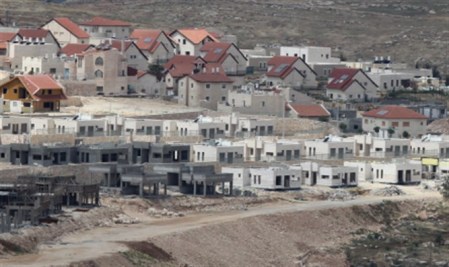
The Civil Administration’s Higher Planning Committee is scheduled to meet next week to approve a series of building projects in Jewish communities in Judea and Samaria. Combined, the projects include plans for more than 2,600 housing units.

If passed as expected, this would mark the first time the committee has approved housing projects in Jewish communities in Judea and Samaria since President Trump took office in January.

The hearings will take place Tuesday and Wednesday, and will cover a number of projects which had been blocked out of political considerations, Channel 2 reported.

The projects include housing outside of the major settlement blocs, in towns such as Kfar Tapuah in central Samaria.

Officials in Jerusalem say the housing projects are not likely to elicit criticism from the White House, noting the open lines of communication between the Prime Minister’s Office and the Trump administration regarding Israeli policy in Judea and Samaria.

The Limits of Israeli Power

June 2, 2017

The Limits of Israeli Power, Front Page MagazineCaroline Glick, June 2, 2017

(As to Jerusalem, please see Turkish takeover in Jerusalem. — DM)

Originally published by the Jerusalem Post

Washington and the rest of the governments of the world know that their refusal to recognize Israel’s capital does not endanger Israel or its control of Jerusalem. They are free to bow to Arab pressure, safe in the knowledge that Israel will continue to protect the unified city.

The time has come, at the outset of the second 50 years of Israeli control over Judea and Samaria, for Israel to take matters into its own hands. Our leaders must stop beating around the bush. They need to use the powers they have to secure Israel’s military and civilian interests in Judea and Samaria for the next 50 years as best they can. And they need to stop waiting for someone else to solve our problems for us.

*********************************

On Thursday, US President Donald Trump bowed to the foreign policy establishment and betrayed his voters. He signed a presidential waiver postponing the transfer of the US Embassy to Jerusalem for yet another six months.

Ahead of Trump’s move, Prime Minister Benjamin Netanyahu made a last-ditch bid to convince Trump to move the embassy to Jerusalem. But it was not to be.

Israel’s failure to convince Trump to do what he repeatedly promised US voters he would do during his presidential campaign shows the disparity in power between Israel and the US.

Israel lacks the power to convince foreign nations to recognize its capital – much less to locate their embassies there. The US, on the other hand, not only has the power to recognize Jerusalem and transfer its embassy to Israel’s capital whenever it wishes to do so, it also has the ability to convince dozens of other countries to immediately follow its lead.

The disparity between what the Americans can do and what Israel can do was on display on Monday evening in a glittering hall at the King David Hotel in Jerusalem. There, Bar-Ilan University conferred its Guardian of Zion award on former US ambassador to the UN John Bolton. In his acceptance speech, Bolton presented his vision for the resolution of the Palestinian conflict with Israel.

Bolton’s views are important not merely because his past work at the State Department and the UN brought the US some of its only diplomatic victories in recent decades. His views are important as well because of his close relationship with Trump.

Bolton began his discussion Monday evening by rejecting the “two-state solution.” The two-state model, he noted, has been tried and has failed repeatedly for the past 70 years. There is no reason to believe that it will succeed now. This is particularly true, he said, given the lack of Palestinian social cohesion.

Hamas controls Gaza. The PLO, which is supposed to be Israel’s peace partner, barely controls parts of Judea and Samaria. At a time when more cohesive Arab societies are unraveling, the notion that a Palestinian state would survive and advance regional peace and stability is laughable, Bolton argued.

Bolton then turned to his preferred policy for resolving the Palestinian conflict with Israel, which he dubbed “the three-state solution.” Under his plan, Egypt and Jordan would work with Israel to solve the Palestinian conflict. Egypt would take over the Gaza Strip and Jordan would negotiate the status of Judea and Samaria with Israel.

The crowd at the King David responded enthusiastically to Bolton’s proposal. This is not surprising.

Since 1967, Israelis have hoped for Jordan and Egypt to work with them to solve the problem of the Arabs of Judea, Samaria and Gaza who lived under Jordanian and Egyptian occupation from 1949-1967.

Unfortunately, Israel’s support for Bolton’s plan is irrelevant. Israel is powerless to advance it. Israel cannot convince Arab nations to help it resolve the Palestinian conflict any more than it can convince the PLO to cut a peace deal with it.

Like PLO leaders, the leaders of the Arab world know that they cannot help Israel with the Palestinians.

Doing so would involve disowning the Palestinian narrative.

The Palestinian narrative claims that the Jews of Israel are colonialist interlopers who stole the land from the Palestinians, its rightful owners. The narrative makes no distinction between Tel Aviv and Hebron. All of Israel is a crime against the Arab world. All of Israel is illegitimate.

The overwhelming majority of the Arab world believes the Palestinian narrative. For an Arab leader to walk away from it or even to signal an attenuation of his fealty to it in the interest of regional peace would be the riskiest of moves.

Israel has nothing to offer Arab leaders that could induce them to take that risk.

Although it is far from certain, the US may very well have the ability to convince Arab leaders to do so. If Trump decided that this is the way to advance peace in the Arab world, chances are he would make some headway. In other words, Bolton’s three-state plan is a plan that only America can adopt. It cannot be an Israeli plan no matter how enthusiastically the public supports involving Jordan and Egypt in solving the conflict.

Given Israel’s inability to offer the Arabs anything valuable enough for Arab leaders to risk life and limb to accept in exchange for helping to solve the Palestinian conflict, as Israel considers its own options in relation to the Palestinians, it needs to limit its goals to things that it can achieve without them. In other words, the only steps that Israel can take in relation to the Palestinians are unilateral steps.

For the past 50 years, hoping that the Arabs – and since 1993, the PLO – would finally make peace with it and so settle the permanent status of Judea and Samaria, Israel refused to take any unilateral actions in relation to its permanent interests in Judea and Samaria. Rather than apply its legal code to Judea and Samaria, it opted for the stop-gap measure of installing a military government to run the areas on the basis of Jordanian law.

Between 1994 and 1996, Israel canceled the military government in the Palestinian population centers in Judea and Samaria and Gaza. In 2005, when it withdrew, it canceled the residual military government in the rest of Gaza. Since then, the only area that remains under the Israeli military government is Area C in Judea and Samaria. Area C includes all of the Israeli communities in Judea and Samaria, and strategically critical areas including the Jordan Valley, the Samaria mountain range and the south Hebron Hills.

On Tuesday, Prime Minister Netanyahu gave an interview with Army Radio where he set out part of his vision for the permanent status of Judea and Samaria. He limited his statement to the military status of the areas. He said that under any possible future scenario, Israel must retain full security control of the areas. This, he said, is the lesson of Israel’s 2005 withdrawal from the Gaza Strip.

That pullout led to the transformation of Gaza into a Hamas-controlled hub of global jihad. Moreover, under Hamas, the Palestinians turned Gaza into one big, densely populated missile-launching pad against Israel.

While justified, Netanyahu’s position obscures more than it illuminates about his long-term vision for Judea and Samaria.

What does he mean by security control? Would the IDF remain in sole control over Israel’s eastern boundaries or would it serve as an overall coordinator of foreign forces operating along the border? Would IDF forces be confined to fortified positions while the Palestinians reign free in the open areas, as was the case in southern Lebanon in the years leading up to Israel’s disastrous withdrawal in 2000? Or would the IDF have freedom of action and maintain the initiative throughout Judea and Samaria? Moreover, does Netanyahu envision the IDF remaining the only military organization operating in Judea and Samaria in the long term? Beyond the security issues that require clarification, Netanyahu’s statements make no mention of the rights of Jews to live in Judea and Samaria.

Does he believe that Jews should be permitted to live permanently in the areas that Israel controls? If so, why are they subjected to the Jordanian legal code used by the military government and which proscribes their right to purchase land and register land sales? This brings us to the issue of governance. What does Netanyahu think about the military government in Area C? Does he believe that the 50-year reign of generals should continue until the Arabs choose to resolve the Palestinian conflict with Israel? What if this means that the generals will continue to rule over hundreds of thousands of Israeli citizens for another 50 or 100 or 150 years? Does he, on the other hand, prefer to transfer governance responsibility in Area C to the Palestinians and place the nearly 500,000 Israelis in the area under Palestinian control? In the course of his remarks, Bolton noted that if Jordan is responsible for the Palestinians of Judea and Samaria, the issue of Jerusalem will be removed from the equation. After all, if their capital is Amman, Israel has no reason to divide its capital city.

And this brings us back to Jerusalem, which Trump spurned on Thursday.

As is the case today, 50 years ago, Israel had no power to influence the positions of foreign governments regarding its capital city. But in contrast to its decision to establish a military government in Judea and Samaria, Israel didn’t wait for foreigners to give it permission to act where it had the power to act in order to change the status of the city and ensure its ability to govern and control its capital for generations to come.

In 1967, the government voted to expand the municipal boundaries of Jerusalem to include the eastern, northern and southern quarters that had been under Jordanian occupation since 1949.

Everyone benefited from the move – including the foreign powers that still refuse to recognize the simple fact that Jerusalem is Israel’s capital.

Washington and the rest of the governments of the world know that their refusal to recognize Israel’s capital does not endanger Israel or its control of Jerusalem. They are free to bow to Arab pressure, safe in the knowledge that Israel will continue to protect the unified city.

Trump’s decision to sign the waiver delaying the embassy move is a betrayal of his campaign promise, but it doesn’t change the situation in Jerusalem. Last week, Israel celebrated 50 years of sovereignty over its united capital. Jerusalem will be neither more nor less united if and when the US moves its embassy to the capital.

Perhaps Trump will eventually keep his word and move the embassy. Perhaps he will continue to breach his promise. And as far as the Palestinians are concerned, perhaps Trump adopts Bolton’s three-state plan in relation to Judea, Samaria and Gaza. Perhaps he will maintain his predecessors’ slavish devotion to the establishment of a PLO state.

Israel can’t control what Trump will do any more than it can influence what the Arabs will do. And so it needs to take a lesson not only from its bitter experience of withdrawing from Gaza, but from its positive experience of taking matters into its own hands in Jerusalem.

The time has come, at the outset of the second 50 years of Israeli control over Judea and Samaria, for Israel to take matters into its own hands. Our leaders must stop beating around the bush. They need to use the powers they have to secure Israel’s military and civilian interests in Judea and Samaria for the next 50 years as best they can. And they need to stop waiting for someone else to solve our problems for us.

The Trump-Haley Effect at the United Nations

June 1, 2017

The Trump-Haley Effect at the United Nations, Front Page MagazineAri Lieberman, June 1, 2017

Judging by this past week’s swift action by the UN Secretary General and Norway, it appears that the Trump-Haley, one-two combo is having the desired effect. Haley’s continued pressure at the UN is all but certain to produce more positive outcomes but it is still an uphill battle given the level of long-standing and embedded vitriol which still prevails in that cesspool of depravity. 

*****************************

It has become routine for Palestinians to name public places, including streets, schools, parks and public squares after hard core terrorists convicted of the most heinous offenses. Over the years, Israel has vigorously protested these outrages to the European Union, the United Nations, and the United States. The latter, particularly under the Obama administration, offered faux sympathy and little else, while the UN and EU were routinely dismissive of Israel’s objections. In the eyes of the UN and EU, the Palestinians could do no wrong and the Obama administration, by its deafening silence, gravitated toward this obscene position. This shocking inaction further encouraged the Palestinians to engage in what can only be described as depraved and aberrant behavior.

But on May 28, something strange but surprisingly decent happened at the UN. UN Secretary-General António Guterres issued a stinging rebuke to the Palestinian Authority for naming a women’s center after Dalal Mughrabi, a notorious terrorist. In 1978, Mughrabi along with seven other Arab terrorists commandeered a bus packed with civilians and mercilessly murdered 37 people, including 12 children.

For the Palestinians, this act of debauchery warranted praise and Mughrabi was elevated to the status of heroine and martyr. On May 26, the watchdog group, Palestinian Media Watch revealed that a women’s center named after Mughrabi in the Arab town of Burqa was constructed with funds provided by the UN and Norway. A prominent sign posted on the building bore the logos of the Palestinian Authority, the UN and Norway. Worse yet, PMW quoted a village council member who stated that “the center will focus especially on the history of the struggle of Martyr Dalal Mughrabi and on presenting it to the youth groups, and…constitutes the beginning of the launch of enrichment activities regarding the history of the Palestinian struggle.”

Upon learning of the outrage, a spokesperson for Guterres released a statement that termed the naming “offensive” and “unacceptable” and described it as a “glorification of terrorism” and an “obstacle to peace.” Guterres also demanded the immediate removal of the UN’s logo. Just two days prior, Norway issued a similar rebuke to the Palestinian Authority demanding not only the removal of the Norwegian logo but the return of all Norwegian funds earmarked for the project.

A statement released by Borge Brende, Norway’s Minister of Foreign Affairs, was unusually harsh in tone and content. It called the Palestinian “glorification of terrorist attacks…completely unacceptable” and noted that “Norway will not allow itself to be associated with institutions that take the names of terrorists in this way [and] will not accept the use of Norwegian aid funding for such purposes.”

So what led to this sudden, drastic change in attitude? There are likely three causes.

Unlike his predecessor Ban Ki-moon, Guterres has made statements and taken actions demonstrating a more balanced, nuanced approach to the Arab-Israeli conflict. For example in March, he rejected a UN report authored by an Israel-hating conspiracy theorist that peddled the banal and false claim that Israel practices apartheid and had the report removed from the UN’s website. Shortly thereafter, a top official that headed the commission which issued the report resigned. That same month, he publicly reiterated recognition of ancient historical and religious Jewish ties to Jerusalem. This was seen as a rebuke to UN bodies like UNESCO, which had sought to sever that nexus. In an address to the World Jewish Congress in April, Guterres stated that “Israel needs to be treated like any other UN member state,” and tellingly noted that, “the modern form of anti-Semitism is the denial of the existence of the State of Israel.”

In addition, the relentless surge of radical Islamic terrorism in Europe has likely produced an increased level of empathy with Israel. Moreover, nations affected by terrorism have reached out to Israel and sought its expertise. Only the most radical and anti-Semitic of Europe’s leaders, like Sweden’s Deputy Prime Minister Margot Wallström and British Labor Party head, Jeremy Corbyn, still differentiate between Israeli blood and blood spilled in Western Europe.

But perhaps the single most influential factor for the positive change in attitude lies with President Donald Trump and America’s ambassador to the UN, Nikki Haley. From the moment he was elected, Trump made clear that he would no longer tolerate the UN’s inequitable practices and shoddy treatment of Israel. He could not have picked a better emissary than Nikki Haley to carry out America’s new and robust approach toward rectifying a long-standing, systemic UN problem.

At every opportunity and in every forum and venue, Haley has made clear that the United States will not sit idly by while one of its most important allies and only Mideast democracy is mercilessly attacked and vilified by assorted despots and dictators, while other nations with abysmal human rights records are allowed to go unchallenged. Haley has made clear to UN member states that “there’s a new sheriff in town” and that sheriff is “taking names.”

Judging by this past week’s swift action by the UN Secretary General and Norway, it appears that the Trump-Haley, one-two combo is having the desired effect. Haley’s continued pressure at the UN is all but certain to produce more positive outcomes but it is still an uphill battle given the level of long-standing and embedded vitriol which still prevails in that cesspool of depravity.