Posted tagged ‘Terrorism’

Obama Warned To Defuse Tensions With Russia, “Unintended Consequences Likely To Be Catastrophic”

October 5, 2016

Obama Warned To Defuse Tensions With Russia, “Unintended Consequences Likely To Be Catastrophic”

Source: Obama Warned To Defuse Tensions With Russia, “Unintended Consequences Likely To Be Catastrophic” | Zero Hedge

A group of ex-U.S. intelligence officials is warning President Obama to defuse growing tensions with Russia over Syria by reining in the demonization of President Putin and asserting White House civilian control over the Pentagon.

ALERT MEMORANDUM FOR: The President


FROM: Veteran Intelligence Professionals for Sanity


SUBJECT: PREVENTING STILL WORSE IN SYRIA


We write to alert you, as we did President George W. Bush, six weeks before the attack on Iraq, that the consequences of limiting your circle of advisers to a small, relatively inexperienced coterie with a dubious record for wisdom can prove disastrous.* Our concern this time regards Syria.


We are hoping that your President’s Daily Brief tomorrow will give appropriate attention to Saturday’s warning by Russia’s Foreign Ministry spokesperson Maria Zakharova: “If the US launches a direct aggression against Damascus and the Syrian Army, it would cause a terrible, tectonic shift not only in the country, but in the entire region.”


Speaking on Russian TV, she warned of those whose “logic is ‘why do we need diplomacy’ … when there is power … and methods of resolving a problem by power. We already know this logic; there is nothing new about it. It usually ends with one thing – full-scale war.”


We are also hoping that this is not the first you have heard of this – no doubt officially approved – statement. If on Sundays you rely on the “mainstream” press, you may well have missed it. In the Washington Post, an abridged report of Zakharova’s remarks (nothing about “full-scale war”) was buried in the last paragraph of an 11-paragraph article titled “Hospital in Aleppo is hit again by bombs.” Sunday’s New York Times totally ignored the Foreign Ministry spokesperson’s statements.


In our view, it would be a huge mistake to allow your national security advisers to follow the example of the Post and Times in minimizing the importance of Zakharova’s remarks.


Events over the past several weeks have led Russian officials to distrust Secretary of State John Kerry. Indeed, Foreign Minister Sergey Lavrov, who parses his words carefully, has publicly expressed that distrust. Some Russian officials suspect that Kerry has been playing a double game; others believe that, however much he may strive for progress through diplomacy, he cannot deliver on his commitments because the Pentagon undercuts him every time. We believe that this lack of trust is a challenge that must be overcome and that, at this point, only you can accomplish this.


It should not be attributed to paranoia on the Russians’ part that they suspect the Sept. 17 U.S. and Australian air attacks on Syrian army troops that killed 62 and wounded 100 was no “mistake,” but rather a deliberate attempt to scuttle the partial cease-fire Kerry and Lavrov had agreed on – with your approval and that of President Putin – that took effect just five days earlier.


In public remarks bordering on the insubordinate, senior Pentagon officials showed unusually open skepticism regarding key aspects of the Kerry-Lavrov deal. We can assume that what Lavrov has told his boss in private is close to his uncharacteristically blunt words on Russian NTV on Sept. 26:


“My good friend John Kerry … is under fierce criticism from the US military machine. Despite the fact that, as always, [they] made assurances that the US Commander in Chief, President Barack Obama, supported him in his contacts with Russia (he confirmed that during his meeting with President Vladimir Putin), apparently the military does not really listen to the Commander in Chief.”


Lavrov’s words are not mere rhetoric. He also criticized JCS Chairman Joseph Dunford for telling Congress that he opposed sharing intelligence with Russia, “after the agreements concluded on direct orders of Russian President Vladimir Putin and US President Barack Obama stipulated that they would share intelligence. … It is difficult to work with such partners. …”


Policy differences between the White House and the Pentagon are rarely as openly expressed as they are now over policy on Syria. We suggest you get hold of a new book to be released this week titled The General vs. the President: MacArthur and Truman at the Brink of Nuclear War by master historian H. W. Brands. It includes testimony, earlier redacted, that sheds light on why President Truman dismissed WWII hero Gen. Douglas MacArthur from command of U.N. forces in Korea in April 1951. One early reviewer notes that “Brands’s narrative makes us wonder about challenges of military versus civilian leadership we still face today.” You may find this new book more relevant at this point in time than the Team of Rivals.


The door to further negotiations remains ajar. In recent days, officials of the Russian foreign and defense ministries, as well as President Putin’s spokesman, have carefully avoided shutting that door, and we find it a good sign that Secretary Kerry has been on the phone with Foreign Minister Lavrov. And the Russians have also emphasized Moscow’s continued willingness to honor previous agreements on Syria.


In the Kremlin’s view, Russia has far more skin in the game than the U.S. does. Thousands of Russian dissident terrorists have found their way to Syria, where they obtain weapons, funding, and practical experience in waging violent insurgency. There is understandable worry on Moscow’s part over the threat they will pose when they come back home. In addition, President Putin can be assumed to be under the same kind of pressure you face from the military to order it to try to clean out the mess in Syria “once and for all,” regardless how dim the prospects for a military solution are for either side in Syria.


We are aware that many in Congress and the “mainstream” media are now calling on you to up the ante and respond – overtly or covertly or both – with more violence in Syria. Shades of the “Washington Playbook,” about which you spoke derisively in interviews with the Atlantic’s Jeffrey Goldberg earlier this year. We take some encouragement in your acknowledgment to Goldberg that the “playbook” can be “a trap that can lead to bad decisions” – not to mention doing “stupid stuff.”


Goldberg wrote that you felt the Pentagon had “jammed” you on the troop surge for Afghanistan seven years ago and that the same thing almost happened three years ago on Syria, before President Putin persuaded Syria to surrender its chemical weapons for destruction. It seems that the kind of approach that worked then should be tried now, as well – particularly if you are starting to feel jammed once again.


Incidentally, it would be helpful toward that end if you had one of your staffers tell the “mainstream” media to tone down it puerile, nasty – and for the most part unjustified and certainly unhelpful – personal vilification of President Putin.


Renewing direct dialogue with President Putin might well offer the best chance to ensure an end, finally, to unwanted “jamming.” We believe John Kerry is correct in emphasizing how frightfully complicated the disarray in Syria is amid the various vying interests and factions. At the same time, he has already done much of the necessary spadework and has found Lavrov for the most part, a helpful partner.


Still, in view of lingering Russian – and not only Russian – skepticism regarding the strength of your support for your secretary of state, we believe that discussions at the highest level would be the best way to prevent hotheads on either side from risking the kind of armed confrontation that nobody should want.


Therefore, we strongly recommend that you invite President Putin to meet with you in a mutually convenient place, in order to try to sort things out and prevent still worse for the people of Syria.


In the wake of the carnage of World War II, Winston Churchill made an observation that is equally applicable to our 21st Century: “To jaw, jaw, jaw, is better than to war, war, war.”

For the Steering Group, Veteran Intelligence Professionals for Sanity

William Binney, former Technical Director, World Geopolitical & Military Analysis, NSA; co-founder, SIGINT Automation Research Center (ret.)

Fred Costello, Former Russian Linguist, USAF

Mike Gravel, former Adjutant, top secret control officer, Communications Intelligence Service; special agent of the Counter Intelligence Corps and former United States Senator

Matthew Hoh, former Capt., USMC, Iraq & Foreign Service Officer, Afghanistan (associate VIPS)

Larry C. Johnson, CIA & State Department (ret.)

John Kiriakou, former CIA counterterrorism officer and former senior investigator, Senate Foreign Relations Committee

Linda Lewis, WMD preparedness policy analyst, USDA (ret.) (associate VIPS)

Edward Loomis, NSA, Cryptologic Computer Scientist (ret.)

Ray McGovern, former US Army infantry/intelligence officer & CIA analyst (ret.)

Elizabeth Murray, Deputy National Intelligence Officer for Middle East, CIA (ret.)

Todd Pierce, MAJ, US Army Judge Advocate (ret.)

Coleen Rowley, Division Counsel & Special Agent, FBI (ret.)

Kirk Wiebe, former Senior Analyst, SIGINT Automation Research Center, NSA, (ret.)

Robert Wing, former Foreign Service Officer

Ann Wright, U.S. Army Reserve Colonel (ret) and former U.S. Diplomat

* In a Memorandum to President Bush criticizing Colin Powell’s address to the UN earlier on February 5, 2003, VIPS ended with these words: “After watching Secretary Powell today, we are convinced that you would be well served if you widened the discussion … beyond the circle of those advisers clearly bent on a war for which we see no compelling reason and from which we believe the unintended consequences are likely to be catastrophic.”


Obama Administration Again Deliberates Air Strikes on Assad

October 5, 2016

Obama Administration Again Deliberates Air Strikes on Assad Regime President unlikely to accept military action in Syria

BY:
October 4, 2016 4:46 pm

Source: Obama Administration Again Deliberates Air Strikes on Assad

The Obama administration is again considering air strikes against the regime of Syrian President Bashar al Assad following the failure of a ceasefire deal brokered by the U.S. and Russia.

Top national security officials are meeting with senior administration officials Wednesday to address the ongoing crisis in the rebel-held city of Aleppo. President Obama is expected to reject proposed airstrikes, according to the Washington Post.

Officials from the State Department, CIA, and Joint Chiefs of Staff met last week at the White House to discuss limited military strikes in Syria against the regime to punish Assad for violating the latest ceasefire and continuing to commit war crimes against his people.

Administration officials also hope to pressure Assad into diplomatic talks aimed at ending the country’s civil war, now in its sixth year.

The administration is considering a number of options that include bombing Syrian air force runways, an official participating in the discussions told the Post. The official said the White House would work around its long-standing refusal to strike the Assad regime without a U.N. Security Council resolution by covertly conducting the strikes.

“There’s an increased mood in support of kinetic actions against the regime,” one senior administration official told the Post.

Still, Obama remains unlikely to approve military action against the regime.

The U.S. on Monday suspended bilateral engagement with Russia on negotiating a diplomatic resolution in Syria. Secretary of State John Kerry had worked to restore a week-long ceasefire with Moscow, but talks ultimately fell through given Russia’s continued assault on Aleppo along with Syrian forces.

Iraq demands that Turkey pull its ‘occupying’ troops out of military base near Mosul

October 5, 2016

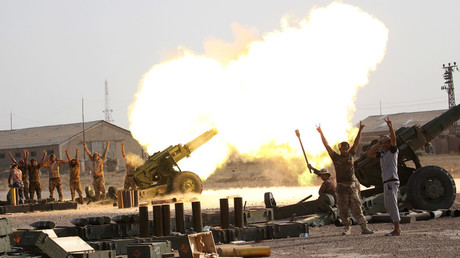
Iraq demands that Turkey pull its ‘occupying’ troops out of military base near Mosul Published time:

5 Oct, 2016 07:52 Edited time: 5 Oct, 2016 10:07

Source: Iraq demands that Turkey pull its ‘occupying’ troops out of military base near Mosul — RT News

© Asmaa Waguih / Reuters

Outraged by Ankara’s decision to extend the stationing of its troops in northern Iraq, 30 kilometers from Mosul, Iraqi MPs have called on the government to review its relations with Turkey and lodge a complaint against the “occupation” with the UNSC.

On Tuesday, the majority of Iraqi legislators spoke out against the Turkish parliament’s decision to prolong the stationing of about 150 Turkish soldiers and some 25 tanks at the Bashiqa military camp in Iraq’s northern Nineveh Province, which is located at the forefront of the battle with Islamic State (IS, formerly ISIS/ISIL).

Read more

U.S soldiers walk on a bridge with in the town of Gwer northern Iraq © Azad Lashkari

In a written statement, the MPs decried the decision, appealing to the country’s prime minister, Haider al-Abadi, to summon the Turkish ambassador and file a complaint with the United Nations Security Council that would designate Turkey’s military contingent as an “occupying” force, according to Rudaw news agency.

On Saturday, the Turkish parliament green lighted the extension of the Turkish military’s engagement in both Iraq and Syria.

Since 2014, Turkish servicemen have provided training and support to Kurdish Peshmerga units and Sunni militia known as Hashd al-Watani forces at the camp, subject to agreement with the Iraqi government. However, on December 4 of last year, Turkey beefed up its military presence at the camp, allegedly to protect its advisers. The move infuriated Bagdad, which insisted that Turkey had not asked for permission from the Iraqi government to deploy additional troops, thus violating its sovereignty.

Turkish President Recep Tayyip Erdogan refused to acknowledge this at that time, claiming that Turkey was acting within the scope of the previous agreement.

“Turkish soldiers are in Basheeqa camp at the request of Haider al-Abadi in 2014. Now I am asking why he has been silent since 2014,” Erdogan said in December, disputing claims that Turkey was intervening in Iraq.

Read more

© Alaa Al-Marjani

Speaking in the wake of the vote, Abadi publicly called for Turkey’s troops to immediately leave its territory, saying that “the Turkish insistence on their presence inside Iraqi territories has no justification.”

The prime-minister told journalists on Tuesday that Iraq has managed to enlist the support of the ‘international community,’ as well as the US-led international coalition, in its bid to remove the Turkish military from its territory.

While Iraq doesn’t want to be dragged into a military conflict with Turkey, it finds the actions of its government “not acceptable by any standard,” he added.

Turkish Deputy Prime Minister Numan Kurtulmus stressed on Wednesday that Turkey’s military presence in the Bashiqa camp is intended solely to provide stability and train the local forces, and that Ankara does not aim to become an occupying force.

Turkey will not allow this to become a matter of debate,” he told reporters as cited by Reuters.

Both Turkey and Iraq summoned each other’s ambassadors on Wednesday to discuss the growing rift between the two states.

Turkey’s foreign ministry also condemned the vote, the Daily Sabah reported.

READ MORE:French fighter jets take off on mission against ISIS stronghold in Mosul, Iraq

Back in December, Iraq appealed to NATO to force Turkey to withdraw its forces, but the alliance found Ankara to be in compliance with the terms of the training agreement.

Iraq’s largest city, Mosul, fell into the hands of Islamic State in 2014, and Iraqi forces are currently preparing an offensive to retake the terrorist stronghold, aided by US-led anti-terrorism coalition.

If the operation is successful, Iraq wants to “ensure Turkish troops do not exploit the power vacuum after achieving victory against Islamic State in Mosul,” Abadi has stressed.

IDF hits targets in northern Gaza in response to rocket strike

October 5, 2016

IDF hits targets in northern Gaza in response to rocket strike After projectile lands on a Sderot street, Israeli tanks reportedly fire on Hamas sites in Beit Hanoun

By Judah Ari Gross October 5, 2016, 11:59 am

Source: IDF hits targets in northern Gaza in response to rocket strike | The Times of Israel

A rocket launched from the Gaza Strip strikes a road in the southern city of Sderot on October 5, 2016. (Israel Police)

Israeli tanks fired on Hamas targets in the northern Gaza Strip on Wednesday in response to a rocket that landed in southern Israel earlier in the day, the army said.

According to Palestinian reports, the IDF tanks struck sites in Beit Hanoun, on the northeastern corner of the coastal enclave. The army would not immediately confirm those reports to The Times of Israel.

There were no immediate reports of Palestinian injuries.

The rocket, which had been fired from the Gaza Strip, struck a street in the city of Sderot — a few miles from Beit Hanoun — just before 10:30 a.m. on Wednesday, police said, causing damage and sending three people to the hospital suffering from anxiety attacks.

The Islamic State-affiliated Ahfad al-Sahaba-Aknaf Bayt al-Maqdis terrorist group took responsibility for the rocket launch in statements released in both Arabic and Hebrew.

“Oh you cowardly Jews: You don’t have safety in our land. [Former defense minister Moshe] Ya’alon, the failure at giving security. [Defense Minister Avigdor] Liberman to fail will be a certainty,” the Salafist group said in its statement, in poorly translated Hebrew.

The attack against Israel was apparently a response to the Strip’s Hamas rulers arresting several members of the Salafist organization, according to the group’s statement.

Though the Salafist group took responsibility for the attack, Israel has said it holds Hamas responsible for any attacks emanating from Gaza and routinely responds to such launches with strikes inside the Palestinian territory.

“We can’t go after every little group in Gaza with a couple of dozen members that goes out one night and fires a rocket,” a senior officer in the IDF’s Southern Command told reporters last month.

Ahfad al-Sahaba-Aknaf Bayt al-Maqdis released a similar statement last month, after a failed attempt to launch a rocket at southern Israel on the first day of school. The group also claimed responsibility for a rocket attack that hit Sderot
in August, landing between two houses in the southern Israeli city.

In Wednesday morning’s rocket attack, three people in Sderot “suffered anxiety attacks” and were treated by medical teams, but no one was physically hurt by the attack, according to the Magen David Adom medical service.

The three — including a 15-year-old girl and 60-year-old man — were taken to Ashkelon’s Barzilai Medical Center for further care, MDA paramedics said.

The rocket alert siren was activated at approximately 10:20 a.m. and was heard in Sderot, Nir Am, Ivim and Gevim.

A few minutes later, Israel Police officers located the rocket in Sderot. The street where it landed was damaged in the attack, as were several nearby cars and homes.

Police sappers were called to the scene, and the area was closed off to pedestrians and traffic, police said.


Police sappers dig out piece of a rocket launched from the Gaza Strip that struck a road in the southern city of Sderot on October 5, 2016.

Last month, a mortar shell was launched from the Gaza Strip and landed in a field in southern Israel, causing neither injury nor damage, the army said. The projectile hit an empty field in the Eshkol region, next to the southern Strip, according to a statement from the Israel Defense Forces.

ISIS cell in Jerusalem?

October 2, 2016

ISIS cell in Jerusalem? Six Jerusalem Arabs arrested for allegedly working to establish ISIS foothold in Israel.

Uzi Baruch, 02/10/16 11:12

Source: ISIS cell in Jerusalem? – Defense/Security – News –


Six Jerusalem Arabs have been indicted for allegedly working to establish a cell of the ISIS terror organization inside Israel.

The six were charged in a Jerusalem court of security offenses, assisting an enemy in war-time, and association with a terror group.

The suspects are residents of the Shuafat and Anata neighborhoods.

According to the indictment, from 2015 until August 2016, the suspects made efforts to enlist in ISIS and establish an ISIS cell inside Israel. Among other activities, the six organized study sessions to spread the terror group’s radical ideology.

The indictment also revealed that some of the suspects attempted to travel to Syria to join the jihadist organization’s fight against the Assad regime.

The suspects also reportedly planned terror attacks against Jews in Jerusalem and Tel Aviv.

Direct aggression by US against Damascus to cause ‘tectonic shift’ in Middle East

October 2, 2016

Direct aggression by US against Damascus to cause ‘tectonic shift’ in Middle East – Moscow

Published time: 1 Oct, 2016 10:22 Edited time: 1 Oct, 2016 18:19

Source: Direct aggression by US against Damascus to cause ‘tectonic shift’ in Middle East – Moscow — RT News


FILE PHOTO Residents in Midan, a Christian district of Aleppo, hit by mortar shelling. © Mikhail Alayeddin
If the US launches a military campaign to oust the Syrian government, it would further fracture the country and have tremendous negative long-term consequence for the entire region, Russian Foreign Ministry spokesperson Maria Zakharova warned.
Read more

Russian Foreign Minister Sergei Lavrov © Mikhail Voskresenskiy

If the US launches a direct aggression against Damascus and the Syrian Army, it would cause a terrible, tectonic shift not only in the country, but in the entire region,” Maria Zakharova said during a talk show, which is to be aired fully later on Saturday and has been cited by RIA.

With no government in Damascus, there will be a power vacuum in Syria, which “so-called moderates, who are, in reality, not moderate at all but just terrorists of all flavors, would fill; and there will be no dealing with them,” the diplomat predicted.

And later it would be aggravated the way it happened in Iraq. We know that [Saddam Hussein’s] Iraqi Army became the basis of the Islamic State. Everything that both the [US-led] coalition and Russia are fighting now stems from it,” Zakharova said.

Russia and the US are accusing each other over the collapse of the ceasefire which was signed last month, but has failed. The US says Moscow did not do enough to win the trust of rebel forces and to prevent the government of Syrian President Bashar Assad from attacking his opponents. Russia says Washington was incapable of separating ‘moderate rebels’ from terrorist groups and keeping them in check for the truce to take hold.

READ MORE: US had never had ‘Plan A’ for Syria, West a root cause of crisis – Syrian UN envoy to RT

With the collapse of the deal, the Syrian government launched an offensive on rebel-held areas of Aleppo, a city divided between the Syrian Army and dozens of armed groups, including Al Qaeda off-shoot Al-Nusra Front.

The US acknowledged that it had not been going after Al-Nusra Front for months because the terrorists intermingled with ‘moderates’ and the civilian population. At the same time, it accused Moscow and Damascus of war crimes, citing civilian deaths caused by the renewed hostilities in Aleppo.

Russia has voiced concern that the US was deliberately shielding Al-Nusra Front from military action by Russia and Syria, hoping that the terrorist group would help oust the Syrian government.

Oppressive! PvdA and D66 to legally protect Islam against Dutch. (Update: motion adopted!)

October 1, 2016

Translation from original Dutch article by JK

Door Joost Niemöller

http://joostniemoller.nl/2016/05/beklemmend-pvda-en-d66-willen-islam-wettelijk-beschermen-nederlanders/

Update: This insane motion was passed by a massive majority!

Vote, the motion-Marcouch / Sjoerdsma (29 614, no. 46).

Chairman:
I note that, the present members of the factions of the SP, the PvdD, the PvdA, GroenLinks, D66, Van Vliet, 50PLUS, Small Group Kuzu / Öztürk, Stonemasons, the VVD, the Christian Union, the CDA for this motion voted and present members of the other groups on it, so that it is adopted.

Marcouch, the Labour MP has filed a motion with Sjoerdsma (D66) which calls for a special legal protection of Islam. At least, of ‘religion’, and this is because there would be ‘Muslim discrimination. “The word” religion “therefore falls, but not pathetic Jehovah witnesses or pathetic Calvinists need to be protected, because that’s not the background of the motion .

What then is the problem? There is nothing to worry about.

There would be ‘under reporting of these’ Muslim discrimination. “On that, a report. It is thus made no declaration, there would be discrimination. Oh dude? What ‘discrimination’ then? Here, of course, remains vague. Also, one ‘under-reporting’ not set against the other, namely because it concerns only the so-called science. Under reporting measure specifically is like measuring the black money circuit: It’s a wild guess.

Oh, there will really ever be drawn to a headscarf. And that’s not nice of course. But how many Dutch women are not abused for whore because they wear a skirt and why the PvdA and D66 should there be no motion because women it out of their head to report about it? It has become ‘normal’?

That the Muslims is correct even easier to report, so that the Dutch government is actively working to incite Muslims to declarations evident from the mass of by the supercharged declarations against Wilders, who now lead to his trial.

There is rather a report about Muslim whining than under reporting.

An older woman who wants to report it because she was robbed by a woman with a headscarf, was literally discouraged by the police to report it. Fact! Then you put it in your head to go to the police when you are being robbed by Muslims as the Netherlands.

But on no Marcouch and Sjoerdsma worry. Therefore, they are not even a motion stating that the police reports must take seriously. All returns! That would be perceived problem with the Muslim discrimination also emerge not? Well, that does not come up, because that does not exist to that extent.

And what has that to do any pulling on headscarves with the protection of religious freedom? It is generally breaking behavior, like cussing for whore. That must be addressed, but you D66 and PvdA do not hear about.

No, Islam, which is pathetic in this country. Islam, which, incidentally, not supposed to be in the Netherlands because the values of the Muslim ideology do not match the values in this country, should the PvdA and D66 given special legal protection that Muslims have priority do when declaration their whining.

Crazy. And perilous. Our living space is increasingly limited. Everything is called racism. Everywhere is punishment. Ie: For Dutch.

And now strengthen so that those sneaky motion to increase the space of Islam with the excuse of a report that has nothing to do with it.

I did not invent all this. This is the motion:

MOTION OF MEMBERS AND Marcouch Sjoerdsma

Presented May 25, 2016

The Chamber, a debate heard, whereas freedom of religious expression is under pressure; Whereas it is established in recent research that in the Rotterdam area are more than twice as many cases of discrimination than Muslims are reported to the designated authorities; whereas under reporting of Muslim discrimination elsewhere is a common phenomenon; believes that protection of freedom of religion by the government should be supported; asks the government for the upcoming budget discussions to bring forward proposals to protect religious freedom, defend and propagate, and proceeds to the order of the day. Marcouch Sjoerdsma

We Are the Third World

October 1, 2016

We Are the Third World, American ThinkerTimothy Birdnow, October 1, 2016

In the presidential debate last Monday Donald Trump warned America that she’s “become a third-world country” to the guffaws and disdain of the liberals, the media (but I repeat myself) and Hillary Rodham Clinton, who later accused Trump of talking smack about the country she wants to loot, er, lead.

One must ask, is Trump correct or do we continue to occupy the apex of the first world? Is there evidence to support Mr. Trump’s claim?

Let me offer exhibit A.

According to the St. Louis Post-Dispatch:

Two years after the University of Missouri closed the state’s lone hospital for treating tuberculosis and other infectious diseases, state health officials are looking at opening a new facility.

The Missouri Department of Health and Senior Services is seeking bids for a study that could provide officials with a roadmap for opening a new treatment center to replace the current process of sending patients to other states.

It comes amid a nationwide increase in the number of people contracting the airborne bacterial disease that attacks the lungs.

According to the request, Missouri has averaged 90 active tuberculosis cases in each of the past three years

Missouri has been more fortunate than many other states in this regard. Why?  Because Missouri a series of strict laws against illegal alien encroachment, going back to 2007.

As a result Missouri has avoided many of the pitfalls — including third-world diseases — that are plaguing other states. But the power of the central government has grown to the point where it has managed to circumvent many of the laws put in place by the states and so the problems plaguing other states are starting to dribble in.

Let’s face it; tuberculosis is now a Third World disease. In the U.S. the number of cases of TB were cut in half between 1953 and 1968 due to better antibiotics and better medical care. (It is interesting to note that Operation Wetback repatriated up to 2 million trespassing aliens starting in 1954, thus helping to reduce the number of such cases.) The reduction in TB rates turned around in the mid ’80s as a result of the HIV/AIDS epidemic (which was not handled like any other infectious epidemics where authorities follow the chain of contagion and restrict the activities of the infected; AIDS was allowed to burn through the populace out of fears of stigmatizing homosexuals.) Still, rates remained low. Only now we see them rising — and HIV is fairly under control, so that is not the cause.

According to the CDC 88% of all antibiotic-resistant TB in the U.S. comes from immigrants.

And that is just one infectious disease. Consider that last year we had 15 cases of bubonic plague in the U.S. Bubonic plague is clearly a third-world disease, one long absent in America.

Another facet of Third Worldism is the export of raw materials rather than manufactured goods. America is now almost completely an exporter of coal, because the Federal government has used regulatory power to strangle the industry. In 2008 then President Obama famously stated: “If someone wants to build a new coal-fired power plant they can, but it will bankrupt them because they will be charged a huge sum for all the greenhouse gas that’s being emitted.”

He has since gone on to crush an entire industry. Peabody Energy and Arch Coal — the largest and second largest coal companies on Earth — both went into bankruptcy recently. We now export raw coal because we can’t use it for anything.

And Lead. The Doe Run smelter — the last in America — closed a couple of years ago as a result of pressure from the Federal government. America now cannot smelt lead, but rather is forced to sell the raw materials to others who process it. That is third world.

Meanwhile, Mr. Trump scolded Ford for moving all its small car manufacturing to foreign countries. Well, that is what they are doing. It’s what happens when you are providing an unfriendly environment to manufacturing businesses.

Then there is language. One of the characteristics of a third-world country is the preponderance of languages; multiple languages exemplify disunity, thus dividing the nation. Well, the U.S. is at least the fifth largest Spanish speaking country on Earth and may well be second only to Mexico with between 35 and 50 million speakers.

In fact, one in five households do not speak English at home. While this is not solely the fault of Barack Obama, the problem (and it is a problem) has clearly metastasized under Il Duce.

Meanwhile, Hillary Clinton is calling for more spending on infrastructure, despite Obama’s trillion-dollar stimulus which supposedly funded “shovel ready jobs” and rebuilt these ailing roads and whatnot. If we can’t make basic repairs to infrastructure with a trillion dollars, how do we differ from a third-world country?

And violence. As I have noted, East St. Louis has levels of violence comparable to Honduras and other hellholes. We all know how many murders are occurring in Chicago, for instance, and we know of the rioting in Baltimore, in Charlotte, and in Ferguson. How does this differ from the war-torn, strife-filled third world?

Well, partly there is the rule of law. Unfortunately, Mr. Obama simply ignores the rule of law when it inconveniences him, granting an amnesty to illegals despite laws duly passed by Congress, for instance. He has simply gone ahead with many things he wanted, such as military action in Libya without Congressional approval, or forcing Boeing to shut down a factory for being non-union in 2011, or giving Mexican criminals thousands of illegal weapons in Fast and Furious. What about the drone strikes killing American citizens without due process? What about his use of executive orders to release people duly imprisoned by courts of law? How about his circumventing Congress to seize land?

And under Mr. Obama wealth has concentrated to just a few crony fat cats while everyone else lives hand to mouth due to underemployment. Even the liberal Huffington Post had to admit this fact. Rich oligarchs are another example of third worldism.

No Third World country is complete without vote fraud to keep the ruling junta in power. Consider the fact that fraud may well be the reason Obama won re-election last time.

A nation without the rule of law is a banana republic. Banana republics are inherently third world.

So Hillary and the Left may dismiss Mr. Trump’s argument that America is becoming third world, but the facts belie their claims.


Obama Admin Signed Secret Doc to Lift UN Sanctions on Iran Banks

September 30, 2016

Report: Obama Admin Signed Secret Document to Lift U.N. Sanctions on Iranian Banks

BY:
September 30, 2016 1:23 pm

Source: Obama Admin Signed Secret Doc to Lift UN Sanctions on Iran Banks

The Obama administration signed a secret document to lift United Nations sanctions on two Iranian state banks that were previously blacklisted for their involvement in financing Iran’s ballistic-missile program the same day Tehran released four American prisoners, the Wall Street Journal reported Friday.

Based on the nuclear agreement between Iran and six world powers, the two banks were initially under sanctions until 2023, but the administration agreed to delist the entities on Jan. 17. Senior U.S. officials told the Journal that State Department official Brett McGurk and an Iranian government representative met in Geneva and signed three documents that day.

One document committed the U.S. to dropping criminal charges against 21 Iranian nationals, and Tehran to releasing the Americans imprisoned in Iran.

Another committed the U.S. to immediately transfer $400 million in cash to the Iranian regime and arrange the delivery within weeks of two subsequent cash payments totaling $1.3 billion to settle a decades-old legal dispute over a failed arms deal.

The U.S. agreed in a third document to support the immediate delisting of the two Iranian banks, according to senior U.S. officials. In the hours after the documents were signed at a Swiss hotel, the different elements of the agreement went forward: The Americans were released, Iran took possession of the $400 million in cash, and the U.N. Security Council removed sanctions on Bank Sepah and Bank Sepah International, these officials said.

In February, a documentary by Iranian media outlet Tasnim News Agency, which is affiliated with the Islamic Revolutionary Guard Corps, claimed that Iranian government officials demanded that Bank Sepah  be delisted from U.N. sanctions as part of the deal to release four Americans. Despite previous sanctions on the bank by the Treasury Department, the Obama administration agreed to lift the sanctions under the nuclear deal reached in July 2015.

After the nuclear accord was inked, senior officials said they continued to have dialogue with Iran about the two banks before the three documents were officially signed in January. Tehran argued that Bank Sepah and Bank Sepah International were critical to international trade and their economy, the Journal reported.

Bank Sepah is Iran’s oldest bank and one of its three largest in terms of assets. Bank Sepah International, based in London, was key to financing Iran’s international trade before sanctions were imposed.

The U.S. Treasury was vehemently opposed to the banks back in 2007 for their alleged role in financially backing Iran’s missile program.

At the time, the Treasury said that Bank Sepah and Bank Sepah International had provided financial support to Iranian-state owned companies and organizations developing Iran’s missile program. These included Iran’s Aerospace Industries Organization and the Shahid Hemmat Industries Group.

“Bank Sepah is the financial linchpin of Iran’s missile procurement network and has actively assisted Iran’s pursuit of missiles capable of carrying weapons of mass destruction,” the Treasury said in a January 2007 statement.

Since the nuclear agreement was reached in July 2015, Iran has conducted up to 10 ballistic missile tests. The U.N. has been critical of these launches but has not imposed any new sanctions.

Senior Pentagon officials are upset about the prisoner deal, the Journal noted, despite U.S. officials saying the Obama administration closely vetted all entities and people associated with Bank Sepah before they agreed to the lifting of sanctions.

The dispute in Washington has only deepened in recent weeks, as senior Pentagon officials, including Secretary of Defense Ash Carter, told Congress in a hearing that they weren’t notified by the White House about the cash transfer. The chairman of the Joints Chief of Staff, Marine Gen. Joe Dunford, said at a hearing last week that he found it “troubling” that the U.S. provided Tehran with so much cash, which he argued could be used for “spreading malign influence.”

The Obama administration has repeatedly denied accusations that it sent $1.7 billion to Tehran to secure the release of four American prisoners. Many lawmakers have called the money transfer a ransom payment. A majority of lawmakers supported legislation last week that would legally ban the Obama administration from sending more cash payments to Tehran.

The Washington Free Beacon previously reported on House Majority Leader Kevin McCarthy (R., Calif.) praising the legislation.

While the Obama administration has threatened to veto the bill, McCarthy said the majority of Congress disagrees with the administration’s decision to pay Iran $1.7 billion prior to the release earlier this year of several U.S. hostages.

“The Obama administration paid a cash ransom to Iran for American hostages,” McCarthy told the Free Beacon. “No matter how the Obama administration chooses to redefine this payment, the message to Iran is crystal clear: You will be rewarded for taking hostages—not punished.”

Abbas to Arab Leaders: Go to Hell!

September 27, 2016

Abbas to Arab Leaders: Go to Hell!

by Khaled Abu Toameh

September 26, 2016 at 5:00 am

Source: Abbas to Arab Leaders: Go to Hell!


  • Abbas and Fatah leaders in Ramallah claim that Egypt, Saudi Arabia, Jordan and the United Arab Emirates (the “Arab Quartet”) are using and promoting Abbas’s rival, Mohamed Dahlan, in order to facilitate their mission of rapprochement with Israel.
  • Many Palestinians were surprised to see veteran Palestinian official Ahmed Qurei, a former Palestinian Authority (PA) prime minister and one of the architects of the Oslo Accord, come out in favor of the Arab plan, which basically envisions ousting Abbas from power.
  • This, and not Israeli policy, is Abbas’s true nightmare. After all, he knows that without Israel’s presence in the West Bank, his regime would have long fallen into the hands of Hamas or even his political rivals in Fatah.
  • The “Arab Quartet” plan shows that some Arab countries are indeed fed up with Abbas’s failure to lead his people towards a better life. These states, which have long been politically and financially supportive of the Palestinians, have had enough of Abbas’s efforts to secure unending power — at the direct cost of the well-being of his people.

In his speech last week before the United Nations General Assembly in New York, Palestinian Authority (PA) President Mahmoud Abbas trotted out his usual charges against Israel, citing “collective punishment,” “house demolitions,” “extrajudicial executions” and “ethnic cleansing.” However, Abbas’s thoughts seem to be elsewhere these days. He is facing a new challenge from unexpected parties, namely several Arab countries that have come together to demand that he reform his ruling Fatah faction and pave the way for the emergence of a new Palestinian leadership.

Yet this was not included in the UN speech. Indeed, why would Abbas share with world leaders that his Arab brothers are pressuring him to introduce major reforms in Fatah and end a decade-long power struggle with Hamas that has resulted in the creation of two separate Palestinian entities in the West Bank and Gaza Strip.

Abbas, his aides admit, is today more worried about the “Arab meddling” in the internal affairs of the Palestinians than he is about “collective punishment” or “settlement activities.” In fact, he is so worried that he recently lashed out at those Arab countries that have launched an initiative to “re-arrange the Palestinian home from within” and bring about changes in the Palestinian political scene.

The Arab countries behind the initiative — Egypt, Saudi Arabia, Jordan and the United Arab Emirates — are being referred to by many Palestinians as the “Arab Quartet.”

In an unprecedented critique of these countries, Abbas recently declared:

“The decision is ours and we are the only ones who make decisions. No one has authority over us. No one can dictate to us what to do. I don’t care about the discomfort of Washington or Moscow or other capitals. I don’t want to hear about these capitals. I don’t want the money of these capitals. Let’s free ourselves from the ‘influence’ of these capitals.”

Although he did not mention the four Arab countries by name, it was clear that Abbas was referring to the “Arab Quartet” when he was talking about “capitals” and their influence and money. Abbas’s message: “How dare any Arab country tell me what to do, no matter how wealthy and influential it may be.” Abbas sees the demand by these Arab countries for new Palestinian leadership, unity and reforms in Fatah as “unacceptable meddling in the internal affairs of the Palestinians.”

So what exactly is it in the new Arab initiative that has so enraged Abbas, to the point that he is prepared to place at risk his relations with four of the Arab world’s preeminent states?

According to reports in Arab media outlets, the “Arab Quartet” has drafted a plan to “activate the Palestinian portfolio” by ending the dispute between Abbas’s Fatah and Hamas. The plan also calls for ending the schism within Fatah by allowing some of its expelled leaders, including Mohamed Dahlan, to return to the faction. The overall aim of the plan is to unite the West Bank and Gaza Strip under one authority and end the state of political anarchy in the territories controlled by the Palestinian Authority and Hamas. The “Arab Quartet” has even formed a committee to oversee the implementation of any “reconciliation” agreements reached between Fatah and Hamas and Abbas and his adversaries in Fatah. According to the plan, if such an agreement is not reached, the Arab League will intervene to “enforce reconciliation” between the rival Palestinian parties.

When Palestinian Authority President Mahmoud Abbas addressed the UN General Assembly on Sept. 22, 2016, he did not share with world leaders that his Arab brothers are pressuring him to introduce major reforms in his Fatah faction, and allow some of its expelled leaders, including Abbas’s rival Mohamed Dahlan (inset), to return.



Abbas’s main concern is not a “reconciliation” with Hamas. In fact, he has repeatedly expressed his readiness to form a unity government with Hamas and end the dispute with the Islamist movement. In recent weeks, there has even been renewed talk of Fatah-Hamas talks in Qatar to achieve “unity” and “reconciliation” between the two rival parties. Rather, it is the attempt to coerce Abbas into reconciling with Dahlan that is really getting to the PA president. In the view of a source close to Abbas, he (Abbas) would rather make peace with Hamas than “swallow the cup of poison” of patching things up with Dahlan.

Abbas harbors a very particular dislike for Dahlan. Until five years ago, Dahlan was a senior Fatah official who had long been closely associated with Abbas. Once, Abbas and Dahlan, a former security commander in the Gaza Strip, formed an alliance against Yasser Arafat, the former president of the PA. But the honeymoon between Abbas and Dahlan came to an end a few tears ago after the Abbas and his lieutenants in Ramallah began suspecting that Dahlan has ambitions to replace or succeed Abbas. At the request of Abbas, Dahlan was expelled from Fatah and accused of murder, financial corruption and conspiring to overthrow Abbas’s regime. From his exile in the United Arab Emirates, Dahlan has since been waging a campaign against the 81-year-old Abbas, accusing him and his two wealthy sons of running the PA as if it were their private fiefdom.

Such is Abbas’s contempt for Dahlan that last week he reportedly instructed the PA authorities to ban Dahlan’s wife, Jalilah, from entering the Gaza Strip. Jalilah runs and funds a number of charities in the Hamas-controlled Gaza Strip. Her activities are seen by Abbas as an attempt to build power bases for her husband and pave the way for his return to the political scene. Abbas’s decision to ban her from entering the Gaza Strip came following reports that she and her husband were planning to organize and fund a collective wedding for dozens of impoverished Palestinian couples. The funding, of course, comes from the United Arab Emirates, whose rulers have been providing the Dahlan couple with shelter and money for several years.

When Abbas says that he “does not want the money” of certain Arab capitals, then, he is referring to the United Arab Emirates and Saudi Arabia. He strongly suspects that these two wealthy countries are investing funds in Dahlan as part of a scheme to replace him and pave the way for the emergence of a new Palestinian leadership. For Abbas, who has refused to name a deputy or promote a potential successor, this is a very serious threat to his autocratic rule and a “conspiracy” by outside parties against him and his Palestinian Authority leadership.

Abbas and Fatah leaders in Ramallah are convinced that the “Arab Quartet” members are actually planning to pave the way for promoting “normalization” between the Arab world and Israel — all at the expense of the Palestinians. They claim that the four Arab countries are using and promoting Dahlan in order to facilitate their mission of rapprochement with Israel. These countries have reached the conclusion that as long as Abbas and the current PA leadership are around, it would be very difficult to initiate any form of “normalization” or peace treaties between Arab countries and Israel. The PA leadership’s position has always been that peace between the Arab countries and Israel should come only after, and not before, the Israeli-Palestinian conflict is resolved.

According to Palestinian political analyst Mustafa Ibrahim:

“The plan of the Arab Quartet prepares for the transitional post-Abbas era and negotiations for peace between Arab countries and Israel. The plan is designed to serve the interests of Arab regimes more than ending divisions among the Palestinians. The goal is to eliminate the Palestinian cause and find an alternative to President Abbas.”

This analysis reflects the views of Abbas and his veteran Palestinian Authority leaders in Ramallah, who continue to be extremely wary of any talk about succession in the PA leadership.

Interestingly, the “Arab Quartet” initiative for now seems to have divided Palestinian officials, with some welcoming it, and others rejecting it.

Criticizing Abbas and the Fatah leadership for coming out against the plan, Hassan Asfour, a senior Fatah official and former PA minister of state, urged Abbas to reconsider his “impractical, irrational and hasty” decision to dismiss the initiative of the four Arab countries. Asfour pointed out that Abbas’s recent criticism of these countries was “harmful” and “unjustified.” Abbas’s close aides have retorted by claiming that Asfour was a political ally of Dahlan and therefore has a clear agenda.

Many Palestinians were surprised to see veteran Palestinian official Ahmed Qurei, a former PA prime minister and one of the architects of the Oslo Accord, come out in favor of the “Arab Quartet” plan, which basically envisions ousting Abbas from power. Abbas’s close advisors claim that Qurei has joined Dahlan in his effort to bring about regime change in Ramallah.

Dahlan, for his part, has launched his own initiative by calling for an “expanded” gathering of Palestinian factions in Cairo, to discuss ways of bringing about real change in the Palestinian political arena. Thus, Dahlan has moved from behind-the-scenes activities to topple Abbas to public moves. And in this he enjoys the political and financial backing of at least four important Arab countries that would also like to see an end to the Abbas era. This is the first time that a senior Palestinian official has openly challenged the PA leadership with the support of Arab countries. It is predicted that at least 600 people will attend the Dahlan-sponsored conference in the Egyptian capital. The PA leadership is now threatening to retaliate against anyone who attends the conference by cutting off their salaries. This will only deepen the crisis in Abbas’s Fatah and yield yet more infighting.

Abbas undoubtedly had these thoughts in mind when he addressed the UN General Assembly — the new Arab “conspiracy” to replace him with Dahlan, or someone else. This, and not Israeli policy, is Abbas’s true nightmare. After all, he knows that without Israel’s presence in the West Bank, his regime would have long fallen into the hands of Hamas or even his political rivals in Fatah.

The “Arab Quartet” plan shows that some Arab countries are indeed fed up with Abbas’s failure to lead his people towards a better life. These states, which have long been politically and financially supportive of the Palestinians, have had enough of Abbas’s efforts to secure unending power — at the direct cost of the well-being of his people. It will not take long before we see whether these Arab countries, now mocked by Abbas, will succeed in ridding the Palestinians of leaders who lead them toward nothing but ruin.