Posted tagged ‘Terrorism’

Egypt Says NY Times Promoting Muslim Brotherhood Agitprop

June 3, 2015

Egypt Says NY Times Promoting Muslim Brotherhood Agitprop, The Clarion ProjectRyan Mauro, June 3, 2015

(Obama has spread and relied upon much the same meme as the NY Times and Washington Post. — DM)

New-York-Times-Building-IP_1The New York Times building in New York City

If the New York Times values objective reporting, then it must mention the Brotherhood’s calls to violence in its coverage as well as the many other instances of violence that the group has been involved in.

*********************

The Egyptian ambassador to the U.S. has written a public letter toThe New York Times protesting “its unquestioning adoption of Moslem Brotherhood’s propaganda” and false characterization of the Islamist group as non-violent.

Ambassador Mohamed Tawfik’s letter was written around the same time that the Egyptian embassy released three videos of calls to violence made on Muslim Brotherhood television networks based in Turkey.

The networks’ coverage promoted explicit calls for killing Egyptian police officers and attacking foreign companies and embassies. A threat was also made to carry out regional attacks against the interests of countries who support the Egyptian government.

Egypt is infuriated at the Times as well as the Washington Post for repeatedly asserting that the Brotherhood is non-violent. In response to the Times suggestion that the Egyptian government’s prosecution of the Brotherhood is pushing it towards terrorism, the Egyptian ambassador writes:

This statement demonstrates, at best, a complete misunderstanding of the roots of radicalism. At worst, it amounts to a justification for violent extremism. Today, terrorists in Egypt are part of a network of extremists who are bound by a singular distorted ideology, and by a shared goal of taking our region back hundreds of years. They are inspired by the radical teachings of the former Moslem Brotherhood leader Sayyid Kutb [Qutb]. Terrorists in Egypt share the same evil goals as terrorists in Iraq, Syria and Libya.

Indeed, Ambassador Tawfik is correct that the New York Times separates Islamists from terrorists and extremists. The Times editorial condemns “relentless and sweeping crackdown on Islamists, under the baseless contention that they are inherently dangerous.”

The New York Times described sentencing to death of former President Morsi and 100 other Brotherhood members as “deplorable.” It describes the Brotherhood as having renounced violence in the 1970s.

However, Morsi and the defendants were sentenced for his involvement in prison breaks in 2011 that freed 20,000 inmates, including Morsi himself. The Egyptian government says the attacks were well-orchestrated and involved participation by the Muslim Brotherhood, Hamas and Hezbollah.

Tawfik chastises the Times for failing to mention that the prison break was a violent operation that resulted in the deaths of prison guards and inmates and freed members of Hamas and Hezbollah.

The Egyptian ambassador also excoriated the Washington Post in February for “toeing the Muslim Brotherhood line” and advised it to be more balance in order to “save whatever is left of your credibility in the Arab world.”

Egyptian President El-Sisi came into power after the popularly-supported military intervention in July 2013 overthrew the Muslim Brotherhood government. The move had the support of a broad spectrum of Egyptian society with public endorsements from secular-democratic activists, the Grand Sheikh of Al-Azhar University and the leader of the Coptic Orthodox Church.

The overthrow came after Morsi (whose election itself was marred bycharges of voter fraud) seized far-sweeping powers for himself, essentially negating any semblance of a democratic government.

El-Sisi is often characterized as an anti-democratic strongman; a depiction that his government is now challenging.

He argues that these strongman tactics are necessary because a democratic transition cannot be completed without stability, economic development and a confrontation with Islamism (also known as Political Islam). He asks the West to understand that there is a “civilizational gap between us and you” and it will take time to modernize.

A study commissioned by the Egyptian government criticized its heavy-handedness but concluded that banning Islamist parties is required for the country’s stability and democratic development. It recommended a program to separate politics and religion.

The Egyptian government sees the Islamic State (ISIS) as a natural outgrowth of the Muslim Brotherhood. Its website warns that the Muslim Brotherhood has a network of fronts in America that are disguised as civil society organizations.

El-Sisi called for a reformation in Islamic interpretation in January 2014 and made a dramatic call on the Islamic religious establishment to address problematic teachings this January that received widespread media coverage. He has explicitly said that Egypt should be “a civil state, not an Islamic one” and defined the ideology of the enemy as Political Islam in an interview on FOX News Channel.

El-Sisi is also confronting Islamist terrorism internationally, in addition to its fight against Islamic State in the Sinai Peninsula. His government is an enemy of Hamas and is as minimally anti-Israel as can be expected of an Arab leader.

Egypt has conducted airstrikes on ISIS in Libya and is materially supporting the Libyan government in its civil war against Islamist forces. Egypt and Libya are complaining about a lack of American backing. A new Egyptian-backed offensive is said to be in the works.

El-Sisi is assembling an Arab rapid-reaction force of 40-50,000 troops that can quickly be deployed to fight Islamic State and other terrorists. Egypt is also taking part in the Arab military intervention against the Iranian-backed Houthi rebels in Yemen.

El-Sisi also made a historic visit to a Coptic Christian church during mass on Christmas Eve. He challenged the Egyptian honor culture when he apologized to a woman who was raped in Tahrir Square.

Major American media outlets have fallen for the falsehood that the Muslim Brotherhood is non-violent. It is true that the Egyptian government is often criticized for its human rights record, but coverage of those accusations should not automatically exempt the Brotherhood and other Islamists from blame.

If the New York Times values objective reporting, then it must mention the Brotherhood’s calls to violence in its coverage as well as the many other instances of violence that the group has been involved in.
European Leaders Demand Regime Change in Iran

June 3, 2015

European Leaders Demand Regime Change in Iran

Call on Iran to allow international inspectors to take inventory of Iranian military sites

BY:
June 3, 2015 5:00 am

via European Leaders Demand Regime Change in Iran | Washington Free Beacon.

Some 200 European officials are calling for Iran’s hardline Islamic government to be dissolved and for the country to allow international inspectors to take inventory of all Iranian sites suspected of housing an illicit nuclear weapons program, according to a letter sent to European Union (EU) Foreign Policy Chief Federica Mogherini on Tuesday.

The delegation, comprised of 221 members of the European Parliament from 28 EU member states, slams Iran’s “destructive meddling” throughout the region and criticizes its human rights record, which is ranked among the worst in the world.

The delegation also backs regime change aimed to bring down Iranian Supreme Leader Ali Khamenei and his hardline inner circle of allies, according to the letter, which was spearheaded by Friends of a Free Iran (FoFI), a European Parliament group formed in 2003.

This regime change would include Iran becoming “a democratic pluralistic republic based on universal suffrage, freedom of expression, abolition of torture and death penalty, separation of church and state, a non-nuclear Iran, an independent judicial system, rights for minorities, peaceful coexistence in the region, gender equality and commitment to Universal Declaration of Human Rights,” the letter reads.

While the leaders did not take an explicit stance on the ongoing negotiations with Iran over its nuclear program, they demanded the country immediately allow inspectors to take inventory of its military sites.

Iranian leaders have rejected this demand multiple times in recent months.

“Iran needs to adhere to all UN Security Council resolutions with regard to its nuclear program and it should respond to all outstanding [International Atomic Energy Agency] questions while allowing intrusive inspections of all its military and non-military sites, whether declared or undeclared,” the letter states.

The European leaders also condemn Iran’s support for terrorism in the region, including in Iran, Yemen, Syria, and elsewhere.

“The destructive meddling of Iran in the region is of growing concern,” they write. “Amnesty International has disclosed many details on the war atrocities in Iraq of the Shia militias affiliated to Iran. Iran is at the heart of the crisis in this region and not part of the solution. If fundamentalism and extremism is to be uprooted in this region, Iran’s destructive influence and interference should end.”

The leaders also single out Iran Quds Force for contributing to atrocities in Syria.

“The active participation of the [Quds] Force, Hezbollah and other Iranian backed militias in the defense of [Bashar al-]Assad dictatorship has so far led to the death of 300,000,” the letter states. “Concurrently, Iran has expanded its dominion over Yemen.”

In addition to Iran’s expansion outward, it stepped up efforts within the country to silence democratic activists.

An Iranian artist, for instance, was sentenced to 12 years in prison this week for drawing cartoons lampooning members of the Iranian parliament.

It also sentenced to death a blogger accused of insulting the prophet in his writings.

Executions in Iran also have hit record levels under President Hassan Rouhani.

“The situation of human rights in Iran needs to be heeded in all relations with this country,” the European officials write. “Iran should end the executions, free political prisoners, stop the repression of women and respect the rights and freedoms of the Iranian people.”

Obama Officials Claim Iran’s Nuclear Program Frozen or Rolled Back During Negotiations

June 3, 2015

Obama Officials Claim Iran’s Nuclear Program Frozen or Rolled Back During Negotiations

BY:
June 3, 2015 5:00 am

via Obama Officials Claim Iran’s Nuclear Program Frozen or Rolled Back During Negotiations | Washington Free Beacon.

New York Times report Tuesday shows increases in Iran’s stockpile of nuclear fuel are “undercutting” the Obama administration’s claims to have “frozen” or rolled back its nuclear program during a period of negotiations.

The New York Times reported:

With only one month left before a deadline to complete a nuclear deal with Iran, international inspectors have reported that Tehran’s stockpile of nuclear fuel increased about 20 percent over the last 18 months of negotiations, partially undercutting the Obama administration’s contention that the Iranian program had been “frozen” during that period.

But Western officials and experts cannot quite figure out why. One possibility is that Iran has run into technical problems that have kept it from converting some of its enriched uranium into fuel rods for reactors, which would make the material essentially unusable for weapons. Another is that it is increasing its stockpile to give it an edge if the negotiations fail.

President Obama told CNN’s Candy Crowley Dec. 21 that “you look at an example like Iran, over the last year and a half, since we began negotiations with them, that’s probably the first year and a half in which Iran has not advanced its nuclear program in the last decade.”

“Our diplomacy is at work with respect to Iran, where, for the first time in a decade, we’ve halted the progress of its nuclear program and reduced its stockpile of nuclear material,” Obama said during his State of the Union Jan. 20.

In an interview with Vox posted in February, Obama said, “We have been able to freeze the program for the first time and, in fact, roll back some elements of its program, like its stockpiles of ultra highly enriched uranium.” During his weekly online address April 4, Obama claimed Iran “had agreed that it will not stockpile the materials it needs to build a weapon.”

Secretary of State John Kerry told This Week March 1, “The fact is, the interim agreement has been adhered to. It has been inspected. We have proven that we have slowed Iran’s–even set back–its nuclear program.”

In various press briefings, spokeswomen Marie Harf and Jen Psaki made similar assertions about the impact of the Joint Plan of Action, as has White House Press Secretary Josh Earnest.

Harf called the New York Times story “bizarre” and inaccurate Tuesday. However, analysis from the Institute for Science and International Security agreed with the article’s contention that Iran effectively had stockpiled enough low-enriched uranium that it would be nearly “impossible for them to meet those obligations in practice,” as blogger Omri Ceren put it.

Islamic State conquests in Syria nearing Israeli border

June 3, 2015

Islamic State conquests in Syria nearing Israeli border

Islamic State fighters managed to conquer two villages in southern Syria, only 60 kilometers from the border with Israel. With Assad’s forces weakening, the only force that can stop their advancement towards the Golan Heights is the Syrian Rebels.

Jun 03, 2015, 11:57AM | Tom Dolev

via Israel News – Islamic State conquests in Syria nearing Israeli border – JerusalemOnline.


Islamic State terrorists in Syria Photo Credit: Reuters / Channel 2 News

According to an announcement published by the Islamic State today (Wednesday), the terror organization’s fighters were able to conquer two villages north of the city of Daraa – meaning that the organization is nearing the border with Israel. The villages are located at the entrance to Hauran, the region closest to the Israel-Syria border.

Images from the area of the fighting show Syrian Rebels trying to fend off Islamic State fighters, who were able to reach as near as 60 kilometers from Quneitra. The Rebels on the other hand claim that they succeeded in thwarting the terror organization’s advancement.

According to reports, the Islamic State is getting closer to the border with Israel and the only force that can stop its advancement towards the Golan Heights is the Syrian Rebels, with Assad’s forces weakening. The As-Suwayda Governorate, in which a Syrian Druze population resides, is also under threat of an Islamic State takeover.
IS continues to advance in Syria

Islamic State continues to advance in Syria Photo Credit: Channel 2 News

Battles on the way to Damascus also continue, as Syrian Rebel and Islamic State forces are getting closer to defeating the Assad regime. According to reports from Syria, there is a real concern that the country could once and for all fall into the hands of the rebels, after decades under the rule of the Assad regime.

Meanwhile, US Deputy Secretary of State Antony Blinken reported a series of achievements reached by the coalition forces operating against the Islamic State. According to Blinken, the coalition forces were able to kill more than 10,000 Islamic State fighters thus far in nine months of fighting, a fact he claimed could have serious implications for the terror organization.

Egyptian Muslim Brotherhood Videos Call for Violence

June 2, 2015

Egyptian Muslim Brotherhood Videos Call for Violence, The Clarion ProjectRyan Mauro, June 2, 2015

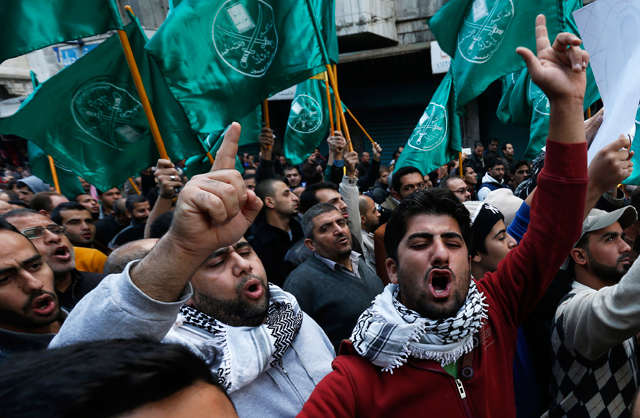
Egypt-Muslim-Brotherhood-Supporters-Flags-IPMuslim Brotherhood supporters in Egypt (Photo: © Reuters)

Egypt has released three videos of Muslim Brotherhood television networks in Turkey advocating violence against the Egyptian police, foreigners, embassies and interests in the region connected to countries that support President El-Sisi.

On Thursday, the Brotherhood’s English-language website announced a decision for revolution “with all its means and mechanisms” against the Egyptian government. The announcement references a declaration signed by 150 Islamic scholars that is less ambiguous in calling for jihad, also published in English.

The first video is from the Muslim Brotherhood’s Rabaa TV network launched in Turkey in 2013. The Egyptian government says the host in the video is a member of the Al-Gama’a Al-Islamiyya terrorist group.

The host is seen reading a statement from the “Revolutionary Youth Coalition;” a group that is almost certainly a Brotherhood front established to give itself plausible deniability while inciting and orchestrating terrorism. The vague terminology is an attempt to give its cause greater legitimacy by appearing more inclusive and broad-based.

The Brotherhood station reads the statement that demands the departure of all foreign Arabs, foreign Africans, embassy personnel, foreign companies and tourists by the end of (last) February. All governments must end their support for the Egyptian government “or else all of their interests in countries of the Middle East will be exposed to severe assaults or will be put in situations that nobody wants.”

The threat warns that henceforth there will be “no concessions or mercy.”

The second video is dated February 24 and is from a satellite network named Misr Alaan that the Egyptian government says was founded by the Brotherhood last year. The Arab press says it was launched from Turkey with Brotherhood sponsorship.  The network’s staff said its purpose is to reach a broader audience than the other Islamist channels in Turkey.

The video comes with an English translation that shows the host of a show explicitly urging the murder of Egyptian police and unspecified revolutionaries to rout the Egyptian soldiers who aid the police in the confrontation. His instructions are clear: “Kill them.”

“I say to the wives of all officers and the sons of all officers: Please be aware, your husbands will be dead. Your children will be orphans,” the host says while adding the sons of police officers may be kidnapped and claiming that the revolutionaries have the home addresses of the police.

The third video, also from Misr Alaan, shows a statement being read by a spokesman calling in from the “Revolutionary Punishment Movement,” continuing the pattern of using new, non-descriptive titles.

The speaker is asked about his group and he only says that it is a youth movement involved in the revolutions since the beginning, referring to the ousting of Egyptian President Mubarak. He condemns the arrests of female members of the group and declares there will be “reciprocal treatment.”

The speaker calls for the kidnapping and killing of Egyptian security personnel by the “lions” of this revolution. He then gives out the names of specific police officers to target without any interruption from the host.

On Thursday, May 28, the Brotherhood’s English-language website carried a statement by spokesperson Mohamed Montaser announcing “a final decision, after consulting its popular base, that the revolutionary option with all its means and mechanisms is its strategic choice from which there will be no retreat.”

The announcement appears to be a response to a reported rift within the Brotherhood between the older and more pragmatic leadership and the more militant youth advocating violence and disruption to society. It reiterates the legitimacy of the Brotherhood leadership and claims that it is inclusive of the youth.

The statement does not explicitly discuss the topic of violence but it certainly does not make the case for non-violence. It gives every reason for an Islamist to believe that violent jihad against the Egyptian government is now permissible.

The intention to inspire violence is detectable in how the Brotherhood references a declaration signed by 150 scholars that declares the Egyptian government to be an “enemy of Allah” waging “war against Islam.” The listed offenses qualify it as a target for violent jihad.

“It is an Islamic duty of the whole Muslim Ummah, rulers and peoples alike, to resist this regime and to seek to break it using all legitimate means in order to safeguard the fundamentals of the Ummah and to maintain the higher objectives of Islam,” it says.

The declaration most clearly instigates violence in points 4 and 6 regarding retribution for acts against the Brotherhood and for forcibly freeing prisoners:

“4. Rulers, judges, officers, soldiers, muftis, media persons, politicians and any other party proven beyond any doubt to be involved in the crimes of violating honor, bloodshed and illegal killing, even if through inciting such acts, are considered, from Islamic perspective, murderers to whom all rulings related to the crime of murder are applicable. They must receive qisas (retribution punishment) within the Islamic Law limits.”

“6. The nation must do its best to free any person, especially women, detained as a result of opposing the coup and demanding respect of the nation’s will and freedom. No effort should be spared to release them using the means approved by Islam.”

The Brotherhood is aware of what it’s calling for. If it didn’t want violent jihad, it would add a disclaimer about the declaration only authorizing non-violence. Instead, there’s only a mention of civil disobedience as a tactic without any kind of rejection of violence in point 13:

“13. We demand all forces opposing the coup and all free people, inside and outside Egypt, to combine efforts in resistance of this criminal regimes and to use all appropriate means such as civil disobedience and any other tool to purge the country of the coup’s tyranny and crimes and to stand up for the martyrs’ cause.”

The declaration is especially significant because brings the Brotherhood a step closer towards officially supporting violence in Egypt; a direction it’s been moving towards in its Arabic content.

In January, the Brotherhood announced a “new phase…where we recall the meanings of jihad and prepare ourselves, our wives, our sons, our daughters, and whoever marched on our path to a long, uncompromising jihad, and during this stage we ask for martyrdom.”

Any doubt as to whether the Brotherhood meant violence is put to rest by what follows:

Imam al-Banna [the founder of the Brotherhood] prepared the jihad brigades that he sent to Palestine to kill the Zionist usurpers and the second [Supreme] Guide Hassan al-Hudaybi reconstructed the ‘secret apparatus’ to bleed the British occupiers.”

The call to violence in Arabic was shortly followed by one in English titled, “Egypt Muslim Brotherhood Reiterates Commitment to Non-Violence.”  The contradiction is reflective of a long-standing patternwhere the Brotherhood speaks more diplomatically in English and more “jihadist” in Arabic. Contrary to assertions that the Brotherhood officially abandoned violence, the group has consistently endorsed and engaged in violent jihad since its supposed “moderation.”

The newly-released videos are just a sample of the proof that the Brotherhood’s “moderate” persona is a contrived mirage.

ISIS arrives in Gaza: Supporters of the “Islamic State of Jerusalem” sighted on Israeli border

June 1, 2015

ISIS arrives in Gaza: Supporters of the “Islamic State of Jerusalem” sighted on Israeli border, DEBKAfile, June 1, 2015

ISIS-Gaza_5.15ISIS lands in Gaza

Followers of the Islamic State of Iraq and the Levant were spotted for the first time in the Gaza Strip this week, DEBKAfile’s military sources report. Their arrival on Israel’s border was confirmed as a division-strength IDF force launched its large-scale “Turning Point 2015” exercise for repelling Islamist cross-border incursions. The Islamist group which has established a substantial anti-Hamas presence in the Gaza Strip is Ansar al Dawa al-Islamia, renamed “Supporters of the Islamic State of Jerusalem.

Israeli, Egyptian and Hamas’ military sources are all concerned to make light of this development. When asked, they say that the group’s nature and scope have not yet been evaluated. Western and Middle East governments took the same tack two years ago, when ISIS first embarked on its calamitous course in Syria.

DEBKAfile’s military sources point to eight signs of the ISIS presence in the Gaza Strip:

1. In the last 48 hours, Hamas security authorities have suddenly set up scores of roadblocks across the Strip, including Gaza City.

2. They acted after senior Hamas security officer Sabah Siam was murdered Saturday, May 30, by a gang of five gunmen sporting ISIS insignia.

Hamas tried pretending that the officer died in a bomb planted in his vehicle by a local rival faction.  But the attack was too public to be concealed. The ISIS gunmen burst into a shop owned by the officer’s family in the center of Gaza City while he was visiting. They cut him down in front of his relatives and dozens of passersby, none of whom made any move to stop them as they made off in two vehicles.

The terrorists later issued a communiqué saying: “Sabah Siam was liquidated because he was a partner in a war declared against religion and against Muslims working for the heretical government in the Gaza Strip.”
In a declaration of war, ISIS warned the Palestinian Hamas to “end its war against religion in Gaza or face the consequences.”

3. Israeli and Egyptian security services, most likely in conjunction with Hamas, set up a tight ring of bodyguards to protect German Foreign Minister Frank-Walter Steinmeier against possible assassins when he visited Gaza Monday, June 1.  He insisted on going through with his visit in the face of the internecine Islamist fighting which had erupted in the Palestinian-ruled territory.

4.  On the day of the visit, Ansar al Dawa al-Islamia posted a social media notice calling on Gazans to discontinue their cooperation with the “heretical Hamas regime.”

5.  The same group also claimed responsibility for a string of bombings outside Hamas headquarters and offices in Gaza during the month of May.

6.  On May 8, the ISIS Sinai branch Ansar Bait Maqdis shelled the Hamas facility in Khan Younis, in southern Gaza.

7.   On May 28, ISIS-Sinai threatened to “target Eilat Port in the coming days,” as a joint project with the ISIS wing in the Gaza Strip, which would also attack Hamas’s military arm, Ezz e-din Al-Qassam, and take control of the Gaza Strip.

8.  DEBKAfile’s counter-terror sources report that Ansar al Dawa is preparing to declare the Gaza Strip a province of the Islamic State of Iraq and the Levant.

Exclusive: Key Rebels Ready to Quit U.S. Fight Vs. ISIS

June 1, 2015
05.31.159:30 PM ET

via Exclusive: Key Rebels Ready to Quit U.S. Fight Vs. ISIS – The Daily Beast.

They were ready to accept American guns and training. But a key rebel group can’t accept the Obama administration’s insistence that they lay off Syria’s dictator.

A centerpiece of the U.S. war plan against ISIS is in danger of collapsing. A key rebel commander and his men are ready to ready to pull out in frustration of the U.S. program to train a rebel army to beat back the terror group in Syria, The Daily Beast has learned.The news comes as ISIS is marching on the suburbs of Aleppo, Syria’s second-largest city. Rebels currently fighting the jihadists there told The Daily Beast that the U.S.-led coalition isn’t even bothering to respond to their calls for airstrikes to stop the jihadist army.

Mustapha Sejari, one of the rebels already approved for the U.S. training program, told The Daily Beast that he and his 1,000 men are on the verge of withdrawing from the program. The issue: the American government’s demand that the rebels can’t use any of their newfound battlefield prowess or U.S.-provided weaponry against the army of Bashar al-Assad or any of its manifold proxies and allies, which include Iranian-built militias such as Lebanese Hezbollah. They must only fight ISIS, Washington insists.

“We submitted the names of 1,000 fighters for the program, but then we got this request to promise not to use any of our training against Assad,” Sejari, a founding member of the Revolutionary Command Council, said. “It was a Department of Defense liaison officer who relayed this condition to us orally, saying we’d have to sign a form. He told us, ‘We got this money from Congress for a program to fight ISIS only.’ This reason was not convincing for me. So we said no.”

“[My men] don’t want to be beholden to this policy because it can be used against them in Syria—that they’ve betrayed the revolution and now they’re just mercenaries for the coalition forces.”

Sejari’s possible departure wouldn’t just mean the loss of a few fighters for the anti-ISIS army the U.S. is trying to assemble. It could mean a fracturing of the entire program—a cornerstone of the Obama administration’s plan to fight ISIS in Syria. (The Pentagon was unable to respond to requests to comment for this article.)

“The train and equip program will be structurally impaired for as long as those taking part in it are asked to target jihadists first and the regime second,” Charlie Winter, an ISIS specialist at the London-based Quilliam Foundation, told The Daily Beast. “It would be naïve to think otherwise: no opposition group will take kindly to being told that they can only be assisted if they focus their efforts on ‘terrorists’ and not the regime that got Syria to this position in the first place.”

Even worse, Sejari added, is that by openly aligning with the United States as a counterterrorism proxy, his troops will have a bullseye painted on its back for all comers, al Qaeda, the regime, Iran and Hezbollah. That force, the al-Ezz Front, broke off from Saudi-backed umbrella opposition group that was routed by Jabhat al-Nusra, the al Qaeda affiliate, in northern Syria in March.

“[My men] don’t want to be beholden to this policy because it can be used against them in Syria—that they’ve betrayed the revolution and now they’re just mercenaries for the coalition forces,” Sejari said.

Sejari has worked for years with the so-called “joint operations command” in Turkey, where the CIA and a host of Western and regional spy agencies have coordinated with vetted moderate rebels—sometimes arming them, although without the stifling proscription on whom they couldn’t fight. “In the past, we got some support through the [Western-backed] Friends of Syria group. Very small amounts. We were hoping there would be more support from the Americans,” Sefjari said.

“The American intelligence services have a fair idea who the good guys and bad guys are in Syria and they know which groups are fighting both extremism and dictatorship,” Sejari said. “If the Obama administration were sincere in putting an end to the suffering of the Syrian people, they could do that in three months.”

As approved by Congress, the Syrian train-and-equip program would be overseen not by intelligence officers but by the American military—definitely in Jordan and Turkey, and likely also in Saudi Arabia and in Qatar. But Ankara and Washington have never agreed on the remit of the mission, with Turkey insisting that these rebels be given air support given that they’ll be targets of the regime’s fighter jets and attack helicopters. Although U.S. Defense Secretary Ash Carter has floated the idea of American air support for the rebels publicly, the administration hasn’t committed to that and likely won’t. According to the Wall Street Journal, Obama worries that if any of his built-up Arab strike teams go after the regime in Syria, then Iran’s Revolutionary Guards Corps-Quds Force will instruct its Shia militias to turn their guns on U.S. personnel in Iraq.

The original goal was to graduate 5,000 battle-ready rebels per year, although the program has suffered numerous setbacks and delays since its inception. In early May, Carter told reporters at a Pentagon press conference that just 90 rebels were being put through the first round of training in Jordan. Col. Patrick Ryder, a spokesman for CENTCOM, claimed that 3,700 Syrians had volunteered in total, but of that number just 400 were approved with another 800 were being processed. This followed from an earlier announcement, in April, that Major General Michael Nagata, the man tapped by Obama spearhead train-and-equip, was stepping down for unknown reasons. It doesn’t inspire confidence, Sejari said, that he didn’t know who was in charge of the program he wants nothing to do with anymore. “We don’t know what happened to Gen. Nagata. No one tells us anything,” he added.

Sejari said that even if he were to sign up, he doesn’t think the result would greatly alter the balance of power in Syria or further stated U.S. objectives. “If anyone with any military knowledge examines this program, he will realize this program is not designed to make an impact or support the Syrian people. It will only contribute to dragging out this conflict much longer,” Sejari said. “We’ve been fighting for four years. Program, no program— we’ve been fighting for four years. If the Americans don’t change this precondition, we will carry on fighting.”

In another uninspiring development for the Levantine arm of the war, a major rebel commander has told The Daily Beast that no matter how hard he tries, he still cannot get the coalition’s attention for directing airstrikes against ISIS. And that’s allowing the jihadists to make major gains near the city of Aleppo, a stronghold of both moderate and Islamist rebels.

“We were hoping that we could work hand-in-hand with coalition forces to defeat ISIS and that the coalition would launch strikes against ISIS-held positions in northeast Aleppo. We called on them to do so,” Brig. Gen. Zaher al-Saket told The Daily Beast in a May 29 Skype interview.

Al-Saket defected from the Syrian Army in March 2013. He had been an officer in Assad’s chemical weapons division and today heads both the Aleppo Military Council and the Chemical Weapons Documentation Center, which compiles evidence of chlorine gas attacks perpetrated by his former comrades on Syrian civilians.

“For the past 24 hours, numerous towns in the northern Aleppo suburbs have been under constant bombardment by Daesh,” al-Shaket said, using the pejorative Arabic acronym for ISIS. “The jihadists captured Sarwan, a key town, and is now advancing on two others including Marea, the nerve center for the rebel groups in Aleppo. The fall of Marea would severely weaken our capacity across the province. Hundreds of shells have rained on houses in Sawran and Marea. Ninety percent of the civilians in Marea had to flee to neighboring areas because their houses were destroyed. The terrorism carried out by ISIS is not very different from the terrorism being carried out by Assad.”

And in some ways, Assad’s Syria Arab Army (SAA) and ISIS are helping one another around Aleppo, where the regime is reported bombing rebel positions. “By attacking opposition positions around northern Aleppo, ISIS has granted the Assad regime a tactical opportunity, one that it has already begun exploiting,” Winter said. “This is not the first time the SAA and ISIS have benefited each other, and it will not be the last.”

For weeks, al-Saket has made numerous media appearances in Arabic-language outlets such as Al Jazeera and Orient TV calling for close coordination between his rebels and the coalition. He said he has precise coordinates for ISIS-controlled installations and materiel in towns such as Raei, Manbej, al-Bab in the Aleppo suburbs. But so far, no one from U.S. Central Command—the arm of the American military responsible for the Middle East—has reached out to him.

ISIS launched their assault on northern Aleppo before the weekend, apparently after it caught wind of a the Syrian opposition’s plan to retake the rest of the province from the Assad regime, putting it in control of key supply corridors currently trafficked by ISIS.

The rebels’ idea is to replicate the success of Jaysh al-Fateh, a consortium of Islamist and jihadist rebel groups, largely led by al-Nusra, which has had stunning successful in driving the regime out of Idlib province over the past month. Al-Saket said that while al-Nusra is not part of forces under his command, there was no denying that the al Qaeda franchise was also at war with ISIS in the province. “If ISIS is able to capture all the northern suburbs of Aleppo, that would mean they’d control the borders with Turkey. I don’t have to tell you what this means for the rebels.”

As al-Saket spoke to The Beast, he was interrupted by a fresh intelligence report from his field commanders saying that that white cars with blue covers were currently en route from Dabiq, an ISIS-controlled town in northern Aleppo, toward Hetemlat whence they’d no doubt proceed onto Marea. The cars were outfitted with explosives and driven by ISIS suicide bombers.

“The Syrian-American community asked the Obama Administration for airstrikes on ISIS near Marea many months ago,” complained Mohammed al-Ghanem, the senior political advisor for the Syrian American Council, a Washington, D.C.-based opposition group in constant contact with the Aleppo Military Council. “We were rebuffed for the astounding reason that aiding the rebels in Aleppo would hurt Assad, which would anger the Iranians, who might then turn up the heat on U.S. troops in Iraq. The rebels are the only ones who can fight ISIS in northern Syria—Assad forces are losing ground rather quickly now—so I hope President Obama will reconsider his willingness to compromise the ISIS fight for the sake of an Iran deal.”

“ISIS is a metastasizing threat, not just for Syria but for the world,” al-Saket agreed, before hanging up to tend to the incoming car bombs.

On achievements and ideas

May 29, 2015

On achievements and ideas, Israel Hayom, Maj. Gen. (ret.) Yaakov Amidror, May 29, 2015

Lately it looks as though the Islamic State group has managed to rack up highly significant geographic achievements. These coups will lead to the group controlling the enormous expanse of territory west of Baghdad to the Syrian border beyond Palmyra by establishing rule in the north and east of the crumbling Syrian state.

The occupation of Ramadi, one end of an arch that bridges between the Iraqi capital and Palmyra in the heart of northern Syria, serves as a base for future gambits of even greater importance. We shouldn’t wonder if the group needs a little time to “digest” the new areas it has conquered, to take care of any local population that might resist, if any such remains, and to settle its rule on the rest of the residents and prepare for retaliatory attacks by the Syrian and Iraqi armies and their auxiliary militia forces.

It appears that in Iraq and Syria — but more importantly, in the U.S. — it is understood that the counterattack stage could turn out to be critical. If the group overcomes these strikes, it is hard to imagine what might stop it in the future, barring full-scale involvement by the U.S. military that would include heavy ground forces.

After the counter-strikes, the moment the organization feels secure in its new area, and we cannot know how long that will take, it will face the standard dilemma presented by such situations: What next? By nature, a group like this cannot refrain from action for long. It needs constant movement; it is thirsty for new gains and fears the “stagnation” that could affect it after a period of calm. The group is still in its dynamic stage, continuing to rise. It has four options for action, and no one knows which one its leaders will choose. It is possible that they themselves have not made up their minds and are still not ready to decide, at least until the results of any possible counterattack become clear.

Islamic State’s next “natural” effort could be toward Baghdad, to strengthen its rule of everything west of the Iraqi capital. The goal would be to strike a fatal blow to the Shiite government’s operational ability in the Sunni regions the group has taken thus far, and maybe even to bring down the present Iraqi regime.

Such a move would doubtless put pressure on the ruling Shiites and their Iranian allies, because when an organization like this approaches areas with a dense Shiite population, as well as the cities most holy to Shiites, the latter envision a mass slaughter. So there is no question that a move like that, if successful, would force the Iranians to make some tough decisions, mainly about whether to opt for direct military intervention.

The group has another option in Iraq: to the north, beyond Kurdistan. If it managed to take control of the areas where the Kurds are currently extracting oil, it would enjoy maximal success, running nearly an entire country and putting heavy pressure on Turkey. That looks tempting, because the West hasn’t taken care to adequately arm the Kurds, the only ones so far who have fought the group successfully.

It is also possible that after its great success in Iraq, the group will prefer to entrench its rule over northern Syria — in other words, seize control of Aleppo and Homs. That would be an ambitious plan given the size of the geographic area, but it appears any resistance there would be weaker than it would be in a metropolis like Baghdad or from the fierce Kurds. If Islamic State took Aleppo and Homs, it would improve its chances of eventually taking action against the Kurds, particularly their Syrian wing.

In Syria, the main ones opposing the group would be President Bashar Assad’s exhausted army. In that area, other Sunni groups from what is known as the army of insurgents might join Islamic State, granting it legitimacy in the eyes of the locals. A move like that could lead to a dramatic change in Assad’s position and force Hezbollah to spread its forces even thinner. A loss of Hezbollah’s strategic homefront and the presence of its Sunni haters breathing down the neck of the Alawite minority, on the coast of Latakia, means a threat to a region that is vital to Hezbollah and to the Iranians’ position in Syria, and eventually in Lebanon. The Iranians and Hezbollah would do almost anything to protect these, because any threat to them is an existential one. If the Islamic State group acquires control of Alawite or Shiite areas, it will exterminate everyone there. This is a life or death struggle. That’s clear to everyone.

The ambitious option

And there is a fourth option, which for now seems less appealing and therefore less likely, although not impossible. It’s possible that to avoid clashing with Shiite strength around Baghdad or with Alawite and Hezbollah desperation en route to Damascus, the group will turn its attention to Amman.

All the residents of Jordan are Sunni, and some of them could begin to identify with a serious, successful Sunni group that purports to act on behalf of Sunnis, who are in distress because of the Shiite dynamic in the Middle East. The group could asses that it would be easier for it to operate against Jordan, and if it does so successfully it would have more convenient access to Saudi Arabia — the crown jewel of the Muslim world.

Saudi Arabia is the target that anyone who talks about an “Islamic caliphate” dreams of, because it is home to Mecca and Medina, the two holiest cities for any Muslim. In acting against Jordan, the group could combine a military maneuver with an attempt to influence the kingdom from inside by exploiting the social and economic problems in Jordan that have worsened because of the mass influx of refugees from Syria.

Today, the chances of the organization succeeding in Jordan appear very slim. The Jordanian army, unlike the armies of Iraq and Syria, is both serious and professional and among many Jordanians, the king is popular as well as legitimate. Jordan is no easy prey, and it would certainly have the help of everyone for whom the kingdom’s stability is important.

In any case, it is obvious that the American intervention thus far has not brought the U.S. any closer to the goal defined by President Barack Obama of “destroying the organization.” The opposite — it has grown stronger and expanded its area of control since the U.S. declared war on it. The last chance the U.S. has to continue its current policy, avoiding the deployment of massive American ground forces, is conditional upon its ability to give the Iraqi army the assistance it needs in the attack it is promising to execute, and possibly on helping the Syrian army indirectly.

The Americans will take a look at themselves after these battles, when it becomes clearer whether the group’s recent successes are the regular ups and downs seen in conflicts like these, or whether they have altered its standing, and Islamic State will now take advantage of the momentum to move on more ambitious targets.

The Pope and the Palestinians

May 20, 2015

The Pope and the Palestinians, Front Page Magazine, May 20, 2015

(The article also deal with Islam in general, as to which the Pope’s fantasies reflect those of the Obama Administration and others. — DM)

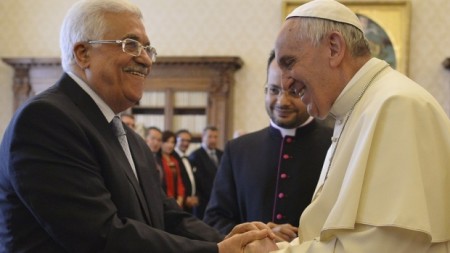
francis-and-abbas-450x253

Perhaps the ultimate expression of this faith in Islam was Pope Francis’ assertion in Evangelii Gaudium that “authentic Islam and the proper reading of the Koran are opposed to every form of violence.”

**************************

Contrary to reports in the mainstream press, Pope Francis did not call Palestinian Authority leader Mahmoud Abbas “an angel of peace.” The correct translation of the pope’s words is “I have thought of you: that you could be an angel of peace.”

Why, then, was it so easy to believe the initial reports? Perhaps because the initial reports seemed to align with previous papal overtures to Palestinian leaders. Pope Francis had previously called Abbas a “man of peace,” he has shown sympathy for Palestinian grievances, and other popes have given the appearance of lending legitimacy to the Palestinian cause. For example, Pope John Paul II is reported to have received PLO leader Yasser Arafat on twelve different occasions.

Arafat was a terrorist. One would think that the Vatican would have wanted to limit its contacts with him. The same goes for Abbas. He has repeatedly honored and praised Palestinian “martyrs” who have slaughtered innocent Jews. There is evidence that he helped fund the 1972 operation that killed eleven Israeli athletes at the Munich Olympic Games. Why is he accorded such a cordial reception at the Vatican?

Although the Church has often declared its spiritual bond with Jews, it has had a less harmonious relationship with the nation where approximately half the world’s Jews now reside. The Vatican was the last Western government to accord diplomatic recognition to the State of Israel (in 1993). In addition, on several occasions, prominent prelates have likened Israel to King Herod, the murderer of innocents; and others have accused Israel of being an apartheid state. Meanwhile, Catholic NGOs such as Pax Christi and Trocaire have been major players in the boycott, divest, and sanctions campaign against Israel.

Of course, the BDS campaign directly impinges on Israeli security. So do the calls by numerous Christian leaders to tear down the security barrier that divides Israel from the West Bank. On his trip to the Holy Land a year ago, Pope Francis allowed himself to be photographed in prayer at a section of the wall where a large graffiti message compared Bethlehem to the Warsaw Ghetto. In a naïve gesture of solidarity with Palestinians, the pope was unwittingly lending credence to the idea that the Israelis could be compared to the Nazi occupiers of Poland.

The wall was constructed to prevent suicide attacks against Israeli citizens. It’s estimated that its construction has saved thousands of lives. To suggest that the wall is offensive, as many Christians have done, is to suggest that Jewish lives don’t matter. Moreover, such judgments betray an entirely lopsided view of the situation. Take the Gaza conflict. The Catholic hierarchy typically had little to say about the daily rocket barrages launched against Israeli citizens from Gaza, but it was quick to condemn Israel on those occasions when it finally retaliated. In a similar vein, Fouad Twal, the Latin Patriarch of Jerusalem, blamed last year’s Gaza war on the Israeli embargo which, he said, had turned Gaza into “a factory of desperate people, designed to easily turn into extremists.”

In short, many Catholic leaders have shown a tendency to blame Israel for defending itself. The implication, of course, is that there would be no need for defense if Israel would only go to the peace table and make the concessions demanded of it by the Palestinians. The Vatican’s recent recognition of the “State of Palestine” reflects this naïve view of the situation. The supposition is that the Palestinians only want to be left in peace, whereas there is abundant evidence that the deepest desire of Palestinian leaders is for the extermination of Israel. Have Vatican officials never seen the photos of Abbas holding up a map of Palestine that encompasses all of the territory currently known as Israel? Are they unaware that he has personally called for a Palestine that is Judenrein? Didn’t they notice that when Israel gambled on disengaging from the Gaza Strip in 2005, Gaza soon turned into a terrorist state governed by an obsession to destroy Israel?

From the Israeli point of view, the call to cooperate with the Palestinian “peace” agenda is a call to cooperate in its own demise. Whenever I hear a UN representative or a Vatican spokesman call for peace talks between Israel and Palestine, I think of that scene from Goldfinger in which James Bond is about to be sliced in two by a laser beam. “Do you expect me to talk?” he asks. “No, Mr. Bond,” replies Goldfinger, “I expect you to die.” The Vatican hasn’t yet grasped the point that the Palestinian leadership doesn’t want the Israelis to talk, it wants them to die.

By words and by actions, the Vatican continues to suggest that there is a moral equivalence between Israel and the Palestinian Authority. This policy not only does a disservice to Jews, it also does a disservice to Catholics and other Christians. The main effect of the moral equivalence stance is to sow confusion among Catholics at a time when they need to be clear and unconfused—clear about Islam, that is. The Vatican policy toward Palestine reflects it overall stance toward the Islamic world. In other words, let’s overlook the dark side—the terrorism, the anti-Semitism, the oppression of Christians and other minorities—and let’s put the best face on the Mohammedan faith. For the sake of peace. And also for the sake of maintaining the threadbare narrative that Islam is a close cousin of Catholicism and, therefore, a religion of peace. Perhaps the ultimate expression of this faith in Islam was Pope Francis’ assertion in Evangelii Gaudium that “authentic Islam and the proper reading of the Koran are opposed to every form of violence.”

How well has this policy worked? Not very. Catholics and other Christians who lived in Muslim lands and who took seriously the Catholic version of “this has nothing to do with Islam” soon found that the tiny minority of misunderstanders were legion and had murder on their minds. Many found out too late. Years of indoctrination in the myth of Islam’s pacific nature had left them unprepared for the violence. Not that the Church was the only culprit. The secular opinion-makers had been preaching the same gospel. The irony is that the Church wants Israel to adopt the same policy of make-believe about Islam that has contributed to the death and displacement of millions of Christians.

The policy requires an almost total denial of facts. In the case of the Arab-Israeli crisis it means ignoring the terrorist ties of the Palestinian government, its unity coalition with Hamas, the massive state-sponsored indoctrination of Palestinian children, and the oft-stated goal of eliminating Israel. Ironically, it also necessitates that one ignore the ongoing persecution of Christians in the Palestinian territories.

The Palestinian leaders do a good job of hijacking Christian themes and imagery in order to gull Christians into thinking that they are, indeed, brothers in Christ. Thus, Palestinians have milked the massacre-of-the-innocents meme for all its worth. They also like to claim that Jesus was the first Palestinian. Another favorite theme is that the Palestinian people are the “new Jesus” who is being crucified by the Israelis.

Many in the Catholic hierarchy seem to fall for the ruse, but the steady exodus of Christians from the Palestinian territories tells a different story. The overall population of Christians in the Palestinian areas has declined from 15 percent in 1950 to 2 percent today. After the Palestinian Authority took control over Bethlehem in 1995, the Christian population there declined by half. In the Gaza Strip, only a few hundred Christians remain. That’s because Christians in Palestine, like Christians in most Muslim-majority societies, are treated as second-class citizens—subject to rape, intimidation, and legalized theft.

Meanwhile, the Christian population of Israel continues to grow. Palestinian Christians want to live there and so do persecuted Christians in other parts of the Middle East. Despite years of propaganda to the contrary, they have come to realize that Israel is a safe haven in a world of Islamic chaos.

Do Christians who migrate to Israel know something that the Vatican doesn’t know? The facts are there for everyone to see, but not everyone sees them. Why do Catholic leaders persist in assigning moral equivalence when there is no moral equivalence? Normally, a belief in moral equivalence grows out of a relativistic outlook. But presumably we can rule that out in the case of Catholic prelates. A more likely cause of their moral neutrality is a misapplication of the principle of “judge not.” Christians today are highly conscious of the sins of Western civilization and are therefore reluctant to judge those who lie outside it—in this case, Muslims. However, the principle is meant to apply to judgments about the state of an individual’s soul, not his behavior. And it was never meant to apply to withholding judgments about ideologies and belief systems.

The reluctance to see the mote in the other’s eye can eventually slide over into willful blindness. There are numerous warnings in the New Testament about spiritual blindness and they apply to those within the Church as well as to those without. The big danger for Church leaders is not that they will be seen as judgmental in the eyes of the world, but that they will be seen as foolishly naïve in the eyes of history.

“First comes Saturday, then comes Sunday” is a well-known slogan in the Middle East. It means that after the Islamists finish with the Jews, they will come after the Christians. The fate of the Saturday people and the Sunday people is intertwined. And the fate of both is put in jeopardy when Christian leaders insist on holding on to a fantasy-based picture of Islam.

Next challenge for US after Ramadi defeat: Iranian ship nears Yemeni shore

May 19, 2015

Next challenge for US after Ramadi defeat: Iranian ship nears Yemeni shore, DEBKAfile, May 19, 2015

Iran_Shahed_21.5.15Iranian aid vessel with “medical relief” personnel

DEBKAfile’s analysts strongly doubt that the USS Theodore Roosevelt carrier and strike force, which have been monitoring the Iranian flotilla’s movements, will be ordered to intervene against the Iranian ships reaching the Yemeni port.

Tehran, for its part has threatened to treat any such inspections as an act of war.

********************

Tuesday, May 19, two days after Ramadi’s fall to the Islamic State landed a major blow to Baghdad and US strategy in the region, 10,000 troops – more than half American – ended a large US-led military exercise in Jordan that was designed to practice tactics for countering ISIS. Taking part surprisingly in the two-week exercise was a heavy US nuclear-capable B-52H bomber, which flew in from the United States, crossing through Israeli air space and returning to home base when it was over.

This was the first time in the 12 years since the US invasion of Iraq that a B-52H, which can deliver nuclear weapons and bunker buster bombers, has appeared in Middle East skies for any military mission.

East of Jordan, as some 25,000 refugees from Ramadi slept in the open, the Islamist conquerors began moving on their next target, the Habbaniyah air base some 70 km west of Baghdad. Its fall would cut Baghdad off from northern and eastern Iraq and place it under siege from three directions – north, east and west.

Most Arab members have dropped out of the US-led coalition committed to fighting the Islamist terrorists in Iraq and Syria. This has left the US Air Force to bear the brunt of the aerial campaign. Its average of 19 air strikes a day is far too few to have any real effect on ISIS’s battle momentum. It certainly did not stop the long columns of black-clad Islamist fighters swarming on Ramadi from all directions in hundreds of tanks, APCs and minivans armed with heavy machine guns, and taking control of the capital of Iraq’s largest province, Anbar.

Western intelligence from the Ramadi region offered disturbing accounts of thousands of fully-armed ISIS fighters springing up apparently from nowhere to descend on the city, with no one able to see where they came from and no air action to scatter them before they entered the city.

After the Ramadi defeat, the Obama administration’s next major test in the region comes from an Iranian cargo vessel heading, accompanied by two warships, for the Yemeni Red Sea port of Hodeida and scheduled to dock Thursday, May 21. According to Tehran, the ship will unload 2,500 tons of humanitarian aid for Yemen, and the hundreds of passengers who disembark are Red Crescent medical relief workers.

The Saudi, US and Egyptian fleets have imposed a sea and air blockade on Yemen to prevent Iran provding the Yemeni Houthi rebels with fresh arms. Saudi and other regional intelligence agencies are convinced that the “paramedics” are in fact Revolutionary Guards officers and instructors in disguise, sent to strengthen the Houthi revolt.

Washington, Riyadh and Cairo have all vowed to stop the Iranian flotilla from putting into port in Yemen and said that its vessels will be forced to submit to inspections to make sure no illicit weapons are aboard and to confirm the passengers’ identities.

Tehran, for its part has threatened to treat any such inspections as an act of war.

Deputy Revolutionary Guards Commander Gen. Masoud Jazayeri put it plainly when he said: “I am distinctly stating that the patience of Iran has limits. If the Iranian aid ship is prevented from reaching Yemen then they, Saudi Arabians and United States, should expect action from us.”

DEBKAfile’s analysts strongly doubt that the USS Theodore Roosevelt carrier and strike force, which have been monitoring the Iranian flotilla’s movements, will be ordered to intervene against the Iranian ships reaching the Yemeni port. It is not a good moment for President Barack Obama to upset Tehran when he is in dire need of the Iraqi Shiite militias controlled by Iran to stand up to ISIS before its columns reach Baghdad.

Without the US, it is hard to see Saudi and Egyptian warships directly engaging an Iranian naval force and risking a major military conflagration.

Therefore, just as the B-52H came and went without action to impede ISIS’s creep closer to Baghdad, the Roosevelt is not likely to halt Iranian warships before they reach Yemen.