Posted tagged ‘Terrorism’

Spain in the Eye of the Storm of Jihad

June 6, 2015

Spain in the Eye of the Storm of Jihad, The Gatestone InstituteSoeren Kern, June 6, 2015

(Right of return? — DM)

  • The Islamists are especially interested in converts who have not yet taken on Muslim names and whose official IDs still have their Christian names, so they can purchase weapons without drawing the attention of police.
  • At least 50,000 Muslim converts are currently living in Spain. Police say that converts are especially susceptible to radicalization because they are facing increasing pressure from Islamists who are calling on them to carry out attacks to “demonstrate their commitment” to their new faith.
  • Spain has also become a key entry point for human trafficking mafias being used by jihadist veterans seeking to return to Europe after fighting in the Middle East.
  • “Turkey is the Seven-Eleven of false passports.” — Spanish agent working on a human trafficking case.

Spanish security forces have arrested a total of 568 jihadists over the past ten years in 124 separate operations against Islamic terrorism, Spanish Interior Minister Jorge Fernández Díaz revealed at an African security conference in Niger on May 14.

Fernández Díaz said that “constant police and judicial actions” have helped Spanish authorities prevent another large-scale terrorist attack similar to the March 2004 Madrid train bombings, in which nearly 200 people were killed and more than 2,000 were injured.

At the same time, Fernández Díaz has warned that it is “very probable” that Islamic terrorists will strike Spain at some point in the future; he has estimated the probability of an attack to be 70%.

At a two-day terrorism conference held in Madrid on April 23 and 24, Fernández Díaz said that at least 115 Spanish jihadists — including at least 15 women — are now known to have joined the Islamic State. He added that 14 jihadists had returned to Spain; nine of those are in prison and five remain free.

In January, Fernández Díaz said the number of Spanish jihadists abroad was 70, which implies a jump of more than 40 new jihadists in the first four months of 2015 alone. In August 2014, the first time that Fernández Díaz provided an official estimate, he said there were 51 Spanish jihadists fighting abroad.

Meanwhile, “dozens” of jihadists and other Islamic radicals are entering Spain from neighboring France, where they are said to be “asphyxiating” due to a government crackdown following theCharlie Hebdo attacks in Paris in January. (On April 29, French President François Hollande announced that a force of 7,000 troops would be deployed to patrol French streets on a permanent basis.)

According to an anonymous Spanish intelligence operative interviewed by El Confidencial, a media outlet based in Madrid, French jihadists are moving to Spain because they feel they have “greater room for movement” on the Iberian Peninsula. They include individuals “suspected” of being Islamic radicals, but for whom there is insufficient proof for either government to arrest them.

The report says that most of the jihadists from France are moving to Catalonia and Spain’s Mediterranean coast, where they are attempting to “blend in” with Muslim communities there. Also known as the Spanish Levant, the region roughly corresponds with what was once known as Xarq al-Ándalus, territories that were occupied by Muslim invaders for nearly five centuries.

Al-Andalus is the Arabic name given to those parts of Spain, Portugal and France occupied by Muslim conquerors (also known as the Moors) from 711 to 1492. Many Muslims believe that territories Muslims lost during the Christian Reconquista of Spain still belong to the realm of Islam. They claim that Islamic law gives them the right to return there and re-establish Muslim rule.

In July 2014, jihadists with the Islamic State produced a video in which they vowed to liberate al-Andalus from non-Muslims and make it part of their new Islamic Caliphate. The video showed a jihadist speaking in Spanish with a heavy North African accent, warning:

“I say to the entire world as a warning: We are living under the Islamic flag, the Islamic caliphate. We will die for it until we liberate those occupied lands, from Jakarta to Andalusia. And I declare: Spain is the land of our forefathers and we are going to take it back with the power of Allah.”
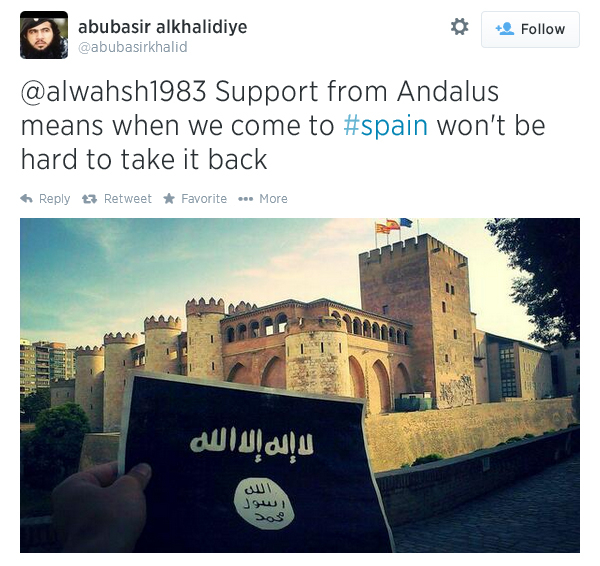
639A tweeted photo of an Islamic State supporter holding the Islamic State’s black flag of jihad in front of Aljafería Palace in Zaragoza, Spain

Counter-terrorism authorities are now warning that the Islamic State is actively looking for Spanish converts to Islam who possess gun licenses and who can legally purchase rifles and shotguns. The Islamists are especially interested in converts who have not yet taken on Muslim names and whose official IDs still have their Christian names, so that they can purchase weapons without drawing the attention of police.

At least 50,000 Muslim converts are currently living in Spain. Police say that converts are especially susceptible to radicalization because they are facing increasing pressure from Islamists who are calling on them to carry out attacks to “demonstrate their commitment” to their new faith. “Converts are the perfect breeding ground for Islamism,” according to a Spanish intelligence operative.

These concerns have been confirmed in a new report published by the Spanish Institute of Strategic Studies, an organ of the Ministry of Defense, which warned that so-called lone wolves pose the biggest threat to Spain and other European countries.

“They are activists who secretly swear allegiance to [Islamic State leader] Abu Bakr al-Baghdadi and act independently without making contact with anyone, so locating them becomes a living hell,” the report said. It added:

“Terrorists no longer need to communicate directly with the leadership of the organization to which they belong, or use the telephone or emails to know exactly what to do, when and under what circumstances. There is no longer any need for prior contact to establish the type of signals to be used, the conditions and dimensions of an attack or any restrictions.

“These tactics end the dream of the intelligence services to control everything through the systematic interception of communications and the use of satellite imagery. If there is no communication, it is not possible to intercept anything.”

Spain has also become a key entry point for human trafficking mafias being used by jihadist veterans seeking to return to Europe after fighting in the Middle East. A report prepared by Spanish border police identifies three main routes of entry — Africa, South America and Europe — and warns that human trafficking is “more lucrative than cocaine trafficking.”

According to the report:

“The proliferation of organizations trafficking in human beings and taking advantage of counterfeit documentation is resulting in the introduction of thousands of people into European countries. The problem is compounded when one considers that European jihadist veterans who have fought in Syria and Iraq on behalf of the Islamic State are using the same networks to facilitate their return. Many have arrest warrants in different countries (Spain, France, UK, etc.) and Islamic State members may cross our borders to carry out terror attacks in Europe.”

In November 2014, police in Madrid arrested 18 individuals — eight Lebanese, four Spaniards, three Syrians, one Ecuadorian, one Moroccan and one Ukrainian — accused of running smuggling operation to bring people from Syria into Spain. Police estimate that the cell, which had branches in Lebanon and Turkey, generated earnings of between €50,000 ($55,000) and €100,000 ($110,000) each month. According to one of the agents working on the case, “Turkey is the Seven-Eleven of false passports.”

Meanwhile, at least 60 jihadists in Catalonia are said to be waiting for a signal from the Islamic State to attack, according to the Madrid-based El País newspaper. The warning was given during a closed-door meeting of anti-terrorism police held in late April in Viladecans, a town near Barcelona.

The unofficial meeting was convened after a counter-terrorism operation in Catalonia was compromised, when some jihadists were allegedly tipped-off that they were about to be arrested. Although the exact circumstances of the imbroglio remain unclear, it appears to have been the result of poor inter-agency coordination between counter-terrorism police in Madrid and Catalan police known as the Mossos d’Esquadra. The two groups were apparently investigating the same Islamist cell without consulting each other.

The meeting in Viladecans, attended by 130 agents from different police forces — Mossos, Civil Guards, national and local police — from across the country, got together to discuss their mutual concerns about “the lack of training of law enforcement to combat jihadist terrorism.”

Much of the daylong meeting was used to share information about how to detect “radicalization processes” and how to distinguish ordinary Muslims from Salafists and jihadists. A counter-terrorism specialist said that one of the key problems faced by police is that “jihadists have infiltrated society, they drink alcohol, eat pork and dress like a Westerner and are undetectable.”

One of the organizers of the event, Alex Pérez of a local branch of the International Police Association, said:

“We go out on the street every day but we do not have the tools needed to combat threats against the public. Some of us are digging into our own pockets to train ourselves, protect ourselves and provide an adequate service to society.”

Another police officer summed it up this way: “We are screwed and will be much worse off in the future because there are radicals increasingly inclined to attack.”

SHOW & TELL? Islamic State (ISIS) beheads Libyan soldier in front of school kids for ‘educational’ purposes

June 6, 2015

SHOW & TELL? Islamic State (ISIS) beheads Libyan soldier in front of school kids for ‘educational’ purposes

via SHOW & TELL? Islamic State (ISIS) beheads Libyan soldier in front of school kids for ‘educational’ purposes | BARE NAKED ISLAM.


The Islamic State (ISIS) reportedly beheaded a Libyan soldier in front of a group of six-year-olds for “educational purposes.” Supporters of ISIS posted the horrific pictures on social media.

Breitbart (h/t Mike F)  The images show a prisoner dressed in bright orange led out to the center of a floor at a mosque in Derna. Masked men with guns line up against the wall behind the captive. Men dressed in black from head to toe force the helpless man, identified as Abdulnabi al-Shargawi, to his knees before one of the barbarians takes a knife to his neck. ISIS charged the man with apostasy, which is the abandonment of Islam.

13.11

After the terrorists chop off his head, another man holds up al-Shargawi’s head as the young children gather around the body. Their faces are stone cold. Sky 105 reported that the images “surprised many” since the children “were never shocked.” But it is possible this is not the first time they witnessed a gruesome execution. ISIS is known to hold public executions and force the public to witness it. Children are often shoved to the front while fathers hold their sons on their shoulders.

0012760131-770x510

ISIS captured Derna, located on the Mediterranean Sea and 801 miles west of Tripoli, in October 2014. The terrorists retained full control of the port city by January 2015. Videos emerged of large crowds pledging “allegiance to ISIS leader Abu Bakr al Baghdadi.” The terrorists control the government and education while police cars are plastered with the ISIS insignia.

“Derna today looks identical to Raqqa, the ISIS headquarters town in Syria,” explained former jihadi Noman Benotman, who now works for the Quilliam Foundation. “ISIS pose a serious threat in Libya. They are well on the way to creating an Islamic emirate in eastern Libya.”

ISIS-beheads-Libyan-in-front-of-children-Social-Media-640x480

The Islamic State Is Here to Stay

June 5, 2015

The Islamic State Is Here to Stay, VICE NewsAhmed S. Hashim, June 6, 2015

(Please see also, The Kurd-Shia War Behind the War on ISIS. — DM)

The victories against IS in early 2015 have proven ephemeral — or have been nullified by IS gains elsewhere. On Sunday, CIA director John Brennan said on Face the Nation, “I don’t see this being resolved anytime soon.” Assad’s vaunted offensives of February 2015 have fallen short as the regime faced stiff resistance from a wide variety of opposition fighters, including elements from IS. The failure was alarming in part because the campaign was designed and aided by both Hezbollah and the Iranians, two seemingly ascendant Shia powers.

************************

Just a few months ago, analysts and policy-makers were certain that the defeat of Islamic State (IS) forces was simply a matter of time.

Coalition airstrikes would degrade the group’s capabilities and eventually allow Iraqi forces and Kurdish Peshmerga — though discredited by their poor military showing in mid-2014 — to push back the extremists. And indeed, IS fighters were ejected from Tikrit in March 2015 by the Iraqi army and thousands of motivated fighters from Shia militias. In Kobani in northern Syria, IS fighters were defeated by Syrian Kurdish fighters. Elsewhere in the country, the regime of Bashar al-Assad was going on the offensive with help from Hezbollah and advisers from the Iranian Revolutionary Guard.

The Islamic State, however, rose like a phoenix from the ashes of every setback. And today, the situation is not so rosy.

The victories against IS in early 2015 have proven ephemeral — or have been nullified by IS gains elsewhere. On Sunday, CIA director John Brennan said on Face the Nation, “I don’t see this being resolved anytime soon.” Assad’s vaunted offensives of February 2015 have fallen short as the regime faced stiff resistance from a wide variety of opposition fighters, including elements from IS. The failure was alarming in part because the campaign was designed and aided by both Hezbollah and the Iranians, two seemingly ascendant Shia powers.

The situation in Iraq is just as complicated, something that the Obama administration appears either oblivious to or reluctant to acknowledge. Much of the US strategy continues to hinge on what is increasingly a mirage: a unified, albeit federal, Iraq under the control of Baghdad. Meanwhile, the resilience of IS is greatly enhanced by the ability of its military forces to innovate and adapt faster on the ground than its lackluster opponents.

In light of the constant aerial strikes by the US and its allies, IS has dispersed and made its forces more mobile, no longer presenting dense concentrations of fighting men as it did when it seized Mosul in mid-2014. Instead, when IS seized Ramadi in May 2015, it made use of inclement weather and sent several small units from different directions simultaneously into the city aided by suicide bombers. Moreover, the fact that the group faced ill-equipped and poorly motivated Sunni fighters in and around Ramadi did not do anything for Baghdad’s standing with the country’s already alienated Sunni community, which had pleaded for arms while caught between the unfathomable brutality of IS and revengeful Shia militias.

Many Sunnis are now angling for their own “super-region,” one that would have considerable independence from Baghdad. The problem? In order to have it, the Sunnis would need to first defeat IS. Currently, they’re unable to do so because they lack the resources; despite all the talk from Baghdad and Washington about arming Sunni tribes, Baghdad is not actually keen to do so.

And besides, the Sunnis seem relatively ambivalent about defeating IS. They took an unequivocal stance between late 2006 and 2009, when they joined with the Americans and the Iraqi government to deal the Islamist militants what was then seen as a decisive blow. Now, however, despite Sunnis’ resentment and fear of IS, the Islamists’ existence is seen as a kind of insurance policy against Shia revanchism should Baghdad succeed in retaking the three Sunni provinces of Anbar, Salahuddin, and Ninevah.

(Please see video at the link. — DM

The “victory” of the Iraqi government in Tikrit was more propaganda than reality; a few hundred IS fighters managed to inflict considerable damage on the Shia militias that had been mobilized to fight alongside the Iraqi army, then withdrew because they were outnumbered and wished to avoid being surrounded. The IS forces in Tikrit simply felt that they had done enough damage; there was no need to waste further assets in an untenable situation.

Militarily, the Iraqi Shia militias are better motivated and more dedicated than the regular army. Anecdotal information out of Baghdad suggests that Iraqi Shias are wondering whether the government should invest more effort building these forces into an effective and more organized parallel army. Even that parallel army, however, might be reluctant to commit to any significant long-term offensive to reclaim provinces full of “ungrateful” Sunnis.

But the Shia are willing to die to defend what they have, and there is increased sentiment among the Shia in central Iraq and Baghdad, along with the southern part of the country, that they would be better off without the Sunnis. There also exists the belief that the Kurds have more or less opted out of the Iraqi state despite the fact that they maintain a presence within the government in Baghdad. The Shia would seemingly not be sorry to see them exit the government in a deal that would settle as best as possible divisions of resources and territory. However, whether the Kurds would take the plunge and opt for de jure rather than de facto independence is a question that is subject to regional realities — How would Ankara and Tehran react? — rather than merely a matter of a deal between Baghdad and Erbil.

The Islamic State will continue to be a profound geopolitical problem for the region and the international community, and a long battle lies ahead. Syria and Iraq are more or less shattered states; it is unlikely that they will be put back together in their previous shapes. If Assad survives 2015, it will be as head of a rump state of Alawites and other minorities protected by Hezbollah, Iran, and Alawite militias. Shia Iraq will survive, and will possibly dissociate itself from the nettlesome Sunni regions. The Kurds will go their own way step by step. The international community is currently at a loss for how to stem the flow of foreign fighters to the IS battlefields — and even more serious is the growing sympathy and admiration for the group in various parts of the world among disgruntled and alienated youth.

If the US is serious about defeating IS, it needs to take on a larger share of the fight on the ground. This means more troops embedded with regular Iraqi forces in order to bring about better command, control, and coordination. It also means advisors who can continue to train these forces so that they improve over time. If this is not done, the regular Iraqi military will continue to be nothing more than an auxiliary to the more motivated — and pro-Iranian — Shia militias. Currently, militia commanders are giving orders to the regular military; that cannot be good for morale.

This month, the Islamic State celebrates the first anniversary of its self-declared caliphate. The group has little reason to fear it will be the last.

War Crimes In GAZA

June 4, 2015

New documentary from Pierre Rehov, this is the trailer , soon the full version.

Russia Demands American Capitulation To Help Eradicate Islamic State

June 4, 2015

Russia Demands American Capitulation To Help Eradicate Islamic State

Author

By David Singer — Bio and Archives June 4, 2015

via Russia Demands American Capitulation To Help Eradicate Islamic State.


Russian Foreign Minister Sergei Lavrov has called on America to end its attempt to remove Syria’s President Assad from power in return for Russia’s co-operation to militarily confront Islamic State.

Lavrov reportedly told Bloomberg on 2 June 2015 :

“The U.S.’s “obsession” with [Syria’s President] Assad isn’t helping in the common fight against the threat from Islamic State…

“People put the fate of one person whom they hate above the fight against terrorism. Islamic State can go “very far” unless stopped, and air strikes alone “are not going to do the trick”

“If people continue to acquiesce with what is going on and continue to acquiesce with those who categorically refuse to start the political process until Bashar Assad disappears, then I’m not very optimistic for the future of this region…”

America is part of the Friends of Syria core group known as the London Eleven that has been assisting rebel forces in Syria attempting to overthrow Assad.

Assad – backed by Russia, Iran and Hezbollah – has rebuffed such attempts during four years of horrendous conflict that has so far seen over 220000 Syrians die, four million citizens made refugees and another 7.6 million internally displaced.

A report published by the UN in March 2015 estimated the total economic loss since the start of the conflict was $202bn and that four in every five Syrians were now living in poverty – 30% of them in abject poverty. Syria’s education, health and social welfare systems are also in a state of collapse.

America apparently intends to ignore Lavrov’s sage advice and continue to pursue its Syrian policy to oust Assad.

Marie Harf – a U.S. State Department spokeswoman told reporters in Washington that:

“we’re certainly not going to coordinate with a brutal dictator who’s massacred so many of his own citizens.”

“That’s just an absurd proposition. That’s certainly not going to happen.”

Lavrov’s comments come at a time when Islamic State – already controlling a large part of Syria and Iraq covering an area greater than the United Kingdom – continues to make further advances – recently seizing the city of Ramadi 110 kilometers west of the Iraqi capital –Baghdad – and capturing the strategic northern Syrian city of Palmyra – a World Heritage listed site containing the monumental ruins of one of the most important cultural centres of the ancient world.

Islamic State reportedly controls up to 80 per cent of oil fields in Syria and has destroyed and also sold looted antiquities in Hatra, Nimrod and Mosul to acquire a major source of its funding – sometimes for seven figure sums.

The American led coalition of some 62 States – meeting in Paris this week – has proved totally unable to stem the advance of Islamic State in its stated objective of restoring the Islamic Caliphate and Sharia law wherever it seizes territory.

Graeme Wood – a contributing editor at The Atlantic – sums up Islamic State’s vulnerability:

If it loses its grip on its territory in Syria and Iraq, it will cease to be a caliphate. Caliphates cannot exist as underground movements, because territorial authority is a requirement: take away its command of territory, and all those oaths of allegiance are no longer binding.”

Only a UN sanctioned military force can hope to achieve this objective.

Obama and Putin need to urgently do a deal that sees:

  1. A UN led process on the political future of Syria being undertaken without first removing Assad
  2. A UN Security Council Chapter VII Resolution passed under Article 42 of the UN Charter authorising military action against Islamic State.

Senseless head-butting needs to give way to sensible brain-storming.

Iranian Soldiers Deployed to Protect Damascus

June 4, 2015

Iranian Soldiers Deployed to Protect Damascus as Rebels Advance

Iranian, Iraqi fighters sent to guard against rebel attack on Syrian capital, amid concerns Assad regime is failing.

By Arutz Sheva Staff

First Publish: 6/3/2015, 4:44 PM

via Iranian Soldiers Deployed to Protect Damascus – Middle East – News – Arutz Sheva.


Fighters from Al Qaeda’s Nusra Front in Idlib, Syria Reuters

Thousands of Iranian and Iraqi fighters have been deployed in Syria in past weeks to bolster the defenses of Damascus and its surroundings, a Syrian security source told AFP on Wednesday.

“Around 7,000 Iranian and Iraqi fighters have arrived in Syria over the past few weeks and their first priority is the defense of the capital. The larger contingent is Iraqi,” the source said on condition of anonymity.

“The goal is to reach 10,000 men to support the Syrian army and pro-government militias, firstly in Damascus, and then to retake Jisr al-Shughur because it is key to the Mediterranean coast and the Hama region” in central Syria, he added.

Syria’s government lost control of Jisr al-Shughur in northwestern Idlib province on April 25, as a coalition of opposition forces including Al-Qaeda affiliate Al-Nusra Front swept through the region.

Yesterday, Iran’s official news agency IRNA quoted elite Revolutionary Guards General Qassem Soleimani as saying “in the coming days the world will be surprised by what we are preparing, in cooperation with Syrian military leaders.”

The agency cautioned however that it “takes no responsibility for the information.”

Iran is a key ally of the Syrian government, and it has provided Damascus with financial and military support throughout the conflict that began in March 2011 with anti-regime protests.

That support has included raising a Syrian pro-government militia known as the National Defense Force (NDF) to supplement the badly-stretched regular Syrian army, as well as sending battalions of fighters from the Hezbollah terrorist group, Tehran’s most important and powerful proxies.

Iran had also coordinated the training, arming and mobilization of Iraqi Shia Islamist militias to fight alongside Syrian government forces as well – though since the Islamic State’s lightening offensive through Iraq last summer most have returned home from Syria to fight ISIS there.

Iran has also sent an unknown number of soldiers and commanders from its own elite Revolutionary Guard corps to battle Syrian rebels.

But despite all that aid, in recent months the Syrian government has lost territory in several parts of the country to both an alliance of largely Islamist groups including Al-Nusra, and to the Islamic State (ISIS) jihadist group. In the south of the country as well, a more moderate rebel alliance has been making steady gains.

The rapid succession of defeats have led many to speculate the Assad regime may be nearing its demise, although other analysts have warned it is far too early to write it off yet.

Faced with those setbacks, the government has appealed to Tehran and ally Russia to step up support, a Syrian political figure close to the regime told AFP.

A diplomatic source in Damascus said Iran had been critical of the regime’s failure to achieve the last major offensive operation it undertook – a February bid to cut rebel supply lines to the northern city of Aleppo.

Tehran had opposed the operation, citing lack of preparation, the source said, and subsequently insisted that Syria change its strategy to focus on holding less territory more securely.

Analysts and observers have said the Syrian government now appears ready to accept the de facto partition of the country, focusing on the defense of strategically important areas and leaving others to rebels or jihadists.

According to one source close to the regime, it considers the coast, the central cities of Hama and Homs, and the capital Damascus as vital.

It also regards the Damascus-Beirut and Damascus-Homs highways as “red lines”, the source said.

More than 220,000 people have been killed in Syria’s civil war.

AFP contributed to this report.

Sunni sheikhs pledge allegiance to ISIL in Iraq’s Anbar

June 4, 2015

Sunni sheikhs pledge allegiance to ISIL in Iraq’s Anbar

Several sheikhs and tribal heads say only way to achieve peace in province is to join ISIL after meeting in Fallujah.

04 Jun 2015 11:33 GMT

via Sunni sheikhs pledge allegiance to ISIL in Iraq’s Anbar – Al Jazeera English.


A number of Sunni tribal sheikhs and tribes in Iraq’s Anbar province have pledged allegiance to the Islamic State of Iraq and the Levant (ISIL) group.

The sheikhs and tribal leaders made the pledge in a statement read out by influential Sheikh Ahmed Dara al-Jumaili, after meeting in Fallujah on Wednesday.

Al Jazeera’s Imran Khan, reporting from Baghdad, said it was not yet clear if the tribes had been forced to pledge allegiance by ISIL fighters, who control Fallujah and most of Anbar province.

“If this is a willing move then that is very worrying for the Iraqi government,” Khan said.”The statement they issued was very strong – it condemned the government.”It said the only way that peace would come to Anbar province is if the tribes joined ISIL.”Influential tribe Khan said the inclusion of the al-Jumaili tribe in the pledge was of particular concern for Iraqi authorities, given the tribe’s influence in Anbar province.”The al-Jumailis command a number of fighters and they have a large amount of influence over other tribes [in Anbar],” he said.The pledge comes after a number of Sunni leaders in Anbar province publicly criticised the involvement of Shia militias in the fight to retake areas of the province from ISIL, including the provincial capital Ramadi which fell last month.While a number of Sunni tribes have joined with government forces and Shia militias, Khan reported that a number of tribal leaders have asked for government support to fight the armed group.”They said ‘if you arm us, if you allow us to fight as Sunnis, we will be able to get rid of ISIL quite quickly’,” he said.”The fact that a number of these tribes have come together … and pledged allegiance to ISIL shows the level of anger the Sunni tribes feel towards the government in Baghdad.”

Turkey, Our Ally

June 4, 2015

Turkey, Our Ally

June 4, 2015 by Robert Ellis

via Turkey, Our Ally.


On his visit to Turkey in 2009, U.S. President Barack Obama proclaimed that Turkey and the U.S. can build “a model partnership” and in an interview with Time in January 2012, he spoke of “the bonds of trust” he had forged with certain leaders, including Turkey’s Recep Tayyip Erdogan.

Traditional Turkish foreign policy, based on Atatürk’s dictum “peace at home and peace abroad,” has been replaced by a delusion, created by former foreign and now prime minister, Ahmet Davutoglu, that Turkey can restore its former Ottoman magnificence. As Davutoglu proclaimed in Sarajevo in 2009, “Like in the 16th century, when the Ottoman Balkans were rising, we will once again make the Balkans, the Caucasus and the Middle East, together with Turkey, the center of world politics.”

The main thrust of this new policy has been to create a Muslim Brotherhood crescent running from Egypt through Turkey to Syria to rival Iran’s Shia crescent, but this policy has been a dismal failure. Turkish ambassadors have been withdrawn from Syria, Egypt, Israel, Libya and Yemen, and recently from Austria and the Vatican, after their acknowledgement of the Armenian genocide, resulting in what Ibrahim Kalin, Erdogan’s chief adviser, in a tweet two years ago, called “precious loneliness.”

It was the same Kalin who, in a keynote speech at the Istanbul Forum in 2012, rejected the European model of secular politics, democracy and pluralism in favor of what he termed a “value-based” (read: Islamist) foreign policy. However, the AKP government’s attempt to overthrow Syria’s Bashar al-Assad has seriously backfired, but they have still not given up trying to drag the U.S. into the quagmire. Turkey’s proposal for the creation of a safe zone and no-fly zone in Syria has been met with no response, and in return Turkey has denied its NATO ally the use of Incirlik airbase for sorties against Islamic State (ISIL).

Consequently, the Bipartisan Policy Center (BPC) in Washington has in its April report concluded that Turkey is an increasingly undependable ally, and that because of the fundamental strategic disparities between Ankara and Washington, the U.S. should look to other regional players, for example, the KRG (Kurdistan Regional Government), for support.

An overriding factor in the BPC’s conclusions has been the Turkish government’s ideologically driven backing for extremist Sunni groups in Syria, where it has acted as a highway for would-be jihadists, who have been given free rein to travel through, recruit from, equip, operate and recuperate in Turkey.

Furthermore, a report from the U.N.’s Analytical Support and Sanctions Monitoring Team concludes that Turkey has also provided the primary routes for arms smuggled to ISIL and the Al-Nusrah Front, an Al-Qaida affiliate.

In the run-up to the Turkish elections on Sunday, there is a furor about video footage published last Friday by secular daily Cumhuriyet, which shows a shipment of weapons and ammunition disguised as humanitarian aid for Syria on trucks belonging to MIT (Turkey’s National Intelligence Organization), Erdogan’s Praetorian Guard. Reuters has also confirmed how MIT helped deliver arms to parts of Syria under Islamist rebel control during late 2013 and early 2014.

Characteristically, the public prosecutors and gendarmerie officers involved in intercepting the arms shipment have been arrested and charged with attempting to overthrow the Turkish government. A gag order has been imposed on coverage of the scandal and President Erdogan has personally threatened Cumhuriyet’s editor-in-chief with retribution. He has now filed a criminal complaint against the newspaper and its editor, demanding a life sentence.

The Turkish military is also uneasy about the charges brought against the gendarmerie officers involved, as their actions fall under military jurisdiction.

However, there is no reason to believe President Erdogan will give way without a struggle. As the Bipartisan Policy Center notes, losing power would be tantamount to a prison sentence, at best, and is simply not an option.

ISIS-Affiliated Group: More Rocket Attacks Coming

June 4, 2015

ISIS-Affiliated Group: More Rocket Attacks on Israel Coming

The Islamic State linked group that fired rockets at southern Israel on Wednesday says it will continue “attacking the Jews.”

By Yaakov Levi

First Publish: 6/4/2015, 9:01 AM

via ISIS-Affiliated Group: More Rocket Attacks Coming – Defense/Security – News – Arutz Sheva.

That happens if you keep playing the thit for that game.

Terrorists in Gaza
Abed Rahim Khatib/Flash 90
The Islamist group that fired rockets at southern Israel Wednesday night said Thursday that it would continue its “way of Jihad” and “attack the Jews” – whether or not Hamas approved. And the next attack, it said, would come within hours.

In a statement, the “Sheikh Amar Hadid Brigades” said that the rockets were fired in revenge for “the death of an Islamic State member in Gaza by Hamas members.”

“We have repeated that we will continue in the way of Jihad against the Jews, the enemies of Allah. No one will stop us from fulfilling our obligation and attacking the Jews.”

Several days ago, the same jihadist group took responsibility for the firing of a Grad rocket at Ashdod last week.

The group has since presented Hamas with an ultimatum demanding that it be allowed to attack Israel from Gaza and on Thursdaysaid it would conduct another attack on the Jewish state within 12 hours.

Earlier this week, a group claiming to be associated with ISIS operating in Gaza claimed it killed a top Hamas commander. According to the group, which calls itself the Army of the Islamic State, Saber Siam was killed when ISIS operatives placed a bomb on his car, blowing it up with him inside.

Siam was killed, the group said, because he was “a partner in a declared war against religion and against Muslims, working for the heretical government in Gaza.”

ISIS warned Hamas to immediately “end its war against religion in Gaza” or “face the consequences.” The group also sent out warnings on social media to Gaza residents to stay away from Hamas offices and buildings, lest they find themselves swept up in attacks against the group.

On Thursday, Defense Minister Moshe Ya’alon said that the IDF would continue attacking all terror threats against Israel, inside Gaza or out of it.

“Even if the groups that fired rockets at Israel Wednesday night were gangs of disaffected Jihadists seeking to challenge Hamas by attacking us, we see Hamas as responsible for these attacks. We will not tolerate attacks on our civilians.”


Pentagon: Iran Continuing Work on Nuclear Systems

June 4, 2015

Pentagon: Iran Continuing Work on Nuclear Systems

Covert support for terrorism ‘unabated’

BY:
June 3, 2015 5:46 pm

via Pentagon: Iran Continuing Work on Nuclear Systems | Washington Free Beacon.

Iran is continuing to develop missiles capable of delivering nuclear weapons despite an interim agreement on its nuclear programs, according to a Pentagon report.

“Although Iran has paused progress in some areas of its nuclear program and fulfilled its obligations under the Joint Plan of Action (JPOA), it continues to develop technological capabilities that also could be applicable to nuclear weapons, including ballistic missile development,” a one-page unclassified summary of the report says.

A copy of the report was obtained by the Washington Free Beacon.

The report was due to Congress in January but was not sent to the Armed Services Committee as required by law until this month. Analysts said the delay appeared designed to avoid upsetting Tehran and the nuclear talks.

Disclosure of the continuing development of nuclear delivery capabilities comes amid reports that Iran increased the amount of nuclear material that could potentially be used to build nuclear weapons despite the JPOA.

The State Department sought to challenge International Atomic Energy Agency reports on the increase in Iranian nuclear material, despite President Obama’s claim that the nuclear agreement had halted Iran’s nuclear program.

State Department spokeswoman Marie Harf said this week that the increase in nuclear production was expected and that the amount has increased and decreased.

Iran’s military also continues to threaten the strategic Strait of Hormuz, the Pentagon report said.

“Iran continues to develop its capabilities to control the Strait of Hormuz and avenues of approach in the event of a military conflict,” the report said, adding that Tehran is “quietly fielding increasingly lethal weapon systems, including more advanced naval mines, small but capable submarines, armed unmanned aerial vehicles, coastal defense cruise missile batteries, attack craft, and ant ship-capable missiles.”

U.S. officials said Iranian backing for Houthi rebels in Yemen is also aimed at gaining access to the strategic Red Sea strait called the Bab-el-Mandeb, which, like the Strait of Hormuz, could be used by Iran to disrupt oil and other shipping.

Tehran’s support for terrorism also has not stopped, according to the Pentagon.

“Iran’s covert activities appear to be continuing unabated,” the report says. “The Islamic Revolutionary Guard Corps-Qods Force (IRGC-QF) remains a key tool of lran’s foreign policy and power projection, particularly in Iraq, Syria, Lebanon, Bahrain, and Yemen.”

The IRGC Quds Force also is continuing to improve its access within foreign countries and its ability to carry terrorist attacks “to safeguard or advance Iran’s interests,” the report said.

U.S. officials disclosed to the Free Beacon last week that Iran is increasing the number of Quds Force fighters and Lebanese Hezbollah militants it is sending to Yemen, to support pro-Iran Houthi rebels there.

The report asserts that Iran’s military doctrine is “primarily defensive” and seeks to insulate Iran from more aggressive Iranian policies involving covert action and terrorism.

Iranian military forces seek to deter attacks, survive initial strikes, and retaliate against aggressors.

“The ongoing civil war in Syria and the instability in Iraq have tested, but not fundamentally altered, this posture,” the report said. “Meanwhile, over the past year, the tone of publicity surrounding major military exercises has remained tempered, a trend that began in 2013, probably in support of negotiations over Iran’s nuclear activities.”

Iranian forces have been working with Iraq’s government to battle Islamic State forces that have taken over large portions of that Middle East state. They have included IRGC fighters.

The report, dated January 2015, concludes that Iran has not substantively altered its military and security strategies in the past year.

“However, Tehran has adjusted its approach to achieve its enduring objectives, by increasing its diplomatic outreach and decreasing its bellicose rhetoric,” the report said.

President Hassan Ruohani has sought to project a global message of “moderation and pragmatism” in support of those objectives.

Also, Iran is seeking to become the dominant regional power and in pursuit of that aim has “unwaveringly sought to improve its deterrent capabilities and increase its regional influence.”

Supreme Leader Ali Khamenei, who is thought to be ill, “remains atop Iran’s power structure as both the political-spiritual guide and the commander in chief of the armed forces.”

The Senate Armed Services Committee, in its report on the fiscal 2016 defense authorization bill passed May 19, expressed concerns about the annual report on Iran’s military.

The report was due to Congress on Jan. 30 but said as of May it had not been provided.

“The committee remains concerned about the threat posed by Iran’s nuclear and ballistic missile development programs,” the report said.

Last year Director of National Intelligence James Clapper testified that Iran “would choose a ballistic missile as its preferred method of delivering nuclear weapons.” And in February, Iran launched a Safir long-range missile system.

“In 2013, the National Air and Space Intelligence Center (NASIC) made the following statement about this system: Iran could develop and test an ICBM capable of reaching the United States by 2015,” the report said.

“Since 2008, Iran has conducted multiple successful launches of the two-stage Safir space launch vehicle (SLV) and has also revealed the larger two stage Simorgh SLV, which could serve as a test bed for developing ICBM technologies.”

The committee asked the secretary of defense to provide an update on Iran’s ballistic missile programs.

As a result of the delay in the annual Iran military power report, the committee directed the Pentagon to provide a briefing on the Iranian missile threat, and to update the January report.

Ilan Berman, an Iran specialist with the American Foreign Policy Council, said the release of the report is good news but “has long been conspicuous by its absence.”

“The study is long overdue, and its delay suggests that the administration has been leery of injecting inconvenient facts into the Iran debate as it closes in on a nuclear deal with the regime in Tehran,” Berman said.

“The findings of the report confirm that Iran’s destructive regional activities have not abated over the past year,” he added.

“If anything, they have increased despite Iran’s dialogue with the West,” Berman said. “The product can be seen in the battlefield victories of Yemen’s Iran-supported Houthi rebels, of the persistence of the Assad regime in Syria, and of the growing profile and capabilities of Iraq’s Shi’a militias.”

“Iran’s activities represent a significant challenge to peace and security in the Middle East,” he said.

“The real question is what, if anything, the White House is prepared to do about it?” he said.

Mark Dubowitz, another Iran expert, said Tehran is continuing to develop long-range ballistic missiles capable of carrying nuclear warheads, in violation of U.N. Security Council limits.

“The Obama administration ceded to Iranian demands that their missile program was non-negotiable and, instead, has tried to reassure Congress that this missile threat can be mitigated by constraining Iran’s ability to develop a nuclear warhead,” said Dubowitz, executive director of the Foundation for Defense of Democracies.

“This major administration concession to Iran will greatly complicate the U.S. intelligence community’s ability to detect whether Iran has develop a nuclear warhead-carrying ICBM capable of reaching the continental United States,” he added. “By its very nature, it is much more difficult to detect and prevent warhead development, which can take place in small, covert facilities, than it is to determine the nature and extent of a hostile missile program. In yet another example of how deeply flawed the emerging Iran deal will be, Tehran will have a much easier pathway to develop systems.”


