Hamas ready to pounce on weak Fatah in local elections, experts say Gaza-ruling terror group now says it will take part in vote set for October; after all, it has won the only two major elections in which it ever competed
The Hamas terror group in control of the Gaza Strip is poised to make a power play using one of its most potent weapons — the ballot box.
In 2012, the hardline Islamist group boycotted municipal elections over allegations of intimidation and corruption in the West Bank by its political rival Fatah, which dominates the Palestinian Authority. Since then, the two major Palestinian parties have remained in a state of cold war.
Despite these ongoing tensions, Hamas surprised many by agreeing recently to participate in municipal elections across the Palestinian territories slated for October 8.
Experts told The Times of Israel that Hamas likely ended its boycott of the vote because the group sees an opportunity to gain legitimacy by beating a weak opponent — the aging and unpopular Palestinian Authority President Mahmoud Abbas and his divided Fatah party.
Hamas is also in a state of political isolation after losing the support of its important Sunni state backers, Egypt, Jordan and Saudi Arabia, and to some extent Turkey after Ankara and Jerusalem recently mended relations. The ballot box, one Israeli expert argued, is a way the group can take control of its own destiny, while a well-known Palestinian scholar hypothesized secret and unprecedented coordination between the Islamists and Fatah.
Palestinian security officers wait to cast their early votes during local elections at a polling station in the West Bank town of Jenin on Thursday. Members of Palestinian security forces cast an early vote ahead of local elections, which are taking place Saturday, in the first such polls since 2006. (AP Photo/Mohammed Ballas)
Hamas has won the only two elections it ever ran in — the 2005 municipal elections and the 2006 legislative elections, which resulted in a war between Hamas and Fatah. But since Hamas’s last democratic victory, 10 years have passed.
“It’s almost obvious why Hamas decided to participate in the upcoming elections,” Prof. Shaul Mishal, head of the Middle East program at the Interdisciplinary Center in Herzliya (IDC), told The Times of Israel.
“If you look back at what happened during the election in 2006, Hamas believes that’s the best way to gain status and strength within the Palestinian population of the West Bank. They want to extend their influence to where the heart of the Palestinian issue is,” he said.
In 2006, Hamas won nearly all the electoral districts in the West Bank and in Gaza.
Mishal believes Hamas sees an opportunity to take advantage of Abbas’s current weakness. The PA leader is 81-years-old and is reportedly not in good health. Polls show a majority of Palestinians want him to resign.
Prof. Shaul Mishal (Courtesy)
“This is Hamas’s opportunity to ensure they will be part and parcel of any future political process,” Mishal said.
He added that Hamas has reached such a point of political isolation that “the only way to strengthen their position with the public is to run in this election.” He argues Hamas’s success in the past and its likely success in the upcoming election has much to do with its nature as an Islamist movement.
“Hamas is a party of the people, putting its efforts into working with the communities on the ground… first and foremost, they are an Islamist social group: they focus on social services, social welfare and working with the needy, especially in places where the central government might not reach,” Mishal said.
In an indication of Hamas’s likely victory in the upcoming elections, the Islamist movement has for the past two years won the contest considered the best barometer of Palestinian public opinion — student elections at Birzeit University. Birzeit is the oldest Palestinian university, considered a liberal outpost and a historic stronghold for Fatah and the PA.
“The young generation is more pro-Hamas. From experience, the student elections tend to be quite accurate,” Mishal said.
Palestinian students who support the Hamas movement take part in an election campaign rally for the student council at Birzeit University, near the West Bank city of Ramallah on April 26, 2016 (AFP/Abbas Momani)
With the odds stacked against it, the Israeli professor believes Fatah may try to wiggle out of having the elections.
“It all depends on one man: Abu Mazen (Abbas). He can find ways to bypass the declaration. He may substitute it with something more dramatic, such as negotiations over the Arab Peace Initiative,” he said, referring to the 2002 offer to the Jewish state for full diplomatic ties with 57 Arab and Muslim countries after cementing a peace accord with the Palestinians.
The Arab Peace Initiative has come to the forefront in the past few months, with both Arab and Israeli statesmen discussing the plan.
Khalil Shikaki, the Director of the Palestinian Center for Policy and Survey Research at his office in Ramallah, June 14, 2011 (Yossi Zamir/Flash90)
“My guess,” said Dr. Khalil Shikaki, a Palestinian political scientist and well-regarded pollster, “is that Hamas has agreed [to the elections] because Abbas, without publicly admitting it, has agreed that local elections in the Gaza Strip can take place fully under Hamas’s security and administrative control.”
Shikaki called the possible coordination “the most visible PA acknowledgment of the legitimacy of Hamas’s control in the Gaza Strip since Hamas’s takeover in June 2007.”
“At this stage,” Shikaki continued, “Hamas seems to care more about maintaining control over the Strip than extending its influence into the West Bank.”
The Palestinian political scientist did, however, offer a second theory similar to Mishal’s.
“Hamas might think that given Fatah’s fragmentation, particularly in the Gaza Strip, the outcome of elections will demonstrate the Islamist group’s ascendance and popularity despite the blockade and siege imposed by Israel and Egypt, thus strengthening further its legitimacy,” Shikaki said.
Israel imposed a land and sea blockade on the Strip, designed to prevent the terror group from importing weapons, after Hamas seized power there in a bloody 2007 coup, which saw Abbas’s Fatah movement ousted from Gaza.
The upcoming elections are slated to be held in 416 townships and village councils; 25 are located in Gaza and the other 391 in the West Bank. If the election does take place, it will be the largest municipal elections held by the Palestinians in their history.
The Islamization of Britain gallops forward. They banned me from the country for daring to oppose jihad terror and sharia, and it’s clear why: they’re embracing sharia provisions quickly and eagerly, and allowing jihad preachers to speak openly and without any hindrance. Sharia Britain will soon be a reality.
“Pakistani ‘hate preacher’ who glorifies Islamist murder welcomed by Archbishop of Canterbury,” by Tom Porter, International Business Times, July 21, 2016:
British authorities have been criticised for allowing two Pakistani clerics who led praise for an Islamist assassin to visit the UK on a seven-week preaching tour.
On Saturday (16 July), Muhammad Naqib ur Rehman and Hassan Haseeb ur Rehman arrived at London’s Heathrow Airport for a tour of mosques in cities including Birmingham, Leeds and Newcastle.
Archbishop of Canterbury Justin Welby welcomed Muhammad Naqib ur Rehman to Lambeth Palace on Monday to discuss subjects including countering “the narrative of extremism and terrorism” and interfaith relations.
The Muslim clerics have led a high-profile campaign in Pakistan in praise of assassin Mumtaz Qadri, who was executed in January after murdering liberal Pakistani politician Salmaan Taseer in 2011. The Punjab governor had criticised Pakistan’s strict anti-blasphemy laws, and Qadri claimed it was his religious duty to kill him….
The tour comes only months after cleric Muhammed Hanif Qureshi, who led calls for Taseer’s murder, was allowed into the UK to preach. A Facebook video shows the Rehmans preaching alongside Qureshi.
Michael Semple, an expert on Pakistan who served as deputy to the EU special representative to Afghanistan, told IBTimes UK those “preaching in favour of Mumtaz Qadri and lauding him and holding him up as a role model to be emulated by people in Pakistan or Afghanistan is something contrary to the public order and might well be illegal in Pakistan also”.
The home secretary has the authority to ban people from the country if their presence is not deemed “conducive to the public good”….
An unprecedented flow of weapons from Central and Eastern Europe is flooding the battlefields of the Middle East.
As Belgrade slept on the night of November 28, 2015, the giant turbofan engines of a Belarusian Ruby Star Ilyushin II-76 cargo plane roared into life, its hull laden with arms destined for faraway conflicts.
Rising from the tarmac of Nikola Tesla airport, the hulking aircraft pierced the Serbian mist to head towards Jeddah, Saudi Arabia.
It was one of at least 68 flights that in just 13 months transported weapons and ammunition to Middle Eastern states and Turkey which, in turn, funnelled arms into brutal civil wars in Syria and Yemen, the Balkan Investigative Reporting Network, BIRN, and the Organized Crime and Corruption Reporting Project, OCCRP, has found. The flights form just a small part of €1.2 billion in arms deals between the countries since 2012, when parts of the Arab Spring turned into an armed conflict.
Belgrade Airport | BIRN
Meanwhile, over the past two years, as thousands of tonnes of weapons fly south, hundreds of thousands of refugees have fled north from the conflicts that have killed more than 400,000 people. But while Balkan and European countries have shut down the refugee route, the billion-euro pipeline sending arms by plane and ship to the Middle East remains open – and very lucrative.
It is a trade that is almost certainly illegal, according to arms and human rights experts.
“The evidence points towards systematic diversion of weapons to armed groups accused of committing serious human rights violations. If this is the case, the transfers are illegal under the ATT (United Nations’ Arms Trade Treaty) and other international law and should cease immediately,” said Patrick Wilcken, an arms-control researcher at Amnesty International who reviewed the evidence collected by reporters.
But with hundreds of millions of euros at stake and weapons factories working overtime, countries have a strong incentive to let the business flourish. Arms export licences, which are supposed to guarantee the final destination of the goods, have been granted despite ample evidence that weapons are being diverted to Syrian and other armed groups accused of widespread human rights abuses and atrocities.
Robert Stephen Ford, US ambassador to Syria between 2011 and 2014, told BIRN and the OCCRP that the trade is coordinated by the US Central Intelligence Agency, CIA, Turkey and Gulf states through centres in Jordan and Turkey, although in practice weapon supplies often bypass this process.
BIRN and the OCCRP examined arms export data, UN reports, flight records, and weapons contracts during a year-long investigation that reveals how thousands of assault rifles, mortar shells, rocket launchers, anti-tank weapons, and heavy machine guns are pouring into the troubled region, originating from Bosnia and Herzegovina, Bulgaria, Croatia, the Czech Republic, Montenegro, Romania, Serbia and Slovakia.
Since the escalation of the Syrian conflict in 2012, these eight countries have approved the shipment of weapons and ammunition worth at least 1.2 billion euros to Saudi Arabia, Jordan, United Arab Emirates, and Turkey.
The figure is likely much higher. Data on arms export licences for four out of eight countries were not available for 2015 and seven out of eight countries for 2016. The four recipient countries are key arms suppliers to Syria and Yemen with little or no history of buying from Central and Eastern Europe prior to 2012. And the pace of the transfers is not slowing, with some of the biggest deals approved in 2015.
Eastern and Central European weapons and ammunition, identified in more than 50 videos and photos posted on social media, are now in use by Western-backed Free Syrian Army units, but also in the hands of fighters of Islamist groups such as Ansar al-Sham, Al Qaeda-affiliated Jabhat al-Nusra, the Islamic State of Iraq and the Levant, ISIS, in Syria, factions fighting for Syrian President Bashar-al Assad and Sunni forces in Yemen.
Markings on some of the weapons identifying the origin and date of production reveal significant quantities have come off production lines as recently as 2015.
Out of the 1.2 billion euros in weapons and ammunition approved for export, about 500 million euros have been delivered, according to UN trade information and national arms export reports.
The frequency and number of cargo flights – BIRN and the OCCRP identified at least 68 in just over one year – reveal a steady flow of weapons from Central and Eastern Europe airports to military bases in Middle East.
The most commonly used aircraft – the Ilyushin II-76 – can carry up to 50 tonnes of cargo or approximately 16,000 AK-47 Kalashnikov rifles or three million bullets. Others, including the Boeing 747, are capable of hauling at least twice that amount.
But arms and ammunitions are not only coming by air. Reporters also have identified at least three shipments made by the US military from Black Sea ports carrying an estimated 4,700 tonnes of weapons and ammunition to the Red Sea and Turkey since December 2015.
One Swedish member of the EU parliament calls the trade shameful.
“Maybe they –[Bulgaria, Slovakia and Croatia] – do not feel ashamed at all but I think they should,” said Bodil Valero, who also served as the rapporteur for the EU’s last arms report.“Countries selling arms to Saudi Arabia or the Middle East-North Africa region are not carrying out good risk assessments and, as a result, are in breach of EU and national law.”.
OCCRP and BIRN talked to government representatives in Croatia, Czech Republic, Montenegro, Serbia, and Slovakia who all responded similarly saying that they are meeting their international obligations. Some cited that Saudi Arabia is not on any international weapons black lists and other said their countries are not responsible if weapons have been diverted.
A question of legality
The global arms trade is regulated by three layers of interconnected legislation — national, European Union, EU, and international – but there are no formal mechanisms to punish those who break the law.
Beyond the blanket ban on exports to embargoed countries, each licence request is dealt with individually.
In the case of Syria, there are currently no sanctions on supplying weapons to the opposition.
As a result, the lawfulness of the export approval hinges on whether countries have carried out due diligence on a range of issues, including the likelihood of the arms being diverted and the impact the export will have on peace and stability.
Bosnia and Herzegovina, Bulgaria, Croatia, the Czech Republic, Montenegro, Romania, Serbia and Slovakia are signatories of the UN’s Arms Trade Treaty, which entered into force in December 2014, and lists measures to prevent the illicit trade and diversion of arms.
Member states of the EU are also governed by the legally-binding 2008 Common Position on arms exports, requiring each country to take into account eight criteria when accessing arms exports licence applications, including whether the country respects international human rights, the preservation of “regional peace, security and stability” and the risk of diversion.
As part of their efforts to join the EU, Bosnia and Herzegovina and Montenegro have already accepted the measures and have amended their national law. Serbia is in the process of doing so.
Weapons exports are initially assessed based on an end-user certificate, a key document issued by the government of the importing country which guarantees who will use the weapons and that the arms are not intended for re-export.
Authorities in Central and Eastern Europe told BIRN and the OCCRP that they also inserted a clause which requires the buyer to seek approval if they later want to export the goods.
Beyond these initial checks, countries are required to carry out a range of other risk assessments based on national and EU law and the ATT, although conversations with, and statements from, authorities revealed little evidence of that.
OCCRP and BIRN talked to government representatives in Croatia, Czech Republic, Montenegro, Serbia, and Slovakia who all responded similarly saying that they are meeting their international obligations. Some cited that Saudi Arabia is not on any international weapons black lists and other said their countries are not responsible if weapons have been diverted. The three other countries did not respond to requests for comment.
The Czech Foreign Ministry was the only public body to directly address concerns about human rights abuses and diversions, saying it took into account both when weighing up an export licence and had blocked transfers on that basis.
The Central and Eastern European weapons supply line can be traced to the winter of 2012, when dozens of cargo planes, loaded with Saudi-purchased Yugoslav-era weapons and ammunition, began leaving Zagreb bound for Jordan. Soon after, the first footage of Croatian weapons in use emerged from the battleground of Syria.
According to a New York Times report from February 2013, a senior Croatian official offered the country’s stockpiles of old weapons for Syria during a visit to Washington in the summer of 2012. Zagreb was later put in touch with the Saudis, who bankrolled the purchases, while the CIA helped with logistics for an airlift that began late that year.
While Croatia’s government has consistently denied any role in shipping weapons to Syria, former US ambassador to Syria Ford confirmed to BIRN and the OCCRP the New York Times account from an anonymous source of how the deal was hatched. He said he was not at liberty to discuss it further.
This was just the beginning of an unprecedented flow of weapons from Central and Eastern Europe into the Middle East, as the pipeline expanded to include stocks from seven other countries. Local arms dealers sourced arms and ammunition from their home countries and brokered the sale of ammunition from Ukraine and Belarus, and even attempted to secure Soviet-made anti-tank systems bought from the UK, as a Europe-wide arms bazaar ensued.
Prior to the Arab Spring in 2011, the arms trade between Eastern Europe and Saudi Arabia, Jordan, the United Arab Emirates, UAE, and Turkey – four key supporters of Syria’s fractured opposition – was negligible to non-existent, according to analysis of export data.
But that changed in 2012. Between that year and 2016, eight Eastern European countries approved at least 806 million euros worth of weapons and ammunition exports to Saudi Arabia, according to national and EU arms export reports as well as government sources.
Jordan secured export licences worth 155 million euros starting in 2012, while the UAE netted 135 million euros and Turkey 87 million euros, bringing the total to 1.2 billion euros.
Qatar, another key supplier of equipment to the Syrian opposition, does not show up in export licences from Central and Eastern Europe.
Jeremy Binnie, Middle East arms expert for Jane’s Defence Weekly, a publication widely regarded as the most trusted source of defence and security information, said the bulk of the weapon exports from Eastern Europe would likely be destined for Syria and, to a lesser extent, Yemen and Libya.
“With a few exceptions, the militaries of Saudi Arabia, Jordan, the UAE and Turkey use Western infantry weapons and ammunition, rather than Soviet-designed counterparts,” said Binnie. “It consequently seems likely that large shipments of such materiel being acquired by – or sent to – those countries are destined for their allies in Syria, Yemen, and Libya.”
BIRN and the OCCRP obtained confidential documents from Serbia’s Ministry of Defence and minutes from a series of inter-ministerial meetings in 2013. The documents show the ministry raised concerns that deliveries to Saudi Arabia would be diverted to Syria, pointing out that the Saudis do not use Central and Eastern European stock and have a history of supplying the Syrian opposition. The Ministry turned down the Saudi request only to reverse course more than one year later and approve new arms shipments citing national interest. Saudi security forces, while mostly armed by Western producers, are known to use limited amounts of Central and Eastern European equipment. This includes Czech-produced military trucks and some Romanian-made assault rifles. But even arms exports destined for use by Saudi forces are proving controversial, given their involvement in the conflict in Yemen.
The Netherlands became the first EU country to halt arms exports to Saudi Arabia as a result of civilian deaths in Yemen’s civil war, and the European Parliament has called for an EU-wide arms embargo.
Supply Logistics: Cargo flights and airdrops
Weapons from Central and Eastern Europe are delivered to the Middle East by cargo flights and ships. By identifying the planes and ships delivering weapons, reporters were able to track the flow of arms in real time.
Detailed analysis of airport timetables, cargo carrier history, flight tracking data, and air traffic control sources helped pinpoint 68 flights that carried weapons to Middle Eastern conflicts in the past 13 months. Belgrade, Sofia and Bratislava emerged as the main hubs for the airlift.
Most frequent were flights operated from Belgrade, the capital of Serbia. The flights were either confirmed as carrying weapons, were headed to military bases in Saudi Arabia or the UAE or were carried out by regular arms shippers.
The Middle East Airlift
At least 68 cargo flights from Serbia, Slovakia, Bulgaria and the Czech Republic have carried thousands of tons of munitions in the past 13 months to Saudi Arabia, the United Arab Emirates, and Jordan, three key suppliers of the Syrian rebels.
These were identified through detailed analysis of airport timetables, cargo carrier history, flight tracking data, leaked arms contracts, end user certificates, and air traffic control sources.
Cargo flights from Central and Eastern Europe to the Middle East, and particularly military bases, were extremely uncommon before late 2012, when the upsurge in weapons and ammunition purchases began, according to EU flight data and interviews with plane-spotters.
The most commonly used aircraft – the Ilyushin II-76 – can carry up to 50 tonnes of cargo or approximately 16,000 AK-47 Kalashnikov rifles or three million bullets. Others, including the Boeing 747, are capable of hauling at least twice that amount.
Of the 68 flights identified, 50 were officially confirmed to have carried arms and ammunition:
Serbia’s Civil Aviation Directorate confirmed that 49 flights departing or passing through Serbia were carrying arms and ammunition from June 1, 2015 to July 4, 2016. The confirmation came following weeks of refusal to comment on grounds of confidentiality and after BIRN and the OCCRP presented its evidence, including photographs showing military boxes being loaded onto planes at Belgrade’s Nikola Tesla Airport on four different occasions.
An official at the Bulgarian National Customs Agency confirmed one flight, operated by Belarussian cargo carrier Ruby Star Airways, was carrying arms from the remote Bulgarian Gorna Oryahovitsa Airport to Brno–Turany Airport, the Czech Republic, and on to Aqaba, Jordan.
An additional 18 flights were identified as very likely to have been carrying arms and ammunition based on one of three variables: the air freight company’s history of weapons supplies; connections to earlier arms flights; or a destination of a military airport:
Ten flights were made to Prince Sultan Air Base in Al Kharj, Saudi Arabia and Al Dhafra Air Base in Abu Dhabi, United Arab Emirates, indicating the likely presence of weapons or ammunition. Additionally, 14 flights to Prince Sultan and Al Dhafra air bases are confirmed as having carried weapons during the same period by Serbia’s Civil Aviation Directorate.
Seven flights were operated from Slovakia and Bulgaria by Jordan International Air Cargo, part of the Royal Jordanian Air Force, which were revealed to have carried weapons and ammunition from Croatia to Jordan in the winter of 2012. Bulgarian retired colonel and counter-terrorism expert Slavcho Velkov, who maintains extensive contacts with the military, told BIRN and the OCCRP that the Sofia-Amman flights “were transporting weapons to Saudi Arabia, mostly for the Syrian conflict.” Additionally, one other flight operated by this airline is confirmed as having carried weapons during the same period by Serbia’s Civil Aviation Directorate.
One flight was operated by a Belarussian cargo carrier TransAVIAexport Airlines, which has a long history of transporting weapons. In 2014, the airline was hired by Serbian arms dealer Slobodan Tesic to transport Serbian and Belarussian weapons and ammunition to air bases in Libya controlled by various militant groups. The United Nations, UN, Sanctions Committee investigated the case and found potential breaches of UN sanctions, according to a 2015 UN report. Additionally, five flights operated by this airline are confirmed as having carried weapons during the same period by Serbia’s Civil Aviation Directorate.
Many of these flights made an additional stop in Central and Eastern Europe – meaning they were likely picking up more weapons and ammunition – before flying to their final destination.
EU flight statistics provide further evidence of the scale of the operation. They reveal that planes flying from Bulgaria and Slovakia have delivered 2,268 tons of cargo – equal to 44 flights with the most commonly used aircraft – the Ilyushin II-76 – since the summer of 2014 to the same military bases in Saudi Arabia and UAE pinpointed by BIRN and OCCRP.
Arms bought for Syria by the Saudis, Turks, Jordanians and the UAE are then routed through two secret command facilities – called Military Operation Centers (MOC) – in Jordan and Turkey, according to Ford, the former US ambassador to Syria.
These units – staffed by security and military officials from the Gulf, Turkey, Jordan and the US – coordinate the distribution of weapons to vetted Syrian opposition groups, according to information from the Atlanta-based Carter Center, a think tank that has a unit monitoring the conflict.
“Each of the countries involved in helping the armed opposition retained final decision-making authority about which groups in Syria received assistance,” Ford said.
A cache of leaked cargo carrier documents provides further clues to how the Saudi military supplies Syrian rebels.
According to the documents obtained by BIRN and the OCCRP, the Moldovan company AeroTransCargo made six flights in the summer of 2015 carrying at least 250 tonnes of ammunition between military bases in Saudi Arabia and Esenboga International Airport in Ankara, the capital of Turkey, reportedly an arrival point for weapons and ammunition for Syrian rebels.
Pieter Wezeman, of the Stockholm International Peace Research Institute, a leading organisation in tracking arms exports, said he suspects the flights are part of the logistical operation to supply ammunition to Syrian rebels.
From the MOCs, weapons are then transported by road to the Syrian border or airdropped by military planes.
A Free Syrian Army commander from Aleppo, who asked to remain anonymous to protect his safety, told BIRN and OCCRP that weapons from Central and Eastern Europe were distributed from centrally controlled headquarters in Syria. “We don’t care about the county of origin, we just know it is from Eastern Europe,” he said.
The Saudis and Turks also provided weapons directly to Islamist groups not supported by the US and who have sometimes ended up fighting MOC-backed factions, Ford added.
The Saudis are also known to have airdropped arms and equipment, including what appeared to be Serbian-made assault rifles to its allies in Yemen.
Ford said that while he was not personally involved in negotiations with Serbia, Bulgaria and Romania over the supply of weapons to Syria, he believes that the CIA is likely to have played a role.
“For operations of this type it would be difficult for me to imagine that there wasn’t some coordination between the intelligence services, but it may have been confined strictly to intelligence channels,” he said.
The US may not have just played a role in the logistics behind delivering Gulf-sponsored weapons from Eastern Europe to the Syrian rebels. Through its Department of Defense’s Special Operations Command (SOCOM), it has also bought and delivered vast quantities of military materiel from Eastern Europe for the Syrian opposition as part of a US$500 million train and equip programme.
Since December 2015, SOCOM has commissioned three cargo ships to transport 4,700 tons of arms and ammunition from ports of Constanta in Romania and Burgas in Bulgaria to the Middle East likely as part of the covert supply of weapons to Syria.
The shipments included heavy machine guns, rocket launchers and anti-tank weapons – as well as bullets, mortars, grenades, rockets and explosives, according to US procurement documents.
The origin of arms shipped by SOCOM is unknown and the material listed in transport documents is available from stockpiles across Central and Eastern Europe.
Not long after one of the deliveries, SOCOM supported Kurdish groups published an image on Twitter and Facebook showing a warehouse piled with US-brokered ammunition boxes in northern Syria SOCOM would not confirm or deny that the shipments were bound for Syria.
US procurement records also reveal that SOCOM secured from 2014 to 2016 at least 25 million euros (27 million dollars) worth of Bulgarian and 11 million euros (12 million dollars) in Serbian weapons and ammunition for covert operations and Syrian rebels..
A Booming Business
Arms control researcher Wilcken said Central and Eastern Europe had been well positioned to cash in on the huge surge in demand for weapons following the Arab Spring.
“Geographical proximity and lax export controls have put some Balkan states in pole position to profit from this trade, in some instances with covert US assistance,” he added. “Eastern Europe is rehabilitating Cold War arms industries which are expanding and becoming profitable again.”
Serbian Prime Minister Aleksandar Vucic boasted recently that his country could produce five times the amount of arms it currently makes and still not meet the demand.
“Unfortunately in some parts of the world they are at war more than ever and everything you produce, on any side of the world you can sell it,” he said.
Arms manufacturers from Bosnia and Herzegovina and Serbia are running at full capacity with some adding extra shifts and others not taking new orders.
Saudi Arabia’s top officials – more used to negotiating multi-billion-dollar fighter-jet deals with Western defence giants – have been forced to deal with a handful of small-time arms brokers operating in Eastern Europe who have access to weapons such as AK-47s and rocket launchers
Middlemen such as Serbia’s CPR Impex and Slovakia’s Eldon have played a critical role in supplying weapons and ammunition to the Middle East
The inventory of each delivery is usually unknown due to the secrecy surrounding arms deals but two end-user certificates and one export licence, obtained by BIRN and the OCCRP, reveal the extraordinary scope of the buy-up for Syrian beneficiaries.
For example, the Saudi Ministry of Defence expressed its interest in buying from Serbian arms dealer CPR Impex a number of weapons including hundreds of aging T-55 and T-72 tanks, millions of rounds of ammunition, multi-launch missile systems and rocket launchers. Weapons and ammunition listed were produced in the former Yugoslavia, Belarus, Ukraine, and the Czech Republic.
An export licence issued to a little-known Slovakian company called Eldon in January 2015 granted the firm the right to transport thousands of Eastern European rocket-propelled grenade launchers, heavy machine guns and almost a million bullets worth nearly 32 million euros to Saudi Arabia.
BIRN and OCCRP’s analysis of social media shows weapons that originated from the former states of Czechoslovakia and Yugoslavia, and Serbia, Croatia and Bulgaria are now present on the battlefields of Syria and Yemen.
While experts believe the countries continue to shirk their responsibility, the weapons pipeline adds more and more fuel to a white hot conflict that leads to more and more misery.
“Proliferation of arms to the region has caused untold human suffering; huge numbers of people have been displaced and parties to the conflict have committed serious human rights violations including abductions, executions, enforced disappearances, torture and rape,” said Amnesty’s Wilcken.
Additional reporting by Atanas Tchobanov, Dusica Tomovic, Jelena Cosic, Jelena Svircic, Lindita Cela, RISE Moldova and Pavla Holcova.
This investigation is produced by BIRN as a part of Paper Trail to Better Governance project.
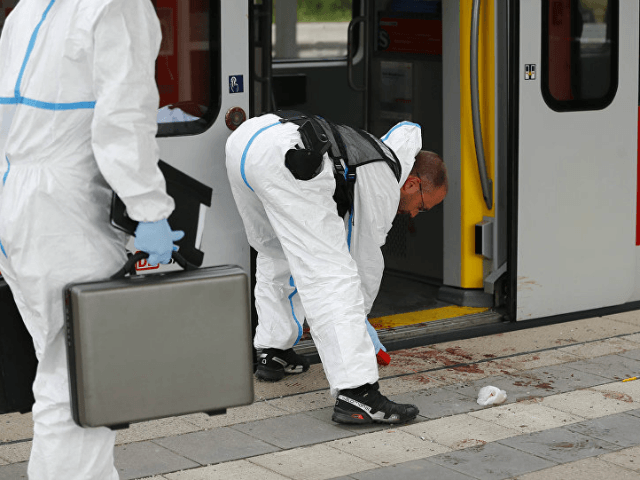
Two men stormed a northern French church, killing a priest and seriously wounding another person, before they were shot dead by police, in what authorities said they are treating as a terrorist attack. The men took five hostages, including the priest, in the church in the small town of Saint Etienne du Rouvray in Normandy. The priest was later found with his throat cut, police said. Police surrounded the church and shot the two men as they exited the building, an Interior Ministry spokesman said. France’s President François Hollande and Interior Minister Bernard Cazeneuve are on their way to the town, said government officials. The assault is being treated as a terror attack by investigators, Paris prosecutors said in a statement. A Vatican spokesman said that Pope Francis shares the “pain and horror” of the attack, which he called a “barbarous” act in a sacred place.
Summary:
Two knifemen took several hostages during mass
They killed the 84-year-old priest, Jacques Hamel, with unconfirmed reports saying his throat was cut; they were then shot dead by police
Three churchgoers were also injured, one of them seriously
President François Hollande is heading to scene; Counter terror judges have been called in to investigate
Police searching church for explosives
In the latest European assault to take place just over the past hour, two knifemen raided the Church of the Gambetta in the northern French town of Saint-Etienne-du-Rouvray, near Rouen in the département of Seine-Maritime (see map below) at 10am on Tuesday, taking between 4 and 6 hostages and allegedly killing a priest before being killed by police. According to subsequent unconfirmed reports the priest had been beheaded.
Another worshipper is said to have been seriously wounded.
Both attackers have been killed by police, an interior ministry spokesman confirmed to Reuters. The Paris anti-terrorist prosecutor is launching an investigation into the church attack and hostage-taking situation, the spokesman added
Subsequent reports suggest that one of the suspects tried to travel to Syria last year.
The killed priest has been identified as 84 year old Jacques Hamel.
One resident was walking to church as the horror broke out. He told French newspaper MetroNews: “I was going to go out and do my shopping when the police started shouting me to go straight home and barricade myself.
“There is a lot of agitation, the police are bulletproof vest and armed.”
While the motives of the hostage taking are still unclear it comes at a time when France is on high alert after a spate of recent terror attacks.
Firefighters, along with SWAT and anti-terror units, came to the scene, and said that there were several people wounded in the attack, RTL France media outlet said.
The Vatican has condemned the “barbaric killing” of the priest in the attack, saying it was made even more heinous by the fact that it happened in a sacred place.
French President Francois Hollande is on his way to the site of the attack, according to an official statement from Elysee Palace. Interior Minister Bernard Cazeneuve is also headed to the scene of the hostage-taking, the ministry said.
Islamic child marriage spelled out by an Islamic lunatic on Arab TV. The girl’s statement at the end should be broadcast around the world https://www.youtube.com/watch?v=lXesp…
Successive French governments have built a trap; the French people, who are in it, are thinking only of how to escape. The situation is more serious than many imagine. Whole areas of France are under the control of gangs and radical imams.
Prime Minister Manuel Valls repeated what he already said 18 months ago: “France is at war.” He named an enemy, “radical Islamism,” but he was quick to add that “radical Islamism” has “nothing to do with Islam.” He then repeated that the French will have to get used to living with “violence and attacks.”
The French are increasingly tired of attempts to exonerate Islam. They know perfectly well that all Muslims are not guilty. But they also know that all those who committed attacks in France in recent years were Muslims. The French have no desire to get used to “violence and attacks.” They do not want to be on the losing side and they feel that we are losing.
Nice, July 14, 2016: Bastille Day. The evening festivities were ending. As the crowd watching fireworks was beginning to disperse, the driver of a 19-ton truck, zig-zagging, mowed down everyone in his way. Ten minutes and 84 dead persons later, the driver was shot and killed. Dozens were wounded; many will be crippled for life. Dazed survivors wandered the streets of the city for hours.
French television news anchors quickly said that what happened was almost certainly an “accident,” or when the French authorities started to speak of terrorism, that the driver could just be a madman. When the police disclosed the killer’s name and identity, and that he had been depressed in the past, they suggested that he had acted in a moment of “high anxiety.” They found witnesses who testified that he was “not a devout Muslim” — maybe not a Muslim at all.
President François Hollande spoke a few hours later and affirmed his determination to “protect the populace.”
Prime Minister Manuel Valls repeated what he already said 18 months ago: “France is at war.” He named an enemy, “radical Islamism,” but he was quick to add that “radical Islamism” has “nothing to do with Islam.” He then repeated what he emphasized so many times: the French will have to get used to living with “violence and attacks.”
The public reaction showed that Valls convinced hardly anyone. The French are increasingly tired of attempts to exonerate Islam. They know perfectly well that all Muslims are not guilty. They also know that, nevertheless, all those who committed attacks in France in recent years were Muslims. They do not feel protected by François Hollande. They see that France is attacked with increasing intensity and that radical Islam has declared war, but they do not see France declaring war back. They have no desire to get used to “violence and attacks.” They do not want to be on the losing side and they feel that we are losing.
Because the National Front Party uses more robust language, much of the public votes for its candidates. The National Front’s leader, Marine Le Pen, will undoubtedly win the first round of voting in the presidential election next year. She will probably not be elected in the end, but if nothing changes quickly and clearly, she will have a very good chance next time.
Moderate politicians read the public opinion polls, harden their rhetoric, and recommend harsher policies. Some of them might demand harsher measures, such as the expulsion of detained terrorists who have dual citizenship and the detention of people that praise attacks. Some have even called for martial law.
Calm will gradually return, but it is clear that the situation in France is approaching the boiling point.
The recent attacks served as an accelerant. Four years ago, when Mohamed Merah murdered soldiers and Jews in Toulouse, the population did not react. Most French did not feel directly concerned; soldiers were just soldiers, and Jews were just Jews. When, in January 2015, Charlie Hebdo cartoonists were slaughtered, an emotional reaction engulfed the country, only to quickly vanish. A huge demonstration was organized in the name of “freedom of speech” and the “values of the republic.” Hundreds of thousands claimed, “Je Suis Charlie” (“I am Charlie”). When, two days later, Jews were murdered again in a kosher grocery store, hardly anyone said “I am a Jew.”
Those who tried to speak of jihad were promptly reduced to silence. Not even a year later, in November, the Bataclan Theater bloodbath did not lead to protests, but was a deeper shock. The mainstream media and the government could no longer hide that it was an act of jihad. The number killed was too overwhelming; one could not just turn the page. The mainstream media and the government did their best to downplay anger and frustration and to emphasize sadness. Solemn ceremonies with flowers and candles were everywhere. A “state of emergency” was declared and soldiers were sent into the streets.
But then the feeling of danger faded. The Euro 2016 soccer championship was organized in France, and the French team’s good performance created a false sense of unity.
The Nice attack was a wake-up call again. It brutally reminded everyone that the danger is still there, deadlier than ever, and that the measures taken by the authorities were useless gesticulations. Memories of the previous killings came back.
Attempts to hide that Mohamed Lahouaiej-Bouhlel, the terrorist in Nice, was a jihadist fooled no one. Instead, it just created more anger, more frustration, and more desire for effective action.
Days before the Nice attack, the media reported that the parliamentary inquiry commission report on the Bataclan Theater attack revealed that the victims had been ruthlessly tortured and mutilated, and that the government had tried to cover up these facts. Now the entire public discovered the extent of the horror, adding fuel to the fire.
France seems now on the verge of a revolutionary moment; it would not take much to cause an explosion. But the situation is more serious than many imagine.
Whole areas of France are under the control of gangs and radical imams. The government delicately calls them “sensitive urban zones.” Elsewhere they are bluntly called “no go zones.” There are more than 570 of them.
Hundreds of thousands of young Muslims live there. Many are thugs, drug traffickers, robbers. Many are imbued with a deeply rooted hatred for France and the West. Recruiters for jihadists organizations tell them — directly or through social networks — that if they kill in the name of Allah, they will attain the status of martyrs. Hundreds are ready. They are unpinned grenades that may explode anywhere, anytime.
Although possessing, carrying and selling weapons are strictly regulated in France, weapons of war circulate widely. And, of course, the Nice attack has shown once again that a firearm is not necessary to commit mass murder.
Twenty-thousand people are listed in the government’s “S-files,” an alert system meant to identify individuals linked to radical Islam. Most are unmonitored. Toulouse murderer Mohamed Merah, the murderers of the Charlie Hebdo cartoonists, and many of the terrorists who attacked the Bataclan Theater were in the S-files. Mohamed Lahouaiej-Bouhlel, the terrorist who acted in Nice, was not.
France’s intelligence chief said recently that more attacks are to come and that many potential killers wander freely, undetected.
Doing what the French government is doing today will not improve anything. On the contrary. France is at the mercy of another attack that will set the powder keg ablaze.
Doing more will lead to worse before matters get better. Regaining control of many areas would entail mobilizing the army, and leftists and anarchists would certainly add disorder to disorder.
Imprisoning whoever could be imprisoned in the name of public safety would imply more than martial law; it would mean the suspension of democratic freedoms, and even so, be an impossible task. The jails in France are already full. The police are outnumbered and showing signs of exhaustion. The French army is at the limit of its capacity for action: it already patrols the streets of France, and is deployed in Africa and the Middle East.
The French army is at the limit of its capacity for action: it already patrols the streets of France and is deployed in Africa and the Middle East. Pictured above: French soldiers guard a Jewish school in Strasbourg, February 2015. (Image source: Claude Truong-Ngoc/Wikimedia Commons)
Successive governments have built a trap; the French, who are in it, are thinking only of how to escape.
President François Hollande and Prime Minister Manuel Valls bear all the guilt. For years, many in France supported any movement that denounced “Islamophobic racism.” They passed laws defining criticism of Islam as a “hate crime.” They relied more and more on the Muslim vote to win elections. The most important left-wing think tank in France, Terra Nova, which is considered close to the Socialist Party, published several reports explaining that the only way for the left to win elections is to attract the votes of Muslim immigrants and to add more Muslims to the France’s population.
The moderate right is also guilty. President Charles de Gaulle established the “Arab policy of France,” a system of alliances with some of the worst dictatorships in the Arab-Muslim world, in the belief that France would regain its lost power thanks to this system. President Jacques Chirac followed in the footsteps of de Gaulle. President Nicolas Sarkozy helped overthrow the Gaddafi regime in Libya and bears a heavy responsibility for the mess that followed.
The trap revealed its lethal effects a decade ago. In 2005, riots across France showed that Muslim unrest could lead France to the brink of destruction. The blaze was extinguished thanks to the appeals for calm from Muslim organizations. Since then, France has been at the mercy of more riots.
The choice was made to practice appeasement. It did not stop the rot gaining ground.
François Hollande made hasty decisions that placed France at the center of the target. Seeing that strategic interests of France were threatened, he launched military operations against Islamist groups in sub-Saharan Africa. Realizing that French Muslims were going to train and wage jihad in Syria, he decided to engage the French army in actions against the Islamic State.
He did not anticipate that Islamist groups and the Islamic State would hit back and attack France. He did not perceive the extent to which France was vulnerable — hollowed out from within.
The results put in full light a frightening landscape. Islamists view the landscape and do not dislike what they see.
On their websites, they often quote a line from Osama bin Laden: “When people see a strong horse and a weak horse, they will naturally want to side with the strong horse.”
They appear to think that France is a weak horse and that radical Islam can bring France to its knees in a pile of dust and rubble. Time, they seem to think, is on their side as well — and demography. Muslims now make up about 10% of the French population; 25% of teenagers in France are Muslims.
The number of French Muslims who want Islamic sharia law applied in France increases year after year, as does the number of French Muslims who approve of violent jihad. More and more French people despise Islam, but are filled with fear. Even the politicians who seem ready to fight do not take on Islam.
Islamists seem to think that no French politician will to overcome what looks more and more like a perfect Arab storm. They seem to feel that the West is already defeated and does not have what it takes to carry the day. Are they wrong?
Dr. Guy Millière, a professor at the University of Paris, is the author of 27 books on France and Europe.
For seven hours the authorities of the leading European power were paralyzed over how to handle the massacre of nine Germans at he Olympia shopping mall of Munich by an 18-year old Iranian German Friday night, July 22 without uttering the words “Islamic” or “jihadist” – or even “terror.” The gunman, who killed himself far from the crime scene, gained German citizenship after arriving from Iran two years ago. He too has not been named. At stake was Chancellor Angela Merkel’s open-arms policy for Middle East refugees. And so a city of 1,5 million was sent into panic by muddled, stammering statements, which for hours refrained from defining the mall attack, locked the entries against the media and refused to specify the number of casualties.. French President Francois Hollande bluntly said it for them. It was a terrorist attack, he said Saturday morning, July 23.
Young people and “adolescents” are among the 9 dead, and children are among the 16 injured. Hundreds of police Saturday searched an apartment believed to have been the shooter’s home.
This was how the episode unfolded, according to debkafile’s initial report Friday night:
With still no official figure on casualties in the shooting spree Friday night, July 22, in the Olympia mall, Munich’s largest shopping center. However medical staff are being rushed to the city from across the state of Bavaria, indicating a casualty emergency of major proportions and multiple deaths.
Munich police now believe that three gunmen were involved and are on the run, but refrain from defining them as jihadist terrorists.
Large numbers of people fled the shopping center at the heart of Germany’s third city, while shopkeepers hid in barricaded stores and eateries.
Following the Olympia mall shooting, sirens were activated in a number of Munich districts warning people that their city was under terror attack which has all the hallmarks of a jihadist atrocity against a soft target.
The public was urged to stay off the streets and away from crowd centers. All Munich transport systems were closed down amid reports of a second shooting at the nearby Marienplatz Metro station at the heart of the capital of Bavaria. The central railway station was evacuated and closed down.
debkafile’s counterterrorism sources report that the gunmen were armed with pistols as well as automatic rifleswhixh were planned to maximize casualties.
It’s the second attack in Germany in less than a week. On Monday, a 17-year-old Afghan wounded five people in an ax-and-knife attack on a regional train in Bavaria. The attacker claimed by ISIS as its “fighter” was shot and killed by police.
The mall is next door to the Munich Olympic stadium, where the Palestinian terrorist group Black September took 11 Israeli athletes hostage and eventually killed them during the 1972 Olympic Games.
UPDATE 2141 BST — Munich Police: Potential 9th Person Dead, May Be Attacker or Accomplice
In a tweet, Munich police say they are investigating whether a ninth person killed is one of the gunmen; police previously stated they believed up to three attackers were on the loose.
Bei einer weiteren toten Person prüfen wir gerade eine mögliche Tatbeteiligung. #oez#Schießerei#münchen
UPDATE 2138 BST — White House Condemns ‘Apparent Terrorist Attack’
White House Press Secretary Joshua Earnest has released a statement, asserting that Washington “condemns in the strongest terms” the “apparent” terrorist attack in Munich.
An eyewitness identifying herself as a Muslim tells CNN she heard shouts of “Allahu Akbar” as shots rang out, confirmed that she heard correctly because “I am a Muslim.”
UPDATE 2124 BST — US Consulate in Munich warns citizens to stay away
The Consulate also advises individuals to avoid plazas and public squares until police life the state of emergency in the city.
UPDATE 2100 BST — Müncheners urged to ‘check in’ after terror attack
Police have called for people in Munich to go on Facebook and check in to the emergency system Facebook created to help locate people in terror attacks and natural disasters.
UPDATE 2035 BST — Latest from Munich Police — 6 Dead Munich police have officially declared six dead in the shootings so far. A police spokesman speaking to media earlier said:
“What I can tell you is there was an incident at the OEZ [Olympia], we have sent police and all emergency services there. What happened, at the moment there are three attackers… we have at the moment 100 people on site and we are trying to evacuate around 100 people”. The spokesman said he could not answer questions about the identities of the attackers, that the injured were in “double figures” and warned Müncheners to stay indoors.
st UPDATE 2030 BST — ISIS-linked communications channel praises attack A journalist with the pan-Arabic Al Aan Satelite TV network has tweeted screenshots of what she claims is an “ISIS propaganda channel” which has not claimed responsibility. The messages, which appear to come from a Whatsapp group read: “Munich so far not claimed by Islamic State. But everything hurting infidels make us happy”.
UPDATE 2020 BST — ‘At Least 6 Dead’ says European agency The European news agency AFP has reported there are at least six dead in the ongoing Munich ‘terror’ attack with three shooters still at large. No confirmation yet on motives for attack.
UPDATE 2000 BST — Video of emergency services tending to wounded A video showing stretchers being prepared to take wounded and an injured man lying supine with a sheet over his body has been uploaded to Twitter.
UPDATE 1940 BST — Well-meaning Müncheners opening their doors to strangers in wake of terror attack
Munich residents have been using the hashtag #offenetür (open door) to offer their hospitality to people unable to get home amid the chaos in the city.
However, others have pointed out the inherent danger in opening doors to strangers at a time when gunmen are on the loose, warning people to take precautions before they open the door.
Aftermath of the May Munich stabbing / Getty
UPDATE 1935 BST — Second Terror Attack in Munich in 2016
German police are reportedly now treating the shooting as a terror attack. Breitbart London reported in May about another terror attack in the German city of Munich, where one died and three were injured.
The attacker reportedly shouted “Allahu Akbar” as he stabbed his fellow passengers on a train. Read more.
UPDATE 1925 BST — Updates from Munich Police
Munich police have posted a series of tweets which appear to suggest that gun fire is being heard elsewhere in the city, including mentions of a “shootout” at approximately 18:50pm. They are repeating advice to avoid public areas warning “the suspects are still on the run,” but are underscoring that the situation remains “confusing”.
A Police statement stated:
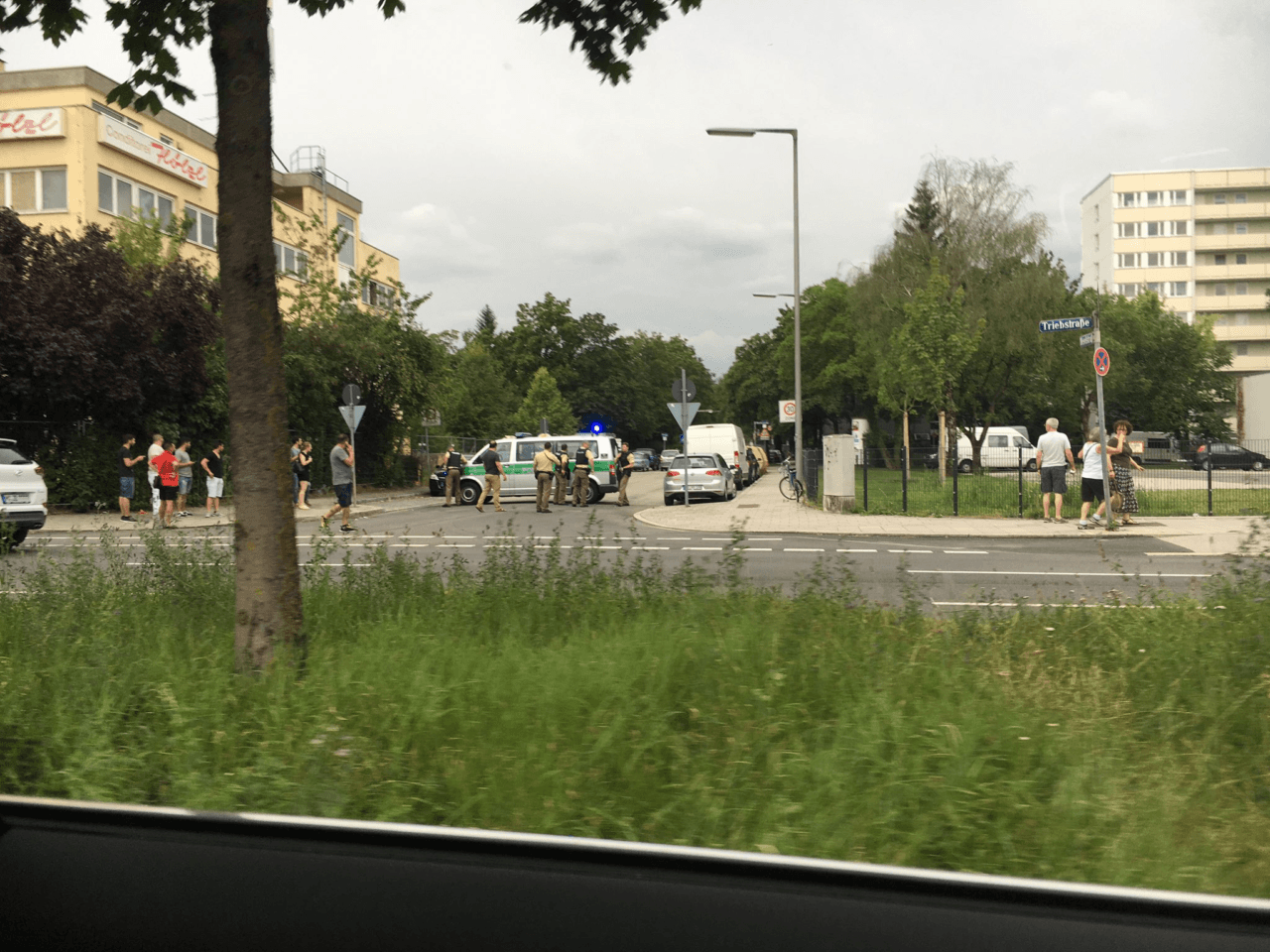
“At 17.50 o’ clock witnesses came forward at the police station and reported a shooting in the area of Hanau Street. Witnesses report three different people with guns.
“Type and number of victims is unknown. The police are using all available forces with the support of special forces, the federal police and neighbouring [forces].
“At the moment no perpetrators have been arrested… Due to the unclear situation we ask all people in the metropolitan area to stay at home or In nearby buildings to seek shelter. The operation of the public transport is currently suspended.
“As soon as more information becomes available, it will be reported”.
UPDATE 1915 BST — Three confirmed dead
The German Interior Ministry has confirmed three dead, the Telegraph has reported.
However, German sources including the Muencher Abendzeitung are reporting that the death toll is much higher, with perhaps as many as 15 casualties. It is not known how many have been injured. An employee within the centre told Reuters “many shots were fired.”
UPDATE 1900 BST — WARNING GRAPHIC
Munich police have asked witnesses not to share pictures of the situation as it unfolds as they track the shooter/s, however a number of images have been posted. While some actually show other attacks including the 2013 Kenyan mall attack, others are more clearly genuine with visible landmarks and signs that show they were likely taken in Germany.
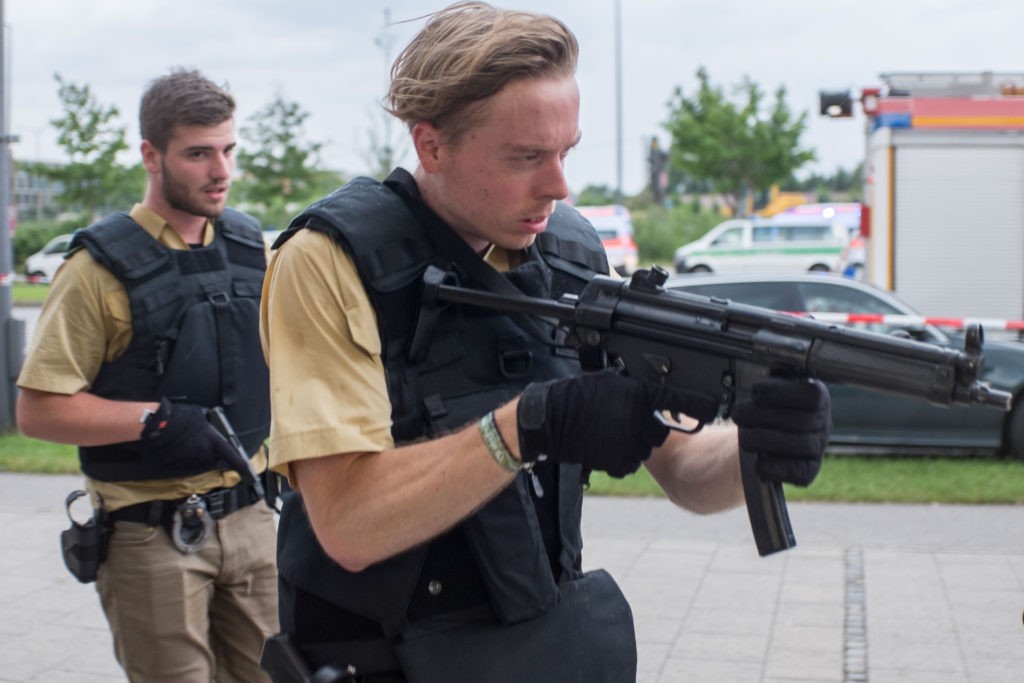
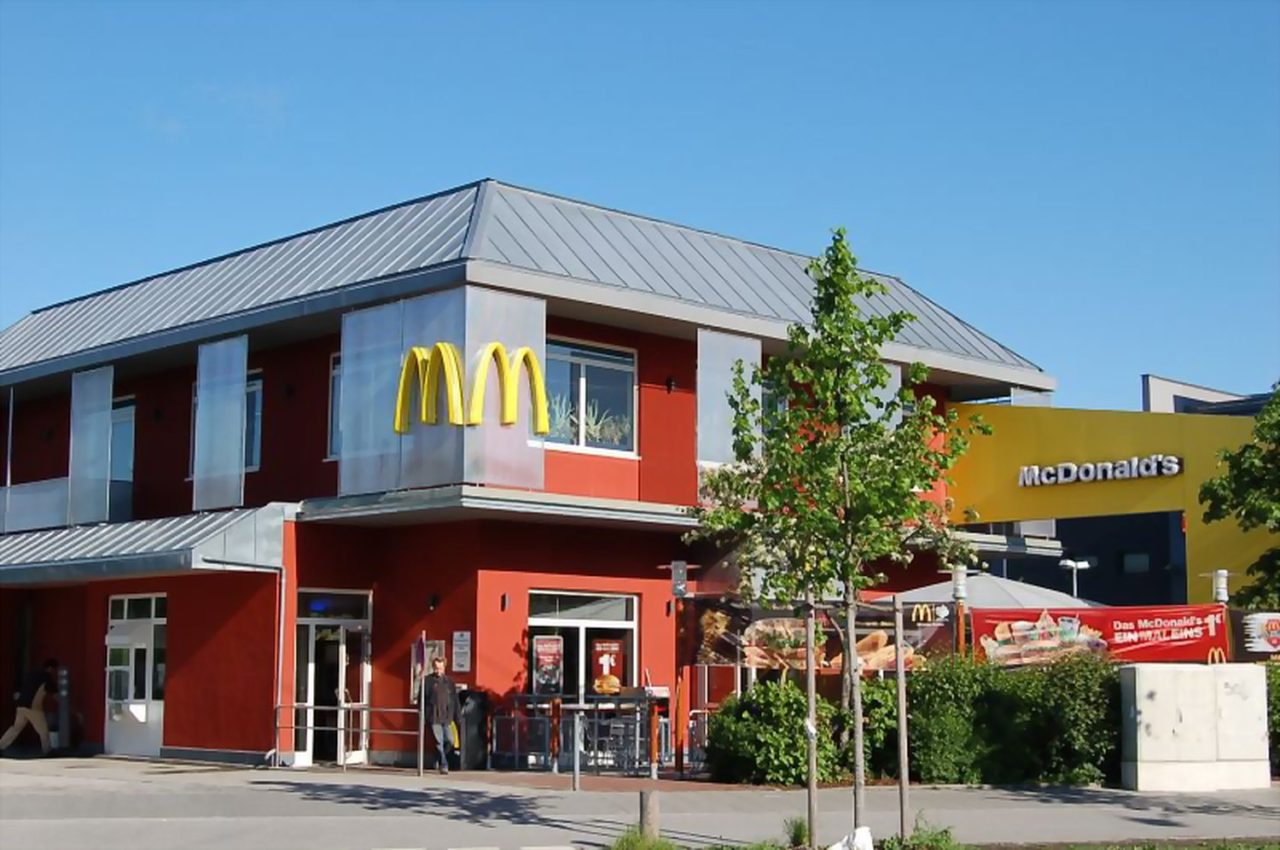
This graphic image shows a first responder standing outside the Olympia McDonalds attending to a victim — the Saturn electrical store next door can be seen in the background.
Twitter
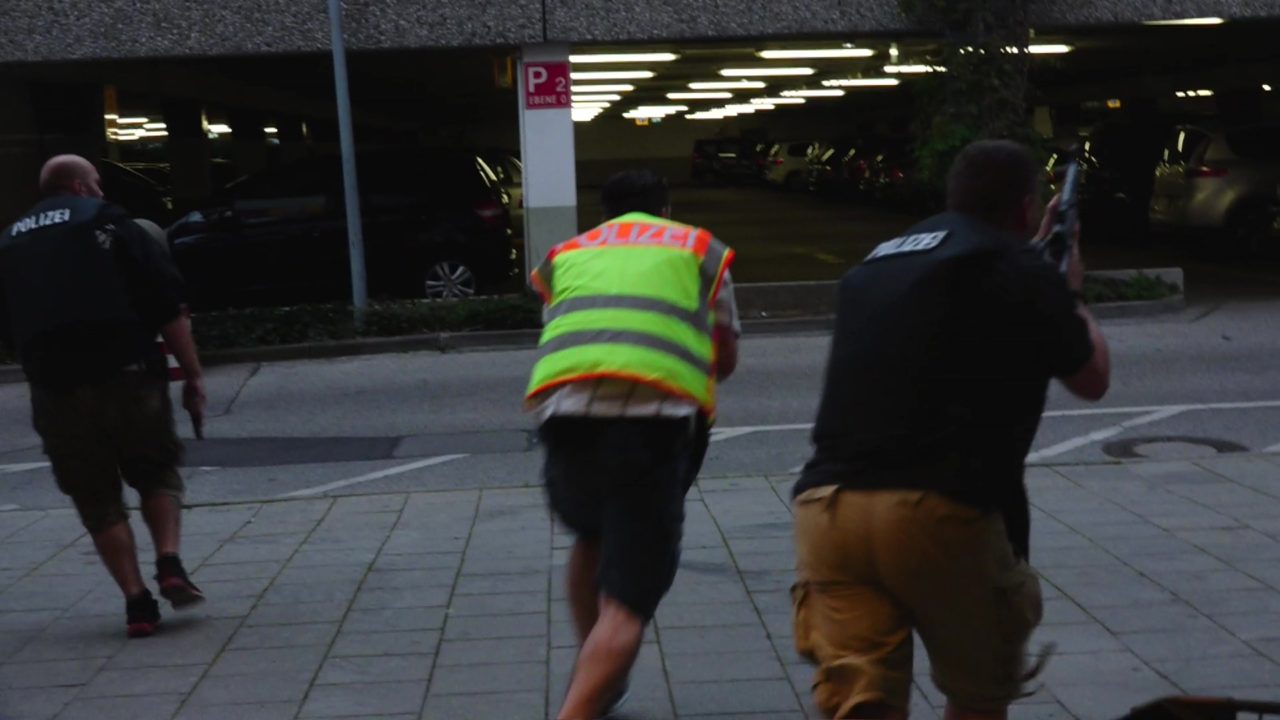
German police arrive / AP
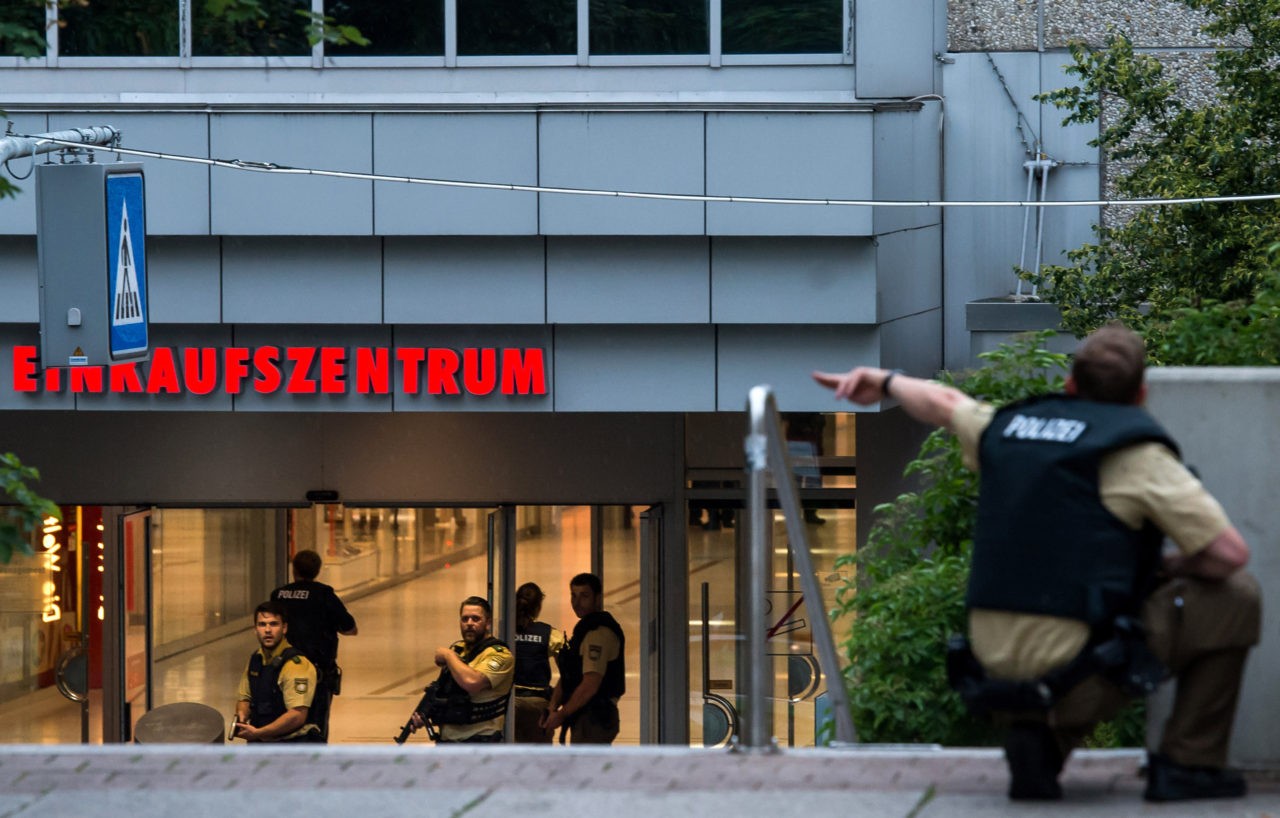
Armed police cover the entrance to the Olympia U-Bahn station / Getty
Getty
Getty
Getty
UPDATE 1855 BST — Reports that Munich Police are dealing with multiple shootings — Mall and Metro station Marienplatz Metro station in the centre of Munich is reported to be the location of a second shooting according to reports, although there are presently no confirmed reports of injuries.
Reports of a third shooting location in the city have not yet been confirmed.
UPDATE 1845 BST — Staff at mall are in hiding Reuters are reporting that staff are still hiding out in the building, according to a member of staff who contacted the news agency by phone.
If so, events could evolve into a hostage situation, although there are currently no suggestions that that is the case.
UPDATE 1835 BST — Video claiming to show shooter posted to social media
A Twitter video showing a man with what appears to be a pistol shooting at bystanders also clearly shows a distinctively laid out branch of the McDonalds fast-food chain. Local images and Google Street View strongly suggests the video is in fact from Munich as claimed.
The Hanauer Strasse McDonalds, directly opposite the Olympia Shopping Centre / Mux.de
UPDATE 1820 BST — Images of armed police on roof
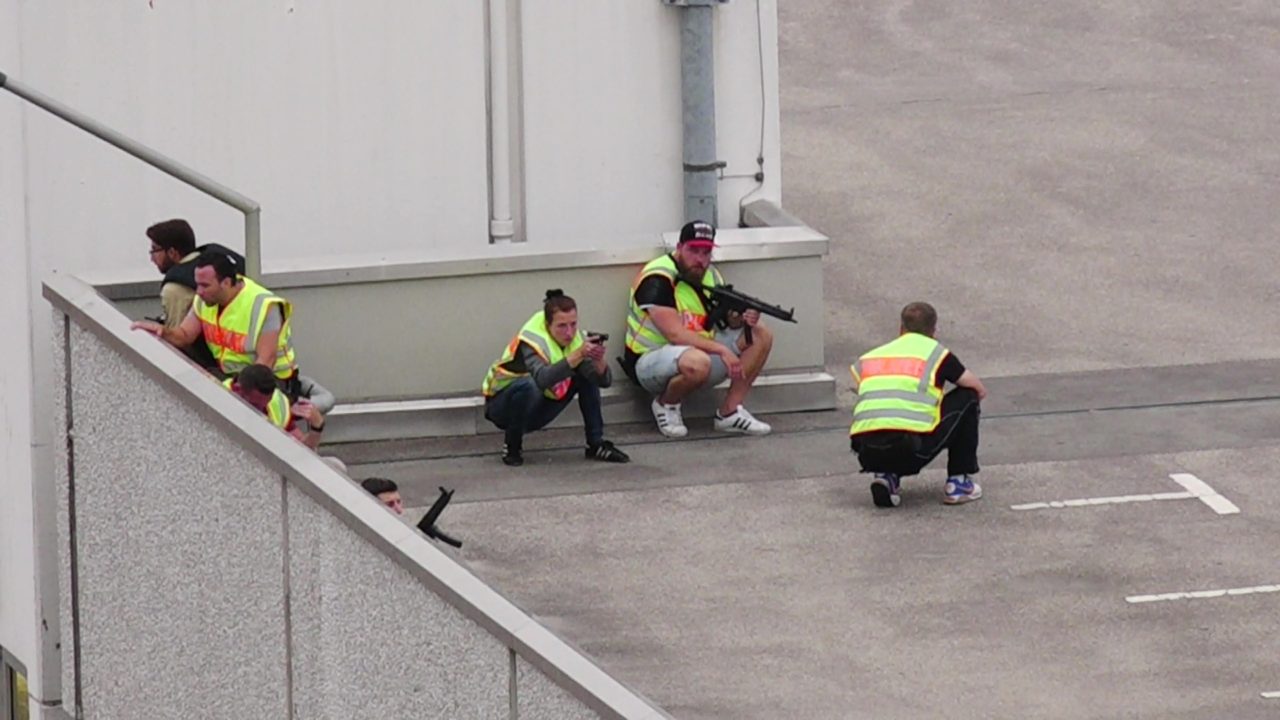
Tweet pictures taken from neighbouring buildings to the Munich shopping mall at the centre of this evening’s apparent attack clearly show Germnan police officers in ordinary patrol dress — rather than armed response order — crouched and taking cover with weapons drawn on the car-park roof. The images may fuel speculation that there may still be an active shooter in the area.
A Munich police source is being reported on Britain’s Sky News as saying there was more than one shooter and there have not yet been any arrests.
UPDATE 1810 BST — Video emerges of situation outside the Munich Olympic Mall
UPDATE 1805 BST — Germans told to expect more terrorism The attacks have come only 48 hours after a warning by German Interior Minister Thomas de Maiziere who claimed that Germans should prepare themselves for more terror attacks in the wake of the axe attack in Wuerzburg. “In Germany we must also expect attacks by small groups of radicalised ‘lone-wolf’ attackers,” he said. Read more at Breitbart London
UPDATE 1800 BST — Confused reports coming out of Munich There may be an active shooter in the Munich shopping mall, with reports of between one and 15 casualties presently being reported in European media.
The story so far:
The gunshots were heard at the Olympiapark shopping centre in Munich and police have announced on twitter that anyone in the area should leave immediately.
A major police operation is currently underway as many witnesses are reporting a very large police presence in the area.
Unconfirmed reports are stating that there may be several casualties as at least one alleged witness has posted a picture of what appears to be injured victims, though there is still no word from Munich police.
The shopping mall is located in the old Olympic park which was built for the 1972 Olympics. The Munich Olympics is well known for being the site of the massacre of Israeli athletes by Palestinian gunmen.
Comment count on this article reflects comments made on Breitbart.com and Facebook. Visit Breitbart’s Facebook Page.
You will be sent a link and password to a private URL to watch the movie. Showtimes: 8pm on Saturday, 2pm on Sunday and 8pm Sunday (all times Eastern).
BREITBART CONNECT
Sign Up For Our Newsletter
UPDATE 2100 BST — Müncheners urged to ‘check in’ after terror attack
Police have called for people in Munich to go on Facebook and check in to the emergency system Facebook created to help locate people in terror attacks and natural disasters.
UPDATE 2020 BST — ‘At Least 6 Dead’ says European agency The European news agency AFP has reported there are at least six dead in the ongoing Munich ‘terror’ attack with three shooters still at large. No confirmation yet on motives for attack.
UPDATE 2000 BST — Video of emergency services tending to wounded A video showing stretchers being prepared to take wounded and an injured man lying supine with a sheet over his body has been uploaded to Twitter.
UPDATE 1940 BST — Well-meaning Müncheners opening their doors to strangers in wake of terror attack
Munich residents have been using the hashtag #offenetür (open door) to offer their hospitality to people unable to get home amid the chaos in the city.
However, others have pointed out the inherent danger in opening doors to strangers at a time when gunmen are on the loose, warning people to take precautions before they open the door.
UPDATE 1935 BST — Second Terror Attack in Munich in 2016
German police are reportedly now treating the shooting as a terror attack. Breitbart London reported in May about another terror attack in the German city of Munich, where one died and three were injured.
The attacker reportedly shouted “Allahu Akbar” as he stabbed his fellow passengers on a train. Read more.
Munich police have posted a series of tweets which appear to suggest that gun fire is being heard elsewhere in the city, including mentions of a “shootout” at approximately 18:50pm. They are repeating advice to avoid public areas warning “the suspects are still on the run,” but are underscoring that the situation remains “confusing”.
A Police statement stated:
“At 17.50 o’ clock witnesses came forward at the police station and reported a shooting in the area of Hanau Street. Witnesses report three different people with guns.
“Type and number of victims is unknown. The police are using all available forces with the support of special forces, the federal police and neighbouring [forces].
“At the moment no perpetrators have been arrested… Due to the unclear situation we ask all people in the metropolitan area to stay at home or In nearby buildings to seek shelter. The operation of the public transport is currently suspended.
“As soon as more information becomes available, it will be reported”.
UPDATE 1915 BST — Three confirmed dead
The German Interior Ministry has confirmed three dead, the Telegraph has reported.
However, German sources including the Muencher Abendzeitung are reporting that the death toll is much higher, with perhaps as many as 15 casualties. It is not known how many have been injured. An employee within the centre told Reuters “many shots were fired.”
UPDATE 1900 BST — WARNING GRAPHIC
Munich police have asked witnesses not to share pictures of the situation as it unfolds as they track the shooter/s, however a number of images have been posted. While some actually show other attacks including the 2013 Kenyan mall attack, others are more clearly genuine with visible landmarks and signs that show they were likely taken in Germany.
This graphic image shows a first responder standing outside the Olympia McDonalds attending to a victim — the Saturn electrical store next door can be seen in the background.
Twitter
Getty
Twitter / @TimmKraeft
Several gunshots are reported to have been fired at a shopping centre in Munich, with media claiming there have been multiple fatalities.
UPDATE 1800 BST — Confused reports coming out of Munich
There may be an active shooter in the Munich shopping mall, with reports of between one and 15 casualties presently being reported in European media.
The story so far:
The gunshots were heard at the Olympiapark shopping centre in Munich and police have announced on twitter that anyone in the area should leave immediately.
Im Moment haben wir einen großen Polizeieinsatz am OEZ. Bitte meiden Sie den Bereich um das Einkaufszentrum.
A major police operation is currently underway as many witnesses are reporting a very large police presence in the area.
Unconfirmed reports are stating that there may be several casualties as at least one alleged witness has posted a picture of what appears to be injured victims, though there is still no word from Munich police.
The shopping mall is located in the old Olympic park which was built for the 1972 Olympics. The Munich Olympics is well known for being the site of the massacre of Israeli athletes by Palestinian gunmen.
London’s new and first Muslim mayor Sadiq Khan has refused to back a request for the terrorist outfit Hezbollah to be a proscribed organisation.
Following a question from UK Independence Party (UKIP) London Assembly member David Kurten, Mr. Khan said that he would not back a ban on the group which has recently had supporters and sympathisers protesting with its famous yellow jihadi flag at ‘Al Quds Day’ in London.
Mr. Kurten asked the question in the discussion following Assembly member Kemi Badenoch’s question: “What action is the Metropolitan Police Service taking against the use of flags representing designated terrorist organisations as seen during the recent al-Quds Day march in London on July 3rd?”
While Mr. Khan said he understood “the concerns of the Jewish community, and the distress these flags cause many Londoners”, he also said “It would not be appropriate… to comment on an ongoing police investigation” and that he would not commit to pushing for a ban on the “political wing” of Hezbollah.
A common misconception about the terror group which is deeply entrenched in both Europe and the Americas is that there is a tangible difference between a “military” or terrorist wing and the group’s political arm. In Lebanon, Hezbollah has 12 member of parliament and takes two seats in the cabinet of the government.
The group is designated as a terror group in its entirety by the Arab League, Bahrain, Canada, France, Israel, the Netherlands, and the United States.
But the European Union, as well as the United Kingdom maintain a difference between the group’s military and political wings, seeking only to proscribe the former.
The Hezbollah flags, which were flown at the Al Quds Day march, do not distinguish between two “wings” and the two “wings” both report to the same group leadership in terror chief Hassan Nasrallah.
Mr. Kurten made this point, and asked if this was the reason why the Metropolitan Police Service is not able to intervene when Hezbollah flags are flown. The Mayor admitted this was the case saying “…you’re right…”.
He then asked the Mayor if he would call for the political wing of Hezbollah to be proscribed to bring the UK into line with many other nations. The Mayor responded negatively saying: “That’s not what I’ve committed to…”
UKIP’s other London Assembly member Peter Whittle joined Mr. Kurten in calling on new Prime Minister Theresa May for Hezbollah to be proscribed in its entirety.
Mr Kurten added after the event: “The number one duty of the Mayor is to ensure that Londoners are safe. It is astonishing that in the current climate the Mayor did not call for a blanket ban of Hezbollah, and did not oppose this loophole which is both frightening to many Londoners and also potentially encourages violent hate crime. I hope that on reflection that he will change his mind.”
Trump sees in Netanyahu “all the things that were lacking in Obama,” David Friedman says.
CLEVELAND – Israeli annexation of settlements in the West Bank could be viewed by a Trump administration as a legitimate way for Israel to move forward if the Palestinians continue to avoid a real and genuine peace deal, David Friedman, a senior advisor to Donald Trump, told The Jerusalem Post on Tuesday.
Speaking as the Republican Party convention entered its second day in Cleveland, Friedman, who advises Trump on matters related to Israel, said that in his view, settlements in the West Bank were not illegal and were not the real impediment to peace with the Palestinians.
“The impediment to peace is very clear in both of our minds and that is the failure of the Palestinians to renounce hatred and renounce violence,” Friedman said. “Everything else is barely important.”
Friedman, a Manhattan-based attorney for Donald Trump and president of the American Friends of Bet El Institutions who serves as an Israel advisor to Trump alongside Jason Greenblatt, told the Post that in his view annexation of the settlements would be a legitimate way for Israel to move forward.
“If there is no agreement with the Palestinians, Israel has to move forward and maybe there is another path and a better path that is not a two-state solution and obviously under those circumstances that [annexation D.Z.] is certainly an option,” he said “I don’t know when or if that would be implemented but it’s certainly not a third rail in terms of options. It is certainly a legitimate possibility.”
Friedman went on to say that a one-state solution was also a viable option for ending the decades-old conflict between Israel and the Palestinians.
What I’m saying is a two-state solution is not the only solution. It’s failed in the past and I think it’s reasonable to consider any other alternatives people of good faith may propose,” he said. “A two-state solution might be a solution. It could work, but it’s not the only solution.”
The one-state idea was a viable solution, he said, since Israel was recognized as a protector of minority rights.
“So I think they have a wonderful track record to import into Judea and Samaria,” he said. “Second of all, the demographics with regard to the entire region are trending in a way that – according to the most credible demographic report – a one state solution would not deprive Israel of its Jewish character.”
According to Friedman, the best solution for the conflict is for the Palestinians to stop killing Israelis.
“The question is: Are people going to kill each other? And let me be clear – the Palestinians have to stop killing the Jews, because that’s where all this violence is initiating,” he said. “Do people have to keep trying? If you have a stomach ache, and you went to 10 different doctors and they all gave you the same medicine and after that you still have a sick stomach, you probably will start thinking about a different medicine or doctor, no?”
Under Trump, Friedman said, the Israeli-American alliance would look 180 degrees different than it has been for the past eight years under President Barack Obama.
“The first and most basic is the presumption on the part of president Trump that Israel actually knows what it is doing, and that Israel wants peace and the people of Israel desperately want peace,” he said. “I think we presume that they want peace and will know the best way to achieve peace and therefore there is no need to pressure them or impose any conditions on them or against their wishes, begin any summits, initiatives, conference that they are not ready for. That is the first major philosophical difference – Israel knows what is best for Israel.”
He said he was also confident that Trump and Prime Minister Benjamin Netanyahu would develop a strong relationship.
“The relationship will be far different and better at the core because there’s going to be a high level of mutual respect,” he said.
“On our side of things – Trump has great respect for Bibi. He sees in Bibi all the things that were lacking in Obama…I think Bibi and Trump have a similar view of the world: The United States and – to a similar extent Israel – have to deal with their enemies from a position of strength. Obama deals from a position of weakness and apology, from a position of conceding whenever necessary. I think Trump recoils from that approach and I think Bibi is the same way. I think they would get along great. They have a very similar world view,” he added.


 The French army is at the limit of its capacity for action: it already patrols the streets of France and is deployed in Africa and the Middle East. Pictured above: French soldiers guard a Jewish school in Strasbourg, February 2015. (Image source: Claude Truong-Ngoc/Wikimedia Commons)








 anneinpt
 artaxes
 danmillerinpanama
 davidking1530
 Peter Hofman
 Joseph Wouk
 Peter
Peter Louisiana Steve
 WarSclerotic
Recent Comments