Posted tagged ‘Terrorism’

Turkish army shells Kurds ‘refusing to retreat’ near Jarablus

August 26, 2016

Turkish army shells Kurds ‘refusing to retreat’ near Jarablus – state media Published time: 26 Aug, 2016 01:57

Source: Turkish army shells Kurds ‘refusing to retreat’ near Jarablus – state media — RT News
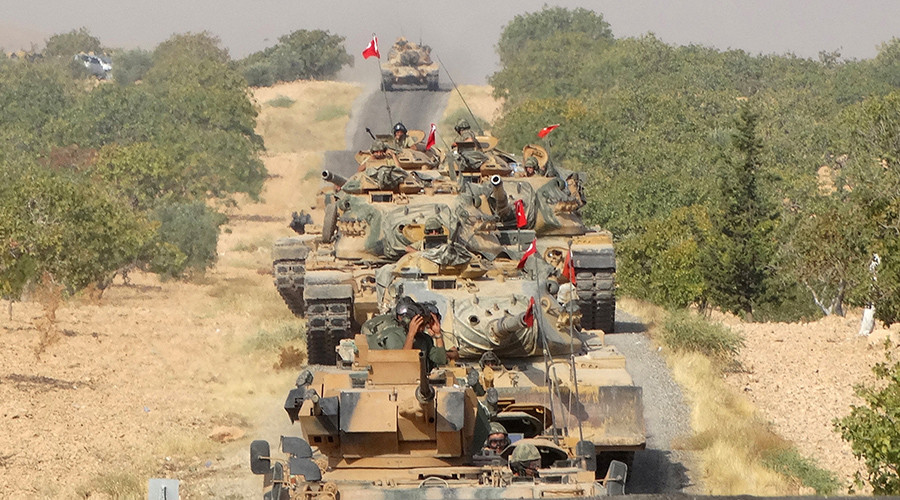
Turkish army tanks make their way towards the Syrian border town of Jarablus, Syria August 24, 2016. © Revolutionary Forces of Syria Media Office / Reuters

Turkish military have targeted US-backed Kurdish YPG militia with artillery fire south of the Syrian border town of Jarablus on Thursday, Anadolu state agency reported, citing a security source. The units allegedly refused to withdraw from the area despite warnings.

The group of YPG fighters were attacked with howitzers at about 6pm local time after they were spotted by Turkish intelligence advancing to Jarablus from the north of Manbij, the report said. Earlier, Washington assured Ankara that the US-backed Kurdish formations have been pulling out forces from the area to the east of the Euphrates River as demanded by Turkey.

READ MORE:Women burn burqas, men cut beards: Manbij celebrates liberation from ISIS (VIDEO, PHOTOS) 

“Kerry [US State Secretary John Kerry] emphasized that the PYD/YPG forces have been withdrawing to the east of the Euphrates,” a Turkish security source was quoted by Hürriyet Daily News as saying following a telephone conversation between the US top diplomat and Turkey’s foreign minister Mevlut Cavusoglu on Thursday morning.

While on a visit to Ankara on August 24, US Vice President Joe Biden pledged to withdraw the support of American forces to Kurdish fighters battling terrorists in Syria if they did not comply with Turkey’s request to remain east of the river.

READ MORE:Turkey shells ISIS & Kurdish positions in Syria

“They cannot, will not and under no circumstances get American support if they do not keep that commitment. Period,” Biden said at a joint news conference with Turkish PM Binali Yildirim.
Read more

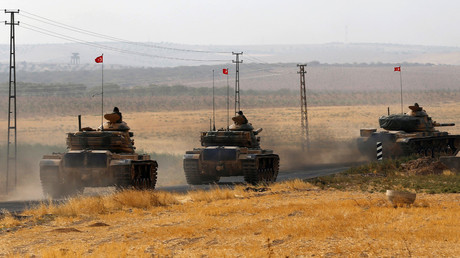
Turkish army tanks drive towards to the border in Karkamis on the Turkish-Syrian border in the southeastern Gaziantep province, Turkey, August 25, 2016. © Umit Bektas

Turkey has been conducting Operation Euphrates Shield since Wednesday after its troops entered the borderline territory in the north of Syria with the focus on retaking Jarablus from the Islamic State (IS, ISIS/ISIL) terrorists, which has been occupying it since July 2013. Justifying the incursion, which had not been authorized by the Syrian government, Turkey’s President Recep Tayyip Erdogan said it is aimed at stopping frequent cross-border attacks and repelling “terror groups which constantly threaten our country like Daesh [Arabic derogatory name for IS] and the PYD [the Democratic Union Party of Syria]”.

READ MORE:‘Blatant violation of sovereignty’: Damascus condemns Turkish operation in Jarablus

Meanwhile, Damascus slammed the offensive as “a blatant violation of sovereignty.”

The shelling follows a statement by YPG command saying that Kurdish militia under its control had left Manbij and returned to its bases, turning over the control over the city to the Manbij Military Council, according to Al-Masdar News.

On Wednesday, the YPG denounced the Turkish military offensive in Syria as “a hostile intervention,” refusing to cave in to pressure coming from Turkey.

“We won’t listen to the demands of Turkey or powers outside of Turkey. Turkey cannot impose its own agenda, its own interests on us. Our forces are there. We will not withdraw from west of the Euphrates,” YPG spokesman Redur Xelil said, as cited by Rudaw.

“Its main goal, more than ISIS, is the Kurds,” he pointed out.
Read more

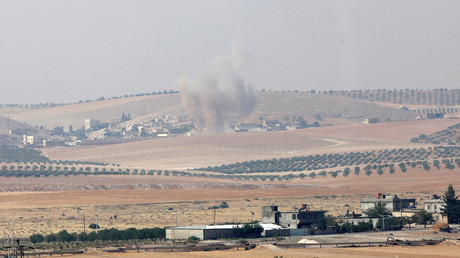
Smoke rises from the Syrian border town of Jarablus as it is pictured from the Turkish town of Karkamis, in the southeastern Gaziantep province, Turkey, August 24, 2016. © Stringer

At the moment, at least 20 Turkish tanks are taking part in operation inside Syria with more armored vehicles are expected to join the effort in the coming days as the Syrian rebels supported by Turkish forces are “cleansing” the city from jihadists.

The former IS stronghold of Manbij was freed by Kurdish-led SDF from jihadists just two weeks ago after months of intense fighting.

The Kurdish People’s Protection Units (YPG) are the armed wing of the Kurdish Democratic Union Party (PYD), close to the Kurdistan Workers’ Party, which Ankara considers a terrorist organization. Turkey has been leading a military campaign against PKK insurgency in the country’s south-eastern Kurdish-populated regions, which has been criticized by rights groups for its brutality. Numerous reports have also suggested that Ankara bombed Kurdish targets inside Syria while allegedly sparing Islamist militants that the YPG have been in bitter battle with.
State capitulates to hunger striking terrorist’s demands

August 25, 2016

State capitulates to hunger striking terrorist’s demands Bilal Kayed, who is hospitalized at Barzilai Hospital after hunger strike, reaches agreement with the Israeli authorities on his release.

Arutz Sheva, 25/08/16 00:15

Source: State capitulates to hunger striking terrorist’s demands – Defense/Security – News –

Terrorist Bilal Kayed, who was in administrative detention and is hospitalized at the Barzilai Hospital after hunger striking, has reached an agreement with Israeli authorities according to which he will be released from administrative detention and will stop his 70-day hunger strike.

Kayed’s lawyers reached an agreement with the state that his administrative detention will not be renewed after six months unless new information emerges which supports his staying in jail.

The agreement will be brought before the High Court on Thursday as part of the petition presented by the terrorist against his administrative detention.

Kayed, 35, a resident of Asira a-Samilia, a village north of Shechem, was arrested during the intifada in 2002 when he was a member of the armed unit of the Democratic front. He was charged with a number of security crimes including attacks and attempted attacks and was sentenced to 14.5 years of jail.

In June the terrorist completed his prison time but was transferred to administrative detention for a half a year and consequently he started a hunger strike.

American University Attacked in Kabul, Afghanistan

August 24, 2016

American University Attacked in Kabul, Afghanistan, ABC News, August 24, 2016

ap_kabul_attack_01_jc_160824_12x5_1600

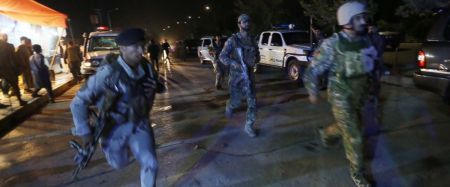
The American University of Afghanistan in Kabul came under attack today, as security forces exchanged gunfire with the attackers.

The gunfire that was reported in the vicinity of the school has now stopped, according to a source in the Kabul Police Force. The same source told ABC News that two people were killed and five were injured in the attack.

The victims have not been publicly identified.

The U.S. State Department this morning acknowledged reports of the attack on an official Twitter account.

“Reports of attack on American University in Kabul. Exercise caution, avoid unnecessary movement in the area & monitor news for updates,” the agency said.

Reports of attack on American University in . Exercise caution, avoid unnecessary movement in the area & monitor news for updates.

10:45 AM – 24 Aug 2016

Massoud Hossaini, a photographer for The Associated Press, tweeted that he was trapped inside during the attack.

“Help we are stuck inside AUAF and shooting flollowed [sic] by Explo this maybe my last tweets,” he wrote.

The AP later reported that he was safe, and had escaped from the school.

The attackers managed to enter Noor Hospital, adjacent to the school, according to eyewitnesses.

The American University of Afghanistan opened in 2006, and was a pet project of former first lady Laura Bush, who helped launch the institution on a 2005 visit to Kabul, the capital.

Much of its funding has come from the U.S. Agency for International Development, which administers civilian foreign aid, and today has more than 1,700 full- and part-time students. It has produced 29 Fulbright Scholars and maintains partnerships with many U.S. colleges, such as Stanford, Georgetown and the University of California network.

The school says on its webpage that it “embraces diversity and community” in Afghanistan.

But it has been no stranger to threats of violence since its creation.

Two professors at the university — one American and one Australian — were abducted at gun point outside the university campus earlier this month, underscoring the deteriorating security situation in the capital and across the country more generally.

Also, two people employed by the university were killed in 2014 when a suicide bomber set off an explosion inside of a Kabul restaurant that was popular with ex-pats.

ABC News’ Aleem Agha and Jon Williams contributed to this report.

U.S. Urges Americans: Leave Gaza ‘As Soon As Possible’

August 24, 2016

U.S. Urges Americans: Leave Hamas-Controlled Gaza ‘As Soon As Possible’

by Breitbart Jerusalem

24 Aug 2016

Source: U.S. Urges Americans: Leave Gaza ‘As Soon As Possible’

David Silverman/Getty

WASHINGTON (AFP) – The United States reiterated its recommendation that Americans in Gaza leave the territory controlled by Hamas, which Washington calls a terrorist group, “as soon as possible.”

The warning came after the Israeli army said it bombed dozens of targets in Gaza from Sunday to Monday, in response to rocket fire from the strip. Palestinian medical officials said four people were wounded.

Washington regularly updates warning notices to Americans traveling to and living in countries around the world.

In the case of Gaza, the State Department warned against “all travel” to the territory and “urges those present to depart as soon as possible when border crossings are open.”

It had issued a similar warning in December 2015.

Since January, 14 rockets fired from Gaza have hit Israeli territory, the military said.

The border area has remained tense since the July-August 2014 war between Israel and Gaza militants that killed more than 2,200 Palestinians and 73 people on the Israeli side.

“Gaza is under the control of Hamas, a foreign terrorist organization. The security environment within Gaza and on its borders is dangerous and volatile,” the State Department said in its warning Tuesday.

As for Israel and the West Bank, a wave of violence there since October 2015 has left Americans dead and wounded, the department said.

However, “there is no indication that US citizens were specifically targeted based on nationality.”

The violence has eased in recent weeks, but an AFP count shows 220 Palestinians and 34 Israelis killed since October 1, 2015 in the Palestinian territories, Jerusalem and Israel.

Most of the Palestinians killed were attackers or suspected attackers. A number were killed in clashes with the Israeli army.


Stunning: Egyptian Foreign Minister says Israel’s treatment of Palestinians not ‘terrorism’

August 24, 2016

Stunning: Egyptian Foreign Minister says Israel’s treatment of Palestinians not ‘terrorism’, American ThinkerThomas Lifson,, August 24, 2016

It is an article of faith in the Arab world that Israel is guilty, guilty, guilty of terrorizing the poor Palestinians, which is why Jews deserve to be terrorized worldwide.  The origins of violence lie exclusively on the Jews, too.  So Arabs and all Muslims have a duty to defend their brothers and sisters by acts of extreme cruelty against Israelis in particular, and Jews in general.

This dogma is extremely important because it avoids any scrutiny of Koranic and other scriptural incitements of violence – even genocide – against Jews. I thus serves a dual purpose. And as a result, it must remain unquestioned.  And for decades, there has been rhetorical solidarity on this point.

Until now.

The fall of the Muslim Brotherhood in Egypt and its replacement by the anti-MB regime of General Sisi, along with the spread of chaos in the Arab world has changed matters. Meanwhile, Israel is quietly building itself into a tiny superpower, its high tech economy and rapid development of offshore gas and onshore fracking making it a global economic power, able to finance a high tech military.

As a result, a stunning break with the past happened, beyond the notice of our mainstream media. The Jerusalem Post reports:

Egyptian Foreign Minister Sameh Shoukry said on Sunday that Israel’s actions against Palestinians does not constitute terrorism, eliciting an angry response from a Hamas spokesman who said Egypt’s top diplomat is blind.

Shoukry’s comments came during a Q&A session with students held at the Egyptian Foreign Ministry, where he was asked why Palestinians children killed in the conflict with Israel were not considered victims of terrorism.

“When looking at this issue, it can be defined as a ‘regime of force,’” the Egyptian media quoted Shoukry as saying. He said there was no evidence to link Israel to terrorist organizations.

“There is nothing that leads to this conclusion,” he said.

Shoukry added that Israel’s history has made it very sensitive to security issues, and as a result tightens control over its territory and border crossings to ensure its security.

The reaction has not been favorable among other Arab regimes. In public, at least. Speaking from Qatar, a major Clinton Foundation donor (and recipient of questionable favors):

Husam Badran, a Hamas spokesperson in Qatar, slammed the Egyptian foreign minister in a Twitter post, saying, “He who does not see the crimes of the Zionist occupation as terrorism is blind.”

The Egyptian cozying up with Israel is far ahead of public opinion there. It is inconceivable to me that Shoukry made these comments without first discussing them with Saudi Arabia, Egypt’s primary financial backer.

Tectonic plates are shifting in the Arab world, with some pragmatic leaders realizing that the primary problems of Arabs are created by themselves, and Israel has much more to offer as a friend than as a mortal enemy.

Hat tip: Clarice Feldman


Israel targeted ‘key Hamas strategic assets’ in Sunday’s barrage

August 23, 2016

Israel targeted ‘key Hamas strategic assets’ in Sunday’s barrage IDF takes advantage of rocket fire from Gaza to take out terrorist infrastructure; Liberman: ‘We won’t allow them to rearm’

By Judah Ari Gross

August 23, 2016, 4:12 pm

Source: Israel targeted ‘key Hamas strategic assets’ in Sunday’s barrage | The Times of Israel

Palestinian militants of the Islamic Jihad movement arrive to inspect a crater on August 22, 2016 in Beit Lahia in the northern Gaza Strip, following an Israeli airstrike the day before that targeted Hamas positions in the Gaza Strip in response to a rocket fired from the Palestinian enclave hits the Israeli city of Sderot. AFP / Mahmud Hams

In Sunday night’s bombardment, the Israel Defense Forces struck “key Hamas strategic assets” in the northern Gaza Strip, military sources said Tuesday, shedding more light on the harsher-than-expected response to a rocket attack from the coastal enclave.

After a projectile from Gaza landed in the southern Israeli town of Sderot on Sunday, the IDF retaliated with what has become the routine response of a limited strike, hitting two Hamas installations in the northern Gaza Strip, the army said.

Hours later, the IDF conducted another, considerably larger barrage, carrying out approximately 50 strikes against Hamas infrastructure in the Gaza Strip, using both tanks and aircraft.

These targets were not directly related to the rocket launch, nor were they only an attempt at creating a deterrent effect. Rather, the IDF took advantage of the opportunity presented by the attack to take out Hamas strategic assets.

An Israeli police sapper carries part of a rocket fired by Palestinian militants in the Gaza Strip from the yard of a house in the city of Sderot, southern Israel, Sunday, August 21, 2016. AP /Tsafrir Abayov.

An Israeli police sapper carries part of a rocket fired by Palestinian militants in the Gaza Strip from the yard of a house in the city of Sderot, southern Israel, Sunday, August 21, 2016. AP /Tsafrir Abayov.

With few exceptions, the army’s policy toward Hamas in Gaza has been only to retaliate, not to initiate, an officer in the IDF’s Southern Command told The Times of Israel in November.

Though the IDF often has extensive intelligence on the terrorist group’s dealings in the Gaza Strip, “we don’t respond to everything, because we don’t want to escalate the situation,” the officer said.

When a rocket is fired into Israel, however, that dynamic changes and the IDF has a certain legitimacy in targeting terrorist infrastructure in the coastal enclave, as occurred on Sunday night.

A Palestinian man loads stones on a cart next to a crater in Beit Lahia in the northern Gaza Strip on August 22, 2016, following an Israeli airstrike the night before that targeted Hamas positions in response to a rocket fired from the Palestinian enclave that hit the Israeli city of Sderot. (Mahmud Hams/AFP)

A Palestinian man loads stones on a cart next to a crater in Beit Lahia in the northern Gaza Strip on August 22, 2016, following an Israeli airstrike the night before that targeted Hamas positions in response to a rocket fired from the Palestinian enclave that hit the Israeli city of Sderot. (Mahmud Hams/AFP)

It was immediately noted that Israel’s bombardment on Sunday was larger than most retaliatory strikes.

“There were approximately 50 airstrikes within two hours,” a senior military official told The Times of Israel. “But there is no intention to escalate the situation further.”

Hamas quickly claimed the response was an attempt by Israel to change the status quo in Gaza — and Israel agreed.

“You can’t expect the State of Israel to allow [Hamas] to rearm itself, to steal money from the residents of Gaza. They are levying taxes and not constructing buildings, but tunnels,” Defense Minister Avigdor Liberman said on Tuesday morning at an army base in the Galilee.

Palestinian security sources in Gaza said several targets in the northern Strip were struck by Israeli fire, and that a reservoir in Beit Hanoun was damaged. Israel also hit a base belonging to Hamas’s military wing, the Izz ad-Din al-Qassam Brigades, in nearby Beit Lahiya, witnesses said. Palestinian health and security sources said between two and five people were lightly wounded by Israel’s retaliatory fire.

Hamas officials have decried the Israeli bombardment, but have not indicated that they intend to respond immediately.

Hamas, Palestinian Authority Target Journalists Ahead of Election

August 23, 2016

Hamas, Palestinian Authority Target Journalists Ahead of Election

by Khaled Abu Toameh

August 23, 2016 at 5:00 am

Source: Hamas, Palestinian Authority Target Journalists Ahead of Election

  • Both of the journalists who were arrested made the mistake of reporting on the suffering of Palestinians living under Hamas rule. These are not the kind of stories that Hamas wishes to see ahead of the local and municipal elections. Rather, Hamas wants to see printed lies of prosperity.
  • It is a puzzle why foreign journalists choose not to report about the campaign of intimidation facing their Palestinian colleagues.
  • One might wonder if the human rights groups neglect these abuses because of their continued obsession with destroying Israel.

Palestinian journalists are at the top of the Palestinian Authority (PA) and Hamas hit-list in the crackdown occurring alongside preparations for the Palestinian local and municipal elections, scheduled for October 8.

The crackdown is part of an ongoing campaign by the two rival parties to silence critics in the West Bank and Gaza Strip. Neither Hamas nor the PA tolerates a free and independent media — especially on the eve of a crucial election that could have far-reaching political implications in the Palestinian arena.

A Hamas victory in the upcoming elections would be catastrophic for President Mahmoud Abbas and his Palestinian Authority. Such an electoral outcome would be tantamount to a vote of no-confidence in their policies and performance.

Hamas, for its part, is investing a huge amount of resources in the election campaign, in hopes that the results would further boost its standing among Palestinians. Hamas fears that a defeat would undermine its power in the Gaza Strip and pave the way for its collapse.

As the election campaign heats up, it is clear that Hamas and the PA agree on one thing: intensifying their repressive measures against Palestinian journalists.

This media crackdown is essentially ignored by international human rights organizations. Why? One reason is that when Israel is not involved, assaults on freedom of the media and expression do not interest them.

Some Western journalists and human rights advocates also treat these cases as “internal Palestinian issues” that are of no relevance to international public opinion. A story about a Palestinian journalist who is arrested by Israel is news. A Palestinian journalist incarcerated or threatened by the Palestinian Authority or Hamas is not.

Take, for example, the case of Ahmed Said, a journalist from the Gaza Strip. Last week, he was arrested by Hamas security forces, who also confiscated his personal computer. Said has a radio show on the Sawt Al Sha’ab (Voice of the People) radio station, where Palestinians call in to voice their grievances and talk openly about the problems they are facing under Hamas rule in the Gaza Strip.

Before he was arrested, Said had phoned the spokesman of the Hamas police force, Ayman Al Batnihi, to discuss the recent rise in cases of homicide in the Gaza Strip. According to the journalist, the furious spokesman threatened him: “You are causing us a lot of problems and inciting people. I know how to deal with people. You need to be hanged.”

Said is no stranger to this sort of encounter. Last year, he was summoned for investigation for “incitement” against the Gaza City Municipality. The move came after Said used his talk show to talk about the case of street vendor Mohamed Abu Assi, who tried to commit suicide by ingesting poison after Gaza City Municipality inspectors banned him from selling corn at the beach.

Earlier, Hamas arrested another Palestinian journalist, this time for no clear reasons. Mahmoud Abu Awwad, who works for the Palestinian daily Al-Quds, was arrested from his home in the Shati refugee camp on July 25. He too had his personal computer and cellular phone seized.

Ahmed Said (left) and Mahmoud Abu Awwad (right) are two journalists living in the Gaza Strip who were recently arrested by Hamas security forces. Both journalists made the mistake of reporting on the suffering of Palestinians living under Hamas rule.

Abu Awwad’s family have since been banned from seeing him in prison. Their son, they were told by Hamas, is being held for “security reasons.” Abu Awwad, who has been working for Al-Quds for the past three years, had been reporting mostly about the hardships facing Palestinians in the Gaza Strip. In addition, he was also reporting for the Saudi London-based pan-Arab daily, Asharq Al Awsat.

“Hamas is trying to spread lies to distort the image of my son and justify his arrest,” Abu Awwad’s father told Al-Quds. “He was arrested because he was critical of the situation in the Gaza Strip and the Hamas government.”

Said and Abu Awwad have something in common. Both journalists made the mistake of reporting on the suffering of Palestinians living under Hamas rule. These are not the kind of stories that Hamas wishes to see ahead of the local and municipal elections. Rather, Hamas wants to see printed lies of prosperity.

In the context of its election campaign, Hamas has released a video featuring new houses and neighborhoods, as well as green and clean parks and smiling children. Entitled, “Thank You Hamas,” the video seeks to persuade Palestinian voters that life under Hamas is the best thing that could ever happen to them. And that is why they need to help Hamas extend its control from the Gaza Strip to the West Bank through the local and municipal elections. Journalists such as Said and Abu Awwad are spoiling the effect with their inconvenient truths.

Hamas, however, is the proverbial pot calling the kettle black. In the face of its own massive journalistic repression, Hamas dares to criticize the Palestinian Authority for taking similar measures in the West Bank.

Like Hamas, the PA leadership has always been intolerant towards Palestinian (and sometimes non-Palestinian) journalists who dare not toe the party line. Hardly a week passes without hearing about another Palestinian journalist who has been arrested or summoned for investigation by the Palestinian Authority.

In recent weeks, the crackdown on journalists in the West Bank seems to have increased in light of the upcoming elections. The PA too wants to remove from the scene any journalist who might harm its loyalists’ chances of winning the local and municipal vote. In this regard, journalists are easy prey.

One of the recent victims is Mohamed Abu Khabisah, who reports on economic issues for the Turkish news agency, Anadolu. Palestinian security officers who raided his home shortly after midnight in Al Bireh, near Ramallah, seized his personal computer and documents before taking him into custody. His wife, Hana, said she too was briefly questioned about her husband’s source of income and the nature of his work. Palestinian sources say he was apparently arrested for reporting about financial corruption in the Palestinian Authority’s official news agency, Wafa.

Abu Khabisah was the sixth journalist to be arrested by the PA since the decision to hold local and municipal elections was taken two months ago. The other four are Yehya Saleh, Raghid Tabisah Ibrahim Al Abed, Mohamed Abu Jheisheh and Ziad Abu Arrah. In another recent incident, Palestinian security officers raided the home of journalist Musab Kafisheh and seized his personal computer, but did not take him into custody.

It is anxiety that is driving Hamas and the Palestinian Authority in their crackdown on Palestinian journalists. The “security reasons” they tout as an excuse for their repression is a foil for their sense of instability: the less politically secure they feel, the more they strip Palestinian journalists of their ability to report how things really stand in the Gaza Strip and the West Bank.

So far, so good, from the point of view of Hamas and the PA. Palestinian reporters have been duly deterred. But they are far from the only ones affected.

Foreign journalists rely almost entirely on Palestinian “fixers” and producers for information about what is happening under the Palestinian Authority and Hamas. Now, local Palestinians will think ten times before they provide their foreign employers with information. Still, it is a puzzle as to why foreign journalists choose not to report about the campaign of intimidation facing their Palestinian colleagues.

One might wonder if the human rights groups neglect these abuses because of their continued obsession with destroying Israel.

Israel strikes Syria

August 23, 2016

Israel strikes Syria After mortar fire landed in the Golan Heights, the Israeli Air Force struck back.

Source: Israel strikes Syria – Defense/Security – News –

Israel Air Force (Illustration)

Israel Air Force

The Israeli Air Force struck a military target in Syria in response to mortar fire which landed in the Golan Heights in the north.

IAF jets scrambled into the air when a mortar strayed over from Syria and exploded in the Golan Heights. The fighter jets targeted a Syrian army missile launcher in retaliation, near Quneitra, Syria.

According to Syrian media, an unmanned aircraft struck a Ba’ath party position at the outskirts of Quneitra.

No one was injured. The mortar landed in open terrain.

No Red Alert rocket sirens sounded when the mortar breached Israeli territory.

Israel maintains a policy that spillover fighting, even of rebels, is the responsibility of the country who allowed it into Israel.

WATCH: Dozens of illegal guns seized in West Bank crackdown

August 23, 2016

Dozens of illegal guns seized in West Bank crackdown IDF, police, Shin Bet conduct raids in Bethlehem, Hebron as part of ongoing campaign against illicit weapons

By Judah Ari Gross

August 23, 2016, 1:53 pm

Source: WATCH: Dozens of illegal guns seized in West Bank crackdown | The Times of Israel


In the largest operation of the year, Israeli security forces seized dozens of weapons, confiscated equipment and made arrests in Hebron and Bethlehem early Tuesday morning as part of an ongoing effort to crack down on illegal guns in the West Bank, an IDF official said.

In total, seven illegal gun workshops were raided and 22 pieces of gunsmithing machinery — drill presses and metal lathes — were seized, along with “approximately 50 weapons,” including handguns, shotguns, hunting rifles and Carlo-style submachine guns, a cheap and simple automatic weapon loosely based off the design of the Carl Gustav submachine gun, the official said.

 Security forces also recovered ammunition and dozens of gun pieces — grips, barrels, stocks, etc. — that would have been used to create more weapons, the official added.

Two of the alleged manufacturers were arrested in the raids. The suspects do not appear to be connected to any terrorist groups, but were more likely driven by financial motives, the army source said.

“It seems to be a combination of market demand and the ability to manufacture,” he said.

The IDF, along with the police and Shin Bet security service, seizes machinery believed to have been used to create illegal weapons in Bethlehem and Hebron on August 23, 2016, as part of a large crackdown effort on illicit guns in the West Bank. (IDF Spokesperson's Unit)

The IDF, along with the police and Shin Bet security service, seizes machinery believed to have been used to create illegal weapons in Bethlehem and Hebron on August 23, 2016, as part of a large crackdown effort on illicit guns in the West Bank. (IDF Spokesperson’s Unit)

Though the tools necessary to create Carlo-style submachine guns are “dual purpose” and can be found in almost any machine shop in the world, the factories raided early Tuesday morning appeared to be “specifically designed for the manufacturing of weapons,” the IDF official said.

More arrests are expected to come, as Shin Bet and Israel Police investigators will now begin interrogating the two suspects in order to locate the manufacturing and distribution network, the official said.

Dozens of illegal weapons seized by Israeli security forces in Bethlehem and Hebron on August 23, 2016, as part of a large crackdown effort on illicit guns in the West Bank. (IDF Spokesperson's Unit)

Dozens of illegal weapons seized by Israeli security forces in Bethlehem and Hebron on August 23, 2016, as part of a large crackdown effort on illicit guns in the West Bank. (IDF Spokesperson’s Unit)

The joint operation was conducted between 1 a.m. and 5:30 a.m. by five battalions from the Israel Defense Forces — the elite Duvdevan unit, the Nahal Brigade’s 50th Battalion, soldiers from an artillery battery and two reservist battalions — along with representatives from the Israel Police and Shin Bet security service, according to spokespeople for the organizations.

IDF soldiers break into a workshop  believed to have been used to create illegal weapons in Bethlehem and Hebron on August 23, 2016, as part of a large crackdown effort on illicit guns in the West Bank. (IDF Spokesperson's Unit)

IDF soldiers break into a workshop believed to have been used to create illegal weapons in Bethlehem and Hebron on August 23, 2016, as part of a large crackdown effort on illicit guns in the West Bank. (IDF Spokesperson’s Unit)

The raids in Bethlehem and Hebron were the culmination of months of gathering “signal intelligence, human intelligence and visual intelligence,” an IDF official said.

There was no immediate indication that any of the guns sold by the two alleged manufacturers were specifically sold for use in terror attacks. These types of guns can be used for any number of reasons, including terrorist attacks, self-defense and criminal activity, the IDF official said.

However, a weapon purchased for self-defense can still end up being used in a terror attack, the official added.

“Someone who has one of these weapons at home [for self-defense] might hide it in a closet. And when his son gets carried away by incitement, he goes and takes this weapon to carry out attacks,” the officer said.

IDF soldiers, along with the police and Shin Bet security service, seize dozens of illegal weapons in Bethlehem and Hebron on August 23, 2016, as part of a large crackdown effort on illicit guns in the West Bank. (IDF Spokesperson's Unit)

IDF soldiers, along with the police and Shin Bet security service, seize dozens of illegal weapons in Bethlehem and Hebron on August 23, 2016, as part of a large crackdown effort on illicit guns in the West Bank. (IDF Spokesperson’s Unit)

This year over 30 shooting attacks have been carried out with illegally produced weapons. In response, the IDF and other security agencies have been cracking down on illegally produced weapons in recent months, arresting more than 140 people suspected of being involved in the creation or distribution of illicit arms, police said.

Over 300 illegal guns and nearly 50 pieces of manufacturing equipment have also been confiscated in raids across the West Bank in recent months, according to police.

The ongoing crackdown has already had an effect on the market, driving up the price of guns Col. Roman Gofman told the Associated Press last month. For example, a crude Carlo-style submachine gun cost around $500 a few months ago, whereas now it can cost upward of $2,500, he said.

Putin said willing to host Israeli-Palestinian peace talks

August 22, 2016

Putin said willing to host Israeli-Palestinian peace talks Comments by Egypt’s president el-Sissi made to newspaper editors after Israeli delegation arrives in Cairo to discuss peace push

By Times of Israel staff August 22, 2016, 1:39 am

Source: Putin said willing to host Israeli-Palestinian peace talks | The Times of Israel

Russian President Vladimir Putin welcomes Prime Minister Benjamin Netanyahu at the start of a meeting at the Kremlin on June 7, 2016 (screen capture: Facebook)

Amid speculation over a developing Egyptian bid to revive stalled Israeli-Palestinian peace negotiations, Egypt’s President Abdel-Fattah el-Sissi said late Sunday that Russian President Vladimir Putin was willing to host Israeli and Palestinian leaders for direct talks.

In a briefing with newspaper editors in Cairo, Sissi said Israel is increasingly convinced of the need for achieving peace with the Palestinians, according to media reports in Israel and Egypt.

 No peace process could be successful, he told the journalists, without reconciliation between Fatah and Hamas.

He also said Israeli-Palestinian peace, which could enable further burgeoning of Israeli-Arab alliances generally, is the key to regional stability, a sentiment that echoed comments heard in recent months from Jordan’s King Abdullah and other Sunni Arab leaders.

Sissi’s comments follow meetings earlier Sunday between an Israeli delegation in Cairo and Egyptian officials on the Egyptian president’s proposal to revive the peace process.

Israeli officials were scheduled to meet their Egyptian counterparts on Palestinian peace talks, as well as other matters related to the two countries, the Germany news agency DPA reported.

The talks were said to last several hours, according to the report by the Germany agency.

Last week, Palestinian Authority President Mahmoud Abbas reportedly informed Egypt he is no longer opposed to participating in a regional or international peace summit in Cairo.

According to a report on Israel Radio on Friday, the Palestinian leader told an Egyptian delegation in Ramallah that he was willing to attend such a conference, but stressed that the Egyptian peace push would not replace the French initiative to revive talks, which the Palestinians have favored but Israel has strongly opposes.

The PA president also reportedly asked that France, Russia and Switzerland attend the summit.

Abbas urged Egypt to press Prime Minister Benjamin Netanyahu to freeze settlement construction and release Palestinian prisoners ahead of a meeting between the two leaders in Egypt, the report said, but Cairo’s position on the proposed preconditions was not immediately clear.

In July, Palestinian leaders presented several preconditions for participating in a trilateral Israeli-Egyptian-Palestinian peace summit in Cairo, including a freeze on Israeli settlement construction, a Palestinian official told The Times of Israel. Abbas also demanded that Israel acquiesce to negotiations based on the pre-1967 lines and pledge ahead of time to implement any agreements reached in the talks.

Netanyahu in July reportedly told Egyptian Foreign Minister Sameh Shoukry — on a rare visit to Jerusalem — he would be willing to meet with Abbas in Cairo for talks hosted by Sissi. The Prime Minister’s Office did not deny the report by the Saudi-owned, pan-Arab news outlet Al-Arabiya. It said in a statement that “whether the issue was discussed or not, Israel has always said it is prepared to conduct direct bilateral negotiations with no preconditions.”

Prime Minister Benjamin Netanyahu meets with Egypt's Foreign Minister Sameh Shoukry at the Prime Minister's Office in Jerusalem on Sunday, July 10, 2016 (Hadas Parush/Flash90)

Prime Minister Benjamin Netanyahu, right, meets with Egypt’s Foreign Minister Sameh Shoukry at the Prime Minister’s Office in Jerusalem on Sunday, July 10, 2016 (Hadas Parush/Flash90)

Sissi reportedly offered to host direct talks between the sides as part of Cairo’s initiative to kick-start the moribund peace process.

Shoukry’s visit to Israel was the first by an Egyptian foreign minister since 2007. The visit came amid speculation over the renewal of an Arab peace initiative and as Israel’s military recently saluted “unprecedented” intelligence cooperation with Egypt to combat the Islamic State group.

Egyptian President Abdel-Fattah el-Sissi, speaks at the United Nations Sustainable Development Summit in New York, September 25, 2015. (AFP Photo/Dominick Reuter)

Egyptian President Abdel-Fattah el-Sissi, speaks at the United Nations Sustainable Development Summit in New York, September 25, 2015. (AFP Photo/Dominick Reuter)

According to Israel’s Channel 2 television, Shoukry’s surprise visit was also aimed at arranging a first meeting between Netanyahu and Sissi in Egypt in the coming months.

The TV report said Shoukry’s first visit to Israel was coordinated between Egypt and Saudi Arabia, whose Arab Peace Initiative is backed by Sissi and much of the Arab world as the basis of any regional peace effort. Netanyahu has rejected the initiative in its current form, but said in late May that it “contains positive elements that could help revive constructive negotiations with the Palestinians.”