Posted tagged ‘Syrian rebels’

Netanyahu phones Putin for clarifications on the South Syrian ceasefire

February 24, 2016

Netanyahu phones Putin for clarifications on the South Syrian ceasefire, DEBKAfile, February 24, 2016

PutinBibi2-480

Prime Minister Binyamin Netanyahu phoned President Vladimir Putin Wednesday Feb. 24, to find out how the partial Syrian ceasefire due to go into effect Saturday Feb. 27 will affect Israel’s northern border security. According to the Kremlin statement, “The two leaders discussed the Middle East and reached agreement to hold a number of high-level contact meetings.”

Agreement was also reached on “a range of contact [meetings] on the high and highest level, taking into consideration the 25tyh anniversary of the establishment of diplomatic relations between the two countries,” the communiqué went on to say.

The language and content of this communiqué struck DEBKAfile’s diplomatic sources as oddly off the point compared with statements that came after past conversations.

It is hard to believe that the Russian President, while deeply immersed in tense exchanges with President Barack Obama and Iran’s Hassan Rouhani for tying up the ends of the approaching Syrian ceasefire, would give his attention to the celebration of a historic event.

The words did however convey the impression that the Russian leader was making an effort to calm Israel’s apprehensions about the coming stage of the Syrian crisis.

According to our sources, Netanyahu put in the call to Putin when he learned that the Russian and American presidents had agreed to get the partial ceasefire started in southern Syria, namely on the front closest to the borders of Israel and Jordan.

Israeli and Jordanian military officials have been trying to get a picture of how these arrangements would work and affect their national security, but Washington and Moscow are similarly tightlipped on information. This is also the reaction the Israeli Foreign Ministry’s Director General Dore Gold found when he called on Russian Foreign Minister Sergei Lavrov in Moscow on Feb. 18. The minister was polite but avoided direct answers to questions.

Israel is most deeply troubled by the possibility that Syrian army, Iranian and Hizballah forces currently in offensive momentum in South Syria will exploit the cessation of hostilities to advance towards its Golan border with hostile intent.

With only three days to go before the truce goes into effect, Israel has still not received any clear answers about whether the Russian air force will continue to strike Syrian rebel elements deemed “terrorists” unabated in close proximity to its northern borders.

US officials have tried in the last 24 hours to assuage Israel’s concerns, but they are no more forthcoming with clear information than the Russians.

Netanyahu therefore picked up the phone to the Russian president, with whom he maintains a friendly dialogue, to find out what was ahead in the wake of the truce and to ask for guarantees that Syrian, Iranian and Hizballah forces would not permitted to take advantage of the lull to gain ground.

The prime minister also asked Putin about the huge $14bn arms deal in negotiation with Tehran.

He is most unlikely to have been appeased by the bone the Russian president threw him about a joint celebration of an anniversary. The record is not assuring. In early January, Putin promised Netanyahu that he would make sure that Hizballah forces would not be part of the Russian-backed Syrian army offensive in the South. But then, on Jan. 27, a large Hizballah force entered the southern town of Daraa and Russian air strikes drew ever closer to the Israeli border, until explosions could be heard in Israel from a distance of no more than a few hundred meters.
Special Israeli emissary to Moscow over Russian Syria air strikes near border

February 17, 2016

Special Israeli emissary to Moscow over Russian Syria air strikes near border, DEBKAfile, February 17, 2016

Israel_near_border_16.2.16

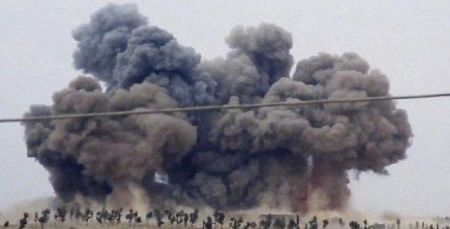
In view of the crisis building up on the southern Syrian-Israeli border, Prime Minister Binyamin Netanyahu decided immediately on his return home from Berlin early Wednesday, Feb. 17, to send a special  emissary to Moscow to ask for clarifications. Tuesday, Intensified Russian air strikes came to within 6 km of the Israeli border, sparking a growing exodus of Syrian refugees heading towards the Qoneitra border crossing to Israel.

DEBKAfile’s sources reveal that the envoy is Dr. Dore Gold, director-general of the Foreign Ministry and one of the prime minister’s few trusted confidantes.

It was still not clear whom Gold will meet in the Russian capital, but it is assumed that it will be one of Moscow’s senior decision-makers in the loop on its military operation in Syria.

The fact that Netanyahu decided to dispatch a top diplomat rather than a senior military or intelligence officer is a sign that the prime minister is not of one mind with the IDF’s intelligence assessments of the situation on the ground.

Netanyahu’s concerns grew after after the Russian air force on Tuesday widened its massive bombing of southern Syria from the city of Daraa to the Golan town of Quneitra, in order to help the Syria army’s 7th armored division push the rebels east, so they will not attempt to cross the border and seek shelter in Israel.

DEBKAfile’s military sources report that that 12 of the 15 targets bombed by the Russian air force across from the Israeli border were new rebel positions that had not been attacked before, even by the Syrian army. Military sources monitoring the war said Tuesday night that there is no doubt that the Russians are in the process of wiping out the rebel positions along the Israeli border by means of an offensive comparable to their operations in the northern Aleppo sector.

Our sources report that Israel’s concerns grew when, as the Russians bombing raids neared the Israeli border, Syrian officials threatened Jordan with serious consequences if Amman gave the Saudi air force a base for attacking eastern or southern Syria.

The threats began Tuesday, after Jordanian forces took over the Syrian-Jordanian border crossings formerly held by Syrian rebels, as a measure to stem the volume of Syrian refugees in search of sanctuary in the Hashemite Kingdom. But this step was interpreted by the Syrians and their Russian ally as clearing the way for Saudi intervention in the Syrian conflict using Jordan as a jumping-off base.

Meanwhile, Western military sources reported a sub substantial presence Tuesday of both Russian and Israeli warplanes in the skies over and around southern Syria.

Assad again controls Damascus thanks to Russian air strikes and intelligence

December 26, 2015

Assad again controls Damascus thanks to Russian air strikes and intelligence, DEBKAfile, December 26, 2015

Allous_Killed_25.12.15

Less noticed, was the UN plan to remove at the same time several thousands ISIS fighters from the Syrian capital and transport them to their Syrian headquarters. The latter project has not been trumpeted for good reason: It implies UN recognition of ISIS as a party in the Syria war.

***************************

The Russian air strike that Friday, Dec. 25, killed Zahran Aloush, founder of the most powerful Syrian rebel group Jaysh al-Islam and his deputy, gave President Bashar Assad a big break in the Syrian war, thanks to his powerful backer, Vladimir Putin.

This grave loss will accelerate the breakup of Syrian rebel strongholds in and around Damascus. It will also hasten the evacuation under a UN-sponsored ceasefire of at least 2,000 rebels from the Damascus region. Less noticed, was the UN plan to remove at the same time several thousands ISIS fighters from the Syrian capital and transport them to their Syrian headquarters. The latter project has not been trumpeted for good reason: It implies UN recognition of ISIS as a party in the Syria war.

For nearly five years, the war seesawed back and forth, with neither the Syrian army nor the insurgents gaining the upper hand for long, even after Tehran threw its Lebanese proxy, Hizballah,  into the fray to bolster Assad’s army.

Interventions by the US, Saudi Arabia, Qatar, the UAE, Jordan and Israel were too trifling and hesitant to tilt the balance in favor of the anti-Assad insurgent militias. Weapons supplies were inferior and tardy and kept the rebels heavily outgunned by the Syrian army’s tanks, helicopters and fighter jets, and helpless against the Iranian-made barrel bombs dropped by the Syrian air force.

The Obama administration was the architect of this uneven support strategy, going so far as to constrain the rebels’ other foreign backers against giving them the resources for carrying the day, aside from local victories.

This strategy had the effect of prolonging the vicious conflict – until it was cut short by two events:

1. In the summer of 2014, the Islamic State of Iraq and the Levant arrived in full force to capture the northern Iraqi city of Mosul, scattering seven Iraqi armed divisions to the four winds, and grabbing  their sophisticated American weapons, along with their arsenals, that were crammed with good American tanks, armored personnel carriers, and an assortment of surface, antitank and antiair missiles.

Part of this booty was diverted to ISIS Syrian headquarters in Raqqa.

2.  A year later, in late September 2015, President Vladimir Putin embarked on a massive buildup of Russian military strength in Syria – notably, his air and missile forces – for direct intervention in the war.

In contrast to President Barack Obama, who sought to keep his hand on the conflict by a complicated system of dribbling arms to select Syrian rebel groups, Putin went all out with massive military and strategic backing to assure the Syrian ruler and his Iranian ally of victory.

The Russian strategy is now becoming evident:  It is to drive the rebels out of the areas they have captured around the main cities of Latakia, Aleppo, Idlib, Homs, Hama and the capital, Damascus, giving them two options: join the opposition front around the table for negotiating an end to the war, or total eradication – even though Moscow and Washington have yet to agree which of the rebel militias belong around that table.

According to Moscow’s scale of priorities, the fight against the Islamic State must wait its turn until after Bashar Assad’s authority as president is fully restored and his country returns to his army’s control.

But on the way to this objective, Putin has run up against a major impediment: the failure of Iranian, Shiite militia, Hizballah and Syrian army ground forces keep up with his pace. The plan was for Russian air strikes and missiles to clear rebels out of one area after another and for pro-Assad ground troops to storm in and take over.

But these troops are proving too slow to press the advantage given them by the Russians.

Last week, the Russians decided to use their intelligence assets to speed things up. They borrowed an Israeli counter-terror tactic to start targeting key rebel chiefs for liquidation.

The death of the Jaysh al-Islamc commander as the result of a Russian airborne rocket strike on Friday was an intelligence feat rather than a military one. Just as Israel last Sunday used its clandestine assets in Damascus to precisely target the Hizballah-Iranian arch terrorist Samir Quntar at his home in the Jaramana district, so the Russians directed their agents on the ground to mark the secret meeting of Jaysh al-Islam commanders at Marj al-Sultan at the precise moment for taking them down.

This blow to the rebel movement, plus the mass-evacuation of its fighters from the Syrian capital, are major steps towards bringing the Syrian capital back under the control of the Syrian dictator.

Syria rebels: We have killed Al Qods Chief Soleimani

November 14, 2015

Syria rebels: We have killed Al Qods Chief Soleimani, DEBKAfile, November 14, 2015

Syrian rebel sources claimed Saturday night that they had killed Iranian al Qods chief, the commander of Iranian forces in Iraq and Syria, Gen. Qassem Soleimani, in the fighting east of Aleppo. This claim is not confirmed by any other sources. The rebels say they located the Iranian general’s movements by means of intelligence and struck his car with a TOW missile, killing him and three other Iranian commanders with him, Masoud Askari, Mahmud Dahakan and Ahmed Rajai. If this is confirmed it would count as a signal Syrian rebel feat.

Obama administration ends $500mn program to train Syrian rebels

October 9, 2015

Obama administration ends $500mn program to train Syrian rebels – report

Published time: 9 Oct, 2015 11:56

Edited time: 9 Oct, 2015 14:00

Source: Obama administration ends $500mn program to train Syrian rebels – report — RT News


he Obama administration is set to overhaul the Defense Department’s $500 million program to train and equip Syrian rebels, according to Defense Secretary Ashton Carter. The US president is expected to speak on the matter later on Friday.

Carter said during a Friday news conference in London that Washington has been “looking for several weeks at ways to improve” the program.

He added that he “wasn’t satisfied with the early efforts” of the program, and that Washington is looking for “different ways to achieve the same kind of strategic objective.”

“I think you’ll be hearing very shortly from [President Obama] in that regard about the proposals that he has approved and that we are going to go forward with,” Carter said following a meeting with his British counterpart Michael Fallon.

READ MORE: ‘Who are Syrian moderates & where are they?’

Meanwhile, a Pentagon official told The New York Times that the recruitment of so-called moderate Syrian rebels to go through training programs in Jordan, Qatar, Saudi Arabia, and the United Arab Emirates will end.

The official, speaking on condition of anonymity, added that a much smaller training center will be opened in Turkey, where a small number of “enablers” – mostly leaders of opposition groups – will be taught operational maneuvers, such as how to call in airstrikes.

A separate US defense official said on Friday that the training program is not ending, but is simply being refocused. Speaking to reporters on condition of anonymity, the official said that some US training and vetting of Syrian forces would continue, Reuters reported.

Speaking to RT, political analyst Dan Glazebrook said “it was obvious that something was going to have to change…my opinion has always been that this whole business about funding moderate rebels has always been a bit of a fantasy, for a number of reasons.”

“There’s nothing moderate about what they’re being trained to do. There’s nothing moderate about forming a militia and then going and killing as many police and soldiers of a sovereign state as you can. And that’s assuming the best case scenario that they’re only attacking police and soldiers…”

He added that there’s “no great surprise that Russia has achieved more in a week of airstrikes than a 62-power coalition has achieved in a year against ISIS.” 

A top US General told Congress in September that only “four or five” US-trained rebels were still fighting on the ground, with Sen. Jeff Sessions (R-Ga.) calling the program a “total failure.”

White House spokesman Josh Earnest said at the time that the small number “certainly raises legitimate questions about what kinds of changes need to be made to this program.”

Senator John McCain has been a vocal critic of Obama’s campaign against ISIS in Syria.

“One year into this campaign, it seems impossible to assert that [Islamic State] is losing and that we are winning. And if you’re not winning in this kind of warfare, you are losing,” McCain said in September.

It comes just one day after reports of a funding bill which earmarks $600 million to support “appropriately vetted” Syrian rebels fighting against both ISIS and the Assad government.

The $500 million training program has experienced multiple setbacks. The first group of trainees disbanded soon after being sent into combat, with some captured or killed and others fleeing. A second class of troops introduced only a small number of new fighters. The original plan, devised in December 2014, aimed to prepare as many as 5,400 fighters this year, and 15,000 over the next three years.

Two major Mid East escalations: Yemeni rebels fire Scuds at Saudi air base. ISIS warns Syrian rebels

June 6, 2015

Two major Mid East escalations: Yemeni rebels fire Scuds at Saudi air base. ISIS warns Syrian rebels, DEBKAfile, June 6, 2015

us_patriot_missiles_saudi_arabia_6.6.15US Patriots stationed in Saudi Arabia

Saudi military sources reported Saturday, June 6, that Patriot air defense batteries had intercepted Scud missiles fired by Yemen Houthi rebels against the kingdom’s largest air base at Khamis al-Mushait in the south west. It is from there that Saudi jets take off to strike the Yemeni rebels. DEBKAfile’s military sources report that the Patriot anti-missile systems, which were activated for the first time, were manned by American teams. This was the first direct US military intervention on the Saudi side of the Yemen conflict.

It was also the first time that Houthi rebels or their allies had fired Scud missile into the oil kingdom. Our sources add that the launch was supervised by Hizballah officers. They were transferred by Tehran to Yemen to ratchet up the conflict – although US, Saudi, Yemeni government and Houthi representatives meeting secretly in Muscat Friday agreed to attend a peace conference in Geneva this month.

Nonetheless, through Friday night and Saturday morning, Houthi forces and allied military units kept on battering at Saudi army and National Guard defense lines, in an effort to break through and seize territory in the kingdom’s southern provinces. The insurgents were evidently grabbing for strategic assets to strengthen their hand at the peace conference.

Iran’s supreme leader Ayatollah Ali Khamenei is also juggling his chips on the deteriorating Syrian warfront. In the coming hours, he is widely expected to announce the activation of the mutual defense pact signed between Iran and Syria in 2006, under which each signatory is committed to send military troops if necessary to defend its partner.

Thursday, June 4, Khamenei fired sharp verbal arrows at the Obama administration: “The United States tolerates extremist groups in Syria and Iraq and even helps them in secret,” he charged.

Our military sources add that although various Mid East publications, especially in Lebanon, are reporting that Iran has already sent units in numbers ranging from 7.000 to 15,000 troops to Syria, none have so far landed, except for the Shiite militias brought over at an earlier stage of the Syrian conflict. The expected Khamenei announcement may change this situation.

ISIS was not waiting. Saturday morning, the group issued a warning to the Syrian rebel forces fighting in the south – the Deraa sector of southern Syria near the meeting point of the Jordanian and Israeli borders and the Quneitra sector opposite the Israeli Golan. They were ordered to break off contact with the US Central Command Forward Jordan-CF-J which is located north of Amman, and the IDF operations command center in northern Israel. Any Syrian rebels remaining in contact with the two command centers would be treated as infidels and liable to the extreme penalty of beheading, the group warned.

The impression of ominous events brewing in the regime was rounded off Friday night by an unusual announcement by the Israeli army spokesman that Iron Dome anti-missile batteries had been deployed around towns and other locations in the south, although no reference was made to any fresh rocket attacks expected from the Gaza Strip. DEBKAfile adds: The first batteries were arrayed Thursday night, June 4, at vulnerable points in southern Israel – from the southernmost Port of Eilat on the Gulf of Aqaba to the western Port of Ashdod on the Mediterranean.


