Posted tagged ‘Syria’

“We will increase cooperation with Russia against ISIS”

October 15, 2014

“We will increase cooperation with Russia against ISIS”

For dozens of years there is tension between the US and Russia. It seems the only thing that keeps the two powers close together is the fear of ISIS becoming any stronger.

The US secretary of state John Kerry says that him and the Russian foreign affairs minister decided to increase intelligence sharing to act more efficiently against ISIS

Oct 15, 2014, 03:00 PM | Rio Avitayler

via Israel News – “We will increase cooperation with Russia against ISIS” – JerusalemOnline.

“We will increase cooperation”. Kerry

“We will increase cooperation”. Kerry AP

“I offered the Russian minister of foreign affairs Sergey Lavrov to increase intelligence cooperation against ISIS and other terror organizations acting in the area”, said Kerry.

Kerry also said that during the meeting between his and Lavrov that lasted more than 3 hours in Paris the two also discussed the question if Russia would be able to support the Iraqi security forces battling ISIS.

Spoke for more than 3 hours. Lavrov and Kerry

Spoke for more than 3 hours. Lavrov and Kerry Reuters

“ISIS is using chemical weapons”

Yesterday a new photo sent directly from the war zone shows victims of ISIS that might prove that the organization is using chemical weapons against civilians. The picture taken in the city of Arsel in north east Lebanon where Hezbollah and the local military force is fighting ISIS, shows tanks and bags containing what looks like chemical weapons. According to the Lebanese, the weapons were found on the dead ISIS terrorists.

A report released by a researcher in the Interdisciplinary center in Herzliya, exposes testimonies by Kurds, fighting ISIS in north Syria, claiming the organization is using chemical weapons. According to them, during the last weeks, ISIS is actively using chemical weapons they obtained from the Syrian military storage rooms.

Destruction in Syria

Destruction in Syria Reuters

The UN published a report saying that 8% of the Syrian regime stockpile of chemical weapons is still being held by the Assad military force. Officials in Syria also admitted that 4 installations, including a research lab and a chemical lab – are still being used by the Syrians.

Israel is worried about this new information regarding the use of chemical weapons and worry that the more ISIS is approaching the border, the more chances they have to also use it against IDF forces along the border.

Understanding multicultural words, phrases and other absurdities

October 15, 2014

Understanding multicultural words, phrases and other absurdities, Dan Miller’s Blog, October 14, 2014

(Some of this is directly pertinent to Israel and the Middle-East, some is pertinent only as U.S. politics affect both. It’s intended to be humorous, in a macabre way. — DM)

The Obama Nation’s multicultural society has become so politically correct and otherwise obtuse that words and phrases are used in any odd ways that may be desired — just as Humpty Dumpty did.

“When I use a word,” Humpty Dumpty said, in rather a scornful tone, “it means just what I choose it to mean—neither more nor less.”

“The question is,” said Alice, “whether you can make words mean so many different things.”

“The question is,” said Humpty Dumpty, “which is to be master—that’s all.”

Here are a few examples and explanations.

Religion of peace. Amish? Quakers? Of course not: it’s Islam. Although the Islamic State, according to Obama, is not “Islamic,” the Islamic Republic of Iran, Turkey, Qatar, Saudi Arabia, et al — which are “Islamic” — are among the world’s foremost sponsors of Islamic terrorism. However, that is irrelevant because Muslims would be offended.

ISIS scared

Here’s Andrew Klavan on how to survive an Islamic Quaker massacre:

Islamic extremists are extreme because they follow the Koran and demand Shari Law. So do “moderate Muslims.”

Modeate Muslim

Bitter clingers are Christians in fly-over country who support the Second Amendment, while revering and trying to live according to their Bibles. Islamists who cling to their scimitars, guns and suicide vests, while revering and trying to live by their Korans and Sharia law, are not bitter clingers.

Reid-knows-Terrorist

That’s racist! Unless you happen to be Black and therefore not conservative, see Great Uniter, below.

The science is settled and the debate is over. Ipse dixit.

Honest discussion. According to Attorney General Holder, Federal Dick, we need to have an honest discussion about race. “Honest” means agreeing with and favoring his people above all others. Or something.

Gender identity. Don’t like your gender? Try another; it’s probably on the house.

The war on women has long been fought by Republican scoundrels, not by Democrats like Billie BJ Clinton or various Islamic states such as Saudi Arabia, Iran and Turkey. The (non Islamic) Islamic State and other (non Islamic) freaks may be fighting a war on women and girls, whom they capture as sex slaves, use and sell. However, few engaged in fierce combat against the war on women seem to notice or care, so the vile war on women must still be exclusively a Republican thing.

War on women

Feminism rejects the vast powers that men have over women by, among many other things, demanding free contraception and abortion on request. Although opposed by some bitter clingers, both are needed to empower women and girls to have sex as often and with as many men as they may desire, with no illnesses (such as pregnancy) or other adverse consequences. Is lesbianism the cure? Should it replace heterosexual nymphomania?

Truth. “Beauty is truth, Truth is beauty. This is all ye know on Earth and all ye need to know.” Truth is beautiful only if it “sounds good” and can become a helpful sound bite to be memorized and used effortlessly.

Ketchup Kerry

Party of billionaires. This refers to Republicans. It does not mean Democrats who pay big bucks (up to $32,000 or more in some cases) to hear Obama tell them how filthy rich Republicans are ruining the country and how wonderful He is.

scrooge-mcduck-make-it-rain

As Gwyneth Paltrow, an impoverished working mother who only “makes $16 million per movie,” said at a recent Obama fundraiser thrown at her humble shanty in California, Obama is

a president who would be studied for generations, and a role model for everyone of this generation.

“It would be wonderful if we were able to give this man all of the power that he needs to pass the things that he needs to pass,” she told the crowd.

Having been reminded of His greatness, attendees contribute more big bucks. It’s a good thing Obama is not a narcissist.

Great uniter refers to Obama, who has done more to unite Blacks against Whites than any other American President. (Conservative Blacks, such as Allen West, Ben Carson and others are White, not Black.) Great progress, Big Guy! Oh. He’s also a like, way cool military strategist.

MissionAccomplished0067

Oh well. Try not to laugh cry; it may cause even more global warming, cooling, climate change and other demons not yet exploited discovered. As Jon Carson at BarackObama.com advised my spam filter just today,

We’re going to win on climate change. We don’t really have another option.

The question is how long will it take for the other side to take this fight seriously — to push the climate change deniers out of the way, and to defeat the powerful interest groups protecting the status quo.

We’re not waiting.

Climate change is already affecting Americans’ lives now — droughts, wildfires, and super storms have devastated every corner of the country.

UPDATE re the party of billionaires:

An article by Bryan Preston at PJ Tatler titled Democrat Billionaire Bankrolls Effort to Suppress Republican Votes asks whether

“Fat cats” such as Tom Steyer, who is using his billions to impact multiple races in key states in ways that no ordinary voter can? Of course not. He’s the right kind of fat cat, meaning he is on the left. Plus, he controls NextGen and pays Lehane a lot of money to come up with its strategies. The libertarian-minded Koch brothers are the wrong kind of fat cats, so the billionaire-funded NextGen, led by consummate Beltway insider Chris Lehane, is pushing Democrat candidates to attack them. [Emphasis added.]

According to a linked article at Politico, the NextGen strategy of demonizing Republican “billionaires” seems to be working. So is the NextGen strategy:

According to the Lehane [NextGen] memo:

“In virtually every state NextGen is electorally engaged, there is an issue where the Republican candidate”s anti-climate, anti-basic science beliefs has manifested itself in policies with harmful consequences for all voters in state, including Republican voters. Our Republican Haircut Strategy – a precision focus on a specific harm in target Republican markets – we will seek to degrade Republican performance.”  [Emphasis added.]

There’s a lot of loaded language in that — “anti-climate, anti-basic science beliefs” could describe anyone who ignores the fact that the climate scare-mongers keep being proved wrong, and that the data shows that the earth has not warmed in the past 15 to 18 years. Climate hysterics systematically rule out the role that the Sun plays in climate stability and change. Which is a very large thing to omit. And we cannot control it with any carbon trade scheme, tax, regulatory regime or any other means. [Emphasis added.]

Sheep eating

Having nothing substantive to say, the Dems apparently attract voters by misleading and scaring them. The farce continues apace.

Ruins of the Middle East

October 14, 2014

Ruins of the Middle East, National Review Online, Victor Hanson Davis, October 14, 2014

Obama shuns friends(Win McNamee/Getty Images)

Israel has nothing to do with the slaughter in Libya or Syria or Iraq, but it is a constant reminder that the United States is indifferent to its friends while it courts its enemies. As Obama’s new policy against ISIS is shaping up, Iran is emerging as more of an ally in his eyes than is Israel.

*****************

Obama shuns our friends and courts our enemies.

Obama’s unfortunate Middle East legacy was predicated on six flawed assumptions:

(1) a special relationship with Turkey;

(2) distancing the U.S. from Israel;

(3) empathy for Islamist governments as exemplified by the Muslim Brotherhood in Egypt;

(4) a sort of non-aggression agreement with Iran;

(5) expecting his own multicultural fides to resonate in the region;

(6) pulling out of Iraq and Afghanistan.

Let us examine what has followed.

Obama’s special relationship with Recep Erdogan proved disastrous from the get-go, as Erdogan immediately began to provoke Israel and promote Islamist revolutionaries. Turkey today not only dislikes the U.S., but also poses an existential problem for the West. It is a NATO member that is antithetical to everything NATO stands for: the protection of human rights and constitutional government against the onslaught of aggressive totalitarian regimes. Turkey is now operating like the old Soviet Union in using murderous proxies to enhance its own stature; for example, it finds ISIS useful in whittling down the Kurds. As a rule of thumb, any enemy of Erdogan’s Turkey — Israel, the Kurds, Greek Cyprus, Greece, Egypt — is likely to be far more friendly to the U.S. and NATO than are other nations in the region. If Turkey were attacked by ISIS, Syria, Iran, or the Kurds, would Belgium or Greece send in its youth under NATO’s Article V?

What did ankle-biting Israel accomplish other than giving Hamas a green light to send rockets into the Jewish State in hopes that we might do something stupid like slow down scheduled arms shipments to Israel or shut down Ben Gurion Airport for a day? Israel has nothing to do with the slaughter in Libya or Syria or Iraq, but it is a constant reminder that the United States is indifferent to its friends while it courts its enemies. As Obama’s new policy against ISIS is shaping up, Iran is emerging as more of an ally in his eyes than is Israel.

Our once-close relationship with Egypt is ruined. All that is left is U.S. foreign aid to Cairo, largely because we have no idea of how not to give a near-starving Egypt assistance. Obama, under the guidance of Hillary Clinton, Samantha Power, and Susan Rice, gyrated from Mubarak to Morsi to el-Sisi, as the U.S. went loudly full circle, from disowning the pro-American kleptocrat to embracing the anti-American theocrat to humiliating the neutral autocrat.

Obama kept quiet when a million Iranian protesters hit the streets in 2009 to show their disgust with theocratic corruption. Apparently the American president thought the pro-American tendencies of the young protesters were proof of their inauthenticity. Or  perhaps he saw them as sort of neocon democracy-pushers who would ruin his own chances of using his multicultural gymnastics to partner with Teheran.

Our serial deadlines for stopping uranium enrichment proved empty. Ending the tough sanctions has brought nothing but delight to the ayatollahs. In the view of Iraq and Syria, somehow the U.S. has become a de facto ally of the greatest enemy to peace in the region. Obama did not wish to stay in Iraq and work with the Sunni minority by pressuring the Maliki government. He threatened the Iranian puppet Assad and then backed off, and he ridiculed alike the dangers of the savage ISIS and the potential of the Free Syrian Army. Meanwhile, the U.S. is sort of bombing on and off to save the innocent and thereby helping the Iran–Assad–Hezbollah alliance.

In order to win over the Islamic street, Obama has tried almost everything to remind the Middle East that America is no longer run by a white male conservative from a Texas oil family. His multifaceted efforts have ranged from the fundamental to the ridiculous. The Al Arabiya interview, the Cairo Speech, the apology tour, the loud (but hypocritical) disparagement of the Bush-Cheney anti-terrorism protocols, the new euphemisms for jihadist terror, the multicultural trendy pronunciation of Talîban and Pâkistan, and references to his father’s religion and his own middle name resulted in American popularity ratings in many Middle Eastern countries lower than during the Bush administration. In the Middle East, the only thing worse than being unapologetically proud of past U.S. foreign policy is being obsequiously ashamed of it.

There were no Americans dying in Iraq when Barack Obama pulled the remaining troops out in order to win a reelection talking point. Iraq was a functioning state, saved by the successful U.S. surge. That’s why both Obama and Joe Biden praised the post-surge calm. When Obama bragged that he had ended the Iraq War (which was ended in early 2009) and then brought our troops home, he gave the Maliki government a green light to hound its Sunni enemies and reboot civil strife in Iraq, in a way that soon birthed ISIS. The same sort of Saigon 1975 scenario will follow in Kabul early next year, if Obama goes ahead with recalling all U.S. peacekeepers from Afghanistan. In just two flippant decisions, the prophet Barack Obama sowed the wind, and now we are reaping the whirlwind that followed from perceptions of U.S. decline, foreign-policy indifference, and a new void in the Middle East.

At this late date, amid the ruins of the last half-century’s foreign policy from Libya and Egypt to Syria, Iraq, and Iran, the U.S. should hunker down and distance itself from its enemies and grow closer to its few remaining friends. We need to arm the Kurds, and help them to save what is left of Kurdish Syria. We should inform Erdogan that either he joins the fight against ISIS or we will welcome a large and autonomous Kurdistan and would prefer that Turkeyleave NATO, as it should have long ago. We should forget the “peace process” and recognize that Hamas is an existential enemy of America and almost all our friends, and instead encourage an alignment of Egypt, the Kurds, Jordan, Israel, and a few of  the saner Gulf States against both ISIS and the new and soon-to-be-nuclear Iranian Axis.

A final note. In this period of fluid jihadism and changing alliances, we should make it extremely difficult for anyone from most Middle Eastern countries (except the few friendly nations mentioned above) to receive a visa to reside in the U.S., a first step in reminding the region that its cheap anti-Americanism has at least a few consequences. And just because ISIS is primordial does not mean that Assad and Iran are not medieval. They are not our friends just because they are enemies of our enemies; they simply remain our enemies squabbling with other enemies.

The present chaos of the Middle East was caused by our withdrawal from Iraq and a widespread sense that the U.S. had forfeited its old responsibilities and interests, and was either on the side of the Arab Spring Islamists or indifferent to those who opposed them. Tragically, while order may soon return, it is likely to be as a sort of Cold War standoff between a pro-Russian, pro-Chinese — and very nuclear – Iranian bloc, and a Sunni Mesopotamian wasteland masquerading as a caliphate, run by beheaders and fueled by petrodollars, with assistance from Turkey and freelancing Wahhabi royals from the Gulf.

CBS: Islamic State Gains Ground, ‘Closer To Total Control’ Of Anbar Province

October 14, 2014

You Tube, October 14, 2014

The Proof ISIS Used Chemical Weapons

October 14, 2014

The Proof ISIS Used Chemical WeaponsLebanese

Military fighters and Hezbollah documented the seizure of ISIS chemical weapons in north-eastern Lebanon.

These images are added to evidence that ISIS attacked the Kurds using chemical weapons.

Israel is closely following these developments with concern.

Oct 14, 2014, 05:03 PM | Rachel Avraham

via Israel News – The Proof ISIS Used Chemical Weapons – JerusalemOnline.


More proof that ISIS used chemical weapons? Photo Credit: Channel 2


As the west continues to fight against ISIS, more and more evidence has been gathered that ISIS used chemical weapons against civilians. New images from the battle areas have emerged that may provide further proof for the use of chemical weapons by the dangerous Islamist terror organization.

The images were taken about two weeks ago in the city of Arsal in north-eastern Lebanon, where Hezbollah and the Lebanese Army fought against ISIS. They documented what appeared like chemical weapons. According to Lebanese reports, the weapons were caught in the hands of ISIS terrorists who were killed fighting.

At the same time, a report by a researcher at the Inter-Disciplinary Center in Herzliya revealed evidence that Kurds, who fought against ISIS in northern Syria, were targeted with chemical weapons. According to them, ISIS terrorists in recent weeks have begun to use the dangerous weapons, which they obtained when they took over weapons depots within the country.

Indeed, it is quite possible that the weakening of the Assad regime and the loss of the Syrian government’s stronghold led to ISIS terrorists getting their hands upon chemical weapons. Recently, the UN published that at least 8 percent of Syria’s chemical weapons are still in the government’s hands. Also Syrian officials admitted that they established four facilities, among them a research and development institute, which they still have not revealed and is in their possession.

Israel is following with concern the intelligence on chemical weapons in Syria and fears that ISIS terrorists could approach the border; they believe they have no reason not to use such weapons on Israeli army patrols in Mount Hermon and the Golan Heights.

Rice Defends US Islamic State Strategy

October 13, 2014

Rice Defends US Islamic State Strategy, Washington Free Beacon, October 12, 2014

(Here’s a video clip of Susan “Blame it on the Video” Rice talking about Obama’s Islamic State strategy.

Does Obama have a problem? Do we? — DM)


Susan RiceSusan Rice / AP

While Rice insisted that there would not be any U.S. ground troops, or recommendations for them, statements by current and former military advisors suggested the comment was premature.

******************

On Sunday, National Security Advisor Susan Rice said the United States would not reevaluate the strategy to “degrade and destroy” the Islamic State of Iraq and the Levant (ISIS or ISIL), despite its recent territorial advances, and said that the Obama administration is still not considering boots on the ground.

“This is very early days of the strategy. The strategy is very clear. We’ll do what we can from the air. We will support the Iraqi security forces, the Kurds, and ultimately over time, the moderate opposition in Syria to be able to control territory and take the fight to ISIL,” Rice told NBC’s “Meet the Press.”

“There has been no recommendation from the American military commanders, either on the ground or here in Washington, that the United States put any ground combat forces into Iraq. That has not come up the chain to anyone at the White House and I don’t anticipate that it will,” Rice said. “The president has been very plain that this is not a campaign that requires, or even would benefit from, American ground troops in combat again.”

Rice’s defense of the American strategy came as many question its effectiveness as the Islamic State makes advances in Anbar province, a region that neighbors Baghdad, and Kobani, a Kurdish town in northern Syria, despite weeks of US-led airstrikes.

While Rice insisted that there would not be any U.S. ground troops, or recommendations for them, statements by current and former military advisors suggested the comment was premature.

Joint Chiefs of Staff General Martin Dempsey pointed to Mosul as an instance where U.S. ground troops may be recommended.

ABC’s Martha Raddatz asked Dempsey, “Would we be more effective against ISIS if we had U.S. troops on the ground spotting targets?”

“Yeah. There will be circumstances when the answer to that question will likely be yes, but I haven’t encountered one right now,” Dempsey said.

“Mosul will likely be the decisive battle in the ground campaign at some point in the future. When [the Iraqi Security Forces] are ready to go back on the offensive. My instinct at this point is that that will require a different kind of advising and assisting because of the complexity of that fight.”

Former Secretary of Defense Leon Panetta seemed to broadly echo that sentiment on CBS’s “Face the Nation,” and warned against taking options off the table.

“I’ve always felt that the President of the United States ought to keep every option available in dealing with this kind of enemy… I think you want to protect every possible option because we are dealing with a very resilient enemy and the only way you deal with a resilient enemy is with flexibility, adaptability, and the kind of determination that we’re going to need if we’re ever going to win this war.”

The overall strategy will take time, Panetta noted, but airstrikes alone will not win the war against ISIS.

“These airstrikes can help to a degree, I think they’ve helped kind of stifle some of the momentum in ISIS, but to make these airstrikes work you’ve got to have information on targets and you’ve got to be able to pinpoint where the enemy location is and that, frankly, is going to take time.”

“You’ve got to have boots on the ground,” Panetta continued, “maybe it doesn’t have to be American boots on the ground, but you have got to have people on the ground who can identify targets and who can help us develop the kind of effective airstrikes that are going to be needed if we’re going to be able to undermine, destroy this vicious enemy that we’re dealing with.”

Rice defended the air campaign, arguing that it was in the early stages, but “off to a strong start.”

“Our efforts have various, different lines of effort, as we call them. On the one hand, we’re trying to build up the capacity of the Iraqis, which means the Iraqi army, the Kurds – the Peshmerga inside of Iraq… we’re building up that capacity and we have seen some success in that regard. On the Syrian side, we also have a longer-term challenge of supporting the moderate opposition, and giving them, while they have great will, greater capacity to fight Assad and to fight ISIL.”

“So, this is going to take time,” Rice continued. “Our air campaign is off to a strong start… it can’t be judged by merely what happens in one particular town or in one particular region.”

ISIS: Can the West Win Without a Ground Game?

October 10, 2014

ISIS: Can the West Win Without a Ground Game? Middle East Forum, Jonathan Spyer, October 2014

(It should be (but appears not to be) obvious to our “leaders” that before we have a chance of “winning” the fight against the Islamic State, et al, we need to define “win” and to decide who are our allies and who are our enemies. That has not yet happened. As to ground troops, how many will we need to do what and where? Those questions need to be answered as well, based largely on answers to the first set of questions. — DM)

[A] lack of strategic understanding of the nature of the conflict being waged is preventing the development of a coherent response to the specific problem of the Islamic State, along with the parallel problems of Shia terror groups such as Hezbollah, and the ambitions of the Islamic Republic of Iran. At root is the failure to grasp the implacable nature of political Islam in both its Sunni and Shia variants at the present time.

From this original error, all further errors, and as we can see there are many, inevitably follow.

**********************

The United States and its allies have launched a military campaign whose stated goal is, in the words of President Barack Obama, to “degrade and ultimately destroy” the Islamic State (I.S., also known as ISIS or ISIL) established by Sunni jihadis in a contiguous land area stretching from western Iraq to the Syrian-Turkish border.
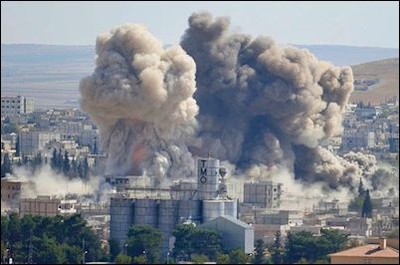
686Smoke rises from a U.S. air strike on Islamic State positions in Kobani.

As the aerial campaign begins in earnest, many observers are wondering what exactly its tactical and strategic objectives are, and how they will be achieved. A number of issues immediately arise.

Any state—even a provisional, slapdash, and fragile one like the jihadi entity now spreading across Iraq and Syria—cannot be “destroyed” from the air. At a certain point, forces on the ground will have to enter and replace the I.S. power. It is not yet clear who is to play this role—especially in the Islamic State’s heartland of Raqqa province in Syria.

In Iraq, the national military and the Kurdish Pesh Merga are now having some successes at chipping away at the Islamic State’s outer holdings. The role of U.S. air support is crucial here. But the center of the Islamic State is not Iraq, and both the Iraqi forces and the Pesh Merga have made clear that they will not cross the border into Syria. This leaves a major question as to who is to perform this task, if the objectives outlined by President Obama are to be achieved.

The answer we have heard most often of late is that elements among the Syrian rebels will be vetted by the U.S., trained in cooperation with the Saudis, and then deployed as the force to destroy the IS on the ground.

If this is indeed the plan, it is deeply problematic.

The Syrian rebels are characterized by extreme disunity, questionable effectiveness, and the presence of hardline Sunni Islamist elements among their most committed units. There are certainly forces of an anti-jihadist ideology among them—the most well-known being the Syrian Revolutionaries Front, headed by Jamal Ma’arouf from the Jebel Zawiya area in northern Syria, and the smaller Harakat Hazm. Both movements have benefitted from Western aid in recent months.

The problem, however, is that these organizations are quite prepared to work with salafi groupings whose worldview is essentially identical to that of the I.S., even if their methods are somewhat different. Thus, if we observe the recent fighting between Assad’s forces and rebels in the Quneitra area along the border with the Israeli Golan Heights, it is clear that the main contribution to rebel achievements came from the Jabhat al-Nusra group, which constitutes the “official franchise” of the core al-Qaeda group in Syria.

Reliable sources confirm that Nusra cooperates with other rebel groups in southern Syria and has even been prepared to minimize its own role, so as to allow other groups to present achievements as their own to Western and Arab patrons and thus secure a continued flow of arms, benefiting all factions.

What this means is that by championing these rebel elements as the ground force which will seek to enter and destroy a weakened I.S. in Raqqa province, the U.S. would be putting itself in the position of supporting one group of Sunni jihadis against another.

In Iraq, while the Kurdish Pesh Merga cooperates de facto with Iran, their alliance is pragmatic and tactical, one that the Kurds would gladly break given the possibility of clear Western sponsorship.

But the fierce condemnations in recent days (even by supposedly “pro-Western” rebel groups such as Hazm) of the U.S. bombing raids into Syria indicate that there is a deeper problem here. The alliance between these Sunni rebel groups and the salafis has a common anti-Western component to it.

It is, in any case, not clear if these Sunni rebels will prove able to defeat the I.S., but even if they were to do so, the presence of radical anti-Western elements among them attests to the danger of a policy of support and sponsorship of them.

Of course, the Sunni jihadis are not the only dangerous players on the ground. Another possible, no less troubling, outcome of the air campaign against the Islamic State could be the return of Bashar al-Assad’s forces to eastern Syria, from which they have been largely expelled over the last year. It is not at all hard to imagine a scenario in which once the I.S. has been weakened by Western air attacks, the Syrian military and its Iranian-backed allies will be able to make gains.

Indeed, the Iranian Revolutionary Guard Corps (IRGC) are already present in northern Iraq (and, of course, in Syria as well) and IRGC personnel have taken part in the fighting in Iraq in recent weeks. Qods force teams are reportedly located at Samarra, Baghdad, Karbala, and the former al-Sahra Air Base near Tikrit. Iran has deployed seven SU-25 ground attack aircraft which have played a role in offering air support to the Kurds and Iraqi special forces.

Following intensive Western bombing, the possibility of the Islamic State eventually being sandwiched between pro-Iranian forces on either side before being destroyed would be a real one. This would achieve the desired goal of destroying the jihadi entity, but it could end up handing a major victory to the Assad regime and its Iranian backers—enemies of the West of significantly greater potency and seriousness than the Islamic State itself.

Such a result would be somewhat reminiscent of the Iraq invasion of 2003, in which the destruction of the Sunni regime of Saddam Hussein ended up largely helping Iran.

How does the West get out of this mess? The discussion about which ground force should be used to replace the Islamic State is itself confused by a much larger misunderstanding regarding the nature of the war now taking place in Iraq and in Syria (and periodically spilling over into Lebanon).

The I.S. has now been depicted as the main problematic factor emerging from this conflict. But the Islamic State is in fact merely a particularly extreme and brutal manifestation of a broader process taking place in this area, in which political Islam of a Sunni variety is at war with the Shia political Islam of Iran and its proxies (especially Hezbollah and the Assad regime).

The I.S. may promote a particularly lurid and repulsive version of Sunni political Islam, but in its beliefs and in its practices it does not represent some unique presence in the Syrian and Iraqi context. Rather, it is little more than a particularly virulent manifestation of a strain of politics and ideology which is the primary cause of the conflict taking place across the region.

In the two scenarios discussed above, both quite plausible outcomes of a Western air campaign, the I.S. would be defeated and replaced by another version of Islamism—either that of its fellow Sunnis, or that of the rival Shi’ites.

A third possibility, however, is that the White House does not actually intend to pursue a policy intended to physically destroy the Islamic State in its heartland in northern Syria. Certainly, more recent statements emerging from the Administration appear to be preparing to “walk back” the President’s comments.

White House Chief of Staff Denis McDonough said in mid-September that success for U.S. policy vis-à-vis the I.S. would come when the group “no longer threatens our friends in the region, no longer threatens the United States.” This sounds like the introduction to a more modest policy of degrading I.S. capabilities, rather than seeking to “destroy” the Islamic State.

Of course, such a modified objective would end the dilemma over which ground forces to ally with. On the other hand, it would also have the effect of a tacit admission that the U.S. did not intend to promote its policy as originally stated by the President in the aftermath of the horrific murder of two U.S. citizens by the Islamic State.

But whether or not the goal of destroying the Islamic State is pursued with vigor, the current failure to see accurately what is happening in the Levant and Mesopotamia looks set to remain. This, in turn, looks set to prevent the emergence of a coherent policy and a coherent allocation of resources.

What is taking place across Syria and Iraq, and across their borders into Lebanon, Turkey, and Iran, is a sectarian war, made possible because of the decline of the police states which for half a century kept the lid on sectarian differences. The regional ambitions of Iran, which has clients and proxies in all three countries, exacerbate this dynamic. The attempts by Saudi Arabia to block Iran’s advance toward the Mediterranean, and by Qatar and Turkey to sponsor various Sunni jihadi elements, have produced a far more confused, and far less effective, Sunni side in this struggle.

The struggle itself, in turn, can be traced back to the failure by these states to develop coherent notions of citizenship or stable national identities in the post-Ottoman period. In other words, this war has been a long time coming, but now it is here.

Because the nature of this struggle is not widely grasped in the West, policy appears somewhat rudderless. This is reflected in the current discussion regarding the response to the Islamic State.

First, Assad was the enemy. This was made clear enough not only by his support for Hezbollah and attempts to nuclearize, but also by his unspeakable brutality and use of chemical weapons against his own citizens.

Then, when the brutality of some of the rebels became apparent, Western public interest in supporting the rebels receded. Soon the I.S. emerged as the new bogeyman. Declarations for its destruction became de rigueur, though it is far from clear how this is going to be carried out—and a de facto alliance with Iran and its clients, at least in Iraq, has emerged. This was seen in the expulsion of the I.S. from the town of Amerli, a pivotal moment in the major setbacks faced by the organization in recent days. In that town, Shi’ite militias were backed by American air power—to telling effect against the Sunni jihadis.

But is it really coherent policy to be backing murderous Shi’ite sectarians against murderous Sunni ones? It is not. Of course, when the West backs the Sunni rebels in Syria, the precise opposite is happening. Weaponry donated to “moderate” rebels then inevitably turns up in the hands of Sunni jihadis, who do most of the fighting associated with the Syrian “rebellion.” The result is that in Iraq the U.S. is helping one side of the Sunni-Shia war, and in Syria it’s helping the other side.

Only when it is understood that the West cannot partner with either version of political Islam does it become possible to formulate a coherent policy toward the Sunni jihadi forces, on the one hand, and toward the Iran-led bloc, on the other.

Such a policy must rest on the identification and strengthening of non-Islamist forces willing to band together and partner with the West. Not all of them are perfect characters, but they all understand the threat that political Islam poses.

Most obviously, there is a line of pro-American states along the southern side of the arena of the war. These are Israel, Jordan, and in a far more partial and problematic way, Saudi Arabia. Both Israel and Jordan have demonstrated that they are able to successfully contain the spread of the chaos coming out of the north. Both are well-organized states with powerful militaries and intelligence structures. Jordan has clearly benefitted from the deployment of U.S. special forces to prevent incursions by the I.S. Israel has also made clear that its resources will be available to assist the Jordanians should this be required. (Egypt, too, while not in the immediate vicinity of the conflict, can be a silent partner as well—as its campaign against the Muslim Brotherhood and tough line against Hamas have shown, it is nothing if not a virulent opponent to political Islam.)

This is what the proper coordination of allied states is supposed to look like. And it works in containing the conflict. To the east of the war’s arena is of course Iran. To its west is the Mediterranean Sea. To its north is a long, contiguous line of Kurdish control, shared between the Kurdish Regional Government of President Massoud Barzani in northern Iraq, as well as the three enclaves created by the PKK-linked Democratic Union Party (PYD) in northern Syria. The YPG militia, which is the military force in these enclaves, has fought the I.S. almost since its inception, and has largely prevailed in keeping the jihadis out of the Kurdish areas.

As part of a strategy of containment, the West should increase support for and recognition of both the Kurdish enclaves in the north of Syria and the Kurdish Regional Government itself. Both are elements capable of containing the spread of the jihadis from the north. It has become clear in recent days that the Pesh Merga, despite early setbacks, is a useful instrument in preventing the further advance westward of the Islamic State, and in so doing protecting the investment of international oil companies in the oil-rich parts of Iraq. The YPG militia, though poorly equipped, has also avoided major losses.

Such a principle of alliance will also encourage the West to reconsider the involvement of Turkey. As events of the last few years have shown, Turkey cannot be a reliable ally in the struggle against political Islam, because its ruling party, AKP, is itself an Islamist party. This is not a theoretical formulation. Turkey’s support for Islamist militias in northern Syria and its opening of its border for them has been a major contributing factor in the proliferation of these elements. There is also considerable evidence that Turkey at the very least turned a blind idea to the activities of the I.S. in the border area in 2013, and may well have offered some help to the jihadis in their fight with the YPG.

In order to grasp the rationale for a policy of dual containment, the nature of the war between rival sectarian forces must be grasped. There is also a need for the clear understanding that the effort to preserve at all costs the territorial integrity of “Iraq” and “Syria” is mistaken. Rather, what should take place is support for those forces committed to order, as listed above, and non-support for the forces of political Islam.

In other words: If political Islam (rather than one specific jihadi group, to quickly be replaced by another) is the real problem, then the real solution is to ally, forcefully and over the long haul, with those forces most committed to stopping it: Israel, Jordan, the Saudis, and the Kurds.

So it may be seen that a lack of strategic understanding of the nature of the conflict being waged is preventing the development of a coherent response to the specific problem of the Islamic State, along with the parallel problems of Shia terror groups such as Hezbollah, and the ambitions of the Islamic Republic of Iran. At root is the failure to grasp the implacable nature of political Islam in both its Sunni and Shia variants at the present time.

From this original error, all further errors, and as we can see there are many, inevitably follow.

The Unresolved Problem with Boots on the Ground

October 10, 2014

The Unresolved Problem with Boots on the Ground, Commentary Magazine, October 10, 2014

(If the U.S. were to put boots on the ground, how many would be needed to do what? Trainers? Spotters for airstrikes? Infantry? Artillery? Psychological operations? Field medics? Something else? Could we shift from a peacetime mode to a wartime mode in time to do significant damage to the Islamic State, et al? — DM)

[T]here is nothing more dangerous to any potential ground troops than to be inserted into a warzone without broad public consensus about their mission and to have a commander-in-chief who has consistently met the requests of forces in the field with indecision and a failure to deliver what ground commanders consider their minimum basic needs.

****************

A growing chorus of analysts, generals, and even cabinet secretaries who served under President Obama suggest that Obama’s stated goal to “degrade and ultimately destroy” ISIS is not going to occur by means of air power alone. That might be true, although it’s also true that Obama hasn’t used airpower to its full effect. To read a Pentagon press release is to read reports of five, six, or seven airstrikes. Given that an aircraft carrier can launch planes every 30 to 40 seconds, this suggests that the Obama administration is effectively committing the equivalent of three or four minutes of dedicated aircraft carrier time to achieve its goals. And even then, many of the strikes Obama has ordered (and the president has said that he approves every strike carried out inside Syria) attack empty buildings or equipment far away from the fronts of the fight.

But even if boots on the ground are necessary with an augmented air campaign, there is one problem that is unsolvable, and that is the personality and lack of commitment of the commander-in-chief. President Obama has the strategic equivalent of Attention Deficit Disorder. Despite his September 10 speech, it’s unclear whether he is truly committed to destroying ISIS or was simply reacting to the spike in public outrage following the murder of James Foley.

Now make no mistake: I personally feel that the defeat of ISIS is an overwhelming national interest, and that the goal should not simply be “deradicalization” for its fighters, but rather their death. That said, there is nothing more dangerous to any potential ground troops than to be inserted into a warzone without broad public consensus about their mission and to have a commander-in-chief who has consistently met the requests of forces in the field with indecision and a failure to deliver what ground commanders consider their minimum basic needs.

What can be done? Unfortunately, there’s no good answer with such lackluster leadership in the White House and Congress. But those serving in uniform and placing themselves in harm’s way should not be a political football. At present, however, that is exactly how the president and some members of both parties treat them and the ISIS problem. Until there is focus and responsibility in both the White House and Congress, and recognition that military action cannot be governed by polls or political timelines, it is foolhardy to insert ground forces.  Regardless of how they might be needed and how determined ISIS is to strike the United States, ground troops without serious leadership would be unwise. Never again should there be a deployment of ground forces without political consensus, broad public support. If these are lacking and we have to pay the consequence, then that will be a “teachable moment” for the public about the importance of freedom and the nature of the evil that the United State must confront.

Bombing for show? Or for effect?

October 10, 2014

Bombing for show? Or for effect? Washington Post OpinionCharles Krauthammer, October 9, 2014

The indecisiveness and ambivalence so devastatingly described by both of Obama’s previous secretaries of defense, Leon Panetta and Bob Gates, are already beginning to characterize the Syria campaign.

The Iraqis can see it. The Kurds can feel it. The jihadists are counting on it.

*********************

During the 1944 Warsaw uprising, Stalin ordered the advancing Red Army to stop at the outskirts of the city while the Nazis, for 63 days, annihilated the non-Communist Polish partisans. Only then did Stalin take Warsaw.

No one can match Stalin for merciless cynicism, but President Recep Tayyip Erdogan of Turkey is offering a determined echo by ordering Turkish tanks massed on the Syrian border, within sight of the besieged Syrian town of Kobane, to sit and do nothing.

For almost a month, Kobane Kurds have been trying to hold off Islamic State fighters. Outgunned, outmanned and surrounded on three sides, the defending Kurds have begged Turkey to allow weapons and reinforcements through the border. Erdogan has refused even that, let alone intervening directly. Infuriated Kurds have launched demonstrations throughout Turkey protesting Erdogan’s deadly callousness. At least 29 demonstrators have been killed.

Because Turkey has its own Kurdish problem — battling a Kurdish insurgency on and off for decades — Erdogan appears to prefer letting the Islamic State destroy the Kurdish enclave on the Syrian side of the border rather than lift a finger to save it. Perhaps later he will move in to occupy the rubble.

Moreover, Erdogan entertains a larger vision: making Turkey the hegemonic power over the Sunni Arabs, as in Ottoman times. The Islamic State is too radical and uncontrollable to be an ally in that mission. But it is Sunni. And it fights Shiites, Alawites and Kurds. Erdogan’s main regional adversary is the Shiite-dominated rule of Syria’s Bashar al-Assad. Erdogan demands that the United States take the fight to Assad before Turkey will join the fight against the Islamic State.

 It took Vice President Biden to accidentally blurt out the truth when he accused our alleged allies in the region of playing a double game — supporting the jihadists in Syria and Iraq, then joining the U.S.-led coalition against them. His abject apologies to the United Arab Emirates, Saudi Arabia and Turkey notwithstanding, Biden was right.

The vaunted coalition that President Obama touts remains mostly fictional. Yes, it puts a Sunni face on the war. Which is important for show. But everyone knows that in real terms the operation remains almost exclusively American.

As designed, the outer limit of its objective is to roll back the Islamic State in Iraq and contain it in Syria. It is doing neither. Despite State Department happy talk about advances in Iraq, our side is suffering serious reverses near Baghdad and throughout Anbar province, which is reportedly near collapse. Baghdad itself is ripe for infiltration for a Tet-like offensive aimed at demoralizing both Iraq and the United States.

As for Syria, what is Obama doing? First, he gives the enemy 12 days of warning about impending air attacks. We end up hitting empty buildings and evacuated training camps.

Next, we impose rules of engagement so rigid that we can’t make tactical adjustments. Our most reliable, friendly, battle-hardened “boots on the ground” in the region are the Kurds. So what have we done to relieve Kobane? About 20 airstrikes in a little more than 10 days, says Centcom.

That’s barely two a day. On the day after the Islamic State entered Kobane, we launched five airstrikes. Result? We hit three vehicles, one artillery piece and one military “unit.” And damaged a tank. This, against perhaps 9,000 heavily armed Islamic State fighters. If this were not so tragic, it would be farcical.

No one is asking for U.S. ground troops. But even as an air campaign, this is astonishingly unserious. As former E.U. ambassador to Turkey Marc Pierini told the Wall Street Journal, “It [the siege] could have been meaningfully acted upon two weeks ago or so” — when Islamic State reinforcements were streaming in the open toward Kobane. “Now it is almost too late.”

Obama has committed the United States to war on the Islamic State. To then allow within a month an allied enclave to be overrun — and perhaps annihilated — would be a major blow.

Guerrilla war is a test of wills. Obama’s actual objectives — rollback in Iraq, containment in Syria — are not unreasonable. But they require commitment and determination. In other words, will. You can’t just make one speech declaring war, then disappear and go fundraising.

The indecisiveness and ambivalence so devastatingly described by both of Obama’s previous secretaries of defense, Leon Panetta and Bob Gates, are already beginning to characterize the Syria campaign.

The Iraqis can see it. The Kurds can feel it. The jihadists are counting on it.

Islamic State, Al-Qaeda, Islam and Iran

October 10, 2014

(Please listen to this twenty-two minute interview with Clare M. Lopez. She highlights Iran’s central involvement and the benefits it receives. — DM)