Posted tagged ‘Syria war’

Aleppo’s Fall Signals Rise of Emboldened Radical Shi’ite Axis

December 16, 2016

Aleppo’s Fall Signals Rise of Emboldened Radical Shi’ite Axis, Investigative Project on Terrorism, Yaakov Lappin, December 16, 2016

1918-1

Recent sweeping gains by the pro-Assad alliance in Aleppo signal the rise of an emboldened Iranian-led radical Shi’ite axis. The more this axis gains strength, territory, weapons, and influence, the more likely it is to threaten regional and global security.

Ideologues in Iran have formulated a Shi’ite jihadist vision which holds that the Iranian Islamic revolution must take control of the entire Muslim world. Losing the Assad regime to Sunni rebels, many of them backed by Tehran’s Gulf Arab state archenemies, would have represented a major setback to Iran’s agenda.

This same ideological agenda also calls for the eventual annihilation of Israel, the toppling of Sunni governments, and intimidating the West into complying with Iran’s schemes.

Supreme Leader Ayatollah Khamenei and Tehran’s military elites, in the form of the Islamic Republican Guards Corps (IRGC), use the current regional chaos to promote these goals.

In Syria, Iran has mobilized tens of thousands of Shi’ite militia fighters from all over the Middle East, as well as those from Hizballah in Lebanon, and sent them to do battle with Sunni rebel organizations to help save the Assad regime.

As the Shi’ite axis wages a sectarian war against Sunnis moderate groups and jihadists, it mobilizes and arms its proxies, and moves military assets into Syria, gaining a growing influence that can be used for bellicose purposes in the not too distant future.

The conquest of east Aleppo is a victory for the wider, transnational Iranian-led alliance, of which the Damascus regime is but one component. The Assad regime is composed and led by Syria’s minority Alawite population, which makes up just 11 percent of Syrians (Alawites are seen as an offshoot of Shia Islam).

A look at the order of battle assembled in Aleppo reveals that the war in Syria is not a civil conflict by any measure. In addition to Assad regime forces sent to fight Sunni rebels, such as the Fourth Division, Syrian army special forces, and paramilitary units, there is also the Iranian-backed Hizballah, which has transformed itself into a regional Shi’ite ground army, deployed across Syria and Lebanon.

These are joined by Shi’ite Iraqi Kataib Hizballah militia, Afghan Shi’ite militia groups, and Iranian military personnel on the ground in Syria, all of whom receive the assistance of massive Russian air power.

The large scale, indiscriminate airstrikes and shelling in places like Aleppo resulted in mass slaughter and ethnic cleansing of many Sunni civilians, producing the largest humanitarian catastrophe and refugee crisis in the 21st century. Such extreme war crimes will be sure to produce a new generation of radical recruits for ISIS and al-Qaida.

The IRGC’s Quds Force, under the command of Qassem Suleimani, orchestrates the entire ground war effort. Suleimani is very close to the Iranian supreme leader.

The Quds Force uses Syria as a transit zone to traffic advanced weapons from Iranian and Syrian arms factories to the Hizballah storehouses that pepper neighboring Lebanon.

Hizballah has amassed one of the largest surface to surface rocket and missile arsenal in the world, composed of over 100,000 projectiles, all of which are pointed at Israeli cities.

According to international media reports, Israel recently launched two strikes in the one week, targeting attempts to smuggle game-changing weapons to Lebanon.

Syrian dictator Basher Assad owes his survival to Iran and Hizballah, and their military presence in Syria should continue and expand further.

Assad regime and Hizballah representatives boast of this fact in recent statements highlighted by the Middle East Media Research Institute (MEMRI).

“The power-balances will change not only in Syria but in the entire region,” said Hizballah Executive Council Chairman Hashem Safi Al-Din.

“Syria’s steadfastness, and the support from its allies, have shifted the regional and international balance [of power], said Assad political adviser Bouthaina Sha’aban. “The recent developments in the international arena are bringing the countries of the region face to face with a new world.

If it takes western Syria with Russian air support, the Shi’ite axis victors will likely turn their sights on seizing southern Syria, near the Israeli border. To accomplish that, they will need to do battle with an array of Sunni rebels that now control that area (groups that include ISIS-affiliates). If successful, the axis could be tempted to build bases of attack throughout Syria against Israel, a development that would certainly trigger Israeli defensive action, as has reportedly occurred in the past.

The same pattern repeats itself in Iraq, where Iran-backed militias are moving in on Mosul, and could later be used to threaten Iraq’s Sunnis, and in Yemen, where Iranian-armed Houthi rebels control large swaths of the country, and are currently at war with a Saudi-led military coalition. The Houthis also threaten international oil shipping lanes and have fired on the U.S. Navy using Iranian-smuggled missiles.

In this way, the fundamentalist Iranian coalition gains a growing foothold.

Iran’s ballistic missile program, which is developing long-range strike capabilities that could place Europe in range, and its temporarily dormant nuclear program, represents investments that would make the Shi’ite axis more powerful than any Sunni Islamist camp.

Defense officials in Israel and in pragmatic Sunni states will watch for the danger that Iran will use its presence, proxies, and bases in Syria and Iraq to wage a Shi’ite jihad that extends well beyond the battlegrounds there.

The Iranian coalition can also lure armed Sunni groups into its orbit as well, as it has done in the past with the Palestinian Hamas terrorist regime in Gaza.

While the Israeli defense establishment has no desire to be dragged into Syria’s conflict, Jerusalem has indicated that it would act to remove any Iranian-Hizballah base it detects in Syria that is designed to launch attacks on Israel, and would not tolerate the trafficking of advanced weapons to Hizballah.

Few events illustrate more clearly how an ascendant Shi’ite jihadist axis is redrawing the map of the region than a recent military parade held by Hizballah in the western Syrian town of Al-Qusayr, which it conquered from the rebels in 2013.

According to an assessment by the Tel Aviv-based Meir Amit Intelligence and Terrorism Information Center, that parade featured Soviet-made tanks, American armored personnel carriers, artillery guns, anti-aircraft guns, and powerful truck-mounted rocket launchers with an estimated range of between 90 to 180 kilometers. “It is clear that state-owned capabilities, some of them advanced, were delivered to Hizballah, which is a terrorist organization,” the Intelligence and Terrorism Information Center said in its report.

Hizballah, like the Assad regime and armed groups in Iraq and Yemen, is a component of an international axis whose battles against ISIS have managed to dupe some decision makers into believing that they are stabilizing forces. In actuality, the Shi’ite jihadists are as radical as their Sunni jihadist counterparts – albeit more tactically prudent – and are far better armed and better organized.

ISIS seizes big Russian-Syrian T-4 air base

December 12, 2016

ISIS seizes big Russian-Syrian T-4 air base, DEBKAfile, December 12, 2016

cairo_terror480

Islamic State forces pushed their assault forward to retake the central Syrian town of Palmyra Monday, Dec. 12. By evening, they had entered the big Russian-Syrian T-4 air base outside the town, carrying off substantial quantities of Russian armaments. Reporting this, DEBKAfile’s military sources add that the booty they snatched included different types of ground-to-ground missiles as well as anti-tank and anti-air rockets.

Russian forces manning the base were hurriedly evacuated from Palmyra and the T-4 base, after the worst defeat Russian armed forces had ever experienced at ISIS hands in Syria. Military circles in Moscow commented grimly that the Russian army had suffered “a major disgrace” in Palmyra.

According to our sources, long convoys of ISIS fighters backed by tanks taken booty from the Syrian army, first forced the Syrian 11th Tank Division to abandon the strategic Jhar Crossroad. After that, the way was clear for the jihadis’ column to reach the T-4 base.

DEBKAfile reported on the ISIS terrorists’ fresh momentum Sunday.

Judging from the rash of reports claiming US-Iraqi military progress in the Mosul offensive against ISIS and the extra American special operations forces personnel posted to Syria for an impending US-Kurdish operation to capture the ISIS Syrian stronghold of Raqqa, the Islamic State ought to be cowering under siege, finally defeated – or at least on the run.

But the facts tell another story. ISIS is on the offensive – so far in the Middle East. Over the weekend, Islamist terrorists accounted for dozens of deaths and injured hundreds more.

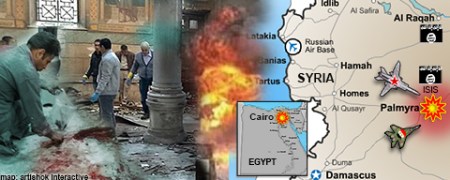
Sunday, Dec. 11, at least 25 people worshipping at the Coptic St. Peter’s and St. Paul’s church adjacent to St, Mark’s cathedral in Cairo were killed and scores injured. The Coptic pope often leads the prayers there. DEBKAfile’s counterterrorism sources reveal that the attack was carried out by Islamist terrorists from Raqqa who bided their time until they struck in the Egyptian capital. Saturday, six Egyptian troops were killed by another Islamist bomb near the Giza pyramids.

On the same day, ISIS fighters pushed back into the ancient Syrian town of Palmyra, nine months after their expulsion.

The Raqqa terrorist stronghold is clearly alive and kicking on more than one front. A number of contributing factors enable the Islamic State to unleash a fresh spate of terror.

1. The US-Iraqi-Kurdish drive has stalled without driving ISIS out of Mosul or choking off the terrorist fighters’ freedom to move between Mosul and Raqqa, their Syrian bastion.

US Defense Secretary Ashton Carter, who arrived in Baghdad Sunday, Dec. 11, was assigned by the Obama administration to make a last effort to reactivate the Mosul campaign. His chances of success are slim. The military coalition which launched the campaign two months ago has lost a vital component, the Kurdish Peshmerga, which backed out three weeks ago. The Iraqi military units which captured some of the city’s outskirts stopped short when they reached the strongest defense lines set up by the Islamic State and have been unable to break through, even with US air support.

The pro-Iranian Iraqi Shiite front which undertook to seize Tal Afar in order to sever the ISIS connecting link between Iraq and Syria are parked outside, having been warned by Turkey not to set foot in the town.

Added to these setbacks, the US CENTCOM which is running the aerial war in Iraq is at loggerheads with the Iraqi Air Force command and has practically grounded all Iraqi warplanes.

Even if Carter can wave a magic wand and resolve all these issues, the momentum and high hopes that actuated the Mosul campaign when it started have been lost and can hardly be recovered before Barack Obama leaves the White House.

At least two of the incoming president Donald Trump’s designated security advisers – Defense Secretary Gen, James Mattis and National security Adviser Gen. Michael Flynn – have criticized the operation in is current form.

2. What is happening in Raqqa doesn’t fit the designation of an offensive. At most, small Kurdish and Syrian rebel groups are mounting sporadic raids against ISIS fighters on the town’s outskirts, with the support of the Obama administration. Our military experts say that Raqqa can’t be captured from the Islamist terrorists by conventional means – mainly because it is spread over a large area of mostly empty desert. ISIS has taken advantage of this terrain to distribute knots of defenders across a vast area ranging hundreds of kilometers from northern to eastern Syria up to the winding, heavily overgrown banks of the Euphrates River.

So when Ash Carter announced Saturday that he would be sending another 200 Special Operations Forces into Syria to join the battle for Raqqa, he had no idea that he, the Russians and the Syrians were about to be caught off guard by a fresh ISIS initiative to reoccupy Palmyra, the ancient Syrian two from which they are thrown out in March.

This was a poke in the eye for Russian President Vladimir Putin who proclaimed Palmyra’s capture from ISIS as a signal coup for the Russian army in its war on Islamist terror.

3.  He might well commiserate with Egyptian President Abdel-Fatteh El-Sisi. For two years, the Egyptian armed forces have been fighting an uphill battle to crush the ISIS groups infesting the Sinai Peninsula. The jihadists constantly elude punishment with the help of supportive Bedouin tribes.

Every few months, they pose a real threat to the stability of the El-Sisi regime by striking inside Cairo, the capital, with some terrorist atrocity, for which they are aided by the Muslim Brotherhood underground and Palestinian Hamas extremists in the Gaza Strip.

The bombing of the Coptic church Saturday was unusually the work of jihadists deployed from Raqqa, Syria.  Egypt has reacted by placing extra guards at Christian sites and declaring three days of national morning for the disastrous bombing attack on Egypt’s largest minority.

The new Islamist drive is looking ominously like the onset of the Christmas-New Year holiday terror onslaught the Islamic State has threatened to unleash in the Middle East and beyond. US and European security services have been placed on high alert in the belief that returning jihadis are programmed to strike at home.

“Syrian 5th Corps” is new Shiite foreign legion

December 4, 2016

“Syrian 5th Corps” is new Shiite foreign legion, DEBKAfile, December 4, 2016

fifth_corps

The new Shiite foreign legion or international brigade presents a major headache for Syria’s neighbors, Turkey, Lebanon, Jordan and Israel. It provides a cover for Iran and Hizballah to sneak troops right up to their borders. Whenever this happened in the past, Israel and Jordan pushed back hard. But this will be more difficult once the Fifth Corps is set up as an integral part of the Syrian army.

***************************

Syria and its allies came closer than ever to taking Aleppo on Friday, Dec. 2, when they captured the Tariq al-Bab district to gain control of 60 percent of the rebel-held eastern part of the city.

Drawing on the lessons of this success, the winning forces have begun building a military outfit modeled on the format of the victorious coalition. It is designated the “Fifth Corps” of the Syrian army, but DEBKAfile’s military and intelligence sources can identity the new unit as the framework for an international Shiite brigade or foreign legion.

It is the brainchild of the Iranian Revolutionary Guards’ Gen. Qassem Soleimani, commander of Iranian Mid East operations, who is in Iraq at present, supervising the Shiite militias on the Mosul front. However, his officers are overseeing its construction of the new military legion. It is composed of the remnants of the Syrian army’s First and Second Corps, which took a bad beating in the five years of conflict, the Hizballah expeditionary force in Syria and the Shiite militias which Tehran imported from Iraq, Afghanistan and Pakistan to fight for Bashar Assad.

The new framework aims to field 50,000 to 70,000 fighting men.

Its command structure is already taking shape in a form that is new for the Syrian army and indeed any other fighting force in the region. Syrian, Hizballah and foreign Shiite officers will make up this command, but not direct their own forces, only mixed units composed of Iranian, Syrian, Shiite and Hizballah servicemen.

It will be the first Shiite army or foreign legion ever seen in the Middle East.

An oblique reference to the novel force came from a Hizballah source this week who said: “The Fifth Corps is an important turning-point for the ties between allied forces within the same axis – Syria, Iran, Russia and Hizballah.”

Russia? DEBKAfile’s sources have heard no hint of the Russians joining the new Shiite legion. But Hizballah has been spreading reports in the past fortnight about its deepening ties with Russian officers, mainly on the Aleppo front, and their supposed appreciation of the Lebanese Shiites’ fighting prowess.

The Syrian high command has meanwhile moved forward on the new scheme with a decision this week to send the entire next class of military recruits to the new Fifth Corps.

The new Shiite foreign legion or international brigade presents a major headache for Syria’s neighbors, Turkey, Lebanon, Jordan and Israel. It provides a cover for Iran and Hizballah to sneak troops right up to their borders. Whenever this happened in the past, Israel and Jordan pushed back hard. But this will be more difficult once the Fifth Corps is set up as an integral part of the Syrian army.

Western and Arab observers following the Syrian war believe that, as soon as they finish off the rebels in Aleppo, the new foreign legion’s forces will turn south to repeat the exercise there with Russian support.

The Russian bombardment of rebel concentrations outside the southern towns of Jasim and Daraa Sunday, Nov. 27, was seen a message from Moscow to Jerusalem and Amman that southern Syria is now in line for the next battle.

Humor | Syrian child disappointed she won’t get to be drone-striked by the first female president

November 13, 2016

Syrian child disappointed she won’t get to be drone-striked by the first female president, Duffel Blog, November 13, 2016

url

ALEPPO, Syria — In the midst of sectarian violence that has overtaken Syria for more than five years, nine-year-old Asil Kassab is shocked by the defeat of Democratic presidential candidate Hillary Clinton.

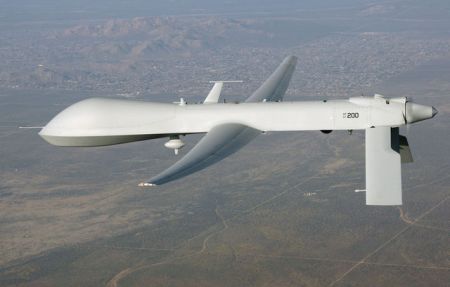
“I am so unhappy that a woman was not elected President,” Asil said, briefly ducking as a bomb from an American MQ-1 Predator drone leveled the hospital behind her. “Hillary Clinton is truly a role model for young girls like me. I was so hoping that she’d be the one to order the drone strike that would inevitably end my life.”

Despite Clinton’s support for regime change in Syria, leading to what is arguably one of the greatest humanitarian crises of the early century, Kassab surprisingly says she holds no ill will.

“I don’t put much stock in the misogynist agenda of American politics,” said Kassab, who, like many children, cannot remember a time before the war that has killed 400,000 people, including her family, and created over 4.7 million refugees. “People will always criticize her because she is a woman in a man’s world; One who has the audacity to run for President.”

“It is sexism that motivates her critics, plain and simple,” she added. “It is sexism, and racism, that caused her to lose the election!”

Huma Abedin, vice chairwoman of Hillary Clinton’s presidential campaign, took a moment from sobbing into a pile of shredded emails to applaud the statement made by young Asil.

“Hearing things like that from little girls on the other side of the globe makes all this worthwhile,” she said. “Secretary Clinton was truly committed to a protracted ground war in Syria. Despite losing the election, I’m sure she’ll find some way to continue being a role model to women everywhere by fighting for no-fly zones and military aggression against Russia.

At press time, Asil was already busy placing “Michelle Obama 2020!” pins on the dust covered corpses lying unburied in the street.


Iran’s Tel Afar op is in sync with Russia in Syria

October 30, 2016

Iran’s Tel Afar op is in sync with Russia in Syria, DEBKAfile, October 30, 2016

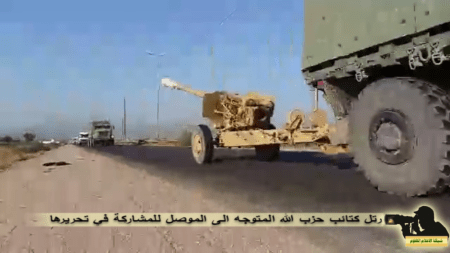
hezbollah_brigades_convoy_mosul_b_30-10-16-png

The irony of this arrangement is that, the US armed the Iraqi army, and indirectly the Shiite militias, for this offensive with top-notch Abrams M1 tanks, M1-198 Howitzers and M88 Recovery vehicles for tanks. All this s valuable hardware looks like ending up away another battlefield away from Mosul in Syria, and under a different command, Russia.

****************************

The pro-Iranian Iraqi Shiite drive to capture Tel Afar, 55 km from Mosul in western Iraq, was designed less to complete the encirclement of the Islamists in Mosul – in support of the US-led coalition – and more to forge a link in the land bridge Tehran aspires to build to give its Revolutionary Guards free passage to Hizballah and the Shiite groups fighting for Bashar Assad in Syria. This is reported by DEBKAfile’s military and intelligence sources.

The Iraqi Shiite battle for Afar is led by Iran’s Al Qods chief, Gen. Qassem Soliemani from the front lines.

US and Iraqi commanders of Operation Inherent for expelling ISIS from Mosul welcomed the Iran-led Iraqi Shiites’ initiative to take Tal Afar in order to sever ISIS’ supply lines from Syria to Mosul.

But Iran’s overriding motive in initiating this operation was laid bare by Ahmad al-Asadi, spokesman of the pro-Iranian Iraqi Hashid Shaabi Shiite groups, when he spoke to reporters Saturday, Oct. 29 in Baghdad.

After “clearing” these “terrorist gangs,” from 14,000 sq. km of Iraq including Tal Afar and the regions bordering on Syria, he said, “We are fully ready to cross the border into Syria and fight alongside President Bashar al-Assad.

According to our sources, this plan was not coordinated directly with the US-Iraqi command of the Mosul operation, but with the Russian military command center in the Syrian province of Latakia.

It is important enough for the Russian command to have just established a new center for military and intelligence interchanges. It is staffed by Russian, Turkish, Syrian, Iraqi Shiite and Iranian officers. This mechanism has been put in charge of coordinating Shiite military operations both in Syria and Iraq.

It was decided that when US military assistance or air support is deemed necessary, requests will be piped through the bureau of Iraq’s Shiite Prime Minister Haider al-Abadi and passed on to the US-Iraqi command of Operation Inherent.

Russian, Iranian and Turkish officers have thus effectively hitched on to the decision-making process for the Mosul offensive alongside American officers.

The irony of this arrangement is that, the US armed the Iraqi army, and indirectly the Shiite militias, for this offensive with top-notch Abrams M1 tanks, M1-198 Howitzers and M88 Recovery vehicles for tanks. All this s valuable hardware looks like ending up away another battlefield away from Mosul in Syria, and under a different command, Russia..

Al-Hariri’s Choice Of Hizbullah Ally Aoun For Lebanese Presidency Is Another March 14 Forces Concession To Pro-Iran Axis

October 28, 2016

Al-Hariri’s Choice Of Hizbullah Ally Aoun For Lebanese Presidency Is Another March 14 Forces Concession To Pro-Iran Axis, MEMRI, E.B. Picali and Y. Yehoshua, October 28, 2016

Introduction

On October 31, 2016, the Lebanese parliament will convene and is expected to vote in Free Patriotic Movement leader and Hizbullah ally Michel Aoun as president of Lebanon; he is Hizbullah’s sole candidate. The move follows a deal struck between Aoun and former Lebanese prime minister Sa’d Al-Hariri, leader of the Sunni Al-Mustaqbal stream, under which Aoun, if elected, will assign Al-Hariri the task of forming the next government.

This move by Al-Hariri has significant implications for the intra-Lebanese political arena and for the regional power balance. Therefore it has encountered criticism both within and outside Lebanon. This move represents a surrender by the March 14 Forces, headed by Al-Mustaqbal, to Hizbullah’s will, and reinforces the position of Hizbullah’s patron Iran at the expense of Saudi Arabia.

The following report reviews Al-Hariri’s decision, the reactions it has encountered, and what it means for Lebanon and the region.

Hizbullah Ally Aoun Expected To Be Chosen President

On October 31, 2016, the Lebanese parliament will hold its 46th presidential selection session since Michel Suleiman’s term ended two-and-a-half years ago.  That session is expected to choose Free Patriotic Movement leader Michel Aoun, who is an ally of Hizbullah, as president. Aoun’s selection will end a two-and-a-half-year presidential vacuum that resulted from disagreement over Suleiman’s successor from among the country’s opposing streams – primarily Al-Mustaqbal, led by Sa’d Al-Hariri, and Hizbullah, which together with Aoun stymied the formation of the quorum that is necessary to elect a president. The breakthrough in the talks over the selection of a president came when Al-Hariri and Aoun reached an agreement under which Al-Hariri would support Aoun’s presidential candidacy and in return Aoun would task Al-Hariri with forming the new government, which would be a national unity government as stipulated in the agreement.[1] This constitutes an Al-Hariri surrender to Hizbullah, which sought an Aoun presidency. It should be mentioned that Al-Hariri’s support for an overt Hizbullah ally is not unprecedented; a year ago, Al-Hariri announced his support for another ally of Hizbullah, and of Syrian president Bashar Al-Assad, Suleiman Frangieh, for the post of Lebanese president.[2]

Al-Hariri announced his support for Aoun in an October 20, 2016 speech, saying that by supporting him he was aiming to save Lebanon from dangerous leadership and economic crises which could, in turn, lead to a new civil war.[3]

Two days later, on October 22, Hizbullah secretary-general Hassan Nasrallah announced that his party’s MPs, who had been boycotting presidential selection sessions, as had MPs from other parties including Aoun’s own Change and Reform bloc, would be attending the October 31 session and would be choosing Aoun.  Nasrallah added that Hizbullah had no objections to Al-Hariri’s serving as prime minister in the new government.

These statements by Al-Hariri and Nasrallah pave Aoun’s path to the presidential palace, even though obstacles and uncertainty remain, both in Lebanon and in the region, in this matter.

Various Lebanese Elements Oppose Aoun’s Appointment As President

The opposition to Aoun’s appointment comes mainly from Lebanese parliamentary speaker Nabih Berri, and from Suleiman Frangieh, who is running against Aoun in the presidential race. Both Berri and Frangieh are March 8 Forces members and open Hizbullah allies. Berri even announced that he would not be part of the government that would be established under the Al-Hariri-Aoun deal, and questioned the deal’s future, saying that it had been arrived at by two sides only, without taking into account the country’s main political elements, himself among them. Druze leader and centrist bloc member Walid Jumblatt, who is another major Lebanese political figure, has not yet expressed a position on this matter, but it is thought that he will back Aoun.

On the other side as well, some in Al-Hariri’s Al-Mustaqbal party and in the March 14 Forces in general   oppose this deal. Immediately after Al-Hariri’s October 20 announcement of support for Aoun, another former prime minister, Fouad Al-Siniora, the head of the Al-Mustaqbal party, (a component of Al-Hariri’s broader Al-Mustaqbal stream) announced that he would not join Al-Hariri in backing Aoun for president. Al-Siniora was joined by other party members, including parliamentary vice president Farid Makari, MPs Ahmad Fatfat and Ammar Houri, Telecommunications Minister Boutros Harb of the March 14 Forces, and March 14 Forces secretary-general Fares Souaid.

Along with the opposition to an Aoun presidency within the Al-Mustaqbal party, other Sunni public figures also objected to the deal, among them Justice Minister Ashraf Rifi, former director-general of the Lebanese Internal Security Forces and a former Al-Hariri supporter. Last year, Rifi harshly attacked Al-Hariri for his support for Hizbullah and Syrian regime ally Suleiman Frangieh. On October 22, 2016, two days after Al-Hariri’s announcement of his support for Aoun as president, Rifi organized an anti-Aoun protest in Tripoli called “Proud Tripoli Rejects the Candidate of Iranian Patronage.” The next day, October 23, a convoy of vehicles from Akkar in the north of the country made its way to Rifi’s home in Tripoli bearing posters of him and expressing support for his position on this matter. It should be mentioned that in the past year, Rifi has gradually chipped away at overall Lebanese Sunni support for Al-Hariri, as evidenced by his party’s landslide victory over Al-Hariri’s party in the mayoral elections in Tripoli, the city with the largest Sunni concentration in the country.

Many in the Al-Mustaqbal party, the March 14 Forces, and the Sunni public who oppose the Al-Hariri-Aoun deal see Al-Hariri’s support for Aoun as yet another concession to Hizbullah and the pro-Iran axis that backs it, and to Hizbullah as an armed state within a state.[4] They accuse Al-Hariri, inter alia, of seeking to become prime minister by selling out Sunni interests and the political legacy of his father Rafiq Al-Hariri, whose 2005 assassination, when Syria was the real power in Lebanon, is thought to have been carried out by five senior Hizbullah officials.

Addressing critics of his deal, Al-Hariri explained his support for Aoun as well as his previous support for Frangieh: “I am willing to take the risks a thousand times over, just as I am willing to risk myself, my people, and my political future, to defend Lebanon and its people.”[5]

Al-Hariri’s Choice Of Aoun Is A Political Victory For Hizbullah

Al-Hariri’s move to support the Hizbullah candidate and ally Aoun has major implication for the internal Lebanese political arena. It constitutes another successful attempt by Hizbullah to impose its wishes there and a further weakening of the country’s main Sunni force, the Al-Mustaqbal party. This triumph for Hizbullah comes at a time when it is mostly preoccupied outside of Lebanon’s borders, primarily with fighting alongside the Assad regime in Syria, as well as elsewhere in the Arab world as a proxy of Iran. The organization has fortified its position within Lebanon by virtue of its network of political alliances in the country, as well as by virtue of the quantity of weapons in its possession.

Ibrahim Al-Amin, head of the board of directors of the Lebanese daily Al-Akhbar and a known Hizbullah supporter, argued that the March 14 Forces, including the Al-Mustaqbal stream, show “the symptoms of card-game addicts,” who delude themselves that they can win and are “unwilling to give up” even when it is clear that it is Hizbullah who is actually directing events on the ground.[6]

At the same time, Hizbullah’s success in pushing its own candidate through is also a result of the political weakness of its rivals, particularly the Hariri-led Al-Mustaqbal stream, who wants the premiership at nearly any cost in order to strengthen his own political status in the country and perhaps his economic status as well.

An Aoun presidency does not mean that the issues contributing to the vast schism between the sides in Lebanon will be resolved, among them the disarming of Hizbullah as demanded by the March 14 Forces – Aoun opposes the organization’s disarmament.[7] As president, Hizbullah ally Aoun would be in charge of a number of security and military portfolios, aggravating the tension between the sides and jeopardizing the army’s independence .

Additionally, the Al-Hariri-Aoun deal does not guarantee that Al-Hariri will actually succeed in forming a government, because of the opposition he faces both inside and outside Lebanon. The deal with Aoun could also harm Al-Hariri’s status among his traditional Sunni support base, thus weakening him in the upcoming spring 2017 parliamentary elections.

An Aoun Presidency: Ramifications For The Regional Power Balance – Down With Saudi Arabia, Up With Iran

Since Lebanon’s future depends on the regional political balance, with Iran, Syria, and Saudi Arabia the patrons of various local Lebanese political players, Al-Hariri’s move has regional ramifications. His surrender to Hizbullah’s wishes reflects the strengthening of Iran, which has exploited the Syrian civil war to deepen its penetration of the region and of Lebanon in particular. Electing the Hizbullah presidential candidate Aoun will definitely serve future pro-Iran interests in Lebanon at the expense of Sunni interests in Lebanon, and also at the expense of Saudi Arabia, which views itself as the protector of these interests.

Saudi Arabia has previously backed Al-Hariri’s past substantial political moves even if these moves haven’t always served Saudi political interests in Lebanon or elsewhere. It is still unclear whether his deal with Aoun has Saudi support, and the Lebanese press has published conflicting reports on the matter. As yet, there has been no official Saudi comment on this, but recent articles in the Saudi press indicate a lack of support for Al-Hariri’s deal with Aoun. However, following a lengthy Saudi silence, Saudi Gulf Affairs Minister Thamer Sabhan, who visited Beirut on October 27 said that his country would not intervene in the selection of Lebanon’s president and would support the president chosen by the Lebanese.[8]

There were also reports in the Lebanese press noting that Al-Hariri’s political status in Lebanon is declining, and that the Saudis no longer consider him the sole representative of the Sunnis in Lebanon, but only one such representative.

It should be noted that in previous years, Saudi Arabia, as the leader of the Sunni world, played a key role in the selection of Lebanese presidents, as did Syria, which together with Hizbullah’s patron Iran represented the resistance axis. Al-Hariri’s choosing Aoun for president without full Saudi backing reflects a decline in Saudi influence in Lebanon, and in Saudi Arabia’s regional status in general. In this context, a report in the Lebanese daily Al-Safir, a known supporter of the resistance axis, claims that Egypt was involved in promoting Aoun’s prospects for the presidency.[9] A possible inference from this report is that Egypt is attempting to step into Saudi Arabia’s shoes in Lebanon in an attempt to restore its status in the Arab world, and particularly in the Sunni world.

Articles in the daily Al-Akhbar, known for its pro-Hizbullah line, addressed the regional implications of Al-Hariri’s gambit and gloated that the move reflected Saudi Arabian weakness. Al-Akhbar columnist Ghassan Saoud wrote that an Aoun presidency would be a manifestation of “Hizbullah’s ability to break the international will, and the Saudi will.”[10]

However, Ibrahim Al-Amin wrote in an Al-Akbar editorial that wars in the Arab region created a reality that was forcing the March 14 Forces to see the choice of Lebanese president differently, and that they needed to realize that the Saudis can no longer help them. As he usually does, he concluded his piece with implied threats, stating: “Anyone who does not want anarchy in Lebanon has no alternative but to choose Aoun for president.”[11]


*E. B. Picali is a research fellow at MEMRI; Y. Yehoshua is Vice President for Research And Director of MEMRI Israel


Endntoes:

[1] One of the main political players pushing for an Aoun presidency is Samir Geagea, chairman of the Lebanese Forces. In January 2016, after a long period of talks, Geagea and Aoun, formerly bitter Christian political rivals, agreed that Geagea would support Aoun’s presidential bid. One of the main reasons behind Geagea’s decision to do so was Al-Hariri’s previous support for the presidential candidacy of Suleiman Frangieh – a fierce rival of Geagea who had been accused of killing several members of the Frangieh family during the country’s civil war.

[2] Similarly, in 2008, during another presidential interregnum, the March 14 Forces and Al-Hariri were forced to make concessions to Hizbullah, which was included in the newly formed Fouad Siniora government; this took place at the Doha conference. The most important concession won by the Hizbullah-led March 8 Forces, as stipulated in the government guidelines, was the legitimation of the Resistance (which allowed Hizbullah to operate as an independent armed force within Lebanon). Hizbullah also received enough cabinet seats to veto any government decision, and Hizbullah subsequently used this veto power against Al-Hariri’s government in 2011. Hizbullah obtained these concessions following the leadership vacuum, the lengthy Hizbullah siege on central Beirut, and the violent events of May 7, 2008.

[3] Al-Mustaqbal (Lebanon), October 21, 2016.

[4] See MEMRI Inquiry & Analysis Series Report No. 1092, Al-Mustaqbal Losing Ground As Representative Of Lebanese Sunnis, May 19, 2014.

[5] Al-Mustaqbal (Lebanon), October 21, 2016.

[6] Al-Akhbar (Lebanon), October 24, 2016.

[7] In an interview with Al-Akhbar, Lebanese Foreign Minister Gebran Bassil, who is Aoun’s son-in-law and heads the Change and Reform bloc founded by Aoun, said that Free Patriotic Movement, to which the Change and Reform bloc belongs, supports Hizbullah’s retention of its weapons. Al-Akhbar(Lebanon), October 22, 2016.

[8] Al-Watan (Saudi Arabia), October 28, 2016.

[9] Al-Safir (Lebanon), October 25, 2016.

[10] Al-Akhbar (Lebanon), October 27, 2016.

[11] Al-Akhbar (Lebanon), October 24, 2016.

Turkish warplanes bomb US-backed Kurdish militias in Syria

October 20, 2016

Turkish warplanes bomb US-backed Kurdish militias in Syria , DEBKAfile, October 20, 2016

Turkish warplanes carried out more than 20 sorties early Thursday morning in northern Syria, attacking positions, vehicles and convoys of US-backed Kurdish militias fighting the Islamic State organization. The targets were in a number of villages around the city of Aleppo. There were conflicting reports on the number of casualties, with the Turkish army reporting that 200 Kurdish fighters had been killed while the militias claimed that there were only about 20 fatalities. DEBKAfile‘s intelligence sources report that the Turkish attack may cause the Kurds to withdraw their forces from the US-led offensive to capture the Iraqi city of Mosul, and not help the US capture the Syrian city of Raqqa afterwards.

Obama vs Baghdad on Sunni cleansing of Mosul

October 20, 2016

Obama vs Baghdad on Sunni cleansing of Mosul, DEBKAfile, October 20, 2016

baaj_road_19-10-16

A major dispute on combat tactics which has sprung up between Washington and Baghdad hangs over the coalition’s Mosul offensive after three days of combat. Thursday, Oct. 20, President Barack Obama and US commanders challenged Iraq’s Shiite Prime Minister Haydar al-Abadi and is generals over a 500km long route, the Ba’aj Road, which does not appear on maps, but is pivotal for the offensive’s continuation, DEBKAfile’s exclusive military and intelligence sources report.

This route is a kind of “Burma road” developed by the Islamic State as a private corridor between Mosul in Iraq and Raqqa, the terrorist group’s Syrian capital, during the terrorist group’s two years of control. It runs through the Iraqi town of Tal Afar before crossing into Syria and passing south of areas controlled by Syrian Kurdish militias, among which US special operations forces are embedded.

The argument flared over a demand by President Obama and US commanders that Iraqi government forces turn to the Syrian border and block the Ba’aja Road, and so cut off the ISIS fighters’ escape route from Mosul to Syria. The Americans can’t bomb the corridor because it is also packed with a stream of refugees in flight from the fighting in Mosul.

So long as it is open, ISIS is free to move thousands of fighters and masses of weapons, ammunition and other supplies between its two strongholds. This freedom of action, Obama warned Al-Abadi, would prolong the Mosul operation beyond the Dec. 20 deadline set by the coalition for its termination.

However, according to our sources, the Iraqi prime minister countered this demand with a proviso unacceptable to Washington. He was prepared to order Iraqi forces to block the Ba’aja Road provided Mosul’s entire population of 750,000 Sunni Muslims was expelled from the city. He argued that ISIS could not be defeated until then because the Sunnis were supporting and collaborating with the Islamist terrorists.

Obama fiercely opposes the mass Sunni expulsion, seeing it as an attempt by the Shiite Iraqi prime minister to cleanse Iraq’s second city of its Sunni inhabitants and using the Mosul offensive against ISIS as a pretext for such action.

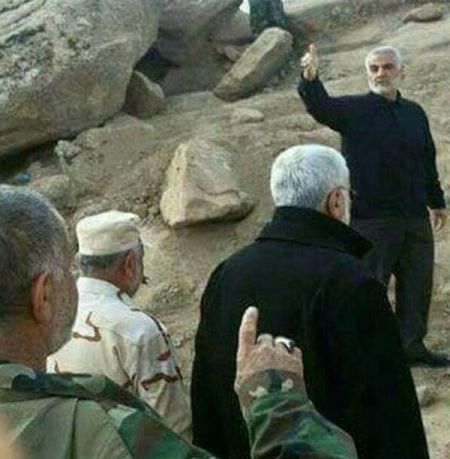
mosul_soulemeni_19-10-16EXCLUSIVE: Iranian Gen. Qassem Soleimani greets Shiite fighters outside Mosul.

DEBKAfile’s sources add that Al-Abadi has found support for his side of the argument with the arrival of the Iranian Al Qods chief Gen. Qassem Soleimani at the command posts of the pro-Iranian Iraqi Shiite militias, who have not yet been thrown into the Mosul battle.

The Mosul offensive came up in the third US presidential debate in Las Vegas early Thursday. The Republican candidate Donald Trump, who appeared to have been updated on the state of play there, commented that the big winner from that offensive would be Iran.

Our military sources report that three days of combat have not brought any major coalition forces advances against ISIS. On some sectors Iraqi forces are moving forward slowly, backed by US air strikes and rocket artillery fire; on others, they are stalled by Islamist resistance.

Fifteen years after the 9/11 attacks, al Qaeda fights on

September 12, 2016

Fifteen years after the 9/11 attacks, al Qaeda fights on, Long War Journal, September 11, 2016

All appeared lost for Osama bin Laden and al Qaeda in December 2001. In the years leading up to the 9/11 hijackings, bin Laden believed that the US was a “paper tiger” and would retreat from the Muslim majority world if al Qaeda struck hard enough. The al Qaeda founder had good reasons to think this. American forces withdrew from Lebanon after a series of attacks in the early 1980s and from Somalia after the “Black Hawk Down” episode in 1993. The US also did not respond forcefully to al Qaeda’s August 1998 embassy bombings in Kenya and Tanzania, or the USS Cole bombing in October 2000.

But bin Laden’s strategy looked like a gross miscalculation in late 2001. An American-led invasion quickly overthrew the Taliban’s regime just weeks after 19 of bin Laden’s men hijacked four airliners and crashed them into the World Trade Center, the Pentagon, and a field in Pennsylvania. Some of al Qaeda’s most senior figures were killed in American airstrikes. With al Qaeda’s foes closing in, bin Laden ordered his men to retreat to the remote Tora Bora Mountains. Here, bin Laden must have thought, al Qaeda would make its last stand. The end was nigh.

Except it wasn’t.

Bin Laden slithered away, eventually making his way to Abbottabad, Pakistan. When Navy SEALs came calling more than nine years later, in early May 2011, the world looked very different.

Documents recovered in bin Laden’s compound reveal that he and his lieutenants were managing a cohesive global network, with subordinates everywhere from West Africa to South Asia. Some US intelligence officials assumed that bin Laden was no longer really active. But Bin Laden’s files demonstrated that this view was wrong.

Writing in The Great War of Our Time: The CIA’s Fight Against Terrorism – From al Qa’ida to ISIS, former CIA official Mike Morell explains how the Abbottabad cache upended the US intelligence community’s assumptions regarding al Qaeda. “The one thing that surprised me was that the analysts made clear that our pre-raid understanding of Bin Laden’s role in the organization had been wrong,” Morell writes. “Before the raid we’d thought that Bin Laden’s deputy, Ayman al Zawahiri, was running the organization on a day-to-day basis, essentially the CEO of al Qaeda, while Bin Laden was the group’s ideological leader, its chairman of the board. But the DOCEX showed something quite different. It showed that Bin Laden himself had not only been managing the organization from Abbottabad, he had been micromanaging it.”*

Consider some examples from the small set of documents released already.

During the last year and a half of his life, Osama bin Laden: oversaw al Qaeda’s “external work,” that is, its operations targeting the West; directed negotiations with the Pakistani state over a proposed ceasefire between the jihadists and parts of the government;ordered his men to evacuate northern Pakistan for safe havens in Afghanistan;instructed Shabaab to keep its role as an al Qaeda branch secret and offered advice concerning how its nascent emirate in East Africa should be run; received status reports on his fighters’ operations in at least eight different Afghan provinces; discussed al Qaeda’s war strategy in Yemen with the head of Al Qaeda in the Arabian Peninsula and other subordinates; received updates from Al Qaeda in the Islamic Maghreb, including details on a proposed truce with the government of Mauritania; authorized the relocation of veteran jihadists to Libya, where they could take advantage of the uprising against Muammar al Qaddafi’s regime; corresponded with the Taliban’s leadership; and generally made decisions that impacted al Qaeda’s operations everywhere around the globe.

Again, these are just a handful of examples culled from the publicly-available files recovered in bin Laden’s compound. The overwhelming majority of these documents remain classified and, therefore, unavailable to the American public.

Al Qaeda has grown under Zawahiri’s tenure

The story of how bin Laden’s role was missed should raise a large red flag. Al Qaeda is still not well-understood and has been consistently misjudged. Not long after bin Laden was killed, a meme spread about his successor: Ayman al Zawahiri. Many ran with the idea that Zawahiri is an ineffectual and unpopular leader who lacked bin Laden’s charisma and was, therefore, incapable of guiding al Qaeda’s global network. This, too, was wrong.

There is no question that the Islamic State, which disobeyed Zawahiri’s orders and was disowned by al Qaeda’s “general command” in 2014, has cut into al Qaeda’s share of the jihadist market and undermined the group’s leadership position. But close observers will notice something interesting about al Qaeda’s response to the Islamic State’s challenge. Under Zawahiri’s stewardship, al Qaeda grew its largest paramilitary force ever.

Brett McGurk, the Special Presidential Envoy for the Global Coalition to Counter ISIL, warned about the rise of Al Nusrah Front during testimony before the Senate Foreign Relations Committee on June 28. “With direct ties to Ayman al Zawahiri, Osama Bin Laden’s successor, Nusra[h] is now al [Qaeda’s] largest formal affiliate in history,” McGurk said. US officials previously contacted by The Long War Journal said Nusrah could easily have 10,000 or more fighters in its ranks.

It is worth repeating that Nusrah grew in size and stature, while being openly loyal to Zawahiri, after the Islamic State became its own jihadist menace. Far from being irrelevant, Zawahiri ensured al Qaeda’s survival in the Levant and oversaw its growth.

image-posted-by-tilmidh-usamah-bin-ladin-1024x348

On July 28, Al Nusrah Front emir Abu Muhammad al Julani announced that his organization would henceforth be known as Jabhat Fath al Sham (JFS, or the “Conquest of the Levant Front”) and would have no “no affiliation to any external [foreign] entity.” This was widely interpreted as Al Nusrah’s “break” from al Qaeda. But Julani never actually said that and al Qaeda itself isn’t an “external entity” with respect to Syria as the group moved much of its leadership to the country long ago. Al Nusrah’s rebranding was explicitly approved by Abu Khayr al Masri, one of Zawahiri’s top deputies, in an audio message released just hours prior to Julani’s announcement. Masri was likely inside Syria at the time.

Julani, who was dressed like Osama bin Laden during his appearance (as pictured above), heaped praise on bin Laden, Zawahiri and Masri. “Their blessed leadership has, and shall continue to be, an exemplar of putting the needs of the community and their higher interests before the interest of any individual group,” Julani said of Zawahiri and Masri.

Most importantly, Al Nusrah’s relaunch as JFS is entirely consistent with al Qaeda’s longstanding strategy in Syria and elsewhere. Al Qaeda never wanted to formally announce its role in the rebellion against Bashar al Assad’s regime, correctly calculating that clandestine influence is preferable to an overt presence for many reasons. This helps explain why Nusrah was never officially renamed as “Al Qaeda in the Levant” in the first place. However, fifteen years after the 9/11 attacks, there is such widespread ignorance of al Qaeda’s goals and strategy that Nusrah’s name change is enough to fool many.

Al Qaeda has grown in South Asia as well. In Sept. 2014, Zawahiri announced the formation of Al Qaeda in the Indian Subcontinent (AQIS), which brought together elements of several existing jihadist organizations. AQIS quickly got to work, attempting to execute an audacious plan that would have used Pakistani arms against American and Indian ships. The plot failed, but revealed that al Qaeda had infiltrated Pakistan’s military.

Pakistani officials recently told the Washington Post that they suspect AQIS has a few thousand members in the city of Karachi alone. And al Qaeda remains closely allied with the Taliban while maintaining a significant presence inside Afghanistan. In October 2015, for instance, Afghan and American forces conducted a massive operation against two large al Qaeda training camps in the southern part of the country. One of the camps was approximately 30 square miles in size. Gen. John F. Campbell, who oversaw the war effort in Afghanistan, explained that the camp was run by AQIS and is “probably the largest training camp-type facility that we have seen in 14 years of war.”

With Zawahiri as its emir, al Qaeda raised its “largest formal affiliate in history” in Syria and operated its “largest training” camp ever in Afghanistan. These two facts alone undermine the widely-held assumption that al Qaeda is on death’s door.

Elsewhere, al Qaeda’s other regional branches remain openly loyal to Zawahiri.

From April 2015 to April 2016, Al Qaeda in the Arabian Peninsula (AQAP) controlled a large swath of territory along Yemen’s southern coast, including the key port city of Mukalla. An Arab-led coalition helped reclaim some of this turf earlier this year, but AQAP’s forces simply melted away, living to fight another day. AQAP continues to wage a prolific insurgency in the country, as does Shabaab across the Gulf of Aden in Somalia. Shabaab’s leaders announced their fealty to Zawahiri in February 2012 and remain faithful to him. They have taken a number of steps to stymie the growth of the Islamic State in Somalia and neighboring countries. Shabaab also exports terrorism throughout East Africa, executing a number of high-profile terrorist attacks in recent years.

Al Qaeda in the Islamic Maghreb (AQIM) continues to operate in West and North Africa, often working in conjunction with front groups. Like al Qaeda’s branches elsewhere, AQIM prefers to mask the extent of its influence, working through organizations such as Ansar al Sharia and Ansar Dine to achieve its goals. Late last year, Al Murabitoon rejoined AQIM’s ranks. Al Murabitoon is led by Mohktar Belmokhtar, who has been reportedly killed on several occasions. Al Qaeda claims that Belmokhtar is still alive and has praised him for rejoining AQIM after his contentious relations with AQIM’s hierarchy in the past. While Belmokhtar’s status cannot be confirmed, several statements have been released in his name in recent months. And Al Murabitoon’s merger with AQIM has led to an increase in high-profile attacks in West Africa.

In sum, AQAP, AQIM, AQIS and Shabaab are formal branches of al Qaeda and have made their allegiance to Zawahiri clear. Jabhat Fath al Sham, formerly known as Al Nusrah, is an obvious al Qaeda project in Syria. Other organizations continue to serve al Qaeda’s agenda as well.

Al Qaeda’s veterans and a “new generation” of jihadist leadership

As the brief summary above shows, Al Qaeda’s geographic footprint has expanded greatly since the Sept. 11, 2001 terrorist attacks. Some US officials argue that al Qaeda has been “decimated” because of the drone campaign and counterterrorism raids. They narrowly focus on the leadership layer of al Qaeda, while ignoring the bigger picture. But even their analysis of al Qaeda’s managers is misleading.

Al Qaeda has lost dozens of key men, but there is no telling how many veterans remain active to this day. Experienced operatives continue to serve in key positions, often returning to the fight after being detained or only revealing their hidden hand when it becomes necessary. Moreover, al Qaeda knew it was going to lose personnel and took steps to groom a new generation of jihadists capable of filling in.

3-aq-leaders-released-from-iran-1023x313From left to right: Saif al Adel, Abu Mohammed al Masri and Abu Khayr al Masri. These photos, first published by the FBI and US intelligence officials, show the al Qaeda leaders when they were younger.

Last year, several veterans were reportedly released from Iran, where they were held under murky circumstances. One of them was Abu Khayr al Masri, who paved the way for Al Nusrah’s rebranding in July. Another is Saif al Adel, who has long been wanted for his role in the 1998 US Embassy bombings in Kenya and Tanzania. At least two others freed by Iran, Abu Mohammed al Masri and Khalid al Aruri, returned to al Qaeda as well.

Masri, Al Adel, and Aruri may all be based inside Syria, or move back and forth to the country from Turkey, where other senior members are based. Mohammed Islambouli is an important leader within al Qaeda. After leaving Iran several years ago, Islambouli returned to Egypt and eventually made his way to Turkey, where he lives today.

Sitting to Julani’s right during his much ballyhooed announcement was one of Islambouli’s longtime compatriots, Ahmed Salama Mabrouk. The diminutive Mabrouk is another Zawahiri subordinate. He was freed from an Egyptian prison in the wake of the 2011 uprisings.

Al Qaeda moved some of its senior leadership to Syria and several others from this cadre are easy to identify. But al Qaeda has also relied on personnel in Yemen to guide its global network. One of Zawahiri’s lieutenants, Hossam Abdul Raouf, confirmed this in an audio message last October. Raouf explained that the “weight” of al Qaeda has been shifted to Syria and Yemen, because that is where its efforts are most needed.

The American drone campaign took out several key AQAP leaders in 2015, but they were quickly replaced. Qasim al Raymi, who was trained by al Qaeda in Afghanistan in the 1990s, succeeded Nasir al Wuhayshi as AQAP’s emir last summer. Raymi quickly renewed his allegiance to Zawahiri, whom Raymi described as the “the eminent sheikh” and “the beloved father.” Another al Qaeda lifer, Ibrahim Abu Salih, emerged from the shadows last year. Salih was not public figure beforehand, but he has been working towards al Qaeda’s goals in Yemen since the early 1990s. Ibrahim al Qosi (an ex-Guantanamo detainee) and Khalid al Batarfi have stepped forward to lead AQAP and are probably also part of al Qaeda’s management team.

This old school talent has helped buttress al Qaeda’s leadership cadre. They’ve been joined by men who signed up for al Qaeda’s cause after the 9/11 attacks as well. In July, the US Treasury Department designated three jihadists who are based in Iran. One of them, known as Abu Hamza al Khalidi, was listed in bin Laden’s files as part of a “new generation” of al Qaeda leaders. Today, he plays a crucial role as the head of al Qaeda’s military commission, meaning he is the equivalent of al Qaeda’s defense minister. Treasury has repeatedly identified other al Qaeda members based in Iran, Afghanistanand elsewhere.

Some members of the “new generation” are more famous than others. Such is the case with Osama’s son, Hamzah bin Laden, who is now regularly featured in propaganda.

This brief survey of al Qaeda is not intended to be exhaustive, yet it is still sufficient to demonstrate that the organization’s bench is far from empty. Moreover, many of the men who lead al Qaeda today are probably unknown to the public.

The threat to the West

Testifying before the Senate Armed Services Committee in February, Director of National Intelligence James Clapper warned that al Qaeda “nodes in Syria, Pakistan, Afghanistan, and Turkey” are “dedicating resources to planning attacks.” His statement underscored how the threats have become more geographically dispersed over time. With great success, the US worked for years to limit al Qaeda’s ability to strike the West from northern Pakistan. But today, al Qaeda’s “external operations” work is carried out across several countries.

During the past fifteen years, Al Qaeda has failed to execute another mass casualty attack in the US on the scale of the 9/11 hijackings. Its most recent attack in Europe came in January 2015, when a pair of brothers backed by AQAP conducted a military-style assault on the Charlie Hebdo office in Paris. AQAP made it clear that the Charlie Hebdo massacre was carried out according to Zawahiri’s orders.

Thanks to vigilance and luck, al Qaeda hasn’t been able to replicate a 9/11-style assault inside the US. Part of the reason is that America’s defenses, as well as those of its partner nations, have improved. Operations such as the 9/11 hijackings are also difficult to carry out in the first place. Even the 9/11 plan experienced interruptions despite a relatively lax security environment. (Most famously, for example, the would-be 20th hijacker was denied entry into the US at an Orlando airport in the summer of 2001.)

But there is another aspect to evaluating the al Qaeda threat that is seldom appreciated. It is widely assumed that al Qaeda is only interested in attacking the West. This is flat false. Most of the organization’s resources are devoted to waging insurgencies in Muslim majority countries.

The story in Syria has been telling. Although al Qaeda may have more resources in Syria than anywhere else, Zawahiri did not order his men to carry out a strike in the West. Al Qaeda’s so-called “Khorasan Group” laid the groundwork for such operations, but Zawahiri did not give this cadre the green light to actually carry them out. Zawahiri’s stand down order is well known. In an interview that aired in May 2015, for instance, Julani explained that the “directives that come to us from Dr. Ayman [al Zawahiri], may Allah protect him, are that Al Nusrah Front’s mission in Syria is to topple [Bashar al Assad’s] regime” and defeat its allies. “We have received guidance to not use Syria as a base for attacks against the West or Europe so that the real battle is not confused,” Julani said. However, he conceded that “maybe” the mother al Qaeda organization is plotting against the West, just “not from Syria.” Julani emphasized that this “directive” came from Zawahiri himself.

To date, al Qaeda has not lashed out at the West from inside Syria, even though it is certainly capable of doing so. Al Qaeda’s calculation has been that such an attack would be too costly for its strategic interests. It might get in the way of al Qaeda’s top priority in Syria, which is toppling the Assad regime. This calculation could easily change overnight and al Qaeda could use Syria as a launching pad against the West soon. But they haven’t thus far. It helps explain why there hasn’t been another 9/11-style plot by al Qaeda against the US in recent years. It also partially explains why al Qaeda hasn’t launched another large-scale operation in Europe for some time. Al Qaeda has more resources at its disposal today than ever, so the group doesn’t lack the capability. If Zawahiri and his advisors decided to make anti-Western attack planning more of a priority, then the probability of another 9/11-style event would go up. Even in that scenario, al Qaeda would have to successfully evade the West’s defenses. But the point is that al Qaeda hasn’t been attempting to hit the West nearly as much as some in the West assume.

In the meantime, it is easy to see how the al Qaeda threat has become more diverse, just as Clapper testified. AQAP has launched several thwarted plots aimed at the US, including the failed Christmas Day 2009 bombing. In 2009, al Qaeda also plotted to strike trains in the New York City area. In 2010, a Mumbai-style assault in Europe was unraveled by security services. It is not hard to imagine al Qaeda trying something along those lines once again. Other organizations tied to al Qaeda, such as the Pakistani Taliban, have plotted against the US as well.

Fifteen years after the 9/11 attacks, al Qaeda lives. Fortunately, Zawahiri’s men have not replicated the hijackings that killed nearly 3,000 Americans. But the al Qaeda threat looms. It would be a mistake to assume that al Qaeda won’t try a large-scale operation again.

*The spellings of al Qaeda and bin Laden are changed in this quote from Morell to make them consistent with the rest of the text.

Putin-Erdogan deal for Syria is ME exit for Obama

September 9, 2016

Putin-Erdogan deal for Syria is ME exit for Obama, DEBKAfile, September 9, 2016

putin_obama_g-20_china

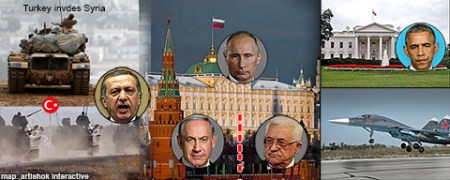
The fledgling “initiatives” reverberating this week in Washington, Moscow, Ankara, Jerusalem and the G20 summit were nothing but distractions from the quiet deals struck by two lead players, Russia and Turkey to seize control of the region’s affairs. Recep Tayyip Erdogan knew nothing would come of his offer on the G20 sidelines to US President Barack Obama to team up for a joint operation to evict ISIS from Raqqa. And, although Moscow was keen on hosting the first handshake in almost a decade between Israeli Prime Minister Binyamin Netanyahu and the Palestinian leader Mahmoud Abbas (Abu Mazen), neither were known to be ready for the last step toward a meeting.

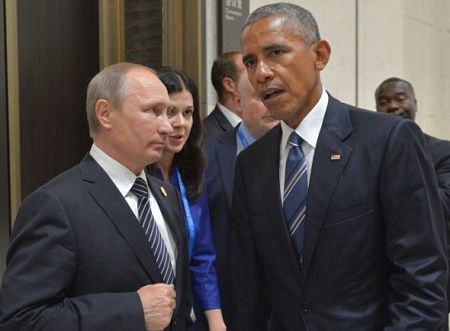
But the game-changing events to watch out for took place in Hangzhou without fanfare – namely, the Obama-Putin talks and the far more fruitful encounter between Putin and Erdogan.

According to DEBKAfile’s intelligence and Mid East sources, Putin virtually shut the door on further cooperation with the United States in Syria. He highhandedly informed Obama that he now holds all the high cards for controlling the Syrian conflict, whereas Washington was just about out of the game.

Putin picked up the last cards, our sources disclose, in a secret deal with Erdogan for Russian-Turkish collaboration in charting the next steps in the Middle East.

The G20 therefore, instead of promoting new US-Russian understanding, gave the impetus to a new Russian-Turkish partnership.

Erdogan raked in instant winnings: Before he left China, he had pocketed Putin’s nod to grab a nice, 4,000-sq.km slice of northern Syria, as a “security zone” under the control of the Turkish army and air force, with Russian non-interference guaranteed.

This Turkish zone would include the Syrian towns of Jarablus, Manjib, Azaz and Al-Bab.

Ankara would reciprocate by withdrawing its support from the pro-US and pro-Saudi rebel groups fighting the Assad army and its allies in the area north of Aleppo.

Turkey’s concession gave Putin a selling-point to buy the Syrian ruler assent to Erdogan’s project. Ankara’s selling-point to the West was that the planned security zone would provide a safe haven for Syrian refugees and draw off some of the outflow perturbing Europe.

kremlinwhitehouse480

It now turns out that, just as the Americans sold the Syrian Kurds down the river to Turkey (when Vice President Joe Biden last month ordered them to withdraw from their lands to the eastern bank of the Euphrates River or lose US support), so too are the Turks now dropping the Syrian rebels they supported in the mud by re-branding them as “terrorists.”

The head of this NATO nation has moreover gone behind America’s back for a deal with the Russian ruler on how to proceed with the next steps of the Syrian conflict.

Therefore, when US Secretary of State John Kerry met Russian Foreign Minister Sergei Lavrov in Geneva Thursday and Friday, Sept. 8-9, for their sixth and seventh abortive sit-downs on the Syrian issue, there was not much left for them to discuss, aside from continuing to coordinate their air traffic over Syria and the eastern Mediterranean.

Washington and Moscow are alike fearful of an accidental collision in the sky in the current inflammable state of relations between the two powers.

As a gesture of warning, a Russian SU-25 fighter jet Tuesday, Sept 6, intercepted a US Navy P8 plane flying on an international route over the Black Sea. When the Russian jet came as close as 12 feet, the US pilots sent out emergency signals – in vain, because the Russian plane’s transponder was switched off. The American plane ended up changing course.

Amid these anomalies, Moscow pressed ahead with preparations to set up a meeting between the Israeli and Palestinian leaders, as the Russian Foreign Ministry announced Thursday.

Putin is keen to succeed where the Obama administration failed. John Kerry abandoned his last effort at peacemaking as a flop two years ago.  But it is hard to see Netanyahu or Abu Mazen rushing to play along with the Russian leader’s plan to demean the US president in the last months of his tenure – especially when no one can tell who will win the November 8 presidential election – Hillary Clinton or Donald Trump – or what policies either will pursue.

All the region’s actors will no doubt be watching closely to see how Turkey’s “Russian track” plays out and how long the inveterate opportunists can hang together.