Posted tagged ‘Sisi’

US Sinai pullback payback for islands handover

April 27, 2016

US Sinai pullback payback for islands handover, DEBKAfile, April 27, 2016

RedSeaBab2

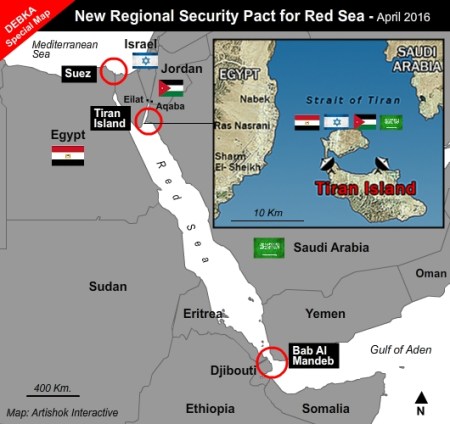
The US withdrew its forces from the Sinai Peninsula last weekend in retaliation for Egypt’s transfer of sovereignty over Tiran and Sanafir islands to Saudi Arabia, according to DEBKAfile’s military and intelligence sources. They also report that the move came after Washington protested to Egyptian President Abdel Fattah al-Sisi over its exclusion from the consultations and military coordination between Egypt, Saudi Arabia and Israel regarding the islands.

The US message was clear. Since Riyadh, Cairo and Jerusalem do not report their military steps in the Sinai Peninsula, the Gulf of Aqaba and the Red Sea to Washington, the US sees no need to inform them of its military steps in the Sinai.

That message was conveyed by the chairman of the US Joint Chiefs of Staff, Joseph F. Dunford, to the Egyptian president during their meeting on Saturday, April 23 in Cairo.

On Tuesday, DEBKAfile’s military sources reported that several days earlier the US military secretly withdrew about 100 of its officers and enlisted men from the multinational peacekeeping force in the northern part of the Sinai. As far as Riyadh, Cairo and Jerusalem are concerned, there is no doubt that it was a retaliatory measure.

US sources refused to specify the current location of the troops. The American force was withdrawn from El Gorah base, located next to the town of Sheikh Zuweid. Gen. Dunford told al-Sisi that the Obama administration is no longer willing to maintain forces in the northern Sinai following the recent shelling of the base by the ISIS affiliate in the restive area. The incident marked the terrorist organization’s first attack on US troops in the Sinai, but its second on an American force in the Middle East.

On March 19, ISIS shelled Fire Base Bell, a US marine base in Makhmur, northern Iraq, about 77 kilometers southeast of the terrorist organization’s de facto capital of Mosul. One marine was killed.

It was not by chance that shortly before he visited Cairo, Gen. Dunford made a visit lasting no more than 90 minutes to the US forward base to award purple hearts to four marines for their bravery during the ISIS shelling.

But while Washington is determined to maintain Fire Base Bell, where it has deployed HIMARS rocket launchers that can fire GPS-guided rockets known as GMLRS capable of reaching Mosul, and awards medals to soldiers serving at the base, it is not ready to treat its soldiers in the Sinai in the same manner because they have the status of multinational observers. Rather than giving out medals, it withdrew those soldiers immediately after the first ISIS attack.

At the same time, US sources launched an unprecedented personal attack on Egypt’s president over his decision to hand over the two islands to Riyadh. Articles attacking El-Sisi’s policy started to appear in the American media, with one saying “The decision to transfer the islands to Saudi Arabia may be the final nail in Sissi’s coffin.” It also described Egypt as being on the verge of a revolution against al-Sisi.

Two other Middle Eastern figures who were involved in Cairo’s decision regarding the islands were Saudi Deputy Crown Prince and Defense Minister Mohammad bin Salman and Israeli Defense Minister Moshe Ya’alon, who said recently that Cairo consulted Jerusalem regarding the transfer of the islands. However, his comment was not mentioned in US media reports, as if the development was not related to Saudi Arabia or Israel.

DEBKAfile’s military and intelligence sources report that one of the main reasons for Washington’s rage was the fact that Egypt, Saudi Arabia, Jordan and Israel decided to establish and coordinate by themselves a regional defense mechanism covering the Suez Canal, the gulfs of Suez and Aqaba, and the Red Sea.

The Obama administration prefers to ignore the fact that the US withdrawal of its naval and air forces from those areas over the last three years has enabled the Iranian fleet to start operating in those waters.

Blasphemy Convictions Intensify in Sisi’s Egypt

April 7, 2016

Blasphemy Convictions Intensify in Sisi’s Egypt, Front Page MagazineRaymond Ibrahim, April 7, 2017

(The author demands that President Sisi “do something,” but does not specify what he, as the president, is in a position to do legally. He does not control Al-Azhar University, nor can he require the courts to interpret or enforce the law as he wishes. He became Egypt’s president because millions of Egyptians were tired of his dictatorial predecessor. Would the author like to see Sisi emulate Morsi?

Egypt is an Islamic nation; Sisi can’t change that. At best, he can try to precipitate a gradual Islamic reformation.– DM)

al-sisi-660x330

Despite Egyptian President Abdel Fattah al-Sisi’s many pluralistic words and gestures—which have won him much praise from the nation’s Christians and moderates—he appeases the Islamist agenda in one very clear way: by allowing the controversial defamation of religions law, colloquially known as the “blasphemy law,” to target Christians and moderates in ways arguably worse than under the Muslim Brotherhood and Morsi.

Late last February, three Christian teenagers were jailed for five years for breaking the defamation of religions law. A fourth defendant, 15, was handed a juvenile detention for an indefinite period.   Earlier they were detained for 45 days and subjected to “ill-treatment” said a human rights group.

Their crime is to have made a 20-second video on a mobile phone mocking the Islamic State—which has been interpreted as mocking Islam.   In the video, the boys appear laughing and joking, as they pretend to be ISIS members praying and slitting throats.  The Egyptian Commission for Rights and Freedoms, an independent rights group, confirmed that the four teenagers were performing scenes “imitating slaughter carried out by terrorist groups.”  Even so, according to their defense lawyer, Maher Naguib, the Christian youth “have been sentenced for contempt of Islam and inciting sectarian strife…. The judge didn’t show any mercy. He handed down the maximum punishment.”

Considering that even Al Azhar—the Islamic world’s most prestigious university located in Egypt—refuses to denounce the Islamic State as being un-Islamic, it is unsurprising that mockery of ISIS is being conflated with mockery of Islam.

The Christian youth made the brief video back in January 2015, when three of them were aged 17 and one 15.  It is believed that the court kept delaying their case till the three 17-year-olds became 18, so they could receive the full penalty.  Their teacher who also appeared in the video had earlier been sentenced to three years in jail.

Several other Christians have been prosecuted for insulting Islam and Muslims under Sisi’s tenure.  One young Christian man was sentenced to six years for “liking” an Arabic-language Facebook page administered by Muslim converts to Christianity.  A female Christian teacher was imprisoned for six months after Muslim parents accused her of insulting Islam and evangelizing.  Bishoy Armia Boulous, a Muslim convert to Christianity, remains behind bars on, according to his lawyer, trumped up charges of blasphemy.

While Christian minorities are the most prone to being targeted by the blasphemy law, secular Muslim thinkers and writers are also on the hit list.  Late last January, female Muslim writer Fatima Naoot was sentenced to three years in prison after she criticized the sadistic slaughter of animals that takes place during the Islamic festival, Eid al-Adha.  The month before that, in December, television host Islam al-Behairy was sentenced to one year in prison for questioning the validity of some of the sayings (hadiths) attributed to Muslim prophet Muhammad.

Although Egypt’s constitution outlaws the “defamation of religions,” the plural indicates that, along with Islam, Judaism and Christianity are protected.   In reality, however, the law is almost exclusively used to prosecute Christian minorities and secular Muslims.   Despite the fact that there are many more Muslims than Christians in Egypt, rarely are Islamists arrested and prosecuted for defaming Christianity.

In this, Egypt is becoming more like Pakistan.  Although that nation also prohibits the defamation of religions—which technically includes Christianity—only Christians and moderates are targeted and imprisoned; some, like Asia Bibi, a wife and mother, are on death row.  Conversely, Muslims who openly defame Christianity—and they are many—are regularly let off one way or the other.  A few weeks ago a Muslim broke into a church and proceeded to burn its Bibles.  Although several Christians caught and handed him over to police, the latter claimed he was mentally unstable and could not stand trial.  Earlier, a Muslim shopkeeper started selling shoes which depict the Christian cross on their soles.  Christians demonstrated but police did nothing.

On January 26, soon after the sentencing of the writer Fatima Naoot, another moderate Muslim and television host in Egypt, Ibrahim Eissa, scathingly criticized the Sisi government, including by saying that “there have been more blasphemy cases and convictions during the Sisi era than during the Morsi era.”  He continued:

There is no greater contradiction between what the [Egyptian] state says and claims about itself and the reality on the ground…  The Egyptian state is schizophrenic because it says what it does not do….  It’s amazing and baffling to see a state who’s president regularly preaches about the need for religious discourse and renewal—and yet, during Sisi’s 18-19 month tenure, the nation has witnessed more reports, cases and convictions, and the imprisonment of writers, in the name of defamation religions than during the one year tenure of the Muslim Brotherhood president….  The [Sisi] revolution dropped the Brotherhood but kept the ideology unchanged.

The Bipartisan Enemy of the Good

April 5, 2016

The Bipartisan Enemy of the Good, Front Page MagazineCaroline Glick, April 5, 2016

secretary_kerry_with_president_al-sisi_july_2014

Originally published by the Jerusalem Post.

On March 25, The New York Times published an editorial effectively calling for US President Barack Obama to abandon the US alliance with Egypt.

The Obama White House’s house paper urged the president to “reassess whether an alliance that has long been considered a cornerstone of American national security policy is doing more harm than good.” The editorial concluded that Obama must “start planning for the possibility of a break in the alliance with Egypt.”

The Times’ call was based on an open letter to Obama authored by a bipartisan group of foreign policy experts that call themselves the “Working Group on Egypt.” Citing human rights violations on the part of the government of Egyptian President Abdel Fattah al-Sisi, the Working Group urged Obama to tie US financial and military assistance to Egypt to the protection of NGOs operating in Egypt.

The self-proclaimed bipartisan band of experts is co-chaired by Robert Kagan from the Brookings Institution and Michele Dunne from the Carnegie Endowment for International Peace. Among its prominent members are Elliott Abrams, Ellen Bork, Reuel Gerecht, Brian Katulis, Neil Hicks and Sarah Margon.

The Working Group has a history.

In January 2011, it called for Obama to force then Egyptian president Hosni Mubarak to resign from office. In so doing, it provided bipartisan cover for Obama’s decision to abandon the US’s most critical and dependable ally in the Arab world. Then, as now, the group’s esteemed experts argued that due to the regime’s infringement of human rights, the US could not in good conscience support it. Back in 2011, Israelis found a rare wall-to-wall unanimity of purpose in vocally and forcefully defending Mubarak from his American detractors. From the far Left to the far Right, from the IDF General Staff to the street, Israelis warned anyone who would listen that if Mubarak were forced out of power, the Muslim Brotherhood would take over and transform Egypt into a jihadist state.

Due in large part to the presence of senior Republican foreign policy hands on the Working Group, by and large Israel’s warnings were ignored in Washington. Facing the unusual Israeli consensus backing Mubarak was an American consensus insisting that “democracy” would ensure that a new liberal democratic Egypt would emerge out the ashes of the Mubarak regime.

The Americans chided us for repeating over and over again that the Muslim Brotherhood, the progenitor of al-Qaida, Hamas, Egyptian Islamic Jihad and every other major Sunni jihadist terrorist group around at the time, was a terrorist group.

We were attacked as “anti-democratic,” for insisting that the Facebook posters and twitterers on Twitter were in no position to replace Mubarak.

Who were we, the Americans scoffed, to point out that the “Facebook revolutionaries” were but a flimsy veneer which barely hid the Islamists from willfully blind Western officials and reporters who refused to admit that liberal values are not universal values – to put it mildly.

In the ensuing five years, every single warning that Israel expressed was borne out in spades.

Just as we said, right after Mubarak was forced from power, the Islamists unceremoniously dispatched with the Facebook crowd. The two million Islamists who converged on Tahrir Square to hear Sheikh Yussuf Qaradawi call for jihad and the Islamic conquest of Israel weren’t interested in democracy.

The women and Christians of Egypt soon realized, Mubarak’s overthrow, which paved the way for the Muslim Brotherhood electoral victories in 2012, did not expand their rights, it endangered their lives. As for the hapless Americans, immediately after Muslim Brotherhood leader Mohammed Morsi was inaugurated to serve as president of Egypt, the government began demanding that the US release from prison Omar Abdel Rahman, the so-called Blind Sheikh who masterminded the 1993 World Trade Center bombings. The US embassy in Cairo was the target of jihadist riots on September 11, 2012.

Then, since Morsi was elected democratically, none of this was any sweat off the back of Washington’s Egypt experts. They supported sending F-16s to his air force even after he hosted then Iranian president Mahmoud Ahmadinejad in Cairo, let Iranian warships traverse the Suez Canal and became a strategic ally of Hamas. They also supported his government, even though he enabled Libyan arms to flow through Egypt to Syria, transforming the war in Syria from a local dispute into the incubator for Islamic State – the precursor of which Morsi also gave a free hand to operate in the Sinai, in conjunction with Hamas.

The Americans didn’t reconsider their belief that Morsi was the guy for them, even after he allowed his Muslim Brothers to torch Coptic churches and massacre Christians. They didn’t revisit their support for the Muslim Brotherhood government even after Morsi arrogated to himself dictatorial powers that even Mubarak never dreamed of.

Perhaps if Morsi had been a responsible economic leader, and maintained the liberalization policies Mubarak enacted during his last five years in power, then defense minister Abdel Fatah Sisi wouldn’t have felt the need to remove him from power. After all, Morsi appointed Sisi to his position.

But in addition to ending even lip service to human rights, Morsi gutted the economy. By the time the military overthrew Morsi and the Muslim Brotherhood in the summer of 2013, Egypt had a mere $5 billion in reserves, and according to the World Health Organization, a quarter of Egyptians were starving.

So had the Muslim Brotherhood remained in power, Egypt would not have remained a democracy.

It would have become a jihadist state as dangerous as Iran, with the economic prospects of North Korea.

In other words, five years ago, there was no chance that a post-Mubarak Egypt would become a liberal democracy. There were only two options – a US-allied tyranny that fought jihad and maintained the peace with Israel, or a jihad state, aligned with Iran, that posed an existential threat to Israel, Jordan, the US and the international economy.

Those are still the choices today, but the stakes are even higher. Due to the Muslim Brotherhood’s year in power, the jihadist elements that gathered force in the Sinai over the past 20 years were able to organize as a more or less unified force, under the rule of Islamic State (ISIS), and in strategic alliance with Hamas. Like ISIS in Syria, ISIS in Egypt is an aggressive, dangerous group that stops at nothing to achieve its aims of expanding the ISIS empire.

The war it now fights against the Egyptian state is a total war.

To his credit, Sisi recognizes the nature of the threat and has taken steps to counter jihad that Mubarak never contemplated. The Egyptian leader recognizes that to defeat ISIS nothing less than a reformation of Islam is required. And so, in addition to fighting ISIS with everything he has, he is risking everything by taking on the jihadist belief system.

Sisi has mobilized the clerics at Al-Azhar seminary to develop an Islamic narrative that rejects jihad.

Sisi risks everything because everything is already at risk. If ISIS wins, Egypt is finished.

To win this war, he has publicly embraced Israel as an ally. He has openly sided with Israel against Hamas. Unlike Mubarak, Sisi has been fully willing to acknowledge that just because Hamas’s primary victims are Jews doesn’t mean that it isn’t a terrorist group that has to be destroyed.

Without putting too fine a point on in, for his fearless fight to the death with the forces of jihad – both in the mosque and on the battlefield – Sisi has already entered the pantheon, alongside Winston Churchill, of word historical figures. And yet, rather than embrace him and support him in his fight for Egypt and humanity, the same “experts” who called for Mubarak to be overthrown now urge Obama to abandon Sisi.

It is depressing that there is no magic bullet – like democracy – for the pathologies that afflict the Islamic world. But there is no magic bullet. And there are no easy choices for people who refuse to recognize that the natural state of man is neither liberal nor democratic.

But it is hard to accept the credibility of those who refuse to learn from their mistakes. It is harder still as well to listen to the “moral calls” of those who refuse to accept that because their past advice was heeded, thousands have died, and if their current calls are heeded, millions of lives will be imperiled.

Netanyahu’s dilemma: Détente with Turkey or recognition of Syrian Kurds

April 4, 2016

Netanyahu’s dilemma: Détente with Turkey or recognition of Syrian Kurds, DEBKAfile, April 4, 2016

obama_erdogan_best_friends_2012They were once good friends

Last Friday, April 1, President Reccep Tayyip Erdogan had his first encounter with a group of American Jewish leaders, at his request. The full details of its contents were hard to sort out because the Turkish translator censored his master’s words with a heavy hand to make them more acceptable to his audience. But Erdogan’s bottom line, DEBKAfile’s New York sources report, was a request for help in explaining to the Obama administration in Washington and the Netanyahu government in Jerusalem why they must on no account extend support to the Syrian Kurdish PYD and its YPG militia or recognize their bid for a separate state in northern Syria.

The Turkish president did not spell out his response to this step, but indicated that a Turkish invasion to confront the Kurdish separatists was under serious consideration in Ankara. His meaning was clear: He would go to war against the Kurds, even if this meant flying in the face of President Barack Obama’s expectation that Turkey would fight the Islamic State.

Relations between the Turkish and US presidents have slipped back another notch in the last two weeks. When he visited Washington for the nuclear summit, Erdogan was pointedly not invited to the White House and his request for a tete a tete with Obama was ruled out. The US president even refused to join Erdogan in ceremonially honoring a new mosque built outside Washington with Turkish government funding.

At odds between them is not just the Kurdish question, but Erdogan’s furious opposition to Obama’s collaboration with Russian President Vladimir Putin on the Syrian conflict, and the two presidents’ tacit accord to leave Bashar Assad in power indefinitely until a handover becomes manageable.

On Feb. 7, on his return for a Latin American tour, the Turkish president warned Obama that he must choose between Ankara and the Kurds, whom he called “terrorists.” By last week, the US president’s choice was clear. It was the Kurds.

ObamaErdogan480_Koteret

When Erdogan arrived home from Washington last week, he discovered that the roughly four million Syrian Kurds dwelling in three enclaves touching on the Turkish border had taken important steps to advance their goal for self-rule: They were drafting a plan for establishing a “Federal Democratic System” in their three enclaves – Hassakeh-Jazeera, Kobani and Afrin – and had announced the amalgamation of their respective militias under the heading the “Syrian Democratic Forces”.

Cold-shouldered in Washington as well as Moscow (since Turkish jets shot down a Russian fighter last November), Erdogan found himself let down by the Jewish leaders whom he tried to woo. They refused to support him or his policy on the Kurdish question for three reasons:

1. Ankara had for years consistently promoted the radical Palestinian Hamas organization. To this, Erdogan replied by denying he had backed Hamas  only acted to improve the lives of the Gaza population. And, anyway, he said he had reacyed understandings with Israel on this issue..

2. His hostility towards Egyptian President Abdel-Fatteh El-Sisi. Erdogan’s response to this was a diatribe slamming the Egyptian ruler.

3. No clear reply had been forthcoming from Jerusalem by that time on Israel’s relations with Turkey or its policy towards the Kurds, despite the Turkish leader’s positive presentation of  mended fences.

The current state of the relationship is laid out by DEBKAfile’s sources:

Prime Minister Binyamin Netanyahu is caught on the horns of multiple dilemmas: While reluctant to respond to Ankara’s suit for warm relations with a leader who is shunned by Obama and Putin alike, Turkey is nonetheless offering to be Israel’s best client for its offshore gas.

Israel’s friendship with the Kurdish people goes back many years. The rise of an independent or autonomous state in Syria and its potential link-up with the semiautonomous Kurdish region of Iraq would create an important new state of 40 million people in the heart of the Middle East.

Israel has no wish to make enemies of its longstanding friends by disowning them in favor of Turkey.

Already, Israel’s evolving ties with the Syrian Kurds have given Israel’s strategic position in Syria a new positive spin, upgrading it versus the Assad regime in Damascus and its Hizballah and Iranian allies, who are avowed enemies of the Jewish state. Those ties offer Israel its first foothold in northern Syria.

And finally, Erdogan is not the only opponent of Kurdish separatism; so too are important Sunni Muslim nations like Saudi Arabia and Egypt. By promoting the Kurds, Israel risks jeopardizing its rapidly developing ties with those governments.

The Sinai Insurgency is Spiking

March 29, 2016

The Sinai Insurgency is Spiking, Israel DefenseDr. Shaul Shay, March 29, 2016

(Please see also, Sisi asks Obama for military intervention to save Egypt from ISIS. — DM)

SianiPhoto: AP

On March 19, 2016, a terrorist attack on a checkpoint in the Safa neighborhood in southern Arish city resulted in the death of 15 police personnel. The victims were two police captains, a first lieutenant, and 12 conscripts. A police officer and two conscripts are still missing after the attack and the whereabouts of the three “missing” police officers are still unknown. Egyptian security forces killed five of the terrorists after violent clashes that lasted for two hours.

This attack is the last among a series of terrorist attacks that have targeted army and police centers in the Sinai Peninsula. The attack was the biggest in Sinai this year and the deadliest since July 2015. It could mark the return of Wilayat Sinai (Ansar Beit Al-Maqdis) to large-scale coordinated attacks after a period of limited operations against checkpoints and security personnel.

Wilayat Sinai has claimed numerous deadly attacks in the region recently, targeting mainly security forces. Earlier this week, an Egyptian soldier and police officer were killed during two separate attacks in the northern Sinai Peninsula. Gunmen affiliated with Wilayat Sinai shot and killed the officer outside his home in el-Arish. A soldier was also killed by a sniper in Sheikh Zuweid, which is not far from el-Arish.

The attack

The terror attack was carefully organized, suggesting it had long been planned. Wilayat Sinai surveillance personnel had probably observed the checkpoint for some time and that automatic weapons and an RPG were stashed nearby.

The checkpoint was close to a valley and olive farm, providing ground cover that the terrorists probably used to crawl undetected on the ground as they hid their weapons. When the suicide bomber struck, his cohorts were then able to fire on any survivors using their cache of weapons.

According to the prosecutor-general, the incident took place at 6.30pm on Saturday (March 19). Prosecutors say checkpoint personnel were subjected to mortar and RPG fire. Ambulances attempting to reach the scene of the attack also came under heavy gunfire.

Wilayat Sinai claimed responsibility

The Wilayat Sinai, which is affiliated with the Islamic State group, claimed responsibility for the attack. In a statement on Twitter, the group said the attack was “part of a series of operations in response to the humiliation and searching of Muslim women at checkpoints.”

The statement said a suicide bomber – Abul-Qaaqaa Al-Masri – drove an explosive-laden car into the security force and detonated it. The statement threatened more attacks in the future.

The response of the Egyptian security forces

President Abdel-Fattah Al-Sisi held a security meeting attended by the ministers of interior and defense, the army chief of staff and senior army and police commanders. Presidential spokesperson Alaa Youssef said Al-Sisi ordered the army and police to coordinate fully in the field.

Security forces were placed on high alert, and the decision was taken to continue targeting terrorist and criminal dens while simultaneously prioritizing the safety and security of civilians.

Egypt’s North Sinai prosecution began investigations into the attack. The prosecution has inspected the site of the attack and will later listen to the testimonies of eyewitnesses and officials in the checkpoint, judicial sources said.

A few days later, Egypt’s army executed an operation to get revenge for the army and police martyrs. The forces destroyed a number of militant hideouts in Rafah and Sheikh Zuweid cities in raids. An Egyptian Army spokesperson has said that 60 Islamic State group militants were killed after fighter jets targeted the group’s positions in North Sinai.

In a Facebook post detailing the outcome of the operation, Brig. Gen. Mohammed Samir said, “counterterrorism units backed by the air force” had “killed 60 terrorists, wounded another 40 and destroyed 27 four-wheel (drive) pick-up trucks south of Rafah and Sheikh Zayed.”

Egypt’s war against terror

A new report of the Tahrir Institute for Middle East Policy (TIMEP) think tank, shows Egypt suffered more than 100 attacks on average per month from January to August 2015, compared to around 30 attacks per month in 2014.

The attacks are also spreading around the country. Until June 2013 violence was mostly contained to North Sinai, but after the ouster of President Mohammed Morsi by Egypt’s military, reports of militant strikes are coming in from all over the country. In particular, Greater Cairo (the provinces of Giza and Cairo), Fayoum and Sharqia have seen a spike in incidents.

The insurgency in North Sinai has transformed into near-daily attacks, often with use of advanced weaponry. Civilians account for the majority of casualties in these strikes.

Another report of the Regional Center for Strategic Studies – the Cairo index of stability, confirmed that terrorist organizations in Egypt in 2015 have become more aggressive than ever before. The number of terrorist attacks reached 617 in 2015, compared with 349 in 2014. According to the same index, Sinai’s statistics are among the worst in Egypt, as the number of terrorist attacks there reached 90 in 2015.

Yet details of the index confirmed there was a crackdown on terrorist organizations following the attacks on Sheikh Zuweid (July 2015): The total number of terrorist attacks in Egypt from August to December 2015 dropped significantly to 64, compared with 170 in the same 2014 period. The escalation in the attacks in recent weeks indicates that Egypt’s efforts to eliminate terrorism in Sinai has not been successful.

According to Maha Abdel Azim (Egyptian streets, March 13, 2016), an estimated 2100 people were killed in North Sinai in 2015, including roughly 1800 described by the military as terrorists, 150 civilians, 40 police officers and conscripts, and 140 military personnel. Many civilians are direct victims of militant attacks or are killed by often unidentified shelling. Others were killed in the crossfires during clashes between the military and militant groups. The estimate is a roundup based on statements by the military spokesperson as well as reporting from Aswat Masriya and Ahram Online.

In January 2016, Islamic State wrote in its weekly magazine Naba’, which runs news from the group’s various branches, that the Sinai branch had killed 1,400 people – members of the military and police as well as collaborators and tribal fighters – in the previous 15 months. The Egyptian military has disputed this figure and said only 69 military personnel were killed in that period.

Summary

Egyptian forces are grappling with an Islamist insurgency based in North Sinai governorate, which spiked following the 2013 ouster of President Mohamed Morsi. The insurgency has killed hundreds of Egyptian security forces, while the armed forces have said their operations have killed Thousands of militants in the area.

One of Wilayat Sinai’s largest attacks came on July 1 ,2015, when car bombs targeted security checkpoints in Sheikh Zuweid. According to a statement from Egyptian army officials issued shortly after the attacks, 17 soldiers and more than 100 militants died.

The challenge of the ongoing terror attacks in Sinai demand a comprehensive response of military and civilian counter measures. Egyptian President Abdel Fattah al-Sisi announced last year to spend 10 billion Egyptian pounds ($1.28 million) on developing the Sinai Peninsula. Additionally, the current government has said that it recognizes the need to work with the local population and provide a development program for the region.

Egypt urgently needs to come up with proper long-term social, political, and economic strategies. Only a well-coordinated plan of dialogue with the local population, social and economic development and military and security crackdown on terrorism will return security and stability to the Sinai region.

Sisi asks Obama for military intervention to save Egypt from ISIS

March 28, 2016

Sisi asks Obama for military intervention to save Egypt from ISIS, DEBKAfile, March 28, 2016

Egyptian President Abdel Fatteh El-Sisi has sent a secret missive to President Barack Obama asking for urgent US military intervention in support of Egypt’s war on the Islamist State in Sinai, before the jihadis pose a real threat to Cairo. DEBKAfile’s exclusive intelligence and counterterrorism sources report that El-Sisi has come to the conclusion that Egyptian army lacks the ability to eradicate the terrorist peril without direct US military support.

In his note, he asks Washington to replicate in Sinai the format of US intervention in the war on ISIS in Iraq and Syria, namely, to send in special operations forces to establish bases and operate drones against jihadist targets. Unless stopped, he warns, the Islamic State is on the point of transforming the Sinai Peninsula into its primary forward base in the Middle East, bolstered by its branches of terror across North Africa, especially in Libya. US intervention is necessary to avert this.

So far, Sisi has received no answer from the White House and no sign of one in the pipeline.

Our military sources note that, given his record as former defense minister and a much-decorated general in the Egyptian army, an appeal to a foreign power for military assistance is out of character and would normally be found unacceptable in his own milieu. It must therefore be seen as a sign of extreme distress over Cairo’s failure to vanquish – or even contain ISIS, which now poses a strategic threat to Egypt proper.

In this situation, the generals in Cairo were dismayed to read a New York Timesleader on March 25, captioned “Time to Rethink US relationship with Egypt,” which faults the Egyptian regime’s human rights record and suggests that the relationship does Washington more harm than good.

The NYT concludes by saying, “Over the next few months, the president should start planning the possibility of a break in the alliance with Egypt. That scenario appears increasingly necessary.”

Since this article appeared out of the blue, it is feared in Cairo that it is President Obama’s way of spurring the Egyptian president’s SOS.

Some high-ranking military figures in Cairo have started talking about alternatives: If Washington refuses to come up with military assistance for fighting the Islamic State, perhaps the time has time to go elsewhere.
An Egyptian appeal to Moscow cannot be ruled out.


American Fascists and delicate little snowflakes

March 26, 2016

American Fascists and delicate little snowflakes, Dan Miller’s Blog, March 26, 2016

(The views expressed in this article are mine and do not necessarily reflect those of Warsclerotic or its other editors. — DM)

Fascists want to take away our freedom of speech. So do the delicate little snowflakes infesting our institutions of “higher learning.” How much worse will it get over the next few years? Substantially worse, I fear.

In the above video, Bill Whittle recounts numerous Fascist attempts to shut down those with different ideas. I’ll not repeat what he says. Instead, I’ll point out a few other Fascist efforts.

Islamist Fascists

In line with its “misconception” that Islam is the religion of peace and tolerance, the Obama administration has consistently courted the Muslim Brotherhood and its affiliate, the Council on American-Islamic Relations (CAIR) — which do everything they can to shut down all discussion of whether Islam is peaceful and tolerant and whether it should change. The Obama administration, following its lead, has ignored Muslim voices for reform.

What does Hillary Clinton think? Apparently that Islam is fine the way it is.

Ayaan Hirsi Ali has a different view.

220px-ayaan-hirsi-ali-vvd-nl-1200x1600

As I noted here, Ayaan Hirsi Ali is a former Muslim. She had been scheduled to receive an honorary degree from Brandeis University in April of 2014. However,

Brandeis University in Massachusetts announced Tuesday that it had withdrawn the planned awarding of an honorary degree to Ayaan Hirsi Ali, a staunch critic of Islam and its treatment of women, after protests from students and faculty.

The university said in a statement posted online that the decision had been made after a discussion between Ali and university President Frederick Lawrence.

“She is a compelling public figure and advocate for women’s rights, and we respect and appreciate her work to protect and defend the rights of women and girls throughout the world,” said the university’s statement. “That said, we cannot overlook certain of her past statements that are inconsistent with Brandeis University’s core values.” [Emphasis added.]

Ali, a member of the Dutch Parliament from 2003 to 2006, has been quoted as making comments critical of Islam. That includes a 2007 interview with Reason Magazine in which she said of the religion, “Once it’s defeated, it can mutate into something peaceful. It’s very difficult to even talk about peace now. They’re not interested in peace. I think that we are at war with Islam. And there’s no middle ground in wars.”

Ali was raised in a strict Muslim family, but after surviving a civil war, genital mutilation, beatings and an arranged marriage, she renounced the faith in her 30s. She has not commented publicly on the issue of the honorary degree.

. . . .

More than 85 of about 350 faculty members at Brandeis signed a letter asking for Ali to be removed from the list of honorary degree recipients. And an online petition created Monday by students at the school of 5,800 had gathered thousands of signatures from inside and outside the university as of Tuesday afternoon.

“This is a real slap in the face to Muslim students,” said senior Sarah Fahmy, a member of the Muslim Student Association who created the petition said before the university withdrew the honor.

“But it’s not just the Muslim community that is upset but students and faculty of all religious beliefs,” she said. “A university that prides itself on social justice and equality should not hold up someone who is an outright Islamophobic.” [Emphasis added.]

The Council on American-Islamic Relations (CAIR) also got into the act:

“It is unconscionable that such a prestigious university would honor someone with such openly hateful views.”

The organization sent a letter to university President Frederick Lawrence on Tuesday requesting that it drop plans to honor Ali.

This makes Muslim students feel very uneasy,” Joseph Lumbard, chairman of Islamic and Middle Eastern studies, said in an interview. “They feel unwelcome here.” [Emphasis added.]

On September 15, Hirsi Ali spoke at Yale University. The usual suspects did not want her to speak.

WFB Program president Rich Lizardo tells the story of events that followed the WFB Program’s public announcement of the event in the Yale Daily News column “We invited Ayaan Hirsi Ali to speak at Yale–and outrage ensued.”

Following the public announcement, the Muslim Students Association at Yale went through its usual routine, first seeking to have Ms. Hirsi Ali disinvited (though it disputes this), then to limit the subject matter of her speech, then to impose conditions on her speech that would stigmatize her. In the spirit of WFB himself, Lizardo stood firm.

The MSA routine worked at Brandeis; at Yale, not so much. Not this time.

Poor delicate little snowflakes. Isn’t it a shame that they might be exposed to new ideas that are alien to them? That they were not required to attend and listen to those ideas is, apparently, inconsequential. They did not anyone to listen to them.

Here’s a video of her remarks. The introductions are a trifle long and add little value. The questions she was asked at the end and her answers are, however, interesting. They begin at 55 minutes into the video.

When I posted the video here, I observed that

She seemed to be speaking less to the “choir” and more to a broader audience which she was trying to convince. To that end, she was as conciliatory as she could be without abandoning her thesis that Islam is the religion of repression, submission and death, not peace; that it is highly dangerous to Western civilization, including our concepts of freedom and democracy. “Radical” Islam is rising, becoming even worse and it must be defeated.

Even to try to defeat Islam, we need to defeat the increasing efforts to eliminate freedom of speech at home in favor of speech that is politically and multiculturally correct and therefore not free. [Emphasis added.]

On April 7, 2015, Hirsi Ali spoke at the National Press Club. Here’s a video of her remarks on the Clash of Civilizations, largely based on her book Heretic, which I later reviewed here. There, she writes optimistically of the possibility (but not the probability) of an Islamic revolution, someday.

There is a clash of civilizations. Muslims in Western countries generally refuse to help the police prevent Islamic terror attacks, such as recently occurred in Brussels.

There is a reason why Israel razes the homes of terrorists. It is because Israelis know that a terrorist cannot plot and carry out an attack without the knowledge and help of his or her immediate relatives, and further, the entire community. Punitive home demolition is meant to serve as a deterrent, the idea being that a would-be terrorist’s family will fear losing their home and thus persuade him or her against the attack.

In fact, knowing that it “takes a village” to aid and abet a terrorist is precisely why the terrorists responsible for the Paris and recent Brussels bombings could operate “right under the noses” of their victims. And it is why some are calling for heightened scrutiny of Muslim communities across the West, and right here in the U.S., despite cries of Islamophobia.

The MailOnline reports that police in Molenbeek — a district known for spawning jihadis like the France and Brussels attackers — have pleaded with local Muslims for help in finding the terror suspects only to have their pleas rebuffed.

Western nations which welcome and care for them are spit upon. “See something, say something” did not work before the San Bernardino Islamic attack. Perhaps those who saw something but said nothing remained silent because they feared being characterized as Islamophobes.

Here is a recent video of an interview with a teenage Yazidi girl who escaped the Islamic State. Is Islam the religion of peace and respect for females? For people of other religions?

https://www.youtube.com/watch?v=nhFcV3Q2ejM

In the unlikely event that any delicate little snowflakes watch it, will they be offended by its presence on You Tube, by the “lies” told by the Yazidi girl or by the truth of her statements?

Multicultural Fascists

Europe has many multicultural Fascists and Obama’s America has fewer. However, those who propagate the multicultural fantasy are winning. In the past, we sought immigrants who brought with them cultures compatible with ours. Now, Obama demands that we accept immigrants whose cultures of violence, drugs, gangs, crime and the like are not compatible. We have sanctuary cities where gang, other violence and drug smuggling and use are endemic. Although state efforts to enforce Federal immigration laws which the Obama administration refuses to enforce have been struck down by the judiciary, the Obama administration somewhat impotently challenged the sanctuary cities this year, only following pressure from the Congress.

Here is a video of remarks made by Victor Davis Hanson about one year ago on the travesty of “illiberal illegal immigration.” Illegal immigration breeds illegality across the board.

https://vimeo.com/122160603

A transcript of his remarks is available here. Here’s just a short snippet:

[I]t’s a controversial topic.  If I had said to you 20 years ago, 10 years ago, we’re going to get in a situation in the United States where 160,000 people are going to arrive at the border and break immigration law and we’re going to let them all in at once without any prior check, medical histories, you would think I was a right-wing conspiracist.  If I had said to you, we’re going to have a president who is going to not only nullify existing federal immigration law, but on 22 occasions prior to that nullification warn us that he couldn’t nullify it, or, if I had said, he’s not only going to nullify federal immigration law, which he said would be unconstitutional, but that he is going to punish members of ICE, the border patrol, who follow existing law rather than his own unlawful existing order, I could go on, but you’d all think this was surreal, Orwellian, it couldn’t happen.  Yet that’s the status quo as we look at it today.

Our borders are worse than porous; they are open and little effort is being made to keep criminals, drug dealers, gang members and other violent people out. While Obama has many “top” priorities, doing that is not among them.

As noted in a post at American Thinker,

Cultures are either consciously abandoned, or consciously enforced. The theory of multiculturalism has always been a tonic for simpletons, since it celebrates the perpetuation and imposition of an incompatible culture, still being practiced by those who carry it, upon a host culture with which it is mutually exclusive. Multiculturalism is entirely subversive. It is intended to force one or more cultures upon the hosts who do not want or need them. Since both cultures cannot successfully coexist within the host, which has its own successful working culture, the purpose of the exercise has always been fraudulent. The “melting pot” concept worked not because of the concept of multiculturalism, but as testament against it. Those who came here in our parents’ and grandparents’ generation consciously chose to abandon the cultures they left in favor of the American culture. They became Americans, embracing one culture.

If one was being less generous than to call multiculturalism a tonic for simpletons, it would be more accurate to say that modern leftist multiculturalism is actually a weapon. Its purpose is not to enhance the host, but to consume it. If the host’s culture is peaceful, it has no use for malcontents who insist upon the dominance of their native culture. Malcontents, in the form of angry and entitled guests, foment chaos and disorder. And yet, the leftists insist that we demonstrate our cultural superiority by abandoning the superiority of our own culture and importing incompatible languages, traditions, practices, and morals.

Here’s a snapshot of our current Southern border by Sharyl Attkisson:

Conclusions

The delicate little snowflakes who demand safe spaces from reality in what were once institutions of higher learning seem to be increasing in number. They are our next generation and will soon begin to elect those with whose milquetoast views they agree. It will be a sad day for America when our nation mirrors those “educational” institutions. Solutions? I have none to offer, other than the development of backbones by their university administrators and teachers; perhaps even by their own parents. Perhaps some little snowflakes will be told, “If you don’t want to be exposed to views inconsistent with those you already hold, don’t come here.”

Living in America should be an honor not granted those who despise and abuse her by coming illegally, by illegally bringing crime and violence or by supporting those who do. Falsely characterizing Islam as the religion of peace and tolerance should not be “who we are” as Obama claims. Most of us are not deluded fools, I hope.

Oh well. Somehow we got Obama as the Commander in Chief. Twice.

This message was posted just eight days before the recent Islamic attack in Brussels, Belgium:

https://www.youtube.com/watch?v=BsNXmQQSSp0


Op-Ed: Contemplating a US/Russia Alliance

February 16, 2016

Op-Ed: Contemplating a US/Russia Alliance, Israel National News, Ted Belman and Alexander Maistrovoy, February 16, 2016

Before Donald Trump’s blowout win in New Hampshire he shocked the world by saying he would allow the Russians to do the “dirty work” and would “let them beat the s*** out of ISIS also.”. Trump went further, “I have always felt that Russia and the United States should be able to work well with each other towards defeating terrorism and restoring world peace, not to mention trade and all of the other benefits derived from mutual respect,”

Putin, responded by saying: “He (Trump) says that he wants to move to another level of relations, to a deeper level of relations with Russia. How can we not welcome that? Of course we welcome it.”

The condemnation of Trump for his remarks was immediate but certainly not universal. Many American’s are beginning to see Russia in a new light.

Until the fall of the USSR, the 20th Century was dominated by an ideological struggle between American capitalism and Russian communism. But now that Russia has abandoned communism and the US is embracing socialism, as seen by the Sander’s victory in the New Hampshire primary, the two powers are more alike than ever before.

Now we have a different ideological struggle to contend with, namely a civilizational war between the Christian/Secular West and the Islamic Caliphate. They are inimical to each other. North America, Europe and Russia are natural allies in this struggle as they are different daughters of one civilization.

In the past, both Russia and the US have backed different Arab states or Muslim groups, including radical Islamists. The end result of this US/Russia enmity was to destabilize the ME and Europe and to allow an Islamic fifth column into America and Europe.

The reality is that Russia, Europe and the US desperately need each other. Together they can withstand the hydra of pan-Islamism with its countless heads (ISIS, al-Qaeda, Jabhat al-Nusra, Salafis, Muslim brothers, etc.), can stabilize the Middle East, the cradle of Islamic fanaticism and can stabilize Europe.

For Russia, the triumph of the Caliphate in any form will be a deadly threat to its “soft underbelly”: the Caucasus and Volga region with Tatarstan.

Penetration of Islamic militancy from Afghanistan into Central Asia means the appearance of the Islamists on the longest and vulnerable southeastern border of Russia.

From Europe’s point of view, a destabilized North Africa and Middle East is resulting in a mass migration of Muslims including radical Islamists which threaten to tear it apart and irreparably change it. This in turn will have dire consequences for both Russia and America.

Both US and Russia are not able to cope with the global “jihad” separately” especially when they are supporting different sides. Russia has no resources for a war against radical Islam made more difficult by western sanctions and pressure. The West, in spite of its material power, lacks the will needed to defeat such a savage and ruthless enemy.

Thus an alliance is imperative.

“New Middle East”

A new Middle East is in the making. It will not look like the “New Middle East” as envisioned by Shimon Peres.  Syria, Iraq and Libya are no more. Lebanon looks like it will also fracture due to the influx of 1.5 million Sunnis, either Palestinian or Syrian. Hezbollah Shia have been reduced from 40% to 25% of the population by this influx so expect a power struggle to ensue there.

Alawite Syria, a strong Kurdish state in the north of former Iraq and Syria, tribal unions in Libya, Druze enclaves in Syria, a Christian enclave in Lebanon and perhaps in Iraq, all will appear on the map of the new Middle East. They will all need the support, both militarily and diplomatically, of either the US or Russia. In this way, the west will be empowered to keep the radical Islamists out.

Russia already has supported the Kurdish PYD (Democratic Union Party) in northern Syria diplomatically (Kremlin insists on PYD’s participation in negotiations about the future of Syria) and by providing them with weapons. The US is also supportive of the Kurds but bas been restrained by Turkey’s insistence that the Kurds be denied independence.  If the US forms an alliance with Russia it no longer needs an alliance with Turkey.

The American embrace of the Muslim Brotherhood and Turkey must be seen as the aberration it is. Rather than support the Islamization of the Middle East and North Africa, America should fight it. Rather than embrace the Muslim Brotherhood and other Islamists, as Obama did, the US should embrace Russia.

Pressure could then be brought to bear on Turkey to change its Islamist allegiances and to allow greater autonomy to its 10 million Kurdish citizens who otherwise will want to join the newly formed Kurdistan.

The US, by destroying Qaddafi and Mubarak, greatly destabilized North Africa. By waging war against Assad, the US has destabilized the Middle East and Europe. What is needed now is that the US and Russia come together to strengthen President al Sisi of Egypt to enable him to defeat ISIS in Sinai and Libya. Russia should be invited back into Libya to assist in its stabilization.  Europe and Tunisia will also benefit from this stabilization as will African states to the south.

In addition, US and Russia should cut a deal for a political solution for Syria in which Syria is divided into three states based on ethnic lines; Alawite Syria in which Russia holds sway, Kurdish Syria which will join with Kurdistan in Iraq and a Sunni state amalgamating the Sunni areas of both Syria and Iraq.

Such a deal will involve cooperation between Russia, US, Turkey and Saudi Arabia. ISIS must be defeated and non-Islamist Sunnis must be put in charge. Saudi Arabia would have a major role in the creation and maintenance of such a state. It is not inconceivable that Jordan would in the end, amalgamate with this state given the number of Sunni refugees it is now host to. This state would serve as a bulwark to an expansionist Iran.

It is in the interest of Russia to placate Saudi Arabia so that Saudi Arabia will cut down on her oil production and allow the price of oil to rise. Saudi Arabia would be agreeable to doing so and to such a division of Syria if Russia would restrain Iran.

Iran

Today, Russia is the de facto ally of Iran and the US is a wannabe.  The Iranian star reached its zenith with the total capitulation of the US in the Iran Deal. Since then it’s been downhill all the way. Without the help of Russia they would have lost Syria as an ally and their connection to Hezbollah. But with that help, Russia is now calling the shots.

It wasn’t so long ago that Russia supported the sanctions on Iran and didn’t want to remove them because it meant the addition of Iranian oil to the world market and the weakening the already weak ruble. Kremlin couldn’t betray its ally but in fact (aside from rhetoric) will not object to a renewal of sanctions. This will save Russia from a powerful competitor in the energy market.

Moscow needs Iran primarily as a means to put pressure on the West but it can quite easily sacrifice it for the sake of strategic considerations. Iran is not a natural ally of Russian for it doesn’t have any historical or cultural connection similar to the connection both Serbia and Armenia have for example.

The View from the Kremlin

Since the 16th century, the main threat to Russia came from the West. Moscow was occupied by Poles in the 17th century and by Napoleon in the 19th century.  In 1941, the troops of the Wehrmacht came within a few kilometers of Moscow.  St. Petersburg was built by Peter Great to resist the invasion of the Swedes.

The collapse of the Soviet Union was a painful blow to Russia and the West took advantage of this collapse. The bombing of Serbia and recognition of Kosovo, the “color revolutions” in the former Soviet Union, NATO’s extension to the Baltic countries, and the constant hectoring of Russia on human rights served to undermine Russia and make her feel threatened. This formed the impetus for the revival of nationalism under the leadership of Vladimir Putin.

The US, Britain and France intervened in Libya in order to both destroy the Gadaffi regime and oust Russia.  Accordingly, they refused Russia’s mediation efforts.  Similarly they tried to oust Assad. But this time, Russia, who had lost its Mediterranean port in Libya was determined to keep its Mediterranean port in Syria.  After many years of death and destruction in Syria brought about by the desire of the US and Saudi Arabia to oust Assad, Assad was on his “death bed”. Russia and Iran doubled down on their efforts to support him. Russia supplied their air force and air defense radar systems and Iran provided more troops. As a result Assad has gained much ground and is in a much better negotiating position today.

During this period, Russia acquired Crimea from the Ukraine and supported an insurgency in eastern Ukraine. A majority of the population of both areas are Russian. The Russians didn’t understand why the West came to the defense of Ukraine. It’s impossible to believe that EU wanted to bring Ukraine into the EU given its large population and systemic corruption.  Moscow believes the West didn’t do so in order to protect the sovereignty of Ukraine but to weaken Russia.  Ukraine, after all, is the backyard of Russia, as Mexica is backyard of US and Corsica is backyard of France.

Last week Russia’s Prime Minister, Medvedev, urged a “more constructive and more cooperative relationship with Russia… I strongly believe that the answer lies with both more defense and more dialogue.”

Last week Henry Kissinger delivered a speech in Moscow in which he began:

“I am here to argue for the possibility of a dialogue that seeks to merge our futures rather than elaborate our conflicts. This requires respect by both sides of the vital values and interest of the other,”

And concluded,

“It will only come with a willingness in both Washington and Moscow, in the White House and the Kremlin, to move beyond the grievances and sense of victimization to confront the larger challenges that face both of our countries in the years ahead.”

Should the West want to pursue such an alliance, it must recognize Russia’s “Near Abroad” – its traditional zone of influence since the 18th century: Ukraine and Belarus, Crimea, whose history is inseparable from Russia, the Caucasus and Central Asia. Russia also seeks influence in Europe and in the Eastern Mediterranean. This is imperial policy but Russia is no longer obsessed with ideological madness.  Thus, it is possible to negotiate a rapprochement and to respect each other’s sphere of influence.

Israel is not an ally of Russia nor its enemy.  Israel and Russia agreed to respect each other’s spheres of interest in Syria. In addition, Moscow mediated in delicate situations between Israel and Hezbollah.  This model can be used on a global scale by the US.

It is of historical note that the Byzantium, otherwise known as the Eastern Roman Empire, fought a sustained battle against the Ottoman Turks, who had invaded, only to finally succumb in 1453.  The Turks changed the name of their capital city, Constantinople, to Istanbul.  The Ottoman Empire succeeded over the years in conquering more of Europe and finally laid an unsuccessful siege to Vienna in 1529. There followed 150 years of bitter military tension and attacks, culminating in the Battle of Vienna of 1683. This battle was won by the Holy Roman Empire of the German Nations in league with the Polish-Lithuanian Commonwealth thereby saving Europe from Islamic conquest.

What is needed today is a similar resolute stand by both east and west against the Islamic Jihad’s attempt to conquer Europe.

Will the old prejudices and enmity focused on Russia prevail over rational considerations and the instinct for self-preservation?

According to the Munich Accords just signed, perhaps not.

It now appears that Russia and the US have come to an agreement for the implementation of a ceasefire and a division of spheres of influence. The document was signed by 17 nations, including Saudi Foreign Minister Adel al-Jubayr for the Syrian opposition and Iran’s top diplomat Muhammed Javad Zarif in the name of the Assad regime.

DEBKA reports:

“The nub of the Munich accord was therefore the parties authorized to name the terrorists. This was spelled out as follows: “The determination of eligible targets and geographic areas is to be left up to a task force of nations headed by Russia and the United States.”

“This puts the entire agreement in the joint hands of the US and Russia. Lavrov emphasized, “The key thing is to build direct contacts, not only on procedures to avoid incidents, but also cooperation between our militaries.”

“The Munich accord therefore provided the framework for expanding the existing US-Russian coordination on air force flights over Syria to cover their direct collaboration in broader aspects of military operations in the war-torn country.

“Lavrov mentioned a “qualitative” change in US military policy to cooperate with Russia in continuing the fight against the Islamic State, but it clearly goes beyond that.”

“This pact as sets out a division of military responsibility between the two powers: The Americans took charge of areas east of the Euphrates, leaving the Russians responsible for the territory east of the river. “

Hopefully, this accord is just the beginning of a new alliance.
MB Apologists Arrive In U.S. For Anti-Sisi Rallies

January 22, 2016

MB Apologists Arrive In U.S. For Anti-Sisi Rallies, Investigative Project on Terrorism, John Rossomando, January 21, 2016

(Please see also, UK Review of Muslim Brotherhood: Top 13 Quotes. — DM)

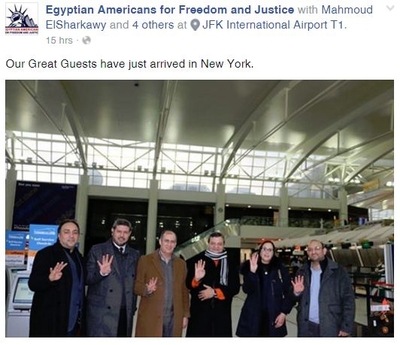
Three Muslim Brotherhood supporters who caused a row in Egypt last year after they met with Obama administration officials and members of Congress returned to the U.S. Wednesday, according to the Facebook page of Egyptian Americans for Freedom and Justice (EAFJ).

During their 2015 trip, Brotherhood leader Gamal Heshmat, former Egyptian Judge Waleed Sharaby and Maha Azzam, head of the Egyptian Revolutionary Council (ERC) lobbied State Department and White House officials for help against the government of Egyptian President Abdel Fatal al-Sisi.

The ERC formed in 2014 with the aim of toppling Sisi and bringing the Brotherhood back to power in Egypt. Sisi took power in 2013 after the Egyptian army ousted President Mohamed Morsi, the leader of the Muslim Brotherhood’s Freedom and Justice Party.

Heshmat has a long history of supporting Palestinian terrorists and was photographed in June 2014 with Hamas political chief Khaled Meshaal.

The State Department agreed with the delegation’s position that Sisi had not brought stability to Egypt, and that his removal would pave the way for a transition to democracy, Sharaby told Egypt’s Mekameleen TV in an interview last February. But that has not translated into concrete action to topple Sisi.

1341 (1)

EAFJ leaders Mahmoud El-Sharkawy, Hani Elkadi and Aber Mostafa greeted Heshmat, Sharaby and Azzam at New York’s JFK airport and posed for a picture with them displaying the Brotherhood’s four-fingered Rabaa salute which has become representative among those wanting the Brotherhood’s return to power in Egypt.

The three are scheduled to speak Friday at an event titled “Egyptian Revolution from Sacrifices to Victory” in North Bergen, N.J.

The event is timed to commemorate the Jan. 25 anniversary of dictator Hosni Mubarak’s fall from power in 2011. Heshmat wrote that his group had no plans to meet with Obama administration representatives during this visit, due to their “position biased” toward Sisi’s regime. They hope to speak with some congressmen, academics and others.

El-Sharkawy is a Brotherhood member and serves as liaison with Brotherhood members exiled in Turkey, Egypt’s Al-Bawaba newspaper reported last April.

He frequently reposts Muslim Brotherhood communiqués on his Facebook page. In December, El Sharkawy encouraged “all youth and revolutionaries” to distribute the official page of Brotherhood spokesman Muhammad Muntasir.

1342

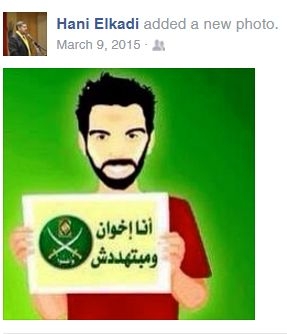
Elkadi seemed to self-identify as a Brotherhood member in a March 9 Facebook post showing an cartoon of a man holding a sign with the Brotherhood logo and the words which translate to, “I am [Muslim] Brotherhood and I’m not threatened.”

Last year, Elkadi, El Sharkawy and Mostafa posted graphics on their Facebook pages seeming to support violence in Egypt.

El Sharkawy and Elkadi posted a Feb. 10 communiqué from the Popular Resistance Movement (PRM) which has launched attacks against Egyptian police and other targets. It features an image of a blood-red map of Egypt with a fist superimposed over it. It claims responsibility for targeting two police cars. “God, martyrs, Revolution,” it said.

Mostafa posted the personal information of a pro-Sisi owner of an Egyptian soccer team with the word “Attaaack!” the same day.

The Inside Track From Israel’s Gaza Border Defenders

January 21, 2016

The Inside Track From Israel’s Gaza Border Defenders, Investigative Project on Terrorism, Paul Alster, January 21, 2016

1339Photos courtesy of IDF Spokesperson.

Like it or not, the Iran nuclear deal is done. In much of the Middle East, defense officials in many states believe that a sizeable proportion of the soon-to-be released $100 billion Iranian windfall will be directed toward funding proxy armies of the Islamic Republic, for whom the Jewish state remains the prime target. Israel’s focus is now, more than ever, on defense and surveillance.

In the north, Hizballah, Iran’s proxy Lebanese army, remains a massive threat to regional stability, siding with Syria’s disgraced President Bashar Assad and his saviors from Russia. In Gaza, it is no secret that a previous rift between Iran and Hamas has been smoothed over to further mutual objectives and that another, and possibly more brutal round of hostilities between Israel and Hamas may not be far away.

“The sanctions relief and the nuclear deal with Iran represent a strategic shift that the IDF will have to tackle over the next decade,” Israel Defense Forces (IDF) Chief of Staff Gadi Eizenkot said Monday in a speech at the INSS conference in Tel Aviv. “We also see [Iran’s] attempt to influence Arab Israelis and those in the Gaza Strip, and the estimation is that as Iran’s economic situation improves, over the next one-to-two years, it will divert considerably more resources into opposing Israel, via the Iranian military industry.”

Last week, the Investigative Project on Terrorism (IPT) saw first-hand the situation on Israel’s south-western border, meeting with a senior IDF source who cannot be identified for security reasons. Close to the Kerem Shalom border crossing, where Israel oversees the transfer of many hundreds of tons of goods and supplies every day into Gaza,  we scrambled up a sizeable sand dune that offered a panoramic view of the situation on the ground toward the closed Rafah crossing from Egypt into Gaza.

“We hear the explosions and the fighting [against the Islamists] on the Egyptian side. The Egyptian army is taking it seriously,” the senior IDF source explained as we looked across the triangular border junction and heard distant noises, apparently explosions. “We hear this every day. Terrorists continue to try to cross from Egypt into Gaza.”

Minutes later, a text message announced that the Keren Shalom crossing suddenly had been closed. It turned out that the Egyptian army reportedly engaged and killed 13 jihadists  just a couple of miles away. Two days earlier, an attempt to breach the Israel-Gaza border fence and plant an IED resulted in an Israeli airstrike reportedly eliminating a member of the Al Aqsa Martyrs Brigade.

Meanwhile, Hamas continues to test fire rockets into the sea, and in recent months other Islamic militants in Gaza sporadically lob rockets toward Israel. On the other side of the border triangle, Egypt is doing its best to keep a lid on ISIS and other Islamist forces in the Sinai Peninsula.

It’s clear that relations between the Israeli and Egyptian militaries are good, a dangerous common enemy helping to focus minds. Under President Abdel Fattah el-Sisi, Egypt (despite a lack of support from the United States), has taken the fight to the terror organizations, often at a significant cost in Egyptian military lives. The horrific October downing of the Russian passenger jet out of Sharm el-Sheikh brought the scale of the task facing Egypt into focus. Israel remains alert for the jihadists turning their attention and firepower from Sinai, but for now believes that Gazan-based terror poses its most immediate threat.

“It’s been quite quiet with Hamas [since the 2014 Protective Edge war], but they don’t keep quiet for long,” the IDF source said. “We’re not looking for a fight – we have an interest that there will be quiet here – but if we have to deal with Hamas, this time we’ll deal with them properly.”

Many Israelis were dismayed when Israel unilaterally pulled out of Gaza in 2014 without a ceasefire, some criticism coming notably from members of the left-wing opposition and media for allowing Hamas off the hook when many believed it was in utter disarray. Now, despite ongoing attempts to stem the flow of weapons, reports suggest Hamas is rebuilding fast and may have some surprises in store for Israel if there’s another round of fighting.

“Look, we’re quite certain they are still building tunnels,” the official said, planting his heel in the sand and showing how easy it is to dig. “And yes, I’m sure they have new weapons – anti-tank, anti-aircraft etc. Like us, they will want to be better next time, but we understand more. The reality is different. We’re learning all the time what is going in Gaza. The army is always preparing for the war to come and [Hamas] won’t meet the same thing as in [Protective Edge].”

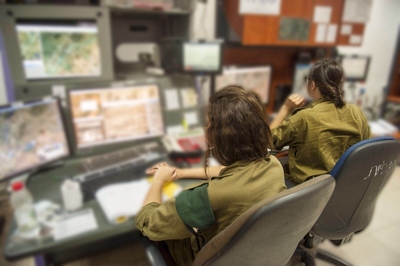
While Israeli soldiers and advanced technology such as its Guardium unmanned patrol vehicles are the first line of defense – the IDF indicated last year that the development of underground tunnel detection systems is also a priority project – the eyes of the military are actually in special units of female soldiers, known as the tazpitanyot. They monitor all movements, looking for suspicious activity, known terror operatives, and attempts to breach the border.

1340 (2)

They work in a series of non-descript trailers and shipping containers belying the fact that inside are massed banks of video screens and radar images, and the ability to combine pictures filmed from aerial blimps with other cameras – both day and night vision. This arrangement allows operatives to zoom in and see Gazans as far as a mile from the border fence.

When anything, or anyone suspicious pops up, there are pictures of ‘Wanted’ terror suspects close to the screens.  They instruct the on-the-ground forces to investigate. Never averting their gaze from the screen during a four-hour shift, each soldier has been trained to identify every landmark, tree, or rock within her specific area of surveillance. “If there’s even a single branch missing from a tree, they’ll spot it” the women’s commanding officer said. They also have remote control of the machine guns sited on border watch towers.

No security system is 100 percent foolproof, and during the first two weeks of the last round of fighting, four terror tunnels emerged on the Israeli side, only being detected at the last moment.  In two cases, the IDF fought gun-battles leaving  at least 10 terrorists and six Israeli soldiers dead. Hamas had hoped to kill civilians before luring Israeli soldiers back through the tunnels then kidnapping them or causing mass casualties.

Methods and practices of surveillance are being continually reviewed, but no-one in the Israeli military doubts the tatzpitanyot’s crucial front-line role in its border security, both north and south.