Clarion sources have noted that the military officially lists all mysterious deaths of Christians in the military as “suicides.” This shows the vast Islamist infiltration throughout Egypt despite President Sisi’s promise to do more for the Christians.
President Sisi fights many fronts and has a more difficult uphill battle than nearly any world leader in modern history.
No leader has ever spoken up for Christians the way President Sisi has. Sisi has actually done a great deal for Christians, and the Christian community recognizes that and appreciates it.
***************************
Christians have lost another fellow believer in Egypt. Ishak Ibrahim Fayez Younan, 37, had his throat slit in his Cairo home and was discovered by his brother, marking the fifth murder in only two weeks. Younan is one of many Christians who have had throats slit and been murdered for their faith.
Despite being in his home, nothing was taken indicating there was no motivation to rob Younan. We can assume his death, which follows a similar pattern of other recent murders in Egypt, was the result of his identification as a Christian in Egypt.
Younan had been working at a local factory that distributes soft drinks to grocery stores to support his wife and two children, ages 10 and 12, who now have no father.
Many citizens of Egypt are calling on President Abdel Fattah el-Sisi to do more for Christians in Egypt, but the underlying and deep-seated Islamist ideology and resentment against Christians seems to go beyond his capabilities as head of state.
Coptic Christians make up 10% Egypt’s population and suffer grave persecution, ranging from denial of jobs, burning of their churches and targets for assassination as in the case of Younan. In December 2016, a large number of churches were bombed and, according to CNN, more than two dozen people were killed with several more injured.
Likewise, many Christian soldiers in the Egyptian Army are facing the same fate because of their faith. Several Coptic soldiers have been the victims of mysterious deaths. In June of 2015, Bahaa Gamal Mikhail Silvanus, 23, was found dead in his office at the post where he was stationed. Silvanus suffered two gunshot wounds and critical blunt force trauma to his head.
Yet, military officials ruled that the cause of death was suicide. Only a few short months later, Baha Saeed Karam, 22, was found dead from four fatal gunshot wounds at his headquarters. Sources from both Silvanus and Karam’s friends and family say that they had been hassled several times by fellow soldiers to convert to Islam. Karam had received death threats from Islamic soldiers shortly prior to his death.
Clarion sources have noted that the military officially lists all mysterious deaths of Christians in the military as “suicides.” This shows the vast Islamist infiltration throughout Egypt despite President Sisi’s promise to do more for the Christians.
President Sisi fights many fronts and has a more difficult uphill battle than nearly any world leader in modern history. Here are some of the hurdles he faces in a country where Christian persecution has historically been among the worst:
1. Since the Muslim Brotherhood was criminalized, the Salafists in Egypt aligned themselves with Sisi to keep safe. Yet, their ideological beliefs that allow for violence against Christians remain rampant.
2. Any sudden movement by Sisi to denounce all Islamist oppressive ideology could result in riots and a loss of his popular support, especially considering the presence in Egypt of Al Azhar University, the seat of the world’s leading Islamic thinkers and teachers.Such broad denouncing could also prove more deadly for Egypt’s Christians who may be viewed as the ones to blame for Sisi’s crackdown on Islamists. No leader has ever spoken up for Christians the way President Sisi has.Sisi has actually done a great deal for Christians, and the Christian community recognizes that and appreciates it.
He has denounced all attacks on Christian churches and has continued to rebuild the destroyed churches in upper Egypt that Muslim Brotherhood sympathizers destroyed in 2013.
3. Brotherhood sympathizers will always hate Sisi, denounce his rule and try to prohibit him from receiving international support. We must never forget that Cairo is the birthplace of Islamist ideology and their genius suppression tactics. These tactics are in full force against the pro-Christian and pro-Israel President Sisi.
The Economist reported in December that “a massacre of Coptic Christians” in Egypt is underway, and identified “disgruntled Islamists” who are out to revenge Egyptian President Abdel-Fattah al-Sisi’s crackdown of the Muslim Brotherhood. Coptic Christians strongly supported el-Sisi’s ouster of his MB predecessor, Mohammed Morsi.
Former Unit 777 (an Egyptian military counter-terrorism and special operations unit) chief-of-staff Hatem Saber, who is also visiting professor at the Egyptian Military Academy and an expert in international terrorism movements, states that he considers “the Brotherhood the source of all current extremist militant groups” in Egypt.
Most Westerners are familiar with the stealth operations of the Muslim Brotherhood, but the Brotherhood also can and does resort to armed jihad depending on political climate.
Regrettably, the Brookings Institution boosts the Muslim Brotherhood. A Brookings Institution report declared that the MB “was left with no other option but to protest in a climate characterized by exclusion and McCarthyism” after Egypt’s military coup in 2013 that outlawed it and declared it a terrorist organization. The very nature of the MB from its founding is conquest and supremacicm; there is no way to appease it save to concede to its leadership, which el-Sisi has demonstrated that he is unwilling to do. El-Sisi said:
Vicious terrorism is being waged against the country’s Copts and Muslims. Egypt will emerge stronger and more united from this situation.
The Brookings Institution, which “bills itself as “the most influential, most quoted and most trusted think tank in the world,” was bought off by the Qatari government in 2013, when it received 14.8 million dollars, casting “a dark cloud” over its “lofty claim to credibility.”
Meanwhile, President Trump affirmed support for Egypt’s fight against terror in a phone call with el-Sisi three days after Trump’s inauguration.
“Coptic Teacher Shot in the Head by Radical Islamists as Attacks on Christians in Egypt Escalate”, by Stoyan Zaimov, Christian Post, February 17, 2017:
A 50-year-old Coptic Christian teacher was shot in the head by two Islamic militants in Egypt while on his way home from school Thursday, as attacks on Christians continues to rise at an alarming rate in the Muslim-majority country.
The Associated Press reported that the killing of Gamal Tawfiq took place in the coastal city of el-Arish when the teacher was attacked by two militants on a motorbike on his way home from El-Samran School.
Tawfiq’s death was confirmed by a school official, but no further details of the crime have yet been provided.
It’s the second murder of a Christian in less than a week in the same northern Sinai region, after suspected militants gunned down Bahgat Zakher, a local vet, on Sunday. Wale Milad, a merchant and Coptic Christian, was killed in late January after militants stormed his shop.
Copts make up only 10 percent of the nation’s 92 million population, and have often been victims of Islamic militants who have vandalized churches, Christian bookshops, orphanages, and other buildings.
As many as five Copts were murdered over a two-week timespan in January, with persecution watchdog groups criticizing the government for not doing enough to help protect Christians from such attacks.
“My brother had no enemies; he was a very simple man, and peaceful,” said a family member of one of the victims. “He left his wife and children to work in Cairo to support them. His family will now face difficulties as he was the primary bread-winner.
In December, Cairo’s largest Coptic cathedral was bombed by Islamic State terror group supporters, killing 25 people, including women and children, in what was one of the deadliest attack against Christians in Egypt in years.
President Abdul Fattah al-Sisi declared a three-day period of national mourning over the attack, insisting that the country stands against such violence.
“Vicious terrorism is being waged against the country’s Copts and Muslims. Egypt will emerge stronger and more united from this situation,” al-Sisi said at the time.
International Christian Concern, which monitors attacks on Christian communities worldwide, said that the bombing must serve as a “wakeup call to the Egyptian government and the international community that the Christian population in Egypt is in grave danger from religious attacks.”
“Entire Christian communities have been assaulted by mobs of Muslim radicals on four separate occasions in 2016 because there was a rumor that a church was being constructed. Now, we have witnessed one of the worst assaults on Egypt’s Christian community in years. More must be done to protect Christians and their places of worship in Egypt,” said William Stark, ICC’s regional manager….
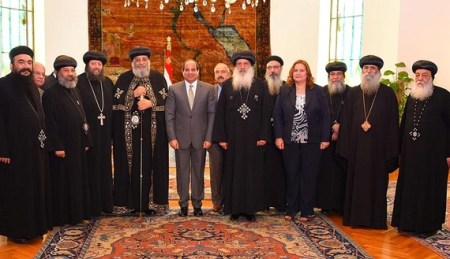
Egyptian President Abdel Fattah al-Sisi attends a meeting with Egyptian Coptic Pope Tawadros II, head of the Egyptian Coptic Orthodox Church, with some members of the Holy Synod of the Coptic Orthodox Church at the Ittihadiya presidential palace in Cairo, Egypt July 28, 2016 in this handout picture courtesy of the Egyptian Presidency.
“In addition to making a donation for the building of a church, [Sisi] also donated his money to establish a mosque, thus putting both communities [Christian and Muslim] on the same pedestal.”
**************************
CAIRO — Egypt’s Coptic Christians have become used to visits by President Abdel Fattah al-Sisi. On Jan. 6, for the third year in a row, Sisi celebrated Coptic Christmas at the Abbasiya Cathedral in Cairo, extending Christmas wishes to the country’s Copts and Tawadros II, the pope of Alexandria and patriarch of the See of St. Mark.
This year, the celebration was different. The cathedral where Sisi addressed the congregation and delivered Christmas wishes stands just meters from St. Peter and St. Paul Coptic Orthodox Church, where an explosion during a service on Dec. 11 claimed the lives of 27 people and wounded 48, mostly women and children.
Sisi responded to the attack not just by visiting the church, but by announcing a 100,000 Egyptian pound (roughly $5,200) personal donation toward building a church and mosque in the new administrative capital of New Cairo.
Hamdi Rizq, the host of the show “Al-Nazra” (“The View”) on satellite TV channel Sada al-Balad, reacted by announcing during his show Jan. 6 that donations were being collected for the building of a mosque and a church in the new capital.
Amina Naseer, a professor of religion at Al-Azhar University and a member of parliament, who also serves on the parliamentary education committee, said in a Jan. 7 phone call on “Al-Nazra” that she had also donated 100,000 pounds to be split equally between the mosque and the church.
During the same show, other donors came forward: Farag Amer, the chair of the parliamentary committee for youth and sport; member of parliament Mustafa Bakry; and businessman Mohammed Abul-Enein, the owner of the Sada al-Balad network.
“The president’s call for donations for a mosque and a church should be an example to all,” Alaa Wali, head of the parliament’s housing committee, told Al-Monitor. “I suggested setting up a fund to receive donations for places of worship in general, including for renovating churches damaged because of terrorist attacks, but the priority will be a mosque and a church in the administrative capital so they can be as beautiful as possible.”
Naseer told Al-Monitor she had urged all members of parliament to donate to the fund. “Those donations are for all Egyptians, not just for the Copts,” she said. “It is true that they will go toward building a church, but that is a reaction by all Egyptians against everyone who tries to impose a foreign mandate on us, as the US Congress tried to do.”
Naseer was referring to a bill debated in Congress on Dec. 28 that would require Egypt to report annually to the US State Department on its work to restore churches vandalized by members of the Muslim Brotherhood, which was toppled from power in July 2013. Egyptian Foreign Ministry spokesman Ahmed Abu Zeed rejected in a press statement issued on the same day the bill and the debate, calling it flagrant intervention in Egypt’s affairs.
While Sisi’s donation was welcomed by some, the suggestion that Egyptians should donate to the fund was slammed by his opponents. Lawyer Tarek Elawady wrote on Facebook Jan. 6: “Sir, Egypt does not need mosques and churches; it needs schools, factories and workplaces.”
Magda Ghonem, a professor of economics and rural development at Ain Shams University in Cairo, tweeted on Jan. 7: “We have a surplus of places of worship, no smaller than the surplus in outbidding and hypocrisy. What about building the biggest home for street children, or the biggest university, or the biggest training center?”
In a lengthy post on Facebook Jan. 7, Cairo University political science professor Hazem Hosny said that the state may not have allocated the necessary funds for a church or a mosque, rather intending to rely on donations made by the citizens. “The president made the first donation, but the whole thing is an attempt to get Egyptians to pay for the new capital under the pretext of building a mosque or a church,” Hosny wrote.
Political activist Mamdouh Hamza satirized Sisi’s donation, tweeting Jan. 7: “Donate for the building of a mosque or a church, because the faithful are lining up outside thousands of mosques and churches; there’s a critical shortage of places for prayer.”
While some critics played down the importance of building mosques and churches at the present time, other bloggers and anonymous activists condemned the idea of donating for church building on religious grounds, saying it violates Sharia.
“The Christian faith is in opposition with Sharia and Islamic doctrine on many issues,” a Salafist scholar who asked not to be named told Al-Monitor. “It is haram for Muslims to donate to the building of any institution that will be a base for discussion and promotion of anything that contradicts Sharia and Islamic doctrine.”
For his part, Abdel Fattah Idriss, a professor of comparative jurisprudence at Al-Azhar University, told Al-Monitor, “There is no jurisprudence proof or any sunna in the holy Quran that prohibits a head of state from donating funds for the building of a church or any other house of worship for the monotheistic religions. Islamic Sharia had approved of this as per Prophet Muhammad who gave the right for Jews of Medina to build their temples.”
Idriss said, “The donation made by a head of state is widely welcomed, as he is considered the [protector] of all communities residing in Egypt and has the complete authority to build houses of worship. Such donations strengthen people’s patriotism and make them feel part of the nation, qualities that Islam has always sought to instill.”
He added, “In addition to making a donation for the building of a church, [Sisi] also donated his money to establish a mosque, thus putting both communities [Christian and Muslim] on the same pedestal.”
A similar controversy broke out in 2009 regarding Sharia rulings on Muslim donations for the building of churches. The sheikh of Al-Azhar at the time, Mohammed Sayed Tantawi, met a delegation from the Egyptian Union for Human Rights, headed by Naguib Gibrael, an adviser to the Orthodox Church. The media reported he had ruled that Muslims donating for church building was permitted by Islamic law. His office denied the reports after a wave of opposition from scholars at Al-Azhar.
Egypt’s Dar al-Iftaa, a government body that advises on Islamic religious affairs, ruled on Jan. 7, 2016, “Christians in Egypt may, according to Islamic law, build churches if they need that for their worship, and Islam demands they be allowed to remain, according to the laws laid down by the Egyptian state. There is nothing in any reliable text on Islamic law to prohibit that.”
Sisi’s attempt to rein in the anger of the Copts after the bombing attack of St. Peter and St. Paul Coptic Orthodox Church thus prompted a range of criticism. But it appears that the opposition comes from a pre-existing state of antagonism between him and his critics who bemoan the lack of social, economic and educational progress in Egypt.
Yesterday saw a stunning contrast as it was revealed that the outgoing Barack Obama funded Palestinians as almost his last act in office, while Donald Trump’s first full workday saw him call Egypt’s President Al-Sisi to offer support in his battle against the Muslim Brotherhood, the Ikhwan, which seeks his overthrow.
It’s all about the Muslim Brotherhood, that octopus of Islamic supremacist jihad that seeks to use all methods — legal, violent, or deceptive – to advance the goal of a world ruled by Islam.
Former President Obama’s last few hours in office saw him override a Congressional “hold” placed on $221 million funding for the Palestinians, whose goal remains the destruction of Israel in line with the Muslim Brotherhood’s strategy. Matthew Lee and Rick Lardner broke the story for the AP:
A State Department official and several congressional aides said the outgoing administration formally notified Congress it would spend the money Friday morning. The official said former Secretary of State John Kerry had informed some lawmakers of the move shortly before he left the State Department for the last time Thursday. The aides said written notification dated Jan. 20 was sent to Congress just hours before Donald Trump took the oath of office. (snip)
Congress had initially approved the Palestinian funding in budget years 2015 and 2016, but at least two GOP lawmakers — Ed Royce of California, the chairman of the House Foreign Affairs Committee, and Kay Granger of Texas, who sits on the House Appropriations Committee — had placed holds on it over moves the Palestinian Authority had taken to seek membership in international organizations. Congressional holds are generally respected by the executive branch but are not legally binding after funds have been allocated.
That this move was a single digit salute to his opponents is evident in the other last minute beneficiaries of Obama’s granting of boons: the United Nations and climate change funding:
In addition to the $221 million for the Palestinians, the Obama administration also told Congress on Friday it was going ahead with the release of another $6 million in foreign affairs spending, including $4 million for climate change programs and $1.25 million for U.N. organizations
President Trump has come under fire for allegedly being anti-Muslim, when in fact his opposition is to violent jihad and those who promote world domination for Islam and the imposition of sharia law on every human being on the planet. Oddly enough, the women marchers on Saturday were led by a fan of sharia, Linda Sarsour.
Actually, President Trump sees good relations with Muslims who oppose violent jihad and the Ikhwan, and acted dramatically on that yesterday, as Reuters reports:
Egyptian President Abdel Fattah al-Sisi and U.S. President Donald Trump discussed ways to boost the fight against terrorism and extremism on Monday and the new American leader underscored his commitment to bilateral ties, the two countries said.
Trump told Sisi in a telephone call he appreciated the difficulties faced by Egypt in its “war on terror” and affirmed his administration’s commitment to supporting the country, Sisi’s spokesman Alaa Youssef said in a statement.
“The U.S. president also expressed during the call his looking forward to the president’s awaited visit to Washington which is being prepared for through diplomatic channels,” the statement said.
“The U.S. president also expressed during the call his looking forward to the president’s awaited visit to Washington which is being prepared for through diplomatic channels,” the statement said.
The people who want to inflict terror attacks on us support the Palestinians funded by Obama, while they want to force Sisi out of office. For the moment, I will leave it to historians to explain why Obama chose to align himself with the former group, and I thank God that president Obama [sic] is supporting President Al-Sisi, who has openly called for reform of Islam.
President Donald Trump assured Egypt’s Abdel El-Sisi that the US remains committed to bilateral relations with Cairo and is ready to offer Egypt economic assistance in the phone conversation they held Monday on economic issues and terrorism.
DEBKAfile: This was Trump’s second phone conversation with a Middle East leader after he talked to Israel’s Binyamin Netanyahu Sunday.
Sisi’s supporters say the Obama administration’s tolerance of Islamism and harsh criticism of Egypt’s counter-terrorism efforts have been an enormous obstacle. In contrast, Trump’s campaign expressed “strong support for Egypt’s war on terrorism” and pledged that “under a Trump Administration, the United States of America will be a loyal friend, not simply an ally, that Egypt can count on in the days and years ahead.”
**********************************
The recent terror attacks in Berlin and Zurich highlight once again the danger that radical Islamism poses to the West. While many are searching for ways to improve security and defeat the threat on the ground, few appear to appreciate that the decisive blow against Islamism can only be administered by leaders in the Middle East.
President-elect Donald Trumppledged during his last major foreign policy speech before the election to “be a friend to all moderate Muslim reformers in the Middle East” “amplify their voices.”
President Abdel Fattah el-Sisi and most of the political and media establishment in Egypt warmly embraced this policy. After meeting with the Republican nominee on the sidelines of the UN General Assembly in September, Sisi told CNN he had “no doubt” Trump would make a strong leader. Sisi was also the first Arab leader to telephone Trump after his election win.
Egyptian affections for Trump are partly fueled by distaste for former Secretary of State Hillary Clinton, who many Egyptians believe conspired with the Muslim Brotherhood to help elect Islamist Muhammad Morsi as president in 2012 (after which she was greeted in Egypt with protestors hurling tomatoes).
However, the main attraction of Trump in the eyes of many Egyptians is his staunch anti-Islamism.
Since coming to power in 2013, Sisi has spoken passionately about the need for an Islamic reformation. For Sisi, Islamism isn’t merely a ruinously bad blueprint for modern governance and a chronic source of security threats, it is also a wedge fueling outside hostility to Muslims, both Islamists and non-Islamists alike. In a 2015 New Year’s Day speech at al-Azhar University, the world’s most prestigious seat of Sunni Islamic learning, Sisi warned that the “corpus of [Islamic] texts and ideas that we have sacralized over the years” are “antagonizing the entire world” and “caus[ing] the entire umma [Muslim world] to be a source of anxiety, danger, killing and destruction.”
Not surprisingly, Sisi has faced opposition in the region, especially from Turkey, Qatar, and powerful figures in the Saudi royal family, who have opened their media to Brotherhood operatives to attack Sisi and even call for his assassination. One of the only Arab governments openly backing Sisi’s uncompromising stance on Islamists is the United Arab Emirates (UAE), which in 2014 designated the Muslim Brotherhood as a terrorist organization (along with two of its U.S.-based affiliates, the Council on American-Islamic Relations and the Muslim American Society).
Within Egypt, Sisi’s calls for a religious revolution have made him extremely popular, but he has faced fierce resistance from Islamists, who still dominate many sectors of Egyptian civil society and exert influence in government, particularly the judiciary.
Sisi’s supporters say the Obama administration’s tolerance of Islamism and harsh criticism of Egypt’s counter-terrorism efforts have been an enormous obstacle. In contrast, Trump’s campaign expressed “strong support for Egypt’s war on terrorism” and pledged that “under a Trump Administration, the United States of America will be a loyal friend, not simply an ally, that Egypt can count on in the days and years ahead.” Walid Phares, a foreign policy advisor for the president-elect, stated in an interview that Trump will work to pass legislation designating the Muslim Brotherhood as a terrorist organization.
Trump’s election appears to have emboldened Sisi to step up his Islamic reformation campaign. Just days later, Sisi pardoned 82 prisoners, among them Islam Behery, a former TV host and prominent leader of a growing neo-Mu’tazilah-style movement that claims Islamic scriptures are man-made and should not overrule reason and critical thinking.
Behery’s movement has gained sweeping popularity as horrors committed by Al-Qaeda, Islamic State, and other Sunni jihadist groups have mounted in recent years.
Many across the Arab world, and Egyptians in particular, are hopeful that the election of Donald Trump will open a new page of cooperation between the United States and those who are seeking to challenge Islamic extremism in the war of ideas. Only together can we defeat the Islamists wreaking carnage on the streets in the West.
Cynthia Farahat is a fellow at the Middle East Forum and a columnist for the Egyptian daily Al-Maqal.
The views expressed by authors are their own and not the views of The Hill.;
“The presidents agreed on the importance of affording the new U.S. administration the full chance to deal with all dimensions of the Palestinian case with a view of achieving a full and final settlement,” he added.
Sisi recently praised Trump and said he expected greater engagement in the Middle East from his administration.
******************************
Egyptian President Abdel Fattah al-Sisi on Thursday night spoke with U.S. President-Elect Donald Trump, Sisi’s office said, according to Reuters.
The call came hours after the UN Security Council postponed indefinitely a vote on Egypt’s draft resolution denouncing Israeli “settlements”.
“During the call they discussed regional affairs and developments in the Middle East and in that context the draft resolution in front of the Security Council on Israeli settlement,” said Sisi’s spokesman, Alaa Yousef.
“The presidents agreed on the importance of affording the new U.S. administration the full chance to deal with all dimensions of the Palestinian case with a view of achieving a full and final settlement,” he added.
Thursday’s vote on the UN Security Council resolution was reportedly postponed after Sisi instructed his nation’s delegation to push for a delay in the vote.
Trump had earlier called for the United States to veto the resolution, as it has traditionally done with similar proposals. American officials indicated that the Obama administration was planning to abstain from voting or even to vote yes.
Sisi recently praised Trump and said he expected greater engagement in the Middle East from his administration.
The Egyptian President has also been at the forefront of the effort to resume talks between Israel and the Palestinian Authority, having several months ago urged Israelis and PalestinianArabs to seize what he said was a “real opportunity” for peace and hailed his own country’s peace deal with Israel.
The comments were welcomed by Prime Minister Binyamin Netanyahu, who stressed that “Israel is ready to participate with Egypt and other Arab states in advancing both the diplomatic process and stability in the region.”
Palestinian Authority (PA) chairman welcomed Sisi’s call as well, saying he welcomed the Egyptian president’s efforts to achieve peace and establish a Palestinian state.
Trump’s statement might have had the greatest influence on the Egyptian decision, beyond Netanyahu’s lobbying or other American statements. “Diplomats in Tel Aviv speculating that Sisi didn’t cave because of Israel, but rather because he didn’t want to piss off incoming president,” Economist correspondent Gregg Carlstrom tweeted.
*********************
Egyptian officials scrapped a plan to proceed with a United Nations Security Council vote condemning the construction of Israeli settlements, following pushback from Israeli officials and President-elect Trump.
“Egypt requested the vote’s delay to permit them to conduct an additional meeting of the Arab League’s foreign ministers to work on the resolution’s wording,” Haaretz reported, citing Western diplomats. But the vote might be postponed “indefinitely,” according to the report.
Israeli settlement construction drew condemnation from the State Department earlier this year, in addition to the rebukes of more customary critics, raising fears in Israel and among congressional Republicans that President Obama might not veto a resolution on the matter in the waning days of his presidency. President-elect Trump stated his opposition to the resolution, as Israeli Prime Minister Benjamin Netanyahu was lobbying Egyptian President Abdel-Fattah El-Sisi to drop the resolution.
“The resolution being considered at the United Nations Security Council regarding Israel should be vetoed,” Trump said in a statement. “As the United States has long maintained, peace between the Israelis and the Palestinians will only come through direct negotiations between the parties, and not through the imposition of terms by the United Nations.”
House Speaker Paul Ryan, R-Wis., also called on the Obama administration to veto it.
Trump’s statement might have had the greatest influence on the Egyptian decision, beyond Netanyahu’s lobbying or other American statements. “Diplomats in Tel Aviv speculating that Sisi didn’t cave because of Israel, but rather because he didn’t want to piss off incoming president,” Economist correspondent Gregg Carlstrom tweeted.
Egypt is a temporary member of the UN Security Council, which is dominated by five permanent members — the United States, the United Kingdom, Russia, China, and France — which have the authority to veto council resolutions. Obama used that authority to block a similar resolution condemning Israeli settlements in 2011, but his administration’s increasingly public frustration with the failure of talks between Israel and the Palestinians raised the possibility that he wouldn’t veto it this time around.
Secretary of State John Kerry acknowledged the appeal of a change in policy when asked about a potential resolution to be authored by French diplomats. “If it’s a biased and unfair and a resolution calculated to delegitimize Israel, we’ll oppose it,” he said at the Haim Saban Forum on December 4. “But it’s getting more complicated now because there is a building sense of what I’ve been saying to you today, which some people can shake their heads, say, well, it’s unfair.”
Kerry emphasized that the Israeli settlements in disputed territory are not the cause of violence, but he argued that were nonetheless a “barrier” to an ultimate peace that was being tolerated by the Israeli government. “I’ll tell you why I know that: because the left in Israel is telling everybody they are a barrier to peace, and the right that supports it openly supports it because they don’t want peace,” Kerry said.
Egyptian President Abdel-Fatteh El-Sisi’s secret decision to intervene militarily in the Syrian war on the side of the Syrian President Bashar Assad is revealed here by DEBKAfile’s military and intelligence sources. The precise details of that intervention vary from source to source.
1. According to one version, a group of Egyptian helicopter pilots – 18, according to one estimate – landed secretly a few days ago at the Syrian Air Force base in Hama and were pressed at once into service for strikes against Syrian rebel forces.
Some sources describe the Egyptian flight crews as taking over the cockpits of Russian attack/reconnaissance Kamov Ka-52 helicopters, with which they were familiar, having trained on them since the end of 2015.
2. Others say that the Egyptian airmen flew those helicopters from Egypt to Syria over the eastern Mediterranean.
3. There is also a claim that their arrival was preceded by a preliminary inspection of the Syrian front lines by two major generals from the Egyptian general staff operations division, who later submitted their recommendations to the Egyptian president. It is not clear if they met the Russian commanders in Syria during that trip.
4. Others say the Egyptian generals headed a military delegation, which has set up a permanent mission in Damascus.
But every one of those sources agrees that, one way or another, Egypt has secretly entered the Syrian war in support of the Bashar regime – a development which has raised a firestorm in Arab capitals.
Saudi Arabia is particularly incensed over El-Sisi’s move. For years, Riyadh granted Cairo billions of dollars in aid, hoping this was an investment for procuring the Egyptian army as the stalwart protector of the kingdom and the Gulf emirates against Iran.
But towards the end of last year, Riyadh was affronted when the Egyptian ruler turned down an appeal for ground troops to support the Yemen campaign against Iranian-backed Houthi rebels. An eye-opener came when Egypt showed sympathy for Assad’s fight against extremist Islamist groups in the rebel movement, especially those associated with the Muslim Brotherhood, which El-Sisi has outlawed in Egypt as the sworn foe of his regime. Then, when Cairo supported Russian pro-Assad diplomacy at the United Nations, Saudi Arabia abruptly cut off financial assistance to Egypt and discontinued its oil shipments.
Donald Trump’s election this month as the next US president has already become the catalyst of a major reshuffling of Middle East alliances and stakes.
Some of its rulers, including El-Sisi, see the landscape changing and may be gambling on Trump reaching a deal with Russian President Vladimir Putin for joint military operations in Syria against the Islamic State and other Islamic terror groups, including the Al-Qaeda affiliate, the Nusra Front. The new bandwagon about to roll appears to favor Bashar Assad and his army.
The US president elect’s take on the Syrian ruler is expected to be markedly different to that of outgoing President Barack Obama, who castigated Assad, but held back from fighting him on the battlefield.
DEBKAfile reported exclusively on Nov. 21 that clandestine talks between Jerusalem, Amman and Damascus were afoot for the restoration of the demilitarized zone on the Golan and steps to stabilize their common borders in southern Syria.
Those talks are taking place with the knowledge of the Trump transition team and the Kremlin. They have already produced results in the return of UNDOF observers to their former posts on the Syrian Golan.
There are grounds to speculate now that the deployment of Egyptian aviators to Syria may be one more product of the secret inter-power diplomacy swirling in recent weeks over Syria’s bloody and intractable five-year war.
In the lead-up to the U.S. presidential election, it appears that the Egyptian regime under President ‘Abd Al-Fattah Al-Sisi prefers Donald Trump to Hillary Clinton as the next president of the U.S. After Al-Sisi met with both presidential candidates in September 2016, his spokesman, ‘Alaa Youssef, said that Egypt regarded both of them equally and that “the [last] word in the U.S. presidential election will be said by the American voters, and we have nothing to do with it.”[1] However, despite this statement, there are clear indications that the Egyptian administration favors Trump over Clinton, especially in light of what is perceived in Egypt as the latter’s support for the Muslim Brotherhood (MB) and her disapproval of Al-Sisi’s ouster of the Muhammad Mursi regime on June 30, 2013. This preference of the Egyptian regime is reflected in statements by Al-Sisi and his associates, as well as in reports and op-eds published in the Egyptian government press.
During his visit to the U.S. to attend the September 20, 2016 UN General Assembly, Al-Sisi met with both Hillary and Trump. However, the mood in his meeting with Clinton seemed formal and restrained; moreover, the Egyptians limited the media’s access to it (reporters were allowed to attend for only a few minutes and were forbidden to take pictures). Conversely, the mood of Al-Sisi’s meeting with Trump seemed open and friendly.
Reports on the meetings in the Egyptian and the global media stressed Trump’s positive stance towards the Egyptian regime versus Clinton’s more critical stance. For example, they emphasized that, during the brief part of the meeting attended by the media, Clinton had praised Egypt, but also implicitly criticized the state of human rights there, and said that she looked forward to talking about “the path we are taking in order to build up a new civil society, a new modern country that upholds the rule of law, that respects human rights and liberties.” Trump, on the other hand, did not bring up these issues in his meeting with the Egyptian president, but lavished praise on Egypt for its tough stance against terror and promised that, under a Trump administration, the U.S. would be “a loyal friend to Egypt,” not simply an ally.[2] Trump’s foreign policy advisor Walid Phares described the meeting between Al-Sisi and Trump as “historic” and noted that Trump was committed to “restoring the warmth to U.S.-Egypt relations, which are presently in a very difficult phase.” [3] Phares also claimed that in the meeting Trump had promised Al-Sisi to promote legislation in the U.S. to designate the MB a terrorist organization.[4]
Indications of Al-Sisi’s preference for Trump can be seen in his September 22, 2016 interview with CNN. In the interview, he said that Trump would no doubt make a strong leader, but when asked whether Clinton would make a good president, he replied evasively that “political parties in the United States would not allow candidates to reach that level unless they are qualified to lead a country the size of the United States of America.”[5]
As stated, the Egyptian regimes’ support for Trump and reservations about Clinton were also reflected in many op-eds published in the Egyptian press. The majority of articles in the government press expressed distaste for Clinton and warned that, in the case of a Clinton victory, Egypt and the entire region would face years of chaos and mounting terror. Some even predicted that a Clinton win would herald further deterioration in Egypt-U.S. relations, due to her insistence on interfering in Egypt’s affairs, such as human rights issues. These articles cited her support for the ouster of Hosni Mubarak and what they described as her positive stance towards the MB. It should be mentioned that, as early as 18 months ago, reports and op-eds in the government daily Al-Ahram have been claiming that Clinton’s personal aide, Huma Abedin, is a member of the MB and serves as Clinton’s liaison with the organization.[6] Conversely, only a minority of articles in the Egyptian press spoke negatively of Trump and/or expressed support for Clinton. Most of the ones that did were penned by senior MB official Gamal Heshmat and by journalists in the independent daily Al-Shurouq, which occasionally criticizes the regime.
This report will review the media discourse in Egypt for and against Trump and Clinton as president.
Pro-Regime Journalists: Clinton Is Bad For Egypt, Trump Is Better
In the days following Al-Sisi’s meetings with the two presidential candidates, the Egyptian government press published many articles and views by opinion-leaders and politicians expressing distaste for Clinton and hope for a Trump victory. For example, MP ‘Imad Gad, deputy-director of the Al-Ahram Center for Political and Strategic Studies, said that Clinton had performed poorly as secretary of state and had caused problems for Egypt, and even called her a liar. Conversely, about Trump he said that “if elected president, he will uproot the MB spirit from the White House and purge the [U.S.] state department of it… Trump will never support the MB. A Trump victory will be best for the interest of the Middle East and of Egypt as a civil state.”[7] Pro-regime journalist Wael Al-Abrashi said on his show on Dream TV that Egyptians tend to support Trump as the next U.S. president despite his racism, because they hate his rival Clinton, who, he said, is known for her support for the MB.[8] On his show on Sada Al-Balad TV, Journalist Ahmed Moussa, likewise a regime supporter, complained that the U.S. media supports Clinton and ignores “that poor guy” Trump, and accused Clinton and U.S. President Obama of “rigging the election.”
After Al-Sisi returned from his U.S. visit, the editor of the government daily Al-Ahram, Muhammad ‘Abd Al-Hadi ‘Allam, published a detailed article about the president’s meetings with world leaders and the messages he had delivered at the UN General Assembly. Addressing Al-Sisi’s meetings with Trump, whom he described as “a strong candidate who has proved his eligibility to [be president] throughout the campaign,” he stressed the importance of the meeting and devoted two paragraphs to enumerating the terrorism-related issues on which the two men had agreed. He also claimed that Trump had told Al-Sisi that “the June 30 revolution [i.e., Al-Sisi’s ouster of Mursi] had saved not only Egypt but the entire world.” As for Al-Sisi’s meeting with Clinton, ‘Allam mentioned it but did not describe its content or say anything positive about the Democratic candidate.[9]
Editor for Al-Yawm Al-Sabi’ Daily: A Clinton Victory Will Be A Catastrophe For The Region And The World
Op-eds in the Egyptian media leveled harsh criticism at Hillary Clinton. Karim ‘Abd Al-Salam, the acting editor of the daily Al-Yawm Al-Sabi’, wrote in a September 21, 2016 article that if Clinton won she would continue the policy of the Obama administration, whose relations with Egypt have been marked by tension and disagreements, whereas Al-Sisi’s meeting with Trump indicated that the latter would focus on cooperation with Egypt in combating terror and extremism. He wrote: “President Al-Sisi met with the two U.S. presidential candidates, Hillary Clinton and Donald Trump. At first glance, and judging from news agency and press reports, the meeting with Hillary was restrained… Hillary Clinton made no clear statement regarding what her policy [towards Egypt] would be were she to be elected U.S. president. During the meeting, she settled for underlining the importance of strengthening bilateral relations… and other such diplomatic statements made for the record, which conceal more than they reveal.
“The president’s meeting with Republican candidate Trump was totally different. During the meeting, Trump largely agreed with the president’s plan for combating terrorism and for economic growth, and at its conclusion he issued statements of explicit future support for Egypt and its president. The Republican candidate stated that he would be a powerful friend and ally of Egypt in all areas, while reiterating his full support for Egypt’s efforts to combat terrorism and for economic and military cooperation…
“Trump focused on the one topic that unites Cairo and Washington: the struggle against the shared enemy of extremism and terrorism. [Trump] explicitly committed to work together with the Egyptian leadership in order to overcome this danger, while Clinton did not address [this issue at all], even though terrorist attacks have reached New York.
“What does this mean? It means that Clinton’s election as president would entail a continuation of the confusion, disagreement, and chaos of the Obama years. Her administration will also focus on the issue of creative chaos, and on the forging of new societies in the Middle East, and will work pressure Egypt by raising the issues of human, minority, and gay rights. [A Clinton administration will also strive] to prevent Cairo from protecting its regional surroundings and security depth in Libya, Sudan, and Syria – not to mention the support that her administration will provide to violent and extremist organizations, chiefly the Muslim Brotherhood and Jabhat Al-Nusra [sic, now Jabhat Fath Al-Sham].
“Therefore, we must be well prepared for the possibility that Hillary Clinton will take the reins of power, despite my personal assessment that Trump will win the presidency, because a Clinton victory would bring four more catastrophic years for the Arab region, Europe, and the U.S. as well!”[10]
Al-Sisi’s meeting with Trump in New York (image: Al-Ahram, Egypt, September 21, 2016)
Al-Ahram Editor: Clinton’s Interference In Egypt’s Affairs Is A Red Line
In a September 25, 2016 article in Al-Ahram, Muhammad Sabreen, a columnist for the daily and a member of its editorial board, reviewed the two candidates’ positions on Egypt, claiming that Trump focuses on the common ground with Egypt – namely the war on terror – whereas Clinton interferes in Egypt’s internal affairs, which Egyptians regard as a “red line”. He wrote: “I believe that Hillary Clinton and her Democratic camp are trying to bring back warmer [relations with Egypt] than existed under Obama, while attempting to blackmail [the Egyptian regime] into bringing the political Islam organizations into Egypt’s political arena. On the other hand, Trump and his campaign are making grand promises about the importance and necessity of [U.S.] cooperation with Egypt. In an important and meticulously planned message, he says that under his presidency, the U.S. would be a friend on which Egypt could rely…
“Trump [seeks] to develop relations to the point of partnership, and later alliance, with Egypt, and the question is why. The answer was provided by Dr. Walid Phares, Trump’s foreign policy advisor, who explained that ‘the challenge of terrorism and ideological extremism is common to both countries’… Phares goes even further and says that Trump would work to place the Muslim Brotherhood on the list of designated terrorist organizations, and furthermore that Trump and his people see ‘Egypt as the first line of defense against terrorism.’ Conversely, Clinton has reverted to talking about her aspiration ‘to build up a new civil society, a new modern country that upholds the rule of law, that respects human rights and liberties.’
“I believe that most Egyptians agree in principle with [the values of] ‘a modern and democratic civil state,’ but strongly oppose Washington’s interference in Egypt’s internal affairs, or [Washington’s] linking [U.S. military] aid or partnership [between the two countries] to any ‘engineering’ of Egypt’s domestic political arena [by the U.S.]. This is and has always been a red line for the Egyptians…”[11]
Al-Ahram Columnist: A Clinton Victory Will Strengthen MB, ISIS
Rania Hefny devoted her October 7 column in Al-Ahram to a diatribe against Clinton, whom she believes is likely to win the election, saying that her victory would strengthen the MB and ISIS. She wrote under the title “The Implications of a Clinton Presidential Victory”: “The foreign policy of the candidate with the highest chance of winning the presidential election, Hillary Clinton, will be far more inflexible than Obama’s. She believes that the world’s problems will be solved more quickly if the U.S. is involved in the solution. [If she is elected,] Libya and Iraq are expected to return to square one. Clinton’s leadership of the American political arena will arouse the Muslim Brotherhood terrorist organization and the statelet Qatar, as well as ISIS – in whose creation she participated – and the focus will be on exporting the conflict to many kingdoms such as Saudi Arabia, Jordan, and Morocco. Beware, beware, beware…
“You would do well to remember that Hillary Clinton supported the escalation of the war in Afghanistan and pushed for the ongoing U.S. military presence in Iraq. She helped plan the attack on Libya, and encouraged Obama to bomb Syria without obtaining the support of the [UN] Security Council… It is known that every American president sees to Israel’s interest, and she has already stated that Israel’s security is non-negotiable. Do not be overly optimistic. Beware.”[12]
Al-Watan Columnist: Clinton Is Concerned About Human Rights Situation In Egypt While Ignoring Assad’s Crimes
In a September 28 column, Al-Watan columnist ‘Imad Al-Din Adib accused Clinton of employing a double standard because she demanded the ouster of former Egyptian president Hosni Mubarak but took a feeble stance vis-à-vis Syrian President Bashar Al-Assad, whose actions against his people are far worse than Mubarak’s were. He wrote: “The position of Ms. Hillary Clinton, the Democratic candidate for U.S. president, on Egypt’s domestic affairs is suspect and odd. Without getting into the dissemination of the well-known conspiracy theory regarding the ‘perpetual American wish to topple any national regime’ in Egypt, let us discuss our actual experience between January 25 and February 11, 2011.
“During the January 2011 revolution [against the Mubarak regime], Ms. Clinton was U.S. secretary of state, and it was she who advised the White House to pressure president Hosni Mubarak to immediately relinquish power, [saying] that it was unavoidable… Thus pressure was applied to president Mubarak… This sent a reassuring message to the rebels, the Muslim Brotherhood, and the military that Washington is withdrawing support for its old friend Hosni Mubarak and his regime… The astonishing thing is that the Americans did all this with Mubarak, yet since March 2011, that is, since the start of the popular rebellion in Syrian Deraa, they have not stated unequivocally that ‘Assad must leave now, and now means today!!!’
“They have not demanded [this] of Assad, who has murdered nearly 400,000 of his own people, wounded two million civilians, and expelled 11 million openly, in broad daylight! Washington has not demanded that Bashar Al-Assad of the barrel bombs, who uses missiles against civilians and chemical weapons against women, children, and the elderly, leave at once. The most it demanded in this matter was expressed in Obama’s recent UN statement, that it is unthinkable that Assad will play any role during the transitional period. Mubarak was warned to leave – but Bashar Al-Assad never was!
“What sort of standards is Washington adopting, and what [sort of standards] were implemented by Ms. Hillary when she was secretary of state? Washington bemoans the human rights situation in Egypt, but not the crushing human destruction in Syria! What standards does Ms. Hillary have?!”[13]
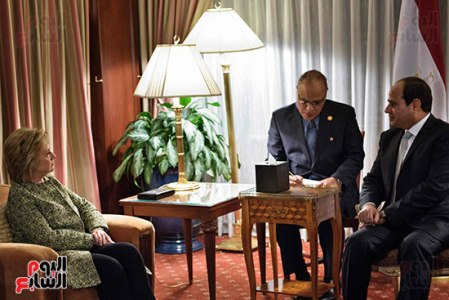
Al-Sisi’s meeting with Clinton in New York (image: Al-Yawm Al-Sabi’, Egypt, September 20, 2016)
MB Official, Independent Journalists: Clinton Is Better Than The Racist Trump
Conversely, an MB official, as well as journalists for the independent daily Al-Shurouq, which tends to be critical of the regime, expressed distaste for Trump and support for Clinton.
In response to the claim by Trump’s advisor that, if elected, he would promote legislation in the U.S. to designate the MB a terrorist organization, MB official Gamal Heshmat said that there was a great deal of similarity between Trump and Al-Sisi, because both of them “rely… on spreading fear among their people in order to justify the actions of violence, exclusion and takeover in which they believe and which they employ with [great] confidence under the pretext of fighting terror and promoting stability!”[14]
Dr. Osama Rushdi, an official in the Construction and Development party, the political branch of Al-Gama’a Al-Islamiyya, said that “it will be a great disaster if Trump becomes the U.S. president,” adding that he is “a racist and fascist” and threatens all Muslims, whereas Clinton is more rational. [15]
Al-Shurouq Editor: Trump Is An Enemy Of Mankind; Clinton Is A True Head of State
The independent daily Al-Shurouq published two articles against supporting Trump. The daily’s editor, ‘Imad Al-Din Hussein, wrote in a September 26 article that Trump was an “extremist and racist” and even “an enemy of most of mankind,” and that Clinton was the better candidate due to her experience. He wrote: “Which of the two would be better for Egypt as U.S. president, Hillary Clinton or Donald Trump?… Among many in Egypt, there is a widespread belief that a Trump victory would be better for us, since he promised to include the Muslim Brotherhood on the list of designated terrorist [organizations], while the Democratic Clinton opposes the June 30 revolution [i.e., Mursi’s ouster]. This impression might be partially true, but people forget that Trump is also an enemy of most of mankind, as he is an extremist and a racist, and repeatedly says that if elected, he would expel the Arabs and Muslims from the U.S. [These] extremist statements have not stopped since the beginning of his election campaign. Likewise, his victory would be the greatest of gifts for ISIS and for all the extremists in the region and in the world, because it would give them the best excuse of all for their extremism.
“It is true that Clinton was not enthusiastic about the June 30 revolution, but she is a true head of state. She is not a demagogue or a racist, and carefully weighs every word she says, as she spent eight years in the White House alongside her husband, president Bill Clinton, and for years was secretary of state during Obama’s first term. Conversely, Trump is rash, a radical extremist, and lacks any political experience.
“So which of the two is better for Egypt, Trump or Clinton? If Trump wins, we will temporarily gain a few nice slogans, but in the long run we will lose much, as Arabs and Muslims, if he implements his slogans. If Clinton wins, she may be somewhat reserved towards us, but not as much as Obama, and our relationship might stabilize in the long term…
“Therefore, those who think a Trump victory means a total reversal [of the U.S. position on Egypt] are deluding themselves. We must remember, for example, that every presidential candidate courts the Jewish lobby and promises to transfer their country’s embassy to Jerusalem, but that [when the time comes] they don’t, because of their interests vis-à-vis the Arab world.”[16]
Former Egyptian MP: Trump “Will Contribute To The World Becoming A Hell”; Hillary Is The Lesser Evil
The second Al-Shurouq article, also published on September 29, was by former Egyptian MP Mustafa Al-Naggar. He contended that Trump was no less dangerous for the world than Nazism and fascism, and condemned those who express support for him in Egypt, calling them extremist right-wing elements that pose a danger to Egypt itself. He wrote: “Under the influence of Ikhwanophobia [fear of the Muslim Brotherhood], the U.S. elections have become a new arena of schism in Egypt, for accusations of treason, and for classification by position on the candidates.
“It is no exaggeration to say that in recent days, and especially after the first televised debate, there is a sense [among Egyptians] that this election is not about the U.S., but about Egypt. There has been a resurgence of the tumultuous debate that is characterized by illogic, to the point where Hillary Clinton is described as a member and supporter of the Muslim Brotherhood. One of the lies [going around] is that Clinton is grooming an American woman who is of Pakistani descent and a Pakistani Muslim Brotherhood member [referring to Huma Abedin] to become secretary of state!…
“In general, it is odd that some in Egypt support Trump, the man who undoubtedly represents the worst of modern American extremism. He repeatedly spews racism in its ugliest form, and most of his positions clash with humanism and the values of tolerance and coexistence with which the world has come very far and from which there is no retreat…
“It is therefore foolish to argue that this despicable racist will combat extremism and terrorism. On the contrary, he will greatly contribute to the world becoming a hell. Therefore, his existence will justify the rise of terrorism, deepen the concept of the clash of civilizations, and inflame religious animosity among the peoples…
“Trump threatens not only the U.S., but the entire world. The rise of Trumpism on the global level effectively recreates messages of hate and the rise of the extreme right, evoking the era of Nazism and Fascism in Germany and Italy that led the world to bloody wars that claimed millions of lives. Who wants that again?
“In effect, the U.S. is not run by a single person, but by enormous institutions of decision-makers. However, the election of an extremist and racist president, who will appoint an administration that shares his mentality, will cause many problems for America and for the world.
“This does not mean that Hillary Clinton is an angel who will do good for the world and Arab countries. But a choice between two bad things does not mean choosing the better one, but choosing the lesser evil. We have no voice in the U.S. presidential race. But we hope that the Americans will throw out the preachers of hatred and the racists, and send a message to the world that they oppose the insane campaign on which Trump and his ilk are leading them…
“[In order to cure] the delusions of the Trump supporters in Egypt, there is first a need for psychological treatment, and [only] then rational and ideological refutation. This group of extremists in Egypt that reflects the rise of a secular right wing is no less dangerous than the religious right. We must deal with it by disproving and dismantling the terminology of this message, and by making the public aware of its risks and consequences for Egypt…”[17]
Other Articles: Trump And Clinton Are Equally Bad
Also published in the Egyptian press were some articles claiming that Trump and Clinton would be equally bad for Egypt. Tarek Fahmy, a professor of political science at the American University in Cairo, told the Al-Yawm Al-Sabi’ daily that America is choosing between bad and worse and that there was essentially no difference between the two candidates in terms of foreign policy.[18]
Mursi ‘Atallah, the former board chairman of the Al-Ahram Foundation, wrote on September 21 that the debate about which is better, Clinton or Trump, was boring since both of them hate Arabs more or less to the same degree. He wrote: “As happens every four years, the Arab analysts and intellectuals are preoccupied with finding an answer to the traditional question: Which is better, an American president from the Democratic party or from the Republican party? The public has wearied of the recurring scenes of this boring play that repeats every four years. Even if the protagonists of this play are different, nothing in the discourse is, not even one single line.
“There is no difference between Reagan and Carter or Hillary Clinton and Donald Trump. The Republicans and the Democrats are two sides of the same coin.
“If the Republican candidate Donald Trump presents himself as an openly hostile enemy of the Arabs and Muslims, there are those who forget that Hillary Clinton harbors no less hostility and hatred [towards them] than Trump, but only softens it outwardly…”[19]
* Y. Graff is a research fellow at MEMRI; H. Varulkar is Director of Research at MEMRI.
 A woman cries as Christians pray in the street outside the orthodox church of the Virgin Mary during the official funerals for victims of a December church bombing that killed 25, mainly women and children.(Photo: © Chris McGrath/Getty Images)









 anneinpt
 artaxes
 danmillerinpanama
 davidking1530
 Peter Hofman
 Joseph Wouk
 Peter
Peter Louisiana Steve
 WarSclerotic
Recent Comments