Posted tagged ‘Sanctions’

Can and should Israel destroy Iran’s nuclear facilities?

April 5, 2015

Can and should Israel destroy Iran’s nuclear facilities? Dan Miller’s Blog, April 5, 2015

(The views expressed in this article are mine and do not necessarily reflect those of Warsclerotic or any of its other editors. — DM)

It has been suggested that Israel should seriously consider destroying Iranian nuclear facilities, but Israeli officials obviously haven’t said, and won’t say, if, how or when she might.

Iran fenced in

Speaking to Arutz Sheva Friday, Professor Efraim Inbar, who heads the Begin-Sadat Center for Strategic Studies, said the deal had realized Israel’s worst fears by leaving Iran’s nuclear program essentially intact.

The Islamic Republic’s nuclear program has been granted “legitimacy” by the agreement, which still allowed it to continue enriching uranium and to maintain a reactor capable of producing enriched plutonium, he said. “And that’s what worries Israel, that they (Iran) will be able within a short time frame to reach a nuclear bomb.”

“I hold the view that the only way to stop Iran in its journey to a nuclear bomb is through military means,” Inbar maintained, suggesting that “Israel needs to seriously consider striking a number of important nuclear facilities” to head off the threat.

On March 28, former U.S. Ambassador Bolton said that it should be done.

The P5+1 nuclear “deal,” proudly announced by President Obama on April 2nd, is a sham. There is no “deal,” and public announcements by Iran and Obama cast it in very different lights. According to Iran, all sanctions will be lifted immediately when an agreement is reached on or before June 30th. According to Obama, sanctions relief will be gradual and based on Iran’s compliance with invasive inspections and other conditions. Even National Public Radio (NPR) has pointed out differences. NPR observed that, according to Iran,

all sanctions relief – U.N., EU and U.S. – would be immediate. It was unequivocal. It stated that Iran under the deal was free to pursue industrial scale enrichment to fuel its own reactors – unequivocal. It stated that Iran was unhindered in its ability to conduct centrifuge R&D.

Iran has also emphasized that its intention to destroy Israel is non-negotiable, and the Obama Administration has rejected any efforts to make Iran recognize Israel’s right to exist, on the ground that

“This is an agreement that is only about the nuclear issue,” State Department spokeswoman Marie Harf told reporters on Friday night, according to Fox News. “This is an agreement that doesn’t deal with any other issues, nor should it.” [Emphasis added.]

Israeli Prime Minister Netanyahu has said that Israel’s right to exist is non-negotiable.

Iran is very unlikely to retreat from its perception of the “deal,” Obama is very likely to retreat in Iran’s favor, and Israel is very unlikely to retreat from its perceptions about Iran, the “deal” or Israel’s right to exist.

What should Israel do?

In Martin Archer’s novel Islamic War, which I reviewed here, Israel dispatched elderly, large and substantially refurbished remove controlled aircraft, full of high explosives, from Somalia to half dozen nuclear facilities operated by hostile nations. They flew circuitous routes at varying altitudes to avoid detection until it was too late to stop them. Over a period of weeks, they crashed into and destroyed their targets, amid speculation about who had done it and why. Israel was not suspected. Would that have been possible then? Now? I don’t know.

It has been reported that Saudi Arabia has given Israel clearance to use her airspace for an attack on Iran’s nuclear facilities.

Fox News reports that US Defense sources claim the Saudis are conducting tests on their air defense systems after giving Israel permission to to enter a narrow corridor to shorten the distance to attack Iran.

The testing would make sure that Saudi jets don’t get scrambled when Israel entered Saudi airspace. Once the IAF planes complete their mission and exit Saudi airspace, Saudi defenses would go back online again. [Emphasis added.]

Might Saudi Arabia, Egypt and perhaps other Gulf States go beyond not interfering with an Israeli attack to provide air support and other help? They seem to be as displeased with the “deal” as Israel is.

Assuming that Israel is not overly concerned about being identified as the attacker and is willing to act alone, she might:

Detonate one or more high-altitude atomic bombs to emit sufficient electromagnetic pulses (EMP) to fry all above-ground Iranian electronics. That would substantially disable Iranian above-ground command and control facilities as well as other communications, hence diminishing (but not eliminating) the possibility of counter-strikes by Iran and/or its proxies. Perhaps she has other, non-nuclear, means of generating EMPs; she hasn’t said.

Immediately thereafter, drop whatever suitable bombs she may have on all Iranian military and nuclear facilities. Does Israel have bunker-buster bombs? Probably not of U.S. manufacture, but that does not mean that she has not developed her own. It would be surprising if she had not.

Obama and other “leaders of the free world” would complain and the U.N. would emit fits of angry censures. However, that happens with great frequency in any event, and would be an insufficient reason for Israel to commit national suicide through inaction against Iran.

I am no “military expert” and would appreciate any comments on the suggestions I have made as well as any other suggestions anyone might care to offer.

COLUMN ONE: The diplomatic track to war

April 3, 2015

COLUMN ONE: The diplomatic track to war, Jerusalem Post, Caroline Glick, April 4, 2015
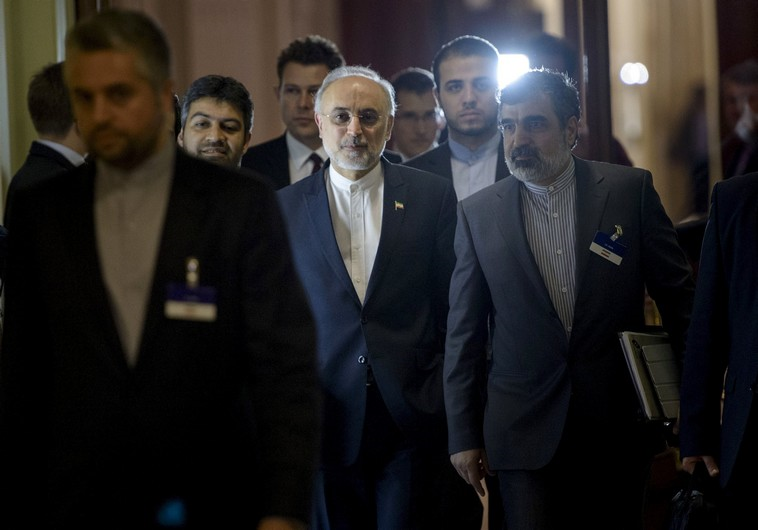
Iran negotiationsIran negotiations. (photo credit:REUTERS)

No one trusts Washington when Obama claims that he is committed to the security of Israel and the US’s Sunni allies in the region.

Iran is far more powerful than the PLO. But the Americans apparently believe they are immune from the consequences of their leaders’ policies. This is not the case for Israel or for our neighbors. We lack the luxury of ignoring the fact that Obama’s disastrous diplomacy has brought war upon us. Deal or no deal, we are again about to be forced to pay a price to maintain our freedom.

********************

Through their nuclear diplomacy, Obama and his comrades started the countdown to war.

The world powers assembled at Lausanne, Switzerland, with the representatives of the Islamic Republic may or may not reach a framework deal regarding Iran’s nuclear program. But succeed or fail, the disaster that their negotiations have unleashed is already unfolding. The damage they have caused is irreversible.

US President Barack Obama, his advisers and media cheerleaders have long presented his nuclear diplomacy with the Iran as the only way to avoid war. Obama and his supporters have castigated as warmongers those who oppose his policy of nuclear appeasement with the world’s most prolific state sponsor of terrorism.

But the opposite is the case. Had their view carried the day, war could have been averted.

Through their nuclear diplomacy, Obama and his comrades started the countdown to war.

In recent weeks we have watched the collapse of the allied powers’ negotiating positions.

They have conceded every position that might have placed a significant obstacle in Iran’s path to developing a nuclear arsenal.

They accepted Iran’s refusal to come clean on the military dimensions of its past nuclear work and so ensured that to the extent UN nuclear inspectors are able to access Iran’s nuclear installations, those inspections will not provide anything approaching a full picture of its nuclear status. By the same token, they bowed before Iran’s demand that inspectors be barred from all installations Iran defines as “military” and so enabled the ayatollahs to prevent the world from knowing anything worth knowing about its nuclear activities.

On the basis of Iran’s agreement to ship its stockpile of enriched uranium to Russia, the US accepted Iran’s demand that it be allowed to maintain and operate more than 6,000 centrifuges.

But when on Monday Iran went back on its word and refused to ship its uranium to Russia, the US didn’t respond by saying Iran couldn’t keep spinning 6,000 centrifuges. The US made excuses for Iran.

The US delegation willingly acceded to Iran’s demand that it be allowed to continue operating its fortified, underground enrichment facility at Fordow. In so doing, the US minimized the effectiveness of a future limited air campaign aimed at significantly reducing Iran’s nuclear capabilities.

With this broad range of great power concessions already in its pocket, the question of whether or not a deal is reached has become a secondary concern. The US and its negotiating partners have agreed to a set of understanding with the Iranians. Whether these understandings become a formal agreement or not is irrelevant because the understandings are already being implemented.

True, the US has not yet agreed to Iran’s demand for an immediate revocation of the economic sanctions now standing against it. But the notion that sanctions alone can pressure Iran into making nuclear concessions has been destroyed by Obama’s nuclear diplomacy in which the major concessions have all been made by the US.

No sanctions legislation that Congress may pass in the coming months will be able to force a change in Iran’s behavior if they are not accompanied by other coercive measures undertaken by the executive branch.

There is nothing new in this reality. For a regime with no qualms about repressing its society, economic sanctions are not an insurmountable challenge. But it is possible that if sanctions were implemented as part of a comprehensive plan to use limited coercive means to block Iran’s nuclear advance, they could have effectively blocked Iran’s progress to nuclear capabilities while preventing war. Such a comprehensive strategy could have included a proxy campaign to destabilize the regime by supporting regime opponents in their quest to overthrow the mullahs. It could have involved air strikes or sabotage of nuclear installations and strategic regime facilities like Revolutionary Guards command and control bases and ballistic missile storage facilities. It could have involved diplomatic isolation of Iran.

Moreover, if sanctions were combined with a stringent policy of blocking Iran’s regional expansion by supporting Iraqi sovereignty, supporting the now deposed government of Yemen and making a concerted effort to weaken Hezbollah and overthrow the Iranian-backed regime in Syria, then the US would have developed a strong deterrent position that would likely have convinced Iran that its interest was best served by curbing its imperialist enthusiasm and setting aside its nuclear ambitions.

In other words, a combination of these steps could have prevented war and prevented a nuclear Iran. But today, the US-led capitulation to Iran has pulled the rug out from any such comprehensive strategy. The administration has no credibility. No one trusts Obama to follow through on his declared commitment to prevent Iran from becoming a nuclear power.

No one trusts Washington when Obama claims that he is committed to the security of Israel and the US’s Sunni allies in the region.

And so we are now facing the unfolding disaster that Obama has wrought. The disaster is that deal or no deal, the US has just given the Iranians a green light to behave as if they have already built their nuclear umbrella. And they are in fact behaving in this manner.

They may not have a functional arsenal, but they act as though they do, and rightly so, because the US and its partners have just removed all significant obstacles from their path to nuclear capabilities. The Iranians know it. Their proxies know it. Their enemies know it.

As a consequence, all the regional implications of a nuclear armed Iran are already being played out. The surrounding Arab states led by Saudi Arabia are pursuing nuclear weapons. The path to a Middle East where every major and some minor actors have nuclear arsenals is before us.

Iran is working to expand its regional presence as if it were a nuclear state already. It is brazenly using its Yemeni Houthi proxy to gain maritime control over the Bab al-Mandab, which together with Iran’s control over the Straits of Hormuz completes its maritime control over shipping throughout the Middle East.

Israel, Jordan, Egypt, Saudi Arabia, Sudan and Eritrea, and their global trading partners will be faced with the fact that their primary maritime shipping route to Asia is controlled by Iran.

With its regional aggression now enjoying the indirect support of its nuclear negotiating partners led by the US, Iran has little to fear from the pan-Arab attempt to dislodge the Houthis from Aden and the Bab al-Mandab. If the Arabs succeed, Iran can regroup and launch a new offensive knowing it will face no repercussions for its aggression and imperialist endeavors.

Then of course there are Iran’s terror proxies.

Hezbollah, whose forces now operate openly in Syria and Lebanon, is reportedly active as well in Iraq and Yemen. These forces behave with a brazenness the likes of which we have never seen.

Hamas too believes that its nuclear-capable Iranian state sponsor ensures that regardless of its combat losses, it will be able to maintain its regime in Gaza and continue using its territory as a launching ground for assaults against Israel and Egypt.

Iran’s Shiite militias in Iraq have reportedly carried out heinous massacres of Sunnis who have fallen under their control and faced no international condemnation for their war crimes, operating as they are under Iran’s protection and sponsorship. And the Houthis, of course, just overthrew a Western-backed government that actively assisted the US and its allies in their campaign against al-Qaida.

For their proxies’ aggression, Iran has been rewarded with effective Western acceptance of its steps toward regional domination and nuclear armament.

Hezbollah’s activities represent an acute and strategic danger to Israel. Not only does Hezbollah now possess precision guided missiles that are capable of taking out strategic installations throughout the country, its arsenal of 100,000 missiles can cause a civilian disaster.

Hezbollah forces have been fighting in varied combat situations continuously for the past three years. Their combat capabilities are incomparably greater than those they fielded in the 2006 Second Lebanon War. There is every reason to believe that these Hezbollah fighters, now perched along Israel’s borders with Lebanon and Syria, can make good their threat to attack and hold fixed targets including border communities.

While Israel faces threats unlike any we have faced in recent decades that all emanate from Western-backed Iranian aggression and expansionism carried out under a Western-sanctioned Iranian nuclear umbrella, Israel is not alone in this reality. The unrolling disaster also threatens the moderate Sunni states including Jordan, Egypt, Saudi Arabia, Kuwait and the United Arab Emirates. The now regional war in Yemen is but the first act of the regional war at our doorstep.

There are many reasons this war is now inevitable.

Every state threatened by Iran has been watching the Western collapse in Switzerland.

They have been watching the Iranian advance on the ground. And today all of them are wondering the same thing: When and what should we strike to minimize the threats we are facing.

Everyone recognizes that the situation is only going to get worse. With each passing week, Iran’s power and brazenness will only increase.

Everyone understands this. And this week they learned that with Washington heading the committee welcoming Iran’s regional hegemony and nuclear capabilities, no outside power will stand up to Iran’s rise. The future of every state in the region hangs in the balance. And so, it can be expected that everyone is now working out a means to preempt and prevent a greater disaster.

These preemptive actions will no doubt include three categories of operations: striking Hezbollah’s missile arsenal; striking the Iranian Navy to limit its ability to project its force in the Bab al-Mandab; and conducting limited military operations to destroy a significant portion of Iran’s nuclear installations.

Friday is the eve of Passover. Thirteen years ago, Palestinian terrorists brought home the message of the Exodus when they blew up the Seder at Netanya’s Park Hotel, killing 30, wounding 140, and forcing Israel into war. The message of the Passover Haggada is that there are no shortcuts to freedom. To gain and keep it, you have to be willing to fight for it.

That war was caused by Israel’s embrace of the notion that you can bring peace through concessions that empower an enemy sworn to your destruction. The price of that delusion was thousands of lives lost and families destroyed.

Iran is far more powerful than the PLO. But the Americans apparently believe they are immune from the consequences of their leaders’ policies. This is not the case for Israel or for our neighbors. We lack the luxury of ignoring the fact that Obama’s disastrous diplomacy has brought war upon us. Deal or no deal, we are again about to be forced to pay a price to maintain our freedom.

Iran’s remarkable achievement

April 3, 2015

Iran’s remarkable achievement, Washington PostMichael Gerson, April 3, 2015

Will Iran continue to hold U.S. policy in the Middle East hostage — causing the United States to hush its reactions to Iranian aggression for fear the regime will walk out of a nuclear deal? This is precisely what American friends in the region fear. The real test — for allies and for members of Congress — will be whether Obama can accompany a final nuclear agreement with a much more aggressive resistance to Iranian ambitions in places such as Syria, Iraq and Yemen. Otherwise, Iran will simply use the wealth that comes from lifted sanctions to cause more havoc.

******************

Whatever else the Obama administration accomplished in the Iran nuclear framework, it did a good job keeping the bar of expectations low and then clearing it.

Many assumed various provisions would last 10 years or less; most are for 15 years or more. Many expected the number of operating centrifuges to exceed 6,000; the target is lower. Many expected the total amount of fissile material Iran is allowed to keep to be higher than the agreed 300 kilograms. These achievements created an initial halo of success.

But as former national security adviser Stephen Hadley emphasized to me, “things that seem too good to be true usually are.” In the days of Cold War arms-control agreements, Soviet negotiators would join in the announcement of notional goals. Later, they would claim that some elements would not fly with Moscow. The strategy was to pocket elements of consensus, then use this as the starting point for new negotiations and additional U.S. concessions.

Tehran can be expected to use every ambiguity in the agreement to its advantage as goals are converted into the language of a final deal. Disagreements are already emerging between the Obama administration and the Iranians on how and when sanctions will be lifted in exchange for compliance, with Foreign Minister Mohammad Javad Zarif essentially accusing the White House of deception.

Given the months of hard negotiations ahead, the self-congratulatory tone of President Obama’s speech announcing the agreement was extremely premature. “Depending on what we learn about critical details,” says professor Peter Feaver of Duke University, “this is not spiking in the end zone. It is spiking on the 5-yard line.”

A number of issues seem murky. What becomes of all the fissile material Iran has apparently agreed to export? What is done with the decommissioned centrifuges and infrastructure to make sure they can’t be easily reinstalled during a breakout attempt? What is the pace and ordering of sanctions relief by the United States, the European Union and the United Nations? How fully will Iran be required to account for past military dimensions of its nuclear programs?

But the largest question will not be answered by the next stage of nuclear negotiations. Will this agreement give the Iranian regime cover for what it is currently doing in the Middle East — actively spreading its influence and threatening our allies? Negotiations on the nuclear issue have taken place in isolation from the ballistic missile issue, the terrorism issue and the regional destabilization issue.

For all the praise Obama is claiming, the Iranian regime counts the most remarkable achievement. It has engaged in nuclear negotiations with the United States while actively engaged in a regional conflict against American friends and proxies. Since Obama has prioritized the nuclear negotiations — the only alternative to which, he constantly reminds us, is war — other concessions have seemed small in comparison. Opposition to Bashar al-Assad has become muted, even as he crosses every blood-red line of brutality, to avoid disrupting relations with his Iranian patron. Human rights issues within Iran have become secondary to avoid giving offense. Obama has sometimes seemed more tolerant and empathetic toward Iranian positions than those of allies and partners such as Israel.

Will Iran continue to hold U.S. policy in the Middle East hostage — causing the United States to hush its reactions to Iranian aggression for fear the regime will walk out of a nuclear deal? This is precisely what American friends in the region fear. The real test — for allies and for members of Congress — will be whether Obama can accompany a final nuclear agreement with a much more aggressive resistance to Iranian ambitions in places such as Syria, Iraq and Yemen. Otherwise, Iran will simply use the wealth that comes from lifted sanctions to cause more havoc.

If Iran is treated as a normal nation simply because of its nuclear cooperation — if it interprets a deal as a green light for its actions in the region — neither our traditional allies nor members of Congress will sustain Obama’s nuclear agreement in the long term. And the support of Congress could be dramatically helpful in surrounding a deal with snapback sanctions and the pre-authorization of military force in the event of an Iranian breach.

To secure his nuclear deal with Iran, Obama must show resistance to Iranian aggression across the range of our relationship.

A “preliminary deal” is announced in Lausanne. Zarif: There is no agreement, no commitments

April 2, 2015

A “preliminary deal” is announced in Lausanne. Zarif: There is no agreement, no commitments, DEBKAfile, April 2, 2015

Obama nuke dealBarack Obama hails nuclear “agreement”

Iranian Foreign Minister Mohammed Javad Zarif and EU Foreign Policy Executive Federica Mogherini announced Thursday, April 2 that “a general agreement for a peaceful nuclear program and a lifting of sanctions against Iran” had been reached in Lausanne. “We have reached solutions on key parameters of a join comprehensive plan of action,” the details to be negotiated between now and June 30,” she said.

Speaking after the EU official, Zarif delivered a long statement ending with the declaration: “There is no agreement; and so no commitments” before June 30.

But President Barack Obama, commenting on the event at the White House, hailed the agreement as a historic event that will change the face of the world and make it a safer place.  “It is a deal that meets our core objectives.” There is no way Iran can get round it to build a bomb, or produce plutonium at its Arak plant. Obama stressed that the verification mechanisms built into the agreed framework would ensure that “if Iran cheats, the world with know it.”

This is a long-term agreement which promises that Iran’s nuclear program will be closely monitoried for the next 20 years. There is much work to be done to hammer out the details before June 30, Obama said, and voiced the hope that the Iranians would not back out of the principles they had accepted in Lausanne.

In the his view, there were just three options for dealing with the Iranian nuclear program: Military force that would hold the program back for no more than two years; more sanctions, when the first round had proved to have little impact; or diplomacy, which he had chosen.

Obama said hoped the US Congress would not heap obstacles in the path of an accord, because the majority of the American popular approved of the course he led.

Before the end of the day, the president said he would talk to Israeli Prime Minister Binyamin Netanyahu and Saudi King Salman, the two leading opponents of the nuclear deal.

The parameters outlined by Mogherini agreed for future negotiation:

• Iran’s enrichment capacity and stockpile would be limited, and Iran’s sole enrichment facility would be at the Natanz nuclear facility. Other nuclear facilities would be converted to other uses.

• The nuclear facility at Fordo would be converted to a nuclear physics and technology center and the facility at Arak would be redesigned as a heavy-water research reactor that will not produce weapons-grade plutonium.

• The European Union would terminate all nuclear-related economic and financial sanctions against Iran, and the United States would do the same once Iran’s implementation of the agreement is confirmed.

• The United Nations would terminate all previous resolutions sanctioning Iran, and would incorporate other restrictions for an agreed-upon period.

Iran FM: ‘We’ll continue enriching, we won’t close facilities…all sanctions will be terminated.’

April 2, 2015

Iran FM: ‘We’ll continue enriching, we won’t close facilities…all sanctions will be terminated’ via You Tube, April 2, 2015


The Tricks Obama Is Trying to Play with the Iran Announcement

April 2, 2015

The Tricks Obama Is Trying to Play with the Iran Announcement, Commentary Magazine, April 2, 2015

(When will Iran say what and to whom about Obama’s new “framework?” Will Iran cloud the results of the negotiations as cleverly as did Obama? — DM)

If you look at what happened today between the U.S. and Iran through the lens of domestic American politics, Barack Obama has made a very clever play here—because what might be called “the agreement of the framework of the possibility of a potential deal” gives him new leverage in his ongoing battle with the Senate to limit its ability to play a role in the most critical foreign-policy matter of the decade.

The “framework” codifies the Obama administration’s cave-ins but casts them as thrilling reductions in Iran’s capacities rather than what they are—a pie-in-the-sky effort to use inspections as the means by which the West can “manage” the speed with which Iran becomes a nuclear power.

Obama’s tone of triumph this afternoon was mixed with sharp reminders that the deal is actually not yet done—and that is entirely the point of this exercise from a domestic standpoint. the triumph signals his troops and apologists that the time has come for them to stand with him, praise the deal sheet and pretend it’s a deal, declare it historic, and generally act as though the world has been delivered from a dreadful confrontation by Obama and Kerry.

But since the deal is not yet done, it could still be derailed. And that is where Obama’s truly Machiavellian play here comes in: He may have found a way to put the Senate in a box and keep Democrats from melting away from him on Iran and voting not only for legislation he doesn’t want but also to override the veto he has promised.

The Senate has two provisions at the ready with which it could go ahead any time. One, called Kirk-Menendez, imposes new sanctions on Iran. Obama promised a veto of this bill should it pass, and after today, one ought to presume that it’s dead.

The other, Corker-Menendez, requires the administration to submit any deal to the Senate within 60 days of its signing. This is a key provision because, of course, what the Iranians want—and what they said today they got—was the lifting of all sanctions. The president, in his statement, vowed to lift the “nuclear” sanctions (there are others involving human rights) if the Iranians comply by the terms of the deal.

Existing sanctions legislation features waivers the president can arguably use to do that. But those sanctions were put into place specifically to make it incredibly painful for Iran to retain any nuclear-weapons capability—not as a means of acceding to Iran’s retention of a nuclear capability.

For this reason, and for the reason that the president is essentially negotiating an arms-control treaty with Iran, the Senate should approve any final deal. Obama disagrees and claims this is merely a nuclear-agreement, not a treaty, and therefore Congress has no role.

That’s a very nervy argument. It is not only disrespectful of the Senate but it misrepresents the nature of what’s being negotiated. And that’s why it’s an argument it appeared the president would lose—that senators would not only vote for Corker-Menendez but would override his veto of it.

Which is why the deal-that’s-not-yet-a-deal works in his favor. Talks are now to continue until the end of June. Obama can and will argue to Democrats that they owe it to him, to their base, and to their governing ideology to give him all the room he needs to get to June 30.

Of course, if the legislation does not pass by June 30 and Obama signs a final deal, the game is up; the Senate can’t retroactively insist in July he bring it to them for a vote.

Will there be a deal by June 30? Maybe, maybe not; maybe they’ll finish, maybe they won’t; maybe the Iranians will say they didn’t agree to this or that and blow up the whole thing; who knows. Probably the total collapse, after all this, would bring the Kirk-Menendez sanctions back to life. Which is why there will never be a total collapse—because these talks can simply go on….

What If There’s No Iran Deal?

March 30, 2015

What If There’s No Iran Deal? Commentary Magazine, March 30, 2015

(If there is no deal, Iran will still have won. U.S. sanctions, difficult to enforce in the best of times, will continue, and be ignored by other nations eager for more trade with Iran. Iran will continue to do as it pleases. The situation will be worse than had no P5+1 deal been sought. — DM)

[T]he grand realignment Obama has been seeking with Iran can’t and won’t be undone. That’s happening whether a deal is signed or not. And while Obama will have spent much of his own political capital, the president’s wasted time will pale in comparison to the smoldering ruins of American influence he leaves behind.

*********************

Each week seems to bring a new damning portrait of President Obama’s foreign policy from a different major news outlet. They say essentially the same thing but, like fingerprints, aren’t exactly the same. And Politico’s piece on Thursday by Michael Crowley stood out for providing a quote from the Obama administration that may rise above even the infamous “leading from behind” slogan the White House has rued since the words were spoken. What it lacks in bumper-sticker brevity it more than makes up for in stunning honesty.

Here’s how the Politico article closes, with a quote from an administration official:

“The truth is, you can dwell on Yemen, or you can recognize that we’re one agreement away from a game-changing, legacy-setting nuclear accord on Iran that tackles what every one agrees is the biggest threat to the region,” the official said.

The Obama administration’s official perspective on the Middle East currently engulfed in brutal sectarian conflict, civil war, and the collapse of state authority is: Let it burn. Nothing matters but a piece of paper affirming a partnership with the region’s key source of instability and terror in the name of a presidential legacy.

But there’s another question that’s easy to miss in the frenetic, desperate attempt to reach a deal with Iran: What if there’s no deal?

Obviously the president wants a deal, and he’s willing to do just about anything for it. The Obama administration long ago abandoned the idea that a bad deal is worse than no deal, and only recently began hinting at this shift in public. Officials have no interest in even talking about Yemen while they’re negotiating the Iran deal. It’s a singleminded pursuit; obsessive, irrational, ideologically extreme. But it’s possible the pursuit will fail: witness today’s New York Times story demonstrating that the Iranians are still playing hardball. (Why wouldn’t they? Their demands keep getting met.)

Surely it’s appalling for the administration to be so dismissive of the failure of a state, such as Yemen, in which we’ve invested our counterterrorism efforts. But it also shifts the power structure in the region. Take this piece in the Wall Street Journal: “Uncertain of Obama, Arab States Gear Up for War.” In it, David Schenker and Gilad Wenig explain that “The willingness of Arab states to finally sacrifice blood and treasure to defend the region from terrorism and Iranian encroachment is a positive development. But it also represents a growing desperation in the shadow of Washington’s shrinking security role in the Middle East.”

They also note the Arab League’s record isn’t exactly a monument to competent organization, so it’s not a great stand-in for an American government looking to unburden itself as a security guarantor for nervous Sunni allies. And it adds yet another note of instability.

Yemen’s only the latest example of the realignment, of course. The death toll in Syria’s civil war long ago hit triple digits, and it’s still raging. Bashar al-Assad, thanks to his patron Iran and Tehran’s complacent hopeful partner in Washington, appears to have turned a corner and is headed to eventual, bloody victory.

The Saudis are toying with joining the nuclear arms race furthered by the Obama administration’s paving the Iranian road to a bomb. In Iraq, as Michael Weiss and Michael Pregent report, our decision to serve as Iran’s air force against ISIS has grotesque consequences, including that our military is now “providing air cover for ethnic cleansing.” Iran’s proxies, such as those in Lebanon and on Israel’s borders, will only be further emboldened.

And the lengths the administration has gone to elbow Israel out of the way–fromleaking Israel’s nuclear secrets to intervening in its elections to try to oust those critical of Obama’s nuclear diplomacy–only cement the impression that to this president, there is room for every erstwhile ally under the bus, if that’s what it takes to get right with Iran. The view from France, meanwhile, “is of a Washington that seems to lack empathy and trust for its long-time friends and partners — more interested in making nice with Iran than looking out for its old allies.”

The ramifications to domestic politics are becoming clear as well. The point of Obama portraying foreign-government critics as Republicans abroad is that he sees everything in binary, hyperpartisan fashion. The latest dispatch from the Wall Street Journal on the issue includes this sentence:

In recent days, officials have tried to neutralize skeptical Democrats by arguing that opposing President Barack Obama would empower the new Republican majority, according to people familiar with the discussions.

Taking a tough line on Iranian nukes is bad, according to Obama, because it could help Republicans. It’s a rather amazing bit of myopia and partisan mania from the president.

And yet all this damage Obama is doing is for an Iran deal that might, in the end, not happen. And what if that’s the case? We can’t stitch Yemen, Syria, and Iraq back together. The failure of the negotiations won’t make the Saudis or the Israelis or the French trust Obama any more.

Obama’s clout on the Hill will plummet. And his legacy will be in ruins. After all, though he has been on pace to sign a bad Iran deal, it would at least buy him time for his devotees to spin the deal before its worst consequences happen (which would be after Obama leaves office, as designed). In other words, signing a bad deal for Obama allows him to say that at least from a narrow antiwar standpoint, all the costs we and our allies have incurred were for a purpose.

Of course, the grand realignment Obama has been seeking with Iran can’t and won’t be undone. That’s happening whether a deal is signed or not. And while Obama will have spent much of his own political capital, the president’s wasted time will pale in comparison to the smoldering ruins of American influence he leaves behind.

Iran, North Korea, nukes and Obama

March 30, 2015

Iran, North Korea, nukes and Obama, Dan Miller’s Blog, March 30, 2015

(The views expressed in this article are mine and do not necessarily reflect those of Warsclerotic or its other editors. — DM)

North Korea has ample nukes and wants money. Iran wants (and may already have) nukes, has money and will have more as sanctions are ended. The two rogue nations have long had a symbiotic relationship and it has not diminished. Yet “our” P5+1 negotiators, under the leadership of Obama’s minions, ignore that inconvenient problem as well as Iran’s missile development, “possible” nuclear weaponization and increasing regional hegemony.

I wrote about the Iran – North Korea connection back in 2013 in articles titled China, Iran and North Korea — a radioactive stew,  Iran, North Korea and Nuke Negotiations and elsewhere. As I noted in the radioactive stew article,

The main thing that puzzles me is why we continue to focus on Iran’s uranium enrichment. Is Iran (again) playing us for suckers? North Korea is fully capable of enriching uranium for Iran (or for anyone else) and would doubtless be happy to enrich as much as may be desired in exchange for the hard currency freely available to Iran if it were only to cease its own enrichment. North Korea needs the money and is not likely very particular about its sources. Just as our sanctions have not impacted Iran’s enrichment capabilities significantly, neither have they impacted those of North Korea. Perhaps we may awaken before it’s too late and notice Iran playing its Korean hole card in our high-stakes poker game.

We have not awakened and the problem has worsened since 2013.

Soure: American in North Korea

Soure: American in North Korea

In 2014, I summarized several earlier articles in one titled The Iran scam continues. There, I pointed out that the English language version of the interim P5+1 deal and the White House summary generally ignore “undisclosed” — but known — Iranian sites for missile and warhead development and the work done there– despite warnings from the International Atomic Energy Agency. I also noted the Iran – North Korea nexus. Again, the situation has become worse since then. As the magic date of March  31, 2015 arrives, Iran is still demanding – and likely will get — more and more concessions.

“The Iranians are again outplaying the Americans,” said one source in Europe familiar with the negotiations. “They know they’ll have to give up certain things eventually. So they’re digging in their heels on issues that mean everything and preparing to give ground on relatively minor issues—but not yet, and not until they see how much more the Americans are willing to give.” [Emphasis added.]

. . . .

“Iran has successfully dragged the administration toward their positions to attain massive concessions, and, sensing that kind of weakness, they are seeking to press their advantage to gain further ground on critical points,” according to the source, who added that on the sanctions relief front, Iran is seeking a rollback “without dismantling anything.” [Emphasis added.]

a1  Obama and Kahameni -building a toaster

What might Iran be willing to give up in order to get additional important concessions? How about stuff that North Korea will be pleased to do in exchange for a share of the extra funds Iran will have as sanctions are eliminated?

Occasionally but not often, news media raise the Iran – North Korea connection. For example, a March 29th article at the Washington Post by Ali Alfoneh and Reuel Marc Gerecht is titled What else is Iran hiding? Another article at the Daily Beast by Gordon G. Chang is titled Does Iran Have Secret Nukes in North Korea?

As noted in the Washington Post article,

The unfinished North Korean-designed reactor that was destroyed by Israeli planes on Sept. 6, 2007, at Deir al-Zour in Syria was in all likelihood an Iranian project, perhaps one meant to serve as a backup site for Iran’s own nuclear plants. We draw this conclusion because of the timing and the close connection between the two regimes: Deir al-Zour was started around the time Iran’s nuclear facilities were disclosed by an Iranian opposition group in 2002, and the relationship between Shiite-ruled Syria and Shiite Iran has been exceptionally tight since Bashar al-Assad came to power in 2000. We also know — because Ali Akbar Hashemi Rafsanjani, the former Iranian president and majordomo of the political clergy, proudly tells us in his multivolume autobiography — that sensitive Iranian-North Korean military cooperation began in 1989. Rafsanjani’s commentary leaves little doubt that the Iranian-North Korean nexus revolved around two items: ballistic missiles and nuclear-weapons technology. [Emphasis added.]

. . . .

The Iranian-North Korean contacts intensify in 1992, the year that Rafsanjani, with Rouhani at his side, launches a policy of commercial engagement with the Europeans. On Jan. 30, Rafsanjani receives intelligence minister Ali Fallahian and Mostafa Pourmohammadi, the ministry’s director of foreign espionage, to discuss “procurement channels for sensitive commodities.” On Feb. 8, Rafsanjani writes, “The North Koreans want oil, but have nothing to give in return but the special commodity. We, too, are inclined to solve their problem.” Rafsanjani orders defense minister Akbar Torkan to organize a task force to analyze the risks and benefits of receiving the “special commodity.” This task force recommends that the president accept the “risk of procuring the commodities in question.” Rafsanjani adds that “I discussed [this] with the Leader [Ayatollah Ali Khamenei] in more general terms and it was decided to take action based on the [task force’s] review.” [Emphasis added.]

It’s most unlikely that the “special commodity” and the technical know-how surrounding it have anything to do with ballistic missiles; Rafsanjani expresses anxiety that the “special commodity” could be intercepted by the United States, but doesn’t share this worry about missile procurement. In a March 9, 1992, journal entry, the cleric gloats about the U.S. Navy having tracked a North Korean ship bound for Syria but not two ships destined for Iran. Two days later, when the “special commodity” is unloaded, he writes: “The Americans were really embarrassed.” [Emphasis added.]

. . . .

Odds are good that North Korea helped to jump-start Iran’s nuclear-weapons program. If so, how long did this nefarious partnership continue?

Rouhani was Rafsanjani’s alter ego. He’s undoubtedly the right man to answer all of the PMD questions that the IAEA keeps asking and the Obama administration keeps avoiding. [Emphasis added.]

As noted at the Daily Beast article,

In October 2012, Iran began stationing personnel at a military base in North Korea, in a mountainous area close to the Chinese border. The Iranians, from the Ministry of Defense and associated firms, reportedly are working on both missiles and nuclear weapons. Ahmed Vahidi, Tehran’s minister of defense at the time, denied sending people to the North, but the unconfirmed dispatches make sense in light of the two states announcing a technical cooperation pact the preceding month.

. . . .

[N]o inspections of Iranian sites will solve a fundamental issue: As can be seen from the North Korean base housing Tehran’s weapons specialists, Iran is only one part of a nuclear weapons effort spanning the Asian continent. North Korea, now the world’s proliferation superstar, is a participant. China, once the mastermind, may still be a co-conspirator. Inspections inside the borders of Iran, therefore, will not give the international community the assurance it needs.

The cross-border nuclear trade is substantial enough to be called a “program.” Larry Niksch of the Center for Strategic and International Studies in Washington, D.C., estimates that the North’s proceeds from this trade with Iran are “between $1.5 billion and $2.0 billion annually.” A portion of this amount is related to missiles and miscellaneous items, the rest derived from building Tehran’s nuclear capabilities. [Emphasis added.]

Iran has bought a lot with its money. Mohsen Fakhrizadeh, thought to be Tehran’s chief nuclear scientist, was almost certainly in North Korea at Punggye-ri in February 2013 to witness Pyongyang’s third atomic test. Reports put Iranian technicians on hand at the site for the first two detonations as well.

The North Koreans have also sold Iran material for bomb cores, perhaps even weapons-grade uranium. The Telegraph reported that in 2002 a barrel of North Korean uranium cracked open and contaminated the tarmac of the new Tehran airport.

. . . .

Even if Iran today were to agree to adhere to the Additional Protocol, it could still continue developing its bomb in North Korea, conducting research there or buying North Korean technology and plans. And as North Korean centrifuges spin in both known and hidden locations, the Kim regime will have a bigger stock of uranium to sell to the Iranians for their warheads. With the removal of sanctions, as the P5+1 is contemplating, Iran will have the cash to accelerate the building of its nuclear arsenal.

So while the international community inspects Iranian facilities pursuant to a framework deal, the Iranians could be busy assembling the components for a bomb elsewhere. In other words, they will be one day away from a bomb—the flight time from Pyongyang to Tehran—not one year as American and other policymakers hope. [Emphasis added.]

Why does the Obama administration persistently avoid raising the Iran – North Korea nexus? Perhaps doing so would scuttle the “negotiations” and thereby Obama’s dreams about His legacy. Perhaps Obama is keen for Iran to have, and be in a position to use, nukes to enhance its hegemony over the Middle East and to displace Israel as well as regional Arab allies in the Gulf states. Since Israel is unwilling to commit suicide in present circumstances by agreeing to a two state solution with Palestinians — intent upon and capable of causing her destruction — that may well be His only way to bring to fruition His desire for Middle east “peace” through submission and “social justice.”

to follow the Constitution.  It's to old and too slow.

to transform the Middle East with social justice

Conclusions

The Iran – North Korea nexus, regardless of its importance, was not considered (or was considered but deemed too intractable to approach) when the framework for the P5+1 negotiations was decided and it will not be considered now. That’s bad and dangerous. If a deal with Iran evolves from the current mess, Obama will gloat about His legacy and the Mad Mullahs will gloat about having put one over on the weak and declining free world. That’s frustrating but otherwise of little consequence.

Because of the Iran – North Korea nexus, Iran would need little time to repair any damage Israel and/or her Arab allies might do to Iran’s existing or future nuclear infrastructure. What can and should be done? I wish I knew. Perhaps Iran’s borders could be sealed adequately to keep North Korean stuff out, but that would require an expensive long term commitment. Perhaps others will think of something better. I hope so.

Obama Admin Threatens U.S. Allies for Disagreeing with Iran Nuke Deal

March 27, 2015

Obama Admin Threatens U.S. Allies for Disagreeing with Iran Nuke Deal, Washington Free Beacon, March 27, 2015

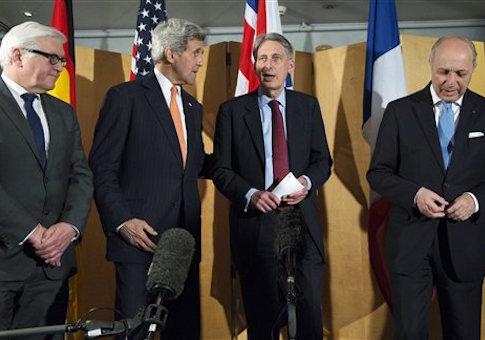
Iran Nuclear TalksFrom left, German Foreign Minister Frank Walter Steinmeier, U.S. Secretary of State John Kerry, British Foreign Secretary Philip Hammond and French Foreign Minister Laurent Fabius talk after Hammond made a statement about their meeting regarding recent negotiations with Iran over Iran’s nuclear program in London, England, Saturday, March 21 / AP

LAUSANNE, Switzerland—Efforts by the Obama administration to stem criticism of its diplomacy with Iran have included threats to nations involved in the talks, including U.S. allies, according to Western sources familiar with White House efforts to quell fears it will permit Iran to retain aspects of its nuclear weapons program.

A series of conversations between top American and French officials, including between President Obama and French President Francois Hollande, have seen Americans engage in behavior described as bullying by sources who spoke to the Washington Free Beacon.

The disagreement over France’s cautious position in regard to Iran threatens to erode U.S. relations with Paris, sources said.

Tension between Washington and Paris comes amid frustration by other U.S. allies, such as Saudi Arabia and Israel. The White House responded to this criticism by engaging in public campaigns analysts worry will endanger American interests.

Western policy analysts who spoke to the Free Beacon, including some with close ties to the French political establishment, were dismayed over what they saw as the White House’s willingness to sacrifice its relationship with Paris as talks with Iran reach their final stages.

A recent phone call between Obama and Hollande was reported as tense as the leaders disagreed over the White House’s accommodation of Iranian red lines.

Amid these tensions, U.S. Ambassador to France Jane Hartley met with her French counterpart, Gerard Araud, Monday to discuss a range of issues.

Benjamin Haddad, who has advised senior French political figures on foreign policy issues, said leaders in Paris have not been shy about highlighting disagreements they have with the White House.

“Fance, like other European countries, has negotiated for more than 10 years and endured most of the sanctions’ burden,” said Haddad, a research fellow at the Hudson Institute.

“The French want a deal, but they see no rush and repeat that Iranians need a deal more than we do, and that we shouldn’t fix artificial deadlines that put more pressure on us than Iran.”

One source in Europe close to the ongoing diplomacy said the United States has begun to adopt a “harsh” stance toward its allies in Paris.

“There have been very harsh expressions of displeasure by the Americans toward French officials for raising substantive concerns about key elements of what the White House and State Department negotiators are willing to concede to Iran,” said the source, who spoke on condition of anonymity. “That is because the clarifications expose just how weak the Americans’ deal is shaping up to be.”

“The meeting between the French ambassador in Washington and the president’s envoy to Paris—not a diplomat but a big fundraiser for his campaigns—comes amid these very harsh words that were spoken privately about the ambassador’s recent comments on the seeming American desperation for a deal, and the tough words that President Obama had for President Hollande in their phone call.”

Strategic differences remain between the United States and its allies over how a final deal should look, the source said. The French remain opposed to a recent range of concessions made by the Obama administration.

“We may agree that denying Iran a nuclear weapon ability is the goal, but apparently the view of what one can leave Iran and assure that is very different,” the source said.

“Clearly these are the differences that must be discussed. I don’t see France suddenly deciding that America is right and French objections to weakness are wrong, nor that silence is preferable to transparency.”

Haddad said the French are hesitant to rush into an agreement.

“The French want a robust deal with clear guarantees on issues like [research and development] and inspections to ensure that Iranians won’t be able to reduce breakout time during the duration of the agreement (also an issue of discussion), or just after thanks to research conducted during the period,” he said. “That is also why they disagreed on lifting sanctions.”

He also said the French “don’t trust Iran and believe an ambiguous deal would lead to regional proliferation.”

Another Western source familiar with the talks said the White House is sacrificing longstanding alliances to cement a contentious deal with Iran before Obama’s term in office ends.

“The President could be hammering out the best deal in the history of diplomacy, and it still wouldn’t be worth sacrificing our alliances with France, Israel, and Saudi Arabia—key partners in Europe, the eastern Mediterranean, and the Gulf,” the source said. “But he’s blowing up our alliances to secure a deal that paves Iran’s way to a bomb.”

A State Department spokesperson declined to comment on the issue.

Meanwhile, talks between the United States and Iran reached a critical juncture Thursday, as Secretary of State John Kerry met with his Iranian counterpoint to hash out differences over key points concerning Iran’s nuclear program.

The sides are hoping to reach a framework agreement by March 31 amid reports that Iran is demanding Saudi Arabia immediately halt airstrikes in Yemen, where Iran-aligned forces are working to bring down the Western-backed government.

The issue could complicate the talks as the United States attempts to balance its regional alliance with Iran in Iraq against competing interests with traditional allies in Saudi Arabia.

U.S. negotiators have reportedly softened their stance in recent days on a range of issues relating to Iran’s continued production of nuclear materials. One of Iran’s nuclear sites in Fordow could continue to operate, according to the Associated Press.

Obama speaks sweetly to Iran

March 20, 2015

Obama speaks sweetly to Iran, The White House via You Tube, March 19, 2015

(Oh well. It’s Obama. — DM)