Posted tagged ‘Russia’

Six Russian MiG-31 interceptor aircraft land in Damascus to rescue Assad regime

August 19, 2015

Six Russian MiG-31 interceptor aircraft land in Damascus to rescue Assad regime, DEBKAfile, August 18, 2015

Mig-31-fighter_18.8.15Russian MiG-31 interceptors

Six Russian MiG-31 Foxhound interceptor aircraft from Moscow landed Tuesday, Aug. 18, at the Mezze Airbase situated in Damascus international airport, DEBKAfile’s military and intelligence sources disclose. They were followed shortly after by giant An-124 Condor transports, which delivered 1,000 Kornet-9M133 third-generation anti-tank guided missiles.

The Russian airlift of advanced weapons for Bashar Assad’s army will last for several days. It betokens Moscow’s intention to keep up its support for the Syrian ruler and counter – by military means if necessary – any secret Iranian diplomatic machinations for terminating the Syria war and with it the Assad regime – such as have been reported in the past week in Western and Arab capitals, especially in the Gulf.

Our sources report that the decision to send the Syrian ruler advanced aircraft and missiles could only have come from the top, i.e. President Vladimir Putin. It took direct aim at the latest moves made by the US, Turkey, Iran and Saudi Arabia for ending the Syrian war. Every formula they came up with entailed Assad’s exit, either in stages or at once.

Russian Foreign Minister Sergey Lavrov made it crystal clear to visiting Saudi Foreign Minister Adel Al-Jubair on Aug. 11 that Moscow would not stand still for any changes in Assad’s position in Damascus. The Migs and Antonovs which landed in Damascus Tuesday were meant not only as a buttress for the Syrian ruler’s regime but as a rescue operation.

The message for Washington and Ankara was that Moscow would oppose any US and Turkish plans to establish a no-fly zone over Syria, or intervene directly in the Syrian conflict.

The Russians sent exactly six MiG interceptors to match the six F-16 fighters the US deployed at the Turkish Incerlik air base on Aug. 9.

So if President Barack Obama decides to deploy more American planes at the Turkish base, he may expect Putin to reciprocate with the same number for Damascus.

Iranian official: Tehran to sign deal with Russia for advanced S-300 missile system next week

August 18, 2015

Iranian official: Tehran to sign deal with Russia for advanced S-300 missile system next week

via Iranian official: Tehran to sign deal with Russia for advanced S-300 missile system next week – Middle East – Jerusalem Post.

Iran and Russia will sign a deal that will see Moscow send Tehran the S-300 air-defense missile system by next week, Iranian Defense Minister Hossein Dehghan said Tuesday.

Russian President Vladimir Putin had been ready to deliver the S-300 to Iran already in 2010, but had previously agreed to ban the sale under pressure from the US. Israel has also pushed Moscow not to send the S-300 to Iran.

The deal has now been updated and will be finalized soon, the Iranian Students’ News Agency quoted Dehghan as saying.

Dehghan said that as part of the new deal, Iran would be receiving an upgraded version of the S-300 system.

“We will go to Russia next week to sign the deal and there is no barrier hindering the agreement,” ISNA quoted him as saying.

He added that the weapons system would be delivered to Iran shortly after the signing of the agreement.

The deal comes after Russia announced that it was lifting its five-year ban on the sale of the S-300 to Iran in April, prior to the July signing of the comprehensive nuclear deal between world powers and Tehran. Putin said at the time that lifting the ban could encourage Iran to finalize the nuclear deal. He reassured Israel that the S-300 does not endanger the Jewish state.

The S-300 is ““one of the most advanced air defense systems in the world,” Brig.-Gen. (res.) Asaf Agmon, a former senior Israel Air Force officer told The Jerusalem Post in April.

The S-300 would make a potential strike against Iran’s nuclear facilities much more difficult. “This system will be a challenge for an air force to overcome. Its arrival is a significant change in our region,” Agmon said.

“Once the S-300 is stationed in Iran, the chances of it getting to Syria and Lebanon rise,” he warned.

Yaakov Lappin and Tovah Lazaroff contributed to this report.

Contentions | The Iran Deal’s Evaporating Logic

August 11, 2015

Contentions | The Iran Deal’s Evaporating Logic, Commentary Magazine, August 11, 2015

Proponents of the Iran nuclear deal are finding the justifications for compelling Congress to ratify the accord, save for preserving Barack Obama’s fragile self-image, are coming apart. As such, the accord’s supporters have increasingly turned to defending the deal with appeals to the president’s stature and authority, as well as by calling into question the motives and character of its opponents. That alone should tell you all you need to know. Though some of the Iran nuclear deal’s remaining backers do still occasionally claim that it will succeed in what was once its singular purpose: limiting Iran’s ability to produce prohibited armaments. One of most convincing precedents supporting this contention has, however, been largely disaffirmed. 

When asked to cite a model to demonstrate how the nuclear deal will not only prevent Iranian from developing a fissionable device but also produce a variety of happy byproducts like the moderation of the Islamic Republic’s destabilizing behavior, the deal’s supporters most frequently point to the 1987 Intermediate-Range Nuclear Forces (INF) treaty with the Soviet Union.

“From the Western perspective, the nuclear deal represents the most important security agreement since the signing of the Intermediate-Range and Shorter-Range Missiles (INF) Treaty between Washington and Moscow during the twilight years of the Cold War,” Al Jazeera columnist Richard Javad Heydarian averred.

Peter Beinart took this contention an ill-advised step further. “By 1987, Reagan had signed the Intermediate-Range Nuclear Forces (INF) treaty, the most sweeping arms-control deal of the Cold War. His rhetoric toward the Soviet Union also radically changed,” Beinart wrote in The Atlantic. “Reagan, in other words, dramatically de-escalated the Cold War long before he knew Gorbachev would let Eastern Europe go free and at a time when prominent conservatives were literally calling him Neville Chamberlain for signing the INF deal.”

That’s true. Graham Allison, also writing in The Atlantic, quoted a few conservatives from the period that feared Reagan was providing the Soviets with a reprieve from the crushing obligations of the arms race. “Reagan insisted that he was capable of brokering agreements to reduce the risks of accidents or unauthorized actions that risked nuclear war with one hand, while redoubling his efforts to undermine the Soviet regime with the other,” he insisted. “And he did just that. The Soviet Union collapsed in 1991.”

This is a remarkable simplification of history. Beinart claims that Regan’s shifting rhetoric (he renounced his “evil empire” comment while standing in the middle of Red Square under the watchful eye of a young Vladimir Putin) provided Mikhail Gorbachev space to make the case to the Politburo that he was not capitulating to Reagan in this accord. But this is a variation of the liberal case that ideational and not material considerations led to the collapse of the Soviet Union. Moreover, the INF effectively marked the end of the arms race, in part because it had already been lost by the Soviets. By contrast, there has been no ideational shift in the theocratic regime in Tehran nor is there any indication in Iran’s behavior that it is desirous of rapprochement with the West. If anything, Iran has behaved in a more bellicose fashion as nuclear negotiations with the P5+1 intensified.

The USSR is long gone, but the INF remains in place. Opponents of the Iran nuclear deal are advised to pay close attention to what that arrangement has become. It is no longer an arms control agreement but a political relic that serves little purpose but to shield from public scrutiny the extent to which Russia has become an irresponsible and revanchist international actor.

Writing in Politico Magazine in April, Foreign Policy Initiative scholars Eric Edelman and Tzvi Kahn outline the scope of the Russian’s efforts to game the INF. In response to Russia’s brazenness, American officials have routinely downplayed Moscow’s cheating. Despite repeatedly warning the United States that it was prepared to violate the INF over the course of the last decade, the Bush administration refused to acknowledge that reality. When Moscow did violate the terms of the INF in this decade, the Obama administration also pretended not to notice. And when this administration finally did address Russia’s violations of the terms of the INF, that acknowledgement was not followed on with any consequences.

That failure of resolve continues even today. According to the Washington Free Beacon’s Bill Gertz, a Pentagon assessment last month revealing the extent of Russia’s violations of the INF paints a damning picture of the Kremlin’s behavior. Unfortunately for anyone who would like to fully understand how Russia has undermined the INF, the White House is allegedly blocking that report’s release.

“Rep. Mike Rogers, chairman of the House Armed Services strategic forces subcommittee, disclosed the existence of the Pentagon assessment last month and said the report is needed for Congress’ efforts to address the problem in legislation,” Gertz reported. “Rogers said the assessment was conducted by chairman of the Joint Chiefs of Staff Gen. Martin Dempsey, and noted that it outlines potential responses to the treaty breach.”

To acknowledge the treaty’s failure would provide additional political legitimacy to an effort by House Republicans that seeks to provide funding for short-range cruise missile defenses in Poland and Romania. That’s a direct repudiation of this White House, which continues to stand by its 2009 rejection of a Bush-era deal that would have provided the Czech Republic and Poland with long-range interceptor and radar technology. In short, politics is dictating American national defense planning and strategy.

“Similarly, for decades, Tehran has violated its nuclear commitments — and the United States has failed to hold it accountable,” Edelman and Kahn observed.

There is no evidence to suggest that regime as demonstrably duplicitous as Iran’s will not cheat on this arrangement. In fact, the terms of this deal would make it difficult to definitively identify cheating, much less to marshal support for an international response to it. Even if such behavior could be identified, though, it’s not entirely clear that this administration (or its successor, presuming the next administration is a Democratic one) will be predisposed to punish Iranian cheating at all. To acknowledge the fact that the nuclear deal with Iran has failed would be to invite searing criticism from the deal’s domestic opponents.

The INF is a treaty in a persistent vegetative state; it’s corporal form remains, but its spirit has long since passed on to another plane. A conventional arms race in Eastern Europe has taken its place. If the West were to acknowledge that arms race, it would be obliged to participate in it. So it simply refuses to acknowledge it. If the Iran deal fails, its proponents in Washington are unlikely to ever say as much. Not until it is too late.

Russian Warships Dock In Iran for War Training

August 10, 2015

Russian Warships Dock In Iran for War Training, Washington Free Beacon, August 10, 2015

Russian President Vladimir Putin, right, and Iranian President Hassan Rouhani  meet at the Shanghai Cooperation Organization summit in Dushanbe, Tajikistan, Friday, Sept. 12, 2014. Iran has an observer status at the  Shanghai Cooperation Organization summit.  (AP Photo/RIA Novosti, Mikhail Klimentyev, Presidential Press Service)Hassan Rouhani, Vladimir Putin / AP

[Iranian] military leader [Fadavi] went on to claim that “Iranian Armed Forces are now at the highest level of preparedness” and that “only the dead body of the American troops realizes the power of the Islamic Revolution.”

********************

Two Russian warships have docked in northern Iran for a series of naval training exercises with the Islamic Republic, according to Persian-language reports translated by the CIA’s Open Source Center.

The two Russian ships docked in Iran’s Anzali port on Sunday and will hold “joint naval exercises during the three-day stay of the warships in Iran,” according to a Persian-language report in Iran’s state-controlled Fars News Agency.

“The [Russian] warships, Volgodonsk and Makhachkala docked in Anzali Port [near the Caspian Sea], in the fourth naval zone, on the afternoon of 9 August,” the report says.

The war exercises come just weeks after Iran and global powers inked a nuclear accord that will provide Iran with billions of dollars in sanctions relief in return for slight restrictions on the country’s nuclear program.

Russian and Iran have grown close in recent years, with delegations from each country regularly visiting one another to ink arms deals and other agreements aimed at strengthening Iran’s nuclear program.

Russia and Iran agreed earlier this year to begin construction on several new nuclear power plants. Russia has also agreed to sell Iran a controversial advanced missile defense system that can prevent attacks by Western powers.

The Russian fleet docked in Iran’s port “carrying a message of ‘peace and friendship,’” according to Iranian officials quoted by Fars. The fleet was “welcomed by Iranian naval commanders and staff.”

The Russian commander of the fleet is scheduled to hold meetings with “local political and military officials” in Iran’s northern provinces, according to Fars.

Levan Jagarian, Russia’s ambassador to Tehran, reportedly attended the docking ceremony and called for “for boosting mutual ties between the two countries in various fields,” according to the report.

The two nations went on to say that “expanding bilateral economic, political, and military cooperation is among the priorities of the visit.”

A Russian fleet also docked in northern Iran in October.

Last week, a senior Iranian naval commander warned the United States against ever taking military action on Iranian interests, claiming that the response would be “unpredictably strong.”

“The western media are mocking at the U.S. for speaking of ‘on the table options (against Iran)’ because the U.S. always utters some words without the ability to materialize them,” Iranian Revolutionary Guard Corps Naval Commander Ali Fadavi was quoted as saying by the country’s state-run press.

Iran is “ready to give such a powerful response to the slightest move of the U.S. that it won’t be able to make any other moves,” Fadavi was quoted as saying.

The military leader went on to claim that “Iranian Armed Forces are now at the highest level of preparedness” and that “only the dead body of the American troops realizes the power of the Islamic Revolution.

Michael Rubin, a former Pentagon adviser and expert on rogue regimes, said the Obama administration is fundamentally misreading Iran’s intentions in light of the recently inked nuclear accord.

“We’re witnessing a new great game, and Obama is so self-centered he keeps playing solitaire,” Rubin said. “Obama simply doesn’t understand that the world is full of dictators who seek to checkmate America. What he sees as compromise; they see as weakness to exploit.”

Referring to a visit last week to Russia by IRGC leader Qassem Soleimani, who is responsible for the deaths of Americans, Rubin said it is clear that Moscow and Tehran aim to build a tight military alliance.

“Visiting Russia to talk arms purchases and now this naval visit, it’s clear that Putin and Khamenei will waste no time to really develop their military cooperation,” he said.

An axis between Russia, Iran, and North Korea is beginning to emerge Rubin said, citing official releases that a North Korean delegation is currently visiting Russia to tour war games sites.

“The Russian warship visit combined with North Korea scoping out war game sites in Russia suggest a new Axis of Evil is taking shape with Russia the lynchpin between Iran and North Korea,” Rubin said. “As for the United States, rather than the leader of the free world, Obama and Kerry have transformed us in much of the world’s eyes as the pinnacle of surrender.”

Meanwhile, Obama admitted Monday that Iran’s nuclear breakout time will shrink to “a matter of months” once the nuclear accord expires in around 15 years.

The day after the deal

August 9, 2015

The day after the deal, Israel Hayom, Prof. Eyal Zisser, August 9, 2015

(Please see also, Russia and US woo Saudis to help save Assad – albeit putting Israel and Jordan in danger from S. Syria.– DM)

[Soleimani] wanted Russia and Iran to agree on the division of the Middle East in a way that would serve their clients in the region (among them, Assad) and check their joint enemies (the Islamic State). After figuring that out, they probably moved on to the next topic: how to marginalize America in the region. As a means to both ends, Russia will continue to serve as Assad’s protector (despite his many crimes), all the while providing Iran with international backing. But above all it will send arms to Iran, to the Syrian regime, and if needed, to Hezbollah.

***********************

Over the weekend it transpired that Maj. Gen. Ghasem Soleimani, the commander of Iran’s Quds Force, had visited Moscow two weeks ago and met with President Vladimir Putin. The Quds Force, in case you forgot, is in charge of the Iranian Revolutionary Guards’ clandestine operations (including terrorism). The Quds Force is responsible for providing aid to Hezbollah and Hamas as well as to Syrian President Bashar Assad and the Houthi rebels in Yemen. In light of his direct involvement in terrorism, the international community imposed sanctions on Soleimani, including travel restrictions.

Only last week, at a hearing on Capitol Hill, U.S. Secretary of State John Kerry vowed that the U.S. will make sure the sanctions on Soleimani would stay in effect and that the Obama administration would counter Iran’s efforts to destabilize the Middle East. But no one takes Kerry seriously anymore. While Kerry continues to engage Iran’s unimportant Foreign Minister Mohammad Javad Zarif, the real wheeling and dealing is actually in Moscow.

Soleimani did not go to Moscow because he had tickets to the Bolshoi. Rather, he arrived because he wanted to discuss “the day after the nuclear deal” with Putin. Namely, he wanted Russia and Iran to agree on the division of the Middle East in a way that would serve their clients in the region (among them, Assad) and check their joint enemies (the Islamic State). After figuring that out, they probably moved on to the next topic: how to marginalize America in the region. As a means to both ends, Russia will continue to serve as Assad’s protector (despite his many crimes), all the while providing Iran with international backing. But above all it will send arms to Iran, to the Syrian regime, and if needed, to Hezbollah.

The Russians, unlike the Iranians, don’t consider Israel to be an enemy state. But as a famous Russian official once said: “When you chop wood, chips fly.” Israel has become the latest chip — the collateral damage. Soleimani’s visit is just the tip of iceberg. It shed light on the not-so-secret deals that are being negotiated in the wake of the “Vienna nuclear agreement.” Europe, as usual, is focused on profit and its corporate executives are already traveling in droves to Tehran to ink deals. There are also political deals Iran wants to secure, which are as important for Tehran. Their price, however, will be measured in blood rather than in euros or dollars.

No one in the Middle East, it seems, is keen on parsing each and every provision in the nuclear deal. Nor is there an attempt to see whether, in the grand scheme of things, it is will have been a worthwhile endeavor some 10 or 15 years from now, when its key elements expire. In this region, what counts is the way this agreement is perceived here and now — and what really matters to people is the way it is portrayed in the media. Under that criteria, Iran is the victor and America is the vanquished, because it caved to Iran. The deal, according to how the media has portrayed it, is a crushing political blow to Israel and the moderate Arab states, led by Saudi Arabia.

This knockout victory will likely produce a new Iranian-American partnership. At the very least, the two nations will mend fences. This will alienate many of Washington’s clients, who will have to look elsewhere for a more reliable ally. Egypt and the Saudis have already realized this and turned to Russia for aid and arms, figuring it would be more trustworthy than the “staff of this broken reed” (Isaiah 36:6).

Saudi Arabia is reportedly sending feelers to see if there is a deal to be had with Russia and Iran. Under the terms of the proposed deal, Saudi Arabia would withhold aid to the Syrian rebels if Iran ends its rogue presence in the state. Such a deal would secure Assad a victory over the insurgents, or a least ensure his regime survives.

The ongoing developments have caused panic, but not over the rising clout of Iran and Russia. The White House, it seems, is fretting over the possibility that Congress may vote against the Iran deal and further tarnish Obama’s image.

Russia and US woo Saudis to help save Assad – albeit putting Israel and Jordan in danger from S. Syria

August 9, 2015

Russia and US woo Saudis to help save Assad – albeit putting Israel and Jordan in danger from S. Syria, DEBKAfile, August 9, 2015
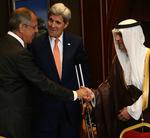
Lavrov_Kerry_and_al-Jubeir-_Doha_3.8.15Lavrov, Kerry, Al-Jubeir at Doha

[N]either Israel nor Jordan has been co-opted to this big power initiative, as though they are not concerned. However, both have a big stake in Saudi Arabia’s next decisions. If Riyadh is won over by US-Russian blandishments and goes back on its decision to boycott Assad, the Saudi-Israeli-Jordanian effort to support Syrian rebel control of southern Syria will fall apart. This will open up both countries to new perils on their  northern borders.

************************

Building on the nuclear accord signed in Vienna last month, the Obama administration has been in close communion with Moscow and Tehran on regional moves to save the Assad regime, as the key to their next regional policies, including a united front against the Islamic State.. Saudi Arabia and its Gulf partners are being assiduously wooed to join the new alignment being set up for this purpose. The live wire in getting them all together is Omani Foreign Minister Khalid bin Mohamed Al-Attiyah, the secret broker who brought Iran and the United States to the negotiating table for a nuclear accord. This was first reported in the last DEBKA Weekly.

Wednesday, Aug. 7, Obama threw out his first hint on this development: “The window has opened a crack for us to get a political resolution in Syria, partly because both Russia and Iran, I think, recognize that the trend lines are not good for Assad,” he said. “Neither of those patrons are particularly sentimental; they don’t seem concerned about the humanitarian disaster that’s been wrought by Assad and this conflict over the last several years, but they are concerned about the potential collapse of the Syrian state. And that means, I think, the prospect of more serious discussions than we’ve had in the past.”

The US president then affirmed more strongly in a CNN interview Sunday, Aug. 9:  “Is there the possibility that having begun conversations around this narrow issue [the nuclear accord with Iran] that you start getting some broader discussions about Syria, for example, and the ability of all the parties involved to try to arrive at a political transition that keeps the country intact and does not further fuel the growth of ISIL and other terrorist organizations? I think that’s possible,” Obama said. “But I don’t think it happens immediately.”

The administration and its prospective partners are united by the will to destroy ISIS – in its Syrian stronghold, for starters – but are divided on much else, DEBKA file reports. And so the process is moving forward in careful steps.

Their initial focus is on Syria, the bloody battleground which in less than five years has left at least 300,000 dead and more than 10 million people homeless.

The plan the group started out with in the last ten days was a swap as simple as it was ruthless: Saudi Arabia and the United Arab Emirates would slow their assistance to Syrian rebel groups, against whom President Bashar Assad’s army and allies would hold their fire; Iran, for its part, was to start withdrawing its support from the Yemeni Houthis insurgents.

The informal truce in Syria would be the stage for the Assad regime and rebel groups to start discussing a new government with room for opposition parties. The Islamists of the Islamic State and Al Qaeda’s Nusra Front would not be invited.

In Yemen, Tehran would cut back on the arms and intelligence which have enabled the Houthi insurgents to stand up to the combined forces of Saudi Arabia, the UAE and Egypt. The pro-Western Yemeni President Abd Rabo Mansour Hadi would be restored to his palace in Sanaa and invite the insurgent leader, Abdu Malik Al-Houthi, to discuss his partnership in a new government.

This deal was tantamount to a joint US-Russian guarantee of Bashar Assad survival in power in return for a Tehran-Riyadh compact for Hadi’s reinstatement in Sanaa.

These arrangements were debated back and forth in exchanges, some semi-secret, among the leading actors for most of July. The visit to Riyadh of the Syrian intelligence chief Maj. Gen. Ali Mamlouk was set up by Moscow as a major push forward.

The plan was for the entire enterprise to be brought out in the open and sealed in Doha, Qatar, Tuesday, Aug. 3 at a conference attended by US Secretary of State John Kerry, Russian Foreign Minister Sergey Lavrov, Saudi Foreign Minister Adel Al-Jubeir and other top Gulf diplomats.

Iranian Foreign Minister Mohammed Javad Zarif was not there. But he put a strong oar into the proceedings by calling in at Muscat, Oman the day before the conference and subsequently on Friday Aug. 7. Assad also kept his hand in by sending his foreign minister Walid Moallem to Tehran and Muscat last week.

But then, at Doha, just as the package was ready to unveil, the Saudi foreign minister pulled away and blew it up with two provisions: a) Riyadh would not countenance Bashar Assad being allowed to stay in office, and: b) Saudi Arabia would not do business with any representative of the Assad regime.

This put a large spoke in the main wheel of the initiative and also scuttled some of the secondary plans depending on it.

But by then, a lot was happening in the Yemeni and Syrian war arenas:

1. Saudi and UAE armored forces had landed in Aden and were closing in on the Yemeni capital, Sanaa. The Houthi rebels, trained and armed by Iran, were forced to retreat without negotiations on their future role in government.

2. Syrian rebel leaders, sensing the approaching betrayal, sent a secret delegation to Tehran to discuss terms for opening negotiations with Assad. They too were left at sea about the deals in play among Washington, Moscow, Tehran and Riyadh over their future.

Saturday, Aug.8, the Russians, egged on by the Americans, set about winning Riyadh into the fold, Foreign Minister Al-Jubeir was invited to pay a visit to Moscow Tuesday, Aug. 11, for talks about the Syrian conflict and the war on the Islamic State.

Refusing to accept that the new initiative had been grounded in Doha, Moscow presented the visit as continuing the ongoing dialogue on the issues raised at that encounter.

DEBKAfile’s military and intelligence sources note that neither Israel nor Jordan has been co-opted to this big power initiative, as though they are not concerned. However, both have a big stake in Saudi Arabia’s next decisions. If Riyadh is won over by US-Russian blandishments and goes back on its decision to boycott Assad, the Saudi-Israeli-Jordanian effort to support Syrian rebel control of southern Syria will fall apart. This will open up both countries to new perils on their  northern borders.

Iran confirms trip by Quds Force Commander to Moscow to discuss arms shipments

August 8, 2015

Iran confirms trip by Quds Force Commander to Moscow to discuss arms shipments, Fox News, , August 8, 2015

Iranian officials confirmed Friday that General Qassem Soleimani, the heavily sanctioned Revolutionary Guard Quds Force commander, traveled to Russia last month and was conducting weapons deals, including discussion of the S-300 missile system, according to Reuters.

The U.S. ambassador to the United Nations, Samantha Power, said Friday the U.S. is very concerned about the development.

“Qassem Soleimani is subject to a UN travel ban and this travel ban requires all states to prohibit Qassem Soleimani from traveling to their nation and the only exception to that is if the Iran sanctions committee grants an exemption,” she said at UN headquarters in New York.

The White House did not specifically blame the Russians for hosting the Iranian general.

“I can’t confirm these specific reports but it is an indication of our ongoing concerns with Iran and their behavior,” White House press secretary Josh Earnest told reporters Friday at the daily press briefing.

Mike Rogers, former chairman of the United States House Permanent Select Committee on Intelligence, weighed in late Friday afternoon.

 “We should not underestimate what this means to our national security,” he said. “A leading general in Iran just told the world that the United States of America is irrelevant and Russia welcomed him with open arms. Not only do Russia and Iran not fear us, they do not respect us. And that, is dangerous.”

According to two separate Western intelligence sources, Soleimani arrived in Moscow on Iran Air flight 5130 from Tehran on July 24, ten days after the nuclear agreement between Iran and six world powers was announced that included a provision to lift the arms embargo on Iran.

Five days later, Secretary of State John Kerry testified about the Iran nuclear deal before the Senate Armed Services Committee, assuring Congress pressure would remain on Iran’s shadowy general.

“Under the United States’ initiative, Qassem Soleimani will never be relieved of any sanctions,” Kerry told the Senate Armed Services Committee.

In Moscow, Soleimani met with President Vladimir Putin and Russia’s defense minister.

In June, Russia announced it would send S-300 anti-aircraft missiles to Iran by next year, according to a top Kremlin official.

Soleimani was photographed in Iraq recently on the front lines with Iranian-backed Shia militias battling ISIS, also in defiance of the travel ban.

Soleimani is blamed for the deaths of 500 Americans in Iraq. He also is suspected of orchestrating the failed assassination attempt on the Saudi Arabian ambassador to the United States at a popular Georgetown restaurant in Washington.

Soleimani’s Moscow visit elicited a reference during the Republican debate Thursday night.

“He’s directly responsible for the murder of over 500 American servicemen in Iraq and part of this Iranian deal was lifting international sanctions on Gen. Soleimani — the day Gen. Soleimani flew back from Moscow to Iran was the day we believe Russia used cyber warfare against the joint chiefs,” said Sen. Ted Cruz, R-Texas.

Iran’s acknowledgement of Soleimani’s visit to Moscow indicates a possible split in Iran’s leadership: those loyal to the military are unconcerned about blazingly defying sanctions even before the nuclear deal is sealed.

Russia slams U.S. attempts to provide air cover to Syrian rebels

August 6, 2015

Russia slams U.S. attempts to provide air cover to Syrian rebels

Middle East

August 4, 2015

via Russia slams U.S. attempts to provide air cover to Syrian rebels – The Journal of Turkish Weekly.

Is this a declaration of war ?

Kremlin denounced Monday the U.S. attempts to provide air cover for Syrian rebels, indicating it will ultimately destabilize the country’s situation.

“We have repeatedly stressed that the assistance, especially financial or technical one, to the Syrian opposition would further destabilize the situation in the country,” Kremlin spokesman Dmitry Peskov said.

Once implemented, the plans would benefit the so-called Islamic State (IS) terrorists, weakening the counter potential of the Syrian capital Damascus, Peskov said.

“This is a fundamental disagreement between Moscow and Washington over Syria,” he added.

On Sunday, U.S. President Barack Obama reportedly authorized air defense to U.S.-backed Syrian rebels against attacks from terrorists or Syrian government forces.

More here .

The U.S. directly stated Tuesday that it would protect its nascent force of Syrian rebels from Syrian government attacks.

“What we are trying to convey is that we’ll also do defensive efforts in case or in the hypothetical that they would come under fire from Syrian forces,” State Department spokesman Mark Toner told reporters.

He ruled out that any such attack would be offensive, however, Toner said “any type of effort to protect them from Syrian forces would be defensive in nature”.

White House spokesman Josh Earnest hinted at the policy Monday, saying previous warnings that Washington issued to Damascus to not interfere with its aerial bombardment of Daesh and other Syrian extremists holds true for the U.S.-trained opposition forces.

He added that the U.S. and its coalition partners are “committed to using military force where necessary to protect the coalition-trained and equipped Syrian opposition fighters that are operating against ISIL inside of Syria right now”.

The decision by President Barack Obama could potentially further Washington’s stake in the Syrian conflict, and drag the U.S. deeper into ongoing hostilities – action the Obama administration has been reluctant to take.

http://www.turkishweekly.net/2015/08/05/news/us-explicitly-warns-damascus-not-to-attack-its-rebels/


Iran orders from China 150 J-10 fighter jets that incorporate Israeli technology

July 30, 2015

Iran orders from China 150 J-10 fighter jets that incorporate Israeli technology, DEBKAfile, July 30, 2015

J-10Chinese Chengdu J-10 for Iranian air force

The scale of Iran’s multibillion acquisitions from China and Russia – 550 warplanes in all so far – indicates that Tehran’s top spending priority upon receipt of the funds released by the removal of sanctions, is to be a spanking new air force.

**********************

Iran is about to conclude a transaction with China for the purchase of the Chengdu J-10 multirole jet fighter, known in the West as the Vigorous Dragon, according to an exclusive report from DEBKAfile’s military and intelligence sources. Beijing has agreed to sell Tehran 150 of these sophisticated jets.

While the Chinese J-10 is comparable to the US F-16, our sources report that it is virtually a replica of the Lavi, the super-fighter developed by Israel’s aerospace industry in the second half of the 80s. Israel sold China the technology, after Washington insisted on Its discontinuing the Lavi’s production. The US also objected to the sale of the Lavi’s avionics, claiming that it contained some American components.

The Chinese plane comes in two versions – the multirole single-seat J-10A and the two-seat J-10B, which serves for training, ground assaults and electronic warfare.

Iran has additionally weighing the purchase in Moscow of 250 highly-advanced Sukhoi-Su-30MK1 twinjet multirole air superiority fighters, known in the West as Flanker-H.

On Wednesday, July 29, an Indian Air Force Su-30MK1 took part for the first time in a British air maneuver, Rainbow, where it dueled with the European Typhoon fighter.

The sophisticated Flanker has been found to have a major shortcoming. To carry eight tons of ordnance, it must use both of its AL-31FP engines, and the transition from one to two – and the reverse – often causes engine failure.

The Indian Air Force has reported three such malfunctions in a month, as well another shortcoming: The time needed for making the aircraft serviceable is too long. As a result, only half of the Indian fleet can be airborne at one time.

In a confrontation, the Iranian Air Force may find that, because of these drawbacks, the Chinese Su-30MK1 is outmatched by its American and European counterparts in the service of the Israeli, Saudi and UAE air forces.

On July 22, DEBKAfile revealed that Moscow and Tehran had concluded a giant transaction for the acquisition of a fleet of 100 IL78 MK1 (Midas) in-flight refueling planes for extending the range of its warplanes up to 7,300 km and able to refuel 6-8 planes at once.

DEBKAfile: The scale of Iran’s multibillion acquisitions from China and Russia – 550 warplanes in all so far – indicates that Tehran’s top spending priority upon receipt of the funds released by the removal of sanctions, is to be a spanking new air force.

Springtime for America’s Enemies

July 22, 2015

Springtime for America’s Enemies, The Daily BeastGarry Kasparov, July 22, 2015

(This is from The Daily Pest Beast. — DM)

Dangerous and short-sighted U.S. diplomacy has empowered no one except state sponsors of terrorism and fascistic regimes.

There has never been a better time in history to be an enemy of the United States of America. While America’s traditional allies in Europe and the Middle East express confusion and frustration, Obama’s White House delivers compliments and concessions to some of the most brutal dictatorships in the world. In the span of a single week, the U.S. has restored diplomatic relations with Cuba, pressured Ukraine to accept Vladimir Putin’s butchering of its eastern region, and brokered a deal to liberate Iran from sanctions.

These actions would represent a tremendous series of diplomatic triumphs if they improved human rights in these repressed nations, saved lives in conflict regions, or improved global security. That is, in fact, what the White House says these deals will do, despite copious evidence to the contrary. These negotiations represent willful ignorance of the fundamental nature of the regimes in question, especially those of Iran and Russia. Cuba is a political hotspot in the U.S. and remains a potent symbol of totalitarianism, but despite its regional meddling, especially in Venezuela, it isn’t on the scale of the global threats represented by Iran’s terrorism and nuclear ambitions and Putin’s nuclear-backed expansionism. Regardless of the wishes of the Iranian and Russian people, their leaders have no interest in peace, although they are very interested in never-ending peace negotiations that provide them with cover as they continue to spread violence and hatred.

The vocabulary of negotiation is a pleasant and comforting one, especially to a war-weary America. It’s difficult to argue against civilized concepts like diplomacy and engagement, and the Obama administration and the pundits who support it have made good use of this rhetorical advantage. In contrast, deterrence and isolation are harsh, negative themes that evoke the dark time of the Cold War and its constant shadow of nuclear confrontation. No one would like less a return to those days than me or anyone else born and raised behind the Iron Curtain. The question is how best to avoid such a return.

The favorite straw man of the “peacemongers” is that the only alternative to appeasement is war, which makes no sense when there is already an escalating war in progress. The alternative to diplomacy isn’t war when it prolongs or worsens existing conflicts and gives the real warmongers a free hand. Deterrence is the alternative to appeasement. Isolation is the alternative to years of engagement that has only fueled more aggression.

Perhaps it’s because I grew up in a Communist country that I cannot so casually ignore the suffering of the people being left behind as these treaties are signed. Ronald Reagan was called a warmonger by the same crowd that is praising Obama to the skies today and yet Reagan is the one who freed hundreds of millions of people from the Communist yoke, not the “peacemakers” Richard Nixon and Jimmy Carter.

Diplomacy takes two while capitulation is unilateral. Diplomacy can fail and there is real damage, and real casualties, when it does. Putin’s dictatorship was immeasurably strengthened by the catastrophe known as “the reset,” an Obama/Hillary Clinton policy that gave Putin a fresh start as an equal on the world stage just months after he invaded Georgia. Years that could have been spent deterring Putin’s crackdowns and centralization of power while he still needed foreign engagement were instead spent cultivating a partnership that never really existed. Time that could have been used to establish alternate sources of gas and oil were squandered, leaving Europe vulnerable to energy blackmail.

By 2014, Putin had consolidated power at home completely and, with no significant domestic enemies left and sure he would face little international opposition, he was confident enough to invade Ukraine and annex Crimea. The thousands of dead and hundreds of thousands of displaced people in Ukraine are Putin’s victims, of course, but they must also weigh on the conscience of the bureaucrats, diplomats, and leaders whose cowardice—well-intentioned or not—emboldened Putin to that point.

As recent days and past decades past have shown us, it is easy to paint the critics of nearly any diplomatic process as warmongers. Again, the language of peace and diplomacy is soothing and positive. If we just talk a little longer, if we just delay a little more, if we just concede a little more… To make the peacemonger position even more unassailable, every outbreak of violence large or small can be blamed on the failure of the diplomats to talk, delay, and concede more. And sometimes, to be fair, acceptable compromises are reached and, if not win-win, mutually satisfactory lose-lose agreements can defuse conflicts and avoid bloodshed. Diplomacy is supposed to be the modern way, the civilized way, and it should always be considered first—and second.

But diplomacy also requires a measure of good faith by all parties. It assumes that one side (or both) isn’t lying and cheating. It assumes that there is sufficient coercion and/or self-interest for the deal to hold. A peace treaty assumes that both sides actually want peace; a ceasefire assumes that both sides will cease firing. When these things cannot be assumed, any deal is a likely to be a bad deal. At best it will be meaningless and the regimes operating in bad faith will be quick to exploit the delays and concessions. By signing agreements with regimes that have proven time and again that they cannot be trusted and have no interest in peace or ceasefires, the Obama administration has turned the great game of diplomacy into Russian roulette.

Keeping a firm grip on power is the only thing that matters in a dictatorship. The consequences of losing power in an authoritarian regime rarely involve peaceful retirement and a long life. (Gorbachev is a notable exception, mostly due to his cleverly taking credit for the Soviet collapse he fought so hard to avoid, as well as to the shameful lack of appetite in Russia and the international community for holding Communist leaders accountable.) Both Khamenei and Putin have brutally cracked down on their own people to remove any challenges to their authority. Both rely on vicious propaganda to drum up nationalism and hatred for foreign enemies and “traitors” at home, i.e. anyone who opposes or criticizes the regime. Both wage war and terror on their borders and beyond. Both hold sham elections to provide a distraction for their citizens and fodder for the global press to blather on about the potential for liberalization. And this week, both Putin and Khamenei have been rewarded by President Obama with negotiations that will aid them in causing further suffering to their people and in making the world far less safe. Obama gets his “peace for our time” fanfare and the dictatorships continue with business as usual.

A remark made by Israeli Minister of Foreign Affairs Moshe Dayan is much repeated by the peacemongers in times like these. In a 1977 interview the renowned military man said that “if you want to make peace, you don’t talk to your friends.” This is both clever and true, but what has been forgotten is that Dayan continued, “But the question is whom do we want to make peace with—not just who are our enemies.” It’s delusional to think you can make peace with an unrepentant state sponsor of terror like Iran or a Russian regime that is sending tanks across a European border and adopting fascist propaganda.

It is clear that the Obama administration thinks it should and can make peace with anyone, whether they like it or not, and whether or not they actually change their odious behavior. These terrible deals with Cuba, Russia, and Iran—it’s like the old joke about the businessman who sells each unit at a loss but says he’ll make it up in volume. Cuba continues to jail journalists and dissidents. Putin’s forces are still illegally occupying Crimea and waging war in Eastern Ukraine while Assistant Secretary of State Victoria Nuland bullies the Ukrainian government into the concessions that Putin demanded in the latest Minsk ceasefire accord (which his troops ignore, of course).

Iran will dramatically upgrade its ability to support the military wings of Hezbollah, Hamas, and the Houthis in Yemen it has been supplying with weapons for years. There is little doubt Iran will also continue its attempts to develop a nuclear weapon, and even if it fails it is sure to spark a nuclear arms race in the region. Iran’s hardliners have been cemented in power by escaping sanctions while giving up nothing. Calling all of this a triumph for diplomacy is perverse. By the time Obama is polishing his Nobel Peace Prize in his presidential library, the next president will be left facing two aggressive despotic regimes that are stronger and more confident of their invincibility than ever.

Expansionist dictatorships never transform quietly. They most often end in collapse or violent revolution. Comparisons of the Iran agreement to the opening of China in the 1970s are absurd. China would have starved had they not abandoned Mao’s catastrophic plans and built an export economy, something that required formal relations with the free world. In contrast, petro-dictatorships like Iran don’t need their people or to be on good terms with the West—especially not now that the economic sanctions will be lifted.

The casualties that have resulted from weakness masked as diplomacy far outnumber those stemming from being too hasty to confront and deter aggression. The peacemongers should keep that in mind as Iran uses some of its $100 billion in newly unfrozen assets to arm its terror proxies. Before applauding the next ceasefire in Ukraine as progress they should recall what Putin did during the last two. More than anything, before Obama again praises the tyrannical leaders of Cuba, Iran, and Russia for their cooperation, he should remember that some enemies are worth having.


