Posted tagged ‘Russia’

“Russia Did More ‘Good’ In 30 Days Than The US Did In A Year”

May 17, 2016

“Russia Did More ‘Good’ In 30 Days Than The US Did In A Year” – The Only Accredited Western Journalist In Damascus Speaks Up

by Tyler Durden on 05/16/2016 22:40 -0400

Source: “Russia Did More ‘Good’ In 30 Days Than The US Did In A Year” – The Only Accredited Western Journalist In Damascus Speaks Up | Zero Hedge

On behalf of Prensa Latina news agency, Miguel Fernandez was the only journalist from the Western world accredited to work in the Syrian capital of Damascus for nearly a year. After returning home to Havana, Fernandez gave Sputnik News an exclusive interview in which he reflects back on what he experienced in the war torn country.

Fernandez first gets into the single biggest lesson he learned, which is that the people of Syria don’t give in, they don’t stop pursuing the dream of having a prosperous country.

“Seeing how these people don’t give in, that they dream about a prosperous country, is the biggest lesson that Syria gave me”

Miguel then reflects back on when a colleague of his first arrived in the city, and as the journalist took him around the city, everything was seemingly so normal that his friend asked “where is the war?”

“Fear is the first thing that war creates, that fear which forces people to be on guard. However, Damascus broke that pattern. When my colleague arrived I took him around the city and he noticed that buses and taxis are traveling around, people are sitting in cafes and going shopping, children are going to school. He asked me, ‘where is the war?'”

“I said, I will show you before we leave for Cuba. And after less than a day, when we were traveling in a taxi, a mortar shell fell in front of us, onto a group of people, some of whom died, and there was chaos all around.”

“I looked at that and I said – that is war. That resistance of the Syrian people, the unwillingness to accept the hardships of war, has inspired me.”

The most harrowing moment for Fernandez was during the fall of Palmyra to the terrorists in May 2011 [later to be taken back from ISIS, and even recently held a concert that was put on by Russia’s famous Mariinsky Theatre Orchestra]. Fernandez reflected on a time in which monuments were destroyed, and children under Daesh leadership were made to kill captured Syrian soldiers.

 “Palmyra is one of ten UNESCO World Heritage sites in Syria, an oasis in the desert, full of mystical stories. Seeing how the Arch of Triumph and other monuments were destroyed. A terrible scene that I will never forget, was when children under the leadership of Daesh killed 50 captured Syrian soldiers who were on their knees.

“For me, that was the saddest moment, because I felt that the war was not only against Syria, but against the world, our culture, our values, our heritage. When I say ours, I mean civilization. These elements (Daesh) are savages. They can destroy a monument in the same way that they cut a child’s head off.”

Fernandez also recalled how differently the Syrian people view Russia and the United States, and that the Russian participation did not feel like an intervention at all. Importantly, Miguel discusses the stark differences between the precision and effectiveness of the US vs Russian air strikes as well. Notably that US airstrikes were not coordinated and often hit Syrian infrastructure, as opposed to Russia’s strikes, which destroyed more Daesh infrastructure in 30 days than the US had been able to accomplish in a year’s time.

“I am fair with blue eyes, so they often confused me with Russians and affectionately greeted me. Syrians believe in Russia because for a long time they were in conflict with the US and some European powers and Russia was the only friendly power.

“I was there when Russia entered the war in September 2015 and Syrians did not perceive it as an intervention, but as support and a sign of solidarity,” Fernandez explained.

“For over a year before that the US had led an international coalition that didn’t show any results. The Americans carried out bombings but Daesh spread even further, and seized new positions.

Those airstrikes were not coordinated and often hit Syrian infrastructure, hospitals and schools. The Russian airstrikes didn’t, because they entered the war at the request of Damascus and their activities were coordinated in order to be effective and not bring harm to civilians.

“During the first 30 days of bombing the Russians were able to destroy 40 percent of Daesh’s infrastructure, which the US and its allies hadn’t been able to do for a year.”

Fernandez ended the interview with a story of a Syrian soldier who complimented him by breaking bread and sharing it with the journalist, as a tribute to what the soldier said was Cuban bravery.

 “One of the soldiers, he was over 50, bearded, dirty, covered in powder and slush, he came to me, broke his bread in two and offered me half.”

“I refused, because I had already had breakfast at home and had no idea how many hours he had gone without eating. But my translator told me to take the bread, explaining that he wanted to share the bread with me because I am Cuban and he had always been told that Cuban soldiers are very brave and that if he shares the bread with me, it will bring him luck in the next battle.”

“I shed a few tears, because I am not a warrior, and I was very touched that he had such an impression about my nation,”


* * *

With all of the speculation and observations from the pundits on television, who have never stepped foot inside the war torn country of Syria, it is helpful to get a first hand account of what’s taking place on the ground. What one may find, is that those that sit around and parrot the “Russia Bad/US Good” narrative all day may not be exactly providing the complete picture.

ISIS, Syrian Conflict ‘Not Containable’ in Middle East

May 17, 2016

ISIS, Syrian Conflict ‘Not Containable’ in Middle East Bipartisan report calls for greater American involvement abroad

BY:
May 17, 2016 5:00 am

Source: ISIS, Syrian Conflict ‘Not Containable’ in Middle East

Threats emanating from the Middle East, including those caused by ISIS and the Syrian civil war, cannot be contained and therefore require the United States to significantly ramp up its military commitments in the region, according to a new report.

A group of scholars, strategists, and former government officials from Republican and Democratic administrations convened to develop the study, which was released by the Center for a New American Security on Monday.

The report, which has been endorsed by a number of ex-Democratic officials including a former Clinton administration aide, implies that the Obama administration’s policies toward Syria and the Middle East in general have been weak.

“Despite recent American misjudgments and failures in the Middle East, for which all recent administrations, including the present one, bear some responsibility, and despite the apparent intractability of many of the problems in the region, the United States has no choice but to engage itself fully in a determined, multi-year effort to find an acceptable resolution to the many crises tearing the region apart,” the report states.

“The key point is that the dangers emanating from the Middle East, including both terrorism and the massive flow of refugees, are not containable. They must be addressed at the source, over many years, using a combination of local actors and American power and influence.”

The report calls for the international effort against ISIS to be “scaled up substantially,” a move that would include sending more U.S. special operations forces to help root out the terror group from Iraq, Syria, and newly-established footholds in countries like Libya.

“The United States should show a new resolve by increasing significantly its military contribution across the board, including providing more unique air assets, additional intelligence assets, and a larger contingent of special operation forces capable of identifying and destroying high value and other critical ISIS targets,” the report states.

President Obama’s efforts against ISIS, which he once compared to a “JV team,” have long been criticized. Just one day before the group launched deadly coordinated terror attacks in Paris last November, the president declared during a nationally televised interview that the terror group had been “contained.”

The Obama administration, which began air strikes against ISIS in 2014, has sent modest contingents of special operations forces to Syria and Iraq in order to provide “advise and assist” support for Syrian Arab, Kurdish, and Iraqi troops fighting the terror group in the region. It has also green-lit limited operations directly targeting leaders of the terrorist group.

The administration has insisted that American troops are not in combat operations against ISIS, even though three American service members have died at the group’s hands in Iraq.

The report released Monday indicates that the administration has not done enough to thwart a terrorist group that could pose a greater threat to American and Western security than al Qaeda.

“The terrorist assault on Paris this past November and on Brussels in March were stark and painful reminders of the many ways instability in the Greater Middle East can come home to countries in Europe. The mass shooting in California in early December 2015 also demonstrates why ISIS potentially poses a greater threat to the United States and its allies and partners than al Qaeda,” the report states, citing the terrorist attack on a San Bernardino, Calif., holiday party carried out by a radicalized couple.

“With so many ISIS-inspired terrorists holding Western passports, counterterrorism has become significantly more difficult. Nor can one discount the possibility that just as ISIS has emerged to compete with al Qaeda for leadership of the jihadi forces, there will be other groups seeking to take the mantle.”

The CNAS project is co-chaired by James Rubin, a former State Department official during the Clinton administration, and is endorsed by CNAS co-founder Michèle Flournoy, who served as undersecretary of defense in the Obama administration. The project was established to develop a bipartisan consensus about the role America should play in the world, and the report was deliberately rolled out ahead of the 2016 election to shape the national conversation.

While the experts do not go out of their way to criticize the current administration’s foreign policy agenda, the report offers implicit rebukes of the administration’s efforts abroad, particularly in the Middle East. It calls for making a political solution to the five-year Syrian civil war dependent on the departure of Syrian leader Bashar al Assad—a point the Obama administration has appeared willing to concede in recent months.

The report also calls for an overhaul of the Pentagon’s “inadequate” program to arm and train the Syrian opposition forces, who have faced brutal resistance from Syrian government troops emboldened by Russian and Iranian intervention in the conflict. The Defense Department was forced to shutter its failed program to train and equip moderate Syrian rebels, which cost American taxpayers $500 million, in favor of a less ambitious initiative last October.

“Syrian government forces have regained considerable territory and momentum especially in and around Aleppo, primarily as a result of coordinated Russian-Syrian-Iranian operations backed by heavy and often indiscriminate Russian bombardment from the air,” the report states.

“At a minimum, the inadequate efforts hitherto to arm, train, and protect a substantial Syrian opposition force must be completely overhauled and made a much higher priority.”

The report also proposes the establishment of a no-fly zone in Syria where displaced Syrians can relocate out of harm’s way and where opposition forces can arm, train, and organize.

More generally, the experts make the case for boosting American engagement in the face of Chinese economic growth and military buildup, Russian aggression, and continued destabilization in the Middle East. The maintenance of post-World War II international order, the report explains, is dependent on strengthening U.S. diplomatic, economic, and military power and boosting spending on defense and national security.

“The greatest challenge to the preservation of this order today may be here in the United States. The bipartisan consensus that has long supported America’s engagement with the world is under attack by detractors in both parties,” the report states.

“Responsible political leaders need to explain to a new generation of Americans how important this world order is to their well-being and how vital America’s role is in sustaining it.”

Putin: Russia will consider tackling NATO missile defense threat

May 13, 2016

Putin: Russia will consider tackling NATO missile defense threat

Published time: 13 May, 2016 12:50 Edited time: 13 May, 2016 13:41

Source: Putin: Russia will consider tackling NATO missile defense threat — RT News

A Tomahawk missile being launched from the Mark 41 Vertical Launching System aboard United States Navy destroyer USS Farragut. File photo. © the United States Navy / Wikipedia

Russia is being forced to look for ways to neutralize threats to its national security due to deployment of the NATO anti-missile shield in Europe, Russian President Vladimir Putin said after the alliance launched a missile defense site in Romania.

“Now, after the deployment of those anti-missile system elements, we’ll be forced to think about neutralizing developing threats to Russia’s security,” Putin said.

Read more

NATO Secretary General Jens Stoltenberg (C) reviews an honour guard during an inauguration ceremony of the US anti-missile station Aegis Ashore Romania (in the background) at the military base in Deveselu, Romania on May 12, 2016. © Daniel Mihailescu

The US missile shield in Europe is a clear violation of Russian-American arms treaties, Putin said at a meeting with Russian military officials, adding that the anti-missile facilities can be easily repurposed for firing short and midrange missiles.

The US anti-missile shield in Europe is yet another step in increasing international tensions and launching a new arms race, he stressed.

“We’re not going to be dragged into this race. We’ll go our own way. We’ll work very accurately without exceeding the plans to finance the re-equipment of our Army and Navy, which have already been laid out for the next several years,” Putin said.

“Recent developments indicate that the situation isn’t getting better. Unfortunately, it’s deteriorating. I’m talking about the launch of the radar station in Romania as one of the elements of the up-and-coming US anti-missile defense program,” Putin said.

Russia is making every effort to maintain the strategic balance of power, in order to avoid the outbreak of large-scale conflicts, the president said.

Read more

NATO Secretary General Jens Stoltenberg (L), Romanian Prime Minister Dacian Ciolos and U.S. Deputy Secretary of Defense Robert Work (R) take part in an official inauguration ceremony at Deveselu air base, Romania, May 12, 2016. © Inquam Photos

NATO formally declared its missile defense base in Deveselu, Romania, operational on Thursday, bringing to fruition a plan to construct a shield in Eastern Europe first announced by George W. Bush in 2007.

Earlier, Moscow said that not only was the US missile defense aimed at neutralizing Russia’s offensive capability – an accusation the Pentagon has repeatedly rejected – but that the Deveselu’s MK 41 launching systems it uses could be re-equipped with offensive cruise missiles.

Russia also stated that US actions are a violation of the Intermediate-Range Nuclear Forces Treaty (INF), and warned that it may pull out from the deal if Washington continues with its anti-missile plans.

The missile shield uses a network of radars that track potential threats in the atmosphere, before launching an interceptor missile from a stationary base, or a fleet.

Simultaneously with Romania coming online, NATO is beginning construction on another base in Poland, which will complete the Eastern European segment of the shield in 2018.

Russia Hints At Nuclear War After US Deploys Ballistic Missile Shield

May 13, 2016

Russia Hints At Nuclear War After US Deploys Ballistic Missile Shield

by Tyler Durden on 05/12/2016 19:02 -0400

Source: Russia Hints At Nuclear War After US Deploys Ballistic Missile Shield | Zero Hedge

In a dramatic development for the global nuclear balance of power, yesterday we reported that starting today, the United States would launch its European missile defense system dubbed Aegis Ashore at a remote airbase in the town of Deveselu, Romania, almost a decade after Washington proposed protecting NATO from Iranian rockets and despite repeated Russian warnings that the West is threatening the peace in central Europe.

As Robert Bell, a NATO-based envoy of U.S. Defense Secretary Ash Carter explained “we now have the capability to protect NATO in Europe. The Iranians are increasing their capabilities and we have to be ahead of that. The system is not aimed against Russia,” he told reporters, adding that the system will soon be handed over to NATO command.

We also noted that the Kremlin, which for years has warned that it would have no choice than to escalate proportionally, was “incensed at such of show of force by its Cold War rival in formerly communist-ruled eastern Europe where it once held sway.” Moscow said that the U.S.-led alliance is trying to encircle it close to the strategically important Black Sea, home to a Russian naval fleet and where NATO is also considering increasing patrols. Russia has good reason to be worried: the US move is a clear defection from the carefully established Game Theory equilibrium in the aftermath of the nuclear arms race, one which potentially removes a Russian first strike threat, thereby pressuring Russia.

We added that “the precarious nuclear balance of power in Europe has suddenly shifted, and quite dramatically: despite U.S. assurances, the Kremlin says the missile shield’s real aim is to neutralize Moscow’s nuclear arsenal long enough for the United States to make a first strike on Russia in the event of war.”

In conclusion we said that “what makes this step particularly dangerous is that Russia will now be forced to retaliate and since it does not have a comparable defensive technology, Putin will have no choice but to deploy more ICBMs on Russia’s borders, which in turn will exponentially escalate the threat of an “inadvertent” launch. Although considering how the “market” responds to newsflow these past few years, this may also be seen as a bullish catalyst for stocks.”

Fast forward to today when as American and allied officials celebrated the opening of a long-awaited missile defense system in Europe with a ribbon cutting and a band…

. the reaction in Moscow on Thursday was darker: a public discussion of how nuclear war might play out in Europe and the prospect that Romania, the host nation for the United States-built system, might be reduced to “smoking ruins.

As expected, Russia was furious. The NYT cites Kremlin spokesman Dmitri Peskov who told reporters in a conference call that “we have been saying right from when this story started that our experts are convinced that the deployment of the ABM system poses a certain threat to the Russian Federation.”

Of course, the US and NATO are well aware of this, which is why they have proceeded with this latest provocation, one which however has far more profound implications to the peace in Europe than the occasional barrel-roll in a fighter plane fly by.

“Measures are being taken to ensure the necessary level of security for Russia,” he said. “The president himself, let me remind you, has repeatedly asked who the system will work against.”

Russian Foreign Ministry spokeswoman, Maria Zakharova, said Russian defense experts consider the site a threat. “We still view the destructive actions of the United States and its allies in the area of missile defense as a direct threat to global and regional security.” She said that the Aegis Ashore launchpad was “practically identical” to a system used aboard Aegis warships that is capable of launching Tomahawk cruise missiles.

As the NYT adds, while the United States says it has no Tomahawk missiles at the site in Romania, the launchpad violates a 1987 treaty intended to take the superpowers off their hair-trigger nuclear alert, the Intermediate-Range Nuclear Forces Treaty, by banning land-based cruise and medium-range missiles with a range from 300 to 3,400 miles.

The problem, as we wrote yesterday, is that the short flight time of these missiles diminished to mere minutes the window Soviet leaders would have had after a warning to decide whether to launch a second strike, raising the risks of mishaps. Any redeployment of nuclear-capable missiles in Central Europe, the NYT writes, would roll the clock back to this nerve-racking 1980s status quo.

And now the ball is in Russia’s court.

“We have to announce this openly, without any additional diplomatic formulations,” Zakharova said of the Russian assertion the site violates the intermediate-range missile ban. “We are talking about violation of this treaty.” Previously Putin has warned that an American antimissile deployment in Eastern Europe could prompt Russia to withdraw from the treaty. The United States last year accused Russia of violating the treaty by failing to declare the true range of two missile types.

One potential response Russia will implement, is a nuclear-armed drone submarine. Last fall, Russian security officials appeared to drop hints of this military response to the missile defense system hinting through the leak that Russia has options. The drone, according to easily decipherable text accompanying the design drawing, would be capable of carrying a large nuclear device into coastal waters and detonating it, touching off a radioactive tsunami to flood and contaminate seaside cities.

In short, the kind of stuff that unleashes new all time highs in stock markets when it all goes wrong.

The submarine would “defeat important economic objects of an enemy in coastal zones, bringing guaranteed and unacceptable losses on the country’s territory by forming a wide area of radioactive contamination incompatible with conducting military, economic or any other activities there for a long period of time,” it said.

As the NYT adds, a Russian commentator, Konstantin Bogdanov, wrote on Lenta.ru, a news portal, that the antimissile sites in Eastern Europe might even accelerate the slippery slope to nuclear war in a crisis.

This is precisely what we said yesterday as well.

Bogdanov added that the missile sites would inevitably become priority targets in the event of nuclear war, possibly even targets for preventive strikes. Countries like Romania that host American antimissile systems might be the only casualties, he wrote, whereas the United States would then reconcile with Russia “over the smoking ruins of the East European elements of the missile defense system.”

* * *

There is, of course, a far simpler response. Recall that in November 2008, then Russian president Dmitry Medvedev made a stark warning to NATO: “Russia will deploy Iskander missile systems in its enclave in Kaliningrad to neutralize, if necessary, the anti-ballistic missile system in Europe.” We also reported in 2013 that in a seeming escalation as the ballistic shield appeared on its way to completion, there were unconfirmed reports that Russia had deployed a “double-digit” amount of SS-26 mobile units within Kaliningrad.

This time, we are absolutely certain, another nuclear ICBM deployment in the proximity of central Europe is imminent as Russia has no choice but to respond and this time it will be very much confirmed.

America’s Outrageous Ultimatum: Syria as the Libya of the Levant

May 7, 2016

America’s Outrageous Ultimatum: Syria as the Libya of the Levant

07.05.2016 Author: Tony Cartalucci

Source: America’s Outrageous Ultimatum: Syria as the Libya of the Levant | New Eastern Outlook

How the United States presumes to possess the authority to determine the fate of a sovereign nation thousands of miles from its own shores in the Middle East is never explained by US Secretary of State John Kerry when he recently announced a new ultimatum leveled at Damascus. Nor is it explained why Syria should capitulate to US demands to begin a political transition that has demonstrably left other nations across the Middle East and North Africa (MENA) divided, destroyed, and safe-havens for state-sponsored terrorism years after “successful” US-backed regime change has been achieved – Libya most notably.

Yet despite all of this, according to the Associate Press (AP) in their article, “Kerry warns Assad to start transition by Aug. 1  or else,” the United States fully expects Damascus to concede to a “political transition” engineered by Washington, leaving the nation in the hands of verified terrorists linked directly to the political and militant forces currently laying waste to Libya and those nations that put them into power.

The article reports:

Secretary of State John Kerry warned Syria’s government and its backers in Moscow and Tehran on Tuesday that they face an August deadline for starting a political transition to move President Bashar Assad out, or they risk the consequences of a new U.S. approach toward ending the 5-year-old civil war.   

AP would also claim:

…it’s unlikely that the Obama administration, so long opposed to an active American combat role in Syria, would significantly boost its presence beyond the 300 special forces it has authorized thus far in the heart of a U.S. presidential election season. More feasible might be U.S. allies like Saudi Arabia giving the rebels new weapons to fight Assad, such as portable surface-to-air missiles.

Again, the US is making demands of “Syria’s government and its backers in Moscow” while it is openly allied with Saudi Arabia who is admittedly backing US State Department-listed foreign terrorist organizations including the Al Nusra Front – quite literally Al Qaeda in Syria and Iraq.

This point has inconveniently surfaced even across the West’s own media, including the Independent in an article titled, “Turkey and Saudi Arabia alarm the West by backing Islamist extremists the Americans had bombed in Syria.” In it states that:

Turkey and Saudi Arabia are actively supporting a hardline coalition of Islamist rebels against Bashar al-Assad’s regime that includes al-Qaeda’s affiliate in Syria, in a move that has alarmed Western governments. 

The two countries are focusing their backing for the Syrian rebels on the combined Jaish al-Fatah, or the Army of Conquest, a command structure for jihadist groups in Syria that includes Jabhat al-Nusra, an extremist rival to Isis which shares many of its aspirations for a fundamentalist caliphate.

Despite superficial attempts to portray Al Nusra at “arms length” from Saudi Arabia, and thus from Saudi Arabia’s closest and most valuable ally, Washington, the inseparable nature of those the US and Saudi Arabia are supporting and those they claim not to support is documented fact.

America Essentially Demands Syria’s Surrender to Al Qaeda

Considering the verified nature of the so-called “opposition” in Syria and the verifiable nature of what US foreign policy has done to Libya – leaving it to this day in the hands of state-sponsored terrorist organizations including the notorious “Islamic State” or ISIS – what the US is essentially demanding of Syria and its allies is capitulation to Al Qaeda.

It is a surreal full-circle US foreign policy has made, from first creating Al Qaeda in the late 1980’s jointly with Saudi Arabia and elements within the Pakistani government, then claiming to have been struck egregiously by the terrorist organization on September 11, 2001 triggering over a decade of very profitable war, before finally arriving in Libya and Syria beginning in 2011 where once again US politicians found themselves standing shoulder-to-shoulder with literal commanders of Al Qaeda and its affiliates, waging proxies wars against their collective enemies.

Indeed, US Senator John McCain would find himself in a Libya utterly devastated by NATO at the end of 2011, shaking hands with the commander of US State Department-listed foreign terrorist organization, the Libyan Islamic Fighting Group (LIFG) – literally Al Qaeda in Libya. The LIFG commander, Abdelhakim Belhadj, had at one point been arrested by the US before being handed over to the Libyan government and imprisoned for his terrorism.

Syria’s Clear Course of Action

Syria is undoubtedly being overrun by heavily armed and extremely dangerous terrorists backed by foreign powers. These are terrorists that have proven already in Libya, that upon coming to power, they will first carry out genocide against their ethnic and political enemies, then transform Syria into a devastated wasteland and springboard for terrorism and proxy war elsewhere in the region – likely Iran and then southern Russia.Syria’s only clear course of action is to resist and defeat these terrorist factions and restore order within the nation’s boundaries. It must do this by interdicting terrorists and their supplies along the Turkish-Syrian border in the north, and the Jordanian-Syrian border in the south. It is abundantly clear that the terrorists operating within Syria cannot sustain their fighting capacity without significant and constant logistical support from their foreign sponsors beyond Syria’s borders. This fact alone, undermines the legitimacy of the so-called “uprising” and “civil war” in Syria that upon closer examination is clearly a proxy invasion.

The US’s Clear Course of Action

The US itself, in its own military manuals (MCWP 3-35.3) regarding combat operations, states in reference to defeating terrorism that:

In countering this threat, [it should be determined] whether it is internally or externally directed terrorism. Terrorism rooted externally must be severed from its roots. Against internal terrorism, [attempts should be made] to penetrate the infrastructure and destroy the leadership of the terrorist groups.

The US has already boasted of having struck hard at the leadership of various terrorist groups in Syria it claims to be at war with, yet these groups appear unfazed. This is precisely because the terrorism is being direct externally, from Turkey and Jordan where the US itself has based its forces for its ongoing Syrian operations. The clear and obvious course of action for the US is to identify the “roots” of this externally directed terrorism and “sever” them.

However, the US refuses to do this. Instead, even as it continues its feigned war against terrorism in Syria, it is doubling down on support for its proxies, including Turkey, Jordan, and Saudi Arabia, who in turn, are harboring, arming, funding, training, and directly supporting the very terrorist groups the US claims to be fighting.

US Secretary of State John Kerry threatens a “new approach” by the US in Syria, if Syria does not capitulate to what is essentially the end of its existence as a functioning nation-state. The “new approach” is likely simply the continuation of existing plans to incrementally invade and occupy Syrian territory, particularly in the east through the infiltration of Iraq-based Kurds operating under US proxy Masoud Barzani, as well as to trigger a cross-border incident north of Aleppo by using their ISIS proxies to attack Turkish targets – reminisced of staged attacks Ankara had planned earlier during the war to justify the invasion and occupation of northern Syria.

Warning the world of the “success” America’s previous “political transitions” have wrought in Libya or Iraq, and raising awareness of the current nature of US-Saudi support for Al Qaeda and other terrorist groups in Syria today, is essential in undermining the legitimacy and authority upon which the US is attempting to base its demands directed at Damascus. The demands are illegitimate and the authority they are made with constitutes not principles nor rule of law, but naked and unjust aggression that must be resisted today lest it succeed and set a precedent for further acts of injustice against other nations tomorrow.
http://journal-neo.org/2016/05/07/america-s-outrageous-ultimatum-syria-as-the-libya-of-the-levant/

Russia to form 3 new divisions to counter NATO buildup

May 4, 2016

Russia to form 3 new divisions to counter NATO buildup

Published time: 4 May, 2016 09:04 Edited time: 4 May, 2016 10:03

Source: Russia to form 3 new divisions to counter NATO buildup — RT News

© Vladimir Semenuk / Sputnik

Russia is to deploy two new divisions in the west and one in the south to counterbalance NATO’s increased military presence near Russian borders, Defense Minister Sergey Shoigu announced.

The Defense Ministry is taking a number of measures to respond to the NATO military buildup at the Russian border,” Shoigu said on Wednesday. “Before the year’s end two new divisions will be formed in the Western Military District and one in the Southern Military District.

Earlier there were reports in the Russian media that three new divisions with 10,000 troops each may be deployed in Rostov-on-Don, the Smolensk Region and the Voronezh Region.

NATO has been sending additional forces to Poland, the Baltic States and elsewhere near Russian borders since 2014. It claimed that the deployments were necessary to build confidence of Eastern European members in the face of “Russian aggression.”

READ MORE: US deploys F-22 stealth fighter jets to Romanian base on Black Sea

The perceived aggression was exemplified by the example of Crimea, which seceded from Ukraine after a coup in Kiev. The former Ukrainian region voted in a referendum to join Russia, which was described as an illegal annexation through military force by the new government in Kiev and its foreign allies.

READ MORE: NATO to send 4,000 troops to border with Russia – report

Moscow rejected the reasoning and said that the alliance was using the political crisis in Ukraine to justify its existence by playing the old Russia scaremongering card.

During a top-level meeting at the ministry, Shoigu also said that Russia has rapped-up military training and production of advanced military hardware in response to the NATO threat.

Cessation of hostilities in Aleppo to be announced in coming hours

May 3, 2016

Cessation of hostilities in Aleppo to be announced in coming hours – Lavrov

Published time: 3 May, 2016 11:55 Edited time: 3 May, 2016 13:34

Source: Cessation of hostilities in Aleppo to be announced in coming hours – Lavrov — RT News

A cessation of hostilities in the Syrian city of Aleppo will be announced in the coming hours, Russian Foreign Minister Sergey Lavrov said on Tuesday after talks with UN Syria envoy Staffan de Mistura.

Lavrov added that the US and Russian militaries are currently holding talks on the Aleppo ceasefire.
“I hope that in the coming hours such an agreement will be announced,” the minister said after the meeting in Moscow.

According to UN special envoy Staffan de Mistura, the stalled Syria peace talks could be resumed if an Aleppo ceasefire is agreed. He added that there is now a possibility to relaunch the ceasefire by extending local truces.

I have a feeling and a hope that we can relaunch this,” De Mistura said. “We all hope that … in a few hours we can relaunch the cessation of hostilities. If we can do this, we will be back on the right track.”

Lavrov also announced the creation of a new Russian-US monitoring center in Geneva, Switzerland, which will oversee ceasefire violations in Syria.

“We are grateful to the UN for its help in solving logistical issues on the creation of this center in Geneva where the militaries of the two countries will discuss face-to-face specific developments on the ground,” he said.

Moscow is also urging Washington to distinguish between extremists and the Syrian opposition, Lavrov added.

To make the ceasefire work and make it inclusive, our partners must do everything possible to remove the moderate opposition, which relies on foreign support, from the positions occupied by the terrorists.

Lavrov also called for an extended ceasefire in Syria. “Of course, there are separate groups who would like to undermine the cessation of hostilities, to provoke an escalation [of the crisis]. We can’t let them do it,” he said.

Lavrov also warned against any calls for a ground operation in Syria.

Russia is concerned, and not just us alone, about Turkey’s shelling of the Syrian territory, continued creation of certain security zones in Syria, not to mention the increasing calls for a ground operation.”

Moscow is convinced “that such calls come from those who are not interested in the real political settlement [of Syrian crisis] and who rely on a military solution.”

“We are convinced that this is the way to a catastrophic situation, and such appeals should be stopped,” Lavrov said.

In April, the Geneva peace talks were gridlocked after the Saudi-backed Syrian opposition withdrew from the negotiations, citing the deteriorating situation in Aleppo.

Acknowledging the increasingly shaky state of the ceasefire in Syria, de Mistura then expressed hope that Russia and the US could breathe new impetus into the process, halting the fighting on the ground and solidifying the political transition process.

On Monday, the Free Syrian Army refused to recognize partial ceasefires or local lulls in violence, claiming that if the UN-backed truce was not implemented in full, the group would reserve its right to withdraw from the Geneva talks and respond to any attacks.

A policy of hypocrisy

April 25, 2016

A policy of hypocrisy, Israel Hayom, Dr. Haim Shine, April 25, 2016

Judging by his approach to complex national and international issues, U.S. President Barack Obama is very frustrated. The frustration is natural for someone who made big promises, almost messianic ones, and is now leaving behind nothing more than a trail of shattered dreams. During his eight years in office, the United States has gone from being a leading superpower, a pillar of Western civilization, to a state that is hesitant, indecisive and alarmingly slow to respond. Its domestic economy is faltering, sowing uncertainty and insecurity among the large middle class.

Needless to say, the success enjoyed by Republican presidential candidate Donald Trump is an expression of a great number of Americans who grew up hearing about how their flag was raised on Japan’s Mount Suribachi on the island of Iwo Jima toward the end of World War II, and who are now watching with heartache as their beloved flag is being lowered to half-mast before being taken down altogether.

In an effort to gather up the pieces of his crumbling legacy, Obama set out on his final trip to the Middle East and Europe. America’s long-time allies feel betrayed. Their resentment is clear. Relationships between countries are not disposable. The Obama administration’s deference to Iran has had major implications on its ties with Saudi Arabia and the Gulf States. A divided Egypt is still paying the price for Obama’s support for the Muslim Brotherhood.

The state of Israel, which has led the struggle against a nuclear Iran for a long time, has by now come to terms with the fact that the United States was duped by the fake smiles of Iranian Foreign Minister Mohammad Javad Zarif and his friends in Tehran. Singing Passover songs in Hebrew won’t change the fact that Obama has not changed, after having sided entirely with the mendacious Palestinian narrative of victimhood.

Leaders in the Middle East cannot decide whether Obama is a naive president or one who is willing to sacrifice his fundamental values and his credibility just so he can leave behind what he sees as a positive sentence in the books of history — a sentence that will be erased with record speed.

Europe is also discouraged by the United States. Obama’s indecisiveness regarding the madness in Syria has allowed Russia to take significant steps in the Middle East and Europe. The failed efforts to confront the Syrian problem have contributed to the tsunami of migrants flooding Europe and all the resulting consequences for European society and its security. Add to this, of course, the financial crisis currently threatening to destroy the European Union, the seeds of which were sown in 1992 with the signing of the Maastricht Treaty in 1992.

It is against this backdrop that the British are expected to decide via referendum whether or not to remain a part of the European Union. During his recent visit to England, Obama spoke out strongly against Britain’s potential separation from the EU. This was a crude and disproportionate effort to meddle in another state’s affairs — an expression of his desire to evade blame for the collapse of the European Union. In his mind, British citizens are expected to forgo their opinions and best interests in favor of his legacy.

It is therefore unclear why Obama unleashed his fury at Prime Minister Benjamin Netanyahu when the latter made tireless efforts to convince Congress and the American public not be deceived by the dangerous nuclear deal. How much hypocrisy does it take to allow yourself to do things that you reprimand others for doing? Immanuel Kant saw this kind of behavior as a basic moral failure. Luckily for Britain’s citizens, Obama cannot veto their decision.

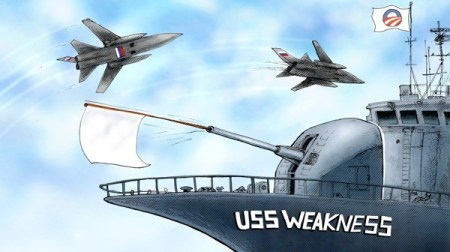
Cartoon of the Day

April 19, 2016

H/t Liberty Alliance

Buzz-Navy-600-LI-1-1-600x336

Israel, Turkey, Russia and Egypt

April 17, 2016

Israel, Turkey, Russia and Egypt, Gatestone InstituteShoshana Bryen, April 17, 2016

(A blast from the past:

— DM)

♦ In 2011, the UN Palmer Commission Report found the blockade of Gaza — jointly administered with Egypt — to be legal, and said Israel owed Turkey neither an apology nor compensation.

♦ Lifting the Israel/Egypt embargo on Gaza would empower Hamas, and thereby the Muslim Brotherhood, Iran and ISIS — which would seem an enormous risk for no gain.

Turkish sources assert that Turkish-Israeli governmental relations are about to come out of the deep freeze. But this is a reflection of Turkey’s regional unpopularity and glides over Turkish demands for Israel to end the blockade of Gaza. To meet Turkey’s condition, Israel would have to abandon the security arrangement it shares with Egypt — which has increased Israel’s security and has begun to pay regional dividends. To restore full relations between Israel and Turkey would irritate Russia, with which Israel has good trade and political relations, and a respectful series of understandings regarding Syria. Israel’s relations with the Kurds are also at issue here.

After the 2010 Mavi Marmara flotilla — in which Turkey supported the Hamas-related Turkish organization, the IHH, in its effort to break the blockade of Gaza — Turkey made three demands of Israel: an Israeli apology for the deaths of Turkish activists; a financial settlement; and lifting the Gaza blockade, which Turkey claimed was illegal. The last would provide IHH with the victory it was unable to achieve with the flotilla.

1080 (1)The Turkish-owned ship Mavi Marmara took part in a 2010 “Gaza flotilla” attempting to break Israel’s naval blockade of Gaza, which is in place to prevent the terrorist group Hamas from bringing arms into Gaza. (Image source: “Free Gaza movement”/Flickr)

In 2011, however, the UN Palmer Commission Report found the blockade of Gaza — jointly administered with Egypt — to be legal, and said Israel owed Turkey neither an apology nor compensation. In 2013, at the urging of President Obama and to move the conversation off the impasse, Prime Minister Netanyahu did apologize for the loss of life and agree to discuss compensation. While President Obama was pleased, Prime Minister Erdogan repaid the gesture by denigrating Israel on Turkish television and announcing he would force the end of the blockade. Israel’s condition — that the office of Hamas in Ankara be closed — was ignored.

Nevertheless, in February 2014, Turkish Foreign Minister Ahmet Davutoglu told Turkish television that Israel and Turkey were “closer than ever” to normalizing relations.” In December 2015, it was more of the same. And in February 2016, there was yet another announcement of imminent restoration of government-to-government ties. In March, Kurdish sources said Turkey was demanding weapons from Israel, but that Israel wanted to ensure that Turkey would not use them against Kurdish forces.

Israel finds itself in an odd position — choosing among those who want its cooperation.

Israel and Egypt have come to a deep understanding of the sources of instability and insecurity in Sinai, and the relationship between Hamas in Gaza and its primary sponsor, Iran, as well as ISIS. Former IDF Chief of Staff Benny Gantz told inFOCUS magazine recently:

Coordination between us is very high and very important because we have identical interests. Period. The way to achieve them might look different, but Egypt is a very important country. It is crucial to the world to ensure its stability – progress in the fight against ISIS that is present in Sinai, and protecting the Suez Canal, and other things… They are all good reasons for Egypt to take these responsibilities seriously and do something about the threats. I’m very happy to see what they’re doing. It is a good track.

This month, Egypt and Saudi Arabia upgraded relations with Egypt, ceding back to the Saudis two islands that Saudi Arabia had given Egypt in 1950 to help Egypt fight Israel in the Red Sea. According to a report in the Egyptian daily al-Ahram, as reported by the Jerusalem Post, the Egyptian government informed Israel of the parameters of the deal, noting that Riyadh would be obligated to honor all of Egypt’s commitments in the peace treaty with Israel, including the presence of international peacekeepers on the islands and freedom of maritime movement in the Gulf of Aqaba. Israel approved the deal “on condition that the Saudis fill in the Egyptians’ shoes in the military appendix of the peace agreement,” according to Defense Minister Moshe Yaalon.

This makes Saudi Arabia an active partner in the Camp David Accords. And it follows on the heels of the Gulf Cooperation Council (GCC) labeling Hezbollah “a terror organization” without the weasel words the Europeans used to condemn only the “military wing” of the organization.

In the face of these developments, it is hard to imagine a benefit that would accrue to Israel by negating the Israel-Egypt blockade of Gaza on behalf of Turkey.

Russia presents a similar series of circumstances. Relations between Russia and Turkey have taken a nosedive over the Syrian civil war, particularly after Turkey shot down a Russian plane. But even before that, Turkey’s support of Sunni jihadist organizations was a thorn in the side of Russia, which still fears Sunni jihad inside southern Russia.

Russia has goals in Syria and Israel also has requirements. In his inFOCUS interview, former Chief of Staff Gantz noted:

The [Israeli] Prime Minister and Chief of Staff [Gantz’s successor] flew to Russia and had some important of discussions of intentions, deconfliction, and we expressed our interests… stability, preventing terrorist activity… preventing armament that will go from Iran through Syria to Hezbollah, or from Russia to Syria and then to Hezbollah…. People can see what it is that Israel does once in a while when it has to protect itself.

Add to this Israel’s generally good economic and political relations with Russia and, again, it is hard to see the benefit that would accrue to Israel by forging closer relations with Turkey while Russia and Turkey are doing a slow burn.

Turkey is doing a faster burn on the Kurds. Having waged a fierce war against Kurdish separatists in southern Turkey, the Turkish government has taken military action against the Kurds of Iraq and Syria to prevent Kurdish forces from connecting two enclaves — one in Iraq and one in Syria — that could form the geographic beginning of an independent Kurdistan.

Even at the peak of Israeli-Turkish relations, Israel’s support of the Kurds has been a relatively open political secret. Although the Israeli government consistently denies providing weapons, reputable sources suggest, at a minimum, training for Kurdish forces. Most recently, Israel acknowledged buying oil from Kurdish sources in Northern Iraq, and IsraAid, an Israeli humanitarian organization, provided assistance to Kurdish refugees fleeing ISIS. Prime Minister Netanyahu has publicly supported the establishment of a Kurdish state.

For Israel to trade its increasingly important relations with Russia, with Egypt — and thereby with Saudi Arabia — and with the Kurds for Turkish political approval and a promise to buy Israeli natural gas would seem to be a bad deal. For Israel to accompany that with the lifting of the Israel/Egypt embargo on Gaza that would empower Hamas — and thereby the Muslim Brotherhood, Iran and ISIS — would seem an enormous risk for no gain.