Posted tagged ‘Rocket attack’

Anti-air missiles in ISIS hands also imperil Saudi, Jordanian and Israeli skies

November 5, 2015

Anti-air missiles in ISIS hands also imperil Saudi, Jordanian and Israeli skies, DEBKAfile, November 5, 2015
Shut_up

The Ansar al Sharia terrorist organization in Libya, which attacked the US consulate in Benghazi and murdered the American ambassador in 2012, has the very missiles capable of shooting down large airliners flying at high altitudes: Russian-made ground-to-air Buk missiles, which have a range of between three and 42 kilometers. This ultra-violent Islamist terror group has very close operational ties with ISIS-Sinai, and very possibly smuggled the missile system into Sinai from Libya.

****************************

The British Cobra (emergency cabinet) decision of Wednesday, Nov. 4, not to send airliners to or from Sharm El-Sheikh, where 20,000 British tourists are stranded, further strengthens the assumption that the Russian Metrojet Flight 9268 was downed over Sinai Saturday by a terrorist missile. It confirms that air traffic over Sinai and landings at Sharm are under threat from the ground – else why leave a large group of Britons under virtual siege in the Egyptian Red Sea resort? London said that the suspension of flights to Sharm was “indefinite.”

Moscow early Thursday accused London of being moved to this action out of hostility to Russia rather than security concerns.

Downing Street released a statement Wednesday saying: “As more information has come to light, we have become concerned that the plane may well have been brought down by an explosive device.” This statement was criticized by Egypt as “premature” – not a good omen for the conversation Prime Minister David Cameron is due to hold with his visitor, Egyptian president Abdel-Fatteh El-Sisi, later Thursday.

The British government has therefore stubbed toes in Moscow and Cairo without coming up with an emergency plan for evacuating its citizens from Egypt, whether overland to Cairo by bus or by sea aboard ships picking them up at the Red Sea resort and sailing through the Suez Canal.

This lack of initiative is a sign of confusion and uncertainty.

So far, the drawn-out deliberations and prevarications by officials in several countries regarding the crash of the Russian plane are meant for one purpose: to gain time for doing nothing about ISIS in Sinai. Neither the US, Russia or Britain is ready to send forces to the peninsula to confront the terrorists head-on.

The Ansar al Sharia terrorist organization in Libya, which attacked the US consulate in Benghazi and murdered the American ambassador in 2012, has the very missiles capable of shooting down large airliners flying at high altitudes: Russian-made ground-to-air Buk missiles, which have a range of between three and 42 kilometers. This ultra-violent Islamist terror group has very close operational ties with ISIS-Sinai, and very possibly smuggled the missile system into Sinai from Libya.

A number of intelligence agencies are aware of this and so a flock of leading European and Persian Gulf airlines lost no time in rerouting their flights to avoid Sinai straight after the Russian air disaster.

By causing this disaster, the Islamist terrorists coolly aimed for four goals:

1.  Retaliation for Russian intervention in Syria

2.  An attempt to destabilize the regime of Egyptian President Fattah Al-Sisi

3.  To show up the inadequacies of the 63-member coalition that the US formed in its effort to fight ISIS

4. To parade before the world the Islamic State’s operational prowess, its ability to shoot down the large passenger planes of the world’s biggest powers.

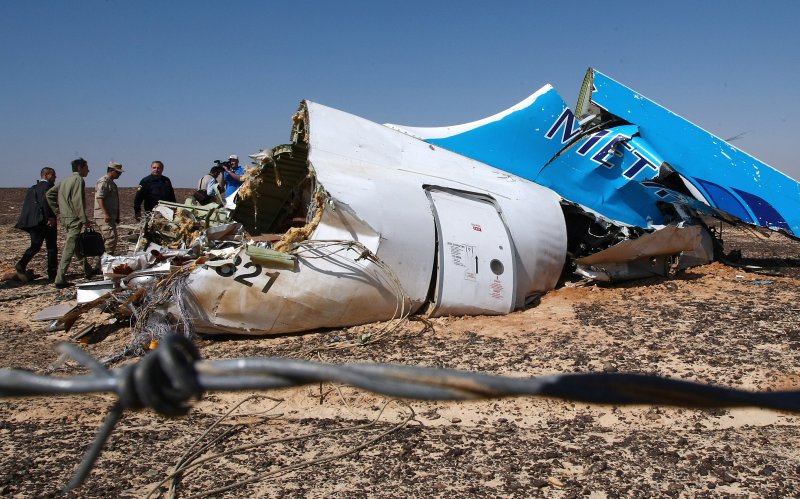
For five days, intelligence and flight safety experts dismissed the claim of responsibility that ISIS issued on the evening of October 31, maintaining that it was not to be taken seriously because no proof had been provided to support the claim – as if the charred fragments of the plane spread across tens of kilometers of desert were deniable.

In the second of its three messages, ISIS repeated its claim Wednesday, Nov. 4, promising details of how it downed the plane at a later date.

While more and more Western governments are coming around to accepting that the Russian airliner’s crash was caused by an explosive device, DEBKAfile’s counterterrorism sources repeat that they cannot rule out the possibility of a missile. The argument made on Wednesday in Washington and London that terrorist organizations do not have missiles capable of downing such planes is are simply incorrect.

ISIS-Sinai’s possession of an advanced ground-air missile system does not only endanger planes in the peninsula’s airspace, but also those aircraft flying over the Suez Canal as well as parts of Saudi Arabia, Jordan and Israel. One of the Egyptian president’s main purposes in his London visit was to try and persuade Prime Minister Cameron to join an Egyptian military operation against Ansar al Sharia in Libya and so eliminate a major prop and arms supplier for ISIS-Sinai. He does not hold out much hope of success.
Jihad, Iranian-style

August 21, 2015

Jihad, Iranian-style, Israel Hayom, Ruthie Blum, August 21, 2015

The new twist in the controversy surrounding the nuclear agreement is an argument over the veracity of a report on a side deal giving Iran the right to inspect its own nuclear facilities for potential violations. The idea is so preposterous that it must be true, judging by the rest of the top-secret document on which the U.S. Congress is going to vote in September.

But as the debate heats up over whether the deal furthers or hinders Iran’s nuclear weapon capabilities, an equally serious issue keeps being marginalized. This is the more immediate and tangible danger posed by Iran’s terrorist proxies, and the sudden financial and ideological boost the deal is providing them.

The reason it is crucial to keep an eye on their activities is that they constitute Iran’s global army — the boots on the ground, so to speak — who perform the legwork necessary for the ultimate aim of regional and global jihadist hegemony. Their role is to set the stage for that time in the not-so-distant future when Iran’s power and reach are so extensive that its leaders won’t need to waste their nuclear warheads by firing them.

This is where Israel comes in. As the only democracy in the Middle East, an ally of the West and a Jewish state, it has key strategic value. It is like the central card in a house of cards, whose removal topples the whole structure.

It is also tiny and surrounded by rogue states with an endless supply of Muslim would-be “martyrs” willing to die in the “holy” endeavor to take it down.

On Thursday, Israel received its latest message to this effect, when four rockets, launched from Syria, landed in the Upper Galilee and the Golan Heights. The Iran-backed Islamic Jihad terrorist organization was behind the attack, which spurred Israel to retaliate.

Also on Thursday, Israel deployed anti-missile Iron Dome batteries in the south of the country, in the areas between Ashkelon and Ashdod, as well as in Beersheba. This was in response to threats of rocket fire by Iran-baked terrorists in Gaza — whose excuse was the worsening condition of hunger-striking Palestinian terror suspect Mohammed Allan.

A review of recent Iranian rhetoric and activity, released by the Investigative Project on Terrorism, puts all of the above in context.<

Last month, the General Assembly of Islamic Resistance Ulema (scholars) held a weekend conference titled “Unity for Palestine.”

At the gathering, Hezbollah chief Hassan Nasrallah said, “We believe with certainty that Israel, this cancerous tumor, is headed for extinction, and that Palestine and Jerusalem will be returned to their people. It is only a matter of time and is linked to the will, action, jihad, and sacrifices of the Ummah [Islamic nation], according to the principle: If you achieve victory for Allah, Allah will lead you to achieve victory.”

From Iran, Ayatollah Mohsen Araki, secretary general of the World Forum for Proximity of Islamic Schools of Thought, agreed.

“Annihilation of the Zionist regime is a sure thing and Quranic pledge,” he said, adding that it is important to unify “Muslims in countering the regime of Zionism and the arrogant world.”

Muhammad Hasan Zamani, a former Iranian cultural attache in Egypt who heads the Department of International Islamic Madrasas (educational institutions) for the General Assembly of Islamic Resistance Ulema, reiterated this position.

“Israel must be erased from the map of the world,” he said. “These are the golden words Imam Khomeini, may God have mercy on him, uttered.”

Sheikh Abdel Halim Qadhi, a professor at Zahedan University in Iran, said, “The holy Quran makes it known that Jews are the enemies of Islam and the Muslims and their holy places and rites. … Jihad is the most powerful and only way to liberate Palestine and defend Jerusalem. … God loves those who fight in his way.”

Earlier this month, Iranian Supreme Leader Ali Khamenei published “Palestine,” a 416-page tome devoted to the issue of Israel’s inevitable demise, with a blurb on its back cover calling the author the “flagbearer of jihad to liberate Jerusalem.”

This week, Khamenei gave an abbreviated version of this on Twitter: “We spare no opportunity to support anyone #FightingTheZionists,” he wrote.

At the same time, a clip produced by the Islamic Revolution Design House, a media outlet associated with the Iranian Revolutionary Guard Corps, began to circulate on YouTube. The minute-and-a-half animated video depicts an Islamist invasion of Jerusalem.

The brief silent film shows soldiers from the Revolutionary Guards, Shia Badr, Hezbollah, Hamas and Qassam Brigades, clad in military gear and keffiyehs, marching to and standing on a hill overlooking the Temple Mount, as thousands upon thousands of additional terrorists amass.

An inscription in Farsi on a black screen at the end says: “Israel must be erased from the annals of history, and the youth will definitely see that day when it comes.”

Lest anyone imagine the mullahs pulling the strings in Iran don’t mean business, all one has to do is observe how they are executing their grand plan, part of which is the nuclear deal with the “Great Satan” and the other P5+1 countries. Among these is Russia, which confirmed on Wednesday that it will supply Iran with four upgraded batteries of S-300 surface-to-air missiles as soon as the deal is finalized.

Such missiles give Iran the extra benefit of being able to stave off attack. At that point, will it really matter if Iran is in charge of its own inspections?

Kerry says sinking of Iran deal would be ‘ultimate screwing of ayatollah’

August 5, 2015

Kerry says sinking of Iran deal would be ‘ultimate screwing of ayatollah,’ Jerusalem Post, August 5, 2015

(It’s as pro-Israel as the Obama administration gets. Please see also, Daniel Greenfield’s comments here. — DM)

ShowImage (6)
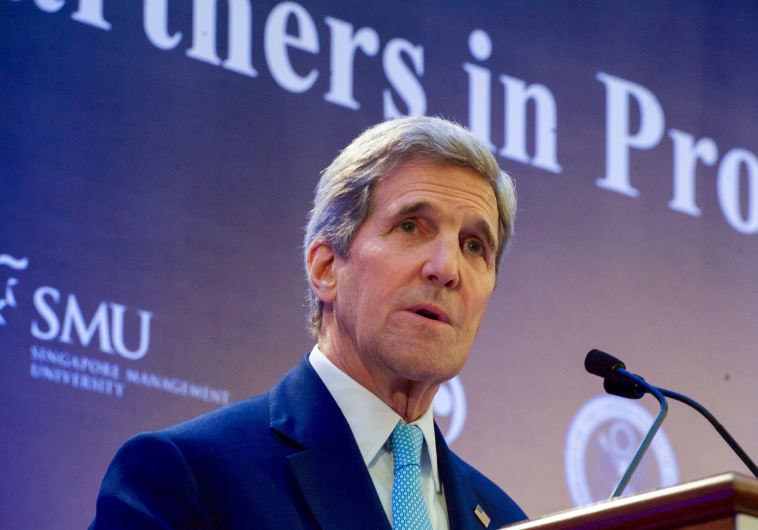
US Secretary of State John Kerry speaks in Singapore. (photo credit:STATE DEPARTMENT)

The secretary rejected Israel’s criticism of the nuclear agreement, saying that the deal “is as pro-Israel” as it gets.

******************

U.S. Secretary of State John Kerry told The Atlantic on Wednesday that if Congress were to shoot down the Iran nuclear agreement, it would be “the ultimate screwing” of Supreme Leader Ayatollah Ali Khamenei.

Kerry made the remarks in an interview with The Atlantic‘s Jeffrey Goldberg.

The secretary rejected Israel’s criticism of the nuclear agreement, saying that the deal “is as pro-Israel” as it gets.

Reneging on the nuclear agreement, which has the support of the major world powers, would constitute a setback for Washington and justify anti-American animus in Iran.

“The ayatollah constantly believed that we are untrustworthy, that you can’t negotiate with us, that we will screw them,” Kerry said. “[Having Congress vote down the nuclear pact] will be the ultimate screwing.”

“The United States Congress will prove the ayatollah’s suspicion, and there’s no way he’s ever coming back. He will not come back to negotiate. Out of dignity, out of a suspicion that you can’t trust America. America is not going to negotiate in good faith. It didn’t negotiate in good faith now, would be his point.”

Kerry also commented on the vociferous opposition to the deal expressed by Israel, which the secretary referred to as “visceral” and “emotional.” He was adamant that the agreement was positive for Israel’s geopolitical standing.

“I’ve gone through this backwards and forwards a hundred times and I’m telling you, this deal is as pro-Israel, as pro-Israel’s security, as it gets,” Kerry said. “And I believe that just saying no to this is, in fact, reckless.”

Kerry said that he was “sensitive” to Israeli concerns over Iran’s long-term aims, but he rejected arguments made by Jerusalem that the Islamic Republic was planning its annihilation.

“I haven’t seen anything that says to me [that Iran will implement its vow of wiping Israel off the map],” the secretary said. “They’ve got 80,000 rockets in Hezbollah pointed at Israel, and any number of choices could have been made. They didn’t make the bomb when they had enough material for 10 to 12. They’ve signed on to an agreement where they say they’ll never try and make one and we have a mechanism in place where we can prove that. So I don’t want to get locked into that debate. I think it’s a waste of time here.”

“I operate on the presumption that Iran is a fundamental danger, that they are engaged in negative activities throughout the region, that they’re destabilizing places, and that they consider Israel a fundamental enemy at this moment in time,” Kerry said. “Everything we have done here [with the nuclear agreement] is not to overlook anything or to diminish any of that; it is to build a bulwark, build an antidote.”

The secretary said that the nuclear deal is even more imperative if Israel’s fears that Iran is plotting its destruction are true, since the agreement neutralizes Tehran’s nuclear program.

Iran’s Supreme Leader Khameni publishes book on how to eliminate Israel

August 2, 2015

Iran’s Supreme Leader Khameni publishes book on how to eliminate Israel, American ThinkerThomas Lifson, August 2, 2015

Ayatollah Ali Khameni has published his version of Mein Kampf, a 416 page book outlining his strategy to eliminate Israel, which he describes as  “a cancerous tumor.” Although it is currently available only in Iran, an Arabic translation is underway, and sooner or later it will achieve wide readership in the Muslim world. The Obama administration is no doubt hoping it will achieve no notice in the United States until after the Iran deal is voted upon, because the plan advocated will be immensely aided by its implementation.

Amir Taheri of the New York Post obtained a copy from Iran:

Khamenei makes his position clear from the start: Israel has no right to exist as a state.

He uses three words. One is “nabudi” which means “annihilation.” The other is “imha” which means “fading out,” and, finally, there is “zaval” meaning “effacement.”

Khameni does not call for wiping out Israel with a nuclear bomb. He states that one of his fondest desires is to pray in Jerusalem. Instead, his plan is one of terrorism and pressure, keeping Israel from fighting back against Iran, the sponsor of terror, with the implicit threat of nuclear retaliation.

 What he recommends is a long period of low-intensity warfare designed to make life unpleasant if not impossible for a majority of Israeli Jews so that they leave the country.

His calculation is based on the assumption that large numbers of Israelis have double-nationality and would prefer emigration to the United States and Europe to daily threats of death.

Iran has many allies in this effort, including the BDS movement in the United States. Cripple Israel economically, and her economically productive people will leave. Make the political cost of supporting Israel high. That will pave the way for an internationally-sponsored plebiscite engineered to produce a Muslim state:

Under Khamenei’s scheme, Israel, plus the West Bank and Gaza, would revert to a United Nations mandate for a brief period during which a referendum is held to create the new state of Palestine.

All Palestinians and their descendants, wherever they are, would be able to vote, while Jews “who have come from other places” would be excluded.

Double standards are inherent in Islamic thinking. Any land that once fell under Muslim control belongs to Muslims by right. So Israelis who only boast a few generations in Israel are excluded, while Arabs whose families once lived in Israel generations ago are automatically qualified.

Khamenei does not mention any figures for possible voters in his dream referendum. But studies by the Islamic Foreign Ministry in Tehran suggest that at least eight million Palestinians across the globe would be able to vote against 2.2 million Jews “acceptable” as future second-class citizens of new Palestine. Thus, the “Supreme Guide” is certain of the results of his proposed referendum.

With a $150 billion war chest, thanks to the Obama deal, and the prospect of oil exploration and other business expansion in Iran, there will be plenty of money available to subsidize Hezb’allah, Hamas, and other terror attacks against Israelis and Jews (such as the attack on the Jewish Community Center in Buenos Aires).

Khamenei boasts about the success of his plans to make life impossible for Israelis through terror attacks from Lebanon and Gaza. His latest scheme is to recruit “fighters” in the West Bank to set up Hezbollah-style units.

“We have intervened in anti-Israel matters, and it brought victory in the 33-day war by Hezbollah against Israel in 2006 and in the 22-day war between Hamas and Israel in the Gaza Strip,” he boasts.

Far from a spittle-flecked madman, Khameni is coldly calculating, and explains a plan that is already underway with considerable success. And he has many allies in this country, some of them in high places.


Islamic State at Israel’s Gate

June 12, 2015

Islamic State at Israel’s Gate, Front Page Magazine, June 12, 2015

(According to Israel National News

Late on Thursday night “color red” rocket sirens were sounded in the southern coastal city of Ashkelon, as well as throughout the Ashkelon Coast regional council.

At least one rocket was identified as having been fired from Gaza, but IDF officials said it is believed the rocket exploded inside Gaza. No rockets were found in Israeli territory.

— DM)

ISIS-in-Gaza-404x350

All this is happening while the Obama administration, by the president’s own admission, has no clear strategy to defeat ISIS. At the same time, President Obama’s “strategy” to deal with Iran is to make concession after concession in order to secure any nuclear deal he can, including the possibility of providing Iran with relief from sanctions that were imposed for non-nuclear related reasons such as Iran’s support for terrorist activities

In short, Israel is facing Iran-backed Hamas from the south, Iran-backed Hezbollah from the north, and an expanding Islamic State presence north and south of Israel and within Israel itself. And that is before Iran gets its hands on a nuclear bomb and the Islamic State has enough radioactive material to build its own weapons of mass destruction.

*****************

Jihadists affiliated with the Islamic State (also known as ISIS or ISIL) are carrying on the rocket war against Israeli civilians from where Hamas left off. Following several rocket attacks in the last several weeks for which the Islamic State has taken credit, rockets launched from Gaza Thursday night exploded in the Ashkelon area.

Israel is still holding Hamas responsible for the attacks as the governing authority in Gaza.

“The IDF understands that Hamas wants quiet and is making an effort to prevent the shooting, but the State of Israel still sees Hamas as responsible for what happens in Gaza,” said Sami Turgeman, head of IDF’s Southern Command.

The Israeli military responded with measured attacks on Hamas facilities, while at the same time trying to avoid setting off a wider war at this time.  But Israel’s hand is being forced by the Islamic State, which is evidently working assiduously to supplant Hamas as the authoritative Islamic power in Gaza. The Gaza branch calls itself the Sheikh Omar Hadid Brigade. It is cooperating with another ISIS-affiliated group operating in the Sinai Peninsula, which calls itself Ansar Bayt al-Maqdis.

According to a June 8th report by Debkafile, “Islamic State operatives in the Gaza Strip have been helping themselves to Hamas rockets in recent weeks after furtively penetrating the factory teams operating the group’s production and assembly lines… The jihadis then secretly passed the stolen rockets to their squads for launching against Israel.”

On June 7th Debkafile noted in more general terms Hamas’s loss of control in Gaza in the face of Islamic State infiltration: “The terror infrastructure Hamas built over many years in Sinai has been taken over by ISIS, and its control of the Gaza Strip is slipping, as yet more radical and violent organizations eat away at its authority and seize control of the rocket offensive against Israel.”

Thus, even as Hamas remains committed to the destruction of Israel and is trying to re-build its arms stockpiles with Iran’s help, it is engaged simultaneously in its own battles with the Islamic State. Hamas has arrested some ISIS supporters and bulldozed a Sunni mosque believed to have been used by ISIS affiliated jihadists, while Hamas’s own facilities have come under attack by ISIS affiliated jihadists. Hamas also claimed in a message to Israeli authorities, routed through an Egyptian intermediary, that jihadists affiliated with the Islamic State were deliberately trying to spark a renewed war between Israel and Hamas.

The Islamic State is also trying to position itself to challenge Israel from the north. Israeli TV Channel 2 reported last week that the Islamic State is moving forces in the direction of the Golan Heights and the Israeli border.

Moreover, ISIS is developing an increasing presence within Israel itself. Recruits, influenced by ISIS’s slick social media promotions, are attracted to ISIS’s self-declared purer Islamic ideology. Hamas is apparently too “moderate” for these jihadists’ tastes.

“Dozens of Israeli Arabs and Palestinians have travelled to Syria and Iraq to join insurgent groups.” Israel’s Shin Bet domestic intelligence agency said in a statement released last January 4th. Israel had announced that it managed to crack one Islamic State cell on its soil and arrested its alleged members. An Israeli security official described the cell as “just the tip of the iceberg.”

Last July, the Islamic State previewed its intentions in a statement that it issued regarding jihad against Israel:

As for the massacres taking place in Gaza against the Muslim men, women and children, then the Islamic State will do everything within its means to continue striking down every apostate who stands as an obstacle on its paths towards Palestine. It is only [a] matter of time and patience before it (Islamic State) reaches Palestine to fight the barbaric Jews and kill those of them hiding behind the gharqad trees – the trees of the Jews.

Arutz Sheva reported that a spokesperson for the Islamic State, Nidal Nuseiri, urged patience as the Islamic State wanted first to consolidate its control over Arab Muslim lands, but “reaffirmed that conquering ‘Bayt el-Maqdis’ (Jerusalem) and destroying the State of Israel is central to the group’s jihad.” Thanks to President Obama’s dithering, the Islamic State is well on its way to achieving such consolidation in Iraq and Syria, while spreading to Libya.

At least three questions arise from the emergence of ISIS as a direct threat to Israel. Will Israeli military and security forces, either on their own or in concert with Jordan and Egypt, take on ISIS directly, including going after ISIS’s command and control centers with far more firepower than the Obama administration has used thus far?

To what extent will Israel be willing to outsource military operations against ISIS affiliates in Gaza to Hamas, much as it has outsourced some security operations to the Palestinian Authority in the West Bank? Major-General Turgeman tried to cast Hamas as the lesser of two evils, since, he claimed, “Israel and Hamas have shared interests, including in the current situation, which is quiet and calm and growth and prosperity.” Hamas “does not want global jihad,” he added. This is a truly incredible assertion coming from an Israeli military leader about a group willing to put its own citizens and their homes in harm’s way in order to launch their own thousands of rockets against Israel. What happened to Israeli Prime Minister Benjamin Netanyahu’s concise description of Hamas and the Islamic State as “branches of the same poisonous tree?” This just further demonstrates how completely insane the Middle East has become.

Finally, how successful will Iran be in exploiting the chaotic situation in Gaza, positioning itself as it has in Iraq as an enemy of ISIS, while further bolstering Hamas to Israel’s detriment?

All this is happening while the Obama administration, by the president’s own admission, has no clear strategy to defeat ISIS. At the same time, President Obama’s “strategy” to deal with Iran is to make concession after concession in order to secure any nuclear deal he can, including the possibility of providing Iran with relief from sanctions that were imposed for non-nuclear related reasons such as Iran’s support for terrorist activities.

In short, Israel is facing Iran-backed Hamas from the south, Iran-backed Hezbollah from the north, and an expanding Islamic State presence north and south of Israel and within Israel itself. And that is before Iran gets its hands on a nuclear bomb and the Islamic State has enough radioactive material to build its own weapons of mass destruction.

IDF Rehearsing for Nightmare Scenario: 4,000 Killed in Days

June 7, 2015

IDF Rehearsing for Nightmare Scenario: 4,000 Killed in Days, Israel National News, Gil Ronen, June 7, 2015

Security forces are currently rehearsing and preparing for a scenario in which Israel’s enemies launch a “carpet” missile attack that Iron Dome will be unable to counter, due to the sheer number of missiles involved, Arutz Sheva has learned from knowledgeable sources that wish to remain anonymous.

In this scenario, up to 4,000 Israelis will be killed in the first days of the attack, which could happen as early as this summer.

“Iran is seeking to cover Israel with intense fire,” Prime Minister Binyamin Netanyahu warned in a special briefing for journalists at the week’s end.

“In Lebanon, the Iranians are inserting the most advanced weapons in the world, and strengthening Hezbollah, so that it can hit any spot in Israel,” Netanyahu was quoted as saying in the daily Makor Rishon. “They are trying to build a second front in the Golan, and of course, in Gaza.”

‘Earth-shaking shock’ 

Former prime minister and defense minister Ehud Barak also sounded dire warnings last week, regarding Hezbollah’s ability to deal a heavy blow to Israel, and Israel’s unpreparedness for this.

“Our rival is serious, and we have no room for smugness on any front,” he said. “We must not be smug and take our superiority as something that is self-evident and supposedly God-given. Superiority is the result of serious work. We have not really dealt with 100,000 rockets, and we have not started to deal with the matter of their accuracy. When the rockets are accurate, it is not more of the same thing. It is something completely different.”

“The country has no choice but to reach conclusions,” Barak warned. “One cannot deal with this challenge by deploying in all of the places, from which [anti-missile] missiles can be fired. These things are very expensive: Iron Dome and Magic Wand, Arrow and Super-Arrow are expensive projects.

“One cannot exaggerate the importance of safeguarding security,” he added, “and one cannot exaggerate the earth-shaking shock that can take place when it turns out that we did not prepare and we did not understand the urgency and practicality of challenges of this sort, and the need to translate clear thought to conclusions, and we will find ourselves [in a situation where] citizens suddenly discover that one cannot walk slowly and lackadaisically to the bomb shelters, knowing that nothing can happen, as we did in during Operation Protective Edge. These things must be done now, we must not wait.”

Israel’s Revenge Is That “We Are Still Here”

June 7, 2015

Israel’s Revenge Is That “We Are Still Here” The Legal Insurrection, June 7, 2015

My wife and I are back, after an intense two weeks in Israel.

From the Lebanese to Gaza borders, from the Mediterranean Sea to Judea and Samaria, from the cool evenings of Jerusalem to the heat of the Negev Desert, from an apartment in the Jewish Quarter of the Old City of Jerusalem to Bedouin villages in the north and south, from university campuses to military bases, from faculty to students, from Jews to Muslims … I can’t say we saw it all, but we saw a lot.

I’ve documented most of our big events in daily posts, with the exception of our emotional meetings with the families of Edward Joffe and Leon Kanner, students killed in the 1969 Supersol supermarket bombing by Rasmea Odeh; that post is coming, but I still have new photos, documents and information I have to work through.

Here are my 5 Big Takeaways from the trip:

1. Our Revenge Is That “We Are Still Here”

Near the start of our trip, we visited Moshav Avivim straddling the Lebanese border, where we met Shimon Biton, a survivor of the 1970 bazooka attack on a school bus by the Popular Front for the Liberation of Palestine.

Biton, who was six and one-half years old, lost his father in the attack, and himself was shot point blank range by the terrorists when they realized he survived the bazooka attack.  Ten days before we met Biton, he was reunited for the first time in 45 years with the nurse who helped save him.  (Featured Image)

When we asked whether he ever wanted revenge, Biton told us that the revenge was that “we are still here and building for another 70 families.”

Moshav-Aviviv-Shimon-Biton-e1432683043370[Shimon Biton, Moshav Avivim, Israel]

When we related that story to numerous people we met along the rest of the trip, heads vigorously shook up and down.  It struck a chord, since almost every Israeli has a relative or friend impacted by terror.

Despite several decades of terrorism, particularly intense during the Second Intifada, and a world campaign against it, the People of Israel are still there.

The will to resist is underestimated.  Israel has a longer-term view, and a history.  It will not give in to boycotts, or Obama, or outside pressure that puts its security at risk.

2. “I don’t like Bibi, BUT….”

For whatever the reason, most of the people with whom we interacted self-identified as center-left or left.

There was no shortage of criticism of Israeli Prime Minister Benjamin Netanyahu: He’s egotistical, he doesn’t keep his tough promises, he is only interested in his own political survival, he’s a liar, his pre-election comment about Arab voting was shameful, and so on.

Yet with only a couple of exceptions, the negative comments always were followed with a big BUT.

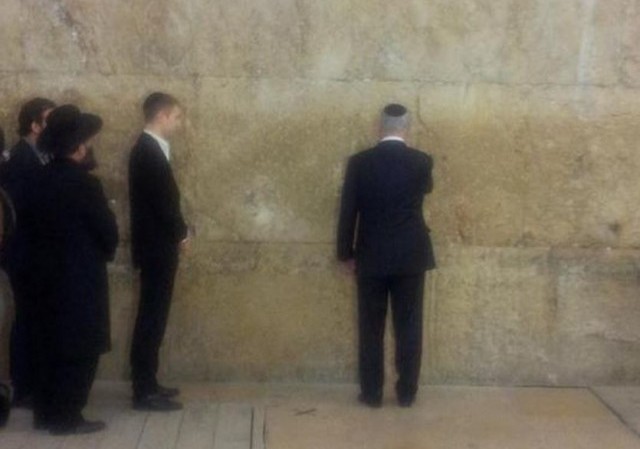
Benjamin-Netanyahu-at-Western-Wall-post-election-2015-e1426681806959[Israeli Prime Minister Benjamin Netanyahu at Western Wall after 2015 election victory.]

But he is the only Israeli politician who has the stature to handle the world pressure; but I don’t envy the position he is in with so many forces against us; but [opposition leader Yitzhak “Bougie” Herzog] Bougie is weak and no one will fear him; and so on.

These opinions pretty much were reflected in polling and the election results — Many people may not like Netanyahu, but he is the only Israeli politician capable of standing up for Israel in a hostile world.

3. I don’t like Obama, no BUTs about it

Polling in Israel shows Obama is hugely unpopular.  Our anecdotal interactions with Israelis confirmed that polling.

I  can’t recall anyone, from left to right, who had anything nice to say about Obama.  The most consistent theme was that Obama is naive and weak, and that naivitee and weakness had resulted in disaster in the Arab world as it encouraged the most aggressive Islamist elements.

They see Syria falling apart with al-Qaeda or ISIS groups likely to control large parts of the country; or if not, then Iran in control. There are no good outcomes for Israel’s Golan Heights border. Along the Lebanese border there is Hezbollah, and in Gaza Hamas and increasingly even more radical Salafist-ISIS groups.

Against this background of being surrounded by a sea of increasing threats resulting from Obama administration policy, not a single person thought the Iran nuclear deal made any sense, or trusted the Obama administration on it.

In other words, Israelis live in the real world, not the world of Obama’s delusional hope.  And they don’t appreciate Obama taking risks with their lives.

4. Are we really that popular in the United States?

The anti-Israel Boycott, Divestment and Sanctions movement was a frequent topic of conversation, almost always brought up by us as part of describing the type of coverage at Legal Insurrection.  This coincided with what I consider an irrational panic the past two weeks in the Israeli press and political discourse about BDS (more on that in a later post.)

I tried to explain that there is a complete disconnect between the BDS movement in the U.S. and the vast majority of Americans.  Gallup and Pew polling shows Israel at or near historical highs in terms of Israel’s favorability both abolutely and relative to favorability of Palestinians.  The gap between those who pick Israel over Palestinians when the question forces a choice, also is historically high.

Virtually every Israeli we met was shocked that Israel is actually so popular in the United States.  Even Israelis who have extensive American contacts and visit the U.S.

That’s not all so surprising.  Both the U.S. and Israeli media focus on the negative, though for different reasons.  The U.S. media long has had in implicit anti-Israel bias, compounded by the rise of left-leaning new media, while the Israeli media competes for readers with a “sky is falling” outlook.

(added) Israel’s enormous popularity among Americans is a strategic asset.  That strategic asset needs to be used more effectively to minimize the damage from the narrow but influential slices of the American population — radical faculty, some students, and mainstream journalists — who have explicit or implicit anti-Israel biases. The American people as a whole are the “Israeli Lobby.”

5. The Next War is Only a Matter of Time

While we were in Jerusalem, Israel underwent a national defense drill, including sirens warningof incoming rockets.

Our tour along the Gaza border, particularly near Sderot, also reflected preparation for the next round of rocket fire through reinforcing key civilian infrastructures, such as schools.

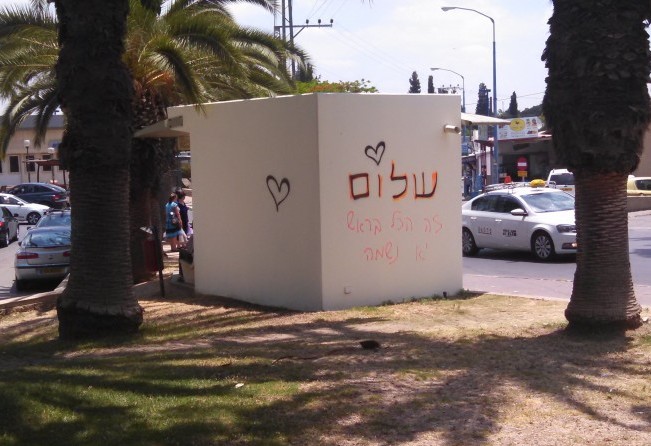
Sderot-Israel-bomb-shelter-street-e1433110130989[Sderot, Israel, street bomb shelter with “Shalom” grafitti]

There was a pervasive feeling that the calm cannot last.  And sure enough, while we were there and just after we left, rockets were fired from Gaza to Israel by Salafists suffering from a Hamas crackdown, and groups competing with Hamas for control.

That’s the logic of the region in which Israel lives: Radical groups retaliate against each other by firing rockets at … Israel.

The next war is coming.  Every Israeli knows it. It’s only a matter of time.

*  *  *  *  *

Those are my big takeaways.  I hope you enjoyed the coverage.

We will be back in Israel, hopefully next year.

Filling the Vacuum in Syria

May 28, 2015

Filling the Vacuum in Syria, The Gatestone InstituteYaakov Lappin, May 28,2015

  • The idea that, because Sunni and Shi’ite elements are locked in battle with one another today, they will not pose a threat to international security tomorrow, is little more than wishful thinking.
  • The increased Iranian-Hezbollah presence needs to be closely watched.
  • A policy of turning a blind eye to the Iran-led axis, including Syria’s Assad regime, appears to be doing more harm than good.

As the regime of Bashar Assad continues steadily to lose ground in Syria; and as Assad’s allies, Iran and Hezbollah, deploy in growing numbers to Syrian battlegrounds to try to stop the Assad regime’s collapse, the future of this war-torn, chaotic land looks set to be dominated by radical Sunni and Shi’ite forces.

The presence of fundamentalist Shi’ite and Sunni forces fighting a sectarian-religious war to the death is a sign of things to come for the region: when states break down, militant entities enter to seize control. The idea that, because Sunni and Shi’ite elements are locked in battle with one another today, they will not pose a threat to international security tomorrow, is little more than wishful thinking.

The increased presence of the radicals in Syria will have a direct impact on international security, even though the West seems more fixated on looking only at threats posed by the Islamic State (ISIS), and disregards the possibly greater threat posed by the Iranian-led axis. It is Iran that is at the center of the same axis, so prominent in entangling Syria.

The threat from ISIS in Syria and Iraq to the West is obvious: Its successful campaigns and expanding transnational territory is set to become an enormous base of jihadist international terrorist activity, a launching pad for overseas attacks, and the basis for a propaganda recruitment campaign.

It has already become a magnet for European Muslim volunteers. Their return to their homes as battle-hardened jihadists poses a clear danger to those states’ national security.

Yet the threat from the Iranian-led axis, highly active in Syria, is more severe. With Iran, a threshold nuclear regional power, as its sponsor, this axis plans to subvert and topple stable Sunni governments in the Middle East and attack Israel. Iran’s axis also has its sights set on eventually sabotaging the international order, to promote Iran’s “Islamic revolution.”

This is the axis upon which the Assad regime has become utterly dependent for its continued survival.

Today, the radical, caliphate-seeking Sunni organization, ISIS, controls half of Syria, while hardline Lebanese Shi’ite Hezbollah units can be found everywhere in Syria, together with their sponsors, Iran’s Islamic Revolutionary Guards Corps (IRGC) personnel, fighting together with the Assad regime’s beleaguered and worn-out military forces.

The increased Iranian-Hezbollah presence needs to be closely watched. According to international media reports, an IRGC-Hezbollah convoy in southern Syria, made up of senior operatives involved in the setting up of a base designed to launch attacks on the Golan Heights, was struck and destroyed by Israel earlier this year. The Hashemite Kingdom of Jordan too hasreason to be concerned.

1088Lebanese Shi’ite Hezbollah fighters are deeply involved in Syria’s civil war. (Image source: Hezbollah propaganda video)

Syria has become a region into which weapons, some highly advanced, flow in ever greater numbers, allowing Hezbollah to acquire guided missiles, and allowing ISIS and the Al-Nusra Front to add to their growing stockpile of weaponry.

Other rebel organizations, some sponsored by Saudi Arabia, Turkey, and Qatar, are also wielding influence in Syria. These groups represent an effort by Sunni states to exert their own influence there.

Despite all the efforts to support it, the Assad regime suffered another recent setback when ISIS seized the ancient city Palmyra in recent days, making an ISIS advance on Damascus more feasible. To the west, near the Lebanese border, Al-Qaeda’s branch in Syria, the Al-Nursa Front, also made gains. It threatened to enter Lebanon, prompting Hezbollah to launch a counter-offensive to take back those areas.

These developments provide a blueprint for the future of Syria: A permanently divided territory, where conquests and counter-offensives continue to rage, and the scene of an ongoing humanitarian catastrophe, producing waves of millions of refugees that could destabilize Syria’s neighbors. Syria is set to remain a land controlled by warring sectarian factions, some of whom plan to spread their destructive influence far beyond Syria.

Events in Syria have shown that the notion that air power can somehow stop ISIS’s advance is a fantasy. More importantly, they have also illustrated that Washington’s policy of cooperation with Iran in a possible “grand bargain” to stabilize the region, while failing to take a firmer stance against the civilian-slaughtering Assad regime, is equally fruitless.

A policy of turning a blind eye to the Iran-led axis, including Syria’s Assad regime, appears to be doing more harm than good.

Hezbollah Prepares

May 28, 2015

Hezbollah Prepares, Power LineScott Johnson, May 28, 2015

[T]he Israelis will have to mobilize massive force to shorten the duration of a future war. One of the things they’ll do is immediately is move to eliminate as much of Hezbollah’s vast arsenal as possible. Hezbollah is counting on the resulting deaths of their human shields – and they’ve guaranteed to that the body count will be significant – to turn Israel into an international pariah.

************************

There is so much bad news coming out of the Middle East that it is hard to keep up. Omri Ceren writes from The Israel Project to fill us in on a preview of coming attractions featuring the proxy forces of President Obama’s Iranian friends. Where precisely does Hezbollah fit in Obama’s vision of Iran as a friendly regional power? Too bad Jeffrey Goldberg didn’t riddle Obama that particular question.

This is Omri’s email message verbatim, complete with the URLs of footnoted stories. I thought that readers who have found Omri’s reports helpful might find this of interest as well:

Variations of this story have been bouncing around for the last few weeks. Two weeks ago there were major recent pieces in the NYT and AP articles, where journalists got to look at IDF aerial photography showing that Hezbollah has moved the vast majority of its military infrastructure into Shiite villages [1][2]. They’ve taken their arsenal – 100,000+ rockets including Burkan rockets with half-ton warheads, ballistic missiles including Scud-Ds that can hit all of Israel, supersonic advanced anti-ship cruise missiles, anti-aircraft assets, drones and mini drones, tunnels, etc. – and embedded it across hundreds of villianges and probably thousands of homes.

The Syrian war has been good for Hezbollah in that respect. They’ve cleaned out Assad’s depots and brought the goods back to Lebanon.

The Israelis can’t afford a war of attrition with Hezbollah. The Iran-backed terror group has the ability to saturation bomb Israeli civilians with 1,500 projectiles a day, every day, for over two months. They will try to bring down Tel Aviv’s skyscrapers with ballistic missiles. They will try to fly suicide drones into Israel’s nuclear reactor. They will try to detonate Israel’s off-shore energy infrastructure. They will try to destroy Israeli military and civilian runways. And – mainly but not exclusively through their tunnels – they will try to overrun Israeli towns and drag away women and children as hostages. Israeli casualties would range in the thousands to tens of thousands.

And so the Israelis will have to mobilize massive force to shorten the duration of a future war. One of the things they’ll do is immediately is move to eliminate as much of Hezbollah’s vast arsenal as possible. Hezbollah is counting on the resulting deaths of their human shields – and they’ve guaranteed to that the body count will be significant – to turn Israel into an international pariah. But the Israelis can’t let Hezbollah level their entire country with indiscriminate rocket fire and advanced missiles, just because no one in Lebanon is willing or able to expel the group from Shiite villages.

This weekend’s round of stories actually came from Hezbollah’s side. As-Safir – a Lebanese daily and a major Hezbollah mouthpiece – published a series of puff pieces about how Hezbollah has turned all of southern Lebanon into a vast military complex. I’ve pasted the full AP/TOI write-up at the bottom [omitted here, [a href=”http://www.timesofisrael.com/hezbollah-flaunts-advanced-tunnel-network-on-israeli-border/”>this is the story], but it’s what you’d expect:

According to the reports, based on a tour of Hezbollah facilities given to the newspaper, the group has built a sprawling underground array of tunnels, bunkers and surveillance outposts along the border with Israel, which it is manning at peak readiness for battle. The tunnels are said to be highly-advanced, with durable concrete, a 24-hour power supply via underground generators, a ventilation system to prevent damp from damaging military equipment and a web of secondary escape shafts in case of attack. The tunnels are said to be housing tens of thousands of rockets ready for launch, themselves wrapped in protective materials in order to preserve them.

None of this is new. In early 2013 veteran Israeli war correspondent Ron Ben-Yishai did a deep dive into Hezbollah military posture [3]. He revealed among other things that Hezbollah had given away thousands of homes to poor Shiite families, on the condition “that at least one rocket launcher would be placed in one of the house’s rooms or in the basement, along with a number of rockets, which will be fired at predetermined targets in Israel when the order is given.” Then in 2014 air force chief Major-General Amir Eshel gave a speech outlining how Hezbollah has embedded its military assets in “thousands” of residential buildings, emphasizing that Israel would have no choice but to target that infrastructure in a war. Reuters picked up the speech under the headline “Hoping to deter Hezbollah, Israel threatens Lebanese civilians” [4].

But there’s a lot of chatter in the Middle East about a summer war between Israel and Lebanon, so you’re seeing a new round of stories about what it might look like. On one hand the Israelis and Hezbollah are saying the same thing: all of southern Lebanon is now one big military compound. But only the Israelis are pointing out that Hezbollah has made sure that in that compound there are tens of thousands of civilians.

[1] http://www.nytimes.com/2015/05/13/world/middleeast/israel-says-hezbollah-positions-put-lebanese-at-risk.html
[2] http://hosted.ap.org/dynamic/stories/M/ML_ISRAEL_HEZBOLLAH?SITE=AP&SECTION=HOME&TEMPLATE=DEFAULT&CTIME=2015-05-13-14-10-05
[3] http://www.ynetnews.com/articles/0,7340,L-4343397,00.html
[4] http://www.reuters.com/article/2014/01/29/us-israel-lebanon-hezbollah-idUSBREA0S1PS20140129

IDF Strikes in Gaza Following Rocket Attack

April 24, 2015

IDF Strikes in Gaza Following Rocket Attack, Israel National News,  Elad Benari and Kobi Finkler, April 24, 2015

img517530Israeli airstrike in Gaza  Reuters

The IDF on Thursday night, shortly before midnight, launched an airstrike which targeted a “terrorist infrastructure” in northern Gaza, the IDF Spokesperson’s Unit said in a statement.

According to the statement, the airstrike was in retaliation for an earlier rocket attack by Gaza terrorists on southern Israel.

In addition, said the IDF, the entry of worshipers from Gaza into Israel will be prevented on Friday.

“The IDF will not permit any attempt to harm the security of the citizens of Israel,” the statement said.

The IDF confirmed earlier that at least one terrorist rocket had been fired from Gaza at southern Israel.

There were no reports of physical injuries or damage. The remains of one rocket were located in an open area in the Sha’ar Hanegev region.

The last time a Color Red siren was heard in the Gaza Belt region was in late December – four months ago. In response, IAF jets attacked Hamastraining grounds in Khan Yunis, in southern Gaza.