Posted tagged ‘Peace Process’

The Left’s Abbas problem

June 6, 2017

The Left’s Abbas problem, Israel Hayom, Jonathan S. Tobin, June 6, 2017

Despite repeated Palestinian rejections of peace offers, advocates of a two-state solution still cling to the belief that it is Israel that is inventing conditions designed to ensure that negotiations will fail. But if their goal is to create a genuine consensus behind peace, then rather than lament Trump’s criticisms of Abbas, they ought to hope he will succeed in getting the PA leader to stop the incitement as well as the prisoner payments. If Netanyahu’s opponents continue to refuse to take this issue seriously, they will have no one but themselves — and the Palestinians — to blame if they continue to be marginalized and peace remains a remote dream.

***********************

For the Israeli Left, talk about Palestinian incitement is nothing more than an excuse invented by the Right to avoid peace. The same largely applies to their views about the Palestinian Authority’s payments of more than $1 billion in just the last four years in salaries to imprisoned terrorists and their families.

The PA’s ongoing efforts to inculcate new generations in the ideology of hate that has driven the century-long war on Zionism is itself a barrier to peace. It also ensures that any effort to end the conflict will run counter to notions of Palestinian identity that are inextricably linked to that war.

But if you believe that Israel’s chief objective must be to achieve a separation from the Palestinians and an end to its presence in the West Bank and east Jerusalem regardless of what happens or who governs a Palestinian state, you view the issue differently. If you think separation is the only way to preserve a Jewish majority in the Jewish state and to protect both Israelis and Palestinians from the burden of the occupation, statements of support or even subsidies for those who commit violence are side issues or distractions that obscure the big picture.

Yet opponents of the Netanyahu government are making a big mistake when they downplay these issues. Though they doubt the motives of those who point out what the Palestinian Authority have been doing and even agree with PA President Mahmoud Abbas’ assertion that both sides incite, they are missing the point. A failure to address these questions has been the Achilles’ heel of the Left ever since the Oslo Accords were signed. Doing so is not only political poison, it also sends the wrong message to Palestinians who they insist are, against all evidence, viable partners for peace.

The issue of incitement is at the center of the discussion now because U.S. President Donald Trump has decided it is important. Trump was sufficiently ignorant of the history of the conflict and how the PA operates that he actually seems to have believed Abbas’ assurances about not supporting incitement or payments to prisoners that the PA leader made during their initial White House meeting.

But when the Israelis pointed out to him that Abbas was seeking to pull the wool over his eyes, and backed it up with video evidence, he didn’t like it. More than that, he rightly understood that this lie was an obstacle to achieving the unlikely diplomatic triumph he craved.

That led to Trump reportedly pounding the table and accusing Abbas of being liar when they met in Bethlehem. Since it would be difficult for Abbas to suddenly alter the nature of what is published in PA newspapers or viewed on PA television to mollify Israeli or Western sensibilities, let alone cease payments to the very same terrorist prisoners who are lauded by Palestinians as heroes, Trump’s insistence on these points was no small controversy.

The Left deplores Trump’s embrace of this issue and puts it down to a clever strategy implemented by Netanyahu. But if that’s all they think there is to it, they’re repeating the same mistakes that ensured the failure of peace talks in the past. In the 1990s, both the Clinton administration and Labor-led governments saw PLO leader Yasser Arafat’s words and actions as merely fodder for domestic Palestinian political consumption. But the result of that policy was not only to convey to the PA that it could transgress with impunity; this spirit of complacency also materially contributed to the collapse of faith in the peace process once Palestinian actions moved from words to bombs in the Second Intifada.

The Left’s problem is not just that serious observers understand the implications of incitement and material support for terror and that not enough people share their belief that Israeli actions are as bad or worse than those of the Palestinians. Nor are most Israelis likely to be persuaded to view actions of self-defense undertaken by their government as morally equivalent to the PA’s support for terror. Just as important is that a Palestinian leader who felt constrained to engage in behavior that engendered such deep mistrust among Israelis would be unlikely to muster support for an end to the conflict among his own people, even if he wanted to make peace.

Despite repeated Palestinian rejections of peace offers, advocates of a two-state solution still cling to the belief that it is Israel that is inventing conditions designed to ensure that negotiations will fail. But if their goal is to create a genuine consensus behind peace, then rather than lament Trump’s criticisms of Abbas, they ought to hope he will succeed in getting the PA leader to stop the incitement as well as the prisoner payments. If Netanyahu’s opponents continue to refuse to take this issue seriously, they will have no one but themselves — and the Palestinians — to blame if they continue to be marginalized and peace remains a remote dream.

Jonathan S. Tobin is the opinion editor of JNS.org and a contributing writer for ‎National Review.

Palestinian Authority’s Fatah Faction Appoints Israeli Arab Terrorist to Central Committee Upon Recommendation of Mahmoud Abbas

May 29, 2017

Palestinian Authority’s Fatah Faction Appoints Israeli Arab Terrorist to Central Committee Upon Recommendation of Mahmoud Abbas, The Jewish PressHana Levi Julian, May 29, 2017

(Please see also, Palestinians: Abbas Immediately Breaks Promises to Trump. — DM)

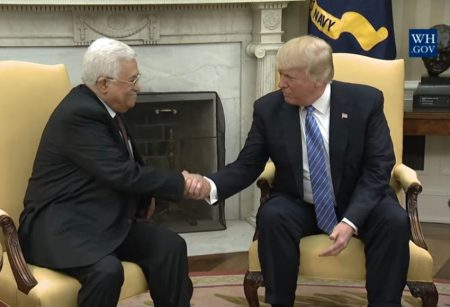
Palestinian Authority leader Mahmoud Abbas sits with US President Donald Trump at the White House, May 3 2017

Fatah has appointed terrorist murderer Karim Younes to its Central Committee upon the personal recommendation of Palestinian Authority leader Mahmoud Abbas, the Palestinian Media Watch reported this week.

Karim Younes and his cousin Maher Younis are two Israeli Arabs who together kidnapped and murdered Israeli soldier Avraham Bromberg in 1980.

The two killers have been presented by the Palestinian Authority government as role models for PA children. Public squares were recently named after each, to further glorify them, by the Palestinian Authority government.

The PLO Director of Prisoner’s Affairs said in a statement that he sees the appointment of Younes as proof that “our prisoners are not terrorists.”

“It is also noteworthy that Abbas has chosen an Israeli citizen to be among Fatah’s decision-makers,” Itamar Marcus and Nan Jacquest Zilberdik said in an article on the PMW website. “This is consistent with the Palestinian Authority message to Israeli Arabs to see themselves as part of the Palestinian national movement, and to view all of the land of the State of Israel as part of a future Palestinian state that will replace Israel.

“This new appointment of a terrorist was announced right after Abbas sent a message to Israelis demonstrating on Saturday for “Two states – One hope” at Rabin Square in Tel Aviv, in which he stated, ‘The opportunity [for peace] still exists, and it cannot be missed when our hand is extended in peace that is created between those who are brave.’” [Ha’aretz, May 27, 2017]

Significantly, “[PA] Minister of Justice Ali Abu Diyak emphasized that the decision of the Fatah Movement leadership – led by President Mahmoud Abbas – to appoint the veteran prisoner Karim Younes to the Fatah Central Committee is the clearest and severest response to the campaign being led by Israel to accuse the prisoners, Martyrs (Shahids), and the Palestinian struggle of terror.” [Official PA daily Al-Hayat Al-Jadida, May 28, 2017]

PLO’s Director of Prisoners’ Affairs Issa Karake welcomed the appointment, claiming it proof that the Palestinian prisoners are not criminals:
“I want to note an additional achievement, which was a political response by the Palestinian leadership when the Fatah Revolutionary Council made a decision to appoint prisoner Karim Younes, the most veteran of the prisoners, as a member of the Fatah Movement Central Committee.

“I think that this is a very great and significant political response, [which says] that our prisoners are not terrorists and are not criminals. They are freedom prisoners and fighters who enjoy an important national, human, and legal status among their leadership and among their Palestinian people.”
[Official PA TV, Palestine This Morning, May 28, 2017]

As part of the PA’s campaign to present terrorists as heroes and role models, the PA recently named two town squares after Karim and Maher Younes.

In his statement regarding the appointment of Younes, the Minister of Justice further glorified all terrorist prisoners:

“The prisoners and Martyrs are the spearhead of the freedom fighters, symbols of our legitimate national struggle, and conscience of the Palestinian people…”
[Official PA daily Al-Hayat Al-Jadida, May 28, 2017]


The onus is on us

May 25, 2017

The onus is on us, Israel Hayom, Isi Leibler, May 25, 2017

(Iran is the greatest threat to Israel; it has or will have nukes and the means of delivering them to obliterate the “little Satan.” The Palestinians don’t and, at least in the foreseeable future, are unlikely to. By working with the Saudis, et al, to defang Iran, President Trump rejected Obama’s policy of yielding to Iran and thereby benefitted both the Saudis, et al, and Israel. — DM)

Trump did not try to force unreasonable concessions. A Palestinian state is not ‎even on the horizon. Neither is there any indication of a return to former President Barack ‎Obama’s policy of freezing all settlement construction.‎

In King Salman’s ‎statement outlining the Saudi position, rather than condemning Israel, he merely expressed the ‎hope that peace will be achieved. This was a clear message, as was the fact that Trump flew to ‎Israel on the first openly direct flight from Riyadh to Tel Aviv.‎

According to The Wall Street Journal, the Saudis no longer demand a complete ‎settlement freeze. Instead, they propose that Israel restrict construction outside the ‎settlement blocs and provide additional humanitarian aid in Gaza. ‎

In return, the Saudis would inch toward normalization by allowing ‎Israeli aircraft to fly over their territory, set up direct telephone connection and even provide ‎tourist visas for Israelis. While this was not officially confirmed, there were no denials, which ‎tends to confirm the veracity of the report. ‎

************************

U.S. President Donald Trump has delivered. He will not have satisfied the delusional ‎aspirations of Israel’s radical right but, despite some missteps before he arrived, the Trump visit was favorable for Israel and outlined ‎parameters of what can be achieved with the Palestinians.‎

It was disappointing that he postponed transferring the U.S. Embassy to Jerusalem, but we appreciate that he is the first sitting ‎American president to visit the Western Wall. ‎

He should have been more explicit about the extent of terrorism in Israel in his ‎address to the Muslim world. But he more than compensated in his extraordinarily warm ‎address at the Israel Museum.‎

There is also some concern that the substantial commercial and defense relationship with the ‎Saudis ($380 billion in deals, including $110 billion in arms purchases) might impact Israel and ‎will require steps to ensure that we maintain our qualitative military edge.‎

Trump did not try to force unreasonable concessions. A Palestinian state is not ‎even on the horizon. Neither is there any indication of a return to former President Barack ‎Obama’s policy of freezing all settlement construction.‎

Indeed, the president expressed support for Israel in a far more open and ‎positive manner than his predecessors. In his address to the leaders of 55 Muslim-‎majority countries, he reversed Obama’s moral equivalence approach and described the ‎conflict as being between the forces of decency on the one hand, and an evil death cult on the ‎other. He urged the Arab and Muslim states to actively eradicate terrorism and extremism ‎from within their ranks. He specifically condemned Hamas and ‎Hezbollah together with ISIS and al-Qaida. And he explicitly called on Arab and Muslim ‎leaders to combat anti-Semitism. ‎

For the first time, the Saudis, backed by the Egyptians and Gulf states, appear to be promoting ‎peace or at least easing the tension between the Palestinians and the Israelis. In King Salman’s ‎statement outlining the Saudi position, rather than condemning Israel, he merely expressed the ‎hope that peace will be achieved. This was a clear message, as was the fact that Trump flew to ‎Israel on the first openly direct flight from Riyadh to Tel Aviv.‎

According to The Wall Street Journal, the Saudis no longer demand a complete ‎settlement freeze. Instead, they propose that Israel restrict construction outside the ‎settlement blocs and provide additional humanitarian aid in Gaza. ‎

In return, the Saudis would inch toward normalization by allowing ‎Israeli aircraft to fly over their territory, set up direct telephone connection and even provide ‎tourist visas for Israelis. While this was not officially confirmed, there were no denials, which ‎tends to confirm the veracity of the report. ‎

Whether this was the outcome of discussions with Trump’s representatives, or ‎because the Saudis recognize the value of Israel’s support against Iran’s efforts to achieve ‎regional hegemony, is irrelevant. There have already been widespread rumors attesting to ‎covert Saudi cooperation with Israel against Iran and similarly with Egypt against ISIS.‎

Trump demanded that the Palestinians cease incitement and stop ‎rewarding terrorists murderers and their families, and avoided suggesting that Israel cease settlement activity. But he undoubtedly pressed Prime ‎Minister Benjamin Netanyahu for confidence-building measures such as ‎improving Palestinian economic conditions.‎

At this potentially historic turning point, Netanyahu must stand firm against the radicals in his ‎coalition and impose a limited freeze beyond the settlement blocs. Most Israelis ‎would endorse this, and if it brings down the government, and forces elections, the ‎nation will support Netanyahu.‎

At this crucial time, decision-making must reflect ‎the views of the centrist majority. No minority groups should ‎be able to veto our national interest.‎

Yesh Atid and elements in Labor embrace this centrist view, and should either join the ‎government or support it on this issue. ‎

Of course, this is only the beginning. Before we engage in negotiating details, ‎Palestinian Authority President Mahmoud Abbas must make some concessions. Let him recognize ‎Israel as a Jewish state and abrogate the Palestinian right of return. Then we can ‎discuss borders and a demilitarized state. For now, we must demonstrate to the ‎world and to Trump that we are reasonable and respond positively to genuine Arab ‎gestures.‎

Despite these efforts, Abbas is probably unwilling or unable to ‎change. He is unlikely to make genuine efforts to stem incitement ‎or cease awarding lavish pensions to murderers and their families. Should that be the case, ‎most of the world, especially the Europeans, will still automatically blame Israel for failure to ‎advance the peace negotiations.‎

Trump’s determination will then be put to test. If, to appease the Saudis, he was to continue to ‎make believe that Abbas is a moderate peace partner and extend the fake “peace process ‎negotiations” we have endured under Obama, we would justly feel betrayed. ‎

However, if the Trump administration performs as an honest broker and recognizes Israel’s ‎efforts and genuine desire for peace, it will conclude that in the absence of a Palestinian ‎negotiating partner, all we can achieve is an improvement in Palestinian quality of life under ‎their own autonomy while we maintain our security. At the same time, as has been hinted by ‎Trump, he may then look more seriously at alternative solutions in cooperation with Egypt and ‎Jordan and backed by the moderate Arab States, which do not involve a two state solution. It ‎is no coincidence that Trump failed to explicitly refer to a Palestinian State while visiting the ‎region. It is this veiled threat that Trump is hoping will entice the Palestinian leadership to ‎conduct bona fide negotiations for the first time.‎

We are today in an exceedingly strong position. Israel has never been so powerful militarily, ‎economically and socially.‎

Israel has never had such widespread international recognition. Whether you adore or loathe ‎Netanyahu, nobody can deny that he has been an outstanding statesman in the international ‎arena. He has a unique relationship with the Americans and with Russian President Vladimir ‎Putin, and has built up relations with India, China, Japan, Southeast Asia, Australia, Eastern ‎Europe and now Africa. ‎

The extraordinary opportunities of today may never be replicated. We must demonstrate ‎restraint and ensure that our elected representatives neither undermine us nor project the ‎image of extremists by engaging in foolish or intemperate outbursts primarily designed for ‎personal political promotion. ‎

Today, we have in our grasp this remarkable opportunity to genuinely move toward ‎improving and stabilizing our relationship with our Arab neighbors. ‎

Dore Gold on “Fox & Friends,” May 22, 2017

May 22, 2017

Dore Gold on “Fox & Friends,” May 22, 2017, The Jerusalem Center via YouTube


We want peace, not a peace ‘process’

May 22, 2017

We want peace, not a peace ‘process’, Israel Hayom, Boaz Bismuth, May 22, 2017

After 100 years of conflict, this is what we’ve learned: There is no chance to advance toward peace as long as there is no Arab-Palestinian recognition of Israel as the Jewish state. Sadly, the war against us will continue no matter how much we withdraw. This land was never a separate, sovereign entity for any nation other than the Jewish people. Even Jerusalem only became important religiously and historically thanks to the Jews. These are the fundamental conditions for fruitful negotiations. For once, we would also like to hear the Palestinians declare out loud what they would accept as a final offer, one that would end the conflict and after which they would make no more demands.

********************

“I love the people of Israel,” you told me in the Oval Office. Seeing as this wasn’t our first interview — I had already gotten to know you rather well during the campaign — I know you were speaking from the heart, rather than trying to curry favor with me.

I know you are sincere when you say you are committed to the security and future of Israel. You believe the United States and Israel are allies that share common values, and that America must not forsake old friends. Your powerful bond with Israel and the Jewish people was not imposed on you by your position. There are even those who say that your affection for Israel is a family affair.

The commitment and affection between Americans and Israelis is mutual. There is a great deal of love in Israel for the U.S. and its people. Throughout your campaign, Mr. President, you had many supporters here in Israel. Less in the media and more on the street — see? I told you the U.S. and Israel have a lot in common.

Here in Israel, no one burns American flags. Not now and not ever. The American flag is almost as popular here as the Israeli flag. For us, both flags symbolize liberty and hope.

Mr. President, you arrive here from Saudi Arabia with a passion to see Israel and its neighbors make peace. We thank you for this genuine desire and wish you, and us, success in this endeavor. But you must know that the last thing we need is another failed peace process. We are tired of futile diplomacy that only leads to more bloodshed, prompting us to adopt a more sober view regarding the prospects of successful negotiations and tempering our faith in peace. We want peace, not a peace process.

The country of the Jewish people

After 100 years of conflict, this is what we’ve learned: There is no chance to advance toward peace as long as there is no Arab-Palestinian recognition of Israel as the Jewish state. Sadly, the war against us will continue no matter how much we withdraw. This land was never a separate, sovereign entity for any nation other than the Jewish people. Even Jerusalem only became important religiously and historically thanks to the Jews. These are the fundamental conditions for fruitful negotiations. For once, we would also like to hear the Palestinians declare out loud what they would accept as a final offer, one that would end the conflict and after which they would make no more demands.

In Riyadh on Sunday, we heard King Salman talk about the need to combat terrorism and warning of the Iranian threat that is jeopardizing the prospects of regional peace. Israel has been saying this for years. In your speech, you, too, sought to distinguish between good and evil. We need this distinction, after years of politically correct ambiguity.

You noted in your speech the need to combat the extremists; you mentioned Iran, al-Qaida, Hezbollah and Hamas. But this axis of evil claims the opposite: that Israel and the U.S. are responsible for terrorism around the world. College campuses across the U.S. are disgracefully portraying Israel as being responsible for terrorism.

But the sad truth is quite the opposite: For over 100 years, we have been subjected to murderous terrorism in various forms, long before the so-called “occupation.” Terrorism in Israel needs to be treated the same as terrorism anywhere else in the world. All terrorism draws on the same source.

There is no Zionism without Zion

Mr. President, you chose to visit during a festive week. Fifty years ago, Israeli soldiers liberated Jerusalem from foreign rule. It has been 1,835 years since Bar-Kokhba’s fighters entered the destroyed city in 132 C.E. They engraved coins with the words “To the freedom of Jerusalem” and commemorated King David, who made it the eternal city. Jerusalem is Zion. There is no Zionism without Zion. This is the place we yearned to return to for 2,000 years. Now that we have returned, nothing can ever cut out the heart of the Jewish people.

Israel welcomes you with blessings, Mr. President. We wish you a successful visit. We bless your arrival with these words: The Lord gives strength to His people; the Lord blesses His people with peace (Psalms 29:11).

Palestinians: Tomorrow’s Secret ‘Day of Rage’

May 21, 2017

Palestinians: Tomorrow’s Secret ‘Day of Rage’, Gatestone InstituteBassam Tawil, May 21, 2017

(Perhaps Prime Minister Netanyahu will arrange for a bit of sightseeing or at least whisper in President Trump’s ear and provide some videos. — DM)

What is really driving this Palestinian hatred of Trump and the U.S.? The Palestinians and the Arabs have long been at war with what they regard as U.S. bias in favor of Israel. What they mean is that U.S. support for Israel stands in their way of destroying Israel.

Abbas is not going to tell Trump about the “Day of Rage” because it flies in the face of his repeated claim that Palestinians are ready for peace and are even raising their children in a culture of peace.

Once again, Abbas is playing Americans and other Westerners for fools. His people remain unwilling to recognize Israel’s very right to exist as a state for Jews. And so, Abbas will talk peace and coexistence while his people organize yet another “Day of Rage.”

Mahmoud Abbas and his Palestinian Authority (PA), preparing to welcome U.S. President Donald Trump to Bethlehem, are seeking to create the impression that their sentiments are shared by their people. Yet many Palestinians are less than enthusiastic about the visit.

It is in the best interests of Abbas and the PA to hide the truth that many Palestinians view the U.S. as an Israel-loving enemy.

While the PA president and his aides attempt to bury that inconvenient fact, they are also doing their best to cover up the truth that many Palestinians have been radicalized to a point that they would rather aim a gun or knife at Israelis than aim for peace with them.

The strongest and most vocal protests against Trump’s visit have thus far come from Ramallah, the de facto capital of the Palestinians.

Ramallah is regularly described by Western journalists as a base for moderation and pragmatism. It is in this city that Abbas and the top PA leadership live and work.

In a statement published earlier this week, the National and Islamic Forces in Ramallah and El-Bireh, a coalition of various Palestinian political and terror groups, called for a “Day of Popular Rage” in the West Bank to protest the imminent presidential visit.

In Palestinian-speak, a “Day of Rage” is a call for intensified violence and terrorism directed mainly against Jews.

The term was formally introduced during the First Intifada, which erupted in late 1987, and consisted of stone and petrol-bomb attacks against Israel Defense Force soldiers and Jews residing in the West Bank and the Gaza Strip.

Similarly, during the Second Intifada, which began in 2000, Days of Rage were associated with suicide bombings, drive-by shootings and other acts of terrorism and assorted crimes perpetrated against Jews living in the West Bank and Gaza Strip, as well as within Israel.

In recent years, Abbas’s Fatah faction and other groups, including Hamas, Islamic Jihad and the Marxist Popular Front for the Liberation of Palestine (PFLP) have used different occasions to urge Palestinians to declare a Day of Rage against Israel.

Generally speaking, such calls come in response to Jewish visits to the Temple Mount — visits that have been taking place since East Jerusalem was liberated from Jordanian occupation in 1967.

The visits were temporarily suspended, however, for security reasons in the first years of the Second Intifada, out of concern for the safety of visitors. It is worth noting that non-Muslims are allowed to tour the Temple Mount, as has been true for the past five decades. The Palestinians, however, are specifically opposed to Jews visiting the site, under the false pretext that Jews are plotting to rebuild their Temple after destroying the Islamic holy sites there. This charge is, of course, another Palestinian blood libel against Jews.

So here we are again. Palestinians are calling for marking Trump’s visit with a Day of Rage (read: heightened terrorism). The statement issued by the National and Islamic Forces in Ramallah and El-Bireh is a clear and direct invitation to Palestinians to take to the streets and mow down Jews.

What is really driving this Palestinian hatred of Trump and the U.S.?

From the Palestinian point of view, were it not for the U.S., the Palestinians and the Arabs would have succeeded long ago in achieving their goal of destroying Israel.

“We reject American bias in favor of Israel,” read the statement. “We call for popular marches and rallies to affirm our people’s adherence to their legitimate rights, including the right of return and self-determination.” The statement also warned against U.S. pressure on Abbas and the PA leadership to return to the negotiating table with Israel.

The so-called “right of return” demanded by Palestinians means the right to flood Israel with millions of Palestinians, in order to create an Arab-majority state where Jews would live as a minority. This would come in addition to the creation of another Palestinian state alongside Israel in the West Bank, Gaza Strip and East Jerusalem.

The Palestinians and the Arabs have long been at war with what they regard as U.S. bias in favor of Israel. What they mean is that U.S. support for Israel stands in their way of destroying Israel. They are saying: Only if Americans would stop supporting Israel financially, militarily and politically, we would be able to remove Israel from the face of the earth.

Neither Trump nor any members of his entourage is likely to notice the latest Palestinian Day of Rage. The strict, unprecedented security measures surrounding Trump’s planned visit to Bethlehem, and the fact that the stop is to last for only for 45 minutes, will make sure of that. Trump will not see Palestinians protesting against his visit. Nor will he see, during his visit, Palestinians closing their businesses and hurling stones and petrol bombs at Jews.

RAMALLAH, WEST BANK – MAY 15: (ISRAEL OUT) Palestinian demonstrators throw stones toward Israeli soldiers during clashes outside of Ofer Prison on May 15, 2012 near the West Bank city of Ramallah. Palestinians mark Israel’s establishment in 1948 with “Nakba” or “catastrophe” day on May 15, to remember the thousands of Palestinians who fled or were expelled during the creation of the Jewish state and the subsequent war. (Photo by Uriel Sinai/Getty Images)

Trump’s Palestinian hosts will do their utmost to disguise many unpleasant truths. For instance, they probably will not mention that Palestinians are taking to the streets to protest his visit as well as to go after Jews. Abbas is not going to tell Trump about the Day of Rage because it flies in the face of his repeated claim that Palestinians are ready for peace and are even raising their children in a “culture of peace.”

The Palestinian Day of Rage during Trump’s visit is a further sign of the increased radicalization among Palestinians and their unwillingness to accept Israel’s right to exist as a state for Jews. Days of Rage are far from contained responses to particular Israeli policies or actions on the ground. The Day of Rage can be traced to the Arab and Muslim world with the establishment of Israel in 1948, and continues to be used by Arabs and Muslims as a tool of terrorism.

In truth, such days are an expression of rage over the presence of Jews in a sovereign state in the Middle East, and of wrath over U.S. support for Israel and of Palestinian support for Hamas, Islamic Jihad and other terror groups. Days of Rage will continue as long as Palestinians continue to believe that Israel can and should be destroyed.

Once again, Abbas is playing Americans and other Westerners for fools. His people remain unwilling to recognize Israel’s very right to exist. And so, Abbas will talk peace and coexistence while his people organize yet another Day of Rage.

The President Goes to Israel

May 18, 2017

The President Goes to Israel, American Thinker, Shoshana Bryen, May 18, 2017

It is worth getting out of the weeds of Washington on occasion and looking at the big picture. This is one of those occasions.

President Trump is going to Israel, visiting the one stable, prosperous, multiethnic, multicultural, democratic ally the United States has in a region marked by war, repression, and corruption. When he visits the Western Wall, he will be the first sitting president to do so — Barack Obama came as a candidate, George W. Bush as governor of Texas, George H.W. Bush as vice president, and Bill Clinton both before and after his presidency.

The fact that he will visit during the week of the 50th anniversary of the reunification of Jerusalem is a potent symbol of American support for Israel’s determination to keep the city open to all religious faiths – and specifically open to Jewish worship. There is no forgetting that only for the past 50 years, only under Israeli control, have Jews been able to study, visit, and pray at Judaism’s holiest sites. During Jordanian occupation of the eastern side of the city, and for the 500 years of Ottoman rule before that, Jews were restricted or banned entirely from their heritage.

The President’s visit to the holiest site in the Jewish world — accessible to Jews for less than his lifetime – is an exclamation point.

The reunification of Jerusalem was, of course, accomplished in the context of the Six-Day War, and the presidential visit comes in that context as well. The war was waged by Arab States unreconciled to Jewish sovereignty in any part of the historic Jewish homeland. Visiting on the eve of the commemoration of Israel’s defense of its place and defense of its rights, Mr. Trump has chosen a time ripe with symbolism to assert America’s longstanding — and newly recovered — shoulder-to-shoulder defense of Israel’s legitimacy and right to sovereign security.

But the visit is not only about symbols; certainly security is never only about symbols.

Mr. Trump was preceded in Israel by Defense Secretary James Mattis and Chairman of the Joint Chiefs of Staff Joseph Dunford. Their visits were aimed at deepening U.S.-Israeli security cooperation and reversing the previous administration’s plan to enhance the role of Iran in the region and decrease American influence. Mr. Trump can be expected to praise the first and find additional ways to work with Israel to constrain Iran’s freedom of action in both missile and nuclear development, and in military activity in Syria, Yemen and the Persian Gulf.

The President will visit with Arab leadership in the Gulf before arriving in Israel. The Sunni Arab world knows Iranian aggression and radical Islam are its fundamental security problems, not Israel. They are thrilled with the administration’s harder line on Iran, and the understanding that American influence and American presence matters. They want to be on Mr. Trump’s “good side,” and that’s helpful. Responding to his interest in Israeli-Palestinian talks, a new incarnation of an “Arab Peace Plan” has been floated. Trying to appear reasonable, the Arabs say Israel has only to “stop building settlements in the West Bank and ease trade restrictions in the Gaza Strip.” In exchange, they will allow Israel access to Gulf State airspace and enable direct communications with Israel.

The good news is that the plan doesn’t appear to try to settle the whole problem in a grand gesture. It does get closer to reality — the prior “Arab Peace Plan” in 2002 required that Israel withdraw from all the territory acquired in the 1967 war, including Jerusalem, before the Arab States would consider — consider, mind you — ending their state of war with Israel. As things go, this is an improvement and an affirmation of the points made by Mr. Trump and Prime Minister Netanyahu made in their joint press conference in February that progress on Palestinian-Israeli accommodation might be accomplished in a regional context.

The Palestinians, it appears, took the possibility that they will be sidelined to heart and went one better than the Arab States, dropping their eight-year insistence on an Israeli building freeze as a precondition to negotiations. U.S. Ambassador to Israel David Friedman put a nail in the coffin of “settlement freezes,” saying, “The U.S. won’t dictate how you should live together, that is something you will have to decide on your own.” Having lost the battle on that issue, the Palestinians will have to be content with the President’s visit to the Church of the Nativity in Bethlehem.

Are there glitches? Yes. There is a long way to go before the Arab States meet their UN-mandated obligation to provide Israel with “termination of all states of belligerency and respect for the sovereignty, territorial integrity and political independence of all States in the region.” The Palestinians aren’t likely to do it before their political and financial masters do.  And Americans David Berns and Jonathan Schrier, working in the U.S. Consulate in Jerusalem — which sees itself as an embassy to the fictitious State of Palestine — tried to create a firestorm over an issue of sovereignty. It was more like a paper fire in a wastebasket, embarrassing the President, but doing no damage.

But those are points that can be left for later.

When the President of the United States arrives in Israel as Israel prepares to commemorate 50 years of the Six-Day War and the reunification of Jerusalem, Americans should be pleased and proud that President Trump chose this time and this place to cement relations with Israel — our ally and friend.


Jordan monarch’s comments on Palestinians raise tensions in kingdom

May 17, 2017

Jordan monarch’s comments on Palestinians raise tensions in kingdom, Al Monitor

(Does the King of Jordan want to rid Jordan of Palestinians and hope they will go to Israel? That’s a great idea; Not.– DM)

Jordan’s King Abdullah arrives the opening ceremony of the first ordinary session of 18th Parliament in Amman, Jordan November 7, 2016. REUTERS/Muhammad Hamed – RTX2SB9H

While speaking with the local media, King Abdullah typically repeats national talking points on political reform. When addressing foreign audiences, he frequently adopts a different approach: bluntly assessing the country’s challenges and even violating sacred taboos. The Hashemite monarch’s recent interview with The Washington Post followed the same pattern.

In a surprising remark, Abdullah noted in the April 6 interview, “In 2016, for the first time, we captured and killed 40 [Islamic State] terrorists in two major incidents. Ninety-six percent of them were of Palestinian origin.” He added, “So if we don’t move the Israeli-Palestinian process forward, that is a major recruiting [opportunity] for disenfranchised and frustrated people.”

However, when the government media printed the king’s remarks, they inaccurately translated the king to avoid publicizing the potentially uncomfortable sections. The 96% statistic was removed from Petra News, and the regime-censored version did not refer to Palestinians as “terrorists” in contrast to Abdullah’s own words. Even Al-Ghad newspaper, which bills itself as Jordan’s most independent paper with the slogan “Right to Know,” deleted the embarrassing sections from the interview.

Jordanian political analyst Katrina Sammour explained that the explosive nature of the king labeling such a high percentage of IS terrorists as Palestinian forced newspapers to censor this part of the interview. She told Al-Monitor the 96% description would increase “resentment between Palestinians and Jordanians even more. Palestinians will feel that they are being attacked, and Jordanians will feel that Palestinians are a threat to society.” Due to political sensitivities, Amman does not publicize data about the percentage of Jordanians of Palestinian descent, but The New York Times estimates that the number is up to 60%.

A prominent Jordanian journalist, who insisted on anonymity due to the risks of directly critiquing Abdullah, told Al-Monitor that saying 96% of IS terrorists in Jordan were Palestinian was inappropriate since it “keeps reminding people where they came from and stigmatizes them, linking terrorism to their origin.”

Given the ongoing Israeli-Palestinian conflict where Jordanian media consistently portrays Israel as the aggressors and the Palestinians as victims, the king’s remarks were especially surprising. Kirk Sowell, an Amman-based political analyst and principal of Utica Risk Services, a Middle East-focused political risk firm, told Al-Monitor, “In Arabic, you would never say this. You can’t refer to Palestinians as terrorists. I am not surprised they [Petra News] edited it since it’s a very sensitive issue.”

Widad Salah, an official with the Royal Court media, declined multiple Al-Monitor requests to explain the king’s remarks.

In addition to the potentially offensive nature of Abdullah’s remarks, many disputed the accuracy of his statement to The Washington Post. “The statement was wrong. I don’t believe Palestine is a main drive for people to join terrorist groups in the Jordanian scene. The youth are feeling disenfranchised, there is government corruption and it is an authoritarian regime,” explained Sammour, who has written extensively on radicalism in the Hashemite kingdom.

With over 70% of Jordan’s national population under the age of 30, Sammour emphasized that the needs of the youth are not being adequately met. “The government has not allowed any alternative speech to be introduced or platform for young people to feel that they are expressing themselves, actually being heard and participating in the decision-making process,” she said. Approximately 2,000 Jordanian fighters have joined IS in Syria and Iraq, including the son of Jordanian member of parliament Mazen Dalaeen, who carried out a suicide attack in Anbar province.

Abdullah’s Washington Post comments are noteworthy given the Hashemite kingdom’s “Raise your head, you are Jordanian” campaign ongoing across Amman since 2015. The government’s message is encouraging national pride for all of its citizens, including those of Palestinian and East Bank descent.

“There is a fiction that there actually is no distinction” between Palestinians and East Bankers, said Sowell. The king’s comments highlighting the fact that the overwhelming majority of IS terrorists captured or killed in 2016 were of Palestinian origin “contradicts the superficial unity,” he added. With the vast majority of sensitive positions in the Jordanian security services awarded to East Bankers while Jordanians of Palestinian origin maintain significant influence over the private sector, “there are real problems of identity,” Sammour stressed.

While clarifying that the king’s motive of raising awareness in the West about establishing a Palestinian state is noble, Mohammed Hussainy, the director of the Amman-based Identity Center think tank, disagreed that Jordanians join IS due to Israel. He told Al-Monitor, “It is clear that IS is not mentioning the Palestinian cause in their media or as a goal.” IS has mainly focused on fighting Shiites, Kurds and Yazidis, Sowell pointed out. Noting that IS combats other Muslims, former Jordanian lawmaker Hind al-Fayez told Al-Monitor, “I’d rather that they [Jordanian youth] join Hamas instead of joining IS because Hamas is entitled to fight the Israelis for protecting their land.”

The Jordanian media’s approach of censoring such sensitive information is naive with the spread of the internet and Facebook and no longer guarantees — as it did decades ago — that the public is shielded from controversial subjects, Bassam al-Badareen, the Amman bureau chief for Al-Quds al-Arabi, told Al-Monitor.

Frustrated by the king’s insistence on linking national origin to radicalism, the Jordanian journalist said, “We are all Jordanians regardless of where we come from. It doesn’t mean if he is originally Palestinian, he is more prone to be a terrorist.”


Palestinians: The Threats Trump Needs to Hear

May 16, 2017

Palestinians: The Threats Trump Needs to Hear, Gatestone Institute, Bassam Tawil, May 16, 2016

(With all due respect to the author, in the unlikely event that President Trump is not already aware of most of the matters about which he “needs to hear,” Ambassador Friedman, PM Netanyahu et al, are and will enlighten him. Abbas’ Palestinian Authority is hardly a “partner for peace” and Hamas — which is very likely to displace the PA, is even less so. Surely, President Trump knows that; he is many things, but retarded is not among them. — DM)

The warning by Hamas and Islamic Jihad is directed not only against Trump and his new administration, but also against Abbas and any Arab leader who dares to “collude” with the U.S.

A new policy document recently published by Hamas says that the Islamic terror movement accepts a Palestinian state in the West Bank, Gaza Strip and East Jerusalem, but without recognizing Israel’s right to exist. Translation: Hamas seeks a Palestinian state that would be used as a launching pad to destroy Israel.

The electoral showing demonstrates with excruciating clarity that Hamas could easily take over any Palestinian state that the U.S. and the Europeans help create in the West Bank.

Abbas is a weak leader with precious little legitimacy among Palestinians. He would never survive any kind of real peace deal with Israel — a reality that, ironically, he has done his very best to create.

As U.S. President Donald Trump prepares to hold his second meeting with Palestinian Authority (PA) President Mahmoud Abbas in Bethlehem next week, two Palestinian terror groups have announced that the new U.S. administration is planning to “liquidate the Palestinian cause.” The warning by Hamas and Islamic Jihad is directed not only against Trump and his new administration, but also against Abbas and any Arab leader who dares to “collude” with the U.S.

The two Palestinian terror groups, which control the Gaza Strip and its two million residents, also renewed their pledge to pursue the armed fight against Israel; they said they would not give up one inch of Palestine, from the (Mediterranean) sea to the (Jordan) river.

Trump and his administration would do well to heed the warning issued by Hamas and Islamic Jihad, especially in the wake of Abbas’s recent statements concerning a two-state solution and peace with Israel. Abbas controls only parts of the West Bank, and how he intends to establish a Palestinian state when he cannot even set foot in the Gaza Strip is anyone’s guess. Recently, Hamas announced that if and when the 82-year-old Abbas shows up in the Gaza Strip, he will be hanged in a public square on charges of “high treason.”

The warning by the Palestinian terror groups was made during a joint rally in the Gaza Strip on May 14. Leaders of Hamas and Islamic Jihad vowed to “preserve the Palestinian rifle and Palestinian rights in the face of any schemes and attempts to liquidate the Palestinian cause.”

Hamas leader Mahmoud Zahar stated that Palestinian “principles are part of our [Islamic] religion, and we cannot make any concessions on them. We will not give up one inch of our land and holy sites. We will continue to work until the liberation of each inch of Palestine.”

Zahar also warned Abbas against signing any agreement with Israel that includes relinquishing Palestinian rights. “Anyone who gives up our rights and holy sites will betray Allah and his Prophet Mohammed,” Zahar cautioned.

Notably, Zahar’s statement to “liberate every inch of Palestine” comes amid false claims in the Western media to the effect that Hamas has abandoned its dream of eliminating Israel.

The claims are based on a new policy document recently published by Hamas; it says that the Islamic terror movement accepts a Palestinian state in the West Bank, Gaza Strip and East Jerusalem, but without recognizing Israel’s right to exist. Translation: Hamas seeks a Palestinian state that would be used as a launching pad to destroy Israel.

Zahar and other Hamas leaders have taken advantage of every available platform to clarify that their acceptance of a Palestinian state on the pre-1967 lines does not mean abandoning their plan to eliminate Israel.

They have also explained, at length, that the new policy document does not replace Hamas’s original charter, which explicitly calls for the destruction of Israel.

Hamas’s honesty with respect to its true intentions stands in utter contrast to the deceit with which the policy document is being treated by others.

For instance, some Western media outlets and Palestinian affairs “experts” and “analysts” deceptively describe the document as a sign of moderation and pragmatism on the part of Hamas.

While Hamas leaders proudly proclaim that there is no real change in their ideology and charter, some Westerners seem to have a sort of hearing disability when it comes to the truth of the terror movement.

Another Hamas leader, Ahmed Bahr, said at the rally that his movement remains strongly opposed to security coordination between Abbas’s Palestinian Authority and Israel in the West Bank.

Bahr described the security coordination and the crackdown on Hamas supporters in the West Bank as a new Palestinian “Nakba” (Catastrophe) — the term used by Palestinians and Arabs to describe the establishment of Israel in 1948.

Referring to Trump’s upcoming visit to Jerusalem and Bethlehem, and reports that the U.S. administration was seeking to revive stalled peace talks between the PA and Israel, the top Hamas official said that Palestinians remain committed to the “resistance to liberate Palestine despite the conspiracies that are being concocted against them.”

For Hamas and its allies, Trump’s peace efforts are nothing less than a plot designed to force Palestinians to make unacceptable concessions to Israel. They will accept nothing but the elimination of Israel and its replacement with an Islamic state governed by Islamic sharia law.

Islamic Jihad leaders, for their part, said that Trump’s upcoming visit to the Middle East was aimed at “forming a new alliance to preserve” Israel’s interests. They believe that the purported alliance will consist of Israel, Abbas’s PA and some Arab countries.

In the view of Islamic Jihad leader Mohammed al-Hindi, the Trump-engineered alliance would “create a new Nakba” for the Palestinians. “Palestine is the land of all Palestinians and part of our history,” he declared. He too warned Abbas against any agreement that includes concessions to Israel.

Ignoring such threats issued by Palestinian terror groups is done only at one’s extreme peril. These are not marginal factions with a limited following among Palestinians. Rather, the ideology of Hamas and Islamic Jihad is widespread among the Palestinians and lives in the hearts and minds of many of them. These terror groups are popular not only in the Gaza Strip, but also among large sectors of Palestinians in the West Bank.

Just last week we received yet another reminder of Hamas’s increased popularity in the West Bank when its supporters won — for the third straight year — the student council elections at Bir Zeit University near Ramallah. Hamas’s victory in the university election has once again left Abbas and his loyalists bewildered.

The electoral showing is anything but confusing: it demonstrates with excruciating clarity that Hamas could easily take over any Palestinian state that the U.S. and the Europeans help create in the West Bank.

No one is more aware of this than Abbas — in a situation that accounts for why he has spent the past decade blocking parliamentary and presidential elections. Above all, Abbas wishes to avoid his mistake of 2006, when Hamas won the parliamentary election.

For a start, Trump might ask Abbas precisely how he plans to cope with the threats by Hamas and Islamic Jihad and other Palestinian groups to destroy Israel and thwart any “treacherous” peace agreement with Israel. Under the current circumstances, when Palestinians are radicalized against Israel on a daily basis and Hamas’s popularity is skyrocketing, the talk about a two-state solution and peace sounds downright delusional.

Abbas is a weak leader with precious little legitimacy among Palestinians. He would never survive any kind of real peace deal with Israel — a reality that, ironically, he has done his very best to create.

Trump and his advisors might put aside the sweet talk of Abbas and his spokesmen, and listen instead for the unsettling truths voiced by other Palestinians such as Hamas and Islamic Jihad. Alternatively, the West can continue to fantasize about a new Middle East in which Arabs and Muslims accept Israel’s right to exist — while in reality many of them are totally consumed by their attempts to raze it to the ground.

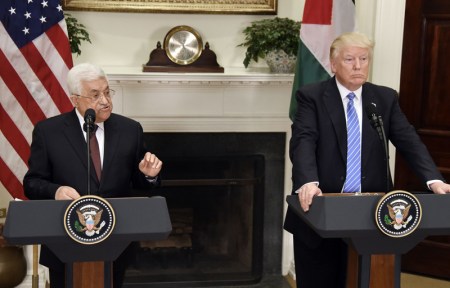
At his scheduled meeting with Palestinian Authority President Mahmoud Abbas in Bethlehem next week, U.S. President Donald Trump might put aside the sweet talk of Abbas, and listen instead for the unsettling truths voiced by other Palestinians such as Hamas and Islamic Jihad. Pictured: Trump and Abbas give a joint statement on May 3, 2017 in Washington, DC. (Image source: Olivier Douliery-Pool/Getty Images)


Despite Hamas Boycott, Fatah Loses Municipal Elections in the PA

May 15, 2017

Despite Hamas Boycott, Fatah Loses Municipal Elections in the PA, The Jewish Press, May 15, 2017

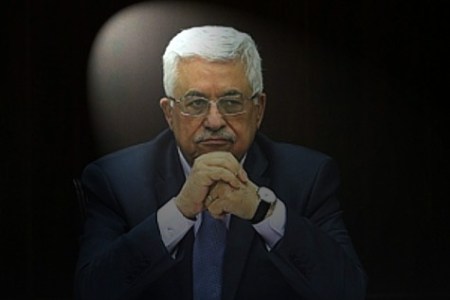
PLO / PA / Fatah leader Mahmoud Abbas.

Basing one’s hopes for making a peace deal happen, relying on an unpopular regime that needs to be non-democratically propped up in order to survive, is a bad deal from the get go.

**************************

The results of this Saturday’s local elections definitely did not portend well for any left-winger or U.S. official putting their hopes on the “moderate” Fatah party of current Palestinian Authority leader Mahmoud Abbas retaining control of PA-controlled areas in Judea and Samaria (the so-called “West Bank”) in the long term, or after the next PA general election.

Despite an official boycott by Hamas, Palestinian Islamic Jihad and the Popular Front for the Liberation of Palestine (PFLP), the PA’s controlling Fatah party still failed to win most of the municipal races in which it ran — even though the ballots were cast only in Judea and Samaria.

Elections were not even held in Hamas controlled Gaza.

To begin with, voter turnout was low. Only 420,682 of 787,386 eligible voters in Judea and Samaria bothered to go to the polls in 145 municipalities.

It could be that turnout was low because PA voters weren’t interested in voting, or it could be low because the PA’s population and voting registries are inflated and outdated, and most of the no-shows no longer reside in the Palestinian Authority.

The low turnout rates were similar in 2012.

To add insult to injury, even with a voter boycott by the top three terrorist factions in the population, Fatah lost to “independents”. Many of the those are known to be associated with Hamas, Islamic Jihad, and the PFLP.

In Hebron, a Hamas stronghold, Fatah won only seven out of the 15 seats. A Hamas terrorist who murdered six Jews won the mayor’s seat in Hebron.

In Shechem (Nablus), Fatah “won” 11 out of the 15 seats, but the candidates had to join with Islamists to do so. Voter turnout in Shechem was the lowest, at 28 percent.

Fatah couldn’t even win in its own capital city of Ramallah, which had a less than 40 percent turnout. The Abna’a al-Balad party won eight of the 15 seats in Ramallah. Abna’a al-Balad appears to be affiliated with Fatah’s rival, the PFLP.

The only municipalities where Fatah had a clear victory was in Jericho with eight out of 15 seats, and Jenin with 10 of 15 seats.

Another amazing tidbit is that the PA forbade its citizens who live in so-called “refugee camps” within the Palestinian Authority from voting. So while residents of Bethlehem could vote, those in Bethlehem’s southern neighborhood of Deheisheh (Refugee Camp) were not granted that same right.

Some “Palestinians” are apparently more equal than others.

In that way, the PA behaves exactly as Lebanon does, denying its “Palestinian” citizens the same rights and privileges as their neighbors receive.

Another weird tidbit: 181 municipalities had lists that ran unopposed, and 65 localities had no nominated lists at all.

It’s not clear which is worse, the failure of the Palestinian Authority to offer a true democratic vote to its citizens, even on just the municipal level, or the fact that it is absolutely clear that the radical Islamists would definitely beat the Fatah Kleptocrats if general elections are ever held (or if the IDF ever stopped providing security support).

This vote makes it clear that Palestinian Authority Arabs reject their current Fatah overlords. And yet those rejected leaders are the same people that U.S. officials and the Left are counting on to make and maintain some sort of lasting peace deal with Israel.

It even appears that US President Trump is bowing to the pressure and backing away from his campaign promise to move the US Embassy from Tel Aviv to Israel’s capital, Jerusalem — rather than supporting the sole democracy in the Middle East, as he keeps claiming he does.

Basing one’s hopes for making a peace deal happen, relying on an unpopular regime that needs to be non-democratically propped up in order to survive, is a bad deal from the get go.