Posted tagged ‘Palestinians’

Palestinian Campuses “More Hamas than Hamas”

March 25, 2016

Palestinian Campuses “More Hamas than Hamas”

by Khaled Abu Toameh March 25, 2016 at 5:00 am

Source: Palestinian Campuses “More Hamas than Hamas”

  • While the anti-Israel activists are busy protesting against Israel on Western campuses, Palestinian students and professors are persecuted by their own Palestinian Authority (PA) and Hamas governments.
  • Let us redefine “pro-Palestinian.” Instead of bashing Israel, real pro-Palestinians will demand democracy for those they champion, and scream for public freedoms for Palestinians under the PA and Hamas regimes, which have always smashed dissent with an iron fist.
  • PA security forces systematically target students and academics under various pretexts. Hundreds of students have been rounded up. Many remain in detention without the possibility of seeing a lawyer or a family member.
  • Palestinians on campuses in the West Bank and the Gaza Strip have once again been reminded that they remain as far as ever from achieving a state that would look any different from the other Arab dictatorships in the region. The campus incidents, which have hardly caught the attention of the international media and anti-Israel activists in the West, also expose the media double standard about human rights violations.
  • In the first case of its kind under the PA, Kadoori University in Tulkarem suspended a student who hugged his fiancée in public.

These are the days when everything is backwards. The “pro-Palestinian” activists on university campuses throughout the Western world have gotten into the spirit: Palestinian students and academics in the West Bank and Gaza Strip endure daily harassment by the Palestinian Authority (PA) and Hamas, because all that gets the activists going are “Israeli abuses.”

Apparently, today, to be “pro-Palestinian” one has to be “anti-Israel.”

For the self-appointed advocates of the Palestinians at Western university campuses, the Palestinian issue is nothing but a vehicle for spewing hatred toward Israel. In good, backwards form, Israel is castigated, and the PA and Hamas are free to abuse their own people.

It seems that in the view of the anti-Israel folks, the Palestinians should not even hope for human rights under the Palestinian regimes.

So while the anti-Israel activists are busy protesting against Israel on Western campuses, Palestinian students and professors are left to be persecuted by their own governments.

Instead of campaigning for reform and democracy in the West Bank and Gaza, these activists spend precious energy trying to take down Israel. The Palestinian students and academics are left to their own devices.

Palestinians living under the Palestinian Authority and Hamas suffer an abysmal level of freedom of expression — and always have. This is the grim reality that the international community and protesting students prefer to ignore. For them, human rights violations must have a “made in Israel” sticker on them.

Here is a suggestion: Let us redefine “pro-Palestinian.” Instead of bashing Israel, the real pro-Palestinians will reveal themselves by demanding democracy for those they champion. True pro-Palestinian activists will scream for public freedoms for the Palestinians under the PA and Hamas regimes, which have always smashed dissent with an iron fist.

In the past few days, Palestinians on campuses in the West Bank and the Gaza Strip have once again been reminded that they remain as far as ever from achieving a state that would look any different from the other Arab dictatorships in the region. The campus incidents, which have hardly caught the attention of the international media and anti-Israel activists in the West, also expose the media double standard about human rights violations in the territories.

In the most recent case, Hamas security guards detained a number of students at Palestine University in the Gaza Strip who protested against the administration’s refusal to allow them to sit for examinations because they had not paid tuition in full.

The students complained that the guards conducted “humiliating” body searches and confiscated their mobile phones. Some said they were physically assaulted.

In another high-profile incident in the Gaza Strip last week, The Islamic University suspended UK-educated Professor Salah Jadallah for criticizing Hamas and the university administration on Facebook. The move drew sharp condemnation from many Palestinian students and academics, who took to social media to voice their fury over the suspension.

Professor Jadallah’s suspension is far from unusual in the Hamas-ruled Gaza Strip, where students, journalists and social media activists have repeatedly fallen victim to the Islamist movement’s harsh clampdowns.

A founder of Hamas in northern Gaza, Professor Jadallah was until recently considered within Hamas’s inner circle. His scathing remarks on Hamas, which he posted on his Facebook page, have turned him into a persona non grata on campus and he is being treated as a “fifth column” by his erstwhile Hamas colleagues. Professor Jadallah is being targeted: what, one might ask, is happening to ordinary Palestinians?

Campuses in the West Bank are faring no better. The Palestinian Authority’s security forces systematically target students and academics under various pretexts. Hundreds of students have been rounded up by these security forces in recent years as part of a crackdown on critics and Hamas “supporters.” Many of the students remain in detention without the possibility of seeing a lawyer or a family member.

Just this week, Palestinian security forces arrested four more university students and teachers: Izaddin Zaitwai, Ehab Ashour, Zuhdi Kawarik and Awni Fares.

It is not only political critics of the PA and Hamas, however, who are of interest to the security forces in Palestinian regimes.

In the first case of its kind under the Palestinian Authority, the Kadoori University in Tulkarem suspended a student who hugged his fiancée in public after offering her a wedding ring. The student, whose identity was not revealed, was accused of “immodest conduct” and is facing a disciplinary hearing. A university spokesman accused the “hugging” student of “slandering” the university’s reputation and defended the punishment.

Left: Hamas supporters are shown in a video screenshot marching during a student council election rally at Bir Zeit University, near Ramallah, on April 20, 2015. Right: Kadoori University in Tulkarem this month suspended a student who hugged his fiancé in public. The student was accused of “immodest conduct” and is facing a disciplinary hearing.

The decision to suspend the student sparked a social media storm, with many Palestinians accusing the Palestinian Authority and Kadoori University of seeking to be “more Hamas than Hamas.”

If the putative champions of the Palestinians in the West continue to disregard the trampling of Palestinian human rights by the PA and Hamas, there may not be any Palestinians left to champion.

Khaled Abu Toameh, an award-winning journalist, is based in Jerusalem.

Inside Account of Anti-Israel Assault at AIPAC

March 23, 2016

Inside Account of Anti-Israel Assault at AIPAC, PJ Media – Bill Whittle via You Tube, March 23, 2016

AIPAC Attendee Beaten, Chased By Anti-Israel Protesters

March 21, 2016

AIPAC Attendee Beaten, Chased By Anti-Israel Protesters, Town Hall Media, March 20, 2016


Israel’s Christian Minority

March 20, 2016

Israel’s Christian Minority, Gatestone InstituteShadi Khalloul, March 20, 2016

♦ Christians in Israel, as well as all other minorities, understand today that serving in the Israeli military is essential. Many Christians and other minorities in Israel share the same fears: they understand that in this region, Israel is the only island of safety that allows them freedom and democratic rights.

♦ Christians and other minorities in Israel prosper and grow, while in other countries in the Middle East, including the Palestinian Authority, they suffer heavily from the Islamic movement and persecution — until forced to disappear.

♦ Contrary to propaganda, there is no “Apartheid” of any kind in Israel, and no roads on which only Jews may travel.

♦ In Israel, members of the Christian and Muslim minorities fill all types of high positions — just as any Jewish Israeli who wishes to have a successful career. There is the Maronite Christian Supreme Court Judge, Salim Jubran.

♦ Widely discussed in the region is how the Europeans secretly want Israel wiped out, too, and are hoping that their new laws, combined with old Arab violence, will do the trick.

Last year, Israel recognized the existence of a group of Christians — “Arameans” — within its borders; an act that no Arab or Muslim nation from the Middle East has ever done or would ever do. Israel recognized a distinct religious and ethnic group: the indigenous people of the ancient Fertile Crescent.

Their language, Aramaic, was the language spoken by Jesus centuries before Islam came to the region.

Israel not only supports and gives Christians and other minorities — Druze, Muslims, Baha’i, everyone — full civil rights, freedom and legal rights to exist peacefully and practice their faith as they wish, but also to develop themselves as a minority with all the implications of differences in culture. Arabs, for instance, are welcomed into the Israel Defense Forces (IDF), but are not, as opposed to Jews, required to serve. Israel’s founding Prime Minister, David Ben Gurion, humanely did not want Arabs to feel as if they were obliged fight their “brothers.”

In Israel, members of the Christian and Muslim minorities fill all types of high positions — just as any Jewish Israeli who wishes to have a successful career. There is the Maronite Christian Supreme Court Judge, Salim Jubran.

Contrary to propaganda, there is no “Apartheid” of any kind, and no roads on which only Jews may travel. Those roads are in Saudi Arabia, which has real Apartheid roads, since only Muslims may travel to Mecca.

Israel does this, moreover, in a neighborhood where most of its neighbors — often the most brutal enemies of humanity — wish Israel were wiped out and often do their utmost to make this wish come true. Sadly, many Europeans join in. Everyone has seen the recent vicious attempts by the European Union to snuff out Israel economically by labeling goods made in disputed territories. This requirement, made of no other country with a disputed border actually hinders any prospects for peace that working together is meant to bring about.

These Europeans are not fooling anyone. Their slyly sadistic, self-righteous “punishments” meant for Israel will only throw thousands of Palestinians out of well-paying, badly-needed work; these diktats also drive many newly out-of-work Palestinians to the employment bureau of last resort: Islamic extremism and terrorism. Ironically, these Europeans, to satisfy their wish to hurt Jews by pretending to help Palestinians, are actually seeding a new crop of terrorists who will later come to Europe and show them what they think of such hypocrites.

Widely discussed in the region is how the Europeans secretly want Israel wiped out, too, and are hoping that their new laws, combined with old Arab violence, will do the trick. That way, the Europeans can pretend to themselves that they had “nothing to do with it.” These Europeans need to know they are not fooling anyone.

Israel, meanwhile, despite having to deal with the European and American fronts as well as often genocidal Muslim threats, continues actively to strengthen its minority communities through a variety of state-sponsored programs. Among them is a five-year plan to develop Israeli Arab and other minority communities adopted by the government on December 30, 2015, at cost of 15 billion shekels [roughly $4 billion]. Social Equality Minister Gila Gamliel, of the Likud Party is in charge of implementing the plan. Prime Minister Netanyahu, who is unjustly demonized, has for the last several years operated the “Authority for the Economic Development of the Arab, Druze and Circassian Sectors.” It is headed by an Arab Muslim, Aiman Saif, who controls a sizeable budget of 7 billion shekels [roughly $1.8 billion], which has mostly gone to different Arab cities and villages to develop modern infrastructure, industrial zones, employment opportunities, education and other elements. The rest was allocated to helping Christian villages in the Galilee.

Arabs have their own section in the Ministry of Education, headed by an Arab Muslim, Abdalla Khateeb, who is also in charge of a sizeable budget of 900 million shekels [$230 million].

Christians, as well as all other minorities, understand today that serving in the Israeli military is essential for their integration in Israel. Many Christians and other minorities in Israel share the same fears: they increasingly understand that in this region, Israel is the only island of safety that allows them freedom and democratic rights. The Muslim Arab community in Israel, as well as the Christian and other Arabic-speaking communities, see the tragic destiny of their brothers in Syria, Iraq, Lebanon and other Arab countries. Muslims killing Muslims; fanatical Muslim groups killing Christians, uprooting them, slitting their throats, burning them alive, drowning them in cages and of course crucifying them, even little children. Israel’s minorities are very aware of this. They also cannot understand why no one is demonizing those villains. They fear that this devastation will spread, first to the holy land of Israel, and then to Europe.

This fear is one of the reasons there have been increasing numbers of Christians applying to serve in the IDF: 30% recruitment on a voluntary basis; while in general Jewish society, the number stands for 57% on an obligatory basis. Today there are even more than 1000 Muslim Arabs serving in the IDF.

We all know the danger of these fanatic Islamic jihadist groups such as Hamas groups, and feel ever more committed to protect this lone pluralistic state.

The community to which this author belongs, Aramean Christians, is of Aramean-Phoenician ethnic roots and language, and was originally based in Syria, Lebanon and Iraq. Over the 1400 years following the Islamic conquest, Aramean Christians were forced to switch to speaking Arabic, and more recently to flee their homes in Syria and Iraq. They have no status in Arab and Islamic states, most ruled according to Islamic sharia law. Aramean Christians also have no status in the Palestinian Authority, which now rules Judea and Samaria.

We are aware of some Christian groups, such as Sabeel, Kairos Palestine and others under the thumb of the Palestinian Authority, who still feel the need to pay lip-service to the Muslim Arabian lords who have conquered them.

Jerusalem is open to everyone. But it has not always been, especially under the jurisdiction of Jordan, until 1967. Not only were Jews not allowed in, but 38,000 Jewish gravestones were taken from the Mount of Olives cemetery and used as building materials and flooring for Jordan’s latrines.

Muslim Arab members of Israel’s Knesset [parliament] reject the right of Christians to preserve their unique heritage. On February 5, 2014, Knesset member Haneen Zoabi of the United Arab List party threatened the Israeli Christian representatives who lobbied in the Knesset Employment Committee in favor of a law that would add Christian representatives to a committee on employment equality in the Economy Ministry. Zoabi rejected their declaration that they were a separate Aramean Christian ethnicity. She insisted on forcing upon them an Arab and Palestinian identity. This identification was of course, as false as if we Christians had insisted that Muslim Arabs call themselves Native Americans. The law passed despite the efforts of Zoabi and her colleagues, due to a coalition of Knesset members — with vast majority of Jewish MKs voting in favor of it.

This incident illustrates how some of Israel’s Muslim Arabs, while asking their Jewish neighbors for help in preserve their own Muslim-Arab heritage, prohibit other ethnic minorities these same rights.

Instead, they try to impose Arabization and Palestinization by threats and by force. In September 2014, for instance, an Aramean Christian woman, IDF Captain Areen Shaabi, was stalked by Arab Muslim activists in Nazareth. She was threatened with shouts of “Allahu Akbar” [“Allah is Greater!”], and at night her car tires were slashed.

IDF Major Ehab Shlayan, an Aramean Christian in Nazareth and the founder of the Christian Recruitment Forum, awoke on the morning of August 2015 to find that a Palestinian flag had been put in front of his door during the night. On Christmas Eve, December 24, 2014, thirty Muslims throwing stones and glass bottles attacked a Christian soldier, 19-year-old Majd Rawashdi, and his home.

1518IDF Major Ehab Shlayan (far left), is an Aramean Christian from Nazareth and founder of the Christian Recruitment Forum, which encourages Israeli Aramean Christians to serve in the military. Muslim Arab Knesset member Haneen Zoabi (right) recently threatened Israeli Christian representatives, rejecting their declaration that they were a separate Aramean Christian ethnicity and insisting on forcing upon them an Arab and Palestinian identity.

All this is hypocrisy at the highest levels, mixed with racism.

In an official Christmas greeting to Israel’s Christians on December 24, 2012, Prime Minister Netanyahu said:

“Israel’s minorities, including over one million citizens who are Arabs, always have full civil rights. Israel’s government will never tolerate discrimination against women. Israel’s Christian population will always be free to practice their faith. This is the only place in the Middle East where Christians are fully free to practice their faith. They don’t have to fear; they don’t have to flee. At a time when Christians are under siege in so many places, in so many lands in the Middle East, I am proud that in Israel Christians are free to practice their faith, and that there is a thriving Christian community in Israel.”

Christians and other minorities in Israel prosper and grow, while in other countries in the Middle East, including the Palestinian Authority, they suffer heavily from the Islamic movement and persecution — until forced to disappear.

John Kerry to the World: Let’s Gang up on Israel

March 18, 2016

John Kerry to the World: Let’s Gang up on Israel, Stephen M. Flatlow, March 17, 2016

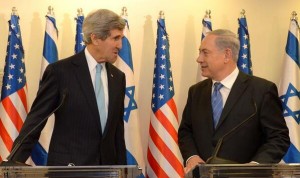
netanyahu-kerry-bibi-300x178 (1)Israeli Prime Minister Netanyahu with US Secretary of State John Kerry. Photo: GPO.

JNS.org – John Kerry has a new strategy for achieving Mideast peace: mobilize the international community to gang up on Israel.

That was the essence of the secretary of state’s disturbing remarks in Paris on March 13. Kerry declared that the Obama administration is “looking for a way forward” to bring about creation of a Palestinian state. He said that Palestinian statehood is “absolutely essential.”

Not just “an idea worth exploring;” not just “something to be considered’.” Rather, “absolutely essential.” Kerry and President Obama have made up their minds and will not consider any alternatives. They have decided that establishing an independent Palestinian state is the only solution to the Arab-Israeli conflict. It’s just a question of how to make it happen.

The administration’s attempts to pressure Israel into creating a Palestinian state obviously have not been successful so far. So Kerry is looking for new ways to harangue the Israelis. Standing next to a group of European foreign ministers at the Paris press conference, Kerry said: “There’s not any one country or one person who can resolve this. This is going to require the global community, it will require international support.”

Significantly, Kerry’s quest for an international alliance to pressure Israel comes on the heels of France’s recent announcement that it will try to convene an international conference to resolve the Israeli-Palestinian conflict. The French said that if the conference failed to produce a Palestinian state, they will go ahead and unilaterally recognize such a state. That’s the French idea of “negotiations.”

The French approach, which Secretary Kerry now seems to be moving towards, is reminiscent of similar proposals that were made back in 1985. Alarmed, then-Defense Minister Yitzhak Rabin flew to Washington to try to head off the convening what was being called an “international umbrella” for Mideast negotiations.

“Whenever anyone mentions umbrella, it reminds me of Chamberlain and Munich,” Rabin declared. For Rabin to invoke the memory of Chamberlain selling out to Hitler at Munich — and for Rabin to use those words at a press conference in Washington — vividly illustrates how dangerous he considered the ‘international’ proposal to be.

It’s not hard to understand why Rabin in 1985 opposed such a proposal, and it’s not hard to see why Israel’s leaders today oppose it, too. If Kerry succeeds in his strategy, such an international conference or umbrella would consist of a dozen or more Arab and European countries ganging up on Israel and demanding that the Israelis make unilateral concessions to the Palestinians. Knowing the Obama administration’s pro-Palestinian slant, one must assume that the US would side with the Arabs and Europeans.

The French — evidently with Kerry’s tacit approval, or perhaps even his encouragement–are pushing forward. French diplomat Pierre Vimont will be visiting Israel and the Palestinian Authority this week to promote France’s initiative. French Foreign Minister Jean-Marc Ayrault, appearing alongside Kerry at the press conference: “The conflict is getting worse and the status quo cannot continue.”

The conflict is getting worse? No, it’s not.

The status quo cannot continue? Yes, it can.

I am the last person in the world to minimize the reality of Palestinian terrorism. But there’s no way anybody can say the current attacks are worse than the weekly bus bombings of the 1990s. Israel’s strong military response put an end to the suicide bombings — which shows that if Israel does not fight with one hand tied behind its back, it can beat the terrorists.

And the status quo may not be the ideal solution, but show me a better one that’s feasible. Withdrawing to indefensible borders? Setting up an armed or soon-to-be-armed Palestinian state just a few miles from Jerusalem and Tel Aviv? In 1976, people were saying “the status quo cannot continue.” They were saying it 1986 and 1996 and 2006, too. Yet here we are, nearly 50 years after the 1967 war — and it has continued, because the alternatives have been worse.

Of course, what Kerry and French call the “status quo” is not at all the same as the status quo of the 1970s or 1980s. In 1995, Rabin withdrew from the areas where 98% of the Palestinians reside. For the past 21 years, the Palestinian Authority has functioned as a de-facto state in a large portion of Judea-Samaria. The only thing the PA lacks is a full-fledged army and the ability to import tanks and planes. And from Israel’s point of view, that’s not such a bad status quo.

So maybe it’s time for Kerry and his gang of would-be interveners to step back, take a deep breath, and face the fact that the slogans and ideas of the 1980s — “status quo,” “international umbrella” and the like — are just not suited to today’s reality.

Analysis: UN, State Dept. Condemn Israel for Legal Land Acquisition Near Jericho

March 17, 2016

As of 1979, Israel has been settling in Judea and Samaria on “State land.” The term was coined by then Attorney General Aharon Barak.

By: JNi.Media Published: March 16th, 2016

Source: The Jewish Press » » Analysis: UN, State Dept. Condemn Israel for Legal Land Acquisition Near Jericho

Vered Yeriho, the Israeli moshav near the 580 acres in question. / Wikipedia commons


On Tuesday, Israel’s Army Radio reported, based largely on a Peace Now report, that the Israeli government had seized 580 acres (less than one square mile) of land in Judea near the Dead Sea and Jericho. The coordinated publicity by Israel’s most leftwing radio station — the IDF’s own, and the most dedicated enemy of Jewish life in Judea and Samaria — Peace Now, quickly generated the expected results:

UN Secretary-General Ban Ki-Moon said Israel must reverse its “confiscation” of land, because it is “an impediment to the two-state solution.” And UN spokesman Stephane Dujarric added that “Such actions appear to point toward an increase in settlement activities and demonstrate that Israel is continuing to push forward in the consolidation of its control of the West Bank,” and “Settlements are illegal under international law and the secretary-general urges the government of Israel to halt and reverse such actions in the interest of a just and comprehensive peace and a just final status agreement.”

Settlements are illegal under the Geneva Convention when the land in question was taken from a sovereign owner.

But since the Jordanian crown’s rule over Judea and Samaria was not recognized internationally, with the exception of the UK, the land Israel took in 1967 was no man’s land, available for settling. This or that Israeli government may wish to use this land as part of a peace negotiation with an enemy entity, and even to evacuate whole settlements — but not because said settlements are illegal by international law. They aren’t.

As of 1979, Israel has been settling in Judea and Samaria on “State land.”

The term was coined by then Attorney General Aharon Barak, later Israel’s most renowned Chief Justice of the Supreme Court, who certainly could not be suspected of having right-wing aspirations. Barak wrote in 1979: “The presupposition in determining ownership of the land is that every land is state-owned, unless it was purchased by someone else. Therefore, unused land with no relevant documentation of ownership should be presumed to be state land.”

Despite this clear opinion of the AG, the Begin government decided that in order to preserve the rights of potential Arab owners, it would institute two additional steps before a land is declared available for acquisition: a review process, followed by a declaration of the pending acquisition.

Until the Oslo agreement, the area in question would have been acquired by this method without any problem. What changed since Oslo was the fact that now Judea and Samaria are divided into three separate areas, two of which, Areas A and B, are exclusively for Arab land acquisition, and one, Area C, is under Israeli control.

As long as the Oslo agreements are in force, land acquisition in Area C is legal, regardless of whether or not it contributes to the two state solution. You can say they do not promote the two-state idea, but you can’t say they are illegal.

In fact, the land in question has been in Jewish possession since the mid 1990s, being used for the fields of Moshav Vered Yericho, which settled nearby in 1980. In effect, those 580 acres had been in a state of review for all these years, and in all this time no Arab claimant has been found — and we trust that had there been such a claimant, Peace Now would have paid for his appeal in Israel’s Supreme Court.

The same distinction between what promotes the two-state solution and what is illegal was the background to Tuesday’s State Dept. press conference. State Dept. Spokesman John Kirby was asked about the “confiscation,” and answered, “We’re concerned about this reported expropriation of … 580 acres in the West Bank as state land, which is a significant increase over the prior announcement. This decision is, in our view, the latest step in what appears to be an ongoing process of land expropriations, settlement expansions, and legalizations of outposts that is fundamentally undermining the prospects for a two-state solution.”

Kirby continued: “As we have said before, we strongly oppose any steps that accelerate settlement expansion, which raise serious questions about Israel’s long-term intentions. And as we’ve repeatedly made clear, we continue to look to both sides to demonstrate with actions and policies a genuine commitment to a two-state solution. Actions such as these do just the opposite.”

The Arab reporter who brought up the issue followed with the question, “Saeb Erekat, the chief Palestinian negotiator, said that they are going to the UN Security Council with this, and they hope to have the support of the international community. If this comes up – in the face of Israel not being deterred on these land confiscations, will you support the Palestinian effort at the United Nations if this comes up at the UN?”

Kirby’s response to that one was non-committal, but at this point Israel has no assurances that, should a PA complaint against Israeli “land seizures” be submitted to the UN Security Council, the Obama Administration would necessarily veto an anti-Israel resolution.

Ignorance of the law, innocent or willful, marks much of the popular criticism of Israel’s policy in Judea and Samaria, both inside and outside the Jewish State. And as was once noted by Herr Joseph Goebbels, lies that are repeated often enough become truths.

Palestinians: Laughing Their Heads Off

March 14, 2016

Palestinians: Laughing Their Heads Off

by Khaled Abu Toameh

March 14, 2016 at 5:00 am

Source: Palestinians: Laughing Their Heads Off

  • As in any comedy, there is a clown, and Biden was played for a fool by a Palestinian Authority leadership that finds that it pays to point its finger at Israel.
  • Here is a dirty little secret: the Palestinian attackers were not driven to murder Jews because of “settlements” and “checkpoints.”
  • Check their Facebook accounts: what fueled their hatred were the lies they had been fed for the past few years by President Abbas and other Palestinian leaders. Palestinian media outlets and spokesmen vomit poison against Israel.
  • And so the curtain rises on another act of the ceremonial, make-believe theater of the Middle East. In Abbas’s sneaky script, it is about settlements. In reality, it is about the refusal of the Americans to read, speak or even translate Arabic.

U.S. Vice President Joe Biden visited Ramallah last week, and Palestinian Authority (PA) President Mahmoud Abbas and his top officials are laughing their heads off.

Why not laugh? Biden arrived in the region hoping to persuade the Palestinian leaders to issue a “condemnation” of the reign of terror, which they continue to describe as a “popular and peaceful uprising.” This in itself reeks of gallows humor.

But what Biden got was even funnier, from the point of view of Abbas and his friends.

The Palestinian president offered “condolences” over the killing of a U.S. citizen in Jaffa the previous day: “The President [Abbas] offered his condolences over the killing of the US citizen, while stressing at the same time that the occupation authorities have killed 200 Palestinians over the past five months,” according to a statement released by the PA leadership in Ramallah.

Abbas’s crocodile tears were shed for Taylor Force, a West Point graduate from Texas who was stabbed to death by a Palestinian during a rampage on the Jaffa beachfront promenade. Abbas is doubtless also upset because Israel has killed Palestinian stabbers and shooters.

Just before Biden arrived in Ramallah, Abbas’s Fatah faction praised the murderer of Force, calling him a “martyr.” But Fatah was quick to delete the posts to avoid embarrassing the Palestinian leadership during Biden’s visit.

It seems that the murder of an American visitor is condemnable, but the murder of some 34 Israelis since last October, including a pregnant woman and civilians, is somewhat less so.

Where was the condemnation of the wounding of nine Israelis in the attack that killed Taylor Force? Where was the condemnation of the attacks the took place on that very day in Jerusalem and Petah Tikva?

But Abbas explained everything to Biden: Israel was in fact fully responsible for the “violence and bloodshed” because of the “occupation” and “settlements.”

Here is a dirty little secret: the Palestinian attackers were not driven to murder Jews because of “settlements” and “checkpoints.”

Check their Facebook accounts: what fueled their hatred were the lies they had been fed for the past few years by President Abbas and other Palestinian leaders, concerning Jews “desecrating” Islamic holy sites and plotting to destroy them. No checkpoint snags, no settlement issues, no protests against construction of new apartments in Jerusalem for Jewish families.

Many of these Palestinians went for Israeli blood because they have been taught — by Mahmoud Abbas, the Palestinian Authority, Hamas and other Palestinian groups — to hate Israel. And they do not give a damn whether that Jew lives in Jaffa or in the West Bank. They also do not give a damn if some of their victims are Arabs.

Yet the comedy continues. Biden is reported to have urged Abbas and the Palestinian leadership to stop the anti-Israel incitement in their official media and on social media. Abbas vehemently denied that this incitement was taking place, and indeed, explained that the US leader had gotten things mixed up entirely: it was Israel that was guilty of incitement against the Palestinians.

While Abbas was busy offering his condolences for the killing of the U.S. citizen, his ruling Fatah faction was busy glorifying Palestinian assailants who killed Israelis.

In one instance, Fatah published an announcement inviting Palestinians to mark the 38th anniversary of the “martyrdom” of Dalal Al-Mughrabi.

Al-Mughrabi was a Fatah member who participated in the 1978 Coastal Road massacre in Israel, in which 38 civilians were killed, including 13 children.

U.S. Vice President Joe Biden visited Palestinian Authority President Mahmoud Abbas in Ramallah on March 10, hoping to persuade Abbas to issue a “condemnation” of the wave of terror attacks against Israelis. The next day, Abbas’s Fatah party invited Palestinians to commemorate the 38th anniversary of the “martyrdom” of Dalal Al-Mughrabi. Al-Mughrabi was a Fatah member who participated in the 1978 Coastal Road massacre in Israel, in which 38 civilians were killed, including 13 children.

The condolence message was also long enough for Fatah to praise Palestinian assailants, including Abdel Malek Abu Kharoub, who carried out a recent shooting attack in Jerusalem. In a post on its official Facebook account, Fatah hailed Abu Kharoub as a “hero and martyr.”

Of course neither Biden nor any of his advisors and aides saw these posts. They prefer to continue burying their heads in the sand and pretending that once the “peace process” is revived, everything will be fine.

So it is business as usual for Abbas and crew. As in any comedy, there is a clown, and Biden was played for a fool by a PA leadership that finds that it pays to point its finger at Israel.

In Arabic, a language in which Western leaders are perhaps not fluent, Palestinian media outlets and spokesmen vomit poison against Israel. Condemnation of attacks on Israelis would be rather unlikely in such a drama.

And so the curtain rises on another act of the ceremonial, make-believe theater of the Middle East. In Abbas’s sneaky script, it is about settlements. In reality, it is about the refusal of the Americans to read, speak or even translate Arabic.

Khaled Abu Toameh, an award-winning journalist, is based in Jerusalem.
  • Follow Khaled Abu Toameh on Twitter


Ya’alon warns Hamas: We will hit even harder

March 13, 2016

Ya’alon warns Hamas: We will hit even harder next time After first casualties in Gaza since October, Defense Minister Ya’alon warns Hamas against further attacks on Israel.

By Arutz Sheva Staff First Publish: 3/12/2016, 10:53 PM

Source: Ya’alon warns Hamas: We will hit even harder – Defense/Security – News – Arutz Sheva

sraeli Defense Minister Moshe Ya’alon warned the Hamas terror group on Saturday night against further escalations, following a spate of violence over the weekend.

On Friday night Hamas terrorists fired four rockets into Israel, from the Gaza Strip. Hours later, Israeli fighters bombed four Hamas targets inside Gaza.

Hamas claimed that two civilians were killed in the strikes, and on Saturday the terror organization threatened further attacks on Israel.

“The blood of the children killed in the Zionist raid will not flow in vain,” Hamas warned in a statement.

Ya’alon responded to the comments, noting that Israel was capable of inflicting serious damage on Hamas.

During an event in Tel Aviv honoring wounded IDF veterans, Ya’alon pointed out that despite the terror organization’s rhetoric, it was Hamas that initiated the violence.

“Just yesterday we saw once again proof that [hostile] states, organizations, and groups seek to harm us just because of who we are,” Ya’alon said, referencing attacks by Hamas and renewed threats by Iran.

Israel’s military response in Gaza, Ya’alon pointed out, “came when a terror group running wild in the Gaza Strip fired rockets at Israel.”

Ya’alon emphasized that Israel would not tolerate rocket fire into its territory, and would respond to Hamas attacks with military force.

“We won’t tolerate attempts to disrupt life in southern Israel. That’s why we responded last night with force against Hamas assets in the Strip; and we know how to hit a lot harder if the attacks continue. Hamas runs Gaza and as far as we are concerned, it is responsible for any attacks emanating from there.”

Obama sees Netanyahu as most disappointing of all Mideast leaders

March 11, 2016

Obama sees Netanyahu as most disappointing of all Mideast leaders — report

The Atlantic: Israeli PM is ‘in his own category’ when it comes to those who frustrate US president; article cites ‘condescending’ lecture by PM, asserts that Obama sees Netanyahu as ‘too fearful and politically paralyzed’ to secure two-state solution

By Times of Israel staff March 10, 2016, 4:39 pm

Source: Obama sees Netanyahu as most disappointing of all Mideast leaders — report | The Times of Israel

US President Barack Obama and Prime Minister Benjamin Netanyahu at a welcoming ceremony for the president at Ben Gurion Airport, March 20, 2013. (photo credit: Marc Israel Sellem/Pool/Flash90)

Prime Minister Benjamin Netanyahu “is in his own category” when it comes to the Middle East leaders who have most deeply disappointed President Barack Obama, according to a major overview of the Obama presidency, featuring numerous interviews with the president, published online Thursday by The Atlantic.

In the piece, headlined “The Obama Doctrine,” writer Jeffrey Goldberg goes to great lengths to trace the president’s growing disillusionment, over the course of his presidency, with the possibility of changing the region for the better. “Some of his deepest disappointments concern Middle Eastern leaders themselves,” Goldberg writes. Of these, “Benjamin Netanyahu is in his own category.”

 According to Goldberg, “Obama has long believed that Netanyahu could bring about a two-state solution that would protect Israel’s status as a Jewish-majority democracy, but is too fearful and politically paralyzed to do so.”

To illustrate Obama’s impatience with Netanyahu, one of several Middle Eastern leaders said to have questioned the president’s understanding of the region, Goldberg relates an incident during an undated Obama-Netanyahu meeting, at which the Israeli prime minister “launched into something of a lecture about the dangers of the brutal region in which he lives.”

Obama, relates Goldberg, “felt that Netanyahu was behaving in a condescending fashion, and was also avoiding the subject at hand: peace negotiations. Finally, the president interrupted the prime minister: ‘Bibi, you have to understand something,’ he said. ‘I’m the African American son of a single mother, and I live here, in this house. I live in the White House. I managed to get elected president of the United States. You think I don’t understand what you’re talking about, but I do.’”

Turkish Prime Minister Recep Tayyip Erdogan (left) with US President Barack Obama during a bilateral meeting (photo credit: AP/Pablo Martinez Monsivais)

Turkish Prime Minister Recep Tayyip Erdogan, left, with US President Barack Obama during a bilateral meeting in 2011. (photo credit: AP/Pablo Martinez Monsivais)

The piece does not single out Netanyahu as the only regional leader to “frustrate him immensely.” Obama now thinks of Turkey’s President Recep Tayyip Erdoğan, who he had hoped could bridge the East-West divide, as “a failure and an authoritarian, one who refuses to use his enormous army to bring stability to Syria,” Goldberg writes.

He also says Obama two years ago took Jordan’s King Abdullah II aside at an international summit because he was unhappy that the monarch was badmouthing him. “Obama said he had heard that Abdullah had complained to friends in the U.S. Congress about his leadership, and told the king that if he had complaints, he should raise them directly. The king denied that he had spoken ill of him.”

“In recent days,” Goldberg continues, “the president has taken to joking privately, ‘All I need in the Middle East is a few smart autocrats.’ Obama has always had a fondness for pragmatic, emotionally contained technocrats, telling aides, ‘If only everyone could be like the Scandinavians, this would all be easy.’”

US President Obama delivering his famed Cairo Speech in 2009. The president highlighted the need for social progress in his first major address to the Muslim world. (photo credit: screen capture, YouTube)

US President Barack Obama speaks in Cairo on June 4, 2009. (photo credit: screen capture, YouTube)

According to Goldberg, Obama now acknowledges that a goal of his Cairo speech in 2009, early in his presidency, in which he sought to persuade Muslims to look honestly at the sources of their unhappiness and stop blaming Israel for all their problems, has proved unsuccessful.

He quotes Obama as follows: “My argument was this: Let’s all stop pretending that the cause of the Middle East’s problems is Israel… We want to work to help achieve statehood and dignity for the Palestinians, but I was hoping that my speech could trigger a discussion, could create space for Muslims to address the real problems they are confronting — problems of governance, and the fact that some currents of Islam have not gone through a reformation that would help people adapt their religious doctrines to modernity. My thought was, I would communicate that the U.S. is not standing in the way of this progress, that we would help, in whatever way possible, to advance the goals of a practical, successful Arab agenda that provided a better life for ordinary people.”

What unfolded over the following three years, Goldberg goes on, “as the Arab Spring gave up its early promise, and brutality and dysfunction overwhelmed the Middle East,” left Obama bleak. “The unraveling of the Arab Spring darkened the president’s view of what the U.S. could achieve in the Middle East, and made him realize how much the chaos there was distracting from other priorities,” Goldberg writes.

Undated file image posted on a militant website on January 14, 2014, shows Islamic State fighters marching in Raqqa, Syria. (AP/Militant Website)

Undated file image posted on a militant website on January 14, 2014, shows Islamic State fighters marching in Raqqa, Syria. (AP/Militant Website)

More recently, says Goldberg, the rise of the Islamic State terror group has “deepened Obama’s conviction that the Middle East could not be fixed — not on his watch, and not for a generation to come.”

In the piece, Goldberg quotes Obama castigating Islamic State in the most bitter tones, as “the distillation of every worst impulse.” Says Obama: “The notion that we are a small group that defines ourselves primarily by the degree to which we can kill others who are not like us, and attempting to impose a rigid orthodoxy that produces nothing, that celebrates nothing, that really is contrary to every bit of human progress— it indicates the degree to which that kind of mentality can still take root and gain adherents in the 21st century.”

Obama is also quoted praising Israelis’ ability to withstand a relentless climate of terrorism. Writes Goldberg of the US president: “Several years ago, he expressed to me his admiration for Israelis’ ‘resilience’ in the face of constant terrorism, and it is clear that he would like to see resilience replace panic in American society.”

A worker outside the Bushehr nuclear power plant in Iran (photo credit: Vahid Salemi/AP)

A worker outside the Bushehr nuclear power plant in Iran (photo credit: AP/Vahid Salemi)

Relating to last July’s nuclear agreement with Iran, on which he and Netanyahu disagreed so profoundly and so publicly, Obama told Goldberg as recently as January that he wasn’t bluffing when he said in 2012 that he would have attacked Iran to prevent it from getting a nuclear weapon. “I actually would have,” Goldberg quotes Obama saying, in reference to a strike on the Iranian nuclear facilities, “If I saw them break out… This was in the category of an American interest.”

Where he and Netanyahu differed, Goldberg elaborates, is that “Netanyahu wanted Obama to prevent Iran from being capable of building a bomb, not merely from possessing a bomb.”

Much of the article relates to Obama’s decision not to strike at Syria after President Bashar Assad used chemical weapons against his own people in the summer of 2013 — a landmark volte face in his presidency. Goldberg reveals, however, that Secretary of State John Kerry has continued to press Obama “to violate Syria’s sovereignty” and “launch missiles at specific regime targets, under cover of night, to ‘send a message’ to the regime.” The president has insistently refused these requests, Goldberg writes, “and seems to have grown impatient” with Kerry’s lobbying. “Recently, when Kerry handed Obama a written outline of new steps to bring more pressure to bear on Assad, Obama said, ‘Oh, another proposal?’”

President Barack Obama and John Kerry (photo credit: AP/Carolyn Kaster)

US President Barack Obama and US Secretary of State John Kerry (photo credit: AP/Carolyn Kaster)

Goldberg concludes the piece by arguing that Obama “has placed some huge bets” in foreign policy — notably where the Iran deal is concerned. When Goldberg told him last May that he was “nervous” about the deal, Obama replied: “Look, 20 years from now, I’m still going to be around, God willing. If Iran has a nuclear weapon, it’s my name on this… I think it’s fair to say that in addition to our profound national-security interests, I have a personal interest in locking this down.”

For supporters of the president, Goldberg sums up, “his strategy makes eminent sense: Double down in those parts of the world where success is plausible, and limit America’s exposure to the rest. His critics believe, however, that problems like those presented by the Middle East don’t solve themselves — that, without American intervention, they metastasize.”

Palestinian Teachers on Strike — Against the Real ‘Occupier’

March 10, 2016

Palestinian Teachers on Strike — Against the Real ‘Occupier’ Algemeiner, Stephen M. Flatow, March 10, 2016

Address by His Excellency Mahmoud Abbas, President of the State of Palestine

Address by His Excellency Mahmoud Abbas, President of the State of Palestine

JNS.org – It has taken more than a month, but the international news media are finally waking up to the fact that the largest teacher’s strike in memory is raging in the Middle East.

In a major feature story on March 8, the New York Times reported that “public schools across the West Bank have been shuttered” since early February, when more than 20,000 Palestinian public school teachers went on strike. The strike has led to “the largest demonstrations in years,” including “four large demonstrations in [the Palestinian Authority capital of] Ramallah,” Times correspondents Diaa Hadid and Ramni Nazzal revealed. That news must have been quite a surprise to Times readers, since the newspaper had not reported on these huge protests until now.

Hadid and Nazzal have eagerly reported on Palestinian “demonstrations” (their euphemism for mobs hurling firebombs and rocks) when the targets were Israelis. The problem this time around is that the target is the Palestinian Authority (PA).

American correspondents in the Middle East seldom report news that is unfavorable to the PA. It’s no mystery why they form a protective cordon around the Palestinian leadership. Most reporters, and most of their editors, would like to see a Palestinian state established as soon as possible, and they know that unfavorable news coverage of the PA leadership could turn American public opinion against Palestinian statehood.

That’s why the Times was so slow to report on the strike. News of the teachers’ actions undermines the cause of Palestinian statehood in three important ways:

— First, the strike reveals the totalitarian ways of the PA, a reminder that a Palestinian state likewise would be a corrupt and dangerously unstable dictatorship. Look at the PA’s strong-arm tactics: Last week, the PA police arrested 20 teachers and two school principals for participating in a rally supporting the strikers.

The Times reports that the PA also has “forced a Palestinian legislator who tried to mediate an end to the crisis into early retirement.” And Haaretz reports that “the PA security services set up rings of checkpoints to prevent the teachers from attending a demonstration” in supporter of the strikers. The US State Department’s latest annual report on human rights found that under the PA, there are “restrictions on freedom of speech, press, and assembly.” There are “limits on freedom of association and movement.” But the State Department report did not attract the interest of the news media.

— The second way in which the teachers strike undermines the Palestinian cause is that it focuses attention on the ultimate reason behind the strike: the PA’s extreme militarization. And that is another red flag with regard to Palestinian statehood. Two years later, the PA promised to increase teachers’ salaries, but now says it doesn’t have enough money to pay the teachers. Why is it out of money? Because the PA has one of the largest per capita security forces in the world, as more than half of all PA employees are in the security forces. The money owed to the teachers is being diverted to the PA’s de-facto army. Which dark regimes of the 1930s does that remind you of?

— Third, the strike reminds the world that the Palestinians are striking against the Palestinian Authority because the “Israeli occupation” ended long ago, and it is the PA which is the occupier. Perpetuating the myth of the “Israeli occupation” helps gin up international sympathy for the idea of a Palestinian state.

Those of us who dwell in the real world know that in 1995, prime minister Yitzhak Rabin signed the Oslo II Accord and withdrew Israel’s forces from the cities where 98 percent of the Palestinians reside. For more than 20 years, the Palestinians have been occupied by the PA, not Israel. It is the PA, not Israel, which is in control of Palestinian education, culture, elections, the economy, and all other facets of communal life. About the only thing the PA can’t do is import and tanks and planes.

Acknowledging this reality interferes with the agenda of those who advocate the Palestinian cause. Amazingly, in the very same edition of the Times that reported on the strike, columnist Roger Cohen, a veteran critic of Israel, wrote, “Today, it is Palestinians in the West Bank who are dehumanized through Israeli dominion…The West Bank is the tomb of Israel as a Jewish and democratic state.”

Wake up, Mr. Cohen. Turn to page 10 of your own newspaper. Read about the Palestinian teachers who are being dehumanized through the PA’s dominion. Face the reality that Israel is still Jewish and still democratic. Israeli citizens vote in Israel; Palestinians vote in PA elections (when their leaders are in the mood to hold elections). Your 1980s-style slogans about the “Israeli occupation” just don’t cut it any longer.

If the editors and reporters of the Times could indefinitely ignore the teacher strike against the PA occupation regime — just as Roger Cohen ignores it —surely they would. But after more than a month of silence, the folks at the Times have recognized that if they continue to black out the news of the strike, it undermines their credibility as a newspaper. And so the news is finally out, much to the dismay of Israel-bashers everywhere.


