Posted tagged ‘Palestinian Authority’

Naming Bin Salman Saudi heir impacts US, Israel

June 21, 2017

Naming Bin Salman Saudi heir impacts US, Israel, DEBKAfile, June 21, 2017

US President Trump is taking the lead role along with Prince Mohammed bin Salman of Saudi Arabia, Sheikh Mohammad bin Zayed Al Nahyan of the United Arab Emirates, another crown prince, Egypt’s President Abdul-Fatteh El-Sisi, and Israel’s Prime Minister Binyamin Netanyahu.

******************************

The Saudi king’s decision to elevate his son Prince Mohammed bin Salman, 31, to crown prince and heir to the throne, in place of his cousin Mohammed bin Nayef – as part of a broad reshuffle, is not merely the internal affair of the royal hierarchy, but a game-changing international event.

DEBKAfile’s analysts see it as the outcome of a global and regional process initiated by Donald Trump soon after he settled in the White House in January. With his appointment as de facto ruler of the oil kingdom, the Saudi king’s son is ready to step into his allotted place in a new US-Arab-Israeli alliance that will seek to dominate Middle East affairs. Israel will be accepted in a regional lineup for the first time alongside the strongest Sunni Arab nations who all share similar objectives, especially the aim to stop Iran.

Trump’s trip to Riyadh and Jerusalem in early May laid the cornerstone for the new US-Sunni Arab bloc versus Iran’s Shiite grouping and also cemented Israel’s co-option.

This bloc is in its infancy and has yet to display staying power and prove the wisdom of its policies. But its contours have taken shape. US President Trump is taking the lead role along with Prince Mohammed bin Salman of Saudi Arabia, Sheikh Mohammad bin Zayed Al Nahyan of the United Arab Emirates, another crown prince, Egypt’s President Abdul-Fatteh El-Sisi, and Israel’s Prime Minister Binyamin Netanyahu.

Three of those leaders already maintain strong direct – albeit discreet – ties with Israel’s prime minister, its security establishment, military and various intelligence agencies.

In a lecture on Tuesday, June 20, Israel’s chief of staff, Lt. Gen. Gady Eisenkott, spoke of the covert relations between the IDF and certain Arab nations, which he did not name. There is clearly a lot going on under the surface in various political, economic, financial, intelligence and military fields.

Recent events in the region already point to President Trump acting on important matters, such as the confrontation with Iran, the war on terror, the Syrian conflict and US intervention in the Yemen conflict, on the advice of the two Arab crown princes rather than Defense Secretary James Mattis and Secretary of State Rex Tillerson.

This was strikingly demonstrated when Trump overrode Tillerson’s recommendation to apply diplomacy for resolving the dispute that led to four Arab nations boycotting Qatar, with the Saudis in the lead, whereas the president then demanded strong action to stop Qatar’s funding of terrorists. He therefore opted for the aggressive Saudi and UAE stance against Qatar’s ruler, Sheikh Tamim bin Hamad Al Thani.

These developments bear strongly on US-Russian relations. The two crown princes maintain active ties with President Vladimir Putin. They could, of course, act as go-betweens for smoothing relations between the White House and the Kremlin. But, on the other hand, their influence could be counter-productive and goad Trump into engaging the Russians in a limited confrontation in Syria. It is hard to see Washington and Moscow coming to terms in Syria at this point when the former is closely allied to Saudi Arabia and the UAE and Moscow maintains its loyalty to Tehran.

The evolving bonds between the US, Saudi Arabia, the UAE, Egypt and Israel are the source of President Trump’s optimism about the prospects of pulling off an Israeli-Palestinian peace accord, a vision which eluded all his predecessors in the White House, while knocking over the decades-old barriers between the moderate Arab nations and the Jewish State.

The first steps towards this goal are in the making. They will include exposing parts of their hidden interaction to the light of day, as well as such important symbolic actions, as opening Arab skies to the passage of Israeli commercial flights, or direct telephone links.

None of this is expected to transpire overnight but rather over years, especially since there is opposition to the process still to overcome in the Arab world, including Saudi Arabia, and also in the United States. Critics lay into Mohammed bin Salman, who has made his mark as a visionary social and economic reformer at home, as too young, brash and impatient to rule the kingdom. His decision to entangle Saudi Arabia in the Yemen war, which many believe it cannot win, is held up as evidence of his reckless nature.

But the process switched on by Trump in Riyadh took a large stride forward on June 21, with the formalization by King Salman of his young son’s role as the top mover and shaker in the Saudi kingdom. King Salman obtained the support of 31 out of 34 members of Saudi Arabia’s Allegiance Council for confirming Prince Muhammad Bin Salman as crown prince as well as deputy prime minister and minister of defense.

Will Trump make a peace breakthrough in 2018?

June 15, 2017

Will Trump make a peace breakthrough in 2018? DEBKAfile, June 15, 2017

(Lots of speculation about future events, but an interesting piece nevertheless. — DM)

US President Donald Trump’s goal of generating a rapid improvement of Israel’s ties with the Arab world, including the Palestinians in 2018, is not just up to Prime Minister Binyamin Netanyahu and Palestinian Authority Chairman Mahmoud Abbas, but depends largely on how the Trump administration handles the continuing conflict between Qatar and its powerful Arab opponents, Egypt, Saudi Arabia and the UAE.

Up until the end of this week, Trump had turned down the efforts of Secretary of State Rex Tillerson and Secretary of Defense James Mattis to resolve the Gulf conflict by diplomacy. Instead of heeding them, the president took the advice of the Saudi defense minister, Prince Mohammed bin Salman, and Saudi Foreign Minister Adel Al-Jubeir, who visited Washington this week. Tillerson and Mattis tried to arrange a conference between Saudi Arabia and Qatar so as to gradually ease the tensions, but Trump torpedoed the initiative by adopting Riyadh’s tough line.

A complex situation has arisen in the last few days regarding the US diplomacy for bringing Israel and the Palestinians aboard a peace process. The signs of movement on this score fluctuate between crises and some progress:

1. The Gaza electricity row falls under the first heading. Some circles contend that the crisis is artificial, since the Palestinian enclave is receiving as much power now as before. What is different is the new, intensified pressure by Egypt on the one hand and the Palestinian Authority on the other in the hope of toppling Hamas rule in the Gaza Strip or squeezing its leaders into toeing their lines. Neither Egyptian President Abel Fatteh El-Sisi nor the Palestinian Authority chairman has made headway. Hamas stubbornly refuses Cairo’s demand to sever ties with Qatar, while launching a counteroffensive to draw Israel into the dispute by making an empty threat of an “explosion.”

Israel responded with a counter-threat on Thursday, June 15: a proposal to transfer one hour’s worth of power from West Bank Palestinian towns to boost the supply to Gaza.

This maneuver kept the entire electricity issue in the court from it was tossed, Ramallah.

2. A shower of Israeli concessions is landing on the Palestinians judging by almost daily reports. Some are true and others false. But in sum, they are designed to impress President Trump with the Netanyahu government’s good will towards his peace initiative and readiness to take steps in its support. In fact, the prime minister is preparing the ground for the forthcoming arrival of Jason Greenblatt, Trump’s envoy on the Israel-Palestinian issue.

3. US Secretary of State Tillerson this week informed the Senate that the Palestinian Authority had agreed to  halt its payments to the families of Palestinian terrorists who were killed while carrying out attacks against Israelis. Palestinian officials no doubt let this be understood to demonstrate their willingness to go along with Trump’s peace initiative, without, however, have any real intention of following through.

4. Media reports and the findings of Arab research institutes add up to the following predictions on the fate of the negotiations generated by the Trump administration between Israel and the Arab world:

A. Some time during 2018, a showcase summit will be staged for Trump, Netanyahu and leading Arab rulers like Saudi King Salman, Egyptian President El-Sisi and the UAE’s Crown Prince Mohammed bin Zayed al-Nahyan.

They will publish a joint declaration signaling the phased normalization of relations with Israel by such preliminary steps as the exchange of economic and business delegations, the opening of trade offices and of Arab skies to Israeli commecial flights. None of these researchers is clear about the Palestinian role in this event.

B. Meanwhile, Israel will make concessions towards improving the lives of ordinary Palestinians, such as removing checkpoints, issuing building permits for Palestinian towns and more jobs in Israel.

C. Israel and the Palestinian Authority will expand their security cooperation. The Palestinians will be persuaded to cease their incitement against the Jewish State and stop payouts to the families of convicted Palestinian terrorists and other security offenders.

D. Direct Israeli-Palestinian negotiations will ensue, without preconditions on either side, and expand. with Arab governments sitting in.

E. At the end of a period of some years, this process will mature into a discussion of the core issues of the dispute, Palestinian statehood, future borders, settlements, Jerusalem and refugees.

In other words, the year 2018 will see the building of normal relations between Israel and Arab countries to be followed at a later date by the Israeli-Palestinian peace process. President Trump has clearly seized on relations with Riyadh, Cairo and Abu Dhabi as a lever for pushing Israel and the Palestinians into peace talks.

The idea is simple. Israel’s improved ties with the Arab world will resonate positively on Israeli-Palestinian relations. That appears to be Trump’s formula for peace. But there is a catch. It depends heavily on the US President maintaining good relations with the Arab world in the long term.

Military crisis in Qatar may spark Gaza outbreak

June 13, 2017

Military crisis in Qatar may spark Gaza outbreak, DEBKAfile, June 13, 2017

A military crisis centering on Qatar would be a catalyst for an outbreak of violence from the Gaza Strip. And indeed, after the failed Sanwar mission to Cairo and the reduction of electric power to the Gaza Strip, Hamas spokesmen warned that an “explosion” was imminent.

*********************

The electricity cutback in the Gaza Strip, engineered by Palestinian leader Mahmoud Abbas to flex muscle against Hamas rule, was just one piece on the checkerboard created by the crackdown Egypt, Saudi Arabia Bahrain and the United Arab Emirates have imposed on Qatar for supporting terrorist groups like the Palestinian extremist Hamas. Therefore, Hamas leader Yahya Sanwar had little to expect from his mission to Cairo last weekend to persuade the El-Sisi government to ease its restrictions on the Gaza Strip.

He arrived at the head of a large mission, in which the group’s military arm, Ezz e-Din El-Qassam was heavily represented. Their appeals to Maj.-Gen Khaled Fawzy, director of Egyptian General Intelligence, met with a list of tough conditions. When the Palestinian delegation balked, Cairo acted to tighten its blockade on the Palestinian enclave.

The Hamas rulers of the Gaza Strip found themselves in the same boat as their old friend, Qatar, in the week that their internal rival, Mahmoud Abba, docked payment for the electricity Israeli supplies the Gaza Strip. The power supply was cut by 40 percent.

From 2015, the emir of Qatar remained the only Arab ruler backing the Palestinian extremist Hamas with occasional cash donations to Gaza City and permission for its top officials to set up shop in Doha.

This flow of aid was abruptly cut off by the land, sea and air blockade Saudi Arabia, the UAE, Bahrain and Egypt clamped down on Qatar last week over its support for terrorist groups and ties with Tehran. Sheikh Tamim bin-Hamad Al-Khalifa defied the ultimatum they presented him, and so Qatar’s banks and international assets have been losing dollars, its currency has plummeted and there is no money to spare for the Gaza Strip.

Qatar and Hamas are being pushed into the same corner.

The small Gulf island, which is the world’s largest supplier of natural gas, was been told by the four leading Arab governments to expel Muslim Brotherhood and Hamas officials from its soil, after years of providing them with hospitality plus pensions generous enough for them to live a life of ease and plenty, while also running their terrorist networks across the region and beyond.

Qatar was also told to discontinue its propaganda campaigns against Egypt, Saudi Arabia and the UAE, and shut down its main platform, the Al Jazeera TV channel; and hundreds of Egyptian and Saudi dissidents granted political asylum deported forthwith.

With nowhere else to go, these dissidents could potentially head for sanctuary in the Gaza Strip, making it a “little Qatar,” which is why Cairo further tightened the Palestinian enclave’s isolation by blocking all routes of access.

The Hamas delegation was likewise confronted in Cairo with tough demands by the Egyptian intelligence chief:

1. To turn in the Muslim Brotherhood fugitives they were sheltering in the Gaza Strip.

2.  Not just to sever cooperation between the Hamas military arm and the Islamic State networks in the Sinai Peninsula, but to surrender to Egypt all the intelligence they possessed about the jihadists and their activities.

3.  To discontinue weapons smuggling operations through Sinai.

After balking at the Egyptian demands, Yahya Sanwar was forced to leave Cairo empty-handed with regard to eased restrictions and humanitarian aid – only to find on his return home that the Egyptians had raised their biggest gun against the Gaza Strip: They had cut off power.

A humanitarian catastrophe now hangs over the two million inhabitants of the tiny Mediterranean enclave. Hospitals are cutting back operations, refrigerators are switched off, clean water supplies are dwindling because desalination plants are without power, raw sewage is dumped into the sea and sanitary conditions deteriorating.

Cairo asked the Palestinian Authority in Ramallah and the Israeli government not to relent, but to keep the pressure on the Hamas regime high. Ramallah must continue to hold back payment to cover Israel’s electricity bills, which suits Mahmoud Abbas’ campaign for bringing Hamas to heel.

But for Israel, there is a dilemma. Nonetheless, the Netanyahu government is extremely wary of breaking away from the anti-terror line taken by Arab governments, because this could put paid to the delicate ties established with them – especially in the military domain – through long and laborious effort.

In Jerusalem, it is therefore ardently hoped that the Qatar crisis is quickly resolved and Hamas and Cairo can reach terms exponentially for easing the humanitarian crisis in the Gaza Strip.

For the time being, there is no sign of this happening. On the contrary, there are indications of the crisis moving onto a military plane. Sources in the Middle East are not ruling out possible military action by Saudi Arabia, Egypt and the UAE against Qatar.

Read more about this looming potential in the coming DEBKA Weekly issue (for subscribers) out next Friday, June 16. 

A military crisis centering on Qatar would be a catalyst for an outbreak of violence from the Gaza Strip. And indeed, after the failed Sanwar mission to Cairo and the reduction of electric power to the Gaza Strip, Hamas spokesmen warned that an “explosion” was imminent.

The Left’s Abbas problem

June 6, 2017

The Left’s Abbas problem, Israel Hayom, Jonathan S. Tobin, June 6, 2017

Despite repeated Palestinian rejections of peace offers, advocates of a two-state solution still cling to the belief that it is Israel that is inventing conditions designed to ensure that negotiations will fail. But if their goal is to create a genuine consensus behind peace, then rather than lament Trump’s criticisms of Abbas, they ought to hope he will succeed in getting the PA leader to stop the incitement as well as the prisoner payments. If Netanyahu’s opponents continue to refuse to take this issue seriously, they will have no one but themselves — and the Palestinians — to blame if they continue to be marginalized and peace remains a remote dream.

***********************

For the Israeli Left, talk about Palestinian incitement is nothing more than an excuse invented by the Right to avoid peace. The same largely applies to their views about the Palestinian Authority’s payments of more than $1 billion in just the last four years in salaries to imprisoned terrorists and their families.

The PA’s ongoing efforts to inculcate new generations in the ideology of hate that has driven the century-long war on Zionism is itself a barrier to peace. It also ensures that any effort to end the conflict will run counter to notions of Palestinian identity that are inextricably linked to that war.

But if you believe that Israel’s chief objective must be to achieve a separation from the Palestinians and an end to its presence in the West Bank and east Jerusalem regardless of what happens or who governs a Palestinian state, you view the issue differently. If you think separation is the only way to preserve a Jewish majority in the Jewish state and to protect both Israelis and Palestinians from the burden of the occupation, statements of support or even subsidies for those who commit violence are side issues or distractions that obscure the big picture.

Yet opponents of the Netanyahu government are making a big mistake when they downplay these issues. Though they doubt the motives of those who point out what the Palestinian Authority have been doing and even agree with PA President Mahmoud Abbas’ assertion that both sides incite, they are missing the point. A failure to address these questions has been the Achilles’ heel of the Left ever since the Oslo Accords were signed. Doing so is not only political poison, it also sends the wrong message to Palestinians who they insist are, against all evidence, viable partners for peace.

The issue of incitement is at the center of the discussion now because U.S. President Donald Trump has decided it is important. Trump was sufficiently ignorant of the history of the conflict and how the PA operates that he actually seems to have believed Abbas’ assurances about not supporting incitement or payments to prisoners that the PA leader made during their initial White House meeting.

But when the Israelis pointed out to him that Abbas was seeking to pull the wool over his eyes, and backed it up with video evidence, he didn’t like it. More than that, he rightly understood that this lie was an obstacle to achieving the unlikely diplomatic triumph he craved.

That led to Trump reportedly pounding the table and accusing Abbas of being liar when they met in Bethlehem. Since it would be difficult for Abbas to suddenly alter the nature of what is published in PA newspapers or viewed on PA television to mollify Israeli or Western sensibilities, let alone cease payments to the very same terrorist prisoners who are lauded by Palestinians as heroes, Trump’s insistence on these points was no small controversy.

The Left deplores Trump’s embrace of this issue and puts it down to a clever strategy implemented by Netanyahu. But if that’s all they think there is to it, they’re repeating the same mistakes that ensured the failure of peace talks in the past. In the 1990s, both the Clinton administration and Labor-led governments saw PLO leader Yasser Arafat’s words and actions as merely fodder for domestic Palestinian political consumption. But the result of that policy was not only to convey to the PA that it could transgress with impunity; this spirit of complacency also materially contributed to the collapse of faith in the peace process once Palestinian actions moved from words to bombs in the Second Intifada.

The Left’s problem is not just that serious observers understand the implications of incitement and material support for terror and that not enough people share their belief that Israeli actions are as bad or worse than those of the Palestinians. Nor are most Israelis likely to be persuaded to view actions of self-defense undertaken by their government as morally equivalent to the PA’s support for terror. Just as important is that a Palestinian leader who felt constrained to engage in behavior that engendered such deep mistrust among Israelis would be unlikely to muster support for an end to the conflict among his own people, even if he wanted to make peace.

Despite repeated Palestinian rejections of peace offers, advocates of a two-state solution still cling to the belief that it is Israel that is inventing conditions designed to ensure that negotiations will fail. But if their goal is to create a genuine consensus behind peace, then rather than lament Trump’s criticisms of Abbas, they ought to hope he will succeed in getting the PA leader to stop the incitement as well as the prisoner payments. If Netanyahu’s opponents continue to refuse to take this issue seriously, they will have no one but themselves — and the Palestinians — to blame if they continue to be marginalized and peace remains a remote dream.

Jonathan S. Tobin is the opinion editor of JNS.org and a contributing writer for ‎National Review.

Taking sides on terrorism

June 4, 2017

Taking sides on terrorism, Israel National News, Att’y Stephen M. Flatow, June 4, 2017

Members of Congress are preparing to cast their votes on legislation that is intended take a strong and clear stand against terrorism. The Taylor Force Act would stop U.S. aid to the Palestinian Authority if the PA continues paying salaries to terrorists and their families. Named after an American murdered by Palestinians in 2016, the law is long-overdue. It would take a real stand against the PA’s outrageous sponsorship of terrorists.

So far, all 41 co-sponsors in the House of Representatives, and all 10 co-sponsors in the Senate, are Republicans. That concerns me. At a time when even the United Nations is denouncing the PA’s glorification of terrorists, there is simply no good reason for Democrats not to support the Taylor Force Act just as much as the GOP. No matter how much ill-will there is right now between Republicans and Democrats on other issues, the fight against terrorism is an issue on which the two parties should be able to unite without the slightest hesitation.

And maybe then even Europe will wake up and realize that all terrorists are colleagues.

*************************************

Stephen M. Flatow, a vice president of the Religious Zionists of America, is an attorney in New Jersey. He is the father of Alisa Flatow, who was murdered in an Iranian-sponsored Palestinian terrorist attack in 1995

We all remember President George W. Bush’s powerful declaration when he spoke at a joint session of Congress on September 21, 2001, shortly after the 9/11 attacks: “Every nation, in every region, now has a decision to make,” he said. “Either you are with us, or you are with the terrorists.”

When it comes to Palestinian terrorists and their colleagues, unfortunately, much of the world has for too long shied away from taking a clear-cut stand. But that is beginning to change. Perhaps the 6 dead on London Bridge will do the trick.

The United States finally seems to be abandoning the old tried-and-failed policy of ignoring the Palestinian Authority’s incitement and support of terrorism. According to media reports, when President Trump recently met PA leader Mahmoud Abbas in Bethlehem, he “accused Abbas of supporting incitement and terrorism with the salaries paid to prisoners” and said Abbas was “personally responsible for incitement” to violence.

This would represent a very significant change from the previous U.S. administration. President Obama and secretaries of state Clinton and Kerry looked the other way when the PA paid terrorists and incited violence by praising terrorists as “heroes” and “martyrs.”

And America is not alone. In a remarkable break from West European appeasement of the PA, the government of Norway last week demanded that Abbas return Norway’s donation to a Palestinian women’s center that the PA named in honor of mass-murderer Dalal Mughrabi. She led the terror gang that carried out the 1978 Tel Aviv Highway massacre of 37 Israelis (including 13 children) and American nature photographer Gail Rubin, the niece of U.S. Senator Abraham Ribicoff.

Norwegian Foreign Minister Borge Brende was unequivocal: “The glorification of terrorist attacks is completely unacceptable, and I deplore this decision in the strongest possible terms. Norway will not allow itself to be associated with institutions that take the names of terrorists in this way. We will not accept the use of Norwegian aid funding for such purposes.” Even the United Nations (!), under new secretary-general Antonio Guterres, has denounced the naming of the center after Mughrabi as “offensive” and removed its name from the facility.

So the United States, Norway, and even the United Nations are standing against Palestinian terrorism.

Who’s on the terrorists’ side? British opposition leader Jeremy Corbyn is. The Daily Mail revealed that Corbyn, leader of England’s Labor Party, took part in a ceremony honoring Palestinian terrorists, including one of the key planners of the 1972 Munich Olympics massacre. At the ceremony, which was held in Tunisia in 2014, Corbyn placed wreaths on the graves of terrorists, including Munich mastermind Atef Bseiso, and wrote about the “poignant” event in the British radical newspaper Morning Star.

Who else is lining up on the side of the terrorists? The city of Barcelona, Spain last week hosted and subsidized a book fair at which one of the featured speakers was the unrepentant Palestinian hijacker Leila Khaled. The mayor and city council members should be ashamed of themselves.

Meanwhile, back in Washington, Members of Congress are preparing to cast their votes on legislation that is intended take a strong and clear stand against terrorism. The Taylor Force Act would stop U.S. aid to the Palestinian Authority if the PA continues paying salaries to terrorists and their families. Named after an American murdered by Palestinians in 2016, the law is long-overdue. It would take a real stand against the PA’s outrageous sponsorship of terrorists.

So far, all 41 co-sponsors in the House of Representatives, and all 10 co-sponsors in the Senate, are Republicans. That concerns me. At a time when even the United Nations is denouncing the PA’s glorification of terrorists, there is simply no good reason for Democrats not to support the Taylor Force Act just as much as the GOP. No matter how much ill-will there is right now between Republicans and Democrats on other issues, the fight against terrorism is an issue on which the two parties should be able to unite without the slightest hesitation.

And maybe then even Europe will wake up and realize that all terrorists are colleagues.

Palestinians: Israel’s Goodwill Gestures Send Wrong Messages

June 2, 2017

Palestinians: Israel’s Goodwill Gestures Send Wrong Messages, Gatestone InstituteBassam Tawil, June 2, 2017

Here is what is being said on the Palestinian street: Today Israel runs away from the West Bank or the Gaza Strip; tomorrow Israel will run away from Ashkelon, then from Tel Aviv and from there to the sea, and we have achieved our goal of destroying Israel. Therefore, we need to continue attacking Israel.

As with the Gaza Strip, the withdrawal from Lebanon taught the Palestinians that terrorism could drive Israelis out of their country.

Never have the Palestinians given Israel credit for its goodwill steps. On the contrary, they scoff at these moves and describe them as “cosmetic changes”. The Palestinian line is that Israel’s steps are “insufficient” and “unhelpful.” Its concessions are regarded as gestures of a terrified people and as the rightful reward for terrorism. Far from satiating the appetite of the terrorists, such steps prompt them to step up their attacks against Israelis.

The West suffers under a major misconception concerning the Israeli-Palestinian conflict: that “goodwill gestures” and territorial concessions on the part of Israel boost the prospects of peace in the Middle East. The facts, however, suggest that precisely the opposite is true.

Last week, Israel’s Channel 10 television station reported that the U.S. administration was pushing Israel to transfer parts of Area C — areas under full Israeli security and civilian control in the West Bank — to the control of Mahmoud Abbas’s Palestinian Authority (PA). According to the report, the U.S. believes that the transfer of the territory to the PA would be a “goodwill step” towards the Palestinians, paving the way for the revival of the stalled peace process with Israel.

This assumption, of course, has already proven wrong. The experiences of the past few decades have shown clearly that Israeli concessions have always sent the wrong message to the Palestinians.

In fact, Palestinians read Israeli goodwill steps as signs of weakness and retreat. This misinterpretation on the part of the Palestinians then leads to more violence against Israel. It would be hard for anyone not to conclude that if pressure works, keep on pressuring.

The past 24 years are littered with examples of how the Palestinians react to Israeli concessions.

The Oslo Accords that were signed between Israel and the PLO in 1993 were seen by Palestinians as a first step by Israel towards total capitulation.

The accords, which brought the PLO from several Arab countries to the West Bank and Gaza Strip, came after five years of the first Palestinian Intifada. By allowing the PLO to assume control over large parts of the West Bank and Gaza Strip, Israel sent a message that it was caving in to the violence and terrorism of the First Intifada.

Barely a breath after Oslo, Israel was again asked to conciliate the Palestinians: this time, hundreds of prisoners, many with Jewish (and Arab) blood on their hands, were released from Israeli prison in order to create an atmosphere “conducive” to the peace process.

Instead of viewing the prisoner release for what it was, namely a generous gesture, many Palestinians considered it a “victory” for terrorism and violence. Worse, it was not long before many of the released prisoners were rearrested for their role in further terrorism against Israel. The release of prisoners also sent a message of recidivism to Palestinians: terror does indeed pay! A short stint in an Israeli prison is sure to lead to release in some Israeli “confidence-building measure” or other.

According to statistics, at least half of released Palestinian prisoners have returned to terrorism.

Despite the grim statistics, the international community regularly demands that Israel release more convicted terrorists as a “gesture” towards Mahmoud Abbas and other Palestinians.

RAMALLAH, WEST BANK – OCTOBER 30: Released Palestinian prisoners stand on a sage as they arrive to the Mukata Presidential Compound in the early morning hours on October 30, 2013 in Ramallah, West Bank. The 26 Palestinian prisoners were released by Israel as part of the terms of renewed U.S.-brokered peace talks. (Photo by Oren Ziv/Getty Images)

Since 1993, Israel has complied again and again with such international pressure, only to reinforce the message to Palestinians: terrorism is indeed worth the trouble.

Let us consider, for a moment, Gaza. In 2005, Israel unilaterally withdrew from the Gaza Strip, after destroying 21 Jewish settlements and expelling more than 8,000 Jews from their homes there.

In Palestinian eyes, however, the Israeli “disengagement” from the Gaza Strip was anything but an olive branch of peace. The withdrawal came after five years of the bloody Second Intifada, when Palestinians waged a massive campaign of suicide bombings and rocket attacks against Israelis.

Thus, for Palestinians, Israel was once again retreating in the face of unremitting bloodshed.

Here is what is being said on the Palestinian street: Today Israel runs away from the West Bank or the Gaza Strip, tomorrow Israel will run away from Ashkelon, then from Ashdod and Tel Aviv and from there to the sea, and we have achieved our goal of destroying Israel. Therefore, we need to continue attacking Israel.

Moreover, it was also precisely the Israeli pullout from Gaza that launched Hamas to its current pinnacle of popularity among Palestinians. Hamas took credit for expelling the Jews from the Gaza Strip through terrorism. A few months later, Hamas even won the Palestinian parliamentary election because Palestinians gave Hamas total credit for driving Israel out of the Gaza Strip.

The Israeli pullout told Palestinians in no uncertain terms: Why bother negotiating when terror will do the trick?

Five years earlier, the Israeli withdrawal from southern Lebanon also had the same effect: it emboldened the Iranian-backed Hezbollah terror group. As with the Gaza Strip, the withdrawal from Lebanon taught the Palestinians that terrorism could drive Israelis out of their country.

In the past few years, additional Israeli goodwill gestures, such as removing security checkpoints and the easing travel restrictions in the West Bank, led to yet more violence, claiming the lives of yet more Israelis.

Abbas and his top officials have always responded to Israeli gestures with cynicism. Never have they given Israel credit for its goodwill steps. On the contrary, they scoff at these moves, and describe them as “cosmetic changes aimed at beautifying Israel’s ugly face” or as public-relations stunts.

For the sake of clarity, let us say it clearly: handing over areas in the West Bank to the Palestinian Authority, and the release of convicted murderers, does not contribute to any sort of “peace process;” it only contributes to the death of more Israelis.

The Palestinian line is that Israel’s steps are “insufficient” and “unhelpful.” Its concessions are regarded as gestures of a terrified people and as the rightful reward for terrorism. Far from satiating the appetite of the terrorists, such steps prompt them to step up their attacks against Israelis. The next time Americans and Europeans think of asking Israel to cede yet more to the Palestinians, let them consider what Israel might be receiving in return, other than the spilling of more Jewish blood.

Bassam Tawil is a Muslim based in the Middle East.

Palestinian Authority’s Fatah Faction Appoints Israeli Arab Terrorist to Central Committee Upon Recommendation of Mahmoud Abbas

May 29, 2017

Palestinian Authority’s Fatah Faction Appoints Israeli Arab Terrorist to Central Committee Upon Recommendation of Mahmoud Abbas, The Jewish PressHana Levi Julian, May 29, 2017

(Please see also, Palestinians: Abbas Immediately Breaks Promises to Trump. — DM)

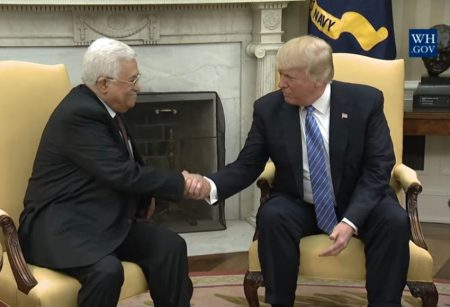
Palestinian Authority leader Mahmoud Abbas sits with US President Donald Trump at the White House, May 3 2017

Fatah has appointed terrorist murderer Karim Younes to its Central Committee upon the personal recommendation of Palestinian Authority leader Mahmoud Abbas, the Palestinian Media Watch reported this week.

Karim Younes and his cousin Maher Younis are two Israeli Arabs who together kidnapped and murdered Israeli soldier Avraham Bromberg in 1980.

The two killers have been presented by the Palestinian Authority government as role models for PA children. Public squares were recently named after each, to further glorify them, by the Palestinian Authority government.

The PLO Director of Prisoner’s Affairs said in a statement that he sees the appointment of Younes as proof that “our prisoners are not terrorists.”

“It is also noteworthy that Abbas has chosen an Israeli citizen to be among Fatah’s decision-makers,” Itamar Marcus and Nan Jacquest Zilberdik said in an article on the PMW website. “This is consistent with the Palestinian Authority message to Israeli Arabs to see themselves as part of the Palestinian national movement, and to view all of the land of the State of Israel as part of a future Palestinian state that will replace Israel.

“This new appointment of a terrorist was announced right after Abbas sent a message to Israelis demonstrating on Saturday for “Two states – One hope” at Rabin Square in Tel Aviv, in which he stated, ‘The opportunity [for peace] still exists, and it cannot be missed when our hand is extended in peace that is created between those who are brave.’” [Ha’aretz, May 27, 2017]

Significantly, “[PA] Minister of Justice Ali Abu Diyak emphasized that the decision of the Fatah Movement leadership – led by President Mahmoud Abbas – to appoint the veteran prisoner Karim Younes to the Fatah Central Committee is the clearest and severest response to the campaign being led by Israel to accuse the prisoners, Martyrs (Shahids), and the Palestinian struggle of terror.” [Official PA daily Al-Hayat Al-Jadida, May 28, 2017]

PLO’s Director of Prisoners’ Affairs Issa Karake welcomed the appointment, claiming it proof that the Palestinian prisoners are not criminals:
“I want to note an additional achievement, which was a political response by the Palestinian leadership when the Fatah Revolutionary Council made a decision to appoint prisoner Karim Younes, the most veteran of the prisoners, as a member of the Fatah Movement Central Committee.

“I think that this is a very great and significant political response, [which says] that our prisoners are not terrorists and are not criminals. They are freedom prisoners and fighters who enjoy an important national, human, and legal status among their leadership and among their Palestinian people.”
[Official PA TV, Palestine This Morning, May 28, 2017]

As part of the PA’s campaign to present terrorists as heroes and role models, the PA recently named two town squares after Karim and Maher Younes.

In his statement regarding the appointment of Younes, the Minister of Justice further glorified all terrorist prisoners:

“The prisoners and Martyrs are the spearhead of the freedom fighters, symbols of our legitimate national struggle, and conscience of the Palestinian people…”
[Official PA daily Al-Hayat Al-Jadida, May 28, 2017]


The onus is on us

May 25, 2017

The onus is on us, Israel Hayom, Isi Leibler, May 25, 2017

(Iran is the greatest threat to Israel; it has or will have nukes and the means of delivering them to obliterate the “little Satan.” The Palestinians don’t and, at least in the foreseeable future, are unlikely to. By working with the Saudis, et al, to defang Iran, President Trump rejected Obama’s policy of yielding to Iran and thereby benefitted both the Saudis, et al, and Israel. — DM)

Trump did not try to force unreasonable concessions. A Palestinian state is not ‎even on the horizon. Neither is there any indication of a return to former President Barack ‎Obama’s policy of freezing all settlement construction.‎

In King Salman’s ‎statement outlining the Saudi position, rather than condemning Israel, he merely expressed the ‎hope that peace will be achieved. This was a clear message, as was the fact that Trump flew to ‎Israel on the first openly direct flight from Riyadh to Tel Aviv.‎

According to The Wall Street Journal, the Saudis no longer demand a complete ‎settlement freeze. Instead, they propose that Israel restrict construction outside the ‎settlement blocs and provide additional humanitarian aid in Gaza. ‎

In return, the Saudis would inch toward normalization by allowing ‎Israeli aircraft to fly over their territory, set up direct telephone connection and even provide ‎tourist visas for Israelis. While this was not officially confirmed, there were no denials, which ‎tends to confirm the veracity of the report. ‎

************************

U.S. President Donald Trump has delivered. He will not have satisfied the delusional ‎aspirations of Israel’s radical right but, despite some missteps before he arrived, the Trump visit was favorable for Israel and outlined ‎parameters of what can be achieved with the Palestinians.‎

It was disappointing that he postponed transferring the U.S. Embassy to Jerusalem, but we appreciate that he is the first sitting ‎American president to visit the Western Wall. ‎

He should have been more explicit about the extent of terrorism in Israel in his ‎address to the Muslim world. But he more than compensated in his extraordinarily warm ‎address at the Israel Museum.‎

There is also some concern that the substantial commercial and defense relationship with the ‎Saudis ($380 billion in deals, including $110 billion in arms purchases) might impact Israel and ‎will require steps to ensure that we maintain our qualitative military edge.‎

Trump did not try to force unreasonable concessions. A Palestinian state is not ‎even on the horizon. Neither is there any indication of a return to former President Barack ‎Obama’s policy of freezing all settlement construction.‎

Indeed, the president expressed support for Israel in a far more open and ‎positive manner than his predecessors. In his address to the leaders of 55 Muslim-‎majority countries, he reversed Obama’s moral equivalence approach and described the ‎conflict as being between the forces of decency on the one hand, and an evil death cult on the ‎other. He urged the Arab and Muslim states to actively eradicate terrorism and extremism ‎from within their ranks. He specifically condemned Hamas and ‎Hezbollah together with ISIS and al-Qaida. And he explicitly called on Arab and Muslim ‎leaders to combat anti-Semitism. ‎

For the first time, the Saudis, backed by the Egyptians and Gulf states, appear to be promoting ‎peace or at least easing the tension between the Palestinians and the Israelis. In King Salman’s ‎statement outlining the Saudi position, rather than condemning Israel, he merely expressed the ‎hope that peace will be achieved. This was a clear message, as was the fact that Trump flew to ‎Israel on the first openly direct flight from Riyadh to Tel Aviv.‎

According to The Wall Street Journal, the Saudis no longer demand a complete ‎settlement freeze. Instead, they propose that Israel restrict construction outside the ‎settlement blocs and provide additional humanitarian aid in Gaza. ‎

In return, the Saudis would inch toward normalization by allowing ‎Israeli aircraft to fly over their territory, set up direct telephone connection and even provide ‎tourist visas for Israelis. While this was not officially confirmed, there were no denials, which ‎tends to confirm the veracity of the report. ‎

Whether this was the outcome of discussions with Trump’s representatives, or ‎because the Saudis recognize the value of Israel’s support against Iran’s efforts to achieve ‎regional hegemony, is irrelevant. There have already been widespread rumors attesting to ‎covert Saudi cooperation with Israel against Iran and similarly with Egypt against ISIS.‎

Trump demanded that the Palestinians cease incitement and stop ‎rewarding terrorists murderers and their families, and avoided suggesting that Israel cease settlement activity. But he undoubtedly pressed Prime ‎Minister Benjamin Netanyahu for confidence-building measures such as ‎improving Palestinian economic conditions.‎

At this potentially historic turning point, Netanyahu must stand firm against the radicals in his ‎coalition and impose a limited freeze beyond the settlement blocs. Most Israelis ‎would endorse this, and if it brings down the government, and forces elections, the ‎nation will support Netanyahu.‎

At this crucial time, decision-making must reflect ‎the views of the centrist majority. No minority groups should ‎be able to veto our national interest.‎

Yesh Atid and elements in Labor embrace this centrist view, and should either join the ‎government or support it on this issue. ‎

Of course, this is only the beginning. Before we engage in negotiating details, ‎Palestinian Authority President Mahmoud Abbas must make some concessions. Let him recognize ‎Israel as a Jewish state and abrogate the Palestinian right of return. Then we can ‎discuss borders and a demilitarized state. For now, we must demonstrate to the ‎world and to Trump that we are reasonable and respond positively to genuine Arab ‎gestures.‎

Despite these efforts, Abbas is probably unwilling or unable to ‎change. He is unlikely to make genuine efforts to stem incitement ‎or cease awarding lavish pensions to murderers and their families. Should that be the case, ‎most of the world, especially the Europeans, will still automatically blame Israel for failure to ‎advance the peace negotiations.‎

Trump’s determination will then be put to test. If, to appease the Saudis, he was to continue to ‎make believe that Abbas is a moderate peace partner and extend the fake “peace process ‎negotiations” we have endured under Obama, we would justly feel betrayed. ‎

However, if the Trump administration performs as an honest broker and recognizes Israel’s ‎efforts and genuine desire for peace, it will conclude that in the absence of a Palestinian ‎negotiating partner, all we can achieve is an improvement in Palestinian quality of life under ‎their own autonomy while we maintain our security. At the same time, as has been hinted by ‎Trump, he may then look more seriously at alternative solutions in cooperation with Egypt and ‎Jordan and backed by the moderate Arab States, which do not involve a two state solution. It ‎is no coincidence that Trump failed to explicitly refer to a Palestinian State while visiting the ‎region. It is this veiled threat that Trump is hoping will entice the Palestinian leadership to ‎conduct bona fide negotiations for the first time.‎

We are today in an exceedingly strong position. Israel has never been so powerful militarily, ‎economically and socially.‎

Israel has never had such widespread international recognition. Whether you adore or loathe ‎Netanyahu, nobody can deny that he has been an outstanding statesman in the international ‎arena. He has a unique relationship with the Americans and with Russian President Vladimir ‎Putin, and has built up relations with India, China, Japan, Southeast Asia, Australia, Eastern ‎Europe and now Africa. ‎

The extraordinary opportunities of today may never be replicated. We must demonstrate ‎restraint and ensure that our elected representatives neither undermine us nor project the ‎image of extremists by engaging in foolish or intemperate outbursts primarily designed for ‎personal political promotion. ‎

Today, we have in our grasp this remarkable opportunity to genuinely move toward ‎improving and stabilizing our relationship with our Arab neighbors. ‎

PA TV host longs for days of Palestinian terror, encourages more violence

May 24, 2017

PA TV host longs for days of Palestinian terror, encourages more violence, Palwatch via YouTube, May 24, 2017

(The interview was conducted on the day before President Trump’s meeting with Obama’s “partner for peace,” Abbas. Please see also, Abbas and Palestinian Authority Honor Terrorists Amid Trump Visit.– DM)


Abbas and Palestinian Authority Honor Terrorists Amid Trump Visit

May 24, 2017

Abbas and Palestinian Authority Honor Terrorists Amid Trump Visit, Investigative Project on Terrorism, May 23, 2017

(Some expressed surprise that President Trump failed to announce a new peace process before leaving Israel. Perhaps Abbas convinced him that a successful peace process is impossible. — DM)

President Trump raised concerns earlier this month over the PA’s program of paying terrorists and their families.

Abbas is unlikely to end the program, with a top aide calling the idea “insane.”

Amid growing pressure to halt this practice, it is important to note that Abbas is directly behind the policy concerning terrorist transfers.

******************************

The Palestinian Authority (PA) honored two terrorists this month in the lead up to President Trump’s visit with his Palestinian counterpart Mahmoud Abbas, Palestinian Media Watch reports.

Though Abbas tried to present a moderate stance to the American president, the PA named public squares in Jenin and Tulkarem after terrorists Karim and Maher Younes, two Israeli Arab cousins convicted in the 1980 kidnapping and murder or Israeli soldier Abraham Bromberg.

Both terrorists were sentenced to 40 years in jail.

Abbas’ Fatah party and Jenin’s municipal authorities sponsored one of the ceremonies.

“…Jenin District Governor Ibrahim Ramadan conveyed a greeting [expressing] honor and pride to the prisoners and their relatives on behalf of [PA] President Mahmoud Abbas and the Palestinian leadership,” the official PA daily Al-Hayat Al-Jadida reported on Friday and translated by PMW.

In Tulkarem, the public ceremony featured a Palestinian official openly supporting the PA’s policy of glorifying terrorists and supporting convicted murderers.

“This is in appreciation of fighter Maher Younes… I thank the Tulkarem Municipality and all of the district’s bodies for this national act of standing side by side with the prisoners and expressing support for them. We permanently stand by our fighters,” proclaimed Tulkarem District Governor Issam Abu Bakr, quoted in Ma’an news on May 11.

President Trump raised concerns earlier this month over the PA’s program of paying terrorists and their families.

Abbas is unlikely to end the program, with a top aide calling the idea “insane.”

Amid growing pressure to halt this practice, it is important to note that Abbas is directly behind the policy concerning terrorist transfers.

He may claim that Palestinians are raising youth in a “culture of peace,” but overwhelming evidence shows that the PA and other Palestinian factions systematically promote violence against Jews and Israelis. Through incitement, Palestinian leaders encourage others to follow in the footsteps of terrorists.

On Monday, a Palestinian terrorist tried to stab Israeli Border Police officers in Abu Dis – a Palestinian town east of Jerusalem – before officers shot and killed the assailant.

The attack reportedly occurred as President Trump toured Jerusalem on an official state visit. The next day, a Palestinian man stabbed and injured an Israeli police officer in Netanya, in a “probable” terrorist attack. Despite suffering a neck wound, the officer was able to shoot and injure the attacker – identified as a 44-year-old man from Tulkarem.


