Posted tagged ‘Palestinian Authority’

Column One: Checkmating Obama

October 27, 2016

Column One: Checkmating Obama, Jerusalem Post, Caroline Glick, October 27, 2016

Obama has waited eight years to exact his revenge on Israel for not supporting his hostile, strategically irrational policies. And he has no interest in letting bygones be bygones.
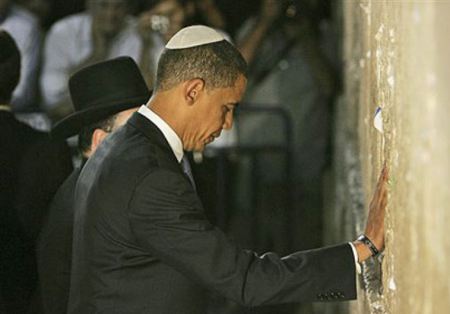
wailingwallobamaObama at the Western Wall. (photo credit:AFP PHOTO)

In one of the immortal lines of Godfather 2, mafia boss Michael Corleone discusses the fate of his brother, who betrayed him, with his enforcer.

“I don’t want anything to happen to him while my mother is alive,” Corleone said.

Message received.

The brother was murdered after their mother’s funeral.

Last week it was reported that the Obama administration has delivered a message to the Palestinian Authority. The administration has warned the PA that the US will veto any anti-Israel resolution brought before the UN Security Council before the US presidential elections on November 8.

Message received.

Open season on Israel at the Security Council will commence November 9. The Palestinians are planning appropriately.

Israel needs to plan, too. Israel’s most urgent diplomatic mission today is to develop and implement a strategy that will outflank President Barack Obama in his final eight weeks in power.

Lobbying the administration is pointless. Obama has waited eight years to exact his revenge on Israel for not supporting his hostile, strategically irrational policies. And he has no interest in letting bygones be bygones.

Before turning to what Israel must do, first we need to understand what Israel can do.

A good place to begin is by considering what just transpired at UNESCO, where twice in a week, UNESCO bodies resolved to erase 3,000 years of Jewish history in Jerusalem and the Temple Mount.

The fight that Israel waged at UNESCO is not the fight it needs to wage at the Security Council. The stakes at the Security Council are far higher.

Like the UN General Assembly, UNESCO’s decisions are non-binding declarations that have no legal or operational significance. As such, there is no reason to expend great resources to fight them. For Israel, the goal of the fight at UNESCO is not to defeat anti-Israel initiatives. That is impossible given the Palestinians’ automatic majority.

The purpose of the fight at UNESCO is to humiliate European governments that side with antisemitic initiatives, and to weaken the congenitally anti-Israel body itself.

The government achieved both of these objectives. Italian Prime Minister Matteo Renzi’s disavowal of his own government’s abstention from the vote on the first resolution – like the similar position taken after the fact by the Mexican government – was a diplomatic victory for Israel.

So too, the fact that UNESCO’s own Secretary-General Irina Bukova felt compelled to disavow her own agency’s actions by rejecting the resolution’s denial of the Jewish people’s ties to Jerusalem was a significant victory for Israel. Her statement was deeply damaging for UNESCO and its reputation.

Finally, the fact that Tanzania and the Philippines voted against the resolution was a testament to Israel’s capacity to convince other governments to abandon their traditional pro-Palestinian voting pattern.

The Palestinians won the vote at UNESCO because they are more powerful diplomatically than Israel. They have an automatic anti-Israel majority. But they weren’t empowered by their victory. To the contrary. They were bloodied by it.

In a sign of their weakening hold on member nations, the Palestinians and Jordanians felt compelled to send a threatening letter to the members of UNESCO’s World Heritage Committee lest they dare to vote against the resolution. Powerful players don’t make threats. They don’t need to.

Israel’s experience at UNESCO teaches us that there are governments that are open to counteroffers. Israel doesn’t need to hide in America’s shadow. It is capable of working on its own to blunt the impact of the Palestinians’ automatic majority. And it will need to use all of its resources to fend off a US-backed assault at the Security Council.

Unlike UNESCO, the Security Council can pass legally binding resolutions. Israel needs to be prepared to bring all of its resources to bear to prevent such a resolution from being adopted against it. Obama’s intention to abandon Israel at the Security Council means that Israel comes to this battle severely hobbled.

But there is one advantage to the US’s betrayal.

Over the years, Israel’s ability to trust the US to veto anti-Israel resolutions at the Security Council was been a mixed blessing. On the one hand, the US has secured Israel from diplomatic assaults. But on the other hand, our ability to trust Washington has made us diplomatically lazy and ineffective.

Safe in Washington’s shadow, we have behaved as through all diplomacy is public diplomacy. That is, we have pretended that statecraft begins and ends with making the moral or strategic case for our side against the other guys.

But public diplomacy is just one diplomatic tool.

The Syrian regime, for instance, has no moral case for securing international support. Bashar Assad didn’t convince Russian President Vladimir Putin to support him by arguing that he is better than alternative regimes. He bought Putin’s support by offering him permanent air and naval bases in Syria.

Then there is Morocco, another weak state with no public diplomacy case to make. Last March, UN Secretary-General Ban Ki-moon outraged Rabat when he acknowledged the plain fact that Western Sahara, which Morocco occupies, is “occupied territory.”

Morocco quickly secured the support of Spain and France and launched an all-out onslaught against Ban. How did Morocco manage?

Morocco’s most powerful diplomatic resource is its control over migration flows from North Africa to Europe. Anytime it wishes, Rabat can open the migratory floodgates just as easily as it can keep them shut. And the French and Spanish know it.

In less than a month, Ban issued repeated abject apologies.

Game. Set. Match. Morocco.

From reports to date, it appears that shortly after the US elections on November 8, the Malaysians or Egyptians will submit a Palestinian-backed resolution that defines Israeli communities in united Jerusalem, Judea and Samaria as illegal. If the resolution is brought to a vote, the US will fail to veto it.

Such a resolution, or a resolution obligating Israel to withdraw to the 1949 armistice lines, would cause Israel grave harm.

So what resources does Israel have to prevent this from happening?

Of course, we have public diplomacy. And that might work with some friendly nations. But it won’t get us over the top. We need to learn from the Syrian and Moroccan examples and consider what we have to offer Security Council members in exchange for their support in scuttling the approaching onslaught against us.

One such resource is the US Congress. Israel’s allies in Congress are sickened by the Obama administration’s devastating Middle East policies. A solid majority of lawmakers can be trusted to support actions that will reinforce Israel’s position.

Israel has other resources as well that we can trade on. We have natural gas. And we have technologies that the governments of the world require to surmount the challenges of the 21 century. There is no reason to give these resources away when we can trade them for diplomatic support.

As for the Palestinians, as the UNESCO vote showed, they are less popular now than at any time in the past 40 years. All they have to offer is threats and antisemitism. Both are powerful weapons.

But they are no longer invincible.

Israel’s goal must be to use our resources at the Security Council in a manner that will make it impossible for Obama to enable an anti-Israel resolution to pass.

A method for achieving this goal has two components. The first component is to convince a friendly country on the Security Council to propose a balanced resolution that would counter the Palestinian-backed Israel-bashing one.

Such a resolution could include four points. First, it could deplore efforts to deny Jewish history in Jerusalem and the Temple Mount.

Second, it can condemn the PA/PLO for their continued unlawful funding of terrorists.

Third, it can urge Israel to restrain settlement construction in areas that in previous negotiations have been identified as likely territory for a future Palestinian state.

Fourth, it can call on Israel and the PA to reinstate negotiations immediately without preconditions.

Israel has friendly ties with a few Security Council members, among them Uruguay and New Zealand. In the final weeks of the Obama era, it is possible that Israel will be able to convince one of them to submit a balanced resolution along these lines.

Obama would be hard-pressed to oppose such a resolution in favor of one that singles Israel out for rebuke.

But that still is insufficient. Obama can make Uruguay and New Zealand a better offer if he wishes.

And so we move to the second aspect of the plan.

If we learn nothing else from the Obama era, we must recognize that the time has come for Israel to stop sufficing with just one Security Council veto. Most states have several. And we need a few more.

Russia today is the best place to start our search for a second veto.

Putin is a dealmaker. As his agreement with Assad showed, he is willing to consider attractive offers. Obviously, Israel won’t offer Russia bases. But we do have other things to offer Putin in exchange for a veto.

For instance, in exchange for a Russian veto at the Security Council, Israel can offer Putin to lobby the US Congress to cancel US sanctions against Russia over Russia’s annexation of Crimea.

Israel has no dog in that fight. And the sanctions are not getting the US anywhere.

Putin might go for the deal for two reasons. First, by stepping into the breach and defending Israel against Obama, he will humiliate Obama.

Second, if Israel succeeds with the Congress, he will reap economic rewards.

For his part, Putin wouldn’t even have to openly side with Israel. All he would have to do is announce that in the interests of regional stability, Russia will not support an unbalanced resolution on Israel and the Palestinians.

If Putin supports a balanced resolution, Obama will be checkmated. His plan to take revenge on Israel for not following him off the strategic cliff will be foiled. Israel will have survived his presidency.

None of this will be easy. And success is far from assured. There are many more ways for Israel to fail than succeed. Our diplomatic weakness remains a millstone around our neck. But as the UNESCO resolutions showed, attacking Israel is no longer cost free. We are not powerless in the grip of circumstances. We have cards to play.

And now is the time to play them for all they are worth.

New PA School Named for Mastermind of Munich Olympics Massacre

October 25, 2016

The Palestinian Authority again glorifies the slaughter of Jews by dedicating a school, supported with foreign aid, in the name of a terror mastermind.

By: Hana Levi Julian

Published: October 25th, 2016

Source: The Jewish Press » » New PA School Named for Mastermind of Munich Olympics Massacre

Israel’s national flag flies at half-mast at Lod Airport, awaiting Israeli athletes murdered by Arab terrorist at Munich Olympics.
Photo Credit: Eldan David, 07/09/1972

A new public school in the Palestinian Authority has been named after Salah Khalaf, head of the Black September terrorist group.

Among the attacks planned by Khalaf was the murder of the 11 Israeli athletes at the Munich Olympics, and the murder of two American diplomats in Sudan.

The school, located in the Palestinian Authority-controlled city of Tulkarem, “will serve as a daily reminder to Arab children that murdering Israelis is a heroic act when they attend the Martyr Salah Khalaf School,” pointed out the Palestinian Media Watch (PMW) watchdog organization which translated the announcement of the dedication in the official PA daily, Al-Hayat Al-Jadida.

The Palestinian Authority laid the cornerstone for the new school a few weeks ago, according to the report. At the ceremony, Tulkarem district governor Issam Abu Bakr “emphasized the importance of the project of building the school named after Martyr Salah Khalaf, in order to commemorate the memory of this great national fighter.”

This is the fourth school the Palestinian Authority has chosen to name after this terrorist, in addition to three others in Gaza. Also attending the ceremony were Tulkarem Mayor Iyad Al-Jallad and Salam Al-Taher, head of the Tulkarem Education Directorate, part of the Palestinian Authority Ministry of Education – which receives funding from the United States and the European Union.

The PMW has released a report, PA Education, A Recipe for Hate and Terror, that documents evidence of 25 Palestinian Authority schools that have been named after terrorist murderers. Also documented in the report is evidence that the PA Ministry of Education is responsible for naming and changing the existing names of PA schools.

The watchdog group has written to the European Union, which funds the salaries in the Palestinian Authority Ministry of Education, and called on the EU to hold up its funding on condition the PA changes the names of all schools that bear dedications and names after terrorists.

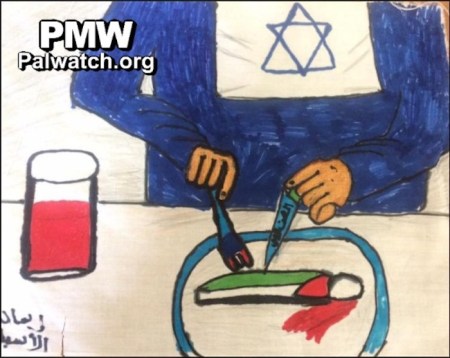
Palestinian Authority kids’ drawings: Israel drinks the blood of “Palestinians”

October 16, 2016

Palestinian Authority kids’ drawings: Israel drinks the blood of “Palestinians” Jihad Watch,

“Of course, Israel cannot be expected to negotiate with anyone who is dedicated to its destruction. But while I know you have had differences with the Palestinian Authority, I believe that you do have a true partner in President Abbas…” — Barack Obama, March 21, 2013

israel-eating-palestine74

“PA kids’ drawings: Israel drinks blood of Palestinians,” by Itamar Marcus, Palestinian Media Watch, October 16, 2016:

Fatah has posted several children’s drawings on Facebook. The drawings clearly show the success of PA and Fatah brainwashing children to believe that Israel only seeks to harm them, violence is good and that all of Israel really is “Palestine.”

Labeling the drawings “innocent drawings” that “express the feelings of children of #Palestine,” Fatah posted the drawing above showing Israel, as indicated by a Star of David, eating a Palestinian body wrapped in the Palestinian flag. Blood is seen coming from the body, and a glass of blood is next to the plate.

Another drawing by a Palestinian child showed a crucified woman wearing the colors of the Palestinian flag, with her body in the shape of the PA map of “Palestine” that presents all of Israel as “Palestine” together with the PA areas. The crucifixion also repeats the analogy that Palestinians are Martyr victims like Jesus.

Yet other drawings showed support for violence as legitimate means of Palestinian opposition to Israel. One child drew a Palestinian with a slingshot, another drew a hand with a rifle (see below). These drawings echo the PA and Fatah’s encouragement of the use of violence against Israel and their glorification of terrorists as heroes. Palestinian Media Watch documented that summer camps organized by the PA Ministry of Education and the PLO educated children to see terrorist stabbers as role models.

Other drawings repeated the world view that all of Israel is “Palestine,” showing the PA map of “Palestine” which completely erases the existence of Israel and its legitimacy (see below).

This message is repeated endlessly by the PA and Fatah. Children are told that “it will all return to us” on kids’ TV programs. The PA National Security Forces regularly post photos from all over Israel presenting the places as “Palestine,” and even crossword puzzles portray Israeli cities as “occupied Palestine.”

The PA’s exploitation of Palestinian children’s innocence is precisely what PMW has been highlighting and warning about for years….

Palestinians: “We Are Proud of You. You Killed Jews!”

October 14, 2016

Palestinians: “We Are Proud of You. You Killed Jews!” Gatestone Institute, Bassam Tawil, October 14, 2016

(On and on it goes. The article does not focus on the recent UNESCO resolution, which may well incite further incitement against “Jews with dirty feet.” Perhaps the violence and its incitement will end with the Obama-Kerry “two state solution.” Not. — DM)

Musbah Abu Sbeih is now the latest “hero” of many Palestinians and not only his family. He is being hailed as a “brave” man and a “hero” because he woke up in the morning, grabbed an M-16 assault rifle and set out on a mission to kill as many Jews as possible.

These calls have come not only from Hamas and Islamic Jihad extremists, but also from “moderate” leaders such as Palestinian Authority President Mahmoud Abbas and his Fatah faction.

“We bless every drop of blood that has been spilled for Jerusalem, which is clean and pure blood, blood spilled for Allah, Allah willing. Every martyr will reach Paradise and everyone wounded will be rewarded by Allah.” – Mahmoud Abbas, Palestinian leader.

As holders of Israeli ID cards, they were even entitled to drive cars with Israeli plates, which is what Abu Sbeih took advantage of to carry out his attack in Jerusalem. His family owns at least two homes in the city and are considered middle-class. Still, this did not stop Abu Sbeih from setting out on his deadly mission. And it did not stop his family members from celebrating the attack.

This is the inevitable result — as in the Spanish Inquisition, the French Revolution, the Turkish Genocide of the Armenians, Rwanda, Darfur, or Nazi Germany — of the poisoning of a people.

The family of Musbah Abu Sbeih say they are “very proud” of what their 40-year-old son did. So are many Palestinians representing all walks of life in Palestinian society. Members of his family, including his parents and daughter, have appeared on too may TV stations to keep track of to commend Abu Sbeih. They have even gone out onto the streets to hand out sweets in jubilation over the terror attack that he carried out in Jerusalem this week, which resulted in the death of a 60-year-old grandmother and a 29-year-old police officer.

Abu Sbeih is now the latest “hero” of many Palestinians, and not only by his family. He is being hailed as a “brave” man and a “hero” because he woke up in the morning, grabbed an M-16 assault rifle and set out to kill as many Jews as possible. His mission was “successful”: he managed to shoot and kill two Jews before he himself was eliminated by policemen.

In a video that he left behind, Abu Sbeih claimed that he carried out the terror attack in response to visits to the Temple Mount by Jews. He claimed (falsely) that these visits were part of an Israeli scheme to destroy the Al-Aqsa Mosque on the Temple Mount.

This is the same false claim that was originally made by Hitler’s friend, the Mufti of Jerusalem at the time, Haj Amin al-Husseini, to pretend there was a good excuse to attack the Jews; it is, as we see, still trotted out from time to time to “justify” killing Jews.

For the record, it is a lie — like Palestinian claims that Israel is poisoning wells and water, which Palestinian Authority (PA) President Mahmoud Abbas was later, for lack of evidence, forced to retract.

Like many other Palestinians who have carried out, or attempted to carry out, terror attacks over the past year, Abu Sbeih was in fact simply heeding his leaders’ call to stop Jews from “desecrating with their filthy feet” the Al-Aqsa Mosque. These calls have been coming for months not only from Hamas and Islamic jihad extremists, but also from “moderate” leaders such as Mahmoud Abbas and his Fatah faction.

These are the Palestinian leaders that European leaders appear to adore. These leaders in Europe, especially the French, keep prodding Israel to negotiate with groups that openly say they want no Israel at all, and that at best are uninterested in the truth — whether about Israelis or Palestinians.

These European leaders would like Israel to keep pretending that the people with whom they are negotiating are actually acting in good faith. They seem to be trying to offer up to the Arabs, Muslims and the Organization of Islamic Cooperation (OIC), the destruction of Israel — physical, diplomatic, economic, whatever they can get — most likely as a bribe to stop Muslims from terrorizing them. They will soon find out, however, that nothing they offer will be seen as adequate. The Europeans will soon find out, as the Persians, Turks, Greeks, North Africans and Eastern Europeans all did, that anything short of submission will just be pocketed as a down-payment on a far bigger mark.

These European leaders are happy to make us in the region, Muslims, Christians and Jews, live under a brutal Islamic dictatorship so long as — in their woozy fantasy — they will not have to. They are in for a shock.

Anyhow, in September 2015, Abbas used the very words from 1924 of Haj Amin al-Husseini, days before the current wave of stabbing, vehicular and shooting attacks began.

Since then, incitement over Jews’ visits to the Temple Mount has been feeding what many Palestinians call the “Al-Quds Intifada.” Abbas has promised that those who die while defending the Al-Aqsa Mosque will go straight to Heaven:

“We bless every drop of blood that has been spilled for Jerusalem, which is clean and pure blood, blood spilled for Allah, Allah willing. Every martyr will reach Paradise and everyone wounded will be rewarded by Allah.”

To repeat: Abbas made this statement two weeks before the Palestinians unleashed a new wave of anti-Israel terrorism. We know, then, what spurred these attacks. They are the direct result of ongoing indoctrination and incitement against Israel that is being waged by Palestinians representing almost all Palestinian institutions and parties in the West Bank and Gaza Strip. Abbas’s words have clearly not fallen on deaf ears. This week’s terror attack, which was carried out by Abu Sbeih, shows that the “Al-Quds Intifada” is anything but dying out. On the contrary, there is increased fear that the terror campaign may escalate from the use of knives, vehicles and stones to pistols and rifles.

1948Musbah Abu Sbeih (right) is the latest “hero” of many Palestinians, because he murdered two Jews this week, acting on the incitement of Palestinian Authority President Mahmoud Abbas (left).

Why is this scenario not far-fetched? Not only because of the motivation of the assailants, but also because of what appears to be widespread popular support among Palestinians for any attack on Israelis. Not a single Palestinian official has dared to come out against the Jerusalem terror attack. And no ordinary Palestinian has dared to question the damage the attacks cause to the Palestinian public, especially those who are directly affected by Israeli retaliatory measures, such as travel restrictions.

Far from crying out against such butchery, many Palestinians have been heaping praise on the assailant.

Abu Sbeih, who as a permanent resident of Jerusalem carried an Israeli ID card and thus enjoyed all rights and privileges granted to Israeli citizens (with the exception of voting in general elections), did not come from an impoverished family at all. Unlike his fellow Palestinians in the West Bank and Gaza Strip, he had free access to Israel and could go anywhere and anytime he wanted to, any place in Israel.

He and his family were able to wake up in the morning and drive to the Tel Aviv beach or eat in any restaurant in Israel without having to pass through Israeli checkpoints. As holders of Israeli ID cards, they were even entitled to drive cars with Israeli plates, which is what Abu Sbeih took advantage of to carry out his attack in Jerusalem. His family owns at least two homes in the city and are considered middle-class. Still, this did not stop Abu Sbeih from setting out on his deadly mission. Nor has it stopped his family members from celebrating the attack.

The first to express her “joy” and “pride” over the death of two Jews was Abu Sbeih’s 15-year-old daughter, Eman. “Thank God, we are very happy and proud of my father,” she said in an interview with a local Palestinian television station.

As in previous cases, some Palestinians, including the sister of Abu Sbeih, handed out sweets to “well-wishers” as a way of expressing their joy over the terror attack. Hours after the attack, dozens of Palestinians gathered outside the family house, chanting slogans praising the assailant as a “hero” and calling on Hamas and other Palestinian groups to step up their attacks against Israel. Such scenes are familiar in the Palestinian arena and are reminiscent of those that used to take place following the wave of suicide bombings against Israelis during the Second Intifada.

Several Palestinian factions lauded Abu Sbeih, calling for stepped up “armed operations against the Zionist enemy.” Hamas leader Khaled Mashaal, who together with his family lives in the comfort of Qatar, was quick to phone the assailant’s family and “congratulate” them on the “martyrdom” of their son. “Our people and nation are proud of their heroism and courage displayed by your son, who sacrificed his life for the sake of Allah,” Mashaal told Abu Sbeih’s parents. He stressed that their son was a role model for Palestinians of his generation.

It was not clear whether the Hamas leader was making the phone call from his suite in one of Qatar’s five-star hotels, or from his private gym.

Thus, for Hamas and many other Palestinians, a man who kills two Jews is the desired role model for young Palestinians. Accordingly, Abu Sbeih’s supporters have taken to social media to praise him and urge Palestinians to follow suit. Because he managed to kill two Jews, Abu Sbeih is now being hailed on Twitter and Facebook as the “Lion of Al-Aqsa.” As they see it, his was a noble act, an effort to save the mosque from being “defiled” with the “filthy feet” of Jews.

Support for Abu Sbeih seems to cross all Palestinian political factions. Even many belonging to President Abbas’s Fatah faction came to the Abu Sbeih home in a show of solidarity with them. Fatah has also declared Abu Sbeih a “martyr.” A Palestinian who goes to meet with a Jew is strongly condemned and accused of seeking “normalization” with the enemy. But a Palestinian who carries a knife or rifle and sets out to kill Jews gains the stars of a “martyr” and wins nearly universal Palestinian praise. This is the current mindset in Palestinian society, the fruit of decades of Palestinian incitement and delegitimization of Israel. This is the inevitable result — as in the Spanish Inquisition, the French Revolution, the Turkish Genocide of the Armenians, Rwanda, Darfur, or Nazi Germany — of the poisoning of a people.

Palestinians: Abbas “The Jew”

October 7, 2016

Palestinians: Abbas “The Jew”, Gatestone Institute, Khaled Abu Toameh, October 7, 2016

The unprecedented outcry over Abbas’s participation in the funeral of an Israeli leader is further proof of the degree to which Palestinians have been radicalized.

This is what happens when you unleash a tidal wave of hate against Israel and its leaders in the media, mosques and public rhetoric. In light of this brainwashing, how do you expect your people to respond when you, in any way, associate with an Israeli leader?

If attending the funeral of an Israeli leader, especially one who devoted the past two decades of his life to peace between Israel and the Palestinians, draws such condemnation, it is easy to imagine the result of a Palestinian leader making a peace overture to Israel.

Even if the current condemnation eventually dies down, it will have sent a message to future Palestinian leaders: “No peace with Israel, not in our time, and not in any time.”


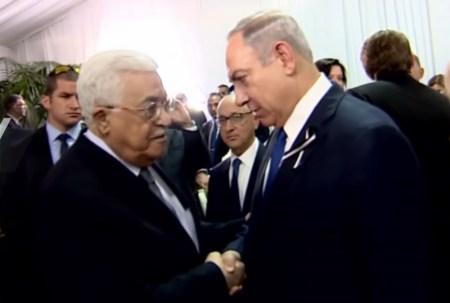
Palestinian Authority (PA) President Mahmoud Abbas is facing a barrage of criticism for attending the funeral of former Israeli President Shimon Peres in Jerusalem. The fury directed towards Abbas comes as no surprise to those who are familiar with the unrelenting campaign of anti-Israel incitement that has been taking place for many years in Palestinian society.

If attending the funeral of an Israeli leader, especially one who devoted the past two decades of his life to peace between Israel and the Palestinians, draws such condemnation, it is easy to imagine the result of a Palestinian leader making a peace overture to Israel.

President Abbas is now receiving a dose of his own medicine. This is what happens when you unleash a tidal wave of hate against Israel and its leaders in the media, mosques and public rhetoric. This is what happens when you inform your people that Israeli leaders are “war criminals” who ought to be prosecuted before the International Criminal Court. This is what happens when you drive into your people that Jews are desecrating with their “filthy feet” Islamic holy sites in Jerusalem. This is what happens when you accuse Israel of “ethnic cleansing”, “extra-judicial executions” and “poisoning” Yasser Arafat.

In light of this brainwashing, how do you expect your people to respond when you, in any way, associate with an Israeli leader?

1928Palestinian Authority President Mahmoud Abbas shakes hands with Israeli Prime Minister Binyamin Netanyahu at the funeral of Shimon Peres, a former president of Israel, on September 30. Abbas is facing a barrage of criticism for attending the funeral, with members of his own party calling it “treason.” (Image source: Ruptly video screenshot)

It is hard to believe that Abbas and his cronies were surprised by the current wave of reprobation. But the degree of vitriol was perhaps not predicted.

Abbas is now getting it from all quarters. The denunciations are coming not only from his political foes in Hamas, Islamic Jihad and the Popular Front for the Liberation of Palestine (PFLP), but also from groups and figures belonging to his ruling Fatah faction.

Palestinians say that the 81-year-old Abbas, who is now in his 11th year of his four-year term in office, is facing his most serious challenge to leadership. And there are no signs that the recriminations are subsiding. On the contrary, each day brings with it yet another flood of reproof, prompting Palestinian Authority officials in Ramallah to issue a stiff warning to those who are exploiting the situation to “incite” against Abbas. However, the threats have failed to deter his critics from proceeding with their attacks on him and calling on him to step down.

One of those who have already paid a price for criticizing Abbas’s attendance of the Peres funeral is Lieutenant Colonel Osama Mansour, who holds a senior position in the PA’s Military Liaison Apparatus. In a post on Facebook, the PA officer strongly condemned Abbas’s move:

“If you alone decided to participate in the funeral of the killer of our sons, then you erred. And if you took the decision on the basis of what you were told by your advisors, then they have misled you.”

Hours after the post appeared on Facebook, Mansour was suspended from his job. Later, he was arrested by PA Military Intelligence Service officers who raided his house and conducted a search, during which they destroyed furniture, according to his family. A PA court has since ordered Mansour remanded into custody for fifteen days.

The suspension and subsequent arrest of the officer sparked a new wave of rage against Abbas and his security forces. Palestinians took to social media to protest the crackdown on the officer, hailing him as a hero and denouncing Abbas as a “dog” and Israeli “collaborator.” Some suggested that the officer was worthy of being appointed as a minister in the PA Cabinet for his courageous remarks.

But the move against the senior officer did not deter many Abbas loyalists from coming out against him for going to the funeral of Peres.

Fatah’s “Youth Movement,” known in Arabic as Al-Shabiba, issued a statement calling on Abbas to “apologize” to the Palestinians for committing a “grave mistake.” Abbas’s participation in the funeral was “humiliating and degrading” for the Palestinians and a form of “treason,” according to the statement. The group pointed out that Abbas’s move was in violation of Fatah’s regulations, which envisage the “full liberation of Palestine and eliminating Israeli occupation economically, politically, militarily and culturally.” Addressing Abbas, the group stated:

“Mr. President of the State of Palestine, Mahmoud Abbas. You have committed a crime against our people by equating the executioner with the victim. We will not allow treason to become a viewpoint.”

Several senior Fatah officials sought to distance themselves from Abbas’s decision to attend the funeral of Peres by claiming that they had not been consulted beforehand.

One of them, Tawfik Tirawi, who previously served as commander of the Palestinian Authority’s General Intelligence Service in the West Bank, announced that he was personally opposed to Abbas’s gesture. He clarified that Abbas did not seek the opinion of the Fatah leadership before he went to the funeral:

“Had I been personally consulted as a member of the Fatah Central Committee, I would have made it clear that I am against participation in principle, because this is a funeral of a Zionist who wallowed, from head to toe, in the blood of our people and other Arabs.”

Tirawi went on to describe Peres as the “engineer of the Israeli nuclear project which is designed to foil any plan to retrieve our land.”

The widespread protests against Abbas’s decision to participate in Peres’s funeral took a violent turn on October 3, when PA policemen used force to break up a peaceful demonstration in Ramallah. Organized by the PFLP, the protest was yet another sign of the strong sentiments many Palestinians harbor not only against Abbas, but also Israel.

Palestinian lawyer Muhanad Karajeh, who works for a Ramallah-based human rights organization, reported that he was asked by the organizers to be present in order to document the event. The lawyer stated he was severely beaten by PA security officers during the protest. “I was repeatedly beaten in the face and different parts of the body,” he recounted. “I know some of the officers personally. They tore my suit although I told them I am a lawyer. They humiliated me and cursed me and my profession.”

In a desperate act to counter the spreading protests, Abbas’s aides organized impromptu marches in support of the Palestinian Authority president. The PA leadership summons Fatah activist-thugs to take to the streets whenever it feels the heat. Carrying photos of Abbas and the yellow Fatah flags, scores of Fatah members marched in the streets of Ramallah in a show of force and as a message of warning to those who would censure Abbas. “We stand behind our historic leadership and President Abbas,” declared top Fatah activist Osama Qawassmeh. “Fatah is a red line and it is facing a conspiracy.”

On social media, the attacks on Abbas were quite ruthless. Palestinian activists circulated cartoons ridiculing Abbas. One of them depicted Abbas as a rabbi in Israeli military uniform and a Jewish skullcap weeping next to Peres’s grave. Another cartoon featured an Arab laying a wreath on a boot next to Peres’s photo.

On Twitter, activists launched hashtags called, “Offering Condolences On the Death of Peres is Treason” and “Normalization is Treason.”

Hamas was not silent about Abbas’s “treason.” Mahmoud Zahar, one of the leaders of the Islamist movement in the Gaza Strip, opined that according to Islamic teachings, Abbas qualifies as a Jew. “We hope that he will join Peres in Hell,” Zahar said. “Abbas is an Israeli product. The man who claims to represent all the Palestinian people has stood up against all Palestinians and Arabs.”

A large group of Palestinian and Arab academics, journalists and political activists signed a petition calling on Abbas to apologize for attending the Peres funeral, characterizing the move as an “historic and political mistake.” At least 150 Palestinians and Arabs signed the petition, which stressed that Abbas’s decision came as a “shock” to Palestinians.

The protests have, meanwhile, spread to Palestinian refugee camps in the West Bank, Gaza Strip and neighboring Arab countries. At the Balata refugee camp near the West Bank city of Nablus, thousands of Palestinians chanted slogans calling for the removal of Abbas from power. The protest came during a funeral of a Palestinian man who had been shot dead a week earlier by Palestinian Authority policemen.

The unprecedented outcry over Abbas’s participation in the funeral of an Israeli leader is further proof of the degree to which Palestinians have been radicalized. Frustration with Abbas and his policies is not new. More and more Palestinians have in recent years expressed rage over his “lenient” policies towards Israel. A particular bone in their throat is the continued security coordination between PA security forces and Israel. They perceive this cooperation with the Israelis as “treasonous”. Many Palestinians are also angry with Abbas for his refusal to share power and pave the way for the emergence of new leaders.

The blame for the radicalization of the Palestinian people lies squarely at the feet of Abbas and the rest of the PA. If you promote boycotts of Israel, expect to be attacked when you break that boycott by associating with any Israeli, alive or dead. Protests tend to subside, but even if the current condemnation eventually does die down, it will have sent a message to future Palestinian leaders. The message is: “No peace with Israel, not in our time, and not in any time.”

Israel in Wonderland

October 7, 2016

Israel in Wonderland, Algemeiner, Martin Sherman, October 7, 2016

obamaatfunderalUS President Barack Obama speaking at the funeral of former Israeli Prime Minister Shimon Peres on September 30. Photo: YouTube screenshot.

The demise of Shimon Peres unleashed a tidal wave of mendacity and hypocrisy that underscores the dominance the delusional dictates of political correctness have over political discourse in (and on) Israel…On Friday, the world proved that what it really wants is to embrace Israel. Oslo, the disengagement and Peres were enough for the world to carry Israel aloft…But Israel repeatedly bites the outstretched hand, pushes the world to detest it… — Gideon Levy, “Shimon Peres’ funeral proved that anti-Semitism is dead,” Haaretz, October 2, 2016.

…No Israeli government has made any efforts in the past decade to move the peace process forward… — Lior Ackerman, former division head of the Shin Bet, “Wanted: Two courageous leaders,” Jerusalem Post, October 3, 2016.

Alice in “Alice in Wonderland”

asdfa

It would be so nice if something would make sense for a change.

In the past two and half decades — almost a quarter-century — truth has always been, at best, incidental to much of the manner in which the political discourse in, and on, Israel has been conducted. More often than not, political truth was surrendered as sacrificial offerings on the altar of the omnipotent deity of political correctness — regardless of how far the precepts of the latter diverged from those of factual correctness.

Appeasement as a yardstick for statesmanship

However, in the past 10 days, since the sad demise of former Israeli President Shimon Peres, it seems the floodgates of falsehood and fabrication have been opened even wider than usual, resulting in a veritable deluge of drivel that distorts the nation’s past, disregards present perils it faces and dismisses its future prospects with prophesies of impending doom.

Every endeavor at appeasing Palestinian-Arab demands, no matter how gruesome the results it precipitated, was applauded as far-sighted statesmanship. Any show of resistance to such demands was disparaged as short-sighted political partisanship; any skepticism as to the consequences of complying with them was denigrated as narrow-minded nationalism; any warning that caution should be exercised before accepting them was disparaged as radical right-wing rejectionism; any suggestion that the risks entailed in acceding to them should be thoroughly assessed was dismissed as extremist scare-mongering.

On the one hand, the discourse has been dominated by an approach that insists on making future Israeli concessions — no matter how fruitless (indeed, counter-productive) past concessions have proven. Moreover, it persists in trivializing all past concessions — no matter how far-reaching these have been, and no matter how calamitous the consequences in which they have culminated. On the other hand, the intransigence of the Palestinian Arabs, and their naked Judeocidal bloodlust, whose lethal consequences have hitherto been constrained only by the physical limitation on their practical capacity to murder and maim Jews, have been met with expansive understanding — even empathy — and are seldom, if ever, mentioned as the cause of conflict.

Indeed, in the dominant political discourse in/on Israel, it would appear that abject appeasement has become the sole yardstick for statesmanship — at least, where Israel is concerned.

Eulogizing the imaginary

Much of this mindset — the need for Israeli consideration for its enemies’ positions, coupled with total disregard for their incandescent anti-Israel hated — was reflected in the eulogies at Peres’ funeral last Friday.

Thus, Barack Obama claimed, “I don’t believe he [Peres] was naïve,” when it is clear that “naïve” is the most charitable characterization of the policies Peres forged in the last quarter-century of his life that proved so disastrously detached from reality.

Obama continued to say that Peres “understood from hard-earned experience that true security comes through making peace with your neighbors” — seemingly oblivious to the reality that nearly all previous land-for-peace endeavors have left Israel in a more precarious position than before, and its civilian population commensurately more exposed to attack, despite the fact that the prospect of a conventional military threat has receded significantly.

The president went on to cite a prime example of latter-day “Peresian” pathos, recalling Peres’ remark regarding Israel’s wars: “We won them all…But we did not win the greatest victory that we aspired to: release from the need to win victories.”

Indeed, this is such an illusionary, rather than visionary, pipe dream that even Peres’ protégé and devoted acolyte, former MK Einat Wilf (a dedicated two-state adherent herself) recognized that Israeli victory, or at least Palestinian defeat, is a precondition for peace.

Illusion not vision

In a recent Haaretz op-ed, “When Palestinians acknowledge defeat to Zionism, peace will follow,” published just days prior to Peres’ passing, Wilf wrote, somewhat remarkably:

The Zionist left wants to see the defeat of the Palestinian national movement just as badly as the right wing does. Only when it admits that, will the Left be able to lead the state of Israel to a peace deal, if and when that becomes feasable. That is because a peace agreement based on dividing the land will be possible only when the Palestinian nationalist movement acknowledges its defeat to the Jewish nationalist movement – Zionism.

Sadly, however, it seems the iron grip of political correctness can obfuscate the perspective even of the most sober pundits. Thus, in a piece written on the day of Peres’ demise, Wilf, after crediting Peres for helping ensure “that the Jews fighting a war of annihilation…had the weapons they needed to ultimately prevail,” went on to claim, “When decades later he recognized that the region might be turning somewhat less hostile, he grabbed the opportunity and brokered careful understandings between former sworn enemies.”

Really??

The region was “turning somewhat less hostile”?  With the Sunni Islamic State, on the one hand, and the Shia Islamic Republic, on the other? True, the conventional threat from several Sunni state actors had diminished, for the time being, only to be replaced by the arguably even more menacing specter of fanatical non-state actors, with quasi-state capabilities and global reach, as well as the Obama-facilitated threat of a nuclear Iran.

Peres “brokered careful understandings between former sworn enemies”? Hmm, one wonders what “careful understandings” those would be. The Oslo Accords? And which “former sworn enemies”? Hamas? Hezbollah? Arafat?

Eulogies (cont.): prattle on peace

Of course, in the labyrinth of contorted rhetoric and distorted polemics that comprise the political discourse in/on Israel, “peace” is no more than a code-word for Israeli capitulation to Arab demands, and the “peace process” an encrypted synonym for “Israeli withdrawal.”

Accordingly, when Obama lauded Peres in his eulogy, declaring, “He understood the practical necessity of peace. Shimon believed that Israel’s exceptionalism was rooted not only in fidelity to the Jewish people, but to…the precepts of his Jewish faith: ‘The Jewish people weren’t born to rule another people,’” the allusion is clear — to achieve peace, Israel must withdraw from the ancient homeland of the Jewish people. As if Arab or Muslim enmity began only in 1967, and the desire to annihilate the Jewish state was fueled only by the “occupation” of Judea-Samaria and not by an implacable Arab refusal to countenance any expression of Jewish sovereignty in any territorial configuration whatsoever.

Then, of course, there was famed author Amos Oz, the ever-eloquent “oracle” of the obsessive dovish Left, who in a 2000 Haaretz interview promised: “The minute we leave south Lebanon we will have to erase the word Hezbollah from our vocabulary, because the whole idea of the state of Israel versus Hezbollah was sheer folly from the outset. It most certainly will no longer be relevant when Israel returns to her internationally recognized northern border.”

Of course, the realities today, long after “Israel return[ed] to her internationally recognized northern border” and the bloody 2006 Second Lebanon War, demonstrate just how wildly inaccurate Oz’s prognosis was, proving he is far more adept in the world of fanciful fiction than that of cold political realities.

Amos Oz: “Peres, a banal hawk”

Past errors, of course, have never swayed Oz’s absolute belief in the infallibility of his political credo, no matter how often and how incontrovertibly it has been disproven in the past. This should be kept in mind when assessing Oz’s remembrance of Peres. Just prior to the funeral, Oz disparagingly dismissed earlier periods of Peres’ political life, saying, “In the early ’70s, he was, in my eyes, a banal hawk. Supporting settlers, a settler lover, a security man, the more land the better, the more power the better.” Having reduced Peres’ more impressive security successes as a hawk to the “banal,” Oz then enthusiastically gushed over Peres’ later failed fiascoes as a dove, saying, “He changed before my eyes…into an enthusiastic and stubborn believer in Israeli-Palestinian peace.”

In Oz’s graveside eulogy, he proclaimed that, despite naysayers who believe peace is impossible, “Peace is not only possible, it is imperative and inevitable.” But then he elaborated with a simplistic — the less charitable might say puerile — analogy, which revealed that what Oz envisaged was not really a harmonious peace, but (unsurprisingly) Israeli withdrawal and separation from the Palestinian Arabs. Relating to the Jewish homeland as innate real estate, he declared: “Since Israelis and Palestinians cannot suddenly become one happy family, there is no alternative to dividing this house [Israel] into two, and converting it into a duplex building.”

Of course, nowhere in this silly, shallow analogy is there any reference to the fact that the “their” apartment will abut a hostile Islamist neighborhood, whose belligerent inhabitants are very likely to turn it into a base from which to launch deadly attacks against “our” apartment and its vulnerable tenants.

But hey, why let pesky details impede a noble vision?

Where are Peres’ successors?

Convinced with cult-like conviction, despite all the evidence to the contrary, of the absolute truth of his ideological creed, Oz pontificated dogmatically: “In their heart of hearts, all sides know this simple truth. Where are the brave leaders who will stand up and make these things a reality? Where are Shimon Peres’ successors?” Indeed, one can only marvel with stunned amazement at this callous (or is that masochistic?) nostalgia for “successors,” who will lead us back into the horrors of charred buses, mutilated bodies and bombed cafes that were the hallmark of the Oslo-ian “peace process” that Oz perversely yearns for.

This call for “brave leaders” was echoed in a particularly inane and incoherent article by Lior Ackermam, titled “Wanted: Two courageous leaders” in the Jerusalem Post(see introductory excerpt), a publication that, since the departure of editor-in-chief Steve Linde, seems to have adopted a dramatically more leftist (and anti-Netanyahu) line.

In it, Ackerman bewails the continued dire conditions under which the Palestinian Arabs live under the regime of the Abbas-headed Palestinian Authority, suggesting that this has understandably precipitated the latest wave of so-called “lone-wolf” terror. He warns that the only thing preventing “total anarchy or a Hamas takeover” is the hard work of the Israeli security forces. But he raises the outrageous claim that “no Israeli government has made any efforts in the past decade to move the peace process forward.”

From the inane to the insane

I guess he must be unaware of Ehud Olmert’s wildly concessionary offer to Abbas in 2008, which the latter flatly rejected. Or the unreciprocated steps Netanyahu took, cutting sharply across the grain of his political base, to coax the Palestinians back to negotiations: the building freeze in Judea-Samaria; the implicit agreement to have the pre-1967 borders serve as a point of departure for negotiations; the release of convicted terrorists with “blood on their hands.”

I could go on and elaborate on the array of patently useless, self-contradictory, already-tried-and-failed “remedies’” that Ackerman proposes to ameliorate the situation until such adequately “courageous leaders” emerge, but that would take more than the remaining space in this essay…

Instead, allow me to conclude with the buffoonish comments of Haaretz’s Gideon Levy. In a delusional piece entitled “Shimon Peres’ funeral proved that anti-Semitism is dead” (see introductory excerpts), he wrote, “On Friday, the world proved that what it really wants is to embrace Israel. Oslo, the disengagement and Peres were enough for the world to carry Israel aloft…But Israel repeatedly bites the outstretched hand, pushes the world to detest it…” He added, “Every Israeli could be proud of being Israeli and not have to hide it out of fear and shame. How much Israel’s fate is in its own hands depends on its behavior. If it wants, it can be admired.”

The world according to Gideon Levy

So, dear Israelis, there you have it — the world according to Gideon Levy. All you have to do to be admired is to endorse fatally flawed and failed formulae that leave your streets strewn with dead bodies and the world will love you.

Simple, isn’t it?

As Alice in Wonderland sighed: “It would be so nice if something would make sense for a change.”

Ending the Palestinian Exception

September 27, 2016

Ending the Palestinian Exception, Front Page MagazineCaroline Glick, September 27, 2016

palestinian_demonstration_against_demolish_of_the_village_susya-e1433517117362

Originally published by the Jerusalem Post

Ahead of Monday night’s first presidential debate, Rudolph Giuliani – former New York mayor and Republican nominee Donald Trump’s current adviser – spoke at the Israeli American Council’s annual conference. Four days of intense debate preparation with Trump preceded the talk. Giuliani insisted the time has come for the US to “reject the whole notion of a two-state solution in Israel.”

It can only be hoped that regardless of who prevails in November, Giuliani’s statement will become the official position of the next US administration.

In his speech before the UN General Assembly last week PLO and Fatah chief and unelected Palestinian Authority President Mahmoud Abbas said many things to drive home the basic point that he is not interested in peace with Israel. He is interested in destroying Israel. But one particular demand stands out.

It stands out not because it is new. It isn’t new.

Abbas says it all the time and his advisers say it all the time. They say it to Palestinian and international audiences alike, and it always is met with support or at least sympathy.

Abbas demanded that Israel stop arresting Palestinian terrorists and release all Palestinian terrorists from its prisons. That is, he demanded that Israel allow thousands of convicted terrorists to walk free and refrain from doing anything to interfere with terrorists engaged planning and carrying out the murder of its citizens.

The overwhelming majority of Palestinians support this demand. And so does the US government.

During US Secretary of State John Kerry’s failed peace process in 2013-14, President Barack Obama and Kerry embraced Abbas’s demand that Israel release 104 terrorist murderers from its prisons as a precondition for agreeing to negotiate with the Jewish state.

Bowing to US pressure, Israel released 78 terrorists from its jails in three tranches. Ahead of the fourth scheduled release, Abbas and his advisers bragged that they would cut off talks with Israel as soon as the last group of terrorist murderers were released.

That is, they admitted that the negotiations, such as they were, were nothing more than a means to achieve the goal of freeing murderers.

Rather than condemn Abbas and his colleagues for their cynical bad faith and repulsive immorality, the Obama administration chastised Israel for refusing to play along. When Israel responded to their statements by refusing to release the last group of 26 convicted terrorists, the administration accused Israel of breaching the terms of the negotiations.

Obama, Kerry and their advisers held Israel responsible for the talks’ failure.

It’s important to consider what Abbas’s demand for free-range terrorists says about him. It is important to ponder what the fact that the overwhelming majority of Palestinians are partners in this demand says about them as a society.

And it is worth pondering as well the strategic rationality and moral stature of a US government that supports this position.

As far as Abbas and the Palestinians are concerned, their refusal to view mass murderers as criminals tells us a great deal about who they are and what they want.

The Palestinian national movement they have come to embody was never about a deep-seated desire for national liberation. It was never about building “Palestine.”

From the time it was created by Amin el-Husseini in 1920, Palestinian identity has been about the negation of the Jewish national liberation movement – Zionism. And since Israel achieved independence in 1948, the Palestinians have defined themselves by their collective dedication to annihilating the Jewish state – hence their support for terrorists who kill Jews.

Husseini’s heir Yasser Arafat shared his view that terrorism was a both strategic goal in and of itself and a means to achieve the ultimate end of the Palestinian movement – that is, the violent eradication of Israel.

As the heir to both men, Abbas, like his sometimes partners and sometimes rivals in Hamas, has never been interested in building anything. And indeed, he hasn’t.

Consider what is loosely referred to as the “Palestinian economy.”

In an article published this week by the Hebrew-language online journal Mida, economist Uri Redler showed that the Palestinian economy isn’t actually an economy. It is an extortion racket.

Using World Bank data, Redler showed that the Palestinian economy is an optical illusion. In its 22 years of existence, the PA has almost entirely destroyed the private sector in Judea, Samaria and Gaza. Seventy-five percent of its tax income comes from indirect taxes that Israel collects for it on imports. Forty percent of its budget comes from donors. Only 18% of it income comes from direct taxation. And most of that comes from deduction at source of PA employees.

Since Operation Protective Edge in 2014, only 15% of foreign aid toward the reconstruction of Gaza has been used for reconstruction projects. The rest of the money has been used as discretionary funds by Hamas. Seventy percent of the funds have come from American and EU taxpayers. This means that the US and the EU have been directly funding Hamas terrorists.

It is not surprising that the aid has been diverted.

And it is not surprising that the US and the EU have continued to provide money they know is being diverted by Hamas.

Hamas, like Fatah, has no interest in developing a Palestinian economy. Economic development doesn’t bring in the money. Terrorism does. Palestinians with economic freedom won’t be dependent on the likes of Abbas and his Hamas counterparts for their livelihoods. So they block all independent paths to prosperity.

Rather than build roads, the PA and Hamas pay people to kill Jews. The more Jews you kill, the more money you receive.

They can maintain this policy because the US and Europe pay them to do so. The more terrorism they commit, the more headlines the Palestinians receive. And the more headlines they receive, the more money they are paid by the UN and Western governments – to advance the cause of the “twostate solution.”

This then brings us to the US and Europe, and their unstinting support for Palestinian demands for the release of terrorists. What are they thinking? Earlier this month Prof. Eugene Kontorovich of Northwestern University Law School and the Kohelet Forum published a paper on the international community’s general interpretation of paragraph 49(6) of the Fourth Geneva Protocol from 1949. The relevant clause states that an “Occupying Power shall not deport or transfer parts of its own civilian population into the territory it occupies.”

As Kontorovich noted, this clause the forms the basis of the international community’s constant refrain that Israeli communities built beyond the 1949 armistice lines in Jerusalem, Judea and Samaria are illegal.

In other words, it forms the basis of the West’s case against Israel and, by extraction, for the Palestinians’.

Just last week during his speech before the UN General Assembly, Obama attacked Israel for its continued settlement activity.

Kontorovich investigated the same international community’s view of communities built by citizens of a dozen other states in lands occupied by their governments in armed conflicts.

He noted that the activities of Moroccans in the Western Sahara, of Turks in Northern Cyprus, of Indonesians in East Timor and of other nationals in multiple other territories are legally indistinguishable from Israel’s activities in the areas it took control over from Jordan in the 1967 Arab-Israel war.

In none of these other cases, however, has the US, EU, UN or any other international or national authority ever invoked the Fourth Geneva Convention or otherwise claimed that those activities are a breach of international law. In other words, the legal basis for the criminalization and political condemnation of Israel in relation to the Palestinians is entirely specious and discriminatory.

In other words, US support for the so-called two state solution, like the international community’s support for it, is really just a means of discriminating against Israel. It does not advance the cause of peace or justice, for Israelis or for Palestinians. It merely empowers terrorist gangsters to kill Israelis and extort both the Palestinians and the international community.

So again, Giuliani is absolutely right.

Abbas to Arab Leaders: Go to Hell!

September 27, 2016

Abbas to Arab Leaders: Go to Hell!

by Khaled Abu Toameh

September 26, 2016 at 5:00 am

Source: Abbas to Arab Leaders: Go to Hell!


  • Abbas and Fatah leaders in Ramallah claim that Egypt, Saudi Arabia, Jordan and the United Arab Emirates (the “Arab Quartet”) are using and promoting Abbas’s rival, Mohamed Dahlan, in order to facilitate their mission of rapprochement with Israel.
  • Many Palestinians were surprised to see veteran Palestinian official Ahmed Qurei, a former Palestinian Authority (PA) prime minister and one of the architects of the Oslo Accord, come out in favor of the Arab plan, which basically envisions ousting Abbas from power.
  • This, and not Israeli policy, is Abbas’s true nightmare. After all, he knows that without Israel’s presence in the West Bank, his regime would have long fallen into the hands of Hamas or even his political rivals in Fatah.
  • The “Arab Quartet” plan shows that some Arab countries are indeed fed up with Abbas’s failure to lead his people towards a better life. These states, which have long been politically and financially supportive of the Palestinians, have had enough of Abbas’s efforts to secure unending power — at the direct cost of the well-being of his people.

In his speech last week before the United Nations General Assembly in New York, Palestinian Authority (PA) President Mahmoud Abbas trotted out his usual charges against Israel, citing “collective punishment,” “house demolitions,” “extrajudicial executions” and “ethnic cleansing.” However, Abbas’s thoughts seem to be elsewhere these days. He is facing a new challenge from unexpected parties, namely several Arab countries that have come together to demand that he reform his ruling Fatah faction and pave the way for the emergence of a new Palestinian leadership.

Yet this was not included in the UN speech. Indeed, why would Abbas share with world leaders that his Arab brothers are pressuring him to introduce major reforms in Fatah and end a decade-long power struggle with Hamas that has resulted in the creation of two separate Palestinian entities in the West Bank and Gaza Strip.

Abbas, his aides admit, is today more worried about the “Arab meddling” in the internal affairs of the Palestinians than he is about “collective punishment” or “settlement activities.” In fact, he is so worried that he recently lashed out at those Arab countries that have launched an initiative to “re-arrange the Palestinian home from within” and bring about changes in the Palestinian political scene.

The Arab countries behind the initiative — Egypt, Saudi Arabia, Jordan and the United Arab Emirates — are being referred to by many Palestinians as the “Arab Quartet.”

In an unprecedented critique of these countries, Abbas recently declared:

“The decision is ours and we are the only ones who make decisions. No one has authority over us. No one can dictate to us what to do. I don’t care about the discomfort of Washington or Moscow or other capitals. I don’t want to hear about these capitals. I don’t want the money of these capitals. Let’s free ourselves from the ‘influence’ of these capitals.”

Although he did not mention the four Arab countries by name, it was clear that Abbas was referring to the “Arab Quartet” when he was talking about “capitals” and their influence and money. Abbas’s message: “How dare any Arab country tell me what to do, no matter how wealthy and influential it may be.” Abbas sees the demand by these Arab countries for new Palestinian leadership, unity and reforms in Fatah as “unacceptable meddling in the internal affairs of the Palestinians.”

So what exactly is it in the new Arab initiative that has so enraged Abbas, to the point that he is prepared to place at risk his relations with four of the Arab world’s preeminent states?

According to reports in Arab media outlets, the “Arab Quartet” has drafted a plan to “activate the Palestinian portfolio” by ending the dispute between Abbas’s Fatah and Hamas. The plan also calls for ending the schism within Fatah by allowing some of its expelled leaders, including Mohamed Dahlan, to return to the faction. The overall aim of the plan is to unite the West Bank and Gaza Strip under one authority and end the state of political anarchy in the territories controlled by the Palestinian Authority and Hamas. The “Arab Quartet” has even formed a committee to oversee the implementation of any “reconciliation” agreements reached between Fatah and Hamas and Abbas and his adversaries in Fatah. According to the plan, if such an agreement is not reached, the Arab League will intervene to “enforce reconciliation” between the rival Palestinian parties.

When Palestinian Authority President Mahmoud Abbas addressed the UN General Assembly on Sept. 22, 2016, he did not share with world leaders that his Arab brothers are pressuring him to introduce major reforms in his Fatah faction, and allow some of its expelled leaders, including Abbas’s rival Mohamed Dahlan (inset), to return.



Abbas’s main concern is not a “reconciliation” with Hamas. In fact, he has repeatedly expressed his readiness to form a unity government with Hamas and end the dispute with the Islamist movement. In recent weeks, there has even been renewed talk of Fatah-Hamas talks in Qatar to achieve “unity” and “reconciliation” between the two rival parties. Rather, it is the attempt to coerce Abbas into reconciling with Dahlan that is really getting to the PA president. In the view of a source close to Abbas, he (Abbas) would rather make peace with Hamas than “swallow the cup of poison” of patching things up with Dahlan.

Abbas harbors a very particular dislike for Dahlan. Until five years ago, Dahlan was a senior Fatah official who had long been closely associated with Abbas. Once, Abbas and Dahlan, a former security commander in the Gaza Strip, formed an alliance against Yasser Arafat, the former president of the PA. But the honeymoon between Abbas and Dahlan came to an end a few tears ago after the Abbas and his lieutenants in Ramallah began suspecting that Dahlan has ambitions to replace or succeed Abbas. At the request of Abbas, Dahlan was expelled from Fatah and accused of murder, financial corruption and conspiring to overthrow Abbas’s regime. From his exile in the United Arab Emirates, Dahlan has since been waging a campaign against the 81-year-old Abbas, accusing him and his two wealthy sons of running the PA as if it were their private fiefdom.

Such is Abbas’s contempt for Dahlan that last week he reportedly instructed the PA authorities to ban Dahlan’s wife, Jalilah, from entering the Gaza Strip. Jalilah runs and funds a number of charities in the Hamas-controlled Gaza Strip. Her activities are seen by Abbas as an attempt to build power bases for her husband and pave the way for his return to the political scene. Abbas’s decision to ban her from entering the Gaza Strip came following reports that she and her husband were planning to organize and fund a collective wedding for dozens of impoverished Palestinian couples. The funding, of course, comes from the United Arab Emirates, whose rulers have been providing the Dahlan couple with shelter and money for several years.

When Abbas says that he “does not want the money” of certain Arab capitals, then, he is referring to the United Arab Emirates and Saudi Arabia. He strongly suspects that these two wealthy countries are investing funds in Dahlan as part of a scheme to replace him and pave the way for the emergence of a new Palestinian leadership. For Abbas, who has refused to name a deputy or promote a potential successor, this is a very serious threat to his autocratic rule and a “conspiracy” by outside parties against him and his Palestinian Authority leadership.

Abbas and Fatah leaders in Ramallah are convinced that the “Arab Quartet” members are actually planning to pave the way for promoting “normalization” between the Arab world and Israel — all at the expense of the Palestinians. They claim that the four Arab countries are using and promoting Dahlan in order to facilitate their mission of rapprochement with Israel. These countries have reached the conclusion that as long as Abbas and the current PA leadership are around, it would be very difficult to initiate any form of “normalization” or peace treaties between Arab countries and Israel. The PA leadership’s position has always been that peace between the Arab countries and Israel should come only after, and not before, the Israeli-Palestinian conflict is resolved.

According to Palestinian political analyst Mustafa Ibrahim:

“The plan of the Arab Quartet prepares for the transitional post-Abbas era and negotiations for peace between Arab countries and Israel. The plan is designed to serve the interests of Arab regimes more than ending divisions among the Palestinians. The goal is to eliminate the Palestinian cause and find an alternative to President Abbas.”

This analysis reflects the views of Abbas and his veteran Palestinian Authority leaders in Ramallah, who continue to be extremely wary of any talk about succession in the PA leadership.

Interestingly, the “Arab Quartet” initiative for now seems to have divided Palestinian officials, with some welcoming it, and others rejecting it.

Criticizing Abbas and the Fatah leadership for coming out against the plan, Hassan Asfour, a senior Fatah official and former PA minister of state, urged Abbas to reconsider his “impractical, irrational and hasty” decision to dismiss the initiative of the four Arab countries. Asfour pointed out that Abbas’s recent criticism of these countries was “harmful” and “unjustified.” Abbas’s close aides have retorted by claiming that Asfour was a political ally of Dahlan and therefore has a clear agenda.

Many Palestinians were surprised to see veteran Palestinian official Ahmed Qurei, a former PA prime minister and one of the architects of the Oslo Accord, come out in favor of the “Arab Quartet” plan, which basically envisions ousting Abbas from power. Abbas’s close advisors claim that Qurei has joined Dahlan in his effort to bring about regime change in Ramallah.

Dahlan, for his part, has launched his own initiative by calling for an “expanded” gathering of Palestinian factions in Cairo, to discuss ways of bringing about real change in the Palestinian political arena. Thus, Dahlan has moved from behind-the-scenes activities to topple Abbas to public moves. And in this he enjoys the political and financial backing of at least four important Arab countries that would also like to see an end to the Abbas era. This is the first time that a senior Palestinian official has openly challenged the PA leadership with the support of Arab countries. It is predicted that at least 600 people will attend the Dahlan-sponsored conference in the Egyptian capital. The PA leadership is now threatening to retaliate against anyone who attends the conference by cutting off their salaries. This will only deepen the crisis in Abbas’s Fatah and yield yet more infighting.

Abbas undoubtedly had these thoughts in mind when he addressed the UN General Assembly — the new Arab “conspiracy” to replace him with Dahlan, or someone else. This, and not Israeli policy, is Abbas’s true nightmare. After all, he knows that without Israel’s presence in the West Bank, his regime would have long fallen into the hands of Hamas or even his political rivals in Fatah.

The “Arab Quartet” plan shows that some Arab countries are indeed fed up with Abbas’s failure to lead his people towards a better life. These states, which have long been politically and financially supportive of the Palestinians, have had enough of Abbas’s efforts to secure unending power — at the direct cost of the well-being of his people. It will not take long before we see whether these Arab countries, now mocked by Abbas, will succeed in ridding the Palestinians of leaders who lead them toward nothing but ruin.

The Real Middle East Story

September 25, 2016

The Real Middle East Story, The Amerian InterestWalter Russell Mead, September 23, 2016

The reason that Bibi has been more successful than Obama is that Bibi understands how the world works better than Obama does. Bibi believes that in the harsh world of international politics, power wisely used matters more than good intentions eloquently phrased.

Bibi’s successes will not and cannot make Israel’s problems and challenges go away. And finding a workable solution to the Palestinian question remains something that Israel cannot ignore on both practical and moral grounds. But Israel is in a stronger global position today than it was when Bibi took office; nobody can say that with a straight face about the nation that President Obama leads. When and if American liberals understand the causes both of Bibi’s successes and of Obama’s setbacks, then perhaps a new and smarter era of American foreign policy debate can begin.

************************

Peter Baker notices something important in his dispatch this morning: at this year’s UNGA, the Israel/Palestine issue is no longer the center of attention. From The New York Times:

They took the stage, one after the other, two aging actors in a long-running drama that has begun to lose its audience. As the Israeli and Palestinian leaders recited their lines in the grand hall of the United Nations General Assembly on Thursday, many in the orchestra seats recognized the script.

“Heinous crimes,” charged Mahmoud Abbas, the Palestinian president. “Historic catastrophe.”

“Fanaticism,” countered Benjamin Netanyahu, the Israeli prime minister. “Inhumanity.”

Mr. Abbas and Mr. Netanyahu have been at this for so long that between them they have addressed the world body 19 times, every year cajoling, lecturing, warning and guilt-tripping the international community into seeing their side of the bloody struggle between their two peoples. Their speeches are filled with grievance and bristling with resentment, as they summon the ghosts of history from hundreds and even thousands of years ago to make their case.

While each year finds some new twist, often nuanced, sometimes incendiary, the argument has been running long enough that the world has begun to move on. Where the Israeli-Palestinian conflict once dominated the annual meeting of the United Nations, this year it has become a side show as Mr. Netanyahu and Mr. Abbas compete for attention against seemingly more urgent crises like the civil war in Syria and the threat from the Islamic State.

Baker (and presumably many of his readers) don’t go on to the next, obvious question: What does this tell us about the relative success or failure of the leaders involved? The piece presents both Netanyahu and Abbas as irrelevant. They used to command the world stage, but now nobody is interested in their interminable quarrel.

What the piece doesn’t say is that this situation is exactly what Israel wants, and is a terrible defeat for the Palestinians. Abbas is the one whose strategy depends on keeping the Palestinian issue front and center in world politics; Bibi wants the issue to fade quietly away. What we saw at the UN this week is that however much Abbas and the Palestinians’ many sympathizers might protest, events are moving in Bibi’s direction.

There is perhaps only one thing harder for the American mind to process than the fact that President Obama has been a terrible foreign policy president, and that is that Bibi Netanyahu is an extraordinarily successful Israeli Prime Minister. In Asia, in Africa, in Latin America, Israel’s diplomacy is moving from strength to strength. Virtually every Arab and Middle Eastern leader thinks that Bibi is smarter and stronger than President Obama, and as American prestige across the Middle East has waned under Obama, Israel’s prestige — even among people who hate it — has grown. Bibi’s reset with Russia, unlike Obama’s, actually worked. His pivot to Asia has been more successful than Obama’s. He has had far more success building bridges to Sunni Muslims than President Obama, and both Russia and Iran take Bibi and his red lines much more seriously than they take Obama’s expostulations and pious hopes.

The reason that Bibi has been more successful than Obama is that Bibi understands how the world works better than Obama does. Bibi believes that in the harsh world of international politics, power wisely used matters more than good intentions eloquently phrased. Obama sought to build bridges to Sunni Muslims by making eloquent speeches in Cairo and Istanbul while ignoring the power political realities that Sunni states cared most about — like the rise of Iran and the Sunni cause in Syria. Bibi read the Sunnis more clearly than Obama did; the value of Israeli power to a Sunni world worried about Iran has led to something close to a revolution in Israel’s regional position. Again, Obama thought that reaching out to the Muslim Brotherhood (including its Palestinian affiliate, Hamas) would help American diplomacy and Middle Eastern democracy. Bibi understood that Sunni states like Egypt and its Saudi allies wanted Hamas crushed. Thus, as Obama tried to end the Gaza war on terms acceptable to Hamas and its allies, Bibi enjoyed the backing of both Egypt and Saudi Arabia in a successful effort to block Obama’s efforts. Israel’s neighbors may not like Bibi, but they believe they can count on him. They may think Obama has some beautiful ideas that he cares deeply about, but they think he’s erratic, unreliable, and doesn’t understand either them or their concerns.

Obama is an aspiring realist who wanted to work with undemocratic leaders on practical agreements. But Obama, despite the immense power of the country he leads, has been unable to gain the necessary respect from leaders like Putin and Xi that would permit the pragmatic relationships he wanted to build. Bibi is a practicing realist who has succeeded where Obama failed. Bibi has a practical relationship with Putin; they work together where their interests permit and where their interests clash, Putin respects Bibi’s red lines. Obama’s pivot to Asia brought the US closer to India and Japan, but has opened a deep and dangerous divide with China. Under Bibi’s leadership, Israel has stronger, deeper relationships with India, China and Japan than at any time in the past, and Asia may well replace Europe as Israel’s primary trade and investment partners as these relationships develop.

The marginalization of Abbas at the UN doesn’t just reflect the world’s preoccupation with bigger crises in the neighborhood. It reflects a global perception that a) the Sunni Arab states overall are less powerful than they used to be and that b) partly as a result of their deteriorating situation, the Sunni Arab states care less about the Palestinian issue than they used to. This is why African countries that used to shun Israel as a result of Arab pressure are now happy to engage with Israel on a variety of economic and defense issues. India used to avoid Israel in part out of fear that its own Kashmir problem would be ‘Palestinianized’ into a major problem with its Arab neighbors and the third world. Even Japan and China were cautious about embracing Israel too publicly given the power of the Arab world and its importance both in the world of energy markets and in the nonaligned movement. No longer.

Inevitably, all these developments undercut the salience of the Palestinian issue for world politics and even for Arab politics and they strengthen Israel’s position in the region and beyond. Obama has never really grasped this; Netanyahu has based his strategy on it. Ironically, much of the decline in Arab power is due to developments in the United States. Fracking has changed OPEC’s dynamics, and Obama’s tilt toward Iran has accelerated the crisis of Sunni Arab power. Netanyahu understands the impact of Obama’s country and Obama’s policy on the Middle East better than Obama does. Bibi, like a number of other leaders around the world, has been able to make significant international gains by exploiting the gaps in President Obama’s understanding of the world and in analyzing ways to profit from the unintended consequences and side effects of Obama policies that didn’t work out as Obama hoped.

Bibi’s successes will not and cannot make Israel’s problems and challenges go away. And finding a workable solution to the Palestinian question remains something that Israel cannot ignore on both practical and moral grounds. But Israel is in a stronger global position today than it was when Bibi took office; nobody can say that with a straight face about the nation that President Obama leads. When and if American liberals understand the causes both of Bibi’s successes and of Obama’s setbacks, then perhaps a new and smarter era of American foreign policy debate can begin.

Between obvious and oblivious

September 25, 2016

Between obvious and oblivious, Israel Hayom, Smadar Bat Adam, September 25, 2016

Imagine if U.S. President Barack Obama, in his last speech before the U.N. General Assembly last week, would have opened by saying: “Eight years ago, when I was sworn in to office, I didn’t know much about the conflict in the Middle East or its origins. With the naivete of a novice, but with a great deal of desire to do good things for the world, I saw conflicts across the globe in black and white. I was sure that anywhere occupation existed, the job of the most powerful Western democracy was to draw the push the occupier back and liberate the occupied.”

Imagine that he would have finished by declaring: “Ladies and gentlemen, I was wrong. I didn’t believe in the existence of an occupied people who don’t yearn for peace. I couldn’t accept that there were people for whom destroying the occupier was more important than independence. After all, it goes against logic that the occupier isn’t the aggressor, but is the one defending himself.”

Now imagine that he would have added, “Today, when the entire world is under the threat of Islamist jihad, I understand. Israel is not the problem. Israel is the symptom. And the settlements are not the obstacle to peace; rather the obstacle is the refusal of the Palestinians, particularly of their leadership, to recognize the fact that Israel is the land and national home of the Jewish people. And the terror which Israel suffers is the same terror determined to kill anyone who doesn’t share its beliefs, which is why we should all stand by the State of Israel.”

Picture Obama expressing, even in milder terms, what many Europeans are already saying openly: “Obviously most Muslims are not involved in terrorism, but all terrorists are Muslim.” And think what a commotion that would have caused at the United Nations; and how those words could have disarmed U.N. Secretary-General Ban Ki-moon, who always has an accusatory finger ready to point at Israel.

In reality, however, what we heard were the familiar refrains: “Surely, Israelis and Palestinians would be better off if Palestinians reject incitement and recognize the legitimacy of Israel, but Israel recognizes that it cannot permanently occupy and settle Palestinian land.”

There is something of a start here. How joyous, indeed. Regardless, let’s just say it would be nice if the Palestinians would “reject incitement” — just as long as no one, heaven forbid, accuses them of doing the inciting. As for the Israelis, their guilt is clear. They are the occupier. Those who didn’t get it from the speech got it from Obama’s comments to Prime Minister Benjamin Netanyahu, albeit in a softened tone, during their much publicized meeting: “The U.S. is concerned about the settlements.”

It’s possible that Obama did not have the time (or the inclination) to learn what most people in the American intelligence community already know, that there is a clear link between Palestinian terrorism and global Islamic terrorism. And it’s quite possible, for various reasons, that this is the legacy he wishes to leave behind. It is also important, of course, to remember that his administration did give Israel a military aid package unprecedented in scope. He has emphasized the unbreakable bond between the countries and the deep concern for the wellbeing of Israel.

Meanwhile, perhaps we should stop focusing on the outgoing president’s swan song and instead help his successor understand this administration’s fundamental error: rejecting the premise that terrorism against Israel is part of fundamentalist Islam’s war of civilizations against the West. Let us hope that in a year’s time this will all be obvious, and we won’t have to imagine anymore. As Herzl would say: If you will it …