Posted tagged ‘Obama’s weakness’

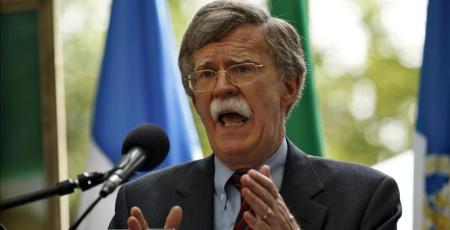
Bolton: Will Obama Apologize For US Destroyer ‘Getting in Way’ of Russian Airplane?

April 15, 2016

Bolton: Will Obama Apologize For US Destroyer ‘Getting in Way’ of Russian Airplane? TownhallCortney O’Brien, April 15, 2016

Bolton

Lt. Col. Ralph Peters (Ret.) was very blunt in his assessment of the incident in the Baltic Sea on Monday, when a Russian warplane buzzed awfully close to a U.S. Navy destroyer.

“I’m very, very worried that in the closing months of Obama’s presidency we’re gonna see American blood,” Peters said in an interview with Fox News.

It was a bold prediction, but one that former Ambassador John Bolton agrees with. During his own conversation on Fox Friday morning, Bolton predicted “there’s more” Russian aggression to come.

“If that airplane had caught a gust of wind, it could have been right up against that destroyer,” the ambassador explained.

Russia’s latest stint in the Baltic Sea signals to our NATO allies that the U.S. can’t take care of itself, he continued.

“I just hope Obama doesn’t apologize for destroyer getting in the way of that airplane.”

Based on the White House’s typical response to foreign intimidation, Bolton’s question is a fair one. Before the Russian airplane flew near our destroyer, Iran captured 10 of our American sailors and celebrated it. Secretary of State John Kerry actually thanked Iran for their compassion during the ordeal. President Obama, meanwhile, continues to defend his nuclear deal with the nation, which has basically given Iran a pass for its bad behavior. A Middle East expert who is very critical of that agreement argues it has severely damaged America’s image as a superpower.

Obama is also no stranger to apologies. He has asked for forgiveness on America’s behalf in about every corner of the globe, it seems. In Argentina last month, he noted the “early dark days” of the CIA and our country’s human rights violations. He continued to express regret over America’s human rights record in Cuba. Yes, Castros’ Cuba, where free speech is suppressed and punished.

Our adversaries are taking advantage of our president’s shows of weakness.

Iran will continue to intimidate us “indefinitely,” Bolton argued, for they know that under Obama, “they will face no consequences.”

A new report indicates that an Iranian general is in Moscow this week to discuss military options with President Putin.

Iran is “going to push the envelope” and “they’ll succeed,” Bolton warned.

Putin Praises Obama’s “Strength”

April 15, 2016

Putin Praises Obama’s “Strength” Front Page Magazine, Daniel Greenfield, April 14, 2016

obama-medvedev-mar-2012-2

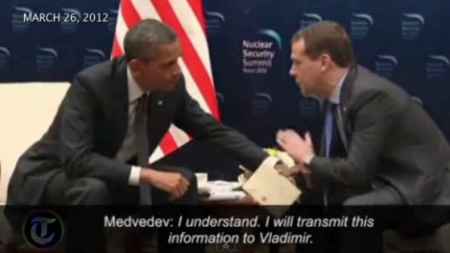
This is A+ trolling. Count on a KGB guy to take Obama’s “weakness is strength” meme and turn it around on him.

“That’s very good that my colleague possesses the courage to make such statements.”

“Barack, as a senator, criticized the administration for its actions in Iraq. But, as president, he allowed a mistake to happen, he has said it himself, in Libya. Not everyone can do that. They snap at him from different sides over that but only a strong man could have done that.”

A very strong man. Let’s get some context on that.

Obama dismissed the notion that Putin was acting “out of strength,” telling the San Diego station the annexation of Crimea was an action taken “out of weakness.”

So Putin turned Obama’s contention that weakness is strength and strength is weakness by praising his weakness as strength. Does Putin mean this? This is a regime whose propagandists depict Obama on toilet paper. But this throws in a dose of mockery and some trolling that Obama is unlikely to get as he’s eating up the flattery.

Now if Putin does encounter a strong US president, he’ll call him weak.

When asked whether he regretted Obama’s leaving office, Putin said, “We all go sooner or later, probably. It’s pointless to regret.”

I bet.

Russian Magazine: Russia’s Air Force In Syria Is Winning The Battle For Assad

February 17, 2016

Russian Magazine: Russia’s Air Force In Syria Is Winning The Battle For Assad, MEMRI, February 17, 2016

(Please see also, Moscow on the Tigris: Russia Joins the Terror Nexus:

While an exhausted and burned out United States wishes international migraines like the Syrian civil war would just go away, Russia is energized by the prospect of filling the vacuum and thus once again playing a major role on the world stage. Aggressively intervening on behalf of his ally in Damascus, President Bashar al-Assad, and projecting force well beyond even the frontier states in his“near abroad,” Vladimir Putin audaciously aims to change political outcomes in a region that has been out of his country’s sphere of influence for a generation.

— DM)

Recently, the Russian campaign in Syria reached its 100th day. An article in Expert Online, the website of the influential Russian analytical magazine Expert, reviews the state of the Syria war, analyzing the activities on various fronts as well as the Russian involvement. The article, by journalist Pyetr Skorobogatyj, states that, with Russia’s help, the Syrian army is advancing slowly but surely. It stresses that the operation in Syria is not a substantial financial burden for Russia, and that it benefits Russia in many ways – including by allowing it to train pilots, test the performance of various weapons, and target Russian-speaking militants who are fighting in Syria. Most significantly, it allows Russia to establish a permanent presence in the Middle East that has an impact on all the region’s countries.

The article then reviews the military situation in Syria region by region. Focusing first on the north, it stresses that the Kurdish forces there are making headway against ISIS and are laying down the foundations for what may eventually become a Kurdish autonomy or even an independent Kurdish state. The main loser, says the article, is Turkey, who is powerless to stop these developments from unfolding.

The article states further that Russia, using its S-400 missiles, has effectively set up a no-fly-zone in the north of Syria, thus enabling the regime forces to make substantial achievements against the rebels, especially in the Latakia area. It adds that the U.S., too, is planning to establish a military base in northeast Syria, in the Malikia area.

Moving to the southern region, the article states that the stalemate between the sides there – namely the regime forces and rebel groups backed by Jordan – has ended, since Jordan has ordered these forces to stop attacking Assad’s troops. In Damascus, too, the regime is slowly flushing out the rebels, street by street and building by building. As for eastern Syria, the article concedes that ISIS still maintains a strong presence there and will be difficult to defeat.

The following are excerpts from the article.[1]

 “The Air Campaign Is Not Expensive For Moscow, And It Allows Russia To Train Pilots And Test Different Types Of Weapons”

“As the Russian campaign recently reached its 100th day,[2] [Russia’s] main goal appears to be the use of military power to force peace on the ‘rational’ [i.e., non-jihadist] rebel groups. There are a number of small [rebel] groups which have either joined Assad’s military or have stayed independent but coordinate their activities with the Syrian army. [Russia’s] largest partner [apart from the Syrian army] is the Syrian Democratic Army [SDA], a Sunni popular militia which is fighting in the north [of the country] alongside the Kurds and government troops. The Russian Ministry of Defense has confirmed that Russia supports the SDA with weapons, ammunition and airstrikes. ‘For its part, the patriotic opposition [i.e. the SDA] coordinates its military objectives with the Russian aviation group,’ noted Lt. General Sergei Rudskoy, Chief of Main Operations Management in the Russian Army General Staff…

“The joint military campaign of the Russian Air Force and Syrian troops seems to be [progressing] slowly but surely. [The slow pace] is due to the broad spectrum of military goals which must be met, including pressure on all ‘factions’ in order to separate [potential] ‘partners’ from ‘enemies,’ as well as the necessity to return as much territory as possible to the Syrian government’s control, in order to enable it to negotiate from a position of strength about the country’s future. In addition, all the battle fronts seem chaotic, with many parallel ‘seething cauldrons’… and with weather conditions are getting worse… All of these factors together make Russian air operations difficult, especially during the winter period. This week the ‘bad guys’ [i.e. ISIS] used the cover of a sandstorm [which hampered Russian air activity] to mount a major offensive on Deir Al-Zor, a Syrian enclave in the desert. This action resulted in a major defeat for the Syrian side. As prevailing weather conditions worsen, the… intensity of the military campaign will decrease…

“Notwithstanding, during the first 100 days of Russian Air Force and Navy operations, 217 villages and towns were retaken, and 1000 sq. km. of territory. The Russian-Syrian coalition has no need to hurry. The air campaign is not expensive for Moscow, and it allows Russia to train pilots and to test the battle performance of different types of weapons. These benefits are in addition to the political gains and to the main goal, which is to eliminate Russian-speaking fighters in theaters far away from Russia’s borders.

“In addition, thanks to the new Russian air force base in the [the Syrian city of] Latakia, Moscow has established a permanent presence in the region, controlling a very important logistic hub. This modern military base (equipped with Iskander[3] and S-400[4] missiles)… changes the military and political situation in Iraq, Iran, Israel, the U.S… and, of course, Turkey”…”

“Russia Has Set Up A No-Fly Zone Using Its S-400 Surface-To-Air Missile System”

“[Meanwhile] the goals of the main participants in the Syrian battle have become clear. In the north of Syria… the Kurds are winning. They are finally receiving extensive military support from the U.S. and covert support from Russia. They are carrying out offensive operations against ISIS and expanding their territory, which might become a future Kurdish state or an autonomous region within Syria, depending on the final agreement… The main loser is Turkey, who is unpredictable, irresponsible and unable to keep agreements. Currently, [Turkish President Recep Tayyip] Erdogan can only look on as the Kurdish enclave continually grows stronger. [The Turkish President] can initiate military operations only on his own territory…

“The geopolitical value of northern Syria is understood by all parties. Russia has set up a no-fly zone [there] using its S-400 surface-to-air missile system… [while] Syria is strengthening its Al-Bab air base with Russian military advisors and the S-300[5] missile system. The Americans are not napping either, and plan to set up a military base in Malikia in north-east Syria… This will allow the U.S to carry out an independent policy without having to depend on the Kurdish state which is being established…

“The Syrian army, aided by Hizbullah’s brigades, is doing very well in the Latakia governorate. The map [below] clearly shows the movement of the fighting forces over the last few months. The dotted red line represents the front on October 7, 2015. In the first half of January 2016, government troops finally showed fighting ability against the Islamist stronghold of Salma… It was the first time that Russian military experts actively took part in the campaign, probably coordinating the attack on Salma. Support from Russian planes in the northern Latakia province allows the Syrian army to continue its advance at full speed…”
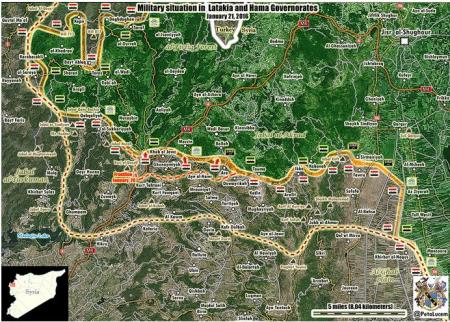
26798Military situation in Latakia and Hama areas, January 21, 2016

In The South, Jordan-Backed Rebels Have Been Ordered To Stop Attacking; In Damascus, The Government Is Flushing Out Islamists; In The East, ISIS Still Holds A Significant Area

“In the Dera province in the south, the opposing sides had [previously] agreed to maintain the status quo. Damascus was avoiding a conflict with Israel as well as with Jordan, which openly sponsored tribal forces and Islamist brigades… [Today, however,] the tactic of constant pressure [by Syrian regime troops on these forces and brigades] is producing results. The Military Operations Command [MOC] in Amman… which is coordinating rebel activities in southern Syria, has ordered [the forces it sponsors] to stop attacking [Syrian] government forces… Jordan’s logic is very simple… Syrian refugees in Jordan now total about 30% of the population, the same number as the Palestinians living in Jordan… so Jordan prefers to try to stabilize the situation in Syria rather than dream about cutting off Syria’s southern territories from the rest of the country. On the other hand, Damascus has begun to raise the issue of Israeli[-sponsored] rebels occupying the [Syrian] Golan Heights.

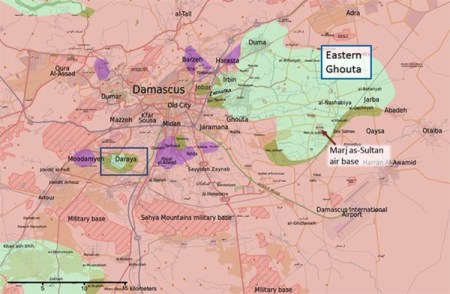
“In the Syrian capital, government troops are continuing to flush out Islamists and ‘bad guys’ from the city. The score is being kept not by counting streets retaken, but by counting buildings… The progress in the Damascus area is noticeable only when viewed over a long period of time. Below is a map showing the balance of forces in 2013, and beneath it a map showing the balance of forces in 2015.
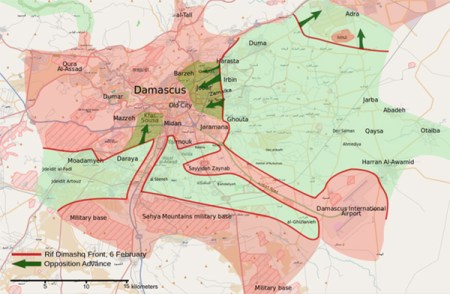
26799Damascus area in 2013
26800Damascus’ area in 2015

“In addition, peace talks between the government and some rebel groups are now underway. Just recently, an agreement was made with a rebel brigade in the Al-Qadam suburb [in Damascus]. Some militants who were disarmed were moved to Raqqa and Idlib, while almost 1,500 others agreed to switch to Assad’s side…

“In spite of the relative success of government troops, ISIS still holds a significant area in the eastern part of Syria… The [ISIS] Caliphate is well-entrenched in the area it controls, with a strong force and command structure, and is not going to withdraw easily.”


Endnotes:

[1] Expert.ru, January, 22, 2016.

[2] The Russian campaign in Syria started on September 30, 2015.

[3] A Russia-manufactured portable short-range ballistic missile system; NATO designation name: SS-26 Stone.

[4] A Russia-manufactured anti-aircraft weapons system; NATO designation name: SA-21 Growler.

[5] A Russia-manufactured long range surface-to-air missile system;  NATO designation name: SA-10 Grumble.
Obama Managed to Make Syria a Lot Messier

February 17, 2016

Obama Managed to Make Syria a Lot Messier, Front Page Magazine, Daniel Greenfield, February 16, 2016

obama-wears-tan-suit-149481242256_6

Obama and Kerry are frantically touting a Syria ceasefire as the solution to the conflict. In reality, they’ve made the conflict much worse.

While Hillary Clinton was talking up a No Fly Zone, Russia entered Syria and enforced its own de facto No Fly Zone against the United States. Their bombing campaign has boosted the Iran-Assad-Hezbollah axis while beating back Sunni militias backed by Turkey and Saudi Arabia.

The Turks responded by shooting down a Russian jet. Obama threw in more anti-tank missiles. But a sustained bombing campaign does pay off. It’s what Obama refused to do against ISIS. But the Russians had no problem hitting Sunni opposition forces with one. They also don’t care about collateral damage. And while Obama and his proxies bleat about Russia being isolated and doomed, Putin set the terms of the proposed peace deal.

Obama’s willingness to switch to the side of the Shiite axis and accept them however only worsened the conflict for reasons ridiculously obvious to everyone outside the White House and the media.

The Saudis and Turkey are not about to lose this fight with Iran. Turkey is also worried about Kurdish gains. So they’re going to send ground troops to “fight ISIS”. Just like Iran and Russia are “fighting ISIS”.

Even in the best case scenario, this means the effective end of an independent Syria as it’s carved up under a Russian-Iranian-Turkish, etc occupation. Since Syria never really existed, that’s not too great of a loss. But in practice, it means that Syria will be divided into terrorist training camps for Shiite and Sunni terrorists, backed by friendly troops and jets from their allied states, which will sometimes also take shots at each other.

This may end up destroying ISIS by territorially squeezing it out. Or it may just escalate the already messy conflict and take it to a new level.

It’s hard to say to what extent this will represent a threat to the United States, aside from the general perception of weakness and impotence inflicted by Obama’s failed foreign policy. But if the conflict escalates, it could have all sorts of destructive implications. And obviously, Israel’s situation becomes more problematic. At the very least, we’re going to see Syria being turned into an even bigger terrorist production factory than it already was. And those terrorists won’t just stay in Syria, as we’ve already seen.

And the United States is likely to be dragged into this mess in a variety of ways from providing aid on the ground to peacekeeping to taking in refugees. And considering Turkey’s inappropriate place in NATO, we might end up even being dragged into an actual war.

That’s what Obama’s ceasefire looks like.

Humor+ | Laugh. It’s the Best Medicine. Then get serious again.

February 11, 2016

Laugh. It’s the Best Medicine. Then get serious again. Dan Miller’s Blog, February 11, 2016

(The views expressed in this post are mine and do not necessarily reflect those of Warsclerotic or its other editors. — DM)

Obama and Hillary are evil and some Republican candidates are bad. Stay mad, but laugh occasionally because it’s refreshing. Then, let’s take America back.

Sometimes life is hard.

Yeah, but wouldn’t it be terrible if everything always happened just as we want it to?

This is pretty much how government really works. They just aren’t this good as telling us.

Jimmy Buffett manages to offend just about everyone while being funny as he does it. That’s good!

It’s about time for a drink.


OK, it’s time to get serious again.

Obama said, “You didn’t build that.” Yes we did; He didn’t, and He keeps trying to tear her down and to rebuild her in His own image.

https://www.youtube.com/watch?v=ArgMK2kAjzw

Now she’s ours. We intend to keep her and to make her as productive, strong and hopeful as she once was. Xenophobic? Damn right.

We can take her back. Will we? You betcha!

Saudi Arabia stews in policy hell

January 4, 2016

Saudi Arabia stews in policy hell, Asia Times, January 3, 2016

Last week’s mass executions in Saudi Arabia suggest panic at the highest level of the monarchy. The action is without precedent, even by the grim standards of Saudi repression. In 1980 Riyadh killed 63 jihadists who had attacked the Grand Mosque of Mecca, but that was fresh after the event. Most of the 47 prisoners shot and beheaded on Jan. 2 had sat in Saudi jails for a decade. The decision to kill the prominent Shia cleric Nimr al-Nimr, the most prominent spokesman for restive Saudi Shia Muslims in Eastern Province, betrays fear of subversion with Iranian sponsorship.

Saudi-beheading22-300x183Official Saudi beheading

Why kill them all now? It is very hard to evaluate the scale of internal threats to the Saudi monarchy, but the broader context for its concern is clear: Saudi Arabia finds itself isolated, abandoned by its longstanding American ally, at odds with China, and pressured by Russia’s sudden preeminence in the region. The Saudi-backed Army of Conquest in Syria seems to be crumbling under Russian attack. The Saudi intervention in Yemen against Iran-backed Houthi rebels has gone poorly. And its Turkish ally-of-convenience is consumed by a low-level civil war. Nothing has gone right for Riyadh.

Worst of all, the collapse of Saudi oil revenues threatens to exhaust the kingdom’s $700 billion in financial reserves within five years, according to an October estimate by the International Monetary Fund (as I discussed here). The House of Saud relies on subsidies to buy the loyalty of the vast majority of its subjects, and its reduced spending power is the biggest threat to its rule. Last week Riyadh cut subsidies for water, electricity and gasoline. The timing of the executions may be more than coincidence: the royal family’s capacity to buy popular support is eroding just as its regional security policy has fallen apart.

For decades, Riyadh has presented itself as an ally of the West and a force for stability in the region, while providing financial support for Wahhabi fundamentalism around the world. China has been the kingdom’s largest customer as well as a provider of sophisticated weapons, including surface-to-surface missiles. But China also has lost patience with the monarchy’s support for Wahhabi Islamists in China and bordering countries.

According to a senior Chinese analyst, the Saudis are the main source of funding for Islamist madrassas in Western China, where the “East Turkistan Independence Movement” has launched several large-scale terror attacks. Although the Saudi government has reassured Beijing that it does not support the homegrown terrorists, it either can’t or won’t stop some members of the royal family from channeling funds to the local jihadis through informal financial channels. “Our biggest worry in the Middle East isn’t oil—it’s Saudi Arabia,” the analyst said.

China’s Muslims—mainly Uyghurs in Western China who speak a Turkish dialect—are Sunni rather than Shia.  Like Russia, China does not have to worry about Iranian agitation among Shia jihadis, and tends to prefer Iran to the Sunni powers. As a matter of form, Beijing wants to appear even-handed in its dealings with Iran and Saudi Arabia, for example in recent contacts between their respective navies. Chinese analysts emphasize that Beijing has sold weapons to both—more in absolute to terms to Iran but more sophisticated weapons to the Saudis.

More pertinent than public diplomacy, though, is where China is buying its oil.

Nonetheless, China’s oil import data show a significant shift away from Saudi Arabia towards Russia and Oman (which China considers part of the Iranian sphere of influence). Russia’s oil exports to China have grown fourfold since 2010 while Saudi exports have stagnated. Given the world oil glut, China can pick and choose its suppliers, and it is hard to avoid the inference that Beijing is buying more from Russia for strategic reasons.  According to Russian sources, China also has allowed Russian oil companies to delay physical delivery of oil due under existing contracts, permitting Russia to sell the oil on the open market for cash—the equivalent of a cash loan to Russia.

saudioil1-768x558

China’s interests in Syria coincide with Russia’s. Both have reason to fear the growth of ISIS as a magnet for their own jihadis.  Thousands of Chinese Uyghurs make their way into Southeast Asia via the porous southern border of Yunnan province, with financial assistance from Saudi supporters and logistical support—including passports—from local Turkish consulates. Chinese Uyghurs were implicated in the bombing of Bangkok’s Erawan Temple last August, and have linked up with ISIS supporters as far south as Indonesia. Turkey reported last month that most jihadists crossing its border into Syria to join ISIS are Chinese Muslims.

With Kurdish and allied forces gaining control of Syria’s border with Turkey, aided by Russian air support, Chinese Uyghurs may lose access to Syria. Late in December Kurdish forces crossed to the western bank of the Euphrates River and are in position to link up with Kurdish militias in northwestern Syria, eliminating Turkish hopes of a “safe zone” controlled by Turkey on the southern side of the Syrian border.  For its part, Turkey risks paralysis from a low-intensity civil war with its Kurdish population. The Kurdish-majority southeast of the country is under siege and fighting has spread to Turkey’s western provinces.

It’s an ill wind that blows nobody good, and China seems hopeful that it has contained its jihadist problem. On New Year’s Day, the Communist Party leader in China’s Xinjiang province declared that “the atmosphere for religious extremism has weakened markedly.”

China is extremely reluctant to commit military forces to overseas conflicts, and its military is ill-prepared to do so even if Beijing were to change its mind. The People’s Liberation Army lacks ground attack aircraft like the two squadrons of Russian Su-24 and Su-25 deployed in Syria. Nonetheless, Beijing is happy that Russia is reducing ISIS forces in Syria as well as Saudi- and Turkish-backed Sunni Islamists like the Army of Conquest.

It will be hard to evaluate the success of Russian bombing in Syria until the dust settles, but there is a great deal of dust in the air. According to Israeli sources, Russia is dumping vast amounts of its Cold War inventory of dumb bombs on Syrian Sunnis with devastating effect. The Russian bombing campaign makes up in volume what it lacks in sophistication, killing far more civilians than Western militaries would tolerate, but changing the situation on the ground. That explains Russian President Vladimir Putin’s newfound popularity among world leaders. He is doing their dirty work.

Saudi Arabia’s proxies in Syria are in trouble. Early in 2015, the Army of Conquest (Jaish al-Fateh), a coalition of al-Qaida and other Sunni Islamists backed by the Saudis, Turks and Qataris, had driven the Syrian army out of several key positions in Northwest Syria, threatening the Assad regime’s core Alawite heartland. The coalition began breaking up in November, however, and the Syrian Army recently retook several villages it had lost to the Army of Conquest. One of the Army of Conquest’s constituent militias, Failaq al-Sham, announced Jan. 3 that it was leaving the coalition to defend Aleppo against regime forces reinforced by Russia.

Everything seems to have gone wrong at once for Riyadh. The only consolation the monarchy has under the circumstances is that its nemesis Iran also is suffering from the collapse of oil revenues and the attrition of war. Iran began withdrawing its Revolutionary Guard forces from Syria in December, largely due to high casualties. The high cost of maintaining the war effort as Iran’s finances implode also may have been a factor. Iran’s Lebanese Shia proxy, Hezbollah, has suffered extremely high casualties, virtually neutralizing its whole first echelon of combat troops. And Russia has shown no interest in interfering with Israeli air strikes against Hezbollah.

The oil price collapse turns the competition between Saudi Arabia and Iran into a race to the bottom. But the monarchy’s panicked response to its many setbacks of the past several months raises a difficult question. In the past, the West did what it could to prop up the Saudi royal family as a pillar of stability in the region, despite the Saudis’ support for jihadi terrorism. Soon the West may not be able to keep the House of Saud in power whether it wants to or not.

Iran provokes the world as Obama does nothing

December 22, 2015

Iran provokes the world as Obama does nothing, Washington Post, The Editorial Board, December 20, 2015

(The interesting thing about this article is that it states the opinion of the Washington Post Editorial Board. — DM)

IRAN IS following through on the nuclear deal it struck with a U.S.-led coalition in an utterly predictable way: It is racing to fulfill those parts of the accord that will allow it to collect $100 billion in frozen funds and end sanctions on its oil exports and banking system, while expanding its belligerent and illegal activities in other areas — and daring the West to respond.

Unfortunately, the Obama administration’s response to these provocations has also been familiar. It is doing its best to downplay them — and thereby encouraging Tehran to press for still-greater advantage.

We’ve pointed out how the regime of Ayatollah Ali Khamenei has unjustly sentenced Post correspondent Jason Rezaian to prison and arrested two businessmen with U.S. citizenship or residence since signing the nuclear accord. There have been no penalties for those outrageous violations of human rights. Now a United Nations panel has determined that Iran test-fired a nuclear-capable missile on Oct. 10 with a range of at least 600 miles, in violation of a U.N. resolution that prohibits such launches. Moreover, it appears likely that a second missile launch occurred on Nov. 21, also in violation of Security Council Resolution 1929.

The U.S. response? “We are now actively considering the appropriate consequences to that launch in October,” State Department official Stephen Mull testified at a Senate committee hearing Thursday. In other words, there have so far been none — other than a speech by the U.S. ambassador to the United Nations blaming the Security Council for the lack of action. As for the second missile launch, the administration claims to be investigating it, though it likely has in its possession the intelligence necessary to make a judgment.

It’s not hard to guess the reasons for this fecklessness. President Obama is reluctant to do anything that might derail the nuclear deal before Iran carries out its commitments, including uninstalling thousands of centrifuges and diluting or removing tons of enriched uranium. The same logic prompted him to tolerate Iran’s malign interventions in Syria, Yemen and elsewhere, along with the arrest of Mr. Rezaian, while the pact was under negotiation.

U.S. officials argue that Iran’s nonnuclear violations make it all the more important that the nuclear deal be implemented. But that ignores the clear connections between the missile launches and Tehran’s ambitions to become a nuclear power. The only practical military purpose of the missiles the regime is testing is to carry atomic warheads. And while missile launches are not prohibited by the nuclear pact itself, the separate resolution banning them remains in effect until the deal is implemented, after which a new resolution takes effect that calls on Iran not to develop such missiles for eight years.

By flouting the U.N. resolutions, Iran is clearly testing the will of the United States and its allies to enforce the overall regime limiting its nuclear ambitions. If there is no serious response, it will press the boundaries in other areas — such as the inspection regime. It will take maximum advantage of Mr. Obama’s fear of undoing a legacy achievement, unless and until its bluff is called. That’s why the administration would be wise to take firm action now in response to the missile tests rather than trying to sweep them under the carpet.

The Pentagon’s Groveling Apology to China for Flying Near a Contested Island

December 21, 2015

The Pentagon’s Groveling Apology to China for Flying Near a Contested Island, National Review, Tom Rogan, December 21, 2015

(Will Obama ever go away? If and when he does, will his replacement be a comparable little man upon the stair who isn’t there?

Last night I saw upon the stair,
A little man who wasn’t there,
He wasn’t there again today
Oh, how I wish he’d go away.. — William Hughes Mearns (1875–1965)

— DM)

On November 13, President Obama claimed that ISIS was “contained.” One day later, ISIS painted bloody red lines on Paris streets. The credibility of American foreign policy took another big hit.

Then came Saturday’s Wall Street Journal report that last week, “an American B-52 bomber on a routine mission over the South China Sea unintentionally flew within two nautical miles of an artificial island [Cuarteron] built by China.” This seemed like good news, suggesting that Obama was challenging — under cover of an “unintentional” foray — China’s imperial project in the East China and South China Seas. That would be welcome, because China’s project intends to subjugate U.S. allies, seize lucrative energy reserves, and dominate crucial trade routes. And Obama seems to realize this. At November’s APEC summit, he offered “shared commitment to the security of the waters of this region and to freedom of navigation.” In October, President Obama sent an American destroyer within twelve miles of another artificial Chinese island.

My hopes in the president were misplaced.

First off, it’s telling that the White House hasn’t commented on the B-52 report. This is the administration’s go-to response for a story they want to go away (if the administration likes the story, we get leaks and Hollywood movies).

But the Pentagon’s response has been equally telling. Instead of broadcasting that America will reject China’s claims in the East China and South China Seas, and instead of asserting that American forces will of course operate in international territory, the Pentagon groveled before China, offering apologies. The Journal reports that the B-52 aircrew is being investigated and that the Pentagon is hinting that “bad weather” led the crew to make a mistake. It’s Scapegoating 101.

Unfortunately, this supplication to China is also Strategic Incompetence 101. First, as evidenced by this situation, if the U.S. is unwilling to operate over international waters without qualification, those waters become Chinese. This yields the strategic initiative to China. It also contradicts the B-52 deployment in the first place. Assuming that the B-52s were flown from Guam (the closest squadron deployment), this must have been a mission focused on China. In part, that’s because B-52s have advanced oceanic-surveillance capabilities. But with Guam a significant distance away from the South China Sea — 2,200 miles — this mission clearly wasn’t for flight hours.

After all, while China carves its empire, Obama continues to claim that his China policy is successful. This success is proven, he says, by China’s pledge to try to cap its carbon emissions by 2030. It’s an unbinding, unenforceable pledge from a socialist kleptocracy.

Nevertheless, the true absurdity of Obama’s delusion is clear only in the light of history. Imagine if President Truman had allowed Stalin to seize Berlin in 1948 in return for Stalin’s pledge to try to hold free elections in 1964. On the contrary, consider how President Truman actually dealt with Stalin during the 1948–1949 Berlin crisis (in which Stalin blockaded Berlin’s western zones). Vastly outgunning U.S. forces in Germany, the Soviets threatened war. But when the question arose of whether or not the United States was going to stay in Berlin, Truman declared: “No discussion . . . we are going to stay — period.” He launched the Berlin airlift and put his faith in American deterrent power and American values. And he won the day.

Of course, today, many would castigate Truman’s blunt speak as gung-ho idiocy, unbefitting of “smart power” and nuanced American leadership in a complex world. But Truman knew that the conduct of an effective statesman isn’t just about dealing with the moment, but also about anticipating the horizon. General Clay, commanding U.S. forces in Berlin during the crisis, also understood this truth. Consider Clay’s cable to Washington at the start of the crisis: “We are convinced that our remaining in Berlin is essential to our prestige in Germany and in Europe. Whether for good or bad, it has become a symbol of the American intent.”

Truman knew that if the United States abandoned the small territory of Berlin, that action would eviscerate American credibility around the world and the Soviets would gain the strategic upper hand in the Cold War. Allies would doubt America’s word, and our adversaries would know America’s weakness. Sadly, last week’s B-52 incident proves that President Obama does not grasp that purpose and credibility are essential components of an effective foreign policy. And American enemies are taking advantage: In 2016, expect historic foes China and Russia to strengthen their alliance against us.


Cartoon of the day

October 15, 2015

H/t Power Line

Leading-from-Behind-copy

“Russia” calling “another US’ bad bluff”!

October 15, 2015

“Russia” calling “another US’ bad bluff”! Zero Point via You Tube, October 14, 2015


https://www.youtube.com/watch?v=jwEbT-ti3Xw


According to the blurb below the video,

The US has now thrown in the towel on the ill-fated strategy of training Syrian fighters and sending them into battle only to be captured and killed by other Syrian fighters who the US also trained..

The Pentagon’s effort to recruit 5,400 properly “vetted” anti-ISIS rebels by the end of the year ended in tears when the entire world laughed until it cried after word got out that only “four or five” of these fighters were actually still around. The rest are apparently either captured, killed, lost in the desert, or fighting for someone else..

This has cost the US taxpayer somewhere in the neighborhood of $40 million over the last six months..
Because this latest program was such a public embarrassment, the Pentagon had to come up with a new idea to assist Syria’s “freedom fighters” now that they are fleeing under bombardment by the Russian air force only to be cut down by Hezbollah..

The newest plan: helicopter ammo. No, really. The US has now resorted to dropping “tons” of ammo into the middle of nowhere and hoping the “right” people find it..

Here’s CNN:

U.S. military cargo planes “gave” 50 tons of ammunition to rebel groups overnight in northern Syria, using an air drop of 112 pallets as the first step in the Obama Administration’s urgent effort to find new ways to support those groups..

Details of the air mission over Syria were confirmed by a U.S. official not authorized to speak publicly because the details have not yet been formally announced..

C-17s, accompanied by fighter escort aircraft, dropped small arms ammunition and other items like hand grenades in Hasakah province in northern Syria to a coalition of rebels groups vetted by the US, known as the Syrian Arab Coalition..

And here’s a bit more color from GOP mouthpiece Fox News:

The ammunition originally was intended for the U.S. military’s “train and equip” mission, the official said. But that program was canceled last week..

“So now we are more focused on the ‘E’ [equip] part of the T&E [train & equip],” said the official, who described equipping Syrian Arabs as the focus of the new strategy against ISIS..

The Defense Department announced Friday that it was overhauling the mission to aid Syrian rebel fighters. After the program fell far short of its goals for recruiting and training Syrian fighters, the DOD said it would focus instead on providing “equipment packages and weapons to a select group of vetted leaders and their units so that over time they can make a concerted push into territory still controlled by ISIL”..

The shift also comes as Russia continues to launch airstrikes in Syria, causing tension with the U.S. amid suspicions Moscow is only trying to prop up Bashar Assad..

Col. Steve Warren, spokesman for the U.S.-led anti-ISIS coalition, confirmed that coalition forces conducted the airdrop..

“The aircraft delivery includes small arms ammunition to resupply counter-ISIL ground forces so that they can continue operations against ISIL. All aircraft exited the drop area safely,” he said in a statement. All pallets successfully were recovered by friendly forces, a U.S. official said..

The US just paradropped 50 tons of ammo on pallets into the most dangerous place on the face of the planet with no way of ensuring that it falls into the “right” hands (it goes without saying that the term “right” is meaningless there). Meanwhile, the Russians are dropping bombs on the same extremists who are set to receive the guns the US is dropping..

Of course if it does somehow fall into the “wrong” hands, it wouldn’t be the first time (see Mosul and recall the $500 billion worth of weapons Washington “misplaced” in Yemen) and as we said a few days ago, this is at least great news for the military-industrial complex. It means more “terrorist attacks” on U.S. “friends and allies”, and perhaps even on U.S. soil – all courtesy of the US government supplying the weapons – are imminent…