Posted tagged ‘Obama’s affinity for Iran’

Op-Ed: Chaos and 2nd Cold War, Part II: Israel’s Nuclear Strategy

October 11, 2015

Op-Ed: Chaos and 2nd Cold War, Part II: Israel’s Nuclear Strategy, Israel National News, Prof. Louis René Beres, October 11, 2015

(Part I is available here. — DM)

Israel should now be calculating the exact extent or subtlety with which it should consider communicating key portions of its nuclear posture and positions. Naturally, Israel should never reveal any too-specific information about its nuclear strategy, its nuclear hardening, or even its nuclear yield-related capabilities. Still, sometimes, the duty of finely-honed intelligence services should not be to maximize strategic secrecy, but rather, to carefully “share” certain bits of pertinent information.

**********************************

How will Russia respond to any ramped up American uses of force in the Middle East, and, more plausibly, vice-versa?  One must assume that Jerusalem is already asking these key questions, and even wondering whether, in part, greater mutualities of interest could sometime exist with Moscow than with Washington.

To wit, Prime Minister Benjamin Netanyahu met with Russia’s President Vladimir Putin in September 2015. Among other things, the Israeli leader must  be calculating: 1)Will the Obama Administration’s incoherent retreat from most of the Middle East point toward a more permanent United States detachment from the region; and 2) If it does, what other major powers are apt to fill the resultant vacuum? Just as importantly, and as an obvious corollary to (2), above, the prime minister should be inquiring: “How will the still-emerging Cold War II axis of conflict impact America’s pertinent foreign policy decisions?”

There are some additional ironies yet to be noted. Almost certainly, ISIS, unless it is first crushed by U.S. and/or Russian-assisted counter-measures, will plan to march westward across Jordan, ultimately winding up at the borders of West Bank (Judea/Samaria). There, ISIS Jihadists could likely make fast work of any still-posted Hamas and Fatah forces, in effect, taking over what might once have become “Palestine.” In this now fully imaginable scenario, the most serious impediment to Palestinian statehood is not Israel, but rather a murderous band of Sunni Arab terrorists.[16]

What about the larger picture of “Cold War II?” Israeli defense planners will need to factor into their suitably nuanced calculations the dramatically changing relationship between Washington and Moscow. During “Cold War I,” much of America’s support for the Jewish State had its most fundamental origins in a perceived need to compete successfully in the Middle East with the then Soviet Union. In the progressive development of “Cold War II,” Jerusalem will need to carefully re-calculate whether a similar “bipolar” dynamic is once again underway, and whether the Russian Federation might, this time around, identify certain strategic benefits to favoring Israel in regional geo-politics.

In all such strategic matters, once Israel had systematically sorted through the probable impact of emerging “superpower” involvements in the Middle East, Jerusalem would need to reassess its historic “bomb in the basement.” Conventional wisdom, of course, has routinely pointed in a fundamentally different policy direction. Still, this “wisdom” assumes that credible nuclear deterrence is simply an automatic result of  physically holding nuclear weapons. By the logic of this too-simplistic argument, removing Israel’s nuclear bomb from the “basement” would only elicit new waves of global condemnation, and would likely do so without returning any commensurate security benefits to Jerusalem.

Scholars know, for good reason, that the conventional wisdom is often unwise. Looking ahead, the strategic issues facing Israel are not at all uncomplicated or straightforward.  Moreover, in the immutably arcane world of Israeli nuclear deterrence, it can never really be adequate that enemy states merely acknowledge the Jewish State’s nuclear status. Rather, it is also important that these states should be able to believe that Israel holds usable nuclear weapons, and that Jerusalem/Tel-Aviv would be willing to employ these usable weapons in certain clear, and situationally recognizable, circumstances.

Current instabilities in the Middle East will underscore several good reasons to doubt that Israel could ever benefit from any stubborn continuance of deliberate nuclear ambiguity. It would seem, too, from certain apparent developments already taking place within Mr. Netanyahu’s “inner cabinet,” that portions of Israel’s delegated leadership must now more fully understand the bases of any such informed skepticism.

In essence, Israel is imperiled by compounding and inter-related existential threats that justify its fundamental nuclear posture, and that require a correspondingly purposeful strategic doctrine. This basic need exists well beyond any reasonable doubt. Without such weapons and doctrine, Israel could not expectedly survive over time, especially if certain neighboring regimes, amid expanding chaos,  should soon become more adversarial, more Jihadist, and/or less risk-averse.

Incontestably, a purposeful nuclear doctrine could prove increasingly vital to coping with various more-or-less predictable strategic scenarios for Israel, that is, those believable narratives requiring preemptive action, and/or an appropriate retaliation.

Typically, military doctrine carefully describes how national forces should fight in various combat operations. The literal definition of “doctrine” derives from Middle English, from the Latin doctrina, meaning teaching, learning, andinstruction. Though generally unrecognized, the full importance of doctrine lies not only in the several ways that it can animate and unify military forces, but also in the uniquely particular fashion that it can transmit certain desired “messages.”

In other words, doctrine can serve an increasingly imperiled  state as a critical form of communication, one directed to its friends, and also to its foes.

Israel can benefit from just such broadened understandings of doctrine. The principal security risks now facing Israel are really more specific than general or generic. This is because Israel’s extant adversaries in the region will likely be joined, at some point, by: (1) a new Arab state of “Palestine;” and/or by (2) a newly-nuclear Iran. It is also because of the evidently rekindled global spark of “bipolar” or “superpower” adversity, and the somewhat corollary insertion of additional American military forces to combat certain new configurations of Jihadi terror.

For Israel, merely having nuclear weapons, even when fully recognized in broad outline by enemy states, can never automatically ensure successful deterrence. In this connection, although starkly counter-intuitive, an appropriately selective and thoughtful end to deliberate ambiguity could improve the overall credibility of Israel’s nuclear deterrent.  With this point in mind, the potential of assorted enemy attack prospects in the future could be reduced by making available certain selected information concerning the safety of  Israel’s nuclear weapon response capabilities.

This crucial information, carefully limited, yet more helpfully explicit, would center on the distinctly major and inter-penetrating issues of Israeli nuclear capability and decisional willingness.

Skeptics, no doubt, will disagree. It is, after all, seemingly sensible to assert that nuclear ambiguity has “worked” thus farWhile Israel’s current nuclear policy has done little to deter multiple conventional terrorist attacks, it has succeeded in keeping the country’s enemies, singly or in collaboration, from mounting any authentically existential aggressions. This conclusion is not readily subject to any reasonable disagreement.

But, as the nineteenth-century Prussian strategic theorist, Karl von Clausewitz, observed, in his classic essay, On War, there may come a military tipping point when “mass counts.” Israel is already coming very close to this foreseeable point of no return. Israel is very small.  Its enemies have always had an  undeniable advantage in “mass.”

More than any other imperiled state on earth, Israel needs to steer clear of such a tipping point.

This, too, is not subject to any reasonable disagreement.

Excluding non-Arab Pakistan, which is itself increasingly coup-vulnerable, none of Israel’s extant Jihadi foes has “The Bomb.”  However, acting together, and in a determined collaboration, they could still carry out potentially lethal assaults upon the Jewish State. Until now, this capability had not been possible, largely because of insistent and  persistently overriding fragmentations within the Islamic world. Looking ahead, however, these same fragmentations could sometime become a source of special danger to Israel, rather than remain a continuing source of  national safety and reassurance.

An integral part of Israel’s multi-layered security system lies in the country’s ballistic missile defenses, primarily, the Arrow or “Hetz.” Yet, even the well-regarded and successfully-tested Arrow, now augmented by the newer and shorter-range iterations of “Iron Dome,” could never achieve a sufficiently high probability of intercept to meaningfully protect Israeli civilians.[17] No system of missile defense can ever be “leak proof,” and even a single incoming nuclear missile that somehow managed to penetrate Arrow or corollary defenses could conceivably kill tens or perhaps hundreds of thousands of Israelis.[18]

In principle, at least, this fearsome reality could be rendered less prospectively catastrophic if Israel’s traditional reliance on deliberate ambiguity were suitably altered.

Why alter? The current Israeli policy of an undeclared nuclear capacity is unlikely to work indefinitely. Leaving aside a Jihadi takeover of already-nuclear Pakistan, the most obviously unacceptable “leakage” threat would come from a nuclear Iran. To be effectively deterred, a newly-nuclear Iran would require convincing assurance that Israel’s atomic weapons were both (1) invulnerable, and (2) penetration-capable.

Any Iranian judgments about Israel’s capability and willingness to retaliate with nuclear weapons would then depend largely upon some prior Iranian knowledge of these weapons, including their expected degree of protection from surprise attack, as well as Israel’s expected capacity to “punch-through” all pertinent Iranian active and passive defenses.

Jurisprudentially, at least, following JCPOA in Vienna, a  nuclear weapons-capable Iran is a fait accompli. For whatever reasons, neither the “international community” in general, nor Israel in particular, had ever managed to create sufficient credibility concerning a once-timely preemptive action. Such a critical defensive action would have required very complex operational capabilities, and could have generated Iranian/Hezbollah counter actions that might have a  very significant impact on the entire Middle East. Nevertheless, from a purely legal standpoint, such preemptive postures could still have been justified, under the authoritative criteria of anticipatory self-defense, as permitted under customary international law.

It is likely that Israel has undertaken some very impressive and original steps in cyber-defense and cyber-war, but even the most remarkable efforts in this direction will not be enough to stop Iran altogether. Earlier, the “sanctions” sequentially leveled at Tehran – although certainly better than nothing – could have had no tangible impact on effectively halting Iranian nuclearization.

Strategic assessments can sometimes borrow from a Buddhist mantra. What is, is. Ultimately, a nuclear Iran could decide to share some of its nuclear components and materials with Hezbollah, or with another kindred terrorist group. Ultimately, amid growing regional chaos, such injurious assets could find their way to such specifically U.S- targeted groups as ISIS.

Where relevant, Israeli nuclear ambiguity could be loosened by releasing certain very general information regarding the availability and survivability of appropriately destructive  nuclear weapons.

Israel should now be calculating the exact extent or subtlety with which it should consider communicating key portions of its nuclear posture and positions. Naturally, Israel should never reveal any too-specific information about its nuclear strategy, its nuclear hardening, or even its nuclear yield-related capabilities. Still, sometimes, the duty of finely-honed intelligence services should not be to maximize strategic secrecy, but rather, to carefully “share” certain bits of pertinent information.

What about irrational enemies? An Israeli move from ambiguity to disclosure would not likely help in the case of an irrational nuclear enemy. It is even possible, in this regard, that particular elements of Iranian leadership might meaningfully subscribe to certain end-times visions of a Shiite apocalypse. By definition, any such enemy would not necessarily value its own continued national survival more highly than any other national preference, or combination of preferences. By definition, any such enemy would present a genuinely unprecedented strategic challenge.

Were its leaders to become authentically irrational, or to turn in expressly non-rational directions, Iran could then effectively become a nuclear suicide-bomber in macrocosm.  Such a profoundly destabilizing strategic prospect is improbable, but it is also not inconceivable. A similarly serious prospect exists in already-nuclear Pakistan.

To protect itself against military strikes from irrational enemies, especially those attacks that could carry existential costs, Israel will need to reconsider virtually every aspect and function of its nuclear arsenal and doctrine. This is a strategic reconsideration that must be based upon a number of bewilderingly complex intellectual calculations, and not merely on ad hoc, and more-or-less presumptively expedient political judgments.

Removing the bomb from Israel’s basement could enhance Israel’s strategic deterrence to the extent that it would heighten enemy perceptions of the severe and likely risks involved. This would also bring to mind the so-called Samson Option, which, if suitably acknowledged, could allow various enemy decision-makers to note and underscore a core assumption. This is that Israel is prepared to do whatever is needed to survive. Interestingly, such preparation could be entirely permissible under governing international law, including the 1996 Advisory Opinion of the International Court of Justice.[19]

Irrespective of  its preferred level of ambiguity, Israel’s nuclear strategy must always remain oriented toward deterrence, not to actual war-fighting.[20] The Samson Option refers to a policy that would be based in part upon a more-or-less implicit threat of massive nuclear retaliation for certain anticipated enemy aggressions.  Israel’s small size means, inter alia, that any nuclear attack would threaten Israel’s very existence, and could not be tolerated. Israel’s small size also suggests a compelling need for sea-basing (submarines) at least a recognizably critical portion of its core nuclear assets,

From a credibility standpoint, a Samson Option could make sense only in “last-resort,” or “near last-resort,” circumstances. If the Samson Option is to be part of a convincing deterrent, as it should, an incremental end to Israel’s deliberate ambiguity is essential. The really tough part of this transformational process will lie in determining the proper timing for such action vis-a-vis Israel’s security requirements, and in calculating authoritative expectations (reasonable or unreasonable) of the “international community.”

The Samson Option should never be confused with Israel’s overriding security objective: To seek stable deterrence at the lowest possible levels of military conflict. As a last resort, it basically states the following warning to all potential nuclear attackers:  “We (Israel) may have to `die,` but (this time) we won’t die alone.”

There is a related observation. In our often counter-intuitive strategic world, it can sometimes be rational to pretend irrationality. The nuclear deterrence benefits of any such pretended irrationality would depend, at least in part, upon an enemy state’s awareness of Israel’s intention to apply counter-value targeting when responding to a nuclear attack. But, once again, Israeli decision-makers would need to be aptly wary of ever releasing too-great a level of specific operational information.

In the end, there are specific and valuable critical security benefits that would likely accrue to Israel as the result of a purposefully selective and incremental end to its historic policy of deliberate nuclear ambiguity.   The right time to begin such an “end”  has not yet arrived. But, at the precise moment that Iran verifiably crosses the nuclear threshold, or arguably just before this portentous moment, Israel should  promptly remove The Bomb from its “basement.”

When this critical moment arrives, Israel should already have configured (1) its presumptively optimal allocation of nuclear assets; and (2) the extent to which this preferred configuration should now be disclosed. Such strategic preparation could then enhance the credibility of Israel’s indispensable nuclear deterrence posture.

When it is time for Israel to selectively ease its nuclear ambiguity, a second-strike nuclear force should be revealed in broad outline. This robust strategic force – hardened, multiplied, and dispersed – would need to be fashioned so as to recognizably inflict a decisive retaliatory blow against major enemy cities. Iran, it follows, so long as it is led by rational decision-makers, should be made to understand that the actual costs of  any planned aggressions against Israel would always exceed any expected gains.

In the final analysis, whether or not a shift from deliberate ambiguity to some selected level of nuclear disclosure would actually succeed in enhancing Israeli nuclear deterrence would depend upon several complex and intersecting factors. These include, inter alia, the specific types of nuclear weapons involved; reciprocal assessments and calculations of pertinent enemy leaders; effects on rational decision-making processes by these enemy leaders; and effects on both Israeli and adversarial command/control/communications operations. If  bringing Israel’s bomb out of the “basement” were to result in certain new enemy pre-delegations of nuclear launch authority, and/or in new and simultaneously less stable launch-on-warning procedures, the likelihood of unauthorized and/or accidental nuclear war could then be substantially increased.

Not all adversaries may be entirely rational. To comprehensively protect itself against potentially irrational nuclear adversaries, Israel has no logical alternative to developing an always problematic conventional preemption option, and to fashion this together with a suitable plan for subsequent “escalation dominance.” Operationally, especially at this very late date, there could be no reasonable assurances of success against many multiple hardened and dispersed targets. Regarding deterrence, however, it is noteworthy that “irrational” is not the same as “crazy,” or “mad,” and that even an expectedly irrational Iranian leadership could still maintain susceptible preference orderings that are both consistent and transitive.

Even an irrational Iranian leadership could be subject to threats of deterrence that credibly threaten certain deeply held religious as well as civic values. The relevant difficulty here for Israel is to ascertain the precise nature of these core enemy values. Should it be determined that an Iranian leadership were genuinely “crazy” or “mad,” that is, without any decipherable or predictable ordering of preferences, all deterrence bets could then have to give way to preemption, and possibly even to certain plainly unwanted forms of war fighting.

Such determinations, of course, are broadly strategic, not narrowly jurisprudential. From the discrete standpoint of international law, especially in view of Iran’s expressly genocidal threats against Israel, a preemption option could still represent a permissible expression of anticipatory self-defense. Again, however, this purely legal judgment would be entirely separate from any parallel or coincident assessments of operational success. There would be no point for Israel to champion any strategy of preemption on solely legal grounds if that same strategy were not also expected to succeed in specifically military terms.

Growing chaotic instability in the Middle East plainly heightens the potential for expansive and unpredictable conflicts.[21] While lacking any obviously direct connection to Middle East chaos, Israel’s nuclear strategy must now be purposefully adapted to this perilous potential. Moreover, in making this adaptation, Jerusalem could also have to pay special attention not only to the aforementioned revival of  major “bipolar” animosities, but also, more specifically and particularly, to Russia’s own now-expanding nuclear forces.

This cautionary warning arises not because augmented and modernized Russian nuclear forces would necessarily pose any enlarged military threat to Israel directly, but rather because these strategic forces could determine much of the way in which “Cold-War II” actually evolves and takes shape. Vladimir Putin has already warned Washington of assorted “nuclear countermeasures,” and recently test launched an intercontinental nuclear missile.[22] One such exercise involved a new submarine-launched Bulava missile, a weapon that could deliver a nuclear strike with up to 100 times the force of the 1945 Hiroshima blast.

Current adversarial Russian nuclear posturing vis-à-vis the United States remains oriented toward the Ukraine, not the Middle East.[23] Nevertheless, whatever happens to U.S.-Russian relations in any one part of the world could carry over to certain other parts, either incrementally, or as distinctly sudden interventions or escalations. For Jerusalem, this means, among other things, an unceasing obligation to fashion its own developing nuclear strategy and posture with an informed view to fully worldwide power problems and configurations.

Whether looking toward Gaza, West Bank (Judea/Samaria), Iran, Lebanon, Iraq, Jordan, Egypt, or Syria, Israel will need to systematically prioritize existential threats, and, thereafter, stay carefully focused on critically intersecting and overriding factors of global and regional security. In all such meticulously careful considerations, both chaos and Cold War II should be entitled to occupy a conspicuous pride of place.

Sources:

[16] A further irony here concerns Palestinian “demilitarization,” a pre-independence condition of statehood called for by Israeli Prime Minister Benjamin Netanyahu. Should Palestinian forces (PA plus Hamas) ever actually choose to abide by any such formal legal expectation, it could makes these forces less capable of withstanding any foreseeable ISIS attacks. Realistically, however, any such antecedent compliance would be highly improbable. See, for earlier legal assessments of Palestinian demilitarization, Louis René Beres and (Ambassador) Zalman Shoval, “Why a Demilitarized Palestinian State Would Not Remain Demilitarized: A View Under International Law,” Temple International and Comparative Law Journal, Winter 1998, pp. 347-363; and Louis René Beres and Zalman Shoval, “On Demilitarizing a Palestinian `Entity’ and the Golan Heights: An International Law Perspective,” Vanderbilt Journal of Transnational Law, Vol. 28, No. 5, November 1995, pp. 959-972.

[17] There is another notable and more generic (pre-nuclear age) risk of placing too-great a reliance on defense. This is the risk that a corollary of any such reliance will be a prospectively lethal tendency to avoid taking otherwise advantageous offensive actions. Recall, in this connection, Carol von Clausewitz On War:  “Defensive warfare…does not consist of waiting idly for things to happen. We must wait only if it brings us visible and decisive advantages. That calm before the storm, when the aggressor is gathering new forces for a great blow, is most dangerous for the defender.” See: Carl von Clausewitz, Principles of War, Hans W. Gatzke, tr., New York: Dover Publications, 2003, p. 54.

[18] For early authoritative accounts, by the author, of expected consequences of a nuclear attack, see: Louis René Beres, Apocalypse: Nuclear Catastrophe in World Politics (Chicago: University of Chicago Press, 1980); Louis René Beres, Mimicking Sisyphus: America’s Countervailing Nuclear Strategy (Lexington, Mass., Lexington Books, 1983); Louis René Beres, Reason and Realpolitik: U.S. Foreign Policy and World Order (Lexington, Mass., Lexington Books, 1984); and Louis René Beres, Security or Armageddon: Israel’s Nuclear Strategy (Lexington, Mass., Lexington Books, 1986).

[19] See: “Summary of the Legality of the Threat or Use of Nuclear Weapons,” Advisory Opinion, 1996, I.C.J., 226 (Opinion of 8 July 1996). The key conclusion of this Opinion is as follows: “…in view of the current state of international law, and of the elements of fact at its disposal, the Court cannot conclude definitively whether the threat or use of nuclear weapons would be lawful or unlawful in an extreme circumstance of self-defense, in which the very survival of a State would be at stake.”

[20] This advice was a central recommendation of the Project Daniel Group’s final report,  Israel’s Strategic Future (ACPR, Israel, May 2004: “The overriding priority of Israel’s nuclear deterrent force must always be that it preserves the country’s security without ever having to be fired against any target. The primary point of Israel’s nuclear forces must always be deterrence ex ante, not revenge ex post.” (p. 11). Conceptually, the core argument of optimizing military force by not resorting to any actual use pre-dates the nuclear age. To wit, Sun-Tzu, in his ancient classic, The Art of War, counseled: “Supreme excellence consists of breaking the enemy’s resistance without fighting.”

[21] Once again, Prussian military thinker, Carl von Clausewitz, had already highlighted the generic (pre-nuclear age) dangers of unpredictability, summarizing these core hazards as matters of “friction.”

[22] ICBM test launches are legal and permissible under the terms of New START, It does appear, however,  that Russia has already developed and tested a nuclear-capable cruise missile with a range of 500-5500 KM, which would be in express violation of the Intermediate Nuclear Forces Treaty (INF). At the same time, current research into the U.S. Conventional Prompt Global Strike Program seeks to circle around INF Treaty limitations, by employing a delivery vehicle trajectory that is technically neither ballistic nor cruise.

[23] Russia, of course, is operating much more openly and substantially in Syria, but here, in the Middle East theatre, at least, Moscow’s public tone toward Washington is somewhat less confrontational or adversarial.


The cipher in the White House

October 11, 2015

The cipher in the White House, Washington TimesWesley Pruden, October 8, 2015

3f7c81114649b52c830f6a706700a75e_c0-0-4712-2746_s561x327

Mr. Obama, humiliated by Vladimir Putin’s seizure of the initiative in the Middle East, seems not to understand what has happened to him. No one fears him or respects him. He has become a harmless cipher in an empty suit in the affairs of serious men. The nation pays the price.

************************

ANALYSIS/OPINION:

Perhaps it’s not fair to blame Barack Obama for the mess he’s making. The Middle East is where chaos was invented, after all, and perhaps not even the collection of incompetents and boobs the president has installed in the White House could make things this bad. Maybe it’s someone else’s fault. He blames the Jews.

When Mr. Obama promised the United Nations General Assembly earlier this month “a different type of leadership,” he prescribed “a leadership strong enough to recognize that nations share common interests and people share a common humanity.” That’s all very nice, and Mr. Obama should buy the world a Coke (or at least a Perrier in a glass bottle). He may have a profitable post-White House career waiting for him writing treacle for greeting cards.

Well-meaning he may be (or not), but he doesn’t have a clue about how such leadership would deal with people who do not share the common humanity. Some people have no humanity, but are the bastard progeny of an alien species of an evil planet in a cosmos, far, far away from our own.

Israel, which has seen pain and death in every guise, was stunned this week by a round of stabbings and shootings, including the murder of an American and his Israeli wife, seated in their car on the road near Nablus, by Palestinian gunmen who required their four children — aged 9, 7, 4 and 4 months — watch while their mother and father bled out their lives. The brutes fled, leaving the terrified children to deal with the terror and the gruesome aftermath of unspeakable cruelty.

The Palestinians celebrated the slaying with what Palestinian newspapers described as “joy” over the “heroics” of the gunmen. They put up photographs of their grim work on Twitter and Facebook. In Washington, the government of the “leader from behind” said it was “monitoring” the violence with a “growing sense of alarm.” The leader from behind hoped the perpetrators would be “swiftly brought to justice.”

Senior officials at the White House viewed with alarm, and pointed with pride at the moral equivalence served at the State Department. “We are deeply concerned about recent violence and escalating tensions in the West Bank and Jerusalem, and we condemn in the strongest terms violence against Israeli and Palestinian civilians.”

And then, with its reserves of decency spent, comes the “but” that everyone knew was on the way. “We call upon all parties to take affirmative steps to restore calm, and refrain from actions and rhetoric that would further escalate tensions.” Memo to Israel: “This means you.” Those parents with their four children should have known their presence on the road was a provocation. Why else assess the not-so-subtle blame for both killer and prey? The super-sleuths in Foggy Bottom are still trying to figure out whether the slaying of the couple on the road, with their four children watching, was an “act of terror.” Why not ask the 9-year-old?

President Obama and his friends dismiss as canard the logical conclusion of a reasonable man that this president just doesn’t like Jews very much, and scorns Israelis in particular.

Israeli President Benjamin Netanyahu demonstrated with devastating effect his dilemma in getting a fair hearing for Israel at the U.N. When he observed that only 70 years after the Holocaust, Iran, guaranteed by Mr. Obama’s deal to get a nuclear bomb, threatens anew to annihilate the Jewish state. There was no response from the General Assembly audience — not a cheer, not even a rumble of applause, nothing but the silence of frightened churls. Mr. Netanyahu did not disturb the silence while 44 seconds ticked off the clock. The only movement in the hall was the squirming in the ranks of the West by the occasional delegate with still a remnant of shame.

The same audience had wildly cheered President Obama the day before as he took a victory lap for his deal with the mullahs, and for making sure a docile Congress took nothing away. The delegates now sat again in stony silence when Mr. Netanyahu observed that Iran continues to spread fear and terror, opposing every interest of America and the democracies, and works without rest toward establishing dominion over the region. Worst of all, there was no silence more profound and more frightening than in the ranks of the American delegates.

Mr. Obama, humiliated by Vladimir Putin’s seizure of the initiative in the Middle East, seems not to understand what has happened to him. No one fears him or respects him. He has become a harmless cipher in an empty suit in the affairs of serious men. The nation pays the price.

What could a “harsh” Iranian reaction to Riyadh constitute?

October 10, 2015

What could a “harsh” Iranian reaction to Riyadh constitute? Al-MonitorAli Omidi, October 9, 2015

[A]s history has shown, a country’s desire to start a military campaign is not always logical. Iran might decide that no matter what, it must launch a military campaign against Riyadh in order to punish Saudi Arabia.

**********************

TEHRAN, Iran — Hundreds of Iranian pilgrims were killed in the Sept. 24 stampede in Mina, near Mecca. The incident was followed by Saudi negligence in reporting the situation on time, and failure to collaborate with Iranian authorities. This prompted Iran’s Supreme Leader Ayatollah Ali Khamenei to call on Saudi Arabia to apologize to the “Muslim world” and Iran. Ayatollah Khamenei also accused Riyadh of not fulfilling its obligations in returning the bodies of the Iranian pilgrims, and behaving “maliciously.” He further warned, “The slightest disrespect to tens of thousands of Iranian pilgrims in Mecca and Medina as well as the Saudi government’s refusal to fulfill its duties with regard to the transfer of the pure corpses [of those killed during the hajj] will elicit a harsh and tough reaction from Iran.”

Meanwhile, upon the Oct. 3 return of the bodies of 104 Iranian pilgrims, President Hassan Rouhani issued an additional warning. He said, “So far, our language has been one of brotherhood. When necessary, we have used the language of diplomacy; however, if needed, the language of authority will be used as well.”

Indeed, on the very same day, Maj. Gen. Mohammad Ali Jafari, the commander of the Islamic Revolutionary Guard Corps (IRGC), said, “The IRGC has prepared all its possible potentials in order to fulfill the will of the great leader of the Islamic Revolution and make the Saudi dynasty answer for the crimes it committed in Mina and restore the rights of the victims. We are ready and are awaiting orders.” Jafari added, “The Muslim World is tired of the Saudis’ betrayals and ignorance, which reminds us of Abu Lahab, including the massacre of the people of Yemen, displacement of the poor people of Syria, repression of the people of Bahrain, ethnic massacres in Iraq, creation of ethnic tension and support of terrorism. The Saudis shall melt in the anger of the Muslims.”

Lastly, former IRGC Cmdr. Mohsen Rezaei, who is also adviser to Ayatollah Khamenei, warned Riyadh, “Don’t play with fire, because the fire will burn you … don’t follow the example of Saddam [Hussein], who in the middle of the Iraq-Iran War had no way out.”

In response, Saudi Arabia has accused Iran of playing politics with the stampede. “I think the Iranians should think of more productive activities than to play politics with a tragedy that has befallen those people who were performing their most sacred religious duty,” Saudi Foreign Minister Adel al-Jubeir told the UN General Assembly. Mindful of the increasingly hostile rhetoric, the question arises of what the “harsh and tough reaction” that Iran has warned of could potentially constitute.

In general, harsh reaction translates into military action. Iran has just finished its negotiations with the six world powers over its nuclear program, and thus considers itself to be in a stronger position. Separately, Iran also assesses that Saudi Arabia is in a desperate situation in Yemen. Therefore, in the case of a possible military confrontation with Saudi Arabia, there are several scenarios that Tehran could consider:

    • A ground campaign. For this kind of campaign to be possible, Iran would need to cross both Iraq and Kuwait. Neither of these countries will allow Iran to enter their territory in order to attack Saudi Arabia. Therefore, this option is not on the table. In addition, such a military campaign requires a large and well-equipped army as well as logistical, financial and economic abilities enjoyed by a superpower. Iran is only considered a mid-level power in the region. There is also the historical example of the US reaction to Iraq’s 1991 invasion of Kuwait for Iran to consider.


    • A naval campaign. This would mean that Iran has to travel a distance of 200 miles to reach the eastern coast of Saudi Arabia. Such a campaign is impossible considering the Iranian armed forces’ lack of strategic depth vis-a-vis Saudi Arabia, as the latter has the advantage of controlling the sea from land.


    • Supporting allies in proxy wars. This would mean that Iran will, more determinedly than ever, support Syrian President Bashar al-Assad in his fight against opposition forces. Tehran would also support Hezbollah against pro-Saudi elements of the Lebanese government, as well as in Israel, and the Houthis in Yemen. Of course, while supporting Hezbollah and Assad is possible and easy, it is more difficult to give military support to the Houthis since Yemen is under naval blockade. Moreover, UN Resolution 2216 forbids provision of military support to the Houthis. Iran can, however, achieve this goal via smugglers and private contractors.


    • Restricting Saudi access to the Strait of Hormuz. Considering Iran’s familiarity with the Strait of Hormuz and the military advantages that it enjoys in this regard, this option is possible. The problem, however, is that this scenario can lead to a battle of tankers, as it did toward the end of the 1980-88 Iran-Iraq War. Indeed, Saudi ships could be prompted to raise a third party flag. In addition, this scenario will give an excuse to world powers to increase their military presence in the Persian Gulf, which runs counter to Iran’s objectives.


    • Destroying the bridge that connects Saudi Arabia to Bahrain. The King Fahd Causeway, which is 25 kilometer (15.5 miles) long, was used for the first time in December 1986. If the bridge is destroyed by high-explosives missiles from the air, the Saudi military support for Bahrain is likely to decrease, which will in turn weaken the Bahraini regime. If such an attack is carried out, and Iran at the same time manages to provide opposition groups in Bahrain with logistic and military support, the Bahraini regime is likely to collapse. However, considering that the United States maintains a military presence in Bahrain, it is not possible for Iran to conduct a direct military campaign against Bahrain.


    • Supporting the Shiite population of Qatif, in Saudi Arabia’s Eastern Province, with the condition that in case of receiving military and logistic support, the Shiites of Saudi Arabia will rebel with the aim of toppling the Saudi government. Considering that Saudi Arabia has built a very long wall on its border with Iraq, and also considering the distance between the Shiite-inhabited region of Saudi Arabia and Iran, this is hardly a probable option. In addition, there are doubts about whether Saudi Shiites will in fact rebel against their government if provided with such support.


  • Firing missiles at Saudi Arabia. As Iran is equipped with multiple types of missiles, it can hit a variety of targets inside Saudi Arabia. Since Saudi Arabia does not have the necessary infrastructure for an effective air defense, such as an Iron Dome, an Iranian missile attack will be effective. The problem, however, is that in such a scenario, Saudi Arabia and its allies will destroy Iran’s oil infrastructure in retaliation.

Considering the options above, and existing limitations, any “harsh” response on the part of Iran will likely be limited to options three through six above. Of course, in case of any kind of confrontation between Iran and Saudi Arabia, all the Arab states of the Persian Gulf — minus Oman — and more than likely the United States and Israel, will offer their complete support to Saudi Arabia. Nevertheless, as history has shown, a country’s desire to start a military campaign is not always logical. Iran might decide that no matter what, it must launch a military campaign against Riyadh in order to punish Saudi Arabia. It is therefore more beneficial, for both Iran and Saudi Arabia, to solve their problems via diplomatic means. However, the current exchange of harsh words between Saudi and Iranian officials shows that the situation will either get critical, or the current cold war will continue.


A word from their Supreme Leader

October 10, 2015

A word from their Supreme Leader, Power LineScott Johnson, October 10, 2015

We have yet to see the fatuous fatwa allegedly promulgated by Iranian Supreme Leader Ali Khameni denouncing the development of nuclear weapons. Yet it has repeatedly been cited by President Obama and others in support of the deadly arrangement into which we have entered with Iran regarding its nuclear program. See, e.g., MEMRI’s reports here and here. The foreboding John Fogerty/Creedence Clearwater Revival song could be put to good use: “I want to know, have you ever seen the fatwa?”

Obama seems to have premised the agreement on hopes for an opening to Iran. Perhaps he doesn’t understand the nature of the Iranian regime. He has an unending train of excuses to mitigate the meaning of their terrorist ventures and ceaseless hostility to the United States. To the extent that Obama can distinguish America’s friends from America’s enemies, he weakens our friends and props up our enemies.

This week Reuters highlighted words actually spoken by their Supreme Leader that tend to belie Obama’s train of thought. In the translation provided in the video Reuters posts with the story, Khamenei states that “negotiation with the U.S. is forbidden[.]” It sounds something like a fatwa of the nonmythical variety. Reuters reports:

Iran’s Supreme Leader Ayatollah Ali Khamenei on Wednesday banned any further negotiations between Iran and the United States, putting the brakes on moderates [sic] hoping to end Iran’s isolation after reaching a nuclear deal with world powers in July.

Khamenei, the highest authority in the Islamic Republic, already said last month there would be no more talks with the United States after the nuclear deal, but has not previously declared an outright ban.

His statements directly contradict those of moderate Iranian President Hassan Rouhani, who says his government is ready to hold talks with the United States on how to resolve the conflict in Syria, where the two countries back opposing sides.

“Negotiations with the United States open gates to their economic, cultural, political and security influence. Even during the nuclear negotiations they tried to harm our national interests.,” Khamenei was quoted as saying on his website.

Khamenei asserts that in the negotiations leading to the arrangement “the Americans took advantage of a few chances.” I’m thinking those “chances” are of the same nature as the fatuous fatwa, i.e., mythical.

Khamenei’s remarks came in an address Revolutionary Guards Navy commanders. Obama hasn’t been asked about them yet. When asked, he will undoubtedly dismiss them as offered for domestic political consumption, as he has done with the Supreme Leader’s “Death to America” routine. Taking Obama’s interpretation at face value, we have Obama presenting a pure case of projection if there ever was one.

What’s Obama’s Next Move on Israel?

October 9, 2015

What’s Obama’s Next Move on Israel? Commentary Magazine, October 9, 2015

(On the other hand, Obama may concentrate on global smarming and bypassing Congress on gun control. — DM)

new-obama

The reasoning behind America’s supine reaction to Russian intervention in Syria is no mystery. It is a clear reflection of President Obama’s longstanding desire to withdraw from the Middle East, as well as his commitment to détente with Iran. Since the Iranians are hoping the Russian forces can do what Hezbollah and Iranian volunteers failed to accomplish in the last few years — destroy Bashar Assad’s opposition — it is hardly surprising that the U.S. would decide to shrug at this nightmarish reversal of fortune for American interests. But that doesn’t mean the president likes being upstaged by Russian President Vladimir Putin. The question for the White House now is how to seize back the initiative on the world stage in a manner better suited to President Obama’s sensibilities. The recent surge of Palestinian terror attacks on Israelis may provide the answer. Though the administration has its hands full with foreign crises right now, it may be that Obama’s answer to Russian adventurism will be a return to the dead in the water peace process between Israel and the Palestinians. Instead of stronger efforts to make good on his promise to destroy ISIS, he may prefer another go at hammering Israeli Prime Minister Netanyahu.

As late as only a couple of weeks ago, the conflict between Israel and the Palestinians didn’t seem to be on the White House’s front burner. To judge by his recent speech at the United Nations General Assembly, President Obama was done with the Israel-Palestinian peace process. For the first time since he became president, Obama didn’t mention the topic once in his annual UN address. With Russia waging war in Syria, the U.S. is unable to do much about ISIS and the region in chaos. The notion that the carnage and suffering that had spread across the Middle East has anything to with Israel or the Palestinians is ludicrous. So it was little surprise that the president preferred to use his address to boast of the dubious virtues of his nuclear deal with Iran than to spout his standard lines about Israel needing to take risks for the sake of a peace process that wasn’t going anywhere.

Indeed, the scheduled meeting with Prime Minister Netanyahu next month was seen as an opportunity to repair the alliance that was damaged by the debate over Iran rather than another chance for Obama to renew his longstanding feud with the Israeli leader. Though Palestinian Authority leader Mahmoud Abbas’s farcical declaration at the UN that the Oslo Accords no longer bound him fell flat, the outbreak of a wave of Palestinian terror directed at Israelis has put that issue back in the news. The administration’s studious neutrality about the recent violence in spite of the incitement from the Palestinian Authority that has stoked the bloodshed has helped to further isolate Israel. The intractable nature of the conflict and the Palestinians’ obvious lack of interest in peace would deter a wiser man than Obama. But the need to do something to assert American influence, or at least get some attention, could prompt the president to use what may be the start of a third intifada to unleash Secretary of State John Kerry and begin a new round of pointless negotiations.

Why would the administration expend what is left of its diminishing political capital for another round of Netanyahu-bashing that would almost certainly do nothing to advance the cause of peace?

The first thing to remember about this president is never to underestimate either the strength of his obsessions or his willingness to hold onto grudges.

President Obama is a man who has learned nothing in his seven years in office. He arrived at the White House determined to foster engagement with Iran and create more daylight between the U.S. and Israel, and convinced that Netanyahu’s Likud was not to his taste. Nothing that has happened in the intervening years has altered his opinion about any of this.

Part of it is rooted in a genuine belief that the only way to solve the Israel-Palestinian conflict is to put sufficient pressure on the Israelis to make concessions. That fits in nicely with his equally sincere conviction that the United States must concentrate its efforts on reaching out to the Muslim and Arab worlds rather than reinforcing the alliance with Israel, which he and advisors like Susan Rice see as an impediment to U.S. interests.

The failure of every previous attempt to foster peace has not influenced the president’s opinion. No matter how many times the Palestinian leadership says no to Israeli offers of peace or incites their people to religious-based violence — as Abbas is currently doing — Obama still thinks that the key to success will be more Israel-bashing.

However, just as important as his faith in pressure on Israel is his animus for Netanyahu. The president’s defining characteristic in office is his arrogant belief in his own superior intellect and Netanyahu’s stubborn refusal to bow to Obama’s demands irritates him in a way that can only be described as disproportionate. As State Department veteran and former Obama staffer Dennis Ross describes in his new book that was excerpted yesterday in Politico, Obama and Susan Rice were so offended by possible Israeli opposition to the Iran deal that they kept Netanyahu in the dark about the talks with Tehran and then spread canards about his dissent being rooted in racism.

It would make political sense for Obama and the Democratic Party for the president to forget about his feud with Netanyahu,  but that isn’t likely to happen. That’s especially true since the prime minister used his own UN speech to reiterate his criticisms of the Iran deal, something that was likely to drive Obama straight up the White House walls even though that’s a fight he’s already won.

Lastly, a new peace process push would let Obama preen on the international stage in a way that he likes. The president disdains and even mocks Putin’s muscular approach to international affairs, even though Russia’s advances come at America’s expense. But he really thinks that moves like appeasing Iran or putting Israel in its place enhance his prestige. That this is dangerous nonsense that only undermines American credibility seems never to occur to him.

The ultimate outcome of any new push for peace with the Palestinians is a foreordained conclusion. Neither Abbas nor his Hamas rivals are willing to recognize the legitimacy of a Jewish state, no matter where its borders might be drawn. Moreover, the violence that Abbas has incited in order to compete with Hamas may not be so easily kept in check. American neutrality about Abbas’ double game in which he stokes hatred with one hand and seeks to restrain it with the other may serve to only make the situation even more dangerous. Instead of allowing the president to claim that the U.S. is a force for peace, more pressure on Israel will just add to the toll of suffering in Iraq and Syria, that Obama’s misguided policies have created.


Obama Admin’s Iran Point Man Promotes Anti-Israel Conspiracy Theories

October 8, 2015

Obama Admin’s Iran Point Man Promotes Anti-Israel Conspiracy Theories, Washington Free Beacon, October 8, 2015

(Surprising? Nope. — DM)

eyrestate__2_Alan Eyre / Twitter

A State Department official closely involved in the Obama administration’s Iran push has been promoting publications from anti-Semitic conspiracy sites and other radical websites that demonize American Jewish groups and Israel, according to sources and documents obtained by the Washington Free Beacon.

Alan Eyre, the State Department’s Persian-language spokesman and a member of the negotiating delegation that struck a nuclear deal with Iran earlier this year, has in recent months disseminated articles that linked American-Jewish skeptics of the deal to shadowy financial networks, sought to soften the image of Iranian terrorists with American blood on their hands, and linked deal criticism to a vast “neoconservative worldview.”

Eyre described the one article, penned by the anti-Israel conspiracy theorist Stephen Walt, as having an “interesting thesis.”

Insiders who spoke to the Free Beacon about Eyre’s private postings pointed to a pattern of partisanship and called it a sign that key officials at the State Department are biased against the state of Israel. Such criticism has dogged the team Obama since the early days of the administration.

Eyre regularly briefed U.S. officials at the negotiating table and was responsible for proofreading draft texts of the recent Iranian nuclear agreement.

While Eyre has a public Facebook page officially sponsored by the State Department, screenshots taken from his private personal account obtained by the Free Beacon include content that insiders described as concerning.

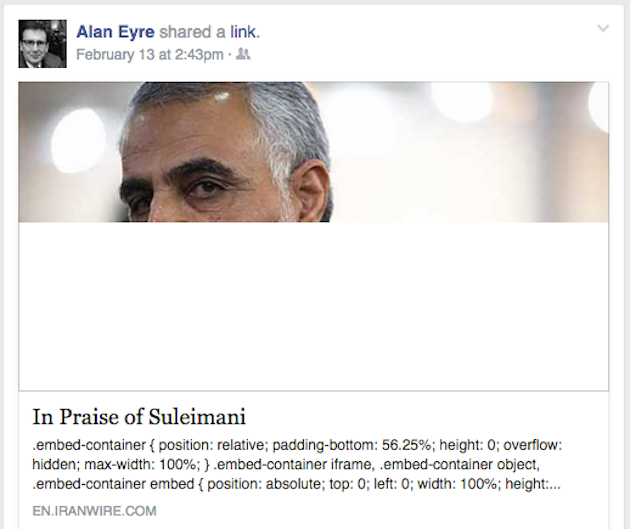
In one Feb. 13 posting, when Iran talks were at a critical stage, Eyre disseminated a link to an article praising Iranian Quds Force Chief Ghassem Suleimani, who is directly responsible for the deaths of Americans abroad.

Image-1

Suleimani, who is listed as a terrorist by the U.S. State Department, will have international sanctions against him waived under the parameters of the nuclear accord.

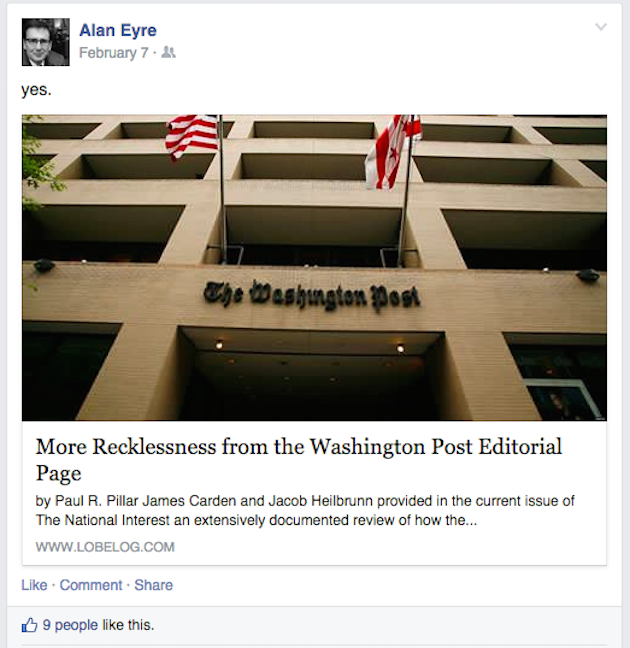
In another posting from Feb. 5, Eyre links to the website LobeBlog, which is viewed by critics as anti-Israel and regularly attacks neoconservative pundits.”

The article Eyre links to, “Who Are the Billionaires Attacking Obama’s Iran Diplomacy,” attacks opponents of the Iranian deal and insinuates that wealthy Jewish donors are behind this push.

The article puts particular emphasis on the Israel Project (TIP), a non-profit advocacy organization run by Josh Block, a longtime Democrat, and claimed that wealthy Jewish individuals were behind a stealth campaign to kill the deal. TIP is portrayed as playing a crucial role in discrediting the deal and convincing lawmakers to take a stance against it.

The article was penned by a former ThinkProgress blogger, Eli Clifton, who was forced out of the Center for American Progress-backed blog following a scandal in which several writers accused Iran deal critics of being “Israel firsters.”

Image-2

In another posting, Eyre links to an article by Stephen Walt, co-author of the book The Israel Lobby, which has been branded by the Anti-Defamation League (ADL) as an “anti-Jewish screed.”

Walt lashes out in the piece at neoconservative critics of the Iran deal, writing that “no one should listen to their advice today.”

Eyre linked to the piece with the comment, “interesting thesis.” He then quoted Walt at length, according to a screenshot:

The real problem is that the neoconservative worldview — one that still informs the thinking of many of the groups and individuals who are most vocal in opposing the Iran deal — is fundamentally flawed. Getting Iraq wrong wasn’t just an unfortunate miscalculation, it happened because their theories of world politics were dubious and their understanding of how the world works was goofy.

Image-3

Eyre also appeared to express disappointment online in March, when Sen. Tom Cotton and 46 other Republican lawmakers penned an open letter to Iran opposing the nuclear talks.

Eyre links to a March 9 Washington Post article by Paul Pillar, an Israel critic who backs boycotts of the Jewish state, titled ‘The misguided, condescending letter from Republican senators to Iran.’ He then opined in the post, “Seriously. Can someone write them a letter telling them that the most fundamental duty of Congress is to pass a budget?”

Image-4

At least one of Eyre’s Facebook friends has quibbled with his postings.

When Eyre linked to a Talking Points Memo article claiming that “49 percent of Republicans don’t believe in evolution,” one critic commented: “This post is total crap. Some 300 people were polled, and the polling criteria were, of course, not specified. This outfit has a deserved reputation as a left-leaning, professionally anti-Republican Flak Tank.”

Eyre dismissed that criticism, responding, “If you are going to fact check every incendiary posting I put up, it is going to detract from the sum total of my facebook-derived frivolity.”

In addition to his postings, Eyre has appeared as a keynote speaker at the National Iranian American Council’s Washington, D.C., conference.

The council, which has been accused as serving as a pro-Tehran lobbying shop, has helped the Obama administration disseminate pro-Iran talking points and champion the deal in the public sphere. Its top officials also have insinuatedthat Jewish lawmakers who oppose the deal have more loyalty to Israel than America.

One senior official at a Washington, D.C., pro-Israel organization expressed disappointment but not surprise at Eyre’s posting.

“The easiest way to explain the State Department’s behavior toward the Middle East is to assume that they don’t like the Israelis very much and they have this romantic fascination with Iran,” the source said. “That’s what you’re seeing here.”

“Of course they can’t admit that out loud, because the American people believe exactly the opposite, so they do it through passive-aggressive Facebook posts and occasional slips of the tongue about how moderate and sophisticated the Iranians are,” the source added.

A State Department spokesman declined to comment on Eyre’s personal postings when contacted by the Free Beacon.

“Alan Eyre is the Department’s Persian Language Spokesperson,” the official said. “In that capacity, he maintains his official page on Facebook here,” the spokesman continued, providing a link to the page.

The Facebook page in question, however, is separate from Eyre’s public-facing personal page referenced by the State Department, which said it had no knowledge of the second page.

“We’re not aware of any such content that you refer to posted on that account,” the official said.

The official did not respond to follow-up requests asking for comment from Eyre on the postings.

Prominent Iranian Analyst Amir Taheri: Obama Is Capitulating And Chasing Illusions In Deal With Iran

October 6, 2015

Prominent Iranian Analyst Amir Taheri: Unlike Kennedy, Nixon And Reagan, Who Drove A Hard Bargain In Negotiations With Enemies, Obama Is Capitulating And Chasing Illusions In Deal With Iran, Middle East Media Research Institute, October 5, 2015

In an opinion piece published August 25, 2015 in the London-based Saudi daily Al-Sharq Al-Awsat, Amir Taheri, a prominent Iranian analyst, author and columnist, compared Obama’s policy towards Iran to the policies of Kennedy, Nixon and Reagan in their dealings with the U.S.’s main rivals in their day – the USSR and China. Taheri wrote that, in making the deal with Iran, Obama wishes to portray himself as an heir to the tradition established by these presidents of defusing conflict through diplomacy and negotiations. He noted, however, that these leaders negotiated from a position of strength, and pursued a detente with America’s enemies only after the latter had fulfilled important American demands and changed key elements of their policies. For example, Kennedy negotiated with the USSR only after forcing it to remove the nuclear sites from Cuba; Nixon’s normalization with China came only after the latter had turned its back on the Cultural Revolution and abandoned its project of exporting communism, and Reagan engaged with the Soviets only after taking military measures to counter the threat they posed to Europe. Moreover, says Taheri, the U.S. warmed its relations with China and the USSR only after they abandoned their absolute enmity towards it and began regarding it as a rival and competitor rather than a mortal enemy that must be destroyed.

Conversely, says Taheri, Obama demanded nothing of the Iranians before commencing negotiations, not even the release of U.S. hostages. Moreover, he pursued rapprochement with Iran despite the absence of any positive change in this country’s hardline policies and ideologies. On the contrary, America’s overtures only encouraged Iran’s worst tendencies, as reflected in a sharp rise in human rights violations within Iran and in its continued support for terror groups and for Assad’s regime in Syria. The detente with America did not even cause Iran to abandon its calls of death to America, Taheri notes. He concludes “Kennedy, Nixon and Reagan responded positively to positive changes on the part of the adversary,” whereas “Obama is responding positively to his own illusions.”

The following are excerpts from his article:

24977Amir Taheri (Image: Twitter.com/amirtaheri4)

JFK Forced Russia To Remove Its Missiles From Cuba; Obama Obtained Nothing Tangible And Verifiable

“Promoting the ‘deal’ he claims he has made with Iran, President Barack Obama is trying to cast himself as heir to a tradition of ‘peace through negotiations’ followed by US presidents for decades. In that context he has named Presidents John F. Kennedy, Richard Nixon and Ronald Reagan as shining examples, with the subtext that he hopes to join their rank in history.

“Obama quotes JFK as saying one should not negotiate out of fear but should not be afraid of negotiating either. To start with, those who oppose the supposed ‘deal’ with Iran never opposed negotiations; they oppose the result it has produced… In one form or another, Iran and the major powers have been engaged in negotiations on the topic since 2003. What prompted Obama to press the accelerator was his desire to score a diplomatic victory before he leaves office. It did not matter if the ‘deal’ he concocted was more of a dog’s dinner than a serious document. He wanted something, anything , and to achieve that he was prepared to settle for one big diplomatic fudge.

“Is Obama the new JFK? Hardly. Kennedy did negotiate with the USSR but only after he had blockaded Cuba and forced Nikita Khrushchev to blink and disband the nuclear sites he had set up on the Caribbean island. In contrast, Obama obtained nothing tangible and verifiable. Iran’s Atomic Energy chief Ali-Akbar Salehi put it nicely when he said that the only thing that Iran gave Obama was a promise ‘not to do things we were not doing anyway, or did not wish to do or could not even do at present.’

“JFK also had the courage to fly to West Berlin to face the Soviet tanks and warn Moscow against attempts at overrunning the enclave of freedom that Germany’s former capital had become. With his ‘Ich bin ein Berliner‘ (I am a citizen of Berlin), he sided with the people of the besieged city in a long and ultimately victorious struggle against Soviet rule. In contrast Obama does not even dare call on the mullahs to release the Americans they hold hostage. Instead, he has engaged in an epistolary courting of the Supreme Guide and instructed his administration in Washington to do and say nothing that might ruffle the mullahs’ feathers.

Nixon Extracted Far-Reaching Concessions From China; Obama Has Only Encouraged The Worst Tendencies Of The Khomeinist Regime

“No, Obama is no JFK.  But is he heir to Nixon? Though he hates Nixon ideologically, Obama has tried to compare his Iran ‘deal’ with Nixon’s rapprochement with China. Again, the comparison is misplaced. Normalization with Beijing came after the Chinese leaders had sorted out their internal power struggle and decided to work their way out of the ideological impasse created by their moment of madness known as The Great Proletarian Cultural Revolution. The big bad wolf of the tale, Lin Biao, was eliminated in an arranged air crash and the Gang of Four defanged before the new leadership set-up in Beijing could approach Washington with talk of normalization.

“At the time the Chinese elite, having suffered defeat in border clashes with the USSR, saw itself surrounded by enemies, especially after China’s only ally Pakistan had been cut into two halves in an Indo-Soviet scheme that led to the creation of Bangladesh. Hated by all its neighbors, China needed the US to break out of isolation. Even then, the Americans drove a hard bargain. They set a list of 22 measures that Beijing had to take to prove its goodwill, chief among them was abandoning the project of ‘exporting revolution’.

“Those of us who, as reporters, kept an eye on China and visited the People’s Republic in those days were astonished at the dramatic changes the Communist leaders introduced in domestic and foreign policies to please the Americans. In just two years, China ceased to act as a ’cause’ and started behaving like a nation-state. It was only then that Nixon went to Beijing to highlight a long process of normalization. In the case of Iran, Obama has obtained none of those things. In fact, his ‘deal’ has encouraged the worst tendencies of the Khomeinist regime as symbolized by dramatic rise in executions, the number of prisoners of conscience and support for terror groups not to mention helping Bashar Al-Assad in Syria.

Reagan Had No Qualms About Calling The USSR ‘The Evil Empire’;  Obama Is Scared Of Offending The Mullahs

“No, Obama is no Nixon. But is he a new Reagan as he pretends? Hardly. Reagan was prepared to engage the Soviets at the highest level only after he had convinced them that they could not blackmail Europe with their SS20s while seeking to expand their empire through so-called revolutionary movements they sponsored across the globe. The SS20s were countered with Pershing missiles and ‘revolutionary’ armies with Washington-sponsored ‘freedom fighters.’

“Unlike Obama who is scared of offending the mullahs, Reagan had no qualms about calling the USSR ‘The Evil Empire’ and castigating its leaders on issues of freedom and human rights. The famous phrase ‘Mr. Gorbachev, tear down that wall!’ indicated that though he was ready to negotiate, Reagan was not prepared to jettison allies to clinch a deal.

“Obama has made no mention of Jimmy Carter, the US president he most resembles. However, even Carter was not as bad as Obama if only because he was prepared to boycott the Moscow Olympics to show his displeasure at the invasion of Afghanistan. Carter also tried to do something to liberate US hostages in Tehran by organizing an invasion of the Islamic Republic with seven helicopters. The result was tragicomic; but he did the best his meagre talents allowed. (NB: No one is suggesting Obama should invade Iran if only because if he did the results would be even more tragicomic than Carter’s adventure.)

“On a more serious note, it is important to remember that dealing with the Khomeinist regime in Tehran is quite different from dealing with the USSR and China was in the context of detente and normalization. Neither the USSR nor the People’s Republic regarded the United States as ‘enemy’ in any religious context as the Khomeinist regime does. Moscow branded the US, its ‘Imperialist’ rival, as an ‘adversary’ (protivnik) who must be fought and, if possible, defeated, but not as a ‘foe’ (vrag) who must be destroyed. In China, too, the US was attacked as ‘arch-Imperialist’ or ‘The Paper Tiger’ but not as a mortal foe. The slogan was ‘Yankee! Go Home!'”

China And USSR Moderated Their Virulent Hate For U.S,; In Iran The Slogan Is Still ‘Death To America’

“In the Khomeinist regime, however, the US is routinely designated as ‘foe’ (doshman) in a religious context and the slogan is ‘Death to America!’ Supreme Guide Ali Khamenei has no qualms about calling for the ‘destruction’ of America, as final step towards a new global system under the banner of his twisted version of Islam. Tehran is the only place where international ‘End of America’ conferences are held by the government every year. The USSR and China first cured themselves of their version of the anti-American disease before seeking detente and normalization. That did not mean they fell in love with the US. What it meant was that they learned to see the US as adversary, rival, or competitor not as a mortal foe engaged in a combat-to-death contest. The Islamic Republic has not yet cured itself of that disease and Obama’s weakness may make it even more difficult for that cure to be applied.

“Détente with the USSR and normalization with China came after they modified important aspects of their behavior for the better. Kennedy, Nixon and Reagan responded positively to positive changes on the part of the adversary. In the case of the USSR positive change started with the 20th congress of the Communist Party of the Soviet Union in which Khrushchev denounced Joseph Stalin’s crimes, purged the party of its nastiest elements, notably Lavrentiy Beria, and rehabilitated millions of Stalin’s victims.

“In foreign policy, Khrushchev, his swashbuckling style notwithstanding, accepted the new architecture of stability in Cold War Europe based on NATO and the Warsaw Pact. Kennedy, Johnson and, later, Nixon and President Gerald Ford had to respond positively. In the late1980s, the USSR offered other positive evolutions through Glasnost and Perestroika and final withdrawal from Afghanistan under Mikhail Gorbachev. Again, Reagan and President George Bush (the father) had to respond positively.

“In the case of China we have already noted the end of the Cultural Revolution. But China also agreed to help the US find a way to end the Vietnam War. Beijing stopped its almost daily provocations against Taiwan and agreed that the issue of the island-nation issue be kicked into the long grass. Within a decade, under Deng Xiaoping, China went even further by adopting capitalism as its economic system.

“There is one other difference between the cases of the USSR and China in the 1960s to 1990s and that of the Khomeinist regime in Tehran today. The USSR had been an ally of the United States during the Second World War and its partner in setting up the United Nations in 1945. Although rivals and adversaries, the two nations also knew when to work together when their mutual interests warranted it. The same was true of the Chinese Communist Party which had been an ally of the US and its Chinese client the Kuomintang during the war against Japanese occupation when Edgar Snow was able to describe Mao Zedong as ‘America’s staunchest ally against the Japanese Empire.’ In the 1970s, Washington and Beijing did not find it strange to cooperate in containing the USSR, their common rival-cum-adversary as they had done when countering Japan.

“In the case of the Islamic Republic there is no sign of any positive change and certainly no history of even tactical alliance with the US.

“Unless he knows something that we do not, Obama is responding positively to his own illusions.”

Persia, Putin and the Pansy

October 3, 2015

Persia, Putin and the Pansy, Times of Israel, Irwin G. Blank, October 3, 2015

(Guess the name of the Pansy. But please see, The Moscow-Washington-Tehran Axis of Evil. — DM)

Putin, a product of the Soviet Communist system is well acquainted with the dictum of the father of the Bolshevik revolution that gave birth to the regime that he so faithfully served. V. I. Lenin’s famous quote-” Probe with a bayonet. If you meet steel, stop. If you meet mush, then push.”

***************************

In ancient times there was no greater empire than that of Persia. This imperial power stretched from the mountains of Afghanistan all the way to the islands of Greece and the deserts of North Africa and the Middle East. Against the Greeks of Alexander the Great, it could field armies of millions of troops arrayed with the most modern weapons of war at the time. Until the rise of the Roman Empire, no power on Earth, made nations tremble as did the rulers of Persia.

Today the fanatic Ayatollahs in Teheran, with a megalomaniacal apocalyptic dream of Islamist imperialism and world conquest under their banner of jihad are hell bent on the recreation of their ancient empire and the destruction of all they see as infidels and unbelievers. Their conception of faith is a political and social fanaticism that goes even further than the hysterical rantings and horrendous nightmare that Nazi Germany once attempted to foist on mankind. Indeed, the very Nazi terminology for its origin, the word “Aryan” is associated with the nation whose name is a derivative of that racist term-Iran.

However, other than employing proxy allies in Lebanon, Syria and Yemen, the mad mullahs knew that their military, for all its goose stepping soldiers and bombast that they would require the tools necessary to fulfill their wicked aims. Firstly, it was able to build up a nuclear industry with the aim of developing the most lethal weapons of mass destruction. Through deception, deliberate obfuscation and diligent denial, it succeeded in the implantation of this atomic framework under the blindness of the international agency whose responsibility is to curtail the spread of nuclear weapons.

Furthermore, when its nefarious production methods and its open evidence of ballistic missile technology became apparent, Iran successfully parried the efforts to curtail its march toward nuclear weaponry by undertaking a Potemkin village of diplomacy whereby even the most seemingly astute diplomatically experienced national leaders, succumbed to the meanderings and sweetheart deal that Iranian negotiators engineered. The secrets of the Ayatollahs were swept under a Persian rug.

However, in the meantime, the Persian imperialist war mongers still were in great need of the assistance of a powerful ally in order to accomplish their more conventional aims in their desire to continue their conquest throughout the Middle East. What better place to seek this help than to another former empire builder than a nation which was chomping on the bit to return to an area of the globe from which it had been so unceremoniously evicted.

The former Soviet Union, now the Russian Federation, has had dreams of installing its imperial presence in the Mediterranean Sea since the days of the Czars. Until 1972 when the late Egyptian president, Anwar Sadat, evicted ( for the most part as a political move, not a military one) most of the Soviet personnel from his country, the USSR had been ensconced throughout Egypt and the Arab world. Indeed, it was the humiliating defeat of the Egyptian and Syrian forces by the Israel Defense Forces during the Yom Kippur War that demonstrated at that time, the weakness of the Soviet response to American supported Israel which was demonstrating the vapidness of the Soviet promise to come to the aid of its Arab allies. The US response to Soviet threats to directly intervene on behalf of its Egyptian and Syrian clients, by moving the US Navy’s Sixth Fleet towards the Syrian coast and the declaration of a higher war footing by all US forces, made the Soviets back down.

The political and military supported victory of American arms and diplomacy demonstrated the resolve of that world power to face down the threat of Soviet dominance in such a strategic region of Western interests. Not only did the diplomacy of Henry Kissinger and the Nixon White House make a shambles of the massive Soviet involvement in the Arab world, but it brought about the first true demarche of Soviet (Russian) imperial chicanery since the Berlin blockade of 1948 and the Cuban Missile Crisis of 1962.

But the Russian Federation today is led by a president whose demonstration of the old Russian imperial nightmare is alive and well. Vladimir Putin, a former high official of the dreaded KGB,( Soviet Secret Service) has no qualms about restoring the dreams of the Czars and the re-entrenchment of his nation’s appearance in the Middle East. As a significant power player on the world scene and a massive supplier of sophisticated arms to anyone who opposes Western influence anywhere on the planet, the situation in the Levant and the hysterical anti-American paranoia in Teheran led the Ayatollahs to the road towards Moscow.

Sending one of their highest ranking military official to Moscow was a masterstroke of diplomatic skullduggery in presenting Putin with a challenge and an opportunity he could not ignore, For here, he was presented with a silver platter with which to serve up a poisonous dish to his arch-rivals, America and NATO. After witnessing their weakness to confront his military in the Ukraine and the Crimea, as well as his bloody campaign in Chechnya, all Putin had to do was experience orgasmic delight in sending his sea and air forces into a disintegrating Syria and pour weapons by the shipload onto the docks of Bandar Abbas in Iran. In full sight of Western intelligence and American spy satellites, crate after crate of Soviet munitions were soon trundling off the piers of the Syrian port of Latakia.

Iran was facing a significant threat to its allies in that disintegrating country and witnessing the probable demise of its Syrian puppet, Bashar al-Assad. The forces of ISIS (an Iranian rival for control of the Islamic world)  were on the march and its debilitating of the Syrian military as well as its capture of large swaths of Alawite controlled territory would put an end to the mullah’s plans for conquest. The entire northern tier of the Middle East would collapse and the Persian dream of conquering all the Sunni dominated lands of the region would go up in smoke. Iran had invested heavily in its subterfuge of the regimes of Iraq, Yemen and its military adventures in those countries. It required a strong ally and it looked to its northern neighbor with which its shares a common enmity for the West, and Putin, licked his chops and dove onto the plate presented to him.

Not only have Russian military forces seized control of the vital Syrian port of Latakia on the Mediterranean, but it has constructed revetments for air forces and ground personnel unseen in this region since the 1970s. His air forces have conducted bombing raids, not on ISIS, which was a planned political prevarication, but on US backed components of the anti-Assad coalition. Of course, Putin has no conflict with conducting airstrikes on civilians. After all, the West has been all but silent on the massive slaughter of approximately 300,000 civilians by the butcher of Damascus. Even when presented with irrefutable evidence of the use of internationally banned chemical weapons on his own countrymen, the US and NATO have been reticent (cowardly) in confronting this evil practice. Why not? The current leader of Syria’s father dropped poison gas on his own people in Homs when they revolted against his tyrannical rule and the world stood silent.

When the president of the United States declared that the Assad administration’s use of chemical weapons would cross a “red line” and force his hand – well, the red line turned into a yellow streak. The insipid and relatively weak assistance that this erstwhile leader of the world’s greatest superpower has shown to be the denigration and degradation of a once trusted and worthy ally. America’s allies no longer trust her and her enemies no longer fear her. It is not the American people who have lost their courage, it is their incompetently dangerous president and his minions that are responsible.

Not only for the rise of Russian/Iranian imperialism, but for its effect as daily demonstrated by the thousands, if not future hundreds of thousands, of men, women and children, fleeing from the murderous genocide of the Assad aided and abetted by this new Axis of evil-Islamic radicalism and Russian imperialism.

Iran seeks to conquer the Middle East and destroy the Sunni dominated Arab states of the region. With Russian assistance it will expand its imperial power behind Russian bayonets and the threat of its own nuclear umbrella to come. It is biding its time while innocents are being slaughtered and the threats against Israel, Jordan and Lebanon are unrelenting through public declarations and political oratory.

Putin, a product of the Soviet Communist system is well acquainted with the dictum of the father of the Bolshevik revolution that gave birth to the regime that he so faithfully served. V. I. Lenin’s famous quote-” Probe with a bayonet. If you meet steel, stop. If you meet mush, then push.”

The American president, who through Constitutional authority commands the most expansive and well trained military in the history of the world, who purports to be the defender of international human rights, has proven himself to be, in the face of wanton aggression and slaughter, in the abrogation of his country’s duty to defend its most vital and established interests, in his tepid response to evil and his recalcitrance to even identify the greatest threat to Western civilization since the rise of Nazi Germany, has without a doubt, at least in this writer’s estimate, become akin to an ostrich-a bird that buries its head in the sand and presents its foes with an irresistible target.

The Dictionary of American Slang has a word for such a person-a weakling and a wimp-the word is “pansy.” The pansy of the United States will bring the most terrible war upon us all-including by beloved tiny Jewish country.

The Iran Nuclear Deal: What the Next President Should Do

October 2, 2015

The Iran Nuclear Deal: What the Next President Should Do, Heritage Foundation, October 2, 2015

(But please see, The Elephant In The Room. — DM)

The failure of Congress to halt the implementation of the Obama Administration’s nuclear agreement with Tehran means that the U.S. is stuck with a bad deal on Iran’s nuclear program at least for now. Iran’s radical Islamist regime will now benefit from the suspension of international sanctions without dismantling its nuclear infrastructure, which will remain basically intact. Iran’s path to a nuclear weapon is unlikely to be blocked by the Administration’s flawed deal, any more than North Korea was blocked by the Clinton Administration’s 1994 Agreed Framework.

The next President should not passively accept Obama’s risky deal with Tehran as a fait accompli. Instead, he or she should immediately cite any violations of the agreement by Iran, its continued support for terrorism, or other hostile policies as reason to abrogate the agreement. The Bush Administration, faced with bad deals negotiated by the Clinton Administration, eventually withdrew from both the Agreed Framework and the Kyoto Protocol.

Rather than endorsing a dangerous agreement that bolsters Iran’s economy, facilitates its military buildup, and paves the way for an eventual Iranian nuclear breakout, the next Administration must accelerate efforts to deter, contain, and roll back the influence of Iran’s theocratic dictatorship, which continues to call for “death to America.”

How the Next President Should Deal with Iran

Upon entering office, the next Administration should immediately review Iran’s compliance with the existing deal, as well as its behavior in sponsoring terrorism, subverting nearby governments, and attacking U.S. allies. Any evidence that Iran is cheating on the agreement (which is likely given Iran’s past behavior) or continuing hostile acts against the U.S. and its allies should be used to justify nullification of the agreement.

Regrettably, Tehran already will have pocketed up to $100 billion in sanctions relief by the time the next Administration comes to office because of the frontloading of sanctions relief in the early months of the misconceived deal. Continuing to fork over billions of dollars that Tehran can use to finance further terrorism, subversion, and military and nuclear expansion will only worsen the situation.

In place of the flawed nuclear agreement, which would boost Iran’s long-term military and nuclear threat potential, strengthen Iran’s regional influence, strain ties with U.S. allies, and diminish U.S. influence in the region, the new Administration should:

1. Expand sanctions on Iran. The new Administration should immediately reinstate all U.S. sanctions on Iran suspended under the Vienna Agreement and work with Congress to expand sanctions, focusing on Iran’s nuclear program; support of terrorism; ballistic missile program; interventions in Syria, Iraq, and Yemen; human rights violations; and holding of four American hostages (Washington Post reporter Jason Rezaian, Christian pastor Saeed Abedini, former U.S. Marine Amir Hekmati, and former FBI agent Robert Levinson, who has been covertly held hostage by Iran since 2007).

The new Administration should designate Iran’s Islamic Revolutionary Guard Corps (IRGC) as a foreign terrorist organization and apply sanctions to any non-Iranian companies that do business with the IRGC’s extensive economic empire. This measure would help reduce the IRGC’s ability to exploit sanctions relief for its own hostile purposes.

Washington should also cite Iranian violations of the accord as reason for reimposing U.N. sanctions on Iran, thus enhancing international pressure on Tehran and discouraging foreign investment and trade that could boost Iran’s military and nuclear programs. It is critical that U.S. allies and Iran’s trading partners understand that investing or trading with Iran will subject them to U.S. sanctions even if some countries refuse to enforce U.N. sanctions.

2. Strengthen U.S. military forces to provide greater deterrence against an Iranian nuclear breakout.Ultimately, no piece of paper will block an Iranian nuclear breakout. The chief deterrent to Iran’s attaining a nuclear capability is the prospect of a U.S. preventive military attack. It is no coincidence that Iran halted many aspects of its nuclear weapons program in 2003 after the U.S. invasion of and overthrow of hostile regimes in Afghanistan and Iraq. Libyan dictator Muammar Qadhafi, motivated by a similar apprehension about the Bush Administration, also chose to give up his chemical and nuclear weapons programs.

To strengthen this deterrence, it is necessary to rebuild U.S. military strength, which has been sapped in recent years by devastating budget cuts. The Obama Administration’s failure to provide for the national defense will shortly result in the absence of U.S. aircraft carriers from the Persian Gulf region for the first time since 2007. Such signs of declining U.S. military capabilities will exacerbate the risks posed by the nuclear deal.

3. Strengthen U.S. alliances, especially with Israel. The nuclear agreement has had a corrosive effect on bilateral relationships with important U.S. allies in the Middle East, particularly those countries that are most threatened by Iran, such as Israel and Saudi Arabia. Rather than sacrificing the interests of allies in a rush to embrace Iran as the Obama Administration has done, the next Administration should give priority to safeguarding the vital security interests of the U.S. and its allies by maintaining a favorable balance of power in the region to deter and contain Iran. Washington should help rebuild security ties by boosting arms sales to Israel, Saudi Arabia, and other members of the Gulf Cooperation Council (GCC) that are threatened by Tehran, taking care that arms sales to Arab states do not threaten Israel’s qualitative military edge in the event of a flare-up in Arab–Israeli fighting.

To enhance deterrence against an Iranian nuclear breakout, Washington also should transfer to Israel capabilities that could be used to destroy hardened targets such as the Fordow uranium enrichment facility, which is built hundreds of feet beneath a mountain. The only non-nuclear weapon capable of destroying such a target is the Massive Ordnance Penetrator (MOP), a precision-guided, 30,000-pound “bunker buster” bomb. Giving Israel these weapons and the aircraft to deliver them would make Tehran think twice about risking a nuclear breakout.

The U.S. and its European allies also should strengthen military, intelligence, and security cooperation with Israel and the members of the GCC, an alliance of Bahrain, Kuwait, Oman, Qatar, Saudi Arabia, and the United Arab Emirates, founded in 1981 to provide collective security for Arab states threatened by Iran. Such a coalition could help both to contain the expansion of Iranian power and to facilitate military action (if necessary) against Iran.

4. Put a high priority on missile defense. Iran’s ballistic missile force, the largest in the Middle East, poses a growing threat to its neighbors. Washington should help Israel to strengthen its missile defenses and help the GCC countries to build an integrated and layered missile defense architecture to blunt the Iranian missile threat. The U.S. Navy should be prepared to deploy warships equipped with Aegis ballistic missile defense systems to appropriate locations to help defend Israel and the GCC allies against potential Iranian missile attacks as circumstances demand. This will require coordinating missile defense activities among the various U.S. and allied missile defense systems through a joint communications system. The U.S. should also field missile defense interceptors in space for intercepting Iranian missiles in the boost phase, which would add a valuable additional layer to missile defenses.

5. Deter nuclear proliferation. For more than five decades, Washington has opposed the spread of sensitive nuclear technologies such as uranium enrichment, even for its allies. By unwisely making an exception for Iran, the Obama Administration in effect conceded the acceptability of an illicit uranium enrichment program in a rogue state. In fact, the Administration granted Iran’s Islamist dictatorship better terms on uranium enrichment than the Ford and Carter Administrations offered to the Shah of Iran, a U.S. ally back in the 1970s.

The Obama Administration’s shortsighted deal with Iran is likely to spur a cascade of nuclear proliferation among threatened states such as Saudi Arabia, Turkey, Egypt, and the United Arab Emirates. Such a multipolar nuclear Middle East, on hair-trigger alert because of the lack of a survivable second-strike capability, would introduce a new level of instability into an already volatile region. To prevent such an outcome, the next Administration must reassure these countries that it will take military action to prevent Iran from gaining a nuclear capability as well as to deter Iranian military threats to their interests.

6. Expand domestic oil and gas production and lift the ban on U.S. oil exports to put downward pressure on world prices. In addition to sanctions, Iran’s economy has been hurt by falling world oil prices. Its oil export earnings, which constitute more than 80 percent of the regime’s revenue, have been significantly reduced. By removing unnecessary restrictions on oil exploration and drilling in potentially rich offshore and Alaskan oil regions, Washington could help to maximize downward pressure on long-term global oil prices. Lifting the ban on U.S. oil exports, an obsolete legacy of the 1973–1974 energy crisis spawned by the Arab oil embargo, would amplify the benefits of increased oil and gas production. Permitting U.S. oil exports not only would benefit the U.S. economy and balance of trade, but also would marginally lower world oil prices and Iranian oil export revenues, thereby reducing the regime’s ability to finance terrorism, subversion, and military expansion.

7. Negotiate a better deal with Iran. The Obama Administration played a strong hand weakly in its negotiations with Iran. It made it clear that it wanted a nuclear agreement more than Tehran appeared to want one. That gave the Iranians bargaining leverage that they used shrewdly. The Administration made a bad situation worse by downplaying the military option and front-loading sanctions relief early in the interim agreement, which reduced Iran’s incentives to make concessions.

The next Administration should seek an agreement that would permanently bar Iran from acquiring nuclear weapons. At a minimum, this would require:

  • Banning Iran from uranium enrichment activities;
  • Dismantling substantial portions of Iran’s nuclear infrastructure, particularly the Fordow and Natanz uranium enrichment facilities and Arak heavy water reactor;
  • Performing robust inspections on an “anytime anywhere” basis and real-time monitoring of Iranian nuclear facilities;
  • Linking sanctions relief to Iranian compliance;
  • Ensuring that Iran comes clean on its past weaponization efforts; and
  • Determining a clear and rapid process for reimposing all sanctions if Iran is caught cheating.

The Bottom Line

The nuclear deal already has weakened relationships between the U.S. and important allies, undermined the perceived reliability of the U.S. as an ally, and helped Iran to reinvigorate its economy and expand its regional influence. After oil sanctions are lifted, Iran will gain enhanced resources to finance escalating threats to the U.S. and its allies. The next Administration must help put Iran’s nuclear genie back in the bottle by taking a much tougher and more realistic approach to deterring and preventing an Iranian nuclear breakout.

The Elephant In The Room

October 2, 2015

The Elephant In The Room, Middle East Media Research Institute (MEMRI), Yigal Carmon*, October 2, 2015

(Please see also, Iran wants to renegotiate parts of the nuke “deal.” That may be good. Have opponents of the “deal” given up? If so, why? — DM)

It may be that these opponents believe that the agreement is a done deal that cannot be stopped and that the current U.S. administration will follow through with it no matter what. This approach reflects not realism but ignorance. Obviously the administration wants to follow through with the deal. But the deal is no longer in it hands. It is Khamenei who is throwing a spanner in the works, declaring that he will not implement the agreement that the West believed it concluded on July 14.

In order to get Iran to implement the agreement, the language of the JCPOA will have to be changed and a new Security Council resolution will have to be passed. While in theory this would not be impossible, it would require a new process, entailing, at the very least, a public political debate in the West – one that would reveal Iran’s unreliability as a partner and would cost valuable time. And time is not on the side of the U.S. administration.

*****************

On September 3, 2015, not two months after the July 14 announcement of the Joint Comprehensive Plan of Action at Vienna and its celebration at the White House and in Europe, Iranian Supreme Leader Ali Khamenei dropped a bombshell.

In a speech to the Iranian Assembly of Experts, he backtracked from the agreement, demanding a new concession: that the sanctions be “lifted,” not merely “suspended.”[1] If that term is not changed, said Khamenei, there is no agreement. If the West only “suspends” the sanctions, he added, Iran will merely “suspend” its obligations. Giving further credence to his threat, he announced that it is the Iranian Majlis that must discuss and approve the agreement (or not), because it represents the people – when it is well known that the majority of its members oppose it, and Iranian President Hassan Rohani made every effort to prevent such a discussion in the Majlis from taking place.

Adding insult to injury, Ali Akbar Velayati, senior advisor to Khamenei and head of Iran’s Center for Strategic Research, said on September 19 that the negotiations, concluded and celebrated less than two months previously on July 14, are actually “not over yet.”[2]

Khamenei’s demand to replace “suspension” with “lifting” is not just semantic. It is a fundamental change, because the snapback of sanctions – the major security mechanism for the entire agreement – cannot take place with “lifting,” but only with “suspension.”

Ever since Khamenei dropped this bombshell, the Western media has maintained total silence, as if this were a trivial matter not worthy of mention, let alone analysis.

One might understand this reaction on the part of those who support the deal. Perhaps they are shocked, at a loss, and therefore hope that if they pretend they don’t see it, it doesn’t exist. Indeed, this is the futile policy regularly adopted by ostriches.

However, one cannot but be astounded by the silence on the part of the opponents of the deal, including – oddly enough – Israel and the U.S. Republicans. One would expect these opponents to pounce on Khamenei’s statement and raise hell over Iran’s infanticide of the two-month-old agreement. One would expect them to bring it to the forefront of a new debate over the deal in any possible forum – in the U.S., the U.N., and the E.U.

But – nothing.

It may be that these opponents believe that the agreement is a done deal that cannot be stopped and that the current U.S. administration will follow through with it no matter what. This approach reflects not realism but ignorance. Obviously the administration wants to follow through with the deal. But the deal is no longer in it hands. It is Khamenei who is throwing a spanner in the works, declaring that he will not implement the agreement that the West believed it concluded on July 14.

In order to get Iran to implement the agreement, the language of the JCPOA will have to be changed and a new Security Council resolution will have to be passed. While in theory this would not be impossible, it would require a new process, entailing, at the very least, a public political debate in the West – one that would reveal Iran’s unreliability as a partner and would cost valuable time. And time is not on the side of the U.S. administration.

Right now, Iran is exposed almost daily as the ally of Russia against the U.S. Three months after the “historic” agreement declared by the White House, Iran continues to seek “Death to America,” and the Iranian foreign minister, the “hero” of the agreement, needs to apologize in Iran for “accidentally” shaking hands with the U.S. president. The truth of the agreement is emerging, and it is not certain that what Iran is now demanding will pass.

Interestingly enough, the White House’s first reaction was to brush off Khamenei’s demand. Iran, said Josh Earnest, should just do what it what it had undertaken to do in the agreement, and stop roiling the waters.[3]

A more sober response followed. There was hope that the meeting set for September 28 between the P5+1 and Iranian foreign ministers, on the margins of the 70th session of the U.N. General Assembly, would produce a solution, but this hope was in vain. Iranian President Rohani fled back to Iran, on the pretext of the hajj tragedy in Mecca, and no one in the West knows how to proceed.

The Western media, for its part, is perpetuating its total blackout on the issue, hoping perhaps for a miracle in the secret U.S.-Iran talks, which this administration has been conducting for years. But even a secret U.S. concession will be no solution. Even if it were to offer a secret commitment to remove the sanctions altogether, Khamenei will not be satisfied. He openly challenged the U.S., and he needs its public capitulation. He will celebrate publicly any secret concession. Moreover, any new U.S. concession will prompt Khamenei to make ever more demands.

The most recent developments, and the emergence of Russia as a new-old contender for power vis-à-vis the U.S. in the world, particularly in the Middle East, will only encourage Khamenei to cling to his tried and true ally, Russia. Indeed, this administration has no objection to Russia’s resurgence in the Middle East, but Russia’s blatant anti-U.S. stance in every venue except in the private, honeyed Putin-Obama talks will ultimately lead even the blindest of Democrats to realize that Iran is indeed an enemy of the U.S. – as Iran plainly declares – and that any further concessions to it make no sense.

It seems that the worst nightmare of the supporters of the deal – that Iran will do away with the July 14 agreement – is about to come to pass.

*Y. Carmon is president and founder of MEMRI.

Endnotes:

[3] Earnest said: “What we have indicated all along is that once an agreement was reached, as it was back in mid-July, that we would be focused on Iran’s actions and not their words, and that we will be able to tell if Iran follows through on the commitments that they made in the context of these negotiations. And that is what will determine our path forward here. We’ve been crystal clear about the fact that Iran will have to take a variety of serious steps to significantly roll back their nuclear program before any sanctions relief is offered – and this is everything from reducing their nuclear uranium stockpile by 98 percent, disconnecting thousands of centrifuges, essentially gutting the core of their heavy-water reactor at Arak, giving the IAEA the information and access they need in order to complete their report about the potential military dimensions of Iran’s nuclear program. And then we need to see Iran begin to comply with the inspections regime that the IAEA will put in place to verify their compliance with the agreement. And only after those steps and several others have been effectively completed, will Iran begin to receive sanctions relief.  The good news is all of this is codified in the agreement that was reached between Iran and the rest of the international community. And that’s what we will be focused on, is their compliance with the agreement.” Whitehouse.gov, September 4, 2015.