Posted tagged ‘Obama’

Russia slams U.S. attempts to provide air cover to Syrian rebels

August 6, 2015

Russia slams U.S. attempts to provide air cover to Syrian rebels

Middle East

August 4, 2015

via Russia slams U.S. attempts to provide air cover to Syrian rebels – The Journal of Turkish Weekly.

Is this a declaration of war ?

Kremlin denounced Monday the U.S. attempts to provide air cover for Syrian rebels, indicating it will ultimately destabilize the country’s situation.

“We have repeatedly stressed that the assistance, especially financial or technical one, to the Syrian opposition would further destabilize the situation in the country,” Kremlin spokesman Dmitry Peskov said.

Once implemented, the plans would benefit the so-called Islamic State (IS) terrorists, weakening the counter potential of the Syrian capital Damascus, Peskov said.

“This is a fundamental disagreement between Moscow and Washington over Syria,” he added.

On Sunday, U.S. President Barack Obama reportedly authorized air defense to U.S.-backed Syrian rebels against attacks from terrorists or Syrian government forces.

More here .

The U.S. directly stated Tuesday that it would protect its nascent force of Syrian rebels from Syrian government attacks.

“What we are trying to convey is that we’ll also do defensive efforts in case or in the hypothetical that they would come under fire from Syrian forces,” State Department spokesman Mark Toner told reporters.

He ruled out that any such attack would be offensive, however, Toner said “any type of effort to protect them from Syrian forces would be defensive in nature”.

White House spokesman Josh Earnest hinted at the policy Monday, saying previous warnings that Washington issued to Damascus to not interfere with its aerial bombardment of Daesh and other Syrian extremists holds true for the U.S.-trained opposition forces.

He added that the U.S. and its coalition partners are “committed to using military force where necessary to protect the coalition-trained and equipped Syrian opposition fighters that are operating against ISIL inside of Syria right now”.

The decision by President Barack Obama could potentially further Washington’s stake in the Syrian conflict, and drag the U.S. deeper into ongoing hostilities – action the Obama administration has been reluctant to take.

http://www.turkishweekly.net/2015/08/05/news/us-explicitly-warns-damascus-not-to-attack-its-rebels/


U.S. Has Photographic Proof Iran Is Trying to Cheat on the Nuclear Deal

August 6, 2015

U.S. Has Photographic Proof Iran Is Trying to Cheat on the Nuclear Deal

by John Sexton5 Aug 2015

via U.S. Has Photographic Proof Iran Is Trying to Cheat on the Nuclear Deal – Breitbart.

Iran is sanitizing a military site believed to have been used for nuclear weapons research in the past. Testing of the site by the IAEA is one of the final hurdles Iran has to clear to gain sanction relief, and the U.S. intelligence community has evidence Iran is trying to cheat on those tests.

A blockbuster report by Josh Rogin and Eli Lake reveals the U.S. intelligence community has shared satellite imagery with top lawmakers which shows Iran doing heavy construction at Parchin, a military site where the IAEA has reason to believe Iran conducted nuclear weapons testing in the past.

Intelligence officials and lawmakers who have seen the new evidence, which is still classified, told us that satellite imagery picked up by U.S. government assets in mid- and late July showed that Iran had moved bulldozers and other heavy machinery to the Parchin site and that the U.S. intelligence community concluded with high confidence that the Iranian government was working to clean up the site ahead of planned inspections by the IAEA.

Sen. Richard Burr (R-NC)

49%

told the Bloomberg reporters the Iranian efforts to sanitize Parchin was “a huge concern.”

Sen. Bob Corker (R-TN)

51%

said he was disturbed by the “blatant way” in which Iran was apparently seeking to prepare the site to fool the IAEA inspectors. “Iran is going to know that we know,” he told Bloomberg.

The IAEA signed a side deal with Iran designed to resolve questions about the past military dimensions (PMD) of its nuclear program. That deal requires Iran to allow the IAEA to access the Parchin military site for testing no later than mid-October. However, some senators have suggested that, under the agreement, Iran may be allowed to collect and provide their own samples to the IAEA for testing, making it more likely they could try to cheat.

Resolving PMD issues has been one of the headline issues in the nuclear agreement for months. Officially, President Obama has insisted Iran will have to resolve all outstanding questions before any sanctions relief takes place. However, Secretary Kerry signaled in June that the administration was not concerned about resolving past nuclear research because, he claimed, “we know what they did.” Democratic Sen. Chris Coons echoed Kerry, telling Bloomberg, “We know what the Iranians did at Parchin.” And because we know, Coons says he is not too concerned about these past issues.

Meanwhile, Iran has maintained for years, including throughout the negotiation of the current deal, that any evidence suggesting it had researched nuclear weapons in the past was fabricated by foreign intelligence agencies. The intense political pressure for the deal to go forward has led some outside experts to suggest the IAEA will issue a hand-waving report which doesn’t really resolve questions about Iran’s past nuclear research.

Tariq Rauf, a former IAEA official, told the Guardian last month, “[IAEA Director] Amano has said he will give an assessment report, not a conclusion, which is not what the IAEA normally does. His likely assessment by December is that there are unanswered questions, but the agency has what it needs, and it will be rubber-stamped by the board.”

Failure to pin Iran down on this will allow them to continue the fiction that they had never sought nuclear weapons in the past, meaning they could emerge with a clean slate on this issue despite the fact that our government says they are lying. Iran’s attempt to sanitize the site with the whole world watching suggests they are very confident indeed that nothing, not even blatant attempts to sanitize evidence, will be allowed to stop this deal from proceeding.

Liar, Liar, World on Fire!

August 6, 2015

Liar, Liar, World on Fire!

Obama spins lies while Iran spins centrifuges.

August 6, 2015

Daniel Greenfield

via Liar, Liar, World on Fire! | Frontpage Mag.

Daniel Greenfield, a Shillman Journalism Fellow at the David Horowitz Freedom Center, is a New York writer focusing on radical Islam.​

Obama loves to play dress up. Sometimes he likes to play FDR, but his favorite costume is JFK. By claiming to be FDR or JFK, he convinces Democrats that he is part of a historical continuity, instead of a horrible aberration, and that he is doing exactly what FDR or JFK would do if they were alive today.

The costumes make Obama seem American instead of Un-American.

Now Obama put on his JFK costume to play the leader who believes in a “practical” and “attainable peace.” His analogy of the USSR to Iran is both terrible and telling.

Nuclear war was not averted because of arms control. The USSR, like Iran, cheated blatantly. Unlike Iran, its leaders weren’t crazy enough to want to see the world burn.

The same can’t be said of the Supreme Leader of Iran who chants “Death to America” and means it.

Treaties did not end the Cold War. The collapse of the USSR, under the pressure of its economic failures, did. Had Obama kept the sanctions in place, Iran’s regime might have also collapsed.

Instead Obama chose to bailout Iran’s regime to the tune of anywhere from 50 to 150 billion dollars; just as he spat on the legacy of JFK by bailing out Castro when the Cuban regime was on its last legs.

By talking about multilateral arms control and the USSR, Obama implicitly admits that this isn’t about preventing Iran from obtaining nuclear weapons, but about opening communications with the Mullahs.

His accusation that opponents of the deal are like those who want “to take military action against the Soviets” is dishonest after he had just admitted that even taking out Iran’s nuclear program would not lead to a war between Iran and the United States.

But Obama’s whole speech is a collection of lies.

He insists that the nuclear deal is “a detailed arrangement that permanently prohibits Iran from obtaining a nuclear weapon”.

There’s nothing “permanent” about it. Even Obama admitted that by Year 13, “breakout times would have shrunk almost down to zero.”  In the same speech in which he makes that claim, he admits (optimistically) that Iran might get a nuke in fifteen years. That’s not what permanent means.

Later he again insists that, “Iran is never allowed to build a nuclear weapon” and puffs up his chest and declares, “Let me repeat:  The prohibition on Iran having a nuclear weapon is permanent.”

This sounds impressive to audiences at home, but it’s completely meaningless.

Iran is an NPT signatory so it was never allowed to build nuclear weapons to begin with. That hasn’t stopped it from trying to do so.

The deal will be as useless as the NPT when it comes to actually stopping Iran from going nuclear.

Obama and Kerry have tried to sell the deal by confusing existing international obligations and laws with an effective enforceable agreement. When Obama says that Iran is not allowed to build a nuke, that means as much as Kerry telling PBS that Iran is “not allowed” to use the sanctions relief to aid terrorists.

The 9/11 hijackers were also “not allowed” to fly planes into the World Trade Center.

In this speech, Obama admits that even though it’s “not allowed” to, Iran will use the money to fund terrorists and he has already admitted that Iran can go nuclear even though it’s “never allowed” to.

Both men are deliberately misleading audiences that aren’t well versed in lawyerly technicalities.

Obama claimed that the deal, which lets Iran build up its nuclear program, “cuts off all of Iran’s pathways to a bomb.” In reality, the deal lets Iran conduct enrichment, run centrifuges and do everything but have official permission to nuke New York or Tel Aviv.

He already admitted that the breakout time drops to zero. If there were no pathway to a bomb, there would be no breakout time, let alone a breakout time of zero.

Obama insisted that the deal “contains the most comprehensive inspection and verification regime ever negotiated” when Iran has stated that not even Obama knows what its military site inspection arrangements with the IAEA will involve.

Essentially the real agreement has been outsourced to the IAEA based on secret side agreements that the Senate and that even the White House may not be privy to. And the IAEA’s director-general is already complaining that Iran is refusing access to nuclear scientists and military officers.

This deal maintains Iran’s nuclear program while promising that this time the IAEA will have more access for inspections than it did before, assuming Iran doesn’t break this agreement, like it broke the NPT.

That’s it.

Obama insists that if Iran goes back to defying the IAEA, as it has all these years, the sanctions will “snap back”. He even goes further, claiming that, “We won’t need the support of other members of the U.N. Security Council; America can trigger snapback on our own.” America can go to the Security Council. It can’t however restore the full set of sanctions now in place on its own. This is one of those cases where Obama is so deliberately misleading audiences that it’s downright criminal.

Since the facts aren’t on his side, Obama falls back to accusing critics of being warmongers who want to invade Iran just like they wanted to invade Iraq. Does that include his Secretary of State, who carried these negotiations, and who stated, “I was in favor of disarming Saddam Hussein, and I’m glad we did.”

Obama mentioned Iraq twelve times in his speech. He ominously warned that “Many of the same people who argued for the war in Iraq are now making the case against the Iran nuclear deal.”

Does that include Hillary Clinton and Joe Biden?

Obama speaks of ending “a mindset characterized by a preference for military action over diplomacy.” When he attacks George W. Bush as a warmonger who liked unilateral invasions, lying to Americans about the cost of war and imposing his will on “a part of the world with a profoundly different culture”, he forgets his illegal invasion of Libya, the murder of four Americans and the rise of ISIS in Libya.

But Obama isn’t just a liar, he’s also a hypocrite.

“The deal we’ll accept is they end their nuclear program,” Obama said, during a presidential debate with Romney.

In this speech, he sneered at his own campaign promise, reframing the idea of dismantling Iran’s nuclear program, as coming from critics who are “are either ignorant of Iranian society, or they’re just not being straight with the American people”.

“Sanctions alone are not going to force Iran to completely dismantle all vestiges of its nuclear infrastructure,” Obama claims.

He seems to have forgotten how he boasted that, “The work that we’ve done with respect to sanctions now offers Iran a choice. They can take the diplomatic route and end their nuclear program or they will have to face a united world and a United States president, me, who said we’re not going to take any options off the table.”

The only options Obama won’t be taking off the table are surrendering and then lying about it.

This is exactly the type of rhetoric that he just now condemned as ignorant, dishonest and impossible to achieve. So was Obama being ignorant or dishonest then? Or is he being dishonest now?

Obama insists that we face a choice between diplomacy and war. As Churchill told Chamberlain, you can have both. “You were given the choice between war and dishonor. You chose dishonor, and you will have war.” Appeasement of an aggressive conqueror doesn’t prevent war. It makes it inevitable.

The Appeaser-in-Chief tells the audience that it shouldn’t overreact to the “hardliners chanting ‘Death to America’ who have been most opposed to the deal.  They’re making common cause with the Republican caucus.”

These “hardliners” include the Supreme Leader of Iran. The man Obama has made common cause with.

While Obama never misses an opportunity to accuse Republican opponents of treason, when he isn’t accusing them of warmongering, he is the traitor. He has made common cause with those who chant, “Death to America.” And sometimes it’s hard not to wonder whether he agrees with them.

All Obama has to offer in this speech, and in every speech, is a selection of the same dishonest arguments that have been disproven even by his own allies in the Senate and in the media.

He’ll smugly repeat the same lies about Iran’s tiny military budget (the secret one is much bigger), about its “permanent” inability to get a bomb (until it does get one) and the sanctions that can snap back with a snap of his fingers, but will vanish the moment Congress votes down this deal.

There’s nothing new here and there’s nothing truthful here.

Even while Obama spins lies, Iran spins centrifuges. Even as he promises rigorous inspections, Iran covers up its nuclear activities at Parchin.

Obama has violated his own promises on Iran. He mocks the same arguments that he used to advance. He keeps talking about a military option when he won’t even stand up to Iran as it threatens American ships and helicopters, as it takes over Yemen and Iraq, And when in doubt, he begins bashing Bush without ever being honest about his own terrible legacy of military and political interventions.

It’s a petty performance from a man who likes to dress up as FDR and JFK, but who when it comes to Iran can’t even measure up to Jimmy Carter.

John Kerry’s Hypocrisy: “Can You Deliver?”

August 6, 2015

John Kerry’s Hypocrisy: “Can You Deliver?

By: Paul Gherkin

Published: August 6th, 2015

Latest update: August 4th, 2015

via The Jewish Press » » John Kerry’s Hypocrisy: “Can You Deliver?”.

Secretary of State John Kerry (L) seen with PA President Mahmoud Abbas.
Photo Credit: Issam Rimawi/FLASH90

{Originally posted to the author’s website, FirstOne Through}

Listening to US Secretary of State John Kerry try to explain and defend the P5+1 Iranian nuclear deal to various audiences is a spectacle to behold, regardless of one’s position on the best course of action.  One of the people who might want to watch the sessions and learn something from John Kerry is John Kerry.

Secretary Kerry argued at the Council for Foreign Relations (CFR) that Congress must support the deal or it would undermine his ability to negotiate any treaty with any government in the future. At 29:55 of the CFR talk, Kerry said: “Other people in the world are going to sit there and say ‘hey, let’s negotiate with the United States, they have 535 Secretaries of State. I mean, please! I would be embarrassed to try to go out… I mean, what am I going to say to people after this as Secretary of State? ‘Come negotiate with us?’ ‘Can you deliver?’ Please!

Kerry made the point that when two parties sit down to negotiate, it is critical for the sides to know that the negotiating parties are both authorized to negotiate and have the ability to fulfill their sides of the deal. If no such authority or ability exists, the discussions are an irrelevant waste of time.

Despite Kerry being quite clear about his logic, he has nevertheless insisted that Israeli Prime Minister Benjamin Netanyahu sit down and negotiate with Acting-President of the Palestinian Authority Mahmoud Abbas, even though it is clearly understood that Abbas can deliver nothing.

  • No Mandate: Abbas’s four-year term as president ran out in 2009. No presidential elections have been held since then.
  • No Authority: Abbas’s Fatah party lost legislative elections in 2006, winning only 33% of the parliament. No legislative elections have been held since then.
  • No Support: Abbas lags in every Palestinian poll held since 2006.
  • No Control: Abbas has no control of Gaza since his Fatah party was kicked out in 2007.
  • No Track Record: Abbas has shown zero credibility in being able to strike compromises to govern his own people, let alone deliver compromises with Israel.

Despite the glaringly obvious impotence of Abbas, the Obama administration continued to pressure Israel to negotiate with this straw man.

The Obama administration publicly acknowledged that the Palestinian Authority has absolutely no ability to deliver peace a few years ago. During the Gaza war on Israel in 2012, then US Secretary of State Hillary Clinton tried to broker a cease-fire. She made a dozen calls to various world leaders to halt the war- but not ONCE called the Abbas and the Palestinian Authority.

Compounding the inherent flaws in Abbas and the Palestinian Authority is Abbas’s insistence on bringing terms of any deal with Israel to a referendum. Abbas stated that he cannot decide on the “Right of Return” for all Palestinians, but that each of the 5 million Palestinian Arab “refugees” must make a decision for themselves. Hey Kerry- 535 “second-guessers” looks pretty good compared to 5 million! In terms of the rest of the components of a final agreement, Abbas stated that he “would go to a referendum everywhere because the agreement represents Palestinians everywhere.”  That’s impressive – he seeks the approval of 11 million “Palestinian” Arabs from all around the world!

Kerry’s comments regarding Iran are both on- and off-the-mark.  Iran and all of the parties in the negotiations know that the United States is a democracy and the political process must run its course.  Once the American people’s representatives in Congress make a decision, the government will deliver on its commitments.

However, Abbas – a complete straw man if ever there was one – with no authority or control whatsoever, openly states that millions of individuals will ultimately not only decide the fate of an Israeli-PA deal overall, but even on certain components on an individual basis.

Kerry fully appreciates that before negotiators start a process that they want to know the answer to the fundamental question: “Can you deliver“? However, he doesn’t care when he forces Israel to do exactly that with Abbas and the Palestinian Authority.


Related FirstOneThrough video and articles:

Abbas demands R-E-S-P-E-C-T

The Disappointing 4+6 Abbas Anniversary

Palestinian “Refugees” or “SAPs”?

Mark Moyar: Lurching without direction

August 5, 2015

Mark Moyar: Lurching without direction, Power Line, Mark Moyar, August 5, 2015

Because crisis management focuses on reducing symptoms rather than eliminating causes, its practitioners typically resort to half measures and token gestures. By demonstrating that the White House is “doing something,” symbolic actions often suffice to alleviate press scrutiny and public pressure for action, at least temporarily. They seldom remedy the problem that they were ostensibly addressing.

**********************

Mark Moyar is Visiting Scholar at The Foreign Policy Initiative and the author, most recently, of the important new book Strategic Failure: How President Obama’s Drone Warfare, Defense Cuts, and Military Amateurism Have Imperiled America. We invited Mark to write something for us bearing the subject of his book. He has responded with this column:

Last year, shortly before Barack Obama fired him, Secretary of Defense Chuck Hagel chided America’s President for “lurching from crisis to crisis without direction.” The treatment of foreign policy as an exercise in ad hoc crisis management has characterized Obama’s entire Presidency, as indeed it has every Democratic Presidency of the last half century. Fixated on domestic affairs and reluctant to assert American power overseas, Democrats from Lyndon Johnson to Barack Obama have viewed foreign policy challenges as nuisances to be kept off the front page of the New York Times, rather than problems to be solved through a coherent grand strategy.

Whereas a good strategy drives an active foreign policy, crisis management is inherently reactive. International problems reach the President’s attention mainly when they generate inordinate press coverage or cause a spike in unfavorable polling. Active adversaries, like North Vietnam in 1964 and Russia and ISIS in 2015, have consistently beaten a reactive United States to the punch and dodged the counterpunches.

Because crisis management focuses on reducing symptoms rather than eliminating causes, its practitioners typically resort to half measures and token gestures. By demonstrating that the White House is “doing something,” symbolic actions often suffice to alleviate press scrutiny and public pressure for action, at least temporarily. They seldom remedy the problem that they were ostensibly addressing.

In the case of Syria, Obama rejected recommendations from his cabinet to arm moderate Syrian rebels until 2013, by which time most of the moderate rebels had been killed or co-opted by extremists. He then decided to train and equip rebel forces in such small numbers and with such restrictions on their activities as to render them insignificant. When ISIS advances compelled Obama to restart American training of Iraqi forces, Obama put a ceiling on the number of U.S. trainers that limited throughput to 3,000 trainees per year, too few to make a difference in the war against ISIS or to lessen the influence of the 100,000 Iraqi Shiite militiamen whom the Iranians were training.

In Afghanistan, Obama authorized a troop surge, but began withdrawing troops much earlier than his generals advised, preventing completion of the military’s counterinsurgency campaign and discouraging Afghans from siding with the pro-American government. In Libya, Obama joined a NATO campaign against Muammar Gadhafi after international outrage about Gadhafi’s atrocities reached fever pitch, but his refusal to send American military forces to help secure the peace or protect American interests led to the collapse of central governance and the killing of the U.S. ambassador at Benghazi.

Of the recent additions to the administration’s list of token gestures and half measures, the most flagrant offender is Obama’s nuclear deal with Iran. Less well known is his response to the crisis of Russian expansionism. For more than a year, Eastern European allies and American critics—some of them within the Obama administration—have been calling for tougher American actions to discourage further Russian advances. Obama finally made his token gesture at the end of June, announcing that the United States would send American troops and heavy weaponry to several eastern European countries.

The joy that the initial announcement may have brought the eastern Europeans quickly faded when they saw the fine print, which was issued by U.S. ambassador to NATO Douglas Lute. The United States, Lute explained, was not going to deploy forces to eastern Europe on a permanent basis. “The tanks are empty, the … vehicles are empty, and will be parked, stored and maintained in training areas across the six Eastern most allies for training purposes,” Lute said. “Then the soldiers, on exercise after exercise, will be flown in.” One doubts that the Latvians will feel secure, or the Russians will feel deterred, by empty American vehicles and occasional visits from jet-setting American soldiers.

Many of Obama’s token gestures and half measures are clearly intended to keep simmering crises from boiling over until Obama leaves office. Administration spokesmen have repeatedly said that defeating ISIS will be a “multiyear” effort. The diluted U.S. military presence in Afghanistan is scheduled to last until the end of Obama’s term. Most of the fallout from Obama’s bad Iran deal will not hit ground until someone else occupies the White House. Obama and his proxies will no doubt craft stories explaining how his successor’s errors undid all of his foreign policy masterstrokes.

The President’s tokenism also serves one of the few national security objectives that Obama has pursued with any consistency, the diminution of American military power. The White House ramped up drone strikes in Pakistan and Yemen as a means of diverting the American people’s attention and showing that the United States could still do damage to terrorists without large military forces. While boasting about the number of people killed by drones, Obama quietly forced through drastic reductions in the armed services and withdrew American forces from critical regions. The drone strikes, in actuality, succeeded mainly in killing low-level fighters and antagonizing the Pakistani and Yemeni governments to the point that the United States eventually had to discontinue most strikes.

If one believes that Obama’s foreign policy should be driven by mitigation of immediate crises, particularly those that might detract from perceived domestic achievements such as Obamacare and environmental regulation, then there may be cause for optimism about the next year and a half. If, on the other hand, one believes that Obama’s foreign policy should be driven by protection of America’s enduring national security interests, then there is cause only for worry. Obama’s remaining months in office will give America’s enemies time and space to accumulate strength. The continuance of passivity and tokenism may even invite audacious provocations from enemies seeking to steal more sheep before a more vigilant shepherd comes along.

Iran Already Sanitizing Nuclear Site, Intel Warns

August 5, 2015

Iran Already Sanitizing Nuclear Site, Intel Warns, Bloomberg View&  August 5, 2015

The U.S. intelligence community has informed Congress of evidence that Iran was sanitizing its suspected nuclear military site at Parchin, in broad daylight, days after agreeing to a nuclear deal with world powers.

For senior lawmakers in both parties, the evidence calls into question Iran’s intention to fully account for the possible military dimensions of its current and past nuclear development. The International Atomic Energy Agency and Iran have a side agreement meant to resolve past suspicions about the Parchin site, and lawmakers’ concerns about it has already become a flashpoint because they do not have access to its text.

Intelligence officials and lawmakers who have seen the new evidence, which is still classified, told us that satellite imagery picked up by U.S. government assets in mid- and late July showed that Iran had moved bulldozers and other heavy machinery to the Parchin site and that the U.S. intelligence community concluded with high confidence that the Iranian government was working to clean up the site ahead of planned inspections by the IAEA.

The intelligence community shared its findings with lawmakers and some Congressional staff late last week, four people who have seen the evidence told us. The Office of the Director of National Intelligence briefed lawmakers about the evidence Monday, three U.S. senators said.

“I am familiar with it,” Senate Intelligence Committee Chairman Richard Burr told us Tuesday. “I think it’s up to the administration to draw their conclusions. Hopefully this is something they will speak on, since it is in many ways verified by commercial imagery. And their actions seem to be against the grain of the agreement.”

Burr said Iran’s activities at Parchin complicate the work of the IAEA inspectors who are set to examine the site in the coming months. IAEA’s director general, Yukiya Amano, was in Washington on Wednesday to brief lawmakers behind closed doors about the side agreements.

“They are certainly not going to see the site that existed. Whether that’s a site that can be determined what it did, only the technical experts can do that,” Burr said. “I think it’s a huge concern.”

A senior intelligence official, when asked about the satellite imagery, told us the IAEA was also familiar with what he called “sanitization efforts” since the deal was reached in Vienna, but that the U.S. government and its allies had confidence that the IAEA had the technical means to detect past nuclear work anyway.

Another administration official explained that this was in part because any trace amounts of enriched uranium could not be fully removed between now and Oct. 15, the deadline for Iran to grant access and answer remaining questions from the IAEA about Parchin.

Senate Foreign Relations Committee Chairman Bob Corker told us Tuesday that while Iran’s activity at Parchin last month isn’t technically a violation of the agreement it signed with the U.S. and other powers, it does call into question Iran’s intention to be forthright about the possible military dimensions of its nuclear program.

“The intel briefing was troubling to me … some of the things that are happening, especially happening in such a blatant way,” he said. “Iran is going to know that we know.” He added the new information gave him “a lot of concerns” about Iran coming clean on military dimensions of its nuclear work.

According to the overall nuclear agreement, sanctions relief for Iran can come only after the IAEA and Iran resolve their outstanding concerns about possible military dimensions of past and current work. But the agreement does not specify how the issue must be resolved, only that it be resolved to the IAEA’s satisfaction.

Several senior lawmakers, including Democrats, are concerned that Iran will be able to collect its own soil samples at Parchin with only limited supervision, a practice several lawmakers have compared to giving suspected drug users the benefit of the doubt to submit specimens unsupervised. Iran’s sanitization of the site further complicates that verification.

Democratic Senator Chris Coons, a member of the Foreign Relations Committee, told us Tuesday that this area is part of why he is undecided on supporting the Iran deal.

“I have concerns about the vigorous efforts by Iran to sanitize Parchin,” he said. “I’ve gotten some reassurance about how difficult it is for them to effectively conceal what we know to have been their illicit nuclear weapons developments there.”

Coons said he was most concerned about the integrity of the IAEA inspection process going forward and not as concerned about figuring out what happened in the site in the past: “We know what the Iranians did at Parchin.”

David Albright, the president of the Institute for Science and International Security, obtained a commercially available image of the Parchin site taken by satellites on July 26 that shows renewed activity at the Parchin site. He told us there are two new large vehicles, alterations ongoing to roofs of two of the buildings and new structures near two of the buildings.

“You have to worry that this could be an attempt by Iran to defeat the sampling, that it’s Iran’s last-ditch effort to eradicate evidence there,” he said. “The day is coming when they are going to have to let the IAEA into Parchin, so they may be desperate to finish sanitizing the site.”

The facility, outside of Tehran, first came to the attention of the international community in 2004 when news reports surfaced that it was being used to test explosives for a nuclear warhead.

A 2007 U.S. National Intelligence Assessment concluded that Iran halted this kind of work in 2003. Between 2005 and today, Iran has allowed IAEA inspectors access to Parchin — a vast complex with dozens of buildings — on only five occasions. In 2012, Abright’s group reported on satellite imagery that it said showed efforts to clean up evidence of an explosives testing chamber there.

Representative Ed Royce, the Republican chairman of the House Foreign Affairs Committee, said that Amano had told him in recent conversations that the IAEA had “thousands of pages of documentations on tests to weaponize a nuclear device.” Royce added, “For a long time, they have been altering sites.”

The IAEA has documented this as well. The agency’s report from May 29 this year said there was  satellite imagery of vehicles, equipment and “probable construction materials” at Parchin. The report said, “The activities that have taken place at this location since February 2012 are likely to have undermined the Agency’s ability to conduct effective verification.”

Secretary of State John Kerry has said that the U.S. government has “absolute knowledge” about what Iran has done in the past. Ahead of the vote on the agreement next month, many lawmakers don’t share Kerry’s confidence. Iran would seem to have its doubts as well, since it’s still trying to cover its tracks.

Obama negotiator says she didn’t see final Iran ‘side deals’

August 5, 2015

Obama negotiator says she didn’t see final Iran ‘side deals,’ The Hill, Kristina Wong, August 5, 2015

(Were the secret agreements on which Kerry, et al, were “fully briefed” and hence know “exactly” what they say also “rough drafts?” Unlike Ms. Sherman, Kerry testified that he had not seen the secret agreement(s).– DM)

shermanwendy_052715gettyGetty Images

[L]ater in the hearing, she walked back her comments about not seeing the final arrangements. 

“I was shown documents that I believed to be the final documents, but whether there were any further discussions…” she added before being cut off by another question by Sen. Pat Toomey (R-Pa.). Later, she said responded, “I have” when asked whether she saw the final versions of the deals.

****************

The only Obama administration official to view confidential “side deals” between Iran and the International Atomic Energy Agency (IAEA) admitted Wednesday she and her team have only seen rough drafts.

“I didn’t see the final documents. I saw the provisional documents, as did my experts,” said Wendy Sherman, a lead U.S. negotiator for the deal, at a Senate Banking Committee hearing.  

Sherman, undersecretary of State for political affairs, said she was only allowed to see the confidential deals “in the middle of the negotiation” when the IAEA “wanted to go over with some of our experts the technical details.” 

She maintained the deals — which focus on with Iran’s prior work on a bomb and access to Iran’s Parchin military site — are still confidential and can’t be submitted to Congress.

Sherman said the U.S. did not protest to the confidentiality of the agreements, despite the Iran Nuclear Agreement Review Act demanding all related agreements, because the administration wanted the IAEA to respect the confidentiality of their agreements with the U.S.

“We want to protect U.S. confidentiality … this is a safeguards protocol. The IAEA protects our confidential understandings … between the United States and the IAEA,” she said.

However, later in the hearing, she walked back her comments about not seeing the final arrangements.

“I was shown documents that I believed to be the final documents, but whether there were any further discussions…” she added before being cut off by another question by Sen. Pat Toomey (R-Pa.). Later, she said responded, “I have” when asked whether she saw the final versions of the deals.

She also argued they could not be submitted to Congress because the administration does not have the deals, and that the Senate had “every single document” the administration has.

Sherman emphasized she would brief Senators later Wednesday afternoon in a classified session on everything she knows about the deal.

A similar briefing for House lawmakers last week did not assuage concerns for Rep. Ed Royce (R-Calif.), chairman of the House Foreign Affairs Committee, who sent a letter to Secretary of State John Kerry on Monday calling on the administration to submit the deals.

She also noted that IAEA Director General Yukiya Amano was meeting with the Senate Foreign Relations Committee later in the afternoon.

Although she said the U.S. did not ask or pressure Amano to conduct the briefing, she suggested it was a gesture beyond what the IAEA is obligated to do.

Todd: No One Will Say The Iran Agreement Is A Great Deal

August 5, 2015

Todd: No One Will Say The Iran Agreement Is A Great Deal, Washington Free Beacon, August 5, 2015

NBC’s Chuck Todd said Wednesday that American sentiment about the Iran nuclear agreement is tepid because, while Americans want to engage in diplomacy, they do not trust Iran or the Ayatollah to keep his word.

“You haven’t hear anybody say this is a great deal,” Todd said on Morning Joe. “’This is a workable deal’ is about the best argument you hear for it.”

As the public opinion of the Iran deal suffers, President Obama has maintained that his deal is the only option to prevent war with the largest state sponsor of terrorism. Americans oppose the Iran agreement by a 2-1 margin.

“There is nobody excited about this deal,” Todd said.

Critics of the Iran deal point to Iran’s actions causing chaos in the Middle East as an indicator of why the deal is misguided. If Iran complies with the terms of the agreement, sanctions will be lifted giving the regime well over $100 billion of its own money that was previously frozen. Side deals between the International Atomic Energy Agency (IAEA) and Iran have also raised alarms, especially about the ability to inspect Iran’s nuclear facilities.

“I feel the president should be acknowledging that this isn’t a perfect deal more often,” Todd said. “I feel like they oversell the deal sometimes.”


Kerry says sinking of Iran deal would be ‘ultimate screwing of ayatollah’

August 5, 2015

Kerry says sinking of Iran deal would be ‘ultimate screwing of ayatollah,’ Jerusalem Post, August 5, 2015

(It’s as pro-Israel as the Obama administration gets. Please see also, Daniel Greenfield’s comments here. — DM)

ShowImage (6)
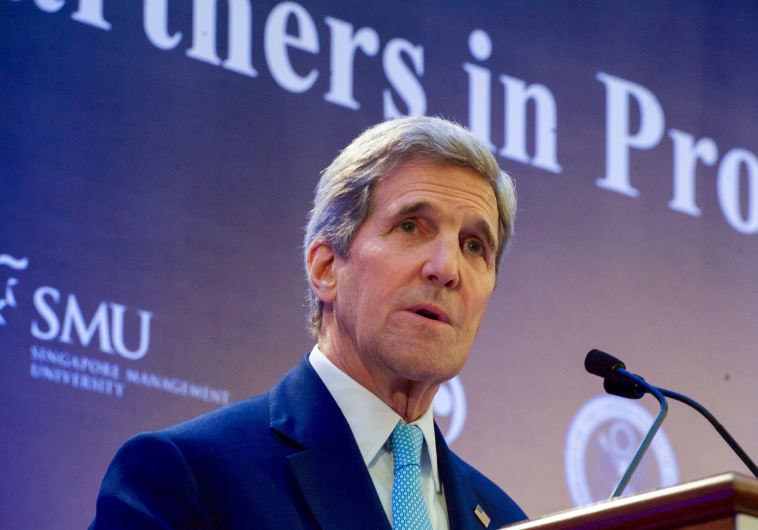
US Secretary of State John Kerry speaks in Singapore. (photo credit:STATE DEPARTMENT)

The secretary rejected Israel’s criticism of the nuclear agreement, saying that the deal “is as pro-Israel” as it gets.

******************

U.S. Secretary of State John Kerry told The Atlantic on Wednesday that if Congress were to shoot down the Iran nuclear agreement, it would be “the ultimate screwing” of Supreme Leader Ayatollah Ali Khamenei.

Kerry made the remarks in an interview with The Atlantic‘s Jeffrey Goldberg.

The secretary rejected Israel’s criticism of the nuclear agreement, saying that the deal “is as pro-Israel” as it gets.

Reneging on the nuclear agreement, which has the support of the major world powers, would constitute a setback for Washington and justify anti-American animus in Iran.

“The ayatollah constantly believed that we are untrustworthy, that you can’t negotiate with us, that we will screw them,” Kerry said. “[Having Congress vote down the nuclear pact] will be the ultimate screwing.”

“The United States Congress will prove the ayatollah’s suspicion, and there’s no way he’s ever coming back. He will not come back to negotiate. Out of dignity, out of a suspicion that you can’t trust America. America is not going to negotiate in good faith. It didn’t negotiate in good faith now, would be his point.”

Kerry also commented on the vociferous opposition to the deal expressed by Israel, which the secretary referred to as “visceral” and “emotional.” He was adamant that the agreement was positive for Israel’s geopolitical standing.

“I’ve gone through this backwards and forwards a hundred times and I’m telling you, this deal is as pro-Israel, as pro-Israel’s security, as it gets,” Kerry said. “And I believe that just saying no to this is, in fact, reckless.”

Kerry said that he was “sensitive” to Israeli concerns over Iran’s long-term aims, but he rejected arguments made by Jerusalem that the Islamic Republic was planning its annihilation.

“I haven’t seen anything that says to me [that Iran will implement its vow of wiping Israel off the map],” the secretary said. “They’ve got 80,000 rockets in Hezbollah pointed at Israel, and any number of choices could have been made. They didn’t make the bomb when they had enough material for 10 to 12. They’ve signed on to an agreement where they say they’ll never try and make one and we have a mechanism in place where we can prove that. So I don’t want to get locked into that debate. I think it’s a waste of time here.”

“I operate on the presumption that Iran is a fundamental danger, that they are engaged in negative activities throughout the region, that they’re destabilizing places, and that they consider Israel a fundamental enemy at this moment in time,” Kerry said. “Everything we have done here [with the nuclear agreement] is not to overlook anything or to diminish any of that; it is to build a bulwark, build an antidote.”

The secretary said that the nuclear deal is even more imperative if Israel’s fears that Iran is plotting its destruction are true, since the agreement neutralizes Tehran’s nuclear program.

Contentions | Has Obama Read the Khamenei Palestine Book?

August 4, 2015

Contentions | Has Obama Read the Khamenei Palestine Book? Commentary Magazine, August 4, 2015

(Another interesting question would be, does Obama agree with any of Khamenei’s statements and, if so, which? — DM)

The Khamenei Palestine book is important not in and of itself but because the regime’s obsession with Israel is a key to its foreign policy. . . . But as much as Iran is focused on regional hegemony in which Sunni states would be brought to heel, as Khamenei’s Palestine illustrates, it is the fixation on Israel and Zionism that really animates their expansionism and aid for terror groups.

******************

It turns out President Obama isn’t the only world leader who writes books. His counterpart in Iran – Supreme Leader Grand Ayatollah Ali Khamenei — has also just published a new book. But while it may not be as introspective as Obama’s Dreams From My Father, it does tell us at least as much about the vision of the person in charge in Tehran (as opposed to Hassan Rouhani, the faux moderate who serves as its president) as the president’s best-selling memoir. As Amir Taheri reports in the New York Post, Palestine is a 416-page diatribe against the existence of the state of Israel and a call to arms for it to be destroyed. Supporters of the nuclear deal the president has struck with Khamenei’s regime may dismiss this book as merely one more example of the Supreme Leader’s unfortunate ideology that must be overlooked. But as the New York Times noted last week, the administration’s real goal here isn’t so much in delaying Iran’s march to a nuclear weapon (which is the most that can be claimed for the agreement) as it is fostering détente with it. Seen in that light, the latest evidence of the malevolence of the Islamist regime should be regarded as yet another inarguable reason for Congress to vote the deal down.

In his interview with The Atlantic’s Jeffrey Goldberg on May 21, President Obama was asked directly about the significance of Iran’s anti-Semitism and its commitment to destroying Israel. The president said the anti-Semitism of the Iranian leadership did not mean they weren’t also “interested in survival” or being “rational.” As far as he was concerned, the ideology of the regime was not something that would influence its decisions.

But everything Khamenei says and, even more importantly, everything the regime does, by funding terrorist groups at war with Israel such as Hamas and Hezbollah or by embarking on a ruinously expensive nuclear project that placed it in conflict with the West, speaks to its commitment to policies that Obama may think are irrational but which are completely in synch with what he called its “organizing principle.” Why would a nation so rich in oil need to risk international isolation or war seek nuclear power if not to help Khamenei fulfill his pledge to “liberate” what is now Israel for Muslims?

The president told Goldberg that the American military option would be a sufficient deterrent to ensure that Iran didn’t violate the nuclear pact or behave in an irrational manner. But since the president has ruled out the use of force in a categorical manner, it’s hard to see why the Iranians would fear it once the U.S. and Europe are doing business with them. Even if it was a matter of snapping back sanctions, assuming that such a concept is even possible? Once the restrictions are unraveled, it’s fair to ask why would they work then when the president repeatedly tells us additional sanctions won’t work now and require us to accept the current deal that doesn’t achieve the objectives that the administration set for the negotiations when they began.

The Khamenei Palestine book is important not in and of itself but because the regime’s obsession with Israel is a key to its foreign policy. Iran constitutes a grave threat to Neighboring Arab countries that are at least as angry about the president’s embrace of Tehran as the Israelis since their nuclear status would undermine their security. But as much as Iran is focused on regional hegemony in which Sunni states would be brought to heel, as Khamenei’s Palestine illustrates, it is the fixation on Israel and Zionism that really animates their expansionism and aid for terror groups.

As Taheri notes in his article on the book, Khamenei distinguishes his idée fixe about destroying Israel from European anti-Semitism. Rather, he insists, that his policy derives from “well established Islamic principles.” Chief among them is the idea that any land that was once ruled by Muslims cannot be conceded to non-believers no matter who lives there now. While the Muslim world seems to understand that they’re not getting Spain back, the territory that constitutes the state of Israel is something else. Its central location in the middle of the Muslim and Arab worlds and the fact that Jews, a despised minority people, now rule it makes its existence particularly objectionable to Islamists like Khamenei.

Khamenei’s book shows that not only is he serious about wanting to destroy Israel and uproot its Jewish population, he regards this project as a practical rather than a theoretical idea. The administration ignores this because it wants to believe that Iran is a nation that wants to, as the president put it, “get right with the world.” But what it wants is to do business with the world while pursuing its ideological goals. The nuclear deal is a means to an end for the regime and that end does not involve good relations with the West or cooperation with other states in the region, let alone coexisting peacefully with Israel.

What is curious is that this is the same administration that regarded the announcement of a housing project in Jerusalem by low-level Israeli officials as an “insult” to Vice President Biden. But it chooses to regard the “death to America” chants led by regime functionaries in Iran as well as a book by the country’s leader indicating that Obama’s ideas about its character are fallacious as non-events. The only explanation for this remarkable lack of interest in Iranian behavior is an ideological fixation on détente with Tehran that is every bit as hardcore as any utterances that emanate from the mouth or the pen of the Supreme Leader.

Taken out of the context of a vision of friendship with the Iranian regime, the nuclear deal makes no sense. Yet squaring that vision with Khamenei’s literary effort is impossible. Members of the House and Senate must take note of this conundrum and vote accordingly.